EP2916331A1 - Unité électromagnétique et procédé de fabrication d'une unité électromagnétique - Google Patents
Unité électromagnétique et procédé de fabrication d'une unité électromagnétique Download PDFInfo
- Publication number
- EP2916331A1 EP2916331A1 EP14157607.4A EP14157607A EP2916331A1 EP 2916331 A1 EP2916331 A1 EP 2916331A1 EP 14157607 A EP14157607 A EP 14157607A EP 2916331 A1 EP2916331 A1 EP 2916331A1
- Authority
- EP
- European Patent Office
- Prior art keywords
- yoke
- armature
- leg
- electromagnetic unit
- recess
- Prior art date
- Legal status (The legal status is an assumption and is not a legal conclusion. Google has not performed a legal analysis and makes no representation as to the accuracy of the status listed.)
- Withdrawn
Links
Images


Classifications
-
- H—ELECTRICITY
- H01—ELECTRIC ELEMENTS
- H01F—MAGNETS; INDUCTANCES; TRANSFORMERS; SELECTION OF MATERIALS FOR THEIR MAGNETIC PROPERTIES
- H01F7/00—Magnets
- H01F7/06—Electromagnets; Actuators including electromagnets
- H01F7/08—Electromagnets; Actuators including electromagnets with armatures
- H01F7/14—Pivoting armatures
-
- H—ELECTRICITY
- H01—ELECTRIC ELEMENTS
- H01F—MAGNETS; INDUCTANCES; TRANSFORMERS; SELECTION OF MATERIALS FOR THEIR MAGNETIC PROPERTIES
- H01F3/00—Cores, Yokes, or armatures
- H01F3/02—Cores, Yokes, or armatures made from sheets
-
- H—ELECTRICITY
- H01—ELECTRIC ELEMENTS
- H01F—MAGNETS; INDUCTANCES; TRANSFORMERS; SELECTION OF MATERIALS FOR THEIR MAGNETIC PROPERTIES
- H01F7/00—Magnets
- H01F7/06—Electromagnets; Actuators including electromagnets
- H01F7/08—Electromagnets; Actuators including electromagnets with armatures
- H01F7/081—Magnetic constructions
-
- H—ELECTRICITY
- H01—ELECTRIC ELEMENTS
- H01F—MAGNETS; INDUCTANCES; TRANSFORMERS; SELECTION OF MATERIALS FOR THEIR MAGNETIC PROPERTIES
- H01F7/00—Magnets
- H01F7/06—Electromagnets; Actuators including electromagnets
- H01F7/08—Electromagnets; Actuators including electromagnets with armatures
- H01F7/121—Guiding or setting position of armatures, e.g. retaining armatures in their end position
- H01F7/122—Guiding or setting position of armatures, e.g. retaining armatures in their end position by permanent magnets
Definitions
- the invention relates to an electromagnetic unit comprising an armature and a, in particular U-shaped yoke having a first and a second yoke leg and a yoke bridge, wherein each of the two yoke legs in a longitudinal direction opposite ends, wherein the yoke legs at one of its ends are interconnected by the yoke bridge and the Joch Georgia opposite free ends of the yoke legs form the pole ends of the yoke, which cooperate with the pivotable armature, and wherein magnetic field generating switchable means are provided, which are adapted to a, in particular closed, magnetic flux in the To produce yoke and the armature, so that in dependence on the switching position of the magnetic field generating means, the armature is displaceable or displaced in a tightened or a released switching position.
- the invention relates to a method for producing an electromagnetic unit with a laminated yoke, wherein in the second pole end of a second yoke leg a recess is recessed, which at least partially receives an end portion of the armature in the tightened position of the armature.
- Electromagnetic units are used in various designs as drives or actuators, for example as lifting, pulling or switching solenoids, in electromagnetic valves, valve systems or in electromechanical units, e.g. in relays.
- To generate a magnetic flux in an armature and a yoke closing the magnetic circuit switchable magnetic field generating means for example, one or more magnetic coil windings are provided. The magnetic flux causes movement of the armature relative to the yoke, so that the electromagnetic unit is actuated depending on the switching position of the magnetic field generating means.
- Electromagnetic devices are often categorized by the motion of their armature and / or yoke shape.
- the armature In a lifting armature system, the armature typically moves toward both pole ends of the yoke during the shifting operation. From this principle, it is necessary to distinguish those electromagnetic units whose armature performs a pivotal movement, which is also referred to as hinged armature systems.
- the anchor is often stored in such units at one of the yoke legs of the yoke. In other words, the armature moves during the closing movement to only one of the two pole ends of the yoke.
- Folding anchor systems such as those used for relays, have a manufacturer-specified torque curve. With large angles of rotation of the armature such units often provide only low torques, so that high tightening currents are necessary. An adaptation of the torque curve to the respective requirements regularly requires an individual redesign of the electromagnetic unit, which is correspondingly expensive to implement.
- an electromagnetic unit comprising a pivotable armature and a, in particular U-shaped, yoke having a first and a second yoke leg and a yoke bridge, wherein each of the two yoke legs in a longitudinal direction opposite ends, wherein the yoke leg to one end of which is interconnected by the yoke bridge and the yoke legs opposite the yoke bridge form the pole ends of the yoke which cooperate with the pivotable armature, and wherein magnetic field generating switchable means are provided which are adapted to provide one, in particular closed, magnetic To generate flux in the yoke and the armature, so that in dependence on the switching position of the magnetic field generating means, the armature is displaceable or displaced into a switched or a released switching position, wherein the electromagnetic unit is formed thereby in that the armature is mounted on an armature shaft defining a pivot axis of the armature, wherein the armature shaft is arranged
- the electromagnetic unit is a hinged armature system.
- it comprises a one-piece, two-legged yoke and an armature which moves in a pivoting plane which has an angle of at least approximately 90 ° to a longitudinal direction of extension of the yoke legs.
- the armature moves in its closing and opening movement to a flat side of the yoke to and from this away.
- the direction of movement of the armature is rotated by 90 °.
- the electromagnetic unit according to the invention is particularly compact and flat.
- the electromagnetic unit is formed by the fact that the first and the second yoke limb have different lengths in their longitudinal direction, wherein, in particular a first length of the first yoke limb is less than a second length of the second yoke limb, and wherein, in particular the first length of the first Jochschenkels at least approximately by a width of the armature, measured in the longitudinal direction of extension of the yoke legs, is less than the second length of the second yoke leg.
- the length of the first or second yoke leg is measured between the ends of the yoke leg.
- the length between an end face at a free end, which is located at the pole end of the yoke, and an opposite end face of the end is measured, which is connected via the yoke bridge with the other yoke leg.
- the adaptation of the lengths of the yoke legs is in accordance with a measured also in the longitudinal direction of the yoke leg width of the armature.
- the armature is thus arranged so that it cooperates with an end face of a yoke leg of the yoke.
- This allows a particularly compact design of the electromagnetic unit with low design effort.
- the difference in length between the yoke legs does not exactly match the width of the anchor.
- a gap is added, so that, for example, a sliding plate or an air gap of corresponding thickness between the end face of the yoke and the armature is provided.
- the electromagnetic unit is developed in that the armature is pivotable in a pivot plane which is at least approximately parallel to a first end side of the first yoke leg, wherein the first pole end of the first yoke leg comprises the first end side, wherein, in particular the armature shaft, in particular centered, is embedded in the first end face of the first yoke leg.
- the centered arrangement of the armature shaft on the end face of the first yoke leg improves the compact design of the electromagnetic unit.
- the armature shaft is inserted off-center in the first end face of the yoke leg.
- the electromagnetic unit is formed by the fact that the yoke is laminated, wherein a stacking direction of the yoke forming, in particular U-shaped, yoke plates transversely to the Pivot axis of the armature is oriented, wherein, in particular, the stacking direction of the yoke plates is oriented at least approximately perpendicular to a defined by the longitudinal extension directions of the first and second yoke leg yoke.
- the yoke plates are preferably electrical sheets or transformer sheets.
- the sheets are stacked suitably stacked and then connected together, in particular welded together.
- the shape of the yoke in the yoke plane in particular the shape of the pole ends and the yoke width, are determined by the shape of the yoke plates.
- a width of the yoke which is measured perpendicular to the yoke plane, results from the height of the stack bundle and thus from the number of yoke plates used to make the yoke.
- the yoke plates are in particular punched components. The shape of the yoke is thus determined by the punching form.
- the electromagnetic unit is easy and flexible to produce.
- equally thick or differently thick yoke plates are used to make the yoke. This increases the possibilities of variation in the production of the electromagnetic unit.
- a recess is recessed in the second pole end of the second yoke leg, which at least partially accommodates an end portion of the armature in the tightened position of the armature, wherein the end portion of the armature comprises a free end of the armature opposite the armature shaft ,
- the torque generated in a switching operation of the electromagnetic unit over the rotation angle of the armature is characterized by the Contour of Ankerallepols, so determines the pole end of the second yoke leg.
- the shape of the recess determines the shape of the armature counter-pole, so that by changing the recess and the generated torque curve is variable.
- the size and shape of the recess are adjustable by the number and die-cut shape of the yoke plates used to make it.
- differently shaped yoke laminations can be provided which are flexibly selected and assembled to produce the desired yoke. Post-processing of the yoke, in particular of the pole end, using metal-cutting methods, is advantageously dispensed with.
- this is characterized by the fact that the recess is embedded in a second end face and in a flat side of the second yoke leg, so that the flat side of the second yoke leg, which, in particular parallel to one by the longitudinal extension directions of the first and second yoke leg defined yoke level is, in particular on the full depth of the second yoke leg, stepped back.
- a depth of the yoke leg is measured in or parallel to the yoke plane and also transversely, in particular perpendicular, to a longitudinal extension direction of the first and second yoke leg.
- the contour of the counter-pole of the armature in other words, therefore, the contour and / or the size of the recess is adjustable by the number and type of yoke plates used and the stack heights of the yoke plates.
- the final shape of the pole ends is determined only during the production of the yoke.
- a variety of different yoke shapes can be made by altering the stack heights and / or stacking order from an identical population of yoke laminations.
- the electromagnetic unit is formed further in that the recess is designed such that the flat side of the second yoke leg is recessed in several stages, the steps being different in height, in particular perpendicular to the yoke plane of different width and / or in the longitudinal extension direction of the second yoke leg are, in particular further the height and / or the width of a, in particular adjacent to the second pole end of the second yoke leg, step is dimensioned such that the end portion of the armature in a starting from this step perpendicular to the yoke extending partial volume of the recess in the attracted state is recorded, in particular is taken so completely that a first flat side of the armature is aligned with the flat side of the second yoke leg.
- the torque acting on the armature is adjustable based on the height and / or width of the steps of the recess.
- an overlapping area between the armature and the step viewed in the released state of the armature, affects the magnetic flux flowing between the armature and the armature opposite pole, and thus the tightening torque acting on the armature.
- the electromagnetic unit is preferably developed by that the yoke is laminated, wherein a stacking direction of the yoke forming, in particular U-shaped, yoke plates is oriented transversely to the pivot axis of the armature, and wherein the stacking direction of the yoke plates is oriented in particular at least approximately perpendicular to the yoke plane, wherein the yoke at least two Groups of different sizes, in particular U-shaped, yoke plates, wherein, in particular a second leg of the yoke plates of the first group and a second leg of the yoke plates of the second group, which form at least a portion of the second yoke leg of the yoke, in the longitudinal direction of the second yoke leg of the Jochs are of different lengths, and wherein, in particular a length difference between the legs of the yoke plates of the first and second group at least approximately corresponds to the height of the step and / or a dimension of the
- the contour of the recess in particular the height and the width of the at least two steps, can be adjusted by the stack heights of the yoke plates of the individual groups. Depending on how many yoke plates form the first or the second group, there is a width of the produced stage.
- a determination of the step height and step width advantageously takes place only during the production of the electromagnetic unit, so that different torque characteristics can be realized in a flexible manner.
- a complex new design is eliminated, even if a novel torque curve is required.
- further groups of yoke plates are provided, which serve to realize further stages in the recess of the second yoke leg.
- the second legs of this third, fourth, fifth, etc. group of yoke plates are different in length compared to the legs of the yoke plates of the other groups.
- This group-wise difference in length between the legs of the yoke plates defines a height of the further stage or stages.
- a width of the step is determined by the number of yoke plates used per group.
- the armature extending sliding plate in addition at least approximately parallel to the pivot plane of the armature extending sliding plate is provided which, in particular at least partially along a first end face of the first yoke leg, between the first end face and the anchor, further in particular starting from extends beyond the first end face of the first yoke leg to the second yoke leg, and further in particular along a wall portion of the recess provided in the second yoke leg.
- the sliding plate is preferably made of Teflon. It serves to guide the armature during the pivoting movement and prevents the armature, due to the electromagnetic forces acting on it, from being tilted relative to the armature shaft or from tilting with respect to the pivot axis.
- the sliding plate ensures that the movement of the armature with low friction occurs. Corresponding is a small effort to generate the magnetic flux and a correspondingly low starting current necessary.
- the anchor is laminated, wherein a stacking direction of the armature-forming laminations is oriented at least approximately parallel to the pivot axis of the armature.
- Both the laminations and the yoke plates are in particular punched components.
- As well as for the yoke plates can be used for the manufacture of the anchor plate electric sheet or transformer plate.
- the armature of the electromagnetic unit is further developed, in particular, in that an armature recess is embedded in an end portion of the armature opposite the armature shaft, in particular the armature recess facing away from the armature shaft end side of the armature and in an at least approximately parallel to the pivot axis of the armature oriented second flat side the anchor is step-stepped.
- the anchor recess and the recess of the second yoke leg cooperate.
- the recess of the yoke leg receives part of the armature and the armature recess receives part of the yoke leg.
- the electromagnetic unit is therefore particularly flat.
- a transition side of the armature recess which extends between the second flat side and a bottom of the armature recess oriented at least approximately parallel thereto, is inclined relative to a vertical standing on the second flat side or the bottom.
- the flat side is in particular inclined with respect to a plane which is oriented perpendicular to a longitudinal extension direction of the armature.
- the inclination is such that a line of intersection between this plane lying perpendicular to the direction of elongation of the armature and a plane defined by the flat side lies parallel to a compartment side of the armature into which the recess is embedded.
- At least one magnetic coil winding is provided as the magnetic field generating means for generating the magnetic flux, which serves in particular as an actuating coil of the electromagnetic unit, wherein in particular at least one of the two yoke legs is surrounded by a magnetic coil winding.
- the electromagnetic unit is further developed in that the armature is spring-loaded in a closing direction, wherein in particular a permanent magnet is provided which serves to generate a permanent magnetic flux in the yoke and the armature, so that in the pulled state, a holding force is exerted on the armature becomes.
- the armature should be understood as spring-loaded in the closing direction when a relief direction of the spring is directed in the opening direction of the armature.
- the permanent magnet is provided in particular on the yoke, which further is in particular in contact with both yoke legs.
- This embodiment of the electromagnetic unit is a bistable system.
- the magnetic flux caused by the permanent magnet generates a holding force on the armature when it is in the tightened state.
- the spring ensures that the armature remains in the open state when the magnetic field generating means are switched off.
- the spring counteracts the typically existing remanence in the system.
- the permanent magnet and the spring more precisely, the magnetic flux generated by the permanent magnet and the spring force of the spring are coordinated so that there is a bistable system.
- the method for producing the electromagnetic unit is very flexible, since using identical yoke plates differently shaped yokes can be produced.
- the same or similar advantages as already mentioned with respect to the electromagnetic unit apply in the same or similar manner to the method of manufacturing this unit, and for that reason shall not be repeated.
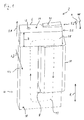
- Fig. 1 shows a schematic perspective view of an electromagnetic unit 2 comprising a yoke 4 and an armature 6.
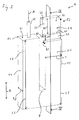
- the yoke 4 comprises a first yoke leg 44 and a second yoke leg 45 (see. Fig. 2 ).
- the yoke legs 44, 45 extend in a longitudinal direction R. They have in the longitudinal direction R to each other opposite ends. At each one of its ends, the yoke legs 44, 45 are connected to each other via a yoke 8.
- the yoke bridge 8 facing away from the free ends of the yoke legs 44, 45 form a first pole end 51 on the first yoke leg 44 and a second pole end 52 on the second yoke leg 45. For example, the first pole end 51 of the magnetic north pole and the second pole end 52 of the south magnetic pole of the yoke 4.
- the pole ends 51, 52 of the yoke 4 cooperate with the armature 6.
- magnetic field generating switchable means which are adapted to generate a, in particular closed, magnetic flux 11 in the yoke 4 and in the armature 6 ( Fig. 1 ).
- the magnetic field generating means is a magnetic coil winding 10.
- the electromagnetic unit 2 comprises only one magnetic coil winding 10.
- a plurality of magnet coil windings 10 are provided, in particular two magnet coil windings 10 which surround the first and second yoke legs 44, 45, respectively. and a different winding sense exhibit.
- the armature 6 due to the magnetic flux 11, is placed in an attracted or a released switching position.
- Fig. 1 is playfully the armature 6 shown in the released switching position.
- a return spring is provided (not shown)
- the discharge direction is directed in the opening direction OE.
- the armature 6 is thus spring-loaded in the closing direction S.
- the armature 6 is pivotally mounted on an armature shaft 12 on the first yoke leg 44.
- a longitudinal extension direction of the armature shaft 12 defines a pivot axis A of the armature 6 (FIG. Fig. 2 ).
- the pivot axis A is at least approximately parallel to the longitudinal extension direction R of at least the first yoke leg 44.
- the first yoke leg 44 and the second yoke leg 45 have an identical longitudinal extension direction R.
- the two yoke legs 44, 45 run parallel to one another.
- the longitudinal extension directions R of the two yoke legs 44, 45 define a yoke plane, in or parallel to which in particular a front side 18 of the yoke 4 (FIG. Fig. 1 ) or the flat sides 26 of the yoke legs 44, 45 extend ( Fig. 2 ).
- the first and the second yoke legs 44, 45 are of different lengths in the longitudinal extension direction R.
- L1 denotes the first length of the first Jochschenkels 44 and L2, the second length of the second yoke leg 45.
- the first length L1 of the first yoke leg 44 is less than the second length L2 of the second yoke leg 45.
- the respective length L1, L2 of the first and second yoke leg 44, 45 in the longitudinal direction R measured between the ends of the respective yoke legs 44, 45.
- a difference between the second length L2 of the second yoke leg 45 and the first length L1 of the first yoke leg 44 substantially corresponds to a width B (FIG. Fig. 1 ) of the armature 6.
- the difference between the two lengths L2 and L1 is slightly greater than the width B of the armature 6, so that a gap between a first end face 31 of the first yoke leg 44 and one of these facing bottom of the armature 6 is maintained Nevertheless, an upper side 14 of the armature 6 and a second end face 32 of the second yoke leg 45 (FIG. Fig. 1 ) are aligned with each other. In other words, therefore, the upper side 14 of the armature 6 and the second end face 32 of the second yoke leg 45 are at least approximately in a common plane.
- the gap between the first end face 31 of the first yoke leg 44 and the underside of the armature 6 opposite the upper side 14 of the armature 6 serves to receive a slide plate 16, which in FIG Fig. 1 is not shown and related to the 6 and 7 will be received.
- the armature 6 is pivotable in a pivot plane which is at least approximately perpendicular to the pivot axis A.
- the tipping plane is also in particular parallel to the first end face 31 of the first yoke leg 44.
- the first end face 31 forms the or at least part of the first pole end 51 of the first yoke leg 44.
- the armature shaft 12 is in particular centered in the first end face 31 of the first yoke leg 44 inserted. In particular, therefore, the pivot axis A is located in the geometric center of the first end face 31st
- the yoke 4 and the armature 6 are preferably executed laminated.
- the yoke 4 is made of a plurality of individual yoke plates. They are stacked during the production of the yoke 4 stacked, in particular aligned, stacked on top of each other, and then connected together. For this purpose, in particular welding methods are used, so that the yoke plates 4 forming yoke plates are welded together in the finished product.
- the armature 6 is made of a variety of laminations. For the manufacture of the armature 6, these are also stacked, in particular aligned, stacked one above the other, and then connected together. Again, a welding method is preferably used, so that the armature plates 6 forming the armature are welded together.
- Fig. 3 shows a schematic perspective view of a laminated armature 6, which comprises a plurality of laminations 61, 62, 63, etc. Only for reasons of clarity, only some of the anchor plates 61, 62, 63 are provided with reference numerals. The number of laminations 61, 62, 63 used to make the armature 6 determines the width B of the armature.
- Fig. 4 shows a simplified cross section through the yoke 4 along the in Fig. 2 level IV-IV.
- the laminated yoke 4 consists of a plurality of yoke laminations 41 a to 43 d, which are divided into several groups. According to the illustrated embodiment, the yoke 4 is made of three groups of yoke plates 41 a to 43 d.
- the yoke plates 41a to 41c form the first Group G1.
- the yoke plates 42a to 42c form the second group G2 and the yoke plates 43a to 43d form the third group G3.
- a stacking direction SA of the armature 6 and a stacking direction SJ of the yoke 4 are oriented at an angle of 90 ° to one another (cf. Fig. 1 ).
- the stacking direction SJ of the yoke plates 4 forming yoke plates 41 a to 43 d is oriented transversely to the pivot axis A of the armature 6.
- the stacking direction SJ is oriented at least approximately perpendicular to a yoke plane defined by the longitudinal extension directions R of the first and second yoke legs 44, 45. This yoke plane extends parallel to the in Fig. 1 shown front 18 of the yoke. 4
- the stacking direction SA of the armature 6 forming the armature plates 61, 62, 63 is oriented at least approximately parallel to the pivot axis A.
- the torque curve over the angle of rotation of the armature 6 is essentially dependent on the geometry of the second pole end 52 of the yoke 4 (FIG. Fig. 2 ) as well as the geometry of an end portion 22 of the armature 6. Also, the change in the parameters in the magnetic circuit upon actuation of the armature 6 is not negligible.
- the second pole end 52 of the second yoke leg 45 comprises a recess 24.
- the end section 22 of the armature 6 is at least partially received in the recess 24 of the second yoke leg 45 in the tightened position of the armature 6.
- the end portion 22 of the armature 6 comprises an armature shaft 12 opposite free end of the armature 6.
- the recess 24 in the second pole end 52 of the second yoke leg 45 is inserted into the second end face 32 and into the flat side 26 of the second yoke leg 45. As a result, the flat side 26 of the second yoke leg 45 is stepped back through the recess 24.
- the flat side 26 of the second yoke leg 45 is set back to form the recess 24 in several stages.
- a bottom of the recess 24 thus extends in two spaced-apart planes.
- a first level is defined by the first stage 30, a second level by the second stage 33.
- the two stages 30, 33 are in particular of different widths.
- the first stage 30 measures a first width B1
- the second stage 33 measures a second width B2.
- the widths B1, B2 of the steps 30, 32 are measured in a direction perpendicular to the yoke plane.
- the first and second stages 30, 33 are of different heights.
- the first height H1 of the first stage 30 differs from the second height H2 of the second stage 32.
- the heights H1, H2 of the first and second stages 30, 32 are measured parallel to the yoke plane, in particular in the longitudinal extension direction R of the second yoke leg 45.
- the stages 30, 33 of the height H1, H2 and / or the widths B1, B2 are different.
- the height H1, H2 and / or the width B1, B2 of the steps 30, 33 are at least approximately the same size.
- the second height H2 of the second step 33 which adjoins the second end face 32 of the second yoke leg 45, is particularly dimensioned so that it substantially corresponds to the width B of the armature 6.
- the dimensioning of the second stage 33 takes place in consideration of the fact that between a wall portion 34 of the recess 24, which is formed by the second stage 33, a gap between a bottom of the armature 6 and this wall portion 34 should be present.
- a separating plate or a separating film with low magnetic conductivity is provided as an alternative to an air gap. The same applies to the bottom 36 of the recess 24.
- the width B2 of the second stage 33 is in particular dimensioned so that the end portion 22 of the armature 6 is so completely absorbed in a starting from the second stage 33 perpendicular to the yoke extending partial volume of the recess 24, in the attracted state that a flat side 38 of the armature 6 with a flat side 26 of the second yoke leg 45 is aligned (see also Fig. 5 ).
- the yoke 4 is made of at least two, in the illustrated example, three groups G1, G2, G3 of different sizes, in particular U-shaped, yoke plates 41 a to 43 d. So it's done well. This shows the in Fig. 4 illustrated cross section along in Fig. 2 shown level IV-IV.
- a section through the second yoke leg 45 is shown, which is formed by the second legs of the yoke plates 41 a to 43 d.
- the second leg each have a different length.
- a length difference between the second legs of the individual yoke plates 41a to 43d of the three groups G1, G2, G3 defines the height H1, H2 of the first and second stages 30, 33, respectively.
- the width B1, B2 of the steps 30, 33 is defined by Number of Jochbleche 41a to 43d set in the respective group G1, G2, G3.
- the overlapping area 53 is in Fig. 5 which shows a schematic plan view of the electromagnetic unit 2.
- the size of the overlapping region 53 can be influenced by the width B2 of the second step 33.
- the armature 6 is in particular designed such that a depth TA of the armature 6 (see. Fig. 5 ) is at least slightly larger than one Width BJ of the yoke 4 (cf. Fig. 2 ). Furthermore, the armature 6 is in particular mounted on the yoke 4 such that its second flat side 56 is aligned with a rear side of the yoke 4, the first flat side 38 projects beyond the front side 18 of the yoke 4 opposite the rear side. In other words, the first flat side 38 of the armature 6 is at least slightly opposite the front side 18 of the yoke 4. As a result of the tapering caused by the anchor recess 50, the projection of the armature 6 on the side facing away from the armature recess 50 causes improved flow guidance in the tapered section.
- a sliding plate 16 in particular a Teflon plate, provided on the underside of the armature 6. This is in the schematic perspective view of Fig. 6 shown.
- the slide plate 16 extends in or parallel to a pivot plane of the armature 6. In particular, it is provided that the slide plate 16 extends at least in sections along a pole end 51 of the first yoke leg 44 comprehensive first end face 31 between this end face 31 and the armature 6. Furthermore, it is provided, in particular, that the slide plate 16, starting from the end face 31 of the first yoke leg 44, extends beyond the latter to the second yoke leg 45. This is in the schematic perspective view of Fig. 7 shown. The slide plate 16 further extends in particular along a wall portion 34 (see. Fig. 5 in which this slide plate 16 is not shown) extending in the recess 24 provided in the second yoke leg 45.
- the armature 6 has an anchor recess 50, which is inserted into the end face 54 facing away from the pivot axis A of the armature 6 at the end portion 22 of the armature 6 in this.
- An oriented at least approximately parallel to the pivot axis A of the armature 6 flat side 56 is thus stepped back.
- a transition side 58 (cf. Fig. 5 ) of the anchor recess 50, which extends between the flat side 56 and an at least approximately parallel thereto oriented bottom 46 of the anchor recess 50 is inclined relative to a standing on the flat side 56 and the bottom 46 perpendicular.
- This inclination is chosen in particular such that between a transition line between the transition side 58 and the flat side 56 and a connecting line between the bottom 46 and the transition side 58 in the longitudinal direction of the armature 6, an offset X between 1 mm and 5 mm, in particular between 2 mm and 3 mm, in particular of 2 mm is present.
- This offset X defines a distance between the transition side 58 and a side surface 66 of the second pole end 52 of the second yoke leg 45. This distance in turn serves to adjust the torque acting on the armature 6, in particular the tightening torque.
- the inclination of the transition side 58 is predetermined by the shape of the anchor plates 61, 62, 63. This shape can be adjusted in particular in a stamping process, so that post-processing of the armature 6 with the aid of machining methods can advantageously be dispensed with.
- the armature 6 in the closing direction S ( Fig. 1 ) spring loaded is the armature 6 in the closing direction S ( Fig. 1 ) spring loaded.
- a permanent magnet is provided, which serves to generate a permanent magnetic flux in the magnetic circuit 11, so that a holding force is exerted on the armature 6.
- the opening spring holds the armature 6 in the open state, while the permanent magnetic flux keeps the armature 6 in the closed state.
- a bistable system can be specified.
Landscapes
- Physics & Mathematics (AREA)
- Electromagnetism (AREA)
- Engineering & Computer Science (AREA)
- Power Engineering (AREA)
- Electromagnets (AREA)
Priority Applications (1)
| Application Number | Priority Date | Filing Date | Title |
|---|---|---|---|
| EP14157607.4A EP2916331A1 (fr) | 2014-03-04 | 2014-03-04 | Unité électromagnétique et procédé de fabrication d'une unité électromagnétique |
Applications Claiming Priority (1)
| Application Number | Priority Date | Filing Date | Title |
|---|---|---|---|
| EP14157607.4A EP2916331A1 (fr) | 2014-03-04 | 2014-03-04 | Unité électromagnétique et procédé de fabrication d'une unité électromagnétique |
Publications (1)
| Publication Number | Publication Date |
|---|---|
| EP2916331A1 true EP2916331A1 (fr) | 2015-09-09 |
Family
ID=50193335
Family Applications (1)
| Application Number | Title | Priority Date | Filing Date |
|---|---|---|---|
| EP14157607.4A Withdrawn EP2916331A1 (fr) | 2014-03-04 | 2014-03-04 | Unité électromagnétique et procédé de fabrication d'une unité électromagnétique |
Country Status (1)
| Country | Link |
|---|---|
| EP (1) | EP2916331A1 (fr) |
Citations (5)
| Publication number | Priority date | Publication date | Assignee | Title |
|---|---|---|---|---|
| US1167067A (en) * | 1913-12-12 | 1916-01-04 | Western Electric Co | Electromagnetic device. |
| US3523263A (en) * | 1968-01-12 | 1970-08-04 | Robertshaw Controls Co | Electromagnetic apparatus |
| US3609609A (en) * | 1968-03-05 | 1971-09-28 | Gen Electric Information Syste | High-speed electromagnet |
| DE2238292A1 (de) * | 1972-08-03 | 1974-02-21 | Standard Elektrik Lorenz Ag | Magnetsystem |
| US4346319A (en) * | 1980-04-15 | 1982-08-24 | Brother Kogyo Kabushiki Kaisha | Rotary electromagnetic actuator |
-
2014
- 2014-03-04 EP EP14157607.4A patent/EP2916331A1/fr not_active Withdrawn
Patent Citations (5)
| Publication number | Priority date | Publication date | Assignee | Title |
|---|---|---|---|---|
| US1167067A (en) * | 1913-12-12 | 1916-01-04 | Western Electric Co | Electromagnetic device. |
| US3523263A (en) * | 1968-01-12 | 1970-08-04 | Robertshaw Controls Co | Electromagnetic apparatus |
| US3609609A (en) * | 1968-03-05 | 1971-09-28 | Gen Electric Information Syste | High-speed electromagnet |
| DE2238292A1 (de) * | 1972-08-03 | 1974-02-21 | Standard Elektrik Lorenz Ag | Magnetsystem |
| US4346319A (en) * | 1980-04-15 | 1982-08-24 | Brother Kogyo Kabushiki Kaisha | Rotary electromagnetic actuator |
Similar Documents
| Publication | Publication Date | Title |
|---|---|---|
| DE10347452B4 (de) | Aktuator, Verfahren zur Herstellung des Aktuators und Leistungsschalter, der mit dem Aktuator ausgestattet ist | |
| DE2728629C2 (de) | Elektromagnetvorrichtung | |
| DE112011100570B4 (de) | Elektromagnet für Elektromagnetvenil | |
| DE102012003175B4 (de) | Magnetventil | |
| DE102009021935A1 (de) | Elektromagnetvorrichtung und elektromagnetisches Schaltschütz | |
| DE102015212818A1 (de) | Kontaktbrückenanordnung für ein elektrisches Schaltelement | |
| DE2816555A1 (de) | Magnetkreisanordnung fuer einen elektromagneten fuer einen mit einem permanentmagneten als anker | |
| DE69707369T2 (de) | Elektromagnetischer Schalter | |
| EP2336618A2 (fr) | Actionneur magnétique | |
| DE4201448A1 (de) | Tauchanker-magnetanordnung | |
| DE102007019684A1 (de) | Magnetsystem für eine elektrische Schaltvorrichtung | |
| EP0594870B1 (fr) | Moteur de commande | |
| DE3439989A1 (de) | Elektromechanischer wandler | |
| DE102008024940B3 (de) | Relais | |
| EP0251034B1 (fr) | Relais électromagnétique | |
| DE10014113C2 (de) | Solenoid-Ventilantriebsvorrichtung | |
| EP3747031A1 (fr) | Noyau magnétique façonné pour un actionneur électromagnétique et procédé de fabrication | |
| DE3209198A1 (de) | Elektromagnetisches relais | |
| DE245805C (fr) | ||
| EP0226907A2 (fr) | Relais | |
| EP3226263A1 (fr) | Aimant d'adhérence électromagnétique, procédé de son production, élement de verrouillage électromagnétique et son utilisation | |
| EP0021335B1 (fr) | Dispositif électromagnétique pour actionner un élément d'impression | |
| DE3018407A1 (de) | Elektromagnetisch betaetigbarer stoesselantrieb, insbesondere fuer anschlagdrucker | |
| DE10213487B4 (de) | Verfahren zur Bildung eines laminierten Kerns und einer Ventilantriebsvorrichtung von elektromagnetischer Art | |
| DE2930692C2 (de) | Elektromagnetische Stellvorrichtung |
Legal Events
| Date | Code | Title | Description |
|---|---|---|---|
| PUAI | Public reference made under article 153(3) epc to a published international application that has entered the european phase |
Free format text: ORIGINAL CODE: 0009012 |
|
| AK | Designated contracting states |
Kind code of ref document: A1 Designated state(s): AL AT BE BG CH CY CZ DE DK EE ES FI FR GB GR HR HU IE IS IT LI LT LU LV MC MK MT NL NO PL PT RO RS SE SI SK SM TR |
|
| AX | Request for extension of the european patent |
Extension state: BA ME |
|
| 17P | Request for examination filed |
Effective date: 20151125 |
|
| RBV | Designated contracting states (corrected) |
Designated state(s): AL AT BE BG CH CY CZ DE DK EE ES FI FR GB GR HR HU IE IS IT LI LT LU LV MC MK MT NL NO PL PT RO RS SE SI SK SM TR |
|
| STAA | Information on the status of an ep patent application or granted ep patent |
Free format text: STATUS: THE APPLICATION HAS BEEN WITHDRAWN |
|
| 18W | Application withdrawn |
Effective date: 20160212 |