EP2916919B1 - Verfahren und system zum vermeiden von bränden einer elektrischen vorrichtung - Google Patents
Verfahren und system zum vermeiden von bränden einer elektrischen vorrichtung Download PDFInfo
- Publication number
- EP2916919B1 EP2916919B1 EP13803279.2A EP13803279A EP2916919B1 EP 2916919 B1 EP2916919 B1 EP 2916919B1 EP 13803279 A EP13803279 A EP 13803279A EP 2916919 B1 EP2916919 B1 EP 2916919B1
- Authority
- EP
- European Patent Office
- Prior art keywords
- electrical device
- composition
- container
- gas generator
- fire
- Prior art date
- Legal status (The legal status is an assumption and is not a legal conclusion. Google has not performed a legal analysis and makes no representation as to the accuracy of the status listed.)
- Active
Links
Images

Classifications
-
- H—ELECTRICITY
- H05—ELECTRIC TECHNIQUES NOT OTHERWISE PROVIDED FOR
- H05K—PRINTED CIRCUITS; CASINGS OR CONSTRUCTIONAL DETAILS OF ELECTRIC APPARATUS; MANUFACTURE OF ASSEMBLAGES OF ELECTRICAL COMPONENTS
- H05K7/00—Constructional details common to different types of electric apparatus
- H05K7/14—Mounting supporting structure in casing or on frame or rack
- H05K7/1485—Servers; Data center rooms, e.g. 19-inch computer racks
- H05K7/1488—Cabinets therefor, e.g. chassis or racks or mechanical interfaces between blades and support structures
- H05K7/1495—Cabinets therefor, e.g. chassis or racks or mechanical interfaces between blades and support structures providing data protection in case of earthquakes, floods, storms, nuclear explosions, intrusions, fire
-
- A—HUMAN NECESSITIES
- A62—LIFE-SAVING; FIRE-FIGHTING
- A62C—FIRE-FIGHTING
- A62C2/00—Fire prevention or containment
- A62C2/04—Removing or cutting-off the supply of inflammable material
-
- A—HUMAN NECESSITIES
- A62—LIFE-SAVING; FIRE-FIGHTING
- A62C—FIRE-FIGHTING
- A62C3/00—Fire prevention, containment or extinguishing specially adapted for particular objects or places
- A62C3/16—Fire prevention, containment or extinguishing specially adapted for particular objects or places in electrical installations, e.g. cableways
-
- A—HUMAN NECESSITIES
- A62—LIFE-SAVING; FIRE-FIGHTING
- A62C—FIRE-FIGHTING
- A62C37/00—Control of fire-fighting equipment
- A62C37/36—Control of fire-fighting equipment an actuating signal being generated by a sensor separate from an outlet device
-
- A—HUMAN NECESSITIES
- A62—LIFE-SAVING; FIRE-FIGHTING
- A62C—FIRE-FIGHTING
- A62C5/00—Making of fire-extinguishing materials immediately before use
- A62C5/006—Extinguishants produced by combustion
-
- A—HUMAN NECESSITIES
- A62—LIFE-SAVING; FIRE-FIGHTING
- A62D—CHEMICAL MEANS FOR EXTINGUISHING FIRES OR FOR COMBATING OR PROTECTING AGAINST HARMFUL CHEMICAL AGENTS; CHEMICAL MATERIALS FOR USE IN BREATHING APPARATUS
- A62D1/00—Fire-extinguishing compositions; Use of chemical substances in extinguishing fires
- A62D1/06—Fire-extinguishing compositions; Use of chemical substances in extinguishing fires containing gas-producing, chemically-reactive components
Definitions
- the invention is directed to a method to avoid a fire in an electrical device which is connected to a source of electrical power.
- the invention is also directed to a system which avoids overheating of an electrical device, thereby avoiding or limiting fire.
- Data centres are parts of buildings or facilities in which a large number of computing and networking IT equipment, such as server computers, are mounted in racks that are arranged in the data centre.
- the dense packing of the server computers results in the generation of a large amount of heat in a localized area.
- air conditioning systems To cool and control humidity of the racks of the data centre, air conditioning systems, often specialized cooling units, have been developed for implementation directly in data centres.
- the specialized cooling units are sometimes known in the art as computer room air conditioning units (“CRACs”) or computer room air handling units.
- CRACs computer room air conditioning units
- One of the main challenges of cooling data centres is the air conditioning system.
- the system is often operated at or near maximum cooling and/or power while some racks and/or servers are still running too hot.
- Fire fighting systems for data centres are known and comprise of smoke and/or flame sensors mounted inside the room where the servers are located to detect a fire and a fire extinguishing system comprising of bottled gas.
- the sensors are mounted at a considerable distance from the servers themselves.
- a disadvantage of these known systems is that they are activated only after detecting a fire by the external sensor. This is disadvantageous because considerable damage may already have occurred. Another disadvantage is that all of the equipment in the data centre is exposed to the fire extinguishing gas, likely causing damage to equipment which initially was not damaged by the local fire. Another disadvantage is the long time period between detection of a fire and extinguishing said fire.
- the present invention aims to provide a system and method which avoids damage to an electrical device as a result of a fire.
- a system comprising (i) an electrical device connected to a source of electrical power; (ii) a container comprising a solid propellant gas generator, an igniter and a filter positioned between the solid propellant gas generator and an outflow opening for a gas, which outflow opening is fluidly connected to the electrical device; (iii) means to detect fire indicator levels, comprising means to detect a temperature, a carbon monoxide level and/or a smoke particle level in the electrical device; and (iv) a control system having a control logic which, when two of the three fire indicators levels as measured by means (iii) are above threshold values, will cut off the source of electrical power, and which will actuate the igniter after a predetermined delay time.
- the present invention also relates to a method to avoid a fire in an electrical device which is connected to a source of electrical power by (a) measuring a fire indicator level, comprising measuring temperature, a carbon monoxide level and/or a smoke particle level in the electrical device; (b) when two of the three fire indicator levels as measured in step (a) are above threshold values, the source of electrical power will be cut off from the electrical device; and (c) a flow of inert gas as generated by a solid propellant gas generator is supplied to the electrical device after a predetermined delay time.
- Another advantage is that the present system and method avoids the need for a complicated system as in US2010/0076607 .
- Another advantage is that the method and system provide a local solution for an individual electrical device, thereby avoiding that other devices in the vicinity are fully exposed to a fire extinguishing gas. It also enables one to suppress overheating or spread of fire of one piece of equipment as part of a group of electrical devices, for example the electrical devices in a data centre, while the remaining electrical devices can continue to perform.
- Other advantages of the invention will be discussed when describing the preferred embodiments here below.
- the delay time is between 1 and 10 seconds.
- the electrical devices which are part of the system may be any type of electrical device.
- the electrical device is a device which may catch fire when overheating occurs.
- Electrical devices may be devices which use and/or generate electricity.
- the electrical device is connected to a source of power. Examples of electrical devices are household equipment, like for examples washing machines, dryers, personal appliances, like for example personal computers and audio equipment, batteries, medical equipment, like for example radio-diagnostic equipment, vehicle, e.g. land, sea and air vehicle, electrical equipment, like for example on-board computers, batteries, fuel cells.
- the electrical device may be server computers, which typically comprise one or more of processors, micro-controllers, high speed video cards, memories, storage such as random access memory (RAM), network interfaces and controllers, semi-conductor devices, disk drives, small computer interface (SCSI) bus controllers, video controllers, power supplies and the like, and one or more subsystems.
- the server computers are operable to perform various applications, such as computing, switching, routing, displaying, and the like.
- the electrical device may also be so-called UPS and PDU units and memory storage equipment, like for example hard disks.
- Such electrical devices are preferably located in one space and positioned in so-called racks.
- the electrical device is suitably fitted in a server rack which itself can be fitted in a container.
- This container may conveniently have a shape suitable to accommodate the electrical device, and accommodate for other necessary components, such as e.g. cooling fans. Typically such containers have a rectangular, box like shape.
- the container typically also is in fluid connection to the environment, to allow for air flow over the components for cooling purposes, by means of one or more ventilation openings.
- the space i.e. a data centre, is preferably cooled by means of air.
- the data centre may also be composed of several modules, each module comprising one or more of the above described equipment.
- each module may be a shipping container as for example described in US7278273 .
- more than one electrical device is provided with the container comprising a solid propellant gas generator.
- the above described container comprising the electrical device is connected to the container comprising the solid propellant gas generator.
- only one container comprising the solid propellant gas generator is actuated to discharge the inert gas to the electrical device to which it is connected, while neighbouring systems are not actuated and continue to function normally.
- the electrical devices are fitted in a container and wherein containers are placed in a server rack it is possible to position the container comprising a solid propellant gas generator, an igniter and a filter at the back side or the front of the server rack. In may be advantageous to place the gas generator at the front side in order to avoid interference with the cabling typically present at the back side of such a server rack.
- the data centre is composed of several modules as described above and wherein one or more containers comprise a system according to the invention.
- the temperature, carbon monoxide level and smoke particle level as measured in one or more of the electrical devices as present in one such module may trigger the actuation of a flow of inert gas from the solid propellant gas generator to a single electrical device.
- a system comprising a, suitably larger, container comprising the solid propellant gas generator, an igniter and a filter may be present in a module which can generate enough inert gas to fill the entire space of a single module. Actuation of such a solid propellant gas generator may be used as a back-up to further avoid or limit fire in the electrical devices as present in the module.
- a preferred system is one wherein the electrical device is positioned in a container and wherein this container is connected to one container comprising a solid propellant gas generator and wherein more than one of such containers comprising the electrical devices are placed in a rack.
- the rack may be part of a server data centre.
- the individual electrical devices may be the earlier referred to processors, micro-controllers, high speed video cards, memories, storage such as random access memory (RAM), network interfaces and controllers, semi-conductor devices, disk drives, small computer interface (SCSI) bus controllers, video controllers, power supplies and the like, and one or more subsystems.
- the system comprises a data centre comprising a multitude of racks, wherein the racks comprises servers individually connected to a source of power, individually provided with the container comprising a solid propellant gas generator and individually provided with the means to detect fire indicator levels and individually provided with the control system which has a control logic to ignite the igniter of the container comprising a solid propellant gas generator of the individual server and cut off the source of electrical power of the individual server.
- the above system may also comprise one or more disk storage systems, one or more transformer units and/or one or more memory storage devices, individually provided with the container comprising a solid propellant gas generator and individually provided with the means to detect fire indicator levels and individually provided with the control system which has a control logic to ignite the igniter of the container comprising a solid propellant gas generator of these individual electrical devices and cut off the source of electrical power of the individual electrical device.
- Solid propellant gas generators are known. Preferred solid gas generators generate an inert gas, such as suitably carbon dioxide and nitrogen.
- a preferred solid propellant gas generator comprises a solid sodium azide containing composition.
- Such compositions which are able to generate a nitrogen gas are known and for example described in WO2009/078707 .
- This publication discloses a suitable composition to be used in the present invention because said composition can generate a cool, i.e. less than 90 °C, more suitably less than 40 °C, nitrogen gas of a high purity. Applicants have found that the temperature of the gas which is generated will depend on the temperature of the environment and is typically within 15 °C of said ambient temperature.
- the inert gas as generated will be suitably be between -2 and 10 °C above the temperature of the solid propellant gas generator itself.
- the minus 2 degrees Celsius above the cited temperature means 2 degrees Celsius below the cited temperature.
- the temperature of the solid gas propellant will be the temperature of the air surrounding the electrical device. It will be understood that this temperature will be higher when the solid propellant gas generator is positioned at the outflow opening of the optional cooling fans of an electrical device and lower when the solid propellant gas generator is positioned at for example the front side, sometimes referred to as the cool side, of a server rack.
- the temperature of the inert gas as generated will be within a range which will reduce or avoid a thermal shock when the inert gas is supplied to the electrical device.
- the container is spaced away from the electrical device such that the temperature of the nitrogen gas as generated will be somewhat lower than the temperature of the overheated electrical device. This is advantageous because some cooling will result when this gas is supplied to the interior of the electrical device.
- the composition comprising solid sodium azide containing is preferably a solid, porous material, suitable for generating nitrogen gas, said material having a porosity of 20 to 75 vol.%, and a composition comprising, based on the weight of the total composition of from 60 to 90 wt.% of sodium azide, and further comprises a coolant, a binder and a modifying agent.
- Porosity is defined as the percentage of the free volume relative to the volume of the solid porous material, wherein the free volume is the difference between the volume of the solids used to prepare the porous material and the porous material itself.
- the porosity is homogeneously distributed in the solid material, thereby enabling the generated gas to pass through the pores of the solid material.
- the solid sodium azide containing composition comprises of between 0.1 to 20 wt.% of the coolant.
- Preferred coolants are inorganic salts having a heat capacity of at least 1400 J/K/kg as determined at 600 K in order to provide sufficient cooling.
- the coolant has an important function as slag modifier. Because of its properties it helps keeping the slag, after the functioning of the gas generator, in place.
- the heat capacity of the coolant is at least 1900 J/K/kg.
- the coolant should be inert, which means that it does not decompose or react with the other components in the charge, at the reaction temperature of the gas generation. This means that hydroxides and carbonates cannot be used herein, as they are unsuitable.
- the coolant is preferably one or more compounds selected from LiF, Li 2 O, Li 2 C 2 , Li 3 N 3 , Li 2 SO 4 , Li 2 B 2 O 4 , Li 2 B 4 O 7 and Li 2 SiO 3 .
- Preferred are the lithium compounds in view of the superior combined properties in relation to slag modifier and coolant.
- the composition comprising solid sodium azide further comprises of from 0.1 to 20 wt.% of the modifying agent.
- Preferred modifying agents or burning modifier is selected from metal oxides and metal carbonates. Generally, these modifying agents do not have the high heat capacity of the cooling agent. Further, the modifying agent either reacts exothermically in the system, or has a catalytic function.
- modifying agent preferably ferric oxide (Fe 2 O 3 ) or sodium carbonate (Na 2 CO 3 ) are used.
- composition comprising solid sodium azide suitably comprises a binder, selected from the group consisting of at least one alkali metal silicate, preferably water glass, or a poly-tetrazole, in an amount of between 3 and 15 wt.% based on total weight of the composition.
- a binder selected from the group consisting of at least one alkali metal silicate, preferably water glass, or a poly-tetrazole, in an amount of between 3 and 15 wt.% based on total weight of the composition.
- the igniter may be any device which triggers the combustion of the solid propellant composition by any suitable means.
- the igniter may be of a classical pyrotechnic type, but it is also possible to use other (conventional) igniters.
- the igniter is positioned such that the composition can be ignited and nitrogen gas is generated.
- the gas generator is provided with a filter that filters out sodium and any other unwanted pollutant and solid or liquid material.
- filters comprise granular material, such as activated carbon, sand, zeolite, metal oxides, and combinations thereof, either in admixture with each other or consecutively.
- the gas generator delivers inert gases with an inert gas content of at least 85 vol.%, preferably at least 95 vol.%.
- the gas contains flammable or combustible gases in concentrations far below their lower flammability limit in air, and preferably the concentration of methane is lower than 0.2 vol.%, the concentration of hydrogen is lower than 1.0 vol.%, the concentration of carbon monoxide is lower than 0.02 vol.%, the concentration of ammonia in the discharged gases is preferably lower than 0.05 vol.%.
- the means to detect fire indicator levels comprising means to detect a temperature, a carbon monoxide level and a smoke particle level in the electrical device may be present in the device or just outside the device. Suitably these means are integrated in the container comprising the solid propellant gas as connected to the electrical device.
- the means to detect fire indicator levels comprising means to detect a temperature, a carbon monoxide level and a smoke particle level in the electrical device may be well known means to the skilled person.
- the threshold value for temperature may be between 50 and 125 °C.
- a possible threshold value for smoke particle level is 500000 smoke particles per cubic cm.
- the threshold value may be a fixed value or may be the increase of the detected level within a small time period. For example an increase of 5 ppm for the carbon monoxide level within a small period of time, for example one minute, may be indicative for the presence of a starting fire.
- the means to detect the temperature may be well known means like for example thermo couples or infra red sensors.
- the means to detect carbon monoxide may be chemical carbon monoxide sensors.
- the means to detect smoke particles may comprise an optical sensor or be an ionization smoke detector.
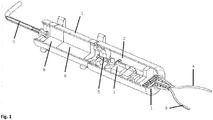
- Figure 1 shows a tubular container 1 provided with a space 2 for electronics 3.
- the electronics are connected to sensor 4 for detecting the temperature, carbon monoxide and/or smoke particle level, e.g. a thermo couple, a smoke detector and/or a carbon monoxide sensor, to detect the values for temperature, carbon monoxide and/or smoke particle level in the electronic device, and connected to igniter 5.
- the electronics 3 also comprise a logic controller as described above. Igniter 5 is in contact with a space containing the solid propellant gas generator 6. Between outflow opening 7 and the solid propellant gas generator 6 a filter material 8 is present.
- the wall of the tubular container 1 may be made from stainless steel.
- a power connector 9 which provides power for electronics 3.
- tubular container 1 is fitted on the back side of a server 10.
- the outflow opening for nitrogen gas is fluidly connected to the interior of the server 10 by means of a conduit 11.
- nitrogen gas can flow into the server in case of overheating or starting fire.
- the power supply for tubular container 1 is provided by connecting power connector 9 to a power supply of the server 10.
- Sensors 4 to detect the temperature, carbon monoxide level or smoke particle level within the server may be positioned at the cooling air outlet 12 of server 10.
- the invention is also directed to a method to avoid a fire in an electrical device which is connected to a source of electrical power by (a) measuring a fire indicator level, comprising measuring temperature, a carbon monoxide level and a smoke particle level in the electrical device; (b) when two of the three fire indicator levels as measured in step (a) is above a threshold value the source of electrical power will be cut off from the electrical device; and (c) a flow of inert gas as generated by a solid propellant gas generator is supplied to the electrical device after a predetermined delay time.
- the threshold value for temperature, carbon monoxide and smoke particle at which the step (c) is performed will be dependant on when the electrical device is actually damaged by overheating and when the first components of the electrical device start to smoulder or even catch fire.
- These threshold values can be well known values in the art for actuating fire alarms which are based on temperature, smoke and carbon monoxide measurements.
- the solid propellant gas generator is preferably as described above.
- a natrium azide based propellant it is found that the temperature of the nitrogen gas as generated will be close to the ambient temperature at which the solid propellant gas generator is operated. In a typical situation the temperature of the nitrogen gas may be below 60 °C.
- the temperature of the solid propellant gas as supplied to the electrical device will be near to the ambient temperature surrounding the device. This will avoid a temperature shock and thus any damage resulting from a temperature shock.
- a threshold values of the sensors may be chosen closer to the working temperature, carbon monoxide and smoke particle levels of the electrical device making the system more robust and lower significantly the risk of fire.
- the preferred nitrogen containing gas is preferably prepared in step (c) in-situ from a solid sodium azide containing composition as described above.
- the nitrogen containing gas is generated in a container containing the solid sodium azide containing composition as described above. Once two of the three of the temperature, carbon monoxide level or smoke particle level have reached the threshold value the igniter of said container is actuated and a nitrogen containing gas is generated which can be supplied to the electrical device.
- the method is performed in the system described above.
- a container was filed with a composition as described in WO2009/078707 having a porosity of 50 vol% and containing 79 wt% NaN 3 , 7 wt% K-silicate, 3 wt% Fe 2 O 3 and 11 wt% LiF.
- the container was ignited at different temperatures of the gas propellant gas generator itself.
- the temperature of the nitrogen gas as discharged was measured. From the results presented in the below Table it follows that the temperature of the gas is close to the temperature of the solid sodium azide. Temperature solid sodium azide (°C) before ignition Temperature of the nitrogen gas (°C) -3 -3 19 19 37 42
Landscapes
- Emergency Management (AREA)
- Business, Economics & Management (AREA)
- Health & Medical Sciences (AREA)
- Public Health (AREA)
- Engineering & Computer Science (AREA)
- Computer Hardware Design (AREA)
- Microelectronics & Electronic Packaging (AREA)
- General Engineering & Computer Science (AREA)
- Chemical & Material Sciences (AREA)
- Chemical Kinetics & Catalysis (AREA)
- General Chemical & Material Sciences (AREA)
- Fire-Extinguishing By Fire Departments, And Fire-Extinguishing Equipment And Control Thereof (AREA)
- Control Of Combustion (AREA)
- Fire-Extinguishing Compositions (AREA)
Claims (15)
- System, umfassend (i) eine elektrische Vorrichtung, welche mit einer elektrischen Stromquelle (9) verbunden ist; (ii) einen Behälter (1) mit einem festen Treibgasgenerator (6), einem Zünder (5) und einem zwischen dem festen Treibgasgenerator (6) und einer Ausströmöffnung (11) für ein Gas angeordneten Filter (8), wobei die Ausströmöffnung in Fluidverbindung mit dem elektrischen Gerät verbunden ist; (iii) eine Einrichtung (4) zum Erfassen von Brandanzeigeniveaus, umfassend Mittel zum Erfassen einer Temperatur, eines Kohlenmonoxidpegels und / oder eines Rauchpartikelniveaus in der elektrischen Vorrichtung; und (iv) ein Steuersystem mit einer Steuerlogik, die, wenn zwei der drei durch die Einrichtung (iii) gemessenen Brandanzeigeniveaus oberhalb von Schwellenwerten liegen, die Stromquelle (9) abschaltet und die den Zünder (5) nach einer vorbestimmten Verzögerungszeit betätigt, wobei vorzugsweise die vorbestimmte Verzögerungszeit zwischen 1 und 10 Sekunden beträgt.
- System gemäß Anspruch 1, wobei die elektrische Vorrichtung in einem Behälter angeordnet ist, und wobei der Behälter mit dem Behälter (1) verbunden ist, welcher den Feststofftreibgasgenerator (6) enthält, wobei der Behälter in einem Rack mit einer Vielzahl von Behältern angebracht werden kann.
- System gemäß eines der Ansprüche 1-2, wobei die elektrische Vorrichtung ein Server (10) oder ein Plattenspeichersystem ist, und vorzugsweise, wobei das System ein Rechenzentrum mit einer Vielzahl von Racks umfasst, wobei die Racks Server (10) enthalten, die jeweils individuell mit einer Energiequelle (9), mit dem einen Feststofftreibgasgenerator enthaltenden Behälter (1), mit der Einrichtung (4) zum Erfassen von Brandanzeigeniveaus versehen, und mit der Steuereinrichtung verbunden sind, welche eine Steuerlogik umfasst um den Zünder (5) des einen Feststofftreibgasgenerator des jeweiligen einzelnen Servers enthaltenden Behälter (1) zu zünden, und um die elektrische Stromquelle (9) des jeweils einzelnen Server abzuschneiden.
- System gemäß Anspruch 3, wobei das Datenzentrum auch ein oder mehrere Plattenspeichersysteme, eine oder mehrere Transformatoreinheiten und/oder ein oder mehrere Festspeichergeräte umfasst, welche individuell mit dem einen Feststofftreibgasgenerator (6) enthaltenden Behälter (1), und individuell mit der Einrichtung (4) zum Erfassen von Brandanzeigeniveaus, und individuell mit dem Steuersystem versehen sind, welches eine Steuerlogik umfasst, um den Zünder (5) des einen Feststofftreibgasgenerator enthaltenden Behälters (1) dieser jeweiligen einzelnen elektrischen Apparate zu zünden, und um die elektrische Stromquelle (9) der jeweiligen elektrischen Apparate abzuschneiden.
- System gemäß eines der Ansprüche 1-4, wobei der Feststofftreibgasgenerator (6) eine Zusammensetzung enthält, die Natriumazid enthält.
- System gemäß Anspruch 5, wobei die Natriumazid enthaltende Zusammensetzung ein festes, poröses Material mit einer Porosität von 20 bis 75 Volumen% ist, und eine Zusammensetzung aufweist, welche, bezogen auf das Gewicht der Gesamtzusammensetzung, von 60 bis 90 Gewichts% an Natriumazid, und des weiteren ein Kühlmittel , ein Bindemittel und ein Modifizierungsmittel umfasst, vorzugsweise wobei die die Natriumazid enthaltende Zusammensetzung des weiteren zwischen 0.1 und 20 Gewichts% des Modifizierungsmittels ausgewählt aus Metalloxiden und Metallcarbonaten umfasst, und zwischen 3 und 15 Gewichts% eines Bindemittels ausgewählt aus einem Alkalimetallsilikat oder einem Poly-Tetrazol, bezogen auf das Gesamtgewicht der Zusammensetzung, umfasst.
- System gemäß Anspruch 6, wobei die Natriumazid enthaltende Zusammensetzung von 0.1 bis 20 Gewichts% des Kühlmittels enthält, wobei das Kühlmittel ein anorganisches Salz mit einer Wärmekapazität von mindestens 1400 J/K/kg ist.
- System gemäß eines der Ansprüche 1-7, wobei der Behälter (1) eine Logiksteuerung umfasst, die eingestellt ist, um den Zünder (5) zu betätigen, sobald die Einrichtung (4) zur Temperaturbestimmung der elektrischen Vorrichtung einen vorgewählten Schwellenwert erreicht.
- System gemäß eines der Ansprüche 1-8, wobei die elektrische Vorrichtung an eine elektrische Stromquelle (9) angeschlossen ist, und wobei das Steuersystem eine Steuerlogik hat welche, wenn eine Temperatur durch Einrichtung (4) (iii) oberhalb eines Schwellenwertes gemessen wird, die elektrische Stromquelle (9) abschneidet und den Zünder betätigt (5).
- Verfahren zur Vermeidung eines Feuers in einem elektrischen Gerät, welches mit einer elektrischen Stromquelle (9) verbunden ist, umfassend (a) Messen eines Brandanzeigeniveaus, umfassend eine Temperaturmessung, eine Kohlenmonoxidpegel und / oder ein Rauchpartikelpegel in dem elektrischen Gerät; (b) Abschneiden der Stromquelle (9) von der elektrischen Vorrichtung (3), wenn zwei der drei Brandanzeigeniveaus, die in Schritt (a) gemessenen sind, oberhalb der Schwellenwerte liegen; und (c) Bereitstellen eines Inertgasstromes an die elektrische Vorrichtung, der durch einen Feststofftreibgasgenerator (6) nach einer vorbestimmten Verzögerungszeit erzeugt wird, wobei vorzugsweise die vorbestimmte Verzögerungszeit zwischen 1 und 10 Sekunden liegt.
- Verfahren gemäß Anspruch 10, wobei das Inertgas eine Temperatur zwischen 2 und 10 °C oberhalb der Temperatur des Feststofftreibgasgenerators (6) hat.
- Verfahren gemäß eines der Ansprüche 10-11, bei dem das Inertgas Stickstoffgas ist, das in-situ aus einer festes Natriumazid enthaltenden Zusammensetzung hergestellt wird, wobei vorzugsweise die Natriumazid enthaltende Zusammensetzung ein festes, poröses Material mit einer Porosität von 20 bis 75 Volumen% ist, und eine Zusammensetzung aufweist, welche, bezogen auf das Gewicht der Gesamtzusammensetzung, von 60 bis 90 Gewichts% an Natriumazid, und des weiteren ein Kühlmittel, ein Bindemittel und ein Modifizierungsmittel umfasst.
- Verfahren gemäß Anspruch 12, wobei die Natriumazid enthaltende Zusammensetzung von 0,1 bis 20 Gewichts.% des Kühlmittels enthält, wobei das Kühlmittel ein anorganisches Salz mit einer Wärmekapazität von mindestens 1400 J/K/kg ist.
- Verfahren gemäß eines der Ansprüche 12-13, wobei die die Natriumazid enthaltende Zusammensetzung des weiteren zwischen 0.1 und 20 Gewichts% des Modifizierungsmittels ausgewählt aus Metalloxiden und Metallcarbonaten umfasst, und zwischen 3 und 15 Gewichts% eines Bindemittels ausgewählt aus einem Alkalimetallsilikat oder einem Poly-Tetrazol, bezogen auf das Gesamtgewicht der Zusammensetzung, umfasst.
- Verfahren gemäß eines der Ansprüche 10-14,wenn durchgeführt in einem System gemäß der Ansprüche 1-9.
Applications Claiming Priority (2)
| Application Number | Priority Date | Filing Date | Title |
|---|---|---|---|
| NL2009789 | 2012-11-12 | ||
| PCT/NL2013/050808 WO2014073970A2 (en) | 2012-11-12 | 2013-11-12 | Method and system to avoid fire of an electrical device |
Publications (2)
| Publication Number | Publication Date |
|---|---|
| EP2916919A2 EP2916919A2 (de) | 2015-09-16 |
| EP2916919B1 true EP2916919B1 (de) | 2017-03-08 |
Family
ID=49759497
Family Applications (1)
| Application Number | Title | Priority Date | Filing Date |
|---|---|---|---|
| EP13803279.2A Active EP2916919B1 (de) | 2012-11-12 | 2013-11-12 | Verfahren und system zum vermeiden von bränden einer elektrischen vorrichtung |
Country Status (4)
| Country | Link |
|---|---|
| US (1) | US20160278233A1 (de) |
| EP (1) | EP2916919B1 (de) |
| CN (1) | CN104902966B (de) |
| WO (1) | WO2014073970A2 (de) |
Families Citing this family (10)
| Publication number | Priority date | Publication date | Assignee | Title |
|---|---|---|---|---|
| US9601915B2 (en) * | 2013-10-29 | 2017-03-21 | Luis Santana | Electronic safety shutoff with dual redundancy |
| CN105160794B (zh) * | 2015-10-14 | 2019-02-12 | 国家电网公司 | 低压配电柜火灾报警防护装置及温度检测方法 |
| US20170372578A1 (en) * | 2016-06-28 | 2017-12-28 | AKCess Pro Limited | Apparatus for Power Distribution, Environment Monitoring and Fire Protection for Rack-Mounted Equipment |
| WO2018089477A1 (en) | 2016-11-11 | 2018-05-17 | Carrier Corporation | High sensitivity fiber optic based detection |
| US10265561B2 (en) * | 2017-02-16 | 2019-04-23 | The Boeing Company | Atmospheric air monitoring for aircraft fire suppression |
| CN107185127A (zh) * | 2017-06-21 | 2017-09-22 | 巴斯夫上海涂料有限公司 | 活性炭脱附及催化氧化中热点检测和联锁处置方法及装置 |
| US11247082B2 (en) * | 2018-05-04 | 2022-02-15 | ArchAngel Fire Systems Holdings, LLC | System, method, and apparatus for the suppression of fire growth |
| AU2020397698A1 (en) * | 2019-12-05 | 2022-05-26 | Tyco Fire Products Lp | Fire suppression system for a battery enclosure |
| NL2027858B1 (en) | 2021-03-29 | 2022-10-12 | Exxfire Bv | A nitrogen gas generator |
| KR20230081833A (ko) * | 2021-11-30 | 2023-06-08 | 현대자동차주식회사 | 차량의 배터리 화재 진압 장치 |
Family Cites Families (20)
| Publication number | Priority date | Publication date | Assignee | Title |
|---|---|---|---|---|
| JPS5234339A (en) * | 1975-09-12 | 1977-03-16 | Ebara Densan:Kk | Fire protection device for switchboard |
| US5936531A (en) * | 1998-03-06 | 1999-08-10 | Powers; Frank A. | Electrical fire sensing and prevention/extinguishing system |
| JP4672110B2 (ja) * | 2000-06-08 | 2011-04-20 | 株式会社コーアツ | 消火設備 |
| DE10130607A1 (de) * | 2001-06-26 | 2003-01-09 | Bsh Bosch Siemens Hausgeraete | Brandschutz- und Brandlöscheinrichtung für wasserführende Haushaltgeräte |
| US6851483B2 (en) * | 2001-09-21 | 2005-02-08 | Universal Propulsion Company, Inc. | Fire suppression system and solid propellant aerosol generator for use therein |
| AU2003271481A1 (en) * | 2002-09-28 | 2004-04-19 | N2 Towers Inc. | System and method for suppressing fires |
| US7278273B1 (en) * | 2003-12-30 | 2007-10-09 | Google Inc. | Modular data center |
| NL1026216C2 (nl) * | 2004-05-18 | 2005-11-21 | Fernandus Cornelis Koelewijn | Inrichting en werkwijze voor het tegen brand beveiligen van een object. |
| DE102004029655A1 (de) * | 2004-06-18 | 2006-01-26 | Siepelmeyer, Ludger, Dr.Ing. | Vorrichtung und Verfahren zum Brandschutz elektronischer Geräte |
| US7775292B1 (en) * | 2004-07-26 | 2010-08-17 | Romanco Ernest K | CO2 fire suppression monitoring apparatus and method |
| DE202004020773U1 (de) * | 2004-10-04 | 2006-01-12 | WAGNER Alarm- und Sicherungssysteme München GmbH | Schaltschrank |
| JP2006334064A (ja) * | 2005-06-01 | 2006-12-14 | Nec Tokin Corp | 自動消火デバイス |
| US20060289175A1 (en) * | 2005-06-22 | 2006-12-28 | Gutowski Gerald J | Portable wireless system and method for detection and automatic suppression of fires |
| DE102005052777A1 (de) * | 2005-11-04 | 2007-05-24 | Amrona Ag | Vorrichtung zur Branderkennung in Schaltschränken |
| US7521817B2 (en) * | 2006-05-03 | 2009-04-21 | Donald Gors | System and method for reducing the chance of fires and/or explosions |
| US20080135266A1 (en) * | 2006-12-11 | 2008-06-12 | Richardson Adam T | Sodium azide based suppression of fires |
| EP2070870A1 (de) * | 2007-12-14 | 2009-06-17 | Nederlandse Organisatie voor toegepast- natuurwetenschappelijk onderzoek TNO | Formulierung zur Erzeugung eines Stickstoffgases |
| JP5234339B2 (ja) * | 2008-08-13 | 2013-07-10 | クラリオン株式会社 | 計算機システム及び経路案内方法 |
| US8485271B2 (en) * | 2010-05-11 | 2013-07-16 | International Business Machines Corporation | In-computer fire suppression |
| JPWO2011161792A1 (ja) * | 2010-06-24 | 2013-08-19 | ホーチキ株式会社 | 防災装置 |
-
2013
- 2013-11-12 WO PCT/NL2013/050808 patent/WO2014073970A2/en not_active Ceased
- 2013-11-12 EP EP13803279.2A patent/EP2916919B1/de active Active
- 2013-11-12 CN CN201380070210.1A patent/CN104902966B/zh active Active
- 2013-11-12 US US14/442,273 patent/US20160278233A1/en not_active Abandoned
Non-Patent Citations (1)
| Title |
|---|
| None * |
Also Published As
| Publication number | Publication date |
|---|---|
| WO2014073970A2 (en) | 2014-05-15 |
| CN104902966A (zh) | 2015-09-09 |
| US20160278233A1 (en) | 2016-09-22 |
| WO2014073970A3 (en) | 2014-11-27 |
| CN104902966B (zh) | 2018-06-29 |
| EP2916919A2 (de) | 2015-09-16 |
Similar Documents
| Publication | Publication Date | Title |
|---|---|---|
| EP2916919B1 (de) | Verfahren und system zum vermeiden von bränden einer elektrischen vorrichtung | |
| US20140196917A1 (en) | Method and system to avoid fire of an electrical device | |
| JP6103887B2 (ja) | 電力貯蔵システム | |
| JP6961671B2 (ja) | 二次電池の火災防止システム | |
| ES2357003T3 (es) | Dispositivo para la detección de incendios en armarios de distribución. | |
| US9010449B2 (en) | Methods and apparatus for hot aisle/cold aisle data center fire suppression | |
| WO2005110548A9 (en) | Device and method for protecting an object against fire | |
| CN113827893A (zh) | 电池舱灭火装置及方法 | |
| JP5208856B2 (ja) | 消火システム | |
| CN117599373A (zh) | 一种用于一体柜的多级智能消防系统及方法 | |
| CN213220679U (zh) | 灭火系统 | |
| CN202797618U (zh) | 一种具有自动灭火功能的电控柜 | |
| US20150165253A1 (en) | Laser material processing systems configured to suppress self-sustained combustion, and associated apparatuses and methods | |
| US20230277884A1 (en) | Systems and methods for early controlled sprinkler activation | |
| CN215741507U (zh) | 换电站的消防系统 | |
| CN210698571U (zh) | 一种气溶胶灭火装置 | |
| KR20250161281A (ko) | 화재 소화 기능을 구비한 배터리팩 보관 시스템 | |
| JPH0866487A (ja) | 閉囲空間の消火設備 | |
| KR20250161292A (ko) | 화재 소화 기능을 구비한 배터리팩 보관 시스템 | |
| RU76233U1 (ru) | Устройство - флегматизатор | |
| CN113181577A (zh) | 基于热熔灭火装置在电网设备的应用方法 | |
| WO2024261625A1 (en) | Container for battery-powered devices for boats | |
| TW202513116A (zh) | 鋰離子電池滅火組成物及使用方法 |
Legal Events
| Date | Code | Title | Description |
|---|---|---|---|
| PUAI | Public reference made under article 153(3) epc to a published international application that has entered the european phase |
Free format text: ORIGINAL CODE: 0009012 |
|
| 17P | Request for examination filed |
Effective date: 20150611 |
|
| AK | Designated contracting states |
Kind code of ref document: A2 Designated state(s): AL AT BE BG CH CY CZ DE DK EE ES FI FR GB GR HR HU IE IS IT LI LT LU LV MC MK MT NL NO PL PT RO RS SE SI SK SM TR |
|
| AX | Request for extension of the european patent |
Extension state: BA ME |
|
| DAX | Request for extension of the european patent (deleted) | ||
| GRAP | Despatch of communication of intention to grant a patent |
Free format text: ORIGINAL CODE: EPIDOSNIGR1 |
|
| INTG | Intention to grant announced |
Effective date: 20160701 |
|
| GRAJ | Information related to disapproval of communication of intention to grant by the applicant or resumption of examination proceedings by the epo deleted |
Free format text: ORIGINAL CODE: EPIDOSDIGR1 |
|
| GRAP | Despatch of communication of intention to grant a patent |
Free format text: ORIGINAL CODE: EPIDOSNIGR1 |
|
| INTC | Intention to grant announced (deleted) | ||
| INTG | Intention to grant announced |
Effective date: 20161006 |
|
| STAA | Information on the status of an ep patent application or granted ep patent |
Free format text: STATUS: GRANT OF PATENT IS INTENDED |
|
| GRAS | Grant fee paid |
Free format text: ORIGINAL CODE: EPIDOSNIGR3 |
|
| GRAA | (expected) grant |
Free format text: ORIGINAL CODE: 0009210 |
|
| STAA | Information on the status of an ep patent application or granted ep patent |
Free format text: STATUS: THE PATENT HAS BEEN GRANTED |
|
| AK | Designated contracting states |
Kind code of ref document: B1 Designated state(s): AL AT BE BG CH CY CZ DE DK EE ES FI FR GB GR HR HU IE IS IT LI LT LU LV MC MK MT NL NO PL PT RO RS SE SI SK SM TR |
|
| REG | Reference to a national code |
Ref country code: GB Ref legal event code: FG4D |
|
| REG | Reference to a national code |
Ref country code: CH Ref legal event code: EP Ref country code: AT Ref legal event code: REF Ref document number: 873005 Country of ref document: AT Kind code of ref document: T Effective date: 20170315 |
|
| REG | Reference to a national code |
Ref country code: IE Ref legal event code: FG4D |
|
| REG | Reference to a national code |
Ref country code: DE Ref legal event code: R096 Ref document number: 602013018372 Country of ref document: DE |
|
| REG | Reference to a national code |
Ref country code: NL Ref legal event code: FP |
|
| REG | Reference to a national code |
Ref country code: LT Ref legal event code: MG4D |
|
| PG25 | Lapsed in a contracting state [announced via postgrant information from national office to epo] |
Ref country code: LT Free format text: LAPSE BECAUSE OF FAILURE TO SUBMIT A TRANSLATION OF THE DESCRIPTION OR TO PAY THE FEE WITHIN THE PRESCRIBED TIME-LIMIT Effective date: 20170308 Ref country code: GR Free format text: LAPSE BECAUSE OF FAILURE TO SUBMIT A TRANSLATION OF THE DESCRIPTION OR TO PAY THE FEE WITHIN THE PRESCRIBED TIME-LIMIT Effective date: 20170609 Ref country code: NO Free format text: LAPSE BECAUSE OF FAILURE TO SUBMIT A TRANSLATION OF THE DESCRIPTION OR TO PAY THE FEE WITHIN THE PRESCRIBED TIME-LIMIT Effective date: 20170608 Ref country code: HR Free format text: LAPSE BECAUSE OF FAILURE TO SUBMIT A TRANSLATION OF THE DESCRIPTION OR TO PAY THE FEE WITHIN THE PRESCRIBED TIME-LIMIT Effective date: 20170308 Ref country code: FI Free format text: LAPSE BECAUSE OF FAILURE TO SUBMIT A TRANSLATION OF THE DESCRIPTION OR TO PAY THE FEE WITHIN THE PRESCRIBED TIME-LIMIT Effective date: 20170308 |
|
| REG | Reference to a national code |
Ref country code: AT Ref legal event code: MK05 Ref document number: 873005 Country of ref document: AT Kind code of ref document: T Effective date: 20170308 |
|
| PG25 | Lapsed in a contracting state [announced via postgrant information from national office to epo] |
Ref country code: RS Free format text: LAPSE BECAUSE OF FAILURE TO SUBMIT A TRANSLATION OF THE DESCRIPTION OR TO PAY THE FEE WITHIN THE PRESCRIBED TIME-LIMIT Effective date: 20170308 Ref country code: ES Free format text: LAPSE BECAUSE OF FAILURE TO SUBMIT A TRANSLATION OF THE DESCRIPTION OR TO PAY THE FEE WITHIN THE PRESCRIBED TIME-LIMIT Effective date: 20170308 Ref country code: LV Free format text: LAPSE BECAUSE OF FAILURE TO SUBMIT A TRANSLATION OF THE DESCRIPTION OR TO PAY THE FEE WITHIN THE PRESCRIBED TIME-LIMIT Effective date: 20170308 Ref country code: SE Free format text: LAPSE BECAUSE OF FAILURE TO SUBMIT A TRANSLATION OF THE DESCRIPTION OR TO PAY THE FEE WITHIN THE PRESCRIBED TIME-LIMIT Effective date: 20170308 Ref country code: BG Free format text: LAPSE BECAUSE OF FAILURE TO SUBMIT A TRANSLATION OF THE DESCRIPTION OR TO PAY THE FEE WITHIN THE PRESCRIBED TIME-LIMIT Effective date: 20170608 |
|
| PG25 | Lapsed in a contracting state [announced via postgrant information from national office to epo] |
Ref country code: AT Free format text: LAPSE BECAUSE OF FAILURE TO SUBMIT A TRANSLATION OF THE DESCRIPTION OR TO PAY THE FEE WITHIN THE PRESCRIBED TIME-LIMIT Effective date: 20170308 Ref country code: RO Free format text: LAPSE BECAUSE OF FAILURE TO SUBMIT A TRANSLATION OF THE DESCRIPTION OR TO PAY THE FEE WITHIN THE PRESCRIBED TIME-LIMIT Effective date: 20170308 Ref country code: CZ Free format text: LAPSE BECAUSE OF FAILURE TO SUBMIT A TRANSLATION OF THE DESCRIPTION OR TO PAY THE FEE WITHIN THE PRESCRIBED TIME-LIMIT Effective date: 20170308 Ref country code: EE Free format text: LAPSE BECAUSE OF FAILURE TO SUBMIT A TRANSLATION OF THE DESCRIPTION OR TO PAY THE FEE WITHIN THE PRESCRIBED TIME-LIMIT Effective date: 20170308 Ref country code: IT Free format text: LAPSE BECAUSE OF FAILURE TO SUBMIT A TRANSLATION OF THE DESCRIPTION OR TO PAY THE FEE WITHIN THE PRESCRIBED TIME-LIMIT Effective date: 20170308 Ref country code: SK Free format text: LAPSE BECAUSE OF FAILURE TO SUBMIT A TRANSLATION OF THE DESCRIPTION OR TO PAY THE FEE WITHIN THE PRESCRIBED TIME-LIMIT Effective date: 20170308 |
|
| REG | Reference to a national code |
Ref country code: FR Ref legal event code: PLFP Year of fee payment: 5 |
|
| PG25 | Lapsed in a contracting state [announced via postgrant information from national office to epo] |
Ref country code: SM Free format text: LAPSE BECAUSE OF FAILURE TO SUBMIT A TRANSLATION OF THE DESCRIPTION OR TO PAY THE FEE WITHIN THE PRESCRIBED TIME-LIMIT Effective date: 20170308 Ref country code: IS Free format text: LAPSE BECAUSE OF FAILURE TO SUBMIT A TRANSLATION OF THE DESCRIPTION OR TO PAY THE FEE WITHIN THE PRESCRIBED TIME-LIMIT Effective date: 20170708 Ref country code: PL Free format text: LAPSE BECAUSE OF FAILURE TO SUBMIT A TRANSLATION OF THE DESCRIPTION OR TO PAY THE FEE WITHIN THE PRESCRIBED TIME-LIMIT Effective date: 20170308 Ref country code: PT Free format text: LAPSE BECAUSE OF FAILURE TO SUBMIT A TRANSLATION OF THE DESCRIPTION OR TO PAY THE FEE WITHIN THE PRESCRIBED TIME-LIMIT Effective date: 20170710 |
|
| REG | Reference to a national code |
Ref country code: DE Ref legal event code: R097 Ref document number: 602013018372 Country of ref document: DE |
|
| PLBE | No opposition filed within time limit |
Free format text: ORIGINAL CODE: 0009261 |
|
| STAA | Information on the status of an ep patent application or granted ep patent |
Free format text: STATUS: NO OPPOSITION FILED WITHIN TIME LIMIT |
|
| PG25 | Lapsed in a contracting state [announced via postgrant information from national office to epo] |
Ref country code: DK Free format text: LAPSE BECAUSE OF FAILURE TO SUBMIT A TRANSLATION OF THE DESCRIPTION OR TO PAY THE FEE WITHIN THE PRESCRIBED TIME-LIMIT Effective date: 20170308 |
|
| 26N | No opposition filed |
Effective date: 20171211 |
|
| PG25 | Lapsed in a contracting state [announced via postgrant information from national office to epo] |
Ref country code: SI Free format text: LAPSE BECAUSE OF FAILURE TO SUBMIT A TRANSLATION OF THE DESCRIPTION OR TO PAY THE FEE WITHIN THE PRESCRIBED TIME-LIMIT Effective date: 20170308 |
|
| PG25 | Lapsed in a contracting state [announced via postgrant information from national office to epo] |
Ref country code: MC Free format text: LAPSE BECAUSE OF FAILURE TO SUBMIT A TRANSLATION OF THE DESCRIPTION OR TO PAY THE FEE WITHIN THE PRESCRIBED TIME-LIMIT Effective date: 20170308 |
|
| PG25 | Lapsed in a contracting state [announced via postgrant information from national office to epo] |
Ref country code: LI Free format text: LAPSE BECAUSE OF NON-PAYMENT OF DUE FEES Effective date: 20171130 Ref country code: CH Free format text: LAPSE BECAUSE OF NON-PAYMENT OF DUE FEES Effective date: 20171130 |
|
| PG25 | Lapsed in a contracting state [announced via postgrant information from national office to epo] |
Ref country code: LU Free format text: LAPSE BECAUSE OF NON-PAYMENT OF DUE FEES Effective date: 20171112 |
|
| REG | Reference to a national code |
Ref country code: IE Ref legal event code: MM4A |
|
| PG25 | Lapsed in a contracting state [announced via postgrant information from national office to epo] |
Ref country code: MT Free format text: LAPSE BECAUSE OF NON-PAYMENT OF DUE FEES Effective date: 20171112 |
|
| PG25 | Lapsed in a contracting state [announced via postgrant information from national office to epo] |
Ref country code: IE Free format text: LAPSE BECAUSE OF NON-PAYMENT OF DUE FEES Effective date: 20171112 |
|
| PG25 | Lapsed in a contracting state [announced via postgrant information from national office to epo] |
Ref country code: HU Free format text: LAPSE BECAUSE OF FAILURE TO SUBMIT A TRANSLATION OF THE DESCRIPTION OR TO PAY THE FEE WITHIN THE PRESCRIBED TIME-LIMIT; INVALID AB INITIO Effective date: 20131112 |
|
| PG25 | Lapsed in a contracting state [announced via postgrant information from national office to epo] |
Ref country code: CY Free format text: LAPSE BECAUSE OF FAILURE TO SUBMIT A TRANSLATION OF THE DESCRIPTION OR TO PAY THE FEE WITHIN THE PRESCRIBED TIME-LIMIT Effective date: 20170308 |
|
| PG25 | Lapsed in a contracting state [announced via postgrant information from national office to epo] |
Ref country code: MK Free format text: LAPSE BECAUSE OF FAILURE TO SUBMIT A TRANSLATION OF THE DESCRIPTION OR TO PAY THE FEE WITHIN THE PRESCRIBED TIME-LIMIT Effective date: 20170308 |
|
| PG25 | Lapsed in a contracting state [announced via postgrant information from national office to epo] |
Ref country code: TR Free format text: LAPSE BECAUSE OF FAILURE TO SUBMIT A TRANSLATION OF THE DESCRIPTION OR TO PAY THE FEE WITHIN THE PRESCRIBED TIME-LIMIT Effective date: 20170308 |
|
| PG25 | Lapsed in a contracting state [announced via postgrant information from national office to epo] |
Ref country code: AL Free format text: LAPSE BECAUSE OF FAILURE TO SUBMIT A TRANSLATION OF THE DESCRIPTION OR TO PAY THE FEE WITHIN THE PRESCRIBED TIME-LIMIT Effective date: 20170308 |
|
| PGFP | Annual fee paid to national office [announced via postgrant information from national office to epo] |
Ref country code: NL Payment date: 20251126 Year of fee payment: 13 |
|
| PGFP | Annual fee paid to national office [announced via postgrant information from national office to epo] |
Ref country code: DE Payment date: 20251128 Year of fee payment: 13 |
|
| PGFP | Annual fee paid to national office [announced via postgrant information from national office to epo] |
Ref country code: GB Payment date: 20251127 Year of fee payment: 13 |
|
| PGFP | Annual fee paid to national office [announced via postgrant information from national office to epo] |
Ref country code: FR Payment date: 20251125 Year of fee payment: 13 |
|
| PGFP | Annual fee paid to national office [announced via postgrant information from national office to epo] |
Ref country code: BE Payment date: 20251127 Year of fee payment: 13 |