EP2917079B1 - Dispositif de freinage pour un véhicule à moteur, comportant un ralentissement préalable préparatoire, et procédé permettant de commander un tel dispositif de freinage - Google Patents
Dispositif de freinage pour un véhicule à moteur, comportant un ralentissement préalable préparatoire, et procédé permettant de commander un tel dispositif de freinage Download PDFInfo
- Publication number
- EP2917079B1 EP2917079B1 EP13760039.1A EP13760039A EP2917079B1 EP 2917079 B1 EP2917079 B1 EP 2917079B1 EP 13760039 A EP13760039 A EP 13760039A EP 2917079 B1 EP2917079 B1 EP 2917079B1
- Authority
- EP
- European Patent Office
- Prior art keywords
- braking
- brake
- preparation
- motor vehicle
- braking torque
- Prior art date
- Legal status (The legal status is an assumption and is not a legal conclusion. Google has not performed a legal analysis and makes no representation as to the accuracy of the status listed.)
- Active
Links
Images
Classifications
-
- B—PERFORMING OPERATIONS; TRANSPORTING
- B60—VEHICLES IN GENERAL
- B60T—VEHICLE BRAKE CONTROL SYSTEMS OR PARTS THEREOF; BRAKE CONTROL SYSTEMS OR PARTS THEREOF, IN GENERAL; ARRANGEMENT OF BRAKING ELEMENTS ON VEHICLES IN GENERAL; PORTABLE DEVICES FOR PREVENTING UNWANTED MOVEMENT OF VEHICLES; VEHICLE MODIFICATIONS TO FACILITATE COOLING OF BRAKES
- B60T8/00—Arrangements for adjusting wheel-braking force to meet varying vehicular or ground-surface conditions, e.g. limiting or varying distribution of braking force
- B60T8/32—Arrangements for adjusting wheel-braking force to meet varying vehicular or ground-surface conditions, e.g. limiting or varying distribution of braking force responsive to a speed condition, e.g. acceleration or deceleration
- B60T8/72—Arrangements for adjusting wheel-braking force to meet varying vehicular or ground-surface conditions, e.g. limiting or varying distribution of braking force responsive to a speed condition, e.g. acceleration or deceleration responsive to a difference between a speed condition, e.g. deceleration, and a fixed reference
- B60T8/74—Arrangements for adjusting wheel-braking force to meet varying vehicular or ground-surface conditions, e.g. limiting or varying distribution of braking force responsive to a speed condition, e.g. acceleration or deceleration responsive to a difference between a speed condition, e.g. deceleration, and a fixed reference sensing a rate of change of velocity
-
- B—PERFORMING OPERATIONS; TRANSPORTING
- B60—VEHICLES IN GENERAL
- B60T—VEHICLE BRAKE CONTROL SYSTEMS OR PARTS THEREOF; BRAKE CONTROL SYSTEMS OR PARTS THEREOF, IN GENERAL; ARRANGEMENT OF BRAKING ELEMENTS ON VEHICLES IN GENERAL; PORTABLE DEVICES FOR PREVENTING UNWANTED MOVEMENT OF VEHICLES; VEHICLE MODIFICATIONS TO FACILITATE COOLING OF BRAKES
- B60T7/00—Brake-action initiating means
- B60T7/12—Brake-action initiating means for automatic initiation; for initiation not subject to will of driver or passenger
- B60T7/22—Brake-action initiating means for automatic initiation; for initiation not subject to will of driver or passenger initiated by contact of vehicle, e.g. bumper, with an external object, e.g. another vehicle, or by means of contactless obstacle detectors mounted on the vehicle
-
- B—PERFORMING OPERATIONS; TRANSPORTING
- B60—VEHICLES IN GENERAL
- B60T—VEHICLE BRAKE CONTROL SYSTEMS OR PARTS THEREOF; BRAKE CONTROL SYSTEMS OR PARTS THEREOF, IN GENERAL; ARRANGEMENT OF BRAKING ELEMENTS ON VEHICLES IN GENERAL; PORTABLE DEVICES FOR PREVENTING UNWANTED MOVEMENT OF VEHICLES; VEHICLE MODIFICATIONS TO FACILITATE COOLING OF BRAKES
- B60T8/00—Arrangements for adjusting wheel-braking force to meet varying vehicular or ground-surface conditions, e.g. limiting or varying distribution of braking force
- B60T8/32—Arrangements for adjusting wheel-braking force to meet varying vehicular or ground-surface conditions, e.g. limiting or varying distribution of braking force responsive to a speed condition, e.g. acceleration or deceleration
- B60T8/321—Arrangements for adjusting wheel-braking force to meet varying vehicular or ground-surface conditions, e.g. limiting or varying distribution of braking force responsive to a speed condition, e.g. acceleration or deceleration deceleration
- B60T8/3255—Systems in which the braking action is dependent on brake pedal data
- B60T8/326—Hydraulic systems
-
- B—PERFORMING OPERATIONS; TRANSPORTING
- B60—VEHICLES IN GENERAL
- B60T—VEHICLE BRAKE CONTROL SYSTEMS OR PARTS THEREOF; BRAKE CONTROL SYSTEMS OR PARTS THEREOF, IN GENERAL; ARRANGEMENT OF BRAKING ELEMENTS ON VEHICLES IN GENERAL; PORTABLE DEVICES FOR PREVENTING UNWANTED MOVEMENT OF VEHICLES; VEHICLE MODIFICATIONS TO FACILITATE COOLING OF BRAKES
- B60T2201/00—Particular use of vehicle brake systems; Special systems using also the brakes; Special software modules within the brake system controller
- B60T2201/02—Active or adaptive cruise control system; Distance control
-
- B—PERFORMING OPERATIONS; TRANSPORTING
- B60—VEHICLES IN GENERAL
- B60T—VEHICLE BRAKE CONTROL SYSTEMS OR PARTS THEREOF; BRAKE CONTROL SYSTEMS OR PARTS THEREOF, IN GENERAL; ARRANGEMENT OF BRAKING ELEMENTS ON VEHICLES IN GENERAL; PORTABLE DEVICES FOR PREVENTING UNWANTED MOVEMENT OF VEHICLES; VEHICLE MODIFICATIONS TO FACILITATE COOLING OF BRAKES
- B60T2201/00—Particular use of vehicle brake systems; Special systems using also the brakes; Special software modules within the brake system controller
- B60T2201/12—Pre-actuation of braking systems without significant braking effect; Optimizing brake performance by reduction of play between brake pads and brake disc
Definitions
- the present invention relates to a braking device for a motor vehicle and a method for controlling such a braking device, in particular in cooperation with a distance control.
- Braking devices in motor vehicles serve to selectively retard the motor vehicle as part of a braking operation, ie to reduce the speed of the vehicle or to reduce an increase in speed of the vehicle caused by external influences, such as, for example, when driving downhill.
- a braking device can have brakes which are coupled to the wheels of the motor vehicle and which, for example, effect a braking torque on an associated wheel by pressing a brake lining against a brake disk.
- a brake device may also have brakes in the form of other deceleration mechanisms, such as an electric generator coupled to one or more wheels which can apply a drag torque to the wheel or wheels, or an eddy current brake.
- each of the wheels of the motor vehicle is equipped with an associated brake.
- the brakes can cause a decelerating braking torque on the wheels of the motor vehicle in response to a braking request produced, for example, by a driver via a brake pedal.
- a braking device In modern motor vehicles, a braking device has, in addition to the brakes, a control or regulation in order to control or regulate the braking torques to be effected by the several brakes of the motor vehicle in accordance with a desired specification. As a result, for example, the braking torques required for an optimum total deceleration of the motor vehicle for the individual wheels can be individually controlled or regulated.
- driver assistance systems such as, for example, an adaptive cruise control system can purposefully determine target specifications for a vehicle deceleration to be effected and transmit it to a control or regulation of a braking device, for example to decelerate the vehicle independently of a braking request caused by a driver, for example if it is a preceding vehicle Vehicle threatens to get too close.
- Brake controls of longitudinal dynamic functions in a driver assistance system are generally based on a target-guided deceleration control.
- a brake of the motor vehicle is only activated when a significant deviation between a desired value and an actual value has been established.
- the brake torque is reduced to zero at a corresponding course of controller input variables and thereby completely solved the brake, without taking into account the driving situation descriptive indicators.
- a control of the deceleration in which a braking torque to be effected by the brakes, triggered for example by a trigger when an emergency braking situation occurs, is set to a fixed default value.
- US 2002/0107629 A1 describes a method and system for controlling a stand-by braking torque in a motor vehicle according to the preamble of independent claims 6 and 1.
- a braking device and a method for driving such a braking device for a motor vehicle according to the independent claims 1 and 6 are proposed which, inter alia, can avoid or at least reduce the abovementioned problems of conventional braking devices.
- a braking device for a motor vehicle which has a nominally guided deceleration device which upon receipt of a brake request caused by a driver or an assistance system based on a difference between a setpoint and an actual value or based only on a predetermined setpoint Brake actuates to cause a target specification guided braking torque for a target value-oriented deceleration of the motor vehicle.
- the braking device is characterized by the fact that in addition to the target-guided deceleration device it has a so-called brake-preparation control which, upon receipt of a brake-preparation signal, actuates the brake independently of the desired value to effect at least one preparation braking torque for a significant pre-deceleration of the motor vehicle.
- a method for driving such a brake device in which a brake preparation signal is generated as soon as a driving situation is determined which makes it possible to expect a braking request brought about by a driver or an assistance system with high probability, the brake preparation signal subsequently being is transmitted to the brake preparation control of the brake device.
- the braking device according to the first aspect of the invention and the method of driving it according to the second aspect of the invention may be considered to be based inter alia on the following findings and ideas:
- a target specification delay device which may be formed, for example in the form of a default delay control or Sollvorgabe delay control, for example, due to a request from an assistance system for controlling a brake provides and on the other hand, a prioritization of influence by If the driver can ensure that braking introduced in this way is aborted or temporarily interrupted within the framework of autonomous longitudinal control, it may happen that, for example, under the unfavorable initial condition of a completely released brake, a rapid deceleration build-up should take place. This can happen, inter alia, in driving situations in which a need for subsequent renewed brake activation with high probability was already derivable in advance, for example by means of suitable situation-recognizing logics.
- the brake device is provided with a so-called brake preparation control, which, when it receives a so-called brake preparation signal, the brake regardless of the set by the driver or the assistance system setpoint controls to at least a predetermined minimum braking torque, herein referred to as Repar istsbremsmoment for a pre-delay of the motor vehicle to effect.
- the brake preparation control is intended to activate the brake in such a way that, even if no braking action is currently requested by the driver or the assistance system, this can cause a certain deceleration of the motor vehicle via a slight actuation of the brake.
- This slight delay is referred to herein as a pre-delay and is intended to have a significant magnitude, that is, the pre-deceleration is to actually decelerate the motor vehicle at least slightly measurable.
- the pre-delay may be at least 0.1 m / s 2 , preferably at least 0.3 m / s 2, and more preferably at least 0.5 m / s 2 .
- the pre-deceleration should be sufficiently significantly strong that it is measurably different from other decelerations, which, independently of the brakes, can affect the motor vehicle, for example due to drag torques, head wind, different road conditions, etc.
- this brake preparation signal is generated, for example, as soon as a driving situation is detected in which it can be assumed that in the near future, that is for example in the next few seconds or Fractions of a second with a high probability of, for example, more than 50%, preferably more than 90% is to be expected with a renewed braking request.
- a suitable driving situation recognition can be carried out for example by a controller of a distance control.
- a cruise control is sometimes referred to as ACC (adaptive cruise control).
- a driving situation detection can also be done using a Video system or by evaluating the operation of an accelerator pedal, a brake pedal and / or steering by the driver.
- the brake preparation signal may be a simple binary signal which only indicates whether or not a renewed braking request is to be expected with a sufficiently high probability within a predetermined future time interval.
- various types of brake preparation signals may be generated, depending on the likelihood of a brake request being promptly made by a driver or assistance system, and / or a criticality of a current driving situation.
- a longitudinally dynamic target variable specified by a driver or an assistance system in connection with a braking request is made independent of a brake controller to rebuild a braking torque, for example via a pre-charge function for a hydraulic brake, or alternatively already existing braking torque not completely reduce.
- the brake-preparation controller upon receiving the brake-conditioning signal, the brake-preparation controller is to drive the brake to increase the brake-torque caused by the brake to a predetermined disposition-braking torque.
- the brake preparation control unit is to trigger the brake on the brake preparation signal not to lower the target-guided braking torque previously generated to zero but only to a minimally maintainable preparation braking torque.
- the probability of future brake request and / or the criticality of a driving situation may be configured to receive these different types of brake preparation signals and, depending on the received brake preparation signal, to apply the brake to a brake signal specific preparation braking torque for a pre-deceleration of the motor vehicle to effect.
- the brake preparation signal-specific preparation brake torque can be chosen so suitable for each of the possible Bremsprapar istale that the brake is driven, for example, to generate a certain braking torque and with a certain braking torque profile. For example, the greater the braking torque, the greater the criticality of the current driving situation. On the other hand, the lesser preparation braking torque can be generated, the lesser the likelihood that a braking request will be caused by a driver or an assistance system in the near future.
- additional signals can be detected in addition during the determination of the driving situation and judged based on whether or not a brake preparation signal should be generated. For example, a lateral position of the preceding vehicle with respect to the own vehicle, a steering angle of the own vehicle and / or an environment situation such as a traffic light ahead, further ahead vehicles and their movement etc. may be taken into account.
- the brake-preparation controller may be configured to drive the brake in response to receipt of a brake-conditioning signal such that the preparation-braking torque is effected with reduced noise compared to a target-applied brake torque.
- a pump that generates a required brake pressure in a hydraulic brake system slower and thus operated at a lower noise level.
- a driver is briefly engaged in vehicle control by a driver during a drive assisted by a driver assistance system, and this driver intervention is prioritized higher than the control of the assistance system, but the driving situation recognition device recognizes that this driver intervention is likely to have a short time limit and subsequently a situation-adapted one Vehicle deceleration is to be continued, after the driver's intervention, the already under the driver's intervention subordinate slight preparation braking moment act immediately delaying.
- the ACC system or an associated driving situation recognition device can already estimate that this "trespassing" represents only a short-term driver intervention and that thereafter a deceleration of the vehicle controlled by the ACC system should be continued.
- a suitable brake preparation signal may then be generated, on the basis of which the brake preparation control then activates the brake to produce a significant pre-delay.
- the brake is thus already during at least slightly activated by the driver so that after the end of this "violation" immediately a delay effect on the motor vehicle is available and not, for example, a hydraulic system must first be put under pressure to achieve such a delay.
- a best possible state of readiness of the brake system can be established by setting up an adapted, optionally increased activation level in preparation for an imminent initiation or continuation of a deceleration control or an anticipated braking by the driver.
- an adapted, optionally increased activation level in preparation for an imminent initiation or continuation of a deceleration control or an anticipated braking by the driver.
- a hydraulic brake system by suitable choice of an increased, beyond the mere application of the brake pads outgoing Vorhellungs mandates the property with the pressure level of increasing circular stiffness can be used to build faster and / or with less noise braking force.
- a preceding braking torque from a preceding braking of the motor vehicle can be actuators of the actuators and thus minimize noise and jerk during a subsequent deceleration.
- a defined residual value of the brake pressure can be "locked in” by mere valve energization without having to activate a pump. As a result, among other things, the runtime load of the pump can be lowered.
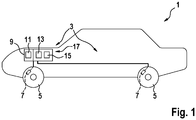
- FIG. 1 shows a motor vehicle 1, which is equipped with a braking device 3 according to an embodiment of the present invention.
- the braking device 3 has a control unit 17 and a plurality of brakes 7, which cooperate with one of the wheels 5 of the motor vehicle 1, on.
- a target specification guided deceleration control 13 and a brake preparation control 15 is provided in the control unit 17 .
- a driving situation recognition device 11 is provided which, in the example shown, is part of a regulation 9 of an adaptive cruise control (ACC).
- ACC adaptive cruise control
- FIG. 1 a common control device for the braking device and the ACC is shown, however, in modern vehicles for implementing the braking device according to the invention, however, alternatively separate control devices with external signals for target deceleration and brake preparation can be used.
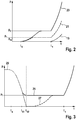
- FIGS. 2 and 3 are time courses of brake pressures p for generating a braking torque M, as it can be generated with a braking device 3 according to an embodiment of the present invention shown.
- a brake pressure p can in this case act, for example, in a hydraulic brake system and thereby cause an associated braking torque M to the vehicle.
- the braking torque M to be effected can also be generated by means of other, for example, non-hydraulic braking systems, for example by an electric machine of an electric or hybrid vehicle operated in the generator mode.
- the curve 19 shows the course of a brake pressure p, as is typically generated in a conventional braking device.
- the pressure p generated in the brake device continuously increases. Since, in the case of, for example, hydraulic brakes, a certain pressure in the hydraulic system has to be initially generated in order to overcome a play between the brake linings and the brake disk in order then to be able to exert a pressure from the brake linings on the brake disks, a certain amount of time passes, until the motor vehicle braking deceleration actually begins, that is, until the brake pressure p reaches a minimum dimension p m necessary for a significant deceleration.
- the curves 21 and 23 in FIG. 2 illustrate brake pressures, as they can be generated in a brake device according to the invention.
- a driving situation recognition device recognizes that there is a driving situation in which a braking request from a driver or an assistance system is to be expected within a short future period with a high probability.
- the driving situation recognition device then outputs a brake preparation signal.
- the braking control of the braking device actuates the brakes to achieve at least a certain minimum disposition brake pressure p 1 as shown in curve 21, or alternatively an increased disabling brake pressure p 2 as shown in curve 23.
- this preparation brake pressure can be selected depending on the probability with which the brake request is to be expected, and / or depending on the criticality of the current driving situation.
- the preparation brake pressure p 1 , p 2 constructed slower than would be necessary for the generation of a target specified braking torque, so that a hydraulic pump used for this purpose, for example, can work slower and quieter than in the generation of a target default braking torque.
- FIG. 3 different courses of the brake pressure in a brake device according to the invention for a case constellation are shown in which in the context of a preceding braking operation up to a time t e on the brake already a high braking torque 29 has been generated, which is then gradually reduced by stopping the braking request.
- a braking operation can be controlled by the time interval t e by a cruise control control, which is then terminated prioritized by the driver pressing the accelerator pedal, so that the brake pressure p is reduced successively.
- a brake preparation signal can be generated. Due to this brake preparation signal, the brake preparation control is used causes the braking pressure 29, which produces the target-guided braking torque generated above, to be lowered only minimally to the brake pressure p 1 effecting the preparation braking torque. For example, by closing an associated valve in a hydraulic brake device, the brake pressure can then, following the curve 25, be kept at this preparation brake pressure p 1 until the expected brake request arrives at a time t 1 , whereupon the brake pressure is greatly increased by default.
- a driving situation recognition device only recognizes at a time t 02 , that is, after the preceding target-guided brake pressure 29 has dropped below a minimum pressure required for a preparation braking torque p 1 , recognizes that a braking request is likely to be repeated soon, while that during the previous Braking operation built-up brake pressure 29 is not used as in the curve 25, but it can, following the curve 27, again a preparation brake pressure p 1 are built slowly.
- a strength of the preparation brake torque to be generated is usefully at least as high as necessary for generating a brake readiness. In hydraulic braking systems, this may correspond to the pressure level of a known pre-filling function (dead volume compensation). The brake pads of the brake are applied to the brake disc, but without noticeably delaying the vehicle. In addition, situationally higher preparation braking torques may be advantageous in order, for example, to further reduce the elasticity of the brake system or to intentionally impose a slight deceleration in order to prepare an anticipated braking intervention in the context of a braking request produced by a driver or an assistance system.
- the preparation braking torque to be generated is to be understood as the minimum braking torque to be set, which is to be maintained or built up. If a simultaneous setpoint-guided longitudinal control requires a higher braking torque as part of a braking request, the latter is to be realized.
- the desired preparation braking torque is preferably generated as jerky and quiet as possible.
- An existing braking torque can be obtained from a preceding desired-specification braking or, if appropriate, reduced to the preparation braking torque to be obtained. If a braking torque has to be built up, this can preferably be done as inconspicuously as possible taking into account the specific characteristics of the brake system.
- the dynamics of the pressure build-up is preferably to be realized so that it can be carried out at low pump speed and thus low noise.
- a subsequent braking intervention can then take place continuously from the level of the preparation braking torque by utilizing the improved properties of the brake system, such as a lower volume requirement by a lower elasticity in a hydraulic brake system.
- a cruise control ACC is used to continuously regulate the speed of a motor vehicle according to a specification, wherein the control of a distance to a preceding vehicle is included as an additional feedback and manipulated variable.
- a braking request is directed to a target-guided deceleration control of a braking device in order to decelerate the own vehicle and thus prevent it from falling below a minimum distance to a vehicle in front.
- a possibility frequently used by a driver to influence the stopping distance or the last phase of the stopping process according to his own wishes is the temporary overriding of the active distance control cruise control with the gas pedal. Since the driver's request always has the highest priority, in conventional braking devices and ACC controls in these cases, a braking torque actually required for the current control is complete dismantled and implemented according to the driver's request control of the drive.
- a deceleration of the vehicle is only continued after the driver intervention ends.
- a high gradient of the brake pressure or braking torque must be implemented in order to achieve the deceleration requirement of the adaptive cruise control. Since this gradient must be generated in a pressureless braking system, this can lead to disturbing noises in the brake system.
- a reaction time of the brake system is unavoidable until the requested vehicle deceleration is set again.
- the controller In order nevertheless to bring the vehicle to a standstill at a required minimum distance or to maintain a required minimum distance behind the slowly preceding vehicle, the controller must increase the vehicle deceleration and / or its jerk to uncomfortable values for the driver in the adaptive cruise control.
- an algorithm may be provided in the adaptive cruise control that allows to reduce or prevent brake system noise and uncomfortable vehicle decelerations after a driver overruns.
- a brake preparation signal is generated. Due to this brake preparation signal, a brake preparation control included in the brake device causes a brake torque or a residual brake pressure present from a preceding brake operation not to be completely reduced or a brake torque or brake pressure to be rebuilt, for example, via a pre-charge function of the brake system. As a result, the braking device is prepared for an imminent continuation of the target-guided deceleration control and an expected deceleration.
- the brake preparation signal may in the simplest case be a simple binary signal.
- a variable variable can be transmitted as a brake preparation signal which, depending on a present driving situation, can be a recommendation for the strength of the retained or newly generated preparation braking torque.
- the brake preparation signal can be generated only in an adjustable speed range in which problems with noise, vibration and / or roughness (sometimes referred to as NVH, noise / vibration / harshness) or comfort are expected.
- the brake preparation signal should only be sent by the adaptive cruise control if, for example, the driving situation detected by existing environmental sensors can be expected to slow down after, for example, the driver has been exceeded. In other cases, generation of a dissecting braking torque would result in an unacceptable degradation in the function of the adaptive cruise control.
- further signals can be used to assess the driving situation or a required follow-up braking, such as a signal that includes information about a lateral position of the vehicle in front to the own vehicle, a steering angle of the own vehicle and / or an environment situation such as a traffic light or further ahead vehicles and their movement indicates.
- an adapted Repar istsbremsmoment can be realized, which acts slightly delaying the vehicle and the brake of the vehicle in increased braking readiness, without already specify a target value for a longitudinal control within the scope of a default-specified deceleration control.
- a subsequent delay control can then be realized if necessary with low delay time and high dynamics.
- braking device proposed herein or the method for controlling thereof is in so-called predictive safety systems.
- Autonomous partial and emergency braking operations are often preceded by a braking intervention by the driver or other autonomous functions. If this is aborted, the brake is initially completely dissolved in conventional systems or held only in readiness, that is, with minimal pre-filling, regardless of an already recognizable degree of criticality of the situation and a probability of anticipated emergency braking intervention. Only when triggering the emergency braking then starts a control of the brake system, wherein the vehicle is initially in the free-rolling state, only minimally delayed by drag torque.
- a preparation braking torque can be generated by suitable activation of the brake even before the actual requesting of emergency braking, so that as soon as the emergency braking request actually arrives, the braking torque can be established without delay.
- an autonomous stopping on the mountain is described in the context of an ACC follow-up drive.
- a slope-dependent braking torque is necessary, which should be built as quickly as possible and ideally at the reversal point of a vehicle movement. If such a situation is detected, for example due to the slope, speed and / or acceleration, the described brake preparation can be requested to retain any existing braking torque or to build up a preparation braking torque. The braking torque required to hold the vehicle can then be built up faster and possibly with less noise.
Landscapes
- Engineering & Computer Science (AREA)
- Transportation (AREA)
- Mechanical Engineering (AREA)
- Regulating Braking Force (AREA)
Claims (11)
- Dispositif de freinage (3) destiné à un véhicule automobile (1), comportant :un organe de ralentissement (13) répondant à des valeurs de consigne qui, lors de la réception d'une demande de freinage déclenchée par un conducteur ou par un système d'assistance sur la base d'une différence entre une valeur de consigne et une valeur réelle ousur la base uniquement d'une valeur de consigne prédéterminée, commande un frein (5) de manière à ce que ce dernier exerce un couple de freinage répondant aux valeurs de consigne, pour ainsi ralentir le véhicule automobile d'une manière orientée par les valeurs de consigne ;dans lequel le dispositif de freinage comporte en outre un module de commande de préparation au freinage (15) qui, lors de la réception d'un signal de préparation au freinage, commande le frein (5) indépendamment de la valeur de consigne de manière à ce que ce dernier exerce au moins un couple de préparation au freinage pour un ralentissement préalable significatif du véhicule automobile,caractérisé en ce que le module de commande de préparation au freinage, lors de la réception du signal de préparation au freinage et lors de la présence d'un couple de freinage répondant aux valeurs de consigne préalablement produit, commande le frein de manière à réduire le couple de freinage répondant aux valeurs de consigne préalablement produit jusqu'à une valeur minimale égale au couple de freinage de préparation.
- Dispositif de freinage selon la revendication 1, dans lequel le ralentissement préalable significatif du véhicule automobile est d'au moins 0,1 m/s2.
- Dispositif de freinage selon la revendication 1 ou 2, dans lequel le module de commande de préparation au freinage commande le frein de manière à effectuer la production du couple de freinage de préparation en produisant un bruit réduit par comparaison à la production d'un couple de freinage répondant aux valeurs de consigne.
- Dispositif de freinage selon l'une des revendications 1 à 3, dans lequel le module de commande de préparation au freinage, lors de la réception du signal de préparation au freinage et en l'absence de production préalable d'un couple de freinage répondant aux valeurs de consigne, commande le frein de manière à ce que le couple de freinage exercé par le frein augmente jusqu'au couple de freinage de préparation.
- Dispositif de freinage selon l'une des revendications 1 à 4, dans lequel le module de préparation au freinage est conçu pour recevoir différents types de signaux de préparation au freinage et commande le frein en fonction du signal de préparation au freinage reçu de manière à exercer un couple de freinage de préparation spécifique du signal de préparation au freinage pour un ralentissement préalable significatif du véhicule automobile.
- Procédé de commande d'un dispositif de freinage selon l'une des revendications 1 à 5, dans lequel le procédé comprend les étapes consistant à :générer un signal de préparation au freinage dès qu'une situation de conduite dans laquelle il paraît très probable qu'un conducteur ou qu'un système d'assistance va bientôt déclencher une demande de freinage, ettransmettre le signal de préparation au freinage au module de commande de préparation au freinage du dispositif de freinage,caractérisé en ce que le module de commande de préparation au freinage, lors de la réception du signal de préparation au freinage et en présence d'un couple de freinage répondant aux valeurs de consigne préalablement produit, commande le frein de manière à réduire le couple de freinage répondant aux valeurs de consigne préalablement produit jusqu'à une valeur minimale égale au couple de freinage de préparation.
- Procédé selon la revendication 6, dans lequel différents types de signaux de préparation au freinage sont générés en fonction d'une probabilité qu'un conducteur ou qu'un système d'assistance va bientôt déclencher une demande de freinage et/ou d'un caractère critique d'une situation de conduite actuelle.
- Procédé selon la revendication 6 ou 7, dans lequel, lors de la détermination de la situation de conduite, une vitesse ou une accélération du véhicule automobile, une distance par rapport à un véhicule précédent, une vitesse ou une accélération du véhicule précédent ou un actionnement de la pédale d'accélérateur par un conducteur sont pris en compte.
- Procédé selon la revendication 8, dans lequel, lors de la détermination de la situation de conduite, une position latérale du véhicule précédent par rapport au véhicule automobile, un angle de braquage du véhicule automobile et/ou des situations environnementales sont également pris en compte.
- Appareil de commande (17) destiné à un véhicule automobile (1), dans lequel l'appareil de commande (17) est conçu pour mettre en oeuvre un procédé selon l'une des revendications 6 à 9.
- Véhicule automobile (1) comportant un dispositif de freinage (3) selon l'une des revendications 1 à 5 et/ou un appareil de commande selon la revendication 10.
Applications Claiming Priority (2)
| Application Number | Priority Date | Filing Date | Title |
|---|---|---|---|
| DE102012220361.3A DE102012220361A1 (de) | 2012-11-08 | 2012-11-08 | Bremsvorrichtung für ein Kraftfahrzeug mit präparierender Vorverzögerung und Verfahren zum Steuern einer solchen Bremsvorrichtung |
| PCT/EP2013/068653 WO2014072098A1 (fr) | 2012-11-08 | 2013-09-10 | Dispositif de freinage pour un véhicule à moteur, comportant un ralentissement préalable préparatoire, et procédé permettant de commander un tel dispositif de freinage |
Publications (2)
| Publication Number | Publication Date |
|---|---|
| EP2917079A1 EP2917079A1 (fr) | 2015-09-16 |
| EP2917079B1 true EP2917079B1 (fr) | 2018-07-11 |
Family
ID=49162143
Family Applications (1)
| Application Number | Title | Priority Date | Filing Date |
|---|---|---|---|
| EP13760039.1A Active EP2917079B1 (fr) | 2012-11-08 | 2013-09-10 | Dispositif de freinage pour un véhicule à moteur, comportant un ralentissement préalable préparatoire, et procédé permettant de commander un tel dispositif de freinage |
Country Status (6)
| Country | Link |
|---|---|
| US (1) | US9796366B2 (fr) |
| EP (1) | EP2917079B1 (fr) |
| JP (1) | JP6097403B2 (fr) |
| CN (1) | CN104755338B (fr) |
| DE (1) | DE102012220361A1 (fr) |
| WO (1) | WO2014072098A1 (fr) |
Families Citing this family (18)
| Publication number | Priority date | Publication date | Assignee | Title |
|---|---|---|---|---|
| WO2014105665A1 (fr) * | 2012-12-27 | 2014-07-03 | Robert Bosch Gmbh | Procédé de décélération d'un véhicule à freinage à récupération et mécanique |
| DE102015215042A1 (de) * | 2015-08-06 | 2017-02-09 | Volkswagen Ag | Steuern einer Verzögerungseinrichtung eines Kraftfahrzeugs |
| CN105644363B (zh) * | 2016-01-11 | 2019-07-02 | 贵州大学 | 一种防止误踩油门踏板智能控制系统及控制方法 |
| DE102016204144A1 (de) * | 2016-03-14 | 2017-09-14 | Robert Bosch Gmbh | Verfahren und Steuereinrichtung zur Steuerung und/oder Regelung eines Funktionssystems in einem Kraftfahrzeug |
| DE102016207581B4 (de) * | 2016-05-03 | 2021-07-15 | Ford Global Technologies, Llc | Verfahren zum Betreiben eines Bremsassistenzsystems eines Fahrzeugs |
| US10106137B2 (en) * | 2017-01-06 | 2018-10-23 | Ford Global Technologies, Llc | Adjustment of maximum brake pump speed based on rate of change of target deceleration |
| US10300899B2 (en) * | 2017-01-06 | 2019-05-28 | Ford Global Technologies, Llc | Adjustment of maximum brake pump speed based on rate of change of target deceleration |
| DE102017205209A1 (de) * | 2017-03-28 | 2018-10-18 | Volkswagen Aktiengesellschaft | Verfahren zum Kompensieren einer geringen Aktuatordynamik einer mechanischen Bremse eines Kraftfahrzeugs sowie Steuervorrichtung |
| KR102393436B1 (ko) * | 2017-05-29 | 2022-05-03 | 현대모비스 주식회사 | 차량의 긴급 제동 준비 방법 |
| US10272890B2 (en) | 2017-06-07 | 2019-04-30 | Bendix Commercial Vehicle Systems Llc | Pneumatic panic brake assist |
| EP3418843B1 (fr) * | 2017-06-23 | 2021-03-17 | Volkswagen Aktiengesellschaft | Concept de coordination d'un freinage d'urgence d'un peloton de véhicules couplé de manière communicative |
| FR3070655B1 (fr) * | 2017-09-06 | 2019-08-23 | Renault S.A.S | Procede et dispositif de controle de distance de freinage d'urgence |
| US10418020B2 (en) | 2017-12-18 | 2019-09-17 | Ford Global Technologies, Llc | Vehicle adaptive cruise control noise cancelation |
| US11077837B2 (en) * | 2018-12-12 | 2021-08-03 | Continental Automotive Systems, Inc. | Cruise control cancel, with brake precharge |
| JP7152321B2 (ja) * | 2019-01-11 | 2022-10-12 | トヨタ自動車株式会社 | 運転支援システム |
| JP7077973B2 (ja) * | 2019-01-17 | 2022-05-31 | トヨタ自動車株式会社 | 運転支援装置 |
| DE102019215232A1 (de) * | 2019-10-02 | 2021-04-08 | Robert Bosch Gmbh | Vorrichtung und Verfahren zum Betreiben eines Bremskrafterzeugers |
| JP7517319B2 (ja) * | 2021-12-16 | 2024-07-17 | トヨタ自動車株式会社 | 車両制御装置 |
Family Cites Families (14)
| Publication number | Priority date | Publication date | Assignee | Title |
|---|---|---|---|---|
| US6026347A (en) * | 1997-05-30 | 2000-02-15 | Raytheon Company | Obstacle avoidance processing method for vehicles using an automated highway system |
| DE19745128C2 (de) * | 1997-10-13 | 1999-08-19 | Daimler Chrysler Ag | Verfahren zur Bestimmung eines Auslöseschwellenwertes für einen automatischen Bremsvorgang |
| DE19817326A1 (de) * | 1998-04-18 | 1999-10-21 | Continental Teves Ag & Co Ohg | Verfahren zum Verkürzen des Bremsgeweges |
| JP2001063541A (ja) * | 1999-08-30 | 2001-03-13 | Unisia Jecs Corp | ブレーキ制御装置 |
| JP3552628B2 (ja) * | 2000-02-21 | 2004-08-11 | 日産自動車株式会社 | 走行制御装置 |
| JP3473563B2 (ja) | 2000-08-17 | 2003-12-08 | 日産自動車株式会社 | 制動制御装置 |
| DE10118708A1 (de) * | 2001-04-12 | 2002-10-17 | Bosch Gmbh Robert | Verfahren zur Regelung der Geschwindigkeit eines Kraftfahrzeugs |
| DE10325266A1 (de) | 2002-06-06 | 2004-01-22 | Continental Teves Ag & Co. Ohg | Bremsanlage und Verfahren für Kraftfahrzeuge |
| DE10322554B4 (de) * | 2003-05-20 | 2005-06-09 | Robert Bosch Gmbh | Steuerung der Eingriffszeitpunkte eines Bremsscheibenwischers |
| DE10356510A1 (de) * | 2003-12-03 | 2005-07-07 | Robert Bosch Gmbh | Fahrdynamikregelung mit vorgezogenem Druckaufbau am zu regelnden Rad |
| JP4613525B2 (ja) * | 2004-06-23 | 2011-01-19 | 日産自動車株式会社 | 車両用運転操作補助装置および車両用運転操作補助装置を備えた車両 |
| US8515625B2 (en) * | 2008-12-16 | 2013-08-20 | Toyota Jidosha Kabushiki Kaisha | Vehicle behavior controlling apparatus |
| DE102009058154A1 (de) * | 2009-12-12 | 2011-06-16 | Wabco Gmbh | Fahrerassistenzsystem für ein Fahrzeug, insbesondere Nutzfahrzeug, sowie Verfahren zum Steuern eines Bremssystems |
| DE102011003494A1 (de) * | 2011-02-02 | 2012-08-02 | Robert Bosch Gmbh | Verfahren zum Bremsen eines Fahrzeugs mit einem Hybrid-Bremssystem |
-
2012
- 2012-11-08 DE DE102012220361.3A patent/DE102012220361A1/de not_active Withdrawn
-
2013
- 2013-09-10 JP JP2015541043A patent/JP6097403B2/ja active Active
- 2013-09-10 EP EP13760039.1A patent/EP2917079B1/fr active Active
- 2013-09-10 US US14/440,655 patent/US9796366B2/en active Active
- 2013-09-10 CN CN201380058336.7A patent/CN104755338B/zh active Active
- 2013-09-10 WO PCT/EP2013/068653 patent/WO2014072098A1/fr not_active Ceased
Non-Patent Citations (1)
| Title |
|---|
| None * |
Also Published As
| Publication number | Publication date |
|---|---|
| JP6097403B2 (ja) | 2017-03-15 |
| DE102012220361A1 (de) | 2014-05-22 |
| US9796366B2 (en) | 2017-10-24 |
| EP2917079A1 (fr) | 2015-09-16 |
| CN104755338A (zh) | 2015-07-01 |
| US20150283985A1 (en) | 2015-10-08 |
| JP2015533726A (ja) | 2015-11-26 |
| CN104755338B (zh) | 2017-07-04 |
| WO2014072098A1 (fr) | 2014-05-15 |
Similar Documents
| Publication | Publication Date | Title |
|---|---|---|
| EP2917079B1 (fr) | Dispositif de freinage pour un véhicule à moteur, comportant un ralentissement préalable préparatoire, et procédé permettant de commander un tel dispositif de freinage | |
| DE112008000808B4 (de) | Technik zum Anfahren eines Kraftfahrzeugs auf einer abschüssigen Fahrstrecke | |
| DE10231584B4 (de) | Verfahren und Vorrichtung zum selbsttätigen Auslösen einer Verzögerung eines Fahrzeugs | |
| DE112011102671B4 (de) | Fahrzeugsteuerungsvorrichtung und Fahrzeugsteuerungsverfahren | |
| EP2358572B1 (fr) | Procédé d'ajustement du système de freinage d'un véhicule automobile en cas de collision | |
| DE102005041071B4 (de) | System zum Kontrolle der Bergabfahrt eines Kraftfahrzeuges | |
| EP2750950B1 (fr) | Procédé d'assistance à un conducteur d'un véhicule automobile | |
| DE4409122A1 (de) | Vorrichtung und Verfahren zum Regeln einer Anfahreinrichtung eines Fahrzeugantriebes | |
| DE102005003274A1 (de) | Verfahren und Vorrichtung zur Vermeidung und/oder Minderung der Folgen von Kollisionen beim Ausweichen vor Hindernissen | |
| EP1409312A1 (fr) | Procede et dispositif de commande automatique du systeme de deceleration d'un vehicule | |
| WO2008012160A1 (fr) | Dispositif de régulation de la vitesse et de l'arrêt dans des véhicules automobiles | |
| EP2517936A2 (fr) | Véhicule automobile comprenant un système d'assistance au conducteur | |
| DE102015206582B4 (de) | Einlegen einer Parksperre an einer Steigung am Ende eines automatischen Einparkvorgangs | |
| DE102011050341A1 (de) | Fahrzeuggeschwindigkeitssteuervorrichtung | |
| DE102012223866A1 (de) | Einrichtung zum Vermeiden des Rollens für ein ein elektrisches Antriebssystem umfassendes Kraftfahrzeug auf einer geneigten Fläche | |
| EP1305181B1 (fr) | Procede et dispositif pour l'adaptation automatique de la vitesse d'un vehicule | |
| DE102012200494B4 (de) | Verfahren zur Regelung einer Bremsanlage für Kraftfahrzeuge sowie Bremsanlage | |
| DE102014211061A1 (de) | Verfahren und Vorrichtung zur Regelung der Fahrstabilität eines Fahrzeuges | |
| EP2004445B1 (fr) | Adaptation d'un système d'assistance au freinage au cours d'un freinage réalisé par le conducteur | |
| DE102005041070A1 (de) | System zur Kontrolle der Bergabfahrt eines Kraftfahrzeuges | |
| DE102011109842B4 (de) | Verfahren zum Betreiben einer Fahrerassistenzeinrichtung sowie Fahrerassistenzeinrichtung | |
| EP3012144A2 (fr) | Procédé de commande d'une force de rappel réglable sur une pédale d'un véhicule utilitaire | |
| DE102014211496B4 (de) | Fahrerassistenzsystem zur Längsdynamikregelung | |
| DE102014010085A1 (de) | Verfahren zum Durchführen eines automatischen Einpark- und/oder Ausparkmanövers eines Fahrzeugs | |
| DE102013225804A1 (de) | Verfahren und Vorrichtung zur Unterstützung des Fahrers eines Kraftfahrzeuges in Gefahrensituationen |
Legal Events
| Date | Code | Title | Description |
|---|---|---|---|
| PUAI | Public reference made under article 153(3) epc to a published international application that has entered the european phase |
Free format text: ORIGINAL CODE: 0009012 |
|
| 17P | Request for examination filed |
Effective date: 20150608 |
|
| AK | Designated contracting states |
Kind code of ref document: A1 Designated state(s): AL AT BE BG CH CY CZ DE DK EE ES FI FR GB GR HR HU IE IS IT LI LT LU LV MC MK MT NL NO PL PT RO RS SE SI SK SM TR |
|
| AX | Request for extension of the european patent |
Extension state: BA ME |
|
| DAX | Request for extension of the european patent (deleted) | ||
| GRAP | Despatch of communication of intention to grant a patent |
Free format text: ORIGINAL CODE: EPIDOSNIGR1 |
|
| INTG | Intention to grant announced |
Effective date: 20180416 |
|
| GRAA | (expected) grant |
Free format text: ORIGINAL CODE: 0009210 |
|
| AK | Designated contracting states |
Kind code of ref document: B1 Designated state(s): AL AT BE BG CH CY CZ DE DK EE ES FI FR GB GR HR HU IE IS IT LI LT LU LV MC MK MT NL NO PL PT RO RS SE SI SK SM TR |
|
| REG | Reference to a national code |
Ref country code: GB Ref legal event code: FG4D Free format text: NOT ENGLISH |
|
| REG | Reference to a national code |
Ref country code: CH Ref legal event code: EP |
|
| REG | Reference to a national code |
Ref country code: AT Ref legal event code: REF Ref document number: 1016544 Country of ref document: AT Kind code of ref document: T Effective date: 20180715 |
|
| GRAS | Grant fee paid |
Free format text: ORIGINAL CODE: EPIDOSNIGR3 |
|
| REG | Reference to a national code |
Ref country code: IE Ref legal event code: FG4D Free format text: LANGUAGE OF EP DOCUMENT: GERMAN |
|
| REG | Reference to a national code |
Ref country code: DE Ref legal event code: R096 Ref document number: 502013010602 Country of ref document: DE |
|
| REG | Reference to a national code |
Ref country code: FR Ref legal event code: PLFP Year of fee payment: 6 |
|
| REG | Reference to a national code |
Ref country code: NL Ref legal event code: MP Effective date: 20180711 |
|
| REG | Reference to a national code |
Ref country code: LT Ref legal event code: MG4D |
|
| PG25 | Lapsed in a contracting state [announced via postgrant information from national office to epo] |
Ref country code: NL Free format text: LAPSE BECAUSE OF FAILURE TO SUBMIT A TRANSLATION OF THE DESCRIPTION OR TO PAY THE FEE WITHIN THE PRESCRIBED TIME-LIMIT Effective date: 20180711 |
|
| PG25 | Lapsed in a contracting state [announced via postgrant information from national office to epo] |
Ref country code: GR Free format text: LAPSE BECAUSE OF FAILURE TO SUBMIT A TRANSLATION OF THE DESCRIPTION OR TO PAY THE FEE WITHIN THE PRESCRIBED TIME-LIMIT Effective date: 20181012 Ref country code: SE Free format text: LAPSE BECAUSE OF FAILURE TO SUBMIT A TRANSLATION OF THE DESCRIPTION OR TO PAY THE FEE WITHIN THE PRESCRIBED TIME-LIMIT Effective date: 20180711 Ref country code: PL Free format text: LAPSE BECAUSE OF FAILURE TO SUBMIT A TRANSLATION OF THE DESCRIPTION OR TO PAY THE FEE WITHIN THE PRESCRIBED TIME-LIMIT Effective date: 20180711 Ref country code: LT Free format text: LAPSE BECAUSE OF FAILURE TO SUBMIT A TRANSLATION OF THE DESCRIPTION OR TO PAY THE FEE WITHIN THE PRESCRIBED TIME-LIMIT Effective date: 20180711 Ref country code: FI Free format text: LAPSE BECAUSE OF FAILURE TO SUBMIT A TRANSLATION OF THE DESCRIPTION OR TO PAY THE FEE WITHIN THE PRESCRIBED TIME-LIMIT Effective date: 20180711 Ref country code: RS Free format text: LAPSE BECAUSE OF FAILURE TO SUBMIT A TRANSLATION OF THE DESCRIPTION OR TO PAY THE FEE WITHIN THE PRESCRIBED TIME-LIMIT Effective date: 20180711 Ref country code: IS Free format text: LAPSE BECAUSE OF FAILURE TO SUBMIT A TRANSLATION OF THE DESCRIPTION OR TO PAY THE FEE WITHIN THE PRESCRIBED TIME-LIMIT Effective date: 20181111 Ref country code: BG Free format text: LAPSE BECAUSE OF FAILURE TO SUBMIT A TRANSLATION OF THE DESCRIPTION OR TO PAY THE FEE WITHIN THE PRESCRIBED TIME-LIMIT Effective date: 20181011 Ref country code: NO Free format text: LAPSE BECAUSE OF FAILURE TO SUBMIT A TRANSLATION OF THE DESCRIPTION OR TO PAY THE FEE WITHIN THE PRESCRIBED TIME-LIMIT Effective date: 20181011 |
|
| PG25 | Lapsed in a contracting state [announced via postgrant information from national office to epo] |
Ref country code: AL Free format text: LAPSE BECAUSE OF FAILURE TO SUBMIT A TRANSLATION OF THE DESCRIPTION OR TO PAY THE FEE WITHIN THE PRESCRIBED TIME-LIMIT Effective date: 20180711 Ref country code: LV Free format text: LAPSE BECAUSE OF FAILURE TO SUBMIT A TRANSLATION OF THE DESCRIPTION OR TO PAY THE FEE WITHIN THE PRESCRIBED TIME-LIMIT Effective date: 20180711 Ref country code: ES Free format text: LAPSE BECAUSE OF FAILURE TO SUBMIT A TRANSLATION OF THE DESCRIPTION OR TO PAY THE FEE WITHIN THE PRESCRIBED TIME-LIMIT Effective date: 20180711 Ref country code: HR Free format text: LAPSE BECAUSE OF FAILURE TO SUBMIT A TRANSLATION OF THE DESCRIPTION OR TO PAY THE FEE WITHIN THE PRESCRIBED TIME-LIMIT Effective date: 20180711 |
|
| REG | Reference to a national code |
Ref country code: DE Ref legal event code: R097 Ref document number: 502013010602 Country of ref document: DE |
|
| PG25 | Lapsed in a contracting state [announced via postgrant information from national office to epo] |
Ref country code: EE Free format text: LAPSE BECAUSE OF FAILURE TO SUBMIT A TRANSLATION OF THE DESCRIPTION OR TO PAY THE FEE WITHIN THE PRESCRIBED TIME-LIMIT Effective date: 20180711 Ref country code: RO Free format text: LAPSE BECAUSE OF FAILURE TO SUBMIT A TRANSLATION OF THE DESCRIPTION OR TO PAY THE FEE WITHIN THE PRESCRIBED TIME-LIMIT Effective date: 20180711 Ref country code: IT Free format text: LAPSE BECAUSE OF FAILURE TO SUBMIT A TRANSLATION OF THE DESCRIPTION OR TO PAY THE FEE WITHIN THE PRESCRIBED TIME-LIMIT Effective date: 20180711 Ref country code: CZ Free format text: LAPSE BECAUSE OF FAILURE TO SUBMIT A TRANSLATION OF THE DESCRIPTION OR TO PAY THE FEE WITHIN THE PRESCRIBED TIME-LIMIT Effective date: 20180711 Ref country code: MC Free format text: LAPSE BECAUSE OF FAILURE TO SUBMIT A TRANSLATION OF THE DESCRIPTION OR TO PAY THE FEE WITHIN THE PRESCRIBED TIME-LIMIT Effective date: 20180711 |
|
| REG | Reference to a national code |
Ref country code: CH Ref legal event code: PL |
|
| PLBE | No opposition filed within time limit |
Free format text: ORIGINAL CODE: 0009261 |
|
| STAA | Information on the status of an ep patent application or granted ep patent |
Free format text: STATUS: NO OPPOSITION FILED WITHIN TIME LIMIT |
|
| PG25 | Lapsed in a contracting state [announced via postgrant information from national office to epo] |
Ref country code: SK Free format text: LAPSE BECAUSE OF FAILURE TO SUBMIT A TRANSLATION OF THE DESCRIPTION OR TO PAY THE FEE WITHIN THE PRESCRIBED TIME-LIMIT Effective date: 20180711 Ref country code: DK Free format text: LAPSE BECAUSE OF FAILURE TO SUBMIT A TRANSLATION OF THE DESCRIPTION OR TO PAY THE FEE WITHIN THE PRESCRIBED TIME-LIMIT Effective date: 20180711 Ref country code: SM Free format text: LAPSE BECAUSE OF FAILURE TO SUBMIT A TRANSLATION OF THE DESCRIPTION OR TO PAY THE FEE WITHIN THE PRESCRIBED TIME-LIMIT Effective date: 20180711 |
|
| REG | Reference to a national code |
Ref country code: BE Ref legal event code: MM Effective date: 20180930 |
|
| 26N | No opposition filed |
Effective date: 20190412 |
|
| GBPC | Gb: european patent ceased through non-payment of renewal fee |
Effective date: 20181011 |
|
| REG | Reference to a national code |
Ref country code: IE Ref legal event code: MM4A |
|
| PG25 | Lapsed in a contracting state [announced via postgrant information from national office to epo] |
Ref country code: LU Free format text: LAPSE BECAUSE OF NON-PAYMENT OF DUE FEES Effective date: 20180910 |
|
| PG25 | Lapsed in a contracting state [announced via postgrant information from national office to epo] |
Ref country code: IE Free format text: LAPSE BECAUSE OF NON-PAYMENT OF DUE FEES Effective date: 20180910 |
|
| PG25 | Lapsed in a contracting state [announced via postgrant information from national office to epo] |
Ref country code: SI Free format text: LAPSE BECAUSE OF FAILURE TO SUBMIT A TRANSLATION OF THE DESCRIPTION OR TO PAY THE FEE WITHIN THE PRESCRIBED TIME-LIMIT Effective date: 20180711 Ref country code: LI Free format text: LAPSE BECAUSE OF NON-PAYMENT OF DUE FEES Effective date: 20180930 Ref country code: CH Free format text: LAPSE BECAUSE OF NON-PAYMENT OF DUE FEES Effective date: 20180930 Ref country code: BE Free format text: LAPSE BECAUSE OF NON-PAYMENT OF DUE FEES Effective date: 20180930 |
|
| PG25 | Lapsed in a contracting state [announced via postgrant information from national office to epo] |
Ref country code: GB Free format text: LAPSE BECAUSE OF NON-PAYMENT OF DUE FEES Effective date: 20181011 |
|
| REG | Reference to a national code |
Ref country code: AT Ref legal event code: MM01 Ref document number: 1016544 Country of ref document: AT Kind code of ref document: T Effective date: 20180910 |
|
| PG25 | Lapsed in a contracting state [announced via postgrant information from national office to epo] |
Ref country code: MT Free format text: LAPSE BECAUSE OF FAILURE TO SUBMIT A TRANSLATION OF THE DESCRIPTION OR TO PAY THE FEE WITHIN THE PRESCRIBED TIME-LIMIT Effective date: 20180711 Ref country code: AT Free format text: LAPSE BECAUSE OF NON-PAYMENT OF DUE FEES Effective date: 20180910 |
|
| PG25 | Lapsed in a contracting state [announced via postgrant information from national office to epo] |
Ref country code: TR Free format text: LAPSE BECAUSE OF FAILURE TO SUBMIT A TRANSLATION OF THE DESCRIPTION OR TO PAY THE FEE WITHIN THE PRESCRIBED TIME-LIMIT Effective date: 20180711 |
|
| PG25 | Lapsed in a contracting state [announced via postgrant information from national office to epo] |
Ref country code: PT Free format text: LAPSE BECAUSE OF FAILURE TO SUBMIT A TRANSLATION OF THE DESCRIPTION OR TO PAY THE FEE WITHIN THE PRESCRIBED TIME-LIMIT Effective date: 20180711 |
|
| PG25 | Lapsed in a contracting state [announced via postgrant information from national office to epo] |
Ref country code: CY Free format text: LAPSE BECAUSE OF FAILURE TO SUBMIT A TRANSLATION OF THE DESCRIPTION OR TO PAY THE FEE WITHIN THE PRESCRIBED TIME-LIMIT Effective date: 20180711 Ref country code: MK Free format text: LAPSE BECAUSE OF NON-PAYMENT OF DUE FEES Effective date: 20180711 Ref country code: HU Free format text: LAPSE BECAUSE OF FAILURE TO SUBMIT A TRANSLATION OF THE DESCRIPTION OR TO PAY THE FEE WITHIN THE PRESCRIBED TIME-LIMIT; INVALID AB INITIO Effective date: 20130910 |
|
| PGFP | Annual fee paid to national office [announced via postgrant information from national office to epo] |
Ref country code: FR Payment date: 20250926 Year of fee payment: 13 |
|
| PGFP | Annual fee paid to national office [announced via postgrant information from national office to epo] |
Ref country code: DE Payment date: 20251121 Year of fee payment: 13 |