EP2917732B1 - Concentration d'une molécule visée en vue d'une détection par un nano-pore - Google Patents
Concentration d'une molécule visée en vue d'une détection par un nano-pore Download PDFInfo
- Publication number
- EP2917732B1 EP2917732B1 EP13795658.7A EP13795658A EP2917732B1 EP 2917732 B1 EP2917732 B1 EP 2917732B1 EP 13795658 A EP13795658 A EP 13795658A EP 2917732 B1 EP2917732 B1 EP 2917732B1
- Authority
- EP
- European Patent Office
- Prior art keywords
- nanopore
- target molecule
- target
- hydrophobic
- leader
- Prior art date
- Legal status (The legal status is an assumption and is not a legal conclusion. Google has not performed a legal analysis and makes no representation as to the accuracy of the status listed.)
- Active
Links
Images



Classifications
-
- C—CHEMISTRY; METALLURGY
- C12—BIOCHEMISTRY; BEER; SPIRITS; WINE; VINEGAR; MICROBIOLOGY; ENZYMOLOGY; MUTATION OR GENETIC ENGINEERING
- C12Q—MEASURING OR TESTING PROCESSES INVOLVING ENZYMES, NUCLEIC ACIDS OR MICROORGANISMS; COMPOSITIONS OR TEST PAPERS THEREFOR; PROCESSES OF PREPARING SUCH COMPOSITIONS; CONDITION-RESPONSIVE CONTROL IN MICROBIOLOGICAL OR ENZYMOLOGICAL PROCESSES
- C12Q1/00—Measuring or testing processes involving enzymes, nucleic acids or microorganisms; Compositions therefor; Processes of preparing such compositions
- C12Q1/68—Measuring or testing processes involving enzymes, nucleic acids or microorganisms; Compositions therefor; Processes of preparing such compositions involving nucleic acids
- C12Q1/6806—Preparing nucleic acids for analysis, e.g. for polymerase chain reaction [PCR] assay
-
- C—CHEMISTRY; METALLURGY
- C12—BIOCHEMISTRY; BEER; SPIRITS; WINE; VINEGAR; MICROBIOLOGY; ENZYMOLOGY; MUTATION OR GENETIC ENGINEERING
- C12Q—MEASURING OR TESTING PROCESSES INVOLVING ENZYMES, NUCLEIC ACIDS OR MICROORGANISMS; COMPOSITIONS OR TEST PAPERS THEREFOR; PROCESSES OF PREPARING SUCH COMPOSITIONS; CONDITION-RESPONSIVE CONTROL IN MICROBIOLOGICAL OR ENZYMOLOGICAL PROCESSES
- C12Q1/00—Measuring or testing processes involving enzymes, nucleic acids or microorganisms; Compositions therefor; Processes of preparing such compositions
- C12Q1/68—Measuring or testing processes involving enzymes, nucleic acids or microorganisms; Compositions therefor; Processes of preparing such compositions involving nucleic acids
- C12Q1/6869—Methods for sequencing
-
- G—PHYSICS
- G01—MEASURING; TESTING
- G01N—INVESTIGATING OR ANALYSING MATERIALS BY DETERMINING THEIR CHEMICAL OR PHYSICAL PROPERTIES
- G01N33/00—Investigating or analysing materials by specific methods not covered by groups G01N1/00 - G01N31/00
- G01N33/48—Biological material, e.g. blood, urine; Haemocytometers
- G01N33/50—Chemical analysis of biological material, e.g. blood, urine; Testing involving biospecific ligand binding methods; Immunological testing
- G01N33/53—Immunoassay; Biospecific binding assay; Materials therefor
- G01N33/543—Immunoassay; Biospecific binding assay; Materials therefor with an insoluble carrier for immobilising immunochemicals
- G01N33/54366—Apparatus specially adapted for solid-phase testing
- G01N33/54373—Apparatus specially adapted for solid-phase testing involving physiochemical end-point determination, e.g. wave-guides, FETS, gratings
Definitions
- This invention is generally directed to concentrating a target molecule for sensing by a nanopore, as well as methods and products relating to the same.
- An individual's unique DNA sequence provides valuable information concerning their susceptibility to certain diseases. It also provides patients with the opportunity to screen for early detection and/or to receive preventative treatment. Furthermore, given a patient's individual blueprint, clinicians will be able to administer personalized therapy to maximize drug efficacy and/or to minimize the risk of an adverse drug response. Similarly, determining the blueprint of pathogenic organisms can lead to new treatments for infectious diseases and more robust pathogen surveillance. Low cost, whole genome DNA sequencing will provide the foundation for modern medicine. To achieve this goal, sequencing technologies must continue to advance with respect to throughput, accuracy, and read length.
- SBS sequencing by synthesis
- Illumina, Inc. 454 Life Sciences, Ion Torrent, Pacific Biosciences
- analogous ligation based platforms Complete Genomics, Life Technologies Corporation
- GnuBio, Inc. uses picoliter reaction vessels to control millions of discreet probe sequencing reactions
- Halcyon Molecular was attempting to develop technology for direct DNA measurement using a transmission electron microscope.
- Nanopore based nucleic acid sequencing is a compelling approach that has been widely studied.
- Kasianowicz et al. Proc. Natl. Acad. Sci. USA 93: 13770-13773, 1996 ) characterized single-stranded polynucleotides as they were electrically translocated through an alpha hemolysin nanopore embedded in a lipid bilayer. It was demonstrated that during polynucleotide translocation partial blockage of the nanopore aperture could be measured as a decrease in ionic current.
- Polynucleotide sequencing in nanopores is burdened by having to resolve tightly spaced bases (0.34 nm) with small signal differences immersed in significant background noise.
- Translocation speed can be reduced by adjusting run parameters such as voltage, salt composition, pH, temperature, and viscosity, to name a few. However, such adjustments have been unable to reduce translocation speed to a level that allows for single base resolution.
- Stratos Genomics has developed a method called Sequencing by Expansion (“SBX”) that uses a biochemical process to transcribe the sequence of DNA onto a measurable polymer called an "Xpandomer” ( Kokoris et al., U.S. Patent No. 7,939,259 , "High Throughput Nucleic Acid Sequencing by Expansion”).
- the transcribed sequence is encoded along the Xpandomer backbone in high signal-to-noise reporters that are separated by ⁇ 10 nm and are designed for high-signal-to-noise, well-differentiated responses. These differences provide significant performance enhancements in sequence read efficiency and accuracy of Xpandomers relative to native DNA.
- Xpandomers can enable several next generation DNA sequencing detection technologies and are well suited to nanopore sequencing.
- Gundlach et al. have demonstrated a method of sequencing DNA that uses a low noise nanopore derived from Mycobacterium smegmatis ("MspA") in conjunction with a process called duplex interrupted sequencing.
- MspA Mycobacterium smegmatis
- duplex interrupted sequencing a process called duplex interrupted sequencing.
- a double strand duplex is used to temporarily hold the single stranded portion in the MspA constriction. This process enables better statistical sampling of the bases held in the limiting aperture. Under such conditions single base identification was demonstrated; however, this approach requires DNA conversion methods such as those disclosed by Kokoris et al. (supra).
- Akeson et al. disclosed methods for characterizing polynucleotides in a nanopore that utilize an adjacently positioned molecular motor to control the translocation rate of the polynucleotide through or adjacent to the nanopore aperture.
- the signal corresponding to the movement of the target polynucleotide with respect to the nanopore aperture can be more closely correlated to the identity of the bases within and proximal to the aperture constriction.
- molecular motor control of polynucleotide translocation rate through a nanopore single base measurement resolution is still limited to the dimension and composition of the aperture constriction.
- Nanopores have proven to be powerful amplifiers, much like their highly exploited predecessors, Coulter Counters.
- a limitation of these devices is their limit of detection. High concentrations of sample materials are required for rapid detection because the ends of long nucleic acid molecules are statistically challenged to find the nanopore entry.
- Branton et al. (Nat Biotech 26(10):1146-1153, 2008 ) calculated that 10 8 full genomes would be required to adequately sequence a genome based upon extrapolated throughput. Indeed, improving the limit of detection for many biomolecular measurements is highly desirable for improving sensitivity and extending the range of applications.
- a method for concentrating a target molecule for nanopore sensing comprising capturing the target molecule on a surface comprising a nanopore and a hydrophobic domain.
- the target molecule comprises a target portion, a hydrophobic capture element and a leader for interaction with the nanopore.
- the hydrophobic capture element of the target molecule is associated with, and capable of movement along, the hydrophobic domain of the surface to bring the leader of the target molecule in proximity with the nanopore.
- At least the target portion of the target molecule is sensed by the nanopore upon interaction with the nanopore.
- the step of capturing the target molecule on the surface comprises contacting the surface with the target molecule, wherein the target molecule comprises, prior to the contacting step, the target portion, the hydrophobic capture element and the leader.
- the step of capturing the target molecule on the surface comprises linking the hydrophobic capture element associated with the surface to the target portion and leader, thereby capturing the target molecule on the surface.
- the nanopore is a biological nanopore.
- the surface is a lipid bilayer, a solid-state and/or synthetic membrane.
- the target portion comprises nucleic acids, a linear polymer, a molecular bar code and/or an Xpandomer.
- the leader is a hydrophilic polymer.
- the hydrophobic capture element is an aliphatic hydrocarbon.
- the target molecule comprises two or more hydrophobic capture elements.
- the invention improves the probability of interaction between a target molecule and a nanopore by capturing the target molecule on a surface comprising the nanopore.
- the captured target molecule, the nanopore, or both are able to move relative to each other along the surface.
- the volume occupied by the target molecule and the nanopore is dramatically reduced compared, for example, to a target molecule in a volume of solution that is in contact with the surface.
- concentrating the target molecule - the probability of interaction between the target molecule and the nanopore is significantly increased.
- Such increased concentration leads to significantly enhanced translocation of the target molecule, or target portion thereof, through the nanopore.
- Nanopores may be broadly classified into two types, biological and synthetic, and both types are intended to be within the scope of this invention. While alpha hemolysin ( ⁇ HL) is perhaps the most studied biological nanopore to date, this and other over biological nanopores may be utilized in the context of this invention, such as mycobacterium smegmatis porin A (MspA). More recently, synthetic nanopores have been introduced using polymers, glass and thin solid-state membranes. Again, all such design options are within the scope of this invention.
- ⁇ HL alpha hemolysin
- MspA mycobacterium smegmatis porin A
- Nanopores are, in effect, small holes through a surface.
- the surface is typically a membrane such as a lipid bilayer.
- other surfaces may also be employed, including lipid monolayers or oil/water interfaces, as well as synthetic and/or inorganic membranes.
- the surface comprises the nanopore, and also comprises a hydrophobic domain.
- the hydrophobic domain is located in the interior portion (i.e., where the hydrophobic tails of the phospholipids lie).
- hydrophobic/hydrophilic interfaces can be used for the surface, including (for example) an oil/water interface, a tethered lipid/water interface, an air/water interface, or a lipid-hydrophobic substrate/water interface.
- these surfaces exhibit differential hydrophobicity and enable capture of the hydrophobic capture element of the target molecule.
- such surfaces do not spatially fix the captured target molecule at a given location on the surface, but instead allow the target molecule to diffuse along the surface.
- the target portion may comprise, for example, nucleic acids or a linear polymer.
- the target portion may comprise a molecular bar code such as taught in Akeson et al. (U.S. Patent No. 6,465,193 ), and/or an Xpandomer such as taught in Kokoris et al. (supra).
- the hydrophobic capture element of the target molecule is associated with the hydrophobic domain of the surface.
- associated means that the hydrophobic capture element of the target molecule and the hydrophobic domain of the surface cause the target molecule to remain joined to the surface, while also permitting the captured target molecule to move along the hydrophobic domain of the surface to bring the target molecule in proximity with the nanopore.
- Such hydrophobic-hydrophobic interaction is mostly an entropic effect associated with disruption of highly dynamic hydrogen bonds between water molecules and nonpolar substances. The strength of hydrophobic interactions depends on temperature, as well as the shape and number of carbon atoms on the hydrophobic compound.
- the target molecule comprises a target portion, a hydrophobic capture element, and a leader.
- the surface is contacted with the target molecule such that the capture element of the target molecule is associated with the hydrophobic domain of the surface, thereby capturing the target molecule.
- the surface having the hydrophobic capture element associated therewith is contacted with the target portion and leader, thereby capturing the target molecule on the surface.
- the leader portion of the target molecule is capable of interacting with the nanopore in a manner that promotes interaction of the target molecule (or target portion thereof) with the nanopore. Such interaction includes, for example, complete or partial translocation through the nanopore. Other interactions may involve positioning a target protein at the nanopore for measurement, or to position a functional protein, such as an enzyme, proximal to the nanopore.
- the leader is not hydrophobic, and in one embodiment is a hydrophilic (charged) polymer of low mass to allow interaction with the nanopore when the nanopore and the leader of the target molecule are in close proximity.
- the captured target molecule, the nanopore, or both are capable of movement relative to each other along the surface.
- Concentrating the target molecule in this manner increases the number of interactions of the target molecule (or target portion thereof) with the nanopore.
- one application of this invention relates to increasing the number of complete or partial translocations of the target portion, such as DNA/RNA, through a nanopore, wherein the DNA/RNA target portion is combined with a hydrophobic capture element and an oligomer leader.
- the hydrophobic capture element is captured in the hydrophobic domain of the lipid bilayer that supports the nanopore.
- the target molecule still maintains lateral mobility across the lipid bilayer surface. This increases the probability that the oligomer leader will be drawn into the nanopore and increases the frequency of DNA/RNA translocation through the nanopore.
- the target portion of the target molecule may be any of a variety of polymeric materials suitable to measurement and/or detection by the nanopore.
- the target portion is an Xpandomer as disclosed in WO2008/157696 ( U.S. Patent No. 7,939,259 ), as well as related embodiments as disclosed in WO2009/055617 , WO2010/088557 and WO2012/003330 .
- Xpandomers synthesized from ligation-based extension of hexamer Xprobes have been end-adapted with C-48-polyA 25 leaders and have demonstrated translocation rates of 3 events per minute with addition of 10 fmol of material.
- the C-48 portion is a concatenate of 4 dodecyl phosphodiester monomers and acts as the hydrophobic capture element
- the polyA 25 portion is a 25 base deoxyadenosine homopolymer that functions as the leader element.
- the same Xpandomers adapted to polyA 25 leaders required additions of 1 pmol for the same event rate.
- the nanopore was wild-type alpha-hemolysin embedded in a 13 micron diameter lipid bilayer.
- target molecule 120 comprises target portion 150, hydrophobic capture element 160 and leader 170 which, in this figure, is shown having substantially translocated through nanopore 110 in surface 130. The direction of translocation through the nanopore is shown by arrow 115.
- Figure 1 also depicts target molecules 121, 122 and 123 having hydrophobic capture elements 161, 162, 163, respectively, captured by the hydrophobic domain of surface 130, which in this figure is depicted as the interior (hydrophobic) portion of a lipid bilayer. Captured target molecules 121, 122 and 123 further comprise target portions 151, 152 and 153 and leaders 171, 172 and 173, respectively.
- Captured target molecules 121, 122 and 123 are capable of movement along surface 130 (as depicted by arrow 116), and such movement brings the leader of a captured target molecule in proximity with the nanopore, as depicted by leader 171 of target molecule 121 being near nanopore 110. Such proximity allows the leader to interact with the nanopore, thus drawing the target molecule into the nanopore for translocation as depicted by target molecule 120.
- the hydrophobic capture element is a C48 aliphatic hydrophobic group and the leader is polyA 24 oligomer that acts as a hydrophilic polyanionic leader.
- the sample reservoir has 1 M potassium chloride in an aqueous 10 mM HEPES pH 7.4 buffer.
- the target molecule diffuses through the reservoir, it eventually interacts with the lipid bilayer and the hydrophobic capture element embeds into the hydrophobic portion of the lipid bilayer core.
- the target molecule is now captured by the surface and the hydrophilic leader is localized in the reservoir close to the surface of the lipid bilayer.
- target molecules concentrate on the lipid bilayer in this manner and diffuse along the surface until the leader of the target molecule is proximal to the nanopore.
- An electric field acting across the pore applies a force on the negatively charged leader, drawing it through the pore and pulling the hydrophobic capture element free of the lipid so translocation of the remainder of the target molecule can proceed.
- the rate of capture and translocation is increased by orders of magnitude relative to the corresponding target portion in solution interacting with the nanopore.
- the target molecule comprises more than one hydrophobic capture element.
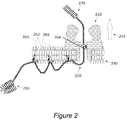
- Figure 2 illustrates a target molecule having four hydrophobic capture elements 261, 262, 263 and 264.
- Hydrophobic capture elements 261, 262 and 263 are shown as captured by the hydrophobic domain of surface 230, which in Figure 2 is depicted as a lipid bilayer.
- Target molecule 220 is shown in Figure 2 as having partially translocated through nanopore 210 in the direction of arrow 215.
- Hydrophobic capture element 264 is depicted as having already been dislodged from the hydrophobic domain of surface 230, and is in the process of translocating through the nanopore.
- a control molecule was prepared having six ligated heterogeneous polymer units, with each polymer unit having four PEG-6 (hexaethyleneglycol phosphodiester) with an amino-modified base.
- One end of the polymer was adapted with a poly-A 50 oligomer (forming the leader) (270).
- the structure on the other end of the polymer is a hairpin loop (290) that is used to prevent backward entry into the pore. The hairpin loop is too large to enter the pore first, but when the hairpin loop is pulled through at the end, the duplex portion will open and unfold the loop, allowing it to translocate.
- This control molecule was compared to a target molecule which is identical except that each pendant amino group (of the amino-modified base) was conjugated with a DiBenzoCycloOctyl (DBCO) hydrophobic moiety (forming the hydrophobic capture element).
- DBCO DiBenzoCycloOctyl
- the DBCO moieties interact with the hydrophobic interior of the lipid bilayer, thus capturing the target molecule on the surface, and thereby increasing the concentration of the leader (the poly-A 50 segment) near the nanopore. Having the leader in close proximity with the nanopore increases the probability that the target molecule will be translocated through the nanopore.
- Translocation frequency through the nanopore (alpha hemolysin) of the target molecule compared to the control molecule showed increases of 30, 15, 9, 10 and 8 times for applied potentials of 100, 110, 120, 130 and 140 mV, respectively.
- the cis and trans reservoirs had 2.0 M LiCl, 10 mM HEPES, pH of 7.4 at a temperature of 10°C and 15 pmol of control or target molecule was added to the 100 ⁇ l cis reservoir.
- the nanopore was a wild-type ⁇ -hemolysin (Sigma Aldrich) and the lipid bilayer was formed on a 13 micron diameter teflon aperture with 1,2-diphytanoyl-sn-glycero-3-phosphoethanolamine (Avanti Polar Lipids) lipid bilayer. (Such methods follow those described by Jetha et al., Chapter 9. Micro and Nano Technologies in Bioanalysis, Humana Press 2009 .)
- capturing the target molecule on the surface comprises contacting the surface with the target molecule, wherein the target molecule comprises the target portion, the hydrophobic capture element and the leader prior to the capturing step.
- capturing the target molecule on the surface comprises contacting the surface with the hydrophobic capture element and linking the hydrophobic capture element to the target portion and leader to yield the captured target molecule on the surface.
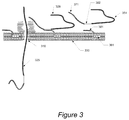
- hydrophobic capture element 361 is captured by the hydrophobic domain of surface 330, which in this figure is depicted as a lipid bilayer.
- the hydrophobic element 361 may be captured during the formation of surface 330 or may be captured after surface 330 is formed.
- Hydrophobic capture element 361 further comprises linking element 381 which permits linkage of hydrophobic capture element 361 to leader 371 and target portion 351 by attachment to corresponding linking element 382. Upon linkage of the capture element to the leader and target portion, target molecule 328 is both formed and captured on the surface.
- the target molecule is capable of diffusing along the surface until the leader of the target molecule is proximal to nanopore 310, as depicted by target molecule 328 in Figure 3 . Such proximity allows the leader to interact with the nanopore, thus drawing the leader and target portion of the target molecule (shown as leader/target portion 325) into the nanopore for translocation there through.
- capture element 361 comprises an aliphatic group and an oligodeoxynucleotide (ODN) linker.
- the aliphatic group (the hydrophobic capture element) remains embedded within the hydrophobic domain of surface 330, which is shown as a lipid bilayer, and the ODN linker extends out of the lipid bilayer and into the aqueous.
- the leader and target portion are adapted with a nucleic acid segment 382 complementary to ODN linker 381. This linker pair is used to join (by hybridization) the leader and target portion to the hydrophobic capture element, thereby forming the target molecule at the surface, as depicted by target molecule 328.
- the aliphatic group diffuses freely throughout the plane of the lipid bilayer. This localization to the plane of the lipid bilayer increases the probability of interaction between the captured target molecule and the nanopore, resulting in the leader being electrophoretically drawn into the nanopore.
- the linker releases (e.g., the hybridized linkage unzips), or the linker remains attached and the hydrophobic capture element is pulled free of the lipid bilayer and is stripped off at the nanopore.
- a representative example of such a hydrophobic capture element is disclosed by Chan et al. (Proceedings of the National Academy of Sciences 106(4): 979-984, 2009 ), which discloses the synthesis of a hydrophobic capture element inserted into a lipid bilayer and linked to a vesicle.
- the hydrophobic portion of the capture element was one of the lipid molecules that forms the lipid bilayer, and this lipid molecule was conjugated to an ODN linker.
- the ODN linker was used to hybridize to a complement ODN that was conjugated to a vesicle, demonstrating capture of the vesicle.
- the hydrophobic capture element may be controlled in size to facilitate diffusive capture of the target molecule with limited diffusive release from the surface, such as a lipid bilayer. However, it should also release with sufficient ease and be sized such that translocation is not interrupted.
- a single length of an aliphatic element that is in-line with the backbone of the target molecule may be utilized. If the length of the aliphatic element is too short, the hydrophilic portions of the target molecule (such as the leader) will limit its interaction with the lipid bilayer's hydrophobic core. Thus, the hydrophobic capture element should be large enough to resist the entropic force that the target molecule will exert.
- the hydrophobic capture element is too long, translocation may be limited due to reduced target molecule mobility in the lipid bilayer; namely, the electrophoretic force required to promote translocation could exceed optimum run conditions and reduce measurement quality.
- excessively long hydrophobic segments may cause target handling issues (particularly in an aqueous environment) and have a disruptive effect on lipid bilayer stability.
- the target molecule may contain additional (i.e., more than one) hydrophobic capture elements.
- embodiments other than linear in-line geometries may be utilized, such as hydrophobic capture elements pendent or branched off the target molecule backbone.
- the hydrophobic capture element may be modified in order to selectively pause translocation through the nanopore, as illustrated by the data presented in the bar graph of Figure 4A .
- translocation frequencies were measured for the linear polymer of Figure 4B with 4 nucleic acid duplexes having total contour length of ⁇ 45 nm (i.e., the target portion).
- the duplexes are used to pause the polymer translocation for a period of time sufficient to measure a distinct current blockage level.
- the blockage level is determined principally by the duplex at the nanopore entrance and the portion of polymer that threads the nanopore barrel. After a stochastic pause, the duplexes are stripped off the polymer backbone and the polymer translocation proceeds until it is paused by the next duplex portion.
- This polymer uses the same 14 base-pair duplex but alternates with threaded portions DDDDAAA or DDDDD, where "D” represents a hexaethyleneglycol phosphodiester linked monomer and "A" is an adenosine deoxynucleotide. Translocation of the molecule can be determined from a characteristic signature of 4 levels alternating between current blockage of 0.31 and 0.18 (relative to open pore current).
- the nanopore was a wild-type ⁇ -hemolysin (Sigma Aldrich) and the lipid bilayer was formed on a 13 micron diameter teflon aperture with 1,2-diphytanoyl-sn-glycero-3-phosphoethanolamine (Avanti Polar Lipids) lipid bilayer.
- the methods follow those described by Jetha et al. (Chapter 9. Micro and Nano Technologies in Bioanalysis, Humana Press 2009 ).
- the 3' end of the target portion was linked to one of three groups:
- Control polymer (1) i.e., target portion joined to leader without hydrophobic capture element
- target molecules (2) and (3) were measured for translocation frequency through a nanopore.
- target molecule (2) C48-polyA 25
- (3) C60-polyA 25
- target polymer (2) increased the number of translocation events/min/pmol by 920 times under the same experimental conditions.
- Nanopore translocations of the target and control could be distinguished by their unique sequence of current blockage signals using the duplex translocation control method described above.
- the results that follow utilize this approach and were derived from measurements made at 20°C and 130 mV.
- the Trans well solution used for these measurements was 2M NH4Cl buffered with 10 mM HEPES/pH7.4; the Cis well solution was 0.4M NH4Cl / 0.6M Guanidine HCl buffered with 10 mM HEPES/pH7.4.
- the nanopore was a wild-type ⁇ -hemolysin (Sigma Aldrich) and the lipid bilayer was formed on a 13 micron diameter teflon aperture generally using 1,2-diphytanoyl-sn-glycero-3-phosphoethanolamine (Avanti Polar Lipids) lipid bilayer. In all cases duplexes are added to the target or control in excess of the number of binding sites by a factor of 100X and are thermally cycled.
- Test molecules were synthesized on a Mermaide 12 oligonucleotide synthesizer (BioAutomation, Texas) using a variety of phosphoamidites listed at the bottom of Figure 5 . In some cases, longer molecules were formed from two parts that are enzymatically ligated to make the full construct.
- Figure 5 shows the composition of the target and control molecules. Each had six duplexed regions that provided a different blockage level sequence when measured in the nanopore.
- FIG. 5 two types of 6-base duplexes are shown adjacent to their complementary sites along the target and control molecules ( 3' AGKCKG 5' and 3' ATKGKT 5' ); each use a modified base-type called a G-Clamp (Glen Research, Sterling, VA, represented as "K") to provide stronger duplexing.
- G-Clamp Glen Research, Sterling, VA, represented as "K"
- This experiment compared translocation rates of the target molecule with five different end-adaptations; namely, dA 6 C 36 dA 24 , dA 5 C 48 dA 24 , dA 4 C 6o dA 24 , C 108 dA 24 and dA 9 dA 24 .
- the first four targets had aliphatic segments of different lengths (hydrophobic capture elements) and the latter end-adaptation had no aliphatic segment.
- the distal dA 24 was the leader.
- the control molecule was end-adapted with dA 5 C 48 dA 24 , and was mixed at equal concentration with one of the target species. For each measurement, a 2 microliter aliquot containing 150 femtomoles of each was injected adjacent to the nanopore and measured. Translocation events were captured and discriminated to calculate translocation rates for both. The target translocation rate was then normalized with the translocation rate of the control molecule.
- Table 1 shows the normalized sample rates of these target molecules after further normalization to the dA 9 dA 24 rate. These are the concentration enhancement factors that indicate the relative increase in sample translocation rates by incorporation of the hydrophobic capture element compared to those without. It is noted that the concentration enhancement factors are less in Table 1 than those shown in Figure 4A . In this regard, it is believed that the Table 1 data were better controlled for concentration which likely accounts for the discrepancy. However, the data presented in both Figure 4A and Table 1 illustrate significant enhancement in translocation rates.
- the leader length that extends beyond the hydrophobic capture element may also be modified for interaction with the nanopore.
- the leader should be of a sufficient length such that its capture in the nanopore exerts enough force to uncouple the target molecule from the bilayer or, depending on the embodiment, unlink the leader/target portion from the hydrophobic capture element.
- the leader should carry electrostatic charge to promote interaction with the nanopore under an applied electric potential.
- a nucleic acid is typically anionic and the leader would typically also be anionic.
- an end portion of the target portion may also function as the leader.
- the leader is typically a single linear polymer, but may have two or more linear polymer portions to help improve nanopore interaction, and should also be able to translocate the nanopore so the target molecule can then engage.
- Leader materials can be synthesized from many anionic, cationic or neutral polymers and may be made of combinations of materials such as (but not limited to) heterogenous or homogeneous polynucleotides, polyethylene glycol, polyvyinyl alcohol, polyphosphates, poly(vinylphosphonate), poly(styrenesulfonate), poly(vinylsulfonate), polyacrylate, abasic deoxyribonucleic acid, abasic ribonucleic acid, polyaspartate, polyglutamate, polyphosphates, and the like.
- a representative leader may comprise PEG-24 and/or poly-A 12 .
- the hydrophobic capture element is designed to promote mobility in the lipid bilayer and maintain the hydrophobically captured state, but limited enough so that the target can be released when interacting with the nanopore.
- the element can extend the target backbone and be in-line with the leader or may be pendant to the backbone or may have multiple elements pendant to the backbone.
- the hydrophobic capture element can be positioned anywhere along the target relative to the leader but can be optimized to improve capture by the nanopore.
- Materials that comprise the hydrophobic capture element include, but are not limited to, linear and branched aliphatic chains, lipids, fatty acids, DBCO, cholesterol, fluorinated polymers, apolar polymers, steroids, polyaromatic hydrocarbons, hydrophobic peptides, and hydrophobic proteins.
- phase transition polymers that can switch from hydrophilic to hydrophobic states under thermal or other environmental change.
- some or all of the heads of the lipids in a bilayer are reactive and can bind to an adapted target molecule as shown by Grenali et al. ( supra ).
- the lipid is the hydrophobic capture element.
- FIG. 3 The method variation shown in Figure 3 was demonstrated using the targets end-adapted with either dA 9 dA 24 or dA 5 C 48 dA 24 and the control shown in Figure 5 .
- a hydrophobic capture element was used that has a C120 on one end (synthesized by linking ten, C12 monomers), and an oligomer at the other end. This oligomer was complementary to a nucleic acid region at the end of the target adjacent to the end modification.
- Figure 7 shows several different versions of this hydrophobic capture element. For each measurement, a 2 microliter aliquot of 300 femtomoles of a capture element was injected into the cis reservoir adjacent to the nanopore.
- the hydrophobic C120 group on the capture element is inserted into the lipid bilayer, with its other oligomer end remaining outside the bilayer in the aqueous buffer.
- the cis reservoir was then exchanged with fresh buffer and a 2 microliter aliquot of sample was added containing 15 femtomoles of target and 15 femtomoles of control.
- the target molecule can hybridize to the capture element and diffuse along the plane of the bilayer.
- the control shown in Figure 5 has no complementary region and will not hybridize to the capture elements described in Figure 7 .
- Nanopore translocation begins when the leader is electrophoretically pulled through and stops at the capture element duplex. The duplex releases due to thermal and electrophoretic pulling forces, allowing translocation to proceed.
- Table 3 shows concentration enhancement factors for these molecules (normalized to the target with no hydrophobic capture element; dA 9 dA 24 ). All measurements were made under the same conditions and concentrations described above. Note that molecules adapted with dA 5 C 48 dA 24 all have a second hydrophobic capture element. Comparing the two CE1 results indicates that having this second hydrophobic capture element increases the concentration enhancement factor. Reducing the duplex length from 16 bases (CE1) to 11 bases (CE2, CE3 and CE4), reduces the stability and enhancement is decreased. The CE2 and CE3 capture elements had similar structure except the C120 hydrophobic group was positioned on opposite ends of the duplex.
- CE4 had 5 PEG-6 spacers between the hydrophobic group and the hybridization site and improved the concentration enhancement relative to both CE2 and CE3, which is believe to be due to relaxing how tightly the duplex was held to the lipid bilayer.
- Table 3 dA 9 dA 24 dA 5 C 48 dA 24 Capture Element None CE1 CE1 CE2 CE3 CE4 Sample Rate (Normalized) 1 417 890 15 100 298
- the surface can be modified to optimize performance of the hydrophobic capture element.
- the surface when the surface is a lipid bilayer, increasing mobility of the captured target molecule increases the probability of leader interaction with the nanopore. For example, increasing the area of the lipid bilayer increases the probability that the target molecules will be captured and migrate to the nanopore.
- Target molecule capture in the bilayer may also be improved by minimizing any undesired trapping on undesired surfaces in the reservoir, such as isolated lipid or non-lipid reservoir walls.
- the use of tethered bilayers is a powerful design tool that could be used to control the relative mobility and capture kinetics of the bilayer surfaces.
- the target molecules can be captured and limited to diffuse in preferred directions along the bilayer surface. For example, by constraining the lipid layer to be a long thin rectangle confines any hydrophobically captured molecules to diffuse principally along its length.
- Figure 9 depicts a supported lipid bilayer (901) used in conjunction with a solid-state nanopore (904).
- Figure 9 is similar to the embodiment depicted in Figure 3 , and depicted in this manner (as opposed to the embodiment of Figures 1 or 2 ) for purpose of illustration only.
- supported lipid layers are synthesized using a tether species (906) that covalently bond to substrate (908) at one end and imbeds into a bilayer on the other end (see J. Jackman et al., "Biotechnology Applications of Tethered Lipid Bilayer Membranes," Materials 5(12):2637-2657, 2012 ).
- a common inorganic film used for solid-state nanopores is silicon nitride which can oxidize to form silicon oxide on its surface.
- Atanasov et al. has shown supported lipid bilayer formation tether-stabilized with lipids adapted with silanes to bond to a silicon oxide surface (" Membrane on a Chip: A Functional Tethered Lipid Bilayer Membrane on Silicon Oxide Surfaces," Biophys J., 89(3):1780-1788, 2005 ).
- These bilayers maintain the required diffusion characteristics that enable the hydrophobically captured molecule to migrate near the nanopore.
- This bilayer does not need to maintain high electrical impedance, but does require that the bilayer integrity be sufficient near the nanopore such that the target molecule leader can be captured.
- Figures 10A and 10B show a supported lipid bilayer (1001) in a shape defined by the diffusion barrier at its edges (1003).
- Arrow (1005) shows the direction that buffer above the bilayer is flowing.
- This flowing buffer applies a shear force to the target molecules (1007) that drags them along until they are interrupted by the diffusion barrier ( Figure 10A represents the location of the target molecules before application of the shear force, while Figure 10B represents location of the target molecules after application of the shear force.)
- the target molecules (1007) are concentrated in an area in proximity to nanopore (1008) (see Figure 10B ).
- This technique can be used to collect and concentrate target molecules in low concentration from larger volumes near a nanopore (or each nanopore in a nanopore array).
- the reservoir may be considered infinite and N R constant.
- N B k Bcapt N R ⁇ k Brel + k B ⁇ trans / A N B when k B ⁇ trans N B / A ⁇ N Bsaturation
- this simplified equation has factor of lipid area, A, that is inserted to normalize the rates of molecule capture/release across a lipid area with the molecules translocating thru a single nanopore on the area. This assumes that molecular depletion from the lipid (due to translocation) happens uniformly across A.
- N B k Bcapt N R / k Brel
- a strong hydrophobic group leads to k BcaPt / k Brel >>1 which leads to high surface concentration of target molecules tethered to the lipid despite relatively low concentration of molecules in the reservoir.
- translocation rates k B-trans and k R-trans are related but differ by the following factors:
- the rate of translocation can have several regimes including:
- Target molecule synthesis is performed using a Mermaide 4 oligonucleotide synthesizer (BioAutomation, Texas) using commercially available amidites (Glen Research, Sterling, VA; Chem Genes, Wilmington, MA).
- the following target molecules are synthesized: Target 1 - (dA) 24 (dCdGdGdGdCdAdAdTdAdA dGdCdCdC); Target 2 - (dA) 24 (Dodecyl phosphodiester) 4 (dA) 5 (dCdGdGdGdGdCdAdA dTdAdAdGdCdCdC);
- Each target molecule was page purified on a 6% acrylamide TBE-Urea gel (Life Technologies, Carlsbad, CA). Both target molecules contain a poly dA leader portion and a stem-loop structure, which is used to control translocation speed and direction.
- Target 2 includes the addition of four dodecyl phosphodiester linked monomers, which create the C48 capture element.
- Each purified target molecule is analyzed using the ⁇ -hemolysin nanopore system described by Jetha et al. (Chapter 9. Micro and Nano Technologies in Bioanalysis, Humana Press 2009 ). Targets are added to the cis reservoir of the nanopore device that contains 100ul 2.0 M LiCl, 10 mM HEPES, pH of 7.4. The trans reservoir contains the same solution. Event frequencies are determined for each target across a range of target inputs (1 fmole to 1 pmole) and voltages (100-140mVolts) to determine the concentration effect of the C48 capture element.
- Detection and identification of nucleic acids at very low concentration is generally not practical without molecular amplification.
- the target molecules can diffuse to the sensor surface in reasonable time periods. If the sensor surface is primarily a hydrophobic domain, target molecules modified with at least one hydrophobic capture element associate and diffuse along the surface. This greatly increases the likelihood of being sensed.
- a microfluid flow cell is designed with a chamber through which electrolyte with sample can pass through.
- the chamber is 100 microns in height, 3 mm wide and 10 mm long with 1.0 mm diameter input and output ports located at the ends on the top side.
- On the top side is glass or polymer that is surface treated to inhibit binding to nucleic acids.
- the bottom side is sealed against a silicon chip that contains a 200 X 500 array of nanopore cells.
- the array lies on a grid with 15 micron centers.
- the outer dimension of the array is 3 mm X 7.5 mm and is centered in the chamber.
- Each cell contains a shallow 10 micron diameter by 3 micron deep well that has an Ag/AgCl electrode at its base.
- the electrode passes current from contacting electrolyte to be measured by the nanopore cell's transconductance amplifier.
- the current-converted voltage outputs from the array of nanopore amplifiers are measured at bandwidths exceeding 1 ksample /s/cell.
- a continuous lipid bilayer is formed in an electrolyte buffer. It is suspended as a membrane over each cell well but is a supported lipid bilayer over the remaining area. Hemolysin nanopores are inserted into the bilayer in a manner to maximize the number of wells with single nanopores.
- the lipid layer that is connected to the substrate is formed so as to electrically isolate adjacent cell wells from current passing between the substrate and the bilayer. This isolation is sufficient that any leakage currents can be ignored compared to currents that pass through the single nanopore.
- a characteristic of the continuous bilayer is that molecules adapted with a hydrophobic group as described herein can associate with the bilayer from the flow chamber and will diffuse anywhere along its surface.
- a pathogen assay uses hybridization and ligation specificity to identify DNA by using the DNA as a template to hybridize and ligate the target shown in Figure 5 with dA 5 C 48 dA 24 L 25 as shown in Figure 6 using methods as taught depicted in U.S. Patent No. 8,586,301 .
- a 3 microliter sample of this ligation product is injected microfluidically to fill the chamber where the ligation products can diffuse until they contact and associate with the lipid bilayer (due to the C 48 group). The ligation products then diffuse along the plane of the lipid bilayer until they are captured and measured in a nanopore.
- This method is highly sensitive because for a 3 microliter sample, all volume diffusing targets are localized to within 100 microns of the active surface, surface-diffusing targets are localized to within 10 microns of a nanopore and measurements provide target specific information from a single molecule.
Landscapes
- Life Sciences & Earth Sciences (AREA)
- Chemical & Material Sciences (AREA)
- Health & Medical Sciences (AREA)
- Engineering & Computer Science (AREA)
- Immunology (AREA)
- Organic Chemistry (AREA)
- Proteomics, Peptides & Aminoacids (AREA)
- Molecular Biology (AREA)
- Zoology (AREA)
- Wood Science & Technology (AREA)
- Analytical Chemistry (AREA)
- Biotechnology (AREA)
- Microbiology (AREA)
- Biochemistry (AREA)
- General Health & Medical Sciences (AREA)
- Physics & Mathematics (AREA)
- Urology & Nephrology (AREA)
- Hematology (AREA)
- Biomedical Technology (AREA)
- Genetics & Genomics (AREA)
- General Engineering & Computer Science (AREA)
- Bioinformatics & Cheminformatics (AREA)
- Biophysics (AREA)
- Cell Biology (AREA)
- Food Science & Technology (AREA)
- Medicinal Chemistry (AREA)
- General Physics & Mathematics (AREA)
- Pathology (AREA)
- Chemical Kinetics & Catalysis (AREA)
- Measuring Or Testing Involving Enzymes Or Micro-Organisms (AREA)
Claims (13)
- Procédé de concentration d'une molécule cible en vue d'une détection par un nanopore, consistant à :capturer la molécule cible sur une surface,la surface comprenant un nanopore et un domaine hydrophobe,la molécule cible comprenant une partie cible, un élément de capture hydrophobe et une séquence de tête pour interaction avec le nanopore, etl'élément de capture hydrophobe étant associé au domaine hydrophobe de la surface et apte à se déplacer le long de celui-ci, afin d'amener la séquence de tête à proximité du nanopore ; etdétecter au moins la partie cible lors d'une interaction avec le nanopore.
- Procédé selon la revendication 1, l'étape de capture de la molécule cible sur la surface comprenant la mise en contact de la surface avec la molécule cible, la molécule cible comprenant, avant l'étape de mise en contact, la partie cible, l'élément de capture hydrophobe et la séquence de tête.
- Procédé selon la revendication 1, l'étape de capture de la molécule cible sur la surface comprenant la liaison de l'élément de capture hydrophobe associé à la surface à la partie cible et à la séquence de tête, ce qui permet de capturer la molécule cible sur la surface.
- Procédé selon la revendication 1, le nanopore étant un nanopore biologique.
- Procédé selon la revendication 1, la surface étant une double couche lipidique.
- Procédé selon la revendication 1, la surface étant une membrane solide ou synthétique.
- Procédé selon la revendication 1, la partie cible comprenant des acides nucléiques.
- Procédé selon la revendication 1, la partie cible comprenant un polymère linéaire.
- Procédé selon la revendication 1, la partie cible comprenant un code-barres moléculaire.
- Procédé selon la revendication 1, la partie cible comprenant un « Xpandomer ».
- Procédé selon la revendication 1, la séquence de tête étant un polymère hydrophile.
- Procédé selon la revendication 1, l'élément de capture hydrophobe étant un hydrocarbure aliphatique.
- Procédé selon la revendication 1, les molécules cibles comprenant deux éléments de capture hydrophobes ou plus.
Applications Claiming Priority (2)
| Application Number | Priority Date | Filing Date | Title |
|---|---|---|---|
| US201261724821P | 2012-11-09 | 2012-11-09 | |
| PCT/US2013/069304 WO2014074922A1 (fr) | 2012-11-09 | 2013-11-08 | Concentration d'une molécule visée en vue d'une détection par un nano-pore |
Publications (2)
| Publication Number | Publication Date |
|---|---|
| EP2917732A1 EP2917732A1 (fr) | 2015-09-16 |
| EP2917732B1 true EP2917732B1 (fr) | 2016-09-07 |
Family
ID=49641879
Family Applications (1)
| Application Number | Title | Priority Date | Filing Date |
|---|---|---|---|
| EP13795658.7A Active EP2917732B1 (fr) | 2012-11-09 | 2013-11-08 | Concentration d'une molécule visée en vue d'une détection par un nano-pore |
Country Status (4)
| Country | Link |
|---|---|
| US (4) | US9670526B2 (fr) |
| EP (1) | EP2917732B1 (fr) |
| CA (1) | CA2890515C (fr) |
| WO (1) | WO2014074922A1 (fr) |
Families Citing this family (53)
| Publication number | Priority date | Publication date | Assignee | Title |
|---|---|---|---|---|
| WO2010086622A1 (fr) | 2009-01-30 | 2010-08-05 | Oxford Nanopore Technologies Limited | Adaptateurs pour des constructions d'acide nucléique dans le séquençage de séquences transmembranaires |
| US9347929B2 (en) | 2011-03-01 | 2016-05-24 | The Regents Of The University Of Michigan | Controlling translocation through nanopores with fluid wall |
| EP3633370B1 (fr) | 2011-05-27 | 2024-05-01 | Oxford Nanopore Technologies plc | Procédé et appareil permettant de déterminer la présence, l'absence ou les caractéristiques d'un analyte |
| IN2014DN00221A (fr) * | 2011-07-25 | 2015-06-05 | Oxford Nanopore Tech Ltd | |
| WO2014013259A1 (fr) | 2012-07-19 | 2014-01-23 | Oxford Nanopore Technologies Limited | Procédé ssb |
| EP2917732B1 (fr) * | 2012-11-09 | 2016-09-07 | Stratos Genomics Inc. | Concentration d'une molécule visée en vue d'une détection par un nano-pore |
| US9557292B2 (en) | 2013-02-25 | 2017-01-31 | The Regents Of The University Of Michigan | Nanopore-based determination of protein charge, shape, volume, rotational diffusion coefficient, and dipole moment |
| BR112015021788B1 (pt) | 2013-03-08 | 2023-02-28 | Oxford Nanopore Technologies Plc | Métodos para mover uma ou mais helicases imobilizadas, para controlar o movimento de um polinucleotídeo alvo, para caracterizar um polinucleotídeo alvo e para controlar o carregamento de uma ou mais helicases em um polinucleotídeo alvo, uso de um poro de transmembrana e de um potencial aplicado e de um ou mais espaçadores, complexo, e, kit |
| GB201314695D0 (en) | 2013-08-16 | 2013-10-02 | Oxford Nanopore Tech Ltd | Method |
| US20150037787A1 (en) * | 2013-07-31 | 2015-02-05 | International Business Machines Corporation | Polynucleotide configuration for reliable electrical and optical sensing |
| GB201406155D0 (en) | 2014-04-04 | 2014-05-21 | Oxford Nanopore Tech Ltd | Method |
| GB201403096D0 (en) | 2014-02-21 | 2014-04-09 | Oxford Nanopore Tech Ltd | Sample preparation method |
| EP3126515B1 (fr) | 2014-04-04 | 2018-08-29 | Oxford Nanopore Technologies Limited | Méthode de caractérisation d'un acide nucléique double brin au moyen d'un nano-pore et de molécules d'ancrage aux deux extrémités dudit acide nucléique |
| US20160003798A1 (en) * | 2014-06-19 | 2016-01-07 | Univ Leland Stanford Junior | Apparatuses and methods for determining analyte charge |
| GB201418159D0 (en) | 2014-10-14 | 2014-11-26 | Oxford Nanopore Tech Ltd | Method |
| GB201418469D0 (en) * | 2014-10-17 | 2014-12-03 | Oxford Nanopore Tech Ltd | Method |
| EP3221327A1 (fr) | 2014-11-20 | 2017-09-27 | Stratos Genomics, Inc. | Esters de phosphoramidate nucléosidiques et leurs dérivés, leur utilisation et leur synthèse |
| AU2016215455A1 (en) * | 2015-02-02 | 2017-08-17 | Ontera Inc. | Labile linkers for biomarker detection |
| EP3256566A4 (fr) | 2015-02-10 | 2018-10-17 | Multerra Bio, Inc. | Appareils et procédés pour détecter des molécules et de l'énergie de liaison |
| GB201609220D0 (en) | 2016-05-25 | 2016-07-06 | Oxford Nanopore Tech Ltd | Method |
| GB201609221D0 (en) | 2016-05-25 | 2016-07-06 | Oxford Nanopore Tech Ltd | Method |
| US10444179B2 (en) | 2016-08-10 | 2019-10-15 | Multerra Bio, Inc. | Apparatuses and methods for detecting molecules and binding energy |
| US9816988B1 (en) | 2016-08-10 | 2017-11-14 | Multerra Bio, Inc. | Apparatuses and methods for detecting molecules and binding energy |
| GB201620450D0 (en) | 2016-12-01 | 2017-01-18 | Oxford Nanopore Tech Ltd | Method |
| GB201707140D0 (en) | 2017-05-04 | 2017-06-21 | Oxford Nanopore Tech Ltd | Method |
| WO2019028361A1 (fr) * | 2017-08-04 | 2019-02-07 | Stratos Genomics Inc. | Détection d'acide nucléique à molécule unique par clivage des mésappariements |
| JP6453960B1 (ja) * | 2017-08-31 | 2019-01-16 | 株式会社東芝 | 検出装置および検出方法 |
| GB201807793D0 (en) | 2018-05-14 | 2018-06-27 | Oxford Nanopore Tech Ltd | Method |
| WO2019226822A1 (fr) * | 2018-05-23 | 2019-11-28 | The Regents Of The University Of California | Procédés d'analyse acides ribonucléiques coiffés |
| GB201809323D0 (en) | 2018-06-06 | 2018-07-25 | Oxford Nanopore Tech Ltd | Method |
| US12188899B2 (en) | 2018-09-07 | 2025-01-07 | Oxford Nanopore Technologies Plc | Sensing compositions, methods, and devices for the detection of molecules using a nanopore device |
| CN113631764A (zh) * | 2019-02-21 | 2021-11-09 | 斯特拉托斯基因公司 | 用于固态合成在单分子测序中使用的可扩展聚合物的方法、组合物和装置 |
| WO2020254672A1 (fr) | 2019-06-19 | 2020-12-24 | Therycell Gmbh | Caractérisation spatiale de structures cibles dans un échantillon |
| GB201915480D0 (en) | 2019-10-25 | 2019-12-11 | Oxford Nanopore Tech Ltd | Improved nanopore sensing device, components and method of manufacture |
| EP4051778A4 (fr) | 2019-10-30 | 2023-11-22 | Stratos Genomics Inc. | Procédés et compositions d'assemblage de nanopores biologiques |
| GB202016874D0 (en) | 2020-10-23 | 2020-12-09 | Oxford Nanopore Tech Ltd | Nanopore support structure and manufacture thereof |
| CN117255945A (zh) | 2021-03-31 | 2023-12-19 | 伊鲁米纳公司 | 纳米孔传感器装置 |
| US20240361297A1 (en) | 2021-11-08 | 2024-10-31 | Illumina, Inc. | Identifying nucleotides using changes in impedance between electrodes |
| EP4499281A1 (fr) | 2022-03-31 | 2025-02-05 | Illumina, Inc. | Barrières comprenant des molécules amphiphiles réticulées, et leurs procédés de fabrication |
| US20250205655A1 (en) | 2022-03-31 | 2025-06-26 | Illumina, Inc. | Amphiphilic polymers to be used in barriers and preparation thereof, barriers with nanopores and preparation thereof |
| CN118973693A (zh) | 2022-03-31 | 2024-11-15 | 伊鲁米纳公司 | 包括用于dna测序的生物纳米孔的屏障、由具有端基和/或中间基团的共聚物制成的该屏障、以及制造该屏障的方法 |
| WO2023187001A1 (fr) | 2022-03-31 | 2023-10-05 | Illumina Cambridge Limited | Dispositifs comprenant des barrières osmotiquement équilibrées, et leurs procédés de fabrication et d'utilisation |
| WO2023187104A1 (fr) | 2022-03-31 | 2023-10-05 | Illumina Cambridge Limited | Dispositifs à nanopores dotés de barrières utilisant des copolymères diblocs ou triblocs, et leurs procédés de fabrication |
| US20230381718A1 (en) | 2022-03-31 | 2023-11-30 | Illumina Cambridge Limited | Barriers including molecules covalently bonded to amphiphilic molecules, and methods of making the same |
| WO2023187081A1 (fr) | 2022-03-31 | 2023-10-05 | Illumina Cambridge Limited | Procédés d'insertion de nanopores dans des membranes polymères à l'aide de solvants chaotropiques |
| EP4689180A1 (fr) | 2023-03-30 | 2026-02-11 | F. Hoffmann-La Roche AG | Modulation d'interactions molécule cible-lipide bicouche |
| US20240392117A1 (en) | 2023-05-25 | 2024-11-28 | Illumina, Inc. | Methods of making barriers including nanopores and crosslinked amphiphilic molecules, and barriers formed using same |
| WO2025000432A1 (fr) * | 2023-06-30 | 2025-01-02 | 深圳华大生命科学研究院 | Procédé de séquençage par nanopores faisant appel à un closer |
| US20250161882A1 (en) | 2023-11-17 | 2025-05-22 | Illumina, Inc. | Fluidic devices, nanopore instruments, and methods |
| WO2026046950A1 (fr) | 2024-08-28 | 2026-03-05 | F. Hoffmann-La Roche Ag | Procédés et compositions pour l'élution sélective selon la taille de macromolécules de xpandomer pour le séquençage de nanopores |
| WO2026050292A1 (fr) | 2024-08-29 | 2026-03-05 | Roche Sequencing Solutions, Inc. | Introduction optimisée de réactif pendant un dosage de séquençage par nanopores |
| WO2026050289A1 (fr) | 2024-08-29 | 2026-03-05 | Roche Sequencing Solutions, Inc. | Protocoles de nettoyage pré- et post-séquençage pour le séquençage par nanopores |
| WO2026050290A1 (fr) | 2024-08-29 | 2026-03-05 | Roche Sequencing Solutions, Inc. | Composition lipidique et procédés d'utilisation dans un essai de séquençage par nanopores |
Family Cites Families (11)
| Publication number | Priority date | Publication date | Assignee | Title |
|---|---|---|---|---|
| WO2000034527A2 (fr) | 1998-12-11 | 2000-06-15 | The Regents Of The University Of California | Codes a barres moleculaires cibles et procedes d'utilisation |
| WO2006028508A2 (fr) | 2004-03-23 | 2006-03-16 | President And Fellows Of Harvard College | Procedes et appareil de caracterisation de polynucleotides |
| WO2008157696A2 (fr) | 2007-06-19 | 2008-12-24 | Stratos Genomics Inc. | Séquençage d'acides nucléiques à haut rendement par expansion |
| EP2215259A1 (fr) | 2007-10-23 | 2010-08-11 | Stratos Genomics Inc. | Séquençage d'acide nucléique à haut débit par espacement |
| CN102066579A (zh) * | 2008-04-24 | 2011-05-18 | 纽约市哥伦比亚大学理事会 | 用于dna分子编排的几何图案和脂质双层以及它们的用途 |
| EP2987864B1 (fr) | 2009-01-29 | 2018-04-25 | Stratos Genomics Inc. | Méthode pour détecter un analyte |
| US8652779B2 (en) * | 2010-04-09 | 2014-02-18 | Pacific Biosciences Of California, Inc. | Nanopore sequencing using charge blockade labels |
| US8586301B2 (en) | 2010-06-30 | 2013-11-19 | Stratos Genomics, Inc. | Multiplexed identification of nucleic acid sequences |
| EP3633370B1 (fr) | 2011-05-27 | 2024-05-01 | Oxford Nanopore Technologies plc | Procédé et appareil permettant de déterminer la présence, l'absence ou les caractéristiques d'un analyte |
| IN2014DN00221A (fr) * | 2011-07-25 | 2015-06-05 | Oxford Nanopore Tech Ltd | |
| EP2917732B1 (fr) * | 2012-11-09 | 2016-09-07 | Stratos Genomics Inc. | Concentration d'une molécule visée en vue d'une détection par un nano-pore |
-
2013
- 2013-11-08 EP EP13795658.7A patent/EP2917732B1/fr active Active
- 2013-11-08 US US14/075,837 patent/US9670526B2/en active Active
- 2013-11-08 WO PCT/US2013/069304 patent/WO2014074922A1/fr not_active Ceased
- 2013-11-08 CA CA2890515A patent/CA2890515C/fr active Active
-
2017
- 2017-05-02 US US15/585,029 patent/US10851405B2/en active Active
-
2020
- 2020-10-15 US US17/071,778 patent/US11920184B2/en active Active
-
2024
- 2024-01-23 US US18/420,048 patent/US20250019742A1/en active Pending
Also Published As
| Publication number | Publication date |
|---|---|
| US20170314062A1 (en) | 2017-11-02 |
| US20140134618A1 (en) | 2014-05-15 |
| CA2890515A1 (fr) | 2014-05-15 |
| CA2890515C (fr) | 2021-11-09 |
| WO2014074922A1 (fr) | 2014-05-15 |
| US20220307067A1 (en) | 2022-09-29 |
| US20250019742A1 (en) | 2025-01-16 |
| EP2917732A1 (fr) | 2015-09-16 |
| US9670526B2 (en) | 2017-06-06 |
| US11920184B2 (en) | 2024-03-05 |
| US10851405B2 (en) | 2020-12-01 |
Similar Documents
| Publication | Publication Date | Title |
|---|---|---|
| US20250019742A1 (en) | Concentrating a target molecule for sensing by a nanopore | |
| US20250027148A1 (en) | Methods for creating bilayers for use with nanopore sensors | |
| US8715933B2 (en) | Assay methods using nicking endonucleases | |
| EP2911771B1 (fr) | Interfaces goutelettes | |
| EP2815235B1 (fr) | Methode aptamere | |
| EP2859340B1 (fr) | Systèmes et procédés de détection électrochimique multiplexée | |
| Mereuta et al. | A nanopore sensor for multiplexed detection of short polynucleotides based on length-variable, poly-arginine-conjugated peptide nucleic acids | |
| Shi et al. | Dynamics of a molecular plug docked onto a solid-state nanopore | |
| Schmidt | Membrane platforms for biological nanopore sensing and sequencing | |
| Loh et al. | Electric single-molecule hybridization detector for short DNA fragments | |
| EP4026916A1 (fr) | Séquençage d'exonucléase activé par des électrodes à nanopores/nanopuits | |
| CN111912892B (zh) | 气单胞菌溶素纳米孔通道在生物磷酸化及相关酶分析中的应用 | |
| US20190093157A1 (en) | Rna nanotubes for single molecule sensing and dna/rna/protein sequencing | |
| EP3511424A1 (fr) | Compositions et procédés pour améliorer le séquençage des nanopores | |
| CN117587110A (zh) | 富集方法、表征分析物的方法及其装置 |
Legal Events
| Date | Code | Title | Description |
|---|---|---|---|
| PUAI | Public reference made under article 153(3) epc to a published international application that has entered the european phase |
Free format text: ORIGINAL CODE: 0009012 |
|
| 17P | Request for examination filed |
Effective date: 20150608 |
|
| AK | Designated contracting states |
Kind code of ref document: A1 Designated state(s): AL AT BE BG CH CY CZ DE DK EE ES FI FR GB GR HR HU IE IS IT LI LT LU LV MC MK MT NL NO PL PT RO RS SE SI SK SM TR |
|
| AX | Request for extension of the european patent |
Extension state: BA ME |
|
| DAX | Request for extension of the european patent (deleted) | ||
| RAP1 | Party data changed (applicant data changed or rights of an application transferred) |
Owner name: STRATOS GENOMICS INC. |
|
| GRAP | Despatch of communication of intention to grant a patent |
Free format text: ORIGINAL CODE: EPIDOSNIGR1 |
|
| INTG | Intention to grant announced |
Effective date: 20160331 |
|
| RIN1 | Information on inventor provided before grant (corrected) |
Inventor name: MCRUER, ROBERT, N. Inventor name: KOKORIS, MARK, STAMATIOS |
|
| GRAS | Grant fee paid |
Free format text: ORIGINAL CODE: EPIDOSNIGR3 |
|
| GRAA | (expected) grant |
Free format text: ORIGINAL CODE: 0009210 |
|
| AK | Designated contracting states |
Kind code of ref document: B1 Designated state(s): AL AT BE BG CH CY CZ DE DK EE ES FI FR GB GR HR HU IE IS IT LI LT LU LV MC MK MT NL NO PL PT RO RS SE SI SK SM TR |
|
| REG | Reference to a national code |
Ref country code: GB Ref legal event code: FG4D |
|
| REG | Reference to a national code |
Ref country code: CH Ref legal event code: EP |
|
| REG | Reference to a national code |
Ref country code: IE Ref legal event code: FG4D |
|
| REG | Reference to a national code |
Ref country code: AT Ref legal event code: REF Ref document number: 827322 Country of ref document: AT Kind code of ref document: T Effective date: 20161015 |
|
| REG | Reference to a national code |
Ref country code: DE Ref legal event code: R096 Ref document number: 602013011233 Country of ref document: DE |
|
| REG | Reference to a national code |
Ref country code: LT Ref legal event code: MG4D |
|
| REG | Reference to a national code |
Ref country code: NL Ref legal event code: MP Effective date: 20160907 |
|
| PG25 | Lapsed in a contracting state [announced via postgrant information from national office to epo] |
Ref country code: HR Free format text: LAPSE BECAUSE OF FAILURE TO SUBMIT A TRANSLATION OF THE DESCRIPTION OR TO PAY THE FEE WITHIN THE PRESCRIBED TIME-LIMIT Effective date: 20160907 Ref country code: FI Free format text: LAPSE BECAUSE OF FAILURE TO SUBMIT A TRANSLATION OF THE DESCRIPTION OR TO PAY THE FEE WITHIN THE PRESCRIBED TIME-LIMIT Effective date: 20160907 Ref country code: NO Free format text: LAPSE BECAUSE OF FAILURE TO SUBMIT A TRANSLATION OF THE DESCRIPTION OR TO PAY THE FEE WITHIN THE PRESCRIBED TIME-LIMIT Effective date: 20161207 Ref country code: LT Free format text: LAPSE BECAUSE OF FAILURE TO SUBMIT A TRANSLATION OF THE DESCRIPTION OR TO PAY THE FEE WITHIN THE PRESCRIBED TIME-LIMIT Effective date: 20160907 Ref country code: RS Free format text: LAPSE BECAUSE OF FAILURE TO SUBMIT A TRANSLATION OF THE DESCRIPTION OR TO PAY THE FEE WITHIN THE PRESCRIBED TIME-LIMIT Effective date: 20160907 |
|
| REG | Reference to a national code |
Ref country code: AT Ref legal event code: MK05 Ref document number: 827322 Country of ref document: AT Kind code of ref document: T Effective date: 20160907 Ref country code: CH Ref legal event code: NV Representative=s name: ING. MARCO ZARDI C/O M. ZARDI AND CO. S.A., CH |
|
| PG25 | Lapsed in a contracting state [announced via postgrant information from national office to epo] |
Ref country code: BE Free format text: LAPSE BECAUSE OF NON-PAYMENT OF DUE FEES Effective date: 20161130 Ref country code: ES Free format text: LAPSE BECAUSE OF FAILURE TO SUBMIT A TRANSLATION OF THE DESCRIPTION OR TO PAY THE FEE WITHIN THE PRESCRIBED TIME-LIMIT Effective date: 20160907 Ref country code: GR Free format text: LAPSE BECAUSE OF FAILURE TO SUBMIT A TRANSLATION OF THE DESCRIPTION OR TO PAY THE FEE WITHIN THE PRESCRIBED TIME-LIMIT Effective date: 20161208 Ref country code: SE Free format text: LAPSE BECAUSE OF FAILURE TO SUBMIT A TRANSLATION OF THE DESCRIPTION OR TO PAY THE FEE WITHIN THE PRESCRIBED TIME-LIMIT Effective date: 20160907 Ref country code: LV Free format text: LAPSE BECAUSE OF FAILURE TO SUBMIT A TRANSLATION OF THE DESCRIPTION OR TO PAY THE FEE WITHIN THE PRESCRIBED TIME-LIMIT Effective date: 20160907 Ref country code: NL Free format text: LAPSE BECAUSE OF FAILURE TO SUBMIT A TRANSLATION OF THE DESCRIPTION OR TO PAY THE FEE WITHIN THE PRESCRIBED TIME-LIMIT Effective date: 20160907 |
|
| REG | Reference to a national code |
Ref country code: FR Ref legal event code: PLFP Year of fee payment: 4 |
|
| PG25 | Lapsed in a contracting state [announced via postgrant information from national office to epo] |
Ref country code: RO Free format text: LAPSE BECAUSE OF FAILURE TO SUBMIT A TRANSLATION OF THE DESCRIPTION OR TO PAY THE FEE WITHIN THE PRESCRIBED TIME-LIMIT Effective date: 20160907 Ref country code: EE Free format text: LAPSE BECAUSE OF FAILURE TO SUBMIT A TRANSLATION OF THE DESCRIPTION OR TO PAY THE FEE WITHIN THE PRESCRIBED TIME-LIMIT Effective date: 20160907 |
|
| PG25 | Lapsed in a contracting state [announced via postgrant information from national office to epo] |
Ref country code: SK Free format text: LAPSE BECAUSE OF FAILURE TO SUBMIT A TRANSLATION OF THE DESCRIPTION OR TO PAY THE FEE WITHIN THE PRESCRIBED TIME-LIMIT Effective date: 20160907 Ref country code: PT Free format text: LAPSE BECAUSE OF FAILURE TO SUBMIT A TRANSLATION OF THE DESCRIPTION OR TO PAY THE FEE WITHIN THE PRESCRIBED TIME-LIMIT Effective date: 20170109 Ref country code: BG Free format text: LAPSE BECAUSE OF FAILURE TO SUBMIT A TRANSLATION OF THE DESCRIPTION OR TO PAY THE FEE WITHIN THE PRESCRIBED TIME-LIMIT Effective date: 20161207 Ref country code: IS Free format text: LAPSE BECAUSE OF FAILURE TO SUBMIT A TRANSLATION OF THE DESCRIPTION OR TO PAY THE FEE WITHIN THE PRESCRIBED TIME-LIMIT Effective date: 20170107 Ref country code: AT Free format text: LAPSE BECAUSE OF FAILURE TO SUBMIT A TRANSLATION OF THE DESCRIPTION OR TO PAY THE FEE WITHIN THE PRESCRIBED TIME-LIMIT Effective date: 20160907 Ref country code: BE Free format text: LAPSE BECAUSE OF FAILURE TO SUBMIT A TRANSLATION OF THE DESCRIPTION OR TO PAY THE FEE WITHIN THE PRESCRIBED TIME-LIMIT Effective date: 20160907 Ref country code: SM Free format text: LAPSE BECAUSE OF FAILURE TO SUBMIT A TRANSLATION OF THE DESCRIPTION OR TO PAY THE FEE WITHIN THE PRESCRIBED TIME-LIMIT Effective date: 20160907 Ref country code: PL Free format text: LAPSE BECAUSE OF FAILURE TO SUBMIT A TRANSLATION OF THE DESCRIPTION OR TO PAY THE FEE WITHIN THE PRESCRIBED TIME-LIMIT Effective date: 20160907 Ref country code: CZ Free format text: LAPSE BECAUSE OF FAILURE TO SUBMIT A TRANSLATION OF THE DESCRIPTION OR TO PAY THE FEE WITHIN THE PRESCRIBED TIME-LIMIT Effective date: 20160907 |
|
| REG | Reference to a national code |
Ref country code: DE Ref legal event code: R097 Ref document number: 602013011233 Country of ref document: DE |
|
| PG25 | Lapsed in a contracting state [announced via postgrant information from national office to epo] |
Ref country code: IT Free format text: LAPSE BECAUSE OF FAILURE TO SUBMIT A TRANSLATION OF THE DESCRIPTION OR TO PAY THE FEE WITHIN THE PRESCRIBED TIME-LIMIT Effective date: 20160907 |
|
| PLBE | No opposition filed within time limit |
Free format text: ORIGINAL CODE: 0009261 |
|
| STAA | Information on the status of an ep patent application or granted ep patent |
Free format text: STATUS: NO OPPOSITION FILED WITHIN TIME LIMIT |
|
| PG25 | Lapsed in a contracting state [announced via postgrant information from national office to epo] |
Ref country code: DK Free format text: LAPSE BECAUSE OF FAILURE TO SUBMIT A TRANSLATION OF THE DESCRIPTION OR TO PAY THE FEE WITHIN THE PRESCRIBED TIME-LIMIT Effective date: 20160907 |
|
| 26N | No opposition filed |
Effective date: 20170608 |
|
| REG | Reference to a national code |
Ref country code: IE Ref legal event code: MM4A |
|
| PG25 | Lapsed in a contracting state [announced via postgrant information from national office to epo] |
Ref country code: SI Free format text: LAPSE BECAUSE OF FAILURE TO SUBMIT A TRANSLATION OF THE DESCRIPTION OR TO PAY THE FEE WITHIN THE PRESCRIBED TIME-LIMIT Effective date: 20160907 |
|
| PG25 | Lapsed in a contracting state [announced via postgrant information from national office to epo] |
Ref country code: LU Free format text: LAPSE BECAUSE OF NON-PAYMENT OF DUE FEES Effective date: 20161130 |
|
| REG | Reference to a national code |
Ref country code: FR Ref legal event code: PLFP Year of fee payment: 5 |
|
| PG25 | Lapsed in a contracting state [announced via postgrant information from national office to epo] |
Ref country code: IE Free format text: LAPSE BECAUSE OF NON-PAYMENT OF DUE FEES Effective date: 20161108 |
|
| PG25 | Lapsed in a contracting state [announced via postgrant information from national office to epo] |
Ref country code: HU Free format text: LAPSE BECAUSE OF FAILURE TO SUBMIT A TRANSLATION OF THE DESCRIPTION OR TO PAY THE FEE WITHIN THE PRESCRIBED TIME-LIMIT; INVALID AB INITIO Effective date: 20131108 |
|
| PG25 | Lapsed in a contracting state [announced via postgrant information from national office to epo] |
Ref country code: CY Free format text: LAPSE BECAUSE OF FAILURE TO SUBMIT A TRANSLATION OF THE DESCRIPTION OR TO PAY THE FEE WITHIN THE PRESCRIBED TIME-LIMIT Effective date: 20160907 Ref country code: MK Free format text: LAPSE BECAUSE OF FAILURE TO SUBMIT A TRANSLATION OF THE DESCRIPTION OR TO PAY THE FEE WITHIN THE PRESCRIBED TIME-LIMIT Effective date: 20160907 Ref country code: MC Free format text: LAPSE BECAUSE OF FAILURE TO SUBMIT A TRANSLATION OF THE DESCRIPTION OR TO PAY THE FEE WITHIN THE PRESCRIBED TIME-LIMIT Effective date: 20160907 |
|
| PG25 | Lapsed in a contracting state [announced via postgrant information from national office to epo] |
Ref country code: MT Free format text: LAPSE BECAUSE OF NON-PAYMENT OF DUE FEES Effective date: 20161108 |
|
| PG25 | Lapsed in a contracting state [announced via postgrant information from national office to epo] |
Ref country code: TR Free format text: LAPSE BECAUSE OF FAILURE TO SUBMIT A TRANSLATION OF THE DESCRIPTION OR TO PAY THE FEE WITHIN THE PRESCRIBED TIME-LIMIT Effective date: 20160907 Ref country code: AL Free format text: LAPSE BECAUSE OF FAILURE TO SUBMIT A TRANSLATION OF THE DESCRIPTION OR TO PAY THE FEE WITHIN THE PRESCRIBED TIME-LIMIT Effective date: 20160907 |
|
| REG | Reference to a national code |
Ref country code: FR Ref legal event code: PLFP Year of fee payment: 10 |
|
| REG | Reference to a national code |
Ref country code: DE Ref legal event code: R081 Ref document number: 602013011233 Country of ref document: DE Owner name: ROCHE DIAGNOSTICS GMBH, DE Free format text: FORMER OWNER: STRATOS GENOMICS INC., SEATTLE, WASH., US |
|
| REG | Reference to a national code |
Ref country code: GB Ref legal event code: 732E Free format text: REGISTERED BETWEEN 20231102 AND 20231108 |
|
| P01 | Opt-out of the competence of the unified patent court (upc) registered |
Free format text: CASE NUMBER: UPC_APP_325390/2023 Effective date: 20230523 |
|
| REG | Reference to a national code |
Ref country code: CH Ref legal event code: U11 Free format text: ST27 STATUS EVENT CODE: U-0-0-U10-U11 (AS PROVIDED BY THE NATIONAL OFFICE) Effective date: 20251201 |
|
| PGFP | Annual fee paid to national office [announced via postgrant information from national office to epo] |
Ref country code: DE Payment date: 20251022 Year of fee payment: 13 |
|
| PGFP | Annual fee paid to national office [announced via postgrant information from national office to epo] |
Ref country code: GB Payment date: 20251022 Year of fee payment: 13 |
|
| PGFP | Annual fee paid to national office [announced via postgrant information from national office to epo] |
Ref country code: FR Payment date: 20251022 Year of fee payment: 13 |
|
| PGFP | Annual fee paid to national office [announced via postgrant information from national office to epo] |
Ref country code: CH Payment date: 20251201 Year of fee payment: 13 |