EP2918190A1 - Applicateur à c'ur ovale et garniture en étoile - Google Patents
Applicateur à c'ur ovale et garniture en étoile Download PDFInfo
- Publication number
- EP2918190A1 EP2918190A1 EP15157693.1A EP15157693A EP2918190A1 EP 2918190 A1 EP2918190 A1 EP 2918190A1 EP 15157693 A EP15157693 A EP 15157693A EP 2918190 A1 EP2918190 A1 EP 2918190A1
- Authority
- EP
- European Patent Office
- Prior art keywords
- fingers
- row
- applicator
- rows
- finger
- Prior art date
- Legal status (The legal status is an assumption and is not a legal conclusion. Google has not performed a legal analysis and makes no representation as to the accuracy of the status listed.)
- Pending
Links
Images


Classifications
-
- A—HUMAN NECESSITIES
- A45—HAND OR TRAVELLING ARTICLES
- A45D—HAIRDRESSING OR SHAVING EQUIPMENT; EQUIPMENT FOR COSMETICS OR COSMETIC TREATMENTS, e.g. FOR MANICURING OR PEDICURING
- A45D40/00—Casings or accessories specially adapted for storing or handling solid or pasty toiletry or cosmetic substances, e.g. shaving soaps or lipsticks
- A45D40/26—Appliances specially adapted for applying pasty paint, e.g. using roller, using a ball
- A45D40/262—Appliances specially adapted for applying pasty paint, e.g. using roller, using a ball using a brush or the like
- A45D40/265—Appliances specially adapted for applying pasty paint, e.g. using roller, using a ball using a brush or the like connected to the cap of the container
- A45D40/267—Appliances specially adapted for applying pasty paint, e.g. using roller, using a ball using a brush or the like connected to the cap of the container comprising a wiper
-
- A—HUMAN NECESSITIES
- A46—BRUSHWARE
- A46B—BRUSHES
- A46B3/00—Brushes characterised by the way in which the bristles are fixed or joined in or on the brush body or carrier
- A46B3/005—Bristle carriers and bristles moulded as a unit
-
- A—HUMAN NECESSITIES
- A46—BRUSHWARE
- A46B—BRUSHES
- A46B3/00—Brushes characterised by the way in which the bristles are fixed or joined in or on the brush body or carrier
- A46B3/04—Brushes characterised by the way in which the bristles are fixed or joined in or on the brush body or carrier by mouldable materials, e.g. metals, cellulose derivatives, plastics
-
- A—HUMAN NECESSITIES
- A46—BRUSHWARE
- A46B—BRUSHES
- A46B9/00—Arrangements of the bristles in the brush body
- A46B9/02—Position or arrangement of bristles in relation to surface of the brush body, e.g. inclined, in rows, in groups
- A46B9/021—Position or arrangement of bristles in relation to surface of the brush body, e.g. inclined, in rows, in groups arranged like in cosmetics brushes, e.g. mascara, nail polish, eye shadow
-
- A—HUMAN NECESSITIES
- A46—BRUSHWARE
- A46B—BRUSHES
- A46B2200/00—Brushes characterized by their functions, uses or applications
- A46B2200/10—For human or animal care
- A46B2200/1046—Brush used for applying cosmetics
- A46B2200/1053—Cosmetics applicator specifically for mascara
Definitions
- the invention relates to a cosmetic applicator and more particularly to a mascara applicator according to the preamble of claim 1.
- wire core brushes were used for the cosmetics and mascara application.
- a number of filaments between the two legs of a U-bent wire is inserted, which is then twisted.
- the filaments are distributed during twisting between the two wire legs and form an applicator with round, mostly helically outwardly projecting bristles.
- the applicator must have the best possible mass storage properties in order to be able to dive into the mascara mass only once and then treat all lashes with the desired layer thickness.
- the applicator must also have so-called combing properties and release properties, because thickly coated eyelashes must not stick together, but are separated by skillful use of the applicator from each other.
- the invention is based on the object to provide an applicator with optimized application and release properties.
- a cosmetic applicator having a rod-shaped core from which molded-on fingers protrude.
- a rod-shaped core is understood to mean a core which extends along the longitudinal axis L of the applicator and whose extent in this direction is at least 5 times, better 10 times, greater than the maximum core diameter.
- the rod-shaped core will usually be massive. Under certain circumstances, it could also be hollow, tube-like.
- Fingers are here understood order organs, which can either be bendable substantially in all directions and are then called bristles or have the property of comb teeth.
- the rod has a non-round cross section, so that its jacket consists of a plurality of mutually delimitable peripheral surfaces. These peripheral surfaces are formed by alternately arranged large and small side surfaces.
- a large side surface is characterized by the fact that its free surface is larger than that of a small side surface.
- the free surface of a large side surface is at least a factor of 2 larger than the surface of a small side surface.
- each of the large side surfaces are exactly or at least substantially the same size and all the small side surfaces are exactly or at least substantially the same size.
- the finger attachment is adapted to the respective side surfaces
- the stocking of the small side surfaces comprises disks
- the stocking of the large side surfaces preferably consists exclusively of bristles.
- the invention is supported, if one optionally curved the large side surfaces concave inwards, towards the central longitudinal axis of the applicator, forming.
- the side surfaces then form a kind of shell or groove in the direction parallel to the longitudinal axis, which is not completely removed from the mass in the passage of the Fingererbesatzes by the scraper, which makes a significant contribution to the good mass storage properties.
- Also conducive to the invention is the option to make the small side surfaces concave arched outward, again based on the central longitudinal axis. With proper dimensioning, this allows the fingers made of the disks to protrude far outwards, so that it is possible to comb and separate without any problem, without at the same time applying further mass.
- peripheral surface of the core consists of at least and ideally only three large and three small side surfaces which alternately follow one another in the circumferential direction.
- each with only three small and three large side surfaces allows the discs, which are then preferably in each case in the region of the tip of the triangle thus formed in the broadest sense, to leave extremely far outward.
- the disks in each case such that they have two large main surfaces, two side surfaces and a radially outward end surface.
- the two main surfaces are completely or at least substantially perpendicular to the applicator longitudinal axis.
- the two main surfaces preferably run substantially perpendicular to the longitudinal axis of the applicator when the smaller angle, which each main surface encloses with respect to the applicator longitudinal axis, is not less than 87 °.
- the two main surfaces on each disc preferably run towards each other in a radially outward direction.
- the two side surfaces preferably run in the radial direction V-shaped apart.
- each of the two major surfaces of the respective disc has a free surface that is at least 2.5 times the free surface area of one of its side surfaces.
- At least the vast majority of the discs are designed so that the radially outward end face is inclined so that each disc has a longer in the radial direction and a shorter side surface in the radial direction.
- the disk in question is thus cut obliquely in the region of its end face.
- the disc has a preferred direction, with which it penetrates best between individual eyelashes, depending on whether the applicator is rotated in one direction or the other during the application. This increases the flexibility in the application behavior, depending on how to move the applicator, you can realize quite different application results.
- the disks are optionally designed such that they form a chisel edge in their radially outward end face.
- a chisel cutting is meant here a local, quasi roof-shaped tapering of the discs to their radially outward end face. Such a taper is formed by the fact that the main surfaces of the disc reinforce at its extreme end, namely roof-like one another.
- each disk run towards each other as a whole in a radially outward direction, so that the disk as a whole forms an edge. From an additional chisel cutting edge can then be waived without further notice.
- the cosmetic applicator according to the invention is designed such that the trimming of the small side surfaces consists of at least three and preferably only three rows of fingers which follow one another in the direction of the applicator longitudinal axis.
- the middle row of these fingers preferably consists exclusively of bristles, while the two lateral rows are preferably rows in which bristles and discs alternate in the direction along the applicator longitudinal axis.
- the change takes place so that after a bristle always follows a disc and vice versa, so that they are always set up alternately.
- Such an embodiment leads to exposed discs, with the help of which, as already mentioned, can be combed well.
- a disc is provided only every other time, with a respective bristle between two discs, in the respective row. This prevents too narrow interstices between the discs which would result in excessive mascara remaining after the applicator has been withdrawn by the wiper.
- the middle row of fingers forming the trimming of the small side surfaces has a lower total number of fingers than the two lateral rows.
- the smaller number of fingers is realized in that a finger belonging to the middle row is arranged only at the level of each second finger of the two outer rows counted in the direction of the applicator longitudinal axis. In this way, one can provide a relatively large clearance along a circumferential line between the discs, because no bristle is set up here in the middle row. A central between two discs, seen in the circumferential direction, standing bristle would have due to the dominance of the discs no Function, but would rather bother. Because of this, it is left out.
- each bristle of the two outer finger rows is in alignment along a common circumferential line.
- a slice of the two outer rows of bristles and a bristle of the middle row of bristles are each a slice of the two outer rows of bristles and a bristle of the middle row of bristles in alignment along a common circumferential line. Then the game starts from the beginning.
- this repeat begins either with two bristles of the two outer rows of bristles positioned circumferentially in a row and then continues as described or this repeat begins at the free end face with two each along a circumferential line in an alignment standing discs of the two outer rows of fingers and one arranged in the same flight in the middle between them bristles of the middle row of fingers.
- the fingers of the middle row of those fingers which respectively form the trimming of a small side surface are longer and preferably longer by at least a quarter than the fingers of the respective laterally adjacent rows belonging to the same small end face of the cosmetic applicator , In this way, it is the fingers of the middle row of a small face that protrude furthest. These fingers thus represent the most exposed organs, with the help of which the separation can be very sensitively begun, which is then continued by the discs, which are also quite exposed and subsequently penetrate between the eyelashes.
- the stocking of the large side surfaces consists in each case of only three rows of bristles arranged consecutively in alignment in the direction of the applicator longitudinal axis. On the large side surfaces so only bristles are provided. This means that the large side surfaces are those surfaces that are mainly used to apply cosmetics or mascara.
- the middle row of the fingers forming the trimming of the large side surfaces has a lower total number of fingers than the two lateral rows.
- a finger belonging to the middle row is arranged only at the level of each second finger of the two outer rows viewed in the direction of the applicator longitudinal axis.
- the three rows of bristles which each form the trimming of one of the large side surfaces, progressively form the following repeat in the direction of the applicator longitudinal axis: one bristle each of the two outer finger rows is aligned along a common circumferential line. This is followed in each case by a single bristle of the middle bristle row as it progresses in the direction of the applicator longitudinal axis. The next progress in the direction of the applicator longitudinal axis is followed by a respective bristle of the two outer finger rows, which are aligned along a common circumferential line. Then, with further progress in the direction of the applicator longitudinal axis, a single bristle again joins the middle row of bristles.
- this repeat can be done either from the free end of the core starting with two Starting bristles of the two outer rows of bristles, which are consecutive along a line in the circumferential direction, or with a bristle of the middle row.
- the bristles which form the trimming of the large side surfaces are each at least a quarter shorter than or the larger or better all the fingers which in each case form the trimming of a small side surface.
- the core of the applicator is crescent-shaped in a plane.
- the applicator core thus assumes the shape of a sickle when viewed in the relevant plane.
- a small side surface of the core forms the outside of the sickle, i. H. the convexly curved back of the sickle.
- the fingers forming the finger attachment of the small side surface, and in particular the fingers formed therebelow experience maximum release, so that, when the applicator is held in place, optimal separation action is achieved by means of the disc-shaped fingers can, because they are so free that there is virtually no danger that during the separation of the eyelashes in undesirable manner come into contact with the finger attachment of the large side surface, which holds mainly the mascara mass stored.
- a cosmetic applicator with a rod-shaped core and integral with the peripheral surface of the Kerns connected fingers claimed, which are arranged in rows in the direction parallel to the longitudinal axis of the applicator, wherein progressing in the circumferential direction following stocking pattern several times, preferably three times, repeated:
- a first row of fingers consisting of discs having a maximum extension ra1 in the radial direction, immediately adjacent thereto at least one second row of fingers consisting of bristles having a maximum extension ra2 in the radial direction, immediately adjacent to the one or more , preferably two second rows, a third row of fingers consisting of discs having in the radial direction a maximum extension ra1, immediately adjacent thereto a fourth row of fingers having a maximum extension ra3 in the radial direction, such that it is instantaneous adjacent thereto, preferably, a fifth row of fingers is provided, which have a maximum extent ra3 * in the radial direction, ideally (optionally) immediately adjacent a sixth row of fingers being provided which have a maximum extent ra3 in the radial direction, where ra2> ra1 > ra3, ideally at the same time ra3> ra3 *.
- independent protection for a Kosmetikapplikatorsystem is claimed with a cosmetic applicator of the type described and a scraper, wherein the extension of the fingers in the radial direction with the scraper is tuned so that the scraper, the first row and third row of fingers not or preferably substantially does not strip off and the scraper strips the one or more second rows in an area that is minimally equal to the radially outermost 1/5 of the finger and at most the radially outermost 1/2 of the finger and that the scraper the fourth and optional fifth as well as the optional sixth row of fingers does not strip off.
- the outer diameter of the stem is greater in its circumference than the diameter predetermined by the bristles of the fourth or fifth or sixth row of fingers, it is ensured that the wiper does not lay down the fingers of the fourth or fifth or sixth row but the fingers of these rows subvert the scraper, so to speak. In this way, in the area of the fingers and radially above the area of the fingers and usually radially above the area of these fingers even after the complete passage of the applicator by the scraper remains a not inconsiderable depot of mascara mass, what the effective application of mascara without multiple reloading of the applicator by dipping into the mascara mass much easier.
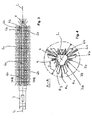
- the Fig. 1 shows an embodiment of an applicator according to the invention frontally from the front.
- the Fig. 2 shows the same embodiment seen from the side.
- the Fig. 3 shows the same embodiment seen from the side.
- the Fig. 4 shows a section along the line AA, which in Fig. 3 is marked.
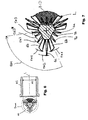
- Fig. 5 illustrates in general what is meant by a finger in the form of a bristle within the meaning of the invention.
- Fig. 6 illustrates the system of applicator and scraper, which forms a further focus of the invention.
- the Fig. 7 shows an enlarged view of the of Fig. 6 shown applicator for the purpose of demonstrating how the repeat repeat on different fingers in the circumferential direction.
- the Fig. 2 gives the quickest overview of the embodiment described here for the applicator 1 according to the invention.
- the applicator 1 consists of a core 2, which is here sickle-shaped curved, but optionally also may be straight, which is not shown here figuratively.
- the core 2 could go directly into a stem, which in turn is connected to a handle, for example.
- a stem which in turn is connected to a handle, for example.
- the core 2 is not integrally connected to a stem, but carries a coupling portion 3, with the help of which he at one corresponding stalk can be set, which is made separately, optionally together with the handle.
- the applicator according to the invention is used in particular as a mascara applicator, accordingly its dimensions are filigree.
- the total length GL of the occupied bristles portion is usually less than 40 mm, usually even less than 30 mm.
- the maximum outer diameter Dmax that the applicator has, including its fill is shown in FIG. Fig. 4 .
- This maximum outer diameter corresponds to the diameter of the smallest circumference that can be applied to the applicator (cf. Fig. 4 ) and is usually ⁇ 10 mm, typically even ⁇ 8 mm.
- the coupling section in turn typically has a length K of ⁇ 12.5 mm.
- the core 2 has no circular cross-section. Instead, the core is profiled so that its peripheral surface consists of small side surfaces 4 and 5 large side surfaces. As can be seen, the small side surfaces 4, with respect to the center of the core, are convexly curved outwards, whereas in the case of the large side surfaces 5, they are preferably just inverted, they are curved concavely inwards, likewise with respect to the center of the core.
- the profiling of the core 2 is preferably selected so that three small side surfaces 4 and three large side surfaces 5 are present, which, as seen in the circumferential direction in turn follow each other alternately.
- a variant would be to provide not three each small and three large side surfaces of the type mentioned, but instead four such side surfaces.
- Fig. 4 sets the applicator for the expert from the mass of the prior art applicators.
- the applicator has arranged at an angle of 3 x 120 ° and preferably on its small side surfaces each have a row of fingers, which far surmounted the surrounding finger rows, preferably by at least 1 ⁇ 4 of the length thereof. This gives the applicator a striking, star-shaped appearance and, due to the strong exposure of this finger row, a novel application behavior.
- the said rows of fingers are each framed on both sides by disc-shaped fingers which are chamfered towards the fingers of the protruding row of fingers.
- the supporting effect of these disc-shaped fingers contributes to an even more pronounced expression of the novel application behavior.
- These three rows R1, R2, R3 are preferably arranged so that a central row R2 runs parallel to the longitudinal axis of the core 2 in the middle of the small side surface 4.
- the other two finger rows R1, R3, which form the finger cover of the small side surfaces 4 are preferably placed symmetrically with respect to the middle finger row R1.
- the setup is such that the two lateral finger rows R1, R2 form a V-shaped arrangement relative to one another, seen from the front side, and the middle row of fingers R2 is arranged on the bisector between the two V-legs.
- the bristle density of the middle row R2 which is involved here in the formation of the finger attachment of the small side surface 4, is only half the size of the finger density of the two outer rows R1 and R3.
- only one bristle 6c is provided in the middle row R2, where one disc 6b of the two outer finger rows R1 and R3 is provided on the left and right of this bristle 6c.
- a bristle 6a is provided in both outer finger rows R1 and R3
- the middle row R2 has no bristle here, but a vacancy.
- FIG. 4 Another look in particular at the Fig. 4 shows that the fingers of the middle row of fingers R2, which is involved in the formation of the finger attachment of the small side surface 4, are at least a quarter in the radial direction longer than the fingers of the two outer finger rows R1 and R3, the formation of the finger of the small side surface 4 are involved.
- the fingers 6c of the middle finger row R2 precisely because they are designed as long bristles, represent a very sensitive handling applicator element. They do not affect the combing effect emanating from the discs 6b, especially since the middle bristles 6c are preferably provided only with a lower density.
- the discs 6b which belong to the fingers of the two outer finger rows R1 and R3, which are involved in the formation of the finger attachment of the small side surface 4, with its circumferentially outer edge just tangle or marginally cross, with the one small side surface 4 merges into a large side surface 5, the discs are thus "on edge".
- each disk 6b which are involved here in the formation of the finger attachment of the small side surface, it holds that these disks 6b each have two preferably substantially orthogonal to the longitudinal axis of the applicator on their front and back sides have aligned major surfaces H, two circumferentially facing side surfaces S and a radially outward end face ST.
- the two side surfaces preferably run apart in the radial direction in a V-shape.
- the two main surfaces H are larger in area by at least a factor of 3, better by a factor of 4 than the two side surfaces S.
- the discs 6b are preferably made quite slender - usually significantly slimmer than the discs commonly used in cosmetic applicators. Therefore, each disc at the height of its free end face, based on the central longitudinal axis, preferably occupies only an arc angle AL of ⁇ 15 ° better still of ⁇ 11 °.
- each disk 6b has a side surface S that is longer in the radial direction and shorter in the radial direction.
- the shape of the inventively preferred discs 6b can be described as "like a loop with an obliquely cut end.”
- the discs 6b form a chisel cutting edge on its radially outward end face, ie a blade-like tapering. This facilitates the splitting of the eyelashes by combing them apart from the chisel cutters, even when they are mascara-covered.
- the stocking of the large side surfaces consists in each case of only three rows RI, RII and RIII of successively in the direction of the applicator longitudinal axis in an alignment behind fingers, which are preferably designed as continuous bristles.
- a fourth row RIV for example in the form of a central double or twin row, could optionally be added, but this is excluded in the context of preferred exemplary embodiments and is not illustrated here in the drawing.
- the arrangement of the finger rows RI to RIII relative to each other is similar to the arrangement of the finger rows R1 to R3 relative to each other, which form the finger attachment of the small side surfaces.
- each finger 7a of the outer finger rows RI and RIII is aligned along a common circumferential line. If one proceeds from there in the direction parallel to the longitudinal axis, then follows a single finger 7b of the middle row of fingers RII. Upon further progression along the applicator longitudinal axis, a finger 7a of the two outer finger rows RI and RIII follows again, which are aligned along a common circumferential line. Then, as the progression progresses, a single finger 7b of the middle row of fingers follows again.
- the fingers 7a of the two outer finger rows RI and RIII make the beginning or a finger 7b of the middle row of fingers RII.
- the described repeat then continues in the direction of the applicator longitudinal axis L until the end of the bristle facing is reached.
- the fingers of the middle row RII terminate with their outer, free ends preferably radially (ie, in a further radially inward direction) earlier than the fingers of the brims surrounding them and together with them large lateral surface forming fingers of the two outer rows RI and RIII.
- the core 2 of the applicator 1 is in a plane, namely in the drawing plane, in which the Fig. 3 is shown, sickle-shaped curved.
- a small face 4 forms the outside of the sickle, resulting in Fig. 3 marked with the arrow A.
- the core 2 and all its fingers 6a-c and 7a, b are injected in one shot of the same material.
- a tubular core is formed, from which a part of the fingers or bristles protrudes as an integral part and from which protrude a further number of fingers or bristles, which with a second, the interior of the core filling plastic through the Openings are integrally connected in the core.
- bristles 8 preferably at least 9 pieces, which the applicator carries on the free end face of its core 2.
- These bristles are preferably arranged at an angle of not more than 30 ° obliquely to the applicator longitudinal axis.
- These bristles optionally enter into a very effective operative connection with the exposed bristles and the discs supporting them, which can characterize the applicator according to the invention.
- the exposed bristles and discs allow a very efficient combing and separation on a greater length, while the bristles on the front side allow to work on the already good combing and separation results locally.
- a bristle is here understood to mean a rod-shaped body whose maximum diameter Dbmax in the region above the curve / throat, with which it merges into the core 2, is smaller by a factor of 4, better by at least a factor of 6, than the free length of the bristle with which it protrudes from the applicator core.
- a finger to be classified as a bristle is so elastic that the amount AE around which the tip of the bristle said body can be elastically deflected from its rest position to the side, without the bristle being damaged, at least by a factor of 4, better at least by a factor of 5 greater than the maximum diameter Dbmax defined above.
- a bristle is typically a body that can be deflected elastically in all directions perpendicular to the direction of its longitudinal axis, while the disk has at least two opposite directions, by resisting being bent.
- FIGS. 6 and 7 serve to describe still another aspect of the invention as follows:
- bristles 6c Progressing in a clockwise direction, at least one second row of fingers, consisting of bristles 6c, is found immediately next to it.
- the bristles 6c are also arranged in the direction parallel to the longitudinal axis one behind the other along the core 2.
- the bristles 6c have a maximum extension ra2 in the radial direction, as also in FIG Fig. 7 indicated by a circle cutout.
- this row can be doubled if necessary, ie there are then two second rows of fingers which are formed by bristles 6c, but this is not shown figuratively ,
- a third row of fingers is provided, which in turn consists of discs 6b.
- the disks 6b are set up along a line in the direction parallel to the longitudinal axis L and preferably also have a maximum extent ra1 in the radial direction.
- a fourth row of fingers 7a is set up. These fingers are also placed one behind the other along the core 2 in the direction parallel to the longitudinal axis L. These fingers of the fourth row have in the radial direction maximum extension ra3. The fingers of the fourth row are designed as bristles 7a.
- a fifth row of fingers formed by bristles 7b is provided next to it, again advancing clockwise along the arrow BM. These bristles are also parallel in a line along the longitudinal axis L. These bristles 7b have a maximum extent ra3 * in the radial direction, as through the corresponding circular section in FIG Fig. 7 indicated.
- another sixth row of fingers is provided, which in turn are formed by bristles 7a.
- This sixth row is found clockwise along the arrow BM immediately adjacent to the fifth row.
- the sixth row is preferably the last row of fingers before repeating the repeat described so far in the circumferential direction.
- the fingers of this sixth row have a maximum extent ra3 in the radial direction, and it is thus preferable for the radial extent of the fourth row and the sixth row, if present, to be identical.
- the same fingers are always set up in an alignment in a direction parallel to the longitudinal axis.
- a useful for some applications variant could be that at least in a row in a row one after the other in the direction parallel to the longitudinal axis established fingers are always bristles and discs alternately, which is not shown figuratively.
- This bristle arrangement has a functional sense.
- the applicator and the associated wiper are in fact so matched to one another that the wiper partly wears off the one or more second rows of bristles 6c, namely preferably in a region which corresponds at least to the radially outermost fifth of the bristle 6c and at most the radially outermost half of the bristle 6c Bristle 6c corresponds.
- This means that the radial extent ra2 of these bristles 6c is correspondingly greater than the stripper inner diameter AD, cf.
- Fig. 6 where it can be seen that the radially expressed quarter of the bristle 6c has a larger radius than the corresponding scraper inner radius AD / 2, so that the outermost quarter of the bristle 6c is folded over and stripped off.
- the fingers of the first and second rows are preferably designed with respect to their maximum radial extension so that the scraper does not strip the first and third rows of fingers, or preferably substantially not.
- there is talk of a "not being stripped off substantially” if only the radially outermost sixth and better still the maximum radially outermost eighth of these fingers are stripped off.
- the radial extent ra2 of these bristles 6c is correspondingly greater than the stripper inner diameter AD, cf. also Fig. 6 ,
- Another optional embodiment has a scraper, which is dimensioned in diameter so that it strikes more without giving up the described support function. Here it is then so that of a "not be stripped substantially" then the speech, if at most the radially outermost third and better yet the maximum radially outermost quarter of these fingers of the first and third row is stripped off.
- the repeat is repeated several times in the circumferential direction along the core 2 of the applicator, such that the applicator is held in a centric position when passing through the scraper, because the trimming arrangement is correspondingly symmetrical. It is particularly favorable if the repeat is repeated three times.
- Cosmetic applicator 1 which is characterized in that the discs 6b each have two major surfaces H, two side surfaces S and a radially outward end face ST, wherein the two major surfaces H perpendicular to the Applikatorlijnsachse L and the two side surfaces S preferably in the radial direction V-shaped diverge, from her foot to her free end.
- Cosmetic applicator 1 which is characterized in that the stocking of the large side surfaces 5 each of only three rows (RI, RII, RIII) consists in each case in the direction of the applicator longitudinal axis (L) in an alignment behind one another fingers 7a, 7b, which are preferably all bristles.
- Cosmetic applicator 1 which is characterized in that the middle row RII of the stocking of the large side surfaces 5 forming fingers 7b has a lower total number of fingers than the two lateral rows RI, RIII, preferably by only at the level of each counted in the direction of the Applikatorl Kunststoffsachse second finger 7a of the two outer rows RI, RIII a belonging to the middle row RII finger 7b is arranged.
- Cosmetic applicator 1 which is characterized in that the three rows RI, RII, RIII of fingers 7a, 7b, which respectively form the finger of one of the large side surfaces 5, in the direction of the Applikatorl Kunststoffsachse L progressively form the following repeat: one finger 7a of the two outer rows of fingers (RI, RIII) are aligned along a common perimeter, followed by a single finger 7b of the middle row of bristles RII, followed by a respective finger 7a of the two outer rows of fingers RI, RIII in alignment along a common perimeter followed by a single finger 7b of the middle row of fingers RII, etc.
- Cosmetic applicator 1 which is characterized in that the fingers 7a, 7b, preferably in the form of bristles, which form the trimming of the large side surfaces 5, are each at least 1 ⁇ 4 shorter than the predominant number and preferably all the fingers 6a, 6b, 6c, each forming the trimming of a small side surface 4.
- the core of the applicator has a core diameter that changes in the direction of the longitudinal axis and becomes smaller, for example, so that the applicator is fitted, preferably approximately like a peanut. Such an applicator stands out then by the fact that its core diameter at the top is greater than in the middle.
Landscapes
- Chemical & Material Sciences (AREA)
- Engineering & Computer Science (AREA)
- Materials Engineering (AREA)
- Brushes (AREA)
Applications Claiming Priority (2)
| Application Number | Priority Date | Filing Date | Title |
|---|---|---|---|
| DE202014100982.5U DE202014100982U1 (de) | 2014-03-05 | 2014-03-05 | Applikator mit unrundem Kern und Sternbesatz |
| DE202014103325.4U DE202014103325U1 (de) | 2014-07-18 | 2014-07-18 | Applikator mit unrundem Kern und Sternbesatz |
Publications (1)
| Publication Number | Publication Date |
|---|---|
| EP2918190A1 true EP2918190A1 (fr) | 2015-09-16 |
Family
ID=52630235
Family Applications (1)
| Application Number | Title | Priority Date | Filing Date |
|---|---|---|---|
| EP15157693.1A Pending EP2918190A1 (fr) | 2014-03-05 | 2015-03-05 | Applicateur à c'ur ovale et garniture en étoile |
Country Status (2)
| Country | Link |
|---|---|
| US (1) | US9730504B2 (fr) |
| EP (1) | EP2918190A1 (fr) |
Cited By (1)
| Publication number | Priority date | Publication date | Assignee | Title |
|---|---|---|---|---|
| FR3074661A1 (fr) * | 2017-12-11 | 2019-06-14 | L'oreal | Applicateur pour appliquer un produit cosmetique |
Families Citing this family (10)
| Publication number | Priority date | Publication date | Assignee | Title |
|---|---|---|---|---|
| DE202012103567U1 (de) * | 2012-09-18 | 2013-12-19 | Geka Gmbh | Faltbarer Applikator |
| FR3012022B1 (fr) * | 2013-10-22 | 2016-06-24 | Albea Services | Applicateur pour produit cosmetique et ensemble applicateur associe |
| FR3017783B1 (fr) * | 2014-02-24 | 2016-02-26 | Albea Services | Applicateur pour produit cosmetique, notamment pour mascara et ensemble applicateur associe |
| FR3053580B1 (fr) * | 2016-07-07 | 2018-07-06 | Albea Services | Applicateur pour produit cosmetique et ensemble applicateur associe |
| JP2018191843A (ja) * | 2017-05-16 | 2018-12-06 | ロレアル | まつげもしくは眉毛をとかすため、および/または、調合物をまつげもしくは眉毛に塗布するためのアプリケータ |
| USD859848S1 (en) * | 2018-01-03 | 2019-09-17 | Brivaplast S.R.L. | Mascara brush |
| WO2020025861A1 (fr) * | 2018-08-03 | 2020-02-06 | Societe Industrielle De Matieres Plastiques | Dispositif applicateur d'un produit fluide |
| USD1083397S1 (en) * | 2022-09-28 | 2025-07-15 | Geka Gmbh | Cosmetic brush |
| USD1040528S1 (en) * | 2023-05-04 | 2024-09-03 | Societe Industrielle De Matieres Plastiques | Mascara brush |
| US12268291B1 (en) * | 2023-06-14 | 2025-04-08 | Elaine S. Ritchey | Mascara applicator with container and method of use |
Citations (4)
| Publication number | Priority date | Publication date | Assignee | Title |
|---|---|---|---|---|
| EP2084987A1 (fr) * | 2008-02-01 | 2009-08-05 | Geka Brush Gmbh | Petite brosse cosmétique dotée de soies moulées sur un corps de base |
| WO2011045770A1 (fr) * | 2009-10-15 | 2011-04-21 | L'oreal | Dispositif pour appliquer une composition aux cils ou sourcils |
| DE102004027098B4 (de) | 2004-06-01 | 2013-10-10 | Geka Gmbh | Applikator für flüssige oder pastöse Medien, insbesondere dekorative Kosmetika wie Mascara |
| DE202013105086U1 (de) * | 2013-11-12 | 2013-11-19 | Geka Gmbh | Applikator mit Besatz aus gekrümmten Borsten und Finnen |
Family Cites Families (4)
| Publication number | Priority date | Publication date | Assignee | Title |
|---|---|---|---|---|
| USD634127S1 (en) * | 2009-12-10 | 2011-03-15 | The Procter & Gamble Company | Cosmetic brush |
| FR2962015B1 (fr) * | 2010-07-01 | 2012-08-31 | Oreal | Applicateur pour appliquer un produit sur les cils. |
| US9254028B2 (en) * | 2010-07-29 | 2016-02-09 | L'oreal | Applicator and a packaging and applicator device including such an applicator |
| FR2973991B1 (fr) | 2011-04-12 | 2013-05-03 | Oreal | Brosse a mascara |
-
2015
- 2015-03-04 US US14/639,021 patent/US9730504B2/en active Active
- 2015-03-05 EP EP15157693.1A patent/EP2918190A1/fr active Pending
Patent Citations (4)
| Publication number | Priority date | Publication date | Assignee | Title |
|---|---|---|---|---|
| DE102004027098B4 (de) | 2004-06-01 | 2013-10-10 | Geka Gmbh | Applikator für flüssige oder pastöse Medien, insbesondere dekorative Kosmetika wie Mascara |
| EP2084987A1 (fr) * | 2008-02-01 | 2009-08-05 | Geka Brush Gmbh | Petite brosse cosmétique dotée de soies moulées sur un corps de base |
| WO2011045770A1 (fr) * | 2009-10-15 | 2011-04-21 | L'oreal | Dispositif pour appliquer une composition aux cils ou sourcils |
| DE202013105086U1 (de) * | 2013-11-12 | 2013-11-19 | Geka Gmbh | Applikator mit Besatz aus gekrümmten Borsten und Finnen |
Cited By (2)
| Publication number | Priority date | Publication date | Assignee | Title |
|---|---|---|---|---|
| FR3074661A1 (fr) * | 2017-12-11 | 2019-06-14 | L'oreal | Applicateur pour appliquer un produit cosmetique |
| WO2019115243A1 (fr) * | 2017-12-11 | 2019-06-20 | L'oreal | Applicateur permettant l'application d'un produit cosmétique |
Also Published As
| Publication number | Publication date |
|---|---|
| US9730504B2 (en) | 2017-08-15 |
| US20150257514A1 (en) | 2015-09-17 |
Similar Documents
| Publication | Publication Date | Title |
|---|---|---|
| EP1161159B1 (fr) | Pinceau applicateur pour produits liquides ou pateux, en particulier pour cosmetiques de maquillage tels que le mascara, et son procede de production | |
| EP1646299B1 (fr) | Brosse a dents manuelle | |
| EP2281478B1 (fr) | Brosse à mascara dotée d'un organe de soutien des cils | |
| EP2471409B1 (fr) | Dispositif applicateur, notamment pour un applicateur cosmétique | |
| EP2822420B1 (fr) | Brosse à noyau constitué de fils comprenant une feuille torsadée | |
| DE202010017159U1 (de) | Applikatoreinrichtung, insbesondere für einen Mascaraapplikator, Kosmetikapplikator, insbesondere Mascaraapplikator aufweisend die Applikatoreinrichtung und Applikationseinheit aufweisend die Applikatoreinrichtung | |
| DE10102219A1 (de) | Applikator für flüssige oder pastöse Medien, insbesondere dekorative kosmetika wie Mascara | |
| WO2012055727A1 (fr) | Dispositif applicateur pour appliquer un cosmétique, élément applicateur à cet effet ainsi qu'unité cosmétique présentant le dispositif applicateur | |
| EP1992251A1 (fr) | Petites brosses cosmétiques dotées de nombreuses soies destinées à l'application d'un produit cosmétique | |
| DE202011106282U1 (de) | Hohle Mascarabürste | |
| DE202014103677U1 (de) | Abstreifer mit Armstützen | |
| DE202016103629U1 (de) | Kosmetikapplikator mit Beflockung und Borsten | |
| EP3457888A1 (fr) | Applicateur de cosmétique doté de soies spéciales | |
| EP3174434B1 (fr) | Applicateur à âme en fil métallique comprenant des poils à plusieurs matériaux | |
| DE202013105086U1 (de) | Applikator mit Besatz aus gekrümmten Borsten und Finnen | |
| DE202013009431U1 (de) | Kosmetikapplikator 2 in 1 | |
| DE202012002307U1 (de) | Gedrillte Bürste mit am distalen Ende parallelen Borsten | |
| DE202014001947U1 (de) | Haar-Applikatorbürste zum Erzeugen von Strähnchen | |
| DE202014103653U1 (de) | Durch Flächenelemente untereinander verbundene, benachbarte Borsten | |
| DE202014103325U1 (de) | Applikator mit unrundem Kern und Sternbesatz | |
| DE202014100982U1 (de) | Applikator mit unrundem Kern und Sternbesatz | |
| DE202014105838U1 (de) | Kosmetikeinheit mit durch den Abstreifer vorpositioniertem Applikator | |
| DE102017211242A1 (de) | Reinigungsstäbchen mit Faserkörper | |
| DE202004007010U1 (de) | Kosmetikbürstchen | |
| DE202017100440U1 (de) | Applikator mit schwenkbaren borstenbesetzten Flügeln |
Legal Events
| Date | Code | Title | Description |
|---|---|---|---|
| PUAI | Public reference made under article 153(3) epc to a published international application that has entered the european phase |
Free format text: ORIGINAL CODE: 0009012 |
|
| AK | Designated contracting states |
Kind code of ref document: A1 Designated state(s): AL AT BE BG CH CY CZ DE DK EE ES FI FR GB GR HR HU IE IS IT LI LT LU LV MC MK MT NL NO PL PT RO RS SE SI SK SM TR |
|
| AX | Request for extension of the european patent |
Extension state: BA ME |
|
| 17P | Request for examination filed |
Effective date: 20160316 |
|
| RBV | Designated contracting states (corrected) |
Designated state(s): AL AT BE BG CH CY CZ DE DK EE ES FI FR GB GR HR HU IE IS IT LI LT LU LV MC MK MT NL NO PL PT RO RS SE SI SK SM TR |
|
| STAA | Information on the status of an ep patent application or granted ep patent |
Free format text: STATUS: EXAMINATION IS IN PROGRESS |
|
| 17Q | First examination report despatched |
Effective date: 20180328 |