EP2919152A2 - Appareil de traitement d'image et procédé de traitement d'image - Google Patents
Appareil de traitement d'image et procédé de traitement d'image Download PDFInfo
- Publication number
- EP2919152A2 EP2919152A2 EP15153014.4A EP15153014A EP2919152A2 EP 2919152 A2 EP2919152 A2 EP 2919152A2 EP 15153014 A EP15153014 A EP 15153014A EP 2919152 A2 EP2919152 A2 EP 2919152A2
- Authority
- EP
- European Patent Office
- Prior art keywords
- pupil region
- image
- halation
- pupil
- region
- Prior art date
- Legal status (The legal status is an assumption and is not a legal conclusion. Google has not performed a legal analysis and makes no representation as to the accuracy of the status listed.)
- Granted
Links
Images





Classifications
-
- G—PHYSICS
- G06—COMPUTING OR CALCULATING; COUNTING
- G06T—IMAGE DATA PROCESSING OR GENERATION, IN GENERAL
- G06T5/00—Image enhancement or restoration
- G06T5/77—Retouching; Inpainting; Scratch removal
-
- H—ELECTRICITY
- H04—ELECTRIC COMMUNICATION TECHNIQUE
- H04N—PICTORIAL COMMUNICATION, e.g. TELEVISION
- H04N1/00—Scanning, transmission or reproduction of documents or the like, e.g. facsimile transmission; Details thereof
- H04N1/46—Colour picture communication systems
- H04N1/56—Processing of colour picture signals
- H04N1/60—Colour correction or control
- H04N1/62—Retouching, i.e. modification of isolated colours only or in isolated picture areas only
- H04N1/624—Red-eye correction
-
- G—PHYSICS
- G06—COMPUTING OR CALCULATING; COUNTING
- G06T—IMAGE DATA PROCESSING OR GENERATION, IN GENERAL
- G06T5/00—Image enhancement or restoration
- G06T5/40—Image enhancement or restoration using histogram techniques
-
- G—PHYSICS
- G06—COMPUTING OR CALCULATING; COUNTING
- G06V—IMAGE OR VIDEO RECOGNITION OR UNDERSTANDING
- G06V40/00—Recognition of biometric, human-related or animal-related patterns in image or video data
- G06V40/10—Human or animal bodies, e.g. vehicle occupants or pedestrians; Body parts, e.g. hands
- G06V40/16—Human faces, e.g. facial parts, sketches or expressions
- G06V40/168—Feature extraction; Face representation
-
- G—PHYSICS
- G06—COMPUTING OR CALCULATING; COUNTING
- G06V—IMAGE OR VIDEO RECOGNITION OR UNDERSTANDING
- G06V40/00—Recognition of biometric, human-related or animal-related patterns in image or video data
- G06V40/10—Human or animal bodies, e.g. vehicle occupants or pedestrians; Body parts, e.g. hands
- G06V40/18—Eye characteristics, e.g. of the iris
- G06V40/193—Preprocessing; Feature extraction
-
- H—ELECTRICITY
- H04—ELECTRIC COMMUNICATION TECHNIQUE
- H04N—PICTORIAL COMMUNICATION, e.g. TELEVISION
- H04N23/00—Cameras or camera modules comprising electronic image sensors; Control thereof
- H04N23/60—Control of cameras or camera modules
- H04N23/61—Control of cameras or camera modules based on recognised objects
- H04N23/611—Control of cameras or camera modules based on recognised objects where the recognised objects include parts of the human body
-
- G—PHYSICS
- G06—COMPUTING OR CALCULATING; COUNTING
- G06T—IMAGE DATA PROCESSING OR GENERATION, IN GENERAL
- G06T2207/00—Indexing scheme for image analysis or image enhancement
- G06T2207/20—Special algorithmic details
- G06T2207/20172—Image enhancement details
-
- G—PHYSICS
- G06—COMPUTING OR CALCULATING; COUNTING
- G06T—IMAGE DATA PROCESSING OR GENERATION, IN GENERAL
- G06T2207/00—Indexing scheme for image analysis or image enhancement
- G06T2207/30—Subject of image; Context of image processing
- G06T2207/30196—Human being; Person
- G06T2207/30201—Face
-
- G—PHYSICS
- G06—COMPUTING OR CALCULATING; COUNTING
- G06T—IMAGE DATA PROCESSING OR GENERATION, IN GENERAL
- G06T2207/00—Indexing scheme for image analysis or image enhancement
- G06T2207/30—Subject of image; Context of image processing
- G06T2207/30216—Redeye defect
Definitions
- the present invention relates to an image processing apparatus configured to correct an image in which a brightness defect has occurred.
- JP 2007-235531A discloses a digital camera according to which a region in which red-eye has occurred is detected in a captured image and tone correction is performed on the region.
- Halation is an example of a phenomenon other than the red-eye phenomenon.
- Halation is a phenomenon in which blown-out highlights appear in a pupil due to the flash being reflected strongly in the pupil.
- tone brightness information and iris pattern information are lost, and therefore this problem cannot be addressed with processing similar to that of red-eye correction.
- JP 4537142B discloses an image processing method of separately extracting a region in which red-eye has occurred and a region in which halation has occurred, and subjecting them to correction using respectively different methods.
- JP 2007-235531A and JP 4537142B are examples of background art.
- pixels having a brightness value greater than or equal to a threshold value are extracted from a region in which a tone defect has occurred, and it is determined that halation has occurred in the pixels.
- determining the occurrence of halation using a fixed threshold value is problematic in that incorrect determination is likely to occur. In other words, if all of the pixels are brighter, the number of pixels having brightness values greater than or equal to the threshold value will increase, and therefore there is a risk that it will be determined that halation has occurred even if halation has not occurred. The inverse is similarly true, in that if the entire image is underexposed and dark, there is a risk that no brightness values will exceed the threshold value and it will consequently be determined that halation has not occurred, even if halation has occurred.
- This problem occurs not only due to the lightness or darkness of the image, but also due to individual differences between imaged people. For example, in the case of an iris with a light color such as blue, the brightness values of the pixels will be higher compared to the case of an iris with a dark color such as brown. In other words, the probability of a determination that halation has occurred will increase even if the state of halation is the same.
- the present invention has been made with consideration given to the above-described problems, and it is an object thereof to provide an image processing apparatus that can correctly determine a state of halation that has occurred in an eye.
- an image processing apparatus configured to correct at least part of a face image
- the image processing apparatus including: an image acquisition unit configured to acquire an input image; a region extraction unit configured to extract a pupil region, which is a region corresponding to an eye of a person, from the input image; a pixel extraction unit configured to, in the pupil region, extract a pixel whose brightness value is higher than a threshold value; a determination unit configured to, based on the result of extraction performed by the pixel extraction unit, determine whether or not halation has occurred in the pupil region; and a correction unit configured to, based on the result of determination performed by the determination unit, perform processing for correcting halation on the pupil region, wherein the pixel extraction unit sets the threshold value based on a bias of a brightness distribution of the pixels included in the pupil region.
- the image processing apparatus is an apparatus that extracts a pupil region from an input image, determines whether or not halation has occurred in the pupil region, and subsequently performs halation correction.
- a pupil region is a region corresponding to a person's pupil and is typically a circular region in which the central point of the pupil is the central coordinate.
- the present invention is not limited to this.
- the threshold value is set based on the bias of the brightness distribution of the pixels included in the pupil region.
- the threshold value is set to a higher brightness, and if the distribution is biased toward a low brightness side, the threshold value is set to a lower brightness. Also, if the brightness distribution has multiple peaks, or in other words, if the distribution is divided into a high brightness class and a low brightness class, the threshold value may be set to a value according to which the classes are divided.
- the determination unit may determine that halation has occurred in the pupil region.
- the number of pixels whose brightness value is greater than a threshold value is larger compared to the case where only highlights exist in the pupil region. In other words, it is possible to estimate whether or not halation has occurred by determining the percentage of these pixels in the pupil region.
- the threshold value may be a value according to which the brightness distribution of the pixels included in the pupil region is separated into a high brightness class and a low brightness class.
- the threshold value can be set to a value according to which a high brightness class, which is the class corresponding to the halation, and a low brightness class, which is a class other than the high brightness class, are separated, it is possible to improve the accuracy of halation determination.
- Class separation can be performed using any method.
- the determination unit may calculate a degree of separation, which is a ratio between an intra-class variance and an inter-class variance in the brightness distribution of the pixels included in the pupil region and set the threshold value to a value according to which the degree of separation is maximized.
- the separation of the high brightness class and the low brightness class is performed using discriminant analysis. Specifically, the ratio between the intra-class variance and the inter-class variance is obtained as the degree of separation, and a threshold value is obtained according to which the degree of separation is maximized. The thus-obtained threshold value is a value according to which the classes are separated most favorably.
- the correction unit may perform halation correction processing regardless of the result of the determination performed by the determination unit.
- the correction unit if the degree of separation is less than or equal to a predetermined value and the average of the brightness values of the pixels included in the pupil region is less than or equal to a predetermined value, it is possible for the correction unit to not perform halation correction processing regardless of the result of the determination performed by the determination unit.
- Having a low degree of separation in the brightness distribution means that an independent halation region in the pupil region cannot be detected. In other words, either no halation at such a level as to be corrected has occurred, or halation has occurred over the entire pupil region.
- the average of the brightness values of the pixels included in the pupil region For example, if the average of the brightness values of the pixels included in the pupil region is higher than a predetermined value, it can be estimated that halation has occurred over the entire pupil region. In such a case, it is preferable to perform halation correction processing on the pupil region regardless of the result of the determination performed by the determination unit. Also, if the average of the brightness values of the pixels included in the pupil region is lower than a predetermined value, it can be estimated that halation requiring correction has not occurred. In such a case, it is preferable to not perform halation correction processing on the pupil region regardless of the result of the determination performed by the determination unit.
- the correction unit may store a pupil image corresponding to a pupil region, and if halation occurs in a pupil region, perform halation correction by pasting the corresponding pupil image on the target pupil region.
- Halation correction can be performed by pasting a pupil image in a normal state on a target pupil region.
- the correction unit may deform the pupil image into a shape matching that of a target pupil region and thereafter paste it on the pupil region, and the correction unit may correct the pupil image to a tone matching that of a target pupil region and thereafter paste it on the pupil region.
- the correction unit may perform halation correction by pasting a pupil image acquired from the second pupil region on the first pupil region.
- an image processing apparatus configured to correct halation that has occurred in a face image
- the image processing apparatus including: an image acquisition unit configured to acquire an input image; a region extraction unit configured to extract a pupil region, which is a region corresponding to an eye of a person, from the input image; a determination unit configured to determine whether or not halation has occurred in the pupil region; and a correction unit configured to, in the case where halation has occurred in the pupil region, perform halation correction by pasting a corresponding pupil image on the target pupil region.
- the present invention can be specified as an image processing apparatus including at least a portion of the above-described units. Also, the present invention can be specified as an image processing method. Also, the present invention can be specified as a program for causing a computer to execute the above-described image processing method.
- the processing and units described above can be implemented in any combination as long as no technical conflicts occur.
- an image processing apparatus capable of correctly determining a state of halation that has occurred in an eye.
- the image processing apparatus is an apparatus that, upon detecting that a tone abnormality or a brightness abnormality has occurred in a pupil of a person included in an image, performs correction on the pupil.
- FIG. 1 is an image of a system configuration of an image processing apparatus 10 according to the present embodiment.
- the image processing apparatus 10 is constituted by an image acquisition unit 11, a pupil detection unit 12, a pupil state determination unit 13, a correction unit 14, and an input/output unit 15.
- the image acquisition unit 11 is a unit configured to acquire an image that is to be subjected to processing, and is typically a storage device such as a fixed disk drive or a flash memory. Note that the image acquisition unit 11 may be a unit configured to acquire an image from an external apparatus (e.g., an interface apparatus or a wireless communication apparatus), and it may be a unit configured to capture an image via a lens or an image sensor.
- an external apparatus e.g., an interface apparatus or a wireless communication apparatus
- the pupil detection unit 12 is a unit configured to extract a region corresponding to a person's pupil from an image acquired by the image acquisition unit 11. Specifically, upon detecting a person's face from the image and clipping an image in which both eyes are included, the positions of the eyes are specified in the image and the central points of the pupils are determined. Also, a circular region centered on a central point of a pupil (referred to below as a "pupil region”) is extracted. Note that in the present specification, the word "pupil region" is used as a word expressing a region having a predetermined size whose central coordinate is the central point of a pupil.
- the pupil state determination unit 13 is a unit configured to determine the state of the pupil region extracted by the pupil detection unit 12. Specifically, it determines whether or not red-eye has occurred, whether or not gold-eye has occurred, and whether or not halation has occurred. The determination method will be described in detail later. Note that gold-eye is a tone defect phenomenon in which a pupil appears yellow due to principles similar to those causing red-eye.
- the correction unit 14 is a unit configured to perform correction of red-eye or gold-eye and halation based on the result of determination performed by the pupil state determination unit 13.
- the region that is to be subjected to correction by the correction unit 14 need not necessarily be the same as the pupil region. For example, it may be a region obtained by removing a region corresponding to skin from the pupil region.
- the input/output unit 15 is a unit configured to receive an input operation performed by a user and present information to the user. Specifically, it is constituted by a touch panel, a control unit for the touch panel, a liquid crystal display, and a control unit for the liquid crystal display.
- the touch panel and the liquid crystal display are composed of one touch panel display in the present embodiment.
- Control of the units described above is realized by a processing device such as a CPU executing a control program.
- the control function may be realized by an FPGA (Field Programmable Gate Array), an ASIC (Application Specific Integrated Circuit), or the like, or a combination thereof.
- An image 201 shown in FIG. 2A is an example of an image obtained by cutting out a region around the eyes from an image of a person acquired by the image acquisition unit 11.
- Reference numeral 202 is a region corresponding to a pupil (a pupil region). Here, it is assumed that halation caused by flash reflection has occurred in the pupil region 202.
- FIG. 2B is a brightness value histogram for the pixels included in the pupil region 202.
- the image 201 is an RGB image, a histogram for a monochrome image is illustrated here in order to simplify the description.
- the horizontal axis of the histogram indicates brightness values, and the vertical axis indicates frequency (number of pixels).
- the distribution of brightness can be used to determine whether or not halation has occurred in the pupil region. If halation has occurred, the brightness distribution will protrude on the high brightness side.
- the portion indicated by reference numeral 203 is a protruding portion in the brightness distribution caused by halation.
- a determination that the brightness distribution protrudes on the high brightness side can be made based on the percentage of pixels having a brightness value that exceeds a threshold value. For example, if the number of pixels whose brightness value is higher than a threshold value 204 is not less than a predetermined percentage (e.g., not less than 20%) of the pixels included in the pupil region 202, it can be determined that halation has occurred in the pupil region.
- a predetermined percentage e.g., not less than 20%
- FIG. 3 is an example of a case in which the brightness distribution is biased in the low brightness direction, or in other words, a case in which the entire image is in a state of under-exposure.
- the percentage of pixels whose brightness is higher than the threshold value 204 decreases. In other words, there is a risk that it will be determined that halation has not occurred, even if halation has occurred.
- FIG. 4 is an example of a case in which the brightness distribution is biased in the high brightness direction, or in other words, a case of a state of over-exposure.
- the percentage of pixels whose brightness is higher than the threshold value 204 increases. In other words, there is a risk that it will be determined that halation has occurred even if halation has not occurred.
- This problem is caused not only by the exposure state, but also by differences in iris color. For example, if the iris of a target person is brightly-colored, the brightness values will shift in the high brightness direction, compared to the case of a dark-colored iris. In other words, an incorrect determination similar to that described above can occur.
- the threshold value is set dynamically based on the bias of the brightness distribution of the pixels included in the pupil region.
- the threshold value is set to a value according to which the histogram peak on the high brightness side and the histogram peak on the low brightness side are separated, it is possible to correctly determine the occurrence of halation.
- the class in which the brightness values are lower than the threshold value t is a low brightness class
- the class in which the brightness values are higher than the threshold value t is a high brightness class.
- ⁇ 1 , m 1 , and ⁇ 1 be the number of pixels, the average of the brightness values, and the variance of the brightness values respectively in the low brightness class
- ⁇ 2 , m 2 , and ⁇ 2 be the number of pixels, the average of the brightness values, and the variance of the brightness values respectively in the high brightness class.
- ⁇ t , m t , and ⁇ t be the number of pixels, the average of the brightness values, and the variance of the brightness values respectively of all pixels included in the pupil region.
- the total value of the variances of the classes can be expressed using equation 1.
- the variance of the average values of the classes can be expressed using equation 2.
- the overall variance is the total value of the above-described intra-class variance and the inter-class variance.
- the image processing apparatus uses the thus-obtained threshold value t to calculate the percentage of pixels corresponding to the high brightness class among the pixels included in the pupil region and determine halation.
- the threshold value t By dynamically setting the threshold value t, it is possible to accurately determine whether or not halation has occurred in the pupil region.
- the above-described processing is advantageous in the case where the brightness distribution is sufficiently separated into a low brightness class and a high brightness class.
- the brightness distribution is not sufficiently separated into a low brightness class and a high brightness class, correction of halation cannot be correctly performed in some cases because of incorrectly determination whether or not halation has occurred.
- FIG. 6 shows an example of a case in which the distribution is biased in the low brightness direction.
- the class representing the flash reflection is indicated by reference numeral 601.
- a reflection of this level is a normal highlight, not halation.
- the threshold value t will end up being set at an undesirable position, such as the position indicated by reference numeral 602. As a result, it is incorrectly determined that halation has occurred in the pupil region in some cases.
- FIG. 7 shows an example of a case in which the distribution is biased in the high brightness direction. If halation has occurred over the entirety of the pupil region, the brightness distribution will be biased in the high brightness direction, as shown here.
- the threshold value t will end up being set at an undesirable position, such as the position indicated by reference numeral 701. As a result, it is incorrectly determined that halation has not occurred in the pupil region in some cases.
- the image processing apparatus is provided with an exception in the halation determination using the threshold value t.
- a pattern in which halation correction is not to be performed regardless of the determination result, and a pattern in which halation correction is to be performed regardless of the determination result are defined.
- halation correction is not to be performed (regardless of the determination result) if the degree of separation of the classes is sufficiently low and the average of the brightness values is sufficiently low, it can be estimated that halation has not occurred in the first place.
- halation correction is to be performed (regardless of the determination result) if the degree of separation of the classes is sufficiently low and the average of the brightness values is sufficiently high, it can be estimated that halation has occurred over most of the pupil region.
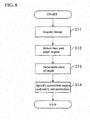
- FIG. 8 is a processing flowchart for the image processing apparatus 10 according to the present embodiment.
- the processing is started by a user operation (e.g., an operation of loading a stored image). Note that in the present embodiment, processing for correcting red-eye and gold-eye is performed at the same time as halation correction processing. Processing for correcting red-eye and gold-eye will be described as needed.
- step S11 the image acquisition unit 11 acquires an image.
- an image stored in advance is acquired from a storage device, but the image may be acquired via a communication means or an image capturing means.
- step S12 the pupil detection unit 12 extracts regions corresponding to a face and a pupil from the acquired image.
- FIG. 9 is a flowchart showing details of the processing performed in step S12. Steps S121 to S124 are executed by the pupil detection unit 12.
- step S121 a rectangular region (face region) corresponding to a face included in the image is extracted. Since the method for extracting the face region from the image is a publicly-known method, a detailed description thereof will not be given here.
- step S122 an eye included in the face region is detected. Specifically, an RGB image corresponding to the face region is converted into a monochrome image, and feature points corresponding to the outer corner, inner corner, and center of the eye are extracted. With this step, a region for searching for a pupil is specified. Note that if feature points fail to be extracted, after filtering is performed, an eye may be detected using matching processing.
- step S123 the image is normalized. Specifically, the face region is subjected to clipping so as to generate a rectangular image of a predetermined size that includes an eye. At this time, the resolution may be converted using an arbitrary interpolation method. Also, if the face region is not level, processing for rotating the image may be performed. Note that the processing of steps S123 to S124 is performed on one eye at a time.
- step S124 the central point of the pupil, which is located in the detected eye, is searched for. Since the method for searching for the central point of the pupil is publicly-known, it will not be described in detail here. For example, it is possible to extract candidate points using a triple filter and determine that a candidate point with the highest score is the central point of the pupil.
- a circular region of a predetermined size is generated around that point, resulting in a pupil region.
- the predetermined size may be a fixed size, and it may be a size that changes for each person.
- the shape of the region may be circular, it may be elliptical and it may be another shape.
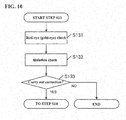
- step S13 the pupil state determination unit 13 determines the state of the pupil region. Since there are three types of tone defects and brightness defects that occur in a pupil, namely "red-eye”, “gold-eye”, and “halation”, in this step, it is determined which of these types applies to the state of the pupil.
- FIG. 10 is a flowchart showing details of the processing performed in step S13. Note that “red-eye” or “gold-eye” and “halation” may occur at once. Steps S131 to S133 are executed by the pupil state determination unit 13. Note that the processing of step S13 is performed on one eye at a time.
- step S131 it is checked whether or not a tone defect is visible in the pupil region, or in other words, whether or not red-eye or gold-eye has occurred.
- FIG. 11 is a flowchart showing details of the processing performed in step S131.
- step S1311 the color space of the image is converted from an RGB color space to a Lab color space.
- step S1312 it is determined whether or not the pixels included in the pupil region satisfy one of the following conditions.
- ⁇ and d are parameters for color in the CIE Lab color system. In other words, it is determined whether or not the color of the pixels is red.
- step S1313 it is determined whether or not the number of pixels that satisfy the above conditions makes up a predetermined percentage or more (e.g. 10% or more) of the pixels in the pupil region, and if it does, it is determined that red-eye has occurred in the pupil region (step S1314). Also, if not, it is determined that red-eye has not occurred in the pupil region (step S1315).
- a predetermined percentage or more e.g. 10% or more
- the determination of gold-eye can be performed using a method similar to the method used in the determination of red-eye.
- the color conditions need only be replaced with those corresponding to a gold color (yellow). For example, it is possible to use the following condition.
- the color space of the image is converted into Lab and the hue is determined thereafter, but the hue may be determined using another method.
- Step S132 is processing for checking whether or not halation has occurred in the pupil region.
- FIG. 12 is a flowchart showing details of the processing performed in step S132. Steps S1321 to S1326 are performed by the pupil state determination unit 13.
- step S1321 the color space of the image is converted from an RGB color space to greyscale.
- step S1322 a threshold value t for separating the brightness values of the pixels included in the pupil region into a high brightness class and a low brightness class is calculated using discriminant analysis, and the degree of separation at that time is obtained. Consequently, if the obtained degree of separation is higher than a predetermined value, the processing moves to step S1323 to perform halation determination.
- step S1323 halation determination is performed using the threshold value t obtained in step S1322.
- the percentage, with respect to the whole, of pixels having a brightness exceeding the threshold value t is calculated, and if the obtained percentage is greater than or equal to a predetermined percentage, it is determined that halation has occurred (step S1325), and if it is smaller than a predetermined percentage, it is determined that halation has not occurred (step S1326).
- step S1322 If the degree of separation obtained in step S1322 is lower than a predetermined value, or in other words, the brightness distribution has not been sufficiently separated into a high brightness class and a low brightness class, it means halation has not occurred or halation has occurred in most of the pupil region. Therefore, in order to distinguish between these two states, the processing moves to step S1324.
- step S1324 the average of the brightness values of the pixels in the pupil region is acquired, and it is determined whether the average value is higher or lower than the predetermined value. If it is consequently determined that the average value is higher than the predetermined value, it can be estimated that halation has occurred in most of the pupil region, and therefore it is determined that halation has occurred (step S1325). On the other hand, if the average value is lower than the predetermined value, it is determined that halation has not occurred (step S1326).
- step S133 If, as a result of checking for red-eye and gold-eye and checking for halation, correspondence to at least one of these defects is determined in step S133, the processing moves to step S14. If no correspondence is determined, the processing is ended.
- step S14 the correction unit 14 corrects the pupil region.
- FIG. 13 is a flowchart showing details of the processing performed in step S14. Steps S141 to S146 are executed by the correction unit 14. Note that the processing of step S14 is performed on one eye at a time.
- step S141 the image is normalized. Specifically, the face region is subjected to clipping so as to generate a rectangular image of a predetermined size that is centered about the central coordinates of the pupil. At this time, the resolution may be converted using any interpolation method. Also, if the face region is not level, processing for rotating the image may be performed.
- a correction region is a region that is to be subjected to correction.
- the correction region generated here is an elliptical region having a predetermined size, centered about the central coordinates of the pupil.
- the correction region may be the same region as the pupil region.
- step S143 the region corresponding to skin is removed so as to form a region. Specifically, a skin-colored region is detected using a Lab color space, and the corresponding region is deleted. At this time, information regarding the shape and arrangement may be used in addition to color information to delete the region corresponding to skin, and processing for removing noise may be added. Furthermore, it is also possible to perform multiple processes using different references and combine the processing results thereof. By executing this step, only the region corresponding to the interior of the eye is extracted.
- step S144 the processing branches according to the correction target. It is thought that performing the determination in step S13 results in three patterns, namely (1) red-eye or gold-eye, (2) halation, and (3) both. Among these, (1) can be addressed using only tone correction. However, with (2), information needs to be supplemented (halation correction) since brightness information and iris pattern information are lost due to halation. Furthermore, with (3) as well, halation correction needs to be performed with priority since brightness information is lost.
- step S145 red-eye correction or gold-eye correction is performed (step S145), and if (2) or (3) is the determination result, halation correction is performed (step S146).
- Red-eye or gold-eye can be corrected using a known method for changing tone.
- One method for correcting halation is a method in which an image of a pupil in a normal state is pasted on a region in which halation has occurred. For example, a pupil image for correction is stored in advance, and the pupil image is pasted on the region in which halation has occurred. In this case, processing for optimizing the size by scaling may be performed, and clipping processing may be performed. Also, tone correction for matching the color of the pupil, and brightness correction for matching the brightness may be performed.
- the pupil image for correction is an average pupil image generated from a pupil (iris) region image extracted in advance from a large number of face images of a person.
- the pupil image may be acquired from the eye on the side in which halation did not occur.
- halation correction can be performed by pasting an image of a pupil in a normal state on the region in which halation has occurred.
- the tone abnormality red-eye or gold-eye
- halation correction and tone correction may be performed separately.
- a threshold value for determining whether or not halation has occurred is set dynamically based on the bias of the distribution of brightness values in the pupil region. Accordingly, even if the brightness distribution is biased, it is possible to accurately determine the occurrence of halation. Also, if the degree of separation in the brightness distribution is low, it is estimated whether or not halation has occurred without using a threshold value. Accordingly, cases in which determination using a threshold value is not appropriate can be excluded, and the determination accuracy can be improved.
- a description was given taking, as an example, an image processing apparatus that performs processing on an image stored in a storage device.
- the image does not necessarily need to be acquired from a storage device, and for example, an image may be acquired from an external apparatus via a wired or wireless network.
- the image may be acquired via a built-in camera.
- the present invention can be implemented as an image capturing apparatus configured to perform processing on a captured image.
- the extent and method of correction at the time of performing halation correction or tone correction may be determined separately.
- the hue change amount at the time of correcting red-eye may be determined based on the result of executing step S131.
- step S131 it is possible to detect the color of a person's pupil and select a partial image of a pupil to be used at the time of halation correction based on the detection result.
- processing is performed on one eye at a time, but processing may be performed on both eyes at a time. Also, if red-eye/gold-eye or halation has occurred in only one eye, information regarding correction (e.g., pupil color, pupil size, etc.) may be acquired by referencing the pupil on the opposite side.
- correction e.g., pupil color, pupil size, etc.
Landscapes
- Engineering & Computer Science (AREA)
- Theoretical Computer Science (AREA)
- Physics & Mathematics (AREA)
- General Physics & Mathematics (AREA)
- Multimedia (AREA)
- Signal Processing (AREA)
- Health & Medical Sciences (AREA)
- Human Computer Interaction (AREA)
- General Health & Medical Sciences (AREA)
- Computer Vision & Pattern Recognition (AREA)
- Ophthalmology & Optometry (AREA)
- Oral & Maxillofacial Surgery (AREA)
- Image Processing (AREA)
- Studio Devices (AREA)
- Image Analysis (AREA)
Applications Claiming Priority (1)
| Application Number | Priority Date | Filing Date | Title |
|---|---|---|---|
| JP2014051799A JP6299300B2 (ja) | 2014-03-14 | 2014-03-14 | 画像処理装置および画像処理方法 |
Publications (3)
| Publication Number | Publication Date |
|---|---|
| EP2919152A2 true EP2919152A2 (fr) | 2015-09-16 |
| EP2919152A3 EP2919152A3 (fr) | 2015-12-23 |
| EP2919152B1 EP2919152B1 (fr) | 2021-06-23 |
Family
ID=52434607
Family Applications (1)
| Application Number | Title | Priority Date | Filing Date |
|---|---|---|---|
| EP15153014.4A Active EP2919152B1 (fr) | 2014-03-14 | 2015-01-29 | appareil de traitement d'image et procédé de traitement d'image |
Country Status (5)
| Country | Link |
|---|---|
| US (1) | US9811888B2 (fr) |
| EP (1) | EP2919152B1 (fr) |
| JP (1) | JP6299300B2 (fr) |
| KR (1) | KR101631012B1 (fr) |
| CN (1) | CN104917935B (fr) |
Cited By (1)
| Publication number | Priority date | Publication date | Assignee | Title |
|---|---|---|---|---|
| EP2993641A1 (fr) * | 2014-09-03 | 2016-03-09 | Omron Corporation | Dispositif de traitement d'images et procédé de traitement d'images |
Families Citing this family (9)
| Publication number | Priority date | Publication date | Assignee | Title |
|---|---|---|---|---|
| JP6500535B2 (ja) * | 2015-03-23 | 2019-04-17 | カシオ計算機株式会社 | 画像処理装置、画像処理方法及びプログラム |
| JP2019506694A (ja) | 2016-01-12 | 2019-03-07 | プリンストン・アイデンティティー・インコーポレーテッド | 生体測定分析のシステムおよび方法 |
| JP6904788B2 (ja) * | 2017-05-25 | 2021-07-21 | キヤノン株式会社 | 画像処理装置、画像処理方法、及びプログラム |
| JP6930223B2 (ja) * | 2017-05-31 | 2021-09-01 | 富士通株式会社 | 瞳孔検出用コンピュータプログラム、瞳孔検出装置及び瞳孔検出方法 |
| CN109635839B (zh) * | 2018-11-12 | 2020-07-14 | 国家电网有限公司 | 一种基于机器学习的非平衡数据集的处理方法和装置 |
| JP7137746B2 (ja) * | 2019-01-30 | 2022-09-15 | 株式会社Jvcケンウッド | 映像処理装置、映像処理方法および映像処理プログラム |
| CN112954261B (zh) * | 2021-03-18 | 2021-09-10 | 深圳奇实科技有限公司 | 一种视频会议网络流量控制方法和系统 |
| CN113409210B (zh) * | 2021-06-17 | 2023-06-02 | 杭州海康威视数字技术股份有限公司 | 瞳孔亮斑消除方法 |
| TWI786719B (zh) * | 2021-07-13 | 2022-12-11 | 義隆電子股份有限公司 | 改善顯示器的光暈效應的方法 |
Citations (2)
| Publication number | Priority date | Publication date | Assignee | Title |
|---|---|---|---|---|
| JP2007235531A (ja) | 2006-03-01 | 2007-09-13 | Nikon Corp | デジタルカメラ |
| JP4537142B2 (ja) | 2004-07-30 | 2010-09-01 | キヤノン株式会社 | 画像処理方法及びその装置、撮像装置、プログラム |
Family Cites Families (11)
| Publication number | Priority date | Publication date | Assignee | Title |
|---|---|---|---|---|
| US5432863A (en) * | 1993-07-19 | 1995-07-11 | Eastman Kodak Company | Automated detection and correction of eye color defects due to flash illumination |
| JP4050842B2 (ja) * | 1998-06-15 | 2008-02-20 | 富士フイルム株式会社 | 画像処理方法 |
| JP2002269545A (ja) * | 2001-03-12 | 2002-09-20 | Matsushita Electric Ind Co Ltd | 顔画像処理方法及び顔画像処理装置 |
| JP4362479B2 (ja) | 2003-12-12 | 2009-11-11 | 富士通株式会社 | カラーバランス補正プログラム、カラーバランス補正装置およびカラーバランス補正方法 |
| WO2006011635A1 (fr) * | 2004-07-30 | 2006-02-02 | Canon Kabushiki Kaisha | Procede et dispositif de traitement d'images, dispositif de detection d'images, et programme |
| JP4537143B2 (ja) * | 2004-07-30 | 2010-09-01 | キヤノン株式会社 | 画像処理装置及びその方法、撮像装置、プログラム |
| JP2006166359A (ja) * | 2004-12-10 | 2006-06-22 | Canon Inc | 赤目補正方法 |
| JP4942189B2 (ja) * | 2007-05-11 | 2012-05-30 | キヤノン株式会社 | 画像処理装置、画像処理方法、プログラムおよび記憶媒体 |
| JP4986797B2 (ja) * | 2007-10-02 | 2012-07-25 | キヤノン株式会社 | 画像処理装置及び画像処理方法 |
| JP2010103820A (ja) * | 2008-10-24 | 2010-05-06 | Seiko Epson Corp | 画像処理装置および画像処理方法並びにプログラム |
| JP5819157B2 (ja) * | 2011-10-18 | 2015-11-18 | 株式会社日立ソリューションズ | 画像処理装置、画像処理方法 |
-
2014
- 2014-03-14 JP JP2014051799A patent/JP6299300B2/ja active Active
-
2015
- 2015-01-26 KR KR1020150012002A patent/KR101631012B1/ko active Active
- 2015-01-29 EP EP15153014.4A patent/EP2919152B1/fr active Active
- 2015-01-30 CN CN201510050135.3A patent/CN104917935B/zh active Active
- 2015-01-30 US US14/610,267 patent/US9811888B2/en active Active
Patent Citations (2)
| Publication number | Priority date | Publication date | Assignee | Title |
|---|---|---|---|---|
| JP4537142B2 (ja) | 2004-07-30 | 2010-09-01 | キヤノン株式会社 | 画像処理方法及びその装置、撮像装置、プログラム |
| JP2007235531A (ja) | 2006-03-01 | 2007-09-13 | Nikon Corp | デジタルカメラ |
Cited By (2)
| Publication number | Priority date | Publication date | Assignee | Title |
|---|---|---|---|---|
| EP2993641A1 (fr) * | 2014-09-03 | 2016-03-09 | Omron Corporation | Dispositif de traitement d'images et procédé de traitement d'images |
| US9542599B2 (en) | 2014-09-03 | 2017-01-10 | Omron Corporation | Image processing device and image processing method |
Also Published As
| Publication number | Publication date |
|---|---|
| JP6299300B2 (ja) | 2018-03-28 |
| KR20150107598A (ko) | 2015-09-23 |
| JP2015176301A (ja) | 2015-10-05 |
| US20150262342A1 (en) | 2015-09-17 |
| KR101631012B1 (ko) | 2016-06-15 |
| EP2919152A3 (fr) | 2015-12-23 |
| CN104917935A (zh) | 2015-09-16 |
| EP2919152B1 (fr) | 2021-06-23 |
| US9811888B2 (en) | 2017-11-07 |
| CN104917935B (zh) | 2018-09-18 |
Similar Documents
| Publication | Publication Date | Title |
|---|---|---|
| EP2919152B1 (fr) | appareil de traitement d'image et procédé de traitement d'image | |
| EP2993641B1 (fr) | Dispositif de traitement d'images et procédé de traitement d'images | |
| CN112001902A (zh) | 缺陷检测方法和相关装置、设备、存储介质 | |
| IES20070820A2 (en) | Method for improved red eye detection in ISO images | |
| CA3153067C (fr) | Procede et dispositif de test d'image | |
| US20090110322A1 (en) | Methods and systems for estimating illumination source characteristics from a single image | |
| US8503734B2 (en) | Detecting image detail level | |
| CN107346419B (zh) | 虹膜识别方法、电子装置和计算机可读存储介质 | |
| JP2005310124A (ja) | 赤目検出装置、プログラムおよびプログラムを記録した記録媒体 | |
| CN107093168A (zh) | 皮肤区域图像的处理方法、装置和系统 | |
| CN110648296B (zh) | 一种瞳孔颜色修正方法、修正装置、终端设备及存储介质 | |
| CN108830184B (zh) | 黑眼圈识别方法及装置 | |
| US12254674B2 (en) | Method for recognizing arteries and veins on a fundus image using hyperspectral imaging technique | |
| CN112102926A (zh) | 一种图像处理方法、装置、设备和存储介质 | |
| JP6274876B2 (ja) | 画像処理装置、画像処理方法及びプログラム | |
| US9147115B2 (en) | Method and device for detecting an object in an image | |
| US11636576B2 (en) | Image processing apparatus for reducing influence of fine particle in an image, control method of same, and non-transitory computer-readable storage medium | |
| US20250028821A1 (en) | Image processing device, attack coutermeasure method, and computer readable medium | |
| EP4287112A1 (fr) | Procédé de détermination, programme de détermination et dispositif de traitement d'informations | |
| JP2010219870A (ja) | 画像処理装置および画像処理方法 | |
| HK40032776A (en) | Defect detection method and related devices, equipment, storage medium | |
| Ojansivu et al. | Degradation based blind image quality evaluation | |
| WO2016171259A1 (fr) | Dispositif de traitement d'image, et appareil d'imagerie |
Legal Events
| Date | Code | Title | Description |
|---|---|---|---|
| PUAI | Public reference made under article 153(3) epc to a published international application that has entered the european phase |
Free format text: ORIGINAL CODE: 0009012 |
|
| AK | Designated contracting states |
Kind code of ref document: A2 Designated state(s): AL AT BE BG CH CY CZ DE DK EE ES FI FR GB GR HR HU IE IS IT LI LT LU LV MC MK MT NL NO PL PT RO RS SE SI SK SM TR |
|
| AX | Request for extension of the european patent |
Extension state: BA ME |
|
| PUAL | Search report despatched |
Free format text: ORIGINAL CODE: 0009013 |
|
| AK | Designated contracting states |
Kind code of ref document: A3 Designated state(s): AL AT BE BG CH CY CZ DE DK EE ES FI FR GB GR HR HU IE IS IT LI LT LU LV MC MK MT NL NO PL PT RO RS SE SI SK SM TR |
|
| AX | Request for extension of the european patent |
Extension state: BA ME |
|
| RIC1 | Information provided on ipc code assigned before grant |
Ipc: G06K 9/00 20060101AFI20151117BHEP Ipc: H04N 1/62 20060101ALI20151117BHEP |
|
| 17P | Request for examination filed |
Effective date: 20160219 |
|
| RBV | Designated contracting states (corrected) |
Designated state(s): AL AT BE BG CH CY CZ DE DK EE ES FI FR GB GR HR HU IE IS IT LI LT LU LV MC MK MT NL NO PL PT RO RS SE SI SK SM TR |
|
| STAA | Information on the status of an ep patent application or granted ep patent |
Free format text: STATUS: EXAMINATION IS IN PROGRESS |
|
| 17Q | First examination report despatched |
Effective date: 20180221 |
|
| GRAP | Despatch of communication of intention to grant a patent |
Free format text: ORIGINAL CODE: EPIDOSNIGR1 |
|
| STAA | Information on the status of an ep patent application or granted ep patent |
Free format text: STATUS: GRANT OF PATENT IS INTENDED |
|
| INTG | Intention to grant announced |
Effective date: 20210324 |
|
| GRAS | Grant fee paid |
Free format text: ORIGINAL CODE: EPIDOSNIGR3 |
|
| GRAA | (expected) grant |
Free format text: ORIGINAL CODE: 0009210 |
|
| STAA | Information on the status of an ep patent application or granted ep patent |
Free format text: STATUS: THE PATENT HAS BEEN GRANTED |
|
| AK | Designated contracting states |
Kind code of ref document: B1 Designated state(s): AL AT BE BG CH CY CZ DE DK EE ES FI FR GB GR HR HU IE IS IT LI LT LU LV MC MK MT NL NO PL PT RO RS SE SI SK SM TR |
|
| REG | Reference to a national code |
Ref country code: GB Ref legal event code: FG4D |
|
| REG | Reference to a national code |
Ref country code: CH Ref legal event code: EP |
|
| REG | Reference to a national code |
Ref country code: DE Ref legal event code: R096 Ref document number: 602015070582 Country of ref document: DE Ref country code: AT Ref legal event code: REF Ref document number: 1404933 Country of ref document: AT Kind code of ref document: T Effective date: 20210715 |
|
| REG | Reference to a national code |
Ref country code: IE Ref legal event code: FG4D |
|
| REG | Reference to a national code |
Ref country code: LT Ref legal event code: MG9D |
|
| PG25 | Lapsed in a contracting state [announced via postgrant information from national office to epo] |
Ref country code: HR Free format text: LAPSE BECAUSE OF FAILURE TO SUBMIT A TRANSLATION OF THE DESCRIPTION OR TO PAY THE FEE WITHIN THE PRESCRIBED TIME-LIMIT Effective date: 20210623 Ref country code: FI Free format text: LAPSE BECAUSE OF FAILURE TO SUBMIT A TRANSLATION OF THE DESCRIPTION OR TO PAY THE FEE WITHIN THE PRESCRIBED TIME-LIMIT Effective date: 20210623 Ref country code: LT Free format text: LAPSE BECAUSE OF FAILURE TO SUBMIT A TRANSLATION OF THE DESCRIPTION OR TO PAY THE FEE WITHIN THE PRESCRIBED TIME-LIMIT Effective date: 20210623 Ref country code: BG Free format text: LAPSE BECAUSE OF FAILURE TO SUBMIT A TRANSLATION OF THE DESCRIPTION OR TO PAY THE FEE WITHIN THE PRESCRIBED TIME-LIMIT Effective date: 20210923 |
|
| REG | Reference to a national code |
Ref country code: AT Ref legal event code: MK05 Ref document number: 1404933 Country of ref document: AT Kind code of ref document: T Effective date: 20210623 |
|
| REG | Reference to a national code |
Ref country code: DE Ref legal event code: R079 Ref document number: 602015070582 Country of ref document: DE Free format text: PREVIOUS MAIN CLASS: G06K0009000000 Ipc: G06V0010000000 |
|
| PG25 | Lapsed in a contracting state [announced via postgrant information from national office to epo] |
Ref country code: RS Free format text: LAPSE BECAUSE OF FAILURE TO SUBMIT A TRANSLATION OF THE DESCRIPTION OR TO PAY THE FEE WITHIN THE PRESCRIBED TIME-LIMIT Effective date: 20210623 Ref country code: SE Free format text: LAPSE BECAUSE OF FAILURE TO SUBMIT A TRANSLATION OF THE DESCRIPTION OR TO PAY THE FEE WITHIN THE PRESCRIBED TIME-LIMIT Effective date: 20210623 Ref country code: NO Free format text: LAPSE BECAUSE OF FAILURE TO SUBMIT A TRANSLATION OF THE DESCRIPTION OR TO PAY THE FEE WITHIN THE PRESCRIBED TIME-LIMIT Effective date: 20210923 Ref country code: LV Free format text: LAPSE BECAUSE OF FAILURE TO SUBMIT A TRANSLATION OF THE DESCRIPTION OR TO PAY THE FEE WITHIN THE PRESCRIBED TIME-LIMIT Effective date: 20210623 Ref country code: GR Free format text: LAPSE BECAUSE OF FAILURE TO SUBMIT A TRANSLATION OF THE DESCRIPTION OR TO PAY THE FEE WITHIN THE PRESCRIBED TIME-LIMIT Effective date: 20210924 |
|
| REG | Reference to a national code |
Ref country code: NL Ref legal event code: MP Effective date: 20210623 |
|
| PG25 | Lapsed in a contracting state [announced via postgrant information from national office to epo] |
Ref country code: SK Free format text: LAPSE BECAUSE OF FAILURE TO SUBMIT A TRANSLATION OF THE DESCRIPTION OR TO PAY THE FEE WITHIN THE PRESCRIBED TIME-LIMIT Effective date: 20210623 Ref country code: SM Free format text: LAPSE BECAUSE OF FAILURE TO SUBMIT A TRANSLATION OF THE DESCRIPTION OR TO PAY THE FEE WITHIN THE PRESCRIBED TIME-LIMIT Effective date: 20210623 Ref country code: EE Free format text: LAPSE BECAUSE OF FAILURE TO SUBMIT A TRANSLATION OF THE DESCRIPTION OR TO PAY THE FEE WITHIN THE PRESCRIBED TIME-LIMIT Effective date: 20210623 Ref country code: CZ Free format text: LAPSE BECAUSE OF FAILURE TO SUBMIT A TRANSLATION OF THE DESCRIPTION OR TO PAY THE FEE WITHIN THE PRESCRIBED TIME-LIMIT Effective date: 20210623 Ref country code: AT Free format text: LAPSE BECAUSE OF FAILURE TO SUBMIT A TRANSLATION OF THE DESCRIPTION OR TO PAY THE FEE WITHIN THE PRESCRIBED TIME-LIMIT Effective date: 20210623 Ref country code: ES Free format text: LAPSE BECAUSE OF FAILURE TO SUBMIT A TRANSLATION OF THE DESCRIPTION OR TO PAY THE FEE WITHIN THE PRESCRIBED TIME-LIMIT Effective date: 20210623 Ref country code: PT Free format text: LAPSE BECAUSE OF FAILURE TO SUBMIT A TRANSLATION OF THE DESCRIPTION OR TO PAY THE FEE WITHIN THE PRESCRIBED TIME-LIMIT Effective date: 20211025 Ref country code: NL Free format text: LAPSE BECAUSE OF FAILURE TO SUBMIT A TRANSLATION OF THE DESCRIPTION OR TO PAY THE FEE WITHIN THE PRESCRIBED TIME-LIMIT Effective date: 20210623 Ref country code: RO Free format text: LAPSE BECAUSE OF FAILURE TO SUBMIT A TRANSLATION OF THE DESCRIPTION OR TO PAY THE FEE WITHIN THE PRESCRIBED TIME-LIMIT Effective date: 20210623 |
|
| PG25 | Lapsed in a contracting state [announced via postgrant information from national office to epo] |
Ref country code: PL Free format text: LAPSE BECAUSE OF FAILURE TO SUBMIT A TRANSLATION OF THE DESCRIPTION OR TO PAY THE FEE WITHIN THE PRESCRIBED TIME-LIMIT Effective date: 20210623 |
|
| REG | Reference to a national code |
Ref country code: DE Ref legal event code: R097 Ref document number: 602015070582 Country of ref document: DE |
|
| PG25 | Lapsed in a contracting state [announced via postgrant information from national office to epo] |
Ref country code: DK Free format text: LAPSE BECAUSE OF FAILURE TO SUBMIT A TRANSLATION OF THE DESCRIPTION OR TO PAY THE FEE WITHIN THE PRESCRIBED TIME-LIMIT Effective date: 20210623 |
|
| PLBE | No opposition filed within time limit |
Free format text: ORIGINAL CODE: 0009261 |
|
| STAA | Information on the status of an ep patent application or granted ep patent |
Free format text: STATUS: NO OPPOSITION FILED WITHIN TIME LIMIT |
|
| 26N | No opposition filed |
Effective date: 20220324 |
|
| PG25 | Lapsed in a contracting state [announced via postgrant information from national office to epo] |
Ref country code: AL Free format text: LAPSE BECAUSE OF FAILURE TO SUBMIT A TRANSLATION OF THE DESCRIPTION OR TO PAY THE FEE WITHIN THE PRESCRIBED TIME-LIMIT Effective date: 20210623 |
|
| PG25 | Lapsed in a contracting state [announced via postgrant information from national office to epo] |
Ref country code: IT Free format text: LAPSE BECAUSE OF FAILURE TO SUBMIT A TRANSLATION OF THE DESCRIPTION OR TO PAY THE FEE WITHIN THE PRESCRIBED TIME-LIMIT Effective date: 20210623 |
|
| PG25 | Lapsed in a contracting state [announced via postgrant information from national office to epo] |
Ref country code: MC Free format text: LAPSE BECAUSE OF FAILURE TO SUBMIT A TRANSLATION OF THE DESCRIPTION OR TO PAY THE FEE WITHIN THE PRESCRIBED TIME-LIMIT Effective date: 20210623 |
|
| REG | Reference to a national code |
Ref country code: CH Ref legal event code: PL |
|
| GBPC | Gb: european patent ceased through non-payment of renewal fee |
Effective date: 20220129 |
|
| REG | Reference to a national code |
Ref country code: BE Ref legal event code: MM Effective date: 20220131 |
|
| PG25 | Lapsed in a contracting state [announced via postgrant information from national office to epo] |
Ref country code: LU Free format text: LAPSE BECAUSE OF NON-PAYMENT OF DUE FEES Effective date: 20220129 Ref country code: GB Free format text: LAPSE BECAUSE OF NON-PAYMENT OF DUE FEES Effective date: 20220129 |
|
| PG25 | Lapsed in a contracting state [announced via postgrant information from national office to epo] |
Ref country code: FR Free format text: LAPSE BECAUSE OF NON-PAYMENT OF DUE FEES Effective date: 20220131 Ref country code: BE Free format text: LAPSE BECAUSE OF NON-PAYMENT OF DUE FEES Effective date: 20220131 |
|
| PG25 | Lapsed in a contracting state [announced via postgrant information from national office to epo] |
Ref country code: LI Free format text: LAPSE BECAUSE OF NON-PAYMENT OF DUE FEES Effective date: 20220131 Ref country code: CH Free format text: LAPSE BECAUSE OF NON-PAYMENT OF DUE FEES Effective date: 20220131 |
|
| PG25 | Lapsed in a contracting state [announced via postgrant information from national office to epo] |
Ref country code: IE Free format text: LAPSE BECAUSE OF NON-PAYMENT OF DUE FEES Effective date: 20220129 |
|
| PG25 | Lapsed in a contracting state [announced via postgrant information from national office to epo] |
Ref country code: HU Free format text: LAPSE BECAUSE OF FAILURE TO SUBMIT A TRANSLATION OF THE DESCRIPTION OR TO PAY THE FEE WITHIN THE PRESCRIBED TIME-LIMIT; INVALID AB INITIO Effective date: 20150129 |
|
| PG25 | Lapsed in a contracting state [announced via postgrant information from national office to epo] |
Ref country code: MK Free format text: LAPSE BECAUSE OF FAILURE TO SUBMIT A TRANSLATION OF THE DESCRIPTION OR TO PAY THE FEE WITHIN THE PRESCRIBED TIME-LIMIT Effective date: 20210623 Ref country code: CY Free format text: LAPSE BECAUSE OF FAILURE TO SUBMIT A TRANSLATION OF THE DESCRIPTION OR TO PAY THE FEE WITHIN THE PRESCRIBED TIME-LIMIT Effective date: 20210623 |
|
| PG25 | Lapsed in a contracting state [announced via postgrant information from national office to epo] |
Ref country code: TR Free format text: LAPSE BECAUSE OF FAILURE TO SUBMIT A TRANSLATION OF THE DESCRIPTION OR TO PAY THE FEE WITHIN THE PRESCRIBED TIME-LIMIT Effective date: 20210623 |
|
| PG25 | Lapsed in a contracting state [announced via postgrant information from national office to epo] |
Ref country code: MT Free format text: LAPSE BECAUSE OF FAILURE TO SUBMIT A TRANSLATION OF THE DESCRIPTION OR TO PAY THE FEE WITHIN THE PRESCRIBED TIME-LIMIT Effective date: 20210623 |
|
| PGFP | Annual fee paid to national office [announced via postgrant information from national office to epo] |
Ref country code: DE Payment date: 20260120 Year of fee payment: 12 |