EP2919453A1 - Videoströmungsschaltung - Google Patents
Videoströmungsschaltung Download PDFInfo
- Publication number
- EP2919453A1 EP2919453A1 EP15158357.2A EP15158357A EP2919453A1 EP 2919453 A1 EP2919453 A1 EP 2919453A1 EP 15158357 A EP15158357 A EP 15158357A EP 2919453 A1 EP2919453 A1 EP 2919453A1
- Authority
- EP
- European Patent Office
- Prior art keywords
- change
- scene
- rate
- bit
- video data
- Prior art date
- Legal status (The legal status is an assumption and is not a legal conclusion. Google has not performed a legal analysis and makes no representation as to the accuracy of the status listed.)
- Granted
Links
Images


Classifications
-
- H—ELECTRICITY
- H04—ELECTRIC COMMUNICATION TECHNIQUE
- H04N—PICTORIAL COMMUNICATION, e.g. TELEVISION
- H04N21/00—Selective content distribution, e.g. interactive television or video on demand [VOD]
- H04N21/20—Servers specifically adapted for the distribution of content, e.g. VOD servers; Operations thereof
- H04N21/23—Processing of content or additional data; Elementary server operations; Server middleware
- H04N21/238—Interfacing the downstream path of the transmission network, e.g. adapting the transmission rate of a video stream to network bandwidth; Processing of multiplex streams
-
- H—ELECTRICITY
- H04—ELECTRIC COMMUNICATION TECHNIQUE
- H04N—PICTORIAL COMMUNICATION, e.g. TELEVISION
- H04N21/00—Selective content distribution, e.g. interactive television or video on demand [VOD]
- H04N21/20—Servers specifically adapted for the distribution of content, e.g. VOD servers; Operations thereof
- H04N21/25—Management operations performed by the server for facilitating the content distribution or administrating data related to end-users or client devices, e.g. end-user or client device authentication, learning user preferences for recommending movies
- H04N21/266—Channel or content management, e.g. generation and management of keys and entitlement messages in a conditional access system, merging a VOD unicast channel into a multicast channel
- H04N21/2662—Controlling the complexity of the video stream, e.g. by scaling the resolution or bitrate of the video stream based on the client capabilities
-
- H—ELECTRICITY
- H04—ELECTRIC COMMUNICATION TECHNIQUE
- H04N—PICTORIAL COMMUNICATION, e.g. TELEVISION
- H04N19/00—Methods or arrangements for coding, decoding, compressing or decompressing digital video signals
- H04N19/10—Methods or arrangements for coding, decoding, compressing or decompressing digital video signals using adaptive coding
- H04N19/134—Methods or arrangements for coding, decoding, compressing or decompressing digital video signals using adaptive coding characterised by the element, parameter or criterion affecting or controlling the adaptive coding
- H04N19/142—Detection of scene cut or scene change
-
- H—ELECTRICITY
- H04—ELECTRIC COMMUNICATION TECHNIQUE
- H04N—PICTORIAL COMMUNICATION, e.g. TELEVISION
- H04N19/00—Methods or arrangements for coding, decoding, compressing or decompressing digital video signals
- H04N19/10—Methods or arrangements for coding, decoding, compressing or decompressing digital video signals using adaptive coding
- H04N19/169—Methods or arrangements for coding, decoding, compressing or decompressing digital video signals using adaptive coding characterised by the coding unit, i.e. the structural portion or semantic portion of the video signal being the object or the subject of the adaptive coding
- H04N19/179—Methods or arrangements for coding, decoding, compressing or decompressing digital video signals using adaptive coding characterised by the coding unit, i.e. the structural portion or semantic portion of the video signal being the object or the subject of the adaptive coding the unit being a scene or a shot
-
- H—ELECTRICITY
- H04—ELECTRIC COMMUNICATION TECHNIQUE
- H04N—PICTORIAL COMMUNICATION, e.g. TELEVISION
- H04N19/00—Methods or arrangements for coding, decoding, compressing or decompressing digital video signals
- H04N19/85—Methods or arrangements for coding, decoding, compressing or decompressing digital video signals using pre-processing or post-processing specially adapted for video compression
- H04N19/87—Methods or arrangements for coding, decoding, compressing or decompressing digital video signals using pre-processing or post-processing specially adapted for video compression involving scene cut or scene change detection in combination with video compression
-
- H—ELECTRICITY
- H04—ELECTRIC COMMUNICATION TECHNIQUE
- H04N—PICTORIAL COMMUNICATION, e.g. TELEVISION
- H04N21/00—Selective content distribution, e.g. interactive television or video on demand [VOD]
- H04N21/20—Servers specifically adapted for the distribution of content, e.g. VOD servers; Operations thereof
- H04N21/23—Processing of content or additional data; Elementary server operations; Server middleware
- H04N21/234—Processing of video elementary streams, e.g. splicing of video streams or manipulating encoded video stream scene graphs
- H04N21/23418—Processing of video elementary streams, e.g. splicing of video streams or manipulating encoded video stream scene graphs involving operations for analysing video streams, e.g. detecting features or characteristics
-
- H—ELECTRICITY
- H04—ELECTRIC COMMUNICATION TECHNIQUE
- H04N—PICTORIAL COMMUNICATION, e.g. TELEVISION
- H04N21/00—Selective content distribution, e.g. interactive television or video on demand [VOD]
- H04N21/20—Servers specifically adapted for the distribution of content, e.g. VOD servers; Operations thereof
- H04N21/23—Processing of content or additional data; Elementary server operations; Server middleware
- H04N21/234—Processing of video elementary streams, e.g. splicing of video streams or manipulating encoded video stream scene graphs
- H04N21/2343—Processing of video elementary streams, e.g. splicing of video streams or manipulating encoded video stream scene graphs involving reformatting operations of video signals for distribution or compliance with end-user requests or end-user device requirements
- H04N21/234327—Processing of video elementary streams, e.g. splicing of video streams or manipulating encoded video stream scene graphs involving reformatting operations of video signals for distribution or compliance with end-user requests or end-user device requirements by decomposing into layers, e.g. base layer and one or more enhancement layers
-
- H—ELECTRICITY
- H04—ELECTRIC COMMUNICATION TECHNIQUE
- H04N—PICTORIAL COMMUNICATION, e.g. TELEVISION
- H04N21/00—Selective content distribution, e.g. interactive television or video on demand [VOD]
- H04N21/20—Servers specifically adapted for the distribution of content, e.g. VOD servers; Operations thereof
- H04N21/23—Processing of content or additional data; Elementary server operations; Server middleware
- H04N21/24—Monitoring of processes or resources, e.g. monitoring of server load, available bandwidth, upstream requests
-
- H—ELECTRICITY
- H04—ELECTRIC COMMUNICATION TECHNIQUE
- H04N—PICTORIAL COMMUNICATION, e.g. TELEVISION
- H04N21/00—Selective content distribution, e.g. interactive television or video on demand [VOD]
- H04N21/20—Servers specifically adapted for the distribution of content, e.g. VOD servers; Operations thereof
- H04N21/23—Processing of content or additional data; Elementary server operations; Server middleware
- H04N21/24—Monitoring of processes or resources, e.g. monitoring of server load, available bandwidth, upstream requests
- H04N21/2402—Monitoring of the downstream path of the transmission network, e.g. bandwidth available
-
- H—ELECTRICITY
- H04—ELECTRIC COMMUNICATION TECHNIQUE
- H04N—PICTORIAL COMMUNICATION, e.g. TELEVISION
- H04N21/00—Selective content distribution, e.g. interactive television or video on demand [VOD]
- H04N21/60—Network structure or processes for video distribution between server and client or between remote clients; Control signalling between clients, server and network components; Transmission of management data between server and client, e.g. sending from server to client commands for recording incoming content stream; Communication details between server and client
- H04N21/63—Control signaling related to video distribution between client, server and network components; Network processes for video distribution between server and clients or between remote clients, e.g. transmitting basic layer and enhancement layers over different transmission paths, setting up a peer-to-peer communication via Internet between remote STB's; Communication protocols; Addressing
- H04N21/643—Communication protocols
- H04N21/6437—Real-time Transport Protocol [RTP]
-
- H—ELECTRICITY
- H04—ELECTRIC COMMUNICATION TECHNIQUE
- H04L—TRANSMISSION OF DIGITAL INFORMATION, e.g. TELEGRAPHIC COMMUNICATION
- H04L12/00—Data switching networks
- H04L12/54—Store-and-forward switching systems
- H04L12/56—Packet switching systems
- H04L12/5601—Transfer mode dependent, e.g. ATM
- H04L2012/5603—Access techniques
Definitions
- the invention is in the field of video streaming over packet networks and in particular concerns the adaptive transmission of data in response to network congestion.
- bit-rate available to a session is subject to significant variations in the number of layers that are transmitted, quality fluctuations occur in the decoded image as layers are added or dropped. When layers are added or dropped frequently the fluctuations in quality may become disturbing to a viewer.
- a method of operating a multimedia server comprising; providing a stream of video data representing a video sequence to an output of the multimedia server, wherein the output of the media server is connected to a packet based network, measuring a property of the video data in order to determine the occurrence of a scene change in the video sequence, detecting the available bandwidth on the network, varying the bit-rate of the stream of video data, variation in the bit-rate of the video data is controlled to occur in response to variations in the detected bandwidth of the network, wherein the method is characterised in that, upon detecting a variation in the detected bandwidth of the network such as to render it appropriate for a change in bit rate to occur, the method further comprises:
- a multimedia server comprising; a reader for reading video data representing a video sequence from a source, a scene change detector for detecting changes of scene in the video sequence, a bit-rate controller for controlling the rate at which the video data is transferred from the reader to an output port, wherein the output port is capable of communicating with a client on a packet network; the media server further comprising means for detecting available bandwidth between the multimedia server and client on the packet network, the bit-rate controller is arranged to vary the bit-rate of the video data transferred to the output port in dependence on the detected bandwidth, characterised by, upon detecting a variation in the capacity of the network such as to render it appropriate for a change in bit rate to occur, the media server determining whether a scene change occurs within a predetermined time, and if such a change of scene is determined to occur within the predetermined time, the change of bit rate is caused to occur at the time of the change of scene detected by the scene change detector, but if a change of scene is determined to not
- scene change (or change of scene) is intended to refer to a sudden change in a video sequence within the space of a one or a very few frames such as typically occurs at a change of scene, whether or not there has been an actual change of scene.
- a media server 202 is provided which has access to compressed audiovisual data 201, which may be fed 'live' from an outside broadcast or may be pre-compressed and stored in a database.
- the data source 201 may be on the same premises as the media server 202 and linked via an intranet.
- the media server 202 runs on a suitable server computer and which has access to the Internet 203.
- a video viewer hitherto referred to as the client 204, running on a PC suitably configured to have access to the Internet 203, may connect to the media server 202 via the Internet 203 and thus the client 204 is able to access content.
- a suitable PC terminal is used.
- Layered video compression is achieved with the 1998 version of H.263 but equally may be any other codec, such as MPEG4.
- Each layer in the hierarchy is coded in such a way as to allow the quality of individual pictures to be enhanced and their resolution to be increased, and additional pictures to be included to increase the overall picture rate, as explained with reference to Figure 2.
- Figure 2 illustrates a typical dependency between pictures in an H.263 scalable layered coder, with the boxes representing the frames for each layer and arrows showing the dependency between frames.
- the lowest row shows original, un-coded frames.
- the next row shows the lowest layer (Layer 0) of the hierarchy which is coded at half the frame rate of Layer 1.
- Frames in Layer 0 are predicted from the previously encoded frame, as in conventional video compression.
- Frames in Layer 1 may be predicted from the previously encoded frame in Layer 1 and, if present, the temporally simultaneous Layer 0 encoded frame.
- Frames in Layer 2 may be predicted from the previously encoded frame in Layer 2 and, if present, the temporally simultaneous Layer 1 or Layer 0 encoded frame.
- the H.263 specification allows for 15 layers; in the present embodiment server and client software is not limited in the number of layers that can be used, but in this case a database has been generated with video streams containing four layers.
- FIG. 3 shows the architecture of media server 201.
- the audiovisual source is a database 301 of compressed video data and the media server 201 is responsible for reading the compressed data from a database, packetising and distributing it.
- the data is distributed according to the Real-time Transport Protocol (RTP) which provides end-to-end network transport functions suitable for applications transmitting real-time data such as audio, video or simulation data.
- RTP does not address resource reservation and does not guarantee quality-of-service for real-time services.
- the data transport is augmented by a control protocol (RTCP) to allow monitoring of the data delivery and to provide minimal control and identification functionality.
- RTCP control protocol
- RTP and RTCP are designed to be independent of the underlying transport and network layers.
- the media server 201 has four major components: database reader 302, video RTP packetiser 303, audio RTP packetiser 305 and a network interface 304.
- Video and audio data are stored as files of compressed bits in the database 301.
- the database reader 302 retrieves and synchronises the compressed audio and video from the database 301.
- the audio and video data is then sent to a RTP packetiser 303,305.
- Audio and video information is transmitted over the IP network using the User Datagram Protocol (UDP) and Real-time Transport Protocol (RTP) packetisation.
- UDP provides a checksum to detect transmission errors, but does not guarantee data delivery: packets may be lost, duplicated or re-ordered.
- RTP provides end-to-end delivery services, such as payload type identification, sequence numbering, time-stamping and delivery monitoring.
- RTP packetisers 303,305 attach the RTP Header and, in the case of video packets, the H.263 Payload Header which provides some protection from packet loss.
- the Payload Header contains information specific to the video stream, such as motion vector predictors, which is obtained by decoding the compressed bit stream.
- a packet numbering module 401 assigns a number to each packet of data. These packet numbers are used by the client to assemble packets into the sequence required for decoding. The number of bits produced by compressing a picture is in general not constant, even when the transmission rate is constant. The first picture of a new scene will usually produce a larger number of bits than a picture where there is little movement or detail. The encoding process will use a control strategy together with an output data buffer to smooth these variations in preparation for transmission at a constant bit rate.
- each layer has its own control strategy and buffer as it has its own constant bit rate constraint to meet.
- the delay across each of these buffers will not be constant and will not be the same for each layer. Delay variation between the layers is therefore introduced at the source of the data. Transmission across a network may cause this delay variation to increase.
- a packet numbering scheme is therefore needed to ensure that a client can arrange the packets it receives into the order required for decoding. This scheme is required to handle the cases of the client not receiving all of the layers and of packet loss in the layers that it does receive.
- Each layer is transmitted as an independent RTP Session on a separate IP address by a session handler 403, 405, 407, 409.
- the rate at which data is transmitted is controlled by the Transfer Rate Control module 402, which counts Layer 0 bytes to ensure that the correct number are transmitted in a given period of time.
- the transmission rate of the other layers is smoothed and locked to the rate of Layer 0 using First-In First-Out (FIFO) buffer elements 404, 406, 408.
- FIFO First-In First-Out
- Each RTP/RTCP Session associated with each layer of encoded data has a session handler 501, 502, 503, 504 at the client which is responsible for receiving RTP packets from the network.
- the packets are then passed to a source demultiplex module 505. This receives packets from all layers and all sources, demultiplexes them by source, and routes them to a blender module 506, 507 for that source.
- the blender module 506, 507 receives packets from all layers from one source in the order that they were received from the network. This may not be the order required for decoding because of packet inter-arrival jitter or packet loss.
- the blender module 506, 507 uses the packet numbers in the RTP headers to arrange the packets from each layer in order and then combines the packets from all layers together.
- the output of the blender module 506, 507 is a single stream of packets which are in the correct order for decoding. This is the same order as they come out of the packet numbering module 401 of the media server 202.
- Packets are then sent to the decoder 508, 509 where the packets are decoded into 20ms blocks of audio samples or to video pictures. In the case of pictures, these are rendered to a window on the display 508.
- a congestion manager 511 to which the session handlers 501-504 report packet loss. If packets are being consistently lost, indicating network congestion, the congestion manager 511 will instruct the session handler responsible for the highest layer of compressed data to terminate the RTP/RTCP Session. Periodically the congestion manager 511 will instruct an experimental joining of a layer via the appropriate session handler to test whether there is available bandwidth in the network. If this experiment is successful, i.e. that substantially all of the packets of each layer are getting reaching the client, then the new layer will be adopted. In this way the maximum available bandwidth is employed.
- the congestion manager 509 It possible for the congestion manager 509 to instruct layers to be dropped and restored rapidly as the network bandwidth fluctuates. This could be annoying for a viewer and so a way of 'hiding' the shift is employed.
- the layered encoding method described above is adapted so that if a layer is to be dropped or added, the changeover preferentially occurs during a scene-change in the video data.
- a video scene is typically perceived as the number of consecutive frames within a video sequence that do not show significant changes in the video content.
- the camera action may be fixed or may exhibit a number of relatively uniform changes like panning, zooming, tracking etc. Scene changes may be recognised as abrupt transitions of the camera action or gradual transitions.
- scene boundary identification includes pixel differencing, motion vector and block matching techniques.
- a very sudden change in the content of temporally adjacent frames will thus appear as a change of scene; clearly it is conceivable that such a change might not actually relate to a scene change at all, but, for example, may instead be the consequence of a large foreground object coming rapidly into view.
- scene change is meant to cover such large changes in frame content from one frame to another.
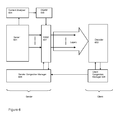
- Figure 6 illustrates a system which detects congestion in the network and also imposes the extra condition of adding or dropping a layer upon a scene change.
- the server 601 comprises the components of the media server 202 of Figure 1 and the unit 603 comprises the components of the client 204 also shown in Figure 1 .
- Video data from the audiovisual source is also passed to a content analyser 604 which segments the video sequence into scenes.
- the segmented video is then passed to an objective quality assessment module (OQAM) 605 which assesses the contribution to the perceived quality of a scene that each component layer provides.
- OQAM objective quality assessment module
- the function of the ILAM 607 is to continuously calculate the number of layers that maximise the perceived quality for the session.
- the ILAM 607 also receives input from a sender congestion manager 608 which reports on the bandwidth available to the session on the network 203.
- the sender congestion manager 608 receives feedback from a client congestion manager 609 on the number of packets that have been received. If this matches the number of packets that were sent then the bandwidth is known to be the current transmission rate. If packets are being lost then the bandwidth available to the session is less than the transmission rate, in which case the sender congestion manager 608 informs the ILAM 607 that a layer should be dropped.
- the ILAM 607 couples the bandwidth required by a layer with its contribution to the quality of the complete image, as calculated by the OQAM 605.
- the ILAM 607 performs an exhaustive search on all of the bandwidth/quality values.
- the timing of the drop is preferentially set to coincide with the transmission of that particular scene. In this way the drop in quality occurs with the scene change and is thus much less noticeable to a viewer than if the quality change had occurred during a scene.
- the sender congestion manager 608 will request the ILAM 607 to add in a layer to test whether all of the available bandwidth is being employed. If no packets are lost during this experiment then the newly added layer is maintained. This process of experimentation with adding layers is continued until a significant proportion of packets are lost, in which instance the system can be confident that all of the available bandwidth is being employed. Again, the timing of the introduction of a layer is set to occur preferentially as the scene changes.
- the invention is not limited in use to hierarchical encoding schemes.
- the invention is suitable for use in any encoding technique where the adaptation of transmission bit-rate to accommodate fluctuations in network capacity occurs.
- the invention may be applied to a transcoding system where encoded data streams are transcoded from a high bit-rate to a low bit-rate or from a low bit-rate to a high bit-rate.
- the present invention would be suitable to reduce the impact for the viewer as the output bit-rate shifts in response to network conditions by timing the transition to occur upon a scene change in the encoded video sequence.
- Another example of an adaptive video streaming technique to which the invention may be applied is where multiple independent video streams of different bit-rates are transmitted. In this case the client chooses which stream to accept based on session bandwidth. The client may switch from one stream to another as bandwidth fluctuates; the present invention ensures that the switch is timed to coincide with a scene change in the encoded video stream.
- the server may be capable of transmitting a first stream at a bit-rate of 500kbit/s and a second, higher quality stream at a bit-rate of 1500kbit/s.
- the client may initially request that the server transmit the first stream at a transmission rate of 1000kbit/s.
- the receive buffer at the client will start to fill with data at a rate of 500kbit/s, since the client will only be removing data from the buffer at a rate of 500kbit/s. After say 10 seconds of filling up the buffer at this rate, the client will have a buffer of ten seconds worth of data at which point it may decide it can attempt to receive the higher bit-rate second stream of video data from the server and thus sends an appropriate request to the server to this effect.
- the server may attempt to wait for a specified period to see if a scene change occurs during this interval. If so, a switch to the second higher bit-rate signal is not made until the change of scene occurs. Of course, if there is no change of scene within the determined period, the server switches to the higher rate anyway. In this example, a period of only ten seconds is deemed appropriate as the waiting time.
- an alternative method would be to pre-analyse the video to be sent (clearly this only applies to pre-stored video data and not live video) and to note when changes of scene occur.
- the server upon receipt of a request from the client to switch streams, could search to see if a suitable change of scene will occur within the predetermined period and if not to switch immediately to the new bit stream.
- the client may have requested a transmission rate of 1500kbit/s corresponding to the rate at which the data will be drawn from the receive buffer by the client.
- the buffer size of 10 seconds should remain constant so long as all of the transmitted packets are successfully received by the client.
- a proportion of packets may fail to arrive at the client.
- the server will be warned of this via the RTCP. If the congestion is sufficiently severe, the server may deduce that the buffer is in danger of emptying which would cause a break in the video displayed by the client to occur. To prevent this, the server may switch back to the lower bit rate stream.
- the server can deduce how long it will be before the buffer is emptied. For this time, the server can wait to see if a change of scene occurs, and if so, the new stream will be switched to at that point. Note that it would also be possible for the client to simply request that the new stream be switched to upon detecting that its receive buffer is emptying at an unsustainable rate.
- the amount of data in the buffer is actually of less significance than the rate of change of the amount of data in the buffer.
- this quantity which either the server or the client measures in order to determine whether to change from one bit stream to another (or whether to add or drop a layer in the first example).
Landscapes
- Engineering & Computer Science (AREA)
- Multimedia (AREA)
- Signal Processing (AREA)
- Databases & Information Systems (AREA)
- Two-Way Televisions, Distribution Of Moving Picture Or The Like (AREA)
- Compression Or Coding Systems Of Tv Signals (AREA)
- Communication Control (AREA)
- Data Exchanges In Wide-Area Networks (AREA)
Applications Claiming Priority (3)
| Application Number | Priority Date | Filing Date | Title |
|---|---|---|---|
| EP01306206 | 2001-07-19 | ||
| PCT/GB2002/003307 WO2003009581A1 (en) | 2001-07-19 | 2002-07-19 | Video stream switching |
| EP02745655.7A EP1407596B1 (de) | 2001-07-19 | 2002-07-19 | Videoströmungsschaltung |
Related Parent Applications (2)
| Application Number | Title | Priority Date | Filing Date |
|---|---|---|---|
| EP02745655.7A Division-Into EP1407596B1 (de) | 2001-07-19 | 2002-07-19 | Videoströmungsschaltung |
| EP02745655.7A Division EP1407596B1 (de) | 2001-07-19 | 2002-07-19 | Videoströmungsschaltung |
Publications (2)
| Publication Number | Publication Date |
|---|---|
| EP2919453A1 true EP2919453A1 (de) | 2015-09-16 |
| EP2919453B1 EP2919453B1 (de) | 2019-04-10 |
Family
ID=8182125
Family Applications (2)
| Application Number | Title | Priority Date | Filing Date |
|---|---|---|---|
| EP02745655.7A Expired - Lifetime EP1407596B1 (de) | 2001-07-19 | 2002-07-19 | Videoströmungsschaltung |
| EP15158357.2A Expired - Lifetime EP2919453B1 (de) | 2001-07-19 | 2002-07-19 | Videoströmungsschaltung |
Family Applications Before (1)
| Application Number | Title | Priority Date | Filing Date |
|---|---|---|---|
| EP02745655.7A Expired - Lifetime EP1407596B1 (de) | 2001-07-19 | 2002-07-19 | Videoströmungsschaltung |
Country Status (6)
| Country | Link |
|---|---|
| US (1) | US8209429B2 (de) |
| EP (2) | EP1407596B1 (de) |
| JP (1) | JP4965059B2 (de) |
| KR (1) | KR100881531B1 (de) |
| CA (1) | CA2451956A1 (de) |
| WO (1) | WO2003009581A1 (de) |
Cited By (1)
| Publication number | Priority date | Publication date | Assignee | Title |
|---|---|---|---|---|
| CN112422970A (zh) * | 2020-10-29 | 2021-02-26 | 西安万像电子科技有限公司 | 图像编码方法及装置 |
Families Citing this family (75)
| Publication number | Priority date | Publication date | Assignee | Title |
|---|---|---|---|---|
| US5793980A (en) * | 1994-11-30 | 1998-08-11 | Realnetworks, Inc. | Audio-on-demand communication system |
| US7349976B1 (en) | 1994-11-30 | 2008-03-25 | Realnetworks, Inc. | Audio-on-demand communication system |
| US7274740B2 (en) | 2003-06-25 | 2007-09-25 | Sharp Laboratories Of America, Inc. | Wireless video transmission system |
| JP4228304B2 (ja) * | 2003-06-26 | 2009-02-25 | ソニー株式会社 | 情報処理システム、情報処理装置および方法、記録媒体、並びにプログラム |
| US7343291B2 (en) | 2003-07-18 | 2008-03-11 | Microsoft Corporation | Multi-pass variable bitrate media encoding |
| US9325998B2 (en) | 2003-09-30 | 2016-04-26 | Sharp Laboratories Of America, Inc. | Wireless video transmission system |
| US8868772B2 (en) | 2004-04-30 | 2014-10-21 | Echostar Technologies L.L.C. | Apparatus, system, and method for adaptive-rate shifting of streaming content |
| US7818444B2 (en) | 2004-04-30 | 2010-10-19 | Move Networks, Inc. | Apparatus, system, and method for multi-bitrate content streaming |
| JP4066268B2 (ja) * | 2005-03-25 | 2008-03-26 | 船井電機株式会社 | データ伝送システム |
| US7477598B2 (en) * | 2005-03-25 | 2009-01-13 | International Business Machines Corporation | Adaptive stream switching with minimized switching delay |
| US8606949B2 (en) * | 2005-04-20 | 2013-12-10 | Jupiter Systems | Interconnection mechanism for multiple data streams |
| US8370514B2 (en) | 2005-04-28 | 2013-02-05 | DISH Digital L.L.C. | System and method of minimizing network bandwidth retrieved from an external network |
| US8683066B2 (en) | 2007-08-06 | 2014-03-25 | DISH Digital L.L.C. | Apparatus, system, and method for multi-bitrate content streaming |
| US7676591B2 (en) * | 2005-09-22 | 2010-03-09 | Packet Video Corporation | System and method for transferring multiple data channels |
| WO2007051343A1 (en) * | 2005-10-31 | 2007-05-10 | Zte Corporation | A bandwidth adaptive stream medium transmission system of a stream medium serving system and a method thereof |
| US9544602B2 (en) | 2005-12-30 | 2017-01-10 | Sharp Laboratories Of America, Inc. | Wireless video transmission system |
| US20070160127A1 (en) | 2006-01-10 | 2007-07-12 | International Business Machines Corporation | Bandwidth adaptive stream selection |
| US9172937B2 (en) * | 2006-03-31 | 2015-10-27 | Qurio Holdings, Inc. | Timed events during recorded media playback |
| US8358693B2 (en) * | 2006-07-14 | 2013-01-22 | Microsoft Corporation | Encoding visual data with computation scheduling and allocation |
| US8311102B2 (en) | 2006-07-26 | 2012-11-13 | Microsoft Corporation | Bitstream switching in multiple bit-rate video streaming environments |
| US8340193B2 (en) * | 2006-08-04 | 2012-12-25 | Microsoft Corporation | Wyner-Ziv and wavelet video coding |
| US7546377B2 (en) * | 2006-08-10 | 2009-06-09 | International Business Machines Corporation | Alternate stream signaling for adaptive stream selection |
| US8861597B2 (en) | 2006-09-18 | 2014-10-14 | Sharp Laboratories Of America, Inc. | Distributed channel time allocation for video streaming over wireless networks |
| US7388521B2 (en) * | 2006-10-02 | 2008-06-17 | Microsoft Corporation | Request bits estimation for a Wyner-Ziv codec |
| US7881335B2 (en) | 2007-04-30 | 2011-02-01 | Sharp Laboratories Of America, Inc. | Client-side bandwidth allocation for continuous and discrete media |
| US8340192B2 (en) * | 2007-05-25 | 2012-12-25 | Microsoft Corporation | Wyner-Ziv coding with multiple side information |
| US8554941B2 (en) * | 2007-08-30 | 2013-10-08 | At&T Intellectual Property I, Lp | Systems and methods for distributing video on demand |
| US9832442B2 (en) * | 2008-01-15 | 2017-11-28 | Echostar Technologies Llc | System and method of managing multiple video players executing on multiple devices |
| US7774488B2 (en) | 2008-03-12 | 2010-08-10 | International Business Machines Corporation | Method and system for switching media streams in a client system based on environmental changes |
| US7779140B2 (en) * | 2008-03-14 | 2010-08-17 | International Business Machines Corporation | Method and system for switching media streams in a client system as directed by a control system |
| US8325800B2 (en) | 2008-05-07 | 2012-12-04 | Microsoft Corporation | Encoding streaming media as a high bit rate layer, a low bit rate layer, and one or more intermediate bit rate layers |
| US8379851B2 (en) | 2008-05-12 | 2013-02-19 | Microsoft Corporation | Optimized client side rate control and indexed file layout for streaming media |
| US7949775B2 (en) | 2008-05-30 | 2011-05-24 | Microsoft Corporation | Stream selection for enhanced media streaming |
| US8265140B2 (en) | 2008-09-30 | 2012-09-11 | Microsoft Corporation | Fine-grained client-side control of scalable media delivery |
| US8499059B2 (en) * | 2009-05-04 | 2013-07-30 | Rovi Solutions Corporation | System and methods for buffering of real-time data streams |
| US20100312905A1 (en) * | 2009-06-08 | 2010-12-09 | Dov Sandmann | Sustaining Live Interactive Streaming |
| US9195775B2 (en) * | 2009-06-26 | 2015-11-24 | Iii Holdings 2, Llc | System and method for managing and/or rendering internet multimedia content in a network |
| US11647243B2 (en) | 2009-06-26 | 2023-05-09 | Seagate Technology Llc | System and method for using an application on a mobile device to transfer internet media content |
| US9049271B1 (en) | 2009-07-16 | 2015-06-02 | Teradici Corporation | Switch-initiated congestion management method |
| WO2011044287A1 (en) * | 2009-10-06 | 2011-04-14 | Openwave Systems Inc. | Managing network traffic by editing a manifest file and/or using intermediate flow control |
| KR101249613B1 (ko) * | 2009-11-11 | 2013-04-01 | 한국전자통신연구원 | 비디오 스트리밍을 위한 네트워크 적응형 가변 스트림 계층화 장치 및 방법 |
| FR2953675B1 (fr) * | 2009-12-08 | 2012-09-21 | Canon Kk | Procede de controle par un dispositif client du transfert d'une sequence video |
| US9294526B2 (en) * | 2009-12-28 | 2016-03-22 | Microsoft Technology Licensing, Llc | Managing multiple dynamic media streams |
| US20110183651A1 (en) * | 2010-01-28 | 2011-07-28 | Packetvideo Corp. | System and method for requesting, retrieving and/or associating contact images on a mobile device |
| US9510029B2 (en) | 2010-02-11 | 2016-11-29 | Echostar Advanced Technologies L.L.C. | Systems and methods to provide trick play during streaming playback |
| EP2538670B1 (de) * | 2010-02-15 | 2018-05-09 | Panasonic Intellectual Property Management Co., Ltd. | Datenverarbeitungseinheit |
| WO2012089670A1 (en) * | 2010-12-29 | 2012-07-05 | Skype | Method and apparatus for processing a video signal |
| WO2012109568A1 (en) | 2011-02-11 | 2012-08-16 | Packetvideo Corporation | System and method for using an application on a mobile device to transfer internet media content |
| US8798777B2 (en) | 2011-03-08 | 2014-08-05 | Packetvideo Corporation | System and method for using a list of audio media to create a list of audiovisual media |
| KR101931653B1 (ko) * | 2011-07-06 | 2018-12-21 | 에스케이플래닛 주식회사 | 멀티캐스트 기반 컨텐츠 전송 시스템 및 방법 |
| CN106875416B (zh) | 2011-07-06 | 2020-11-06 | Sk 普兰尼特有限公司 | 用户终端和用户终端的基于多播的内容接收方法 |
| US9445136B2 (en) * | 2011-09-21 | 2016-09-13 | Qualcomm Incorporated | Signaling characteristics of segments for network streaming of media data |
| US9571827B2 (en) | 2012-06-08 | 2017-02-14 | Apple Inc. | Techniques for adaptive video streaming |
| CN103051982B (zh) * | 2012-12-28 | 2015-09-09 | 上海华为技术有限公司 | 一种视频流传输控制方法以及视频流传输控制装置 |
| KR101716071B1 (ko) * | 2013-02-27 | 2017-03-13 | 애플 인크. | 적응적 스트리밍 기법 |
| US9049266B2 (en) * | 2013-03-13 | 2015-06-02 | Cisco Technology, Inc. | Network server layer providing disjoint channels in response to client-layer disjoint path requests |
| FR3005068B1 (fr) | 2013-04-26 | 2017-05-26 | Arjowiggins Security | Element de securite comportant un hologramme en volume. |
| US9942295B2 (en) * | 2013-06-28 | 2018-04-10 | Intel Corporation | Live crowdsourced media streaming |
| DE102013220901A1 (de) * | 2013-10-15 | 2015-04-16 | Continental Automotive Gmbh | Verfahren zur Übertragung von digitalen Audio- und/oder Videodaten |
| US10423481B2 (en) * | 2014-03-14 | 2019-09-24 | Cisco Technology, Inc. | Reconciling redundant copies of media content |
| US10693936B2 (en) | 2015-08-25 | 2020-06-23 | Qualcomm Incorporated | Transporting coded audio data |
| US9788053B2 (en) | 2015-09-09 | 2017-10-10 | Ericsson Ab | Fast channel change in a multicast adaptive bitrate (MABR) streaming network using HTTP download segment recovery in a dedicated bandwidth pipe |
| US9942290B2 (en) | 2015-09-09 | 2018-04-10 | Ericsson Ab | Fast channel change in a multicast adaptive bitrate (MABR) streaming network using HTTP download segment recovery in a shared progressive ABR download pipe |
| WO2017106695A2 (en) * | 2015-12-16 | 2017-06-22 | Gracenote, Inc. | Dynamic video overlays |
| US10182017B2 (en) | 2016-06-30 | 2019-01-15 | Mellanox Technologies Tlv Ltd. | Estimating multiple distinct-flow counts in parallel |
| CN107995502B (zh) * | 2016-10-26 | 2020-01-21 | 中国电信股份有限公司 | 实现自适应流媒体的方法和设备以及系统 |
| US10218642B2 (en) * | 2017-03-27 | 2019-02-26 | Mellanox Technologies Tlv Ltd. | Switch arbitration based on distinct-flow counts |
| US10425683B2 (en) | 2017-05-31 | 2019-09-24 | Netflix, Inc. | Temporal placement of a rebuffering event |
| US10432987B2 (en) | 2017-09-15 | 2019-10-01 | Cisco Technology, Inc. | Virtualized and automated real time video production system |
| US10848538B2 (en) | 2017-11-28 | 2020-11-24 | Cisco Technology, Inc. | Synchronized source selection for adaptive bitrate (ABR) encoders |
| US10728358B2 (en) * | 2018-01-24 | 2020-07-28 | Citrix Systems, Inc. | Method to compute the tradeoff between user experience from prefetching versus the bandwidth constraints/cost at the cloud service |
| US10820066B2 (en) | 2018-06-20 | 2020-10-27 | Cisco Technology, Inc. | Reconciling ABR segments across redundant sites |
| KR102287274B1 (ko) * | 2019-12-05 | 2021-08-06 | 울산과학기술원 | 비디오 인코딩 장치 및 방법 |
| US20220394073A1 (en) * | 2021-06-08 | 2022-12-08 | Comcast Cable Communications, Llc | Method and apparatus for determining bitrate switch points |
| KR20240016801A (ko) * | 2022-07-29 | 2024-02-06 | 삼성전자주식회사 | 저지연 스트리밍을 위해 동영상을 적응적으로 인코딩하는 방법 및 컴퓨팅 장치 |
Citations (6)
| Publication number | Priority date | Publication date | Assignee | Title |
|---|---|---|---|---|
| US5990945A (en) * | 1996-08-30 | 1999-11-23 | U.S. Philips Corporation | Encoded digital video transmission system |
| WO2000001151A1 (en) * | 1998-06-26 | 2000-01-06 | Sarnoff Corporation | Apparatus and method for dynamically controlling the frame rate of video streams |
| US6014694A (en) * | 1997-06-26 | 2000-01-11 | Citrix Systems, Inc. | System for adaptive video/audio transport over a network |
| US6038000A (en) * | 1997-05-28 | 2000-03-14 | Sarnoff Corporation | Information stream syntax for indicating the presence of a splice point |
| WO2000027087A1 (en) * | 1998-10-30 | 2000-05-11 | British Telecommunications Public Limited Company | Data transport |
| EP1021042A1 (de) * | 1999-01-14 | 2000-07-19 | Mitsubishi Denki Kabushiki Kaisha | Verfahren zur Szenenänderungs- und Überblendungensdetektion für Videosequenzindexierung |
Family Cites Families (8)
| Publication number | Priority date | Publication date | Assignee | Title |
|---|---|---|---|---|
| ES2038897B1 (es) * | 1991-06-07 | 1995-10-16 | Alcatel Espacio Sa | Metodo y dispositivo de regulacion de velocidad de salida de datos para compresores de imagenes con velocidad de salida variable. |
| JP2515080B2 (ja) * | 1992-06-29 | 1996-07-10 | 敷島製パン株式会社 | 超音波を用いる液種発酵法 |
| US5812786A (en) * | 1995-06-21 | 1998-09-22 | Bell Atlantic Network Services, Inc. | Variable rate and variable mode transmission system |
| US20030061368A1 (en) * | 1997-03-17 | 2003-03-27 | Navin Chaddha | Adaptive right-sizing of multicast multimedia streams |
| GB2353653B (en) | 1999-08-26 | 2003-12-31 | Sony Uk Ltd | Signal processor |
| US7093028B1 (en) * | 1999-12-15 | 2006-08-15 | Microsoft Corporation | User and content aware object-based data stream transmission methods and arrangements |
| US6970935B1 (en) * | 2000-11-01 | 2005-11-29 | International Business Machines Corporation | Conversational networking via transport, coding and control conversational protocols |
| US20020122491A1 (en) * | 2001-01-03 | 2002-09-05 | Marta Karczewicz | Video decoder architecture and method for using same |
-
2002
- 2002-07-19 KR KR1020047000887A patent/KR100881531B1/ko not_active Expired - Lifetime
- 2002-07-19 WO PCT/GB2002/003307 patent/WO2003009581A1/en not_active Ceased
- 2002-07-19 CA CA002451956A patent/CA2451956A1/en not_active Abandoned
- 2002-07-19 JP JP2003514793A patent/JP4965059B2/ja not_active Expired - Lifetime
- 2002-07-19 EP EP02745655.7A patent/EP1407596B1/de not_active Expired - Lifetime
- 2002-07-19 EP EP15158357.2A patent/EP2919453B1/de not_active Expired - Lifetime
- 2002-07-19 US US10/482,940 patent/US8209429B2/en not_active Expired - Fee Related
Patent Citations (6)
| Publication number | Priority date | Publication date | Assignee | Title |
|---|---|---|---|---|
| US5990945A (en) * | 1996-08-30 | 1999-11-23 | U.S. Philips Corporation | Encoded digital video transmission system |
| US6038000A (en) * | 1997-05-28 | 2000-03-14 | Sarnoff Corporation | Information stream syntax for indicating the presence of a splice point |
| US6014694A (en) * | 1997-06-26 | 2000-01-11 | Citrix Systems, Inc. | System for adaptive video/audio transport over a network |
| WO2000001151A1 (en) * | 1998-06-26 | 2000-01-06 | Sarnoff Corporation | Apparatus and method for dynamically controlling the frame rate of video streams |
| WO2000027087A1 (en) * | 1998-10-30 | 2000-05-11 | British Telecommunications Public Limited Company | Data transport |
| EP1021042A1 (de) * | 1999-01-14 | 2000-07-19 | Mitsubishi Denki Kabushiki Kaisha | Verfahren zur Szenenänderungs- und Überblendungensdetektion für Videosequenzindexierung |
Non-Patent Citations (2)
| Title |
|---|
| ANONYMOUS: "Method to Deliver Scalable Video across a Distributed Computer System", IBM TECHNICAL DISCLOSURE BULLETIN, IBM CORP. NEW YORK, US, vol. 5, no. 37, 1 May 1994 (1994-05-01), pages 251 - 256, XP002079392, ISSN: 0018-8689 * |
| REJAIE R ET AL: "Architectural considerations for playback of quality adaptive video over the Internet", IEEE INTERNATIONAL CONFERENCE ON NETWORKS. ICON. PROCEEDINGS OF ICON, XX, XX, 5 September 2000 (2000-09-05), pages 204 - 209, XP002177090 * |
Cited By (2)
| Publication number | Priority date | Publication date | Assignee | Title |
|---|---|---|---|---|
| CN112422970A (zh) * | 2020-10-29 | 2021-02-26 | 西安万像电子科技有限公司 | 图像编码方法及装置 |
| CN112422970B (zh) * | 2020-10-29 | 2024-05-17 | 西安万像电子科技有限公司 | 图像编码方法及装置 |
Also Published As
| Publication number | Publication date |
|---|---|
| EP1407596B1 (de) | 2017-10-25 |
| KR100881531B1 (ko) | 2009-02-05 |
| US20040172478A1 (en) | 2004-09-02 |
| WO2003009581A1 (en) | 2003-01-30 |
| EP2919453B1 (de) | 2019-04-10 |
| JP2004536525A (ja) | 2004-12-02 |
| EP1407596A1 (de) | 2004-04-14 |
| KR20040031779A (ko) | 2004-04-13 |
| CA2451956A1 (en) | 2003-01-30 |
| JP4965059B2 (ja) | 2012-07-04 |
| US8209429B2 (en) | 2012-06-26 |
Similar Documents
| Publication | Publication Date | Title |
|---|---|---|
| EP2919453B1 (de) | Videoströmungsschaltung | |
| CN100420250C (zh) | 通信设备操作方法、数据呈现方法和设备 | |
| US7295520B2 (en) | System and method of network adaptive real-time multimedia streaming | |
| US8621543B2 (en) | Distributed statistical multiplexing of multi-media | |
| KR100711635B1 (ko) | 화상 부호화 방법 | |
| CN100344162C (zh) | 视频点播服务器系统和方法 | |
| JP4748729B2 (ja) | データおよび対応するプロダクトを送信する準備のための装置と方法 | |
| KR20160110472A (ko) | 상이한 인코딩 파라미터를 이용해 인코딩되는 복수의 인코딩 스트리밍 | |
| KR100410973B1 (ko) | 주문형 비디오 시스템에서 동영상의 스트리밍 방법 | |
| US20040034870A1 (en) | Data streaming system and method | |
| EP1371225B1 (de) | Videocodierungs- und transportverfahren zum verbergen der effekte von paketverlusten in paketvermittelten mehrkanalnetzwerken | |
| JP2005033556A (ja) | データ送信装置、データ送信方法、データ受信装置、データ受信方法 | |
| Basso et al. | Real-time MPEG-2 delivery based on RTP: Implementation issues | |
| US8401086B1 (en) | System and method for increasing responsiveness to requests for streaming media | |
| KR20080049701A (ko) | 단말의 성능을 고려한 멀티미디어 서비스 제공방법 및 그에사용되는 단말기 | |
| Bolot et al. | Sound and Video on the Web | |
| KR20020020957A (ko) | 인터랙티브 프로세스 시스템 | |
| KR101148072B1 (ko) | 멀티미디어 지원 시스템 및 그 지원방법 |
Legal Events
| Date | Code | Title | Description |
|---|---|---|---|
| PUAI | Public reference made under article 153(3) epc to a published international application that has entered the european phase |
Free format text: ORIGINAL CODE: 0009012 |
|
| AC | Divisional application: reference to earlier application |
Ref document number: 1407596 Country of ref document: EP Kind code of ref document: P |
|
| AK | Designated contracting states |
Kind code of ref document: A1 Designated state(s): AT BE BG CH CY CZ DE DK EE ES FI FR GB GR IE IT LI LU MC NL PT SE SK TR |
|
| 17P | Request for examination filed |
Effective date: 20160219 |
|
| RBV | Designated contracting states (corrected) |
Designated state(s): AT BE BG CH CY CZ DE DK EE ES FI FR GB GR IE IT LI LU MC NL PT SE SK TR |
|
| RAP1 | Party data changed (applicant data changed or rights of an application transferred) |
Owner name: BRITISH TELECOMMUNICATIONS PUBLIC LIMITED COMPANY |
|
| STAA | Information on the status of an ep patent application or granted ep patent |
Free format text: STATUS: EXAMINATION IS IN PROGRESS |
|
| 17Q | First examination report despatched |
Effective date: 20180817 |
|
| REG | Reference to a national code |
Ref country code: DE Ref legal event code: R079 Ref document number: 60249864 Country of ref document: DE Free format text: PREVIOUS MAIN CLASS: H04N0005000000 Ipc: H04N0021240000 |
|
| GRAP | Despatch of communication of intention to grant a patent |
Free format text: ORIGINAL CODE: EPIDOSNIGR1 |
|
| STAA | Information on the status of an ep patent application or granted ep patent |
Free format text: STATUS: GRANT OF PATENT IS INTENDED |
|
| RIC1 | Information provided on ipc code assigned before grant |
Ipc: H04N 19/142 20140101ALI20181112BHEP Ipc: H04N 21/234 20110101ALI20181112BHEP Ipc: H04N 21/24 20110101AFI20181112BHEP Ipc: H04N 21/2662 20110101ALI20181112BHEP Ipc: H04N 19/87 20140101ALI20181112BHEP Ipc: H04N 21/2343 20110101ALI20181112BHEP Ipc: H04N 19/179 20140101ALI20181112BHEP Ipc: H04N 21/6437 20110101ALI20181112BHEP |
|
| INTG | Intention to grant announced |
Effective date: 20181127 |
|
| RIN1 | Information on inventor provided before grant (corrected) |
Inventor name: WALKER, MATTHEW DAVID Inventor name: MIRAS, DIMITRIOS Inventor name: JACOBS, RICHARD JAMES |
|
| GRAS | Grant fee paid |
Free format text: ORIGINAL CODE: EPIDOSNIGR3 |
|
| GRAA | (expected) grant |
Free format text: ORIGINAL CODE: 0009210 |
|
| STAA | Information on the status of an ep patent application or granted ep patent |
Free format text: STATUS: THE PATENT HAS BEEN GRANTED |
|
| AC | Divisional application: reference to earlier application |
Ref document number: 1407596 Country of ref document: EP Kind code of ref document: P |
|
| AK | Designated contracting states |
Kind code of ref document: B1 Designated state(s): AT BE BG CH CY CZ DE DK EE ES FI FR GB GR IE IT LI LU MC NL PT SE SK TR |
|
| REG | Reference to a national code |
Ref country code: GB Ref legal event code: FG4D |
|
| REG | Reference to a national code |
Ref country code: CH Ref legal event code: EP Ref country code: AT Ref legal event code: REF Ref document number: 1120325 Country of ref document: AT Kind code of ref document: T Effective date: 20190415 |
|
| REG | Reference to a national code |
Ref country code: IE Ref legal event code: FG4D |
|
| REG | Reference to a national code |
Ref country code: DE Ref legal event code: R096 Ref document number: 60249864 Country of ref document: DE |
|
| REG | Reference to a national code |
Ref country code: NL Ref legal event code: MP Effective date: 20190410 |
|
| REG | Reference to a national code |
Ref country code: AT Ref legal event code: MK05 Ref document number: 1120325 Country of ref document: AT Kind code of ref document: T Effective date: 20190410 |
|
| PG25 | Lapsed in a contracting state [announced via postgrant information from national office to epo] |
Ref country code: NL Free format text: LAPSE BECAUSE OF FAILURE TO SUBMIT A TRANSLATION OF THE DESCRIPTION OR TO PAY THE FEE WITHIN THE PRESCRIBED TIME-LIMIT Effective date: 20190410 |
|
| PG25 | Lapsed in a contracting state [announced via postgrant information from national office to epo] |
Ref country code: ES Free format text: LAPSE BECAUSE OF FAILURE TO SUBMIT A TRANSLATION OF THE DESCRIPTION OR TO PAY THE FEE WITHIN THE PRESCRIBED TIME-LIMIT Effective date: 20190410 Ref country code: SE Free format text: LAPSE BECAUSE OF FAILURE TO SUBMIT A TRANSLATION OF THE DESCRIPTION OR TO PAY THE FEE WITHIN THE PRESCRIBED TIME-LIMIT Effective date: 20190410 Ref country code: FI Free format text: LAPSE BECAUSE OF FAILURE TO SUBMIT A TRANSLATION OF THE DESCRIPTION OR TO PAY THE FEE WITHIN THE PRESCRIBED TIME-LIMIT Effective date: 20190410 Ref country code: PT Free format text: LAPSE BECAUSE OF FAILURE TO SUBMIT A TRANSLATION OF THE DESCRIPTION OR TO PAY THE FEE WITHIN THE PRESCRIBED TIME-LIMIT Effective date: 20190910 |
|
| PG25 | Lapsed in a contracting state [announced via postgrant information from national office to epo] |
Ref country code: BG Free format text: LAPSE BECAUSE OF FAILURE TO SUBMIT A TRANSLATION OF THE DESCRIPTION OR TO PAY THE FEE WITHIN THE PRESCRIBED TIME-LIMIT Effective date: 20190710 Ref country code: GR Free format text: LAPSE BECAUSE OF FAILURE TO SUBMIT A TRANSLATION OF THE DESCRIPTION OR TO PAY THE FEE WITHIN THE PRESCRIBED TIME-LIMIT Effective date: 20190711 |
|
| PG25 | Lapsed in a contracting state [announced via postgrant information from national office to epo] |
Ref country code: AT Free format text: LAPSE BECAUSE OF FAILURE TO SUBMIT A TRANSLATION OF THE DESCRIPTION OR TO PAY THE FEE WITHIN THE PRESCRIBED TIME-LIMIT Effective date: 20190410 |
|
| REG | Reference to a national code |
Ref country code: DE Ref legal event code: R097 Ref document number: 60249864 Country of ref document: DE |
|
| PG25 | Lapsed in a contracting state [announced via postgrant information from national office to epo] |
Ref country code: EE Free format text: LAPSE BECAUSE OF FAILURE TO SUBMIT A TRANSLATION OF THE DESCRIPTION OR TO PAY THE FEE WITHIN THE PRESCRIBED TIME-LIMIT Effective date: 20190410 Ref country code: DK Free format text: LAPSE BECAUSE OF FAILURE TO SUBMIT A TRANSLATION OF THE DESCRIPTION OR TO PAY THE FEE WITHIN THE PRESCRIBED TIME-LIMIT Effective date: 20190410 Ref country code: SK Free format text: LAPSE BECAUSE OF FAILURE TO SUBMIT A TRANSLATION OF THE DESCRIPTION OR TO PAY THE FEE WITHIN THE PRESCRIBED TIME-LIMIT Effective date: 20190410 Ref country code: CZ Free format text: LAPSE BECAUSE OF FAILURE TO SUBMIT A TRANSLATION OF THE DESCRIPTION OR TO PAY THE FEE WITHIN THE PRESCRIBED TIME-LIMIT Effective date: 20190410 |
|
| PLBE | No opposition filed within time limit |
Free format text: ORIGINAL CODE: 0009261 |
|
| STAA | Information on the status of an ep patent application or granted ep patent |
Free format text: STATUS: NO OPPOSITION FILED WITHIN TIME LIMIT |
|
| PG25 | Lapsed in a contracting state [announced via postgrant information from national office to epo] |
Ref country code: MC Free format text: LAPSE BECAUSE OF FAILURE TO SUBMIT A TRANSLATION OF THE DESCRIPTION OR TO PAY THE FEE WITHIN THE PRESCRIBED TIME-LIMIT Effective date: 20190410 Ref country code: IT Free format text: LAPSE BECAUSE OF FAILURE TO SUBMIT A TRANSLATION OF THE DESCRIPTION OR TO PAY THE FEE WITHIN THE PRESCRIBED TIME-LIMIT Effective date: 20190410 |
|
| REG | Reference to a national code |
Ref country code: CH Ref legal event code: PL |
|
| 26N | No opposition filed |
Effective date: 20200113 |
|
| PG25 | Lapsed in a contracting state [announced via postgrant information from national office to epo] |
Ref country code: TR Free format text: LAPSE BECAUSE OF FAILURE TO SUBMIT A TRANSLATION OF THE DESCRIPTION OR TO PAY THE FEE WITHIN THE PRESCRIBED TIME-LIMIT Effective date: 20190410 |
|
| REG | Reference to a national code |
Ref country code: BE Ref legal event code: MM Effective date: 20190731 |
|
| PG25 | Lapsed in a contracting state [announced via postgrant information from national office to epo] |
Ref country code: LU Free format text: LAPSE BECAUSE OF NON-PAYMENT OF DUE FEES Effective date: 20190719 Ref country code: BE Free format text: LAPSE BECAUSE OF NON-PAYMENT OF DUE FEES Effective date: 20190731 Ref country code: LI Free format text: LAPSE BECAUSE OF NON-PAYMENT OF DUE FEES Effective date: 20190731 Ref country code: CH Free format text: LAPSE BECAUSE OF NON-PAYMENT OF DUE FEES Effective date: 20190731 |
|
| PG25 | Lapsed in a contracting state [announced via postgrant information from national office to epo] |
Ref country code: IE Free format text: LAPSE BECAUSE OF NON-PAYMENT OF DUE FEES Effective date: 20190719 |
|
| PG25 | Lapsed in a contracting state [announced via postgrant information from national office to epo] |
Ref country code: CY Free format text: LAPSE BECAUSE OF FAILURE TO SUBMIT A TRANSLATION OF THE DESCRIPTION OR TO PAY THE FEE WITHIN THE PRESCRIBED TIME-LIMIT Effective date: 20190410 |
|
| PGFP | Annual fee paid to national office [announced via postgrant information from national office to epo] |
Ref country code: FR Payment date: 20210623 Year of fee payment: 20 |
|
| PGFP | Annual fee paid to national office [announced via postgrant information from national office to epo] |
Ref country code: GB Payment date: 20210623 Year of fee payment: 20 |
|
| PGFP | Annual fee paid to national office [announced via postgrant information from national office to epo] |
Ref country code: DE Payment date: 20210622 Year of fee payment: 20 |
|
| REG | Reference to a national code |
Ref country code: DE Ref legal event code: R071 Ref document number: 60249864 Country of ref document: DE |
|
| REG | Reference to a national code |
Ref country code: GB Ref legal event code: PE20 Expiry date: 20220718 |
|
| PG25 | Lapsed in a contracting state [announced via postgrant information from national office to epo] |
Ref country code: GB Free format text: LAPSE BECAUSE OF EXPIRATION OF PROTECTION Effective date: 20220718 |