EP2919540A1 - Procédé et appareil utilisant des sous-trames silenciées dans un systeme de communications portables tdd pour la communication directe entre terminaux - Google Patents
Procédé et appareil utilisant des sous-trames silenciées dans un systeme de communications portables tdd pour la communication directe entre terminaux Download PDFInfo
- Publication number
- EP2919540A1 EP2919540A1 EP15165727.7A EP15165727A EP2919540A1 EP 2919540 A1 EP2919540 A1 EP 2919540A1 EP 15165727 A EP15165727 A EP 15165727A EP 2919540 A1 EP2919540 A1 EP 2919540A1
- Authority
- EP
- European Patent Office
- Prior art keywords
- abs
- subframe
- communications
- enb
- operable
- Prior art date
- Legal status (The legal status is an assumption and is not a legal conclusion. Google has not performed a legal analysis and makes no representation as to the accuracy of the status listed.)
- Granted
Links
- 238000004891 communication Methods 0.000 title claims abstract description 195
- 238000000034 method Methods 0.000 title claims abstract description 80
- 238000010295 mobile communication Methods 0.000 title description 5
- 238000005259 measurement Methods 0.000 claims description 22
- 230000015572 biosynthetic process Effects 0.000 claims description 8
- 238000001514 detection method Methods 0.000 claims description 3
- 230000003993 interaction Effects 0.000 claims description 2
- 230000005540 biological transmission Effects 0.000 abstract description 47
- 238000005516 engineering process Methods 0.000 description 25
- 230000015654 memory Effects 0.000 description 14
- 238000010586 diagram Methods 0.000 description 10
- 230000006870 function Effects 0.000 description 10
- 230000011664 signaling Effects 0.000 description 8
- 239000003795 chemical substances by application Substances 0.000 description 7
- 238000011161 development Methods 0.000 description 6
- 230000018109 developmental process Effects 0.000 description 6
- 238000001228 spectrum Methods 0.000 description 6
- 230000004048 modification Effects 0.000 description 5
- 238000012986 modification Methods 0.000 description 5
- 239000000969 carrier Substances 0.000 description 4
- 125000004122 cyclic group Chemical group 0.000 description 4
- 230000000694 effects Effects 0.000 description 4
- 230000003287 optical effect Effects 0.000 description 4
- 230000008520 organization Effects 0.000 description 4
- 230000002411 adverse Effects 0.000 description 3
- 230000001413 cellular effect Effects 0.000 description 3
- 238000006243 chemical reaction Methods 0.000 description 3
- 238000013500 data storage Methods 0.000 description 3
- 238000013461 design Methods 0.000 description 3
- 230000008569 process Effects 0.000 description 3
- 238000012545 processing Methods 0.000 description 3
- 230000000977 initiatory effect Effects 0.000 description 2
- 230000002452 interceptive effect Effects 0.000 description 2
- 239000002245 particle Substances 0.000 description 2
- 230000004044 response Effects 0.000 description 2
- 238000000638 solvent extraction Methods 0.000 description 2
- 230000006399 behavior Effects 0.000 description 1
- 238000004422 calculation algorithm Methods 0.000 description 1
- 238000004364 calculation method Methods 0.000 description 1
- 230000008859 change Effects 0.000 description 1
- 238000004590 computer program Methods 0.000 description 1
- 230000008878 coupling Effects 0.000 description 1
- 238000010168 coupling process Methods 0.000 description 1
- 238000005859 coupling reaction Methods 0.000 description 1
- 230000007774 longterm Effects 0.000 description 1
- 230000002093 peripheral effect Effects 0.000 description 1
- 230000001105 regulatory effect Effects 0.000 description 1
- 230000001360 synchronised effect Effects 0.000 description 1
- 238000012546 transfer Methods 0.000 description 1
- 238000011144 upstream manufacturing Methods 0.000 description 1
Images






Classifications
-
- H—ELECTRICITY
- H04—ELECTRIC COMMUNICATION TECHNIQUE
- H04W—WIRELESS COMMUNICATION NETWORKS
- H04W72/00—Local resource management
- H04W72/04—Wireless resource allocation
- H04W72/044—Wireless resource allocation based on the type of the allocated resource
- H04W72/046—Wireless resource allocation based on the type of the allocated resource the resource being in the space domain, e.g. beams
-
- H—ELECTRICITY
- H04—ELECTRIC COMMUNICATION TECHNIQUE
- H04W—WIRELESS COMMUNICATION NETWORKS
- H04W72/00—Local resource management
- H04W72/02—Selection of wireless resources by user or terminal
-
- H—ELECTRICITY
- H04—ELECTRIC COMMUNICATION TECHNIQUE
- H04B—TRANSMISSION
- H04B7/00—Radio transmission systems, i.e. using radiation field
- H04B7/24—Radio transmission systems, i.e. using radiation field for communication between two or more posts
- H04B7/26—Radio transmission systems, i.e. using radiation field for communication between two or more posts at least one of which is mobile
- H04B7/2612—Arrangements for wireless medium access control, e.g. by allocating physical layer transmission capacity
-
- H—ELECTRICITY
- H04—ELECTRIC COMMUNICATION TECHNIQUE
- H04W—WIRELESS COMMUNICATION NETWORKS
- H04W72/00—Local resource management
- H04W72/20—Control channels or signalling for resource management
- H04W72/23—Control channels or signalling for resource management in the downlink direction of a wireless link, i.e. towards a terminal
-
- H—ELECTRICITY
- H04—ELECTRIC COMMUNICATION TECHNIQUE
- H04L—TRANSMISSION OF DIGITAL INFORMATION, e.g. TELEGRAPHIC COMMUNICATION
- H04L5/00—Arrangements affording multiple use of the transmission path
- H04L5/14—Two-way operation using the same type of signal, i.e. duplex
-
- H—ELECTRICITY
- H04—ELECTRIC COMMUNICATION TECHNIQUE
- H04W—WIRELESS COMMUNICATION NETWORKS
- H04W16/00—Network planning, e.g. coverage or traffic planning tools; Network deployment, e.g. resource partitioning or cells structures
- H04W16/24—Cell structures
- H04W16/32—Hierarchical cell structures
-
- H—ELECTRICITY
- H04—ELECTRIC COMMUNICATION TECHNIQUE
- H04W—WIRELESS COMMUNICATION NETWORKS
- H04W72/00—Local resource management
- H04W72/20—Control channels or signalling for resource management
- H04W72/27—Control channels or signalling for resource management between access points
Definitions
- the present disclosure relates generally to communication, and more specifically to techniques for supporting device-to-device (D2D) communications in conjunction with wide area network (WAN) communications.
- D2D device-to-device
- WAN wide area network
- Wireless communication networks are widely deployed to provide various types of communication content, such as voice, video, packet data, messaging, broadcast, etc.
- Wireless networks may be multiple-access networks capable of supporting multiple users by sharing the available network resources. Examples of such multiple-access networks include Code Division Multiple Access (CDMA) networks, Time Division Multiple Access (TDMA) networks, Frequency Division Multiple Access (FDMA) networks, Orthogonal FDMA (OFDMA) networks, and Single-Carrier FDMA (SC-FDMA) networks.
- CDMA Code Division Multiple Access
- TDMA Time Division Multiple Access
- FDMA Frequency Division Multiple Access
- OFDMA Orthogonal FDMA
- SC-FDMA Single-Carrier FDMA
- a wireless communication network may also be referred to as a wide area network (WAN).
- WAN wide area network
- GSM Global System for Mobile communications
- radio frequency spectrum is a limited shared resource, governed by regulatory bodies such as the International Telecommunication Union - Radiocommunication sector (ITU-R) and other regional and national regulators, all of whom determine in their respective jurisdictions how to allocate the radio frequency spectrum among the different types of services and technologies that seek to use it.
- ITU-R International Telecommunication Union - Radiocommunication sector
- This role is facilitated by the standardization of radio technologies.
- standardization encourages interoperability of equipment from multiple vendors, fostering competition and resulting in reduced equipment cost. Standardization also promotes the efficient use of radio spectrum and the deployment of new and improved services.
- the ITU-R has defined technology families and has associated specific ranges of the radio spectrum with these families. Two such families are the International Mobile Telecommunications (IMT) family, which includes so-called “Third Generation” (3G) systems; and the IMT-Advanced (IMT-A) family, which includes “Fourth Generation” (4G) systems.
- IMT International Mobile Telecommunications
- IMT-A IMT-Advanced
- 4G Fullth Generation
- the designation of each new generation refers generally to a fundamental change in the nature of the technologies used, e.g., different multiple access schemes resulting in non-backwards-compatible transmission technology, higher peak bitrates, different frequency bands, wider channel frequency bandwidth, and higher capacity. New mobile generations have been introduced about every ten years since the early 1980s, when analog 1G systems were deployed. In the early 1990s, digital 2G systems were deployed. In the early 2000s, 3G systems using spread spectrum communication were deployed. In the early 2010s, 4G systems based entirely on packet-switched (PS) technology
- a wireless communication network in accordance with the foregoing standards may include a number of base stations (also referred to as evolved Node Bs, eNBs, BSs, or access nodes) that can support communication for a number of UEs.
- base stations also referred to as evolved Node Bs, eNBs, BSs, or access nodes
- eNBs evolved Node Bs
- BSs Backbone Service Set
- access nodes for a number of UEs.
- communication by UEs typically occurs via uplink/downlink channels between the UEs and a base station.
- a UE may be enabled to communicate directly, that is, without communicating through the base station.
- a UE may thus be enabled to communicate peer-to-peer (P2P), also referred to as device-to-device (D2D), with one or more other UEs.
- P2P peer-to-peer
- D2D device-to-device
- an eNodeB comprising a controller module operable to obtain an indicator of a need for a quiescent subframe, and to select responsively thereto a subframe of a communication frame, and allocate the selected subframe as an Almost Blank Subframe (ABS).
- the base station includes a transceiver module operable to communicate the ABS over an air interface, and to send a misinformation signal to another eNodeB device indicating the ABS is not almost blank.
- a user equipment in accordance with the herein disclosed apparatus, systems and methods may include at least one receiver module, and a radio frequency (RF) module.
- the RF module may be operable to receive an almost blank subframe (ABS) from the receiver and to at least perform an operation during the ABS that is appropriate for direct communication with a user equipment (UE) in a Device to Device (D2D) communication mode.
- ABS almost blank subframe
- UE user equipment
- D2D Device to Device
- a cellular system is one that divides its service area into so-called cells, each with its own base station that communicates with and provides services to devices located within the cell using a communication channel arranged not to interfere with channels used in adjacent cells.
- a base station may be referred to as a NodeB, evolved NodeB, eNB, or a BS, by way of non-limiting example.
- Communicating devices used by end users in such a cell-based system may include stationary and mobile personal computers, laptops, netbooks, handsets, phones, etc., each of which may be referred to as a User Equipment (UE).
- the communication path from the NodeB to the UE may be referred to as the downlink (DL), while that from the UE to the NodeB may be referred to as the uplink (UL).
- DL downlink
- UL uplink
- a CDMA network may implement a radio technology such as Universal Terrestrial Radio Access (UTRA), cdma2000, and the like.
- UTRA includes Wideband CDMA (WCDMA), Time Division Synchronous CDMA (TD-SCDMA), and other variants of CDMA, and cdma2000 covers IS-2000, IS-95, and IS-856 standards.
- a TDMA network may implement a radio technology, such as Global System for Mobile Communications (GSM).
- GSM Global System for Mobile Communications
- An OFDMA network may implement a radio technology such as Evolved UTRA (E-UTRA), Ultra Mobile Broadband (UMB), IEEE 802.11 (Wi-Fi), IEEE 802.16 (WiMAX), IEEE 802.20, Flash-OFDM®, and the like.
- E-UTRA and E-UTRA are part of Universal Mobile Telecommunication System (UMTS).
- 3GPP Long Term Evolution (LTE) and LTE-Advanced (LTE-A) in both Frequency Division Duplex (FDD) and Time Division Duplex (TDD), are new releases of UMTS that use E-UTRA.
- UTRA, E-UTRA, UMTS, LTE, LTE-A and GSM are described in documents from an organization named "3rd Generation Partnership Project" (3GPP).
- UMB and cdma2000 are described in documents from an organization named "3rd Generation Partnership Project 2" (3GPP2).
- the techniques described herein may be used for the wireless networks and radio technologies mentioned above, as well as for other
- IMT International Mobile Telecommunications
- 3G Fifth Generation
- IMT-A IMT-Advanced
- 4G Fullth Generation
- 3GPP 3rd Generation Partnership Project
- 3GPP2 3rd Generation Partnership Project2
- IEEE Institute of Electrical and Electronics Engineers
- the physical or logical link that connects a data source (transmitter) to a data sink (receiver) is called a channel.
- Communications in which two devices may simultaneously send and receive signals between them are referred to as duplex communications.
- Systems that support duplex communications among a plurality of pairs of devices are called multiple access systems.
- the combining of multiple channels into a single shared channel is called multiplexing, the goal of which is generally to share a limited or expensive resource, such as radio spectrum.
- TDMA and FDMA are used in 2G standards, including the GSM, General Packet Radio Service (GPRS), and Enhanced Data rates for GSM Evolution (EDGE).
- CDMA is used in 3G standards, including the UMTS and its progeny High Speed Downlink Packet Access (HSDPA), High Speed Uplink Packet Access (HSUPA), High Speed Packet Access (HSPA), and enhanced HSPA (HSPA+), some of which may use W-CDMA (which uses 5 MHz bandwidth carriers).
- HSDPA High Speed Downlink Packet Access
- HSPA High Speed Packet Access
- HSPA+ High Speed Packet Access
- W-CDMA which uses 5 MHz bandwidth carriers
- LTE has been complemented by developments in non-radio aspects of a complete mobile communications system called System Architecture Evolution (SAE), which includes the Evolved Packet Core (EPC) network. Together, LTE and SAE make up the Evolved Packet System (EPS), in which the core network and the radio access network are entirely packet-switched.
- SAE System Architecture Evolution
- EPC Evolved Packet Core
- the 3GPP supports standardization by producing highly detailed specification documents which are released in associated groups or series. For example, Release 8 (R8) describes the first version of LTE; and Release 10 (R10) describes the first version of LTE Advanced (LTE-A).
- Release 8 describes the first version of LTE
- Release 10 describes the first version of LTE Advanced (LTE-A).
- LTE-A LTE Advanced
- an important consideration is to introduce new technology in a manner that is backward compatible with legacy equipment of the same generation. Such backward compatibility enables network operators to continue to provide services to existing subscribers using legacy UEs, while introducing new services and features that function only with newer UEs.
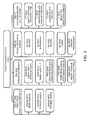
- the 3GPP is divided into four Technical Specification Groups (TSGs), each of which comprises several Working Groups (WGs), as shown in FIG. 2 .
- TSGs Technical Specification Groups
- WGs Working Groups
- Each of the WGs works on a different aspect of developing technologies.
- the documents produced by the 3GPP such as technical reports and technical specifications, are presently available to the public at http://www.3gpp.org.
- the WGs consider the technologies being developed holistically, taking into account issues such as performance, cost to implement, complexity, compatibility with earlier versions and deployments, and the like.
- the 3GPP documents pertaining to released standards and ongoing standards development that are available at www.3gpp.org as of the filing of the present disclosure are hereby incorporated herein by reference in their entirety as is fully set forth.
- UEs that are compliant with LTE release 10 and earlier are able to communicate directly only with eNodeBs in a so-called homogeneous configuration in which each eNodeB uses different carriers than all other eNodeBs having overlapping service areas.
- heterogeneous networks hetnets
- a plurality of eNodeBs with overlapping service areas use at least some of the same carriers.
- the largest cell served by an eNodeB is called a macrocell.
- Smaller cells called picocells may deployed within or overlapping with the service area of the macrocell, each served by a lower power "pico" eNodeB that uses the same multiple access parameters as the macrocell's eNodeB. Even smaller femtocells may also be deployed within the service area of the macrocell, typically deployed by private parties without the permission or even knowledge of the macro cell operator. Each femtocell is served by an even lower power femto or "Home" eNodeB (HeNB) also using many of the same parameters as the macrocell's NodeB. Thus, each smaller cell shares at least one channel resource with the macrocell it is located in.
- HeNB Home eNodeB
- a WAN can employ macrocells, picocells, and/or femtocells to provide wireless coverage in a variety of environments, ranging from open outdoor spaces to office buildings, homes, and underground areas.
- the macro, pico, and femto eNodeBs provide a mosaic of coverage with handoff capabilities therebetween, typically with much better combined coverage and greater throughput than would be possible using conventionally placed macro eNodeBs alone.
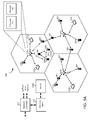
- FIG. 3A An exemplary arrangement of network elements in accordance with the herein disclosed apparatus, systems, and methods is shown in FIG. 3A .
- interference can occur between the different devices that are using the same communication parameters for their own respective communications.
- a macro eNodeB transmission to a macro UE can interfere with the reception at a pico eNodeB of a transmission from a pico UE.
- the pico UE's transmission to the pico eNodeB may interfere with the reception at the macro UE of the macro eNodeB's transmission.
- transmissions from any transmitting device can interfere with the reception of other devices' transmissions when their intended receivers are near enough, and are using the same communication parameters for their own respective communications.
- the transmissions of every such device must be managed if such interference is to be avoided.
- Direct communication between devices that operate at the same level within the network may be referred to as P2P, or D2D, communication.
- P2P Direct communication between an eNodeB and another eNodeB or HeNB
- P2P A UE communicating directly with another UE
- P2P One recent development in LTE-A is the ability of properly configured UEs to engage in D2D communications using the same carriers that are used by the macro eNodeB and smaller cell eNodeBs within whose service area one or both of the UEs are located. Such D2D communications may result in additional interference scenarios between the various devices that are using the same communication parameters.
- a transmitting device that interferes with a communication session between two other devices is called an aggressor.
- the interference occurs when the aggressor transmits concurrently with a second device using the same communication parameters.
- the receiver that was intended to receive the second device's transmission is prevented from doing so by the aggressor's transmission.
- the receiver i.e., the device whose operation is directly adversely affected by the aggressor
- a victim is referred to as a victim.
- One way to avoid such interference is to schedule the transmissions of the various devices that are using the same shared radio resources such that no two transmitting devices transmit at the same time while they are both within range of an intended receiver of one of the two devices. Such scheduling may be accomplished using control signals. However, it is important to accomplish the scheduling in a manner that is backward compatible with legacy devices of the same generation, or in other words, that permits the legacy devices to operate as they normally would, while at the same time enabling newer devices to implement new features and capabilities.
- problematic interference can arise at a receiver when two transmitters are transmitting concurrently using the same channel resources, when both are within range of the receiver, but the receiver is the intended recipient of the transmissions of only one of them, referred to here as its partner.
- the non-partner transmission is regarded as noise with respect to the partner transmission, and adversely affects the signal-to-noise ratio (SNR) of the partner transmission. If the non-partner signal is strong enough at the receiver, the partner signal becomes difficult or impossible to understand, i.e., it is overwhelmed by what it perceives as noise.
- a different but related problem can occur even if the non-partner is not using the same channel resources as the receiver and its partner. Even when the non-partner transmission is using different channel resources, the non-partner transmission may deliver enough power on the partner channel at the receiver's location to adversely affect the SNR of the partner transmission at the receiver. A strong enough non-partner transmission can thereby desense the receiver with respect to the partner transmission, making it difficult or impossible to understand. Desensing must also be controlled where it may arise in a HetNet. Henceforth as used herein, the word "interference" and its derivatives includes desensing as well.
- Wireless communication network 300 may be a LTE network or other wireless network (also referred to herein as a wide area network, or WAN, or simply as a network).
- Wireless communication network 300 may include a number of base stations and other network entities. For simplicity, only three base stations 310a, 310b, and 310c, one network controller 325, and a directory agent 330 are shown in FIG. 3A .
- a base station also referred to as BS, eNodeB, HeNB, eNB, or access point, for example
- Each base station 310 may provide communication coverage for a particular geographic area, and may support communication for the devices located within the coverage area.
- the overall coverage area of a base station may be partitioned into multiple (e.g., three in the illustration) smaller areas. Each smaller area may be served by a respective base station subsystem.
- the term “cell” can refer to a coverage area of a base station and/or a base station subsystem serving this coverage area, depending on the context in which the term is used.
- the term “sector” or “cell-sector” can refer to a coverage area of a base station and/or a base station subsystem serving this coverage area.
- the 3GPP concept of "cell” is used throughout the disclosure.
- WAN 300 may be a HetNet that includes base stations of different types, for example, macro base stations, pico base stations, home base stations, relays, and the like. Accordingly, a base station may provide communication coverage for a macro cell, a pico cell, a femto cell, and/or other types of cells.
- a macro cell may cover a relatively large geographic area (e.g., several kilometers in radius) and may allow unrestricted access by UEs with service subscription.
- a pico cell may cover a relatively small geographic area (an office building or campus) and may allow unrestricted access by UEs with service subscription.
- a femto cell may cover an even smaller geographic area (e.g., a home) and may allow restricted access by UEs having association with the femto cell (e.g., UEs in a Closed Subscriber Group (CSG)).
- WAN 300 includes macro base stations 310a, 310b and 310c for correspondent macro cells.
- WAN 300 may also include pico base stations 315a, 315b, 315c, and 315d for pico cells, and/or home base stations for femto cells.
- Network controller 325 may couple to one or more base stations, and may provide coordination and control for these base stations.
- Network controller 325 may be a single network entity or a collection of network entities.
- Network controller 325 may communicate with the base stations via a backhaul, by way of non-limiting example.
- the base stations may also communicate with each another, for example, directly or indirectly via wireless or wireline backhaul.
- Directory agent 330 may be a separate network entity and may be coupled to network controller 325 (as shown in FIG. 3A ) and/or to other network entities. Directory agent 330 may also be part of a base station, or network controller 325, or some other network entity not shown in FIG. 3A . Directory agent 330 may further include, or be communicatively associated with, server 330a. Directory agent 330 may support the setup of D2D communication, such as by providing certain identifying information of user devices, as described further below.
- Processor/controller 335 may be associated with, or form part of, network controller 325.
- Processor/controller 335 may also be, or form part of, or be distinct from, server 330a, and may be associated with a correspondent memory 340 that may be, form part of, or be distinct from, directory agent 330.
- Processor/controller 335 may include comparator capabilities, assessing capabilities, and like processing capabilities, and may be associated with information stored in a memory within, or associated with, directory agent 330. As such, processor/controller 335 may be within a base station 310a, and may provide the processing and calculation functions described herein.
- User equipments (UEs) 320 may be disposed throughout the wireless network, and each device may be stationary or mobile.
- a UE may also be referred to as a user device, a mobile station, a terminal, an access terminal, a subscriber unit, a station, etc.
- a UE may be a cellular phone, a personal digital assistant (PDA), a wireless modem, a wireless communication device, a handheld device, a laptop computer, a cordless phone, a wireless local loop (WLL) station, a smart phone, a netbook, a smartbook, a tablet, a peripheral device (e.g., a printer), or the like.
- PDA personal digital assistant
- WLL wireless local loop
- a UE may communicate with a base station in a wireless network.
- a UE may also communicate with other UEs using D2D communications.
- UEs 320x and 320y may communicate D2D.
- Other UEs 320 may communicate with base stations 310a, 310b, 310c, and UEs 320x and 320y may also be capable of communicating with the base stations, e.g., when not engaged in D2D communication or concurrently with D2D communication.
- D2D communication may be used to offload data traffic in order to reduce congestion on the radio interface, on WAN network 300, as well as on a core network (not shown).
- WAN 300 may also include relays 380.
- a relay may be any entity that receives a transmission of data from an upstream entity (such as a base station or a UE) and sends a transmission of the data to a downstream entity (such as another UE or base station), that relays data, typically without modification.
- a relay may be a UE that relays transmissions for other UEs, or a base station that relays transmissions, or any other independent relay device or node.
- relays may be disposed throughout the networks, cells, and systems herein described.
- WAN communication refers to communication between a UE and a base station, such as for a call between the UE and a remote entity like another UE, via the base station.
- a D2D communication refers to direct communication between two or more UEs, wherein at least a portion of the direct communication occurs without going through a base station.
- a D2D link, or variants thereof thus refers to a direct communication link between two or more UEs engaged in D2D communication.
- a WAN UE is a UE that is interested or engaged in WAN communication
- a D2D UE is a UE that is interested or engaged in D2D communication
- a macro UE is a UE that is interested or engaged in WAN communication with a macro eNodeB
- a pico UE is a UE that is interested or engages in WAN communication with a pico eNodeB.
- Downlink (DL) transmissions from an eNodeB to a UE, as shown in FIG. 3A , in an LTE or LTE-A system comprise so-called user-plane and control-plane data.
- a downlink transmission comprises a plurality of channels, each one of which is used to transmit either user content or control signaling that coordinates the resources needed to send the user content in a manner that can be understood by its intended recipient.
- a plurality of such transmissions may be sent concurrently, multiplexed by manipulating physical layer signaling in the multiple access scheme of OFDMA.
- OFDMA divides the transmitted signal along small units of time and frequency.
- Uplink (UL) transmissions from a UE to a base station also comprise user-plane and control-plane data.
- the multiple access scheme used in the uplink is SC-FDMA.
- the herein disclosed apparatus, systems, and methods pertain primarily to DL and D2D communications.
- carrier capacity during subframes that would ordinarily be allocated for sending DL information from a macro eNodeB to UEs can instead be reallocated for use in D2D communications occurring directly between UEs.
- any interference (or desense) that would otherwise have been caused by such DL transmissions at devices other than the D2D UEs is mitigated.
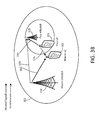
- a pico eNodeB 315 in the macro eNodeB's 310 service area 301 is receiving a Physical Uplink Control Channel (PUCCH) Radio Bearer (RB) 350 from pico UE 355.
- PUCCH Physical Uplink Control Channel
- RB Radio Bearer
- a macro eNodeB downlink transmission 360 to a neighboring macro UE 365 may interfere 370 with the pico eNodeB's PUCCH reception. If so, rescheduling the macro eNodeB's transmission to a different subframe would eliminate that interference.
- PUCCH Physical Uplink Control Channel
- RB Radio Bearer
- the rescheduling would also eliminate interference 375 that would otherwise be experienced by the macro UE 365 receiving the macro eNodeB's DL 360, due to the pico UE's PUCCH transmission 350 to the pico eNodeB 315.
- the subframe that originally contained the macro eNodeB data that was rescheduled would be completely blank, eliminating even the possibility of interference toward the UEs engaged in D2D communications during that subframe.
- the DL subframe is not typically completely blank.
- certain control signals such as the cell-specific Reference Signal (RS), Primary Synchronization Signal (PSS), Secondary Synchronization Signal (SSS), and the Paging Channel (PCH) and Physical Broadcast Channel (PBCH).
- RS cell-specific Reference Signal
- PSS Primary Synchronization Signal
- SSS Secondary Synchronization Signal
- PCH Paging Channel
- PCH Physical Broadcast Channel
- PBCH Physical Broadcast Channel
- LTE may be enhanced by implementing Time Division Multiplex (TDM) partitioning between D2D UEs and any nearby small cell eNodeBs to prevent interference between them.
- TDM Time Division Multiplex
- FDM Frequency Division Multiplex
- FIG. 4 illustrates the structure 400 of radio resources most commonly used in DL transmissions by the herein disclosed apparatus, systems, and methods, although other frame, subframe, or like information-carrying structures may also be used.
- the DL transmission resources in LTE can be described in terms of space, time, and frequency.
- the spatial dimension contains one or more layers (only one of which is shown), each layer representing an antenna port at the eNodeB.
- a Reference Signal (RS) is provided to enable the User Equipment (UE) to locate the radio channel.
- RS Reference Signal
- UE User Equipment
- the largest unit of time is the radio frame 410, which has a duration of 10ms.
- Each radio frame is subdivided into ten 1ms subframes 420, and each of the subframes is split into two 0.5 ms slots 430.
- Each slot comprises seven OFDM symbols 440 in the case of the normal Cyclic Prefix (CP) length, or six (not shown) if the extended CP is configured in the cell.
- the largest unit is called a carrier 450, which has a bandwidth of at least 180 kHz.
- Each carrier is divided into at least 12 subcarriers or "tones" 460, each with a spacing of 15 kHz.
- One carrier (12 subcarriers) for a duration of one slot is called a Resource Block (RB) 470.
- the smallest unit of resource consists of one subcarrier for a duration of one OFDM symbol, called a Resource Element (RE) 480.
- An RB thus comprises 84 REs using a normal cyclic prefix length, and 72 REs using the extended cyclic prefix.
- FIG. 4 illustrates the resource structure using the normal cyclic prefix length.
- FIG. 5 is a table showing TDD uplink/downlink configurations that may be used in the herein disclosed apparatus, systems, and methods.
- the letter D indicates that the sub-frame is a downlink sub-frame
- the letter U indicates that the sub-frame is an uplink sub-frame
- the letter S indicates that the corresponding sub-frame is a "special" sub-frame.
- special subframe the beginning portion is utilized for downlink transmission
- the ending portion is utilized for uplink transmission.
- a silence or "guard" region is arranged in the middle of the special sub-frame between the downlink and uplink portions.
- TDD configuration 3 may be being used in a particular macro cell to schedule UL and DL transmissions.
- subframe 4 of TDD configuration 3 comprises six DL subframes, three UL subframes, and one special subframe.
- One way to accommodate D2D communication among UEs in its coverage area is for the macrocell eNodeB to provide quiescent subframes in its coverage area during which UEs which are capable of doing so may engage in D2D communications, without problematic interference from other devices transmitting at the same time using the same resources.
- the eNB can switch from TDD configuration 3 to a TDD configuration that provides one or more additional DL subframes, thereby allowing the eNodeB to gain control over the additional subframe(s).
- the eNB then informs other devices in its service area that it has done so.
- TDD configuration 4 has seven DL subframes, one more than TDD configuration 3.
- the additional DL subframe is subframe 4 of TDD configuration 4, which is now a DL instead of an UL subframe.
- the macro eNB in addition to selecting a TDD configuration that provides UL and DL resources appropriate for the transmissions it participates in itself, may additionally select a TDD configuration that will provide quiescent subframes in which D2D communications may proceed.
- the eNB accomplishes that by selecting a new TDD configuration that adds one or more DL subframes, i.e., that modifies the downlink/uplink configuration, to the number otherwise provided for by the TDD configuration that it selected based only on the needs/factors associated with the eNB.
- subframe 4 is now a DL subframe, and the eNB informs other devices in its coverage area that the new TDD configuration being used in configuration 4.
- the macro eNodeB thereby gains control over subframe 4 in this scenario.
- the eNB ensures that frame 4 remains quiescent, for example, by scheduling subframe 4 as an ABS.
- control signaling such as CRS, PSS, and SSS, in the ABS. Those signals in an ABS are ignored by R11 and R12 UEs, so that they may engage in HetNet communications and D2D communications, respectively.
- the macro eNodeB informs R10 and other prior art UEs in the macrocell that it has made subframe 4 an ABS, so that they can modify their measurements accordingly, and they will continue to monitor those frames for control signaling, per above, but will not affirmatively attempt communication due to modification of those subframes from uplink to downlink.
- the macro eNodeB informs R12 UEs that subframe 4 is an ABS and available for D2D communications.
- the eNB may suppress small cell eNodeBs from transmitting and interfering with the R12 UEs' D2D communications, such as by misinforming the small cell eNodeBs, via the X2 or S1 interface, that subframe 4 is an ordinary TDD configuration 3 UL subframe and not an ABS.
- the eNB may simply refrain from informing the pico/femto eNBs that it has implemented a different TDD configuration. Consequently, because a small cell eNodeB will believe that macro UEs are engaged in UL transmissions, it will not transmit during subframe 4. Further, macro UEs will not engage in UL transmissions because the previously UL frame is now a DL frame.
- the macro eNB itself transmits as little as it can without disrupting the operation of the macro cell, by configuring the new DL subframe as an ABS.
- the R12 UEs can engage in D2D communications without undue interference from other devices in the macro cell.
- the macro eNB may execute the foregoing modification to the at least one subframe modified from a UL to a DL subframe for any reasons known to those skilled in the art.
- the macro eNB may sense the presence in its cell of R12 UEs capable of D2D communications, or of R11 UEs capable of HetNet communications.
- the macro eNB may receive a request for resources for D2D communications or for HetNet communications.
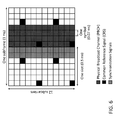
- FIG. 6 illustrates an exemplary ABS that may be used in accordance with the herein disclosed apparatus, systems, and methods.
- the ABS contains control signaling such as PBCH, CRS, and synchronization signals. Nevertheless, more than half of the ABS remains blank.
- FIG. 7 illustrates an exemplary scenario in accordance with the herein disclosed apparatus, systems, and methods.
- subframe x is being used for UL communications to macro eNodeB 705 from macro UEs 710, 715, 720 in its coverage area.
- the macro eNodeB can reschedule at least the user plane data of subframe x, and allocate subframe x for D2D communication, 725.
- the macro eNodeB causes subframe x to be an ABS, for example, by forming the ABS itself, or by directing another network element such as a small cell eNB to form the ABS.
- the macro eNodeB informs the small cell eNodeBs (via the X2 or S1 interface) that subframe x is not an ABS subframe, 735.
- the macro eNB informs the small cell eNB(s) that subframe x is a DL frame, but refrains from informing them that it is an ABS. In that case, because the small cell eNodeBs believe the macro eNodeB is using subframe x as an ordinary DL subframe, they do not transmit on that subframe, 740.
- the macro eNB may simply refrain from informing the small cell eNB(s) that it has selected a different TDD configuration. In that case, the small cell eNB(s) believe subframe x is still an UL subframe being used by macro UEs for UL communications to the macro eNB, and will still not transmit on that subframe, 740.
- the macro eNodeB identifies subframe x as an ABS in the Master Information Block (MIB) and System Information Blocks (SIBs), 745. Because R11 and R12 UEs obtain information about macro frames from the MIB and SIBs, those UEs understand subframe x is an ABS, and do not perform measurements thereon, 750. However, the macro eNodeB also identifies subframe x as a D2D subframe in the MIB and SIBs, 755. As a result, R12 UEs understand they are free to use subframe x for D2D communications, 760.
- MIB Master Information Block
- SIBs System Information Blocks
- the macro eNB will continue to ensure that CRS, PSS, and SSS signals are provided, 775.
- the R12 UEs may be configured to cancel one or more of those signals, 765.
- R11 UEs may be configured to cancel one or more of those signals, 770, when they communicate with a small cell eNodeB instead of with the macrocell eNodeB.
- the macro eNodeB transmits the CRS, PSS, and SSS signaling as applicable on subframe x.
- the R11 and R12 UEs will not use that signaling for measurements, but R10 and older UEs will perform measurements based on the signals as usual, 780.
- D2D communication between R12 UEs can be scheduled to avoid interfering with the CRS transmissions, such as in order to prevent R10 and older UEs from being interfered with, and wrongly determining that a radio link failure has occurred.
- the Resource Elements (REs) used for CRS signaling i.e., the symbol, tone
- the R12 UEs can be ignored by the R12 UEs, or the entire symbol that contains those REs can be ignored.
- FIG. 8A is a block diagram of a communications apparatus in accordance with an aspect of the herein disclosed apparatus, systems, and methods.
- the communications apparatus 800 may, for example, be a UE disposed in the network illustrated in FIG. 3A .
- the operation of the network may be in compliance with LTE or LTE-A standards.
- Apparatus 800 comprises a baseband module 810, a receiver module 815, a Radio Frequency (RF) transceiver module 820, and a controller module 830.
- the baseband module 810 may comprise a plurality of hardware devices configured to perform baseband signal processing, such as Analog to Digital Conversion (ADC), Digital to Analog Conversion (DAC), gain adjusting, modulation, demodulation, encoding, decoding, and so on.
- ADC Analog to Digital Conversion
- DAC Digital to Analog Conversion
- gain adjusting modulation, demodulation, encoding, decoding, and so on.
- the receiver module 815 may comprise an antenna and other components arranged to receive wireless RF signals.
- Transceiver module 820 may obtain RF signals from the receiver, and convert the obtained signals to baseband signals which are processed by the baseband module 810. Conversely, transceiver module 820 may receive baseband signals from the baseband module 810, convert the received baseband signals to RF signals, and wirelessly transmit the RF signals via a transmitter.
- RF module 820 may also comprise one or more hardware devices to perform radio frequency conversion.
- RF module 820 may comprise a mixer to multiply the baseband signals with a carrier oscillated at a radio frequency of the wireless communications system, wherein the radio frequency may be, for example, 900 MHz, 1900 MHz, or 2100 MHz as utilized in UMTS, or 900 MHz, 2100 MHz, or 2.6 GHz as utilized in LTE systems, or other frequencies depending on the radio access technology being used.
- Controller module 830 controls the operation of baseband module 810, receiver module 815, and transceiver module 820, as well as other functional components such as a display, keypad, a non-transitory storage unit storing data and application program code, communication protocols, or the like.
- FIG. 8B is a block diagram illustrating a communication apparatus in accordance with another aspect of the herein disclosed apparatus, systems, and methods.
- Communications apparatus 840 may, for example, be an evolved NodeB (eNB) in a network such as that shown in FIG. 3A .
- Communications apparatus 840 comprises a baseband module 850, a transceiver module 860, a signal monitor module 870, and a controller module 880.
- the transceiver module 860 may cause signals to be transmitted and received via wireless and/or wired connection.
- the eNB may transmit control or/and data signals to one or more UEs, for example over an air interface, and may communicate with other eNBs via wireless or wired connection, such as via an X2 or S1 interface, a network controller, a core network device, or the like.
- the transceiver module may communicate with other eNBs via backhaul connection.
- the operation of baseband module 850 and the controller module 880 are similar to that of the baseband module 810 and the controller module 830 described previously. Note that because the eNB communicates directly with UEs and other devices in its coverage area, the controller module 880 may also schedule the transmission of control signals and data to the UE(s) and other devices in its service area. As such, the controller module 880 may include a scheduler module 890 arranged to schedule control signal and data transmissions.
- FIG. 9 is a block diagram illustrating a method 900 for use with the disclosed apparatus and systems.
- an apparatus which may be a base station/eNB, obtains an indicator of a needed quiescent subframe, 910.
- the eNB may sense the presence in its cell of one or more R12 UEs capable of D2D communications, and/or may receive a request for D2D communications.
- the apparatus selects a subframe of a communication frame, 920, and allocates the selected subframe for use as an almost blank subframe (ABS), 930. That is, at steps 920 and 930, the apparatus may modify the communication configuration of the subframes.
- the apparatus transmits the ABS over an air interface, 940.
- the apparatus may send a misinformation signal indicating the ABS is not almost blank, 950.
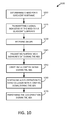
- FIG. 10 is a block diagram illustrating a method 1000 for use with the disclosed apparatus and systems.
- an apparatus which may be a UE that is capable of D2D communications, determines a need for a quiescent subframe, 1010, for example, so that it can engage in D2D communications without undue interference.
- the apparatus transmits a signal indicative of the need for a quiescent subframe, 1020.
- the apparatus receives an ABS, 1030, which may be provided in response to its transmitted indicator signal.
- the apparatus prevents performing a measurement, such as a measurement based on control signals of the ABS, 1040. Further, the apparatus cancels at least one control signal during the ABS, 1050.
- the apparatus schedules a D2D operation such that the operation, which may be a D2D transmission, for example, will avoid collision with a control signal during the ABS, 1060.
- the apparatus then performs the D2D operation during the ABS, 1070.
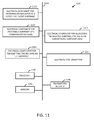
- FIG. 11 is a block diagram of an exemplary apparatus 1100 that may be configured as a network entity (e.g., a base station such as the eNB 840 in FIG. 8B ) in a wireless network, or as a processor or similar device/component for use within the network entity.
- the apparatus 1100 may include functional blocks that represent functions implemented by an application specific processor, or software executing on a general purpose processor, or a combination thereof (e.g., firmware).
- apparatus 1100 includes a processor for executing computer code 1190, a memory or other storage device 1192 that may store the computer code and/or the results of the executed code, and a transmitter/receiver 1195 for communicating with other devices, all of which would be included in eNB 840.
- apparatus 1100 may include an electrical component or module 1101 for obtaining an indicator of a needed quiescent subframe (which may be included, e.g., in transceiver module 860 or signal monitor module 870).
- the apparatus 1100 may also include an electrical component or module 1105 for selecting a subframe of a communication frame (which may be included, e.g., in controller module 880).
- An electrical component or module 1107 may be included for allocating the selected subframe for use as an almost blank subframe (ABS) (which may be included, e.g., in scheduler module 890).
- the apparatus 1100 may also include an electrical component or module 1109 for transmitting the ABS over an air interface (which may be included, e.g., in transceiver module 860).
- the apparatus 1100 may also include an electrical component or module 1111 for sending a misinformation signal indicating the ABS is not almost blank (which may be included, e.g., in transceiver module 860).
- an exemplary apparatus 1200 may be configured as a network entity (e.g., a UE such as the UE 800 in FIG. 8A ) in a wireless network.
- the apparatus 1200 may include functional blocks that represent functions implemented by an application specific processor, or software executing on a general purpose processor, or a combination thereof (e.g., firmware).
- apparatus 1200 includes a processor for executing computer code 1290, a memory or other storage device 1292 that may store the computer code and/or the results of the executed code, and a transmitter/receiver 1295 for communicating with other devices, all of which would be included in UE 800.
- apparatus 1200 may include an electrical component or module 1201 for determining a need for a quiescent subframe, such as to engage in D2D communications (which may be included, e.g., in controller module 830).
- the apparatus may also include an electrical component or module 1203 for transmitting a signal indicative of the need for a quiescent subframe (which may be included, e.g., in transceiver module 820).
- the apparatus may also include an electrical component or module 1205 for receiving an almost blank subframe (ABS) (which may be included, e.g., in receiver module 815).
- ABS almost blank subframe
- the apparatus may also include an electrical component or module 1208 for preventing performing a measurement during the ABS, such as a measurement of synchronization signals (which may be included, e.g., in controller module 830).
- the apparatus may also include an electrical component or module 1209 for canceling a control signal during the ABS (which may also be included, e.g., in controller module 830).
- the apparatus may also include an electrical component or module 1210 for scheduling a D2D operation such that it avoids collision with a control signal during the ABS (which may also be included, e.g., in controller module 830).
- the apparatus may also include an electrical component or module 1212 for performing a D2D operation during the ABS (which may also be included, e.g., in controller module 830).
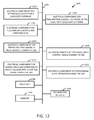
- FIG. 13 is a block diagram of an exemplary apparatus 1300 that may be configured as a network entity (e.g., a base station such as the eNB 840 in FIG. 8B ) in a wireless network, or as a processor or similar device/component for use within the network entity.
- the apparatus 1300 may include functional blocks that represent functions implemented by an application specific processor, or software executing on a general purpose processor, or a combination thereof (e.g., firmware).
- apparatus 1300 includes a processor for executing computer code 1390, a memory or other storage device 1392 that may store the computer code and/or the results of the executed code, and a transmitter/receiver 1395 for communicating with other devices, all of which would be included in eNB 840.
- apparatus 1300 may include electrical component means 1301 for obtaining an indicator of a needed quiescent subframe (which may be included, e.g., in transceiver module 860 or signal monitor module 870).
- the apparatus 1300 may also include electrical component means 1303 for modifying a TDD uplink/downlink configuration to a configuration containing at least one more DL subframe responsive to the indicator of a needed quiescent subframe (which may be included, e.g., in controller module 880).
- the apparatus 1300 may also include electrical component means 1305 for allocating the at least one additional DL subframe as at least one respective ABS (which may be included, e.g., in controller module 880).
- Electrical component means 1308 may be included for communicating the at least one ABS over an air interface (which may be included, e.g., in transceiver module 860).
- the apparatus 1300 may also include electrical component means 1309 for sending a misinformation signal indicating the ABS is not almost blank (which may be included, e.g., in transceiver module 860).
- the apparatus 1300 may also include electrical component means 1310 for forming the at least one additional DL subframe as at least one respective ABS (which may be included, e.g., in controller module 880).
- the apparatus 1300 may also include electrical component means 1312 detecting at least one UE operable to engage in D2D communications (which may be included, e.g., in signal monitor module 870).
- the apparatus 1300 may also include electrical component means 1314 for causing formation of an MIB/SIB indicating the added DL is an ABS (which may be included, e.g., in controller module 880).
- the apparatus 1300 may also include electrical component means 1316 for causing formation of an MIB/SIB indicating the added DL is for D2D communications (which may be included, e.g., in controller module 880).
- the processor, memory, and/or the transmitter/receiver of apparatus 1100, 1200, and 1300 may be in operative communication with the components 1101 - 1111, 1201 - 1212, and 1301 - 1316, respectively, via buses 1150, 1250, and 1350, respectively, or via similar communication coupling.
- the processors may effect initiation and scheduling of the processes and/or functions performed by electrical components 1101 - 1111, 1201 - 1212, and 1301 - 1316.
- transmitter/receiver components of the apparatus described herein may be embodied in a transceiver, and/or a stand alone receiver and/or stand alone transmitter may be used in lieu of or in conjunction with a transceiver.
- the apparatus is a base station, eNB, or the like
- that apparatus may also include a network interface (not shown) for connecting to one or more core network entities and/or base station entities.
- a network interface not shown
- apparatus 1100, 1200, and 1300 may optionally include an additional computer readable component for storing information. That component may be operatively coupled to the other components of the apparatus 1100, 1200, and 1300, such as via the bus 1150, 1250, 1350 or the like.
- the memory components may be adapted to store computer readable instructions and data for affecting the processes and behavior of the components described in each of the apparatus, and subcomponents thereof, or the processors, or the methods disclosed herein.
- the memory described herein may store instructions for executing functions associated with the components of the apparatus. It is further noted that the apparatus illustrated in FIGs.11 , 12 , 13 may comprise additional processors, electronic devices, hardware devices, electronic sub-components, logical circuits, memories, software codes, firmware codes, etc., or any combination thereof as needed to effect the herein described systems and methods, and/or others not described herein.
- DSP digital signal processor
- ASIC application specific integrated circuit
- FPGA field programmable gate array
- a general-purpose processor may be a microprocessor, but in the alternative, the processor may be any conventional processor, controller, microcontroller, or state machine.
- a processor may also be implemented as a combination of computing devices, e.g., a combination of a DSP and a microprocessor, a plurality of microprocessors, one or more microprocessors in conjunction with a DSP core, or any other such configuration.
- a software module may reside in RAM memory, flash memory, ROM memory, EPROM memory, EEPROM memory, registers, magnetic hard disk, a removable disk, a CD-ROM, or any other form of storage medium known in the art.
- An exemplary storage medium is coupled to the processor such that the processor can read information from, and/or write information to, the storage medium.
- the storage medium may be distinct from or integral to the processor.
- the processor and the storage medium may reside in an ASIC. In some cases, the ASIC may reside in a user terminal. In the alternative, the processor and the storage medium may reside as discrete components in a user terminal.
- the functions described may be implemented using hardware, software, firmware, or any combination thereof. If implemented using software, the functions may be stored on or transmitted over as one or more instructions or code on a non-transitory computer-readable medium.
- Computer-readable media may encompass both computer storage media and communication media including any tangible non-transitory medium that facilitates transfer of a computer program from one place to another.
- a storage medium may be any available non-transitory medium that can be accessed by a general purpose or special purpose computer.
- Such computer-readable media can comprise RAM, ROM, EEPROM, CD-ROM or other optical disk storage, magnetic disk storage or other magnetic storage devices, or any other medium that can be used to carry or store desired program code means in the form of instructions or data structures and that can be accessed by a general-purpose or special-purpose computer, or a general-purpose or special-purpose processor.
- Disk and disc can include any optical storage device such as compact disc (CD), laser disc, optical disc, digital versatile disc (DVD), floppy disk and blu-ray disc where disks usually reproduce data magnetically, while discs reproduce data optically with lasers. Combinations of the above should also be included within the scope of computer-readable media
Landscapes
- Engineering & Computer Science (AREA)
- Signal Processing (AREA)
- Computer Networks & Wireless Communication (AREA)
- Mobile Radio Communication Systems (AREA)
Applications Claiming Priority (3)
| Application Number | Priority Date | Filing Date | Title |
|---|---|---|---|
| US13/534,731 US8737276B2 (en) | 2012-06-27 | 2012-06-27 | Method and apparatus using modified subframes |
| PCT/US2013/047111 WO2014004314A2 (fr) | 2012-06-27 | 2013-06-21 | Procédé et appareil utilisant des sous-trames modifiées |
| EP13734915.5A EP2868150B1 (fr) | 2012-06-27 | 2013-06-21 | Procede et appareil utilisant des sous-trames modifiees quasi-silenciees pour transmissions directes entre equipements portables |
Related Parent Applications (2)
| Application Number | Title | Priority Date | Filing Date |
|---|---|---|---|
| EP13734915.5A Division EP2868150B1 (fr) | 2012-06-27 | 2013-06-21 | Procede et appareil utilisant des sous-trames modifiees quasi-silenciees pour transmissions directes entre equipements portables |
| EP13734915.5A Division-Into EP2868150B1 (fr) | 2012-06-27 | 2013-06-21 | Procede et appareil utilisant des sous-trames modifiees quasi-silenciees pour transmissions directes entre equipements portables |
Publications (2)
| Publication Number | Publication Date |
|---|---|
| EP2919540A1 true EP2919540A1 (fr) | 2015-09-16 |
| EP2919540B1 EP2919540B1 (fr) | 2018-07-18 |
Family
ID=48748536
Family Applications (3)
| Application Number | Title | Priority Date | Filing Date |
|---|---|---|---|
| EP13734915.5A Not-in-force EP2868150B1 (fr) | 2012-06-27 | 2013-06-21 | Procede et appareil utilisant des sous-trames modifiees quasi-silenciees pour transmissions directes entre equipements portables |
| EP15165709.5A Not-in-force EP2919539B1 (fr) | 2012-06-27 | 2013-06-21 | Procédé et appareil utilisant des sous-trames silenciées pour la communication directe entre terminaux portables |
| EP15165727.7A Not-in-force EP2919540B1 (fr) | 2012-06-27 | 2013-06-21 | Procédé et appareil utilisant des sous-trames silenciées dans un systeme de communications portables tdd pour la communication directe entre terminaux |
Family Applications Before (2)
| Application Number | Title | Priority Date | Filing Date |
|---|---|---|---|
| EP13734915.5A Not-in-force EP2868150B1 (fr) | 2012-06-27 | 2013-06-21 | Procede et appareil utilisant des sous-trames modifiees quasi-silenciees pour transmissions directes entre equipements portables |
| EP15165709.5A Not-in-force EP2919539B1 (fr) | 2012-06-27 | 2013-06-21 | Procédé et appareil utilisant des sous-trames silenciées pour la communication directe entre terminaux portables |
Country Status (5)
| Country | Link |
|---|---|
| US (2) | US8737276B2 (fr) |
| EP (3) | EP2868150B1 (fr) |
| KR (1) | KR101727215B1 (fr) |
| CN (1) | CN104412680B (fr) |
| WO (1) | WO2014004314A2 (fr) |
Families Citing this family (36)
| Publication number | Priority date | Publication date | Assignee | Title |
|---|---|---|---|---|
| US8737276B2 (en) | 2012-06-27 | 2014-05-27 | Qualcomm Incorporated | Method and apparatus using modified subframes |
| US9622279B2 (en) * | 2012-08-22 | 2017-04-11 | Telefonaktiebolaget L M Ericsson (Publ) | Dynamic spectrum band selection for D2D communications |
| US9288746B2 (en) * | 2012-09-20 | 2016-03-15 | Qualcomm Incorporated | Determination of available services in a broadcast network |
| US8902907B2 (en) | 2012-10-05 | 2014-12-02 | Futurewei Technologies, Inc. | Terminal based grouping virtual transmission and reception in wireless networks |
| US9692550B2 (en) | 2012-11-29 | 2017-06-27 | Huawei Technologies Co., Ltd. | Systems and methods for waveform selection and adaptation |
| WO2014104627A1 (fr) * | 2012-12-30 | 2014-07-03 | 엘지전자 주식회사 | Appareil et procédé de réalisation d'une communication de dispositif à dispositif dans un système de communications sans fil |
| US9306721B2 (en) * | 2013-03-15 | 2016-04-05 | Google Technology Holdings LLC | Method and apparatus for device-to-device communication |
| US9794861B2 (en) * | 2013-03-31 | 2017-10-17 | Tejas Networks Limited | System information message communication by dynamic segmenting of SI messages in a wireless communication system |
| US20160050706A1 (en) * | 2013-04-04 | 2016-02-18 | Intel IP Corporation | Dual connectivity for terminals supporting one uplink carrier |
| US9191178B2 (en) | 2013-04-04 | 2015-11-17 | Intel IP Corporation | Enhanced node B and method for RRC connection establishment for small data transfers |
| EP2984764B1 (fr) * | 2013-04-08 | 2021-06-09 | Telefonaktiebolaget LM Ericsson (publ) | Procédé permettant de supprimer une interférence sur la base d'un équipement utilisateur (ue) en facilitant la signalisation par l'intermédiaire d'une liaison de dispositif à dispositif (d2d) |
| CN104125039B (zh) * | 2013-04-28 | 2017-11-14 | 电信科学技术研究院 | 一种确定传输链路的类型的方法、系统及设备 |
| US9467277B2 (en) * | 2013-05-16 | 2016-10-11 | Htc Corporation | Method and related communication device for handling communication between time division duplex devices |
| US10257713B2 (en) * | 2013-06-06 | 2019-04-09 | Nokia Technologies Oy | Methods and apparatus for interference management and resource sharing |
| WO2014198207A1 (fr) * | 2013-06-13 | 2014-12-18 | 上海朗帛通信技术有限公司 | Procédé et dispositif de communication dans un eu d2d de système drt |
| US9467880B2 (en) * | 2013-06-28 | 2016-10-11 | Kyocera Corporation | Management of device-to-device discovery signals and small cell discovery signals |
| JP6183148B2 (ja) * | 2013-10-24 | 2017-08-23 | 富士通株式会社 | 通信端末装置、通信制御システムおよび通信制御方法 |
| EP3065311B1 (fr) * | 2013-10-31 | 2019-12-11 | LG Electronics Inc. | Procédés d'émission et de réception de signal par un terminal vers/depuis une station de base au moyen d'une communication dispositif-à-dispositif dans un système de communication sans fil |
| US10143004B2 (en) * | 2013-12-18 | 2018-11-27 | Lg Electronics Inc. | Method and apparatus for receiving ABS information in wireless communication system |
| US9363072B2 (en) | 2014-05-22 | 2016-06-07 | Samsung Electronics Co., Ltd. | Computing system with synchronization mechanism and method of operation thereof |
| US11076417B2 (en) | 2014-07-31 | 2021-07-27 | Microsoft Technology Licensing, Llc | Downlink transmission scheduling for user equipments enabling device-to-device communications |
| CN106797541B (zh) * | 2014-08-07 | 2021-03-26 | 瑞典爱立信有限公司 | 用于d2d的空白子帧的使用 |
| KR102301826B1 (ko) * | 2014-08-27 | 2021-09-14 | 삼성전자 주식회사 | 무선 통신 시스템 및 그 시스템에서 간섭 조정을 위한 자원 관리 방법 |
| US20160103914A1 (en) * | 2014-10-10 | 2016-04-14 | Salesforce.Com, Inc. | Offloading search processing against analytic data stores |
| US10244444B2 (en) * | 2015-03-04 | 2019-03-26 | Qualcomm Incorporated | Dual link handover |
| KR102332471B1 (ko) | 2015-05-08 | 2021-11-30 | 삼성전자주식회사 | 동기 신호 검출을 위한 장치 및 방법 |
| US9756641B2 (en) | 2015-07-07 | 2017-09-05 | Qualcomm Incorporated | Dynamic signaling of LTE-TDD configurations in the presence of D2D transmissions |
| US10383136B2 (en) | 2015-08-24 | 2019-08-13 | Qualcomm Incorporated | Methods an apparatus for backhaul and access link scheduling in integrated access and backhaul network and synchronized networks |
| JP6593531B2 (ja) * | 2015-10-26 | 2019-10-23 | 富士通株式会社 | 無線通信システムにおいて使用される基地局および無線装置 |
| US10089289B2 (en) | 2015-12-29 | 2018-10-02 | Palantir Technologies Inc. | Real-time document annotation |
| US11012204B2 (en) * | 2016-06-08 | 2021-05-18 | Lg Electronics Inc. | Communication method of using full duplex in NR |
| US10349403B2 (en) | 2016-08-25 | 2019-07-09 | Qualcomm Incorporated | Supporting different numerology configurations |
| WO2018174614A1 (fr) * | 2017-03-22 | 2018-09-27 | 엘지전자 주식회사 | Procédé d'émission et de réception de signaux par un terminal et une station de base dans un système de communication sans fil, et dispositif pour la mise en oeuvre de ce procédé |
| US12022492B2 (en) * | 2017-05-02 | 2024-06-25 | Ntt Docomo, Inc. | User terminal and radio communication method |
| CN108990023A (zh) * | 2018-07-02 | 2018-12-11 | 北京交通大学 | 基于机器学习的lte网络的动态空白子帧分配方法 |
| WO2020191782A1 (fr) * | 2019-03-28 | 2020-10-01 | 华为技术有限公司 | Procédé et dispositif de transmission de données |
Citations (3)
| Publication number | Priority date | Publication date | Assignee | Title |
|---|---|---|---|---|
| US20110310830A1 (en) * | 2010-06-18 | 2011-12-22 | Mediatek Inc. | Method for Coordinating Transmissions Between Different Communications Apparatuses and Communication Sapparatuses Utilizing the Same |
| WO2012060608A2 (fr) * | 2010-11-01 | 2012-05-10 | 엘지전자 주식회사 | Procédé de coordination de brouillage entre cellules et station de base |
| KR101150846B1 (ko) * | 2011-09-05 | 2012-06-13 | 엘지전자 주식회사 | 셀 측정 방법 및 그를 위한 정보 전송 방법 |
Family Cites Families (20)
| Publication number | Priority date | Publication date | Assignee | Title |
|---|---|---|---|---|
| US8879479B2 (en) * | 2009-01-27 | 2014-11-04 | Motorola Solutions, Inc. | Reactive scheduling methods and apparatus to enable peer-to-peer communication links in a wireless OFDMA system |
| AU2011233858B2 (en) | 2010-03-29 | 2015-01-29 | Lg Electronics Inc. | Method and apparatus for measurement for inter-cell interference coordination in radio communication system |
| US9392608B2 (en) * | 2010-04-13 | 2016-07-12 | Qualcomm Incorporated | Resource partitioning information for enhanced interference coordination |
| US20110249642A1 (en) | 2010-04-13 | 2011-10-13 | Qualcomm Incorporated | Adaptive resource negotiation between base stations for enhanced interference coordination |
| US8504052B2 (en) | 2010-05-06 | 2013-08-06 | Nokia Corporation | Measurements and fast power adjustments in D2D communications |
| US8526347B2 (en) | 2010-06-10 | 2013-09-03 | Qualcomm Incorporated | Peer-to-peer communication with symmetric waveform for downlink and uplink |
| US20120149362A1 (en) * | 2010-06-18 | 2012-06-14 | Interdigital Patent Holdings, Inc. | Victim User Equipment Status |
| US8611295B2 (en) * | 2010-06-21 | 2013-12-17 | Qualcomm Incorporated | Adaptive resource partitioning information (ARPI) transition behavior in heterogeneous networks |
| US20120142268A1 (en) * | 2010-12-06 | 2012-06-07 | Industrial Technology Research Institute | Signal transmission method,base station and wireless communication device |
| KR20120083192A (ko) * | 2011-01-17 | 2012-07-25 | 주식회사 팬택 | 무선통신 시스템에서 채널 상태 정보의 전송 장치 및 방법 |
| US9078255B2 (en) * | 2011-08-16 | 2015-07-07 | Alcatel Lucent | Method and apparatus for allocating almost blank subframes |
| US9253713B2 (en) * | 2011-09-26 | 2016-02-02 | Blackberry Limited | Method and system for small cell discovery in heterogeneous cellular networks |
| KR101587144B1 (ko) * | 2011-09-29 | 2016-01-20 | 노키아 솔루션스 앤드 네트웍스 오와이 | 간섭 관리를 위한 방법 및 장치 |
| US9473279B2 (en) * | 2011-11-04 | 2016-10-18 | Blackberry Limited | Inter-cell interference coordination for E-PDCCH |
| US8798021B2 (en) * | 2012-03-16 | 2014-08-05 | Nokia Siemens Networks Oy | Hierarchical network and interference management |
| US9288680B2 (en) * | 2012-03-22 | 2016-03-15 | Alcatel Lucent | Almost blank subframe duty cycle adaptation in heterogeneous networks |
| US9066367B2 (en) * | 2012-03-29 | 2015-06-23 | Intel Mobile Communications GmbH | Macro-femto inter-cell interference mitigation |
| US8559917B1 (en) * | 2012-03-30 | 2013-10-15 | Alcatel Lucent | Method, apparatus and computer readable medium for associating user equipment with a cell |
| US8755791B2 (en) * | 2012-05-11 | 2014-06-17 | Blackberry Limited | Method and system for low power downlink transmission in heterogeneous networks |
| US8737276B2 (en) | 2012-06-27 | 2014-05-27 | Qualcomm Incorporated | Method and apparatus using modified subframes |
-
2012
- 2012-06-27 US US13/534,731 patent/US8737276B2/en not_active Expired - Fee Related
-
2013
- 2013-06-21 WO PCT/US2013/047111 patent/WO2014004314A2/fr not_active Ceased
- 2013-06-21 EP EP13734915.5A patent/EP2868150B1/fr not_active Not-in-force
- 2013-06-21 EP EP15165709.5A patent/EP2919539B1/fr not_active Not-in-force
- 2013-06-21 CN CN201380033986.6A patent/CN104412680B/zh not_active Expired - Fee Related
- 2013-06-21 KR KR1020157001814A patent/KR101727215B1/ko not_active Expired - Fee Related
- 2013-06-21 EP EP15165727.7A patent/EP2919540B1/fr not_active Not-in-force
-
2014
- 2014-05-22 US US14/284,786 patent/US9055558B2/en not_active Expired - Fee Related
Patent Citations (5)
| Publication number | Priority date | Publication date | Assignee | Title |
|---|---|---|---|---|
| US20110310830A1 (en) * | 2010-06-18 | 2011-12-22 | Mediatek Inc. | Method for Coordinating Transmissions Between Different Communications Apparatuses and Communication Sapparatuses Utilizing the Same |
| WO2012060608A2 (fr) * | 2010-11-01 | 2012-05-10 | 엘지전자 주식회사 | Procédé de coordination de brouillage entre cellules et station de base |
| US20130223393A1 (en) * | 2010-11-01 | 2013-08-29 | Lg Electronics Inc. | Method for coordinating inter-cell interference and base station |
| KR101150846B1 (ko) * | 2011-09-05 | 2012-06-13 | 엘지전자 주식회사 | 셀 측정 방법 및 그를 위한 정보 전송 방법 |
| US20130058234A1 (en) * | 2011-09-05 | 2013-03-07 | Lg Electronics Inc. | Method of performing cell measurement and method of providing information for cell measurement |
Also Published As
| Publication number | Publication date |
|---|---|
| EP2868150B1 (fr) | 2017-01-11 |
| EP2868150A2 (fr) | 2015-05-06 |
| WO2014004314A2 (fr) | 2014-01-03 |
| US20140003301A1 (en) | 2014-01-02 |
| KR20150023867A (ko) | 2015-03-05 |
| EP2919539B1 (fr) | 2018-02-21 |
| CN104412680A (zh) | 2015-03-11 |
| CN104412680B (zh) | 2018-07-17 |
| EP2919539A1 (fr) | 2015-09-16 |
| US9055558B2 (en) | 2015-06-09 |
| WO2014004314A3 (fr) | 2014-06-26 |
| US8737276B2 (en) | 2014-05-27 |
| US20140254439A1 (en) | 2014-09-11 |
| KR101727215B1 (ko) | 2017-04-14 |
| EP2919540B1 (fr) | 2018-07-18 |
Similar Documents
| Publication | Publication Date | Title |
|---|---|---|
| EP2919539B1 (fr) | Procédé et appareil utilisant des sous-trames silenciées pour la communication directe entre terminaux portables | |
| JP6449883B2 (ja) | 無認可スペクトルを用いたlte(登録商標)/lte−a通信システムのためのダウンリンクプロシージャ | |
| CN103718614B (zh) | 用于异构网络中的信令的方法和系统 | |
| KR101886749B1 (ko) | 협력형 통신 시스템들에 대한 채널 사용 비콘 신호 설계 | |
| JP5805829B2 (ja) | コグニティブ無線通信における感知を可能にすること | |
| KR101726535B1 (ko) | 인핸스드 pdsch 동작 | |
| US10182421B2 (en) | Authorized shared access carrier aggregation with sensing | |
| US9788327B2 (en) | Methods and apparatus for reducing interference in a heterogeneous network | |
| CN102823165B (zh) | 针对异构网络的系统接入 | |
| CN106031112B (zh) | 具有无执照频谱的lte/lte-a网络中的天线选择 | |
| CN107431934B (zh) | 用于频谱的分层级共享的信标 | |
| CN113170303A (zh) | 多sim和c-rat操作中寻呼抵触的解决方案 | |
| KR20170043522A (ko) | 비허가된 스펙트럼을 갖는 lte/lte-a에서 csi 요청 절차 | |
| CN111294963B (zh) | 在利用非许可频谱的lte/lte-a中的重新同步管理 | |
| CN114830808A (zh) | 多usim和双连接操作的通信周期 | |
| KR20150082433A (ko) | 무선 통신 시스템들에서 향상된 새로운 캐리어 타입 | |
| KR20170137749A (ko) | 튠-어웨이 동작을 제어하기 위한 장치 및 방법 | |
| CN110999456A (zh) | 具有可配置带宽的csirs的传输、接收和配置 | |
| US20230262543A1 (en) | Method of ue assisted enablement from ue to network on preferred resource in a multi-sim device |
Legal Events
| Date | Code | Title | Description |
|---|---|---|---|
| PUAI | Public reference made under article 153(3) epc to a published international application that has entered the european phase |
Free format text: ORIGINAL CODE: 0009012 |
|
| 17P | Request for examination filed |
Effective date: 20150429 |
|
| AC | Divisional application: reference to earlier application |
Ref document number: 2868150 Country of ref document: EP Kind code of ref document: P |
|
| AK | Designated contracting states |
Kind code of ref document: A1 Designated state(s): AL AT BE BG CH CY CZ DE DK EE ES FI FR GB GR HR HU IE IS IT LI LT LU LV MC MK MT NL NO PL PT RO RS SE SI SK SM TR |
|
| AX | Request for extension of the european patent |
Extension state: BA ME |
|
| STAA | Information on the status of an ep patent application or granted ep patent |
Free format text: STATUS: EXAMINATION IS IN PROGRESS |
|
| 17Q | First examination report despatched |
Effective date: 20161122 |
|
| RIC1 | Information provided on ipc code assigned before grant |
Ipc: H04W 72/04 20090101AFI20170704BHEP Ipc: H04W 76/02 20090101ALN20170704BHEP Ipc: H04W 16/32 20090101ALN20170704BHEP |
|
| GRAP | Despatch of communication of intention to grant a patent |
Free format text: ORIGINAL CODE: EPIDOSNIGR1 |
|
| STAA | Information on the status of an ep patent application or granted ep patent |
Free format text: STATUS: GRANT OF PATENT IS INTENDED |
|
| INTG | Intention to grant announced |
Effective date: 20170822 |
|
| GRAJ | Information related to disapproval of communication of intention to grant by the applicant or resumption of examination proceedings by the epo deleted |
Free format text: ORIGINAL CODE: EPIDOSDIGR1 |
|
| STAA | Information on the status of an ep patent application or granted ep patent |
Free format text: STATUS: EXAMINATION IS IN PROGRESS |
|
| GRAP | Despatch of communication of intention to grant a patent |
Free format text: ORIGINAL CODE: EPIDOSNIGR1 |
|
| STAA | Information on the status of an ep patent application or granted ep patent |
Free format text: STATUS: GRANT OF PATENT IS INTENDED |
|
| INTC | Intention to grant announced (deleted) | ||
| RIC1 | Information provided on ipc code assigned before grant |
Ipc: H04W 16/32 20090101ALN20180109BHEP Ipc: H04W 76/14 20180101ALN20180109BHEP Ipc: H04W 72/04 20090101AFI20180109BHEP |
|
| INTG | Intention to grant announced |
Effective date: 20180125 |
|
| GRAS | Grant fee paid |
Free format text: ORIGINAL CODE: EPIDOSNIGR3 |
|
| GRAA | (expected) grant |
Free format text: ORIGINAL CODE: 0009210 |
|
| STAA | Information on the status of an ep patent application or granted ep patent |
Free format text: STATUS: THE PATENT HAS BEEN GRANTED |
|
| AC | Divisional application: reference to earlier application |
Ref document number: 2868150 Country of ref document: EP Kind code of ref document: P |
|
| AK | Designated contracting states |
Kind code of ref document: B1 Designated state(s): AL AT BE BG CH CY CZ DE DK EE ES FI FR GB GR HR HU IE IS IT LI LT LU LV MC MK MT NL NO PL PT RO RS SE SI SK SM TR |
|
| REG | Reference to a national code |
Ref country code: GB Ref legal event code: FG4D |
|
| REG | Reference to a national code |
Ref country code: CH Ref legal event code: EP |
|
| REG | Reference to a national code |
Ref country code: IE Ref legal event code: FG4D |
|
| REG | Reference to a national code |
Ref country code: AT Ref legal event code: REF Ref document number: 1020726 Country of ref document: AT Kind code of ref document: T Effective date: 20180815 |
|
| REG | Reference to a national code |
Ref country code: DE Ref legal event code: R096 Ref document number: 602013040690 Country of ref document: DE |
|
| REG | Reference to a national code |
Ref country code: NL Ref legal event code: MP Effective date: 20180718 |
|
| REG | Reference to a national code |
Ref country code: LT Ref legal event code: MG4D |
|
| REG | Reference to a national code |
Ref country code: AT Ref legal event code: MK05 Ref document number: 1020726 Country of ref document: AT Kind code of ref document: T Effective date: 20180718 |
|
| PG25 | Lapsed in a contracting state [announced via postgrant information from national office to epo] |
Ref country code: NL Free format text: LAPSE BECAUSE OF FAILURE TO SUBMIT A TRANSLATION OF THE DESCRIPTION OR TO PAY THE FEE WITHIN THE PRESCRIBED TIME-LIMIT Effective date: 20180718 |
|
| PG25 | Lapsed in a contracting state [announced via postgrant information from national office to epo] |
Ref country code: FI Free format text: LAPSE BECAUSE OF FAILURE TO SUBMIT A TRANSLATION OF THE DESCRIPTION OR TO PAY THE FEE WITHIN THE PRESCRIBED TIME-LIMIT Effective date: 20180718 Ref country code: PL Free format text: LAPSE BECAUSE OF FAILURE TO SUBMIT A TRANSLATION OF THE DESCRIPTION OR TO PAY THE FEE WITHIN THE PRESCRIBED TIME-LIMIT Effective date: 20180718 Ref country code: LT Free format text: LAPSE BECAUSE OF FAILURE TO SUBMIT A TRANSLATION OF THE DESCRIPTION OR TO PAY THE FEE WITHIN THE PRESCRIBED TIME-LIMIT Effective date: 20180718 Ref country code: BG Free format text: LAPSE BECAUSE OF FAILURE TO SUBMIT A TRANSLATION OF THE DESCRIPTION OR TO PAY THE FEE WITHIN THE PRESCRIBED TIME-LIMIT Effective date: 20181018 Ref country code: SE Free format text: LAPSE BECAUSE OF FAILURE TO SUBMIT A TRANSLATION OF THE DESCRIPTION OR TO PAY THE FEE WITHIN THE PRESCRIBED TIME-LIMIT Effective date: 20180718 Ref country code: IS Free format text: LAPSE BECAUSE OF FAILURE TO SUBMIT A TRANSLATION OF THE DESCRIPTION OR TO PAY THE FEE WITHIN THE PRESCRIBED TIME-LIMIT Effective date: 20181118 Ref country code: AT Free format text: LAPSE BECAUSE OF FAILURE TO SUBMIT A TRANSLATION OF THE DESCRIPTION OR TO PAY THE FEE WITHIN THE PRESCRIBED TIME-LIMIT Effective date: 20180718 Ref country code: NO Free format text: LAPSE BECAUSE OF FAILURE TO SUBMIT A TRANSLATION OF THE DESCRIPTION OR TO PAY THE FEE WITHIN THE PRESCRIBED TIME-LIMIT Effective date: 20181018 Ref country code: GR Free format text: LAPSE BECAUSE OF FAILURE TO SUBMIT A TRANSLATION OF THE DESCRIPTION OR TO PAY THE FEE WITHIN THE PRESCRIBED TIME-LIMIT Effective date: 20181019 Ref country code: RS Free format text: LAPSE BECAUSE OF FAILURE TO SUBMIT A TRANSLATION OF THE DESCRIPTION OR TO PAY THE FEE WITHIN THE PRESCRIBED TIME-LIMIT Effective date: 20180718 |
|
| REG | Reference to a national code |
Ref country code: CH Ref legal event code: PK Free format text: BERICHTIGUNGEN |
|
| RIC2 | Information provided on ipc code assigned after grant |
Ipc: H04W 16/32 20090101ALN20180109BHEP Ipc: H04W 76/14 20180101ALN20180109BHEP Ipc: H04W 72/04 20090101AFI20180109BHEP |
|
| PG25 | Lapsed in a contracting state [announced via postgrant information from national office to epo] |
Ref country code: HR Free format text: LAPSE BECAUSE OF FAILURE TO SUBMIT A TRANSLATION OF THE DESCRIPTION OR TO PAY THE FEE WITHIN THE PRESCRIBED TIME-LIMIT Effective date: 20180718 Ref country code: LV Free format text: LAPSE BECAUSE OF FAILURE TO SUBMIT A TRANSLATION OF THE DESCRIPTION OR TO PAY THE FEE WITHIN THE PRESCRIBED TIME-LIMIT Effective date: 20180718 Ref country code: AL Free format text: LAPSE BECAUSE OF FAILURE TO SUBMIT A TRANSLATION OF THE DESCRIPTION OR TO PAY THE FEE WITHIN THE PRESCRIBED TIME-LIMIT Effective date: 20180718 |
|
| REG | Reference to a national code |
Ref country code: DE Ref legal event code: R097 Ref document number: 602013040690 Country of ref document: DE |
|
| PG25 | Lapsed in a contracting state [announced via postgrant information from national office to epo] |
Ref country code: CZ Free format text: LAPSE BECAUSE OF FAILURE TO SUBMIT A TRANSLATION OF THE DESCRIPTION OR TO PAY THE FEE WITHIN THE PRESCRIBED TIME-LIMIT Effective date: 20180718 Ref country code: RO Free format text: LAPSE BECAUSE OF FAILURE TO SUBMIT A TRANSLATION OF THE DESCRIPTION OR TO PAY THE FEE WITHIN THE PRESCRIBED TIME-LIMIT Effective date: 20180718 Ref country code: IT Free format text: LAPSE BECAUSE OF FAILURE TO SUBMIT A TRANSLATION OF THE DESCRIPTION OR TO PAY THE FEE WITHIN THE PRESCRIBED TIME-LIMIT Effective date: 20180718 Ref country code: EE Free format text: LAPSE BECAUSE OF FAILURE TO SUBMIT A TRANSLATION OF THE DESCRIPTION OR TO PAY THE FEE WITHIN THE PRESCRIBED TIME-LIMIT Effective date: 20180718 Ref country code: ES Free format text: LAPSE BECAUSE OF FAILURE TO SUBMIT A TRANSLATION OF THE DESCRIPTION OR TO PAY THE FEE WITHIN THE PRESCRIBED TIME-LIMIT Effective date: 20180718 |
|
| PLBE | No opposition filed within time limit |
Free format text: ORIGINAL CODE: 0009261 |
|
| STAA | Information on the status of an ep patent application or granted ep patent |
Free format text: STATUS: NO OPPOSITION FILED WITHIN TIME LIMIT |
|
| PG25 | Lapsed in a contracting state [announced via postgrant information from national office to epo] |
Ref country code: SK Free format text: LAPSE BECAUSE OF FAILURE TO SUBMIT A TRANSLATION OF THE DESCRIPTION OR TO PAY THE FEE WITHIN THE PRESCRIBED TIME-LIMIT Effective date: 20180718 Ref country code: SM Free format text: LAPSE BECAUSE OF FAILURE TO SUBMIT A TRANSLATION OF THE DESCRIPTION OR TO PAY THE FEE WITHIN THE PRESCRIBED TIME-LIMIT Effective date: 20180718 Ref country code: DK Free format text: LAPSE BECAUSE OF FAILURE TO SUBMIT A TRANSLATION OF THE DESCRIPTION OR TO PAY THE FEE WITHIN THE PRESCRIBED TIME-LIMIT Effective date: 20180718 |
|
| 26N | No opposition filed |
Effective date: 20190423 |
|
| PG25 | Lapsed in a contracting state [announced via postgrant information from national office to epo] |
Ref country code: SI Free format text: LAPSE BECAUSE OF FAILURE TO SUBMIT A TRANSLATION OF THE DESCRIPTION OR TO PAY THE FEE WITHIN THE PRESCRIBED TIME-LIMIT Effective date: 20180718 |
|
| PG25 | Lapsed in a contracting state [announced via postgrant information from national office to epo] |
Ref country code: MC Free format text: LAPSE BECAUSE OF FAILURE TO SUBMIT A TRANSLATION OF THE DESCRIPTION OR TO PAY THE FEE WITHIN THE PRESCRIBED TIME-LIMIT Effective date: 20180718 |
|
| REG | Reference to a national code |
Ref country code: CH Ref legal event code: PL |
|
| REG | Reference to a national code |
Ref country code: BE Ref legal event code: MM Effective date: 20190630 |
|
| PG25 | Lapsed in a contracting state [announced via postgrant information from national office to epo] |
Ref country code: TR Free format text: LAPSE BECAUSE OF FAILURE TO SUBMIT A TRANSLATION OF THE DESCRIPTION OR TO PAY THE FEE WITHIN THE PRESCRIBED TIME-LIMIT Effective date: 20180718 |
|
| PG25 | Lapsed in a contracting state [announced via postgrant information from national office to epo] |
Ref country code: IE Free format text: LAPSE BECAUSE OF NON-PAYMENT OF DUE FEES Effective date: 20190621 |
|
| PG25 | Lapsed in a contracting state [announced via postgrant information from national office to epo] |
Ref country code: LI Free format text: LAPSE BECAUSE OF NON-PAYMENT OF DUE FEES Effective date: 20190630 Ref country code: CH Free format text: LAPSE BECAUSE OF NON-PAYMENT OF DUE FEES Effective date: 20190630 Ref country code: LU Free format text: LAPSE BECAUSE OF NON-PAYMENT OF DUE FEES Effective date: 20190621 Ref country code: BE Free format text: LAPSE BECAUSE OF NON-PAYMENT OF DUE FEES Effective date: 20190630 |
|
| PG25 | Lapsed in a contracting state [announced via postgrant information from national office to epo] |
Ref country code: FR Free format text: LAPSE BECAUSE OF NON-PAYMENT OF DUE FEES Effective date: 20190630 Ref country code: PT Free format text: LAPSE BECAUSE OF FAILURE TO SUBMIT A TRANSLATION OF THE DESCRIPTION OR TO PAY THE FEE WITHIN THE PRESCRIBED TIME-LIMIT Effective date: 20181118 |
|
| PGFP | Annual fee paid to national office [announced via postgrant information from national office to epo] |
Ref country code: DE Payment date: 20200518 Year of fee payment: 8 |
|
| PGFP | Annual fee paid to national office [announced via postgrant information from national office to epo] |
Ref country code: GB Payment date: 20200529 Year of fee payment: 8 |
|
| PG25 | Lapsed in a contracting state [announced via postgrant information from national office to epo] |
Ref country code: CY Free format text: LAPSE BECAUSE OF FAILURE TO SUBMIT A TRANSLATION OF THE DESCRIPTION OR TO PAY THE FEE WITHIN THE PRESCRIBED TIME-LIMIT Effective date: 20180718 |
|
| PG25 | Lapsed in a contracting state [announced via postgrant information from national office to epo] |
Ref country code: HU Free format text: LAPSE BECAUSE OF FAILURE TO SUBMIT A TRANSLATION OF THE DESCRIPTION OR TO PAY THE FEE WITHIN THE PRESCRIBED TIME-LIMIT; INVALID AB INITIO Effective date: 20130621 Ref country code: MT Free format text: LAPSE BECAUSE OF FAILURE TO SUBMIT A TRANSLATION OF THE DESCRIPTION OR TO PAY THE FEE WITHIN THE PRESCRIBED TIME-LIMIT Effective date: 20180718 |
|
| REG | Reference to a national code |
Ref country code: DE Ref legal event code: R119 Ref document number: 602013040690 Country of ref document: DE |
|
| GBPC | Gb: european patent ceased through non-payment of renewal fee |
Effective date: 20210621 |
|
| PG25 | Lapsed in a contracting state [announced via postgrant information from national office to epo] |
Ref country code: GB Free format text: LAPSE BECAUSE OF NON-PAYMENT OF DUE FEES Effective date: 20210621 Ref country code: DE Free format text: LAPSE BECAUSE OF NON-PAYMENT OF DUE FEES Effective date: 20220101 |
|
| PG25 | Lapsed in a contracting state [announced via postgrant information from national office to epo] |
Ref country code: MK Free format text: LAPSE BECAUSE OF FAILURE TO SUBMIT A TRANSLATION OF THE DESCRIPTION OR TO PAY THE FEE WITHIN THE PRESCRIBED TIME-LIMIT Effective date: 20180718 |