EP2920157B1 - Di-macrocyclen - Google Patents
Di-macrocyclen Download PDFInfo
- Publication number
- EP2920157B1 EP2920157B1 EP13854903.5A EP13854903A EP2920157B1 EP 2920157 B1 EP2920157 B1 EP 2920157B1 EP 13854903 A EP13854903 A EP 13854903A EP 2920157 B1 EP2920157 B1 EP 2920157B1
- Authority
- EP
- European Patent Office
- Prior art keywords
- attached
- formula
- macrocycle
- structure according
- substituted
- Prior art date
- Legal status (The legal status is an assumption and is not a legal conclusion. Google has not performed a legal analysis and makes no representation as to the accuracy of the status listed.)
- Active
Links
- -1 166Ho Chemical compound 0.000 claims description 94
- 125000000217 alkyl group Chemical group 0.000 claims description 93
- 125000004404 heteroalkyl group Chemical group 0.000 claims description 92
- 229910052751 metal Inorganic materials 0.000 claims description 74
- 239000002184 metal Substances 0.000 claims description 74
- 229910052757 nitrogen Inorganic materials 0.000 claims description 67
- 125000003118 aryl group Chemical group 0.000 claims description 62
- 229910052760 oxygen Inorganic materials 0.000 claims description 49
- 125000001072 heteroaryl group Chemical group 0.000 claims description 47
- 125000000592 heterocycloalkyl group Chemical group 0.000 claims description 44
- 125000005842 heteroatom Chemical group 0.000 claims description 37
- 229910052799 carbon Inorganic materials 0.000 claims description 35
- IJGRMHOSHXDMSA-UHFFFAOYSA-N Atomic nitrogen Chemical compound N#N IJGRMHOSHXDMSA-UHFFFAOYSA-N 0.000 claims description 34
- 229910021645 metal ion Inorganic materials 0.000 claims description 34
- 108091034117 Oligonucleotide Proteins 0.000 claims description 28
- QVGXLLKOCUKJST-UHFFFAOYSA-N atomic oxygen Chemical compound [O] QVGXLLKOCUKJST-UHFFFAOYSA-N 0.000 claims description 27
- 239000001301 oxygen Substances 0.000 claims description 27
- 108020004414 DNA Proteins 0.000 claims description 26
- 108090000765 processed proteins & peptides Proteins 0.000 claims description 25
- 229910052717 sulfur Inorganic materials 0.000 claims description 25
- VOXZDWNPVJITMN-ZBRFXRBCSA-N 17β-estradiol Chemical compound OC1=CC=C2[C@H]3CC[C@](C)([C@H](CC4)O)[C@@H]4[C@@H]3CCC2=C1 VOXZDWNPVJITMN-ZBRFXRBCSA-N 0.000 claims description 23
- 229960005309 estradiol Drugs 0.000 claims description 23
- 229930182833 estradiol Natural products 0.000 claims description 23
- 239000004721 Polyphenylene oxide Substances 0.000 claims description 22
- 229920000570 polyether Polymers 0.000 claims description 22
- 125000004429 atom Chemical group 0.000 claims description 20
- 125000000753 cycloalkyl group Chemical group 0.000 claims description 20
- 229910052710 silicon Inorganic materials 0.000 claims description 20
- 125000004432 carbon atom Chemical group C* 0.000 claims description 12
- 229910052736 halogen Inorganic materials 0.000 claims description 12
- OKTJSMMVPCPJKN-UHFFFAOYSA-N Carbon Chemical compound [C] OKTJSMMVPCPJKN-UHFFFAOYSA-N 0.000 claims description 11
- 102000053602 DNA Human genes 0.000 claims description 11
- 229910052747 lanthanoid Inorganic materials 0.000 claims description 11
- 150000002602 lanthanoids Chemical class 0.000 claims description 11
- 229910052771 Terbium Inorganic materials 0.000 claims description 10
- 150000002367 halogens Chemical class 0.000 claims description 10
- 125000000449 nitro group Chemical group [O-][N+](*)=O 0.000 claims description 10
- HKCRVXUAKWXBLE-UHFFFAOYSA-N terbium(3+) Chemical compound [Tb+3] HKCRVXUAKWXBLE-UHFFFAOYSA-N 0.000 claims description 10
- 125000004209 (C1-C8) alkyl group Chemical group 0.000 claims description 8
- 229910052768 actinide Inorganic materials 0.000 claims description 7
- 229910052796 boron Inorganic materials 0.000 claims description 7
- LNBHUCHAFZUEGJ-UHFFFAOYSA-N europium(3+) Chemical compound [Eu+3] LNBHUCHAFZUEGJ-UHFFFAOYSA-N 0.000 claims description 7
- 229910052698 phosphorus Inorganic materials 0.000 claims description 7
- YMURPAJPLBCAQW-UHFFFAOYSA-N thorium(4+) Chemical compound [Th+4] YMURPAJPLBCAQW-UHFFFAOYSA-N 0.000 claims description 7
- 229910052776 Thorium Inorganic materials 0.000 claims description 6
- 125000004122 cyclic group Chemical group 0.000 claims description 6
- 230000003381 solubilizing effect Effects 0.000 claims description 6
- 108091032973 (ribonucleotides)n+m Proteins 0.000 claims description 5
- 150000001255 actinides Chemical class 0.000 claims description 4
- JCXGWMGPZLAOME-AKLPVKDBSA-N bismuth-212 Chemical compound [212Bi] JCXGWMGPZLAOME-AKLPVKDBSA-N 0.000 claims description 4
- OHSVLFRHMCKCQY-NJFSPNSNSA-N lutetium-177 Chemical compound [177Lu] OHSVLFRHMCKCQY-NJFSPNSNSA-N 0.000 claims description 4
- KZUNJOHGWZRPMI-AKLPVKDBSA-N samarium-153 Chemical compound [153Sm] KZUNJOHGWZRPMI-AKLPVKDBSA-N 0.000 claims description 4
- 229910052727 yttrium Inorganic materials 0.000 claims description 4
- GRTBAGCGDOYUBE-UHFFFAOYSA-N yttrium(3+) Chemical compound [Y+3] GRTBAGCGDOYUBE-UHFFFAOYSA-N 0.000 claims description 4
- 229910052726 zirconium Inorganic materials 0.000 claims description 4
- GBNDTYKAOXLLID-UHFFFAOYSA-N zirconium(4+) ion Chemical compound [Zr+4] GBNDTYKAOXLLID-UHFFFAOYSA-N 0.000 claims description 4
- 229910052692 Dysprosium Inorganic materials 0.000 claims description 3
- 229910052691 Erbium Inorganic materials 0.000 claims description 3
- 229910052693 Europium Inorganic materials 0.000 claims description 3
- 229910052688 Gadolinium Inorganic materials 0.000 claims description 3
- 229910052689 Holmium Inorganic materials 0.000 claims description 3
- 229910052765 Lutetium Inorganic materials 0.000 claims description 3
- 229910052770 Uranium Inorganic materials 0.000 claims description 3
- 229910052769 Ytterbium Inorganic materials 0.000 claims description 3
- 229910052767 actinium Inorganic materials 0.000 claims description 3
- 229910052789 astatine Inorganic materials 0.000 claims description 3
- KBQHZAAAGSGFKK-AKLPVKDBSA-N dysprosium-166 Chemical compound [166Dy] KBQHZAAAGSGFKK-AKLPVKDBSA-N 0.000 claims description 3
- 229910052738 indium Inorganic materials 0.000 claims description 3
- 229910052705 radium Inorganic materials 0.000 claims description 3
- YMWUJEATGCHHMB-UHFFFAOYSA-N Dichloromethane Chemical compound ClCCl YMWUJEATGCHHMB-UHFFFAOYSA-N 0.000 description 219
- 125000005647 linker group Chemical group 0.000 description 175
- OKKJLVBELUTLKV-UHFFFAOYSA-N Methanol Chemical compound OC OKKJLVBELUTLKV-UHFFFAOYSA-N 0.000 description 147
- 239000000243 solution Substances 0.000 description 103
- HEDRZPFGACZZDS-MICDWDOJSA-N Trichloro(2H)methane Chemical compound [2H]C(Cl)(Cl)Cl HEDRZPFGACZZDS-MICDWDOJSA-N 0.000 description 80
- 239000002738 chelating agent Substances 0.000 description 70
- 230000002829 reductive effect Effects 0.000 description 68
- 239000002904 solvent Substances 0.000 description 64
- RTZKZFJDLAIYFH-UHFFFAOYSA-N Diethyl ether Chemical compound CCOCC RTZKZFJDLAIYFH-UHFFFAOYSA-N 0.000 description 60
- ZMANZCXQSJIPKH-UHFFFAOYSA-N Triethylamine Chemical compound CCN(CC)CC ZMANZCXQSJIPKH-UHFFFAOYSA-N 0.000 description 60
- 150000001875 compounds Chemical class 0.000 description 54
- 238000004252 FT/ICR mass spectrometry Methods 0.000 description 52
- 230000008685 targeting Effects 0.000 description 51
- 238000006243 chemical reaction Methods 0.000 description 47
- VEXZGXHMUGYJMC-UHFFFAOYSA-N Hydrochloric acid Chemical compound Cl VEXZGXHMUGYJMC-UHFFFAOYSA-N 0.000 description 45
- ZMXDDKWLCZADIW-UHFFFAOYSA-N N,N-Dimethylformamide Chemical compound CN(C)C=O ZMXDDKWLCZADIW-UHFFFAOYSA-N 0.000 description 42
- XLYOFNOQVPJJNP-UHFFFAOYSA-N water Substances O XLYOFNOQVPJJNP-UHFFFAOYSA-N 0.000 description 40
- 150000001412 amines Chemical class 0.000 description 37
- 230000015572 biosynthetic process Effects 0.000 description 36
- 238000005160 1H NMR spectroscopy Methods 0.000 description 34
- 238000001644 13C nuclear magnetic resonance spectroscopy Methods 0.000 description 33
- HEMHJVSKTPXQMS-UHFFFAOYSA-M Sodium hydroxide Chemical compound [OH-].[Na+] HEMHJVSKTPXQMS-UHFFFAOYSA-M 0.000 description 33
- IAZDPXIOMUYVGZ-WFGJKAKNSA-N Dimethyl sulfoxide Chemical compound [2H]C([2H])([2H])S(=O)C([2H])([2H])[2H] IAZDPXIOMUYVGZ-WFGJKAKNSA-N 0.000 description 32
- 125000000524 functional group Chemical group 0.000 description 32
- 239000008188 pellet Substances 0.000 description 32
- 238000003786 synthesis reaction Methods 0.000 description 32
- 239000000047 product Substances 0.000 description 31
- 125000002496 methyl group Chemical group [H]C([H])([H])* 0.000 description 30
- 150000004985 diamines Chemical class 0.000 description 28
- QTBSBXVTEAMEQO-UHFFFAOYSA-N Acetic acid Chemical compound CC(O)=O QTBSBXVTEAMEQO-UHFFFAOYSA-N 0.000 description 27
- 150000002678 macrocyclic compounds Chemical class 0.000 description 26
- 150000001768 cations Chemical class 0.000 description 25
- 239000000562 conjugate Substances 0.000 description 23
- 238000010898 silica gel chromatography Methods 0.000 description 23
- 125000001424 substituent group Chemical group 0.000 description 23
- 125000001301 ethoxy group Chemical group [H]C([H])([H])C([H])([H])O* 0.000 description 22
- 239000000203 mixture Substances 0.000 description 21
- 125000006239 protecting group Chemical group 0.000 description 21
- LFQSCWFLJHTTHZ-UHFFFAOYSA-N Ethanol Chemical compound CCO LFQSCWFLJHTTHZ-UHFFFAOYSA-N 0.000 description 20
- JGFZNNIVVJXRND-UHFFFAOYSA-N N,N-Diisopropylethylamine (DIPEA) Chemical compound CCN(C(C)C)C(C)C JGFZNNIVVJXRND-UHFFFAOYSA-N 0.000 description 20
- 125000001797 benzyl group Chemical group [H]C1=C([H])C([H])=C(C([H])=C1[H])C([H])([H])* 0.000 description 20
- 125000001495 ethyl group Chemical group [H]C([H])([H])C([H])([H])* 0.000 description 19
- KFZMGEQAYNKOFK-UHFFFAOYSA-N Isopropanol Chemical compound CC(C)O KFZMGEQAYNKOFK-UHFFFAOYSA-N 0.000 description 18
- 239000012043 crude product Substances 0.000 description 18
- 239000003446 ligand Substances 0.000 description 18
- 238000000034 method Methods 0.000 description 18
- 230000002378 acidificating effect Effects 0.000 description 17
- 239000003480 eluent Substances 0.000 description 17
- OAKJQQAXSVQMHS-UHFFFAOYSA-N Hydrazine Chemical compound NN OAKJQQAXSVQMHS-UHFFFAOYSA-N 0.000 description 16
- WYURNTSHIVDZCO-UHFFFAOYSA-N Tetrahydrofuran Chemical compound C1CCOC1 WYURNTSHIVDZCO-UHFFFAOYSA-N 0.000 description 16
- 150000001408 amides Chemical class 0.000 description 16
- PNDVORZHTYLVOD-UHFFFAOYSA-N n'-[2-[2-[2-(2-methoxyethoxy)ethoxy]ethoxyamino]ethyl]ethane-1,2-diamine Chemical compound COCCOCCOCCONCCNCCN PNDVORZHTYLVOD-UHFFFAOYSA-N 0.000 description 16
- 150000003839 salts Chemical class 0.000 description 16
- WSFSSNUMVMOOMR-UHFFFAOYSA-N Formaldehyde Chemical compound O=C WSFSSNUMVMOOMR-UHFFFAOYSA-N 0.000 description 15
- 238000013459 approach Methods 0.000 description 15
- 108090000623 proteins and genes Proteins 0.000 description 15
- 239000007787 solid Substances 0.000 description 15
- YNNWOAVXPPNEGS-UHFFFAOYSA-N S1SN[C-]=C1 Chemical compound S1SN[C-]=C1 YNNWOAVXPPNEGS-UHFFFAOYSA-N 0.000 description 14
- 239000012298 atmosphere Substances 0.000 description 14
- 239000011324 bead Substances 0.000 description 14
- 125000003178 carboxy group Chemical group [H]OC(*)=O 0.000 description 14
- 125000000956 methoxy group Chemical group [H]C([H])([H])O* 0.000 description 14
- BWHMMNNQKKPAPP-UHFFFAOYSA-L potassium carbonate Chemical compound [K+].[K+].[O-]C([O-])=O BWHMMNNQKKPAPP-UHFFFAOYSA-L 0.000 description 14
- 150000003335 secondary amines Chemical class 0.000 description 14
- KFBNIEXDEFEJDR-UHFFFAOYSA-N (4-isothiocyanatophenyl)thiourea Chemical class NC(=S)NC1=CC=C(N=C=S)C=C1 KFBNIEXDEFEJDR-UHFFFAOYSA-N 0.000 description 13
- ZHNUHDYFZUAESO-UHFFFAOYSA-N Formamide Chemical compound NC=O ZHNUHDYFZUAESO-UHFFFAOYSA-N 0.000 description 13
- NHFXCAKSVYBHRL-UHFFFAOYSA-N S[C-]1SC=C[NH2+]1 Chemical compound S[C-]1SC=C[NH2+]1 NHFXCAKSVYBHRL-UHFFFAOYSA-N 0.000 description 13
- VYPSYNLAJGMNEJ-UHFFFAOYSA-N Silicium dioxide Chemical compound O=[Si]=O VYPSYNLAJGMNEJ-UHFFFAOYSA-N 0.000 description 13
- 238000007792 addition Methods 0.000 description 13
- 229910052739 hydrogen Inorganic materials 0.000 description 13
- 102000004169 proteins and genes Human genes 0.000 description 13
- LGWWEAIKTQOYNQ-UHFFFAOYSA-N tert-butyl n-[5-amino-6-[2-aminoethyl-[2-[bis(2-aminoethyl)amino]ethyl]amino]hexyl]carbamate Chemical compound CC(C)(C)OC(=O)NCCCCC(N)CN(CCN)CCN(CCN)CCN LGWWEAIKTQOYNQ-UHFFFAOYSA-N 0.000 description 13
- WEVYAHXRMPXWCK-UHFFFAOYSA-N Acetonitrile Chemical compound CC#N WEVYAHXRMPXWCK-UHFFFAOYSA-N 0.000 description 12
- 239000002253 acid Substances 0.000 description 12
- 235000018102 proteins Nutrition 0.000 description 12
- 229960000583 acetic acid Drugs 0.000 description 11
- 125000003277 amino group Chemical group 0.000 description 11
- 239000002585 base Substances 0.000 description 11
- 125000001584 benzyloxycarbonyl group Chemical group C(=O)(OCC1=CC=CC=C1)* 0.000 description 11
- 230000001588 bifunctional effect Effects 0.000 description 11
- 238000010790 dilution Methods 0.000 description 11
- 239000012895 dilution Substances 0.000 description 11
- 235000019441 ethanol Nutrition 0.000 description 11
- 239000011541 reaction mixture Substances 0.000 description 11
- 239000000725 suspension Substances 0.000 description 11
- 125000003396 thiol group Chemical group [H]S* 0.000 description 11
- DTQVDTLACAAQTR-UHFFFAOYSA-N Trifluoroacetic acid Chemical compound OC(=O)C(F)(F)F DTQVDTLACAAQTR-UHFFFAOYSA-N 0.000 description 10
- 239000001257 hydrogen Substances 0.000 description 10
- 238000002360 preparation method Methods 0.000 description 10
- WVDGHGISNBRCAO-UHFFFAOYSA-N 2-hydroxyisophthalic acid Chemical compound OC(=O)C1=CC=CC(C(O)=O)=C1O WVDGHGISNBRCAO-UHFFFAOYSA-N 0.000 description 9
- OCVLSHAVSIYKLI-UHFFFAOYSA-N 3h-1,3-thiazole-2-thione Chemical compound SC1=NC=CS1 OCVLSHAVSIYKLI-UHFFFAOYSA-N 0.000 description 9
- KWYUFKZDYYNOTN-UHFFFAOYSA-M Potassium hydroxide Chemical compound [OH-].[K+] KWYUFKZDYYNOTN-UHFFFAOYSA-M 0.000 description 9
- 102000004196 processed proteins & peptides Human genes 0.000 description 9
- 125000001436 propyl group Chemical group [H]C([*])([H])C([H])([H])C([H])([H])[H] 0.000 description 9
- 0 **C(NCCN(CCNC(*ICI)=O)C(CN(CCNC(*I*(*)I*C(N1)=O)=O)C(*)C1I)I)=O Chemical compound **C(NCCN(CCNC(*ICI)=O)C(CN(CCNC(*I*(*)I*C(N1)=O)=O)C(*)C1I)I)=O 0.000 description 8
- MNZPFYUUDBYKMD-UHFFFAOYSA-N 2,3,4,5,6-pentachlorophenol;hydrochloride Chemical class Cl.OC1=C(Cl)C(Cl)=C(Cl)C(Cl)=C1Cl MNZPFYUUDBYKMD-UHFFFAOYSA-N 0.000 description 8
- OATPMSQHAJHWIP-UHFFFAOYSA-N 2-(6-methoxycarbonyl-2-oxo-1-phenylmethoxypyridin-3-yl)oxyacetic acid Chemical compound COC(=O)C1=CC=C(OCC(O)=O)C(=O)N1OCC1=CC=CC=C1 OATPMSQHAJHWIP-UHFFFAOYSA-N 0.000 description 8
- NQTADLQHYWFPDB-UHFFFAOYSA-N N-Hydroxysuccinimide Chemical class ON1C(=O)CCC1=O NQTADLQHYWFPDB-UHFFFAOYSA-N 0.000 description 8
- 150000001299 aldehydes Chemical class 0.000 description 8
- 125000004005 formimidoyl group Chemical group [H]\N=C(/[H])* 0.000 description 8
- JUJWROOIHBZHMG-UHFFFAOYSA-N pyridine Substances C1=CC=NC=C1 JUJWROOIHBZHMG-UHFFFAOYSA-N 0.000 description 8
- 238000010992 reflux Methods 0.000 description 8
- YLQBMQCUIZJEEH-UHFFFAOYSA-N tetrahydrofuran Natural products C=1C=COC=1 YLQBMQCUIZJEEH-UHFFFAOYSA-N 0.000 description 8
- 241001465754 Metazoa Species 0.000 description 7
- DWPBEWIGNADCAX-UHFFFAOYSA-N benzyl n-[2-[2-(phenylmethoxycarbonylamino)ethylamino]ethyl]carbamate Chemical compound C=1C=CC=CC=1COC(=O)NCCNCCNC(=O)OCC1=CC=CC=C1 DWPBEWIGNADCAX-UHFFFAOYSA-N 0.000 description 7
- QULXAVUPIMDVQO-UHFFFAOYSA-N dimethyl 6-oxo-1-phenylmethoxypyridine-2,5-dicarboxylate Chemical compound C(C1=CC=CC=C1)ON1C(=CC=C(C1=O)C(=O)OC)C(=O)OC QULXAVUPIMDVQO-UHFFFAOYSA-N 0.000 description 7
- 150000002148 esters Chemical class 0.000 description 7
- 239000012362 glacial acetic acid Substances 0.000 description 7
- 150000002540 isothiocyanates Chemical class 0.000 description 7
- 239000000863 peptide conjugate Substances 0.000 description 7
- 229910000027 potassium carbonate Inorganic materials 0.000 description 7
- 150000003141 primary amines Chemical class 0.000 description 7
- 241000894007 species Species 0.000 description 7
- JOXIMZWYDAKGHI-UHFFFAOYSA-N toluene-4-sulfonic acid Chemical compound CC1=CC=C(S(O)(=O)=O)C=C1 JOXIMZWYDAKGHI-UHFFFAOYSA-N 0.000 description 7
- WMFOQBRAJBCJND-UHFFFAOYSA-M Lithium hydroxide Chemical compound [Li+].[OH-] WMFOQBRAJBCJND-UHFFFAOYSA-M 0.000 description 6
- 239000013522 chelant Substances 0.000 description 6
- 238000010668 complexation reaction Methods 0.000 description 6
- 238000001914 filtration Methods 0.000 description 6
- 239000000499 gel Substances 0.000 description 6
- 150000002463 imidates Chemical class 0.000 description 6
- 239000011261 inert gas Substances 0.000 description 6
- QZUPTXGVPYNUIT-UHFFFAOYSA-N isophthalamide Chemical compound NC(=O)C1=CC=CC(C(N)=O)=C1 QZUPTXGVPYNUIT-UHFFFAOYSA-N 0.000 description 6
- OKKJLVBELUTLKV-VMNATFBRSA-N methanol-d1 Chemical compound [2H]OC OKKJLVBELUTLKV-VMNATFBRSA-N 0.000 description 6
- 229940046166 oligodeoxynucleotide Drugs 0.000 description 6
- UYWQUFXKFGHYNT-UHFFFAOYSA-N phenylmethyl ester of formic acid Natural products O=COCC1=CC=CC=C1 UYWQUFXKFGHYNT-UHFFFAOYSA-N 0.000 description 6
- 238000006303 photolysis reaction Methods 0.000 description 6
- 230000015843 photosynthesis, light reaction Effects 0.000 description 6
- 239000002244 precipitate Substances 0.000 description 6
- 239000000741 silica gel Substances 0.000 description 6
- 229910002027 silica gel Inorganic materials 0.000 description 6
- 239000000126 substance Substances 0.000 description 6
- 150000003512 tertiary amines Chemical class 0.000 description 6
- 230000001225 therapeutic effect Effects 0.000 description 6
- BDNKZNFMNDZQMI-UHFFFAOYSA-N 1,3-diisopropylcarbodiimide Chemical compound CC(C)N=C=NC(C)C BDNKZNFMNDZQMI-UHFFFAOYSA-N 0.000 description 5
- 150000003923 2,5-pyrrolediones Chemical class 0.000 description 5
- IUDNRKGPFWUYIC-UHFFFAOYSA-N 2-[2-(2-methoxyethoxy)ethoxy]ethyl 4-methylbenzenesulfonate Chemical compound COCCOCCOCCOS(=O)(=O)C1=CC=C(C)C=C1 IUDNRKGPFWUYIC-UHFFFAOYSA-N 0.000 description 5
- FYNBHZALBLIWBV-UHFFFAOYSA-N 2-phenylmethoxybenzene-1,3-dicarboxylic acid Chemical compound OC(=O)C1=CC=CC(C(O)=O)=C1OCC1=CC=CC=C1 FYNBHZALBLIWBV-UHFFFAOYSA-N 0.000 description 5
- YYROPELSRYBVMQ-UHFFFAOYSA-N 4-toluenesulfonyl chloride Chemical compound CC1=CC=C(S(Cl)(=O)=O)C=C1 YYROPELSRYBVMQ-UHFFFAOYSA-N 0.000 description 5
- FSYMPGIWXPGRRW-UHFFFAOYSA-N 6-chloropyridine-2,5-dicarboxylic acid Chemical compound OC(=O)C1=CC=C(C(O)=O)C(Cl)=N1 FSYMPGIWXPGRRW-UHFFFAOYSA-N 0.000 description 5
- UFHFLCQGNIYNRP-UHFFFAOYSA-N Hydrogen Chemical compound [H][H] UFHFLCQGNIYNRP-UHFFFAOYSA-N 0.000 description 5
- 206010028980 Neoplasm Diseases 0.000 description 5
- 239000012317 TBTU Substances 0.000 description 5
- CLZISMQKJZCZDN-UHFFFAOYSA-N [benzotriazol-1-yloxy(dimethylamino)methylidene]-dimethylazanium Chemical compound C1=CC=C2N(OC(N(C)C)=[N+](C)C)N=NC2=C1 CLZISMQKJZCZDN-UHFFFAOYSA-N 0.000 description 5
- 238000000862 absorption spectrum Methods 0.000 description 5
- 150000001350 alkyl halides Chemical class 0.000 description 5
- 125000002947 alkylene group Chemical group 0.000 description 5
- 239000003153 chemical reaction reagent Substances 0.000 description 5
- 238000001816 cooling Methods 0.000 description 5
- WJVZJZKNWMHNQW-UHFFFAOYSA-N dibenzyl 2-phenylmethoxybenzene-1,3-dicarboxylate Chemical compound C=1C=CC(C(=O)OCC=2C=CC=CC=2)=C(OCC=2C=CC=CC=2)C=1C(=O)OCC1=CC=CC=C1 WJVZJZKNWMHNQW-UHFFFAOYSA-N 0.000 description 5
- 239000002027 dichloromethane extract Substances 0.000 description 5
- BGRWYRAHAFMIBJ-UHFFFAOYSA-N diisopropylcarbodiimide Natural products CC(C)NC(=O)NC(C)C BGRWYRAHAFMIBJ-UHFFFAOYSA-N 0.000 description 5
- 201000010099 disease Diseases 0.000 description 5
- 208000037265 diseases, disorders, signs and symptoms Diseases 0.000 description 5
- 238000000295 emission spectrum Methods 0.000 description 5
- LNGNMSRHYCEECQ-UHFFFAOYSA-N ethyl 3-hydroxy-6-methyl-2-oxo-1h-pyridine-4-carboxylate Chemical compound CCOC(=O)C=1C=C(C)NC(=O)C=1O LNGNMSRHYCEECQ-UHFFFAOYSA-N 0.000 description 5
- 239000000284 extract Substances 0.000 description 5
- 238000001502 gel electrophoresis Methods 0.000 description 5
- 150000002431 hydrogen Chemical class 0.000 description 5
- OJURWUUOVGOHJZ-UHFFFAOYSA-N methyl 2-[(2-acetyloxyphenyl)methyl-[2-[(2-acetyloxyphenyl)methyl-(2-methoxy-2-oxoethyl)amino]ethyl]amino]acetate Chemical compound C=1C=CC=C(OC(C)=O)C=1CN(CC(=O)OC)CCN(CC(=O)OC)CC1=CC=CC=C1OC(C)=O OJURWUUOVGOHJZ-UHFFFAOYSA-N 0.000 description 5
- TWNQGVIAIRXVLR-UHFFFAOYSA-N oxo(oxoalumanyloxy)alumane Chemical compound O=[Al]O[Al]=O TWNQGVIAIRXVLR-UHFFFAOYSA-N 0.000 description 5
- 239000006228 supernatant Substances 0.000 description 5
- 125000005931 tert-butyloxycarbonyl group Chemical group [H]C([H])([H])C(OC(*)=O)(C([H])([H])[H])C([H])([H])[H] 0.000 description 5
- 125000002023 trifluoromethyl group Chemical group FC(F)(F)* 0.000 description 5
- WGJCBBASTRWVJL-UHFFFAOYSA-N 1,3-thiazolidine-2-thione Chemical compound SC1=NCCS1 WGJCBBASTRWVJL-UHFFFAOYSA-N 0.000 description 4
- DSOJUNIVQDYEJC-UHFFFAOYSA-N 1-(carboxymethyl)-6-methyl-2-oxo-3-phenylmethoxypyridine-4-carboxylic acid Chemical compound O=C1N(CC(O)=O)C(C)=CC(C(O)=O)=C1OCC1=CC=CC=C1 DSOJUNIVQDYEJC-UHFFFAOYSA-N 0.000 description 4
- VDPHDUCOIICBNM-UHFFFAOYSA-N 1-hydroxy-6-oxopyridine-2,5-dicarboxylic acid Chemical compound OC(=O)C1=CC=C(C(O)=O)C(=O)N1O VDPHDUCOIICBNM-UHFFFAOYSA-N 0.000 description 4
- ACQXHCHKMFYDPM-UHFFFAOYSA-N 2-chloro-6-methylpyridine-3-carboxylic acid Chemical compound CC1=CC=C(C(O)=O)C(Cl)=N1 ACQXHCHKMFYDPM-UHFFFAOYSA-N 0.000 description 4
- VHYFNPMBLIVWCW-UHFFFAOYSA-N 4-Dimethylaminopyridine Chemical compound CN(C)C1=CC=NC=C1 VHYFNPMBLIVWCW-UHFFFAOYSA-N 0.000 description 4
- CZRHFLDLNZJJJJ-UHFFFAOYSA-N 5-(carboxymethoxy)-1-hydroxy-6-oxopyridine-2-carboxylic acid Chemical compound OC(=O)COC1=CC=C(C(O)=O)N(O)C1=O CZRHFLDLNZJJJJ-UHFFFAOYSA-N 0.000 description 4
- VCQJDZOFKAZCJC-UHFFFAOYSA-N 6-bromo-5-(carboxymethoxy)-1-oxidopyridin-1-ium-2-carboxylic acid Chemical compound OC(=O)COC1=CC=C(C(O)=O)[N+]([O-])=C1Br VCQJDZOFKAZCJC-UHFFFAOYSA-N 0.000 description 4
- JYQVSFPAWWYIPK-UHFFFAOYSA-N 6-bromo-5-(carboxymethoxy)pyridine-2-carboxylic acid Chemical compound OC(=O)COC1=CC=C(C(O)=O)N=C1Br JYQVSFPAWWYIPK-UHFFFAOYSA-N 0.000 description 4
- MHZGKXUYDGKKIU-UHFFFAOYSA-N Decylamine Chemical compound CCCCCCCCCCN MHZGKXUYDGKKIU-UHFFFAOYSA-N 0.000 description 4
- KCXVZYZYPLLWCC-UHFFFAOYSA-N EDTA Chemical compound OC(=O)CN(CC(O)=O)CCN(CC(O)=O)CC(O)=O KCXVZYZYPLLWCC-UHFFFAOYSA-N 0.000 description 4
- MHAJPDPJQMAIIY-UHFFFAOYSA-N Hydrogen peroxide Chemical compound OO MHAJPDPJQMAIIY-UHFFFAOYSA-N 0.000 description 4
- 102000008394 Immunoglobulin Fragments Human genes 0.000 description 4
- 108010021625 Immunoglobulin Fragments Proteins 0.000 description 4
- CSNNHWWHGAXBCP-UHFFFAOYSA-L Magnesium sulfate Chemical compound [Mg+2].[O-][S+2]([O-])([O-])[O-] CSNNHWWHGAXBCP-UHFFFAOYSA-L 0.000 description 4
- KDLHZDBZIXYQEI-UHFFFAOYSA-N Palladium Chemical compound [Pd] KDLHZDBZIXYQEI-UHFFFAOYSA-N 0.000 description 4
- UIIMBOGNXHQVGW-UHFFFAOYSA-M Sodium bicarbonate Chemical compound [Na+].OC([O-])=O UIIMBOGNXHQVGW-UHFFFAOYSA-M 0.000 description 4
- 229920002472 Starch Polymers 0.000 description 4
- JLCPHMBAVCMARE-UHFFFAOYSA-N [3-[[3-[[3-[[3-[[3-[[3-[[3-[[3-[[3-[[3-[[3-[[5-(2-amino-6-oxo-1H-purin-9-yl)-3-[[3-[[3-[[3-[[3-[[3-[[5-(2-amino-6-oxo-1H-purin-9-yl)-3-[[5-(2-amino-6-oxo-1H-purin-9-yl)-3-hydroxyoxolan-2-yl]methoxy-hydroxyphosphoryl]oxyoxolan-2-yl]methoxy-hydroxyphosphoryl]oxy-5-(5-methyl-2,4-dioxopyrimidin-1-yl)oxolan-2-yl]methoxy-hydroxyphosphoryl]oxy-5-(6-aminopurin-9-yl)oxolan-2-yl]methoxy-hydroxyphosphoryl]oxy-5-(6-aminopurin-9-yl)oxolan-2-yl]methoxy-hydroxyphosphoryl]oxy-5-(6-aminopurin-9-yl)oxolan-2-yl]methoxy-hydroxyphosphoryl]oxy-5-(6-aminopurin-9-yl)oxolan-2-yl]methoxy-hydroxyphosphoryl]oxyoxolan-2-yl]methoxy-hydroxyphosphoryl]oxy-5-(5-methyl-2,4-dioxopyrimidin-1-yl)oxolan-2-yl]methoxy-hydroxyphosphoryl]oxy-5-(4-amino-2-oxopyrimidin-1-yl)oxolan-2-yl]methoxy-hydroxyphosphoryl]oxy-5-(5-methyl-2,4-dioxopyrimidin-1-yl)oxolan-2-yl]methoxy-hydroxyphosphoryl]oxy-5-(5-methyl-2,4-dioxopyrimidin-1-yl)oxolan-2-yl]methoxy-hydroxyphosphoryl]oxy-5-(6-aminopurin-9-yl)oxolan-2-yl]methoxy-hydroxyphosphoryl]oxy-5-(6-aminopurin-9-yl)oxolan-2-yl]methoxy-hydroxyphosphoryl]oxy-5-(4-amino-2-oxopyrimidin-1-yl)oxolan-2-yl]methoxy-hydroxyphosphoryl]oxy-5-(4-amino-2-oxopyrimidin-1-yl)oxolan-2-yl]methoxy-hydroxyphosphoryl]oxy-5-(4-amino-2-oxopyrimidin-1-yl)oxolan-2-yl]methoxy-hydroxyphosphoryl]oxy-5-(6-aminopurin-9-yl)oxolan-2-yl]methoxy-hydroxyphosphoryl]oxy-5-(4-amino-2-oxopyrimidin-1-yl)oxolan-2-yl]methyl [5-(6-aminopurin-9-yl)-2-(hydroxymethyl)oxolan-3-yl] hydrogen phosphate Polymers Cc1cn(C2CC(OP(O)(=O)OCC3OC(CC3OP(O)(=O)OCC3OC(CC3O)n3cnc4c3nc(N)[nH]c4=O)n3cnc4c3nc(N)[nH]c4=O)C(COP(O)(=O)OC3CC(OC3COP(O)(=O)OC3CC(OC3COP(O)(=O)OC3CC(OC3COP(O)(=O)OC3CC(OC3COP(O)(=O)OC3CC(OC3COP(O)(=O)OC3CC(OC3COP(O)(=O)OC3CC(OC3COP(O)(=O)OC3CC(OC3COP(O)(=O)OC3CC(OC3COP(O)(=O)OC3CC(OC3COP(O)(=O)OC3CC(OC3COP(O)(=O)OC3CC(OC3COP(O)(=O)OC3CC(OC3COP(O)(=O)OC3CC(OC3COP(O)(=O)OC3CC(OC3COP(O)(=O)OC3CC(OC3COP(O)(=O)OC3CC(OC3CO)n3cnc4c(N)ncnc34)n3ccc(N)nc3=O)n3cnc4c(N)ncnc34)n3ccc(N)nc3=O)n3ccc(N)nc3=O)n3ccc(N)nc3=O)n3cnc4c(N)ncnc34)n3cnc4c(N)ncnc34)n3cc(C)c(=O)[nH]c3=O)n3cc(C)c(=O)[nH]c3=O)n3ccc(N)nc3=O)n3cc(C)c(=O)[nH]c3=O)n3cnc4c3nc(N)[nH]c4=O)n3cnc4c(N)ncnc34)n3cnc4c(N)ncnc34)n3cnc4c(N)ncnc34)n3cnc4c(N)ncnc34)O2)c(=O)[nH]c1=O JLCPHMBAVCMARE-UHFFFAOYSA-N 0.000 description 4
- 125000002252 acyl group Chemical group 0.000 description 4
- 125000003342 alkenyl group Chemical group 0.000 description 4
- 125000003545 alkoxy group Chemical group 0.000 description 4
- 230000029936 alkylation Effects 0.000 description 4
- 238000005804 alkylation reaction Methods 0.000 description 4
- 125000000304 alkynyl group Chemical group 0.000 description 4
- 239000008346 aqueous phase Substances 0.000 description 4
- 230000000295 complement effect Effects 0.000 description 4
- 150000004696 coordination complex Chemical class 0.000 description 4
- 238000005859 coupling reaction Methods 0.000 description 4
- 239000013078 crystal Substances 0.000 description 4
- 238000010511 deprotection reaction Methods 0.000 description 4
- MHDVGSVTJDSBDK-UHFFFAOYSA-N dibenzyl ether Chemical compound C=1C=CC=CC=1COCC1=CC=CC=C1 MHDVGSVTJDSBDK-UHFFFAOYSA-N 0.000 description 4
- 150000005690 diesters Chemical class 0.000 description 4
- DNKPFCQEGBJJTE-UHFFFAOYSA-N diiodohydroxypropane Chemical compound ICC(O)CI DNKPFCQEGBJJTE-UHFFFAOYSA-N 0.000 description 4
- 150000002019 disulfides Chemical class 0.000 description 4
- XMBWDFGMSWQBCA-UHFFFAOYSA-N hydrogen iodide Chemical compound I XMBWDFGMSWQBCA-UHFFFAOYSA-N 0.000 description 4
- 150000002500 ions Chemical class 0.000 description 4
- CTDGECZLXZOBFG-UHFFFAOYSA-M lithium;6-methoxycarbonyl-2-oxo-1-phenylmethoxypyridine-3-carboxylate Chemical compound [Li+].COC(=O)C1=CC=C(C([O-])=O)C(=O)N1OCC1=CC=CC=C1 CTDGECZLXZOBFG-UHFFFAOYSA-M 0.000 description 4
- NUJOXMJBOLGQSY-UHFFFAOYSA-N manganese dioxide Chemical compound O=[Mn]=O NUJOXMJBOLGQSY-UHFFFAOYSA-N 0.000 description 4
- LLOGOTBJPXVQTG-UHFFFAOYSA-N methyl 6-bromo-5-butanoyloxypyridine-2-carboxylate Chemical compound CCCC(=O)OC1=CC=C(C(=O)OC)N=C1Br LLOGOTBJPXVQTG-UHFFFAOYSA-N 0.000 description 4
- 230000007935 neutral effect Effects 0.000 description 4
- 125000004433 nitrogen atom Chemical group N* 0.000 description 4
- 230000000269 nucleophilic effect Effects 0.000 description 4
- 230000003647 oxidation Effects 0.000 description 4
- 238000007254 oxidation reaction Methods 0.000 description 4
- 239000002245 particle Substances 0.000 description 4
- 239000012286 potassium permanganate Substances 0.000 description 4
- 125000002924 primary amino group Chemical group [H]N([H])* 0.000 description 4
- UMJSCPRVCHMLSP-UHFFFAOYSA-N pyridine Natural products COC1=CC=CN=C1 UMJSCPRVCHMLSP-UHFFFAOYSA-N 0.000 description 4
- 235000019698 starch Nutrition 0.000 description 4
- 239000008107 starch Substances 0.000 description 4
- 239000007858 starting material Substances 0.000 description 4
- 238000003756 stirring Methods 0.000 description 4
- 125000004169 (C1-C6) alkyl group Chemical group 0.000 description 3
- ZRWAPLTWCQQSAN-UHFFFAOYSA-N 2-methoxybenzene-1,3-dicarboxylic acid Chemical compound COC1=C(C(O)=O)C=CC=C1C(O)=O ZRWAPLTWCQQSAN-UHFFFAOYSA-N 0.000 description 3
- ZSLUVFAKFWKJRC-IGMARMGPSA-N 232Th Chemical compound [232Th] ZSLUVFAKFWKJRC-IGMARMGPSA-N 0.000 description 3
- DHLUJPLHLZJUBW-UHFFFAOYSA-N 6-methylpyridin-3-ol Chemical compound CC1=CC=C(O)C=N1 DHLUJPLHLZJUBW-UHFFFAOYSA-N 0.000 description 3
- RPNUMPOLZDHAAY-UHFFFAOYSA-N Diethylenetriamine Chemical compound NCCNCCN RPNUMPOLZDHAAY-UHFFFAOYSA-N 0.000 description 3
- IAZDPXIOMUYVGZ-UHFFFAOYSA-N Dimethylsulphoxide Chemical compound CS(C)=O IAZDPXIOMUYVGZ-UHFFFAOYSA-N 0.000 description 3
- QXNVGIXVLWOKEQ-UHFFFAOYSA-N Disodium Chemical class [Na][Na] QXNVGIXVLWOKEQ-UHFFFAOYSA-N 0.000 description 3
- XEKOWRVHYACXOJ-UHFFFAOYSA-N Ethyl acetate Chemical compound CCOC(C)=O XEKOWRVHYACXOJ-UHFFFAOYSA-N 0.000 description 3
- VWQVUPCCIRVNHF-OUBTZVSYSA-N Yttrium-90 Chemical compound [90Y] VWQVUPCCIRVNHF-OUBTZVSYSA-N 0.000 description 3
- 150000007513 acids Chemical class 0.000 description 3
- 230000004913 activation Effects 0.000 description 3
- 150000001266 acyl halides Chemical class 0.000 description 3
- 150000001409 amidines Chemical class 0.000 description 3
- 238000004458 analytical method Methods 0.000 description 3
- 239000000427 antigen Substances 0.000 description 3
- 108091007433 antigens Proteins 0.000 description 3
- 102000036639 antigens Human genes 0.000 description 3
- 239000007864 aqueous solution Substances 0.000 description 3
- 238000003556 assay Methods 0.000 description 3
- 150000001540 azides Chemical class 0.000 description 3
- AGEZXYOZHKGVCM-UHFFFAOYSA-N benzyl bromide Chemical compound BrCC1=CC=CC=C1 AGEZXYOZHKGVCM-UHFFFAOYSA-N 0.000 description 3
- KCXMKQUNVWSEMD-UHFFFAOYSA-N benzyl chloride Chemical compound ClCC1=CC=CC=C1 KCXMKQUNVWSEMD-UHFFFAOYSA-N 0.000 description 3
- 229940073608 benzyl chloride Drugs 0.000 description 3
- 230000005255 beta decay Effects 0.000 description 3
- 125000000484 butyl group Chemical group [H]C([*])([H])C([H])([H])C([H])([H])C([H])([H])[H] 0.000 description 3
- 125000004744 butyloxycarbonyl group Chemical group 0.000 description 3
- 150000001718 carbodiimides Chemical class 0.000 description 3
- 230000008859 change Effects 0.000 description 3
- 230000008878 coupling Effects 0.000 description 3
- 238000010168 coupling process Methods 0.000 description 3
- 230000002950 deficient Effects 0.000 description 3
- 238000013461 design Methods 0.000 description 3
- GJLXRDKNDGIVAI-UHFFFAOYSA-N dimethyl 1-hydroxy-6-oxopyridine-2,5-dicarboxylate Chemical compound ON1C(=CC=C(C1=O)C(=O)OC)C(=O)OC GJLXRDKNDGIVAI-UHFFFAOYSA-N 0.000 description 3
- 230000005264 electron capture Effects 0.000 description 3
- 238000002330 electrospray ionisation mass spectrometry Methods 0.000 description 3
- 150000002170 ethers Chemical class 0.000 description 3
- CEIPQQODRKXDSB-UHFFFAOYSA-N ethyl 3-(6-hydroxynaphthalen-2-yl)-1H-indazole-5-carboximidate dihydrochloride Chemical compound Cl.Cl.C1=C(O)C=CC2=CC(C3=NNC4=CC=C(C=C43)C(=N)OCC)=CC=C21 CEIPQQODRKXDSB-UHFFFAOYSA-N 0.000 description 3
- MBQXYNLEVHHQMD-UHFFFAOYSA-N ethyl 6-methyl-2-oxo-3-phenylmethoxy-1h-pyridine-4-carboxylate Chemical compound C1=C(C)NC(=O)C(OCC=2C=CC=CC=2)=C1C(=O)OCC MBQXYNLEVHHQMD-UHFFFAOYSA-N 0.000 description 3
- 239000000706 filtrate Substances 0.000 description 3
- 150000004820 halides Chemical class 0.000 description 3
- 125000005843 halogen group Chemical group 0.000 description 3
- 238000004128 high performance liquid chromatography Methods 0.000 description 3
- 230000007062 hydrolysis Effects 0.000 description 3
- 238000006460 hydrolysis reaction Methods 0.000 description 3
- 125000002887 hydroxy group Chemical group [H]O* 0.000 description 3
- GQZXNSPRSGFJLY-UHFFFAOYSA-N hydroxyphosphanone Chemical compound OP=O GQZXNSPRSGFJLY-UHFFFAOYSA-N 0.000 description 3
- RAXXELZNTBOGNW-UHFFFAOYSA-N imidazole Natural products C1=CNC=N1 RAXXELZNTBOGNW-UHFFFAOYSA-N 0.000 description 3
- 125000002883 imidazolyl group Chemical group 0.000 description 3
- 238000003780 insertion Methods 0.000 description 3
- 230000037431 insertion Effects 0.000 description 3
- 239000012948 isocyanate Substances 0.000 description 3
- 150000002513 isocyanates Chemical class 0.000 description 3
- 239000010410 layer Substances 0.000 description 3
- 238000004020 luminiscence type Methods 0.000 description 3
- 108020004707 nucleic acids Proteins 0.000 description 3
- 102000039446 nucleic acids Human genes 0.000 description 3
- 150000007523 nucleic acids Chemical class 0.000 description 3
- 239000003921 oil Substances 0.000 description 3
- 125000000636 p-nitrophenyl group Chemical group [H]C1=C([H])C(=C([H])C([H])=C1*)[N+]([O-])=O 0.000 description 3
- 229920001223 polyethylene glycol Polymers 0.000 description 3
- 229920001184 polypeptide Polymers 0.000 description 3
- 229940002612 prodrug Drugs 0.000 description 3
- 239000000651 prodrug Substances 0.000 description 3
- 238000000746 purification Methods 0.000 description 3
- 230000002285 radioactive effect Effects 0.000 description 3
- 230000009257 reactivity Effects 0.000 description 3
- 239000011734 sodium Substances 0.000 description 3
- FVAUCKIRQBBSSJ-UHFFFAOYSA-M sodium iodide Chemical compound [Na+].[I-] FVAUCKIRQBBSSJ-UHFFFAOYSA-M 0.000 description 3
- 239000008223 sterile water Substances 0.000 description 3
- 239000011550 stock solution Substances 0.000 description 3
- 125000004434 sulfur atom Chemical group 0.000 description 3
- MHSKRLJMQQNJNC-UHFFFAOYSA-N terephthalamide Chemical compound NC(=O)C1=CC=C(C(N)=O)C=C1 MHSKRLJMQQNJNC-UHFFFAOYSA-N 0.000 description 3
- 125000005309 thioalkoxy group Chemical group 0.000 description 3
- ASGMFNBUXDJWJJ-JLCFBVMHSA-N (1R,3R)-3-[[3-bromo-1-[4-(5-methyl-1,3,4-thiadiazol-2-yl)phenyl]pyrazolo[3,4-d]pyrimidin-6-yl]amino]-N,1-dimethylcyclopentane-1-carboxamide Chemical compound BrC1=NN(C2=NC(=NC=C21)N[C@H]1C[C@@](CC1)(C(=O)NC)C)C1=CC=C(C=C1)C=1SC(=NN=1)C ASGMFNBUXDJWJJ-JLCFBVMHSA-N 0.000 description 2
- 125000004178 (C1-C4) alkyl group Chemical group 0.000 description 2
- ICGQLNMKJVHCIR-UHFFFAOYSA-N 1,3,2-dioxazetidin-4-one Chemical compound O=C1ONO1 ICGQLNMKJVHCIR-UHFFFAOYSA-N 0.000 description 2
- WBBVQVDFNDCKOZ-UHFFFAOYSA-N 2-(4-ethoxycarbonyl-6-methyl-2-oxo-3-phenylmethoxypyridin-1-yl)acetic acid Chemical compound CCOC(=O)c1cc(C)n(CC(O)=O)c(=O)c1OCc1ccccc1 WBBVQVDFNDCKOZ-UHFFFAOYSA-N 0.000 description 2
- LDLCZOVUSADOIV-UHFFFAOYSA-N 2-bromoethanol Chemical compound OCCBr LDLCZOVUSADOIV-UHFFFAOYSA-N 0.000 description 2
- PECYZEOJVXMISF-UHFFFAOYSA-N 3-aminoalanine Chemical compound [NH3+]CC(N)C([O-])=O PECYZEOJVXMISF-UHFFFAOYSA-N 0.000 description 2
- GRFNBEZIAWKNCO-UHFFFAOYSA-N 3-pyridinol Chemical compound OC1=CC=CN=C1 GRFNBEZIAWKNCO-UHFFFAOYSA-N 0.000 description 2
- IYHHRZBKXXKDDY-UHFFFAOYSA-N BI-605906 Chemical compound N=1C=2SC(C(N)=O)=C(N)C=2C(C(F)(F)CC)=CC=1N1CCC(S(C)(=O)=O)CC1 IYHHRZBKXXKDDY-UHFFFAOYSA-N 0.000 description 2
- CPELXLSAUQHCOX-UHFFFAOYSA-M Bromide Chemical compound [Br-] CPELXLSAUQHCOX-UHFFFAOYSA-M 0.000 description 2
- YAHDJRPUYXVGOD-UHFFFAOYSA-N C(C1=CC=CC=C1)ON1C(C(=CC=C1C(=O)O)OCC(=O)O)=O Chemical compound C(C1=CC=CC=C1)ON1C(C(=CC=C1C(=O)O)OCC(=O)O)=O YAHDJRPUYXVGOD-UHFFFAOYSA-N 0.000 description 2
- UHNRLQRZRNKOKU-UHFFFAOYSA-N CCN(CC1=NC2=C(N1)C1=CC=C(C=C1N=C2N)C1=NNC=C1)C(C)=O Chemical compound CCN(CC1=NC2=C(N1)C1=CC=C(C=C1N=C2N)C1=NNC=C1)C(C)=O UHNRLQRZRNKOKU-UHFFFAOYSA-N 0.000 description 2
- 101150041968 CDC13 gene Proteins 0.000 description 2
- KSSJBGNOJJETTC-UHFFFAOYSA-N COC1=C(C=CC=C1)N(C1=CC=2C3(C4=CC(=CC=C4C=2C=C1)N(C1=CC=C(C=C1)OC)C1=C(C=CC=C1)OC)C1=CC(=CC=C1C=1C=CC(=CC=13)N(C1=CC=C(C=C1)OC)C1=C(C=CC=C1)OC)N(C1=CC=C(C=C1)OC)C1=C(C=CC=C1)OC)C1=CC=C(C=C1)OC Chemical compound COC1=C(C=CC=C1)N(C1=CC=2C3(C4=CC(=CC=C4C=2C=C1)N(C1=CC=C(C=C1)OC)C1=C(C=CC=C1)OC)C1=CC(=CC=C1C=1C=CC(=CC=13)N(C1=CC=C(C=C1)OC)C1=C(C=CC=C1)OC)N(C1=CC=C(C=C1)OC)C1=C(C=CC=C1)OC)C1=CC=C(C=C1)OC KSSJBGNOJJETTC-UHFFFAOYSA-N 0.000 description 2
- 229940127007 Compound 39 Drugs 0.000 description 2
- 238000005698 Diels-Alder reaction Methods 0.000 description 2
- ZAFNJMIOTHYJRJ-UHFFFAOYSA-N Diisopropyl ether Chemical compound CC(C)OC(C)C ZAFNJMIOTHYJRJ-UHFFFAOYSA-N 0.000 description 2
- 108090000790 Enzymes Proteins 0.000 description 2
- 102000004190 Enzymes Human genes 0.000 description 2
- PIICEJLVQHRZGT-UHFFFAOYSA-N Ethylenediamine Chemical compound NCCN PIICEJLVQHRZGT-UHFFFAOYSA-N 0.000 description 2
- 229920002527 Glycogen Polymers 0.000 description 2
- 108700005091 Immunoglobulin Genes Proteins 0.000 description 2
- 108090001090 Lectins Proteins 0.000 description 2
- 102000004856 Lectins Human genes 0.000 description 2
- KDXKERNSBIXSRK-UHFFFAOYSA-N Lysine Natural products NCCCCC(N)C(O)=O KDXKERNSBIXSRK-UHFFFAOYSA-N 0.000 description 2
- 239000004472 Lysine Substances 0.000 description 2
- 238000006845 Michael addition reaction Methods 0.000 description 2
- QPCDCPDFJACHGM-UHFFFAOYSA-N N,N-bis{2-[bis(carboxymethyl)amino]ethyl}glycine Chemical compound OC(=O)CN(CC(O)=O)CCN(CC(=O)O)CCN(CC(O)=O)CC(O)=O QPCDCPDFJACHGM-UHFFFAOYSA-N 0.000 description 2
- ISWSIDIOOBJBQZ-UHFFFAOYSA-N Phenol Chemical compound OC1=CC=CC=C1 ISWSIDIOOBJBQZ-UHFFFAOYSA-N 0.000 description 2
- 239000002202 Polyethylene glycol Substances 0.000 description 2
- 229920000954 Polyglycolide Polymers 0.000 description 2
- 239000002262 Schiff base Substances 0.000 description 2
- 150000004753 Schiff bases Chemical class 0.000 description 2
- VMHLLURERBWHNL-UHFFFAOYSA-M Sodium acetate Chemical compound [Na+].CC([O-])=O VMHLLURERBWHNL-UHFFFAOYSA-M 0.000 description 2
- HEMHJVSKTPXQMS-DYCDLGHISA-M Sodium hydroxide-d Chemical compound [Na+].[2H][O-] HEMHJVSKTPXQMS-DYCDLGHISA-M 0.000 description 2
- NINIDFKCEFEMDL-UHFFFAOYSA-N Sulfur Chemical compound [S] NINIDFKCEFEMDL-UHFFFAOYSA-N 0.000 description 2
- XSQUKJJJFZCRTK-UHFFFAOYSA-N Urea Chemical compound NC(N)=O XSQUKJJJFZCRTK-UHFFFAOYSA-N 0.000 description 2
- 238000002835 absorbance Methods 0.000 description 2
- 238000010521 absorption reaction Methods 0.000 description 2
- 150000001298 alcohols Chemical class 0.000 description 2
- 150000001336 alkenes Chemical class 0.000 description 2
- 239000012223 aqueous fraction Substances 0.000 description 2
- 125000003710 aryl alkyl group Chemical group 0.000 description 2
- RWCCWEUUXYIKHB-UHFFFAOYSA-N benzophenone Chemical group C=1C=CC=CC=1C(=O)C1=CC=CC=C1 RWCCWEUUXYIKHB-UHFFFAOYSA-N 0.000 description 2
- 230000008033 biological extinction Effects 0.000 description 2
- IISBACLAFKSPIT-UHFFFAOYSA-N bisphenol A Chemical compound C=1C=C(O)C=CC=1C(C)(C)C1=CC=C(O)C=C1 IISBACLAFKSPIT-UHFFFAOYSA-N 0.000 description 2
- 239000012267 brine Substances 0.000 description 2
- GDTBXPJZTBHREO-UHFFFAOYSA-N bromine Chemical compound BrBr GDTBXPJZTBHREO-UHFFFAOYSA-N 0.000 description 2
- 229910052794 bromium Inorganic materials 0.000 description 2
- 239000000872 buffer Substances 0.000 description 2
- 201000011510 cancer Diseases 0.000 description 2
- 235000013877 carbamide Nutrition 0.000 description 2
- 150000001720 carbohydrates Chemical group 0.000 description 2
- 125000002915 carbonyl group Chemical group [*:2]C([*:1])=O 0.000 description 2
- 150000001735 carboxylic acids Chemical class 0.000 description 2
- 239000003054 catalyst Substances 0.000 description 2
- 150000003841 chloride salts Chemical class 0.000 description 2
- 239000000460 chlorine Substances 0.000 description 2
- 229910052801 chlorine Inorganic materials 0.000 description 2
- IJOOHPMOJXWVHK-UHFFFAOYSA-N chlorotrimethylsilane Chemical compound C[Si](C)(C)Cl IJOOHPMOJXWVHK-UHFFFAOYSA-N 0.000 description 2
- 230000001268 conjugating effect Effects 0.000 description 2
- 238000004132 cross linking Methods 0.000 description 2
- 125000000113 cyclohexyl group Chemical group [H]C1([H])C([H])([H])C([H])([H])C([H])(*)C([H])([H])C1([H])[H] 0.000 description 2
- JXTHNDFMNIQAHM-UHFFFAOYSA-N dichloroacetic acid Chemical compound OC(=O)C(Cl)Cl JXTHNDFMNIQAHM-UHFFFAOYSA-N 0.000 description 2
- 238000010494 dissociation reaction Methods 0.000 description 2
- 230000005593 dissociations Effects 0.000 description 2
- 150000002081 enamines Chemical class 0.000 description 2
- WBJINCZRORDGAQ-UHFFFAOYSA-N ethyl formate Chemical compound CCOC=O WBJINCZRORDGAQ-UHFFFAOYSA-N 0.000 description 2
- 125000003916 ethylene diamine group Chemical group 0.000 description 2
- 125000002534 ethynyl group Chemical group [H]C#C* 0.000 description 2
- 238000002474 experimental method Methods 0.000 description 2
- 229910052731 fluorine Inorganic materials 0.000 description 2
- 125000001153 fluoro group Chemical group F* 0.000 description 2
- 235000019256 formaldehyde Nutrition 0.000 description 2
- 238000013467 fragmentation Methods 0.000 description 2
- 238000006062 fragmentation reaction Methods 0.000 description 2
- 239000011521 glass Substances 0.000 description 2
- 229940096919 glycogen Drugs 0.000 description 2
- 229940093915 gynecological organic acid Drugs 0.000 description 2
- 125000001188 haloalkyl group Chemical group 0.000 description 2
- 238000010438 heat treatment Methods 0.000 description 2
- 125000004474 heteroalkylene group Chemical group 0.000 description 2
- 125000004051 hexyl group Chemical group [H]C([H])([H])C([H])([H])C([H])([H])C([H])([H])C([H])([H])C([H])([H])* 0.000 description 2
- 235000014304 histidine Nutrition 0.000 description 2
- 150000002411 histidines Chemical class 0.000 description 2
- 229940088597 hormone Drugs 0.000 description 2
- 239000005556 hormone Substances 0.000 description 2
- 150000007857 hydrazones Chemical class 0.000 description 2
- 125000004356 hydroxy functional group Chemical group O* 0.000 description 2
- 239000005457 ice water Substances 0.000 description 2
- 150000002466 imines Chemical class 0.000 description 2
- 239000012442 inert solvent Substances 0.000 description 2
- 229910021644 lanthanide ion Inorganic materials 0.000 description 2
- 238000011031 large-scale manufacturing process Methods 0.000 description 2
- 239000002523 lectin Substances 0.000 description 2
- 230000000670 limiting effect Effects 0.000 description 2
- 150000002632 lipids Chemical class 0.000 description 2
- 229910003002 lithium salt Inorganic materials 0.000 description 2
- 125000003588 lysine group Chemical group [H]N([H])C([H])([H])C([H])([H])C([H])([H])C([H])([H])C([H])(N([H])[H])C(*)=O 0.000 description 2
- 229910052943 magnesium sulfate Inorganic materials 0.000 description 2
- 235000019341 magnesium sulphate Nutrition 0.000 description 2
- 238000004519 manufacturing process Methods 0.000 description 2
- 239000000463 material Substances 0.000 description 2
- GAVHSGPZDJCNDR-UHFFFAOYSA-N methyl 6-bromo-5-hydroxypyridine-2-carboxylate Chemical compound COC(=O)C1=CC=C(O)C(Br)=N1 GAVHSGPZDJCNDR-UHFFFAOYSA-N 0.000 description 2
- 230000004048 modification Effects 0.000 description 2
- 238000012986 modification Methods 0.000 description 2
- 125000004573 morpholin-4-yl group Chemical group N1(CCOCC1)* 0.000 description 2
- 239000012299 nitrogen atmosphere Substances 0.000 description 2
- 231100000252 nontoxic Toxicity 0.000 description 2
- 230000003000 nontoxic effect Effects 0.000 description 2
- 150000007524 organic acids Chemical class 0.000 description 2
- 235000005985 organic acids Nutrition 0.000 description 2
- CTSLXHKWHWQRSH-UHFFFAOYSA-N oxalyl chloride Chemical compound ClC(=O)C(Cl)=O CTSLXHKWHWQRSH-UHFFFAOYSA-N 0.000 description 2
- 150000002923 oximes Chemical class 0.000 description 2
- 150000004713 phosphodiesters Chemical class 0.000 description 2
- 229920000747 poly(lactic acid) Polymers 0.000 description 2
- 229920002401 polyacrylamide Polymers 0.000 description 2
- 238000002264 polyacrylamide gel electrophoresis Methods 0.000 description 2
- 150000004032 porphyrins Chemical class 0.000 description 2
- 230000008569 process Effects 0.000 description 2
- 230000001681 protective effect Effects 0.000 description 2
- 238000002331 protein detection Methods 0.000 description 2
- UBQKCCHYAOITMY-UHFFFAOYSA-N pyridin-2-ol Chemical compound OC1=CC=CC=N1 UBQKCCHYAOITMY-UHFFFAOYSA-N 0.000 description 2
- ILVXOBCQQYKLDS-UHFFFAOYSA-N pyridine N-oxide Chemical compound [O-][N+]1=CC=CC=C1 ILVXOBCQQYKLDS-UHFFFAOYSA-N 0.000 description 2
- 238000004007 reversed phase HPLC Methods 0.000 description 2
- 210000002966 serum Anatomy 0.000 description 2
- 150000003384 small molecules Chemical class 0.000 description 2
- 239000001632 sodium acetate Substances 0.000 description 2
- 235000017281 sodium acetate Nutrition 0.000 description 2
- 235000017557 sodium bicarbonate Nutrition 0.000 description 2
- 229910000030 sodium bicarbonate Inorganic materials 0.000 description 2
- 239000001509 sodium citrate Substances 0.000 description 2
- NLJMYIDDQXHKNR-UHFFFAOYSA-K sodium citrate Chemical compound O.O.[Na+].[Na+].[Na+].[O-]C(=O)CC(O)(CC([O-])=O)C([O-])=O NLJMYIDDQXHKNR-UHFFFAOYSA-K 0.000 description 2
- HPALAKNZSZLMCH-UHFFFAOYSA-M sodium;chloride;hydrate Chemical compound O.[Na+].[Cl-] HPALAKNZSZLMCH-UHFFFAOYSA-M 0.000 description 2
- PFNFFQXMRSDOHW-UHFFFAOYSA-N spermine Chemical group NCCCNCCCCNCCCN PFNFFQXMRSDOHW-UHFFFAOYSA-N 0.000 description 2
- 238000010189 synthetic method Methods 0.000 description 2
- 238000004885 tandem mass spectrometry Methods 0.000 description 2
- GZCRRIHWUXGPOV-UHFFFAOYSA-N terbium atom Chemical compound [Tb] GZCRRIHWUXGPOV-UHFFFAOYSA-N 0.000 description 2
- GFISHBQNVWAVFU-UHFFFAOYSA-K terbium(iii) chloride Chemical compound Cl[Tb](Cl)Cl GFISHBQNVWAVFU-UHFFFAOYSA-K 0.000 description 2
- DYHSDKLCOJIUFX-UHFFFAOYSA-N tert-butoxycarbonyl anhydride Chemical compound CC(C)(C)OC(=O)OC(=O)OC(C)(C)C DYHSDKLCOJIUFX-UHFFFAOYSA-N 0.000 description 2
- 125000000999 tert-butyl group Chemical group [H]C([H])([H])C(*)(C([H])([H])[H])C([H])([H])[H] 0.000 description 2
- 150000003568 thioethers Chemical class 0.000 description 2
- ZSLUVFAKFWKJRC-VENIDDJXSA-N thorium-226 Chemical compound [226Th] ZSLUVFAKFWKJRC-VENIDDJXSA-N 0.000 description 2
- ZSLUVFAKFWKJRC-FTXFMUIASA-N thorium-227 Chemical compound [227Th] ZSLUVFAKFWKJRC-FTXFMUIASA-N 0.000 description 2
- 210000001519 tissue Anatomy 0.000 description 2
- LENZDBCJOHFCAS-UHFFFAOYSA-N tris Chemical compound OCC(N)(CO)CO LENZDBCJOHFCAS-UHFFFAOYSA-N 0.000 description 2
- 125000004417 unsaturated alkyl group Chemical group 0.000 description 2
- JFALSRSLKYAFGM-QQVBLGSISA-N uranium-230 Chemical compound [230U] JFALSRSLKYAFGM-QQVBLGSISA-N 0.000 description 2
- AOSZTAHDEDLTLQ-AZKQZHLXSA-N (1S,2S,4R,8S,9S,11S,12R,13S,19S)-6-[(3-chlorophenyl)methyl]-12,19-difluoro-11-hydroxy-8-(2-hydroxyacetyl)-9,13-dimethyl-6-azapentacyclo[10.8.0.02,9.04,8.013,18]icosa-14,17-dien-16-one Chemical compound C([C@@H]1C[C@H]2[C@H]3[C@]([C@]4(C=CC(=O)C=C4[C@@H](F)C3)C)(F)[C@@H](O)C[C@@]2([C@@]1(C1)C(=O)CO)C)N1CC1=CC=CC(Cl)=C1 AOSZTAHDEDLTLQ-AZKQZHLXSA-N 0.000 description 1
- DCYPPXGEIQTVPI-BQBZGAKWSA-N (1s,2s)-cycloheptane-1,2-diol Chemical compound O[C@H]1CCCCC[C@@H]1O DCYPPXGEIQTVPI-BQBZGAKWSA-N 0.000 description 1
- IHUKVJKKTBLTEE-QMMMGPOBSA-N (2s)-2-acetamido-5-[[amino-(methylcarbamoylamino)methylidene]amino]-n-methylpentanamide Chemical compound CNC(=O)NC(N)=NCCC[C@H](NC(C)=O)C(=O)NC IHUKVJKKTBLTEE-QMMMGPOBSA-N 0.000 description 1
- OPOTYPXOKUZEKY-QMMMGPOBSA-N (2s)-2-nitramido-3-phenylpropanoic acid Chemical compound [O-][N+](=O)N[C@H](C(=O)O)CC1=CC=CC=C1 OPOTYPXOKUZEKY-QMMMGPOBSA-N 0.000 description 1
- STBLNCCBQMHSRC-BATDWUPUSA-N (2s)-n-[(3s,4s)-5-acetyl-7-cyano-4-methyl-1-[(2-methylnaphthalen-1-yl)methyl]-2-oxo-3,4-dihydro-1,5-benzodiazepin-3-yl]-2-(methylamino)propanamide Chemical compound O=C1[C@@H](NC(=O)[C@H](C)NC)[C@H](C)N(C(C)=O)C2=CC(C#N)=CC=C2N1CC1=C(C)C=CC2=CC=CC=C12 STBLNCCBQMHSRC-BATDWUPUSA-N 0.000 description 1
- QFLWZFQWSBQYPS-AWRAUJHKSA-N (3S)-3-[[(2S)-2-[[(2S)-2-[5-[(3aS,6aR)-2-oxo-1,3,3a,4,6,6a-hexahydrothieno[3,4-d]imidazol-4-yl]pentanoylamino]-3-methylbutanoyl]amino]-3-(4-hydroxyphenyl)propanoyl]amino]-4-[1-bis(4-chlorophenoxy)phosphorylbutylamino]-4-oxobutanoic acid Chemical compound CCCC(NC(=O)[C@H](CC(O)=O)NC(=O)[C@H](Cc1ccc(O)cc1)NC(=O)[C@@H](NC(=O)CCCCC1SC[C@@H]2NC(=O)N[C@H]12)C(C)C)P(=O)(Oc1ccc(Cl)cc1)Oc1ccc(Cl)cc1 QFLWZFQWSBQYPS-AWRAUJHKSA-N 0.000 description 1
- 125000000008 (C1-C10) alkyl group Chemical group 0.000 description 1
- 125000006732 (C1-C15) alkyl group Chemical group 0.000 description 1
- 125000003837 (C1-C20) alkyl group Chemical group 0.000 description 1
- 125000000229 (C1-C4)alkoxy group Chemical group 0.000 description 1
- 125000006755 (C2-C20) alkyl group Chemical group 0.000 description 1
- 125000006528 (C2-C6) alkyl group Chemical group 0.000 description 1
- ZYZCALPXKGUGJI-DDVDASKDSA-M (e,3r,5s)-7-[3-(4-fluorophenyl)-2-phenyl-5-propan-2-ylimidazol-4-yl]-3,5-dihydroxyhept-6-enoate Chemical compound C=1C=C(F)C=CC=1N1C(\C=C\[C@@H](O)C[C@@H](O)CC([O-])=O)=C(C(C)C)N=C1C1=CC=CC=C1 ZYZCALPXKGUGJI-DDVDASKDSA-M 0.000 description 1
- PAAZPARNPHGIKF-UHFFFAOYSA-N 1,2-dibromoethane Chemical compound BrCCBr PAAZPARNPHGIKF-UHFFFAOYSA-N 0.000 description 1
- VILFTWLXLYIEMV-UHFFFAOYSA-N 1,5-difluoro-2,4-dinitrobenzene Chemical compound [O-][N+](=O)C1=CC([N+]([O-])=O)=C(F)C=C1F VILFTWLXLYIEMV-UHFFFAOYSA-N 0.000 description 1
- ASOKPJOREAFHNY-UHFFFAOYSA-N 1-Hydroxybenzotriazole Chemical class C1=CC=C2N(O)N=NC2=C1 ASOKPJOREAFHNY-UHFFFAOYSA-N 0.000 description 1
- KQZLRWGGWXJPOS-NLFPWZOASA-N 1-[(1R)-1-(2,4-dichlorophenyl)ethyl]-6-[(4S,5R)-4-[(2S)-2-(hydroxymethyl)pyrrolidin-1-yl]-5-methylcyclohexen-1-yl]pyrazolo[3,4-b]pyrazine-3-carbonitrile Chemical compound ClC1=C(C=CC(=C1)Cl)[C@@H](C)N1N=C(C=2C1=NC(=CN=2)C1=CC[C@@H]([C@@H](C1)C)N1[C@@H](CCC1)CO)C#N KQZLRWGGWXJPOS-NLFPWZOASA-N 0.000 description 1
- ONBQEOIKXPHGMB-VBSBHUPXSA-N 1-[2-[(2s,3r,4s,5r)-3,4-dihydroxy-5-(hydroxymethyl)oxolan-2-yl]oxy-4,6-dihydroxyphenyl]-3-(4-hydroxyphenyl)propan-1-one Chemical compound O[C@@H]1[C@H](O)[C@@H](CO)O[C@H]1OC1=CC(O)=CC(O)=C1C(=O)CCC1=CC=C(O)C=C1 ONBQEOIKXPHGMB-VBSBHUPXSA-N 0.000 description 1
- VSTXCZGEEVFJES-UHFFFAOYSA-N 1-cycloundecyl-1,5-diazacycloundec-5-ene Chemical compound C1CCCCCC(CCCC1)N1CCCCCC=NCCC1 VSTXCZGEEVFJES-UHFFFAOYSA-N 0.000 description 1
- VCRPKWLNHWPCSR-UHFFFAOYSA-N 1-diazonio-3-(4-nitrophenoxy)-3-oxoprop-1-en-2-olate Chemical compound [O-][N+](=O)C1=CC=C(OC(=O)C(=O)C=[N+]=[N-])C=C1 VCRPKWLNHWPCSR-UHFFFAOYSA-N 0.000 description 1
- KSFQNMZAJKFRIO-UHFFFAOYSA-N 1-ethyl-3-hydroxypyridin-4-one Chemical compound CCN1C=CC(=O)C(O)=C1 KSFQNMZAJKFRIO-UHFFFAOYSA-N 0.000 description 1
- SNUSZUYTMHKCPM-UHFFFAOYSA-N 1-hydroxypyridin-2-one Chemical group ON1C=CC=CC1=O SNUSZUYTMHKCPM-UHFFFAOYSA-N 0.000 description 1
- 125000001637 1-naphthyl group Chemical group [H]C1=C([H])C([H])=C2C(*)=C([H])C([H])=C([H])C2=C1[H] 0.000 description 1
- 125000004214 1-pyrrolidinyl group Chemical group [H]C1([H])N(*)C([H])([H])C([H])([H])C1([H])[H] 0.000 description 1
- 125000001462 1-pyrrolyl group Chemical group [*]N1C([H])=C([H])C([H])=C1[H] 0.000 description 1
- 125000004206 2,2,2-trifluoroethyl group Chemical group [H]C([H])(*)C(F)(F)F 0.000 description 1
- URDCARMUOSMFFI-UHFFFAOYSA-N 2-[2-[bis(carboxymethyl)amino]ethyl-(2-hydroxyethyl)amino]acetic acid Chemical compound OCCN(CC(O)=O)CCN(CC(O)=O)CC(O)=O URDCARMUOSMFFI-UHFFFAOYSA-N 0.000 description 1
- RAEOEMDZDMCHJA-UHFFFAOYSA-N 2-[2-[bis(carboxymethyl)amino]ethyl-[2-[2-[bis(carboxymethyl)amino]ethyl-(carboxymethyl)amino]ethyl]amino]acetic acid Chemical compound OC(=O)CN(CC(O)=O)CCN(CC(=O)O)CCN(CCN(CC(O)=O)CC(O)=O)CC(O)=O RAEOEMDZDMCHJA-UHFFFAOYSA-N 0.000 description 1
- JKMHFZQWWAIEOD-UHFFFAOYSA-N 2-[4-(2-hydroxyethyl)piperazin-1-yl]ethanesulfonic acid Chemical compound OCC[NH+]1CCN(CCS([O-])(=O)=O)CC1 JKMHFZQWWAIEOD-UHFFFAOYSA-N 0.000 description 1
- 125000004174 2-benzimidazolyl group Chemical group [H]N1C(*)=NC2=C([H])C([H])=C([H])C([H])=C12 0.000 description 1
- JUIKUQOUMZUFQT-UHFFFAOYSA-N 2-bromoacetamide Chemical compound NC(=O)CBr JUIKUQOUMZUFQT-UHFFFAOYSA-N 0.000 description 1
- RGHQKFQZGLKBCF-UHFFFAOYSA-N 2-bromoethyl acetate Chemical compound CC(=O)OCCBr RGHQKFQZGLKBCF-UHFFFAOYSA-N 0.000 description 1
- KTVKQTNGWVJHFL-UHFFFAOYSA-N 2-ethylchromen-4-one Chemical compound C1=CC=C2OC(CC)=CC(=O)C2=C1 KTVKQTNGWVJHFL-UHFFFAOYSA-N 0.000 description 1
- 125000002941 2-furyl group Chemical group O1C([*])=C([H])C([H])=C1[H] 0.000 description 1
- NEAQRZUHTPSBBM-UHFFFAOYSA-N 2-hydroxy-3,3-dimethyl-7-nitro-4h-isoquinolin-1-one Chemical class C1=C([N+]([O-])=O)C=C2C(=O)N(O)C(C)(C)CC2=C1 NEAQRZUHTPSBBM-UHFFFAOYSA-N 0.000 description 1
- 125000001622 2-naphthyl group Chemical group [H]C1=C([H])C([H])=C2C([H])=C(*)C([H])=C([H])C2=C1[H] 0.000 description 1
- 125000003903 2-propenyl group Chemical group [H]C([*])([H])C([H])=C([H])[H] 0.000 description 1
- 125000004105 2-pyridyl group Chemical group N1=C([*])C([H])=C([H])C([H])=C1[H] 0.000 description 1
- 125000000389 2-pyrrolyl group Chemical group [H]N1C([*])=C([H])C([H])=C1[H] 0.000 description 1
- 125000000175 2-thienyl group Chemical group S1C([*])=C([H])C([H])=C1[H] 0.000 description 1
- WFOVEDJTASPCIR-UHFFFAOYSA-N 3-[(4-methyl-5-pyridin-4-yl-1,2,4-triazol-3-yl)methylamino]-n-[[2-(trifluoromethyl)phenyl]methyl]benzamide Chemical compound N=1N=C(C=2C=CN=CC=2)N(C)C=1CNC(C=1)=CC=CC=1C(=O)NCC1=CC=CC=C1C(F)(F)F WFOVEDJTASPCIR-UHFFFAOYSA-N 0.000 description 1
- 125000000474 3-butynyl group Chemical group [H]C#CC([H])([H])C([H])([H])* 0.000 description 1
- YHPMRHPLAQSPHJ-UHFFFAOYSA-N 3-chloropyrazine-2-carboxamide Chemical compound NC(=O)C1=NC=CN=C1Cl YHPMRHPLAQSPHJ-UHFFFAOYSA-N 0.000 description 1
- DLYIXSSECJQHOL-UHFFFAOYSA-N 3-diazo-2-oxopropanamide Chemical class NC(=O)C(=O)C=[N+]=[N-] DLYIXSSECJQHOL-UHFFFAOYSA-N 0.000 description 1
- MZJVXDGQPDYGBY-UHFFFAOYSA-N 3-diazo-2-oxopropanoic acid Chemical class [N+](=[N-])=CC(C(=O)O)=O MZJVXDGQPDYGBY-UHFFFAOYSA-N 0.000 description 1
- 125000003682 3-furyl group Chemical group O1C([H])=C([*])C([H])=C1[H] 0.000 description 1
- 125000003349 3-pyridyl group Chemical group N1=C([H])C([*])=C([H])C([H])=C1[H] 0.000 description 1
- 125000001397 3-pyrrolyl group Chemical group [H]N1C([H])=C([*])C([H])=C1[H] 0.000 description 1
- 125000001541 3-thienyl group Chemical group S1C([H])=C([*])C([H])=C1[H] 0.000 description 1
- 229960000549 4-dimethylaminophenol Drugs 0.000 description 1
- 125000000339 4-pyridyl group Chemical group N1=C([H])C([H])=C([*])C([H])=C1[H] 0.000 description 1
- KDDQRKBRJSGMQE-UHFFFAOYSA-N 4-thiazolyl Chemical group [C]1=CSC=N1 KDDQRKBRJSGMQE-UHFFFAOYSA-N 0.000 description 1
- DUFCMRCMPHIFTR-UHFFFAOYSA-N 5-(dimethylsulfamoyl)-2-methylfuran-3-carboxylic acid Chemical compound CN(C)S(=O)(=O)C1=CC(C(O)=O)=C(C)O1 DUFCMRCMPHIFTR-UHFFFAOYSA-N 0.000 description 1
- CWDWFSXUQODZGW-UHFFFAOYSA-N 5-thiazolyl Chemical group [C]1=CN=CS1 CWDWFSXUQODZGW-UHFFFAOYSA-N 0.000 description 1
- ZCYVEMRRCGMTRW-UHFFFAOYSA-N 7553-56-2 Chemical group [I] ZCYVEMRRCGMTRW-UHFFFAOYSA-N 0.000 description 1
- QGZKDVFQNNGYKY-UHFFFAOYSA-O Ammonium Chemical compound [NH4+] QGZKDVFQNNGYKY-UHFFFAOYSA-O 0.000 description 1
- 239000004382 Amylase Substances 0.000 description 1
- 102000013142 Amylases Human genes 0.000 description 1
- 108010065511 Amylases Proteins 0.000 description 1
- BTBUEUYNUDRHOZ-UHFFFAOYSA-N Borate Chemical compound [O-]B([O-])[O-] BTBUEUYNUDRHOZ-UHFFFAOYSA-N 0.000 description 1
- 206010006187 Breast cancer Diseases 0.000 description 1
- 208000026310 Breast neoplasm Diseases 0.000 description 1
- COVZYZSDYWQREU-UHFFFAOYSA-N Busulfan Chemical compound CS(=O)(=O)OCCCCOS(C)(=O)=O COVZYZSDYWQREU-UHFFFAOYSA-N 0.000 description 1
- WESCQXVYWQGVER-UHFFFAOYSA-N CC(C)C(CNC(CNC(CNC(CNC(CN)=O)=O)=O)=O)=O Chemical compound CC(C)C(CNC(CNC(CNC(CNC(CN)=O)=O)=O)=O)=O WESCQXVYWQGVER-UHFFFAOYSA-N 0.000 description 1
- BXWNZHKLQDPPRY-CVMQYECCSA-N CCCOCCOCCOCCOc1ccc([C@@H](CC[C@]2(C)C(CC3)O)[C@@](C)(CC4)[C@@]23[N]#C)c4c1 Chemical compound CCCOCCOCCOCCOc1ccc([C@@H](CC[C@]2(C)C(CC3)O)[C@@](C)(CC4)[C@@]23[N]#C)c4c1 BXWNZHKLQDPPRY-CVMQYECCSA-N 0.000 description 1
- BQXUPNKLZNSUMC-YUQWMIPFSA-N CCN(CCCCCOCC(=O)N[C@H](C(=O)N1C[C@H](O)C[C@H]1C(=O)N[C@@H](C)c1ccc(cc1)-c1scnc1C)C(C)(C)C)CCOc1ccc(cc1)C(=O)c1c(sc2cc(O)ccc12)-c1ccc(O)cc1 Chemical compound CCN(CCCCCOCC(=O)N[C@H](C(=O)N1C[C@H](O)C[C@H]1C(=O)N[C@@H](C)c1ccc(cc1)-c1scnc1C)C(C)(C)C)CCOc1ccc(cc1)C(=O)c1c(sc2cc(O)ccc12)-c1ccc(O)cc1 BQXUPNKLZNSUMC-YUQWMIPFSA-N 0.000 description 1
- OYPRJOBELJOOCE-UHFFFAOYSA-N Calcium Chemical compound [Ca] OYPRJOBELJOOCE-UHFFFAOYSA-N 0.000 description 1
- KXDHJXZQYSOELW-UHFFFAOYSA-N Carbamic acid Chemical compound NC(O)=O KXDHJXZQYSOELW-UHFFFAOYSA-N 0.000 description 1
- 239000004215 Carbon black (E152) Substances 0.000 description 1
- OKTJSMMVPCPJKN-NJFSPNSNSA-N Carbon-14 Chemical compound [14C] OKTJSMMVPCPJKN-NJFSPNSNSA-N 0.000 description 1
- VEXZGXHMUGYJMC-UHFFFAOYSA-M Chloride anion Chemical compound [Cl-] VEXZGXHMUGYJMC-UHFFFAOYSA-M 0.000 description 1
- KZBUYRJDOAKODT-UHFFFAOYSA-N Chlorine Chemical compound ClCl KZBUYRJDOAKODT-UHFFFAOYSA-N 0.000 description 1
- 206010009944 Colon cancer Diseases 0.000 description 1
- 108020004635 Complementary DNA Proteins 0.000 description 1
- 229940126657 Compound 17 Drugs 0.000 description 1
- 229940126639 Compound 33 Drugs 0.000 description 1
- YZCKVEUIGOORGS-OUBTZVSYSA-N Deuterium Chemical compound [2H] YZCKVEUIGOORGS-OUBTZVSYSA-N 0.000 description 1
- RWSOTUBLDIXVET-UHFFFAOYSA-N Dihydrogen sulfide Chemical class S RWSOTUBLDIXVET-UHFFFAOYSA-N 0.000 description 1
- 239000005977 Ethylene Substances 0.000 description 1
- PXGOKWXKJXAPGV-UHFFFAOYSA-N Fluorine Chemical compound FF PXGOKWXKJXAPGV-UHFFFAOYSA-N 0.000 description 1
- SXRSQZLOMIGNAQ-UHFFFAOYSA-N Glutaraldehyde Chemical compound O=CCCCC=O SXRSQZLOMIGNAQ-UHFFFAOYSA-N 0.000 description 1
- 239000007995 HEPES buffer Substances 0.000 description 1
- 102000008100 Human Serum Albumin Human genes 0.000 description 1
- 108091006905 Human Serum Albumin Proteins 0.000 description 1
- CPELXLSAUQHCOX-UHFFFAOYSA-N Hydrogen bromide Chemical compound Br CPELXLSAUQHCOX-UHFFFAOYSA-N 0.000 description 1
- DGAQECJNVWCQMB-PUAWFVPOSA-M Ilexoside XXIX Chemical compound C[C@@H]1CC[C@@]2(CC[C@@]3(C(=CC[C@H]4[C@]3(CC[C@@H]5[C@@]4(CC[C@@H](C5(C)C)OS(=O)(=O)[O-])C)C)[C@@H]2[C@]1(C)O)C)C(=O)O[C@H]6[C@@H]([C@H]([C@@H]([C@H](O6)CO)O)O)O.[Na+] DGAQECJNVWCQMB-PUAWFVPOSA-M 0.000 description 1
- ZCYVEMRRCGMTRW-AHCXROLUSA-N Iodine-123 Chemical compound [123I] ZCYVEMRRCGMTRW-AHCXROLUSA-N 0.000 description 1
- PEEHTFAAVSWFBL-UHFFFAOYSA-N Maleimide Chemical compound O=C1NC(=O)C=C1 PEEHTFAAVSWFBL-UHFFFAOYSA-N 0.000 description 1
- 238000006957 Michael reaction Methods 0.000 description 1
- AVYVHIKSFXVDBG-UHFFFAOYSA-N N-benzyl-N-hydroxy-2,2-dimethylbutanamide Chemical compound C(C1=CC=CC=C1)N(C(C(CC)(C)C)=O)O AVYVHIKSFXVDBG-UHFFFAOYSA-N 0.000 description 1
- POFVJRKJJBFPII-UHFFFAOYSA-N N-cyclopentyl-5-[2-[[5-[(4-ethylpiperazin-1-yl)methyl]pyridin-2-yl]amino]-5-fluoropyrimidin-4-yl]-4-methyl-1,3-thiazol-2-amine Chemical compound C1(CCCC1)NC=1SC(=C(N=1)C)C1=NC(=NC=C1F)NC1=NC=C(C=C1)CN1CCN(CC1)CC POFVJRKJJBFPII-UHFFFAOYSA-N 0.000 description 1
- 229910002651 NO3 Inorganic materials 0.000 description 1
- NHNBFGGVMKEFGY-UHFFFAOYSA-N Nitrate Chemical compound [O-][N+]([O-])=O NHNBFGGVMKEFGY-UHFFFAOYSA-N 0.000 description 1
- 229910003849 O-Si Inorganic materials 0.000 description 1
- 229910004749 OS(O)2 Inorganic materials 0.000 description 1
- 229910003872 O—Si Inorganic materials 0.000 description 1
- 241001315609 Pittosporum crassifolium Species 0.000 description 1
- 229920002732 Polyanhydride Polymers 0.000 description 1
- 229920001710 Polyorthoester Polymers 0.000 description 1
- ZLMJMSJWJFRBEC-UHFFFAOYSA-N Potassium Chemical compound [K] ZLMJMSJWJFRBEC-UHFFFAOYSA-N 0.000 description 1
- 206010060862 Prostate cancer Diseases 0.000 description 1
- 208000000236 Prostatic Neoplasms Diseases 0.000 description 1
- 108020004511 Recombinant DNA Proteins 0.000 description 1
- 229910007161 Si(CH3)3 Inorganic materials 0.000 description 1
- XUIMIQQOPSSXEZ-UHFFFAOYSA-N Silicon Chemical compound [Si] XUIMIQQOPSSXEZ-UHFFFAOYSA-N 0.000 description 1
- PNUZDKCDAWUEGK-CYZMBNFOSA-N Sitafloxacin Chemical compound C([C@H]1N)N(C=2C(=C3C(C(C(C(O)=O)=CN3[C@H]3[C@H](C3)F)=O)=CC=2F)Cl)CC11CC1 PNUZDKCDAWUEGK-CYZMBNFOSA-N 0.000 description 1
- KEAYESYHFKHZAL-UHFFFAOYSA-N Sodium Chemical compound [Na] KEAYESYHFKHZAL-UHFFFAOYSA-N 0.000 description 1
- YZCKVEUIGOORGS-NJFSPNSNSA-N Tritium Chemical compound [3H] YZCKVEUIGOORGS-NJFSPNSNSA-N 0.000 description 1
- VWQVUPCCIRVNHF-OIOBTWANSA-N Yttrium-86 Chemical compound [86Y] VWQVUPCCIRVNHF-OIOBTWANSA-N 0.000 description 1
- SMNRFWMNPDABKZ-WVALLCKVSA-N [[(2R,3S,4R,5S)-5-(2,6-dioxo-3H-pyridin-3-yl)-3,4-dihydroxyoxolan-2-yl]methoxy-hydroxyphosphoryl] [[[(2R,3S,4S,5R,6R)-4-fluoro-3,5-dihydroxy-6-(hydroxymethyl)oxan-2-yl]oxy-hydroxyphosphoryl]oxy-hydroxyphosphoryl] hydrogen phosphate Chemical compound OC[C@H]1O[C@H](OP(O)(=O)OP(O)(=O)OP(O)(=O)OP(O)(=O)OC[C@H]2O[C@H]([C@H](O)[C@@H]2O)C2C=CC(=O)NC2=O)[C@H](O)[C@@H](F)[C@@H]1O SMNRFWMNPDABKZ-WVALLCKVSA-N 0.000 description 1
- 150000001241 acetals Chemical class 0.000 description 1
- CUJRVFIICFDLGR-UHFFFAOYSA-N acetylacetonate Chemical compound CC(=O)[CH-]C(C)=O CUJRVFIICFDLGR-UHFFFAOYSA-N 0.000 description 1
- 229940125666 actinium-225 Drugs 0.000 description 1
- QQINRWTZWGJFDB-YPZZEJLDSA-N actinium-225 Chemical compound [225Ac] QQINRWTZWGJFDB-YPZZEJLDSA-N 0.000 description 1
- 230000003213 activating effect Effects 0.000 description 1
- 230000010933 acylation Effects 0.000 description 1
- 238000005917 acylation reaction Methods 0.000 description 1
- 239000000556 agonist Substances 0.000 description 1
- 125000003158 alcohol group Chemical group 0.000 description 1
- 230000001476 alcoholic effect Effects 0.000 description 1
- 125000003172 aldehyde group Chemical group 0.000 description 1
- 150000001335 aliphatic alkanes Chemical class 0.000 description 1
- 125000001931 aliphatic group Chemical group 0.000 description 1
- 125000003282 alkyl amino group Chemical group 0.000 description 1
- 125000004414 alkyl thio group Chemical group 0.000 description 1
- 150000001361 allenes Chemical class 0.000 description 1
- 230000005262 alpha decay Effects 0.000 description 1
- HSFWRNGVRCDJHI-UHFFFAOYSA-N alpha-acetylene Natural products C#C HSFWRNGVRCDJHI-UHFFFAOYSA-N 0.000 description 1
- 230000001668 ameliorated effect Effects 0.000 description 1
- 235000001014 amino acid Nutrition 0.000 description 1
- 125000000539 amino acid group Chemical group 0.000 description 1
- 150000001413 amino acids Chemical class 0.000 description 1
- 235000019418 amylase Nutrition 0.000 description 1
- 150000008064 anhydrides Chemical class 0.000 description 1
- 239000005557 antagonist Substances 0.000 description 1
- 238000011319 anticancer therapy Methods 0.000 description 1
- 239000012062 aqueous buffer Substances 0.000 description 1
- 239000012736 aqueous medium Substances 0.000 description 1
- 238000010936 aqueous wash Methods 0.000 description 1
- 150000001502 aryl halides Chemical class 0.000 description 1
- RYXHOMYVWAEKHL-OUBTZVSYSA-N astatine-211 Chemical compound [211At] RYXHOMYVWAEKHL-OUBTZVSYSA-N 0.000 description 1
- 125000000751 azo group Chemical group [*]N=N[*] 0.000 description 1
- 125000005337 azoxy group Chemical group [N+]([O-])(=N*)* 0.000 description 1
- 230000008901 benefit Effects 0.000 description 1
- WPYMKLBDIGXBTP-UHFFFAOYSA-N benzoic acid group Chemical group C(C1=CC=CC=C1)(=O)O WPYMKLBDIGXBTP-UHFFFAOYSA-N 0.000 description 1
- 239000012965 benzophenone Substances 0.000 description 1
- 230000005266 beta plus decay Effects 0.000 description 1
- 229920000249 biocompatible polymer Polymers 0.000 description 1
- 229920002988 biodegradable polymer Polymers 0.000 description 1
- 239000004621 biodegradable polymer Substances 0.000 description 1
- 239000012472 biological sample Substances 0.000 description 1
- 125000000319 biphenyl-4-yl group Chemical group [H]C1=C([H])C([H])=C([H])C([H])=C1C1=C([H])C([H])=C([*])C([H])=C1[H] 0.000 description 1
- JCXGWMGPZLAOME-RNFDNDRNSA-N bismuth-213 Chemical compound [213Bi] JCXGWMGPZLAOME-RNFDNDRNSA-N 0.000 description 1
- 238000009835 boiling Methods 0.000 description 1
- 210000000988 bone and bone Anatomy 0.000 description 1
- 239000007853 buffer solution Substances 0.000 description 1
- 239000008366 buffered solution Substances 0.000 description 1
- 238000010804 cDNA synthesis Methods 0.000 description 1
- 239000011575 calcium Substances 0.000 description 1
- 229910052791 calcium Inorganic materials 0.000 description 1
- 150000004657 carbamic acid derivatives Chemical class 0.000 description 1
- 239000004202 carbamide Substances 0.000 description 1
- MPBRYMWMMKKRGC-UHFFFAOYSA-M carbocyanin DBTC Chemical compound [Br-].C1=CC=CC2=C([N+](=C(C=C(C)C=C3N(C4=C5C=CC=CC5=CC=C4S3)CC)S3)CC)C3=CC=C21 MPBRYMWMMKKRGC-UHFFFAOYSA-M 0.000 description 1
- 235000014633 carbohydrates Nutrition 0.000 description 1
- CREMABGTGYGIQB-UHFFFAOYSA-N carbon carbon Chemical compound C.C CREMABGTGYGIQB-UHFFFAOYSA-N 0.000 description 1
- 239000011203 carbon fibre reinforced carbon Substances 0.000 description 1
- 210000004027 cell Anatomy 0.000 description 1
- 230000001413 cellular effect Effects 0.000 description 1
- 239000000919 ceramic Substances 0.000 description 1
- 239000007795 chemical reaction product Substances 0.000 description 1
- 239000003795 chemical substances by application Substances 0.000 description 1
- VXIVSQZSERGHQP-UHFFFAOYSA-N chloroacetamide Chemical compound NC(=O)CCl VXIVSQZSERGHQP-UHFFFAOYSA-N 0.000 description 1
- 208000029742 colonic neoplasm Diseases 0.000 description 1
- 239000002299 complementary DNA Substances 0.000 description 1
- 229940126142 compound 16 Drugs 0.000 description 1
- 229940125877 compound 31 Drugs 0.000 description 1
- 229940125878 compound 36 Drugs 0.000 description 1
- 229940127573 compound 38 Drugs 0.000 description 1
- 238000009833 condensation Methods 0.000 description 1
- 230000005494 condensation Effects 0.000 description 1
- 230000021615 conjugation Effects 0.000 description 1
- 239000013256 coordination polymer Substances 0.000 description 1
- 229920001795 coordination polymer Polymers 0.000 description 1
- RYGMFSIKBFXOCR-IGMARMGPSA-N copper-64 Chemical compound [64Cu] RYGMFSIKBFXOCR-IGMARMGPSA-N 0.000 description 1
- 239000002178 crystalline material Substances 0.000 description 1
- 150000001913 cyanates Chemical class 0.000 description 1
- WZHCOOQXZCIUNC-UHFFFAOYSA-N cyclandelate Chemical compound C1C(C)(C)CC(C)CC1OC(=O)C(O)C1=CC=CC=C1 WZHCOOQXZCIUNC-UHFFFAOYSA-N 0.000 description 1
- 238000006352 cycloaddition reaction Methods 0.000 description 1
- 125000000392 cycloalkenyl group Chemical group 0.000 description 1
- 125000000582 cycloheptyl group Chemical group [H]C1([H])C([H])([H])C([H])([H])C([H])([H])C([H])(*)C([H])([H])C1([H])[H] 0.000 description 1
- 125000001511 cyclopentyl group Chemical group [H]C1([H])C([H])([H])C([H])([H])C([H])(*)C1([H])[H] 0.000 description 1
- 125000004186 cyclopropylmethyl group Chemical group [H]C([H])(*)C1([H])C([H])([H])C1([H])[H] 0.000 description 1
- XUJNEKJLAYXESH-UHFFFAOYSA-N cysteine Natural products SCC(N)C(O)=O XUJNEKJLAYXESH-UHFFFAOYSA-N 0.000 description 1
- 239000008367 deionised water Substances 0.000 description 1
- 238000001212 derivatisation Methods 0.000 description 1
- 229910052805 deuterium Inorganic materials 0.000 description 1
- 238000011161 development Methods 0.000 description 1
- 238000003745 diagnosis Methods 0.000 description 1
- 150000008049 diazo compounds Chemical class 0.000 description 1
- 125000000664 diazo group Chemical group [N-]=[N+]=[*] 0.000 description 1
- 239000012954 diazonium Substances 0.000 description 1
- IJGRMHOSHXDMSA-UHFFFAOYSA-O diazynium Chemical compound [NH+]#N IJGRMHOSHXDMSA-UHFFFAOYSA-O 0.000 description 1
- 229960005215 dichloroacetic acid Drugs 0.000 description 1
- HBGGXOJOCNVPFY-UHFFFAOYSA-N diisononyl phthalate Chemical compound CC(C)CCCCCCOC(=O)C1=CC=CC=C1C(=O)OCCCCCCC(C)C HBGGXOJOCNVPFY-UHFFFAOYSA-N 0.000 description 1
- 239000003085 diluting agent Substances 0.000 description 1
- 239000000539 dimer Substances 0.000 description 1
- 125000002228 disulfide group Chemical group 0.000 description 1
- YDXNEAOQXCAYOR-UHFFFAOYSA-K dysprosium(3+);trichloride;hydrate Chemical compound O.Cl[Dy](Cl)Cl YDXNEAOQXCAYOR-UHFFFAOYSA-K 0.000 description 1
- 238000007336 electrophilic substitution reaction Methods 0.000 description 1
- 238000001962 electrophoresis Methods 0.000 description 1
- 238000005516 engineering process Methods 0.000 description 1
- 230000007515 enzymatic degradation Effects 0.000 description 1
- 150000002118 epoxides Chemical class 0.000 description 1
- 125000004185 ester group Chemical group 0.000 description 1
- 230000032050 esterification Effects 0.000 description 1
- 238000005886 esterification reaction Methods 0.000 description 1
- GWNFQAKCJYEJEW-UHFFFAOYSA-N ethyl 3-[8-[[4-methyl-5-[(3-methyl-4-oxophthalazin-1-yl)methyl]-1,2,4-triazol-3-yl]sulfanyl]octanoylamino]benzoate Chemical compound CCOC(=O)C1=CC(NC(=O)CCCCCCCSC2=NN=C(CC3=NN(C)C(=O)C4=CC=CC=C34)N2C)=CC=C1 GWNFQAKCJYEJEW-UHFFFAOYSA-N 0.000 description 1
- PQJJJMRNHATNKG-UHFFFAOYSA-N ethyl bromoacetate Chemical compound CCOC(=O)CBr PQJJJMRNHATNKG-UHFFFAOYSA-N 0.000 description 1
- 239000012065 filter cake Substances 0.000 description 1
- 230000004992 fission Effects 0.000 description 1
- 239000011737 fluorine Substances 0.000 description 1
- 238000004108 freeze drying Methods 0.000 description 1
- LDWZIXQSZWFRGT-UHFFFAOYSA-N gadolinium(3+);trinitrate;hydrate Chemical compound O.[Gd+3].[O-][N+]([O-])=O.[O-][N+]([O-])=O.[O-][N+]([O-])=O LDWZIXQSZWFRGT-UHFFFAOYSA-N 0.000 description 1
- 230000005251 gamma ray Effects 0.000 description 1
- 239000007789 gas Substances 0.000 description 1
- 230000002068 genetic effect Effects 0.000 description 1
- 150000004676 glycans Chemical class 0.000 description 1
- PCHJSUWPFVWCPO-UHFFFAOYSA-N gold Chemical compound [Au] PCHJSUWPFVWCPO-UHFFFAOYSA-N 0.000 description 1
- 239000010931 gold Substances 0.000 description 1
- 229910052737 gold Inorganic materials 0.000 description 1
- 239000003102 growth factor Substances 0.000 description 1
- 238000003306 harvesting Methods 0.000 description 1
- 230000005802 health problem Effects 0.000 description 1
- 125000000623 heterocyclic group Chemical group 0.000 description 1
- 125000004366 heterocycloalkenyl group Chemical group 0.000 description 1
- 238000001511 high performance liquid chromatography nuclear magnetic resonance spectroscopy Methods 0.000 description 1
- 229940042795 hydrazides for tuberculosis treatment Drugs 0.000 description 1
- 150000002429 hydrazines Chemical class 0.000 description 1
- 229930195733 hydrocarbon Natural products 0.000 description 1
- 150000002430 hydrocarbons Chemical class 0.000 description 1
- 150000002443 hydroxylamines Chemical class 0.000 description 1
- 239000012216 imaging agent Substances 0.000 description 1
- 150000002460 imidazoles Chemical class 0.000 description 1
- 150000003949 imides Chemical class 0.000 description 1
- 229940127121 immunoconjugate Drugs 0.000 description 1
- 238000002513 implantation Methods 0.000 description 1
- 230000002401 inhibitory effect Effects 0.000 description 1
- 238000007689 inspection Methods 0.000 description 1
- 230000003993 interaction Effects 0.000 description 1
- 230000002452 interceptive effect Effects 0.000 description 1
- 238000011835 investigation Methods 0.000 description 1
- 229910052740 iodine Inorganic materials 0.000 description 1
- ZCYVEMRRCGMTRW-YPZZEJLDSA-N iodine-125 Chemical compound [125I] ZCYVEMRRCGMTRW-YPZZEJLDSA-N 0.000 description 1
- 229940044173 iodine-125 Drugs 0.000 description 1
- GKOZUEZYRPOHIO-IGMARMGPSA-N iridium-192 Chemical compound [192Ir] GKOZUEZYRPOHIO-IGMARMGPSA-N 0.000 description 1
- 125000000959 isobutyl group Chemical group [H]C([H])([H])C([H])(C([H])([H])[H])C([H])([H])* 0.000 description 1
- 125000001449 isopropyl group Chemical group [H]C([H])([H])C([H])(*)C([H])([H])[H] 0.000 description 1
- ZBKFYXZXZJPWNQ-UHFFFAOYSA-N isothiocyanate group Chemical group [N-]=C=S ZBKFYXZXZJPWNQ-UHFFFAOYSA-N 0.000 description 1
- 230000000155 isotopic effect Effects 0.000 description 1
- 238000005304 joining Methods 0.000 description 1
- 125000000468 ketone group Chemical group 0.000 description 1
- 150000002576 ketones Chemical class 0.000 description 1
- 239000004816 latex Substances 0.000 description 1
- 229920000126 latex Polymers 0.000 description 1
- 159000000002 lithium salts Chemical class 0.000 description 1
- 230000004807 localization Effects 0.000 description 1
- 229920002521 macromolecule Polymers 0.000 description 1
- 159000000003 magnesium salts Chemical class 0.000 description 1
- 125000005439 maleimidyl group Chemical group C1(C=CC(N1*)=O)=O 0.000 description 1
- 238000004949 mass spectrometry Methods 0.000 description 1
- 230000007246 mechanism Effects 0.000 description 1
- 201000001441 melanoma Diseases 0.000 description 1
- 238000006263 metalation reaction Methods 0.000 description 1
- 150000002739 metals Chemical class 0.000 description 1
- HZVOZRGWRWCICA-UHFFFAOYSA-N methanediyl Chemical compound [CH2] HZVOZRGWRWCICA-UHFFFAOYSA-N 0.000 description 1
- 239000010445 mica Substances 0.000 description 1
- 229910052618 mica group Inorganic materials 0.000 description 1
- 239000013580 millipore water Substances 0.000 description 1
- 150000007522 mineralic acids Chemical class 0.000 description 1
- 238000005065 mining Methods 0.000 description 1
- 238000002156 mixing Methods 0.000 description 1
- 125000006682 monohaloalkyl group Chemical group 0.000 description 1
- 125000004572 morpholin-3-yl group Chemical group N1C(COCC1)* 0.000 description 1
- BPFBNAXGHSFGDC-UHFFFAOYSA-N n'-(2-aminoethyl)-n'-[2-[bis(2-aminoethyl)amino]ethyl]ethane-1,2-diamine Chemical compound NCCN(CCN)CCN(CCN)CCN BPFBNAXGHSFGDC-UHFFFAOYSA-N 0.000 description 1
- 125000004108 n-butyl group Chemical group [H]C([H])([H])C([H])([H])C([H])([H])C([H])([H])* 0.000 description 1
- 125000003136 n-heptyl group Chemical group [H]C([H])([H])C([H])([H])C([H])([H])C([H])([H])C([H])([H])C([H])([H])C([H])([H])* 0.000 description 1
- 125000001280 n-hexyl group Chemical group C(CCCCC)* 0.000 description 1
- 125000000740 n-pentyl group Chemical group [H]C([H])([H])C([H])([H])C([H])([H])C([H])([H])C([H])([H])* 0.000 description 1
- 125000004123 n-propyl group Chemical group [H]C([H])([H])C([H])([H])C([H])([H])* 0.000 description 1
- 230000003472 neutralizing effect Effects 0.000 description 1
- 150000002825 nitriles Chemical class 0.000 description 1
- QJGQUHMNIGDVPM-UHFFFAOYSA-N nitrogen group Chemical group [N] QJGQUHMNIGDVPM-UHFFFAOYSA-N 0.000 description 1
- 150000002832 nitroso derivatives Chemical class 0.000 description 1
- 238000009206 nuclear medicine Methods 0.000 description 1
- 238000001668 nucleic acid synthesis Methods 0.000 description 1
- 239000012038 nucleophile Substances 0.000 description 1
- 238000010534 nucleophilic substitution reaction Methods 0.000 description 1
- PIDFDZJZLOTZTM-KHVQSSSXSA-N ombitasvir Chemical compound COC(=O)N[C@@H](C(C)C)C(=O)N1CCC[C@H]1C(=O)NC1=CC=C([C@H]2N([C@@H](CC2)C=2C=CC(NC(=O)[C@H]3N(CCC3)C(=O)[C@@H](NC(=O)OC)C(C)C)=CC=2)C=2C=CC(=CC=2)C(C)(C)C)C=C1 PIDFDZJZLOTZTM-KHVQSSSXSA-N 0.000 description 1
- 238000005580 one pot reaction Methods 0.000 description 1
- 210000000056 organ Anatomy 0.000 description 1
- 239000012044 organic layer Substances 0.000 description 1
- 239000011368 organic material Substances 0.000 description 1
- 239000012074 organic phase Substances 0.000 description 1
- 239000003960 organic solvent Substances 0.000 description 1
- 150000002905 orthoesters Chemical class 0.000 description 1
- SYQBFIAQOQZEGI-RNFDNDRNSA-N osmium-194 Chemical compound [194Os] SYQBFIAQOQZEGI-RNFDNDRNSA-N 0.000 description 1
- DAWBXZHBYOYVLB-UHFFFAOYSA-J oxalate;zirconium(4+) Chemical compound [Zr+4].[O-]C(=O)C([O-])=O.[O-]C(=O)C([O-])=O DAWBXZHBYOYVLB-UHFFFAOYSA-J 0.000 description 1
- 230000001590 oxidative effect Effects 0.000 description 1
- 125000004430 oxygen atom Chemical group O* 0.000 description 1
- 230000036961 partial effect Effects 0.000 description 1
- KHIWWQKSHDUIBK-UHFFFAOYSA-N periodic acid Chemical compound OI(=O)(=O)=O KHIWWQKSHDUIBK-UHFFFAOYSA-N 0.000 description 1
- 239000012071 phase Substances 0.000 description 1
- 150000002989 phenols Chemical class 0.000 description 1
- 125000001997 phenyl group Chemical group [H]C1=C([H])C([H])=C(*)C([H])=C1[H] 0.000 description 1
- NMHMNPHRMNGLLB-UHFFFAOYSA-N phloretic acid Chemical compound OC(=O)CCC1=CC=C(O)C=C1 NMHMNPHRMNGLLB-UHFFFAOYSA-N 0.000 description 1
- 150000008300 phosphoramidites Chemical class 0.000 description 1
- OJMIONKXNSYLSR-UHFFFAOYSA-N phosphorous acid Chemical class OP(O)O OJMIONKXNSYLSR-UHFFFAOYSA-N 0.000 description 1
- 239000003504 photosensitizing agent Substances 0.000 description 1
- 230000000704 physical effect Effects 0.000 description 1
- 230000004962 physiological condition Effects 0.000 description 1
- 125000000587 piperidin-1-yl group Chemical group [H]C1([H])N(*)C([H])([H])C([H])([H])C([H])([H])C1([H])[H] 0.000 description 1
- 125000004483 piperidin-3-yl group Chemical group N1CC(CCC1)* 0.000 description 1
- 229920003023 plastic Polymers 0.000 description 1
- 239000004033 plastic Substances 0.000 description 1
- 239000002798 polar solvent Substances 0.000 description 1
- 229920002627 poly(phosphazenes) Polymers 0.000 description 1
- 229920002721 polycyanoacrylate Polymers 0.000 description 1
- 125000006684 polyhaloalkyl group Polymers 0.000 description 1
- 238000003752 polymerase chain reaction Methods 0.000 description 1
- 229920001282 polysaccharide Polymers 0.000 description 1
- 239000005017 polysaccharide Substances 0.000 description 1
- 229920006316 polyvinylpyrrolidine Polymers 0.000 description 1
- 239000011591 potassium Substances 0.000 description 1
- 229910052700 potassium Inorganic materials 0.000 description 1
- LPNYRYFBWFDTMA-UHFFFAOYSA-N potassium tert-butoxide Chemical compound [K+].CC(C)(C)[O-] LPNYRYFBWFDTMA-UHFFFAOYSA-N 0.000 description 1
- 229920001592 potato starch Polymers 0.000 description 1
- 239000002243 precursor Substances 0.000 description 1
- 230000009145 protein modification Effects 0.000 description 1
- 238000000425 proton nuclear magnetic resonance spectrum Methods 0.000 description 1
- 239000012264 purified product Substances 0.000 description 1
- 125000000561 purinyl group Chemical group N1=C(N=C2N=CNC2=C1)* 0.000 description 1
- 125000003373 pyrazinyl group Chemical group 0.000 description 1
- 239000010453 quartz Substances 0.000 description 1
- GJAWHXHKYYXBSV-UHFFFAOYSA-L quinolinate(2-) Chemical compound [O-]C(=O)C1=CC=CN=C1C([O-])=O GJAWHXHKYYXBSV-UHFFFAOYSA-L 0.000 description 1
- 230000005258 radioactive decay Effects 0.000 description 1
- HCWPIIXVSYCSAN-OIOBTWANSA-N radium-223 Chemical compound [223Ra] HCWPIIXVSYCSAN-OIOBTWANSA-N 0.000 description 1
- 229960005562 radium-223 Drugs 0.000 description 1
- 238000006268 reductive amination reaction Methods 0.000 description 1
- 238000011160 research Methods 0.000 description 1
- 230000000717 retained effect Effects 0.000 description 1
- MHOVAHRLVXNVSD-NJFSPNSNSA-N rhodium-105 Chemical compound [105Rh] MHOVAHRLVXNVSD-NJFSPNSNSA-N 0.000 description 1
- 238000007363 ring formation reaction Methods 0.000 description 1
- 238000002390 rotary evaporation Methods 0.000 description 1
- 239000012146 running buffer Substances 0.000 description 1
- 239000012266 salt solution Substances 0.000 description 1
- 238000007127 saponification reaction Methods 0.000 description 1
- 229920006395 saturated elastomer Polymers 0.000 description 1
- 229930195734 saturated hydrocarbon Natural products 0.000 description 1
- 239000012047 saturated solution Substances 0.000 description 1
- 125000002914 sec-butyl group Chemical group [H]C([H])([H])C([H])([H])C([H])(*)C([H])([H])[H] 0.000 description 1
- 150000003349 semicarbazides Chemical class 0.000 description 1
- 150000007659 semicarbazones Chemical class 0.000 description 1
- 238000000926 separation method Methods 0.000 description 1
- 239000010703 silicon Substances 0.000 description 1
- 239000000377 silicon dioxide Substances 0.000 description 1
- 239000002893 slag Substances 0.000 description 1
- 229910052708 sodium Inorganic materials 0.000 description 1
- 239000012312 sodium hydride Substances 0.000 description 1
- 229910000104 sodium hydride Inorganic materials 0.000 description 1
- 235000009518 sodium iodide Nutrition 0.000 description 1
- KSAVQLQVUXSOCR-UHFFFAOYSA-N sodium;2-[dodecanoyl(methyl)amino]acetic acid Chemical compound [Na+].CCCCCCCCCCCC(=O)N(C)CC(O)=O KSAVQLQVUXSOCR-UHFFFAOYSA-N 0.000 description 1
- 125000006850 spacer group Chemical group 0.000 description 1
- 229940063675 spermine Drugs 0.000 description 1
- 230000002269 spontaneous effect Effects 0.000 description 1
- 230000006641 stabilisation Effects 0.000 description 1
- 238000011105 stabilization Methods 0.000 description 1
- 238000010186 staining Methods 0.000 description 1
- 239000003270 steroid hormone Substances 0.000 description 1
- 230000004936 stimulating effect Effects 0.000 description 1
- 238000006467 substitution reaction Methods 0.000 description 1
- 239000000758 substrate Substances 0.000 description 1
- 150000003455 sulfinic acids Chemical class 0.000 description 1
- LSNNMFCWUKXFEE-UHFFFAOYSA-L sulfite Chemical class [O-]S([O-])=O LSNNMFCWUKXFEE-UHFFFAOYSA-L 0.000 description 1
- 229940124530 sulfonamide Drugs 0.000 description 1
- 150000003456 sulfonamides Chemical class 0.000 description 1
- 150000003457 sulfones Chemical class 0.000 description 1
- 150000003460 sulfonic acids Chemical class 0.000 description 1
- 150000003462 sulfoxides Chemical class 0.000 description 1
- 239000011593 sulfur Substances 0.000 description 1
- 150000003467 sulfuric acid derivatives Chemical class 0.000 description 1
- YBBRCQOCSYXUOC-UHFFFAOYSA-N sulfuryl dichloride Chemical class ClS(Cl)(=O)=O YBBRCQOCSYXUOC-UHFFFAOYSA-N 0.000 description 1
- 230000002194 synthesizing effect Effects 0.000 description 1
- 125000004192 tetrahydrofuran-2-yl group Chemical group [H]C1([H])OC([H])(*)C([H])([H])C1([H])[H] 0.000 description 1
- 150000007970 thio esters Chemical class 0.000 description 1
- 150000003567 thiocyanates Chemical class 0.000 description 1
- 150000003573 thiols Chemical class 0.000 description 1
- ZSLUVFAKFWKJRC-UHFFFAOYSA-N thorium Chemical compound [Th] ZSLUVFAKFWKJRC-UHFFFAOYSA-N 0.000 description 1
- PRFFJYANKYMDRN-UHFFFAOYSA-N thorium(4+);tetranitrate;hydrate Chemical compound O.[Th+4].[O-][N+]([O-])=O.[O-][N+]([O-])=O.[O-][N+]([O-])=O.[O-][N+]([O-])=O PRFFJYANKYMDRN-UHFFFAOYSA-N 0.000 description 1
- 230000009466 transformation Effects 0.000 description 1
- 230000007704 transition Effects 0.000 description 1
- 238000006478 transmetalation reaction Methods 0.000 description 1
- FLIBUADNTQAMNC-UHFFFAOYSA-K trichlorolutetium;hydrate Chemical compound O.Cl[Lu](Cl)Cl FLIBUADNTQAMNC-UHFFFAOYSA-K 0.000 description 1
- ULJUVCOAZNLCJZ-UHFFFAOYSA-K trichloroterbium;hexahydrate Chemical compound O.O.O.O.O.O.[Cl-].[Cl-].[Cl-].[Tb+3] ULJUVCOAZNLCJZ-UHFFFAOYSA-K 0.000 description 1
- BWOAAAYNOWWMHL-UHFFFAOYSA-K trichloroyttrium;hydrate Chemical compound O.[Cl-].[Cl-].[Cl-].[Y+3] BWOAAAYNOWWMHL-UHFFFAOYSA-K 0.000 description 1
- GKASDNZWUGIAMG-UHFFFAOYSA-N triethyl orthoformate Chemical compound CCOC(OCC)OCC GKASDNZWUGIAMG-UHFFFAOYSA-N 0.000 description 1
- JPJIEXKLJOWQQK-UHFFFAOYSA-K trifluoromethanesulfonate;yttrium(3+) Chemical compound [Y+3].[O-]S(=O)(=O)C(F)(F)F.[O-]S(=O)(=O)C(F)(F)F.[O-]S(=O)(=O)C(F)(F)F JPJIEXKLJOWQQK-UHFFFAOYSA-K 0.000 description 1
- 125000003258 trimethylene group Chemical group [H]C([H])([*:2])C([H])([H])C([H])([H])[*:1] 0.000 description 1
- 229910052722 tritium Inorganic materials 0.000 description 1
- OUYCCCASQSFEME-UHFFFAOYSA-N tyrosine Natural products OC(=O)C(N)CC1=CC=C(O)C=C1 OUYCCCASQSFEME-UHFFFAOYSA-N 0.000 description 1
- 125000002233 tyrosyl group Chemical group 0.000 description 1
- 150000003672 ureas Chemical class 0.000 description 1
- 125000005500 uronium group Chemical group 0.000 description 1
- 125000000391 vinyl group Chemical group [H]C([*])=C([H])[H] 0.000 description 1
- 229920002554 vinyl polymer Polymers 0.000 description 1
- 239000003039 volatile agent Substances 0.000 description 1
- 239000002699 waste material Substances 0.000 description 1
- VWQVUPCCIRVNHF-BJUDXGSMSA-N yttrium-88 Chemical compound [88Y] VWQVUPCCIRVNHF-BJUDXGSMSA-N 0.000 description 1
- VWQVUPCCIRVNHF-NJFSPNSNSA-N yttrium-91 Chemical compound [91Y] VWQVUPCCIRVNHF-NJFSPNSNSA-N 0.000 description 1
Images

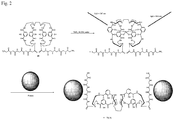
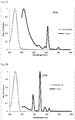
Classifications
-
- C—CHEMISTRY; METALLURGY
- C07—ORGANIC CHEMISTRY
- C07D—HETEROCYCLIC COMPOUNDS
- C07D259/00—Heterocyclic compounds containing rings having more than four nitrogen atoms as the only ring hetero atoms
-
- A—HUMAN NECESSITIES
- A61—MEDICAL OR VETERINARY SCIENCE; HYGIENE
- A61P—SPECIFIC THERAPEUTIC ACTIVITY OF CHEMICAL COMPOUNDS OR MEDICINAL PREPARATIONS
- A61P43/00—Drugs for specific purposes, not provided for in groups A61P1/00-A61P41/00
-
- C—CHEMISTRY; METALLURGY
- C07—ORGANIC CHEMISTRY
- C07D—HETEROCYCLIC COMPOUNDS
- C07D273/00—Heterocyclic compounds containing rings having nitrogen and oxygen atoms as the only ring hetero atoms, not provided for by groups C07D261/00 - C07D271/00
-
- C—CHEMISTRY; METALLURGY
- C07—ORGANIC CHEMISTRY
- C07D—HETEROCYCLIC COMPOUNDS
- C07D487/00—Heterocyclic compounds containing nitrogen atoms as the only ring hetero atoms in the condensed system, not provided for by groups C07D451/00 - C07D477/00
- C07D487/12—Heterocyclic compounds containing nitrogen atoms as the only ring hetero atoms in the condensed system, not provided for by groups C07D451/00 - C07D477/00 in which the condensed system contains three hetero rings
- C07D487/18—Bridged systems
-
- C—CHEMISTRY; METALLURGY
- C07—ORGANIC CHEMISTRY
- C07D—HETEROCYCLIC COMPOUNDS
- C07D487/00—Heterocyclic compounds containing nitrogen atoms as the only ring hetero atoms in the condensed system, not provided for by groups C07D451/00 - C07D477/00
- C07D487/22—Heterocyclic compounds containing nitrogen atoms as the only ring hetero atoms in the condensed system, not provided for by groups C07D451/00 - C07D477/00 in which the condensed system contains four or more hetero rings
-
- C—CHEMISTRY; METALLURGY
- C07—ORGANIC CHEMISTRY
- C07D—HETEROCYCLIC COMPOUNDS
- C07D498/00—Heterocyclic compounds containing in the condensed system at least one hetero ring having nitrogen and oxygen atoms as the only ring hetero atoms
- C07D498/12—Heterocyclic compounds containing in the condensed system at least one hetero ring having nitrogen and oxygen atoms as the only ring hetero atoms in which the condensed system contains three hetero rings
- C07D498/18—Bridged systems
-
- C—CHEMISTRY; METALLURGY
- C07—ORGANIC CHEMISTRY
- C07F—ACYCLIC, CARBOCYCLIC OR HETEROCYCLIC COMPOUNDS CONTAINING ELEMENTS OTHER THAN CARBON, HYDROGEN, HALOGEN, OXYGEN, NITROGEN, SULFUR, SELENIUM OR TELLURIUM
- C07F5/00—Compounds containing elements of Groups 3 or 13 of the Periodic Table
- C07F5/003—Compounds containing elements of Groups 3 or 13 of the Periodic Table without C-Metal linkages
-
- C—CHEMISTRY; METALLURGY
- C07—ORGANIC CHEMISTRY
- C07H—SUGARS; DERIVATIVES THEREOF; NUCLEOSIDES; NUCLEOTIDES; NUCLEIC ACIDS
- C07H21/00—Compounds containing two or more mononucleotide units having separate phosphate or polyphosphate groups linked by saccharide radicals of nucleoside groups, e.g. nucleic acids
- C07H21/04—Compounds containing two or more mononucleotide units having separate phosphate or polyphosphate groups linked by saccharide radicals of nucleoside groups, e.g. nucleic acids with deoxyribosyl as saccharide radical
-
- C—CHEMISTRY; METALLURGY
- C07—ORGANIC CHEMISTRY
- C07J—STEROIDS
- C07J43/00—Normal steroids having a nitrogen-containing hetero ring spiro-condensed or not condensed with the cyclopenta(a)hydrophenanthrene skeleton
- C07J43/003—Normal steroids having a nitrogen-containing hetero ring spiro-condensed or not condensed with the cyclopenta(a)hydrophenanthrene skeleton not condensed
-
- C—CHEMISTRY; METALLURGY
- C07—ORGANIC CHEMISTRY
- C07K—PEPTIDES
- C07K5/00—Peptides containing up to four amino acids in a fully defined sequence; Derivatives thereof
- C07K5/04—Peptides containing up to four amino acids in a fully defined sequence; Derivatives thereof containing only normal peptide links
- C07K5/10—Tetrapeptides
- C07K5/1002—Tetrapeptides with the first amino acid being neutral
- C07K5/1005—Tetrapeptides with the first amino acid being neutral and aliphatic
- C07K5/1008—Tetrapeptides with the first amino acid being neutral and aliphatic the side chain containing 0 or 1 carbon atoms, i.e. Gly, Ala
Definitions
- the invention relates to chemical compounds and complexes that can be used in therapeutic and diagnostic applications.
- a coordination number of 8 or greater is generally preferred by actinide ions as they have a tendency to form stable complexes with ligands of high denticity; however, the selectivity towards the binding of the thorium will be determined by our design of the chelating unit.
- the effective but nonselective amino-carboxylic acid ligands such as DTPA can deplete essential biological metal ions from patients, thus causing serious health problems. Selecting the correct type of chelating unit, therefore, is an important factor in achieving high selectivity toward the specific metal ion.
- a chelator can comprise numerous chelating moieties. Particularly useful chelators contain a number of chelating moieties sufficient to provide, for example, 6, 8 or 10 heteroatoms such as oxygen that coordinate with a metal ion to form a complex. The heteroatoms such as oxygen provide electron density for forming coordinate bonds with a positively charged ion, and such heteroatoms can thus be considered "donors".
- the plurality of chelating moieties of a chelator comprises a plurality of oxygen donors and a metal ion (such as a radionuclide) is chelated to the chelator via at least one of the oxygen donors.
- a chelator comprises a plurality of oxygen donors and a metal ion (such as a radionuclide) is chelated to the chelator via a plurality or all of the oxygen donors.
- Lanthanide metal complexes useful in diagnostic and therapeutic applications are known. Lanthanide complexes of macrocycle cages based on 2-hydroxy-1,3-bisphthalamide units linked by ethylenediamine groups are described in EP 2,423,201 . Macrocycles consisting of N-hydroxy-pyridin-2-one units linked by ethylenediamine groups are described in WO2011079291 . Polyaza macrocyclic ligands useful for the complexation of lanthanide ions are described in WO1997002051 , US 5,739,294 and Supramolecular Chemistry, Vol 22, p653-655 (2010 ).
- substituent groups are specified by their conventional chemical formulae, written from left to right, they optionally equally encompass the chemically identical substituents, which would result from writing the structure from right to left, e.g., -CH 2 O- is intended to also recite -OCH 2 -.
- alkyl by itself or as part of another substituent, means a straight or branched chain hydrocarbon, which may be fully saturated, mono- or polyunsaturated and includes mono-, di- and multivalent radicals.
- saturated hydrocarbon radicals include, but are not limited to, groups such as methyl, ethyl, n-propyl, isopropyl, n-butyl, t-butyl, isobutyl, sec-butyl, cyclohexyl, (cyclohexyl)methyl, cyclopropylmethyl, homologs and isomers of, for example, n-pentyl, n-hexyl, n-heptyl, n-octyl, and the like.
- An unsaturated alkyl group is one having one or more double bonds or triple bonds (i.e., alkenyl and alkynyl moieties).
- unsaturated alkyl groups include, but are not limited to, vinyl, 2-propenyl, crotyl, 2-isopentenyl, 2-(butadienyl), 2,4-pentadienyl, 3-(1,4-pentadienyl), ethynyl, 1- and 3-propynyl, 3-butynyl, and the higher homologs and isomers.
- alkyl can refer to "alkylene", which by itself or as part of another substituent means a divalent radical derived from an alkane, as exemplified, but not limited, by -CH 2 CH 2 CH 2 CH 2 -.
- an alkyl (or alkylene) group will have from 1 to 30 carbon atoms.
- a “lower alkyl” or “lower alkylene” is a shorter chain alkyl or alkylene group, generally having eight or fewer carbon atoms.
- alkyl refers to an alkyl or combination of alkyls selected from C 1 , C 2 , C 3 , C 4 , C 5 , C 6 , C 7 , C 8 , C 9 , C 10 , C 11 , C 12 , C 13 , C 14 , C 15 , C 16 , C 17 , C 18 , C 19 , C 20 , C 21 , C 22 , C 23 , C 24 , C 25 , C 26 , C 27 , C 28 , C 29 and C 30 alkyl.
- alkyl refers to C 1 -C 25 alkyl.
- alkyl refers to C 1 -C 20 alkyl.
- alkyl refers to C 1 -C 15 alkyl.
- alkyl refers to C 1 -C 10 alkyl.
- alkyl refers to C 1 -C 6 alkyl.
- heteroalkyl by itself or in combination with another term, means an alkyl in which one or more carbons are replaced with one or more heteroatoms selected from the group consisting of O, N, Si and S, (preferably O, N and S), wherein the nitrogen and sulfur atoms may optionally be oxidized and the nitrogen heteroatom may optionally be quaternized.
- the heteroatoms O, N, Si and S may be placed at any interior position of the heteroalkyl group or at the position at which the alkyl group is attached to the remainder of the molecule.
- the heteroatom may be bonded to one or more H or substituents such as (C 1 , C 2 , C 3 , C 4 , C 5 or C 6 ) alkyl according to the valence of the heteroatom.
- heteroalkylene by itself or as part of another substituent means a divalent radical derived from heteroalkyl, as exemplified, but not limited by, -CH 2 -CH 2 -S-CH 2 -CH 2 - and -CH 2 -S-CH 2 -CH 2 -NH-CH 2 -.
- the designated number of carbons in heteroforms of alkyl, alkenyl and alkynyl includes the heteroatom count.
- a (C 1 , C 2 , C 3 , C 4 , C 5 or C 6 ) heteroalkyl will contain, respectively, 1, 2, 3, 4, 5 or 6 atoms selected from C, N, O, Si and S such that the heteroalkyl contains at least one C atom and at least one heteroatom, for example 1-5 C and 1 N or 1-4 C and 2 N.
- a heteroalkyl may also contain one or more carbonyl groups.
- a heteroalkyl is any C 2 -C 30 alkyl, C 2 -C 25 alkyl, C 2 -C 20 alkyl, C 2 -C 15 alkyl, C 2 -C 10 alkyl or C 2 -C 6 alkyl in any of which one or more carbons are replaced by one or more heteroatoms selected from O, N, Si and S (or from O, N and S).
- each of 1, 2, 3, 4 or 5 carbons is replaced with a heteroatom.
- alkoxy alkylamino
- alkylthio or thioalkoxy
- alkyl and heteroalkyl groups attached to the remainder of the molecule via an oxygen atom, a nitrogen atom (e.g., an amine group), or a sulfur atom, respectively.
- cycloalkyl and “heterocycloalkyl”, by themselves or in combination with other terms, refer to cyclic versions of “alkyl” and “heteroalkyl”, respectively. Additionally, for heterocycloalkyl, a heteroatom can occupy the position at which the heterocycle is attached to the remainder of the molecule. Examples of cycloalkyl include, but are not limited to, cyclopentyl, cyclohexyl, 1-cyclohexenyl, 3-cyclohexenyl, cycloheptyl, and the like.
- heterocycloalkyl examples include, but are not limited to, 1 -(1,2,5,6-tetrahydropyridyl), 1-piperidinyl, 2-piperidinyl, 3-piperidinyl, 4-morpholinyl, 3-morpholinyl, tetrahydrofuran-2-yl, tetrahydrofuran-3-yl, tetrahydrothien-2-yl, tetrahydrothien-3-yl, 1-piperazinyl, 2-piperazinyl, and the like.
- aryl means a polyunsaturated, aromatic substituent that can be a single ring or optionally multiple rings (preferably 1, 2 or 3 rings) that are fused together or linked covalently. In some embodiments, aryl is a 3, 4, 5, 6, 7 or 8 membered ring, which is optionally fused to one or two other 3, 4, 5, 6, 7 or 8 membered rings.
- heteroaryl refers to aryl groups (or rings) that contain 1, 2, 3 or 4 heteroatoms selected from N, O, and S, wherein the nitrogen and sulfur atoms are optionally oxidized, and the nitrogen atom(s) are optionally quaternized. A heteroaryl group can be attached to the remainder of the molecule through a heteroatom.
- Non-limiting examples of aryl and heteroaryl groups include phenyl, 1-naphthyl, 2-naphthyl, 4-biphenyl, 1-pyrrolyl, 2-pyrrolyl, 3-pyrrolyl, 3-pyrazolyl, 2-imidazolyl, 4-imidazolyl, pyrazinyl, 2-oxazolyl, 4-oxazolyl, 2-phenyl-4-oxazolyl, 5-oxazolyl, 3-isoxazolyl, 4-isoxazolyl, 5-isoxazolyl, 2-thiazolyl, 4-thiazolyl, 5-thiazolyl, 2-furyl, 3-furyl, 2-thienyl, 3-thienyl, 2-pyridyl, 3-pyridyl, 4-pyridyl, 2-pyrimidyl, 4-pyrimidyl, 5-benzothiazolyl, purinyl, 2-benzimidazolyl, 5-indolyl, 1-isoquinoly
- any of alkyl, heteroalkyl, cycloalkyl, heterocycloalkyl, aryl and heteroaryl is optionally substituted. That is, in some embodiments, any of these groups is substituted or unsubstituted.
- substituents for each type of radical are selected from those provided below.
- alkyl, heteroalkyl, cycloalkyl and heterocycloalkyl radicals are generically referred to as "alkyl group substituents".
- R', R", R'" and R" are each independently selected from hydrogen, alkyl (e.g., C 1 , C 2 , C 3 , C 4 , C 5 and C 6 alkyl).
- R', R", R'" and R" each independently refer to hydrogen, substituted or unsubstituted heteroalkyl, substituted or unsubstituted aryl, e.g., aryl substituted with 1-3 halogens, substituted or unsubstituted alkyl, alkoxy or thioalkoxy groups, or arylalkyl groups.
- R', R", R'" and R" are each independently selected from hydrogen, alkyl, heteroalkyl, cycloalkyl, heterocycloalkyl, aryl, heteroaryl, alkoxy, thioalkoxy groups, and arylalkyl.
- R' and R" When R' and R" are attached to the same nitrogen atom, they can be combined with the nitrogen atom to form a 5-, 6-, or 7-membered ring.
- -NR'R" can include 1-pyrrolidinyl and 4-morpholinyl.
- an alkyl group substituent is selected from substituted or unsubstituted alkyl, substituted or unsubstituted heteroalkyl, substituted or unsubstituted cycloalkyl, substituted or unsubstituted heterocycloalkyl, substituted or unsubstituted aryl and substituted or unsubstituted heteroaryl.
- R', R", R'" and R" are independently selected from hydrogen and alkyl (e.g., C 1 , C 2 , C 3 , C 4 , C 5 and C 6 alkyl). In some embodiments, R', R", R'" and R"" are independently selected from hydrogen, substituted or unsubstituted alkyl, substituted or unsubstituted heteroalkyl, substituted or unsubstituted aryl and substituted or unsubstituted heteroaryl. In some embodiments, R', R", R'" and R"" are independently selected from hydrogen, alkyl, heteroalkyl, aryl and heteroaryl.
- an aryl group substituent is selected from substituted or unsubstituted alkyl, substituted or unsubstituted heteroalkyl, substituted or unsubstituted cycloalkyl, substituted or unsubstituted heterocycloalkyl, substituted or unsubstituted aryl and substituted or unsubstituted heteroaryl.
- Two of the substituents on adjacent atoms of the aryl or heteroaryl ring may optionally be replaced with a substituent of the formula -T-C(O)-(CRR') q -U-, wherein T and U are independently -NR-, -O-, -CRR'- or a single bond, and q is an integer of from 0 to 3.
- two of the substituents on adjacent atoms of the aryl or heteroaryl ring may optionally be replaced with a substituent of the formula -A-(CH 2 ) r -B-, wherein A and B are independently -CRR'-, -O-, -NR-, -S-, -S(O)-, -S(O) 2 -, -S(O) 2 NR'- or a single bond, and r is an integer of from 1 to 4.
- One of the single bonds of the new ring so formed may optionally be replaced with a double bond.
- two of the substituents on adjacent atoms of the aryl or heteroaryl ring may optionally be replaced with a substituent of the formula -(CRR') s -X-(CR"R"') d -, where s and d are independently integers of from 0 to 3, and X is -O-, -NR'-, -S-,-S(O)-, -S(O) 2 -, or -S(O) 2 NR'-.
- the substituents R, R', R" and R'" are preferably independently selected from hydrogen or substituted or unsubstituted (C 1 -C 6 )alkyl.
- acyl refers to a species that includes the moiety -C(O)R, where R has the meaning defined herein.
- exemplary species for R include H, halogen, substituted or unsubstituted alkyl, substituted or unsubstituted aryl, substituted or unsubstituted heteroaryl, and substituted or unsubstituted heterocycloalkyl.
- R is selected from H and (C 1 -C 6 )alkyl.
- halo or halogen
- haloalkyl by themselves or as part of another substituent, mean, unless otherwise stated, a fluorine, chlorine, bromine, or iodine atom.
- terms such as “haloalkyl,” are meant to include monohaloalkyl and polyhaloalkyl.
- halo(C 1 -C 4 )alkyl is mean to include, but not be limited to, trifluoromethyl, 2,2,2-trifluoroethyl, 4-chlorobutyl, 3-bromopropyl, and the like.
- halogen refers to an atom selected from F, Cl and Br.
- heteroatom includes oxygen (O), nitrogen (N), sulfur (S) and silicon (Si).
- a heteroatom is selected from N and S.
- the heteroatom is O.
- R is a general abbreviation that represents a substituent group that is selected from acyl, substituted or unsubstituted alkyl, substituted or unsubstituted heteroalkyl, substituted or unsubstituted cycloalkyl, substituted or unsubstituted heterocycloalkyl, substituted or unsubstituted aryl and substituted or unsubstituted heteroaryl.
- R is a general abbreviation that represents a substituent group that is selected from acyl, substituted or unsubstituted alkyl, substituted or unsubstituted heteroalkyl, substituted or unsubstituted cycloalkyl, substituted or unsubstituted heterocycloalkyl, substituted or unsubstituted aryl and substituted or unsubstituted heteroaryl.
- R is a general abbreviation that represents a substituent group that is selected from acyl, substituted or unsubstitute
- -COOH also refers to -COO - and -OH also refers to -O - .
- any of the compounds disclosed herein can be made into a pharmaceutically acceptable salt.
- pharmaceutically acceptable salts includes salts of compounds that are prepared with relatively nontoxic acids or bases, depending on the particular substituents found on the compounds described herein.
- base addition salts can be obtained by contacting the neutral form of such compounds with a sufficient amount of the desired base, either neat or in a suitable inert solvent.
- pharmaceutically acceptable base addition salts include sodium, potassium, calcium, ammonium, organic amino, or magnesium salt, or a similar salt.
- acid addition salts can be obtained by contacting the neutral form of such compounds with a sufficient amount of the desired acid, either neat or in a suitable inert solvent.
- pharmaceutically acceptable acid addition salts include those derived from inorganic acids like hydrochloric, hydrobromic, nitric, carbonic, monohydrogencarbonic, phosphoric, monohydrogenphosphoric, dihydrogenphosphoric, sulfuric, monohydrogensulfuric, hydriodic, or phosphorous acids and the like, as well as the salts derived from relatively nontoxic organic acids like acetic, propionic, isobutyric, maleic, malonic, benzoic, succinic, suberic, fumaric, lactic, mandelic, phthalic, benzenesulfonic, p-tolylsulfonic, citric, tartaric, methanesulfonic, and the like.
- salts of amino acids such as arginate and the like, and salts of organic acids like glucuronic or galactunoric acids and the like (see, for example, Berge et al., Journal of Pharmaceutical Science, 66: 1-19 (1977 )).
- Certain specific compounds of the present invention contain both basic and acidic functionalities that allow the compounds to be converted into either base or acid addition salts.
- the neutral forms of the compounds are preferably regenerated by contacting the salt with a base or acid and isolating the parent compound in the conventional manner.
- the parent form of the compound differs from the various salt forms in certain physical properties, such as solubility in polar solvents, but otherwise the salts are equivalent to the parent form of the compound for the purposes of the present invention.
- the present invention provides any of the compounds disclosed herein in a prodrug form.
- Prodrugs of the compounds described herein are those compounds that readily undergo chemical changes under physiological conditions to provide the compounds of the present invention.
- Certain compounds of the present invention can exist in unsolvated forms as well as solvated forms, including hydrated forms. In general, the solvated forms are equivalent to unsolvated forms and are encompassed within the scope of the present invention. Certain compounds of the present invention may exist in multiple crystalline or amorphous forms. In general, all physical forms are equivalent for the uses contemplated by the present invention and are intended to be within the scope of the present invention.
- the compounds of the present invention may also contain unnatural proportions of atomic isotopes at one or more of the atoms that constitute such compounds.
- the compounds may be labeled with deuterium ( 2 H) or radiolabeled with radioactive isotopes, such as for example tritium ( 3 H), iodine-125 ( 125 I) or carbon-14 ( 14 C). All isotopic variations of the compounds of the present invention, whether radioactive or not, are intended to be encompassed within the scope of the present invention.
- the symbol displayed perpendicular to a bond, indicates the point at which the displayed moiety is attached to the remainder of the molecule.
- the definition of terms used herein is according to IUPAC.
- a chelator comprises a plurality of chelating agents that are linked together by way of three or more scaffold moieties.
- the invention provides a di-macrocycle having the structure: wherein
- a 1 when A 1 has a structure according to formula (I), A 1 is attached to L 2 and L 6 through R 6 and R 10 ; when A 1 has a structure according to formula (II) or (III), A 1 is attached to L 2 and L 6 through R 6 and R 9 ; when A 2 has a structure according to formula (I), A 2 is attached to L 3 and L 7 through R 6 and R 10 ; when A 2 has a structure according to formula (II) or (III), A 2 is attached to L 3 and L 7 through R 6 and R 9 ; when A 3 has a structure according to formula (I), A 3 is attached to L 4 and L 8 through R 6 and R 10 ; when A 3 has a structure according to formula (II) or (III), A 3 is attached to L 4 and L 8 through R 6 and R 9 ; when A 4 has a structure according to formula (I), A 4 is attached to L 5 and L 9 through R 6 and R 10 ; and when A 4 has a structure according to formula (II) or
- each of A 1 , A 2 , A 3 and A 4 is independently selected from:
- the di-macrocycle of the invention has the structure: wherein L x1 , L x2 and L x3 are independently selected from H and a linker.
- the di-macrocycle of the invention has the structure:
- the di-macrocycle of the invention has the structure: wherein L x1 , L x2 and L x3 are independently selected from H and a linker.
- the di-macrocycle of the invention has the structure:
- the invention provides a di-macrocycle having the structure: wherein
- the di-macrocycle is covalently modified with at least one linker.
- one of L 1 , L 2 , L 3 , L 4 , L 5 , L 6 , L 7 , L 8 , and L 9 is substituted with a linker.
- each of A 1 , A 2 , A 3 and A 4 is independently selected from:
- a 1 when A 1 has a structure according to formula (1), A 1 is attached to L 2 and L 8 through R 6 and R 10 ; when A 1 has a structure according to formula (2a), (2b), (3), (4) or (5), A 1 is attached to L 2 and L 8 through R 6 and R 9 ; when A 2 has a structure according to formula (1), A 2 is attached to L 3 and L 6 through R 6 and R 10 ; when A 2 has a structure according to formula (2a), (2b), (3), (4) or (5), A 2 is attached to L 3 and L 6 through R 6 and R 9 ; when A 3 has a structure according to formula (1), A 3 is attached to L 4 and L 7 through R 6 and R 10 ; when A 3 has a structure according to formula (2a), (2b), (3), (4) or (5), A 3 is attached to L 4 and L 7 through R 6 and R 9 ; when A 4 has a structure according to formula (1), A 4 is attached to L 5 and L 9 through R 6 and R 10 ; and when
- the di-macrocycle of the invention has the structure: wherein L x1 , L x2 and L x3 are independently selected from H and a linker.
- the di-macrocycle of the invention has the structure:
- the di-macrocycle of the invention has the structure:
- the invention provides a complex comprising a di-macrocycle of the invention and a metal ion, optionally wherein the metal ion is a lanthanide, optionally the lanthanide is selected from Eu and Tb, optionally wherein the metal ion is an actinide, optionally wherein the metal ion is selected from yttrium(III), europium(III), terbium(III), zirconium(IV) and thorium(IV), optionally wherein the metal ion is a radionuclide selected from isotopes of U, Pu, Fe, Cu, Sm, Gd, Tb, Dy, Ho, Er, Yb, Lu, Y, Th, Zr, In, Ga, Bi, Ra, At and Ac, optionally wherein said metal ion is 227 Th(IV) or 89 Zr(IV), optionally wherein said metal is a member selected from 177 Lu, 166 Ho, 153 Sm, 90 Y
- the estradiol-derived group is selected from estradiol and the estradiol-derived group of example 13.
- a 1 , A 2 , A 3 , A 4 and A 5 are chelating moieties having a structure independently selected from: wherein
- the respective chelating moiety is attached to S 1 and S 2 or S 1 and S 3 through R 6 and R 10 .
- the respective chelating moiety is attached to S 1 and S 2 or S 1 and S 3 through R 6 and R 9 .
- At least one of R 6 and R 10 in (I) is a bond attached to S 1 , S 2 , or S 3 .
- a 1 , A 2 , A 3 , A 4 and A 5 are chelating moieties having a structure independently selected from: R 6 , R 7 , R 8 , R 9 , and R 10 are as defined herein.
- a 1 , A 2 , A 3 , A 4 and A 5 are chelating moieties having a structure independently selected from: R 6 , R 9 , and R 10 are as defined herein.
- a "scaffold moiety” is any moiety useful for covalently linking two or more chelating moieties in any of the chelators (di-macrocycles) disclosed herein.
- any two scaffold moieties disclosed herein are joined via a plurality of chelating moieties to form a macrocycle.
- one or more scaffold moieties of a chelator is substituted with a linker.
- the scaffold moiety is selected from substituted or unsubstituted alkyl and substituted or unsubstituted heteroalkyl.
- Exemplary scaffold moieties include linear or branched ethers and amines.
- the linker is attached to a targeting moiety.
- the scaffold moiety comprises a targeting moiety.
- exemplary scaffold moieties may include, but are not limited to:
- X represents a locus of attachment for a chelating moiety, and in exemplary embodiments includes a heteroatom such as nitrogen.
- X is NR'R", wherein R' and R" are independently selected from substituted or unsubstituted alkyl, substituted or unsubstituted heteroalkyl, substituted or unsubstituted cycloalkyl, substituted or unsubstituted heterocycloalkyl, substituted or unsubstituted aryl, substituted or unsubstituted heteroaryl, halogen, CN, CF 3 , -C(O)R 17 , -SO 2 NR 17 R 18 , -NR 17 R 18 , -OR 17 , -S(O) 2 R 17 , -COOR 17 , -S(O) 2 OR 17 , -OC(O)R 17 , -C (O)NR 17 R 18 , -NR 17 C(O)R 18 ,
- a scaffold moiety is linear.
- One exemplary scaffold moiety is X-(CH 2 ) 3 -X-(CH 2 ) 4 -X-(CH 2 ) 3 -X, which is preferably substituted (e.g. with a linker) at at least one of the alkyl moieties. That is, one exemplary scaffold moiety is spermine based.
- Other exemplary scaffold moieties include and any of which is preferably substituted (e.g. with a linker) at at least one of the alkyl moieties.
- X is as given in the previous paragraph.
- One preferred moiety for at least one of the X moieties is the 1,2-HOPO amide moiety, but those of skill in the art will appreciate that other chelating moieties in any used in any combination.
- an aryl moiety or alkyl moiety can be substituted with one or more "aryl group substituent” or "alkyl group substituent” as defined herein.
- a particularly useful scaffold moiety for any chelator described herein has the structure wherein Z 1a , Z 2a , Z 3a , Z 4a and Z 5a are selected from substituted or unsubstituted alkyl and substituted or unsubstituted heteroalkyl; and Z 1a , Z 2a , Z 4a and Z 5a comprise a bond to one of the chelating moieties.
- Z 1a , Z 2a , Z 4a and Z 5a have a structure selected from Z'R 20a N(H)C(O)Z", Z'R 20a N(H)C(O)R 21a Z" and Z'R 21a Z" wherein Z' is a bond to the second scaffold moiety, Z" is a bond to one of the plurality of chelating moieties, R 20a is selected from substituted or unsubstituted alkyl and substituted or unsubstituted heteroalkyl. and R 21a is selected from substituted or unsubstituted alkyl and substituted or unsubstituted heteroalkyl.
- R 20a is selected from substituted or unsubstituted (C 1 , C 2 , C 3 , C 4 , C 5 or C 6 ) alkyl and substituted or unsubstituted (C 1 , C 2 , C 3 , C 4 , C 5 or C 6 ) heteroalkyl.
- R 20a is selected from substituted or unsubstituted ethyl.
- R 21a is from substituted or unsubstituted -(CH 2 ) w O- wherein w is selected from 1, 2, 3, 4, 5 and 6. In exemplary embodiments, w is 1 or 3.
- At least one of Z 1a , Z 2a , Z 3a , Z 4a and Z 5a is substituted with a linker.
- Another particularly useful scaffold moiety for any chelator herein has the structure
- x is selected from 1, 2, 3 and 4. In exemplary embodiments, x is 1. In exemplary embodiments, x is 2. In exemplary embodiments, x is 3. In exemplary embodiments, x is 4.
- Y 1 and Y 2 are each independently selected from H, substituted or unsubstituted alkyl and substituted or unsubstituted heteroalkyl. In exemplary embodiments, Y 1 and Y 2 are H.
- Z 7 is selected from substituted or unsubstituted alkyl and substituted or unsubstituted heteroalkyl. In exemplary embodiments, at least one Z 7 is substituted with a linker. In some embodiments, each Z 7 is independently substituted or unsubstituted (C 1 , C 2 , C 3 , C 4 , C 5 or C 6 ) alkyl. In exemplary embodiments, each Z 7 is independently substituted or unsubstituted propyl or butyl. In some embodiments, each Z 7 is independently substituted or unsubstituted heteroalkyl.
- each Z 7 is independently substituted or unsubstituted -(CH 2 ) m (CH 2 CH 2 O) n (CH 2 ) p -, wherein m, n and p are integers independently selected from 1, 2, 3, 4, 5 and 6.
- each Z 7 is substituted or unsubstituted -(CH 2 ) 2 O(CH 2 ) 2 -.
- Z 6 and Z 8 are independently selected from -C(O)-, substituted or unsubstituted alkyl, and substituted or unsubstituted heteroalkyl; and each of Z 6 and Z 8 comprises a bond to one of the chelating moieties.
- Z 6 and Z 8 are -C(O)-.
- L 3 comprises -(CH 2 CH 2 O) m R 31 - wherein m is an integer selected from 0, 1, 2, 3, 4, 5, 6, 7, 8 and 9. In some embodiments, m is 0. In some embodiments, m is 1. In some embodiments, L 3 is -CH 2 CH 2 OCH 2 CH 2 -.
- L 1 , L 2 , L 4 , L 5 and R 31 are independently selected from substituted or unsubstituted alkyl, substituted or unsubstituted heteroalkyl, substituted or unsubstituted cycloalkyl, substituted or unsubstituted heterocycloalkyl, substituted or unsubstituted aryl and substituted or unsubstituted heteroaryl.
- L 1 , L 2 , L 4 , L 5 are independently selected substituted or unsubstituted (C 1 , C 2 , C 3 , C 4 , C 5 or C 6 ) alkyl.
- R 31 is substituted or unsubstituted (C 1 , C 2 , C 3 , C 4 , C 5 or C 6 ) alkyl.
- L 1 , L 2 , L 4 , L 5 are independently selected substituted or unsubstituted ethyl.
- R 31 is substituted or unsubstituted ethyl.
- L 1 , L 2 , L 4 , L 5 are ethyl, one or more of which is substituted with a linker.
- L 1 is substituted with a linker.
- L 2 is substituted with a linker.
- L 3 is substituted with a linker.
- L 4 is substituted with a linker.
- L 5 is substituted with a linker.
- L 1 is ethyl substituted with a linker.
- L 2 is ethyl substituted with a linker.
- L 3 is ethyl substituted with a linker.
- L 4 is ethyl substituted with a linker.
- L 5 is ethyl substituted with a linker.
- R 40 , R 41 , R 42 and R 43 are bonds.
- R 40 , R 41 , R 42 and R 43 are -(CH 2 ) w O-, wherein w is selected from 0, 1, 2, 3, 4, 5, 6, 7, 8, 9 and 10. In exemplary embodiments, w is 3.
- L 3 comprises -(CH 2 CH 2 O) m R 31 - wherein m is an integer selected from 0, 1, 2, 3, 4, 5, 6, 7, 8 and 9. In some embodiments, m is 0. In some embodiments, m is 1. In some embodiments, L 3 is -CH 2 CH 2 OCH 2 CH 2 -. In some embodiments, L 3 is -C(O)C(O)-.
- L 1 , L 2 , L 4 , L 5 and R 31 are independently selected from substituted or unsubstituted alkyl, substituted or unsubstituted heteroalkyl, substituted or unsubstituted cycloalkyl, substituted or unsubstituted heterocycloalkyl, substituted or unsubstituted aryl and substituted or unsubstituted heteroaryl.
- L 1 , L 2 , L 4 , L 5 are independently selected substituted or unsubstituted (C 1 , C 2 , C 3 , C 4 , C 5 or C 6 ) alkyl.
- R 31 is substituted or unsubstituted (C 1 , C 2 , C 3 , C 4 , C 5 or C 6 ) alkyl.
- L 1 , L 2 , L 4 , L 5 are independently selected substituted or unsubstituted ethyl.
- L 1 , L 2 , L 4 , L 5 are independently selected substituted or unsubstituted propyl.
- R 31 is substituted or unsubstituted ethyl.
- L 1 , L 2 , L 4 , L 5 are ethyl, one or more of which is substituted with a linker.
- L 1 is substituted with a linker.
- L 2 is substituted with a linker.
- L 3 is substituted with a linker.
- L 4 is substituted with a linker.
- L 5 is substituted with a linker.
- L 1 is propyl substituted with a linker.
- L 2 is propyl substituted with a linker.
- L 3 is propyl substituted with a linker.
- L 4 is propyl substituted with a linker.
- L 5 is propyl substituted with a linker.
- a scaffold is selected from: and In any of these structures, one or more methyl, ethyl, propyl or butyl moieties can be substituted with one or more linkers. In some embodiments, two of these scaffold moieties, in which one or more methyl, ethyl, propyl or butyl moieties are optionally substituted with one or more linkers, are used to form a macrocycle.
- any one, two or all of the first, second and third scaffold moiety comprise a linker. In some embodiments, the linker is attached to a targeting moiety. In some embodiments, any one, two or all of the first, second and third scaffold moiety comprise a targeting moiety.
- first scaffold moiety is as defined for S 1 herein.
- second and third scaffold moieties are as defined for S 2 and S 3 herein.
- any one, two or all of S 1 , S 2 and S 3 comprise a linker.
- S 1 comprises a linker.
- S 2 or S 3 comprises a linker.
- the linker is attached to a targeting moiety.
- any one, two or all of S 1 , S 2 and S 3 comprise a targeting moiety.
- S 1 comprises a targeting moiety.
- S 2 or S 3 comprises a targeting moiety.
- S 1 has the structure: wherein L 1 , L 2 , L 3 , L 4 , and L 5 are independently selected from substituted or unsubstituted alkyl, substituted or unsubstituted heteroalkyl, substituted or unsubstituted aryl, substituted or unsubstituted heteroaryl and substituted or unsubstituted heterocycloalkyl. In some embodiments, L 1 , L 2 , L 3 , L 4 , and L 5 are independently selected from substituted or unsubstituted alkyl and substituted or unsubstituted heteroalkyl. In some embodiments, L 1 is In some embodiments, one of L 5 and L 1 is substituted with a linker.
- L 5 is substituted with a linker.
- Linkers are as defined herein.
- B 1 and B 2 are independently selected from the elements capable of 3, 4, or 5 covalent bonds.
- B 1 and B 2 are independently selected from N, C, B, Si, and P.
- B 1 and B 2 are independently selected from N and C.
- B 1 and B 2 are N.
- S 1 has the structure: wherein L 1 , L 2 , L 3 , L 4 , and L 5 are as defined herein.
- S 1 has the structure: wherein L x1 , L x2 and L x3 are independently selected from H and a linker. In some embodiments, only one of L x1 , L x2 and L x3 is a linker. In some embodiments, L x1 is a linker. Linkers are as defined herein. In some embodiments, L x1 , L x2 and L x3 are H.
- S 1 has the structure: wherein L x1 , L x2 and L x3 are independently selected from H and a linker. In some embodiments, only one of L x1 , L x2 and L x3 is a linker. In some embodiments, L x3 is a linker. Linkers are as defined herein. In some embodiments, L x1 , L x2 and L x3 are H.
- S 1 has the structure:
- S 2 has the structure: wherein L 6 and L 7 are independently selected from substituted or unsubstituted alkyl, substituted or unsubstituted heteroalkyl, substituted or unsubstituted aryl, substituted or unsubstituted heteroaryl and substituted or unsubstituted heterocycloalkyl. In some embodiments, L 6 and L 7 are independently selected from substituted or unsubstituted alkyl and substituted or unsubstituted heteroalkyl. In some embodiments, one of L 6 and L 7 is substituted with a linker. Linkers are as defined herein. B 4 is selected from the elements capable of 3, 4, or 5 covalent bonds.
- B 4 is selected from N, C, B, Si, and P. In some embodiments, B 4 is selected from N and C. In some embodiments, B 4 is N.
- F 1 is selected from H, substituted or unsubstituted alkyl, substituted or unsubstituted heteroalkyl, substituted or unsubstituted aryl, substituted or unsubstituted heteroaryl and substituted or unsubstituted heterocycloalkyl. In some embodiments, F 1 is as defined herein.
- S 2 has the structure: wherein L 6 , L 7 and F 1 are as defined herein.
- S 2 has the structure: wherein L x4 is H or a linker.
- F 1 is as defined herein.
- Linkers are as defined herein.
- S 2 has the structure: wherein F 1 is as defined herein.
- S 2 has the structure: wherein F 1 is as defined herein.
- S 2 has the structure: wherein F 1 is as defined herein.
- S 3 has the structure: wherein L 8 and L 9 are independently selected from substituted or unsubstituted alkyl, substituted or unsubstituted heteroalkyl, substituted or unsubstituted aryl, substituted or unsubstituted heteroaryl and substituted or unsubstituted heterocycloalkyl. In some embodiments, L 8 and L 9 are independently selected from substituted or unsubstituted alkyl and substituted or unsubstituted heteroalkyl. In some embodiments, one of L 8 and L 9 is substituted with a linker. Linkers are as defined herein. B 3 is selected from the elements capable of 3, 4, or 5 covalent bonds.
- B 3 is selected from N, C, B, Si, and P. In some embodiments, B 3 is selected from N and C. In some embodiments, B 3 is N.
- F 2 is selected from H, substituted or unsubstituted alkyl, substituted or unsubstituted heteroalkyl, substituted or unsubstituted aryl, substituted or unsubstituted heteroaryl and substituted or unsubstituted heterocycloalkyl. In some embodiments, F 2 is as defined herein.
- S 3 has the structure: wherein L 8 , L 9 and F 2 are as defined herein.
- S 3 has the structure: wherein L x5 is H or a linker.
- F 2 is as defined herein.
- Linkers are as defined herein.
- S 3 has the structure: wherein F 2 is as defined herein.
- S 3 has the structure: wherein F 2 is as defined herein.
- S 3 has the structure: wherein F 2 is as defined herein.
- S 2 and S 3 have the same structure.
- a “linker”, “linking member”, or “linking moiety” as used herein is a moiety that joins or potentially joins, covalently or noncovalently, a first moiety to a second moiety.
- a linker attaches or could potentially attach a chelator described herein to another molecule, such as a targeting moiety.
- a linker attaches or could potentially attach a chelator described herein to a solid support.
- a linker comprising a reactive functional group that can be further reacted with a reactive functional group on a structure of interest in order to attach the structure of interest to the linker is referred to as a "functionalized linker".
- a linker is a functionalized linker.
- a chelator comprises one or more functionalized linkers.
- a linker comprises a targeting moiety.
- a linker to a targeting moiety comprises a bond to the targeting moiety.
- a linker can be any useful structure for that joins a chelator to a reactive functional group or a targeting moiety, such as an antibody.
- Examples of a linker include 0-order linkers (i.e., a bond), substituted or unsubstituted alkyl, substituted or unsubstituted heteroalkyl, substituted or unsubstituted cycloalkyl, substituted or unsubstituted heterocycloalkyl, substituted or unsubstituted aryl and substituted or unsubstituted heteroaryl.
- linkers include substituted or unsubstituted (C 1 , C 2 , C 3 , C 4 , C 5 , C 6 , C 7 , C 8 , C 9 or C 10 ) alkyl, substituted or unsubstituted heteroalkyl, -C(O)NR'-, -C(O)O-, -C(O)S-, and -C(O)CR'R", wherein R' and R" are members independently selected from H, substituted or unsubstituted alkyl, substituted or unsubstituted heteroalkyl, substituted or unsubstituted aryl, substituted or unsubstituted heteroaryl and substituted or unsubstituted heterocycloalkyl.
- a linker includes at least one heteroatom.
- exemplary linkers also include -C(O)NH-, -C(O), -NH-, -S-, -O-, and the like.
- a linker is a heteroalkyl substituted with a reactive functional group.
- a linker comprises a reactive functional group (or a "reactive functional moiety", used synonymously), which can be further reacted to covalently attach the linker to a targeting moiety.
- Reactive functional groups and classes of reactions useful in practicing the present invention are generally those that are well known in the art of bioconjugate chemistry. Currently favored classes of reactions available with reactive functional groups of the invention are those which proceed under relatively mild conditions.
- nucleophilic substitutions e.g., reactions of amines and alcohols with acyl halides and activated esters
- electrophilic substitutions e.g., enamine reactions
- additions to carbon-carbon and carbon-heteroatom multiple bonds e.g., Michael reactions and Diels-Alder reactions.
- a reactive functional group refers to a group selected from olefins, acetylenes, alcohols, phenols, ethers, oxides, halides, aldehydes, ketones, carboxylic acids, esters, amides, cyanates, isocyanates, thiocyanates, isothiocyanates, amines, hydrazines, hydrazones, hydrazides, diazo, diazonium, nitro, nitriles, mercaptans, sulfides, disulfides, sulfoxides, sulfones, sulfonic acids, sulfinic acids, acetals, ketals, anhydrides, sulfates, sulfenic acids isonitriles, amidines, imides, imidates, nitrones, hydroxylamines, oximes, hydroxamic acids thiohydroxamic acids, allenes, ortho esters,
- Reactive functional groups also include those used to prepare bioconjugates, e.g., N-hydroxysuccinimide esters, maleimides and the like. Methods to prepare each of these functional groups are well known in the art and their application or modification for a particular purpose is within the ability of one of skill in the art ( see, for example, Sandler and Karo, eds., Organic Functional Group Preparations, (Academic Press, San Diego, 1989 )).
- a reactive functional group can be chosen according to a selected reaction partner.
- an activated ester such as an NHS ester will be useful to label a protein via lysine residues.
- Sulfhydryl reactive groups such as maleimides can be used to label proteins via amino acid residues carrying an SH-group (e.g., cystein).
- Antibodies may be labeled by first oxidizing their carbohydrate moieties (e.g., with periodate) and reacting resulting aldehyde groups with a hydrazine containing ligand.
- the reactive functional groups can be chosen such that they do not participate in, or interfere with, the reactions necessary to assemble the reactive ligand.
- a reactive functional group can be protected from participating in the reaction by means of a protecting group.
- protecting groups see, for example, Greene et al., PROTECTIVE GROUPS IN ORGANIC SYNTHESIS, John Wiley & Sons, New York, 1991 .
- a reactive functional group is selected from an amine, (such as a primary or secondary amine), hydrazine, hydrazide and sulfonylhydrazide.
- Amines can, for example, be acylated, alkylated or oxidized.
- Useful non-limiting examples of amino-reactive groups include N-hydroxysuccinimide (NHS) esters, sulfur-NHS esters, imidoesters, isocyanates, isothiocyanates, acylhalides, arylazides, p-nitrophenyl esters, aldehydes, sulfonyl chlorides, thiazolides and carboxyl groups.
- NHS N-hydroxysuccinimide
- NHS esters and sulfur-NHS esters react preferentially with a primary (including aromatic) amino groups of a reaction partner.
- the imidazole groups of histidines are known to compete with primary amines for reaction, but the reaction products are unstable and readily hydrolyzed.
- the reaction involves the nucleophilic attack of an amine on the acid carboxyl of an NHS ester to form an amide, releasing the N-hydroxysuccinimide.
- Imidoesters are the most specific acylating reagents for reaction with amine groups of a molecule such as a protein. At a pH between 7 and 10, imidoesters react only with primary amines. Primary amines attack imidates nucleophilically to produce an intermediate that breaks down to amidine at high pH or to a new imidate at low pH. The new imidate can react with another primary amine, thus crosslinking two amino groups, a case of a putatively monofunctional imidate reacting bifunctionally. The principal product of reaction with primary amines is an amidine that is a stronger base than the original amine. The positive charge of the original amino group is therefore retained. As a result, imidoesters do not affect the overall charge of the conjugate.
- Isocyanates (and isothiocyanates) react with the primary amines of the conjugate components to form stable bonds. Their reactions with sulfhydryl, imidazole, and tyrosyl groups give relatively unstable products.
- Acylazides are also used as amino-specific reagents in which nucleophilic amines of the reaction partner attack acidic carboxyl groups under slightly alkaline conditions, e.g. pH 8.5.
- Arylhalides such as 1,5-difluoro-2,4-dinitrobenzene react preferentially with the amino groups and tyrosine phenolic groups of the conjugate components, but also with its sulfhydryl and imidazole groups.
- p-Nitrophenyl esters of carboxylic acids are also useful amino-reactive groups. Although the reagent specificity is not very high, ⁇ - and ⁇ -amino groups appear to react most rapidly.
- Aldehydes react with primary amines of the conjugate components (e.g ., ⁇ -amino group of lysine residues). Although unstable, Schiff bases are formed upon reaction of the protein amino groups with the aldehyde. Schiff bases, however, are stable, when conjugated to another double bond. The resonant interaction of both double bonds prevents hydrolysis of the Schiff linkage. Furthermore, amines at high local concentrations can attack the ethylenic double bond to form a stable Michael addition product. Alternatively, a stable bond may be formed by reductive amination.
- Aromatic sulfonyl chlorides react with a variety of sites of the conjugate components, but reaction with the amino groups is the most important, resulting in a stable sulfonamide linkage.
- Free carboxyl groups react with carbodiimides, soluble in both water and organic solvents, forming pseudoureas that can then couple to available amines yielding an amide linkage.
- Yamada et al., Biochemistry, 1981, 20: 4836-4842 e.g., teach how to modify a protein with carbodiimides.
- a reactive functional group is selected from a sulfhydryl group (which can be converted to disulfides) and sulfhydryl-reactive group.
- sulfhydryl-reactive groups include maleimides, alkyl halides, acyl halides (including bromoacetamide or chloroacetamide), pyridyl disulfides, and thiophthalimides.
- Maleimides react preferentially with the sulfhydryl group of the conjugate components to form stable thioether bonds. They also react at a much slower rate with primary amino groups and the imidazole groups of histidines. However, at pH 7 the maleimide group can be considered a sulfhydryl-specific group, since at this pH the reaction rate of simple thiols is 1000-fold greater than that of the corresponding amine.
- Alkyl halides react with sulfhydryl groups, sulfides, imidazoles, and amino groups. At neutral to slightly alkaline pH, however, alkyl halides react primarily with sulfhydryl groups to form stable thioether bonds. At higher pH, reaction with amino groups is favored.
- Pyridyl disulfides react with free sulfhydryl groups via disulfide exchange to give mixed disulfides.
- pyridyl disulfides are relatively specific sulfhydryl-reactive groups.
- Thiophthalimides react with free sulfhydryl groups to also form disulfides.
- Non-specific reactive groups include photoactivatable groups, for example.
- Photoactivatable groups are ideally inert in the dark and are converted to reactive species in the presence of light.
- Electron-deficient arylnitrenes rapidly ring-expand to form dehydroazepines, which tend to react with nucleophiles, rather than form C-H insertion products.
- the reactivity of arylazides can be increased by the presence of electron-withdrawing substituents such as nitro or hydroxyl groups in the ring. Such substituents push the absorption maximum of arylazides to longer wavelength.
- Unsubstituted arylazides have an absorption maximum in the range of 260-280 nm, while hydroxy and nitroarylazides absorb significant light beyond 305 nm. Therefore, hydroxy and nitroarylazides are most preferable since they allow to employ less harmful photolysis conditions for the affinity component than unsubstituted arylazides.
- photoactivatable groups are selected from fluorinated arylazides.
- the photolysis products of fluorinated arylazides are arylnitrenes, all of which undergo the characteristic reactions of this group, including C-H bond insertion, with high efficiency ( Keana et al., J. Org. Chem. 55: 3640-3647, 1990 ).
- photoactivatable groups are selected from benzophenone residues.
- Benzophenone reagents generally give higher crosslinking yields than arylazide reagents.
- photoactivatable groups are selected from diazo compounds, which form an electron-deficient carbene upon photolysis. These carbenes undergo a variety of reactions including insertion into C-H bonds, addition to double bonds (including aromatic systems), hydrogen attraction and coordination to nucleophilic centers to give carbon ions.
- photoactivatable groups are selected from diazopyruvates.
- diazopyruvates the p-nitrophenyl ester of p-nitrophenyl diazopyruvate reacts with aliphatic amines to give diazopyruvic acid amides that undergo ultraviolet photolysis to form aldehydes.
- the photolyzed diazopyruvate-modified affinity component will react like formaldehyde or glutaraldehyde forming intraprotein crosslinks.
- a linker joins a chelator to a targeting moiety. That is, in exemplary embodiments, a linker comprises a targeting moiety. In some embodiments, a chelator comprises a linker to a targeting moiety. Any linker described herein may be a linker comprising a reactive functional group that could react with a reactive functional group on a targeting moiety to join the linker to the targeting moiety. Any linker described herein may be a linker comprising a bond to a targeting moiety.
- targeting moiety refers to a moiety serves to target or direct the molecule to which it is attached (e.g., a chelator or a chelator complexed to a metal ion (such as a radionuclide)) to a particular location or molecule.
- a targeting moiety may be used to target a molecule to a specific target protein or enzyme, or to a particular cellular location, to a particular cell type or to a diseased tissue.
- the localization of proteins within a cell is a simple method for increasing effective concentration. For example, shuttling an imaging agent and/or therapeutic into the nucleus confines them to a smaller space thereby increasing concentration.
- the physiological target may simply be localized to a specific compartment, and the agents must be localized appropriately.
- the targeting moiety can be a small molecule (e.g., MW ⁇ 500D), which includes both non-peptides and peptides.
- a targeting moiety also include peptides, polypeptides (including proteins, and in particular antibodies, which includes antibody fragments), nucleic acids, oligonucleotides, carbohydrates, lipids, hormones (including proteinaceous and steroid hormones), growth factors, lectins, receptors, receptor ligands, cofactors and the like.
- Targets of a targeting moiety can include a complementary nucleic acid, a receptor, an antibody, an antigen or a lectin, for example.
- a targeting moiety can bind to a target with high binding affinity.
- a targeting moiety with high binding affinity to a target has a high specificity for or specifically binds to the target.
- a high binding affinity is given by a dissociation constant K d of about 10 -7 M or less.
- a high binding affinity is given by a dissociation constant K d of about 10 -8 M or less, about 10 -9 M or less, about 10 -10 M or less, about 10 -11 M or less, about 10 -12 M or less, about 10 -13 M or less, about 10 -14 M or less or about 10 -15 M or less.
- a compound may have a high binding affinity for a target if the compound comprises a portion, such as a targeting moiety, that has a high binding affinity for the target.
- a targeting moiety is an antibody.
- An "antibody” refers to a protein comprising one or more polypeptides substantially encoded by all or part of the recognized immunoglobulin genes.
- the recognized immunoglobulin genes include the kappa ( ⁇ ), lambda ( ⁇ ) and heavy chain genetic loci, which together compose the myriad variable region genes, and the constant region genes mu ( ⁇ ), delta ( ⁇ ), gamma ( ⁇ ), epsilon ( ⁇ ) and alpha ( ⁇ ), which encode the IgM, IgD, IgG, IgE, and IgA isotypes respectively.
- Antibody herein is meant to include full length antibodies and antibody fragments, and may refer to a natural antibody from any organism, an engineered antibody or an antibody generated recombinantly for experimental, therapeutic or other purposes as further defined below.
- Antibody fragments include Fab, Fab', F(ab') 2 , Fv, scFv or other antigen-binding subsequences of antibodies and can include those produced by the modification of whole antibodies or those synthesized de novo using recombinant DNA technologies.
- the term "antibody” refers to both monoclonal and polyclonal antibodies. Antibodies can be antagonists, agonists, neutralizing, inhibitory or stimulatory.
- a targeting moiety may be appended to a chelator in order to localize the compound to a specific region in an animal
- certain chelators have a natural affinity for cells, tissue, organs or some other part of the animal.
- a chelator disclosed herein might have a natural or intrinsic affinity for bone.
- a chelator does not comprise a targeting moiety or a linker to a targeting moiety.
- a chelator lacking a targeting moiety can be used in any method that does not require specific targeting.
- a chelator comprises a linker to a solid support. That is, any linker described herein may be a linker comprising a reactive functional group that could react with a reactive functional group on a solid support to join the linker to the solid support. Any linker described herein may be a linker comprising a bond to a solid support.
- a "solid support” is any material that can be modified to contain discrete individual sites suitable for the attachment or association of a chelator. Suitable substrates include biodegradable beads, non-biodegradable beads, silica beads, magnetic beads, latex beads, glass beads, quartz beads, metal beads, gold beads, mica beads, plastic beads, ceramic beads, or combinations thereof.
- biocompatible polymers including biodegradable polymers that are slowly removed from the system by enzymatic degradation.
- Example biodegradable materials include starch, cross-linked starch, poly(ethylene glycol), polyvinylpyrrolidine, polylactides (PLA), polyglycolides (PGA), poly(lactide-co-glycolides) (PLGA), polyanhydrides, polyorthoesters, poly(DTH iminocarbonate), poly(bisphenol A iminocarbonate), polycyanoacrylate, polyphosphazene, mixtures thereof and combinations thereof.
- Other suitable substances for forming the particles exist and can be used.
- a solid support is a bead comprising a cross-linked starch, for example, cross-linked potato starch. Beads made from starch are completely biodegradable in the body, typically by serum amylase, a naturally occurring enzyme found in the body.
- the chelator optionally further comprises a targeting moiety or a linker to a targeting moeity. In cases where a chelator that is attached to a solid support does not comprise a targeting moiety, the chealtor can be localized directly by the practitioner, for example, by direct surgical implantation.
- a linker has the structure -L 11 -X, wherein L 11 is selected from a bond, acyl, substituted or unsubstituted alkyl, substituted or unsubstituted heteroalkyl, substituted or unsubstituted cycloalkyl, substituted or unsubstituted heterocycloalkyl, substituted or unsubstituted aryl and substituted or unsubstituted heteroaryl; and X is a reactive functional group or a targeting moiety.
- L 11 is selected from substituted or unsubstituted alkyl and substituted or unsubstituted heteroalkyl. In some embodiments, L 11 is heteroalkyl. In some embodiments, L 11 is (C 1 , C 2 , C 3 , C 4 , C 5 , C 6 , C 7 , C 8 , C 9 , C 10 , C 11 , C 12 , C 13 , C 14 , C 15 , C 16 , C 17 , C 18 , C 19 or C 20 ) alkyl in which 1, 2 or 3 atoms are replaced with a heteroatom, such as nitrogen or oxygen.
- X is selected from -NH 2 and -CO(O)H.
- -L 11 -X is selected from
- X is a targeting moiety.
- a linker is a linker to a targeting moiety.
- the targeting moiety is selected from a polypeptide, a nucleic acid, a lipid, a polysaccharide, a small molecule, a cofactor and a hormone.
- the targeting moiety is an antibody or antibody fragment.
- a linker includes an aliphatic carbon chain or a polyethyleneglycol (PEG) chain.
- a linker can comprise a structure selected from: The integer v is selected from 1 to 20, and w is an integer from 1 to 1,000 or 1 to 500 or 1 to 100 or 1 to 50 or 1 to 10.
- Exemplary X 2 groups include OH, alkoxy, and one of the following structures: wherein R 22 is a member selected from H, substituted or unsubstituted alkyl, substituted or unsubstituted heteroalkyl, substituted or unsubstituted aryl, substituted or unsubstituted heteroaryl and substituted or unsubstituted heterocycloalkyl.
- the integer v is selected from 1 to 20, and w is an integer from 1 to 1,000 or 1 to 500 or 1 to 100 or 1 to 50 or 1 to 10.
- a linker has the structure: wherein Z 5 is selected from H, OR 23 , SR 23 , NHR 23 , OCOR 24 , OC(O)NHR 24 , NHC(O)OR 23 , OS(O) 2 OR 23 , and C(O)R 24 .
- R 23 is selected from H, substituted or unsubstituted alkyl, and substituted or unsubstituted heteroalkyl.
- R 24 is selected from H, OR 25 , NR 25 NH 2 , SH, C(O)R 25 , NR 25 H, substituted or unsubstituted alkyl and substituted or unsubstituted heteroalkyl.
- R 25 is selected from H, substituted or unsubstituted alkyl and substituted or unsubstituted alkyl.
- X 3 is selected from O, S and NR 26 , wherein R 26 is a member selected from H, substituted or unsubstituted alkyl and substituted or unsubstituted heteroalkyl.
- the integers j and k are members independently selected from 1, 2, 3, 4, 5, 6, 7, 8, 9, 10, 11, 12, 13, 14, 15, 16, 17, 18, 19 and 20. In some embodiments, the integers j and k are members independently selected from 1, 2,3,4,5,6.
- a particular functional group can be chosen such that it does not participate in, or interfere with, the reaction controlling the attachment of the functionalized spacer component to another ligand component.
- the reactive functional group can be protected from participating in the reaction by the presence of a protecting group.
- protecting groups See Greene et al., PROTECTIVE GROUPS IN ORGANIC SYNTHESIS, John Wiley & Sons, New York, 1991 .
- one, two or all of S 1 , S 2 and S 3 comprise a modifying moiety.
- Each of the modifying moieties can be the same or different.
- the modifying moiety modifies various properties of the di-macrocycle and/or a complex formed between the di-macrocycle and a metal ion, such as solubility, charge, or affinity. In some embodiments, the modifying moiety does not interact with the metal when the di-macrocycle is complexed to a metal.
- the modifying moiety is a solubilizing group, an estradiol-derived moiety, a prodrug moiety (for example, with a cleavable moiety), an oligonucleotide, ssDNA, dsDNA, RNA, or a peptide.
- the solubilizing group improves solubility of the di-macrocycle and/or a complex formed between the di-macrocycle and a metal ion in aqueous media.
- S 2 and S 3 comprise a modifying moiety.
- S 1 comprises a linker; and S 2 and S 3 comprise a modifying moiety.
- S 2 and S 3 comprise a modifying moiety; and S 2 or S 3 further comprises a linker.
- F 1 , F 2 or both comprise a modifying moiety. In some embodiments, F 1 and F 2 comprise a modifying moiety. In some embodiments, F 1 , F 2 or both are modifying moieties. In some embodiments, F 1 and F 2 are modifying moieties.
- F 1 , F 2 or both are substituted or unsubstituted heteroalkyl. In some embodiments, F 1 , F 2 or both are a substituted or unsubstituted polyether. In some embodiments, F 1 , F 2 or both comprise an estradiol-derived moiety. In some embodiments, F 1 , F 2 or both are a polyether substituted with an estradiol-derived moiety. In some embodiments, F 1 , F 2 or both are members independently selected from: and In some embodiments, F 1 , F 2 or both are a peptide. In some embodiments, F 1 , F 2 or both are In some embodiments, F 1 , F 2 or both comprise an oligunucleotide.
- F 1 and F 2 each comprise an oligonucleotide.
- the oligonucleotide of F 1 is complementary to the oligonucleotide of F 2 .
- F 1 and F 2 are the same.
- F 1 , F 2 or both are a linker.
- the invention provides a di-macrocycle having the structure: as defined herein.
- F 1 and F 2 are modifying moieties. Modifying moieties are as defined herein.
- the di-macrocycle is covalently modified with at least one linker.
- one of L 1 , L 2 , L 3 , L 4 , L 5 , L 6 , L 7 , L 8 , and L 9 is substituted with a linker.
- L 5 is substituted with a linker.
- L 1 is substituted with a linker.
- one of L 6 , L 7 , L 8 and L 9 is substituted with a linker.
- the invention provides a di-macrocycle having the structure: as defined herein.
- F 1 and F 2 are modifying moieties. Modifying moieties are as defined herein.
- the di-macrocycle is covalently modified with at least one linker.
- one of L 1 , L 2 , L 3 , L 4 , L 5 , L 6 , L 7 , L 8 , and L 9 is substituted with a linker.
- L 5 is substituted with a linker.
- L 1 is substituted with a linker.
- one of L 6 , L 7 , L 8 and L 9 is substituted with a linker.
- the disclosure provide a di-macrocycle having the structure: wherein
- the disclosure provide a di-macrocycle having the structure: wherein
- the disclosure provides a di-macrocycle having the structure: wherein
- the disclosure provides a di-macrocycle having the structure: wherein L x1 is H or a linker; and F 1 and F 2 are modifying moieties.
- Linkers are as defined herein.
- L x1 is H.
- L x1 is a linker.
- F 1 and F 2 are substituted or unsubstituted heteroalkyl.
- F 1 and F 2 are a substituted or unsubstituted polyether.
- F 1 and F 2 are a polyether substituted with an estradiol-derived moiety.
- F 1 and F 2 are members independently selected from: and In some embodiments, F 1 and F 2 are the same. In some embodiments, F 1 and F 2 are different.
- the disclosure provides a di-macrocycle having the structure: wherein L x1 is H or a linker; and F 1 and F 2 are modifying moieties.
- Linkers are as defined herein.
- L x1 is H.
- L x1 is a linker.
- F 1 and F 2 are substituted or unsubstituted heteroalkyl.
- F 1 and F 2 are a substituted or unsubstituted polyether.
- F 1 and F 2 are a polyether substituted with an estradiol-derived moiety.
- F 1 and F 2 are members independently selected from: and In some embodiments, F 1 and F 2 are the same. In some embodiments, F 1 and F 2 are different.
- the disclosure provides a di-macrocycle having the structure: wherein L x1 is H or a linker; and F 1 and F 2 are modifying moieties.
- Linkers are as defined herein.
- L x1 is H.
- L x1 is a linker.
- F 1 and F 2 are substituted or unsubstituted heteroalkyl.
- F 1 and F 2 are a substituted or unsubstituted polyether.
- F 1 and F 2 are a polyether substituted with an estradiol-derived moiety.
- F 1 and F 2 are members independently selected from: and In some embodiments, F 1 and F 2 are the same. In some embodiments, F 1 and F 2 are different.
- the disclsoure provides a di-macrocycle having the structure: wherein F 1 and F 2 are modifying moieties.
- F 1 and F 2 are peptides.
- F 1 and F 2 are the same.
- F 1 and F 2 are each
- F 1 and F 2 are different.
- F 1 and F 2 each comprise an oligonucleotide.
- the oligonucleotide of F 1 is complementary to the oligonucleotide of F 2 .
- the disclosure provides a di-macrocycle having the structure: wherein L x5 is a linker; and F 1 and F 2 are modifying moieties.
- Linkers are as defined herein.
- F 1 and F 2 are substituted or unsubstituted heteroalkyl.
- F 1 and F 2 are a substituted or unsubstituted polyether.
- F 1 and F 2 are a polyether substituted with an estradiol-derived moiety.
- F 1 and F 2 are members independently selected from: and In some embodiments, F 1 and F 2 are the same. In some embodiments, F 1 and F 2 are different.
- the disclosure provides a di-macrocycle having the structure: wherein L x1 is H or a linker; and F 1 and F 2 are modifying moieties.
- Linkers are as defined herein.
- L x1 is H.
- L x1 is a linker.
- F 1 and F 2 are substituted or unsubstituted heteroalkyl.
- F 1 and F 2 are a substituted or unsubstituted polyether.
- F 1 and F 2 are a polyether substituted with an estradiol-derived moiety.
- F 1 and F 2 are members independently selected from: and In some embodiments, F 1 and F 2 are the same. In some embodiments, F 1 and F 2 are different.
- the disclosure provides a di-macrocycle having the structure: wherein L x1 is H or a linker; and F 1 and F 2 are modifying moieties.
- Linkers are as defined herein.
- L x1 is H.
- L x1 is a linker.
- F 1 and F 2 are substituted or unsubstituted heteroalkyl.
- F 1 and F 2 are a substituted or unsubstituted polyether.
- F 1 and F 2 are a polyether substituted with an estradiol-derived moiety.
- F 1 and F 2 are members independently selected from: and In some embodiments, F 1 and F 2 are the same. In some embodiments, F 1 and F 2 are different.
- the disclosure provides a di-macrocycle having the structure: wherein L x1 is H or a linker; and F 1 and F 2 are modifying moieties.
- Linkers are as defined herein.
- L x1 is H.
- L x1 is a linker.
- F 1 and F 2 are substituted or unsubstituted heteroalkyl.
- F 1 and F 2 are a substituted or unsubstituted polyether.
- F 1 and F 2 are a polyether substituted with an estradiol-derived moiety.
- F 1 and F 2 are members independently selected from: and In some embodiments, F 1 and F 2 are the same. In some embodiments, F 1 and F 2 are different.
- the disclosure provides a di-macrocycle having the structure: wherein L x1 is H or a linker; and F 1 and F 2 are modifying moieties.
- Linkers are as defined herein.
- L x1 is H.
- L x1 is a linker.
- F 1 and F 2 are substituted or unsubstituted heteroalkyl.
- F 1 and F 2 are a substituted or unsubstituted polyether.
- F 1 and F 2 are a polyether substituted with an estradiol-derived moiety.
- F 1 and F 2 are members independently selected from: and In some embodiments, F 1 and F 2 are the same. In some embodiments, F 1 and F 2 are different.
- the invention provides a complex of a di-macrocycle disclosed herein with a metal ion.
- the metal is an actinide. In some embodiments, the metal is a lanthanide. In some embodiments, the lanthanide is Tb. In some embodiments, the lanthanide is Eu. In some embodiments, the metal ion is yttrium(III). In some embodiments, the metal ion is europium(III). In some embodiments, the metal ion is terbium(III). In some embodiments, the metal ion is zirconium(IV). In some embodiments, the metal ion is thorium(IV). In some embodiments, the metal is a radionuclide. In some embodiments, the metal ion is 227 Th(IV). In some embodiments, the metal ion is 89 Zr(IV).
- the metal is 177 Lu. In some embodiments, the metal is 166 Ho. In some embodiments, the metal is 153 Sm. In some embodiments, the metal is 90 Y. In some embodiments, the metal is 86 Y. In some embodiments, the metal is 166 Dy. In some embodiments, the metal is 165 Dy. In some embodiments, the metal is 169 Er. In some embodiments, the metal is 175 Yb. In some embodiments, the metal is 225 Ac. In some embodiments, the metal is 149 Tb. In some embodiments, the metal is 153 Gd. In some embodiments, the metal is 230 U.
- the metal is 111 In. In some embodiments, the metal is 67 Ga. In some embodiments, the metal is 67 Cu. In some embodiments, the metal is 64 Cu. In some embodiments, the metal is 186 Re. In some embodiments, the metal is 188 Re. In some embodiments, the metal is 111 Ag. In some embodiments, the metal is 109 Pd. In some embodiments, the metal is 212 Pb. In some embodiments, the metal is 203 Pb. In some embodiments, the metal is 212 Bi. In some embodiments, the metal is 213 Bi. In some embodiments, the metal is 195m Pt. In some embodiments, the metal is 201 Tl. In some embodiments, the metal is 55 Co. In some embodiments, the metal is 99m Tc.
- the chelating moieties disclosed herein can be used to bind metal ions, in particular, a radionuclide.
- the term "radionuclide” or “radioisotope” refers to a radioactive isotope or element with an unstable nucleus that tends to undergo radioactive decay. Numerous decay modes are known in the art and include alpha decay, proton emission, neutron emission, double proton emission, spontaneous fission, cluster decay, ⁇ - decay, positron emission ( ⁇ + decay), electron capture, bound state beta decay, double beta decay, double electron capture, electron capture with positron emission, double positron emission, isomeric transition and internal conversion.
- radionuclides include alpha-emitters, which emit alpha particles during decay.
- a radionuclide is an emitter of a gamma ray or a particle selected from an alpha particle, an electron and a positron.
- the radionuclide is an actinide. In some embodiments, the radionuclide is a lanthanide. In some embodiments, the radionuclide is a 3 + ion. In some embodiments, the radionuclide is a 4 + ion. In some embodiements the radionuclide is a 2 + ion.
- radionuclides selected from isotopes of U, Pu, Fe, Cu, Sm, Gd, Tb, Dy, Ho, Er, Yb, Lu, Y, Th, Zr, In, Ga, Bi, Ra, At and Ac.
- a radionuclide is selected form radium-223, thorium-227, astatine-211, bismuth-213, Lutetium-177, and actinium-225.
- radionuclide is thorium, particularly selected from thorium-227 and thorium-232.
- thorium-226 is excluded.
- U is excluded.
- uranium-230 is excluded. That is, in some embodiments, a radionuclide is not U, or a radionuclide is not uranium-230 or a radionuclide is not thorium-226.
- Th exists in nature as an ⁇ -emitter with a half life of 1.4 x 10 10 yr.
- Th(IV) is the only oxidation state.
- Thorium(IV) ion is bigger than Pu(IV) and usually forms complexes with 9 or higher coordination number.
- the crystal structure of both Th(IV) complexes of simple bidentate 1,2-HOPO and Me-3,2-HOPO have been determined as nine coordinated species.
- thorium(IV) prefers forming complexes with oxygen, especially negative oxygen donor ligands.
- Thorium(IV) also prefers octadentate or higher multidentate ligands: Ligand Acac NTA HEDTA* EDTA** DTPA TTHA Ligand Type Bi-dentate Tetra- Hexa- Hexa- Octa- Deca- Log K 1 7.85 16.9 18.5 25.3 30.34 31.9 *with one alcoholic oxygen and three carboxyl groups; **with four carboxyl groups.
- radionuclides with diagnostic and therapeutic value that can be used with the compounds disclosed herein can be found, for example, in U.S. Patent Nos. 5,482,698 and 5,601,800 ; and Boswell and Brechbiel, Nuclear Medicine and Biology, 2007 October, 34(7): 757-778 and the manuscript thereof made available in PMC 2008 October 1.
- the chelators and complexes disclosed herein can be used in a wide variety of therapeutic and diagnostic settings.
- the disclosure provides a method of treating a disease in an animal comprising administering a complex disclosed herein to the animal, whereby the disease is ameliorated or eliminated.
- the disclosure provides a method of diagnosing a disease in an animal comprising (a) administering a complex disclosed herein to the animal and (b) detecting the presence or absence of a signal emitted by the complex.
- the detecting step comprises obtaining an image based on the signal.
- the disease is cancer.
- the complex comprises a linker to a targeting moiety and the method further comprises localizing the complex to a targeting site in the animal by binding the targeting moiety to the targeting site.
- the compounds disclosed herein are particularly well suited for the preparation of stable, pre-labeled antibodies for use in the diagnosis and treatment of cancer and other diseases.
- antibodies expressing affinity for specific tumors or tumor-associated antigens are labeled with a diagnostic radionuclide-complexed chelate, and the labeled antibodies can be further stabilized through lyophilization.
- a chelate is used, it generally is covalently attached to the antibody.
- the antibodies used can be polyclonal or monoclonal, and the radionuclide-labeled antibodies can be prepared according to methods known in the art. The method of preparation will depend upon the type of radionuclide and antibody used.
- a stable, lyophilized, radiolabeled antibody can be reconstituted with suitable diluent at the time of intended use, thus greatly simplifying the on site preparation process.
- the methods herein can be applied to stabilize many types of pre-labeled antibodies, including, but not limited to, polyclonal and monoclonal antibodies to tumors associated with melanoma, colon cancer, breast cancer, prostate cancer, etc. Such antibodies are known in the art and are readily available.
- Any scaffold moiety can be derivatized with at least one linker, such as a functionalized linker.
- a linker such as a functionalized linker
- a linker can be attached to the scaffold moiety.
- a linker such as a functionalized linker
- a functionalized linker can reacted to form a bond with a targeting moiety.
- the linker can also be attached to any other linker within a compound.
- Scaffold moieties that include a linker can be prepared by the following exemplary methods.
- scaffolds include those in which the chiral carbon is placed on the central ethylene bridge of H22-amine.
- An exemplary route to such a scaffold initiates with 2,3-Diaminopropionic acid, as its carboxyl group is connected directly to the amine backbone to give a very rigid geometry, extended carboxyl chain is needed to provide flexibility for eventual protein conjugating.
- a synthetic scheme to the scaffold is shown in scheme 1.2.
- HOPO chelating moieties One concern with HOPO chelating moieties is that it might be difficult to couple these to a targeting moiety, such as an antibody, without protection in some form or another.
- a targeting moiety such as an antibody
- One approach for HOPO chelating moiety protection/deprotection is to use a metal complex in the coupling reaction, then remove the metal from the metal complex-antibody conjugate after coupling to make room for the radionuclide (transmetalation).
- Another approach is to use ortho-nitrobenzyl in place of the benzyl protective group in the HOPO chelating moiety synthesis, and photodeprotect this after coupling the potential chelating moiety to the antibody.
- Exemplary di-macrocycles any of which can be derivatized with a linker (e.g., a functionalized linker or a linker comprising a targeting moiety) are disclosed throughout the application.
- a linker e.g., a functionalized linker or a linker comprising a targeting moiety
- the compounds and complexes of the invention are synthesized by an appropriate combination of generally well-known synthetic methods. Techniques useful in synthesizing the compounds of the invention are both readily apparent and accessible to those of skill in the relevant art. The discussion below is offered to illustrate certain of the diverse methods available for use in assembling the compounds of the invention, it is not intended to limit the scope of reactions or reaction sequences that are useful in preparing the compounds of the present invention.
- the activated amide 8 was reacted with triamine 4 under pseudo-first order conditions to provide the amide 9, which was reacted with amine 10 under high dilution conditions to form the di-macrocycle 11.
- Protective groups were removed from compound 11 using a solution of concentrated hydrochloric acid in acetic acid to provide di-macrocycle 12.
- N,N "-Di-Z-diethylenetriamine 1 (1.00 g, 2.69 mmol), [2-[2-(2-methoxyethoxy)ethoxy]ethoxy] p-toluene sulfonate 2 (1.529 g, 4.80 mmol), potassium carbonate (557 mg, 4.04 mmol), and sodium iodide (404 mg, 2.69 mmol) were dried together in vacuo.
- N'-[2-[2-(2-methoxyethoxy)ethoxy]ethoxy]-bis(2-aminoethyl)amine 4.
- N,N"-bis(carbobenzyloxy)-N'-[2-[2-(2-methoxyethoxy)ethoxy]ethoxy]-bis(2-aminoethyl)amine 3 (1.028 g, 1.99 mmol) was dissolved in ethyl alcohol (100 mL). Palladium on carbon (10% wet, 100 mg) was added, and the atmosphere was exchanged for hydrogen.
- 2-Hydroxy-isophthalic Acid 6 2-Methoxyisophthalic acid 5 (25 g, 0.127 mol) was dissolved in a 1:1 mixture of 48% HBr and glacial acetic acid (700 mL) in a 1 L round bottom flask. The mixture was heated at reflux for 48 hr, whereupon the 2-hydroxyisophthalic acid deposited after cooling as slight pink crystals. These were collected by filtration and dried in vacuo to provide 2-hydroxyisophthalic acid (20.5 g, 89%).
- Dibenzyl 2-benzyloxyisophthalate 6A 2-Hydroxyisophthalic acid 6 (75 g, 0.38 mol), benzyl chloride (158 g, 1.25 mol), and anhydrous K 2 CO 3 (172 g, 1.25 mol) were added to 500 mL of dry dimethylformamide. The mixture was heated at 75 °C under nitrogen for 18 hr. The reaction mixture was cooled to ambient temperature and filtered, and the filtrate was evaporated to dryness under reduced pressure. The resulting residue was dissolved in dichloromethane (2 L) and filtered through a silica gel plug.
- 2-Benzyloxy-bis(2-mercaptothiazole)isophthalamide 8 To a solution of 2-benzyloxyisophthalic acid 7 (68 g, 0.25 mol) in anhydrous dichloromethane, oxalyl chloride (76 g, 0.6 mol) and a few drops of dimethylformamide were added with stirring. After 8 hours, volatiles were removed under reduced pressure and the residue dried overnight in vacuo. The intermediate diacid chloride was dissolved in anhydrous dichloromethane (500 mL) and added dropwise to a cooled solution of 2-mercaptothiazole (62 g, 0.52 mol) in triethylamine (90 mL) and dichloromethane (500 mL).
- N'-[2-[2-(2-methoxyethoxy)ethoxy]ethoxy]-bis(2-aminoethyl)amine 4 (481 mg, 1.93 mmol) was dissolved in dichloromethane (50 mL) and added dropwise to a solution of 2-benzyloxy-bis(2-mercaptothiazole)isophthalamide 8 (10.515 g, 22.2 mmol) in dichloromethane (250 mL) over a period of 20 hrs. Solvent was removed under reduced pressure, and the crude product was purified by silica gel chromatography using 1 - 3.5% methanol in dichloromethane as eluents.
- di-macrocycle 12 Benzyl and tert-butyloxycarbonyl-protected di-macrocycle 11 (10 mg, 5.4 ⁇ m ⁇ l) was dissolved in 12N hydrochloric acid (0.5 mL) and glacial acetic acid (0.5 mL). The solution was stirred under inert atmosphere for 24 hr, whereupon HCl was removed with a stream of inert gas. Solvents were removed under reduced pressure and the residue was dried in vacuo. The residue was dissolved in methanol (600 ⁇ L) and transferred to two O-ring microcentrifuge tubes. Ether (ca. 1.5 mL/tube) was added, and the tubes were placed at 4 °C for 30 minutes.
- Di-macrocycle, 4-isothiocyanatophenylthiourea derivative 13 Di-macrocycle 12 (5.1 mg, 3.3 ⁇ m ⁇ l) was dissolved in dimethylformamide (250 ⁇ L) and triethylamine (10 ⁇ L). The solution was transferred to a microcentrifuge tube containing 1,4-phenyldiisothiocyanate (6.3 mg, 33 ⁇ m ⁇ l) and mixed at 800 rpm under inert atmosphere for 1.5 hours. Ether (ca. 1.5 mL) was added, and the resulting suspension placed at 4 °C for 60 minutes. The tube was centrifuged at 12,000 rpm for 3 minutes, decanted, the pellet was washed with ether (ca.
- a DNA 18-base oligonucleotide (14) with the sequence 5'-AAGGTCATCCATGACAAC-3' was purchased commercially (Eurogentec, Inc., Seraing, Belgium) and purified using reverse-phase HPLC. The oligonucleotide was modified during synthesis to possess an aminopropyl group attached at the 5'-terminus via a phosphodiester linkage.
- a solution of DNA oligomer in water (75 ⁇ L, 95 nmol) was diluted with sodium bicarbonate buffer (0.8 M, 100 ⁇ L) in an eppendorf tube.
- a solution of di-macrocycle, 4-isothiocyanatophenylthiourea derivative 13 (1 mg, 633 nmol) in anhydrous DMF (50 ⁇ L) was freshly prepared, added to the DNA oligomer and mixed at 1200 rpm using a commercial device (Eppendorf Mixmate®) at ambient temperature for 19.5 hours.
- a solution (45 ⁇ L) of glycogen (350 ⁇ g/mL) in 3M sodium acetate, pH 5.2 was added to the solution.
- the solution was mixed, absolute ethanol (1.1 mL) was added, the solution was mixed again, and the tube was stored at -20 °C for 1.5 hours.
- the eppendorf tube was centrifuged at 12,000 rpm for 20 minutes, the supernatant decanted, and the resulting pellet was washed with cold, 70% aqueous ethanol (1.1 mL). The supernatant was decanted, and the pellet was allowed to dry open to the air. The pellet was dissolved in sterile water (100 ⁇ L), and an aliquot (2 ⁇ L) was removed to quantify by UV-visible absorbance using the extinction coefficient at 260 nm of 181,600 M -1 cm -1 . The resulting stock was found to have a concentration of 882 ⁇ M (88.2 nmol, 93% crude yield). There was ca. 40% conversion to conjugate, as estimated from analysis using 20% polyacrylamide gel electrophoresis. The conjugate was used without further purification.
- the electrophoretic mobility of the conjugate on a polyacrylamide gel was then compared with that of the conjugate which was not exposed to the solution of metal cation.
- Metal complexation in this format is indicated by a gel electrophoresis mobility shift, such that the heavier and more positively charged species formed upon metal complexation migrates more slowly.
- the gel electrophoretic mobility of the DNA oligomer 14 that was not conjugated to 12, present in the solution of 15, was also compared with and without exposure to the metal cation solution.
- Figure 1 shows the electrophoretic mobility of DNA oligonucleotide conjugate 15 (upper band) or DNA oligonucleotide 14 (lower band) in the absence or presence of metal cations.
- C control, no metal cations.
- Y, Eu, Tb, Zr, Th yttrium(III), europium(III), terbium(III), zirconium(IV), and thorium(IV), respectively. Arrow indicates luminescent band observed under hand held ultraviolet lamp.
- a solution of DNA oligomer (3 ⁇ L, 33 ⁇ M, all concentrations final) was mixed with a solution of metal cation (2 ⁇ L, 625 ⁇ M) or an equal volume of water, additional water (2.5 ⁇ L) and a buffer solution (2.5 ⁇ L, 50 mM HEPES, pH 7.5). The solution was incubated at 55 °C for 15 minutes, whereupon the solution was allowed to cool to ambient temperature and a solution of 50% formamide (5 ⁇ L) was added. The solution was then applied to a 20% polyacrylamide gel containing 8M urea.
- Gel electrophoresis was conducted for about 7 hours using a commercial running buffer (Ambion AM9863) containing 89 mM tris(hydroxymethyl)aminomethane (TRIS), 89 mM borate, and 2 mM ethylenediaminetetraacetic acid (EDTA).
- TriS tris(hydroxymethyl)aminomethane
- EDTA ethylenediaminetetraacetic acid
- the gel was removed from the glass plates and soaked in a 50% formamide solution containing 12.5 mg/mL Stains-All® (Sigma Chemicals). After staining, the gel was destained in de-ionized water for 2 hours and imaged using a commercial scanner (HP Officejet® J5750).
- metal ion stocks Preparation of metal ion stocks.
- the chloride salts of metal cations were dissolved in 50 mM sodium citrate, pH 5, to provide primary stocks of 25 mM cation. These stocks were diluted to 2.5 mM in sterile water. Yttrium triflate was used instead of the chloride salt.
- Th(IV) nitrate a 25 mM stock was prepared in methanol, and this was diluted to 2.5 mM using additional methanol.
- a related synthetic approach is used to prepare a symmetrical intermediate that is conjugated to a peptide, an oligonucleotide, or other biomolecules.
- an orthogonal protective group e.g., butyloxycarbonyl
- benzyl protected dithiazolide under pseudo-first order conditions yields the butyloxycarbonyl protected dithiazolide intermediate that is condensed with tetrakis(2-aminoethyl)-ethylenediamine under high dilution conditions to provide the fully protected dimacrocycle.
- the butyloxycarbonyl protective groups are removed using trifluoroacetic acid to provide the diamine.
- This diamine is reacted with two peptides sequentially, for example by using an excess of diamine to condense with the first peptide, then conjugating the resulting mono-peptide conjugate with a second peptide.
- the peptides may be identical or different.
- the peptide protective groups are removed, for example, with trifluoroacetic acid.
- the resulting octa-coordinating di-macrocyclic chelator peptide conjugate is used to form a luminescent coordination complex with terbium(III).
- This compound can be used to assay for the presence of a protein, for example, that binds one or more of the peptide sequences, effecting terbium(III) release and loss of the luminescent signal.
- the octa-coordinating di-macrocyclic chelator peptide conjugate prepared above may be used to assay the presence of a protein that binds specifically to the peptide sequence(s) it contains.
- a protein that binds specifically to the peptide sequence(s) it contains For example, addition of buffered terbium chloride solution to an aqueous or methanol solution of peptide conjugate 25 will result in formation of a metal complex (or chelate).
- the chelator in this instance shields the terbium cation from water and also acts as a photosensitizer, such that activation with light of approximately 340 nm results in long lived terbium luminescence at 545 nm (and other wavelengths).
- Methyl 2-bromo-3-[(ethylacetyl)oxy]-6-pyridinecarboxylate 32 was prepared as previously described ( Kelly, T. R. and Lang, F. J. Org. Chem., 1996, 61, 4623-4633 ).
- Compound 31 (4.732 g, 20.4 mmol) was treated with ethyl bromoacetate (3.39 mL, 30.6 mmol) and potassium carbonate (4.22 g, 30.6 mmol) in 125 mL anhydrous acetonitrile and heated at reflux for 6 hr.
- Benzyl-protected 1,2-hydroxypyridinone monoacid monoester 37 is activated using diisopropylcarbodiimide and N-hydroxysuccinimide in dimethylformamide and reacted with diamine 4 to form the diamide 38.
- Ester groups are removed from the diamide by hydrolysis, whereupon the resulting diacid 39 is activated using diisopropylcarbodiimide and N-hydroxysuccinimide in dimethylformamide and condensed with tetra-amine 10 under high-dilution conditions to provide the benzyl and tert-butyloxycarbonyl protected di-macrocycle 40. Removal of protective groups using acidic conditions results in the 1,2-hydroxypyridinone octa-coordinating di-macrocycle 41.
- Benzyl and tert-butyloxycarbonyl-protected di-macrocycle 40 A solution of compound 39 (ca. 1 g) in dichloromethane (49.5 mL) and triethylamine (0.5 mL) and a solution of 5-amino-6-[(2-aminoethyl)-[2-[bis(2-aminoethyl)amino]ethyl]amino]hexylcarbamic acid tert-butyl ester 10 (one molar equivalent) in dichloromethane, isopropyl alcohol (ca. 5%), and diisopropylethylamine (ca.
- Di-macrocycle 41 Benzyl and tert-butyloxycarbonyl-protected di-macrocycle 40 (ca. 50 mg) is dissolved in 12N hydrochloric acid (1.0 mL) and glacial acetic acid (1.0 mL). The solution is stirred under inert atmosphere for ca. one day, whereupon HCl is removed with a stream of inert gas. Solvents are removed under reduced pressure and the residue is dried in vacuo. The residue is dissolved in methanol (600 + 300 ⁇ L) and transferred to two O-ring microcentrifuge tubes. Ether (ca. 1.5 mL) is added, and the tubes are placed at 4 °C for 1 hr.
- the tubes are centrifuged at 12,000 rpm for 3 minutes, decanted, the pellets are washed with ether (ca. 1.5 mL) and allowed to air dry. The pellets are dried in vacuo to provide di-macrocycle 41, pentahydrochloride salt.
- Utilizing complimentary oligonucleotides on endocyclic amines allows for complimentary pairing in aqueous solution.
- the synthetic method is versatile in that it allows for the coupling of different entities on the two free amines during synthesis, prior to formation of the macromolecule.
- the two covalently attached oligonucleotides need not be complementary, such that a third, free oligonucleotide in solution, of appropriate sequence, could be used to stabilize the reported structure. Additionally, if the solution based oligo is from a specimen under investigation, a properly prepared reporter could serve to prime various polymerase chain reactions that would replicate the template DNA.
- a properly designed chelate is provided with covalently attached oligos that are bound to their compliment sections of a hybridized oligo spanning both segments.
- An intermediate sequence that lacks complementarity to the reporter is designed with complementarity with a sequence that is of interest in biological samples.
- the loop section hybridizes with the target sequence and the rigid double-stranded oligo forces the reporter open, releasing the Tb and resulting in a subsequent loss of fluorescent signal.
- tert-Butyloxycarbonyl protected diethylenetriamine 17 is condensed with 2-benzyloxy-bis(2-mercaptothiazole)isophthalamide 8, using pseudo-first order conditions as shown in Scheme 6.
- Condensation of 18 with diamine 4 under high dilution conditions leads to formation of the mono-macrocycle 42.
- Removal of the tert-butyloxycarbonyl protective group with trifluoroacetic acid produces the macrocycle 43.
- Alkylation of 43 with 1,2-dibromoethane using pseudo-first order conditions produces alkyl halide 44.
- Macrocyclic amine 55 is used to alkylate macrocyclic amine 43 to form the protected di-macrocycle 11.
- Di-macrocycle 11 is deprotected as shown above in Scheme 1 to form di-macrocycle 12.
- Formamide protected diethylenetriamine 57 is condensed with 8 under pseudo-first order conditions to form dithiazolide 58.
- the secondary amine 47 is alkylated to form tertiary amine 59, which is deprotected under reducing conditions to provide diamine 60.
- the dithiazolide 58 is condensed with diamine 60 under high dilution conditions to form macrocycle 61.
- the formamide group is removed using hydrazine to form the macrocyclic amine 62, which is alkylated with the macrocyclic bromide 44 to form the protected di-macrocycle 63.
- Di-macrocycle 63 is deprotected under acidic conditions to form di-macrocycle 64.
- Formamide protected dithiazolide 58 is condensed with tetra-amine 10 to form the di-macrocycle 65.
- Deprotection of the formamide groups using hydrazine affords the macrocyclic diamine 66.
- Alkylation of diamine 66 with a tosylate derived from estradiol, 67, produces the protected di-macrocycle 68.
- Di-macrocycle 68 is deprotected under acidic conditions to form di-macrocycle 69.
- the presence of the estradiol-derived moieties on the bifunctional chelator may serve to alter the pharmacokinetics of the derived site-directing molecule, for example by binding to human serum albumin.
- Macrocyclic amine 43 is alkylated with 2-bromoethanol to form alcohol 70. Protective groups are removed under acidic conditions to form macrocycle 71, which is activated using p-toluenesufonyl chloride in pyridine to afford tosylate 72. Macrocyclic amine 43 is deprotected under acidic conditions to form macrocycle 73. Macrocycle 73 and macrocycle 72 are mixed together in an aqueous buffer containing a metal cation such as terbium chloride. Upon metal complexation, the terbium complex 74 is formed.
- a metal cation such as terbium chloride
- the proximity of the amine and the tosylate increases the rate of reaction to form di-macrocyclic metal complex 75 in improved yield.
- the metal cation can be removed under acidic conditions.
- the di-macrocyclic chelator formed from 75 and mono-macrocyclic compounds such as 73 could display utility to sequester metal cations from ores, mining slags, tailings, nuclear waste, or biological systems.
- compositions may be derived by judicious selection of the structural element joining the macrocyclic subunits in di-macrocyclic species.
- Alkylation of macrocyclic amine 43 with bis-bromomethyl substituted porphyrin 85 yields protected di-macrocycle 86.
- Di-macrocycle 86 is deprotected under acidic conditions to form di-macrocycle 87.
- Complexation with a metal cation such as terbium(III) in aqueous buffered solution forms a dimer or higher order species such as the coordination polymer 88 .
- Such supramolecular compositions may display light harvesting properties that are of value for photovoltaic cells, for example.
- 2,3-Dibenzyloxy-bis(2-mercaptothiazolide)terephthalamide 89 was synthesized as described ( Doble, D.M.J., et al., Inorg. Chem. 2003, 42, 4930-4937 .
- N'-[2-[2-(2-methoxyethoxy)ethoxy]ethoxy]-bis(2-aminoethyl)amine 4 (371 mg, 1.49 mmol) was dissolved in dichloromethane (30 mL) and added using a syringe pump (NE1000) to a solution of 2,3-dibenzyloxy-bis(2-mercaptothiazole)terephthalamide 89 (7.80 g, 13.4 mmol) in dichloromethane (75 mL) over a period of 20 hrs at a rate of 1.50 mL/hr.
- NE1000 syringe pump
- Di-macrocycle 94 Benzyl and tert-butyloxycarbonyl-protected di-macrocycle 91 (10 mg, 4.4 ⁇ mol) was dissolved in 12N hydrochloric acid (0.5 mL) and glacial acetic acid (0.5 mL). The solution was stirred under inert atmosphere for 44 hr, whereupon HCl was removed with a stream of inert gas. Solvents were removed under reduced pressure and the residue was dried in vacuo. The residue was dissolved in methanol (2 x 200 ⁇ L) and transferred to an O-ring microcentrifuge tube. Ether (ca. 1.5 mL) was added, and the tube was placed at 4 °C overnight.
- FTMS pESI calculated for C 68 H 101 N 13 O 22 [M+2H] 2+ , 725.8587, found, 725.8583.
- Di-macrocycle 93 was formed from compound 92 following a similar procedure.
- FTMS pESI calculated for C 68 H 101 N 13 O 22 [M+2H] 2+ , 725.8587, found, 725.8590.
- Di-macrocycle, 4-isothiocyanatophenylthiourea derivative 95 Di-macrocycle, 4-isothiocyanatophenylthiourea derivative 95.
- di-macrocycle 94 5.98 mg, 3.7 ⁇ mol
- dimethylformamide (75 ⁇ L) and triethylamine (10.2 ⁇ L) was added a solution of 1,4-phenyldiisothiocyanate (7.7 mg, 40 ⁇ mol) in dimethylformamide (75 ⁇ L).
- Ether ca. 1.5 mL was added, and the resulting suspension placed at 4 °C for 60 minutes.
- Dimacrocycle - oligodeoxynucleotide conjugate 96 A DNA 18-base oligonucleotide (14) with the sequence 5'- AAGGTCATCCATGACAAC-3' was purchased commercially (Eurogentec, Inc., Seraing, Belgium) and purified using reverse-phase HPLC. The oligonucleotide was modified during synthesis to possess an aminopropyl group attached at the 5'-terminus via a phosphodiester linkage. A solution of DNA oligomer in water (75 ⁇ L, 102 nmol) was diluted with sodium bicarbonate buffer (0.8 M, 100 ⁇ L) in an eppendorf tube.
- sodium bicarbonate buffer 0.8 M, 100 ⁇ L
- a solution of di-macrocycle, 4-isothiocyanatophenylthiourea derivative 95 (1.65 mg, 1.00 ⁇ mol) in anhydrous DMF (50 ⁇ L) was freshly prepared, added to the DNA oligomer and mixed at 1200 rpm using a commercial device (Eppendorf Mixmate®) at ambient temperature for 18 hours.
- a solution (45 ⁇ L) of glycogen (350 ⁇ g/mL) in 3M sodium acetate, pH 5.2 was added to the solution.
- the solution was mixed, absolute ethanol (1.1 mL) was added, the solution was mixed again, and the tube was stored at -20 °C for 1.5 hours.
- the eppendorf tube was centrifuged at 12,000 rpm for 20 minutes, the supernatant decanted, and the resulting pellet was washed with cold, 70% aqueous ethanol (1.1 mL). The supernatant was decanted, and the pellet was allowed to dry open to the air. The pellet was dissolved in sterile water (100 ⁇ L), and an aliquot (2 ⁇ L) was removed to quantify by UV-visible absorbance using the extinction coefficient at 260 nm of 181,600 M -1 cm -1 . The resulting stock was found to have a concentration of 881 ⁇ M (88 nmol, 86% crude yield). There was ca. 70% conversion to conjugate, as estimated from analysis using 20% polyacrylamide gel electrophoresis. The conjugate was used without further purification.
- Di-macrocycle 93 was converted to the corresponding isothiocyanate derivative 97 using a protocol similar to that above. Isothiocyanate 97 was coupled with oligonucleotide 14 to provide the corresponding di-macrocycle - oligodeoxynucleotide conjugate 98.
- a thiol-reactive maleimide bifunctional chelator may be prepared from di-macrocyclic chelators as illustrated in the example below:
- Di-macrocycle, 3-maleimidopropyl derivative 99 Di-macrocycle 12 (10.12 mg, 6.45 ⁇ mol), was dissolved in dimethylformamide (100 ⁇ L) and triethylamine (10 ⁇ L), and added to 3-maleimidoproprionic acid, N-hydroxysuccinimide ester (3.4 mg, 13 ⁇ mol). The resulting solution was mixed at 800 rpm under inert atmosphere for 1 hour. Ether (ca. 1.5 mL) was added, and the resulting suspension placed at 4 °C for 60 minutes. The tube was centrifuged at 12,000 rpm for 3 minutes, decanted, the pellet was washed with ether (ca. 1.5 mL) and allowed to air dry.
- Di-thiazolide 104 was condensed with [2-[2-(2-methoxyethoxy)ethoxy]ethoxy] diethylenetriamine 4 under pseudo-first order conditions to provide the activated di-amide 105, which was reacted with amine 10 under high dilution conditions to form the di-macrocycle 106.
- Protective groups were removed using a solution of concentrated hydrochloric acid in acetic acid to provide di-macrocycle 107.
- N'-[2-[2-(2-methoxyethoxy)ethoxy]ethoxy]-bis(2-aminoethyl)amine 4 (382 mg, 1.54 mmol) was dissolved in dichloromethane (33 mL) and diisopropylethylamine (0.8 mL) and added using a syringe pump (NE1000) to a solution of 3-benzyloxy-1-carbonyl(2-mercaptothiazolide)methyl-6-methyl-2-oxo-1,2-dihydropyridine-4-carbonyl(2-mercaptothiazolide) 104 (1.99 g, 38.3 mmol) in dichloromethane (50 mL) over a period of 23 hrs at a rate of 1.50 mL/hr.
- Di-macrocycle 107 Benzyl and tert-butyloxycarbonyl-protected di-macrocycle 106 (51 mg, 25 ⁇ mol) was dissolved in 12N hydrochloric acid (1.0 mL) and glacial acetic acid (1.0 mL). The solution was stirred under inert atmosphere for 23 hr, whereupon HCl was removed with a stream of inert gas. Solvents were removed under reduced pressure and the residue was dried in vacuo. The residue was dissolved in methanol (600 + 300 ⁇ L) and transferred to two O-ring microcentrifuge tubes. Ether (ca. 1.5 mL) was added, and the tubes were placed at 4 °C for 1 hr.
- FTMS pESI calculated for C 72 H 113 N 17 O 22 [M+2H] 2+ , 783.9118, found, 783.9140.
- Metal cation complexes of di-macrocyclic chelators may be prepared readily, for example, by treatment with the metal cation as a solution in methanol in the presence of a tertiary amine as described below.
- Stock solutions of the pentahydrochloride salts of chelators 94, 12, and 107 were prepared at a concentration of 50 mg/mL in methanol (ca. 30 mM).
- Triethylamine (10 ⁇ L, ca. 12 molar equivalents) was added to each stock solution to free the base.
- Stock solutions of metal cation salts were prepared at a concentration of 5 mM in methanol.
- Chelator 94, 12, or 107 (20 ⁇ L) was added to the metal cation salt solution (122.4 ⁇ L, ca. 1 molar equivalent) at ambient temperature in a 2 mL microcentrifuge tube. A precipitate formed immediately. After standing for 30 minutes, diethyl ether (ca. 1.8 mL) was added, and the samples were stored at 4 °C for 15 minutes. The samples were centrifuged for 3 minutes at 12,000 rpm, whereupon the supernatants were decanted and the pellets allowed to air dry. Samples were analyzed in methanol by mass spectrometry, with results reported below.
- the europium(III) and terbium(III) complexes of chelator 12 were noted to be luminescent when viewed using a long wavelength (365 nm) UV lamp. Absorption and emission spectra for these species were obtained.
- Metal cation salts tested include europium(III) chloride hexahydrate (99.99%), terbium chloride hexahydrate (99.9%), thorium nitrate hydrate (99.8%), zirconium acetate (16% solution in dilute acetic acid, diluted in methanol to 5 mM concentration), gadolinium nitrate hydrate (99.9%), lutetium chloride hydrate (99.99+%), yttrium chloride hydrate (99.99%), and dysprosium chloride hydrate (99.99%).
- Figure 3A shows absorption and emission spectra of di-macrocyclic chelator 12 with europium(III).
- Figure 3B shows absorption and emission spectra of di-macrocyclic chelator 12 with terbium(III).
- Preparation of a 1,2-HOPO macrocyclic ligand began with 2-chloro-6-methyl-nicotinic acid 108, which was oxidized with potassium permanganate to provide 2-chloro-pyridine-3,6-dicarboxylic acid 109.
- Oxidation of 109 with hydrogen peroxide under acidic conditions provided the pyridine-N-oxide 110, which was heated with sodium hydroxide to provide 1-hydroxy-3,6-dicarboxy-2(1H)pyridinone 111.
- Diacid 111 was treated with methanol under acidic conditions to provide methyl diester 112.
- Diester 112 was alkylated with benzyl chloride to provide the benzyl ether 113.
- Ether 113 was selectively saponified using lithium hydroxide to provide the lithium salt of mono-acid, monomethyl ester 114, which was condensed with [2-[2-(2-methoxyethoxy)ethoxy]ethoxy] diethylenetriamine 4 using diisopropylcarbodiimide to provide di-amide 115.
- Diamide 115 is saponified with sodium hydroxide to provide the diacid 116, which may be converted to the the bis(2-mercaptothiazolide) derivative 117 by treatment with 2-mercaptothiazoline in the presence of a uronium salt such as TBTU in the presence of a tertiary amine.
- Active amide 117 is reacted with amine 10 under high dilution conditions to form the di-macrocycle 118.
- Protective groups are removed using a solution of concentrated hydrochloric acid in acetic acid to provide di-macrocycle 119.
- 2-Chloro-pyridine-3,6-dicarboxylic acid 109 To a mixture of 2-chloro-6-methyl-nicotinic acid 108 (25 g, 0.146 mol) and water (1.5 L) in a 3 liter flask equipped with a mechanical stirrer and a heating mantle, potassium hydroxide (15 g, 0.26 mol) was added to form a clear light brown solution. The solution was heated so that the temperature of the reaction mixture was kept in the range of 85-95 °C during the oxidation process. Potassium permanganate was added in 2 - 4 gram portions, with the successive portion added only after the pink color from last portion of potassium permanganate had disappeared.
- the oxidation was monitored by HPLC and proton NMR (in D 2 O-NaOD). Additional potassium permanganate (70 g, 0.44 mol) was used to complete the reaction. The reaction mixture was filtered while it was hot to remove the large amount of MnO 2 , and the MnO 2 filter cake washed with boiling water (0.5 L). The combined filtrates were acidified with conc. HCl. The white crystals that formed were collected by filtration and dried under reduced pressure to provide 109 (22 g, 75%).
- 2-Chloro-pyridine-N-oxide-3,6-dicarboxylic acid 110 2-Chloro-pyridine-3,6-dicarboxylic acid (22 g , 0.109 mol) was dissolved in 300 mL of trifluoroacetic acid and 30% H 2 O 2 (40 mL) was added to this solution while stirring. The solution was heated to 80 °C, and the reaction progress was monitored by HPLC. After the reaction finished, the reaction mixture was concentrated to ca. 50 mL by rotary evaporation and then added to ice water (500 mL). The product immediately precipitated as a finely divided, white crystalline solid. It was isolated by filtration, washed with ice water, and dried in vacuum to provide compound 110 (20 g, 84%).
- 1-Hydroxy-3,6-dicarboxy-2(1H)pyridinone 111 2-Chloro-pyridine-N-oxide-3,6-dicarboxylic acid (20 g, 92 mmol) was dissolved in 25% aqueous KOH (250 mL), and the resulting solution was maintained at 80 °C overnight. Reaction progress was monitored by HPLC. Upon completion of the reaction, the solution was cooled in an ice bath and treated with concentrated hydrochloric acid until the acidity of solution reached about pH 2. The brown-yellow suspended solid was isolated by filtration, washed with dilute HCl and cold water (3 x 15 mL), and dried in vacuo to provide compound 111 (15.5 g, 80%).
- the aqueous phase was extracted with dichloromethane (2 x 25 mL) and solvent was removed from the combined organic extracts under reduced pressure.
- the crude product was purified by silica gel chromatography using 0 - 3% methanol in dichloromethane as eluents. Fractions containing product were combined, solvent was removed under reduced pressure, and the residue dried in vacuo to provide compound 113 as a pale yellow oil (3.3 g, 80%).
- Lithium 1-(benzyloxy)-6-(methoxycarbonyl)-2-oxo-1,2-dihydropyridine-3-carboxylate 114 To a solution of dimethyl 1-(benzyloxy)-6-oxo-1,6-dihydropyridine-2,5-dicarboxylate 113 (3.2 g, 10 mmol) in methanol (100 mL), cooled with an ice bath, a solution of lithium hydroxide (0.24 g) in a mixture of methanol (20 mL) and water (1 mL) was added under nitrogen. The mixture was allowed to warm to ambient temperature while stirring overnight.
- N-hydroxysuccinimide (222 mg, 1.93 mmol) was added and the solids were dried in vacuo overnight.
- Anhydrous dimethylformamide (4 mL) was added to form a solution, diisopropylcarbodiimide (348 ⁇ L, 2.25 mmol) was added, and the solution was stirred for 4.5 hr under nitrogen atmosphere.
- N'-[2-[2-(2-methoxyethoxy)ethoxy]ethoxy]-bis(2-aminoethyl)amine 4 (182 mg, 729 ⁇ mol) was dissolved in dimethylformamide (1 mL) and diisopropylethylamine (381 ⁇ L, 2.19 mmol) and added to the reaction mixture.
- Compound 115 is dissolved in methanol and treated with 1 M sodium hydroxide solution (2 molar equivalents) for one hour at ambient temperature. Solvents are removed under reduced pressure to provide compound 116 as the disodium salt.
- Benzyl and tert-butyloxycarbonyl-protected di-macrocycle 118 A solution of compound 117 (ca. 1 g) in dichloromethane (49.5 mL) and triethylamine (0.5 mL) and a solution of 5-amino-6-[(2-aminoethyl)-[2-[bis(2-aminoethyl)amino]ethyl]amino]hexylcarbamic acid tert-butyl ester 10 (one molar equivalent) in dichloromethane, isopropyl alcohol (ca. 5%), and diisopropylethylamine (ca.
- Di-macrocycle 119 Benzyl and tert-butyloxycarbonyl-protected di-macrocycle 118 (ca. 50 mg) is dissolved in 12N hydrochloric acid (1.0 mL) and glacial acetic acid (1.0 mL). The solution is stirred under inert atmosphere for ca. one day, whereupon HCl is removed with a stream of inert gas. Solvents are removed under reduced pressure and the residue is dried in vacuo. The residue is dissolved in methanol (600 + 300 ⁇ L) and transferred to two O-ring microcentrifuge tubes. Ether (ca. 1.5 mL) is added, and the tubes are placed at 4 °C for 1 hr.
- the tubes are centrifuged at 12,000 rpm for 3 minutes, decanted, the pellets are washed with ether (ca. 1.5 mL) and allowed to air dry. The pellets are dried in vacuo to provide di-macrocycle 119, pentahydrochloride salt.
- di-macrocylic chelators For ease of manufacture, it might be desirable to prepare di-macrocylic chelators using a convergent synthesis.
- One such approach exemplified for a chelator containing four isophthalamide coordinating units, is shown is Scheme 19.
- the mono-macrocyclic intermediate 42 is prepared by cyclization of dithiazolide 9 with diamine 17. Deprotection of 42 under acidic conditions provides secondary amine 43, which may be alkylated in one pot to provide the symmetrical di-macrocycle 120. Di-macrocycle 120 is further alkylated to provide ether 121. Deprotection of di-macrocycle 121 under acidic conditions forms the symmetric di-macrocyclic chelator 122. It is to be noted that only one regioisomer is formed using this approach.
- N,N"-Bis(carbobenzyloxy)-N'-tert-butyloxycarbonyl-bis(2-aminoethyl)amine 16 was dried overnight in vacuo. Anhydrous dichloromethane (25 mL) was added, and the resulting solution was treated with triethylamine (0.751 mL, 5.39 mmol) and Boc anhydride (0.928 mL, 4.04 mmol) for 27 hr. The solution was transferred to a separatory funnel using dichloromethane (25 mL) and washed with 1 M sodium hydroxide (50 mL).
- N,N"-Bis(carbobenzyloxy)-N'-tert-butyloxycarbonyl-bis(2-aminoethyl)amine 16 (1.150 g, 2.44 mmol) was dissolved in ethyl alcohol (50 mL). Palladium on carbon (10% wet, 115 mg) was added, and the atmosphere was exchanged for hydrogen. After 15 hr, methanol (50 mL) was added to the resulting suspension to form a solution.
- Mono-macrocycle 43 Protected mono-macrocycle 42 (50 mg, 54 ⁇ mol) was dissolved in dichloromethane (500 ⁇ L) and dichloroacetic acid (500 ⁇ L) was added. After 3 hr, the reaction mixture was transferred to three microcentrifuge tubes and diethyl ether (ca. 1.5 mL/tube) was added. The tubes were stored at 4 °C for 30 minutes, centrifuged at 12,000 rpm for 3 minutes, and decanted. The pellets were washed with ether (ca. 1.5 mL) and allowed to air dry. The pellets were dried in vacuo to provide mono-macrocycle 43, dichloroacetate salt (15.4 mg, 30%).
- FTMS pESI calculated for C 45 H 57 N 6 O 9 [M+H] + , 825.4182, found, 825.4186.
- Di-macrocycle 120 Mono-macrocycle 43, dichloroacetate salt (75 mg, 79 ⁇ mol) and potassium carbonate (3 molar equivalents) are dried overnight in vacuo. Anhydrous acetonitrile (2 mL) and 1,3-diiodo-2-propanol (0.5 molar equivalents) are added and the resulting suspension is heated at reflux for 24 hr. Upon cooling, solvent is removed under reduced pressure, and the residue is dissolved in dichloromethane (ca. 10 mL) and washed with water (ca. 5 mL).
- Di-macrocycle 121 Di-macrocycle 120 (50 mg, 29 ⁇ mol) is dissolved in anhydrous tetrahydrofuran (2 mL) and cooled in an ice bath. Sodium hydride (1 molar equivalent) is added, followed by 4-(Boc-amino) butyl bromide (1 molar equivalent). The reaction mixture is allowed to warm to ambient temperature, and after reaction is complete, solvent is removed under reduced pressure. The residue is dissolved in dichloromethane (ca. 10 mL) and washed with water (ca. 5 mL).
- Di-macrocycle 122 Benzyl and tert-butyloxycarbonyl-protected di-macrocycle 121 (ca. 50 mg) is dissolved in 12N hydrochloric acid (1.0 mL) and glacial acetic acid (1.0 mL). The solution is stirred under inert atmosphere for ca. one day, whereupon HCl is removed with a stream of inert gas. Solvents are removed under reduced pressure and the residue is dried in vacuo. The residue is dissolved in methanol (600 + 300 ⁇ L) and transferred to two O-ring microcentrifuge tubes. Ether (ca. 1.5 mL) is added, and the tube is placed at 4 °C for 1 hr.
- the tubes are centrifuged at 12,000 rpm for 3 minutes, decanted, the pellets are washed with ether (ca. 1.5 mL) and allowed to air dry. The pellets are dried in vacuo to provide di-macrocycle 122, pentahydrochloride salt.
- Mono-macrocycle 43 is reacted with an excess of 1,3-diiodo-2-propanol to provide the iodide 125.
- Iodide 125 is used to alkylate the secondary amine 124 under basic conditions to form di-macrocycle 126.
- Di-macrocycle 126 may be alkylated to form ether 127, and protective groups are removed under acidic conditions to provide di-macrocycle 128 as the penta-hydrochloride salt. Similar syntheses to prepare di-macrocyclic chelators bearing alternative coordinating groups are envisioned.
- Such approaches may yield bifunctional chelators that combine advantageous properties of the individual coordinating groups, such as luminescence in the presence of certain lanthanide ions (to help assess, for example, biodistribution) with strong metal cation binding properties or more facile kinetics of metalation.
Landscapes
- Chemical & Material Sciences (AREA)
- Organic Chemistry (AREA)
- Health & Medical Sciences (AREA)
- General Health & Medical Sciences (AREA)
- Life Sciences & Earth Sciences (AREA)
- Biochemistry (AREA)
- Molecular Biology (AREA)
- Medicinal Chemistry (AREA)
- Genetics & Genomics (AREA)
- Engineering & Computer Science (AREA)
- Chemical Kinetics & Catalysis (AREA)
- Animal Behavior & Ethology (AREA)
- Bioinformatics & Cheminformatics (AREA)
- Public Health (AREA)
- Veterinary Medicine (AREA)
- Pharmacology & Pharmacy (AREA)
- General Chemical & Material Sciences (AREA)
- Biotechnology (AREA)
- Nuclear Medicine, Radiotherapy & Molecular Imaging (AREA)
- Biophysics (AREA)
- Proteomics, Peptides & Aminoacids (AREA)
- Pharmaceuticals Containing Other Organic And Inorganic Compounds (AREA)
Claims (21)
- Di-Macrocyclus, aufweisend die folgende Struktur:
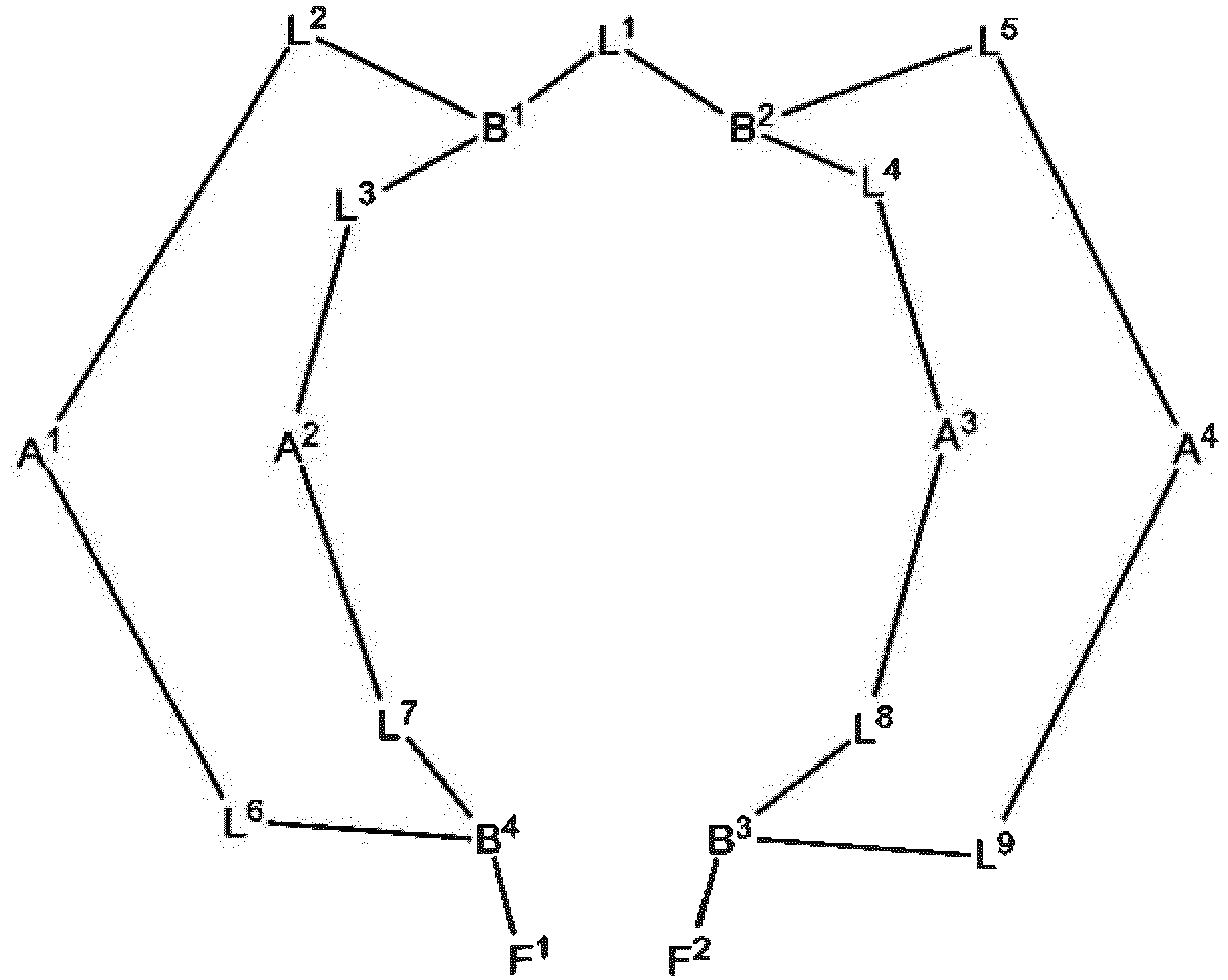 wobei B1, B2, B3 und B4 unabhängig voneinander ausgewählt sind aus N, C, B, Si und P;F1 und F2 unabhängig voneinander ausgewählt sind aus H, C1-C8-Alkyl, Heteroalkyl von 2, 3, 4, 5 oder 6 Atomen ausgewählt aus C, N, O, Si und S, sodass das Heteroalkyl zumindest ein C-Atom und zumindest ein Heteroatom, C5-C8-Aryl, C3-C8-Heteroaryl enthält, wobei die Arylgruppen 1, 2, 3 oder 4 Heteroatome ausgewählt aus N, O und S und C3-C8-Heterocycloalkyl enthalten, und wobei, wenn F1 und F2 nicht H sind, F1 und F2 jeweils eine modifizierende Komponente umfassen, die aus einer solubilisierenden Gruppe, einer von Estradiol abgeleiteten Komponente, einem Oligonukleotid, ssDNA, dsDNA, RNA und einem Peptid ausgewählt ist, und wobei gegebenenfalls F1 und F2 unabhängig voneinander aus einem Polyether und einem Peptid ausgewählt sind;L1, L2, L3, L4, L5, L6, L7, L8 und L9 unabhängig voneinander ausgewählt aus C1-C8-Alkyl gegebenenfalls substituiert mit einem Linker, Heteroalkyl von 2, 3, 4, 5 oder 6 Atomen, ausgewählt aus C, N, O, Si und S, sodass das Heteroalkyl zumindest ein C-Atom und zumindest ein Heteroatom enthält, und C3-C8-Heterocycloalkyl;wobei A1, A2, A3 und A4 Glieder sind, die unabhängig voneinander aus den allgemeinen Strukturen ausgewählt sind:
 Wobei A und G unabhängig voneinander aus Kohlenstoff, Stickstoff und Sauerstoff ausgewählt sind;J aus Kohlenstoff und Stickstoff ausgewählt ist;jedes R1 und R2 unabhängig aus H ausgewählt sind, und einer einfach negativen Ladung;jedes R6, R7, R8, R9 und R10 unabhängig voneinander ausgewählt sind aus einer Bindung an L2, L3, L4, L5, L6, L7, L8 oder L9, Alkanediyl gebunden an L2, L3, L4, L5, L6, L7, L8 oder L9, H, Alkyl, Heteroalkyl, Halogen, CN, CF3, -C(O)R17, -SO2NR17R18, -NR17R18, -OR17, -S(O)2R17, -COOR17, - S(O)2OR17, -OC(O)R17, -C(O)NR17R18, -NR17C(O)R18, -NR17SO2R18 und -NO2, wobei zumindest zwei von R6, R7, R8, R9 und R10 gegebenenfalls verbunden sind, um ein Ringsystem ausgewählt aus Cycloalkyl, Heterocycloalkyl, Aryl und Heteroaryl zu bilden;R17 und R18 unabhängig voneinander ausgewählt sind aus H, Alkyl, Heteroalkyl, Aryl, Heteroaryl und Heterocycloalkyl; und R17 und R18, zusammen mit den Atomen, an die sie gebunden sind, gegebenenfalls verbunden sind, um einen 5-, 6- oder 7-gliedrigen Ring zu bilden, wenn A Sauerstoff ist, R9 nicht vorhanden ist; und wenn G Sauerstoff ist, R7 nicht vorhanden ist;A1 ist an L2 und L6 durch zwei Glieder ausgewählt aus R6, R7, R8, R9 und R10 gebunden;A2 ist an L3 und L7 durch zwei Glieder ausgewählt aus R6, R7, R8, R9 und R10 gebunden;A3 ist an L4 und L8 durch zwei Glieder ausgewählt aus R6, R7, R8, R9 und R10 gebunden;A4 ist an L5 und L9 durch zwei Glieder ausgewählt aus R6, R7, R8, R9 und R10 gebunden.
 - Di-Macrocyclus nach Anspruch 1, wobei wenn A1 eine Struktur nach Formel (I) aufweist, A1 an L2 und L6 durch R6 und R10 gebunden ist;
wenn A1 eine Struktur nach Formel (II) oder (III) aufweist, ist A1 an L2 und L6 durch R6 und R9 gebunden;
wenn A2 eine Struktur nach Formel (I) aufweist, ist A2 an L3 und L7 durch R6 und R10 gebunden;
wenn A2 eine Struktur nach Formel (II) oder (III) aufweist, ist A2 an L3 und L7 durch R6 und R9 gebunden;
wenn A3 eine Struktur nach Formel (I) aufweist, ist A3 an L4 und L8 durch R6 und R10 gebunden;
wenn A3 eine Struktur nach Formel (II) oder (III) aufweist, ist A3 an L4 und L8 durch R6 und R9 gebunden;
wenn A4 eine Struktur nach Formel (I) aufweist, ist A4 an L5 und L9 durch R6 und R10 gebunden; und
wenn A4 eine Struktur nach Formel (II) oder (III) aufweist, ist A4 an L5 und L9 durch R6 und R9 gebunden. - Di-Macrocyclus nach Anspruch 2, wobei wenn A1 eine Struktur nach Formel (I) aufweist, zumindest eines von R6 und R10 von A1 eine Bindung ist, die an L2 oder L6 gebunden ist.
wenn A2 eine Struktur nach Formel (I) aufweist, ist zumindest eines von R6 und R10 von A2 eine Bindung, die an L3 oder L7 gebunden ist;
wenn A3 eine Struktur nach Formel (I) aufweist, ist zumindest eines von R6 und R10 von A3 eine Bindung, die an L4 oder L8 gebunden ist; und
wenn A4 eine Struktur nach Formel (I) aufweist, ist zumindest eines von R6 und R10 von A4 eine Bindung, die an L5 oder L9 gebunden ist. - Di-Macrocyclus nach Anspruch 1, wobei jedes von A1, A2, A3 und A4 unabhängig voneinander ausgewählt ist aus:

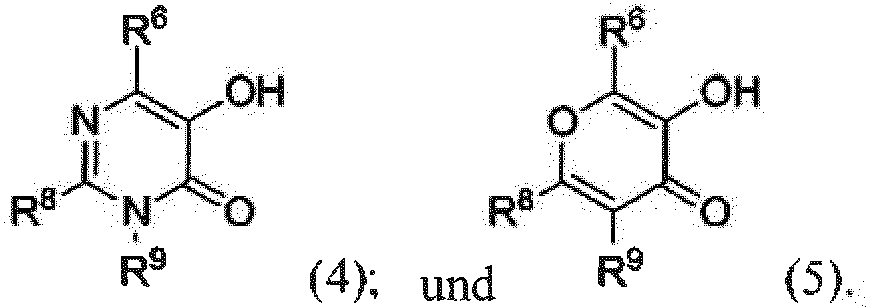
- Di-Macrocyclus nach Anspruch 4, wobei wenn A1 eine Struktur nach Formel (1) aufweist, A1 an L2 und L6 durch R6 und R10 gebunden ist;
wenn A1 eine Struktur nach Formel (2a), (2b), (3), (4) oder (5) aufweist, ist A1 an L2 und L6 durch R6 und R9 gebunden;
wenn A2 eine Struktur nach Formel (1) aufweist, ist A2 an L3 und L7 durch R6 und R10 gebunden;
wenn A2 eine Struktur nach Formel (2a), (2b), (3), (4) oder (5) aufweist, ist A2 an L3 und L7 durch R6 und R9 gebunden;
wenn A3 eine Struktur nach Formel (1) aufweist, ist A3 an L4 und L8 durch R6 und R10 gebunden;
wenn A3 eine Struktur nach Formel (2a), (2b), (3), (4) oder (5) aufweist, ist A3 an L4 und L8 durch R6 und R9 gebunden;
wenn A4 eine Struktur nach Formel (1) aufweist, ist A4 an L5 und L9 durch R6 und R10 gebunden;
und wenn A4 eine Struktur nach Formel (2a), (2b), (3), (4) oder (5) aufweist, ist A4 an L5 und L9 durch R6 und R9 gebunden. - Di-Macrocyclus nach Anspruch 5, wobei wenn A1 eine Struktur der Formel (1) aufweist, zumindest eins von R6 und R10 von A1 eine Bindung ist, die an L2 oder L6 gebunden ist;
wenn A2 eine Struktur nach Formel (1) aufweist, ist zumindest eines von R6 und R10 von A2 eine Bindung, die an L3 oder L7 gebunden ist;
wenn A3 eine Struktur nach Formel (1) aufweist, ist zumindest eines von R6 und R10 von A3 eine Bindung, die an L4 oder L8 gebunden ist; und
wenn A4 eine Struktur nach Formel (1) aufweist, ist zumindest eines von R6 und R10 von A4 eine Bindung, die an L5 oder L9 gebunden ist. - Di-Macrocyclus nach einem der Ansprüche 1-6, aufweisend die folgende Struktur:
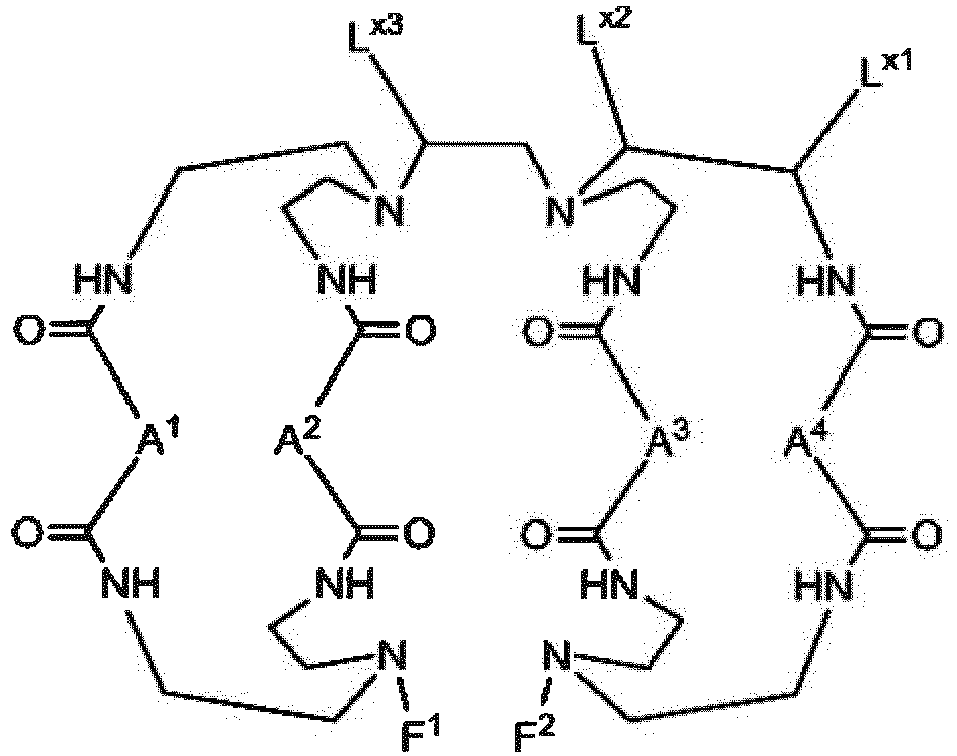
- Di-Macrocyclus nach Anspruch 7, aufweisend die folgende Struktur:

- Di-Macrocyclus nach einem der Ansprüche 1-6, aufweisend die folgende Struktur:

- Di-Macrocyclus nach Anspruch 9, aufweisend die folgende Struktur:

- Di-Macrocyclus, aufweisend die folgende Struktur:
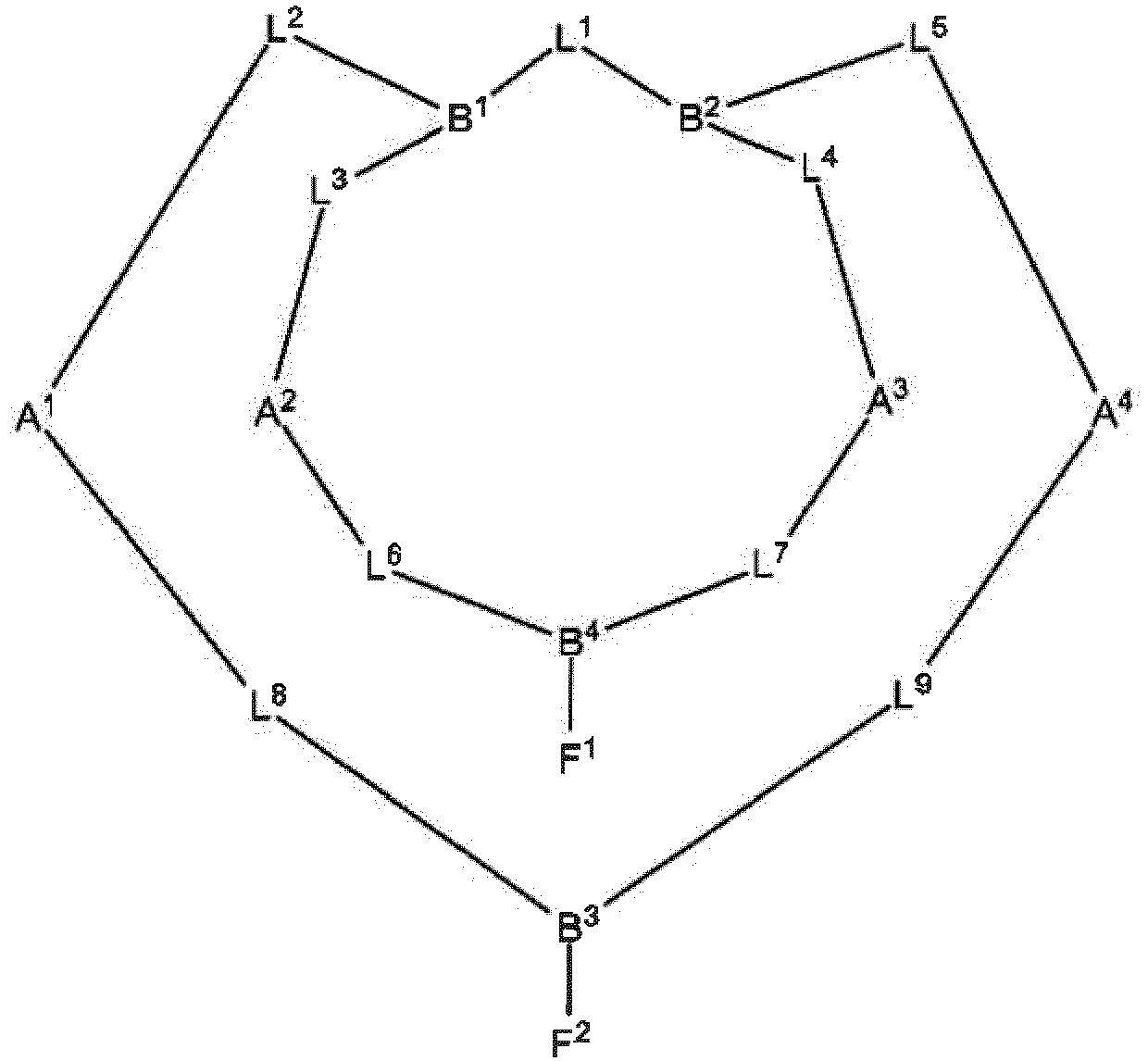 Wobei B1, B2, B3 und B4 unabhängig voneinander ausgewählt sind aus N, C, B, Si und P;F1 und F2 unabhängig voneinander ausgewählt sind aus H, C1-C8-Alkyl, Heteroalkyl von 2, 3, 4, 5 oder 6 Atomen ausgewählt aus C, N, O, Si und S, sodass das Heteroalkyl zumindest ein C-Atom und zumindest ein Heteroatom, C5-C8-Aryl, C3-C8-Heteroaryl enthält, wobei die Arylgruppen 1, 2, 3 oder 4 Heteroatome ausgewählt aus N, O und S und C3-C8-Heterocycloalkyl enthalten, und wobei, wenn F1 und F2 nicht H sind, F1 und F2 jeweils eine modifizierende Komponente umfassen, die aus einer solubilisierenden Gruppe, einer von Estradiol abgeleiteten Komponente, einem Oligonukleotid, ssDNA, dsDNA, RNA und einem Peptid ausgewählt ist, und wobei gegebenenfalls F1 und F2 unabhängig voneinander aus einem Polyether und einem Peptid ausgewählt sind;L1, L2, L3, L4, L5, L6, L7, L8 und L9 unabhängig voneinander ausgewählt aus C1-C8-Alkyl gegebenenfalls substituiert mit einem Linker, Heteroalkyl von 2, 3, 4, 5 oder 6 Atomen, ausgewählt aus C, N, O, Si und S, sodass das Heteroalkyl zumindest ein C-Atom und zumindest ein Heteroatom C5-C8-Aryl, C3-C8-Heteroaryl enthält, wobei die Arylgruppen 1, 2, 3 oder 4 Heteroatome ausgewählt aus N, O und S und C3-C8-Heterocycloalkyl enthalten;Wobei A1, A2, A3 und A4 Glieder sind, die unabhängig voneinander aus den allgemeinen Strukturen ausgewählt sind:
 Wobei A und G unabhängig voneinander aus Kohlenstoff, Stickstoff und Sauerstoff ausgewählt sind;J aus Kohlenstoff und Stickstoff ausgewählt ist;jedes R1 und R2 unabhängig aus H ausgewählt sind, und einer einfach negativen Ladung;jedes R6, R7, R8, R9 und R10 unabhängig voneinander ausgewählt ist aus einer Bindung an L2, L3, L4, L5, L6, L7, L8 oder L9, Alkanediyl gebunden an L2, L3, L4, L5, L6, L7, L8 oder L9, H, Alkyl, Heteroalkyl, Halogen, CN, CF3, -C(O)R17, -SO2NR17R18, -NR17R18, -OR17, -S(O)2R17,-COOR17, - S(O)2OR17, -OC(O)R17, -C(O)NR17R18, -NR17C(O)R18, -NR17SO2R18 und -NO2, wobei zumindest zwei von R6, R7, R8, R9 und R10 gegebenenfalls verbunden sind, um ein Ringsystem ausgewählt aus Cycloalkyl, Heterocycloalkyl, Aryl und Heteroaryl zu bilden;R17 und R18 unabhängig voneinander ausgewählt sind aus H, Alkyl, Heteroalkyl, Aryl, Heteroaryl und Heterocycloalkyl; und R17 und R18, zusammen mit den Atomen, an die sie gebunden sind, gegebenenfalls verbunden sind, um einen 5-, 6- oder 7-gliedrigen Ring zu bilden, wenn A Sauerstoff ist, R9 nicht vorhanden ist; und wenn G Sauerstoff ist, R7 nicht vorhanden ist;A1 ist an L2 und L8 durch zwei Glieder ausgewählt aus R6, R7, R8, R9 und R10 gebunden;A2 ist an L3 und L6 durch zwei Glieder ausgewählt aus R6, R7, R8, R9 und R10 gebunden;A3 ist an L4 und L7 durch zwei Glieder ausgewählt aus R6, R7, R8, R9 und R10 gebunden;A4 ist an L5 und L9 durch zwei Glieder ausgewählt aus R6, R7, R8, R9 und R10 gebunden.
 - Di-Macrocyclus nach Anspruch 1 oder Anspruch 11, wobei der Di-Macrocyclus mit zumindest einem Linker kovalent modifiziert ist.
- Di-Macrocyclus nach Anspruch 12, wobei jedes von L1, L2, L3, L4, L5, L6, L7, L8 und L9 mit einem Linker substituiert ist.
- Di-Macrocyclus nach einem der Ansprüche 11-13, wobei wenn A1 eine Struktur nach Formel (I) aufweist, A1 an L2 und L8 durch R6 und R10 gebunden ist;
wenn A1 eine Struktur nach Formel (II) oder (III) aufweist, ist A1 an L2 und L8 durch R6 und R9 gebunden;
wenn A2 eine Struktur nach Formel (I) aufweist, ist A2 an L3 und L6 durch R6 und R10 gebunden;
wenn A2 eine Struktur nach Formel (II) oder (III) aufweist, ist A2 an L3 und L6 durch R6 und R9 gebunden;
wenn A3 eine Struktur nach Formel (I) aufweist, ist A3 an L4 und L7 durch R6 und R10 gebunden;
wenn A3 eine Struktur nach Formel (II) oder (III) aufweist, ist A3 an L4 und L7 durch R6 und R9 gebunden;
wenn A4 eine Struktur nach Formel (I) aufweist, ist A4 an L5 und L9 durch R6 und R10 gebunden; und
wenn A4 eine Struktur nach Formel (II) oder (III) aufweist, ist A4 an L5 und L9 durch R6 und R9 gebunden. - Di-Macrocyclus nach einem der Ansprüche 11-14, wobei jedes von A1, A2, A3 und A4 unabhängig voneinander ausgewählt ist aus:

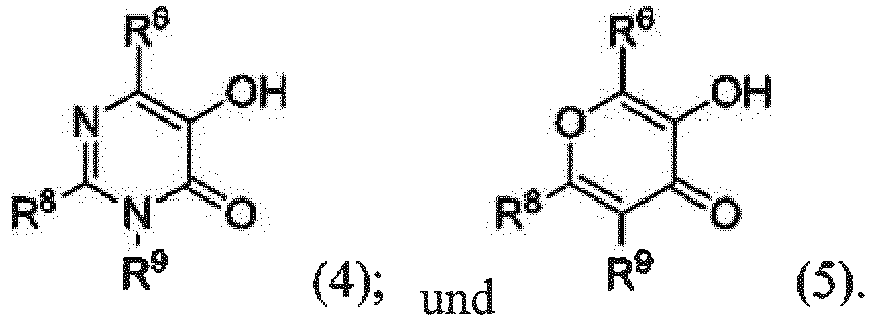
- Di-Macrocyclus nach Anspruch 15, wobei wenn A1 eine Struktur nach Formel (1) aufweist, A1 an L2 und L8 durch R6 und R10 gebunden ist;
wenn A1 eine Struktur nach Formel (2a), (2b), (3), (4) oder (5) aufweist, ist A1 an L2 und L8 durch R6 und R9 gebunden;
wenn A2 eine Struktur nach Formel (1) aufweist, ist A2 an L3 und L6 durch R6 und R10 gebunden;
wenn A2 eine Struktur nach Formel (2a), (2b), (3), (4) oder (5) aufweist, ist A2 an L3 und L6 durch R6 und R9 gebunden;
wenn A3 eine Struktur nach Formel (1) aufweist, ist A3 an L4 und L7 durch R6 und R10 gebunden;
wenn A3 eine Struktur nach Formel (2a), (2b), (3), (4) oder (5) aufweist, ist A3 an L4 und L7 durch R6 und R9 gebunden;
wenn A4 eine Struktur nach Formel (1) aufweist, ist A4 an L5 und L9 durch R6 und R10 gebunden; und
wenn A4 eine Struktur nach Formel (2a), (2b), (3), (4) oder (5) aufweist, ist A4 an L5 und L9 durch R6 und R9 gebunden. - Di-Macrocyclus nach einem der Ansprüche 11-16, aufweisend die folgende Struktur:

- Di-Macrocyclus nach Anspruch 17, aufweisend die folgende Struktur:

- Di-Macrocyclus nach Anspruch 17, aufweisend die folgende Struktur:
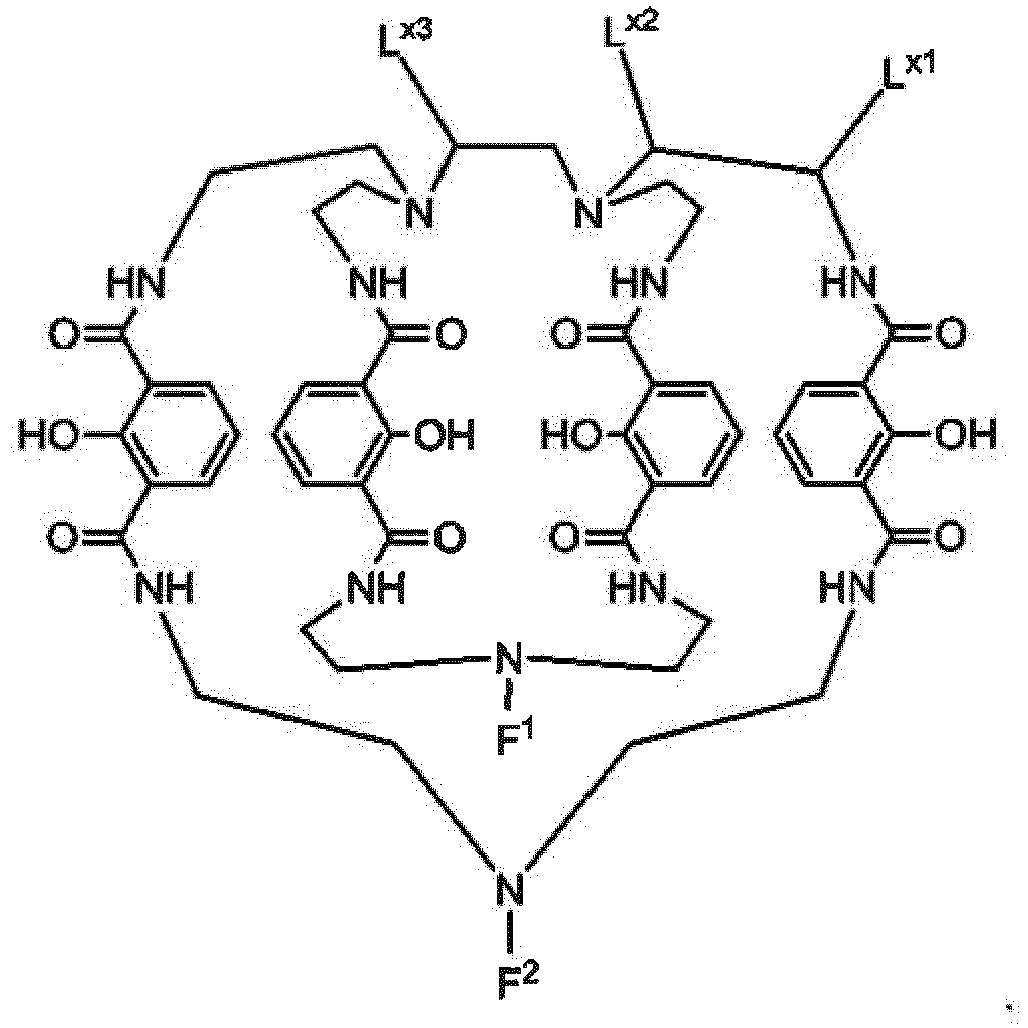
- Komplex, umfassend einen Di-Macrocyclus nach einem der vorhergehenden Ansprüche und ein Metallion, wobei das Metallion gegebenenfalls ein Lanthanid ist, gegebenenfalls das Lanthanid ausgewählt ist aus Eu und Tb, wobei das Metallion gegebenenfalls ein Actinid ist, wobei das Metallion gegebenenfalls ausgewählt ist aus Yttrium(III), Europium(III), Terbium(III), Zirconium(IV) und Thorium(IV), wobei das Metallion gegebenenfalls ein Radionuklid ist, ausgewählt aus Isotopen von U, Pu, Fe, Cu, Sm, Gd, Tb, Dy, Ho, Er, Yb, Lu, Y, Th, Zr, In, Ga, Bi, Ra, At und Ac, wobei das Metallion gegebenenfalls 227Th(IV) oder 89Zr(IV) ist, wobei das Metallion gegebenenfalls ein Glied ist, ausgewählt aus 177Lu, 166Ho, 153Sm, 90Y, 86Y, 166Dy, 165Dy, 169Er, 175Yb, 225Ac, 149Tb, 153Gd und 230U oder wobei das Metallion gegebenenfalls ein Glied ist, ausgewählt aus 111In, 67Ga, 67Cu, 64Cu, 186Re, 188Re, 111Ag, 109Pd, 212Pb, 203Pb, 212Bi, 213Bi, 195mPt, 201T1, 55Co und 99mTc.
- Di-Macrocyclus nach einem der Ansprüche 1 bis 19 oder Komplex, umfassend einen Di-Macrocyclus nach Anspruch 20, wobei die von Estradiol abgeleitete Gruppe ausgewählt ist aus Estradiol und die von Estradiol abgeleitete Gruppe die folgende Struktur aufweist

Applications Claiming Priority (3)
| Application Number | Priority Date | Filing Date | Title |
|---|---|---|---|
| US201261727568P | 2012-11-16 | 2012-11-16 | |
| US201361793265P | 2013-03-15 | 2013-03-15 | |
| PCT/US2013/070356 WO2014078690A1 (en) | 2012-11-16 | 2013-11-15 | Di-macrocycles |
Publications (3)
| Publication Number | Publication Date |
|---|---|
| EP2920157A1 EP2920157A1 (de) | 2015-09-23 |
| EP2920157A4 EP2920157A4 (de) | 2016-05-11 |
| EP2920157B1 true EP2920157B1 (de) | 2019-09-11 |
Family
ID=50731726
Family Applications (1)
| Application Number | Title | Priority Date | Filing Date |
|---|---|---|---|
| EP13854903.5A Active EP2920157B1 (de) | 2012-11-16 | 2013-11-15 | Di-macrocyclen |
Country Status (4)
| Country | Link |
|---|---|
| EP (1) | EP2920157B1 (de) |
| AU (1) | AU2013344514B2 (de) |
| CA (1) | CA2891593C (de) |
| WO (1) | WO2014078690A1 (de) |
Families Citing this family (5)
| Publication number | Priority date | Publication date | Assignee | Title |
|---|---|---|---|---|
| US11691997B2 (en) | 2014-04-09 | 2023-07-04 | Lumiphore, Inc. | Macrocycles |
| US10434186B2 (en) | 2014-12-22 | 2019-10-08 | Lumiphore, Inc. | Functionalized linear ligands and complexes thereof |
| CA3035526A1 (en) | 2016-09-02 | 2018-03-08 | Lumiphore, Inc. | Macrocyclic ligands with pendant chelating moieties and complexes thereof |
| CA3093247A1 (en) | 2018-03-07 | 2019-09-12 | Lumiphore, Inc. | Macrocyclic ligands with pendant chelating moieties and complexes thereof |
| CN118852025B (zh) * | 2024-06-21 | 2025-02-18 | 珠海市金团化学品有限公司 | 一种反应条件缓和有机酸铋的制备方法 |
Family Cites Families (12)
| Publication number | Priority date | Publication date | Assignee | Title |
|---|---|---|---|---|
| JPH07501058A (ja) | 1991-11-08 | 1995-02-02 | キュレイターズ オブ ザ ユニヴァーシティー オブ ミズーリー | 治療または診断用の放射性薬品の像形成剤の設計における潜在的な使用のための新規な多官能リガンド |
| US5739294A (en) | 1991-12-10 | 1998-04-14 | The Dow Chemical Company | Bicyclopol yazamacrocyclophosphonic acid complexes for use as contrast agents |
| US5482698A (en) | 1993-04-22 | 1996-01-09 | Immunomedics, Inc. | Detection and therapy of lesions with biotin/avidin polymer conjugates |
| US5624901A (en) | 1994-04-15 | 1997-04-29 | The Regents Of The University Of California | 3-hydroxy-2(1H)-pyridinone chelating agents |
| DE19525924A1 (de) | 1995-07-04 | 1997-01-09 | Schering Ag | Kaskaden-Polymer-Komplexe, Verfahren zu ihrer Herstellung und diese enthaltende pharmazeutische Mittel |
| CA2371816C (en) | 1999-02-18 | 2010-04-27 | The Regents Of The University Of California | Phthalamide-lanthanide complexes for use as luminescent markers |
| DE60012485T2 (de) | 1999-02-18 | 2005-08-18 | The Regents Of The University Of California, Oakland | Salicylamid-lanthanid komplexe zur verwendung als lumineszenzmarker |
| US6846915B2 (en) | 2001-08-13 | 2005-01-25 | The Regents Of The University Of California | Hydroxypyridonate and hydroxypyrimidinone chelating agents |
| US8557601B2 (en) | 2006-07-10 | 2013-10-15 | The Regents Of The University Of California | Luminescent 1-hydroxy-2-pyridinone chelates of lanthanides |
| US8173800B2 (en) | 2006-08-15 | 2012-05-08 | The Regents Of The University Of California | Luminescent macrocyclic lanthanide complexes |
| US8507199B2 (en) | 2007-01-25 | 2013-08-13 | Lumiphore, Inc. | Multi-color time resolved fluorophores based on macrocyclic lanthanide complexes |
| JP2013515744A (ja) | 2009-12-24 | 2013-05-09 | ルミフォア,インコーポレイテッド | 放射性医薬品錯体 |
-
2013
- 2013-11-15 AU AU2013344514A patent/AU2013344514B2/en active Active
- 2013-11-15 WO PCT/US2013/070356 patent/WO2014078690A1/en not_active Ceased
- 2013-11-15 CA CA2891593A patent/CA2891593C/en active Active
- 2013-11-15 EP EP13854903.5A patent/EP2920157B1/de active Active
Non-Patent Citations (1)
| Title |
|---|
| None * |
Also Published As
| Publication number | Publication date |
|---|---|
| CA2891593C (en) | 2021-09-14 |
| WO2014078690A1 (en) | 2014-05-22 |
| EP2920157A4 (de) | 2016-05-11 |
| CA2891593A1 (en) | 2014-05-22 |
| AU2013344514B2 (en) | 2017-09-14 |
| EP2920157A1 (de) | 2015-09-23 |
| AU2013344514A1 (en) | 2015-06-04 |
Similar Documents
| Publication | Publication Date | Title |
|---|---|---|
| US20200024234A1 (en) | Radiopharmaceutical complexes | |
| EP3129350B1 (de) | Makrocyclen | |
| AU2022252848B2 (en) | Macrocyclic ligands with pendant chelating moieties and complexes thereof | |
| US12440584B2 (en) | Macrocyclic ligands with pendant chelating moieties and complexes thereof | |
| US10434186B2 (en) | Functionalized linear ligands and complexes thereof | |
| EP2920157B1 (de) | Di-macrocyclen | |
| US11453652B2 (en) | Di-macrocycles |
Legal Events
| Date | Code | Title | Description |
|---|---|---|---|
| PUAI | Public reference made under article 153(3) epc to a published international application that has entered the european phase |
Free format text: ORIGINAL CODE: 0009012 |
|
| 17P | Request for examination filed |
Effective date: 20150615 |
|
| AK | Designated contracting states |
Kind code of ref document: A1 Designated state(s): AL AT BE BG CH CY CZ DE DK EE ES FI FR GB GR HR HU IE IS IT LI LT LU LV MC MK MT NL NO PL PT RO RS SE SI SK SM TR |
|
| AX | Request for extension of the european patent |
Extension state: BA ME |
|
| DAX | Request for extension of the european patent (deleted) | ||
| RIC1 | Information provided on ipc code assigned before grant |
Ipc: C07D 259/00 20060101AFI20160331BHEP Ipc: C07D 273/00 20060101ALI20160331BHEP Ipc: C07D 487/18 20060101ALI20160331BHEP Ipc: C07D 487/22 20060101ALI20160331BHEP Ipc: C07F 19/00 20060101ALI20160331BHEP Ipc: A61P 43/00 20060101ALI20160331BHEP Ipc: C07D 498/18 20060101ALI20160331BHEP |
|
| RA4 | Supplementary search report drawn up and despatched (corrected) |
Effective date: 20160408 |
|
| STAA | Information on the status of an ep patent application or granted ep patent |
Free format text: STATUS: EXAMINATION IS IN PROGRESS |
|
| 17Q | First examination report despatched |
Effective date: 20170124 |
|
| GRAP | Despatch of communication of intention to grant a patent |
Free format text: ORIGINAL CODE: EPIDOSNIGR1 |
|
| STAA | Information on the status of an ep patent application or granted ep patent |
Free format text: STATUS: GRANT OF PATENT IS INTENDED |
|
| INTG | Intention to grant announced |
Effective date: 20190227 |
|
| GRAJ | Information related to disapproval of communication of intention to grant by the applicant or resumption of examination proceedings by the epo deleted |
Free format text: ORIGINAL CODE: EPIDOSDIGR1 |
|
| STAA | Information on the status of an ep patent application or granted ep patent |
Free format text: STATUS: EXAMINATION IS IN PROGRESS |
|
| INTC | Intention to grant announced (deleted) | ||
| GRAR | Information related to intention to grant a patent recorded |
Free format text: ORIGINAL CODE: EPIDOSNIGR71 |
|
| GRAS | Grant fee paid |
Free format text: ORIGINAL CODE: EPIDOSNIGR3 |
|
| STAA | Information on the status of an ep patent application or granted ep patent |
Free format text: STATUS: GRANT OF PATENT IS INTENDED |
|
| GRAA | (expected) grant |
Free format text: ORIGINAL CODE: 0009210 |
|
| STAA | Information on the status of an ep patent application or granted ep patent |
Free format text: STATUS: THE PATENT HAS BEEN GRANTED |
|
| INTG | Intention to grant announced |
Effective date: 20190730 |
|
| RAP1 | Party data changed (applicant data changed or rights of an application transferred) |
Owner name: LUMIPHORE, INC. |
|
| AK | Designated contracting states |
Kind code of ref document: B1 Designated state(s): AL AT BE BG CH CY CZ DE DK EE ES FI FR GB GR HR HU IE IS IT LI LT LU LV MC MK MT NL NO PL PT RO RS SE SI SK SM TR |
|
| REG | Reference to a national code |
Ref country code: GB Ref legal event code: FG4D |
|
| REG | Reference to a national code |
Ref country code: CH Ref legal event code: EP |
|
| REG | Reference to a national code |
Ref country code: AT Ref legal event code: REF Ref document number: 1178302 Country of ref document: AT Kind code of ref document: T Effective date: 20190915 |
|
| REG | Reference to a national code |
Ref country code: DE Ref legal event code: R096 Ref document number: 602013060510 Country of ref document: DE Ref country code: IE Ref legal event code: FG4D |
|
| REG | Reference to a national code |
Ref country code: NL Ref legal event code: MP Effective date: 20190911 |
|
| REG | Reference to a national code |
Ref country code: LT Ref legal event code: MG4D |
|
| PG25 | Lapsed in a contracting state [announced via postgrant information from national office to epo] |
Ref country code: SE Free format text: LAPSE BECAUSE OF FAILURE TO SUBMIT A TRANSLATION OF THE DESCRIPTION OR TO PAY THE FEE WITHIN THE PRESCRIBED TIME-LIMIT Effective date: 20190911 Ref country code: BG Free format text: LAPSE BECAUSE OF FAILURE TO SUBMIT A TRANSLATION OF THE DESCRIPTION OR TO PAY THE FEE WITHIN THE PRESCRIBED TIME-LIMIT Effective date: 20191211 Ref country code: NO Free format text: LAPSE BECAUSE OF FAILURE TO SUBMIT A TRANSLATION OF THE DESCRIPTION OR TO PAY THE FEE WITHIN THE PRESCRIBED TIME-LIMIT Effective date: 20191211 Ref country code: HR Free format text: LAPSE BECAUSE OF FAILURE TO SUBMIT A TRANSLATION OF THE DESCRIPTION OR TO PAY THE FEE WITHIN THE PRESCRIBED TIME-LIMIT Effective date: 20190911 Ref country code: FI Free format text: LAPSE BECAUSE OF FAILURE TO SUBMIT A TRANSLATION OF THE DESCRIPTION OR TO PAY THE FEE WITHIN THE PRESCRIBED TIME-LIMIT Effective date: 20190911 Ref country code: LT Free format text: LAPSE BECAUSE OF FAILURE TO SUBMIT A TRANSLATION OF THE DESCRIPTION OR TO PAY THE FEE WITHIN THE PRESCRIBED TIME-LIMIT Effective date: 20190911 |
|
| PG25 | Lapsed in a contracting state [announced via postgrant information from national office to epo] |
Ref country code: ES Free format text: LAPSE BECAUSE OF FAILURE TO SUBMIT A TRANSLATION OF THE DESCRIPTION OR TO PAY THE FEE WITHIN THE PRESCRIBED TIME-LIMIT Effective date: 20190911 Ref country code: RS Free format text: LAPSE BECAUSE OF FAILURE TO SUBMIT A TRANSLATION OF THE DESCRIPTION OR TO PAY THE FEE WITHIN THE PRESCRIBED TIME-LIMIT Effective date: 20190911 Ref country code: GR Free format text: LAPSE BECAUSE OF FAILURE TO SUBMIT A TRANSLATION OF THE DESCRIPTION OR TO PAY THE FEE WITHIN THE PRESCRIBED TIME-LIMIT Effective date: 20191212 Ref country code: AL Free format text: LAPSE BECAUSE OF FAILURE TO SUBMIT A TRANSLATION OF THE DESCRIPTION OR TO PAY THE FEE WITHIN THE PRESCRIBED TIME-LIMIT Effective date: 20190911 Ref country code: LV Free format text: LAPSE BECAUSE OF FAILURE TO SUBMIT A TRANSLATION OF THE DESCRIPTION OR TO PAY THE FEE WITHIN THE PRESCRIBED TIME-LIMIT Effective date: 20190911 |
|
| REG | Reference to a national code |
Ref country code: AT Ref legal event code: MK05 Ref document number: 1178302 Country of ref document: AT Kind code of ref document: T Effective date: 20190911 |
|
| PG25 | Lapsed in a contracting state [announced via postgrant information from national office to epo] |
Ref country code: NL Free format text: LAPSE BECAUSE OF FAILURE TO SUBMIT A TRANSLATION OF THE DESCRIPTION OR TO PAY THE FEE WITHIN THE PRESCRIBED TIME-LIMIT Effective date: 20190911 Ref country code: PT Free format text: LAPSE BECAUSE OF FAILURE TO SUBMIT A TRANSLATION OF THE DESCRIPTION OR TO PAY THE FEE WITHIN THE PRESCRIBED TIME-LIMIT Effective date: 20200113 Ref country code: PL Free format text: LAPSE BECAUSE OF FAILURE TO SUBMIT A TRANSLATION OF THE DESCRIPTION OR TO PAY THE FEE WITHIN THE PRESCRIBED TIME-LIMIT Effective date: 20190911 Ref country code: RO Free format text: LAPSE BECAUSE OF FAILURE TO SUBMIT A TRANSLATION OF THE DESCRIPTION OR TO PAY THE FEE WITHIN THE PRESCRIBED TIME-LIMIT Effective date: 20190911 Ref country code: IT Free format text: LAPSE BECAUSE OF FAILURE TO SUBMIT A TRANSLATION OF THE DESCRIPTION OR TO PAY THE FEE WITHIN THE PRESCRIBED TIME-LIMIT Effective date: 20190911 Ref country code: AT Free format text: LAPSE BECAUSE OF FAILURE TO SUBMIT A TRANSLATION OF THE DESCRIPTION OR TO PAY THE FEE WITHIN THE PRESCRIBED TIME-LIMIT Effective date: 20190911 Ref country code: EE Free format text: LAPSE BECAUSE OF FAILURE TO SUBMIT A TRANSLATION OF THE DESCRIPTION OR TO PAY THE FEE WITHIN THE PRESCRIBED TIME-LIMIT Effective date: 20190911 |
|
| PG25 | Lapsed in a contracting state [announced via postgrant information from national office to epo] |
Ref country code: SM Free format text: LAPSE BECAUSE OF FAILURE TO SUBMIT A TRANSLATION OF THE DESCRIPTION OR TO PAY THE FEE WITHIN THE PRESCRIBED TIME-LIMIT Effective date: 20190911 Ref country code: CZ Free format text: LAPSE BECAUSE OF FAILURE TO SUBMIT A TRANSLATION OF THE DESCRIPTION OR TO PAY THE FEE WITHIN THE PRESCRIBED TIME-LIMIT Effective date: 20190911 Ref country code: SK Free format text: LAPSE BECAUSE OF FAILURE TO SUBMIT A TRANSLATION OF THE DESCRIPTION OR TO PAY THE FEE WITHIN THE PRESCRIBED TIME-LIMIT Effective date: 20190911 Ref country code: IS Free format text: LAPSE BECAUSE OF FAILURE TO SUBMIT A TRANSLATION OF THE DESCRIPTION OR TO PAY THE FEE WITHIN THE PRESCRIBED TIME-LIMIT Effective date: 20200224 |
|
| REG | Reference to a national code |
Ref country code: DE Ref legal event code: R097 Ref document number: 602013060510 Country of ref document: DE |
|
| REG | Reference to a national code |
Ref country code: CH Ref legal event code: PL |
|
| PLBE | No opposition filed within time limit |
Free format text: ORIGINAL CODE: 0009261 |
|
| STAA | Information on the status of an ep patent application or granted ep patent |
Free format text: STATUS: NO OPPOSITION FILED WITHIN TIME LIMIT |
|
| PG2D | Information on lapse in contracting state deleted |
Ref country code: IS |
|
| PG25 | Lapsed in a contracting state [announced via postgrant information from national office to epo] |
Ref country code: LI Free format text: LAPSE BECAUSE OF NON-PAYMENT OF DUE FEES Effective date: 20191130 Ref country code: CH Free format text: LAPSE BECAUSE OF NON-PAYMENT OF DUE FEES Effective date: 20191130 Ref country code: DK Free format text: LAPSE BECAUSE OF FAILURE TO SUBMIT A TRANSLATION OF THE DESCRIPTION OR TO PAY THE FEE WITHIN THE PRESCRIBED TIME-LIMIT Effective date: 20190911 Ref country code: MC Free format text: LAPSE BECAUSE OF FAILURE TO SUBMIT A TRANSLATION OF THE DESCRIPTION OR TO PAY THE FEE WITHIN THE PRESCRIBED TIME-LIMIT Effective date: 20190911 Ref country code: LU Free format text: LAPSE BECAUSE OF NON-PAYMENT OF DUE FEES Effective date: 20191115 Ref country code: IS Free format text: LAPSE BECAUSE OF FAILURE TO SUBMIT A TRANSLATION OF THE DESCRIPTION OR TO PAY THE FEE WITHIN THE PRESCRIBED TIME-LIMIT Effective date: 20200112 |
|
| 26N | No opposition filed |
Effective date: 20200615 |
|
| REG | Reference to a national code |
Ref country code: BE Ref legal event code: MM Effective date: 20191130 |
|
| PG25 | Lapsed in a contracting state [announced via postgrant information from national office to epo] |
Ref country code: SI Free format text: LAPSE BECAUSE OF FAILURE TO SUBMIT A TRANSLATION OF THE DESCRIPTION OR TO PAY THE FEE WITHIN THE PRESCRIBED TIME-LIMIT Effective date: 20190911 |
|
| PG25 | Lapsed in a contracting state [announced via postgrant information from national office to epo] |
Ref country code: IE Free format text: LAPSE BECAUSE OF NON-PAYMENT OF DUE FEES Effective date: 20191115 |
|
| PG25 | Lapsed in a contracting state [announced via postgrant information from national office to epo] |
Ref country code: BE Free format text: LAPSE BECAUSE OF NON-PAYMENT OF DUE FEES Effective date: 20191130 |
|
| PG25 | Lapsed in a contracting state [announced via postgrant information from national office to epo] |
Ref country code: CY Free format text: LAPSE BECAUSE OF FAILURE TO SUBMIT A TRANSLATION OF THE DESCRIPTION OR TO PAY THE FEE WITHIN THE PRESCRIBED TIME-LIMIT Effective date: 20190911 |
|
| PG25 | Lapsed in a contracting state [announced via postgrant information from national office to epo] |
Ref country code: HU Free format text: LAPSE BECAUSE OF FAILURE TO SUBMIT A TRANSLATION OF THE DESCRIPTION OR TO PAY THE FEE WITHIN THE PRESCRIBED TIME-LIMIT; INVALID AB INITIO Effective date: 20131115 Ref country code: MT Free format text: LAPSE BECAUSE OF FAILURE TO SUBMIT A TRANSLATION OF THE DESCRIPTION OR TO PAY THE FEE WITHIN THE PRESCRIBED TIME-LIMIT Effective date: 20190911 |
|
| PG25 | Lapsed in a contracting state [announced via postgrant information from national office to epo] |
Ref country code: TR Free format text: LAPSE BECAUSE OF FAILURE TO SUBMIT A TRANSLATION OF THE DESCRIPTION OR TO PAY THE FEE WITHIN THE PRESCRIBED TIME-LIMIT Effective date: 20190911 |
|
| PG25 | Lapsed in a contracting state [announced via postgrant information from national office to epo] |
Ref country code: MK Free format text: LAPSE BECAUSE OF FAILURE TO SUBMIT A TRANSLATION OF THE DESCRIPTION OR TO PAY THE FEE WITHIN THE PRESCRIBED TIME-LIMIT Effective date: 20190911 |
|
| P01 | Opt-out of the competence of the unified patent court (upc) registered |
Effective date: 20230524 |
|
| PGFP | Annual fee paid to national office [announced via postgrant information from national office to epo] |
Ref country code: GB Payment date: 20240926 Year of fee payment: 12 |
|
| PGFP | Annual fee paid to national office [announced via postgrant information from national office to epo] |
Ref country code: DE Payment date: 20240925 Year of fee payment: 12 |
|
| PGFP | Annual fee paid to national office [announced via postgrant information from national office to epo] |
Ref country code: FR Payment date: 20241001 Year of fee payment: 12 |