EP2920971B1 - Dispositifs et procédés de traitement d'une syntaxe non idr pour codage vidéo à haut rendement (hevc) - Google Patents
Dispositifs et procédés de traitement d'une syntaxe non idr pour codage vidéo à haut rendement (hevc) Download PDFInfo
- Publication number
- EP2920971B1 EP2920971B1 EP13786369.2A EP13786369A EP2920971B1 EP 2920971 B1 EP2920971 B1 EP 2920971B1 EP 13786369 A EP13786369 A EP 13786369A EP 2920971 B1 EP2920971 B1 EP 2920971B1
- Authority
- EP
- European Patent Office
- Prior art keywords
- decoding refresh
- instantaneous decoding
- refresh parameter
- parameter
- picture
- Prior art date
- Legal status (The legal status is an assumption and is not a legal conclusion. Google has not performed a legal analysis and makes no representation as to the accuracy of the status listed.)
- Active
Links
Images







Classifications
-
- H—ELECTRICITY
- H04—ELECTRIC COMMUNICATION TECHNIQUE
- H04N—PICTORIAL COMMUNICATION, e.g. TELEVISION
- H04N19/00—Methods or arrangements for coding, decoding, compressing or decompressing digital video signals
- H04N19/70—Methods or arrangements for coding, decoding, compressing or decompressing digital video signals characterised by syntax aspects related to video coding, e.g. related to compression standards
Definitions
- the disclosure relates generally to the field of video coding, and more specifically to systems, devices and methods for cleaning up the slice segment header syntax design.
- Video compression uses block processing for many operations.
- a block of neighboring pixels is grouped into a coding unit and compression operations treat this group of pixels as one unit to take advantage of correlations among neighboring pixels within the coding unit.
- Block-based processing often includes prediction coding and transform coding.
- Transform coding with quantization is a type of data compression which is commonly "lossy" as the quantization of a transform block taken from a source picture often discards data associated with the transform block in the source picture, thereby lowering its bandwidth requirement but often also resulting in quality loss in reproducing of the original transform block from the source picture.
- MPEG-4 AVC also known as H.264
- H.264 is an established video compression standard that uses transform coding in block processing.
- a picture is divided into macroblocks (MBs) of 16x16 pixels.
- MB macroblocks
- Each MB is often further divided into smaller blocks.
- Blocks equal in size to or smaller than a MB are predicted using intra-/inter-picture prediction, and a spatial transform along with quantization is applied to the prediction residuals.
- the quantized transform coefficients of the residuals are commonly encoded using entropy coding methods (e.g., variable length coding or arithmetic coding).
- Context Adaptive Binary Arithmetic Coding was introduced in H.264 to provide a substantially lossless compression efficiency by combining an adaptive binary arithmetic coding technique with a set of context models.
- Context model selection plays a role in CABAC in providing a degree of adaptation and redundancy reduction.
- H.264 specifies two kinds of scan patterns over 2D blocks. A zigzag scan is used for pictures coded with progressive video compression techniques and an alternative scan is for pictures coded with interlaced video compression techniques.
- HEVC High Efficiency Video Coding
- HD high definition
- codecs encoders and decoders
- method comprising: evaluating, by the computing device, a single conditional statement once to determine if a current picture is a non-IDR picture; based on the evaluating of the single conditional statement, when a non-IDR flag indicates a non-IDR picture is present, performing: encoding or decoding, by the computing device, a first non-IDR parameter indicating a picture order count modulo MaxPicOrderCntLsb for the current picture; encoding or decoding, by the computing device, a second non-IDR parameter indicating how a short-term picture set of the current picture is created; encoding or decoding, by the computing device, a third non-IDR parameter indicating an index to a list of the short-term reference picture sets used for creation of a reference picture set of the current picture; encoding or decoding, by the computing device, a fourth non-IDR parameter indicating a number of candidate long-term reference pictures that are included in a long-term reference picture set of
- an order in the encoded bitstream is the first non-IDR parameter, the second non-IDR parameter, the third non-IDR parameter, the fourth non-IDR parameter, the fifth non-IDR parameter, the sixth non-IDR parameter, the seventh non-IDR parameter, the eighth non-IDR parameter, the ninth non-IDR parameter, the tenth non-IDR parameter, the eleventh non-IDR parameter and the twelfth non-IDR parameter.
- the non-IDR flag is set to a first value to enable a non-IDR picture mode or set to a second value to disable the non-IDR picture mode.
- the non-IDR flag indicates the non-IDR mode is disabled, not encoding or decoding the first non-IDR parameter, the second non-IDR parameter, the third non-IDR parameter, the fourth non-IDR parameter, the fifth non-IDR parameter, the sixth non-IDR parameter, the seventh non-IDR parameter, the eighth non-IDR parameter, the ninth non-IDR parameter, the tenth non-IDR parameter, the eleventh non-IDR parameter and the twelfth non-IDR parameter in or from the encoded bitstream associated with the sequence of video.
- an order in the encoded bitstream varies among the first non-IDR parameter, the second non-IDR parameter, the third non-IDR parameter, the fourth non-IDR parameter, the fifth non-IDR parameter, the sixth non-IDR parameter, the seventh non-IDR parameter, the eighth non-IDR parameter, the ninth non-IDR parameter, the tenth non-IDR parameter, the eleventh non-IDR parameter and the twelfth non-IDR parameter.
- the method further comprises: encoding or decoding, by the computing device, a first IDR parameter indicating if sample adaptive offset (SAO) is enabled for a luma component of the sequence of video, wherein the first IDR parameter is encoded or decoded consecutively without any other bits or syntax between the twelfth non-IDR parameter and first IDR parameter.
- the method further comprises: encoding or decoding, by the computing device, a second IDR parameter indicating if sample adaptive offset (SAO) is enabled for a chroma component of the sequence of video, wherein the second IDR parameter is encoded or decoded consecutively without any other bits or syntax between the first IDR parameter and second IDR parameter.
- all of the non-IDR parameters in a slice are grouped under a single non-IDR flag.
- the non-IDR flag is located in a slice header.
- a decoder comprising: one or more computer processors; and a non-transitory computer-readable storage medium comprising instructions that, when executed, control the one or more computer processors to be configured for: determining an encoded bitstream; evaluating, by the computing device, a single conditional statement once to determine if a current picture is a non-IDR picture; based on the evaluating of the single conditional statement, when a non-IDR flag indicates a non-IDR picture is present, performing: decoding a first non-IDR parameter indicating a picture order count modulo MaxPicOrderCntLsb for the current picture; decoding a second non-IDR parameter indicating how a short-term picture set of the current picture is created; decoding a third non-IDR parameter indicating an index to a list of the short-term reference picture sets used for creation of a reference picture set of the current picture; decoding a fourth non-IDR parameter indicating a number of candidate long-term reference pictures
- an order in the encoded bitstream is the first non-IDR parameter, the second non-IDR parameter, the third non-IDR parameter, the fourth non-IDR parameter, the fifth non-IDR parameter, the sixth non-IDR parameter, the seventh non-IDR parameter, the eighth non-IDR parameter, the ninth non-IDR parameter, the tenth non-IDR parameter, the eleventh non-IDR parameter and the twelfth non-IDR parameter.
- the non-IDR flag is set to a first value to enable a non-IDR picture mode or set to a second value to disable the non-IDR picture mode.
- the non-IDR flag indicates the non-IDR mode is disabled, not decoding the first non-IDR parameter, the second non-IDR parameter, the third non-IDR parameter, the fourth non-IDR parameter, the fifth non-IDR parameter, the sixth non-IDR parameter, the seventh non-IDR parameter, the eighth non-IDR parameter, the ninth non-IDR parameter, the tenth non-IDR parameter, the eleventh non-IDR parameter and the twelfth non-IDR parameter from the encoded bitstream associated with the sequence of video.
- an order in the encoded bitstream varies among the first non-IDR parameter, the second non-IDR parameter, the third non-IDR parameter, the fourth non-IDR parameter, the fifth non-IDR parameter, the sixth non-IDR parameter, the seventh non-IDR parameter, the eighth non-IDR parameter, the ninth non-IDR parameter, the tenth non-IDR parameter, the eleventh non-IDR parameter and the twelfth non-IDR parameter.
- all of the non-IDR parameters in a slice are grouped under a single non-IDR flag.
- the non-IDR flag is located in a slice header.
- an encoder comprising: one or more computer processors; and a non-transitory computer-readable storage medium comprising instructions that, when executed, control the one or more computer processors to be configured for: evaluating a single conditional statement once to determine if a current picture is a non-IDR picture; based on the evaluating of the single conditional statement, when a non-IDR flag indicates a non-IDR picture is present, performing: encoding a first non-IDR parameter indicating a picture order count modulo MaxPicOrderCntLsb for the current picture; encoding a second non-IDR parameter indicating how a short-term picture set of the current picture is created; encoding a third non-IDR parameter indicating an index to a list of the short-term reference picture sets used for creation of a reference picture set of the current picture; encoding a fourth non-IDR parameter indicating a number of candidate long-term reference pictures that are included in a long-term reference picture set
- an order in the encoded bitstream is the first non-IDR parameter, the second non-IDR parameter, the third non-IDR parameter, the fourth non-IDR parameter, the fifth non-IDR parameter, the sixth non-IDR parameter, the seventh non-IDR parameter, the eighth non-IDR parameter, the ninth non-IDR parameter, the tenth non-IDR parameter, the eleventh non-IDR parameter and the twelfth non-IDR parameter.
- an order in the encoded bitstream varies among the first non-IDR parameter, the second non-IDR parameter, the third non-IDR parameter, the fourth non-IDR parameter, the fifth non-IDR parameter, the sixth non-IDR parameter, the seventh non-IDR parameter, the eighth non-IDR parameter, the ninth non-IDR parameter, the tenth non-IDR parameter, the eleventh non-IDR parameter and the twelfth non-IDR parameter.
- all of the non-IDR parameters in a slice are grouped under a single non-IDR flag.
- coding refers to encoding that occurs at the encoder or decoding that occurs at the decoder.
- coder refers to an encoder, a decoder, or a combined encoder/decoder (CODEC).
- CODEC encoder/decoder
- coder, encoder, decoder and CODEC all refer to specific machines designed for the coding (encoding and/or decoding) of image and/or video data consistent with this disclosure.
- Image and video data generally consist of three components- one for a luma component which represents brightness of a pixel and two for chroma components which represent color information of a pixel.
- a video system may include a head end 100 of a cable television network.
- the head end 100 may be configured to deliver video content to neighborhoods 129, 130 and 131.
- the head end 100 may operate within a hierarchy of head ends, with the head ends higher in the hierarchy generally having greater functionality.
- the head end 100 may be communicatively linked to a satellite dish 112 and receive video signals for non-local programming from it.
- the head end 100 may also be communicatively linked to a local station 114 that delivers local programming to the head end 100.
- the head end 100 may include a decoder 104 that decodes the video signals received from the satellite dish 112, an off-air receiver 106 that receives the local programming from the local station 114, a switcher 102 that routes data traffic among the various components of the head end 100, encoders 116 that encode video signals for delivery to customers, modulators 118 that modulate signals for delivery to customers, and a combiner 120 that combines the various signals into a single, multi-channel transmission.
- a decoder 104 that decodes the video signals received from the satellite dish 112
- an off-air receiver 106 that receives the local programming from the local station 114
- a switcher 102 that routes data traffic among the various components of the head end 100
- encoders 116 that encode video signals for delivery to customers
- modulators 118 that modulate signals for delivery to customers
- a combiner 120 that combines the various signals into a single, multi-channel transmission.
- the head end 100 may also be communicatively linked to a hybrid fiber cable (HFC) network 122.
- the HFC network 122 may be communicatively linked to a plurality of nodes 124, 126, and 128. Each of the nodes 124, 126, and 128 may be linked by coaxial cable to one of the neighborhoods 129, 130 and 131 and deliver cable television signals to that neighborhood.
- One of the neighborhoods 130 of FIG. 1A is shown in more detail.
- the neighborhood 130 may include a number of residences, including a home 132 shown in FIG. 1A . Within the home 132 may be a set-top box 134 communicatively linked to a video display 136.
- the set-top box 134 may include a first decoder 138 and a second decoder 140.
- the first and second decoders 138 and 140 may be communicatively linked to a user interface 142 and a mass storage device 144.
- the user interface 142 may be communicatively linked to the video display 136.
- head end 100 may receive local and nonlocal programming video signals from the satellite dish 112 and the local station 114.
- the nonlocal programming video signals may be received in the form of a digital video stream, while the local programming video signals may be received as an analog video stream.
- local programming may also be received as a digital video stream.
- the digital video stream may be decoded by the decoder 104 and sent to the switcher 102 in response to customer requests.
- the head end 100 may also include a server 108 communicatively linked to a mass storage device 110.
- the mass storage device 110 may store various types of video content, including video on demand (VOD), which the server 108 may retrieve and provide to the switcher 102.
- VOD video on demand
- the switcher 102 may route local programming directly to the modulators 118, which modulate the local programming, and route the non-local programming (including any VOD) to the encoders 116.
- the encoders 116 may digitally encode the non-local programming.
- the encoded non-local programming may then be transmitted to the modulators 118.
- the combiner 120 may be configured to receive the modulated analog video data and the modulated digital video data, combine the video data and transmit it via multiple radio frequency (RF) channels to the HFC network 122.
- RF radio frequency
- the HFC network 122 may transmit the combined video data to the nodes 124, 126 and 128, which may retransmit the data to their respective neighborhoods 129, 130 and 131.
- the home 132 may receive this video data at the set-top box 134, more specifically at the first decoder 138 and the second decoder 140.
- the first and second decoders 138 and 140 may decode the digital portion of the video data and provide the decoded data to the user interface 142, which then may provide the decoded data to the video display 136.
- the encoders 116 and the decoders 138 and 140 of FIG. 1A may be implemented as computer code comprising computer readable instructions stored on a computer readable storage device, such as memory or another type of storage device.
- the computer code may be executed on a computer system by a processor, such as an application-specific integrated circuit (ASIC), or other type of circuit.
- ASIC application-specific integrated circuit
- computer code for implementing the encoders 116 may be executed on a computer system (such as a server) residing in the headend 100.
- Computer code for the decoders 138 and 140 may be executed on the set-top box 134, which constitutes a type of computer system.
- the code may exist as software programs comprised of program instructions in source code, object code, executable code or other formats. It should be appreciated that the computer code for the various components shown in FIG. 1A may reside anywhere in system 10 or elsewhere (such as in a cloud network), that is determined to be desirable or advantageous. Furthermore, the computer code may be located in one or more components, provided the instructions may be effectively performed by the one or more components.
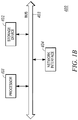
- FIG. 1B shows an example of a computer system on which computer code for the encoders 116 and the decoders 138 and 140 may be executed.
- the computer system generally labeled 400, includes a processor 401, or processing circuitry, that may implement or execute software instructions performing some or all of the methods, functions and other steps described herein. Commands and data from processor 401 may be communicated over a communication bus 403, for example.
- Computer system 400 may also include a computer readable storage device 402, such as random access memory (RAM), where the software and data for processor 401 may reside during runtime. Storage device 402 may also include non-volatile data storage.
- Computer system 400 may include a network interface 404 for connecting to a network.
- the computer system 400 may reside in the headend 100 and execute the encoders 116, and may also be embodied in the set-top box 134 to execute the decoders 138 and 140. Additionally, the computer system 400 may reside in places other than the headend 100 and the set-top box 134, and may be miniaturized so as to be integrated into a smartphone or tablet computer.
- Video encoding systems may achieve compression by removing redundancy in the video data, e.g., by removing those elements that can be discarded without greatly adversely affecting reproduction fidelity. Because video signals take place in time and space, most video encoding systems exploit both temporal and spatial redundancy present in these signals. Typically, there is high temporal correlation between successive frames. This is also true in the spatial domain for pixels which are close to each other. Thus, high compression gains are achieved by carefully exploiting these spatio-temporal correlations.
- HEVC High Efficiency Video Coding
- LCUs largest coding units
- CTBs coding tree blocks
- An LCU can be divided into four square blocks, called CUs (coding units), which are a quarter of the size of the LCU. Each CU can be further split into four smaller CUs, which are a quarter of the size of the original CU. The splitting process can be repeated until certain criteria are met.
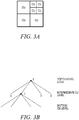
- FIG. 3A shows an example of LCU partitioned into CUs. In general, for HEVC, the smallest CU used (e.g., a leaf node as described in further detail below) is considered a CU.
- a flag is set to "1" if the node is further split into sub-nodes. Otherwise, the flag is unset at "0.”
- the LCU partition of FIG. 3A can be represented by the quadtree of FIG. 3B .
- These "split flags" may be jointly coded with other flags in the video bitstream, including a skip mode flag, a merge mode flag, and a predictive unit (PU) mode flag, and the like.
- the split flags 10100 could be coded as overhead along with the other flags. Syntax information for a given CU may be defined recursively, and may depend on whether the CU is split into sub-CUs.
- a node that is not split may include one or more prediction units (PUs).
- PUs prediction units
- a PU represents all or a portion of the corresponding CU, and includes data for retrieving a reference sample for the PU for purposes of performing prediction for the CU.
- a CU of 2Nx2N can possess one of four possible patterns (NxN, Nx2N, 2NxN and 2Nx2N), as shown in FIG. 2B . While shown for a 2Nx2N CU, other PUs having different dimensions and corresponding patterns (e.g., square or rectangular) may be used.
- a CU can be either spatially or temporally predictive coded. If a CU is coded in intra mode, each PU of the CU can have its own spatial prediction direction. If a CU is coded in inter mode, each PU of the CU can have its own motion vector(s) and associated reference picture(s).
- the data defining the motion vector may describe, for example, a horizontal component of the motion vector, a vertical component of the motion vector, a resolution for the motion vector (e.g., one-quarter pixel precision or one-eighth pixel precision), a reference frame to which the motion vector points, and/or a reference list (e.g., list 0 or list 1) for the motion vector.
- a motion vector predictor index may be used to identify a motion vector predictor (e.g., MV of left neighbor, MV of co-located neighbor).
- Data for the CU defining the one or more PUs of the CU may also describe, for example, partitioning of the CU into the one or more PUs. Partitioning modes may differ between whether the CU is uncoded, intra-prediction mode encoded, or inter-prediction mode encoded.
- the prediction can be formed by a weighted average of the previously encoded samples, located above and to the left of the current block.
- the encoder may select the mode that minimizes the difference or cost between the original and the prediction and signals this selection in the control data.
- inter-prediction encoding video sequences have high temporal correlation between frames, enabling a block in the current frame to be accurately described by a region (or two regions in the case of bi-prediction) in the previously coded frames, which are known as reference frames.
- Inter-prediction utilizes previously encoded and reconstructed reference frames to develop a prediction using a block-based motion estimation and compensation technique.
- quantization of transform coefficients may be performed.
- any transform operations may be bypassed using e.g., a transform skip mode in HEVC.
- Quantization generally refers to a process in which transform coefficients are quantized to possibly reduce the amount of data used to represent the coefficients, e.g., by converting high precision transform coefficients into a finite number of possible values.
- Each CU can also be divided into transform units (TUs).
- a block transform operation is performed on one or more TUs, to decorrelate the pixels within the block and compact the block energy into the low order coefficients of the transform block.
- one transform of 8x8 or 4x4 may be applied.
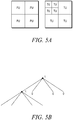
- a set of block transforms of different sizes may be applied to a CU, as shown in FIG. 5A where the left block is a CU partitioned into PUs and the right block is the associated set of transform units (TUs).
- the size and location of each block transform within a CU is described by a separate quadtree, called RQT.
- FIG. 5B shows the quadtree representation of TUs for the CU in the example of FIG. 5A .
- 11000 is coded and transmitted as part of the overhead.
- CUs, PUs, and TUs may be of NxN in size or MxN (or NxM), where N ⁇ M.
- the TUs and PUs of any given CU may be used for different purposes.
- TUs are typically used for transformation, quantizing and coding operations
- PUs are typically used for spatial and temporal prediction. There is not necessarily a direct relationship between the number of PUs and the number of TUs for a given CU.
- Video blocks may comprise blocks of pixel data in the pixel domain, or blocks of transform coefficients in the transform domain, e.g., following application of a transform, such as a discrete cosine transform (DCT), an integer transform, a wavelet transform, or a conceptually similar transform to residual data for a given video block, wherein the residual data represents pixel differences between video data for the block and predictive data generated for the block.
- video blocks may comprise blocks of quantized transform coefficients in the transform domain, wherein, following application of a transform to residual data for a given video block, the resulting transform coefficients are also quantized.
- quantization is the step that introduces loss, so that a balance between bitrate and reconstruction quality can be established.
- Block partitioning serves an important purpose in block-based video coding techniques. Using smaller blocks to code video data may result in better prediction of the data for locations of a video frame that include high levels of detail, and may therefore reduce the resulting error (e.g., deviation of the prediction data from source video data), represented as residual data.
- prediction exploits the spatial or temporal redundancy in a video sequence by modeling the correlation between sample blocks of various dimensions, such that only a small difference between the actual and the predicted signal needs to be encoded. A prediction for the current block is created from the samples which have already been encoded. While potentially reducing the residual data, such techniques may, however, require additional syntax information to indicate how the smaller blocks are partitioned relative to a video frame, and may result in an increased coded video bitrate. Accordingly, in some techniques, block partitioning may depend on balancing the desirable reduction in residual data against the resulting increase in bitrate of the coded video data due to the additional syntax information.
- blocks and the various partitions thereof may be considered video blocks.
- a slice may be considered to be a plurality of video blocks (e.g., macroblocks, or coding units), and/or sub-blocks (partitions of macroblocks, or sub-coding units such as sub-blocks of PUs, TUs, etc.).
- Each slice may be an independently decodable unit of a video frame.
- frames themselves may be decodable units, or other portions of a frame may be defined as decodable units.
- a GOP also referred to as a group of pictures, may be defined as a decodable unit.
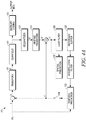
- the encoders 116 may be, according to an embodiment of the disclosure, composed of several functional modules as shown in FIG. 4A . These modules may be implemented as hardware, software, or any combination of the two. Given a current PU, x, a prediction PU, x', may first be obtained through either spatial prediction or temporal prediction. This spatial or temporal prediction may be performed by a spatial prediction module 129 or a temporal prediction module 130 respectively.
- spatial prediction directions there are several possible spatial prediction directions that the spatial prediction module 129 can perform per PU, including horizontal, vertical, 45-degree diagonal, 135-degree diagonal, DC, Planar, etc.
- spatial prediction may be performed differently for luma PU and chroma PU.
- an additional mode called IntraFromLuma, may be used for the Chroma intra prediction mode.
- a syntax indicates the spatial prediction direction per PU.
- the encoder 116 may perform temporal prediction through motion estimation operation. Specifically, the temporal prediction module 130 ( FIG. 4A ) may search for a best match prediction for the current PU over reference pictures.
- the best match prediction may be described by motion vector (MV) and associated reference picture (refldx).
- MV motion vector
- refldx reference picture
- a PU in B pictures can have up to two MVs. Both MV and refldx may be part of the syntax in the bitstream.
- the prediction PU may then be subtracted from the current PU, resulting in the residual PU, e.
- the residual CU generated by grouping the residual PU, e, associated with the CU, may then be transformed by a transform module 117, one transform unit (TU) at a time, resulting in the residual PU in the transform domain, E.
- the transform module 117 may use e.g., either a square or a non-square block transform.
- the transform coefficients E may then be quantized by a quantizer module 118, converting the high precision transform coefficients into a finite number of possible values.
- the quantization process may reduce the bit depth associated with some or all of the coefficients. For example, an n-bit value may be rounded down to an m-bit value during quantization, where n is greater than m.
- external boundary conditions are used to produce modified one or more transform coefficients. For example, a lower range or value may be used in determining if a transform coefficient is given a nonzero value or just zeroed out.
- quantization is a lossy operation and the loss by quantization generally cannot be recovered.
- the quantized coefficients may then be entropy coded by an entropy coding module 120, resulting in the final compression bits.
- the specific steps performed by the entropy coding module 120 will be discussed below in more detail. It should be noted that the prediction, transform, and quantization described above may be performed for any block of video data, e.g., to a PU and/or TU of a CU, or to a macroblock, depending on the specified coding standard.
- the encoder 116 may also take the quantized transform coefficients E and dequantize them with a dequantizer module 122 resulting in the dequantized transform coefficients E'.
- the dequantized transform coefficients are then inverse transformed by an inverse transform module 124, resulting in the reconstructed residual PU, e'.
- the reconstructed residual PU, e' is then added to the corresponding prediction, x', either spatial or temporal, to form a reconstructed PU, x".
- a deblocking filter (DBF) operation may be performed on the reconstructed PU, x", first to reduce blocking artifacts.
- a sample adaptive offset (SAO) process may be conditionally performed after the completion of the deblocking filter process for the decoded picture, which compensates the pixel value offset between reconstructed pixels and original pixels.
- both the DBF operation and SAO process are implemented by adaptive loop filter functions, which may be performed conditionally by a loop filter module 126 over the reconstructed PU.
- the adaptive loop filter functions minimize the coding distortion between the input and output pictures.
- loop filter module 126 operates during an inter-picture prediction loop. If the reconstructed pictures are reference pictures, they may be stored in a reference buffer 128 for future temporal prediction.
- HEVC specifies two loop filters that are applied in order with the deblocking filter (DBF) applied first and the sample adaptive offset (SAO) filter applied afterwards.
- the DBF is similar to the one used by H.264/MPEG-4 AVC but with a simpler design and better support for parallel processing.
- the DBF only applies to an 8x8 sample grid while with H.264/MPEG-4 AVC the DBF applies to a 4x4 sample grid.
- DBF uses an 8x8 sample grid since it causes no noticeable degradation and significantly improves parallel processing because the DBF no longer causes cascading interactions with other operations.
- Another change is that HEVC only allows for three DBF strengths of 0 to 2.
- HEVC also requires that the DBF first apply horizontal filtering for vertical edges to the picture and only after that does it apply vertical filtering for horizontal edges to the picture. This allows for multiple parallel threads to be used for the DBF.
- the SAO filter process is applied after the DBF and is made to allow for better reconstruction of the original signal amplitudes by using e.g., a look up table that includes some parameters that are based on a histogram analysis made by the encoder.
- the SAO filter has two basic types which are the edge offset (EO) type and the band offset (BO) type.
- One of the SAO types can be applied per coding tree block (CTB).
- the edge offset (EO) type has four sub-types corresponding to processing along four possible directions (e.g., horizontal, vertical, 135 degree, and 45 degree). For a given EO sub-type, the edge offset (EO) processing operates by comparing the value of a pixel to two of its neighbors using one of four different gradient patterns.
- An offset is applied to pixels in each of the four gradient patterns. For pixel values that are not in one of the gradient patterns, no offset is applied.
- the band offset (BO) processing is based directly on the sample amplitude which is split into 32 bands.
- An offset is applied to pixels in 16 of the 32 bands, where a group of 16 bands corresponds to a BO sub-type.
- the SAO filter process was designed to reduce distortion compared to the original signal by adding an offset to sample values. It can increase edge sharpness and reduce ringing and impulse artifacts.
- intra pictures such as an I picture
- inter pictures such as P pictures or B pictures
- An intra picture may be coded without referring to other pictures.
- spatial prediction may be used for a CU/PU inside an intra picture.
- An intra picture provides a possible point where decoding can begin.
- an inter picture generally aims for high compression.
- Inter picture supports both intra and inter prediction.
- a CU/PU in inter picture is either spatially or temporally predictive coded. Temporal references are the previously coded intra or inter pictures.
- An entropy decoding module 146 of the decoder 145 may decode the sign values, significance map and non-zero coefficients to recreate the quantized and transformed coefficients.
- the entropy decoding module 146 may perform the reverse of the procedure described in conjunction with the entropy coding module 120 - decoding the significance map along a scanning pattern made up of scanning lines.
- the entropy decoding module 146 then may provide the coefficients to a dequantizer module 147, which dequantizes the matrix of coefficients, resulting in E'.
- the dequantizer module 147 may provide the dequantized coefficients to an inverse transform module 149.
- the inverse transform module 149 may perform an inverse transform operation on the coefficients resulting in e'. Filtering and spatial prediction may be applied in a manner described in conjunction with FIG. 4A .
- encoders operate by encoding slices of a video stream.
- a slice may be considered to be a plurality of video blocks (e.g., macroblocks, or coding units), and/or sub-blocks (partitions of macroblocks, or sub-coding units such as sub-blocks of PUs, TUs, etc.).
- Each slice may be an independently or dependent decodable unit of a video frame.
- Encoders 116 may use a flag !IdrPicFlag that indicates whether or not a non-instantaneous decoding refresh (non-IDR) picture is present in a sequence of video.
- An IDR picture contains only I slices, and may be the first picture in the bitstream in decoding order, or may appear later in the bitstream.
- Each IDR picture is the first picture of a coded video sequence (CVS) in decoding order.
- CVS coded video sequence
- non-IDR pictures may include I-, B- and P- slices.
- the flag !IdrPicFlag when the flag !IdrPicFlag is set to a first value, such as 0, then non-IDR picture data is not present in the sequence of video. However, when the flag !IdrPicFlag is equal to a second value, such as 1, then it is possible that non-IDR picture data is present in the sequence of video.
- the flag !IdrPicFlag is calculated according to the Network Abstraction unit (NAL unit) type information specified in the header of NAL that includes the current slice header.
- the slice header is a header for a slice.
- the flag !IdrPicFlag governs whether non-IDR picture data may be found in the picture that is associated with the slice header.
- the flag !IdrPicFlag may be located in other headers, such as in a picture header. If the flag !IdrPicFlag is in the picture header, the flag !IdrPicFlag applies to all pictures that are associated with this picture header.
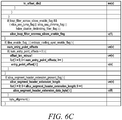
- FIG. 6 illustrates an example slice header syntax 600 in current HEVC.
- Slice header syntax 600 describes two groupings 601 and 603 of the parameters for non-IDR pictures according to one embodiment.
- Syntax 600 governs how encoders 116 encode the slice header and how decoders 138, 140 decode the slice header.
- syntax 600 is located in or is part of a sequence parameter set (SPS) header. Consequently, in such embodiments, the non-IDR flag is located in the SPS header.
- SPS sequence parameter set
- the flag !IdrPicFlag is shown. Also at 604, another flag !IdrPicFlag in combination with flag sps_temporal_mvp_enable_flag is shown.
- the flag !IdrPicFlag may indicate whether a non-IDR picture is present for the sequence of pictures. For example, as described above, encoders 116 may encode the value for the flag !IdrPicFlag as 0 or 1.
- the sps_temporal_mvp_enable_flag equal to 1 specifies that slice_temporal_mvp_enabled_flag is present in the slice headers of non-IDR pictures in the CVS.
- the sps_temporal_mvp_enable_flag 0 specifies that slice_temporal_mvp_enabled_flag is not present in slice headers and that temporal motion vector predictors are not used in the CVS.
- flag !IdrPicFlag 602 and flag !IdrPicFlag 604 include a conditional statement (e.g., if statement) that tests whether the flag !IdrPicFlag is enabled or disabled. If the flag !IdrPicFlag is disabled, then encoders 116 do not encode the parameters shown in groupings 601 and 603 in the encoded bitstream. Further, decoders 138, 140 do not attempt to decode the parameters shown in groupings 601 and 602 if the flag !IdrPicFlag is disabled.
- a conditional statement e.g., if statement
- encoders 116 encode the non-IDR picture parameters shown in groupings 601 and 602 in the encoded bitstream and also decoders 138, 140 decode the non-IDR picture parameters from the encoded bitstream.
- syntax 600 includes a parameter pic_order_cnt_lsb.
- This parameter specifies the picture order count modulo MaxPicOrderCntLsb for the current picture.
- the length of the pic_order_cnt_lsb syntax element is log2_max_pic_order_cnt_lsb_minus4 + 4 bits.
- the value of the pic_order_cnt_lsb shall be in the range of 0 to MaxPicOrderCntLsb - 1, inclusive. When pic_order_cnt_lsb is not present, pic_order_cnt_lsb is inferred to be equal to 0.
- syntax 600 includes a parameter short_term_ref_pic_set_sps_flag.
- This parameter specifies how the short-term picture set of the current picture is created. For example, short_term_ref_pic_set_sps_flag equal to 1 specifies that the short-term reference picture set of the current picture is created using syntax elements in the active SPS. short_term_ref_pic_set_sps_flag equal to 0 specifies that the short-term reference picture set of the current picture is created using syntax elements in the short_term_ref_pic_set() syntax structure in the slice header.
- syntax 600 includes a parameter short_term_ref_pic_set_idx.
- This parameter specifies the index to the list of the short-term reference picture sets specified in the active SPS that is used for creation of the reference picture set of the current picture.
- the syntax element short_term_ref_pic_set_idx is represented by Ceil(Log2(num_short_term_ref_pic_sets)) bits. When not present, the value of short_term_ref_pic_set_idx is inferred to be equal to 0.
- the value of short_term_ref_pic_set_idx shall be in the range of 0 to num_short_term_ref_pic_sets - 1, inclusive.
- syntax 600 includes a parameter num_long_term_sps.
- This parameter specifies the number of candidate long-term reference pictures specified in the active SPS that are included in the long-term reference picture set of the current picture.
- the value of num_long_term_sps shall be in the range of 0 to Min(num_long_term_ref_pics_sps, sps_max_dec_pic_buffering_minus1[sps_max_sub_layers_minus1] -NumNegative Pics[StRpsIdx] - NumPositivePics[StRpsIdx]), inclusive.
- the value of num_long_term_sps is inferred to be equal to 0.
- syntax 600 includes a parameter num_long_term_pics.
- This parameter specifies the number of long-term reference pictures specified in the slice header, which are included in the long-term reference picture set of the current picture.
- the value of num_long_term_pics shall be in the range of 0 to sps_max_dec_pic_buffering_minus1[sps_max_sub_layers_minus1] - NumNegative Pics[StRpsIdx] - NumPositivePics[StRpsIdx] - num_long_term_sps, inclusive.
- the value of num_long_term_pics is inferred to be equal to 0.
- syntax 600 includes a parameter lt_idx_sps[1].
- This parameter specifies an index into the list of candidate long-term reference pictures specified in the active SPS for identification of the picture that is included in the long-term reference picture set of the current picture.
- the number of bits used to represent lt_idx_sps[i] is equal to Ceil(Log2(num_long_term_ref_pics_sps)).
- the value of lt_idx_sps[i] is inferred to be equal to 0.
- the value of lt_idx_sps[i] shall be in the range of 0 to num_long_term_ref_pics_sps - 1, inclusive.
- syntax 600 includes a parameter poc_lsb_lt[i]. This parameter specifies the value of the picture order count modulo MaxPicOrderCntLsb of the i-th long-term reference picture that is included in the long-term reference picture set of the current picture.
- the length of the poc_lsb_lt[i] syntax element is log2_max_pic_order_cnt_lsb_minus4 + 4 bits.
- syntax 600 includes a parameter used_by_curr_pic_lt_flag[i]. This parameter specifies whether the i-th long term reference picture is used for reference by the current picture.
- a used_by_curr_pic_lt_flag[i] equal to 0 specifies that the i-th long-term reference picture included in the long-term reference picture set of the current picture is not used for reference by the current picture.
- PocLsbLt[i] and UsedByCurrPicLt[i] may be derived as follows:
- syntax 600 includes a parameter delta_poc_msb_present_flag[i]. This parameter specifies if delta_poc_msb_cycle_lt[i] is present, which may be used to calculate the picture order of the long term reference picture set of the current picture.
- a delta_poc_msb_cycle_lt[i] is equal to 1 specifies that delta_poc_msb_cycle_lt[i] is present.
- delta_poc_msb_present_flag[i] equal to 0 specifies that delta_poc_msb_cycle_lt[i] is not present.
- syntax 600 includes a parameter delta_poc_msb_cycle_lt[i]. This parameter is used to determine the value of the most significant bits of the picture order count value of the i-th long-term reference picture that is included in the long-term reference picture set of the current picture. When delta_poc_msb_cycle_lt[i] is not present, it is inferred to be equal to 0.
- the parameter DeltaPocMsbCycleLt[i] is derived as follows:
- syntax 600 includes a parameter slice_temporal_mvp_enable_flag. This parameter specifies whether temporal motion vector predictors can be used for inter prediction. If slice_temporal_mvp_enabled_flag is equal to 0, the syntax elements of the current picture shall be constrained such that no temporal motion vector predictor is used in decoding of the current picture. If slice_temporal_mvp_enabled_flag is equal to 1, temporal motion vector predictors may be used in decoding of the current picture. When not present, the value of slice_temporal_mvp_enabled_flag is inferred to be equal to 0.
- some syntax parameters are spread in different locations in the slice header, such as the two groupings 601 and 603, relating to parameters for non-IDR pictures.
- This spreading of syntax parameters throughout the slice header may be arbitrary, e.g., the location of the s may not necessarily have a causal relationship with other parameters.
- Such design is less than ideal because it is messy for presentation of slice header syntax and because it may require more logic condition checking.
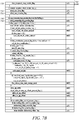
- the relative syntax parameters and function calls that are under a same condition may be grouped together, as shown in FIG. 7 .
- particular embodiments group the parameters for the non-IDR pictures together in grouping 701 in the slice header.
- encoders 116 encode the non-IDR picture parameters consecutively in the encoded bitstream.
- decoders 138, 140 may decode the non-IDR picture parameters consecutively when the encoded bitstream is received.
- FIG. 7 illustrates an example slice header syntax using such syntax grouping for same non-IDR picture condition in HEVC.
- Slice header syntax 700 describes a single grouping 701 of the parameters for non-IDR pictures according to one embodiment.
- Syntax 700 may be for a slice header, but may be used for other headers.
- Syntax 700 governs how encoders 116 encode the slice header and how decoders 138, 140 decode the SPS header.
- the flag !IdrPicFlag is shown. As described above, the flag !IdrPicFlag may indicate whether a non-IDR picture is present for the sequence of pictures.
- flag !IdrPicFlag 702 includes a conditional statement (e.g., if statement) that tests whether the flag !IdrPicFlag is enabled or disabled. If the flag !IdrPicFlag is disabled, then encoders 116 do not encode the parameters shown in grouping 701 in the encoded bitstream. Further, decoders 138, 140 do not attempt to decode the parameters shown in grouping 701 if the flag !IdrPicFlag is disabled.
- conditional statement e.g., if statement
- encoders 116 encode the non-IDR picture parameters shown in grouping 701 in the encoded bitstream and also decoders 138, 140 decode the non-IDR picture parameters from the encoded bitstream.
- syntax 700 includes a parameter pic_order_cnt_lsb. As described above, this parameter specifies the picture order count modulo MaxPicOrderCntLsb for the current picture.
- syntax 700 includes a parameter short_term_ref_pic_set_sps_flag. As described above, this parameter specifies how the short-term picture set of the current picture is created.
- syntax 700 includes a parameter short_term_ref_pic_set_idx. As described above, this parameter specifies the index to the list of the short-term reference picture sets specified in the active SPS that is used for creation of the reference picture set of the current picture.
- syntax 700 includes a parameter num_long_term_sps. As described above, this parameter specifies the number of candidate long-term reference pictures specified in the active SPS that are included in the long-term reference picture set of the current picture.
- syntax 700 includes a parameter num_long_term_pics. As described above, this parameter specifies the number of long-term reference pictures specified in the slice header, which are included in the long-term reference picture set of the current picture.
- syntax 700 includes a parameter lt_idx_sps[1]. As described above, this parameter specifies an index into the list of candidate long-term reference pictures specified in the active SPS for identification of the picture that is included in the long-term reference picture set of the current picture.
- syntax 700 includes a parameter poc_lsb_lt[i]. As described above, this parameter specifies the value of the picture order count modulo MaxPicOrderCntLsb of the i-th long-term reference picture that is included in the long-term reference picture set of the current picture.
- syntax 700 includes a parameter used_by_curr_pic_lt_flag[i]. As described above, this parameter specifies whether the i-th long term reference picture is used for reference by the current picture.
- syntax 700 includes a parameter delta_poc_msb_present_flag[i]. As described above, this parameter specifies if delta_poc_msb_cycle_lt[i] is present.
- syntax 700 includes a parameter delta_poc_msb_cycle_lt[i]. As described above, this parameter is used to determine the value of the most significant bits of the picture order count value of the i-th long-term reference picture that is included in the long-term reference picture set of the current picture.
- syntax 700 includes a parameter sps_temporal_mvp_enable_flag.
- this parameter specifies if temporal motion vector predictors may be used in the CVS.
- the sps_temporal_mvp_enable_flag 1 specifies that slice_temporal_mvp_enabled_flag is present in the slice headers of non-IDR pictures in the CVS.
- the sps_temporal_mvp_enable_flag 0 specifies that slice_temporal_mvp_enabled_flag is not present in slice headers and that temporal motion vector predictors are not used in the CVS.
- syntax 700 includes a parameter slice_temporal_mvp_enable_flag. As described above, this parameter specifies whether temporal motion vector predictors can be used for inter prediction.
- the parameter slice_temporal_mvp_enable_flag may be moved or grouped under a single condition 701 of non-IDR picture.
- This slice_temporal_mvp_enable_flag parameter may be moved because it has the same logic conditions as the group it is being moved to (i.e., !IdrPicFlag ). Consequently, at 740, syntax 700 illustrates the moved parameters 728 and 730, shown with strikethrough.
- syntax 700 includes a parameter slice_sao_luma_flag. This parameter specifies whether SAO is enabled for a luma component in a current slice.
- a slice_sao_luma_flag equal to 1 specifies that SAO is enabled for the luma component in the current slice;
- slice_sao_luma_flag 0 specifies that SAO is disabled for the luma component in the current slice.
- slice_sao_luma_flag is not present, it is inferred to be equal to 0.
- syntax includes a parameter slice_sao_chroma_flag. This parameter specifies whether SAO is enabled for a chroma component in a current slice.
- a slice_sao_chroma_flag 1 specifies that SAO is enabled for the chroma component in the current slice;
- slice_sao_chroma_flag 0 specifies that SAO is disabled for the chroma component in the current slice.
- slice_sao_chroma_flag is not present, it is inferred to be equal to 0.
- the parameters slice_sao_luma_flag 732 and slice_sao_chroma_flag 734 may be placed after the group of non-IDR picture parameters 701 because of above grouping or reordering.
Landscapes
- Engineering & Computer Science (AREA)
- Multimedia (AREA)
- Signal Processing (AREA)
- Compression Or Coding Systems Of Tv Signals (AREA)
Claims (11)
- Procédé comprenant les étapes consistant à :évaluer, par le biais d'un dispositif informatique, une instruction conditionnelle unique une seule fois pour déterminer si une image actuelle est une image de rafraîchissement de décodage non instantané ; etsur la base de l'étape d'évaluation de l'instruction conditionnelle unique, lorsque l'image actuelle est une image de rafraîchissement de décodage non instantané, mettre en œuvre les étapes consistant à :coder ou décoder, par le biais du dispositif informatique, un premier paramètre de rafraîchissement de décodage non instantané (708) indiquant un opérateur modulo de comptage d'ordre d'image pour l'image actuelle ;coder ou décoder, par le biais du dispositif informatique, un deuxième paramètre de rafraîchissement de décodage non instantané (710) indiquant comment un ensemble d'images éphémères de l'image actuelle est créé ;coder ou décoder, par le biais du dispositif informatique, un troisième paramètre de rafraîchissement de décodage non instantané (712) indiquant un index d'une liste d'ensembles d'images de référence éphémères utilisés pour la création d'un ensemble d'images de référence de l'image actuelle ;coder ou décoder, par le biais du dispositif informatique, un quatrième paramètre de rafraîchissement de décodage non instantané (714) indiquant un nombre d'images de référence durables candidates qui sont incluses dans un ensemble d'images de référence durables de l'image actuelle ;coder ou décoder, par le biais du dispositif informatique, un cinquième paramètre de rafraîchissement de décodage non instantané (716) indiquant le nombre d'images de référence durables qui sont incluses dans l'ensemble d'images de référence durables de l'image actuelle ;mettre en œuvre l'une des étapes consistant à :coder ou décoder, par le biais du dispositif informatique, un sixième paramètre de rafraîchissement de décodage non instantané (718) indiquant un index dans une liste d'images de référence durables candidates pour l'identification d'une image qui est incluse dans l'ensemble d'images de référence durables de l'image actuelle ; oucoder ou décoder, par le biais du dispositif informatique, un septième paramètre de rafraîchissement de décodage non instantané (720) indiquant une valeur d'un opérateur modulo de comptage d'ordre d'image d'une i-ème image de référence durable qui est incluse dans l'ensemble d'images de référence durables de l'image actuelle ; etcoder ou décoder, par le biais du dispositif informatique, un huitième paramètre de rafraîchissement de décodage non instantané (722) indiquant si l'i-ème image de référence durable est utilisée en tant que référence par l'image actuelle ;coder ou décoder, par le biais du dispositif informatique, un neuvième paramètre de rafraîchissement de décodage non instantané (724) indiquant comment calculer un ordre d'image de l'ensemble d'images de référence durables de l'image actuelle ;coder ou décoder, par le biais du dispositif informatique, un dixième paramètre de rafraîchissement de décodage non instantané (726) indiquant la valeur de bits les plus importants d'une valeur de comptage d'ordre d'image de l'i-ème image de référence durable qui est incluse dans l'ensemble d'images de référence durables de l'image actuelle ; etcoder ou décoder, par le biais du dispositif informatique, un onzième paramètre de rafraîchissement de décodage non instantané (730) indiquant si des prédicteurs de vecteurs de mouvement temporel peuvent être utilisés dans le cadre d'une inter-prédiction ;dans lequel le premier paramètre de rafraîchissement de décodage non instantané, le deuxième paramètre de rafraîchissement de décodage non instantané, le troisième paramètre de rafraîchissement de décodage non instantané, le quatrième paramètre de rafraîchissement de décodage non instantané, le cinquième paramètre de rafraîchissement de décodage non instantané, l'un parmi le sixième paramètre de rafraîchissement de décodage non instantané ou le septième paramètre de rafraîchissement de décodage non instantané, et le huitième paramètre de rafraîchissement de décodage non instantané, le neuvième paramètre de rafraîchissement de décodage non instantané, le dixième paramètre de rafraîchissement de décodage non instantané et le onzième paramètre de rafraîchissement de décodage non instantané, sont codés ou décodés consécutivement sans autres bits ou autre syntaxe entre le premier paramètre de rafraîchissement de décodage non instantané, le deuxième paramètre de rafraîchissement de décodage non instantané, le troisième paramètre de rafraîchissement de décodage non instantané, le quatrième paramètre de rafraîchissement de décodage non instantané, le cinquième paramètre de rafraîchissement de décodage non instantané, l'un parmi le sixième paramètre de rafraîchissement de décodage non instantané ou le septième paramètre de rafraîchissement de décodage non instantané, et le huitième paramètre de rafraîchissement de décodage non instantané, le neuvième paramètre de rafraîchissement de décodage non instantané, le dixième paramètre de rafraîchissement de décodage non instantané et le onzième paramètre de rafraîchissement de décodage non instantané, dans un train de bits codé, ou à partir d'un train de bits codé, associé à la séquence vidéo.
- Procédé selon la revendication 1, dans lequel un ordre, dans lequel les paramètres existent dans le train de bits codé, est : le premier paramètre de rafraîchissement de décodage non instantané, le deuxième paramètre de rafraîchissement de décodage non instantané, le troisième paramètre de rafraîchissement de décodage non instantané, le quatrième paramètre de rafraîchissement de décodage non instantané, le cinquième paramètre de rafraîchissement de décodage non instantané, l'un parmi le sixième paramètre de rafraîchissement de décodage non instantané ou le septième paramètre de rafraîchissement de décodage non instantané, et le huitième paramètre de rafraîchissement de décodage non instantané, le neuvième paramètre de rafraîchissement de décodage non instantané, le dixième paramètre de rafraîchissement de décodage non instantané et le onzième paramètre de rafraîchissement de décodage non instantané.
- Procédé selon la revendication 1, dans lequel l'instruction conditionnelle unique interroge un état d'un indicateur de rafraîchissement de décodage non instantané, et dans lequel l'indicateur de rafraîchissement de décodage non instantané est défini sur une première valeur pour activer un mode d'image de rafraîchissement de décodage non instantané, ou est défini sur une seconde valeur pour désactiver le mode d'image de rafraîchissement de décodage non instantané.
- Procédé selon la revendication 1, dans lequel l'instruction conditionnelle unique interroge un état d'un indicateur de rafraîchissement de décodage non instantané, et dans lequel, lorsque l'indicateur de rafraîchissement de décodage non instantané indique que le mode de rafraîchissement de décodage non instantané est désactivé, le procédé ne code ou ne décode pas le premier paramètre de rafraîchissement de décodage non instantané, le deuxième paramètre de rafraîchissement de décodage non instantané, le troisième paramètre de rafraîchissement de décodage non instantané, le quatrième paramètre de rafraîchissement de décodage non instantané, le cinquième paramètre de rafraîchissement de décodage non instantané, l'un parmi le sixième paramètre de rafraîchissement de décodage non instantané ou le septième paramètre de rafraîchissement de décodage non instantané, et le huitième paramètre de rafraîchissement de décodage non instantané, le neuvième paramètre de rafraîchissement de décodage non instantané, le dixième paramètre de rafraîchissement de décodage non instantané et le onzième paramètre de rafraîchissement de décodage non instantané, dans le train de bits codé, ou à partir de celui-ci, associé à la séquence vidéo.
- Procédé selon la revendication 1, dans lequel un ordre dans le train de bits codé varie entre le premier paramètre de rafraîchissement de décodage non instantané, le deuxième paramètre de rafraîchissement de décodage non instantané, le troisième paramètre de rafraîchissement de décodage non instantané, le quatrième paramètre de rafraîchissement de décodage non instantané, le cinquième paramètre de rafraîchissement de décodage non instantané, l'un parmi le sixième paramètre de rafraîchissement de décodage non instantané ou le septième paramètre de rafraîchissement de décodage non instantané, et le huitième paramètre de rafraîchissement de décodage non instantané, le neuvième paramètre de rafraîchissement de décodage non instantané, le dixième paramètre de rafraîchissement de décodage non instantané et le onzième paramètre de rafraîchissement de décodage non instantané.
- Procédé selon la revendication 1, comprenant en outre l'étape consistant à :coder ou décoder, par le biais du dispositif informatique, un premier paramètre de rafraîchissement de décodage instantané indiquant si un décalage adaptatif d'échantillon, SAO, est activé pour une composante de luminance de la séquence vidéo ;dans lequel le premier paramètre de rafraîchissement de décodage instantané est codé ou décodé consécutivement sans autres bits ou autre syntaxe entre le onzième paramètre de rafraîchissement de décodage non instantané et le premier paramètre de rafraîchissement de décodage instantané.
- Procédé selon la revendication 6, comprenant en outre l'étape consistant à :coder ou décoder, par le biais du dispositif informatique, un second paramètre de rafraîchissement de décodage instantané indiquant si un décalage adaptatif d'échantillon, SAO, est activé pour une composante de chrominance de la séquence vidéo ;dans lequel le second paramètre de rafraîchissement de décodage instantané est codé ou décodé consécutivement sans autres bits ou autre syntaxe entre le premier paramètre de rafraîchissement de décodage instantané et le deuxième paramètre de rafraîchissement de décodage non instantané.
- Procédé selon la revendication 1, dans lequel tous les paramètres de rafraîchissement de décodage non instantané dans une tranche sont inclus dans le train de bits codé, après l'instruction conditionnelle unique incluant un unique indicateur de rafraîchissement de décodage non instantané, et avant une tranche successive.
- Procédé selon la revendication 1, dans lequel l'indicateur de rafraîchissement de décodage non instantané est situé dans un en-tête de tranche.
- Codeur comprenant :un ou plusieurs processeurs informatiques ; etun support de stockage non transitoire lisible par ordinateur comprenant des instructions qui, lorsqu'elles sont exécutées, commandent audit un ou auxdits plusieurs processeurs informatiques d'être configurés pour :évaluer une instruction conditionnelle unique une seule fois pour déterminer si une image actuelle est une image de rafraîchissement de décodage non instantané ; etsur la base de l'étape d'évaluation de l'instruction conditionnelle unique, lorsque l'image actuelle est une image de rafraîchissement de décodage non instantané, mettre en œuvre les étapes consistant à :coder un premier paramètre de rafraîchissement de décodage non instantané (708) indiquant un opérateur modulo de comptage d'ordre d'image pour l'image actuelle ;coder un deuxième paramètre de rafraîchissement de décodage non instantané (710) indiquant comment un ensemble d'images éphémères de l'image actuelle est créé ;coder un troisième paramètre de rafraîchissement de décodage non instantané (712) indiquant un index d'une liste des ensembles d'images de référence éphémères utilisés pour la création d'un ensemble d'images de référence de l'image actuelle ;coder un quatrième paramètre de rafraîchissement de décodage non instantané (714) indiquant un nombre d'images de référence durables candidates qui sont incluses dans un ensemble d'images de référence durables de l'image actuelle ;coder un cinquième paramètre de rafraîchissement de décodage non instantané (716) indiquant le nombre d'images de référence durables qui sont incluses dans l'ensemble d'images de référence durables de l'image actuelle ;mettre en œuvre l'une des étapes consistant à :coder un sixième paramètre de rafraîchissement de décodage non instantané (718) indiquant un index dans une liste d'images de référence durables candidates pour l'identification d'une image qui est incluse dans l'ensemble d'images de référence durables de l'image actuelle ; oucoder un septième paramètre de rafraîchissement de décodage non instantané (720) indiquant une valeur d'un opérateur modulo de comptage d'ordre d'image d'une i-ème image de référence durable qui est incluse dans l'ensemble d'images de référence durables de l'image actuelle ; etcoder un huitième paramètre de rafraîchissement de décodage non instantané (722) indiquant si l'i-ème image de référence durable est utilisée en tant que référence par l'image actuelle ;coder un neuvième paramètre de rafraîchissement de décodage non instantané (724) indiquant comment calculer un ordre d'image de l'ensemble d'images de référence durables de l'image actuelle ;coder un dixième paramètre de rafraîchissement de décodage non instantané (726) indiquant la valeur de bits les plus importants d'une valeur de comptage d'ordre d'image de l'i-ème image de référence durable qui est incluse dans l'ensemble d'images de référence durables de l'image actuelle ; etcoder un onzième paramètre de rafraîchissement de décodage non instantané (730) indiquant si des prédicteurs de vecteurs de mouvement temporels peuvent être utilisés dans le cadre d'une inter-prédiction ;dans lequel le premier paramètre de rafraîchissement de décodage non instantané, le deuxième paramètre de rafraîchissement de décodage non instantané, le troisième paramètre de rafraîchissement de décodage non instantané, le quatrième paramètre de rafraîchissement de décodage non instantané, le cinquième paramètre de rafraîchissement de décodage non instantané, l'un parmi le sixième paramètre de rafraîchissement de décodage non instantané ou le septième paramètre de rafraîchissement de décodage non instantané, et le huitième paramètre de rafraîchissement de décodage non instantané, le neuvième paramètre de rafraîchissement de décodage non instantané, le dixième paramètre de rafraîchissement de décodage non instantané et le onzième paramètre de rafraîchissement de décodage non instantané, sont codés consécutivement sans autres bits ou autre syntaxe entre le premier paramètre de rafraîchissement de décodage non instantané, le deuxième paramètre de rafraîchissement de décodage non instantané, le troisième paramètre de rafraîchissement de décodage non instantané, le quatrième paramètre de rafraîchissement de décodage non instantané, le cinquième paramètre de rafraîchissement de décodage non instantané, l'un parmi le sixième paramètre de rafraîchissement de décodage non instantané ou le septième paramètre de rafraîchissement de décodage non instantané, et le huitième paramètre de rafraîchissement de décodage non instantané, le neuvième paramètre de rafraîchissement de décodage non instantané, le dixième paramètre de rafraîchissement de décodage non instantané et le onzième paramètre de rafraîchissement de décodage non instantané, dans un train de bits codé associé à la séquence vidéo.
- Décodeur comprenant :un ou plusieurs processeurs informatiques ; etun support de stockage non transitoire lisible par ordinateur comprenant des instructions qui, lorsqu'elles sont exécutées, commandent audit un ou auxdits plusieurs processeurs informatiques d'être configurés pour :évaluer une instruction conditionnelle unique une seule fois pour déterminer si une image actuelle est une image de rafraîchissement de décodage non instantané ; etsur la base de l'étape d'évaluation de l'instruction conditionnelle unique, lorsque l'image actuelle est une image de rafraîchissement de décodage non instantané, mettre en œuvre les étapes consistant à :décoder un premier paramètre de rafraîchissement de décodage non instantané (708) indiquant un opérateur modulo de comptage d'ordre d'image pour l'image actuelle ;décoder un deuxième paramètre de rafraîchissement de décodage non instantané (710) indiquant comment un ensemble d'images éphémères de l'image actuelle est créé ;décoder un troisième paramètre de rafraîchissement de décodage non instantané (712) indiquant un index d'une liste d'ensembles d'images de référence éphémères utilisés pour la création d'un ensemble d'images de référence de l'image actuelle ;décoder un quatrième paramètre de rafraîchissement de décodage non instantané (714) indiquant un nombre d'images de référence durables candidates qui sont incluses dans un ensemble d'images de référence durables de l'image actuelle ;décoder un cinquième paramètre de rafraîchissement de décodage non instantané (716) indiquant le nombre d'images de référence durables qui sont incluses dans l'ensemble d'images de référence durables de l'image actuelle ;mettre en œuvre l'une des étapes consistant à :décoder un sixième paramètre de rafraîchissement de décodage non instantané (718) indiquant un index dans une liste d'images de référence durables candidates pour l'identification d'une image qui est incluse dans l'ensemble d'images de référence durables de l'image actuelle ; oudécoder un septième paramètre de rafraîchissement de décodage non instantané (720) indiquant une valeur d'un opérateur modulo de comptage d'ordre d'image d'une i-ème image de référence durable qui est incluse dans l'ensemble d'images de référence durables de l'image actuelle ; etdécoder un huitième paramètre de rafraîchissement de décodage non instantané (722) indiquant si l'i-ème image de référence durable est utilisée en tant que référence par l'image actuelle ;décoder un neuvième paramètre de rafraîchissement de décodage non instantané (724) indiquant comment calculer un ordre d'image de l'ensemble d'images de référence durables de l'image actuelle ;décoder un dixième paramètre de rafraîchissement de décodage non instantané (726) indiquant la valeur de bits les plus importants d'une valeur de comptage d'ordre d'image de l'i-ème image de référence durable qui est incluse dans l'ensemble d'images de référence durables de l'image actuelle ; etdécoder un onzième paramètre de rafraîchissement de décodage non instantané (730) indiquant si des prédicteurs de vecteurs de mouvement temporels peuvent être utilisés dans le cadre d'une inter-prédiction ;dans lequel le premier paramètre de rafraîchissement de décodage non instantané, le deuxième paramètre de rafraîchissement de décodage non instantané, le troisième paramètre de rafraîchissement de décodage non instantané, le quatrième paramètre de rafraîchissement de décodage non instantané, le cinquième paramètre de rafraîchissement de décodage non instantané, l'un parmi le sixième paramètre de rafraîchissement de décodage non instantané ou le septième paramètre de rafraîchissement de décodage non instantané, et le huitième paramètre de rafraîchissement de décodage non instantané, le neuvième paramètre de rafraîchissement de décodage non instantané, le dixième paramètre de rafraîchissement de décodage non instantané et le onzième paramètre de rafraîchissement de décodage non instantané, sont décodés consécutivement sans autres bits ou autre syntaxe entre le premier paramètre de rafraîchissement de décodage non instantané, le deuxième paramètre de rafraîchissement de décodage non instantané, le troisième paramètre de rafraîchissement de décodage non instantané, le quatrième paramètre de rafraîchissement de décodage non instantané, le cinquième paramètre de rafraîchissement de décodage non instantané, l'un parmi le sixième paramètre de rafraîchissement de décodage non instantané ou le septième paramètre de rafraîchissement de décodage non instantané, et le huitième paramètre de rafraîchissement de décodage non instantané, le neuvième paramètre de rafraîchissement de décodage non instantané, le dixième paramètre de rafraîchissement de décodage non instantané et le onzième paramètre de rafraîchissement de décodage non instantané, dans un train de bits codé associé à la séquence vidéo.
Applications Claiming Priority (4)
| Application Number | Priority Date | Filing Date | Title |
|---|---|---|---|
| US201261727659P | 2012-11-16 | 2012-11-16 | |
| US201361785781P | 2013-03-14 | 2013-03-14 | |
| US13/864,198 US20140140406A1 (en) | 2012-11-16 | 2013-04-16 | Devices and methods for processing of non-idr related syntax for high efficiency video coding (hevc) |
| PCT/US2013/065870 WO2014078013A1 (fr) | 2012-11-16 | 2013-10-21 | Dispositifs et procédés de traitement d'une syntaxe non idr pour codage vidéo à haut rendement (hevc) |
Publications (2)
| Publication Number | Publication Date |
|---|---|
| EP2920971A1 EP2920971A1 (fr) | 2015-09-23 |
| EP2920971B1 true EP2920971B1 (fr) | 2020-07-01 |
Family
ID=50727910
Family Applications (1)
| Application Number | Title | Priority Date | Filing Date |
|---|---|---|---|
| EP13786369.2A Active EP2920971B1 (fr) | 2012-11-16 | 2013-10-21 | Dispositifs et procédés de traitement d'une syntaxe non idr pour codage vidéo à haut rendement (hevc) |
Country Status (3)
| Country | Link |
|---|---|
| US (1) | US20140140406A1 (fr) |
| EP (1) | EP2920971B1 (fr) |
| WO (1) | WO2014078013A1 (fr) |
Families Citing this family (13)
| Publication number | Priority date | Publication date | Assignee | Title |
|---|---|---|---|---|
| US11039138B1 (en) | 2012-03-08 | 2021-06-15 | Google Llc | Adaptive coding of prediction modes using probability distributions |
| US10003793B2 (en) | 2012-10-01 | 2018-06-19 | Google Technology Holdings LLC | Processing of pulse code modulation (PCM) parameters |
| GB2509707B (en) * | 2013-01-04 | 2016-03-16 | Canon Kk | A method, device, computer program, and information storage means for encoding or decoding a video sequence |
| JP6209772B2 (ja) | 2013-01-15 | 2017-10-11 | 華為技術有限公司Huawei Technologies Co.,Ltd. | シグナリングを用いたビデオデコーダ |
| RU2639958C2 (ru) * | 2013-04-17 | 2017-12-25 | Нокиа Текнолоджиз Ой | Устройство, способ и компьютерная программа для кодирования и декодирования видеоинформации |
| US9648326B2 (en) | 2013-07-02 | 2017-05-09 | Qualcomm Incorporated | Optimizations on inter-layer prediction signalling for multi-layer video coding |
| US9681145B2 (en) | 2013-10-14 | 2017-06-13 | Qualcomm Incorporated | Systems and methods for inter-layer RPS derivation based on sub-layer reference prediction dependency |
| JP6253406B2 (ja) * | 2013-12-27 | 2017-12-27 | キヤノン株式会社 | 画像符号化装置、撮像装置、画像符号化方法、及びプログラム |
| CN107852511B (zh) * | 2015-07-16 | 2020-09-22 | 杜比实验室特许公司 | 用于hdr和宽色域信号的信号整形和编码 |
| US11463736B2 (en) * | 2018-09-21 | 2022-10-04 | Sharp Kabushiki Kaisha | Systems and methods for signaling reference pictures in video coding |
| US11032574B2 (en) | 2018-12-31 | 2021-06-08 | Tencent America LLC | Method and apparatus for video coding |
| CN117156127B (zh) | 2019-01-02 | 2026-02-10 | Oppo广东移动通信有限公司 | 对视频信号进行编解码的方法和设备以及计算机可读介质 |
| US12278946B2 (en) | 2020-03-26 | 2025-04-15 | Alibaba Group Holding Limited | Methods and apparatuses for signaling picture header |
Family Cites Families (7)
| Publication number | Priority date | Publication date | Assignee | Title |
|---|---|---|---|---|
| US10034018B2 (en) * | 2011-09-23 | 2018-07-24 | Velos Media, Llc | Decoded picture buffer management |
| US20130089152A1 (en) * | 2011-10-05 | 2013-04-11 | Qualcomm Incorporated | Signaling picture identification for video coding |
| US9451284B2 (en) * | 2011-10-10 | 2016-09-20 | Qualcomm Incorporated | Efficient signaling of reference picture sets |
| US9554149B2 (en) * | 2012-02-29 | 2017-01-24 | Lg Electronics, Inc. | Inter-layer prediction method and apparatus using same |
| US20130343465A1 (en) * | 2012-06-26 | 2013-12-26 | Qualcomm Incorporated | Header parameter sets for video coding |
| US9635369B2 (en) * | 2012-07-02 | 2017-04-25 | Qualcomm Incorporated | Video parameter set including HRD parameters |
| US20140192881A1 (en) * | 2013-01-07 | 2014-07-10 | Sony Corporation | Video processing system with temporal prediction mechanism and method of operation thereof |
-
2013
- 2013-04-16 US US13/864,198 patent/US20140140406A1/en not_active Abandoned
- 2013-10-21 EP EP13786369.2A patent/EP2920971B1/fr active Active
- 2013-10-21 WO PCT/US2013/065870 patent/WO2014078013A1/fr not_active Ceased
Non-Patent Citations (1)
| Title |
|---|
| None * |
Also Published As
| Publication number | Publication date |
|---|---|
| US20140140406A1 (en) | 2014-05-22 |
| EP2920971A1 (fr) | 2015-09-23 |
| WO2014078013A1 (fr) | 2014-05-22 |
Similar Documents
| Publication | Publication Date | Title |
|---|---|---|
| EP2878124B1 (fr) | Dispositif et procédés de traitement de mode de partition dans un codage vidéo à haute efficacité | |
| EP2920971B1 (fr) | Dispositifs et procédés de traitement d'une syntaxe non idr pour codage vidéo à haut rendement (hevc) | |
| US9888249B2 (en) | Devices and methods for sample adaptive offset coding and/or selection of edge offset parameters | |
| US20140146894A1 (en) | Devices and methods for modifications of syntax related to transform skip for high efficiency video coding (hevc) | |
| US9565435B2 (en) | Devices and methods for context reduction in last significant coefficient position coding | |
| US9774853B2 (en) | Devices and methods for sample adaptive offset coding and/or signaling | |
| US9872034B2 (en) | Devices and methods for signaling sample adaptive offset (SAO) parameters | |
| EP2805495B1 (fr) | Dispositifs et procédés pour la réduction de contexte dans le codage de la position d'un dernier coefficient significatif | |
| US20130188741A1 (en) | Devices and methods for sample adaptive offset coding and/or selection of band offset parameters | |
| US20140092975A1 (en) | Devices and methods for using base layer motion vector for enhancement layer motion vector prediction | |
| US11039166B2 (en) | Devices and methods for using base layer intra prediction mode for enhancement layer intra mode prediction | |
| US11638024B2 (en) | Image encoding/decoding method and apparatus for signaling residual coding method used for encoding block to which BDPCM is applied, and method for transmitting bitstream | |
| WO2013109419A1 (fr) | Dispositifs et procédés de codage de décalage adaptatif d'échantillon et/ou de sélection de paramètres de décalage de bande |
Legal Events
| Date | Code | Title | Description |
|---|---|---|---|
| PUAI | Public reference made under article 153(3) epc to a published international application that has entered the european phase |
Free format text: ORIGINAL CODE: 0009012 |
|
| 17P | Request for examination filed |
Effective date: 20150609 |
|
| AK | Designated contracting states |
Kind code of ref document: A1 Designated state(s): AL AT BE BG CH CY CZ DE DK EE ES FI FR GB GR HR HU IE IS IT LI LT LU LV MC MK MT NL NO PL PT RO RS SE SI SK SM TR |
|
| AX | Request for extension of the european patent |
Extension state: BA ME |
|
| DAX | Request for extension of the european patent (deleted) | ||
| GRAP | Despatch of communication of intention to grant a patent |
Free format text: ORIGINAL CODE: EPIDOSNIGR1 |
|
| STAA | Information on the status of an ep patent application or granted ep patent |
Free format text: STATUS: GRANT OF PATENT IS INTENDED |
|
| INTG | Intention to grant announced |
Effective date: 20181008 |
|
| GRAJ | Information related to disapproval of communication of intention to grant by the applicant or resumption of examination proceedings by the epo deleted |
Free format text: ORIGINAL CODE: EPIDOSDIGR1 |
|
| STAA | Information on the status of an ep patent application or granted ep patent |
Free format text: STATUS: REQUEST FOR EXAMINATION WAS MADE |
|
| STAA | Information on the status of an ep patent application or granted ep patent |
Free format text: STATUS: EXAMINATION IS IN PROGRESS |
|
| INTC | Intention to grant announced (deleted) | ||
| 17Q | First examination report despatched |
Effective date: 20190322 |
|
| GRAP | Despatch of communication of intention to grant a patent |
Free format text: ORIGINAL CODE: EPIDOSNIGR1 |
|
| STAA | Information on the status of an ep patent application or granted ep patent |
Free format text: STATUS: GRANT OF PATENT IS INTENDED |
|
| INTG | Intention to grant announced |
Effective date: 20200116 |
|
| GRAS | Grant fee paid |
Free format text: ORIGINAL CODE: EPIDOSNIGR3 |
|
| GRAA | (expected) grant |
Free format text: ORIGINAL CODE: 0009210 |
|
| STAA | Information on the status of an ep patent application or granted ep patent |
Free format text: STATUS: THE PATENT HAS BEEN GRANTED |
|
| AK | Designated contracting states |
Kind code of ref document: B1 Designated state(s): AL AT BE BG CH CY CZ DE DK EE ES FI FR GB GR HR HU IE IS IT LI LT LU LV MC MK MT NL NO PL PT RO RS SE SI SK SM TR |
|
| REG | Reference to a national code |
Ref country code: CH Ref legal event code: EP Ref country code: AT Ref legal event code: REF Ref document number: 1287281 Country of ref document: AT Kind code of ref document: T Effective date: 20200715 |
|
| REG | Reference to a national code |
Ref country code: IE Ref legal event code: FG4D |
|
| REG | Reference to a national code |
Ref country code: DE Ref legal event code: R096 Ref document number: 602013070352 Country of ref document: DE |
|
| REG | Reference to a national code |
Ref country code: FI Ref legal event code: FGE |
|
| REG | Reference to a national code |
Ref country code: NL Ref legal event code: FP |
|
| REG | Reference to a national code |
Ref country code: SE Ref legal event code: TRGR |
|
| REG | Reference to a national code |
Ref country code: NO Ref legal event code: T2 Effective date: 20200701 |
|
| REG | Reference to a national code |
Ref country code: LT Ref legal event code: MG4D |
|
| PG25 | Lapsed in a contracting state [announced via postgrant information from national office to epo] |
Ref country code: BG Free format text: LAPSE BECAUSE OF FAILURE TO SUBMIT A TRANSLATION OF THE DESCRIPTION OR TO PAY THE FEE WITHIN THE PRESCRIBED TIME-LIMIT Effective date: 20201001 |
|
| REG | Reference to a national code |
Ref country code: AT Ref legal event code: MK05 Ref document number: 1287281 Country of ref document: AT Kind code of ref document: T Effective date: 20200701 |
|
| PG25 | Lapsed in a contracting state [announced via postgrant information from national office to epo] |
Ref country code: AT Free format text: LAPSE BECAUSE OF FAILURE TO SUBMIT A TRANSLATION OF THE DESCRIPTION OR TO PAY THE FEE WITHIN THE PRESCRIBED TIME-LIMIT Effective date: 20200701 Ref country code: PT Free format text: LAPSE BECAUSE OF FAILURE TO SUBMIT A TRANSLATION OF THE DESCRIPTION OR TO PAY THE FEE WITHIN THE PRESCRIBED TIME-LIMIT Effective date: 20201102 Ref country code: HR Free format text: LAPSE BECAUSE OF FAILURE TO SUBMIT A TRANSLATION OF THE DESCRIPTION OR TO PAY THE FEE WITHIN THE PRESCRIBED TIME-LIMIT Effective date: 20200701 Ref country code: GR Free format text: LAPSE BECAUSE OF FAILURE TO SUBMIT A TRANSLATION OF THE DESCRIPTION OR TO PAY THE FEE WITHIN THE PRESCRIBED TIME-LIMIT Effective date: 20201002 Ref country code: CZ Free format text: LAPSE BECAUSE OF FAILURE TO SUBMIT A TRANSLATION OF THE DESCRIPTION OR TO PAY THE FEE WITHIN THE PRESCRIBED TIME-LIMIT Effective date: 20200701 Ref country code: ES Free format text: LAPSE BECAUSE OF FAILURE TO SUBMIT A TRANSLATION OF THE DESCRIPTION OR TO PAY THE FEE WITHIN THE PRESCRIBED TIME-LIMIT Effective date: 20200701 Ref country code: LT Free format text: LAPSE BECAUSE OF FAILURE TO SUBMIT A TRANSLATION OF THE DESCRIPTION OR TO PAY THE FEE WITHIN THE PRESCRIBED TIME-LIMIT Effective date: 20200701 |
|
| PG25 | Lapsed in a contracting state [announced via postgrant information from national office to epo] |
Ref country code: LV Free format text: LAPSE BECAUSE OF FAILURE TO SUBMIT A TRANSLATION OF THE DESCRIPTION OR TO PAY THE FEE WITHIN THE PRESCRIBED TIME-LIMIT Effective date: 20200701 Ref country code: PL Free format text: LAPSE BECAUSE OF FAILURE TO SUBMIT A TRANSLATION OF THE DESCRIPTION OR TO PAY THE FEE WITHIN THE PRESCRIBED TIME-LIMIT Effective date: 20200701 Ref country code: RS Free format text: LAPSE BECAUSE OF FAILURE TO SUBMIT A TRANSLATION OF THE DESCRIPTION OR TO PAY THE FEE WITHIN THE PRESCRIBED TIME-LIMIT Effective date: 20200701 Ref country code: IS Free format text: LAPSE BECAUSE OF FAILURE TO SUBMIT A TRANSLATION OF THE DESCRIPTION OR TO PAY THE FEE WITHIN THE PRESCRIBED TIME-LIMIT Effective date: 20201101 |
|
| REG | Reference to a national code |
Ref country code: CH Ref legal event code: NV Representative=s name: SERVOPATENT GMBH, CH |
|
| REG | Reference to a national code |
Ref country code: DE Ref legal event code: R097 Ref document number: 602013070352 Country of ref document: DE |
|
| PG25 | Lapsed in a contracting state [announced via postgrant information from national office to epo] |
Ref country code: SM Free format text: LAPSE BECAUSE OF FAILURE TO SUBMIT A TRANSLATION OF THE DESCRIPTION OR TO PAY THE FEE WITHIN THE PRESCRIBED TIME-LIMIT Effective date: 20200701 Ref country code: RO Free format text: LAPSE BECAUSE OF FAILURE TO SUBMIT A TRANSLATION OF THE DESCRIPTION OR TO PAY THE FEE WITHIN THE PRESCRIBED TIME-LIMIT Effective date: 20200701 Ref country code: EE Free format text: LAPSE BECAUSE OF FAILURE TO SUBMIT A TRANSLATION OF THE DESCRIPTION OR TO PAY THE FEE WITHIN THE PRESCRIBED TIME-LIMIT Effective date: 20200701 Ref country code: DK Free format text: LAPSE BECAUSE OF FAILURE TO SUBMIT A TRANSLATION OF THE DESCRIPTION OR TO PAY THE FEE WITHIN THE PRESCRIBED TIME-LIMIT Effective date: 20200701 |
|
| PLBE | No opposition filed within time limit |
Free format text: ORIGINAL CODE: 0009261 |
|
| STAA | Information on the status of an ep patent application or granted ep patent |
Free format text: STATUS: NO OPPOSITION FILED WITHIN TIME LIMIT |
|
| PG25 | Lapsed in a contracting state [announced via postgrant information from national office to epo] |
Ref country code: AL Free format text: LAPSE BECAUSE OF FAILURE TO SUBMIT A TRANSLATION OF THE DESCRIPTION OR TO PAY THE FEE WITHIN THE PRESCRIBED TIME-LIMIT Effective date: 20200701 |
|
| 26N | No opposition filed |
Effective date: 20210406 |
|
| PG25 | Lapsed in a contracting state [announced via postgrant information from national office to epo] |
Ref country code: SK Free format text: LAPSE BECAUSE OF FAILURE TO SUBMIT A TRANSLATION OF THE DESCRIPTION OR TO PAY THE FEE WITHIN THE PRESCRIBED TIME-LIMIT Effective date: 20200701 |
|
| PG25 | Lapsed in a contracting state [announced via postgrant information from national office to epo] |
Ref country code: SI Free format text: LAPSE BECAUSE OF FAILURE TO SUBMIT A TRANSLATION OF THE DESCRIPTION OR TO PAY THE FEE WITHIN THE PRESCRIBED TIME-LIMIT Effective date: 20200701 |
|
| PG25 | Lapsed in a contracting state [announced via postgrant information from national office to epo] |
Ref country code: TR Free format text: LAPSE BECAUSE OF FAILURE TO SUBMIT A TRANSLATION OF THE DESCRIPTION OR TO PAY THE FEE WITHIN THE PRESCRIBED TIME-LIMIT Effective date: 20200701 Ref country code: CY Free format text: LAPSE BECAUSE OF FAILURE TO SUBMIT A TRANSLATION OF THE DESCRIPTION OR TO PAY THE FEE WITHIN THE PRESCRIBED TIME-LIMIT Effective date: 20200701 |
|
| PG25 | Lapsed in a contracting state [announced via postgrant information from national office to epo] |
Ref country code: MK Free format text: LAPSE BECAUSE OF FAILURE TO SUBMIT A TRANSLATION OF THE DESCRIPTION OR TO PAY THE FEE WITHIN THE PRESCRIBED TIME-LIMIT Effective date: 20200701 |
|
| P01 | Opt-out of the competence of the unified patent court (upc) registered |
Effective date: 20230511 |
|
| PGFP | Annual fee paid to national office [announced via postgrant information from national office to epo] |
Ref country code: MT Payment date: 20241001 Year of fee payment: 12 |
|
| REG | Reference to a national code |
Ref country code: CH Ref legal event code: U11 Free format text: ST27 STATUS EVENT CODE: U-0-0-U10-U11 (AS PROVIDED BY THE NATIONAL OFFICE) Effective date: 20251101 |
|
| PGFP | Annual fee paid to national office [announced via postgrant information from national office to epo] |
Ref country code: LU Payment date: 20251027 Year of fee payment: 13 Ref country code: NL Payment date: 20251026 Year of fee payment: 13 |
|
| PGFP | Annual fee paid to national office [announced via postgrant information from national office to epo] |
Ref country code: DE Payment date: 20251029 Year of fee payment: 13 |
|
| PGFP | Annual fee paid to national office [announced via postgrant information from national office to epo] |
Ref country code: GB Payment date: 20251027 Year of fee payment: 13 |
|
| PGFP | Annual fee paid to national office [announced via postgrant information from national office to epo] |
Ref country code: MC Payment date: 20251003 Year of fee payment: 13 Ref country code: NO Payment date: 20251029 Year of fee payment: 13 |
|
| PGFP | Annual fee paid to national office [announced via postgrant information from national office to epo] |
Ref country code: IT Payment date: 20251021 Year of fee payment: 13 Ref country code: FI Payment date: 20251027 Year of fee payment: 13 |
|
| PGFP | Annual fee paid to national office [announced via postgrant information from national office to epo] |
Ref country code: FR Payment date: 20251027 Year of fee payment: 13 |
|
| PGFP | Annual fee paid to national office [announced via postgrant information from national office to epo] |
Ref country code: BE Payment date: 20251027 Year of fee payment: 13 |
|
| PGFP | Annual fee paid to national office [announced via postgrant information from national office to epo] |
Ref country code: CH Payment date: 20251101 Year of fee payment: 13 Ref country code: SE Payment date: 20251027 Year of fee payment: 13 |
|
| PGFP | Annual fee paid to national office [announced via postgrant information from national office to epo] |
Ref country code: IE Payment date: 20251027 Year of fee payment: 13 |