EP2921132B1 - Fil de rétraction gingivale absorbant imprégné chimiquement comprenant de la soie - Google Patents
Fil de rétraction gingivale absorbant imprégné chimiquement comprenant de la soie Download PDFInfo
- Publication number
- EP2921132B1 EP2921132B1 EP15001243.3A EP15001243A EP2921132B1 EP 2921132 B1 EP2921132 B1 EP 2921132B1 EP 15001243 A EP15001243 A EP 15001243A EP 2921132 B1 EP2921132 B1 EP 2921132B1
- Authority
- EP
- European Patent Office
- Prior art keywords
- retraction cord
- silk
- strands
- knitted
- aluminum
- Prior art date
- Legal status (The legal status is an assumption and is not a legal conclusion. Google has not performed a legal analysis and makes no representation as to the accuracy of the status listed.)
- Not-in-force
Links
- 230000002745 absorbent Effects 0.000 title claims description 39
- 239000002250 absorbent Substances 0.000 title claims description 39
- 239000000835 fiber Substances 0.000 claims description 51
- 230000015556 catabolic process Effects 0.000 claims description 44
- 238000006731 degradation reaction Methods 0.000 claims description 44
- 239000013543 active substance Substances 0.000 claims description 38
- 229920000742 Cotton Polymers 0.000 claims description 15
- 239000002874 hemostatic agent Substances 0.000 claims description 15
- 229940030225 antihemorrhagics Drugs 0.000 claims description 13
- 229920001778 nylon Polymers 0.000 claims description 11
- 229920000728 polyester Polymers 0.000 claims description 11
- 239000004677 Nylon Substances 0.000 claims description 10
- VSCWAEJMTAWNJL-UHFFFAOYSA-K aluminium trichloride Chemical compound Cl[Al](Cl)Cl VSCWAEJMTAWNJL-UHFFFAOYSA-K 0.000 claims description 8
- JIAARYAFYJHUJI-UHFFFAOYSA-L zinc dichloride Chemical compound [Cl-].[Cl-].[Zn+2] JIAARYAFYJHUJI-UHFFFAOYSA-L 0.000 claims description 8
- 239000003212 astringent agent Substances 0.000 claims description 7
- 229910052751 metal Inorganic materials 0.000 claims description 5
- 239000002184 metal Substances 0.000 claims description 5
- GRLPQNLYRHEGIJ-UHFFFAOYSA-J potassium aluminium sulfate Chemical compound [Al+3].[K+].[O-]S([O-])(=O)=O.[O-]S([O-])(=O)=O GRLPQNLYRHEGIJ-UHFFFAOYSA-J 0.000 claims description 5
- 239000005526 vasoconstrictor agent Substances 0.000 claims description 5
- HSEYYGFJBLWFGD-UHFFFAOYSA-N 4-methylsulfanyl-2-[(2-methylsulfanylpyridine-3-carbonyl)amino]butanoic acid Chemical compound CSCCC(C(O)=O)NC(=O)C1=CC=CN=C1SC HSEYYGFJBLWFGD-UHFFFAOYSA-N 0.000 claims description 4
- 229910021578 Iron(III) chloride Inorganic materials 0.000 claims description 4
- HDYRYUINDGQKMC-UHFFFAOYSA-M acetyloxyaluminum;dihydrate Chemical compound O.O.CC(=O)O[Al] HDYRYUINDGQKMC-UHFFFAOYSA-M 0.000 claims description 4
- AZDRQVAHHNSJOQ-UHFFFAOYSA-N alumane Chemical class [AlH3] AZDRQVAHHNSJOQ-UHFFFAOYSA-N 0.000 claims description 4
- DIZPMCHEQGEION-UHFFFAOYSA-H aluminium sulfate (anhydrous) Chemical compound [Al+3].[Al+3].[O-]S([O-])(=O)=O.[O-]S([O-])(=O)=O.[O-]S([O-])(=O)=O DIZPMCHEQGEION-UHFFFAOYSA-H 0.000 claims description 4
- 229940009827 aluminum acetate Drugs 0.000 claims description 4
- LVYZJEPLMYTTGH-UHFFFAOYSA-H dialuminum chloride pentahydroxide dihydrate Chemical compound [Cl-].[Al+3].[OH-].[OH-].[Al+3].[OH-].[OH-].[OH-].O.O LVYZJEPLMYTTGH-UHFFFAOYSA-H 0.000 claims description 4
- RBTARNINKXHZNM-UHFFFAOYSA-K iron trichloride Chemical compound Cl[Fe](Cl)Cl RBTARNINKXHZNM-UHFFFAOYSA-K 0.000 claims description 4
- RUTXIHLAWFEWGM-UHFFFAOYSA-H iron(3+) sulfate Chemical compound [Fe+3].[Fe+3].[O-]S([O-])(=O)=O.[O-]S([O-])(=O)=O.[O-]S([O-])(=O)=O RUTXIHLAWFEWGM-UHFFFAOYSA-H 0.000 claims description 4
- GDPKWKCLDUOTMP-UHFFFAOYSA-B iron(3+);dihydroxide;pentasulfate Chemical compound [OH-].[OH-].[Fe+3].[Fe+3].[Fe+3].[Fe+3].[O-]S([O-])(=O)=O.[O-]S([O-])(=O)=O.[O-]S([O-])(=O)=O.[O-]S([O-])(=O)=O.[O-]S([O-])(=O)=O GDPKWKCLDUOTMP-UHFFFAOYSA-B 0.000 claims description 4
- 229910000360 iron(III) sulfate Inorganic materials 0.000 claims description 4
- 229920001864 tannin Polymers 0.000 claims description 4
- 239000001648 tannin Substances 0.000 claims description 4
- 235000018553 tannin Nutrition 0.000 claims description 4
- 235000005074 zinc chloride Nutrition 0.000 claims description 4
- 239000011592 zinc chloride Substances 0.000 claims description 4
- 238000004519 manufacturing process Methods 0.000 claims description 3
- XLYOFNOQVPJJNP-UHFFFAOYSA-N water Substances O XLYOFNOQVPJJNP-UHFFFAOYSA-N 0.000 claims description 3
- UCTWMZQNUQWSLP-VIFPVBQESA-N (R)-adrenaline Chemical compound CNC[C@H](O)C1=CC=C(O)C(O)=C1 UCTWMZQNUQWSLP-VIFPVBQESA-N 0.000 claims description 2
- 229930182837 (R)-adrenaline Natural products 0.000 claims description 2
- 229960005139 epinephrine Drugs 0.000 claims description 2
- -1 permanganates Substances 0.000 claims description 2
- JCRIVQIOJSSCQD-UHFFFAOYSA-N propylhexedrine Chemical compound CNC(C)CC1CCCCC1 JCRIVQIOJSSCQD-UHFFFAOYSA-N 0.000 claims description 2
- 229960000786 propylhexedrine Drugs 0.000 claims description 2
- 239000000463 material Substances 0.000 description 42
- 239000000203 mixture Substances 0.000 description 9
- 238000000034 method Methods 0.000 description 8
- 208000032843 Hemorrhage Diseases 0.000 description 7
- 238000009940 knitting Methods 0.000 description 7
- 238000012856 packing Methods 0.000 description 7
- 239000000243 solution Substances 0.000 description 7
- 230000008901 benefit Effects 0.000 description 6
- 230000000740 bleeding effect Effects 0.000 description 6
- 210000004195 gingiva Anatomy 0.000 description 5
- 238000010521 absorption reaction Methods 0.000 description 4
- 230000009286 beneficial effect Effects 0.000 description 4
- 230000000593 degrading effect Effects 0.000 description 4
- 239000007788 liquid Substances 0.000 description 4
- 229920002994 synthetic fiber Polymers 0.000 description 4
- 230000002439 hemostatic effect Effects 0.000 description 3
- 238000005470 impregnation Methods 0.000 description 3
- 239000012209 synthetic fiber Substances 0.000 description 3
- XEEYBQQBJWHFJM-UHFFFAOYSA-N Iron Chemical compound [Fe] XEEYBQQBJWHFJM-UHFFFAOYSA-N 0.000 description 2
- 239000008280 blood Substances 0.000 description 2
- 210000004369 blood Anatomy 0.000 description 2
- 230000001747 exhibiting effect Effects 0.000 description 2
- 230000006872 improvement Effects 0.000 description 2
- 238000002156 mixing Methods 0.000 description 2
- 239000000126 substance Substances 0.000 description 2
- 230000002195 synergetic effect Effects 0.000 description 2
- 241000255789 Bombyx mori Species 0.000 description 1
- 206010053567 Coagulopathies Diseases 0.000 description 1
- 206010018276 Gingival bleeding Diseases 0.000 description 1
- 241000238631 Hexapoda Species 0.000 description 1
- 241001465754 Metazoa Species 0.000 description 1
- 230000002411 adverse Effects 0.000 description 1
- 229940037003 alum Drugs 0.000 description 1
- 239000007864 aqueous solution Substances 0.000 description 1
- 230000003190 augmentative effect Effects 0.000 description 1
- 210000004204 blood vessel Anatomy 0.000 description 1
- 239000003518 caustics Substances 0.000 description 1
- 239000003795 chemical substances by application Substances 0.000 description 1
- 238000004140 cleaning Methods 0.000 description 1
- 230000035602 clotting Effects 0.000 description 1
- 150000001875 compounds Chemical class 0.000 description 1
- 230000008602 contraction Effects 0.000 description 1
- 238000005520 cutting process Methods 0.000 description 1
- 238000000354 decomposition reaction Methods 0.000 description 1
- 230000002950 deficient Effects 0.000 description 1
- 239000005548 dental material Substances 0.000 description 1
- 230000001627 detrimental effect Effects 0.000 description 1
- 238000001035 drying Methods 0.000 description 1
- 230000009977 dual effect Effects 0.000 description 1
- 238000005516 engineering process Methods 0.000 description 1
- 239000012634 fragment Substances 0.000 description 1
- 230000023597 hemostasis Effects 0.000 description 1
- 208000015181 infectious disease Diseases 0.000 description 1
- 229910052742 iron Inorganic materials 0.000 description 1
- 230000007246 mechanism Effects 0.000 description 1
- 229920005615 natural polymer Polymers 0.000 description 1
- 229920000642 polymer Polymers 0.000 description 1
- 229920005594 polymer fiber Polymers 0.000 description 1
- 239000011148 porous material Substances 0.000 description 1
- 230000002028 premature Effects 0.000 description 1
- 230000008569 process Effects 0.000 description 1
- 102000004169 proteins and genes Human genes 0.000 description 1
- 108090000623 proteins and genes Proteins 0.000 description 1
- 150000003839 salts Chemical class 0.000 description 1
- 238000007493 shaping process Methods 0.000 description 1
- 229910052709 silver Inorganic materials 0.000 description 1
- 239000004332 silver Substances 0.000 description 1
- 230000009044 synergistic interaction Effects 0.000 description 1
- 229920001059 synthetic polymer Polymers 0.000 description 1
Images

Classifications
-
- A—HUMAN NECESSITIES
- A61—MEDICAL OR VETERINARY SCIENCE; HYGIENE
- A61C—DENTISTRY; APPARATUS OR METHODS FOR ORAL OR DENTAL HYGIENE
- A61C9/00—Impression cups, i.e. impression trays; Impression methods
- A61C9/0033—Gingival retraction appliances
Definitions
- the present invention relates to gingival retraction cords. More particularly, the present invention relates to chemically impregnated knitted retraction cords having high resistance to degradation and good absorption.
- retraction cords which are typically braided or knitted for increased strength, flexibility and resilience. Examples of braided or knitted gingival retraction cords may be found in U.S. Pat. No. 4,321,038 to Porteous , U.S. Pat. No. 4,522,593 to Fischer , U.S. Pat. No. 4,617,950 to Porteous et al. , U.S. Pat. No. 4,892,482 to Lococo and U.S. Publication No. 2005/0277087 to Fischer et al
- the most common purpose for using a retraction cord is to retract the gingiva away from the tooth to take an accurate and reliable impression of the tooth. It is critical to make an accurate impression of the tooth when constructing artificial crowns to ensure that the crown remains properly secured to the tooth for an extended period of time. It is particularly important to make an accurate impression of the tooth in the area at or below the gingival margin. Failure to take an accurate impression can result in a poorly-formed or deficient prosthesis, particularly at the gingival margin. Premature failure of a crown is often due to poor marginal detail in the impression used to fabricate the crown.
- the person's gingiva not only prevents an accurate impression of the proper shape of a person's tooth beneath the gingiva, it may also bleed if torn or damaged by high speed cutting drills or burrs used to remove tooth material preparatory to placing a crown. This bleeding may further interfere with the taking of a good impression because extravasated blood tends to prevent adequate cleaning and drying of the marginal area of the tooth prior to taking an impression and tends to displace the impression material before it can set.
- the dual problems of contraction of the gingival cuff and the presence of hemorrhaging tissues make it impractical to simply take an impression following shaping of the tooth with a high speed drill or burr without retraction of the gingiva.
- retraction cords are often treated with a hemostatic agent.
- a hemostatic agent includes astringents, which lock or seal off exposed blood vessels so as to arrest bleeding.
- U.S. Pat. Nos. 4,321,038 , 4,522, 593 , 4,617,950 and 4,892,482 referred to above, discuss the use of astringents such as potassium aluminum sulfate, also known as "alum".
- retraction cords are made of knitted or braided cotton fibers, which are absorbent so as to retain the active agent within the cotton fibers.
- a hemostatic agent in the retraction cord can degrade the cord over time, making it more likely to fray and/or fail during use. If fibers in the knit or braid fail during use, the dental packing instrument used to insert the retraction cord into the sulcus can slip through the fibers and potentially cut or injure the underlying tissue.
- fragments of the retraction cord can remain embedded between the tooth and gums, providing greater risk of infection.
- Frayed filaments can easily lodge within coagulum, which can be painful to the patient and result in a recurrence of bleeding when the cord is removed. Furthermore, the expandability and resilience of the retraction cord diminishes as the integrity of the knit or weave of the cord degrades.
- a gingival retraction cord that is absorbent so as to retain an active agent (e.g ., a hemostat solution), and which also resists decomposition and degradation due to a hemostatic or other corrosive agent. It would be a further improvement if such a retraction cord could be formed from strands comprising a single material while maintaining desired properties of being absorbent yet resistant to corrosive dental materials.
- an active agent e.g a hemostat solution
- the present invention is directed to a gingival retraction cord according to claim 1 that resists degradation when impregnated with an active agent (e.g ., a hemostatic agent).
- an active agent e.g ., a hemostatic agent
- the retraction cord is formed from one or more strands by interlocking a plurality of loops so as to form a knitted retraction cord that is deformable and moisture absorbent.
- the one or more strands (as a whole) comprise at least about 50% silk, which material the inventors have discovered exhibits resistance to degradation while also exhibiting the ability to absorb liquid (e.g ., a hemostatic agent solution) when manufactured so as to have a knitted structure.
- An active agent is impregnated within the one or more strands and/or the plurality of interlocking loops of the knitted retraction cord such that the cord advantageously retains the active agent and resists degradation by the active agent.
- each strand may comprise at least about 50% silk.
- one or more strands of a single material may be used, so long as at least about 50% of the overall knitted retraction cord comprises silk.
- Cotton and/or other absorbent materials e.g ., natural fibers
- Synthetic degradation-resistant fibers e.g ., nylon and/or polyester
- Absorbent materials may be present to provide increased absorption to the cord, while synthetic degradation resistant materials may provide additional structural integrity for resisting degradation caused by the one or more active agents.
- the various fibers i.e ., silk and otherwise
- the blended strands may then be knitted to form the retraction cord of the present invention.
- each strand of the knit can advantageously include silk fibers such that the entire knit resists degradation.
- the blended strands can also be knitted together with 100% silk strands, blended strands having a higher silk content, blended strands having a lower silk content, or strands having no silk.
- the silk fibers within the cord give the retraction cord durability and integrity in the presence of the active agent. Even if the active agent breaks down or otherwise weakens cotton and/or other degradable natural strands or fibers, the degradation resistant silk strands and/or fibers resist such degradation, thereby preserving the overall structural integrity of the knit.
- the silk and any other strands and/or fibers used to make the retraction cord of the present invention are blended together such that each fiber and strand follows the knit pattern. In this way, any blending of materials does not compromise the beneficial features of the knit pattern. Rather, the knitted retraction cord is advantageously elastic and resilient in both the longitudinal and transverse dimensions.
- the retraction cord is formed from one or more strands wherein each strand consists essentially of silk.
- each strand consists entirely of silk, manufacture is simplified, as only one strand material is required while also providing beneficial characteristics of absorbency and degradation resistance.
- strand may include one or more fibers which are twisted or otherwise joined together.
- insect refers to protein animal fibers produced by various insects (e.g ., the silkworm larvae).
- the present invention is directed to gingival retraction cords that are formed of a material and in a manner that yields a cord that is both resistant to degradation and absorbent so as to allow impregnation with an active agent (e.g ., a hemostatic agent).
- the retraction cord is formed from one or more strands by interlocking a plurality of loops so as to form a knitted retraction cord that is deformable and moisture absorbent.
- the strand material (as a whole) comprises at least about 50% silk, preferably at least about 80% silk, more preferably at least about 90% silk, and most preferably at least about 95% silk. In one embodiment, the entirety of the strands are formed of silk.
- Silk-containing strands when knitted, exhibit both resistance to degradation and the ability to absorb liquid (e.g ., a hemostatic agent solution).
- liquid e.g ., a hemostatic agent solution.
- Silk has traditionally been regarded as a non-absorbent material in the context of retraction cords, but because of a synergistic interaction between the silk material and the knitted structure, the liquid is absorbed within the one or more strands and/or the plurality of interlocking loops of the knitted structure. It is for this reason that at least about 50% (and preferably much more) of the strand material comprises silk.
- the result is a knitted gingival retraction cord that may advantageously be formed of a single material (i.e ., silk), while exhibiting both resistance to degradation and absorption so as to retain an active agent.
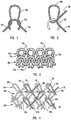
- Figures 1 and 2 illustrate two exemplary types of knitting techniques that may be used to form the retraction cords of the present invention.
- Figure 1 illustrates an "open” loop
- Figure 2 illustrates a "closed” loop.
- the "open" loop shown in Figure 1 is formed using a first loop 10a that is interlocked with an adjacent loop 12a such that ends 14a and 16a of loop 10a do not cross one another.
- Figure 2 illustrates what is generally known as a "closed” loop knit in which end 16b of first loop 10b bends back over and crosses in a manner that closes off loop 10b.
- Figure 3 illustrates two rows (generally designated 18a and 20a) of interlocked loops constructed with the open-loop configuration shown in Figure 1 .
- row 18a includes a plurality of loops 10a, which are interlocked with loops 12a of adjacent row 20a.
- Figure 3 illustrates "weft" knitting, which is made from one loop to the next in the same course ( i.e., row), of loops, and which can be done using a first strand 21a for row 18a and a second strand 21b for row 20a. Alternatively, weft knitting can be performed using a single strand or more than two strands.
- strands 21a and 21b may include a blend of different materials, or one or both may be formed entirely of silk.
- at least about 50% of the overall strand material is formed of silk so as to make the knitted retraction cord resistant to the degrading effects of a hemostatic or other active agent, while also being absorbent so as to allow impregnation by the active agent.
- Absorbent fibers e.g ., cotton
- synthetic degradation resistant fibers e.g ., polyester and/or nylon
- synthetic degradation resistant fibers may be included, silk is particularly preferred over synthetic degradation resistant fibers because silk is degradation resistant and there is advantageously a synergistic effect associated with the combination of silk fibers and the knitted structure, resulting in an absorbent knit structure which is not characteristic of synthetic fibers, even in a knit structure.
- synthetic degradation resistant fibers e.g ., nylon and/or polyester
- synthetic degradation resistant fibers are preferably included in a fraction no greater than about 25% of the overall strand materials.
- Figure 4 illustrates three rows (generally designated at 18b, 20b, and 22b, respectively) of interlocked loops constructed utilizing the closed-loop configuration of Figure 2 .
- row 18b includes loops 10b, which are interlocked with the loops 12b of adjacent row 20b.
- Loops 12b of row 20b are in turn interlocked with the loops 24b of adjacent row 22b, and so on.
- Figure 4 illustrates "warp" knitting in which several strands 26, 28, 30, and 32, are interconnected such that the interlocking loops of each strand connect from one row to the next.
- At least 50% of the overall strand material comprises silk.
- Each strand may comprise a single material, or one or more of the strands may comprise a blend of materials.
- at least about 50% of the material from which strands 26, 28, 30, and 32 are formed comprises silk so as to make the knitted retraction cord resistant to the degrading effects of a hemostatic agent, while also being absorbent.
- Absorbent fibers and/or strands may be incorporated into one or more of the strands of the knit structure to yield increased absorbency
- synthetic degradation resistant fibers may be incorporated into one or more of the strands or the knit structure to provide additional resistance to degradation.
- synthetic degradation resistant fibers and/or strands e.g ., nylon and/or polyester
- silk is particularly preferred over synthetic degradation resistant fibers and/or strands because silk is degradation resistant and advantageously exhibits a synergistic effect associated with the combination of silk fibers and the knitted structure, resulting in an absorbent knit structure which is not characteristic of synthetic fibers and/or strands, even in a knit structure.
- a knit retraction cord formed entirely of synthetic degradation resistant fibers does not exhibit the absorbency that a knit retraction cord formed entirely of silk does.
- synthetic degradation resistant fibers and/or strands e.g ., nylon and/or polyester
- the knit retraction cord is substantially devoid of synthetic degradation resistant fibers.
- Figure 5A shows a gingival retraction cord 34 knitted from four strands 36, 38, 40, and 42 using the closed-loop pattern shown in Figures 2 and 4 .
- the number and pattern of strands 36, 38, 40, and 42 is more readily apparent in the cross sectional view of retraction cord 34 illustrated in Figure 5B .
- two of the four strands i.e ., strands 38 and 42
- strands 36 and 40 may comprise another material ( e.g ., cotton, nylon, and/or polyester).
- three of the four strands ( i.e., 38', 40', and 42') of cord 34' comprise silk, while strand 36' may comprise another material.
- all four strands 36", 38", 40", and 42" of cord 34" are comprised entirely of silk.
- the knitted retraction cord of the present invention can be constructed using either an open-loop or a closed-loop pattern or structure, as shown in Figures 1-4 .
- Retraction cords 34, 34' or 34" can also be made using other kitting patterns so long as the knit pattern forms a plurality of interlocking loops, which provide elasticity and/or resilience, while also providing absorbency and degradation resistance when the cord is made from at least about 50% silk.
- the knit pattern can include any number of strands and each strand can be made from any number of fibers.
- strands 36, 38, 40, and 42 represent a plurality of strand materials.
- strands 38 and 42 are silk strands, while strands 36 and 40 may be cotton.
- the different strands are knitted to form retraction cord 34 having a 2:2 ratio of silk to other strands.
- three of the four strands i.e ., 38', 40', and 42'
- the blended strands are knitted to form retraction cord 34' having a 3:1 ratio of silk to other strands. The ratio may be adjusted as desired by using more or fewer silk and/or other strands.
- all four of the strands are silk.
- Such a configuration advantageously only requires a single material (i.e ., silk) in the manufacture of the knitted retraction cord, while also providing degradation resistance and absorption.
- a cord comprising silk and at least one other material is created by blending two or more fibers to make a strand.
- One or more strands are then knitted to make a retraction cord.
- Figure 7 illustrates an exemplary strand 44 that is made from a blend of silk fibers 46a and 46b and other material (e.g ., cotton) fibers 48a and 48b. Fibers 46a, 46b, 48a, and 48b are twisted together to form strand 44 having a 2:2 ratio of silk to other fibers. It will be understood that the ratio of strand 44 may be adjusted as desired by using more or fewer silk and/or other fibers. It will be understood that more or fewer than four fibers may be used to form a desired strand.
- strands can be made from more or fewer silk and/or other fibers and that the knitted retraction cords of the present invention can have almost any desired blend ratio of silk to other materials that is at least about 50% silk ( i.e ., at least about a 1:1 ratio of silk to other fibers).
- blended strands may also be knitted with other blended or non-blended strands to create a retraction cord that may incorporate materials in addition to silk.
- Materials in addition to silk that may be used to create the blends employed with the present invention include natural and synthetic polymers, coated polymers, metal filaments, or any other threadable material that can give the retraction cord a desired property.
- cotton may be used for its excellent absorbency and biocompatibility.
- Synthetic materials e.g ., nylon and/or polyester
- Cotton, nylon, and/or polyester may also be included to reduce the cost of the cord as compared to pure silk.
- a polymer fiber or metal filament can be included to give the retraction cord a desired resiliency, elasticity, or deformability.
- a metal filament such as silver can also be included to make the retraction cord radioopaque.
- a significant fraction of silk fiber is included in the knit of the retraction cord to resist degradation by an active agent and provide absorbency.
- active agents such as hemostatic agents are advantageously included in the retraction cord to assist in controlling gingival bleeding during a procedure.
- active agents break down absorbent fibers such as cotton. While polyester and/or nylon fibers do resist degradation, they are not absorbent.
- the inclusion of silk in the knit results in a retraction cord that is absorbent and resists degradation. Degradation leads to failure of the retraction cord and/or fraying in which the frayed filaments easily lodge within and bond to clotting blood, which can result in a recurrence of bleeding and pain for the patient upon removal. Preventing the failure of the knit helps ensure that the retraction cord properly retracts gingival tissue and reduces the chances that a packing instrument will pierce the knit of the cord and damage the underlying tissue.
- the silk and optionally an additional synthetic non-degrading material may be blended into the knit through a strand or through individual fibers that form part of a strand.
- an additional synthetic non-degrading material e.g ., polyester and/or nylon
- the knitted retraction cords (i.e ., 34, 34', 34") of Figures 5A-6B are characteristically highly elastic and resilient in both the longitudinal and transverse dimensions.
- Each of the strands (e.g ., strands 36, 38, 40, and 42 of cord 34) used to create the blended cord may be formed as part of the knit of each retraction cord so as to not disrupt the advantages provided by a knit pattern.
- Cords 34, 34', and 34" can be easily stretched along their length, and squeezed or compressed radially because of the properties of the knit pattern.
- the strand or strands are oriented so that a portion of each strand runs transversely, or at approximately right angles to the longitudinal axis of the cord, thus making the cord more compressible and also more stretchable along its length.
- a twisted-strand or braided-type cord has very little longitudinal or transverse elasticity.
- braided retraction cords In general, as between twisted-strand or braided-type cords, the use of braided retraction cords has been found to be advantageous over twisted-strand cords because the braided cord better maintains its structural integrity under the force of the dental packing instrument and under the pressure exerted by the surrounding gingival tissue once the cord has been packed into the sulcus.
- the retraction cord is advantageously absorbent so as to allow an active agent to be impregnated within one or more strands and/or within the plurality of interlocking loops of the knitted retraction cord.
- Hemostatic agents including astringents and/or other vasoconstrictors, can be impregnated in the retraction cord to control bleeding and/or stiffen gingival tissue.
- Active agents that may be useful in assisting hemostasis include, but are not limited to aluminum compounds such as potassium aluminum sulfate, aluminum ammonium sulfate, aluminum sulfate, aluminum chlorohydrate, aluminum acetate, aluminum chloride, other water soluble astringent aluminum salts, and mixtures thereof.
- Another class of astringents includes iron-based compounds such as ferric salts, including but not limited to ferric sulfate, ferric subsulfate, ferric chloride, and mixtures thereof.
- Other astringents include permanganates, tannins and zinc chloride.
- the active agent may comprise a vasoconstrictor such as epinephrine and/or propylhexedrine.
- the active agent is typically delivered to the gingival tissue in a solution, such as an aqueous solution.
- a solution such as an aqueous solution.
- the retraction cord comprising silk is advantageously absorbent.
- the solution is absorbed within the silk fibers, strands, within any additional absorptive material (e.g ., cotton) that may optionally be included, and/or within the plurality of interlocking loops of the knit structure.
- the active agent may be impregnated using a mechanism other than a solution, a solution is beneficial because it can easily be expressed in the sulcus.
- knitted retraction cords to effectively deliver the active agents to the gingival tissue is greatly augmented by the fact that the knitted retraction cords are compressed when packed in the sulcus.
- knitted cords may actually express the hemostatic or other agents into the small capillaries of the gingival tissue when compressed, thereby forcing the active agents into the bleeding pores so as to stop hemorrhage.
- the knitted pattern of retraction cords 34, 34', and 34" advantageously helps absorb and deliver the active agent.
- the interlocking loops of the knit pattern substantially increase the interstitial volume of the knitted retraction cords, which allows the retraction cords to carry larger amounts of active agent as compared to twisted or braided cords, all else being equal.
- the inventor has discovered that knitted retraction cords retain up to about 250% more liquid volume than a braided cord of the same material. Because the knit pattern carries additional active agent, silk, a degradation resistant, relatively non-absorbent material can advantageously be used within the knit pattern, and the resulting retraction cord is both degradation resistant and absorptive.
- Figure 8 shows a dental instrument 50 being used to press the gingival retraction cord 34 within the sulcus 52 between the gingival cuff 54 and the tooth 56.
- the resilience and flexibility in the transverse direction allows the knitted retraction cord 34 to conform to irregularities, such as a margin 58 of tooth 56.
- the knitted retraction cords can accomplish both horizontal and vertical retraction using a single cord.
- knitted retraction cords Another advantage of knitted retraction cords is their tendency to return to their original, uncompressed shape because of their resilience. Thus, when a knitted retraction cord is packed into the sulcus, it is compressed, and the "memory" in the retraction cord causes the cord to gently push outward against the gingival tissue 54. This outward pushing increases the ability of the knitted cord 34 to retract gingival tissues over braided and/or twisted retraction cords. Another advantage arising from the compressibility of knitted retraction cords is realized when retracting gingival tissue around the front teeth. The labial gingival tissue is particularly thin and membranous as compared to the lingual gingival tissue.
- the lingual gingival tissue can be adequately retracted with the knitted retraction cord only slightly compressed, and by virtue of its compressibility and its ability to stretch and become thinner, the same cord can be packed into the sulcus on the labial side of an interior tooth without over-retracting the gingival tissue.
- the cord then exerts a general, steady outward force on the tissue, which advantageously retracts the tissue without causing any undue damage to the thin, sensitive labial gingival tissue.
- the retraction cord may be chemically impregnated with an active agent over an extended period of time without compromising the knit pattern and the benefits that accompany a knitted cord.
- the silk fibers, strands, and interlocking loops of the retraction cord permit chemical impregnation yet give the retraction cord strength in the event that the active agent degrades any optional degradable fibers ( e.g. , cotton) in the cord.
Landscapes
- Health & Medical Sciences (AREA)
- Oral & Maxillofacial Surgery (AREA)
- Dentistry (AREA)
- Epidemiology (AREA)
- Life Sciences & Earth Sciences (AREA)
- Animal Behavior & Ethology (AREA)
- General Health & Medical Sciences (AREA)
- Public Health (AREA)
- Veterinary Medicine (AREA)
- Materials For Medical Uses (AREA)
Claims (15)
- Fil de rétraction gingivale absorbant chimiquement imprégné (34) qui est résistant à la dégradation, comprenant :un fil de rétraction tricoté comprenant un ou plusieurs brins (36, 38, 40, 42), le fil de rétraction comprenant de la soie ; etun agent actif imprégné à l'intérieur du fil de rétraction, l'agent actif étant un agent hémostatique, comprenant des agents astringents et/ou vasoconstricteurs, préférablement sélectionnés dans le groupe constitué du sulfate de potassium-aluminium, du sulfate d'aluminium-ammonium, du sulfate d'aluminium, du chlorhydrate d'aluminium, de l'acétate d'aluminium, du chlorure d'aluminium, d'autres sels d'aluminium astringents solubles dans l'eau, du sulfate ferrique, du sous-sulfate ferrique, du chlorure ferrique, des permanganates, des tannins, du chlorure de zinc, et de leurs combinaisons,le fil de rétraction tricoté résistant à la dégradation par l'agent actif.
- Fil de rétraction gingivale absorbant chimiquement imprégné selon la revendication 1, le fil de rétraction tricoté comprenant au moins 50 % de soie.
- Fil de rétraction gingivale absorbant chimiquement imprégné selon la revendication 1 ou 2, lesdits brins formant une pluralité de boucles imbriquées de sorte que le fil de rétraction tricoté est déformable et absorbe l'humidité.
- Fil de rétraction gingivale absorbant chimiquement imprégné selon la revendication 1 à 3, chacun desdits brins comprenant au moins 50 % de soie.
- Fil de rétraction gingivale absorbant chimiquement imprégné selon la revendication 1 à 4, lesdits brins contenant au moins 80 %, préférablement au moins 90 % de soie, et plus préférablement au moins 95 % de soie.
- Fil de rétraction gingivale absorbant chimiquement imprégné selon l'une quelconque des revendications 1 à 5, le fil de rétraction tricoté comprenant au moins 80 % de soie, préférablement au moins 90 % de soie, et plus préférablement au moins 95 % de soie.
- Fil de rétraction gingivale absorbant chimiquement imprégné selon l'une quelconque des revendications 1 à 6, au moins l'un desdits brins comprenant en outre du coton.
- Fil de rétraction gingivale absorbant chimiquement imprégné selon l'une quelconque des revendications 1 à 7, au moins l'un desdits brins comprenant en outre du nylon et/ou du polyester.
- Fil de rétraction gingivale absorbant chimiquement imprégné selon l'une quelconque des revendications 1 à 7, le fil de rétraction tricoté étant sensiblement exempt de fibres synthétiques résistantes à la dégradation.
- Fil de rétraction gingivale absorbant chimiquement imprégné selon l'une quelconque des revendications 1 à 9, au moins l'un desdits brins comprenant un métal, et le métal donnant de la radio-opacité au fil de rétraction tricoté.
- Fil de rétraction gingivale absorbant chimiquement imprégné selon la revendication 1 ou 3, chacun desdits brins étant constitué de soie.
- Fil de rétraction gingivale absorbant chimiquement imprégné selon la revendication 1, 3 ou 11, le fil de rétraction tricoté étant constitué de soie.
- Fil de rétraction gingivale absorbant chimiquement imprégné selon l'une quelconque des revendications 1 à 12, l'agent actif étant un agent hémostatique sélectionné dans le groupe constitué du sulfate de potassium-aluminium, du sulfate d'aluminium-ammonium, du sulfate d'aluminium, du chlorhydrate d'aluminium, de l'acétate d'aluminium, du chlorure d'aluminium, du sulfate ferrique, du sous-sulfate ferrique, du chlorure ferrique, des permanganates, des tannins, du chlorure de zinc, et de leurs combinaisons.
- Fil de rétraction gingivale absorbant chimiquement imprégné selon l'une quelconque des revendications 1 à 12, l'agent actif comprenant en outre un vasoconstricteur sélectionné dans le groupe constitué de l'épinéphrine, de la propylhexedrine, et de leurs combinaisons.
- Procédé de fabrication d'un fil de rétraction gingivale absorbant chimiquement imprégné qui est résistant à la dégradation, comprenant :la fourniture d'un fil de rétraction tricoté comprenant un ou plusieurs brins, le fil de rétraction tricoté comprenant de la soie ; etl'imprégnation d'un agent actif à l'intérieur du fil de rétraction, l'agent actif étant un agent hémostatique, comprenant des agents astringents et/ou vasoconstricteurs, préférablement sélectionnés dans le groupe constitué du sulfate de potassium-aluminium, du sulfate d'aluminium-ammonium, du sulfate d'aluminium, du chlorhydrate d'aluminium, de l'acétate d'aluminium, du chlorure d'aluminium, d'autres sels d'aluminium astringents solubles dans l'eau, du sulfate ferrique, du sous-sulfate ferrique, du chlorure ferrique, des permanganates, des tannins, du chlorure de zinc, et de leurs combinaisons,le fil de rétraction résistant à la dégradation par l'agent actif.
Priority Applications (1)
| Application Number | Priority Date | Filing Date | Title |
|---|---|---|---|
| PL15001243T PL2921132T3 (pl) | 2006-10-20 | 2007-07-26 | Chemicznie impregnowana, chłonna dziąsłowa nić retrakcyjna zawierająca jedwab |
Applications Claiming Priority (3)
| Application Number | Priority Date | Filing Date | Title |
|---|---|---|---|
| US11/551,542 US7901208B2 (en) | 2006-10-20 | 2006-10-20 | Chemically impregnated absorbent gingival retraction cord comprising silk |
| EP20070840529 EP2077794B1 (fr) | 2006-10-20 | 2007-07-26 | Fil de rétraction gingivale absorbant imprégné chimiquement comprenant de la soie |
| PCT/US2007/074430 WO2008051644A1 (fr) | 2006-10-20 | 2007-07-26 | Fil de rétraction gingivale absorbant imprégné chimiquement comprenant de la soie |
Related Parent Applications (1)
| Application Number | Title | Priority Date | Filing Date |
|---|---|---|---|
| EP20070840529 Division EP2077794B1 (fr) | 2006-10-20 | 2007-07-26 | Fil de rétraction gingivale absorbant imprégné chimiquement comprenant de la soie |
Publications (2)
| Publication Number | Publication Date |
|---|---|
| EP2921132A1 EP2921132A1 (fr) | 2015-09-23 |
| EP2921132B1 true EP2921132B1 (fr) | 2019-04-03 |
Family
ID=39318343
Family Applications (2)
| Application Number | Title | Priority Date | Filing Date |
|---|---|---|---|
| EP15001243.3A Not-in-force EP2921132B1 (fr) | 2006-10-20 | 2007-07-26 | Fil de rétraction gingivale absorbant imprégné chimiquement comprenant de la soie |
| EP20070840529 Not-in-force EP2077794B1 (fr) | 2006-10-20 | 2007-07-26 | Fil de rétraction gingivale absorbant imprégné chimiquement comprenant de la soie |
Family Applications After (1)
| Application Number | Title | Priority Date | Filing Date |
|---|---|---|---|
| EP20070840529 Not-in-force EP2077794B1 (fr) | 2006-10-20 | 2007-07-26 | Fil de rétraction gingivale absorbant imprégné chimiquement comprenant de la soie |
Country Status (5)
| Country | Link |
|---|---|
| US (1) | US7901208B2 (fr) |
| EP (2) | EP2921132B1 (fr) |
| ES (2) | ES2728499T3 (fr) |
| PL (1) | PL2921132T3 (fr) |
| WO (1) | WO2008051644A1 (fr) |
Families Citing this family (9)
| Publication number | Priority date | Publication date | Assignee | Title |
|---|---|---|---|---|
| US7470517B2 (en) * | 2004-04-09 | 2008-12-30 | Trustees Of Boston University | Method for de novo detection of sequences in nucleic acids: target sequencing by fragmentation |
| US7168951B2 (en) * | 2004-06-09 | 2007-01-30 | Ultradent Products, Inc. | Reinforced gingival retraction cord |
| US7901208B2 (en) | 2006-10-20 | 2011-03-08 | Ultradent Products, Inc. | Chemically impregnated absorbent gingival retraction cord comprising silk |
| US7922487B2 (en) * | 2008-06-09 | 2011-04-12 | Ultradent Products, Inc. | Chemically pre-impregnated silk retraction cords having increased strength |
| EP2172167A1 (fr) * | 2008-10-02 | 2010-04-07 | 3M Innovative Properties Company | Dispositif de rétraction dentaire et son procédé de fabrication |
| US8313764B2 (en) | 2010-06-22 | 2012-11-20 | Stemnion, Inc. | Wound healing device |
| GB201113856D0 (en) * | 2011-08-11 | 2011-09-28 | Oxford Biomaterials Ltd | Medical device |
| KR101675867B1 (ko) * | 2014-12-17 | 2016-11-23 | 주식회사 아모그린텍 | 나노섬유 복합사를 이용한 치과용 코드 및 그의 제조방법 |
| US10327871B2 (en) * | 2016-08-26 | 2019-06-25 | King Abdulaziz University | Reinforced gingival retraction cord |
Family Cites Families (26)
| Publication number | Priority date | Publication date | Assignee | Title |
|---|---|---|---|---|
| US4321038A (en) * | 1980-07-18 | 1982-03-23 | Van R Dental Products, Inc. | Braided gingival retraction cord |
| US4465462A (en) * | 1983-04-27 | 1984-08-14 | Ticknor Verne E | Gingival retraction cord |
| US4522593A (en) * | 1983-07-07 | 1985-06-11 | Fischer Dan E | Knitted gingival retraction cord |
| US4617950A (en) * | 1985-04-22 | 1986-10-21 | Van R Dental Products, Inc. | Gingival retraction cord with wet, drip-free astringent |
| SE458984B (sv) * | 1986-05-26 | 1989-05-29 | Leif Hagne | Foerfarande samt retraktionstraad foer frilaeggning och torrlaeggning av preprationsgraensen vid taender |
| US4728291A (en) * | 1986-06-26 | 1988-03-01 | Golub Jeff E | Cloth wrap dental process |
| JPH01139057A (ja) | 1987-11-26 | 1989-05-31 | Haan Leif | 歯の調整限界線を露出させて湿分除去する方法及びこれに用いるリトラクションコード |
| US5874164A (en) * | 1988-03-14 | 1999-02-23 | Nextec Applications, Inc. | Barrier webs having bioactive surfaces |
| US4892482A (en) * | 1988-08-30 | 1990-01-09 | Lococo Michael P | Dental retraction cord |
| US5022859A (en) * | 1989-10-10 | 1991-06-11 | Oliva Richard A | Gingival rectractor instrument |
| US5558652A (en) * | 1994-10-06 | 1996-09-24 | B. Braun Medical, Inc. | Introducer with radiopaque marked tip and method of manufacture therefor |
| US5540588A (en) * | 1994-11-02 | 1996-07-30 | Earle; Jeffrey O. | Teflon-coated intraoral tissue retraction cord |
| US5676543A (en) * | 1995-03-08 | 1997-10-14 | Centrix, Inc. | Gum tissue retraction device and method |
| US5899694A (en) * | 1998-02-20 | 1999-05-04 | Summer; John | Gingival retraction apparatus and method |
| US6179872B1 (en) * | 1998-03-17 | 2001-01-30 | Tissue Engineering | Biopolymer matt for use in tissue repair and reconstruction |
| US6325993B1 (en) * | 1999-03-03 | 2001-12-04 | Nitto Denko Corporation | Oral adhesive sheet and oral adhesive preparation |
| WO2000066025A1 (fr) * | 1999-04-29 | 2000-11-09 | Neks Recherche Et Developpement Inc. | Applicateur interproximal de composition a appliquer sur les dents |
| US6375461B1 (en) * | 2000-09-18 | 2002-04-23 | Ultradent Products, Inc. | Gingival retraction cords incorporating propylhexedrine |
| US6612839B2 (en) * | 2001-04-04 | 2003-09-02 | Murgesh J. Loynes | Gingival retractor |
| KR100444893B1 (ko) | 2001-12-24 | 2004-08-21 | 주식회사 화이투스 | 치약 조성물 |
| CA2441907A1 (fr) * | 2003-09-19 | 2003-12-11 | Dr. Graham Matheson Inc. | Dispositif de deplacement du tissu gingival |
| US7168951B2 (en) * | 2004-06-09 | 2007-01-30 | Ultradent Products, Inc. | Reinforced gingival retraction cord |
| US7121828B2 (en) * | 2004-06-09 | 2006-10-17 | Ultradent Products, Inc. | Reinforced gingival retraction cord |
| JP2006056833A (ja) | 2004-08-20 | 2006-03-02 | Biotech One Inc | 歯肉圧排材料 |
| WO2007115063A2 (fr) * | 2006-03-31 | 2007-10-11 | 3M Innovative Properties Company | Appareil de rétraction dentaire, sa méthode de fabrication et d'utilisation |
| US7901208B2 (en) | 2006-10-20 | 2011-03-08 | Ultradent Products, Inc. | Chemically impregnated absorbent gingival retraction cord comprising silk |
-
2006
- 2006-10-20 US US11/551,542 patent/US7901208B2/en not_active Expired - Fee Related
-
2007
- 2007-07-26 PL PL15001243T patent/PL2921132T3/pl unknown
- 2007-07-26 WO PCT/US2007/074430 patent/WO2008051644A1/fr not_active Ceased
- 2007-07-26 EP EP15001243.3A patent/EP2921132B1/fr not_active Not-in-force
- 2007-07-26 ES ES15001243T patent/ES2728499T3/es active Active
- 2007-07-26 EP EP20070840529 patent/EP2077794B1/fr not_active Not-in-force
- 2007-07-26 ES ES07840529.7T patent/ES2540914T3/es active Active
Non-Patent Citations (1)
| Title |
|---|
| None * |
Also Published As
| Publication number | Publication date |
|---|---|
| EP2077794A1 (fr) | 2009-07-15 |
| US7901208B2 (en) | 2011-03-08 |
| ES2540914T3 (es) | 2015-07-14 |
| PL2921132T3 (pl) | 2019-09-30 |
| EP2077794B1 (fr) | 2015-05-06 |
| WO2008051644A1 (fr) | 2008-05-02 |
| EP2921132A1 (fr) | 2015-09-23 |
| EP2077794A4 (fr) | 2012-05-23 |
| US20080096164A1 (en) | 2008-04-24 |
| ES2728499T3 (es) | 2019-10-25 |
Similar Documents
| Publication | Publication Date | Title |
|---|---|---|
| US7883335B2 (en) | Reinforced gingival retraction cord | |
| EP2077794B1 (fr) | Fil de rétraction gingivale absorbant imprégné chimiquement comprenant de la soie | |
| EP0131360B1 (fr) | Corde tricotée pour retenir la gencive | |
| EP1188419A2 (fr) | Cordes pour la rétraction de la gencive | |
| US7121828B2 (en) | Reinforced gingival retraction cord | |
| EP2386323A2 (fr) | Aiguille à injection pour chirurgie plastique comportant un fil chirurgical utilisable pour la suppression des rides | |
| US20110229849A1 (en) | Dental Retraction Device and Process of its Production | |
| KR101947950B1 (ko) | 증모 시술 방법 | |
| KR101506202B1 (ko) | 복수의 실을 삽입하는 매선장치 | |
| US20070196785A1 (en) | Dental appliance for deflecting gingival tissue | |
| US7922487B2 (en) | Chemically pre-impregnated silk retraction cords having increased strength | |
| Brandt et al. | Suturing principles for the dentoalveolar surgeon | |
| EP1776062B1 (fr) | Fil retractable ayant un pouvoir absorbant ameliore | |
| KR101641298B1 (ko) | 인체 성형 시술용 도구 세트 | |
| US5330530A (en) | Fiber prosthesis and method of implantation in living tissue | |
| US20080003538A1 (en) | Gingival retraction cord with wetting agent | |
| DE102009004978B4 (de) | Retraktionshilfe für den zahnärztlichen Gebrauch | |
| WO2010131893A2 (fr) | Implant | |
| BG4966U1 (bg) | Ретракционен конец със сърцевина монофиламент | |
| KR20210012745A (ko) | 의료용 네일 가이드 및 이를 구비하는 네일 가이드 수술 키트 | |
| US10327871B2 (en) | Reinforced gingival retraction cord | |
| WO2014077498A1 (fr) | Fil de suture de boîtier d'aiguille | |
| Ghai et al. | Gingival tissue management in fixed prosthodontics | |
| WO2007078298A2 (fr) | Fil de rétraction gingivale comprenant un agent mouillant |
Legal Events
| Date | Code | Title | Description |
|---|---|---|---|
| PUAI | Public reference made under article 153(3) epc to a published international application that has entered the european phase |
Free format text: ORIGINAL CODE: 0009012 |
|
| AC | Divisional application: reference to earlier application |
Ref document number: 2077794 Country of ref document: EP Kind code of ref document: P |
|
| AK | Designated contracting states |
Kind code of ref document: A1 Designated state(s): AT BE BG CH CY CZ DE DK EE ES FI FR GB GR HU IE IS IT LI LT LU LV MC MT NL PL PT RO SE SI SK TR |
|
| 17P | Request for examination filed |
Effective date: 20160318 |
|
| RBV | Designated contracting states (corrected) |
Designated state(s): AT BE BG CH CY CZ DE DK EE ES FI FR GB GR HU IE IS IT LI LT LU LV MC MT NL PL PT RO SE SI SK TR |
|
| STAA | Information on the status of an ep patent application or granted ep patent |
Free format text: STATUS: EXAMINATION IS IN PROGRESS |
|
| 17Q | First examination report despatched |
Effective date: 20170921 |
|
| GRAP | Despatch of communication of intention to grant a patent |
Free format text: ORIGINAL CODE: EPIDOSNIGR1 |
|
| STAA | Information on the status of an ep patent application or granted ep patent |
Free format text: STATUS: GRANT OF PATENT IS INTENDED |
|
| INTG | Intention to grant announced |
Effective date: 20181024 |
|
| GRAS | Grant fee paid |
Free format text: ORIGINAL CODE: EPIDOSNIGR3 |
|
| GRAA | (expected) grant |
Free format text: ORIGINAL CODE: 0009210 |
|
| STAA | Information on the status of an ep patent application or granted ep patent |
Free format text: STATUS: THE PATENT HAS BEEN GRANTED |
|
| AC | Divisional application: reference to earlier application |
Ref document number: 2077794 Country of ref document: EP Kind code of ref document: P |
|
| AK | Designated contracting states |
Kind code of ref document: B1 Designated state(s): AT BE BG CH CY CZ DE DK EE ES FI FR GB GR HU IE IS IT LI LT LU LV MC MT NL PL PT RO SE SI SK TR |
|
| REG | Reference to a national code |
Ref country code: GB Ref legal event code: FG4D |
|
| REG | Reference to a national code |
Ref country code: CH Ref legal event code: EP Ref country code: AT Ref legal event code: REF Ref document number: 1114799 Country of ref document: AT Kind code of ref document: T Effective date: 20190415 |
|
| REG | Reference to a national code |
Ref country code: DE Ref legal event code: R096 Ref document number: 602007058046 Country of ref document: DE |
|
| REG | Reference to a national code |
Ref country code: IE Ref legal event code: FG4D |
|
| REG | Reference to a national code |
Ref country code: NL Ref legal event code: MP Effective date: 20190403 |
|
| REG | Reference to a national code |
Ref country code: LT Ref legal event code: MG4D |
|
| REG | Reference to a national code |
Ref country code: AT Ref legal event code: MK05 Ref document number: 1114799 Country of ref document: AT Kind code of ref document: T Effective date: 20190403 |
|
| PG25 | Lapsed in a contracting state [announced via postgrant information from national office to epo] |
Ref country code: NL Free format text: LAPSE BECAUSE OF FAILURE TO SUBMIT A TRANSLATION OF THE DESCRIPTION OR TO PAY THE FEE WITHIN THE PRESCRIBED TIME-LIMIT Effective date: 20190403 |
|
| REG | Reference to a national code |
Ref country code: ES Ref legal event code: FG2A Ref document number: 2728499 Country of ref document: ES Kind code of ref document: T3 Effective date: 20191025 |
|
| PG25 | Lapsed in a contracting state [announced via postgrant information from national office to epo] |
Ref country code: PT Free format text: LAPSE BECAUSE OF FAILURE TO SUBMIT A TRANSLATION OF THE DESCRIPTION OR TO PAY THE FEE WITHIN THE PRESCRIBED TIME-LIMIT Effective date: 20190803 Ref country code: LT Free format text: LAPSE BECAUSE OF FAILURE TO SUBMIT A TRANSLATION OF THE DESCRIPTION OR TO PAY THE FEE WITHIN THE PRESCRIBED TIME-LIMIT Effective date: 20190403 Ref country code: CZ Free format text: LAPSE BECAUSE OF FAILURE TO SUBMIT A TRANSLATION OF THE DESCRIPTION OR TO PAY THE FEE WITHIN THE PRESCRIBED TIME-LIMIT Effective date: 20190403 Ref country code: FI Free format text: LAPSE BECAUSE OF FAILURE TO SUBMIT A TRANSLATION OF THE DESCRIPTION OR TO PAY THE FEE WITHIN THE PRESCRIBED TIME-LIMIT Effective date: 20190403 Ref country code: SE Free format text: LAPSE BECAUSE OF FAILURE TO SUBMIT A TRANSLATION OF THE DESCRIPTION OR TO PAY THE FEE WITHIN THE PRESCRIBED TIME-LIMIT Effective date: 20190403 |
|
| PG25 | Lapsed in a contracting state [announced via postgrant information from national office to epo] |
Ref country code: LV Free format text: LAPSE BECAUSE OF FAILURE TO SUBMIT A TRANSLATION OF THE DESCRIPTION OR TO PAY THE FEE WITHIN THE PRESCRIBED TIME-LIMIT Effective date: 20190403 Ref country code: GR Free format text: LAPSE BECAUSE OF FAILURE TO SUBMIT A TRANSLATION OF THE DESCRIPTION OR TO PAY THE FEE WITHIN THE PRESCRIBED TIME-LIMIT Effective date: 20190704 Ref country code: BG Free format text: LAPSE BECAUSE OF FAILURE TO SUBMIT A TRANSLATION OF THE DESCRIPTION OR TO PAY THE FEE WITHIN THE PRESCRIBED TIME-LIMIT Effective date: 20190703 |
|
| PG25 | Lapsed in a contracting state [announced via postgrant information from national office to epo] |
Ref country code: AT Free format text: LAPSE BECAUSE OF FAILURE TO SUBMIT A TRANSLATION OF THE DESCRIPTION OR TO PAY THE FEE WITHIN THE PRESCRIBED TIME-LIMIT Effective date: 20190403 Ref country code: IS Free format text: LAPSE BECAUSE OF FAILURE TO SUBMIT A TRANSLATION OF THE DESCRIPTION OR TO PAY THE FEE WITHIN THE PRESCRIBED TIME-LIMIT Effective date: 20190803 |
|
| REG | Reference to a national code |
Ref country code: DE Ref legal event code: R097 Ref document number: 602007058046 Country of ref document: DE |
|
| PG25 | Lapsed in a contracting state [announced via postgrant information from national office to epo] |
Ref country code: RO Free format text: LAPSE BECAUSE OF FAILURE TO SUBMIT A TRANSLATION OF THE DESCRIPTION OR TO PAY THE FEE WITHIN THE PRESCRIBED TIME-LIMIT Effective date: 20190403 Ref country code: SK Free format text: LAPSE BECAUSE OF FAILURE TO SUBMIT A TRANSLATION OF THE DESCRIPTION OR TO PAY THE FEE WITHIN THE PRESCRIBED TIME-LIMIT Effective date: 20190403 Ref country code: EE Free format text: LAPSE BECAUSE OF FAILURE TO SUBMIT A TRANSLATION OF THE DESCRIPTION OR TO PAY THE FEE WITHIN THE PRESCRIBED TIME-LIMIT Effective date: 20190403 Ref country code: DK Free format text: LAPSE BECAUSE OF FAILURE TO SUBMIT A TRANSLATION OF THE DESCRIPTION OR TO PAY THE FEE WITHIN THE PRESCRIBED TIME-LIMIT Effective date: 20190403 |
|
| PLBE | No opposition filed within time limit |
Free format text: ORIGINAL CODE: 0009261 |
|
| STAA | Information on the status of an ep patent application or granted ep patent |
Free format text: STATUS: NO OPPOSITION FILED WITHIN TIME LIMIT |
|
| PG25 | Lapsed in a contracting state [announced via postgrant information from national office to epo] |
Ref country code: MC Free format text: LAPSE BECAUSE OF FAILURE TO SUBMIT A TRANSLATION OF THE DESCRIPTION OR TO PAY THE FEE WITHIN THE PRESCRIBED TIME-LIMIT Effective date: 20190403 |
|
| REG | Reference to a national code |
Ref country code: CH Ref legal event code: PL |
|
| 26N | No opposition filed |
Effective date: 20200106 |
|
| PG25 | Lapsed in a contracting state [announced via postgrant information from national office to epo] |
Ref country code: TR Free format text: LAPSE BECAUSE OF FAILURE TO SUBMIT A TRANSLATION OF THE DESCRIPTION OR TO PAY THE FEE WITHIN THE PRESCRIBED TIME-LIMIT Effective date: 20190403 |
|
| REG | Reference to a national code |
Ref country code: BE Ref legal event code: MM Effective date: 20190731 |
|
| PG25 | Lapsed in a contracting state [announced via postgrant information from national office to epo] |
Ref country code: CH Free format text: LAPSE BECAUSE OF NON-PAYMENT OF DUE FEES Effective date: 20190731 Ref country code: LI Free format text: LAPSE BECAUSE OF NON-PAYMENT OF DUE FEES Effective date: 20190731 Ref country code: BE Free format text: LAPSE BECAUSE OF NON-PAYMENT OF DUE FEES Effective date: 20190731 Ref country code: LU Free format text: LAPSE BECAUSE OF NON-PAYMENT OF DUE FEES Effective date: 20190726 Ref country code: SI Free format text: LAPSE BECAUSE OF FAILURE TO SUBMIT A TRANSLATION OF THE DESCRIPTION OR TO PAY THE FEE WITHIN THE PRESCRIBED TIME-LIMIT Effective date: 20190403 |
|
| PG25 | Lapsed in a contracting state [announced via postgrant information from national office to epo] |
Ref country code: IE Free format text: LAPSE BECAUSE OF NON-PAYMENT OF DUE FEES Effective date: 20190726 |
|
| PGFP | Annual fee paid to national office [announced via postgrant information from national office to epo] |
Ref country code: FR Payment date: 20200724 Year of fee payment: 14 Ref country code: GB Payment date: 20200716 Year of fee payment: 14 Ref country code: DE Payment date: 20200714 Year of fee payment: 14 Ref country code: ES Payment date: 20200803 Year of fee payment: 14 |
|
| PGFP | Annual fee paid to national office [announced via postgrant information from national office to epo] |
Ref country code: IT Payment date: 20200713 Year of fee payment: 14 |
|
| PG25 | Lapsed in a contracting state [announced via postgrant information from national office to epo] |
Ref country code: CY Free format text: LAPSE BECAUSE OF FAILURE TO SUBMIT A TRANSLATION OF THE DESCRIPTION OR TO PAY THE FEE WITHIN THE PRESCRIBED TIME-LIMIT Effective date: 20190403 |
|
| PG25 | Lapsed in a contracting state [announced via postgrant information from national office to epo] |
Ref country code: HU Free format text: LAPSE BECAUSE OF FAILURE TO SUBMIT A TRANSLATION OF THE DESCRIPTION OR TO PAY THE FEE WITHIN THE PRESCRIBED TIME-LIMIT; INVALID AB INITIO Effective date: 20070726 Ref country code: MT Free format text: LAPSE BECAUSE OF FAILURE TO SUBMIT A TRANSLATION OF THE DESCRIPTION OR TO PAY THE FEE WITHIN THE PRESCRIBED TIME-LIMIT Effective date: 20190403 |
|
| PGFP | Annual fee paid to national office [announced via postgrant information from national office to epo] |
Ref country code: PL Payment date: 20210628 Year of fee payment: 15 |
|
| REG | Reference to a national code |
Ref country code: DE Ref legal event code: R119 Ref document number: 602007058046 Country of ref document: DE |
|
| GBPC | Gb: european patent ceased through non-payment of renewal fee |
Effective date: 20210726 |
|
| PG25 | Lapsed in a contracting state [announced via postgrant information from national office to epo] |
Ref country code: GB Free format text: LAPSE BECAUSE OF NON-PAYMENT OF DUE FEES Effective date: 20210726 Ref country code: DE Free format text: LAPSE BECAUSE OF NON-PAYMENT OF DUE FEES Effective date: 20220201 |
|
| PG25 | Lapsed in a contracting state [announced via postgrant information from national office to epo] |
Ref country code: FR Free format text: LAPSE BECAUSE OF NON-PAYMENT OF DUE FEES Effective date: 20210731 |
|
| PG25 | Lapsed in a contracting state [announced via postgrant information from national office to epo] |
Ref country code: IT Free format text: LAPSE BECAUSE OF NON-PAYMENT OF DUE FEES Effective date: 20210726 |
|
| REG | Reference to a national code |
Ref country code: ES Ref legal event code: FD2A Effective date: 20220928 |
|
| PG25 | Lapsed in a contracting state [announced via postgrant information from national office to epo] |
Ref country code: ES Free format text: LAPSE BECAUSE OF NON-PAYMENT OF DUE FEES Effective date: 20210727 |
|
| PG25 | Lapsed in a contracting state [announced via postgrant information from national office to epo] |
Ref country code: PL Free format text: LAPSE BECAUSE OF NON-PAYMENT OF DUE FEES Effective date: 20220726 |