EP2923457B1 - Systèmes et procédés pour des schémas de multiplexage spatial en boucle ouverte pour la virtualisation d'accès radio - Google Patents
Systèmes et procédés pour des schémas de multiplexage spatial en boucle ouverte pour la virtualisation d'accès radio Download PDFInfo
- Publication number
- EP2923457B1 EP2923457B1 EP13863359.9A EP13863359A EP2923457B1 EP 2923457 B1 EP2923457 B1 EP 2923457B1 EP 13863359 A EP13863359 A EP 13863359A EP 2923457 B1 EP2923457 B1 EP 2923457B1
- Authority
- EP
- European Patent Office
- Prior art keywords
- antenna ports
- antennas
- spreading
- receiver
- sequence
- Prior art date
- Legal status (The legal status is an assumption and is not a legal conclusion. Google has not performed a legal analysis and makes no representation as to the accuracy of the status listed.)
- Active
Links
Images




Classifications
-
- H—ELECTRICITY
- H04—ELECTRIC COMMUNICATION TECHNIQUE
- H04B—TRANSMISSION
- H04B7/00—Radio transmission systems, i.e. using radiation field
- H04B7/02—Diversity systems; Multi-antenna system, i.e. transmission or reception using multiple antennas
- H04B7/04—Diversity systems; Multi-antenna system, i.e. transmission or reception using multiple antennas using two or more spaced independent antennas
- H04B7/06—Diversity systems; Multi-antenna system, i.e. transmission or reception using multiple antennas using two or more spaced independent antennas at the transmitting station
- H04B7/0697—Diversity systems; Multi-antenna system, i.e. transmission or reception using multiple antennas using two or more spaced independent antennas at the transmitting station using spatial multiplexing
-
- H—ELECTRICITY
- H04—ELECTRIC COMMUNICATION TECHNIQUE
- H04B—TRANSMISSION
- H04B1/00—Details of transmission systems, not covered by a single one of groups H04B3/00 - H04B13/00; Details of transmission systems not characterised by the medium used for transmission
- H04B1/69—Spread spectrum techniques
- H04B1/707—Spread spectrum techniques using direct sequence modulation
-
- H—ELECTRICITY
- H04—ELECTRIC COMMUNICATION TECHNIQUE
- H04J—MULTIPLEX COMMUNICATION
- H04J13/00—Code division multiplex systems
- H04J13/0007—Code type
- H04J13/004—Orthogonal
- H04J13/0048—Walsh
-
- H—ELECTRICITY
- H04—ELECTRIC COMMUNICATION TECHNIQUE
- H04J—MULTIPLEX COMMUNICATION
- H04J13/00—Code division multiplex systems
- H04J13/0007—Code type
- H04J13/0055—ZCZ [zero correlation zone]
- H04J13/0059—CAZAC [constant-amplitude and zero auto-correlation]
- H04J13/0062—Zadoff-Chu
-
- H—ELECTRICITY
- H04—ELECTRIC COMMUNICATION TECHNIQUE
- H04B—TRANSMISSION
- H04B7/00—Radio transmission systems, i.e. using radiation field
- H04B7/02—Diversity systems; Multi-antenna system, i.e. transmission or reception using multiple antennas
- H04B7/04—Diversity systems; Multi-antenna system, i.e. transmission or reception using multiple antennas using two or more spaced independent antennas
- H04B7/0413—MIMO systems
- H04B7/0452—Multi-user MIMO systems
-
- H—ELECTRICITY
- H04—ELECTRIC COMMUNICATION TECHNIQUE
- H04B—TRANSMISSION
- H04B7/00—Radio transmission systems, i.e. using radiation field
- H04B7/02—Diversity systems; Multi-antenna system, i.e. transmission or reception using multiple antennas
- H04B7/04—Diversity systems; Multi-antenna system, i.e. transmission or reception using multiple antennas using two or more spaced independent antennas
- H04B7/06—Diversity systems; Multi-antenna system, i.e. transmission or reception using multiple antennas using two or more spaced independent antennas at the transmitting station
- H04B7/0613—Diversity systems; Multi-antenna system, i.e. transmission or reception using multiple antennas using two or more spaced independent antennas at the transmitting station using simultaneous transmission
- H04B7/0615—Diversity systems; Multi-antenna system, i.e. transmission or reception using multiple antennas using two or more spaced independent antennas at the transmitting station using simultaneous transmission of weighted versions of same signal
- H04B7/0619—Diversity systems; Multi-antenna system, i.e. transmission or reception using multiple antennas using two or more spaced independent antennas at the transmitting station using simultaneous transmission of weighted versions of same signal using feedback from receiving side
- H04B7/0621—Feedback content
- H04B7/063—Parameters other than those covered in groups H04B7/0623 - H04B7/0634, e.g. channel matrix rank or transmit mode selection
Definitions
- the present invention relates to systems and methods for wireless communications and, in particular embodiments, to systems and methods for open-loop spatial multiplexing for radio access virtualization.
- Radio access virtualization is a potential technology for solving inter-transmit point interference in a fundamental way. It can significantly enhance radio access network capacity and user equipment (UE) experience. Radio access virtualization can be realized by transmit point virtualization and reception point virtualization. Transmit point virtualization provides UE-centric transmit point optimization powered by cloud radio access network (CRAN). Receiving point virtualization is based on UE cooperative reception which is powered by UE direct communications.
- CRAN cloud radio access network
- CL closed loop
- MU multi-user
- MIMO multiple-input multiple-output
- CL CoMP Open loop
- OL Open loop
- Radio access virtualization can enable a more advanced transmission scheme.
- US 2012/0114021 A1 discloses a method for configuring a transmission mode for a backhaul link transmission in a radio communication system including a relay station.
- the method comprises: a step in which a base station transmits, to the relay station, a relay-physical downlink control channel (R-PDCCH) containing backhaul control information; and a step in which the base station transmits, to the relay station, a relay-physical downlink shared channel (R-PDSCH) containing backhaul data, wherein the R-PDCCH is transmitted in one transmission mode selected from a plurality of predetermined transmission modes, and a reference signal transmitted through the R-PDCCH for the demodulation of the R-PDCCH is determined in accordance with said selected transmission mode.
- R-PDCCH relay-physical downlink control channel
- R-PDSCH relay-physical downlink shared channel
- US 2007/0211786 A1 relates to multicarrier sub-layer for direct sequence channel and multiple-access coding.
- Carrier Interferometry provides wideband transmission protocols with frequency-band selectivity to improve interference rejection, reduce multipath fading, and enable operation across non-continuous frequency bands.
- Direct-sequence protocols such as DS-CDMA
- CI introduces families of orthogonal polyphase codes that can be used for channel coding, spreading, and/or multiple access.
- CI coding is not necessary for energy spreading because a set of CI carriers has an inherently wide aggregate bandwidth.
- CI codes are used for channelization, energy smoothing in the frequency domain, and interference suppression.
- CI-based ultra-wideband protocols are implemented via frequency-domain processing to reduce synchronization problems, transceiver complexity, and poor multipath performance of conventional ultra-wideband systems.
- CI allows wideband protocols to be implemented with space-frequency processing and other array-processing techniques to provide either or both diversity combining and sub-space processing.
- CI also enables spatial processing without antenna arrays. Even the bandwidth efficiency of multicarrier protocols is greatly enhanced with CI.
- CI-based wavelets avoid time and frequency resolution trade-offs associated with conventional wavelet processing.
- CI-based Fourier transforms eliminate all multiplications, which greatly simplifies multi-frequency processing.
- the quantum-wave principles of CI improve all types of baseband and radio processing.
- WO 2008/024462 A2 discloses a multiple-input multiple-output (MIMO) transmitter and receiver for supporting downlink (DL) communication of single channel codewords.
- MIMO multiple-input multiple-output
- the transmitter includes N T transmit antennas for transmitting spatial streams to a receiver having N R receive antennas, a precoder and a space-time or space-frequency matrix construction unit in communication with the precoder and the transmit antennas.
- the space-time or space-frequency matrix construction unit constructs a matrix that defines a threaded algebraic space-time codeword based on a number of virtual antennas, N V , and the number of transmit antennas, N T .
- the transmitter operates in an open loop mode when no feedback information from the receiver is available, a semi-open loop mode when channel rank information is available, and a closed loop mode when channel state information (CSI) is available.
- the receiver is configured to provide feedback to the transmitter on a per received spatial stream basis.
- R HOSHYAR ET AL.: Novel Low-Density Signature for Synchronous CDMA Systems Over AWGN Channel IEEE TRANS. ON SIGNAL PROCESSING, vol. 56., no. 4, April 2008 (2008-04), XP011205892 " discloses a novel low-density signature (LDS) for synchronous CDMA systems over AWGN channel.
- LDS low-density signature
- a novel low-density signature structure is provided for transmission and detection of symbol-synchronous communication over memoryless Gaussian channel.
- the idea behind the proposal of this document is basically to change the interference pattern being seen by each user.
- the proposed LDS structure limits the amount of interference occurred on each chip over which the user transmits a copy of his symbol.
- a system for open-loop spatial multiplexing for radio access virtualization includes a plurality of antenna ports and a processor coupled to the plurality of antenna ports and configured to spread a spreading sequence over at least a portion of the plurality of antenna ports in a spatial domain, wherein the processor is configured to cause the antenna ports to transmit multiple spreading sequences simultaneously by sequence superposition, wherein the spreading sequences are selected from a pre-defined pool, such as a matrix, a total number of a plurality of physical antennas is equal to or greater than a spreading factor, and a signature length for a device receiving communication from the antenna ports is determined according to a multiple-input multiple-output (MIMO) rank of the device and the MIMO rank is determined from device feedback and device measurement, wherein the signature length is the number of antenna ports over which the spreading sequence is spread.
- MIMO multiple-input multiple-output
- a method for open-loop spatial multiplexing for radio access virtualization includes determining a spreading sequence for a plurality of transmit antenna ports, spreading a signal with the determined spreading sequence over a plurality of transmitter antenna ports, and transmitting multiple spread signals simultaneously in a spatial domain superposition, wherein the spreading sequences are selected from a pre-defined pool, such as a matrix, a total number of a plurality of physical antennas is equal to or greater than a spreading factor, and a signature length for one of the multiple spread signals is equal to a multiple-input multiple-output (MIMO) rank supported by a corresponding receiver, wherein the signature length is the number of transmitter antenna ports over which the spreading sequence is spread.
- MIMO multiple-input multiple-output
- a network component configured for open-loop spatial multiplexing for radio access virtualization includes a processor and a computer readable storage medium storing programming for execution by the processor, the programming including instructions to implement action in the above described method.
- a method for open-loop spatial multiplexing for radio access virtualization includes receiving with a plurality of receiver antennas a plurality of overlaid sequences from a plurality of transmit antenna ports, wherein the overlaid sequences comprise a spreading sequence spread over a spatial domain, and jointly decoding the overlaid sequences received by a plurality of receiver antennas, or transmitting the overlaid sequences received by a plurality of receiver antennas to a central processor through a backhaul network for decoding.
- An embodiment provides open-loop spatial multiplexing schemes for radio access virtualization.
- An embodiment provides a spatial domain low density spreading-based spatial multiplexing scheme for radio access virtualization.
- a Walsh Hadamard code, a Zadoff-Chu sequence, or an other orthogonal/low correlation sequence is used to superposition signals.
- a low density signature (LDS) structure is used to reduce the number of interferers in each chip in a code division multiple access (CDMA) system.
- this scheme is also applied in an orthogonal frequency division multiplexing (OFDM) system by spreading the symbols on a number of sub-carriers. This provides frequency diversity gain for both the signal and interference. Because of the low density feature of the spreading sequence, only a fraction of the signal generates interference to other signals. This provides a much smaller search space and a more affordable detection technique. With an advanced Rx algorithm, such as a message passing algorithm (MPA), reasonably good multi-user detection performance can be obtained even in an overloaded system.
- MPA message passing algorithm
- An embodiment applies the concept of LDS to distributed transmit antennas and distributed receive antennas providing additional multiplexing dimension and diversity.
- An embodiment applies LDS to the spatial domain to enable open-loop MIMO transmission for the communications between a virtual transmitter and virtual receiver.
- a single transmitter and single receiver are special cases. Additional information about LDS and MPA may be found in U.S. Patent Application No. 61/788,881 entitled "Low Complexity Receiver for Low Density Signature Modulation" filed March 15, 2013.
- An embodiment provides spatial domain low density signature spreading.
- An embodiment allows spatial domain overloading.
- An embodiment provides an OL joint transmission scheme without channel state information (CSI) feedback or with limited CSI feedback.
- An embodiment provides better performance than existing OL non-coherent CoMP with same feedback overhead.
- Embodiments may be implemented in cellular networks and devices, such as mobile terminals, infrastructure equipment, and the like.
- the term spatial multiplexing is a transmission technique in MIMO wireless communication to transmit independent and separately encoded data signals (i.e., streams) from each of the multiple transmit antenna ports.
- the multiple transmit antenna ports may be virtual transmitter antenna ports. Therefore, the space dimension is reused, or multiplexed, more than one time.
- the maximum spatial multiplexing order is equal to the min ( N r , N t ).
- FIG. 1 illustrates a network 100 for communicating data.
- the network 100 comprises an access point (AP) 110 having a coverage area 112, a plurality of user equipment (UEs) 120, and a backhaul network 130.
- AP may also be referred to as a transmission point (TP) and the two terms may be used interchangeably throughout this disclosure.
- the AP 110 may comprise any component capable of providing wireless access by, inter alia, establishing uplink (dashed line) and/or downlink (dotted line) connections with the UEs 120, such as a base station transceiver (BST), an enhanced base station (eNB), a femtocell, and other wirelessly enabled devices.
- BST base station transceiver
- eNB enhanced base station
- femtocell femtocell
- the UEs 120 may comprise any component capable of establishing a wireless connection with the AP 110.
- the backhaul network 130 may be any component or collection of components that allow data to be exchanged between the AP 110 and a remote end (not shown).
- the network 100 may comprise various other wireless devices, such as relays, femtocells, etc.
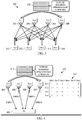
- Figure 2 illustrates an embodiment spatial domain LDS transmitter system 200.
- the low density signature is spread over a number of transmit antenna ports 202, 204, 206, 208. Multiple signatures can be transmitted simultaneously by signature superposition.
- the signatures are selected from a pre-defined pool, such as a matrix 212.
- the antenna ports 202, 204, 206, 208 can be co-located or distributed.
- the signature length (the number of antenna ports over which the signature is spread) is determined by the rank of MIMO channel.
- the number of virtual antenna ports is equal to the spreading factor.
- the total number of PHY-Tx antenna port is equal or greater than the spreading factor.
- a precoder maps the virtual antenna ports to PHY-Tx antenna ports.
- the total number of Rx antenna ports is equal or greater than the spreading factor. No CSI feedback is needed.
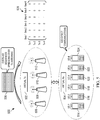
- FIG. 3 illustrates an embodiment spatial domain LDS receiver system 300.
- Spatial domain LDS signals are received by a group of receiver antennas 310, 312, 314, 316. These can be located in the same device or different devices.
- the number of receiver antennas 310, 312, 314, 316 should be equal to or larger than the spreading factor.
- the devices should be able to exchange data between each other. If the number of receiver antennas 310, 312, 314, 316 for a single device is equal or larger than the number of transmit antenna ports 302, 304, 306, 308, then data exchange between devices is not mandatory. However, multiple devices joint reception can improve the performance.
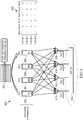
- FIG. 4 illustrates a first embodiment open-loop single user (SU)-MIMO system 400.
- the open-loop SU-MIMO system 400 includes a plurality of physical transmitter antennas 404, 406, 408, 410 and a receiver 402.
- the signature length is the same as the MIMO rank supported by the device in which the receiver 402 is located.
- the network obtains the device's MIMO rank information through UE feedback and UE measurement.
- the spreading factor is over virtual antenna ports if the device's MIMO rank is less than the number of physical antennas.
- a fixed precoder can be applied to map virtual antenna ports to physical antennas.
- a MIMO equalizer and an MPA are applied to decode the signals.
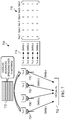
- FIG. 5 illustrates a second embodiment open-loop MIMO scheme 500 for hyper transceiver (downlink (DL)) where multiple transmitters communicate with multiple receivers.
- the scheme 500 includes a plurality of antennas 506, 508, 510, 512 that form a virtual transmitter 502 and a plurality of receivers 514, 516, 518, 520, 522, 524 that jointly form a virtual receiver 504.
- the receivers 514, 516, 518, 520, 522, 524 are UEs designated as UE-1, UE-2, UE-3, UE-4, UE-5, and UE-6.
- multiple transmitters 506, 508, 510, 512 jointly transmit signals and multiple receivers 514, 516, 518,520,522,524 jointly decode received signals.
- the virtual receiver 504 guarantees enough receiver 514, 516, 518,520,522,524 antennas to enable full rank spatial domain LDS.
- the multiple device virtual receiver 504 can support a bigger virtual transmitter 502, and provide better diversity gain and cooperation gain.
- the virtual receiver 504 allows overload to enhance system capacity.
- 4 antenna ports from 4 transmit nodes form a virtual transmitter.
- 6 devices form a virtual receiver. Each device has one or more receiver antennas. Low density signatures are spread to four Tx antenna ports. Data carried by different signatures can be targeted to the same device or different devices.
- the signals are received by all antennas in the virtual receiver. The received signals are decoded jointly by all devices or a portion of the devices. The minimum number of the joint-decoding devices is determined by the MIMO rank supported the joint-decoding devices.
- the signal processing is handled by a centralized signal processing unit.
- the signal processing is taken care by multiple signal processing units that are connected with each other wirelessly (or via wireline, for example in an office). MIMO equalizer and MPA can be applied to decode the signals.
- FIG. 6 illustrates a third embodiment open-loop MIMO scheme 600 for hyper transceiver (uplink (UL)).
- uplink (UL) uplink
- each of the 6 symbols 620 are spread with a sequence over 4 UEs 602, 604, 606, 608.
- 6 data symbols 620 are available at all 4 UEs.
- the UEs 602, 604, 606, 608 exchange data symbols through device-to-device (D2D) communications.
- 6 overlaid sequences 620 are transmitted by 4 UEs 602, 604, 606, 608 as specified by matrix 622.
- Each UE 602, 604, 606, 608 has one Tx antenna port.
- a UE 602, 604, 606, 608 has more than one physical Tx antenna
- the virtual antenna port concept as described above may be applied to the UE 602, 604, 606, 608.
- 6 sequences 620 of data may belong to any of the 4 available UEs 602, 604, 606, 608.
- An embodiment provides cooperative Rx or joint Rx 618 with a centralized signal processing unit. All Rx nodes 610, 612, 614, 616 send the received signals to the centralized unit through backhaul.
- a more advanced decoding algorithm can be developed by the centralized unit in the network side to provide better decoding performance.
- Figure 7 illustrates an embodiment mapping signature scheme 700 to transmit antenna ports.
- TP transmit port
- the formation of virtual Tx should be transparent to the UE virtual Rx 702.
- the virtual TP transmits according to matrix 716.
- the UE virtual receiver 702 needs to know which virtual antenna port 704, 706, 708, 710 corresponds to which element of the signature 716. If the element of the signature 716 is linked with the demodulation reference signal (DMRS) port according to mapping rule 714, the UE and network will have the same understanding of the mapping rule 714.
- DMRS demodulation reference signal
- FIG. 8 illustrates an embodiment two-dimensional LDS system 800.
- a two dimensional signature 816 can be applied to both the spatial domain and the time/frequency domain.
- two sets of overlaid signatures 812, 814 are used to spread symbols over both Tx antenna ports 804, 806, 808, 810 and subcarriers 824, 826, 828, 830 respectively and transmitted to the UE 802.
- the two sets of signatures 812, 814 can be decoded separately or jointly.
- one set of overlaid signatures are used to spread symbols over both Tx antenna ports 804, 806, 808, 810 and subcarriers 824, 826, 828, 830 and transmitted to the UE 802. Joint decoding is used. The same symbol or a different symbol may be carried.
- the spatial domain LDS mode is defined.
- the UE sends the capability information to the network indicating whether spatial domain LDS mode can be supported, whether there is single device based reception or a group devices base reception, and whether there is single device based transmission or a group devices base transmission in the UL transmission mode.
- the network informs the devices of the enabling of spatial domain LDS mode through multicast radio resource control (RRC) signaling, unicast RRC signaling, or dynamic scheduling signaling.
- RRC radio resource control
- the precoder for the mapping between virtual antennas and physical antennas is pre-defined or is signalled to devices by network.
- MIMO rank information signaling if the MIMO rank is determined by the device, the device reports the rank indicator to the network through the UL feedback channel. If the MIMO rank is determined by the network, the network sends the rank indicator/or mapping precoder information to the device through the DL control channel.
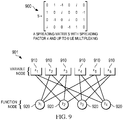
- Figure 9 shows an embodiment spreading matrix ( S ) 900 that can be used to define a spreading sequence for LDS modulation (e.g., in transmission).
- the spreading matrix 900 is an example of a matrix that may be used for matrices 212, 414, 528, 622, and 716 in Figures 2 , 4 , 5 , 6 , and 7 .
- the spreading matrix 900 can be implemented at a transmitter to determine output symbols (e.g., for OFDM) of multiplexed data for a plurality of user equipment (UEs) (e.g., in joint transmissions).
- the spreading matrix 900 has a spreading factor of 4 multiplexing signatures or signals for 6 UEs.
- the entries of the spreading matrix 900 designate the contributions for each of 6 symbols for 6 respective UEs to each of 4 output resources such as OFDMA tones.
- Each of the 6 columns is associated with one of the 6 signatures or the 6 UEs, and each of the 4 rows is associated with one of the 4 resources.
- more than one signature can be allocated to a UE.
- the 6 signatures can be for a single UE or up to 6 UEs.
- Figure 9 also shows a graph 901 that connects 6 variable nodes 910 (labeled x 1 , x 2 , x 3 , x 4 , x 5 , x 6 ) to 4 function nodes 920 (labeled y 1 , y 2 , y 3 , y 4 ).
- the graph representation is used to map the relationship between the 6 UE symbols and the 4 resources or tones.
- Each branch between one variable node 910 and one function node 920 represents a vector of probability values for all possible values (also referred to as constellation points) for that variable node 910. These values represent the complete set of values from which one is assigned to the symbol for the UE corresponding to that variable node 910.
- the vector of probabilities in the branch between one variable node 910 and one function node 920 represent a probability distribution (of the possible values) for the contribution of one symbol (corresponding to that variable node 910) to one tone (corresponding to that function node 920).
- the probability values in each branch may be log-likelihood ratios (LLRs) in the case of lower modulation orders, such as binary phase-shift keying (BPSK).
- LLRs log-likelihood ratios
- BPSK binary phase-shift keying
- QPSK Quadrature phase-shift keying
- the values may be normalized reliability values for each of the constellation points.
- the function node y 1 is a combination of the following variable nodes: x 2 - x 3 + i x 5 .
- y 2 x 1 + i x 3 - x 6
- y 3 - x 2 + i x 4 + x 6
- y 4 i x 1 - x 4 + x 5 .
- FIG 10 illustrates a standard MPA scheme 1000 that is used for LDS detection based on belief propagation (BP) for Low Density Parity Check (LDPC) decoding.
- the MPA scheme 1000 can be used at a LDS detector that receives the signals over the 4 tones of Figure 9 .
- the MPA scheme 1000 implements an iterative algorithm to determine the probability values at the variable nodes (VNs) 1010 for the 6 UEs from the 4 function nodes (FNs) 1020. Initially a vector containing a priori (ap) probabilities is used for each of the 6 VNs 1010.
- the 6 initial vectors for the 6 VNs 1010 are labeled ap 1 , ap 2 , ap 3 , ap 4 , ap 5 , ap 6 .
- the MPA scheme 1000 iteratively updates the values at the FNs 1020 according to the values sent from the VNs 1010 (starting from the initial AP values) and subsequently use the updated values at the FNs 1020 to update the values at the VNs 1010. Updating the vectors or values back and forth between the VNs 1010 and the FNs 1020 is also referred to as message passing or exchange between the two node sets. This back and forth information passing between the FNs 1020 and the VNs 1010 is repeated until the probability values at the VNs 1010 converge to a solution. The converged probability values at the VNs 1010 are then processed to determine each of the 6 symbols for the 6 UEs.
- FIG 11 is an embodiment method 1100 for open-loop spatial multiplexing schemes for radio access virtualization.
- the method 1100 begins at step 1102 where the transmitter or a central processing system determines a low density signature (LDS) sequence for a plurality of sub-carriers.
- LDS low density signature
- the method 1100 spreads the LDS sequence over a plurality of transmitter antenna ports.
- the method 1100 transmits the overlaid LDS sequence to one or more receivers using the plurality of transmitter antenna ports.
- the transmitter ports may be co-located in a single device.
- the signals from the transmitters are received at a plurality of antennas.
- the received signals may be communicated between a plurality of devices if the receiving antennas are not located in a single device.
- the received signals are decoded either jointly by a plurality of devices corresponding to the plurality of receivers or are transmitted from each receiver to a central processor through a backhaul network for decoding by the central processor, after which, the method 1100 may end.
- the central processor may be located in one of the devices.
- FIG. 12 is a block diagram of a processing system 1200 that may be used for implementing the devices and methods disclosed herein. Specific devices may utilize all of the components shown, or only a subset of the components, and levels of integration may vary from device to device. Furthermore, a device may contain multiple instances of a component, such as multiple processing units, processors, memories, transmitters, receivers, etc.
- the processing system 1200 may include a processing unit 1201 equipped with one or more input/output devices , such as a speaker, microphone, mouse, touchscreen, keypad, keyboard, printer, display, and the like.
- the processing unit may include a central processing unit (CPU) 1202, memory 1208, a mass storage device 1204, a video adapter 1210, and an I/O interface 1212 connected to a bus 1214.
- CPU central processing unit
- the bus 1214 may be one or more of any type of several bus architectures including a memory bus or memory controller, a peripheral bus, video bus, or the like.
- the CPU 1202 may include any type of electronic data processor configured to execute programming instructions.
- the memory 1208 may include any type of system memory such as static random access memory (SRAM), dynamic random access memory (DRAM), synchronous DRAM (SDRAM), read-only memory (ROM), a combination thereof, or the like.
- the memory 1208 may include ROM for use at boot-up, and DRAM for program and data storage for use while executing programs.
- the mass storage device 1204 may include any type of storage device (e.g., computer readable storage medium) configured to store data, programs for execution by the CPU 1202, and other information and to make the data, programs, and other information accessible via the bus 1214.
- storage device e.g., computer readable storage medium
- the mass storage device 1204 may include, for example, one or more of a solid state drive, hard disk drive, a magnetic disk drive, an optical disk drive, or the like.
- the video adapter 1210 and the I/O interface 1212 provide interfaces to couple external input and output devices to the processing unit 1201.
- input and output devices include the display 1216 coupled to the video adapter 1210 and the mouse/keyboard/printer 1218 coupled to the I/O interface 1212.
- Other devices may be coupled to the processing unit 1201, and additional or fewer interface cards may be utilized.
- a serial interface such as Universal Serial Bus (USB) (not shown) may be used to provide an interface for a printer.
- USB Universal Serial Bus
- the processing unit 1201 also includes one or more network interfaces 1206, which may include wired links, such as an Ethernet cable or the like, and/or wireless links to access nodes or different networks 1220.
- the network interface 1206 allows the processing unit 1201 to communicate with remote units via the networks 1220.
- the network interface 1206 may provide wireless communication via one or more transmitters/transmit antennas and one or more receivers/receive antennas.
- the processing unit 1201 is coupled to a local-area network or a wide-area network for data processing and communications with remote devices, such as other processing units, the Internet, remote storage facilities, or the like.
Landscapes
- Engineering & Computer Science (AREA)
- Computer Networks & Wireless Communication (AREA)
- Signal Processing (AREA)
- Power Engineering (AREA)
- Radio Transmission System (AREA)
- Mobile Radio Communication Systems (AREA)
Claims (18)
- Système de multiplexage spatial à boucle ouverte pour une visualisation d'accès radio, comprenant :une pluralité de ports d'antenne ; etun processeur couplé à la pluralité de ports d'antenne et configuré pour étaler une séquence d'étalement sur au moins une portion de la pluralité de ports d'antenne dans un domaine spatial,dans lequel le processeur est configuré pour amener les ports d'antenne à émettre simultanément de multiples séquences d'étalement par superposition de séquence,dans lequel les séquences d'étalement sont sélectionnées dans une réserve prédéfinie, telle qu'une matrice, un nombre total d'une pluralité d'antennes physiques est supérieur ou égal à un facteur d'étalement, et une longueur de signature pour un dispositif recevant une communication des ports d'antenne est déterminée selon un rang entrées multiples, sorties multiples (MIMO) du dispositif et le rang MIMO est déterminé à partir d'une rétroaction de dispositif et d'une mesure de dispositif, dans lequel la longueur de signature est le nombre de ports d'antenne sur lesquels la séquence d'étalement est étalée.
- Système selon la revendication 1, dans lequel le processeur est configuré pour former des ports d'antenne émetteurs virtuels à partir d'une pluralité d'antennes physiques ou configuré pour mettre en correspondance des ports émetteurs virtuels avec une pluralité d'antennes physiques.
- Système selon la revendication 1, comprenant en outre une pluralité d'antennes physiques et dans lequel la pluralité d'antennes physiques sont colocalisées dans un dispositif unique ou au moins certaines de la pluralité d'antennes physiques sont localisées dans des dispositifs différents.
- Système selon la revendication 1, dans lequel un port d'antenne d'émission est lié à un port de signal de référence de démodulation (DMRS).
- Système selon la revendication 1, comprenant en outre :une pluralité d'antennes réceptrices, dans lequel un nombre total de la pluralité d'antennes réceptrices est supérieur ou égal à un facteur d'étalement.
- Système selon la revendication 1, dans lequel au moins certaines de la pluralité d'antennes sont localisées dans des dispositifs différents et dans lequel les dispositifs différents sont considérés pour échanger des données les uns avec les autres.
- Système selon la revendication 1, dans lequel la séquence d'étalement est l'une quelconque de ce qui suit : une signature basse densité, un code Walsh Hadamard, une séquence Zadoff-Chu, ou, une séquence de corrélation orthogonale/faible.
- Procédé de multiplexage spatial à boucle ouverte pour une virtualisation d'accès radio, le procédé comprenant :la détermination d'une séquence d'étalement pour une pluralité de ports d'antenne d'émission ;l'étalement d'un signal avec la séquence d'étalement déterminée sur une pluralité de ports d'antenne émetteurs ; etl'émission simultanée de multiples signaux d'étalement dans une superposition de domaine spatial, dans lequel les séquences d'étalement sont sélectionnées dans une réserve prédéfinie, telle qu'une matrice, un nombre total d'une pluralité d'antennes physiques est supérieur ou égal à un facteur d'étalement, et une longueur de signature pour l'un des multiples signaux d'étalement est égale à un rang entrées multiples, sorties multiples (MIMO) pris en charge par un récepteur correspondant, dans lequel la longueur de signature est le nombre de ports d'antenne émetteurs sur lesquels la séquence d'étalement est étalée.
- Procédé selon la revendication 8, dans lequel les ports d'antenne émetteurs comprennent des ports d'antenne virtuels, et comprenant en outre la mise en correspondance du port d'antenne virtuel avec une pluralité d'antennes physiques.
- Procédé selon la revendication 8, comprenant en outre la détermination d'un facteur d'étalement pour un récepteur correspondant, dans lequel un rang entrées multiples, sorties multiples (MIMO) pris en charge par un récepteur est inférieur à un nombre de ports d'antenne physique de l'émetteur, et dans lequel le facteur d'étalement correspond à une pluralité de ports d'antenne virtuels.
- Procédé selon la revendication 8, dans lequel les multiples signaux d'étalement sont émis vers de multiples récepteurs, dans lequel les multiples récepteurs communiquant directement les uns avec les autres, et dans lequel les multiples récepteurs sont configurés pour décoder conjointement les multiples signaux d'étalement.
- Procédé selon la revendication 11, dans lequel les multiples récepteurs sont configurés pour employer un algorithme de passage de message (MPA) pour décoder les signaux d'étalement.
- Procédé selon la revendication 9, dans lequel deux ensembles de signatures recouvertes sont utilisés pour étaler des symboles sur les antennes émettrices et une pluralité de sous-porteuses de temps/fréquence, ou un ensemble de signatures recouvertes est utilisé pour étaler des symboles à la fois sur les antennes émettrices et une pluralité de sous-porteuses de temps/fréquence.
- Procédé selon la revendication 9, comprenant en outre la détermination d'un rang entrées multiples, sorties multiples (MIMO) pour un récepteur unique, comprenant en outre :la réception d'une rétroaction de rang MIMO en provenance du récepteur unique par l'intermédiaire d'un canal de rétroaction de liaison montante, oul'émission d'un indicateur de rang MIMO vers le récepteur par l'intermédiaire d'un canal de commande de liaison descendante.
- Procédé selon la revendication 14, dans lequel un port d'antenne d'émission est lié à un port de signal de référence de démodulation (DMRS).
- Procédé selon la revendication 14, dans lequel la séquence d'étalement est une signature de faible densité, ou un code Walsh Hadamard, une séquence Zadoff-Chu, ou une séquence de corrélation orthogonale/faible.
- Composant de réseau configuré pour un multiplexage spatial à boucle ouverte pour une virtualisation d'accès radio, comprenant :un processeur ; etun support de stockage lisible par ordinateur stockant une programmation pour exécution par le processeur, la programmation comportant des instructions pour implémenter une action dans un procédé conformément à l'une quelconque des revendications 8 à 16.
- Procédé selon la revendication 8, le procédé comprenant :la réception avec une pluralité d'antennes réceptrices, d'une pluralité de séquences recouvertes en provenance d'une pluralité de ports d'antenne d'émission, dans lequel les séquences recouvertes comprennent une séquence d'étalement étalée sur un domaine spatial ; etle décodage conjoint des séquences recouvertes reçues par une pluralité d'antennes réceptrices, ou l'émission des séquences recouvertes reçues par une pluralité d'antennes réceptrices vers un processeur central par l'intermédiaire d'un réseau d'amenée pour un décodage.
Applications Claiming Priority (3)
| Application Number | Priority Date | Filing Date | Title |
|---|---|---|---|
| US201261737614P | 2012-12-14 | 2012-12-14 | |
| US13/900,410 US20140169409A1 (en) | 2012-12-14 | 2013-05-22 | Systems and Methods for Open-loop Spatial Multiplexing Schemes for Radio Access Virtualization |
| PCT/CN2013/089492 WO2014090197A1 (fr) | 2012-12-14 | 2013-12-16 | Systèmes et procédés pour des schémas de multiplexage spatial en boucle ouverte pour la virtualisation d'accès radio |
Publications (3)
| Publication Number | Publication Date |
|---|---|
| EP2923457A1 EP2923457A1 (fr) | 2015-09-30 |
| EP2923457A4 EP2923457A4 (fr) | 2015-11-25 |
| EP2923457B1 true EP2923457B1 (fr) | 2018-04-04 |
Family
ID=50930840
Family Applications (1)
| Application Number | Title | Priority Date | Filing Date |
|---|---|---|---|
| EP13863359.9A Active EP2923457B1 (fr) | 2012-12-14 | 2013-12-16 | Systèmes et procédés pour des schémas de multiplexage spatial en boucle ouverte pour la virtualisation d'accès radio |
Country Status (3)
| Country | Link |
|---|---|
| US (1) | US20140169409A1 (fr) |
| EP (1) | EP2923457B1 (fr) |
| WO (1) | WO2014090197A1 (fr) |
Families Citing this family (40)
| Publication number | Priority date | Publication date | Assignee | Title |
|---|---|---|---|---|
| GB2496908B (en) | 2011-11-28 | 2017-04-26 | Ubiquisys Ltd | Power management in a cellular system |
| WO2013144950A1 (fr) | 2012-03-25 | 2013-10-03 | Intucell Ltd. | Système et procédé d'optimisation de performances d'un réseau de communication |
| IL222709A (en) | 2012-10-25 | 2016-02-29 | Intucell Ltd | A method and mechanism for coordinating interference between communications cells in solar systems |
| US9167444B2 (en) | 2012-12-04 | 2015-10-20 | Cisco Technology, Inc. | Method for managing heterogeneous cellular networks |
| IL224926A0 (en) | 2013-02-26 | 2013-07-31 | Valdimir Yanover | A method and system for allocating resources in the @telecommunications@cellphone network |
| GB2518584B (en) | 2013-07-09 | 2019-12-25 | Cisco Tech Inc | Power setting |
| US9414310B2 (en) | 2013-11-27 | 2016-08-09 | Cisco Technology, Inc. | System and method for small cell power control in an enterprise network environment |
| US9872242B2 (en) * | 2014-01-31 | 2018-01-16 | Qualcomm Incorporated | Joint transmission of CSI-RS for channel state feedback and transmission point selection |
| US9655102B2 (en) | 2014-06-20 | 2017-05-16 | Cisco Technology, Inc. | Interference control in a cellular communications network |
| WO2016007757A1 (fr) * | 2014-07-11 | 2016-01-14 | Huawei Technologies Co., Ltd. | Systèmes et procédés pour une formation de faisceau et une compression optimisées pour des réseaux d'accès radio mimo en nuage de liaison montante |
| US9537556B2 (en) | 2014-07-11 | 2017-01-03 | Huawei Technologies Canada Co., Ltd. | Systems and methods for optimized beamforming and compression for uplink MIMO cloud radio access networks |
| US9402195B2 (en) | 2014-09-07 | 2016-07-26 | Cisco Technology, Inc. | Operation of base station in a cellular communications network |
| US9844070B2 (en) | 2014-09-10 | 2017-12-12 | Cisco Technology, Inc. | System and method for decoupling long term evolution media access control scheduling from subframe rate procedures |
| US9729396B2 (en) | 2014-11-04 | 2017-08-08 | Cisco Technology, Inc. | System and method for providing dynamic radio access network orchestration |
| US10193671B2 (en) | 2014-11-06 | 2019-01-29 | Huawei Technologies Co., Ltd. | System and method for transmission symbol arrangement for reducing mutual interference |
| CN107078853B (zh) | 2014-12-11 | 2020-02-14 | 华为技术有限公司 | 数据处理的方法、装置和设备 |
| US10476729B2 (en) | 2015-02-04 | 2019-11-12 | Lg Electronics Inc. | Method and apparatus for spatial modulation based on virtual antenna |
| US20160254937A1 (en) * | 2015-02-27 | 2016-09-01 | Huawei Technologies Co., Ltd | Low complexity scma/lds detection systems and methods |
| US9918314B2 (en) | 2015-04-14 | 2018-03-13 | Cisco Technology, Inc. | System and method for providing uplink inter cell interference coordination in a network environment |
| CN107925434B (zh) | 2015-05-11 | 2021-02-05 | 凝聚技术公司 | 用于数据的辛正交时频移位调制和传输的系统和方法 |
| US10917167B2 (en) * | 2015-05-29 | 2021-02-09 | Huawei Technologies Co., Ltd. | MC-CDMA with low peak-to-average power ratio multi-carrier waveform |
| US10693581B2 (en) | 2015-07-12 | 2020-06-23 | Cohere Technologies, Inc. | Orthogonal time frequency space modulation over a plurality of narrow band subcarriers |
| US10244422B2 (en) | 2015-07-16 | 2019-03-26 | Cisco Technology, Inc. | System and method to manage network utilization according to wireless backhaul and radio access network conditions |
| US9860852B2 (en) | 2015-07-25 | 2018-01-02 | Cisco Technology, Inc. | System and method to facilitate small cell uplink power control in a network environment |
| US9648569B2 (en) | 2015-07-25 | 2017-05-09 | Cisco Technology, Inc. | System and method to facilitate small cell uplink power control in a network environment |
| US9854535B2 (en) | 2015-07-28 | 2017-12-26 | Cisco Technology, Inc. | Determining fractional frequency reuse power levels for downlink transmissions |
| US9854536B2 (en) | 2015-08-03 | 2017-12-26 | Cisco Technology, Inc. | User equipment power level selection for downlink transmissions |
| US9967067B2 (en) | 2015-09-08 | 2018-05-08 | Cisco Technology, Inc. | Serving noise/macro interference limited user equipment for downlink inter-cell interference coordination |
| US11038733B2 (en) | 2015-11-18 | 2021-06-15 | Cohere Technologies, Inc. | Orthogonal time frequency space modulation techniques |
| US9826408B2 (en) | 2015-12-07 | 2017-11-21 | Cisco Technology, Inc. | System and method to provide uplink interference coordination in a network environment |
| US10143002B2 (en) | 2016-01-12 | 2018-11-27 | Cisco Technology, Inc. | System and method to facilitate centralized radio resource management in a split radio access network environment |
| US9813970B2 (en) | 2016-01-20 | 2017-11-07 | Cisco Technology, Inc. | System and method to provide small cell power control and load balancing for high mobility user equipment in a network environment |
| US10420134B2 (en) | 2016-02-02 | 2019-09-17 | Cisco Technology, Inc. | System and method to facilitate subframe scheduling in a split medium access control radio access network environment |
| US10091697B1 (en) | 2016-02-08 | 2018-10-02 | Cisco Technology, Inc. | Mitigation of uplink interference within heterogeneous wireless communications networks |
| WO2018027909A1 (fr) * | 2016-08-12 | 2018-02-15 | 富士通株式会社 | Procédé et appareil de mappage et multiplexage de signal de référence de démodulation, et système de communication |
| CN108023632B (zh) | 2016-11-04 | 2022-06-28 | 华为技术有限公司 | 数据处理方法和发送设备 |
| US10153814B1 (en) * | 2017-06-13 | 2018-12-11 | Corning Incorporated | Massive multiple-input multiple-output (M-MIMO) wireless distribution system (WDS) and related methods for optimizing the M-MIMO WDS |
| CN109379704B (zh) * | 2018-12-21 | 2020-07-03 | 珠海市小源科技有限公司 | 短信的区域信息校正方法、装置、设备及存储介质 |
| JP7541661B2 (ja) * | 2020-04-14 | 2024-08-29 | 日本電気株式会社 | 無線受信装置 |
| CN114726399B (zh) * | 2022-03-14 | 2023-05-23 | 中国电子科技集团公司第十研究所 | 一种非地面网络的空频二维跳频传输系统及传输方法 |
Family Cites Families (19)
| Publication number | Priority date | Publication date | Assignee | Title |
|---|---|---|---|---|
| US7430257B1 (en) * | 1998-02-12 | 2008-09-30 | Lot 41 Acquisition Foundation, Llc | Multicarrier sub-layer for direct sequence channel and multiple-access coding |
| US7428268B2 (en) * | 2004-12-07 | 2008-09-23 | Adaptix, Inc. | Cooperative MIMO in multicell wireless networks |
| EP2637318B1 (fr) * | 2006-01-18 | 2014-10-01 | Huawei Technologies Co., Ltd. | Procédé et système de synchronisation dans un système de communication |
| US7944985B2 (en) * | 2006-08-24 | 2011-05-17 | Interdigital Technology Corporation | MIMO transmitter and receiver for supporting downlink communication of single channel codewords |
| JP5026122B2 (ja) * | 2007-03-20 | 2012-09-12 | 株式会社エヌ・ティ・ティ・ドコモ | 移動通信システムにおける基地局装置及び方法 |
| KR101755038B1 (ko) * | 2009-01-30 | 2017-07-06 | 엘지전자 주식회사 | 무선 통신 시스템에서 참조신호 전송 장치 및 방법 |
| CN102232319B (zh) * | 2009-03-09 | 2013-08-14 | 华为技术有限公司 | 多址接入通信系统的方法和装置 |
| KR101276859B1 (ko) * | 2009-04-15 | 2013-06-18 | 엘지전자 주식회사 | 참조 신호를 전송하는 방법 및 장치 |
| US8797950B2 (en) * | 2009-05-27 | 2014-08-05 | Texas Instruments Incorporated | Dual-layer beam forming in cellular networks |
| EP2456093B1 (fr) * | 2009-07-13 | 2017-05-24 | LG Electronics Inc. | Procédé et appareil de configuration d'un mode de transmission pour une transmission par liaison terrestre |
| EP3687091B1 (fr) * | 2009-08-21 | 2022-04-13 | BlackBerry Limited | Transmission d'informations dans un système de communication sans fil |
| WO2011055986A2 (fr) * | 2009-11-08 | 2011-05-12 | Lg Electronics Inc. | Procédé et station de base permettant de transmettre un csi-rs, et procédé et équipement d'utilisateur permettant de le recevoir |
| KR101782647B1 (ko) * | 2010-01-28 | 2017-09-28 | 엘지전자 주식회사 | 무선 통신 시스템에서 상향링크 제어 정보 인코딩 방법 및 장치 |
| PL2369775T3 (pl) * | 2010-03-16 | 2019-08-30 | Lg Electronics Inc. | Sposób i stacja bazowa do przesyłania sygnałów odniesienia oraz sposób i urządzenie użytkownika do odbioru sygnałów odniesienia |
| EP2685691A4 (fr) * | 2011-03-11 | 2015-12-30 | Lg Electronics Inc | Procédé de réception de signal de liaison descendante et procédé de transmission de ce signal, et dispositif de réception de ce signal et dispositif de transmission de ce signal |
| US9014020B2 (en) * | 2011-05-02 | 2015-04-21 | Blackberry Limited | Methods and systems of wireless communication with remote radio heads |
| US9735844B2 (en) * | 2011-05-09 | 2017-08-15 | Texas Instruments Incorporated | Channel feedback for coordinated multi-point transmissions |
| JP6081470B2 (ja) * | 2011-10-20 | 2017-02-15 | サムスン エレクトロニクス カンパニー リミテッド | 無線通信システムにおける制御情報の送受信方法及び装置 |
| US20130322277A1 (en) * | 2012-05-31 | 2013-12-05 | Interdigital Patent Holdings, Inc | Measurements and interference avoidance for device-to-device links |
-
2013
- 2013-05-22 US US13/900,410 patent/US20140169409A1/en not_active Abandoned
- 2013-12-16 EP EP13863359.9A patent/EP2923457B1/fr active Active
- 2013-12-16 WO PCT/CN2013/089492 patent/WO2014090197A1/fr not_active Ceased
Non-Patent Citations (1)
| Title |
|---|
| None * |
Also Published As
| Publication number | Publication date |
|---|---|
| US20140169409A1 (en) | 2014-06-19 |
| WO2014090197A1 (fr) | 2014-06-19 |
| EP2923457A4 (fr) | 2015-11-25 |
| EP2923457A1 (fr) | 2015-09-30 |
Similar Documents
| Publication | Publication Date | Title |
|---|---|---|
| EP2923457B1 (fr) | Systèmes et procédés pour des schémas de multiplexage spatial en boucle ouverte pour la virtualisation d'accès radio | |
| CN114503449B (zh) | 用于复用部分信道状态信息的方法和装置 | |
| KR102453737B1 (ko) | 첨단 무선 통신 시스템에서의 더 높은 랭크의 csi 보고 방법 및 장치 | |
| US11888557B2 (en) | Method and apparatus for port selection in wireless communication systems | |
| CN111771340B (zh) | 用于高级无线通信系统中的宽带csi报告的方法和装置 | |
| EP3427389B1 (fr) | Attribution de ressources et de puissance dans des émissions de liaison montante non-orthogonales | |
| US9820290B2 (en) | Virtual antenna mapping method and apparatus for feedback of virtual antenna mapping information in MIMO system | |
| EP2837123B1 (fr) | Diversité de transmission sur un canal de commande sans signaux de référence supplémentaires | |
| KR102508858B1 (ko) | 송신 다이버시티를 위한 방법 및 장치 | |
| US10574315B2 (en) | Method for transmitting and receiving signal based on non-orthogonal multiple access scheme and apparatus therefor | |
| CN108702226A (zh) | 无线通信系统中的测量参考信号的方法和设备 | |
| WO2014165018A1 (fr) | Alignement spatial pour atténuation de brouillage d2d | |
| KR20110010089A (ko) | 통신 시스템에서 네트워크 코딩을 위한 장치 및 방법 | |
| WO2013084693A1 (fr) | Dispositif de station de base sans fil, système et procédé de communication sans fil | |
| CN113455061A (zh) | 无线通信系统中发送和接收同步信号的方法及装置 | |
| KR20200005028A (ko) | 무선 통신 시스템에서 빔 포밍을 수행하는 방법 및 장치 | |
| CN109565364B (zh) | 空间复用mimo通信中的信号处理 | |
| WO2015119461A1 (fr) | Procédé et dispositif d'émission de signal dans un système de communication sans fil | |
| KR102278012B1 (ko) | 무선 통신 시스템에서 간섭 정렬을 위한 장치 및 방법 | |
| KR20240005748A (ko) | 무선 통신 시스템에서 채널 상태 정보를 보고하는 방법 및 장치 | |
| KR102369775B1 (ko) | 다중 안테나를 이용하여 신호를 송수신하기 위한 방법 및 장치 | |
| KR102660123B1 (ko) | 무선 통신 시스템에서 데이터 송신 방법 및 장치 | |
| JP5444353B2 (ja) | 無線通信システム、基地局及び無線通信方法 | |
| WO2019027363A1 (fr) | Formation de faisceau basée sur diagnostic de bloc amélioré | |
| CN116848801A (zh) | 用于分布式mimo系统的天线选择的方法和装置 |
Legal Events
| Date | Code | Title | Description |
|---|---|---|---|
| PUAI | Public reference made under article 153(3) epc to a published international application that has entered the european phase |
Free format text: ORIGINAL CODE: 0009012 |
|
| 17P | Request for examination filed |
Effective date: 20150625 |
|
| AK | Designated contracting states |
Kind code of ref document: A1 Designated state(s): AL AT BE BG CH CY CZ DE DK EE ES FI FR GB GR HR HU IE IS IT LI LT LU LV MC MK MT NL NO PL PT RO RS SE SI SK SM TR |
|
| AX | Request for extension of the european patent |
Extension state: BA ME |
|
| RA4 | Supplementary search report drawn up and despatched (corrected) |
Effective date: 20151028 |
|
| RIC1 | Information provided on ipc code assigned before grant |
Ipc: H04J 13/00 20110101ALI20151022BHEP Ipc: H04L 1/06 20060101ALI20151022BHEP Ipc: H04B 7/06 20060101ALI20151022BHEP Ipc: H04B 7/04 20060101ALI20151022BHEP Ipc: H04B 7/02 20060101AFI20151022BHEP |
|
| DAX | Request for extension of the european patent (deleted) | ||
| REG | Reference to a national code |
Ref country code: DE Ref legal event code: R079 Ref document number: 602013035550 Country of ref document: DE Free format text: PREVIOUS MAIN CLASS: H04L0001060000 Ipc: H04B0007020000 |
|
| GRAP | Despatch of communication of intention to grant a patent |
Free format text: ORIGINAL CODE: EPIDOSNIGR1 |
|
| RIC1 | Information provided on ipc code assigned before grant |
Ipc: H04L 1/06 20060101ALI20170928BHEP Ipc: H04J 13/00 20110101ALI20170928BHEP Ipc: H04B 7/0452 20170101ALI20170928BHEP Ipc: H04B 7/06 20060101ALI20170928BHEP Ipc: H04B 7/04 20170101ALI20170928BHEP Ipc: H04B 7/02 20170101AFI20170928BHEP |
|
| INTG | Intention to grant announced |
Effective date: 20171016 |
|
| GRAS | Grant fee paid |
Free format text: ORIGINAL CODE: EPIDOSNIGR3 |
|
| GRAA | (expected) grant |
Free format text: ORIGINAL CODE: 0009210 |
|
| AK | Designated contracting states |
Kind code of ref document: B1 Designated state(s): AL AT BE BG CH CY CZ DE DK EE ES FI FR GB GR HR HU IE IS IT LI LT LU LV MC MK MT NL NO PL PT RO RS SE SI SK SM TR |
|
| REG | Reference to a national code |
Ref country code: GB Ref legal event code: FG4D |
|
| REG | Reference to a national code |
Ref country code: CH Ref legal event code: EP |
|
| REG | Reference to a national code |
Ref country code: AT Ref legal event code: REF Ref document number: 986659 Country of ref document: AT Kind code of ref document: T Effective date: 20180415 |
|
| REG | Reference to a national code |
Ref country code: IE Ref legal event code: FG4D |
|
| REG | Reference to a national code |
Ref country code: DE Ref legal event code: R096 Ref document number: 602013035550 Country of ref document: DE |
|
| REG | Reference to a national code |
Ref country code: NL Ref legal event code: MP Effective date: 20180404 |
|
| REG | Reference to a national code |
Ref country code: LT Ref legal event code: MG4D |
|
| PG25 | Lapsed in a contracting state [announced via postgrant information from national office to epo] |
Ref country code: NL Free format text: LAPSE BECAUSE OF FAILURE TO SUBMIT A TRANSLATION OF THE DESCRIPTION OR TO PAY THE FEE WITHIN THE PRESCRIBED TIME-LIMIT Effective date: 20180404 |
|
| PG25 | Lapsed in a contracting state [announced via postgrant information from national office to epo] |
Ref country code: PL Free format text: LAPSE BECAUSE OF FAILURE TO SUBMIT A TRANSLATION OF THE DESCRIPTION OR TO PAY THE FEE WITHIN THE PRESCRIBED TIME-LIMIT Effective date: 20180404 Ref country code: LT Free format text: LAPSE BECAUSE OF FAILURE TO SUBMIT A TRANSLATION OF THE DESCRIPTION OR TO PAY THE FEE WITHIN THE PRESCRIBED TIME-LIMIT Effective date: 20180404 Ref country code: SE Free format text: LAPSE BECAUSE OF FAILURE TO SUBMIT A TRANSLATION OF THE DESCRIPTION OR TO PAY THE FEE WITHIN THE PRESCRIBED TIME-LIMIT Effective date: 20180404 Ref country code: BG Free format text: LAPSE BECAUSE OF FAILURE TO SUBMIT A TRANSLATION OF THE DESCRIPTION OR TO PAY THE FEE WITHIN THE PRESCRIBED TIME-LIMIT Effective date: 20180704 Ref country code: FI Free format text: LAPSE BECAUSE OF FAILURE TO SUBMIT A TRANSLATION OF THE DESCRIPTION OR TO PAY THE FEE WITHIN THE PRESCRIBED TIME-LIMIT Effective date: 20180404 Ref country code: AL Free format text: LAPSE BECAUSE OF FAILURE TO SUBMIT A TRANSLATION OF THE DESCRIPTION OR TO PAY THE FEE WITHIN THE PRESCRIBED TIME-LIMIT Effective date: 20180404 Ref country code: NO Free format text: LAPSE BECAUSE OF FAILURE TO SUBMIT A TRANSLATION OF THE DESCRIPTION OR TO PAY THE FEE WITHIN THE PRESCRIBED TIME-LIMIT Effective date: 20180704 Ref country code: ES Free format text: LAPSE BECAUSE OF FAILURE TO SUBMIT A TRANSLATION OF THE DESCRIPTION OR TO PAY THE FEE WITHIN THE PRESCRIBED TIME-LIMIT Effective date: 20180404 |
|
| PG25 | Lapsed in a contracting state [announced via postgrant information from national office to epo] |
Ref country code: LV Free format text: LAPSE BECAUSE OF FAILURE TO SUBMIT A TRANSLATION OF THE DESCRIPTION OR TO PAY THE FEE WITHIN THE PRESCRIBED TIME-LIMIT Effective date: 20180404 Ref country code: GR Free format text: LAPSE BECAUSE OF FAILURE TO SUBMIT A TRANSLATION OF THE DESCRIPTION OR TO PAY THE FEE WITHIN THE PRESCRIBED TIME-LIMIT Effective date: 20180705 Ref country code: HR Free format text: LAPSE BECAUSE OF FAILURE TO SUBMIT A TRANSLATION OF THE DESCRIPTION OR TO PAY THE FEE WITHIN THE PRESCRIBED TIME-LIMIT Effective date: 20180404 Ref country code: RS Free format text: LAPSE BECAUSE OF FAILURE TO SUBMIT A TRANSLATION OF THE DESCRIPTION OR TO PAY THE FEE WITHIN THE PRESCRIBED TIME-LIMIT Effective date: 20180404 |
|
| REG | Reference to a national code |
Ref country code: AT Ref legal event code: MK05 Ref document number: 986659 Country of ref document: AT Kind code of ref document: T Effective date: 20180404 |
|
| PG25 | Lapsed in a contracting state [announced via postgrant information from national office to epo] |
Ref country code: PT Free format text: LAPSE BECAUSE OF FAILURE TO SUBMIT A TRANSLATION OF THE DESCRIPTION OR TO PAY THE FEE WITHIN THE PRESCRIBED TIME-LIMIT Effective date: 20180806 |
|
| REG | Reference to a national code |
Ref country code: DE Ref legal event code: R097 Ref document number: 602013035550 Country of ref document: DE |
|
| PG25 | Lapsed in a contracting state [announced via postgrant information from national office to epo] |
Ref country code: AT Free format text: LAPSE BECAUSE OF FAILURE TO SUBMIT A TRANSLATION OF THE DESCRIPTION OR TO PAY THE FEE WITHIN THE PRESCRIBED TIME-LIMIT Effective date: 20180404 Ref country code: CZ Free format text: LAPSE BECAUSE OF FAILURE TO SUBMIT A TRANSLATION OF THE DESCRIPTION OR TO PAY THE FEE WITHIN THE PRESCRIBED TIME-LIMIT Effective date: 20180404 Ref country code: SK Free format text: LAPSE BECAUSE OF FAILURE TO SUBMIT A TRANSLATION OF THE DESCRIPTION OR TO PAY THE FEE WITHIN THE PRESCRIBED TIME-LIMIT Effective date: 20180404 Ref country code: RO Free format text: LAPSE BECAUSE OF FAILURE TO SUBMIT A TRANSLATION OF THE DESCRIPTION OR TO PAY THE FEE WITHIN THE PRESCRIBED TIME-LIMIT Effective date: 20180404 Ref country code: EE Free format text: LAPSE BECAUSE OF FAILURE TO SUBMIT A TRANSLATION OF THE DESCRIPTION OR TO PAY THE FEE WITHIN THE PRESCRIBED TIME-LIMIT Effective date: 20180404 Ref country code: DK Free format text: LAPSE BECAUSE OF FAILURE TO SUBMIT A TRANSLATION OF THE DESCRIPTION OR TO PAY THE FEE WITHIN THE PRESCRIBED TIME-LIMIT Effective date: 20180404 |
|
| PLBE | No opposition filed within time limit |
Free format text: ORIGINAL CODE: 0009261 |
|
| STAA | Information on the status of an ep patent application or granted ep patent |
Free format text: STATUS: NO OPPOSITION FILED WITHIN TIME LIMIT |
|
| PG25 | Lapsed in a contracting state [announced via postgrant information from national office to epo] |
Ref country code: SM Free format text: LAPSE BECAUSE OF FAILURE TO SUBMIT A TRANSLATION OF THE DESCRIPTION OR TO PAY THE FEE WITHIN THE PRESCRIBED TIME-LIMIT Effective date: 20180404 Ref country code: IT Free format text: LAPSE BECAUSE OF FAILURE TO SUBMIT A TRANSLATION OF THE DESCRIPTION OR TO PAY THE FEE WITHIN THE PRESCRIBED TIME-LIMIT Effective date: 20180404 |
|
| 26N | No opposition filed |
Effective date: 20190107 |
|
| PG25 | Lapsed in a contracting state [announced via postgrant information from national office to epo] |
Ref country code: SI Free format text: LAPSE BECAUSE OF FAILURE TO SUBMIT A TRANSLATION OF THE DESCRIPTION OR TO PAY THE FEE WITHIN THE PRESCRIBED TIME-LIMIT Effective date: 20180404 |
|
| REG | Reference to a national code |
Ref country code: CH Ref legal event code: PL |
|
| PG25 | Lapsed in a contracting state [announced via postgrant information from national office to epo] |
Ref country code: MC Free format text: LAPSE BECAUSE OF FAILURE TO SUBMIT A TRANSLATION OF THE DESCRIPTION OR TO PAY THE FEE WITHIN THE PRESCRIBED TIME-LIMIT Effective date: 20180404 Ref country code: LU Free format text: LAPSE BECAUSE OF NON-PAYMENT OF DUE FEES Effective date: 20181216 |
|
| REG | Reference to a national code |
Ref country code: IE Ref legal event code: MM4A |
|
| REG | Reference to a national code |
Ref country code: BE Ref legal event code: MM Effective date: 20181231 |
|
| PG25 | Lapsed in a contracting state [announced via postgrant information from national office to epo] |
Ref country code: FR Free format text: LAPSE BECAUSE OF NON-PAYMENT OF DUE FEES Effective date: 20181231 Ref country code: IE Free format text: LAPSE BECAUSE OF NON-PAYMENT OF DUE FEES Effective date: 20181216 |
|
| PG25 | Lapsed in a contracting state [announced via postgrant information from national office to epo] |
Ref country code: BE Free format text: LAPSE BECAUSE OF NON-PAYMENT OF DUE FEES Effective date: 20181231 |
|
| PG25 | Lapsed in a contracting state [announced via postgrant information from national office to epo] |
Ref country code: LI Free format text: LAPSE BECAUSE OF NON-PAYMENT OF DUE FEES Effective date: 20181231 Ref country code: CH Free format text: LAPSE BECAUSE OF NON-PAYMENT OF DUE FEES Effective date: 20181231 |
|
| PG25 | Lapsed in a contracting state [announced via postgrant information from national office to epo] |
Ref country code: MT Free format text: LAPSE BECAUSE OF NON-PAYMENT OF DUE FEES Effective date: 20181216 |
|
| PG25 | Lapsed in a contracting state [announced via postgrant information from national office to epo] |
Ref country code: TR Free format text: LAPSE BECAUSE OF FAILURE TO SUBMIT A TRANSLATION OF THE DESCRIPTION OR TO PAY THE FEE WITHIN THE PRESCRIBED TIME-LIMIT Effective date: 20180404 |
|
| PG25 | Lapsed in a contracting state [announced via postgrant information from national office to epo] |
Ref country code: MK Free format text: LAPSE BECAUSE OF NON-PAYMENT OF DUE FEES Effective date: 20180404 Ref country code: HU Free format text: LAPSE BECAUSE OF FAILURE TO SUBMIT A TRANSLATION OF THE DESCRIPTION OR TO PAY THE FEE WITHIN THE PRESCRIBED TIME-LIMIT; INVALID AB INITIO Effective date: 20131216 Ref country code: CY Free format text: LAPSE BECAUSE OF FAILURE TO SUBMIT A TRANSLATION OF THE DESCRIPTION OR TO PAY THE FEE WITHIN THE PRESCRIBED TIME-LIMIT Effective date: 20180404 |
|
| PG25 | Lapsed in a contracting state [announced via postgrant information from national office to epo] |
Ref country code: IS Free format text: LAPSE BECAUSE OF FAILURE TO SUBMIT A TRANSLATION OF THE DESCRIPTION OR TO PAY THE FEE WITHIN THE PRESCRIBED TIME-LIMIT Effective date: 20180804 |
|
| PGFP | Annual fee paid to national office [announced via postgrant information from national office to epo] |
Ref country code: DE Payment date: 20251104 Year of fee payment: 13 |
|
| PGFP | Annual fee paid to national office [announced via postgrant information from national office to epo] |
Ref country code: GB Payment date: 20251030 Year of fee payment: 13 |