EP2923533B1 - Konfiguration von betriebsgeräten für leuchtmittel - Google Patents
Konfiguration von betriebsgeräten für leuchtmittel Download PDFInfo
- Publication number
- EP2923533B1 EP2923533B1 EP13824579.0A EP13824579A EP2923533B1 EP 2923533 B1 EP2923533 B1 EP 2923533B1 EP 13824579 A EP13824579 A EP 13824579A EP 2923533 B1 EP2923533 B1 EP 2923533B1
- Authority
- EP
- European Patent Office
- Prior art keywords
- appliance
- mobile
- operating
- lamp
- parameters
- Prior art date
- Legal status (The legal status is an assumption and is not a legal conclusion. Google has not performed a legal analysis and makes no representation as to the accuracy of the status listed.)
- Active
Links
Images


Classifications
-
- H—ELECTRICITY
- H05—ELECTRIC TECHNIQUES NOT OTHERWISE PROVIDED FOR
- H05B—ELECTRIC HEATING; ELECTRIC LIGHT SOURCES NOT OTHERWISE PROVIDED FOR; CIRCUIT ARRANGEMENTS FOR ELECTRIC LIGHT SOURCES, IN GENERAL
- H05B47/00—Circuit arrangements for operating light sources in general, i.e. where the type of light source is not relevant
- H05B47/10—Controlling the light source
-
- H—ELECTRICITY
- H05—ELECTRIC TECHNIQUES NOT OTHERWISE PROVIDED FOR
- H05B—ELECTRIC HEATING; ELECTRIC LIGHT SOURCES NOT OTHERWISE PROVIDED FOR; CIRCUIT ARRANGEMENTS FOR ELECTRIC LIGHT SOURCES, IN GENERAL
- H05B47/00—Circuit arrangements for operating light sources in general, i.e. where the type of light source is not relevant
- H05B47/10—Controlling the light source
- H05B47/175—Controlling the light source by remote control
- H05B47/196—Controlling the light source by remote control characterised by user interface arrangements
- H05B47/1965—Controlling the light source by remote control characterised by user interface arrangements using handheld communication devices
-
- H—ELECTRICITY
- H05—ELECTRIC TECHNIQUES NOT OTHERWISE PROVIDED FOR
- H05B—ELECTRIC HEATING; ELECTRIC LIGHT SOURCES NOT OTHERWISE PROVIDED FOR; CIRCUIT ARRANGEMENTS FOR ELECTRIC LIGHT SOURCES, IN GENERAL
- H05B45/00—Circuit arrangements for operating light-emitting diodes [LED]
- H05B45/20—Controlling the colour of the light
- H05B45/22—Controlling the colour of the light using optical feedback
-
- H—ELECTRICITY
- H05—ELECTRIC TECHNIQUES NOT OTHERWISE PROVIDED FOR
- H05B—ELECTRIC HEATING; ELECTRIC LIGHT SOURCES NOT OTHERWISE PROVIDED FOR; CIRCUIT ARRANGEMENTS FOR ELECTRIC LIGHT SOURCES, IN GENERAL
- H05B47/00—Circuit arrangements for operating light sources in general, i.e. where the type of light source is not relevant
- H05B47/10—Controlling the light source
- H05B47/175—Controlling the light source by remote control
- H05B47/19—Controlling the light source by remote control via wireless transmission
-
- H—ELECTRICITY
- H05—ELECTRIC TECHNIQUES NOT OTHERWISE PROVIDED FOR
- H05B—ELECTRIC HEATING; ELECTRIC LIGHT SOURCES NOT OTHERWISE PROVIDED FOR; CIRCUIT ARRANGEMENTS FOR ELECTRIC LIGHT SOURCES, IN GENERAL
- H05B45/00—Circuit arrangements for operating light-emitting diodes [LED]
- H05B45/20—Controlling the colour of the light
-
- H—ELECTRICITY
- H05—ELECTRIC TECHNIQUES NOT OTHERWISE PROVIDED FOR
- H05B—ELECTRIC HEATING; ELECTRIC LIGHT SOURCES NOT OTHERWISE PROVIDED FOR; CIRCUIT ARRANGEMENTS FOR ELECTRIC LIGHT SOURCES, IN GENERAL
- H05B47/00—Circuit arrangements for operating light sources in general, i.e. where the type of light source is not relevant
- H05B47/10—Controlling the light source
- H05B47/175—Controlling the light source by remote control
- H05B47/198—Grouping of control procedures or address assignation to light sources
- H05B47/199—Commissioning of light sources
Definitions
- the invention relates to a device, a system and a method for configuring a light source.
- the invention relates to a configuration of an operating device for a light source, which operating device is part of a luminaire.
- WO 2010/100576 A1 a system is known that allows goods to be ordered via a mobile phone.
- the system includes a light that changes color depending on the order.
- an irradiance for example from a table, a transport route or other objects, is determined indirectly via a sensor attached to the lamp, for example. Color temperature values and a color composition are not recorded. In particular, there is no analysis of the light emitted by a light source, the radiation intensity and a color composition with regard to physiological aspects, ie with regard to the effect of the emitted light on people.
- this has the disadvantage that, in general, the lighting situation, in particular the color temperature or the color spectrum of the light, cannot be adjusted to a person's individual perception.
- different surfaces have different reflection properties with the same irradiation, which can be perceived differently by a person, e.g. as pleasant or unpleasant, for example depending on the time of day, a season, a location and/or a temperature.
- Today's light measuring systems work according to the indirect principle, i.e. light regulation/control is used by the light reflected on a surface.
- the color of a table surface can have a strong impact on a person's perception, since the reflected light is highly dependent on the optical properties of the table surface.
- the control gear and/or the light source With the same setting for the luminaire, the control gear and/or the light source, a significantly lower reflection can be determined on a dark table surface, which is perceived as pleasant by a person, while with the same setting and a white table surface there is an unpleasant reflection with high radiant intensity is perceived. The same applies to matt and reflective surfaces.
- a further problem is the assignment of a position to an address of the luminaire, the operating device and/or the illuminant, which is often problematic.
- the invention therefore sets itself the task of enabling user-defined regulation/control of a light source and simplifying the addressing of the operating device or the luminaire.
- the US2012091896 A1 discloses a device according to the preamble of claim 1.
- the invention solves the objects with devices, the system and the method according to the independent claims. Further advantageous embodiments of the invention are described in the dependent claims.
- the invention provides a mobile detection and configuration device for configuring at least one operating device for operating a light source.
- the mobile device has: at least one optical sensor, which is designed to record photometric parameters.
- the mobile device can have at least one localization unit, which is provided to record absolute and/or relative position parameters of the mobile device, which can be output as position data.
- the mobile device has an interface for communication with the at least one operating device, and is set up, for example, to exchange configuration parameters with the operating device via the interface and based on the detected photometric parameters and/or position data at least one of the light reproduction of the lamp to change influencing configuration parameters in the operating device.
- the at least one optical sensor can be a light sensor, a color sensor, an image sensor and/or a camera.
- the optical sensor can be set up to determine lighting parameters, such as brightness information, an irradiance of an object, a surface property of an object, a color temperature, a color and/or light temperature.
- the mobile device can be set up to read out and store at least one configuration parameter and in particular an identifier from the operating device and/or the lamp, for example via the emitted light.
- the optical sensor is designed to record photometric parameters, e.g. via device-internal image processing.
- the mobile device is set up to receive a configuration parameter from the operating device via the optical sensor, the configuration parameter being determined by the mobile device on the basis of the detected photometric parameters.
- the mobile device can be set up to automatically recognize an operating device using an identifier and to transmit predetermined configuration parameters to the operating device and/or the lamp.
- the mobile device is set up to read out and store position data from the operating device and/or the lamp.
- the mobile device can further be set up to transmit predetermined configuration parameters to the operating device and/or the lamp automatically and/or in response to a user interaction, if the mobile device is, for example, at a certain distance from the operating device.
- the mobile device can also have a user interface that is designed to change configuration parameters, in particular as a function of the detected photometric parameters and/or the position data, in response to a user interaction.
- the mobile device can also be set up to transmit the changed configuration parameters to the operating device.
- the at least one localization unit can have a (eg barometric) altimeter, a GPS receiver and/or a compass and/or be set up to receive radio signals and/or light signals.
- a (eg barometric) altimeter e.g., a GPS receiver and/or a compass and/or be set up to receive radio signals and/or light signals.
- the configuration parameter can be determined on the basis of the recorded photometric parameters using the device's internal image processing.
- the mobile device can be set up to determine a position from the position parameters and to transmit it to the operating device as position data.
- the mobile device can be set up to automatically and/or in response to a user interaction from at least one configuration parameter set with at least one configuration parameter that can be stored in the operating device and/or the lamp and/or stored in the operating device and/or the lamp select a configuration parameter set for the operation of the lamp.
- the mobile device can be set up to display the at least one configuration parameter set stored in the operating device and/or the lamp and/or stored in the operating device and/or the lamp, e.g. according to a sorting, in particular according to a frequency with which the at least a configuration parameter set.
- the interfaces can be set up for wireless and/or wired communication.
- the mobile device can have a communication interface and be set up to receive data from an external memory via the communication interface, e.g. temperature and/or time information, and then, automatically and/or following a user interaction, configuration parameters via the interface for communication with the transmit operating device.
- the mobile device can also be set up to transmit configuration parameters and/or a configuration parameter set to an external memory via the communication interface.
- the mobile device can be set up to receive data for displaying the user interface and/or parts thereof, data for carrying out the image processing, at least one operating device identifier and/or position data for at least one operating device and/or a lamp via the communication interface.
- the mobile device can be a mobile communication terminal, e.g., a mobile phone (cellular phone) or smartphone.
- a mobile communication terminal e.g., a mobile phone (cellular phone) or smartphone.
- the invention provides an operating device for operating a light source, the operating device having an interface for communication with at least one mobile device according to one of the preceding claims, and the operating device being set up in particular to transfer configuration parameters to the mobile device via the interface Replace device, to store a position transmitted by the mobile device and/or at least one configuration parameter transmitted by the mobile device, and to change at least one configuration parameter influencing the light reproduction of the light source depending on the at least one transmitted configuration parameter.
- the operating device can be set up to store a configuration parameter set with at least one configuration parameter, eg with a frequency with which the configuration parameter set is selected, and/or to transmit at least one configuration identifier for the configuration parameter set to the mobile device.
- the mobile device or the operating device can be set up to determine its position on the basis of received radio and/or light signals and to transmit the position to the operating device or the mobile device.
- the invention provides a luminaire with an operating device as described above.
- the invention provides a configuration system with at least one operating device for operating a light source and/or a lamp and at least one mobile device for configuring the at least one operating device and/or the lamp, the mobile device having at least one optical sensor which is intended to record photometric parameters, e.g.
- the operating device and/or the light and the mobile devices each have an interface that is set up to exchange configuration parameters between the operating device and/or the light and the mobile device, and wherein the mobile device is set up in particular to, via the interface, based on the recorded photometric parameters and/or Position data to change at least one configuration parameter influencing the light reproduction of the lamp in the operating device and/or the lamp.
- the invention provides a method for configuring an operating device for operating a light source, wherein a mobile device uses at least one optical sensor to record photometric parameters, e.g. via device-internal image processing, and the operating device transmits a configuration parameter by changing a photometric parameter of the light source, and the mobile device, in particular via the optical sensor, e.g Device-internal image processing, based on the recorded photometric parameters, recognizes and evaluates the configuration parameters.
- a mobile device uses at least one optical sensor to record photometric parameters, e.g. via device-internal image processing, and the operating device transmits a configuration parameter by changing a photometric parameter of the light source, and the mobile device, in particular via the optical sensor, e.g Device-internal image processing, based on the recorded photometric parameters, recognizes and evaluates the configuration parameters.
- the invention provides a method for configuring an operating device for operating a light source, wherein a mobile communication device uses at least one optical sensor to detect photometric parameters, e.g. via device-internal image processing, and the operating device acquires an address by modulating the light source transmits, and the mobile communication device recognizes the address transmitted by the operating device, in particular via the optical sensor, e.g.
- the light from an artificial light source as a light source 22 is now recorded directly, i.e. in visual contact with the light outlet of the light source 22, with a mobile device 10, which ensures that environmental influences can be better determined and taken into account than with a measurement the indirect principle.
- the system described thus enables energy-efficient light control/regulation, which also makes it possible to carry out light control/regulation according to physiological criteria.
- the mobile device allows 10 operating devices or lights to be put into operation in a simplified manner.
- the light control/regulation preferably takes place by changing configuration parameters in a control unit of a lamp or an operating device 20 for an illuminant/light source or by transmission 30 of at least one configuration parameter set with at least one configuration parameter.
- control unit and operating device 20 are used synonymously below.
- an operating device 20 can be arranged, in particular, in a lamp and can operate an illuminant/light source 22 .
- the mobile device 10 has at least one optical sensor 12 (for example at least one camera and/or a light sensor).
- the mobile device 10 has two optical sensors 12, 13, which are arranged on different sides of the mobile device.
- At least one photometric parameter 31 of a light source can be detected and/or measured by the mobile device 10 via the first and second optical sensors 12, 13 arranged on the mobile device 10.
- the mobile device 10 also has an interface 11, in particular a wireless return channel, with which the mobile device 10 can communicate with the control unit, e.g. the operating device 20 for an illuminant (the light source) 22, of which at least one photometric parameter 31 is recorded became.
- the control unit e.g. the operating device 20 for an illuminant (the light source) 22, of which at least one photometric parameter 31 is recorded became.
- a user can change or set at least one lighting parameter 31 via a user interface 14 on the mobile device 10, for example via a controller displayed on a touch-sensitive input field (touch screen).
- the desired settings are then preferably transmitted wirelessly to the operating device 20 or an interface thereof.
- image processing can be carried out in the mobile device 10, which makes use of a processor 15, a graphics processor 16 and/or a memory 17 provided in the mobile device 10, for example.
- Image processing 18 can be used, for example, to extract and/or calculate photometric parameters 31 from an image captured by a camera (as an optical sensor). This is in 2 shown schematically, in which an example of a possibility for determining at least one photometric parameter with image processing 18 is shown.
- information received both from the first optical sensor 12 and (additionally or alternatively) from the second optical sensor 13 can be processed in order to determine or calculate the photometric parameter 31 or another (photometric) parameter.
- the image captured by the camera can also be the evaluation of one or more images from a camera recorded videos.
- An optical sensor 12, 13 can, of course, also be set up to determine a lighting parameter directly, ie without image processing 18, for example as a light sensor that directly outputs a brightness value. For example, a brightness value, a light color, a color temperature, color components of the light spectrum of the emitted light and/or other light characteristics can be determined in this way.
- the light emitted by the light source 22 (by a first optical sensor 12) and a light reflected by an object 40 (by a second optical sensor 13) can be measured simultaneously, in particular by optical sensors 12, 13 mounted on different sides of the mobile device 10. capture.
- the first optical sensor 12 to analyze the light emitted by a ceiling lamp and to use the opposite second optical sensor 13 to record, analyze and possibly also to record the light reflected and/or emitted by an object 40, e.g. a tabletop to determine a lighting parameter 32 from this and/or to change a lighting parameter that has already been determined (as is also the case in the example of 4 is explained).
- a configuration for the operating device 20 can then be proposed to the user, for example, which is then sent either in the form of configuration parameters to the operating device 20 for the Illuminant is transmitted 30, or can be changed by the user via the user interface 14 in advance.
- An optical sensor 12, 13 can also be provided for recording surface information of an object 40.
- a parameter can then be determined from the recorded surface information and compared with data in a table and/or database 117, for example. Of course, such a comparison can also be made for determined photometric parameters 31, 32.
- the configuration of the operating device 20 or the control unit can then be influenced or changed based on information resulting from a comparison of the parameter with the table or database.
- at least one configuration parameter that is used to change the configuration of the operating device 20 can be determined for a parameter.
- the table/database 117 can preferably be held in the mobile device 10 in the memory 17, and can for example be part of a configuration program which is executed on the mobile device, e.g. together with the image processing 18 and/or the user interface 14.
- the mobile device 10 can also read an identifier from the operating device 20, for example a unique address specified by the manufacturer or a randomly assigned address. This identifier can then, for example, be stored in the mobile device 10 together with a configuration for the operating device 20 .
- the transmission of information i.e. the transmission 30 of the configuration parameters from and/or to the mobile device 10 or the operating device 20, is preferably carried out wirelessly, e.g. via infrared, visible light, Bluetooth, ANT, Zigbee,.... However, it can also be wired, e.g. via USB, Ethernet, etc., the mobile device 10 being connected to the operating device 20 or the interface 21 of the operating device 20.
- the wireless transmission of information, i.e. the transmission 30 of the configuration parameters from the operating device 20 to the mobile device 10 can also take place via the illuminant 22 and the interface 31 (i.e.
- the emitted light in the case of transmission by means of infrared or visible light
- the operating device 20 can additionally have an interface 21 which can be used to receive data/information transmitted by the mobile device 10 via its interface 11 .
- the transmission 30 of the configuration parameters from the operating device 20 via the light source 22 to the mobile device 10 can be received by an optical sensor 12 or 13 of the mobile device 10 in the case of transmission by means of infrared or visible light.
- the transmission 30 can take place by changing a photometric parameter 31, with this photometric parameter 31 being an optical sensor 12 or 13 of the mobile device 10 is detected and is evaluated internally in the mobile device 10, for example by means of the image processing 18. It is thus possible, for example, for an identifier, for example a unique address specified by the manufacturer or a randomly assigned address, to be read out of the operating device 20 by the mobile device 10 using an optical sensor 12 or 13 .
- the light emitted by the illuminant 22 can be recorded by the camera 1 or the camera 3 and evaluated by the mobile device 10, preferably by means of the image processing unit 18. It would be possible for the operating device 20 to modulate the light emitted by the light source 22 in the infrared or visible range and, by means of this modulation, to transmit the configuration parameter, preferably the identifier, as information.
- the optical sensor 12 or 13, which is formed, for example, by the camera 1 or the camera 3, can record the light emitted by the illuminant 22.
- the sequence of recorded images can be evaluated by mobile device 10 directly, preferably by means of image processing 18, or indirectly by forwarding the recorded images for evaluation to a central unit, with the configuration parameter, preferably an identifier, being recognized and evaluated as a modulated signal can be.
- the identifier can, as already mentioned, be, for example, a unique address specified by the manufacturer, which is stored by the manufacturer in the operating device 20, preferably in the memory 23.
- the identifier can also be a randomly assigned address or an address specified by a control device via the operating device bus 24 .
- the address can be assigned, for example, in such a way that the operating device 20 is requested, for example via the operating device bus 24 or via the mobile device 10 via the transmission 30, to transmit its address as a configuration parameter. In the case of an address specified by the manufacturer, this can be output directly.
- the operating device 20 can, for example, independently determine an address using a random number or can be assigned an address by a central unit via the operating device bus 24 upon request. As already explained, the operating device 20 can change a photometric parameter of the light source 22 in such a way that this change can be detected and evaluated by the mobile device 10 using the optical sensor 12 or 13 .
- various configuration parameters i.e. not only an identifier, but also, for example, general information for the user (price information in a supermarket, for example each light source is assigned to a product or advertising messages to the user) or status information such as information about the previous Operating time of the operating device 20 or the light source 22, information about the light source 22 such as the type or the power or errors that have occurred in the operating device 20 or the light source 22 via a photometric parameter 31 using the light source 22 and are recorded by the mobile device 10 using the optical sensors 12, 13.
- changing a photometric parameter 31 enables information to be transmitted from the operating device 20 via the light source 22 to the mobile device 10, with the mobile device 10 being able to use an optical sensor 12, 13 to receive the transmitted information.
- a photometric parameter 31 for transmitting information can be changed, for example, by modulating the brightness of the light source 22 or by repeatedly changing the color of the light source 22 .
- the mobile device 10 first transmits data to an external memory 50, for example via a communication interface 19, from which the configuration parameters are then transmitted to the operating device 20 or the control unit.
- This external memory can also be a computer, for example a PC.
- the identifier can first be read from the operating device 20 or the control unit in order to address the operating device 20 or to assign a position to the manufacturer's address.
- the mobile device 10 can therefore have a localization unit 110, for example an altimeter, GPS, a compass, an acceleration sensor, a radio receiver and/or an infrared receiver used to determine absolute and/or relative position data.
- a localization unit 110 for example an altimeter, GPS, a compass, an acceleration sensor, a radio receiver and/or an infrared receiver used to determine absolute and/or relative position data.
- An example for the determination of such position data is in the DE 10 2010 003 949 A1 described.
- the mobile device 10 After the mobile device 10 has determined an absolute and/or relative position, it can transmit this position to the operating device 20 30 , which then stores the position and, if necessary, transmits it to a central unit via an operating device bus 24 .
- the mobile device 10 can also automatically transmit predetermined configuration parameters to the operating device 20 via the identifier and/or the position of an operating device 20 for lighting means. This can be done, for example, when a user has already specified a configuration parameter set for a specific situation, time or position or has generally stored a configuration parameter set for the operating device 20 .
- the mobile device 10 If the mobile device 10 receives the identifier of the operating device 20, it can automatically transmit the predetermined or stored at least one configuration parameter set with at least one configuration parameter to the operating device 20.
- an area around the position of the operating device 20 can be defined.
- the mobile device 10 can then transmit the corresponding configuration to the operating device 20 when it enters this area. It is also possible for the mobile device 10 to first inform the user that there is at least one configuration parameter set for an operating device 20 that can be activated as a result of an event (eg entry into the area). If several configuration parameter sets are present, these can then be displayed to the user for selection. The user is then able to change a proposed set of configuration parameters or to initiate transmission to the operating device 20 .
- At least one configuration parameter set is already stored in the operating device 20, e.g. in a memory 23, which is transmitted to the mobile device 10 when the latter enters an area around the operating device 20.
- This area can be defined, for example, by specifying a position for the operating device 20 and setting up the operating device 20 such that at least one configuration can be actively transmitted to the mobile device 10 when it enters the area around the operating device 20 .
- the area around the operating device 20 can be defined by a range of a transmitter provided in the operating device 20 (eg a Bluetooth communication unit). If the mobile device 10 is within reception range, the at least one configuration parameter set is transmitted. This configuration parameter set can then be displayed to the user by the mobile device 10 and, if necessary, changed by the user.
- a plurality of configuration parameter sets are transmitted from the operating device 20 to the mobile device 10, they can be displayed sorted, for example, with the sorting being able to take place according to the frequency with which the configuration parameter set is used.
- the operating device 20 can register (e.g. in the memory 23) how often a configuration in the form of a configuration parameter set with at least one configuration parameter is used and/or serves as the basis for a configuration change. This makes it easy for the user, for example, to access configurations that are frequently used by other users, for example, and thus to arrive at an advantageous configuration more quickly.
- the mobile device 10 can receive data via the communication interface 19 from an external memory 50, e.g. a network memory.
- This data can be temperature and/or time information, for example. It is also possible for configurations for one or more operating devices to be transmitted from the external memory 50 to the mobile device 10 . This makes it possible, for example, to transfer configurations created by other users to the mobile device 10, to change and/or use this configuration and to transfer it to the operating device 20.
- the data can also be transferred to the table/database 117, which is used, for example, for comparisons with lighting parameters 31, 32 (see above).
- the mobile device 10 can also change configuration parameters for the user on the basis of the supplied data, for example the temperature and/or time information suggest or automatically transmit 30 to the operating device 20.
- the mobile device 10 can run an evaluation program that creates a configuration that is suitable for a season, for example, depending on time information and that changes the light parameters of the light emitted by the light source.
- the communication interface 19 of the mobile device 10 it is also possible to transfer configurations created on the mobile device 10 or configurations determined by the operating device 20 to an external memory 50 .
- a manufacturer's address of the operating device 20 can also be transmitted to the external memory together with position data.
- Parts of the user interface 14 or the user interface 14 itself can be transmitted to the mobile device 10 via the communication interface 19 .
- the user interface 14, configuration software, and/or image processing 18 running on the mobile device 10 may be changed and/or updated.
- the user interface 14 or parts thereof can be transmitted to the mobile device 10 in the form of application data ("apps"), for example.
- the mobile device 10 is a mobile communication terminal, e.g. a mobile phone (mobile phone), a smartphone (as a special form of a mobile phone), a tablet computer (PC), a laptop computer, etc.
- a mobile communication terminal e.g. a mobile phone (mobile phone), a smartphone (as a special form of a mobile phone), a tablet computer (PC), a laptop computer, etc.
- a method for configuring an operating device 20 for operating a lamp 22 is thus also made possible, with a mobile communication device using at least one optical sensor 12, 13 detecting photometric parameters, e.g. via device-internal image processing 18.
- the operating device 20 transmits an address by modulating the light source 22 .
- the operating device 20 can, for example, transmit an address as an example of a configuration parameter by high-frequency modulation of the light emitted by the light source 22 .
- the mobile communication device recognizes the address transmitted by the operating device 20 in particular via the optical sensor 12, 13, e.g.
- the high-frequency modulation of the light from the illuminant 22 does not have to be perceptible to the user, but it can be recorded by means of the optical sensors 12, 13 and then evaluated by the mobile communication device.
- the operating device 20 for operating the lamp has an interface 21 that corresponds to the interface in the mobile device 10.
- the operating device 20 receives configuration parameters via the interface 21 and stores them in the memory 23 provided in the operating device 20 and influences the light reproduction of the light source depending on the configuration parameters received.
- the interface 21 is intended to transmit configuration parameters from the operating device 20 to the mobile device 10 .
- the operating device 20 can in particular store a number of configuration parameter sets with at least one configuration parameter and, for example, also the frequency with which a configuration parameter set is selected or used by a mobile device 10 .
- the operating device 20 is set up to store a position depending on the address specified by the manufacturer.
- the operating device 20 can be provided in a lamp and have a bus interface for communication with a central unit, for example according to the DALI or the Power Line standard. It is possible for the configuration parameters, which change the photometric parameters of the illuminant 22 or the light source, to be transmitted to the operating device 20 via a computer, e.g. a PC.
- a computer e.g. a PC.
- a configuration system is also provided that uses a mobile device 10 and an operating device as described above.
- the 3 shows the mobile device 10 as an example Figure 3a shows a front of the mobile device 10 while Figure 3b a rear side of the mobile device 10 shows.
- the mobile device 10 has a camera 1 and a light sensor 2 on the front side, while a camera 3 is arranged on the other side of the mobile device.
- this inside 3 illustrated mobile device 10 shows an example of how in the 1 and 2 illustrated mobile device 10 can look to the outside.
- the first optical sensor 12 can be formed by a camera 1
- the second optical sensor 13 can be formed by a light sensor 2
- the second optical sensor 13 could also be formed by a second camera on the back of the mobile device 10 .
- the 4 shows an exemplary arrangement of the mobile device 10 for detecting photometric parameters.
- the device 10 records light from an illuminant 22, for example via the camera 1 (as the first optical sensor 12) or the light sensor 2 (as the second optical sensor 13), and at the same time light reflected from a table 41, for example via the camera 3
- the communication between an interface 11 of the mobile device 10 and an interface 21 of an operating device 20 for the operation of the light source 22 is also shown schematically.
- the mobile device 10 can also detect the ambient light, for example by changing the brightness in the meantime or preferably briefly switching off the light source 22, the ambient light can be inferred.
- FIG 5 the method according to the invention is shown schematically.
- a lamp D emits a luminous flux, which is recorded by the mobile device B.
- the luminous flux can be detected and evaluated by the at least one optical sensor.
- the mobile device B can either be the lamp or one that is present in it Operating device, directly control by changing configuration parameters, or configuration parameters first to a computer, such as a PC, transferred from which then the configuration parameters to the lamp D are transferred.
- a network connection of the mobile device B can also be used to network relevant data, e.g. the configuration parameters, and other data, such as an ambient temperature or the time of year, can be taken into account in the configuration.
- optical sensors for example two cameras 1,3
- photometric parameters e.g. the recording of luminous flux parameters
- properties of an object as object parameters e.g. the acquisition of supporting surface parameters.
- the mobile device 10 detects at least one lighting parameter (e.g. an irradiance, a color temperature, a color ”) directly at the desired location and regulates/controls the light source 22, for example using a stored algorithm by changing the configuration parameters in the operating device.
- at least one lighting parameter e.g. an irradiance, a color temperature, a color
- sources of error e.g sources of interference, which result from the nature or color of an object, but also, for example, upstream or covered luminaire glass, must be taken into account when configuring the control gear.
- This data can be exchanged via a network connection, e.g. via an Internet connection of the mobile device, and taken into account and used during configuration.
- an outside temperature can be determined and a color mixture can be changed automatically by a configuration parameter change in order to generate a different light.
- a configuration parameter change in order to generate a different light.
- Another example is the change in the blue component in the light emitted by the illuminant 22 .
- the blue component can be changed depending on the season, for example, to create a more pleasant light impression.
- the energy efficiency can be increased since, for example, the light emission can be adapted to surface features, for example black or dark or white or light table surfaces, by changing the configuration parameters.
- the commissioning of lights or operating devices is also simplified since the localization unit in the mobile device 10 can determine a position which can then be transmitted to the operating device 20 .
- the altimeter can be used to record floors, while GPS, compass and acceleration sensors as well as the optical sensor can be used to record positions.
- a wireless communication interface of the mobile device can also support position finding by determining the positions of transmission towers (as fixed reference points) and/or transit time measurements. Such a position can be found, for example, with the help of a central unit where, for example, real-time software runs on a central computer and uses the transmitted runtime measurements and information on the distance and direction to the fixed reference points to find a position.
- the determined position can be transmitted from the central unit to the mobile device 10 and/or operating device.
- the position can also be found using the evaluation of images recorded by the camera 1 (as the first optical sensor 12).
- the camera 1 can be used to record an image of the luminaire to be recognized with the operating device 20 and the illuminant 22, with the luminaire and its surroundings being recorded on this image.
- This recorded image can be used to find a position based on a comparison with reference images, for example by recognizing distinctive points on the lamp or the environment or using an identification code applied to the lamp, for example (can be a bar code, for example).
- Such an evaluation of the images can, for example, on the mobile device 10 (in particular by means of the image processing 18) or on a central unit (a computer), where in this case the images and the results of the evaluation are transmitted via the communication interface 19.
- Configuration parameters and position data can also be stored in the mobile device 10 and only transmitted to a central unit when connected to another computer or when the mobile device is connected to an operating device bus.
- the present invention can also be used to include natural ambient light in the lamp configuration, or to activate and/or deactivate lamps depending on the position of the mobile device.
Landscapes
- Engineering & Computer Science (AREA)
- Computer Networks & Wireless Communication (AREA)
- Circuit Arrangement For Electric Light Sources In General (AREA)
Description
- Die Erfindung betrifft eine Vorrichtung, ein System und ein Verfahren zum Konfigurieren einer Lichtquelle. Insbesondere betrifft die Erfindung eine Konfiguration eines Betriebsgerätes für ein Leuchtmittel, welches Betriebsgerät Teil einer Leuchte ist.
- Aus der
WO 2010/100576 A1 ist ein System bekannt, das eine Bestellung von Gütern über ein Mobiltelefon erlaubt. In dem System ist eine Leuchte vorgesehen, die je nach Bestellung die Farbe ändert. - Aus der
DE 10 2010 038 792 A1 ist ein Verfahren zur Zuweisung einer Betriebsadresse an ein busfähiges Betriebsgerät für Leuchtmittel bekannt, in dem eine absolute oder relative Position des Betriebsgeräts durch ein PositionsGerät ermittelt wird. Die Position wird in eine Betriebsadresse umgesetzt und in dem Betriebsgerät gespeichert. - Bei marktüblichen Licht-/Beleuchtungssystemen die z.B. am Arbeitsplatz zum Einsatz kommen, wird eine Bestrahlungsstärke beispielsweise von einem Tisch, einem Transportweg oder anderen Objekten indirekt über einen z.B. an der Leuchte angebrachten Sensor bestimmt. Farbtemperaturwerte sowie eine Farbzusammenstellung werden nicht erfasst. Insbesondere erfolgt keine Analyse des von einer Lichtquelle abgegebenen Lichts, der Strahlungsstärke sowie einer Farbzusammenstellung hinsichtlich physiologischer Aspekte, d.h. hinsichtlich der Auswirkung des abgegebenen Lichts auf den Menschen.
- Dies hat insbesondere den Nachteil, dass sich im Allgemeinen die Beleuchtungssituation, insbesondere die Farbtemperatur oder das Farbspektrum des Lichts nicht auf das individuelle Empfinden einer Person einstellen lässt.
- Weiter haben verschiedene Oberflächen bei gleicher Bestrahlung unterschiedliche Reflektionseigenschaften, die beispielsweise abhängig von einer Tageszeit, einer Jahreszeit, eines Ortes und/oder einer Temperatur von einer Person verschieden, z.B. als angenehm oder unangenehm, wahrgenommen werden können.
- Heutige Lichtmesssysteme arbeiten nach dem indirekten Prinzip, d.h. es wird eine Lichtregelung/-Steuerung durch das an einer Oberfläche reflektierte Licht herangezogen. Beispielsweise kann die Farbe einer Tischoberfläche einen starken Einfluss auf die Wahrnehmung einer Person haben, da das reflektierte Licht stark von den optischen Eigenschaften der Tischoberfläche abhängt. So kann bei gleicher Einstellung für die Leuchte, das Betriebsgerät und/oder das Leuchtmittel bei einer dunklen Tischoberfläche eine wesentlich geringere Reflektion festgestellt werden, die von einer Person als angenehm empfunden wird, während bei gleicher Einstellung und einer weißen Tischoberfläche eine unangenehme Reflektion mit hoher Strahlstärke wahrgenommen wird. Ähnliches gilt für matte und spiegelnde Oberflächen.
- Ein weiteres Problem stellt die Zuordnung einer Position zu einer Adresse der Leuchte, des Betriebsgeräts und/oder des Leuchtmittels dar, die oft problematisch ist.
- Die Erfindung macht es sich daher zur Aufgabe, eine benutzerdefinierte Regelung/Steuerung einer Lichtquelle zu ermöglichen und die Adressierung des Betriebsgeräts bzw. der Leuchte zu vereinfachen.
- Die
US2012091896 A1 offenbart ein Gerät gemäss der Präambel des Anspruchs 1. - Die Erfindung löst die Aufgaben mit Vorrichtungen, dem System und dem Verfahren gemäß den unabhängigen Ansprüchen. Weitere vorteilhafte Ausführungsformen der Erfindung sind in den abhängigen Ansprüchen beschrieben. In einem ersten Aspekt stellt die Erfindung ein mobiles Erfassungs- und Konfigurierungsgerät zur Konfiguration wenigstens eines Betriebsgeräts zum Betrieb eines Leuchtmittels bereit. Das mobile Gerät weist dabei auf: - wenigstens einen optischen Sensor, der dazu ausgestaltet ist lichttechnische Parameter zu erfassen.
- Optional kann das mobile Gerät wenigstens eine Lokalisierungseinheit aufweisen, die vorgesehen ist, absolute und/oder relative Positionsparameter des mobilen Gerätes zu erfassen, welche als Positionsdaten ausgegeben werden können.
- Optional weist das mobile Gerät eine Schnittstelle zur Kommunikation mit dem wenigstens einen Betriebsgerät auf, und ist beispielsweise dazu eingerichtet, über die Schnittstelle Konfigurationsparameter mit dem Betriebsgerät auszutauschen und auf Basis der erfassten lichttechnischen Parameter und/oder Positionsdaten wenigstens einen die Lichtwiedergabe des Leuchtmittels beeinflussenden Konfigurationsparameter in dem Betriebsgerät zu verändern.
- Der wenigstens eine optische Sensor kann ein Lichtsensor, ein Farbsensor, ein Bildsensor und/oder eine Kamera sein. Der optische Sensor kann dazu eingerichtet sein, lichttechnische Parameter, wie z.B. eine Helligkeitsinformation, eine Bestrahlungsstärke eines Objekts, eine Oberflächeneigenschaft eines Objekts, eine Farbtemperatur, eine Farbe und/oder Lichttemperatur zu bestimmen.
- Das mobile Gerät kann dazu eingerichtet sein, wenigstens einen Konfigurationsparameter und insbesondere einen Identifikator von dem Betriebsgerät und/oder der Leuchte, beispielsweise über das abgestrahlte Licht, auszulesen und zu speichern.
- Der optische Sensor ist vorgesehen, lichttechnische Parameter, z.B. über eine Geräteinterne Bildverarbeitung, zu erfassen. Das mobile Gerät ist dazu eingerichtet, über den optischen Sensor einen Konfigurationsparameter von dem Betriebsgerät zu empfangen, wobei der Konfigurationsparameter auf Basis der erfassten lichttechnischen Parameter durch das mobile Gerät ermittelt wird.
- Das mobile Gerät kann dazu eingerichtet sein, ein Betriebsgerät mittels eines Identifikators automatisch zu erkennen und vorbestimmte Konfigurationsparameter zu dem Betriebsgerät und/oder der Leuchte zu übermitteln.
- Das mobile Gerät ist dazu eingerichtet, Positionsdaten von dem Betriebsgerät und/oder der Leuchte auszulesen und zu speichern. Das mobile Gerät kann weiter dazu eingerichtet sein, vorbestimmte Konfigurationsparameter automatisch und/oder auf eine Benutzerinteraktion hin zu dem Betriebsgerät und/oder der Leuchte zu übermitteln, wenn sich das mobile Gerät z.B. in einem bestimmten Abstand von dem Betriebsgerät befindet.
- Das mobile Gerät kann weiter eine Benutzerschnittstelle aufweisen, die dazu ausgestaltet ist, Konfigurationsparameter, insbesondere in Abhängigkeit von den erfassten lichttechnischen Parametern und/oder den Positionsdaten, auf eine Benutzerinteraktion hin zu verändern. Das mobile Gerät kann auch dazu eingerichtet sein, die veränderten Konfigurationsparameter an das Betriebsgerät zu übertagen.
- Die wenigstens eine Lokalisierungseinheit kann einen (bspw. barometrischen) Höhenmesser, einen GPS-Empfänger und/oder einen Kompass aufweisen und/oder dazu eingerichtet sein, Funksignale und/oder Lichtsignale zu empfangen.
- Der Konfigurationsparameter kann auf Basis der erfassten lichttechnischen Parameter mittels der Geräteinternen Bildverarbeitung ermittelt werden.
- Das mobile Gerät kann dazu eingerichtet sein, eine Position aus den Positionsparametern zu bestimmen und als Positionsdaten zu dem Betriebsgerät zu übermitteln.
- Das mobile Gerät kann dazu eingerichtet sein, aus wenigstens einem Konfigurationsparametersatz mit wenigstens einem Konfigurationsparameter, der in dem Betriebsgerät und/oder der Leuchte hinterlegt und/oder in dem Betriebsgerät und/oder der Leuchte gespeichert sein kann, automatisch und/oder auf eine Benutzerinteraktion hin einen Konfigurationsparametersatz für den Betrieb des Leuchtmittels auszuwählen.
- Das mobile Gerät kann dazu eingerichtet sein, den wenigstens einen, in dem Betriebsgerät und/oder der Leuchte hinterlegten und/oder in dem Betriebsgerät und/oder der Leuchte gespeicherten, Konfigurationsparametersatz anzuzeigen, z.B. gemäß einer Sortierung, insbesondere nach einer Häufigkeit der Wahl des wenigstens einen Konfigurationsparametersatzes.
- Die Schnittstellen können für eine drahtlose und/oder drahtgebundene Kommunikation eingerichtet sein.
- Das mobile Gerät kann eine Kommunikationsschnittstelle aufweisen und dazu eingerichtet sein, über die Kommunikationsschnittstelle von einem externen Speicher Daten zu empfangen, z.B. Temperatur- und/oder Zeitinformationen, und daraufhin, automatisch und/oder auf eine Benutzerinteraktion hin Konfigurationsparameter über die Schnittstelle zur Kommunikation mit dem Betriebsgerät zu übermitteln. Das mobile Gerät kann auch dazu eingerichtet sein, Konfigurationsparameter und/oder einen Konfigurationsparametersatz zu einem externen Speicher über die Kommunikationsschnittstelle zu übertagen.
- Das mobile Gerät kann dazu eingerichtet sein, Daten zur Darstellung der Benutzerschnittstelle und/oder Teilen davon, Daten zur Durchführung der Bildverarbeitung, wenigstens einen Betriebsgeräteidentifikator und/oder Positionsdaten für wenigstens ein Betriebsgerät und/oder eine Leuchte über die Kommunikationsschnittstelle zu empfangen.
- Das mobile Gerät kann ein mobiles Kommunikationsendgerät, z.B. ein Mobiltelefon (Handy) oder Smartphone, sein.
- In einem weiteren Aspekt stellt die Erfindung ein Betriebsgerät zum Betrieb eines Leuchtmittels bereit, wobei das Betriebsgerät eine Schnittstelle zur Kommunikation mit wenigstens einem mobilen Gerät nach einem der vorhergehenden Ansprüche aufweist, und wobei das Betriebsgerät insbesondere dazu eingerichtet ist, über die Schnittstelle Konfigurationsparameter mit dem mobilen Gerät auszutauschen, eine von dem mobilen Gerät übermittelte Position und/oder wenigstens einen von dem mobilen Gerät übermittelten Konfigurationsparameter zu speichern, und zumindest einen die Lichtwiedergabe des Leuchtmittels beeinflussenden Konfigurationsparameter abhängig von dem wenigstens einen übermittelten Konfigurationsparameter zu verändern.
- Das Betriebsgerät kann dazu eingerichtet sein, einen Konfigurationsparametersatz mit wenigstens einem Konfigurationsparameter, z.B. mit einer Häufigkeit der Wahl des Konfigurationsparametersatzes, zu speichern und/oder wenigstens einen Konfigurationsidentifikator für den Konfigurationsparametersatz zu dem mobilen Gerät zu übermitteln.
- Das mobile Gerät oder das Betriebsgerät kann dazu eingerichtet sein, seine Position auf Basis von empfangenen Funk- und/oder Lichtsignalen zu bestimmen und die Position an das Betriebsgerät oder das mobile Gerät zu übermitteln.
- In noch einem weiteren Aspekt stellt die Erfindung eine Leuchte mit einem Betriebsgerät, wie es vorstehend beschrieben ist, bereit.
- In noch einem weiteren Aspekt stellt die Erfindung ein Konfigurationssystem mit wenigstens einem Betriebsgerät zum Betrieb eines Leuchtmittels und/oder einer Leuchte und wenigstens einem mobilen Gerät zur Konfiguration des wenigstens einen Betriebsgeräts und/oder der Leuchte, wobei das mobile Gerät wenigstens einen optischen Sensor, der vorgesehen ist, lichttechnische Parameter, z.B. über eine Geräteinterne Bildverarbeitung, zu erfassen, und/oder wenigstens eine Lokalisierungseinheit, die vorgesehen ist, absolute und/oder relative Positionsdaten des mobilen Gerätes zu erfassen, aufweist, wobei das Betriebsgerät und/oder die Leuchte und das mobile Gerät jeweils eine Schnittstelle aufweisen, die jeweils dazu eingerichtet ist, Konfigurationsparameter zwischen dem Betriebsgerät und/oder der Leuchte und dem mobilen Gerät auszutauschen, und wobei das mobile Gerät insbesondere dazu eingerichtet ist, über die Schnittstelle auf Basis der erfassten lichttechnischen Parameter und/oder Positionsdaten zumindest einen die Lichtwiedergabe des Leuchtmittels beeinflussenden Konfigurationsparameter in dem Betriebsgerät und/oder der Leuchte zu verändern.
- In einem weiteren Aspekt stellt die Erfindung ein Verfahren zur Konfiguration eines Betriebsgeräts zum Betrieb eines Leuchtmittels bereit, wobei
ein mobiles Gerät mittels wenigstens einem optischen Sensor lichttechnische Parameter, z.B. über eine Geräteinterne Bildverarbeitung, erfasst, und wobei das Betriebsgerät einen Konfigurationsparameter durch Änderung eines lichttechnischen Parameters des Leuchtmittels aussendet, und wobei das mobile Gerät, insbesondere über den optischen Sensor, z.B. mit Hilfe einer Geräteinterne Bildverarbeitung, auf Basis der erfassten lichttechnischen Parameter den Konfigurationsparameter erkennt und auswertet. - In noch einem weiteren Aspekt stellt die Erfindung ein Verfahren zur Konfiguration eines Betriebsgeräts zum Betrieb eines Leuchtmittels bereit, wobei ein mobiles Kommunikationsgerät mittels wenigstens einem optischen Sensor lichttechnische Parameter, z.B. über eine Geräteinterne Bildverarbeitung, erfasst, und wobei das Betriebsgerät durch Modulation des Leuchtmittels eine Adresse aussendet, und wobei das mobile Kommunikationsgerät insbesondere über den optischen Sensor, z.B. mit Hilfe einer Geräteinterne Bildverarbeitung, auf Basis der erfassten lichttechnischen Parameter die vom Betriebsgerät ausgesendete Adresse erkennt.
- Weitere Aspekte der Erfindung werden im Folgenden auch im Hinblick auf die beigefügten Zeichnungen beschrieben.
-
- Fig. 1
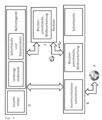
- zeigt einen schematischen Überblick über das Gesamtsystem.
- Fig. 2
- zeigt exemplarisch eine Möglichkeit für die Ermittlung von lichttechnischen Parametern.
- Fig. 3
- zeigt schematisch ein mobiles Gerät.
- Fig. 4
- zeigt eine exemplarische Messanordnung.
- Fig. 5
- zeigt schematisch eine Ausführungsform des Gesamtsystems.
- Gemäß der Erfindung, wie sie in
Fig. 1 gezeigt ist, wird nun das Licht einer künstlichen Lichtquelle als Leuchtmittel 22 direkt, d.h. in Sichtverbindung mit dem Lichtaustritt des Leuchtmittels 22, mit einem mobilen Gerät 10 erfasst, wodurch gewährleistet wird, dass Umgebungseinflüsse besser ermittelt und berücksichtigt werden können, als bei einer Messung nach dem indirekten Prinzip. - Das beschriebene System ermöglicht somit eine energieeffiziente Lichtsteuerung/-Regelung, die es auch ermöglicht, eine Lichtsteuerung/-Regelung nach physiologischen Kriterien durchzuführen. Zudem erlaubt es das mobile Gerät 10 Betriebsgeräte bzw. Leuchten vereinfacht in Betrieb zu nehmen.
- So wird es beispielsweise ermöglicht, je nach Jahreszeit mehr oder weniger Blauanteil dem Lichtspektrum des abgestrahlten Lichts beizumischen, um das Wohlbefinden eines Benutzers zu erhöhen. Die Lichtsteuerung/-Regelung erfolgt gemäß der Erfindung vorzugsweise durch eine Veränderung von Konfigurationsparametern in einer Steuereinheit einer Leuchte bzw. einem Betriebsgerät 20 für ein Leuchtmittel/ eine Lichtquelle bzw. durch eine Übertragung 30 von wenigstens einem Konfigurationsparametersatz mit wenigstens einem Konfigurationsparameter. Im Folgenden werden die Begriffe Steuereinheit und Betriebsgerät 20 synonym verwendet. Weiter kann ein Betriebsgerät 20 insbesondere in einer Leuchte angeordnet sein und ein Leuchtmittel/eine Lichtquelle 22 betreiben.
- Das mobile Gerät 10 nach der Erfindung weist wenigstens einen optischen Sensor 12 (beispielsweise wenigstens eine Kamera und/oder einen Lichtsensor) auf. Insbesondere weist das mobile Gerät 10 zwei optische Sensoren 12, 13 auf, die auf unterschiedlichen Seiten des mobilen Geräts angeordnet sind. Über die an dem mobilen Gerät 10 angeordneten ersten und zweiten optischen Sensoren 12, 13 kann durch das mobile Gerät 10 mindestens ein lichttechnischer Parameter 31 einer Lichtquelle erfasst und/oder gemessen werden.
- Das mobile Gerät 10 weist weiter eine Schnittstelle 11, insbesondere einen drahtlosen Rückkanal, auf, mit der das mobile Gerät 10 mit der Steuereinheit, z.B. dem Betriebsgerät 20 für ein Leuchtmittel (der Lichtquelle) 22 kommunizieren kann, von der wenigstens ein lichttechnischer Parameter 31 erfasst wurde.
- Ein Benutzer kann über eine Benutzerschnittstelle 14 an dem mobilen Gerät 10, beispielsweise über einen auf einem berührungsempfindlichen Eingabefeld (Touchscreen) dargestellten Regler, wenigstens einen lichttechnischen Parameter 31 verändern oder einstellen. Die gewünschten Einstellungen werden dann vorzugsweise drahtlos zu dem Betriebsgerät 20 bzw. einer Schnittstelle davon übertragen.
- Für die Ermittlung des wenigstens einen lichttechnischen Parameters 31 kann in dem mobilen Gerät 10 eine Bildverarbeitung durchgeführt werden, die sich beispielsweise einen in dem mobilen Gerät 10 vorgesehenen Prozessor 15, einen Graphikprozessor 16 und/oder einen Speicher 17 zunutze macht. Durch die Bildverarbeitung 18 können beispielsweise aus einem durch eine Kamera (als optischer Sensor) erfassten Bild lichttechnische Parameter 31 extrahiert und/oder berechnet werden. Dies ist in
Fig. 2 schematisch gezeigt, in der exemplarisch eine Möglichkeit für die Ermittlung wenigstens eines lichttechnischen Parameters mit Bildverarbeitung 18 gezeigt ist. Dabei können sowohl von dem ersten optischen Sensor 12 als auch (zusätzlich oder alternativ) von dem zweiten optischen Sensor 13 empfangene Informationen verarbeitet werden, um den lichttechnischen Parameter 31 oder einen weiteren (lichttechnischen) Parameter zu bestimmen oder zu berechnen. Beispielsweise handelt es sich dabei um ein Mobiltelefon (Smartphone) mit einer Kamera an der Vorderseite, womit diese erste Kamera den ersten optischen Sensor 12 bildet, sowie einer zweiten Kamera, die den zweiten optischen Sensor 13 bildet. Das von der Kamera erfasste Bild kann auch die Auswertung eines oder mehrerer Bilder eines von der Kamera aufgezeichneten Videos umfassen. Ein optischer Sensor 12, 13 kann selbstverständlich auch dazu eingerichtet sein, einen lichttechnischen Parameter direkt, d.h. ohne Bildverarbeitung 18, zu ermitteln, z.B. als ein Lichtsensor, der direkt einen Helligkeitswert ausgibt. Beispielsweise können so ein Helligkeitswert, eine Lichtfarbe, eine Farbtemperatur, Farbanteile des Lichtspektrums des abgegebenen Lichts und/oder andere Licht-Merkmale bestimmt werden. - Wieder mit Blick auf
Fig. 1 , lässt sich insbesondere durch auf unterschiedlichen Seiten des mobilen Geräts 10 angebrachte optische Sensoren 12, 13 gleichzeitig das von dem Lichtquelle 22 abgestrahlte Licht (durch einen ersten optischen Sensor 12) und ein von einem Objekt 40 reflektiertes Licht (durch einen zweiten optischen Sensor 13) erfassen. So ist es beispielsweise möglich über den ersten optischen Sensor 12 von einer Deckenlampe abgestrahltes Licht zu analysieren und über den gegenüberliegenden zweiten optischen Sensor 13 das von einem Objekt 40, z.B. einer Tischplatte, reflektierte und/oder abgestrahlte Licht aufzunehmen, zu analysieren und ggf. auch daraus einen lichttechnischen Parameter 32 zu ermitteln und/oder einen bereits ermittelten lichttechnischen Parameter zu verändern (wie dies auch beim Beispiel derFig. 4 erläutert wird). - Auf Grundlage der ermittelten lichttechnischen Parameter 31, 32 kann dann dem Benutzer beispielsweise eine Konfiguration für das Betriebsgerät 20 vorgeschlagen werden, die dann entweder in Form von Konfigurationsparametern an das Betriebsgerät 20 für das Leuchtmittel übermittelt 30 wird, oder vom Benutzer vorher über die Benutzerschnittstelle 14 verändert werden kann.
- Ein optischer Sensor 12, 13 kann auch dafür vorgesehen sein, Oberflächeninformationen eines Objekts 40 aufzunehmen. Aus den aufgenommenen Oberflächeninformationen kann dann ein Parameter ermittelt werden, und beispielsweise mit Daten einer Tabelle und/oder Datenbank 117 verglichen werden. Ein solcher Vergleich kann selbstverständlich auch für ermittelte lichttechnische Parameter 31, 32 erfolgen.
- Die Konfiguration des Betriebsgeräts 20 bzw. der Steuereinheit kann dann basierend auf Informationen, die sich aus einem Vergleich des Parameters mit der Tabelle oder Datenbank ergeben, beeinflusst oder verändert werden. Insbesondere kann so zu einem Parameter wenigstens ein Konfigurationsparameter ermittelt werden, der verwendet wird um die Konfiguration des Betriebsgeräts 20 zu verändern. Die Tabelle/Datenbank 117 kann vorzugsweise in dem mobilen Gerät 10 in dem Speicher 17 vorgehalten werden, und beispielweise Teil eines Konfigurationsprogramms sein, das auf dem mobilen Gerät, z.B. zusammen mit der Bildverarbeitung 18 und/oder der Benutzerschnittstelle 14 ausgeführt wird.
- Das mobile Gerät 10 kann auch einen Identifikator, beispielsweise eine eindeutige, vom Hersteller vorgegebene Adresse oder eine zufällig vergebene Adresse, aus dem Betriebsgerät 20 auslesen. Dieser Identifikator kann dann beispielsweise zusammen mit einer Konfiguration für das Betriebsgerät 20 in dem mobilen Gerät 10 gespeichert werden.
- Die Informationsübertragung, d.h. die Übertragung 30 der Konfigurationsparameter von und/oder zu dem mobilen Gerät 10, bzw. dem Betriebsgerät 20, erfolgt vorzugsweise drahtlos, z.B. über Infrarot, sichtbares Licht, Bluetooth, ANT, Zigbee,.... Sie kann jedoch auch drahtgebunden erfolgen, z.B. über USB, Ethernet etc., wobei das mobile Gerät 10 mit dem Betriebsgerät 20 bzw. der Schnittstelle 21 des Betriebsgeräts 20 verbunden ist. Die drahtlose Informationsübertragung, d.h. die Übertragung 30 der Konfigurationsparameter von dem Betriebsgerät 20 zu dem mobilen Gerät 10 kann bei einer Übertragung mittels Infrarot oder sichtbarem Licht auch über das Leuchtmittel 22 und die Schnittstelle 31 erfolgen (also das abgestrahlte Licht), wobei in diesem Fall die Schnittstelle 21 des Betriebsgeräts 20 zum Senden von Informationen an das mobile Gerät 10 mit der durch das Leuchtmittel 22 gebildet werden kann. In einem derartigen Fall kann das Betriebsgerät 20 zusätzlich weiterhin eine Schnittstelle 21 aufweisen, die zum Empfang von dem mobilen Gerät 10 über dessen Schnittstelle 11 ausgesendeten Daten / Informationen dienen kann. Der Empfang der Übertragung 30 der Konfigurationsparameter von dem Betriebsgerät 20 über die Lichtquelle 22 zu dem mobilen Gerät 10 kann bei einer Übertragung mittels Infrarot oder sichtbarem Licht durch einen optischen Sensor 12 oder 13 des mobilen Gerätes 10 erfolgen.
- Im Falle einer Übertragung 30 der Konfigurationsparameter von dem Betriebsgerät 20 über das Leuchtmittel 22 zu dem mobilen Gerät 10 kann bei einer Übertragung mittels Infrarot oder sichtbarem Licht kann die Übertragung 30 durch Änderung eines lichttechnischen Parameters 31 erfolgen, wobei dieser lichttechnische Parameter 31 durch einen optischen Sensor 12 oder 13 des mobilen Gerätes 10 erfasst wird und beispielsweise mittels der Bildverarbeitung 18 intern im mobilen Gerät 10 ausgewertet wird. So ist es beispielsweise möglich, dass Auslesen eines Identifikators, beispielsweise einer eindeutigen, vom Hersteller vorgegebene Adresse oder einer zufällig vergebenen Adresse, aus dem Betriebsgerät 20 durch das mobile Gerät 10 mittels eines optischen Sensors 12 oder 13 erfolgt. So kann beispielsweise durch die Kamera 1 oder die Kamera 3 das von dem Leuchtmittel 22 abgestrahlte Licht aufgezeichnet und durch das mobile Gerät 10, vorzugsweise mittels der Bildverarbeitung 18, ausgewertet werden. Es wäre dabei möglich, dass das Betriebsgerät 20 das von dem Leuchtmittel 22 abgestrahlte Licht im Infrarot oder sichtbaren Bereich moduliert und mittels dieser Modulation den Konfigurationsparameter, vorzugsweise den Identifikator, als Information überträgt. Der optische Sensor 12 oder 13, der beispielsweise durch die Kamera 1 oder die Kamera 3 gebildet wird, kann das von dem Leuchtmittel 22 abgestrahlte Licht aufzeichnen. Die Folge der aufgezeichneten Bilder können durch das mobile Gerät 10 direkt, vorzugsweise mittels der Bildverarbeitung 18, oder indirekt, mittels einer Weiterleitung der aufgezeichneten Bilder zur Auswertung auf einer Zentraleinheit, ausgewertet werden, wobei der Konfigurationsparameter, vorzugsweise Identifikator, als moduliertes Signal erkannt und ausgewertet werden kann.
- Auf diese Weise ist eine Übermittlung eines Identifikators vom Betriebsgerät 20 über das Leuchtmittel 22 durch Änderung eines lichttechnischen Parameters zu dem mobilen Gerät 10 möglich, wobei der optische Sensor 12 oder 13 zum Empfang des Identifikators genutzt wird. Der Identifikator kann wie bereits erwähnt beispielsweise eine eindeutige, vom Hersteller vorgegebene Adresse sein, die vom Hersteller in dem Betriebsgerät 20, vorzugsweise in dem Speicher 23, abgelegt ist. Der Identifikator kann auch eine zufällig vergebenen Adresse oder eine von einem Steuergerät über den Betriebsgerätebus 24 vorgegebene Adresse sein. Eine Zuweisung der Adresse kann beispielsweise derart erfolgen, dass beispielsweise über den Betriebsgerätebus 24 oder aber über das mobile Gerät 10 über die Übertragung 30 das Betriebsgerät 20 aufgefordert wird, seine Adresse als Konfigurationsparameter zu übertragen. Im Falle einer vom Hersteller vorgegebenen Adresse kann diese direkt ausgegeben werden. Wenn noch keine Adresse im Betriebsgerät 20 abgelegt ist, dann kann das Betriebsgerät 20 beispielsweise selbstständig per Zufallszahl eine Adresse ermitteln oder aber nach Anfrage von einer Zentraleinheit über den Betriebsgerätebus 24 zugewiesen erhalten. In weiterer Folge kann wie bereits erläutert das Betriebsgerät 20 einen lichttechnischen Parameter der Lichtquelle 22 derart ändern, dass diese Änderung durch das mobile Gerät 10 mittels des optischen Sensors 12 oder 13 erfasst und ausgewertet werden kann.
- Es ist auch möglich, dass verschiedene Konfigurationsparameter, also nicht nur ein Identifikator, sondern beispielsweise auch allgemeine Informationen für den Benutzer (Preisinformation in einem Supermarkt, wobei beispielsweise jedes Leuchtmittel einem Produkt zugeordnet ist oder Werbebotschaften an den Benutzer) oder Statusinformationen wie Informationen über die bisherige Betriebsdauer des Betriebsgerätes 20 oder des Leuchtmittels 22, Informationen über das Leuchtmittel 22 wie beispielsweise der Typ oder die Leistung oder aufgetretene Fehler des Betriebsgerätes 20 oder des Leuchtmittels 22 über einen lichttechnischen Parameter 31 mittels des Leuchtmittels 22 ausgegeben werden und vom mobilen Gerät 10 mittels der optischen Sensoren 12, 13 erfasst werden. Grundsätzlich ist durch die Änderung eines lichttechnischen Parameters 31 eine Informationsübertragung von dem Betriebsgerät 20 über das Leuchtmittel 22 zu dem mobilen Gerät 10 möglich, wobei das mobile Gerät 10 einen optischen Sensor 12, 13 zum Empfang der übertragenen Information nutzen kann.
- Die Änderung eines lichttechnischen Parameters 31 zur Übertragung einer Information kann beispielsweise durch eine Modulation der Helligkeit des Leuchtmittels 22 oder durch eine wiederholte Änderung der Farbe des Leuchtmittels 22 erfolgen.
- Es ist ebenfalls möglich, dass das mobile Gerät 10 zunächst Daten zu einem externen Speicher 50, beispielsweise über eine Kommunikationsschnittstelle 19 übermittelt, von dem aus dann die Konfigurationsparameter zu dem Betriebsgerät 20, bzw. der Steuereinheit, übertragen werden. Dieser externe Speicher kann auch ein Rechner sein, beispielswiese ein PC.
- Weiterhin kann der Identifikator zunächst aus dem Betriebsgerät 20, bzw. der Steuereinheit ausgelesen werden, um das Betriebsgerät 20 zu adressieren, bzw. der herstellerseitigen Adresse eine Position zuzuordnen. Das mobile Gerät 10 kann daher eine Lokalisierungseinheit 110 aufweisen, beispielsweise einen Höhenmesser, GPS, einen Kompass, einen Beschleunigungssensor, einen Funkempfänger und/oder einen Infrarotempfänger, die dazu dient, absolute und/oder relative Positionsdaten zu ermitteln. Ein Beispiel für die Ermittlung solcher Positionsdaten ist in der
DE 10 2010 003 949 A1 beschrieben. - Nachdem das mobile Gerät 10 eine absolute und/oder relative Position ermittelt hat, kann es diese Position zu dem Betriebsgerät 20 übertragen 30, das dann die Position speichert und ggf. an eine Zentraleinheit über einen Betriebsgerätebus 24 übermittelt.
- Über den Identifikator und/oder die Position eines Betriebsgeräts 20 für Leuchtmittel kann das mobile Gerät 10 auch automatisch vorbestimmte Konfigurationsparameter zu dem Betriebsgerät 20 übermitteln. Dies kann beispielsweise dann der erfolgen, wenn ein Benutzer bereits einen Konfigurationsparametersatz für eine bestimmte Situation, Zeit oder Position angegeben hat oder allgemein für das Betriebsgerät 20 einen Konfigurationsparametersatz hinterlegt hat.
- Empfängt das mobile Gerät 10 den Identifikator des Betriebsgeräts 20, so kann es automatisch den vorbestimmten oder hinterlegten wenigstens einen Konfigurationsparametersatz mit wenigstens einem Konfigurationsparameter zu dem Betriebsgerät 20 übertragen.
- Das kann, wie gesagt, auch abhängig von der Position geschehen. Beispielsweise kann ein Bereich um die Position des Betriebsgeräts 20 definiert sein. Das mobile Gerät 10 kann dann bei Eintritt in diesen Bereich die entsprechende Konfiguration an das Betriebsgerät 20 übermitteln. Es ist natürlich auch möglich, dass das mobile Gerät 10 zunächst den Benutzer darüber informiert, dass zu einem Betriebsgerät 20 zumindest eine Konfigurationsparametersatz vorliegt, der aufgrund eines Ereignisses (z.B. Eintritt in den Bereich) aktiviert werden kann. Beim Vorliegen mehrerer Konfigurationsparametersätze können diese dann dem Benutzer zur Auswahl angezeigt werden. Der Benutzer ist dann in der Lage einen vorgeschlagenen Konfigurationsparametersatz zu verändern, oder die Übertragung zu dem Betriebsgerät 20 anzustoßen.
- Es kann auch vorgesehen sein, dass in dem Betriebsgerät 20 bereits wenigstens ein Konfigurationsparametersatz, z.B. in einem Speicher 23, hinterlegt ist, der zu dem mobilen Gerät 10 übertragen wird, wenn dieses in einen Bereich um das Betriebsgerät 20 eintritt.
- Dieser Bereich kann z.B. dadurch definiert sein, dass eine Position für das Betriebsgerät 20 festgelegt und das Betriebsgerät 20 so eingerichtet ist, dass zumindest eine Konfiguration aktiv zu dem mobilen Gerät 10 übermittelt werden kann, wenn dieses in den Bereich um das Betriebsgerät 20 eintritt. Weiter kann der Bereich um das Betriebsgerät 20 durch eine Reichweite eines in dem Betriebsgerät 20 vorgesehenen Senders definiert sein (z.B. einer Bluetooth-Kommunikationseinheit). Ist das mobile Gerät 10 in Empfangsreichweite, so wird der wenigstens eine Konfigurationsparametersatz übertragen. Durch das mobile Gerät 10 kann dieser Konfigurationsparametersatz dann dem Benutzer angezeigt werden und von diesem ggf. verändert werden.
- Werden mehrere Konfigurationsparametersätze von dem Betriebsgerät 20 zu dem mobilen Gerät 10 übertragen, so können diese beispielsweise sortiert dargestellt werden, wobei die Sortierung nach einer Häufigkeit der Konfigurationsparametersatzbenutzung erfolgen kann. Dazu kann das Betriebsgerät 20 registrieren (z.B. in dem Speicher 23), wie oft eine Konfiguration in Form eines Konfigurationsparametersatzes mit wenigstens einem Konfigurationsparameter verwendet wird und/oder als Basis für eine Konfigurationsänderung dient. Für den Benutzer ist es dadurch beispielsweise leicht möglich, auf z.B. von anderen Benutzern häufig benutzte Konfigurationen zurückzugreifen und damit schneller zu einer vorteilhaften Konfiguration zu gelangen.
- Weiter kann das mobile Gerät 10 über die Kommunikationsschnittstelle 19 von einem externen Speicher 50, z.B. einen Netzwerkspeicher, Daten empfangen. Diese Daten können beispielsweise Temperatur- und/oder Zeitinformationen sein. Auch ist es möglich, dass von dem externen Speicher 50 Konfigurationen für ein oder mehrere Betriebsgeräte zu dem mobilen Gerät 10 übertragen werden. Dadurch ist es z.B. möglich, von anderen Benutzern erstellte Konfigurationen auf das mobile Gerät 10 zu übertragen, diese Konfiguration zu verändern und/oder zu benutzen und zu dem Betriebsgerät 20 zu übertragen. Die Daten können auch in die Tabelle/Datenbank 117 übertragen werden, die z.B. für Vergleiche mit lichttechnischen Parametern 31, 32 verwendet wird (siehe oben).
- Das mobile Gerät 10 kann auf Basis der zugeführten Daten, beispielsweise der Temperatur- und/oder Zeitinformationen, auch dem Benutzer Konfigurationsparameteränderungen vorschlagen oder automatisch an das Betriebsgerät 20 übermitteln 30. Zu diesem Zweck kann das mobile Gerät 10 ein Auswertungsprogramm ausführen, das beispielsweise abhängig von einer Zeitinformation eine zu einer Jahreszeit passende Konfiguration erstellt, durch die die Lichtparameter des von dem Leuchtmittel abgegebenen Lichts verändert werden.
- Über die Kommunikationsschnittstelle 19 des mobilen Geräts 10 ist es weiter ebenfalls möglich auf dem mobilen Gerät 10 erstellte Konfigurationen, bzw. von dem Betriebsgerät 20 ermittelte Konfigurationen, auf einen externen Speicher 50 zu übertragen. So können beispielsweise auch eine herstellerseitige Adresse des Betriebsgeräts 20 zusammen mit Positionsdaten auf den externen Speicher übertragen werden.
- Über die Kommunikationsschnittstelle 19 können weiter Teile der Benutzerschnittstelle 14, bzw. die Benutzerschnittstelle 14 selbst, auf das mobile Gerät 10 übertragen werden. Im Besonderen können die Benutzerschnittstelle 14, die Konfigurationssoftware und/oder die Bildverarbeitung 18, die auf dem mobilen Gerät 10 ausgeführt wird, verändert und/oder erneuert werden. Die Benutzerschnittstelle 14 bzw. Teile davon können beispielsweise in Form von Anwendungsdaten ("Apps") zu dem mobilen Gerät 10 übertragen werden.
- In einer Ausführungsform ist das mobile Gerät 10 ein mobiles Kommunikationsendgerät, z.B. ein Handy (Mobiltelefon), ein Smartphone (als spezielle Form eines Mobiltelefons), ein Tablet-Computer (PC), ein Laptop-Computer, etc.
- Es wird somit auch ein Verfahren zur Konfiguration eines Betriebsgeräts 20 zum Betrieb eines Leuchtmittels 22 ermöglicht, wobei ein mobiles Kommunikationsgerät mittels wenigstens eines optischen Sensors 12,13 lichttechnische Parameter, z.B. über eine Geräteinterne Bildverarbeitung 18, erfasst. Das Betriebsgerät 20 sendet durch Modulation des Leuchtmittels 22 eine Adresse aus. Das Betriebsgerät 20 kann beispielsweise durch eine hochfrequente Modulation des von dem Leuchtmittel 22 abgestrahlten Lichtes eine Adresse als ein Beispiel eines Konfigurationsparameters übertragen. Das mobile Kommunikationsgerät erkennt insbesondere über den optischen Sensor 12,13, z.B. mit Hilfe einer Geräteinterne Bildverarbeitung 18, auf Basis der erfassten lichttechnischen Parameter die vom Betriebsgerät 20 ausgesendete Adresse. Die hochfrequente Modulation des Lichtes des Leuchtmittels 22 muß dabei für den Benutzer nicht wahrnehmbar sein, mittels des optischen Sensors 12,13 kann sie jedoch aufgezeichnet und dann durch das mobile Kommunikationsgerät ausgewertet werden.
- Das Betriebsgerät 20 zum Betrieb des Leuchtmittels (Lichtquelle 22) weist eine zu der Schnittstelle im mobilen Gerät 10 korrespondierende Schnittstelle 21 auf. Insbesondere nimmt das Betriebsgerät 20 über die Schnittstelle 21 Konfigurationsparameter entgegen und speichert diese in dem in dem Betriebsgerät 20 vorgesehenen Speicher 23 und beeinflusst abhängig von den empfangenen Konfigurationsparametern die Lichtwiedergabe des Leuchtmittels. Die Schnittstelle 21 ist dabei dazu vorgesehen, Konfigurationsparameter von dem Betriebsgerät 20 zu dem mobilen Gerät 10 zu übertragen.
- Das Betriebsgerät 20 kann insbesondere ein Anzahl von Konfigurationsparametersätzen mit wenigstens einem Konfigurationsparameter und beispielsweise auch die Häufigkeit, mit der ein Konfigurationsparametersatz von einem mobilen Gerät 10 ausgewählt oder verwendet wird, speichern.
- Insbesondere ist das Betriebsgerät 20 dazu eingerichtet, eine Position in Abhängigkeit zur herstellerseitig vorgegebenen Adresse zu speichern.
- Das Betriebsgerät 20 kann dabei in einer Leuchte vorgesehen sein und eine Busschnittstelle zur Kommunikation mit einer zentralen Einheit, beispielsweise nach dem DALI- oder dem Power Line-Standard, aufweisen. Es ist dabei möglich, dass die Konfigurationsparameter, die die lichttechnischen Parameter des Leuchtmittels 22 bzw. der Lichtquelle verändern, über einen Rechner, z.B. einem PC, zu dem Betriebsgerät 20 übertragen werden.
- Erfindungsgemäß ist ebenfalls ein Konfigurationssystem vorgesehen, das ein mobiles Gerät 10 und ein Betriebsgerät, wie sie oben beschrieben sind, verwendet.
- Die
Fig. 3 zeigt beispielhaft das mobile Gerät 10. DieFig. 3a zeigt dabei eine Vorderseite des mobilen Gerätes 10, währendFig. 3b eine Rückseite des mobilen Gerätes 10 zeigt. - In dem dargestellten Beispiel weist das mobile Gerät 10 auf der Vorderseite eine Kamera 1 und einen Lichtsensor 2 auf, während auf der anderen Seite des mobilen Gerätes eine Kamera 3 angeordnet ist. Dieses in
Fig. 3 dargestellte mobile Gerät 10 zeigt beispielhaft wie das in denFig. 1 undFig. 2 dargestellte mobile Gerät 10 nach außen hin aussehen kann. Der erste optische Sensor 12 kann wie bereits erwähnt durch eine Kamera 1 gebildet werden, während der zweite optische Sensor 13 durch einen Lichtsensor 2 gebildet werden kann. Alternativ könnte beispielsweise auch der zweite optische Sensor 13 durch eine zweite Kamera auf der Rückseite des mobilen Gerätes 10 gebildet werden. - Die
Fig. 4 zeigt eine exemplarische Anordnung des mobilen Gerätes 10 zur Erfassung lichttechnischer Parameter. Dabei nimmt das Gerät 10 Licht von einem Leuchtmittel 22, beispielsweise über die Kamera 1 (als ersten optischen Sensor 12) oder den Lichtsensor 2 (als zweiten optischen Sensor 13), und gleichzeitig von einem Tisch 41 reflektiertes Licht auf, beispielsweise über die Kamera 3. Schematisch ist ebenfalls die Kommunikation zwischen einer Schnittstelle 11 des mobilen Gerätes 10 und einer Schnittstelle 21 eines Betriebsgeräts 20 für den Betrieb des Leuchtmittels 22 gezeigt. Das mobile Gerät 10 kann auch das Umgebungslicht erfassen, bspw. kann durch zwischenzeitliches Ändern der Helligkeit oder vorzugsweise kurzzeitiges Abschalten des Leuchtmittels 22 auf das Umgebungslicht geschlossen werden. - In
Fig. 5 ist schematisch das erfindungsgemäße Verfahren gezeigt. Eine Leuchte D sendet einen Lichtstrom aus, welcher über das mobile Gerät B erfasst wird. - Der Lichtstrom kann durch den wenigstens einen optischen Sensor erfasst und ausgewertet werden. Das mobile Gerät B kann entweder die Leuchte, bzw. ein darin vorhandenes Betriebsgerät, durch Veränderung von Konfigurationsparametern direkt steuern, oder Konfigurationsparametern zunächst zu einem Rechner, z.B. einem PC, übertragen, von dem aus dann die Konfigurationsparameter zu der Leuchte D übertragen werden.
- Durch einen Netzwerkanschluss des mobilen Gerätes B kann zudem eine Vernetzung relevanter Daten, z.B. der Konfigurationsparameter, erfolgen und andere Daten, wie z.B. eine Umgebungstemperatur oder die Jahreszeit, können bei der Konfiguration berücksichtigt werden.
- Bei mehreren vorhandenen optischen Sensoren, beispielsweise bei zwei Kameras 1,3, ist die gleichzeitige Erfassung mehrerer lichttechnischer Parameter möglich, z.B. die Erfassung von Lichtstrom-Parametern, die Erfassung von Eigenschaften eines Objekts als Objekt-Parameter, z.B. betreffend eine Objektoberflächeneigenschaft, und/oder die Erfassung von Auflagefläche-Parametern.
- Zusammengefasst lassen sich die Vorteile der Erfindung wie folgt charakterisieren: Das mobile Gerät 10 erfasst mindestens einen lichttechnischen Parameter (z.B. einer Bestrahlungsstärke, eine Farbtemperatur, eine Farbe ...) direkt am gewünschten Ort und regelt/steuert das Leuchtmittel 22 beispielsweise über einen hinterlegten Algorithmus durch Veränderung der Konfigurationsparameter in dem Betriebsgerät. Dadurch können Fehlerquellen, z.B. Störquellen, die aus einer Beschaffenheit bzw. Farbe eines Objekts resultieren, aber beispielsweise auch vorgeschaltete oder verdeckte Leuchtengläser, bei der Konfiguration des Betriebsgerätes berücksichtigt werden.
- Diese Daten können über eine Netzanbindung, z.B. über eine Internetanbindung des mobilen Gerätes, ausgetauscht und bei der Konfiguration berücksichtigt und verwendet werden.
- Beispielsweise kann eine Außentemperatur ermittelt werden, und automatisch eine Farbmischung durch eine Konfigurationsparameterveränderung geändert werden, um ein anderes Licht zu erzeugen. Ein anderes Beispiel ist die Veränderung des Blauanteils in dem von dem Leuchtmittel 22 abgegebenen Licht. Der Blauanteil kann z.B. jahreszeitabhängig verändert werden, um beispielsweise einen angenehmeren Lichteindruck hervorzurufen.
- Schließlich kann die Energieeffizienz gesteigert werden, da beispielsweise die Lichtabgabe durch die Veränderung der Konfigurationsparameter an Oberflächenmerkmale, beispielsweise schwarze oder dunkle bzw. weiße oder helle Tischoberflächen, angepasst werden kann.
- Die Inbetriebnahme von Leuchten, bzw. Betriebsgeräten, ist ebenfalls vereinfacht, da durch die Lokalisierungseinheit in dem mobilen Gerät 10 eine Position ermittelt werden kann, die dann zu dem Betriebsgerät 20 übermittelt werden kann. Dabei kann der Höhenmesser für eine Stockwerkserfassung genutzt werden, während GPS, Kompass und Beschleunigungssensor sowie der optische Sensor für die Positionserfassung ausgewertet werden können.
- Auch kann ausgehend von einem Referenzpunkt und einer Ermittlung einer relativen Position dazu die Position des mobilen Gerätes und so auch die Position der Leuchte, bzw. des entsprechenden Betriebsgerätes, ermittelt werden. Auch eine drahtlose Kommunikationsschnittstelle des mobilen Gerätes, beispielsweise ein GSM-Modul oder ein WLAN-Modul, kann die Positionsfindung durch die Ermittlung von Sendemast-Positionen (als fixe Referenzpunkte) und/ oder Laufzeitmessungen unterstützen. Eine derartige Positionsfindung kann beispielsweise mit Hilfe einer Zentraleinheit erfolgen, wo beispielsweise eine echtzeittaugliche Software auf einem Zentralcomputer läuft, und anhand der übermittelten Laufzeitmessungen und Informationen zu Abstand und Richtung zu den fixen Referenzpunkten eine Positionsfindung durchführt. Die ermittelte Position kann von der Zentraleinheit an das mobile Gerät 10 und / oder Betriebsgerät übermittelt werden.
- Die Positionsfindung kann zusätzlich oder alternativ auch anhand der Auswertung von mittels der Kamera 1 (als ersten optischen Sensor 12) aufgenommener Bilder erfolgen. Dabei kann mittels der Kamera 1 ein Bild der zu erkennenden Leucht mit dem Betriebsgerät 20 und dem Leuchtmittel 22 aufgezeichnet werden, wobei auf diesem Bild die Leuchte und deren Umgebung aufgenommen werden. Dieses aufgenommene Bild kann anhand eines Vergleichs mit Referenzbildern zur Positionsfindung genutzt werden, beispielsweise durch ein Erkennen von markanten Punkten an der Leuchte oder der Umgebung oder auch mittels eines beispielsweise auf der Leuchte aufgebrachten Identifikationscodes (kann beispielsweise ein Strichcode sein). Eine derartige Auswertung der Bilder kann beispielsweise auf dem mobilen Gerät 10 (insbesondere mittels der Bildverarbeitung 18) oder auch auf einer Zentraleinheit (einem Computer), wobei in diesem Fall die Bilder und die Ergebnisse der Auswertung über die Kommunikationsschnittstelle 19 übertragen werden, erfolgen.
- Konfigurationsparameter und Positionsdaten können auch in dem mobilen Gerät 10 gespeichert sein und erst bei Verbindung mit einem anderen Rechner, bzw. bei Anschluss des mobilen Gerätes an einen Betriebsgerätebus, zu einer Zentraleinheit übermittelt werden. Die vorliegende Erfindung kann auch dazu verwendet werden, um natürliches Umgebungslicht in die Leuchtmittelkonfiguration einzubeziehen, bzw. abhängig von der Position des mobilen Gerätes Leuchtmittel zu aktivieren und/oder zu deaktivieren.
Claims (12)
- Mobiles Gerät (10) zur Konfiguration wenigstens eines Betriebsgeräts (20) zum Betrieb eines Leuchtmittels (22),wobei das mobile Gerät (10) wenigstens einen optischen Sensor (12,13) aufweist, der vorgesehen ist, lichttechnische Parameter, z.B. über eine geräteinterne Bildverarbeitung (18), zu erfassen, und wobei das mobile Gerät (10) dazu eingerichtet ist, über den optischen Sensor (12,13) einen Konfigurationsparameter von dem Betriebsgerät (20) zu empfangen, wobei der Konfigurationsparameter auf Basis der erfassten lichttechnischen Parameter durch das mobile Gerät (10) ermittelt wird,wobei das mobile Gerät (10) dazu eingerichtet ist, als Konfigurationsparameter einen Identifikator, vorzugsweise eine Adresse, von dem Betriebsgerät (20) auszulesen und zu speichern,wobei das mobile Gerät (10) dazu eingerichtet ist, das Betriebsgerät (20) mittels des Identifikators automatisch zu erkennen und den Identifikator über eine Benutzerschnittstelle (14) oder eine Schnittstelle (11) und/oder Kommunikationsschnittstelle (19) auszugeben,wobei das mobile Gerät (10) dazu eingerichtet ist, bei der Ausgabe des Identifikators gleichzeitig Positionsdaten zu dem Betriebsgerät (20) und/oder einer das Betriebsgerät (20) aufweisenden Leuchte auszugeben und zu speichern,wobei das mobile Gerät (10) dazu eingerichtet ist, die Konfigurationsparameter an das Betriebsgerät (20) oder die Leuchte zu übertragen,dadurch gekennzeichnet, dassdas mobile Gerät weiter dazu ausgelegt ist, mittels der Benutzerschnittstelle (14) Konfigurationsparameter in Abhängigkeit von den erfassten lichttechnischen Parametern und/oder den Positionsdaten auf eine Benutzerinteraktion hin zu verändern, und dass das mobile Gerät (10) weiter dazu eingerichtet ist, vorbestimmte Konfigurationsparameter automatisch und/oder auf eine Benutzerinteraktion hin zu dem Betriebsgerät (20) zu übermitteln, wenn sich das mobile Gerät (10) in einem bestimmten Abstand von dem Betriebsgerät (20) befindet.
- Mobiles Gerät (10) nach Anspruch 1, wobei der wenigstens eine optische Sensor (12, 13) ein Lichtsensor (3), ein Bildsensor und/oder eine Kamera (1) ist und wobei der optische Sensor (12, 13) dazu eingerichtet ist, lichttechnische Parameter, wie z.B. eine Helligkeitsinformation, eine Bestrahlungsstärke eines Objekts, eine Oberflächeneigenschaft eines Objekts, eine Farbtemperatur, eine Farbe und/oder Lichttemperatur zu bestimmen.
- Mobiles Gerät (10) nach Anspruch 1 oder 2, wobei der Konfigurationsparameter auf Basis der erfassten lichttechnischen Parameter mittels der geräteinternen Bildverarbeitung (18) ermittelt wird.
- Mobiles Gerät (10) nach einem der vorhergehenden Ansprüche, wobei das mobile Gerät (10) dazu eingerichtet ist, das von dem Leuchtmittel (22) abgestrahlte Licht mittels des optischen Sensors (12, 13) aufzuzeichnen und mittels der geräteinternen Bildverarbeitung (18) auszuwerten.
- Mobiles Gerät (10) nach einem der vorhergehenden Ansprüche, wobei die Schnittstelle (11) und /oder die Kommunikationsschnittstelle (19) für eine drahtlose und/oder drahtgebundene Kommunikation eingerichtet ist.
- Mobiles Gerät (10) nach Anspruch 5, wobei das mobile Gerät (10) dazu eingerichtet ist, Daten zur Darstellung der Benutzerschnittstelle (14) und/oder Teilen davon, Daten zur Durchführung der Bildverarbeitung (18) und/oder Positionsdaten für wenigstens ein Betriebsgerät (20) über die Kommunikationsschnittstelle (19) zu empfangen.
- Mobiles Gerät (10) nach einem der vorhergehenden Ansprüche, wobei das mobile Gerät (10) ein mobiles Kommunikationsendgerät, z.B. ein Mobiltelefon oder Smartphone, ist.
- Konfigurationssystem mitwenigstens einem Betriebsgerät (20) zum Betrieb eines Leuchtmittels (22) undwenigstens einem mobilen Gerät (10) zur Konfiguration des wenigstens einen Betriebsgeräts (20),wobei das mobile Gerät (10) wenigstens einen optischen Sensor (12, 13) aufweist, der vorgesehen ist, lichttechnische Parameter, z.B. über eine geräteinterne Bildverarbeitung (18), zu erfassen,wobei das Betriebsgerät (20) dazu ausgelegt ist, einen Konfigurationsparameter durch Änderung eines lichttechnischen Parameters (31) des Leuchtmittels (22) zu dem mobilen Gerät (10) zu übertragen undwobei das mobile Gerät (10) dazu eingerichtet ist, auf Basis der erfassten lichttechnischen Parameter als Konfigurationsparameter einen Identifikator auszulesen,wobei das mobile Gerät (10) dazu eingerichtet ist, das Betriebsgerät (20) mittels des Identifikators automatisch zu erkennen und den Identifikator über eine Benutzerschnittstelle (14) oder eine Schnittstelle (11) und/oder Kommunikationsschnittstelle (19) auszugeben,wobei das mobile Gerät (10) dazu eingerichtet ist, bei der Ausgabe des Identifikators gleichzeitig Positionsdaten zu dem Betriebsgerät (20) und/oder einer das Betriebsgerät (20) aufweisenden Leuchte auszugeben und zu speichern, undwobei das mobile Gerät (10) weiter dazu ausgelegt ist, mittels der Benutzerschnittstelle (14) Konfigurationsparameter in Abhängigkeit von den erfassten lichttechnischen Parametern und/oder den Positionsdaten auf eine Benutzerinteraktion hin zu verändern, undwobei das mobile Gerät (10) dazu eingerichtet ist, die veränderten Konfigurationsparameter an das Betriebsgerät (20) oder die Leuchte zu übertragen, wobei das mobile Gerät (10) weiter dazu eingerichtet ist, vorbestimmte Konfigurationsparameter automatisch und/oder auf eine Benutzerinteraktion hin zu dem Betriebsgerät (20) zu übermitteln, wenn sich das mobile Gerät (10) in einem bestimmten Abstand von dem Betriebsgerät (20) befindet.
- System nach Anspruch 8, wobei das mobile Gerät (10) ein mobiles Gerät (10) nach einem der Ansprüche 1 bis 7 ist, und wobeidas Betriebsgerät (20) eine Schnittstelle (21) zur Kommunikation mit wenigstens einem mobilen Gerät (10) nach einem der Ansprüche 1 bis 7 aufweist, undwobei das Betriebsgerät (20) dazu eingerichtet ist, als Konfigurationsparameter den Identifikator, vorzugsweise eine Adresse, durch Änderung eines lichttechnischen Parameters (31) des Leuchtmittels (22) zu dem mobilen Gerät (10) zu übertragen.
- System nach Anspruch 9, wobei das Betriebsgerät (20) dazu eingerichtet ist, als Identifikator eine eindeutige, vom Hersteller vorgegebene Adresse, die vom Hersteller in dem Betriebsgerät (20), vorzugsweise in dem Speicher (23), abgelegt ist, eine zufällig vergebene Adresse oder eine von einem Steuergerät über einen Betriebsgerätebus (24) vorgegebene Adresse zu übertragen.
- Verfahren zur Konfiguration eines Betriebsgeräts (20) zum Betrieb eines Leuchtmittels (22),wobei ein mobiles Gerät (10) mittels wenigstens einem optischen Sensor (12,13) lichttechnische Parameter, z.B. über eine geräteinterne Bildverarbeitung (18), erfasst, undwobei das Betriebsgerät (20) einen Konfigurationsparameter durch Änderung eines lichttechnischen Parameters (31) des Leuchtmittels (22) aussendet, undwobei das mobile Gerät (10) insbesondere über den optischen Sensor (12,13), z.B. mit Hilfe einer geräteinterne Bildverarbeitung (18), auf Basis der erfassten lichttechnischen Parameter als Konfigurationsparameter einen Identifikator erkennt und auswertet,wobei das mobile Gerät (10) den Identifikator über eine Benutzerschnittstelle (14) oder eine Schnittstelle (11) und/oder Kommunikationsschnittstelle (19) ausgibt,wobei das mobile Gerät (10) bei der Ausgabe des Identifikators gleichzeitig Positionsdaten zu dem Betriebsgerät (20) und/oder einer das Betriebsgerät (20) aufweisenden Leuchte ausgibt und speichert, und wobei das mobile Gerät (10) mittels der Benutzerschnittstelle (14) Konfigurationsparameter in Abhängigkeit von den erfassten lichttechnischen Parametern und/oder den Positionsdaten auf eine Benutzerinteraktion hin verändert, undwobei das mobile Gerät (10) die veränderten Konfigurationsparameter an das Betriebsgerät (20) oder die Leuchte überträgtwobei das mobile Gerät (10) vorbestimmte Konfigurationsparameter automatisch und/oder auf eine Benutzerinteraktion hin zu dem Betriebsgerät (20) übermittelt, wenn sich das mobile Gerät (10) in einem bestimmten Abstand von dem Betriebsgerät (20) befindet.
- Verfahren nach Anspruch 11, wobei
das mobile Gerät (10) ein mobiles Kommunikationsgerät ist, und wobei das Betriebsgerät (20) durch Modulation des Leuchtmittels (22) als Identifikator eine Adresse aussendet, und wobei das mobile Kommunikationsgerät insbesondere über den optischen Sensor (12,13), z.B. mit Hilfe einer geräteinterne Bildverarbeitung (18), auf Basis der erfassten lichttechnischen Parameter die vom Betriebsgerät (20) ausgesendete Adresse erkennt.
Applications Claiming Priority (2)
| Application Number | Priority Date | Filing Date | Title |
|---|---|---|---|
| ATGM449/2012U AT14448U1 (de) | 2012-11-21 | 2012-11-21 | Konfiguration von Betriebsgeräten für Leuchtmittel |
| PCT/AT2013/000194 WO2014078881A2 (de) | 2012-11-21 | 2013-11-21 | Konfiguration von betriebsgeräten für leuchtmittel |
Publications (2)
| Publication Number | Publication Date |
|---|---|
| EP2923533A2 EP2923533A2 (de) | 2015-09-30 |
| EP2923533B1 true EP2923533B1 (de) | 2023-04-12 |
Family
ID=50776613
Family Applications (1)
| Application Number | Title | Priority Date | Filing Date |
|---|---|---|---|
| EP13824579.0A Active EP2923533B1 (de) | 2012-11-21 | 2013-11-21 | Konfiguration von betriebsgeräten für leuchtmittel |
Country Status (3)
| Country | Link |
|---|---|
| EP (1) | EP2923533B1 (de) |
| AT (1) | AT14448U1 (de) |
| WO (1) | WO2014078881A2 (de) |
Families Citing this family (5)
| Publication number | Priority date | Publication date | Assignee | Title |
|---|---|---|---|---|
| DE102014225706A1 (de) * | 2014-12-12 | 2016-06-16 | Fraunhofer-Gesellschaft zur Förderung der angewandten Forschung e.V. | Verfahren zur selektiven Einstellung einer gewünschten Helligkeit und/oder Farbe eines bestimmten Raumbereiches und Datenverarbeitungsvorrichtung hierzu |
| MX394030B (es) * | 2015-08-05 | 2025-03-24 | Lutron Electronics Co | Puesta en marcha y control de dispositivos de control de carga. |
| GB2562020B (en) * | 2016-12-21 | 2022-02-16 | Tridonic Gmbh & Co Kg | Commissioning of one or more installed lighting devices |
| DE102019201624A1 (de) * | 2019-02-08 | 2020-08-13 | Osram Gmbh | Verfahren zur lokalisierung einer leuchte |
| DE102019113121A1 (de) * | 2019-05-17 | 2020-11-19 | Trilux Gmbh & Co. Kg | Erfassung der räumlichen Anordnung von Komponenten eines Beleuchtungssystems und Zuordnung einer jeweiligen Betriebsadresse |
Family Cites Families (8)
| Publication number | Priority date | Publication date | Assignee | Title |
|---|---|---|---|---|
| US7856152B2 (en) * | 2005-03-23 | 2010-12-21 | Koninklijke Philips Electronics N.V. | Light condition recorder system and method |
| EP1989925A1 (de) * | 2006-02-23 | 2008-11-12 | TIR Technology LP | System und verfahren zur lichtquellenidentifikation |
| US8442403B2 (en) * | 2008-03-02 | 2013-05-14 | Lumenetix, Inc. | Lighting and control systems and methods |
| EP2753153B1 (de) | 2009-03-03 | 2018-04-11 | Philips Lighting Holding B.V. | System zur Identifizierung von persönlichen Objekten auf Lichtbasis |
| CA2757938C (en) * | 2009-04-08 | 2017-12-05 | Koninklijke Philips Electronics N.V. | Efficient address assignment in coded lighting systems |
| DE102010003949A1 (de) | 2009-04-22 | 2010-10-28 | Ledon Lighting Jennersdorf Gmbh | Abgleichsystem zum Anpassen der Lichtparameter von LED-Lichtquellen |
| DE102009056152A1 (de) * | 2009-11-27 | 2011-06-01 | Ledon Lighting Jennersdorf Gmbh | Beleuchtungsfernsteuerung |
| DE102010038792B4 (de) * | 2010-08-02 | 2024-11-07 | Tridonic Gmbh & Co Kg | Verfahren, Vorrichtung und System zur Adressierung von Betriebsgeräten für Leuchtmittel |
-
2012
- 2012-11-21 AT ATGM449/2012U patent/AT14448U1/de not_active IP Right Cessation
-
2013
- 2013-11-21 WO PCT/AT2013/000194 patent/WO2014078881A2/de not_active Ceased
- 2013-11-21 EP EP13824579.0A patent/EP2923533B1/de active Active
Also Published As
| Publication number | Publication date |
|---|---|
| EP2923533A2 (de) | 2015-09-30 |
| WO2014078881A3 (de) | 2014-07-31 |
| WO2014078881A2 (de) | 2014-05-30 |
| AT14448U1 (de) | 2015-11-15 |
Similar Documents
| Publication | Publication Date | Title |
|---|---|---|
| EP2991456B1 (de) | Konfiguration von betriebsgeräten für leuchtmittel | |
| DE112012004714B4 (de) | Lichtsteuerverfahren und dieses verwendende Beleuchtungseinrichtung | |
| DE112016003708B4 (de) | Beleuchtungsverwaltungssystem | |
| EP3274735B1 (de) | Tracking-system und verfahren zum tracken eines trägers einer mobilen kommunikationseinheit | |
| DE102018109808A1 (de) | Steuerungsparameter-einstellverfahren zur nutzung in einem beleuchtungssystem, und bedienungsendgerät | |
| EP2923533A2 (de) | Konfiguration von betriebsgeräten für leuchtmittel | |
| DE102010020960A1 (de) | Leuchte und Leuchtensteuerungssystem | |
| WO2015110414A1 (de) | Verfahren zur steuerung einer adaptiven beleuchtungsvorrichtung und beleuchtungssystem zum durchführen des verfahrens | |
| EP3412192A1 (de) | Sich selbsttätig innerhalb einer umgebung fortbewegendes fahrzeug sowie system mit einem fahrzeug und einer externen beleuchtungseinrichtung | |
| WO2015091604A1 (de) | Beleuchtungssystem mit automatischer leuchtenidentifizierung zur ortsabhängigen leuchtenkonfiguration und verfahren zum betrieb eines beleuchtungssystems | |
| EP4505210A1 (de) | Positionsbestimmung-verfahren bzw. -system für eine positionsbestimmung von gegenständen | |
| DE102014212860B4 (de) | Verfahren zur durch Gestensteuerung berührungslos erfolgenden Bedienung einer Leuchte | |
| EP3644554A1 (de) | Verfahren für eine entnahmeeinheit und zugehörige entnahmeeinheit | |
| EP2936937B1 (de) | System zum auswählen von teilnehmern eines beleuchtungssystems | |
| EP2925098B1 (de) | Leuchte ausgestaltet zur kommunikation mit mobilem gerät | |
| WO2015121460A1 (de) | Beleuchtungssystem | |
| DE102013201650A1 (de) | Verfahren und system zur erkennung einer position oder form eines leuchtelements | |
| EP3427548B1 (de) | Beleuchtungssystem mit automatischer bakenkonfiguration | |
| DE102019109182A1 (de) | Segmentierte Leuchtanzeige | |
| DE102012213038A1 (de) | Farbortdetektion | |
| DE102012218521B4 (de) | Steuerungssystem für verteilt angeordnete Lampenbetriebsgeräte, sowie Verfahren zur Inbetriebnahme des Systems | |
| EP3231258B1 (de) | Verfahren zur selektiven einstellung einer gewünschten helligkeit und/oder farbe eines bestimmten raumbereiches und datenverarbeitungsvorrichtung hierzu | |
| AT17525U1 (de) | Bewegungserfassung von Personen mittels Farbsensoren | |
| EP3493652A1 (de) | Automatische anpassung der lichtfarbe von leuchten | |
| DE102018119274A1 (de) | Beleuchtungssystem mit Sensor zur Aussendung von Lichtimpulsen |
Legal Events
| Date | Code | Title | Description |
|---|---|---|---|
| PUAI | Public reference made under article 153(3) epc to a published international application that has entered the european phase |
Free format text: ORIGINAL CODE: 0009012 |
|
| 17P | Request for examination filed |
Effective date: 20150427 |
|
| AK | Designated contracting states |
Kind code of ref document: A2 Designated state(s): AL AT BE BG CH CY CZ DE DK EE ES FI FR GB GR HR HU IE IS IT LI LT LU LV MC MK MT NL NO PL PT RO RS SE SI SK SM TR |
|
| AX | Request for extension of the european patent |
Extension state: BA ME |
|
| RIN1 | Information on inventor provided before grant (corrected) |
Inventor name: WOOD, ANTHONY JOHN |
|
| DAX | Request for extension of the european patent (deleted) | ||
| STAA | Information on the status of an ep patent application or granted ep patent |
Free format text: STATUS: EXAMINATION IS IN PROGRESS |
|
| 17Q | First examination report despatched |
Effective date: 20180131 |
|
| REG | Reference to a national code |
Ref country code: DE Ref legal event code: R079 Ref document number: 502013016367 Country of ref document: DE Free format text: PREVIOUS MAIN CLASS: H05B0037020000 Ipc: H05B0047175000 |
|
| GRAP | Despatch of communication of intention to grant a patent |
Free format text: ORIGINAL CODE: EPIDOSNIGR1 |
|
| STAA | Information on the status of an ep patent application or granted ep patent |
Free format text: STATUS: GRANT OF PATENT IS INTENDED |
|
| RIC1 | Information provided on ipc code assigned before grant |
Ipc: H05B 47/19 20200101ALI20221123BHEP Ipc: H05B 45/22 20200101ALI20221123BHEP Ipc: H05B 47/175 20200101AFI20221123BHEP |
|
| INTG | Intention to grant announced |
Effective date: 20221221 |
|
| GRAS | Grant fee paid |
Free format text: ORIGINAL CODE: EPIDOSNIGR3 |
|
| GRAA | (expected) grant |
Free format text: ORIGINAL CODE: 0009210 |
|
| STAA | Information on the status of an ep patent application or granted ep patent |
Free format text: STATUS: THE PATENT HAS BEEN GRANTED |
|
| AK | Designated contracting states |
Kind code of ref document: B1 Designated state(s): AL AT BE BG CH CY CZ DE DK EE ES FI FR GB GR HR HU IE IS IT LI LT LU LV MC MK MT NL NO PL PT RO RS SE SI SK SM TR |
|
| REG | Reference to a national code |
Ref country code: GB Ref legal event code: FG4D Free format text: NOT ENGLISH |
|
| REG | Reference to a national code |
Ref country code: CH Ref legal event code: EP |
|
| REG | Reference to a national code |
Ref country code: DE Ref legal event code: R096 Ref document number: 502013016367 Country of ref document: DE |
|
| REG | Reference to a national code |
Ref country code: DE Ref legal event code: R084 Ref document number: 502013016367 Country of ref document: DE |
|
| REG | Reference to a national code |
Ref country code: IE Ref legal event code: FG4D Free format text: LANGUAGE OF EP DOCUMENT: GERMAN |
|
| REG | Reference to a national code |
Ref country code: AT Ref legal event code: REF Ref document number: 1560514 Country of ref document: AT Kind code of ref document: T Effective date: 20230515 |
|
| P01 | Opt-out of the competence of the unified patent court (upc) registered |
Effective date: 20230530 |
|
| REG | Reference to a national code |
Ref country code: LT Ref legal event code: MG9D |
|
| REG | Reference to a national code |
Ref country code: NL Ref legal event code: MP Effective date: 20230412 |
|
| PG25 | Lapsed in a contracting state [announced via postgrant information from national office to epo] |
Ref country code: NL Free format text: LAPSE BECAUSE OF FAILURE TO SUBMIT A TRANSLATION OF THE DESCRIPTION OR TO PAY THE FEE WITHIN THE PRESCRIBED TIME-LIMIT Effective date: 20230412 |
|
| PG25 | Lapsed in a contracting state [announced via postgrant information from national office to epo] |
Ref country code: SE Free format text: LAPSE BECAUSE OF FAILURE TO SUBMIT A TRANSLATION OF THE DESCRIPTION OR TO PAY THE FEE WITHIN THE PRESCRIBED TIME-LIMIT Effective date: 20230412 Ref country code: PT Free format text: LAPSE BECAUSE OF FAILURE TO SUBMIT A TRANSLATION OF THE DESCRIPTION OR TO PAY THE FEE WITHIN THE PRESCRIBED TIME-LIMIT Effective date: 20230814 Ref country code: NO Free format text: LAPSE BECAUSE OF FAILURE TO SUBMIT A TRANSLATION OF THE DESCRIPTION OR TO PAY THE FEE WITHIN THE PRESCRIBED TIME-LIMIT Effective date: 20230712 Ref country code: ES Free format text: LAPSE BECAUSE OF FAILURE TO SUBMIT A TRANSLATION OF THE DESCRIPTION OR TO PAY THE FEE WITHIN THE PRESCRIBED TIME-LIMIT Effective date: 20230412 |
|
| PG25 | Lapsed in a contracting state [announced via postgrant information from national office to epo] |
Ref country code: RS Free format text: LAPSE BECAUSE OF FAILURE TO SUBMIT A TRANSLATION OF THE DESCRIPTION OR TO PAY THE FEE WITHIN THE PRESCRIBED TIME-LIMIT Effective date: 20230412 Ref country code: PL Free format text: LAPSE BECAUSE OF FAILURE TO SUBMIT A TRANSLATION OF THE DESCRIPTION OR TO PAY THE FEE WITHIN THE PRESCRIBED TIME-LIMIT Effective date: 20230412 Ref country code: LV Free format text: LAPSE BECAUSE OF FAILURE TO SUBMIT A TRANSLATION OF THE DESCRIPTION OR TO PAY THE FEE WITHIN THE PRESCRIBED TIME-LIMIT Effective date: 20230412 Ref country code: LT Free format text: LAPSE BECAUSE OF FAILURE TO SUBMIT A TRANSLATION OF THE DESCRIPTION OR TO PAY THE FEE WITHIN THE PRESCRIBED TIME-LIMIT Effective date: 20230412 Ref country code: IS Free format text: LAPSE BECAUSE OF FAILURE TO SUBMIT A TRANSLATION OF THE DESCRIPTION OR TO PAY THE FEE WITHIN THE PRESCRIBED TIME-LIMIT Effective date: 20230812 Ref country code: HR Free format text: LAPSE BECAUSE OF FAILURE TO SUBMIT A TRANSLATION OF THE DESCRIPTION OR TO PAY THE FEE WITHIN THE PRESCRIBED TIME-LIMIT Effective date: 20230412 Ref country code: GR Free format text: LAPSE BECAUSE OF FAILURE TO SUBMIT A TRANSLATION OF THE DESCRIPTION OR TO PAY THE FEE WITHIN THE PRESCRIBED TIME-LIMIT Effective date: 20230713 Ref country code: AL Free format text: LAPSE BECAUSE OF FAILURE TO SUBMIT A TRANSLATION OF THE DESCRIPTION OR TO PAY THE FEE WITHIN THE PRESCRIBED TIME-LIMIT Effective date: 20230412 |
|
| PG25 | Lapsed in a contracting state [announced via postgrant information from national office to epo] |
Ref country code: FI Free format text: LAPSE BECAUSE OF FAILURE TO SUBMIT A TRANSLATION OF THE DESCRIPTION OR TO PAY THE FEE WITHIN THE PRESCRIBED TIME-LIMIT Effective date: 20230412 |
|
| REG | Reference to a national code |
Ref country code: DE Ref legal event code: R097 Ref document number: 502013016367 Country of ref document: DE |
|
| PG25 | Lapsed in a contracting state [announced via postgrant information from national office to epo] |
Ref country code: SK Free format text: LAPSE BECAUSE OF FAILURE TO SUBMIT A TRANSLATION OF THE DESCRIPTION OR TO PAY THE FEE WITHIN THE PRESCRIBED TIME-LIMIT Effective date: 20230412 |
|
| PG25 | Lapsed in a contracting state [announced via postgrant information from national office to epo] |
Ref country code: SM Free format text: LAPSE BECAUSE OF FAILURE TO SUBMIT A TRANSLATION OF THE DESCRIPTION OR TO PAY THE FEE WITHIN THE PRESCRIBED TIME-LIMIT Effective date: 20230412 Ref country code: SK Free format text: LAPSE BECAUSE OF FAILURE TO SUBMIT A TRANSLATION OF THE DESCRIPTION OR TO PAY THE FEE WITHIN THE PRESCRIBED TIME-LIMIT Effective date: 20230412 Ref country code: RO Free format text: LAPSE BECAUSE OF FAILURE TO SUBMIT A TRANSLATION OF THE DESCRIPTION OR TO PAY THE FEE WITHIN THE PRESCRIBED TIME-LIMIT Effective date: 20230412 Ref country code: EE Free format text: LAPSE BECAUSE OF FAILURE TO SUBMIT A TRANSLATION OF THE DESCRIPTION OR TO PAY THE FEE WITHIN THE PRESCRIBED TIME-LIMIT Effective date: 20230412 Ref country code: DK Free format text: LAPSE BECAUSE OF FAILURE TO SUBMIT A TRANSLATION OF THE DESCRIPTION OR TO PAY THE FEE WITHIN THE PRESCRIBED TIME-LIMIT Effective date: 20230412 Ref country code: CZ Free format text: LAPSE BECAUSE OF FAILURE TO SUBMIT A TRANSLATION OF THE DESCRIPTION OR TO PAY THE FEE WITHIN THE PRESCRIBED TIME-LIMIT Effective date: 20230412 |
|
| PLBE | No opposition filed within time limit |
Free format text: ORIGINAL CODE: 0009261 |
|
| STAA | Information on the status of an ep patent application or granted ep patent |
Free format text: STATUS: NO OPPOSITION FILED WITHIN TIME LIMIT |
|
| 26N | No opposition filed |
Effective date: 20240115 |
|
| PG25 | Lapsed in a contracting state [announced via postgrant information from national office to epo] |
Ref country code: SI Free format text: LAPSE BECAUSE OF FAILURE TO SUBMIT A TRANSLATION OF THE DESCRIPTION OR TO PAY THE FEE WITHIN THE PRESCRIBED TIME-LIMIT Effective date: 20230412 |
|
| PG25 | Lapsed in a contracting state [announced via postgrant information from national office to epo] |
Ref country code: SI Free format text: LAPSE BECAUSE OF FAILURE TO SUBMIT A TRANSLATION OF THE DESCRIPTION OR TO PAY THE FEE WITHIN THE PRESCRIBED TIME-LIMIT Effective date: 20230412 Ref country code: IT Free format text: LAPSE BECAUSE OF FAILURE TO SUBMIT A TRANSLATION OF THE DESCRIPTION OR TO PAY THE FEE WITHIN THE PRESCRIBED TIME-LIMIT Effective date: 20230412 |
|
| REG | Reference to a national code |
Ref country code: CH Ref legal event code: PL |
|
| PG25 | Lapsed in a contracting state [announced via postgrant information from national office to epo] |
Ref country code: MC Free format text: LAPSE BECAUSE OF FAILURE TO SUBMIT A TRANSLATION OF THE DESCRIPTION OR TO PAY THE FEE WITHIN THE PRESCRIBED TIME-LIMIT Effective date: 20230412 |
|
| PG25 | Lapsed in a contracting state [announced via postgrant information from national office to epo] |
Ref country code: LU Free format text: LAPSE BECAUSE OF NON-PAYMENT OF DUE FEES Effective date: 20231121 |
|
| PG25 | Lapsed in a contracting state [announced via postgrant information from national office to epo] |
Ref country code: CH Free format text: LAPSE BECAUSE OF NON-PAYMENT OF DUE FEES Effective date: 20231130 |
|
| PG25 | Lapsed in a contracting state [announced via postgrant information from national office to epo] |
Ref country code: MC Free format text: LAPSE BECAUSE OF FAILURE TO SUBMIT A TRANSLATION OF THE DESCRIPTION OR TO PAY THE FEE WITHIN THE PRESCRIBED TIME-LIMIT Effective date: 20230412 Ref country code: LU Free format text: LAPSE BECAUSE OF NON-PAYMENT OF DUE FEES Effective date: 20231121 Ref country code: CH Free format text: LAPSE BECAUSE OF NON-PAYMENT OF DUE FEES Effective date: 20231130 |
|
| REG | Reference to a national code |
Ref country code: BE Ref legal event code: MM Effective date: 20231130 |
|
| REG | Reference to a national code |
Ref country code: IE Ref legal event code: MM4A |
|
| PG25 | Lapsed in a contracting state [announced via postgrant information from national office to epo] |
Ref country code: IE Free format text: LAPSE BECAUSE OF NON-PAYMENT OF DUE FEES Effective date: 20231121 |
|
| PG25 | Lapsed in a contracting state [announced via postgrant information from national office to epo] |
Ref country code: BE Free format text: LAPSE BECAUSE OF NON-PAYMENT OF DUE FEES Effective date: 20231130 |
|
| PG25 | Lapsed in a contracting state [announced via postgrant information from national office to epo] |
Ref country code: IE Free format text: LAPSE BECAUSE OF NON-PAYMENT OF DUE FEES Effective date: 20231121 Ref country code: BE Free format text: LAPSE BECAUSE OF NON-PAYMENT OF DUE FEES Effective date: 20231130 |
|
| PG25 | Lapsed in a contracting state [announced via postgrant information from national office to epo] |
Ref country code: BG Free format text: LAPSE BECAUSE OF FAILURE TO SUBMIT A TRANSLATION OF THE DESCRIPTION OR TO PAY THE FEE WITHIN THE PRESCRIBED TIME-LIMIT Effective date: 20230412 |
|
| PG25 | Lapsed in a contracting state [announced via postgrant information from national office to epo] |
Ref country code: BG Free format text: LAPSE BECAUSE OF FAILURE TO SUBMIT A TRANSLATION OF THE DESCRIPTION OR TO PAY THE FEE WITHIN THE PRESCRIBED TIME-LIMIT Effective date: 20230412 |
|
| REG | Reference to a national code |
Ref country code: AT Ref legal event code: MM01 Ref document number: 1560514 Country of ref document: AT Kind code of ref document: T Effective date: 20231121 |
|
| PG25 | Lapsed in a contracting state [announced via postgrant information from national office to epo] |
Ref country code: AT Free format text: LAPSE BECAUSE OF NON-PAYMENT OF DUE FEES Effective date: 20231121 |
|
| PG25 | Lapsed in a contracting state [announced via postgrant information from national office to epo] |
Ref country code: AT Free format text: LAPSE BECAUSE OF NON-PAYMENT OF DUE FEES Effective date: 20231121 |
|
| PG25 | Lapsed in a contracting state [announced via postgrant information from national office to epo] |
Ref country code: CY Free format text: LAPSE BECAUSE OF FAILURE TO SUBMIT A TRANSLATION OF THE DESCRIPTION OR TO PAY THE FEE WITHIN THE PRESCRIBED TIME-LIMIT; INVALID AB INITIO Effective date: 20131121 |
|
| PG25 | Lapsed in a contracting state [announced via postgrant information from national office to epo] |
Ref country code: HU Free format text: LAPSE BECAUSE OF FAILURE TO SUBMIT A TRANSLATION OF THE DESCRIPTION OR TO PAY THE FEE WITHIN THE PRESCRIBED TIME-LIMIT; INVALID AB INITIO Effective date: 20131121 |
|
| PG25 | Lapsed in a contracting state [announced via postgrant information from national office to epo] |
Ref country code: TR Free format text: LAPSE BECAUSE OF FAILURE TO SUBMIT A TRANSLATION OF THE DESCRIPTION OR TO PAY THE FEE WITHIN THE PRESCRIBED TIME-LIMIT Effective date: 20230412 |
|
| PGFP | Annual fee paid to national office [announced via postgrant information from national office to epo] |
Ref country code: DE Payment date: 20251126 Year of fee payment: 13 |
|
| PGFP | Annual fee paid to national office [announced via postgrant information from national office to epo] |
Ref country code: GB Payment date: 20251125 Year of fee payment: 13 |
|
| PGFP | Annual fee paid to national office [announced via postgrant information from national office to epo] |
Ref country code: FR Payment date: 20251124 Year of fee payment: 13 |