EP2924936B1 - Procédé et dispositif d'estimation de canal - Google Patents
Procédé et dispositif d'estimation de canal Download PDFInfo
- Publication number
- EP2924936B1 EP2924936B1 EP13856230.1A EP13856230A EP2924936B1 EP 2924936 B1 EP2924936 B1 EP 2924936B1 EP 13856230 A EP13856230 A EP 13856230A EP 2924936 B1 EP2924936 B1 EP 2924936B1
- Authority
- EP
- European Patent Office
- Prior art keywords
- channel estimation
- pilots
- data
- physical resource
- dimension
- Prior art date
- Legal status (The legal status is an assumption and is not a legal conclusion. Google has not performed a legal analysis and makes no representation as to the accuracy of the status listed.)
- Active
Links
Images


Classifications
-
- H—ELECTRICITY
- H04—ELECTRIC COMMUNICATION TECHNIQUE
- H04L—TRANSMISSION OF DIGITAL INFORMATION, e.g. TELEGRAPHIC COMMUNICATION
- H04L25/00—Baseband systems
- H04L25/02—Details ; arrangements for supplying electrical power along data transmission lines
- H04L25/0202—Channel estimation
- H04L25/0224—Channel estimation using sounding signals
- H04L25/0228—Channel estimation using sounding signals with direct estimation from sounding signals
-
- H—ELECTRICITY
- H04—ELECTRIC COMMUNICATION TECHNIQUE
- H04L—TRANSMISSION OF DIGITAL INFORMATION, e.g. TELEGRAPHIC COMMUNICATION
- H04L25/00—Baseband systems
- H04L25/02—Details ; arrangements for supplying electrical power along data transmission lines
- H04L25/0202—Channel estimation
- H04L25/022—Channel estimation of frequency response
-
- H—ELECTRICITY
- H04—ELECTRIC COMMUNICATION TECHNIQUE
- H04L—TRANSMISSION OF DIGITAL INFORMATION, e.g. TELEGRAPHIC COMMUNICATION
- H04L25/00—Baseband systems
- H04L25/02—Details ; arrangements for supplying electrical power along data transmission lines
- H04L25/0202—Channel estimation
-
- H—ELECTRICITY
- H04—ELECTRIC COMMUNICATION TECHNIQUE
- H04L—TRANSMISSION OF DIGITAL INFORMATION, e.g. TELEGRAPHIC COMMUNICATION
- H04L25/00—Baseband systems
- H04L25/02—Details ; arrangements for supplying electrical power along data transmission lines
- H04L25/0202—Channel estimation
- H04L25/0224—Channel estimation using sounding signals
- H04L25/0228—Channel estimation using sounding signals with direct estimation from sounding signals
- H04L25/023—Channel estimation using sounding signals with direct estimation from sounding signals with extension to other symbols
- H04L25/0232—Channel estimation using sounding signals with direct estimation from sounding signals with extension to other symbols by interpolation between sounding signals
-
- H—ELECTRICITY
- H04—ELECTRIC COMMUNICATION TECHNIQUE
- H04L—TRANSMISSION OF DIGITAL INFORMATION, e.g. TELEGRAPHIC COMMUNICATION
- H04L25/00—Baseband systems
- H04L25/02—Details ; arrangements for supplying electrical power along data transmission lines
- H04L25/0202—Channel estimation
- H04L25/0224—Channel estimation using sounding signals
- H04L25/0228—Channel estimation using sounding signals with direct estimation from sounding signals
- H04L25/023—Channel estimation using sounding signals with direct estimation from sounding signals with extension to other symbols
- H04L25/0232—Channel estimation using sounding signals with direct estimation from sounding signals with extension to other symbols by interpolation between sounding signals
- H04L25/0234—Channel estimation using sounding signals with direct estimation from sounding signals with extension to other symbols by interpolation between sounding signals by non-linear interpolation
-
- H—ELECTRICITY
- H04—ELECTRIC COMMUNICATION TECHNIQUE
- H04L—TRANSMISSION OF DIGITAL INFORMATION, e.g. TELEGRAPHIC COMMUNICATION
- H04L27/00—Modulated-carrier systems
- H04L27/26—Systems using multi-frequency codes
- H04L27/2601—Multicarrier modulation systems
- H04L27/2647—Arrangements specific to the receiver only
- H04L27/2655—Synchronisation arrangements
- H04L27/2689—Link with other circuits, i.e. special connections between synchronisation arrangements and other circuits for achieving synchronisation
- H04L27/2695—Link with other circuits, i.e. special connections between synchronisation arrangements and other circuits for achieving synchronisation with channel estimation, e.g. determination of delay spread, derivative or peak tracking
-
- H—ELECTRICITY
- H04—ELECTRIC COMMUNICATION TECHNIQUE
- H04L—TRANSMISSION OF DIGITAL INFORMATION, e.g. TELEGRAPHIC COMMUNICATION
- H04L25/00—Baseband systems
- H04L25/02—Details ; arrangements for supplying electrical power along data transmission lines
- H04L25/0202—Channel estimation
- H04L25/0222—Estimation of channel variability, e.g. coherence bandwidth, coherence time, fading frequency
Definitions
- the present invention relates to the field of communications and particularly to a channel estimation method and device.
- Channel estimation refers to a process of obtaining space channel information from a known transmitted pilot, a time-frequency location at which the pilot is transmitted, and a data signal received at the time-frequency location.
- LTE Long Term Evolution
- One-dimension cascaded filtering interpolation refers to that filtering interpolation is performed on data in a specified region 1 firstly in one dimension (e.g., in one of the time domain and the frequency domain) using pilots in a specified region 2 to derive channel estimation on symbols where the pilots are located, and filter interpolation is performed then in the other dimension (in the other of the time domain and the frequency domain) to derive channel estimation values over all the resources.
- Two-dimension filtering interpolation refers to that filter interpolation is performed on data in a specified region 1 concurrently in both the dimensions using pilots in a specified region 2 to derive channel estimation values over all the resources.
- EP 2515570 A1 patent application discloses a channel estimation method and device in an orthogonal frequency dividion multiplecing system. The method includes steps of: A. grouping physical resoutce blocks in the bandwidth of the orthogonal frequency division multiplexing system; B.
- Interpolation is an important part of an OFDM channel estimator.
- the structure of OFDM signal facilitates use of two-dimensional channel estimation which itself utilizes correlation of the channel in both time and frequency directions. Hence the pilots can be scattered in the two directions, resulting to less overhead and more system efficiency.
- the optimum linear interpolator/filter in MMSE sense is 2D Wiener filter if channel statistics are known in advance. If not, a robust design may be used.
- the information about only the one dimension is used each time interpolation is performed without making full use of the information about the pilots having high correlation around the interpolation points, thus resulting in relatively low precision of channel estimation.
- the matrix in use may be large, thus resulting in a significant calculation effort.
- Embodiments of the invention provide a channel estimation method and device so as to improve the precision of channel estimation.
- a channel estimation method includes:
- a channel estimation device includes:
- the embodiments of the invention can make full use of pilots having high correlation around interpolation points for interpolation calculation to thereby improve the precision of channel estimation. Moreover the embodiments of the invention can lower the complexity of algorithm.
- An embodiment of the invention provides a channel estimation method which can be applicable to uplink and downlink channel estimation processes and to LTE, LTE-Advanced (LTE-A), China Mobile Multimedia Broadcasting (CMMB) and other systems.
- the method is used for estimating channel impulse responses (i.e., channel estimation values) of time-frequency resources, where received data are located, according to channel impulse responses (i.e., channel estimation values) of time-frequency resources where transmitted pilots are located.
- the channel estimation method includes the following operations:
- a channel estimation device performs channel estimation on dense pilots using channel estimation values of original pilots through two-dimension channel estimation to derive channel estimation values of the dense pilots.
- the channel estimation values of the dense pilots are channel estimation values of a part of resources (referred to as dense pilots).
- the channel estimation device can be a base station device.
- the two-dimension channel estimation is performed in a highly complex and precise algorithm, and two-dimension channel estimation includes but will not be limited to channel estimation using two-dimension filtering interpolation in the time and frequency domains.
- the original pilots are pilots, specified in a system, for channel estimation.
- Time-frequency locations of the original pilots are time-frequency locations, specified in the system, for transmitting the pilot signals, and channel information at the time-frequency locations can be derived directly from a known pilot sequence and received signals.
- the dense pilots are signals transmitted over a part of time-frequency locations for data transmission specified in the system.
- Channel information at the time-frequency locations of the signals can not be derived directly, but the relatively accurate channel information at the time-frequency locations can be derived by using the channel information of the original pilots.
- the channel information can be used together with the channel information of the original pilots to estimate channel information of the rest of time-frequency locations for data transmission specified in the system.
- Operation 102 The channel estimation device performs channel estimation on all the resources using the channel estimation values of the dense pilots through one-dimension channel estimation to derive channel estimation values over all the resources. All the resources are all the time-frequency resources, and the channel estimation values are channel impulse responses of all the time-frequency resources.
- the one-dimension channel estimation is performed in a less complex and precise algorithm, and the one-dimension channel estimation includes but will not be limited to channel estimation using one-dimension cascaded filtering interpolation, channel estimation using one-dimension cascaded linear interpolation, and channel estimation using one-dimension cascaded hybrid linear and filtering interpolation.
- the one-dimension cascaded filtering interpolation particularly includes but will not be limited to: one-dimension cascaded filtering interpolation of firstly performing interpolation in the frequency domain and then performing interpolation in the time domain, and one-dimension cascaded filter interpolation of firstly performing interpolation in the time domain and then performing interpolation in the frequency domain.
- One-dimension cascaded linear interpolation includes but will not be limited to: one-dimension cascaded linear interpolation of firstly performing linear interpolation in the frequency domain and then performing linear interpolation in the time domain, and one-dimension cascaded linear interpolation of performing firstly linear interpolation in the time domain and then performing linear interpolation in the frequency domain.
- One-dimension cascaded hybrid linear and filtering interpolation includes but will not be limited to: one-dimension cascaded hybrid linear and filtering interpolations of firstly performing linear interpolation in the frequency domain and then performing filtering interpolation in the time domain, of firstly performing filtering interpolation in the time domain and then performing linear interpolation in the frequency domain, of firstly performing filtering interpolation in the frequency domain and then performing linear interpolation in the time domain, and of firstly performing linear interpolation in the time domain and then performing filtering interpolation in the frequency domain.
- the channel estimation device performs channel estimation on the dense pilots using the channel estimation values of the original pilots through two-dimension channel estimation to derive the channel estimation values of the dense pilots in the following process without any limitation thereto:
- P ft represents a two-dimension filtering matrix based upon two-dimension channel estimation
- ⁇ ( k b i,j , l b i,j ) represents the channel estimation values of the set of physical resource locations ( k b i,j , l b i,j ) of the original pilots.
- the channel estimation device determines the set of physical resource locations of the dense pilots in one or any combination of the following approaches without any limitation thereto:
- the channel estimation device determines a preset set of physical resource locations of the dense pilots as the set of physical resource locations of the dense pilots.
- the channel estimation device determines the set of physical resource locations of the dense pilots according to Doppler shift and delay information of channels.
- the channel estimation device increases the number of physical resource locations of the dense pilots in the time domain dimension of the original pilots, where both the first shift threshold and the first time threshold can be selected empirically.
- the Doppler shift and delay information of the above channels indicates that the current scenario is a scenario with a high speed and a low delay. That is, in the scenario with a high speed and a low delay, when determining the physical resource locations of the dense pilots, the channel estimation device preferentially increases the number of physical resource locations of the dense pilots in the time domain dimension of the original pilots.
- the channel estimation device increases the number of physical resource locations of the dense pilots in the frequency domain dimension of the original pilots.
- both the second shift threshold and the second time threshold can be selected empirically, and the second shift threshold is less than the first shift threshold and the second time threshold is more than the first time threshold.
- the Doppler shift and delay information of the above channels indicates that the current scenario is a scenario with a low speed and a high delay. That is, in the scenario with a low speed and a high delay, when determining the physical resource locations of the dense pilots, the channel estimation device preferentially increases the number of physical resource locations of the dense pilots in the frequency domain dimension of the original pilots.
- the channel estimation device determines the set of physical resource locations of the dense pilots according to pilot pattern information, and location information of resources needed to be estimated as follows without any limitation thereto:
- the channel estimation device determines physical resource locations distributed evenly in a region of the resources needed to be estimated as the physical resource locations of the dense pilots, according to the pilot pattern information and the location information of the resources needed to be estimated. That is, the channel estimation device determines the physical resource locations of the dense pilots by distributing the added physical resource locations of the dense pilots as evenly as possible in the region of the resources needed to be estimated; or the channel estimation device determines, according to the pilot pattern information and the location information of the resources needed to be estimated, central locations of the physical resources of the original pilots for estimating the channel estimation values of the dense pilots and determines physical resource locations at the central locations of the original pilots as the physical resource locations of the dense pilots. That is, the channel estimation device determines the physical resource locations of the dense pilots by positioning as many added physical resource locations of the dense pilots as possible at the central locations of the original pilots.
- the channel estimation device determines the set of physical resource locations of the original pilots for estimating the set of physical resource locations of the dense pilots in one or any combination of the following approaches without any limitation thereto:
- the channel estimation device determines a preset set of physical resource locations of the original pilots as the set of physical resource locations of the original pilots for estimating the dense pilots.
- the channel estimation device determines a set of physical resource locations of all or a part of original pilots, the correlation between which and the channels of the dense pilots satisfying a preset relationship, as the set of physical resource locations of the original pilots for estimating the dense pilots. That is, the channel estimation device determines a set of physical resource locations of all or a part of original pilots highly correlated with the channels of the dense pilots as the set of physical resource locations of the original pilots for estimating the dense pilots, and the number of physical resource locations of the original pilots for estimating the dense pilots depends upon the acceptable complexity of the algorithm, and Doppler shift and delay information of the channels.
- the channel estimation device can further take the Doppler shift and delay information of the channels into account, when determining the set of physical resource locations of all or a part of original pilots, the correlation between which and the channels of the dense pilots satisfying a preset relationship, as the set of physical resource locations of the original pilots for estimating the dense pilots.
- Doppler shift and delay information of the channels is such that the Doppler shift values of the channels are above a third shift threshold, and the delays of the channels are below a third time threshold
- the channel estimation devices increases the number of physical resource locations of the original pilots, for estimating the dense pilots, the correlation between which and the channels of the dense pilots satisfying the preset relationship, in the frequency domain dimension of the original pilots.
- the channel estimation devices increases the number of physical resource locations of the original pilots, for estimating the dense pilots, the correlation between which and the channels of the dense pilots satisfying the preset relationship, in the time domain dimension of the original pilots. Correlation with the channels of the dense pilots satisfying the preset relationship refers to high correlation with the channels of the dense pilots.
- Both the third shift threshold and the third time threshold can be selected empirically.
- the Doppler shift and delay information of the channels indicates that the current scenario is a scenario with a high speed and a low delay.
- the channel estimation device selects a number as small as possible of physical resource locations of the original pilots in the time domain and a number as large as possible of physical resource locations of the original pilots in the frequency domain.
- Both the fourth shift threshold and the fourth time threshold can be selected empirically, and the fourth shift threshold is less than the third shift threshold and the fourth time threshold is more than the third time threshold.
- the Doppler shift and delay information of the channels indicates that the current scenario is a scenario with a low peed and a high delay.
- the channel estimation device selects a number as large as possible of physical resource locations of the original pilots in the time domain and a number as small as possible of physical resource locations of the original pilots in the frequency domain.
- the set of physical resource locations ( k a i , l a i ) of the dense pilots may coincide completely or partially or may not coincide with the set of physical resource locations ( k b i,j , l b i,j ) of the original pilots.
- the channel estimation device performs channel estimation on all the resources using the channel estimation values of the dense pilots through one-dimension channel estimation to derive the channel estimation values over all the resources as follows without any limitation thereto:
- the channel estimation device When the set of physical resource locations ( k a i , l a i ) of the dense pilots coincide completely or partially with the set of physical resource locations ( k b i,j , l b i,j ) of the original pilots, the channel estimation device performs channel estimation on all the resources using the channel estimation values H '( k a i , l a i ) of the dense pilots through one-dimension channel estimation to derive the channel estimation values over all the resources ( k , l ); or
- the channel estimation device When the set of physical resource locations ( k a i , l a i ) of the dense pilots do not coincide with the set of physical resource locations ( k b i,j , l b i,j ) of the original pilots, the channel estimation device performs channel estimation on all the resources using the channel estimation values H '( k a i , l a i ) of the dense pilots and the channel estimation values ⁇ ( k b i,j , l b i,j ) of the original pilots through one-dimension channel estimation to derive the channel estimation values over all the resources ( k , l ).
- the embodiment of the invention can make full use of pilots having high correlation around interpolation points for interpolation calculation to thereby improve the precision of channel estimation. Moreover the embodiment of the invention can lower the complexity of algorithm.
- Another embodiment of the invention provides a channel estimation method which can be applicable to uplink and downlink channel estimation processes and to LTE, LTE-A, CMMB and other systems.
- the method is used for estimating channel impulse responses (i.e., channel estimation values) of time-frequency resources, where received data are located, according to channel impulse responses (i.e., channel estimation values) of time-frequency resources where transmitted pilots are located.
- channel impulse responses i.e., channel estimation values
- the channel estimation method includes the following operations:
- the channel estimation device determines the set of physical resource locations of the dense pilots in one or any combination of the following approaches without any limitation thereto:
- the channel estimation device determines a preset set of physical resource locations of the dense pilots as the set of physical resource locations of the dense pilots.
- the channel estimation device determines the set of physical resource locations of the dense pilots according to Doppler shift and delay information of channels.
- the channel estimation device increases the number of physical resource locations of the dense pilots in the time domain dimension of the original pilots, where both the first shift threshold and the first time threshold can be selected empirically.
- the Doppler shift and delay information of the channels indicates that the current scenario is a scenario with a high speed and a low delay. That is, in the scenario with a high speed and a low delay, when determining the physical resource locations of the dense pilots, the channel estimation device preferentially increases the number of physical resource locations of the dense pilots in the time domain dimension of the original pilots.
- the channel estimation device increases the number of physical resource locations of the dense pilots in the frequency domain dimension of the original pilots.
- the second shift threshold and the second time threshold can be selected empirically, and the second shift threshold is less than the first shift threshold and the second time threshold is more than the first time threshold.
- the Doppler shift and delay information of the channels indicates that the current scenario is a scenario with a low speed and a high delay. That is, in the scenario with a low speed and a high delay, when determining the physical resource locations of the dense pilots, the channel estimation device preferentially increases the number of physical resource locations of the dense pilots in the frequency domain dimension of the original pilots.
- the channel estimation device determines the set of physical resource locations of the dense pilots according to pilot pattern information, and location information of resources needed to be estimated as follows without any limitation thereto:
- the channel estimation device determines physical resource locations distributed evenly in a region of the resources needed to be estimated as the physical resource locations of the dense pilots, according to the pilot pattern information and the location information of the resources needed to be estimated. That is, the channel estimation device determines the physical resource locations of the dense pilots by distributing the added physical resource locations of the dense pilots as evenly as possible in the region of the resources needed to be estimated; or the channel estimation device determines, according to the pilot pattern information and the location information of the resources needed to be estimated, central locations of the physical resources of the original pilots for estimating the channel estimation values of the dense pilots and determines physical resource locations at the central locations of the original pilots as the physical resource locations of the dense pilots. That is, the channel estimation device determines the physical resource locations of the dense pilots by positioning as many added physical resource locations of the dense pilots as possible at the central locations of the original pilots.
- the channel estimation device determines the set of physical resource locations of the original pilots for estimating the set of physical resource locations of the dense pilots in one or any combination of the following approaches without any limitation thereto:
- the channel estimation device determines a preset set of physical resource locations of the original pilots as the set of physical resource locations of the original pilots for estimating the dense pilots.
- the channel estimation device determines a set of physical resource locations of all or a part of original pilots, the correlation between which and the channels of the dense pilots satisfying a preset relationship, as the set of physical resource locations of the original pilots for estimating the dense pilots. That is, the channel estimation device determines a set of physical resource locations of all or a part of original pilots highly correlated with the channels of the dense pilots as the set of physical resource locations of the original pilots for estimating the dense pilots, and the number of physical resource locations of the original pilots for estimating the dense pilots depends upon the acceptable complexity of the algorithm, and Doppler shift and delay information of the channels.
- the channel estimation device can further take the Doppler shift and delay information of the channels into account, when determining the set of physical resource locations of all or a part of original pilots, the correlation between which and the channels of the dense pilots satisfying a preset relationship, as the set of physical resource locations of the original pilots for estimating the dense pilots.
- Doppler shift and delay information of the channels is such that the Doppler shift values of the channels are above a third shift threshold, and the delays of the channels are below a third time threshold
- the channel estimation devices increases the number of physical resource locations of the original pilots, for estimating the dense pilots, the correlation between which and the channels of the dense pilots satisfying the preset relationship, in the frequency domain dimension of the original pilots.
- the channel estimation devices increases the number of physical resource locations of the original pilots, for estimating the dense pilots, the correlation between which and the channels of the dense pilots satisfying the preset relationship, in the time domain dimension of the original pilots. Correlation with the channels of the dense pilots satisfying the preset relationship refers to high correlation with the channels of the dense pilots.
- Both the third shift threshold and the third time threshold can be selected empirically.
- the Doppler shift and delay information of the channels indicates that the current scenario is a scenario with a high speed and a low delay.
- the channel estimation device selects a number as small as possible of physical resource locations of the original pilots in the time domain and a number as large as possible of physical resource locations of the original pilots in the frequency domain.
- Both the fourth shift threshold and the fourth time threshold can be selected empirically, and the fourth shift threshold is less than the third shift threshold and the fourth time threshold is more than the third time threshold.
- the Doppler shift and delay information of the channels indicates that the current scenario is a scenario with a low peed and a high delay.
- the channel estimation device selects a number as large as possible of physical resource locations of the original pilots in the time domain and a number as small as possible of physical resource locations of the original pilots in the frequency domain.
- Fig.3 illustrates a schematic diagram of determining physical resource locations of original pilots having high correlation as a set of physical resource locations of the original pilots according to an embodiment of the invention.
- diagram a represents an example of a scenario with a high speed and a low delay. In the scenario with a high speed and a low delay, a number as small as possible of physical resource locations of original pilots are selected in the time domain, and a number as large as possible of physical resource locations of original pilots are selected in the frequency domain.
- diagram b represents an example of a scenario with a low speed and a high delay. In the scenario with a low speed and a high delay, a number as large as possible of physical resource locations of original pilots are selected in the time domain, and a number as small as possible of physical resource locations of original pilots are selected in the frequency domain.
- P ft represents a two-dimension filtering matrix based upon two-dimension channel estimation
- ⁇ ( k b i,j , l b i,j ) represents the channel estimation values of the set of physical resource locations ( k b i,j , l b i,j ) of the original pilots.
- the channel estimation device in the process that the channel estimation device can perform channel estimation on each dense pilot using the channel estimation values of the original pilots to derive the channel estimation value of the dense pilot, can further divide a region, in which the dense pilots are to be estimated, into a plurality of zones and estimate the channel estimation values of the dense pilots in the respective zones respectively to thereby lower the complexity of calculation.
- Operation 204 The channel estimation device performs channel estimation on all the resources using the channel estimation values of the dense pilots through one-dimension channel estimation to derive channel estimation values over all the resources. All the resources are all the channel resources, and the channel estimation values are channel impulse responses of all the time-frequency resources.
- one-dimension channel estimation can be one-dimension cascaded filtering interpolation of firstly performing interpolation in the frequency domain and then performing interpolation in the time domain.
- Fig.4 illustrates a schematic diagram of a set of physical resource locations ( k a i , l a i ) of dense pilots and a set of physical resource locations ( k b i,j , l b i,j ) of original pilots according to an embodiment of the invention.
- the set of physical resource locations ( k a i , l a i ) of the dense pilots may coincide completely with the set of physical resource locations ( k b i,j , l b i,j ) of the original pilots as illustrated in diagram a in Fig.4 .
- the set of physical resource locations ( k a i , l a i ) of the dense pilots may coincide partially with the set of physical resource locations ( k b i,j , l b i,j ) of the original pilots as illustrated in diagram b in Fig.4 .
- the set of physical resource locations ( k a i , l a i ) of the dense pilots may not coincide with the set of physical resource locations ( k b i,j , l b i,j ) of the original pilots as illustrated in diagram c in Fig.4 .
- the channel estimation device performs channel estimation on all the resources using the channel estimation values H '( k a i , l a i ) of the dense pilots through one-dimension cascaded filtering interpolation of firstly performing interpolation in the frequency domain and then performing interpolation in the time domain to derive the channel estimation values over all the resources ( k , l ); or
- the channel estimation device performs channel estimation on all the resources using the channel estimation values H '( k a i , l a i ,
- the channel estimation device in the process that the channel estimation device performs channel estimation on all the resources using the channel estimation values of the dense pilots through one-dimension channel estimation to derive the channel estimation values over all the resources, can further divide a region, in which the resources are to be estimated, into a plurality of zones and estimate the channel estimation values of the data points in the respective zones respectively to thereby lower the complexity of calculation.
- the embodiment of the invention can make full use of pilots having high correlation around interpolation points for interpolation calculation to thereby improve the precision of channel estimation. Moreover the embodiment of the invention can lower the complexity of algorithm.
- An embodiment of the invention further provides a channel estimation device.
- the channel estimation device includes:
- k represents a resource index in frequency domain
- l represents a resource index in time domain
- a represents a resource index of an dense pilot
- b represents a resource index of an original pilot for estimating the dense pilot
- i ⁇ 1,2, ⁇ , N ⁇
- N represents the number of dense pilots
- j ⁇ 1,2, ⁇ , M i ⁇
- M i represents the number of original pilots for estimating the dense pilots
- H ′ k a i l a i P ft ⁇ H ⁇ k b i , 1 l b i , 1 ⁇ H ⁇ k b i , M i l b i , M i ;
- P ft represents a two-dimension filtering matrix based upon two-dimension channel estimation
- ⁇ ( k b i,j , l b i,j ) represents the channel estimation values of the set of physical resource locations ( k b i,j , l b i,j ) of the original pilots.
- the first channel estimation module 11 configured to determine the set of physical resource locations of the dense pilots is configured in one or any combination of the following approaches:
- the first channel estimation module 11 is configured, when the Doppler shift and delay information of the channels is such that the Doppler shift values of the channels are above a first shift threshold and the delays of the channels are below a first time threshold, to increase the number of physical resource locations of the dense pilots in the time domain dimension of the original pilots; or when the Doppler shift and delay information of the channels is such that the Doppler shift values of the channels are below a second shift threshold and the delays of the channels are above a second time threshold, to increase the number of physical resource locations of the dense pilots in the frequency domain dimension of the original pilots; and To determine, according to the pilot pattern information and the location information of the resources needed to be estimated, physical resource locations distributed evenly in a region of the resources needed to be estimated as the physical resource locations of the dense pilots; or to determine, according to the pilot pattern information and the location information of the resources needed to be estimated, central locations of the physical resources of the original pilots for estimating the channel estimation values of the dense pilots, and to determine physical resource
- the first channel estimation module 11 configured to determine the set of physical resource locations of the original pilots for estimating the dense pilots is configured:
- the first channel estimation module 11 is configured, when Doppler shift and delay information of the channels is such that the Doppler shift values of the channels are above a third shift threshold, and the delays of the channels are below a third time threshold, to increase the number of physical resource locations of the original pilots, for estimating the dense pilots, the correlation between which and the channels of the dense pilots satisfying the preset relationship, in the frequency domain dimension of the original pilots; or When the Doppler shift and delay information of the channels is such that the Doppler shift values of the channels are below a fourth shift threshold, and the delays of the channels are above a fourth time threshold, to increase the number of physical resource locations of the original pilots, for estimating the dense pilots, the correlation between which and the channels of the dense pilots satisfying the preset relationship, in the time domain dimension of the original pilots.
- the second channel estimation module 12 is configured, when the set of physical resource locations ( k a i , l a i ) of the dense pilots coincide completely or partially with the set of physical resource locations ( k b i,j , l b i,j ) of the original pilots, to perform channel estimation on all the resources using the channel estimation values H '( k a i , l a i ) of the dense pilots through one-dimension channel estimation to derive the channel estimation values over all the resources; or When the set of physical resource locations ( k a i , l a i ) of the dense pilots do not coincide with the set of physical resource locations ( k b i,j , l b i,j ) of the original pilots, to perform channel estimation on all the resources using the channel estimation values H '( k a i , l a i ) of the dense pilots and the channel estimation values ⁇ ( k
- the two-dimension channel estimation includes channel estimation using two-dimension filtering interpolation in the time and frequency domains; and
- the one-dimension channel estimation includes channel estimation using one-dimension cascaded filtering interpolation, channel estimation using one-dimension cascaded linear interpolation, and channel estimation using one-dimension cascaded hybrid linear and filtering interpolation,
- the one-dimension cascaded filtering interpolation includes one-dimension cascaded filtering interpolation of firstly performing interpolation in the frequency domain and then performing interpolation in the time domain, and one-dimension cascaded filtering interpolation of firstly performing interpolation in the time domain and then performing interpolation in the frequency domain
- the one-dimension cascaded linear interpolation includes one-dimension cascaded linear interpolation of firstly performing linear interpolation in the frequency domain and then performing linear interpolation in the time domain, and one-dimension cascaded linear interpolation of firstly performing linear interpolation in the time domain and then performing linear interpolation in the frequency domain, and
- Fig.6 illustrates a schematic structural diagram of a channel estimation device according to another embodiment of the invention.
- the device includes a memory and a processor communicating with the memory, where the memory includes a first channel estimation instruction, and a second channel estimation instruction, executable by the processor.
- the memory can be a nonvolatile computer readable storage medium, and the first channel estimation instruction and the second channel estimation instruction can be machine readable instructions stored in the memory.
- the processor can also execute the machine readable instructions stored in the memory.
- the first channel estimation instruction is configured to perform channel estimation on dense pilots using channel estimation values of original pilots through two-dimension channel estimation to derive channel estimation values of the dense pilots;
- the second channel estimation instruction is configured to perform channel estimation on all the resources using the channel estimation values of the dense pilots through one-dimension channel estimation to derive channel estimation values over all the resources.
- To determine a set of physical resource locations ( k b i,j ,l b i,j ) of the original pilots for estimating the set of physical resource locations ( k a i , l a i ) of the dense pilots where k represents a resource index in frequency domain, l represents a resource index in time domain, a represents a resource index of
- H ′ k a i l a i P ft ⁇ H ⁇ k b i , 1 l b i , 1 ⁇ H ⁇ k b i , M i l b i , M i ,
- P ft represents a two-dimension filtering matrix based upon two-dimension channel estimation
- ⁇ (k b i,j , l b i,j ) represents the channel estimation values of the set of physical resource locations ( k b i,j , l b i,j ) of the original pilots.
- the first channel estimation instruction configured to determine the set of physical resource locations of the dense pilots is configured in one or any combination of the following approaches:
- the first channel estimation instruction is configured, when the Doppler shift and delay information of the channels is such that the Doppler shift values of the channels are above a first shift threshold and the delays of the channels are below a first time threshold, to increase the number of physical resource locations of the dense pilots in the time domain dimension of the original pilots; or when the Doppler shift and delay information of the channels is such that the Doppler shift values of the channels are below a second shift threshold and the delays of the channels are above a second time threshold, to increase the number of physical resource locations of the dense pilots in the frequency domain dimension of the original pilots; and To determine, according to the pilot pattern information and the location information of the resources needed to be estimated, physical resource locations distributed evenly in a region of the resources needed to be estimated as the physical resource locations of the dense pilots; or to determine, according to the pilot pattern information and the location information of the resources needed to be estimated, central locations of the physical resources of the original pilots for estimating the channel estimation values of the dense pilots, and to determine physical resource locations
- the first channel estimation instruction configured to determine the set of physical resource locations of the original pilots for estimating the dense pilots is configured:
- the first channel estimation instruction is configured, when Doppler shift and delay information of the channels is such that the Doppler shift values of the channels are above a third shift threshold, and the delays of the channels are below a third time threshold, to increase the number of physical resource locations of the original pilots, for estimating the dense pilots, the correlation between which and the channels of the dense pilots satisfying the preset relationship, in the frequency domain dimension of the original pilots; or When the Doppler shift and delay information of the channels is such that the Doppler shifts of the channels are below a fourth shift threshold, and the delays of the channels are above a fourth time threshold, to increase the number of physical resource locations of the original pilots, for estimating the dense pilots, the correlation between which and the channels of the dense pilots satisfying the preset relationship, in the time domain dimension of the original pilots.
- the second channel estimation instruction is configured, when the set of physical resource locations ( k a i , l a i ) of the dense pilots coincide completely or partially with the set of physical resource locations ( k b i,j , l b i,j ) of the original pilots, to perform channel estimation on all the resources using the channel estimation values H '( k a i , l a i ) of the dense pilots through one-dimension channel estimation to derive the channel estimation values over all the resources; or When the set of physical resource locations ( k a i , l a i ) of the dense pilots do not coincide with the set of physical resource locations ( k b i,j , l b i,j ) of the original pilots, to perform channel estimation on all the resources using the channel estimation values H '( k a i , l a i ) of the dense pilots and the channel estimation values ⁇ ( k b
- the two-dimension channel estimation includes channel estimation using two-dimension filtering interpolation in the time and frequency domains;
- the one-dimension channel estimation includes channel estimation using one-dimension cascaded filtering interpolation, channel estimation using one-dimension cascaded linear interpolation, and channel estimation using one-dimension cascaded hybrid linear and filtering interpolation
- the one-dimension cascaded filtering interpolation includes one-dimension cascaded filtering interpolation of firstly performing interpolation in the frequency domain and then performing interpolation in the time domain, and one-dimension cascaded filtering interpolation of firstly performing interpolation in the time domain and then performing interpolation in the frequency domain
- the one-dimension cascaded linear interpolation includes one-dimension cascaded linear interpolation of firstly performing linear interpolation in the frequency domain and then performing linear interpolation in the time domain, and one-dimension cascaded linear interpolation of firstly performing linear interpolation in the time domain and then performing linear interpolation in the frequency domain
- the one-dimension cascaded hybrid linear and filtering interpolation includes one-dimension cascaded hybrid linear and filtering interpolations of firstly performing linear
- the embodiment of the invention can make full use of pilots having high correlation around interpolation points for interpolation calculation to thereby improve the precision of channel estimation. Moreover the embodiment of the invention can lower the complexity of algorithm.
- the respective modules in the device according to the embodiments of the invention can be integrated together or can be deployed separately.
- the modules above can be combined into a single module or can be further divided into a plurality of sub-modules.
- the invention can be implemented in software plus a necessary general hardware platform or, of course, in hardware, although the former implementation may be preferred in many cases.
- the technical solutions of the invention in essence or the part thereof contributing to the prior art can be embodied in the form of a software product, which can be stored in a storage medium, and which includes several instructions to cause a computer device (e.g., a personal computer, a server, a network device, etc.) to perform the methods according to the respective embodiments of the invention.
- a computer device e.g., a personal computer, a server, a network device, etc.
- modules in the devices of the embodiments can be distributed in the devices of the embodiments as described in the embodiments or located in one or more devices different from those of the embodiments given corresponding variations.
- the modules of the embodiments can be combined into one module or further subdivided into a plurality of sub-modules.
Landscapes
- Engineering & Computer Science (AREA)
- Computer Networks & Wireless Communication (AREA)
- Signal Processing (AREA)
- Power Engineering (AREA)
- Physics & Mathematics (AREA)
- Nonlinear Science (AREA)
- Mobile Radio Communication Systems (AREA)
Claims (2)
- Procédé d'estimation de canal, comprenant :l'exécution (101), par un dispositif d'estimation de canal, d'une estimation de canal sur une première partie de données au moyen de valeurs d'estimation de canal de pilotes originaux par l'intermédiaire d'une estimation de canal bidimensionnelle pour dériver des valeurs d'estimation de canal de la première partie de données ; dans lequel la première partie de données se réfère à des signaux transmis sur une partie de positions temps-fréquence pour une transmission de données spécifiée dans un système ; etl'exécution (102), par le dispositif d'estimation de canal, d'une estimation de canal sur toutes les ressources au moyen des valeurs d'estimation de canal de la première partie de données par l'intermédiaire d'une estimation de canal unidimensionnelle pour dériver des valeurs d'estimation de canal de données sur toutes les ressources ;dans lequel l'exécution, par le dispositif d'estimation de canal, de l'estimation de canal sur la première partie de données au moyen des valeurs d'estimation de canal des pilotes originaux par l'intermédiaire d'une estimation de canal bidimensionnelle pour dériver les valeurs d'estimation de canal de la première partie de données comprend :la détermination, par le dispositif d'estimation de canal, d'un ensemble de positions de ressources physiques (ka
i ,lai ) de la première partie de données, dans lequel k représente un indice de ressource de fréquence dans le domaine fréquentiel, l représente un indice de ressource de temps dans le domaine temporel, a représente un indice de ressource d'un point de données de la première partie de données, i = {1, 2, ..., N}, et N représente le nombre de points de données de la première partie de données ;la détermination, par le dispositif d'estimation de canal, d'un ensemble de positions de ressources physiques (kbi,j ,lbi,j ) des pilotes originaux pour estimer l'ensemble de positions de ressources physiques (kai ,lai ) de la première partie de données, dans lequel k représente un indice de ressource de fréquence dans le domaine fréquentiel, l représente un indice de ressource de temps, a représente un indice de ressource d'un point de données de la première partie de données, b représente un indice de ressource d'un pilote original pour estimer le point de données de la première partie de données, i = {1, 2, ..., N}, et N représente le nombre de points de données de la première partie de données, j = {1, 2, ..., Mi}, et Mi représente le nombre de pilotes originaux pour estimer la première partie de données ; etl'exécution, par le dispositif d'estimation de canal, de l'estimation de canal sur chaque point de données de la première partie de données au moyen des valeurs d'estimation de canal des pilotes originaux par l'intermédiaire de l'estimation de canal bidimensionnelle pour dériver les valeurs d'estimation de canal de chaque point de données de la première partie de données en tant que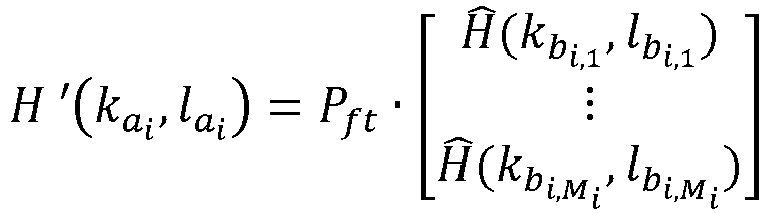
i,j ,lbi,j ) représente les valeurs d'estimation de canal de l'ensemble de positions de ressources physiques (kbi,j ,lbi,j ) des pilotes originaux ;caractérisé par :
lorsque l'ensemble de positions de ressources physiques (kai ,lai ) de la première partie de données ne coïncide pas avec l'ensemble de positions de ressources physiques (kbi,j ,lbi,j ) des pilotes originaux, l'exécution, par le dispositif d'estimation de canal, de l'estimation de canal sur toutes les ressources au moyen des valeurs d'estimation de canal H'(kai ,lai ) de la première partie de données et des valeurs d'estimation de canal Ĥ(kbi,j ,lbi,j ) des pilotes originaux par l'intermédiaire de l'estimation de canal unidimensionnelle pour dériver les valeurs d'estimation de canal des données sur toutes les ressources (k,l). - Dispositif d'estimation de canal, comprenant :un premier module d'estimation de canal (11) configuré pour exécuter une estimation de canal sur une première partie de données au moyen de valeurs d'estimation de canal de pilotes originaux par l'intermédiaire d'une estimation de canal bidimensionnelle pour dériver des valeurs d'estimation de canal de la première partie de données ; dans lequel la première partie de données se réfère à des signaux transmis sur une partie de positions temps-fréquence pour une transmission de données spécifiée dans un système ; etun second module d'estimation de canal (12) configuré pour exécuter une estimation de canal sur toutes les ressources au moyen des valeurs d'estimation de canal de la première partie de données par l'intermédiaire d'une estimation de canal unidimensionnelle pour dériver des valeurs d'estimation de canal sur toutes les ressources ;dans lequel le premier module d'estimation de canal (11) est configurépour déterminer un ensemble de positions de ressources physiques (ka
i ,lai ) de la première partie de données, dans lequel k représente un indice de ressource de fréquence dans le domaine fréquentiel, l représente un indice de ressource de temps dans le domaine temporel, a représente un indice de ressource d'un point de données de la première partie de données, i = {1, 2, ..., N}, et N représente le nombre de points de données de la première partie de données ;pour déterminer un ensemble de positions de ressources physiques
i ,lai ) de la première partie de données, dans lequel k représente un indice de ressource de fréquence dans le domaine fréquentiel, l représente un indice de ressource de temps, a représente un indice de ressource d'un point de données de la première partie de données, b représente un indice de ressource d'un pilote original pour estimer le point de données de la première partie de données, i = {1, 2, ..., N}, et N représente le nombre de points de données de la première partie de données, j = {1, 2, ..., Mi}, et Mi représente le nombre de pilotes originaux pour estimer la première partie de données ; etpour exécuter une estimation de canal sur chaque point de données de la première partie de données au moyen des valeurs d'estimation de canal des pilotes originaux par l'intermédiaire de l'estimation de canal bidimensionnelle pour dériver les valeurs d'estimation de canal de chaque point de données de la première partie de données en tant que
i,j ,lbi,j ) représente les valeurs d'estimation de canal de l'ensemble de positions de ressources physiques (kbi,j ,lbi,j ) des pilotes originaux ;caractérisé par :
lorsque l'ensemble de positions de ressources physiques (kai ,lai ) de la première partie de données ne coïncide pas avec l'ensemble de positions de ressources physiques (kbij ,lbi,j ) des pilotes originaux, pour exécuter une estimation de canal sur toutes les ressources au moyen des valeurs d'estimation de canal H'(kai ,lai ) de la première partie de données et des valeurs d'estimation de canal Ĥ(kbi,j ,lbi,j ) des pilotes originaux par l'intermédiaire de l'estimation de canal unidimensionnelle pour dériver les valeurs d'estimation de canal des données sur toutes les ressources.
Applications Claiming Priority (2)
| Application Number | Priority Date | Filing Date | Title |
|---|---|---|---|
| CN201210477611.6A CN103841057B (zh) | 2012-11-21 | 2012-11-21 | 一种信道估计方法和设备 |
| PCT/CN2013/087547 WO2014079370A1 (fr) | 2012-11-21 | 2013-11-21 | Procédé et dispositif d'estimation de canal |
Publications (3)
| Publication Number | Publication Date |
|---|---|
| EP2924936A1 EP2924936A1 (fr) | 2015-09-30 |
| EP2924936A4 EP2924936A4 (fr) | 2016-01-20 |
| EP2924936B1 true EP2924936B1 (fr) | 2021-06-16 |
Family
ID=50775550
Family Applications (1)
| Application Number | Title | Priority Date | Filing Date |
|---|---|---|---|
| EP13856230.1A Active EP2924936B1 (fr) | 2012-11-21 | 2013-11-21 | Procédé et dispositif d'estimation de canal |
Country Status (4)
| Country | Link |
|---|---|
| US (1) | US9374247B2 (fr) |
| EP (1) | EP2924936B1 (fr) |
| CN (1) | CN103841057B (fr) |
| WO (1) | WO2014079370A1 (fr) |
Families Citing this family (6)
| Publication number | Priority date | Publication date | Assignee | Title |
|---|---|---|---|---|
| US9787460B2 (en) | 2015-07-16 | 2017-10-10 | LGS Innovations LLC | Self-interference channel estimation system and method |
| TWI594592B (zh) * | 2016-01-08 | 2017-08-01 | 國立中山大學 | 無線通訊系統之通道估測方法 |
| CN108243124B (zh) * | 2016-12-27 | 2021-03-23 | 联芯科技有限公司 | 一种信道估计方法和装置 |
| CN111786763B (zh) * | 2020-06-23 | 2023-06-30 | Oppo广东移动通信有限公司 | 信号传输方法及装置、发射端、接收端、存储介质 |
| DE102021209536A1 (de) * | 2021-08-31 | 2023-03-02 | Siemens Aktiengesellschaft | Verfahren zur Kommunikation mittels einer zur Richtübertragung ausgebildeten Mehrantennenanordnung und Kommunikationseinrichtung |
| CN116113027A (zh) * | 2021-11-09 | 2023-05-12 | 大唐移动通信设备有限公司 | 时延估计方法、装置、设备及存储介质 |
Family Cites Families (11)
| Publication number | Priority date | Publication date | Assignee | Title |
|---|---|---|---|---|
| US5867478A (en) * | 1997-06-20 | 1999-02-02 | Motorola, Inc. | Synchronous coherent orthogonal frequency division multiplexing system, method, software and device |
| US7248559B2 (en) * | 2001-10-17 | 2007-07-24 | Nortel Networks Limited | Scattered pilot pattern and channel estimation method for MIMO-OFDM systems |
| KR101227491B1 (ko) * | 2006-03-20 | 2013-01-29 | 엘지전자 주식회사 | 이동통신 시스템에서 패킷 재전송 방법 및 복원 방법 |
| US8009622B2 (en) * | 2006-05-09 | 2011-08-30 | Telefonaktiebolaget Lm Ericsson (Publ) | Method and apparatus for improved single cell adaption due to change in environment |
| KR100913870B1 (ko) * | 2006-11-17 | 2009-08-26 | 삼성전자주식회사 | 직교 주파수 분할 시스템에서의 채널 추정 방법 및 장치 |
| CN101414986A (zh) * | 2007-10-17 | 2009-04-22 | 华为技术有限公司 | 一种信道估计方法和装置 |
| US8467465B2 (en) * | 2009-08-07 | 2013-06-18 | Qualcomm Incorporated | Channel estimation using replicas zero forcing |
| CN102202029B (zh) * | 2010-03-24 | 2015-01-28 | 中兴通讯股份有限公司 | 正交频分复用系统中的信道估计方法及装置 |
| CN102130860B (zh) | 2011-03-16 | 2013-10-30 | 东南大学 | 一种带相位补偿的二维离散傅里叶变换信道估计方法 |
| CN102325101B (zh) | 2011-07-08 | 2013-12-11 | 电信科学技术研究院 | 一种采用导频测速的方法及装置 |
| CN102571650B (zh) | 2011-12-20 | 2014-06-18 | 东南大学 | 一种应用于3gpp lte系统的自适应信道估计方法 |
-
2012
- 2012-11-21 CN CN201210477611.6A patent/CN103841057B/zh active Active
-
2013
- 2013-11-21 US US14/442,723 patent/US9374247B2/en active Active
- 2013-11-21 WO PCT/CN2013/087547 patent/WO2014079370A1/fr not_active Ceased
- 2013-11-21 EP EP13856230.1A patent/EP2924936B1/fr active Active
Non-Patent Citations (2)
| Title |
|---|
| G.G RALEIGH ET AL: "Multivariate modulation and coding for wireless communication", IEEE JOURNAL ON SELECTED AREAS IN COMMUNICATIONS, 1 May 1999 (1999-05-01), pages 851 - 866, XP055661821, Retrieved from the Internet <URL:https://ieeexplore.ieee.org/ielx5/49/16637/00768200.pdf?tp=&arnumber=768200&isnumber=16637&ref=aHR0cHM6Ly9pZWVleHBsb3JlLmllZWUub3JnL2F1dGhvci8zNzM1MDcxNDAwMA==> DOI: 10.1109/49.768200 * |
| MICHAEL SPETH ET AL: "Optimum Receiver Design for OFDM-Based Broadband Transmission-Part II: A Case Study", IEEE TRANSACTIONS ON COMMUNICATIONS, IEEE SERVICE CENTER, PISCATAWAY, NJ. USA, vol. 49, no. 4, 1 April 2001 (2001-04-01), pages 571 - 578, XP011009914, ISSN: 0090-6778 * |
Also Published As
| Publication number | Publication date |
|---|---|
| US9374247B2 (en) | 2016-06-21 |
| CN103841057B (zh) | 2017-07-14 |
| CN103841057A (zh) | 2014-06-04 |
| EP2924936A1 (fr) | 2015-09-30 |
| WO2014079370A1 (fr) | 2014-05-30 |
| EP2924936A4 (fr) | 2016-01-20 |
| US20150312057A1 (en) | 2015-10-29 |
Similar Documents
| Publication | Publication Date | Title |
|---|---|---|
| EP2924936B1 (fr) | Procédé et dispositif d'estimation de canal | |
| EP2590340B1 (fr) | Procédé d'estimation de canal, appareil et système associés | |
| EP2515570B1 (fr) | Procédé et dispositif destinés à réaliser une estimation de voie dans un système de multiplexage par répartition orthogonale de la fréquence | |
| EP2777337B1 (fr) | Synchronisation temporelle et fréquentielle à étages multiples. | |
| US8744013B2 (en) | Channel estimation for OFDM systems | |
| CN105391671B (zh) | 用于信道估计和均衡的方法和装置 | |
| CN102647387B (zh) | 同频干扰的消除方法及装置 | |
| CN106656441A (zh) | 用于提高车辆至车辆通信的可靠性的方法和设备 | |
| CN104301260B (zh) | 一种信道参数估计方法及系统 | |
| JP2013214969A (ja) | チャネル推定装置、チャネル推定方法及びユーザ機器 | |
| CN107294678B (zh) | 用于信道估计的方法和通信设备 | |
| CN103379048B (zh) | 信道估计和检测的方法及基站 | |
| CN109495407B (zh) | 一种信道估计方法、装置、设备及计算机可读存储介质 | |
| JP6220844B2 (ja) | Mimo方式システムの試験装置および試験方法 | |
| KR102275054B1 (ko) | Fbmc 시스템에서 심볼을 송수신하는 기법 | |
| CN104426817A (zh) | 一种信道估计方法及其装置 | |
| CN104253771A (zh) | 多参数联合估计方法和装置 | |
| CN104753834B (zh) | 一种信道估计方法和装置 | |
| CN105337919A (zh) | 一种在高速移动系统中进行多普勒估计的方法与装置 | |
| KR102792891B1 (ko) | Ofdm 기반 통신 시스템에서의 순환 쉬프트 추정 기법 | |
| CN104579560B (zh) | 一种snr计算方法和装置 | |
| CN107370557B (zh) | 一种信息处理方法、基站、终端和系统 | |
| CN104113496A (zh) | 一种利用序贯导频序列进行信道估计的方法 | |
| CN103428118B (zh) | 信道估计方法和装置 | |
| CN103107962B (zh) | 发送信号估计值的获取处理方法与装置、片上系统 |
Legal Events
| Date | Code | Title | Description |
|---|---|---|---|
| PUAI | Public reference made under article 153(3) epc to a published international application that has entered the european phase |
Free format text: ORIGINAL CODE: 0009012 |
|
| 17P | Request for examination filed |
Effective date: 20150619 |
|
| AK | Designated contracting states |
Kind code of ref document: A1 Designated state(s): AL AT BE BG CH CY CZ DE DK EE ES FI FR GB GR HR HU IE IS IT LI LT LU LV MC MK MT NL NO PL PT RO RS SE SI SK SM TR |
|
| AX | Request for extension of the european patent |
Extension state: BA ME |
|
| RIC1 | Information provided on ipc code assigned before grant |
Ipc: H04L 25/02 20060101AFI20151009BHEP |
|
| RA4 | Supplementary search report drawn up and despatched (corrected) |
Effective date: 20151222 |
|
| RIC1 | Information provided on ipc code assigned before grant |
Ipc: H04L 25/02 20060101AFI20151216BHEP |
|
| DAX | Request for extension of the european patent (deleted) | ||
| STAA | Information on the status of an ep patent application or granted ep patent |
Free format text: STATUS: EXAMINATION IS IN PROGRESS |
|
| 17Q | First examination report despatched |
Effective date: 20180319 |
|
| GRAP | Despatch of communication of intention to grant a patent |
Free format text: ORIGINAL CODE: EPIDOSNIGR1 |
|
| STAA | Information on the status of an ep patent application or granted ep patent |
Free format text: STATUS: GRANT OF PATENT IS INTENDED |
|
| INTG | Intention to grant announced |
Effective date: 20210129 |
|
| GRAS | Grant fee paid |
Free format text: ORIGINAL CODE: EPIDOSNIGR3 |
|
| GRAA | (expected) grant |
Free format text: ORIGINAL CODE: 0009210 |
|
| STAA | Information on the status of an ep patent application or granted ep patent |
Free format text: STATUS: THE PATENT HAS BEEN GRANTED |
|
| AK | Designated contracting states |
Kind code of ref document: B1 Designated state(s): AL AT BE BG CH CY CZ DE DK EE ES FI FR GB GR HR HU IE IS IT LI LT LU LV MC MK MT NL NO PL PT RO RS SE SI SK SM TR |
|
| REG | Reference to a national code |
Ref country code: GB Ref legal event code: FG4D |
|
| REG | Reference to a national code |
Ref country code: CH Ref legal event code: EP |
|
| REG | Reference to a national code |
Ref country code: DE Ref legal event code: R096 Ref document number: 602013077986 Country of ref document: DE |
|
| REG | Reference to a national code |
Ref country code: AT Ref legal event code: REF Ref document number: 1403250 Country of ref document: AT Kind code of ref document: T Effective date: 20210715 |
|
| REG | Reference to a national code |
Ref country code: IE Ref legal event code: FG4D |
|
| REG | Reference to a national code |
Ref country code: LT Ref legal event code: MG9D |
|
| PG25 | Lapsed in a contracting state [announced via postgrant information from national office to epo] |
Ref country code: HR Free format text: LAPSE BECAUSE OF FAILURE TO SUBMIT A TRANSLATION OF THE DESCRIPTION OR TO PAY THE FEE WITHIN THE PRESCRIBED TIME-LIMIT Effective date: 20210616 Ref country code: BG Free format text: LAPSE BECAUSE OF FAILURE TO SUBMIT A TRANSLATION OF THE DESCRIPTION OR TO PAY THE FEE WITHIN THE PRESCRIBED TIME-LIMIT Effective date: 20210916 Ref country code: LT Free format text: LAPSE BECAUSE OF FAILURE TO SUBMIT A TRANSLATION OF THE DESCRIPTION OR TO PAY THE FEE WITHIN THE PRESCRIBED TIME-LIMIT Effective date: 20210616 Ref country code: FI Free format text: LAPSE BECAUSE OF FAILURE TO SUBMIT A TRANSLATION OF THE DESCRIPTION OR TO PAY THE FEE WITHIN THE PRESCRIBED TIME-LIMIT Effective date: 20210616 |
|
| REG | Reference to a national code |
Ref country code: AT Ref legal event code: MK05 Ref document number: 1403250 Country of ref document: AT Kind code of ref document: T Effective date: 20210616 |
|
| REG | Reference to a national code |
Ref country code: NL Ref legal event code: MP Effective date: 20210616 |
|
| PG25 | Lapsed in a contracting state [announced via postgrant information from national office to epo] |
Ref country code: LV Free format text: LAPSE BECAUSE OF FAILURE TO SUBMIT A TRANSLATION OF THE DESCRIPTION OR TO PAY THE FEE WITHIN THE PRESCRIBED TIME-LIMIT Effective date: 20210616 Ref country code: GR Free format text: LAPSE BECAUSE OF FAILURE TO SUBMIT A TRANSLATION OF THE DESCRIPTION OR TO PAY THE FEE WITHIN THE PRESCRIBED TIME-LIMIT Effective date: 20210917 Ref country code: RS Free format text: LAPSE BECAUSE OF FAILURE TO SUBMIT A TRANSLATION OF THE DESCRIPTION OR TO PAY THE FEE WITHIN THE PRESCRIBED TIME-LIMIT Effective date: 20210616 Ref country code: SE Free format text: LAPSE BECAUSE OF FAILURE TO SUBMIT A TRANSLATION OF THE DESCRIPTION OR TO PAY THE FEE WITHIN THE PRESCRIBED TIME-LIMIT Effective date: 20210616 Ref country code: NO Free format text: LAPSE BECAUSE OF FAILURE TO SUBMIT A TRANSLATION OF THE DESCRIPTION OR TO PAY THE FEE WITHIN THE PRESCRIBED TIME-LIMIT Effective date: 20210916 |
|
| REG | Reference to a national code |
Ref country code: DE Ref legal event code: R081 Ref document number: 602013077986 Country of ref document: DE Owner name: DATANG MOBILE COMMUNICATIONS EQUIPMENT CO., LT, CN Free format text: FORMER OWNER: CHINA ACADEMY OF TELECOMMUNICATIONS TECHNOLOGY, BEIJING, CN |
|
| PG25 | Lapsed in a contracting state [announced via postgrant information from national office to epo] |
Ref country code: SK Free format text: LAPSE BECAUSE OF FAILURE TO SUBMIT A TRANSLATION OF THE DESCRIPTION OR TO PAY THE FEE WITHIN THE PRESCRIBED TIME-LIMIT Effective date: 20210616 Ref country code: SM Free format text: LAPSE BECAUSE OF FAILURE TO SUBMIT A TRANSLATION OF THE DESCRIPTION OR TO PAY THE FEE WITHIN THE PRESCRIBED TIME-LIMIT Effective date: 20210616 Ref country code: EE Free format text: LAPSE BECAUSE OF FAILURE TO SUBMIT A TRANSLATION OF THE DESCRIPTION OR TO PAY THE FEE WITHIN THE PRESCRIBED TIME-LIMIT Effective date: 20210616 Ref country code: CZ Free format text: LAPSE BECAUSE OF FAILURE TO SUBMIT A TRANSLATION OF THE DESCRIPTION OR TO PAY THE FEE WITHIN THE PRESCRIBED TIME-LIMIT Effective date: 20210616 Ref country code: AT Free format text: LAPSE BECAUSE OF FAILURE TO SUBMIT A TRANSLATION OF THE DESCRIPTION OR TO PAY THE FEE WITHIN THE PRESCRIBED TIME-LIMIT Effective date: 20210616 Ref country code: NL Free format text: LAPSE BECAUSE OF FAILURE TO SUBMIT A TRANSLATION OF THE DESCRIPTION OR TO PAY THE FEE WITHIN THE PRESCRIBED TIME-LIMIT Effective date: 20210616 Ref country code: PT Free format text: LAPSE BECAUSE OF FAILURE TO SUBMIT A TRANSLATION OF THE DESCRIPTION OR TO PAY THE FEE WITHIN THE PRESCRIBED TIME-LIMIT Effective date: 20211018 Ref country code: RO Free format text: LAPSE BECAUSE OF FAILURE TO SUBMIT A TRANSLATION OF THE DESCRIPTION OR TO PAY THE FEE WITHIN THE PRESCRIBED TIME-LIMIT Effective date: 20210616 Ref country code: ES Free format text: LAPSE BECAUSE OF FAILURE TO SUBMIT A TRANSLATION OF THE DESCRIPTION OR TO PAY THE FEE WITHIN THE PRESCRIBED TIME-LIMIT Effective date: 20210616 |
|
| REG | Reference to a national code |
Ref country code: GB Ref legal event code: 732E Free format text: REGISTERED BETWEEN 20220113 AND 20220119 |
|
| PG25 | Lapsed in a contracting state [announced via postgrant information from national office to epo] |
Ref country code: PL Free format text: LAPSE BECAUSE OF FAILURE TO SUBMIT A TRANSLATION OF THE DESCRIPTION OR TO PAY THE FEE WITHIN THE PRESCRIBED TIME-LIMIT Effective date: 20210616 |
|
| REG | Reference to a national code |
Ref country code: DE Ref legal event code: R097 Ref document number: 602013077986 Country of ref document: DE |
|
| PLBE | No opposition filed within time limit |
Free format text: ORIGINAL CODE: 0009261 |
|
| STAA | Information on the status of an ep patent application or granted ep patent |
Free format text: STATUS: NO OPPOSITION FILED WITHIN TIME LIMIT |
|
| PG25 | Lapsed in a contracting state [announced via postgrant information from national office to epo] |
Ref country code: DK Free format text: LAPSE BECAUSE OF FAILURE TO SUBMIT A TRANSLATION OF THE DESCRIPTION OR TO PAY THE FEE WITHIN THE PRESCRIBED TIME-LIMIT Effective date: 20210616 |
|
| 26N | No opposition filed |
Effective date: 20220317 |
|
| PG25 | Lapsed in a contracting state [announced via postgrant information from national office to epo] |
Ref country code: AL Free format text: LAPSE BECAUSE OF FAILURE TO SUBMIT A TRANSLATION OF THE DESCRIPTION OR TO PAY THE FEE WITHIN THE PRESCRIBED TIME-LIMIT Effective date: 20210616 |
|
| PG25 | Lapsed in a contracting state [announced via postgrant information from national office to epo] |
Ref country code: MC Free format text: LAPSE BECAUSE OF FAILURE TO SUBMIT A TRANSLATION OF THE DESCRIPTION OR TO PAY THE FEE WITHIN THE PRESCRIBED TIME-LIMIT Effective date: 20210616 |
|
| REG | Reference to a national code |
Ref country code: CH Ref legal event code: PL |
|
| PG25 | Lapsed in a contracting state [announced via postgrant information from national office to epo] |
Ref country code: LU Free format text: LAPSE BECAUSE OF NON-PAYMENT OF DUE FEES Effective date: 20211121 Ref country code: IT Free format text: LAPSE BECAUSE OF FAILURE TO SUBMIT A TRANSLATION OF THE DESCRIPTION OR TO PAY THE FEE WITHIN THE PRESCRIBED TIME-LIMIT Effective date: 20210616 Ref country code: BE Free format text: LAPSE BECAUSE OF NON-PAYMENT OF DUE FEES Effective date: 20211130 |
|
| REG | Reference to a national code |
Ref country code: BE Ref legal event code: MM Effective date: 20211130 |
|
| PG25 | Lapsed in a contracting state [announced via postgrant information from national office to epo] |
Ref country code: LI Free format text: LAPSE BECAUSE OF NON-PAYMENT OF DUE FEES Effective date: 20211130 Ref country code: CH Free format text: LAPSE BECAUSE OF NON-PAYMENT OF DUE FEES Effective date: 20211130 |
|
| PG25 | Lapsed in a contracting state [announced via postgrant information from national office to epo] |
Ref country code: IE Free format text: LAPSE BECAUSE OF NON-PAYMENT OF DUE FEES Effective date: 20211121 |
|
| PG25 | Lapsed in a contracting state [announced via postgrant information from national office to epo] |
Ref country code: HU Free format text: LAPSE BECAUSE OF FAILURE TO SUBMIT A TRANSLATION OF THE DESCRIPTION OR TO PAY THE FEE WITHIN THE PRESCRIBED TIME-LIMIT; INVALID AB INITIO Effective date: 20131121 |
|
| PG25 | Lapsed in a contracting state [announced via postgrant information from national office to epo] |
Ref country code: CY Free format text: LAPSE BECAUSE OF FAILURE TO SUBMIT A TRANSLATION OF THE DESCRIPTION OR TO PAY THE FEE WITHIN THE PRESCRIBED TIME-LIMIT Effective date: 20210616 |
|
| PG25 | Lapsed in a contracting state [announced via postgrant information from national office to epo] |
Ref country code: MK Free format text: LAPSE BECAUSE OF FAILURE TO SUBMIT A TRANSLATION OF THE DESCRIPTION OR TO PAY THE FEE WITHIN THE PRESCRIBED TIME-LIMIT Effective date: 20210616 |
|
| PG25 | Lapsed in a contracting state [announced via postgrant information from national office to epo] |
Ref country code: MT Free format text: LAPSE BECAUSE OF FAILURE TO SUBMIT A TRANSLATION OF THE DESCRIPTION OR TO PAY THE FEE WITHIN THE PRESCRIBED TIME-LIMIT Effective date: 20210616 |
|
| REG | Reference to a national code |
Ref country code: DE Ref legal event code: R082 Ref document number: 602013077986 Country of ref document: DE Representative=s name: DENNEMEYER & ASSOCIATES RECHTSANWALTSGESELLSCH, DE |
|
| PG25 | Lapsed in a contracting state [announced via postgrant information from national office to epo] |
Ref country code: TR Free format text: LAPSE BECAUSE OF FAILURE TO SUBMIT A TRANSLATION OF THE DESCRIPTION OR TO PAY THE FEE WITHIN THE PRESCRIBED TIME-LIMIT Effective date: 20210616 |
|
| PGFP | Annual fee paid to national office [announced via postgrant information from national office to epo] |
Ref country code: DE Payment date: 20251119 Year of fee payment: 13 |
|
| PGFP | Annual fee paid to national office [announced via postgrant information from national office to epo] |
Ref country code: GB Payment date: 20251121 Year of fee payment: 13 |
|
| PGFP | Annual fee paid to national office [announced via postgrant information from national office to epo] |
Ref country code: FR Payment date: 20251125 Year of fee payment: 13 |