EP2926732A1 - Blutanalysator - Google Patents
Blutanalysator Download PDFInfo
- Publication number
- EP2926732A1 EP2926732A1 EP15160051.7A EP15160051A EP2926732A1 EP 2926732 A1 EP2926732 A1 EP 2926732A1 EP 15160051 A EP15160051 A EP 15160051A EP 2926732 A1 EP2926732 A1 EP 2926732A1
- Authority
- EP
- European Patent Office
- Prior art keywords
- analysis data
- blood cell
- blood
- cell type
- information
- Prior art date
- Legal status (The legal status is an assumption and is not a legal conclusion. Google has not performed a legal analysis and makes no representation as to the accuracy of the status listed.)
- Granted
Links
Images







Classifications
-
- G—PHYSICS
- G01—MEASURING; TESTING
- G01N—INVESTIGATING OR ANALYSING MATERIALS BY DETERMINING THEIR CHEMICAL OR PHYSICAL PROPERTIES
- G01N33/00—Investigating or analysing materials by specific methods not covered by groups G01N1/00 - G01N31/00
- G01N33/48—Biological material, e.g. blood, urine; Haemocytometers
- G01N33/50—Chemical analysis of biological material, e.g. blood, urine; Testing involving biospecific ligand binding methods; Immunological testing
- G01N33/5005—Chemical analysis of biological material, e.g. blood, urine; Testing involving biospecific ligand binding methods; Immunological testing involving human or animal cells
- G01N33/5094—Chemical analysis of biological material, e.g. blood, urine; Testing involving biospecific ligand binding methods; Immunological testing involving human or animal cells for blood cell populations
-
- G—PHYSICS
- G01—MEASURING; TESTING
- G01N—INVESTIGATING OR ANALYSING MATERIALS BY DETERMINING THEIR CHEMICAL OR PHYSICAL PROPERTIES
- G01N33/00—Investigating or analysing materials by specific methods not covered by groups G01N1/00 - G01N31/00
- G01N33/48—Biological material, e.g. blood, urine; Haemocytometers
- G01N33/50—Chemical analysis of biological material, e.g. blood, urine; Testing involving biospecific ligand binding methods; Immunological testing
- G01N33/53—Immunoassay; Biospecific binding assay; Materials therefor
- G01N33/569—Immunoassay; Biospecific binding assay; Materials therefor for microorganisms, e.g. protozoa, bacteria, viruses
- G01N33/56966—Animal cells
- G01N33/56972—White blood cells
-
- G—PHYSICS
- G01—MEASURING; TESTING
- G01N—INVESTIGATING OR ANALYSING MATERIALS BY DETERMINING THEIR CHEMICAL OR PHYSICAL PROPERTIES
- G01N33/00—Investigating or analysing materials by specific methods not covered by groups G01N1/00 - G01N31/00
- G01N33/48—Biological material, e.g. blood, urine; Haemocytometers
- G01N33/50—Chemical analysis of biological material, e.g. blood, urine; Testing involving biospecific ligand binding methods; Immunological testing
- G01N33/72—Chemical analysis of biological material, e.g. blood, urine; Testing involving biospecific ligand binding methods; Immunological testing involving blood pigments, e.g. haemoglobin, bilirubin or other porphyrins; involving occult blood
- G01N33/721—Haemoglobin
-
- G—PHYSICS
- G01—MEASURING; TESTING
- G01N—INVESTIGATING OR ANALYSING MATERIALS BY DETERMINING THEIR CHEMICAL OR PHYSICAL PROPERTIES
- G01N33/00—Investigating or analysing materials by specific methods not covered by groups G01N1/00 - G01N31/00
- G01N33/48—Biological material, e.g. blood, urine; Haemocytometers
- G01N33/50—Chemical analysis of biological material, e.g. blood, urine; Testing involving biospecific ligand binding methods; Immunological testing
- G01N33/80—Chemical analysis of biological material, e.g. blood, urine; Testing involving biospecific ligand binding methods; Immunological testing involving blood groups or blood types or red blood cells
-
- G—PHYSICS
- G01—MEASURING; TESTING
- G01N—INVESTIGATING OR ANALYSING MATERIALS BY DETERMINING THEIR CHEMICAL OR PHYSICAL PROPERTIES
- G01N15/00—Investigating characteristics of particles; Investigating permeability, pore-volume or surface-area of porous materials
- G01N15/10—Investigating individual particles
- G01N15/14—Optical investigation techniques, e.g. flow cytometry
- G01N15/1456—Optical investigation techniques, e.g. flow cytometry without spatial resolution of the texture or inner structure of the particle, e.g. processing of pulse signals
- G01N15/1459—Optical investigation techniques, e.g. flow cytometry without spatial resolution of the texture or inner structure of the particle, e.g. processing of pulse signals the analysis being performed on a sample stream
-
- G—PHYSICS
- G01—MEASURING; TESTING
- G01N—INVESTIGATING OR ANALYSING MATERIALS BY DETERMINING THEIR CHEMICAL OR PHYSICAL PROPERTIES
- G01N2800/00—Detection or diagnosis of diseases
- G01N2800/22—Haematology
- G01N2800/222—Platelet disorders
-
- G—PHYSICS
- G01—MEASURING; TESTING
- G01N—INVESTIGATING OR ANALYSING MATERIALS BY DETERMINING THEIR CHEMICAL OR PHYSICAL PROPERTIES
- G01N2800/00—Detection or diagnosis of diseases
- G01N2800/22—Haematology
- G01N2800/224—Haemostasis or coagulation
-
- G—PHYSICS
- G01—MEASURING; TESTING
- G01N—INVESTIGATING OR ANALYSING MATERIALS BY DETERMINING THEIR CHEMICAL OR PHYSICAL PROPERTIES
- G01N33/00—Investigating or analysing materials by specific methods not covered by groups G01N1/00 - G01N31/00
- G01N33/48—Biological material, e.g. blood, urine; Haemocytometers
- G01N33/483—Physical analysis of biological material
- G01N33/487—Physical analysis of biological material of liquid biological material
- G01N33/49—Blood
- G01N33/492—Determining multiple analytes
Definitions
- the invention relates to a blood analyzer capable of providing information useful in discrimination of cytopenia.
- Cytopenia includes thrombocytopenia, erythropenia, leukopenia, and pancytopenia.
- Patent Literature 1 states that a percentage of immature platelets is useful information for discrimination between idiopathic thrombocytopenic purpura (ITP) and aplastic anemia (AA), both of which are thrombocytopenia.
- the measurement apparatus of Patent Literature 1 is capable of presenting the apparatus user with, as information for discrimination of thrombocytopenia, a percentage of immature platelets obtained from measurement data on platelets.
- the percentage of immature platelets the number of immature platelets/(the number of immature platelets+the number of mature platelets).
- Patent Literature 1 merely presents information on platelets as information for supporting discrimination of thrombocytopenia. A further improvement is desired in the precision of information for supporting discrimination of cytopenia.
- Patent Literature 1 U.S. Patent Application Publication No. 2005/002826
- An aspect of the invention is a blood analyzer including: a measurement unit configured to measure a blood sample and output measurement data; a controller configured to analyze the measurement data outputted from the measurement unit, generate analysis data on each of blood cell types including red blood cell, white blood cell, and platelet, and generate support information for supporting discrimination of a cause of a reduction in the number of blood cells of a predetermined type among the blood cell types by using the analysis data including first analysis data on the predetermined blood cell type and second analysis data on a blood cell type other than the predetermined blood cell type; and an output unit configured to output the support information.
- Fig. 1 illustrates blood analyzer (multi-parameter blood cell counter) 1.
- Blood analyzer 1 is configured to count the number of blood cells (white blood cells, red blood cells, platelets) contained in a blood sample for the blood analysis.
- Blood analyzer 1 includes measurement unit 3 and information processing unit 5 capable of controlling measurement unit 3.
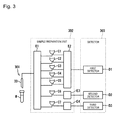
- Measurement unit 3 includes aspirator 301, sample preparation unit 302, detector 303, communicator 305, and the like.
- Aspirator 301 is configured to aspirate a blood sample from blood samples stored in sample container W.
- Aspirator 301 includes piercer 33 configured to aspirate a blood sample in sample container W.
- Sample preparation unit 302 is configured to prepare a measurement sample from the blood sample aspirated with aspirator 301, the measurement sample used for measurement.
- Detector 303 is configured to detect blood cells from the measurement sample prepared by sample preparation unit 302.
- Measurement unit 3 communicates with information processing unit 5 through communicator 305.
- Communicator 305 is configured to receive a control instruction from information processing unit 5.
- communicator 305 is configured to transmit to information processing unit 5 measurement data obtained by detection with detector 303.
- Aspirator 301, sample preparation unit 302, and detector 303 are configured to have hydraulic circuits.
- the hydraulic circuits are configured to operate in such a manner that a measurement sample is prepared from blood aspirated with piercer 33 and the measurement sample is provided to detector 303.
- Sample preparation unit 302 includes first reaction chamber C1 to seventh reaction chamber C7 configured to prepare a sample.
- Detector 303 includes first detector D1 to third detector D3 configured to detect a measurement sample.
- the hydraulic circuits constituting sample preparation unit 302 include first hydraulic circuit E1 to fourth hydraulic circuit E4.
- Hydraulic circuits E1 to E4 include unillustrated valves, pumps, and the like, and are configured to switch flow paths with the valves, so that a fluid such as a blood sample can be conveyed into the hydraulic circuits with the pumps.
- First hydraulic circuit E1 is configured to dispense a blood sample from piercer 33 to each of reaction chambers C1 to C7.
- first hydraulic circuit E1 is configured to supply reaction chambers C1 to C7 with a diluent, a lysing agent, a staining solution, or the like, as necessary.
- Liquids such as a diluent, a lysing agent, and a staining solution (sample preparation liquids) are used to prepare a measurement sample.
- Second hydraulic circuit E2 is configured to convey, to first detector D1, a measurement sample prepared in first reaction chamber C1 to fifth reaction chamber C5.
- Third hydraulic circuit E3 is configured to convey a measurement sample prepared in sixth reaction chamber C6 to second detector D2.
- Fourth hydraulic circuit E4 is configured to convey a measurement sample prepared in seventh reaction chamber C7 to third detector D3.
- First reaction chamber C1 is a reaction chamber configured to prepare a sample (first sample) for analysis of white blood cells/nucleated red blood cells.
- Second reaction chamber C2 is a reaction chamber configured to prepare a sample (second sample) for analysis of differential white blood cell count.
- Third reaction chamber C3 is a reaction chamber configured to prepare a sample (third sample) for analysis of the number of abnormal cells/immature cells.
- Fourth reaction chamber C4 is a reaction chamber configured to prepare a sample (fourth sample) for analysis of reticulocytes.
- Fifth reaction chamber C5 is a reaction chamber configured to prepare a sample (fifth sample) for analysis of platelets.
- Sixth reaction chamber C6 is a reaction chamber configured to prepare a sample (sixth sample) for analysis of red blood cells and platelets.
- Seventh reaction chamber C7 is a reaction chamber configured to prepare a sample (seventh sample) for analysis of hemoglobins.
- First detector D1 includes a flow cell and an optical detector for a measurement by flow cytometry using a semiconductor laser.
- the optical detector is configured to detect, as measurement data, optical information (side fluorescence signal, forward scattered light signal, side scattered light signal) from blood cells (such as white blood cells, red blood cells, platelets) in a sample.
- First detector D1 is configured to perform a measurement on a first sample (first measurement: measurement for analysis of white blood cells/nucleated red blood cells), a measurement on a second sample (second measurement: measurement for analysis of differential white blood cell count), a measurement on a third sample (third measurement: measurement for analysis of the number of abnormal cells/immature cells), a measurement on a fourth sample (fourth measurement: measurement for analysis of reticulocytes), and a measurement on a fifth sample (fifth measurement: measurement for analysis of platelets).
- Second detector D2 is configured to perform a measurement by a sheath flow DC detection method. Second detector D2 is configured to measure a sixth sample (sixth measurement: measurement for analysis of red blood cells and platelets).
- Third detector D3 is configured to perform a measurement by an SLS-hemoglobin method. Third detector D3 is configured to measure a seventh sample (seventh measurement: measurement for analysis of hemoglobins).
- Information processing unit 5 is constituted of a computer.
- Fig. 4 is a block diagram for illustrating the configuration of information processing unit 5.
- computer 5 includes main body (controller) 51, display unit (output unit) 52, and input unit 53.
- Main body 51 includes CPU 51a, ROM 51b, RAM 51c, hard disk 51d, reader 51e, input-output interface 51f, communication interface 51g, and image output interface 51 h.
- CPU 51a, ROM 51 b, RAM 51 c, hard disk 51 d, reader 51 e, input-output interface 51f, communication interface 51 g, and image output interface 51 h are connected to each other with bus 51 i.
- CPU 51 a is capable of executing computer programs.
- Installed in hard disk (memory) 51d are: an operating system and various computer programs 54a executed by CPU 51 a, such as application programs, as well as data used for executing the computer programs.
- Computer programs 54a include programs for controlling the measurement unit, analyzing measurement data, outputting information, and other processing.
- Computer programs 54a can be recorded in portable recording medium 54 such as a CD-ROM.
- Reader 51 e is capable of reading computer programs 54a recorded in recording medium 54.
- Computer programs 54a can be provided not only with portable recording medium 54 but also through an electric communication line (which may be wired or wireless) from an external device connected to computer 5 with the electric communication line in such a manner as to establish communications therebetween.
- an electric communication line which may be wired or wireless
- hard disk 51d is configured to function as a storage to store various data (measurement data storage 54b, analysis data storage 54c, scoring information storage 54d, support information storage 54e), as well.
- Measurement data storage 54b is configured to store measurement data received from measurement unit 3.
- Analysis data storage 54c is configured to store analysis data generated by analyzing measurement data.
- Scoring information storage 54d is configured to store information (scoring information) for scoring analysis data. Scoring information storage 54d sets the scoring information in advance.
- Support information storage 54e is configured to store support information generated based on analysis data.
- Input-output interface 51f is connected to measurement unit 3. This enables information processing unit 5 to control measurement unit 3 and to receive measurement data from measurement unit 3.
- Image output interface 51h is connected to display unit (output unit) 52 constituted of a display and so forth.
- information processing unit 5 can display (output) various information such as support information.
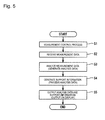
- Fig. 5 illustrates a measurement-analysis procedure executed by information processing unit 5 (CPU 51a). The processes in Fig. 5 are performed by causing CPU 51a to execute computer programs 54a.
- information processing unit 5 executes a measurement control process (Step S1).
- the measurement control process controls measurement unit 3 for measurement of a measurement sample.
- Measurement unit 3 outputs measurement data obtained by measuring the measurement sample to information processing unit 5.
- Information processing unit 5 receives the measurement data (Step S2). Subsequently, information processing unit 5 analyzes the measurement data thus received and generates analysis data (Step S3).
- Information processing unit 5 generates support information, using the analysis data (Step S4). Information processing unit 5 outputs the analysis data and the support information thus generated to display unit (output unit) 52 (Step S5).
- Fig. 6 is a functional block diagram for illustrating functions performed by information processing unit 5 in the process from the measurement control process (Step S1) to the support information generation process (Step S4).
- the functional block illustrated in Fig. 6 includes measurement controller 56, measurement data storage 54b, measurement data analyzer (first generator) 57, analysis data storage 54c, and support information generator (second generator) 58.
- the functions illustrated in the functional block of Fig. 6 are functions performed by information processing unit 5 when CPU 51 a executes computer programs 54a.
- Measurement controller 56 is configured to control each measurement in measurement unit 3, and includes first measurement controller 56a to seventh measurement controller 56g.
- First measurement controller 56a is configured to control a measurement for analysis of white blood cells/nucleated red blood cells (first measurement).
- Second measurement controller 56b is configured to control a measurement for analysis of differential white blood cell count (second measurement).
- Third measurement controller 56c is configured to control a measurement for analysis of the number of abnormal cells/immature cells (third measurement).
- Fourth measurement controller 56d is configured to control a measurement for analysis of reticulocytes (fourth measurement).
- Fifth measurement controller 56e is configured to control a measurement for analysis of platelets (fifth measurement).
- Sixth measurement controller 56f is configured to control a measurement for analysis of red blood cells and platelets (sixth measurement).
- Seventh measurement controller 56g is configured to control a measurement for analysis of hemoglobins (seventh measurement).
- Measurement data storage 54b is configured to store measurement data received from measurement unit 3, and includes first measurement data storage 54b-1 to seventh measurement data storage 54b-7.
- First measurement data storage 54b-1 is configured to store first measurement data (measurement data on white blood cells/nucleated red blood cells) obtained by a measurement for analysis of white blood cells/nucleated red blood cells (first measurement).
- Second measurement data storage 54b-2 is configured to store second measurement data (measurement data on differential white blood cell count) obtained by a measurement for analysis of differential white blood cell count (second measurement).
- Third measurement data storage 54b-3 is configured to store third measurement data (measurement data on the number of abnormal cells/immature cells) obtained by a measurement for analysis of the number of abnormal cells/immature cells (third measurement).
- Fourth measurement data storage 54b-4 is configured to store fourth measurement data (measurement data on reticulocytes) obtained by a measurement for analysis of reticulocytes (fourth measurement).
- Fifth measurement data storage 54b-5 is configured to store fifth measurement data (measurement data on platelets) obtained by a measurement for analysis of platelets (fifth measurement).
- Sixth measurement data storage 54b-6 is configured to store sixth measurement data (measurement data on red blood cells and platelets) obtained by a measurement for analysis of red blood cells and platelets (sixth measurement).
- Seventh measurement data storage 54b-7 is configured to store seventh measurement data (measurement data on hemoglobins) obtained by a measurement for analysis of hemoglobins (seventh measurement).
- Measurement data analyzer 57 is configured to generate analysis data using each of measurement data stored in measurement data storages 54b-1 to 54b-7, and includes first measurement data analyzer 57a to seventh measurement data analyzer 57g.
- First measurement data analyzer 57a is configured to generate analysis data on white blood cells/nucleated red blood cells, using first measurement data.
- Second measurement data analyzer 57b is configured to generate analysis data on differential white blood cell count, using second measurement data.
- Third measurement data analyzer 57c is configured to generate analysis data on the number of abnormal cells/immature cells, using third measurement data.
- Fourth measurement data analyzer 57d is configured to generate analysis data on reticulocytes, using fourth measurement data.
- Fifth measurement data analyzer 57e is configured to generate analysis data on platelets, using fifth measurement data.
- Sixth measurement data analyzer 57f is configured to generate analysis data on red blood cells and platelets, using sixth measurement data.
- Seventh measurement data analyzer 57g is configured to generate analysis data on hemoglobins, using seventh measurement data.
- Each of first measurement data analyzer 57a to fifth measurement data analyzer 57e is configured to create a scattergram using optical information (side fluorescence signal, forward scattered light signal, side scattered light signal) that are measurement data outputted from first detector D1.
- Analyzers 57a to 57e generate analysis data on the number of blood cells and other analysis parameters based on the scattergrams thus created respectively.
- Fig. 7A illustrates a scattergram created by fifth measurement data analyzer 57e
- Fig. 7B illustrates a scattergram created by fourth measurement data analyzer 57d.
- Fig. 7A illustrates the scattergram in two-dimensional coordinates with (side) fluorescence intensity on the horizontal axis and forward scattered light (FSC) on the vertical axis.
- the fluorescence intensity and forward scattered light intensity of each particle in a fifth sample are plotted on the coordinates.
- a region where immature platelets appear IPF region
- a region where platelets appear PLT region
- Fifth measurement data analyzer 57e is configured to count the number of plots appearing in the PLT region (the number of platelets: PLT) and the number of plots appearing in the IPF region (the number of immature platelets: IPF). In this manner, the number of platelets (PLT) and the number of immature platelets (IPF) can be obtained as analysis data on platelets.
- Fig. 7B illustrates the scattergram in two-dimensional coordinates with (side) fluorescence intensity on the horizontal axis and forward scattered light (FSC) on the vertical axis.
- the fluorescence intensity and forward scattered light intensity of each particle in a fourth sample are plotted on the coordinates.
- a region where reticulocytes appear (RET region) is set in the scattergram of Fig. 7B .
- Fourth measurement data analyzer 57d is configured to count the number of plots appearing in the RET region (the number of reticulocytes: RET#). In this manner, the number of reticulocytes (RET#) can be obtained as analysis data on reticulocytes.
- Each of the other measurement data analyzers 57a to 57c configured to analyze measurement data obtained from first detector D1 is also configured to create a scattergram and generate analysis data.
- Sixth measurement data analyzer 57f is configured to generate, as analysis data on red blood cells and platelets, analysis data on the number of red blood cells, the number of platelets, and other analysis parameters related to red blood cells and platelets, using sixth measurement data outputted from second detector D2.
- Seventh measurement data analyzer 57g is configured to generate analysis data on hemoglobins such as hemoglobin concentration, using seventh measurement data outputted from third detector D3.
- Analysis data storage 54c is configured to store analysis data generated by each of measurement data analyzers 57a to 57g, and includes first analysis data storage 54c-1, second analysis data storage 54c-2, third analysis data storage 54c-3, fourth analysis data storage 54c-4, fifth analysis data storage 54c-5, sixth analysis data storage 54c-6, and seventh analysis data storage 54c-7.
- blood analyzer 1 includes analysis channels 61 to 67 for the process from sample measurement to analysis data generation.
- Channels 61 to 67 includes first analysis channel 61 for analysis of white blood cells/nucleated red blood cells, second analysis channel 62 for analysis of differential white blood cell count, third analysis channel 63 for analysis of the number of abnormal cells/immature cells, fourth analysis channel 64 for analysis of reticulocytes, fifth analysis channel 65 for analysis of platelets, sixth analysis channel 66 for analysis of red blood cells and platelets, and seventh analysis channel 67 for analysis of hemoglobins.
- the analysis channels are independent of each other in terms of analysis data generation. In other words, when analysis data is generated in one analysis channel, measurement data of the analysis channel is used, but no measurement data of the other analysis channels are used.
- the fifth measurement data analyzer 57e uses only fifth measurement data obtained by measuring a fifth sample, but does not use measurement data in other analysis channels 61 to 64, 66, 67.
- analysis data generated in each of measurement data analyzers 57a to 57e. Note that analysis data is not limited to data specifically listed below.
- Analysis data on white blood cells/nucleated red blood cells include analysis data corresponding to analysis parameters of white blood cells/nucleated red blood cells.
- Examples of such analysis data corresponding to analysis parameters of white blood cells/nucleated red blood cells include the number of white blood cells (WBC), the number of basophils (BASO), the number of nucleated red blood cells (NRBC#), and the like.
- Analysis data on differential white blood cell count include analysis data corresponding to analysis parameters of differential white blood cell count.
- analysis data corresponding to analysis parameters of differential white blood cell count include the number of neutrophils (Neut#), the number of lymphocytes (Lymph#), the number of monocytes (MONO#), the number of eosinophils (EO#), immature granulocyte fraction (IG%), and the like.
- the immature granulocyte fraction (IG%) is a ratio of the number of immature granulocytes relative to a total leukocyte count.
- Analysis data on the number of abnormal cells/immature cells include analysis data corresponding to analysis parameters of the number of abnormal cells/immature cells.
- Analysis data on reticulocytes include analysis data corresponding to analysis parameters of reticulocytes.
- Examples of such analysis data corresponding to analysis parameters of reticulocytes include analysis data on as the number of reticulocytes (RET#), fragmented red-blood-cell indicator (FRC#), and the like.
- Analysis data on platelets include analysis data corresponding to analysis parameters of platelets.
- Examples of such analysis data corresponding to analysis parameters of platelets include analysis data on the number of platelets (PLT), immature platelet fraction (IPF%), and the like.
- Analysis data on red blood cells and platelets includes analysis data corresponding to analysis parameters of red blood cells and platelets.
- Examples of such analysis data corresponding to analysis parameters of red blood cells and platelets include analysis data on the number of red blood cells (RBC#), mean corpuscular volume (MCV), red blood cell distribution width (RDW-SD), mean platelet volume (MPV), and the like.
- analysis data on hemoglobin examples include analysis data on hemoglobin concentration (Hgb) and the like.
- Cytopenia is a disease that reduces the number of blood cells in blood. Cytopenia includes thrombocytopenia, erythropenia, leukopenia, and pancytopenia.
- Thrombocytopenia reduces the number of platelets in peripheral blood.
- Examples of the causative disease of thrombocytopenia include idiopathic thrombocytopenic purpura (ITP), aplastic anemia (AA), myelodysplastic syndrome (MDS), and the like.
- ITP idiopathic thrombocytopenic purpura
- AA aplastic anemia
- MDS myelodysplastic syndrome
- a reduction in the number of platelets in blood is mainly caused by increased destruction and decreased production of platelets.
- the increased destruction causes idiopathic thrombocytopenic purpura (ITP), while the decreased production causes aplastic anemia (AA) and myelodysplastic syndrome (MDS).
- iron-deficiency anemia IDA
- AA aplastic anemia
- MDS myelodysplastic syndrome
- HA hemolytic anemia
- IDA iron-deficiency anemia
- Fig. 8A illustrates the result of evaluating the cytopenia-discrimination ability using immature platelet fraction (IPF%) similarly to Patent Literature 1.
- the disease herein includes myelodysplastic syndrome (MDS) in addition to idiopathic thrombocytopenic purpura (ITP) and aplastic anemia (AA), all of which are thrombocytopenia.
- MDS myelodysplastic syndrome
- ITP idiopathic thrombocytopenic purpura
- AA aplastic anemia
- the vertical axis represents the immature platelet fraction (IPF%), and immature platelet fractions of patients with AA, ITP, or MDS are plotted.
- the number N of AA cases is 142
- the number N of ITP cases is 309
- the number N of MDS cases is 147.
- the cutoff value of the immature platelet fraction (IPF%) is set at 16%
- the false positive rate of AA is 3.5%
- the true positive rate of ITP is 17.5%
- the false positive rate of MDS is 29.9%. Note that the positive means that the immature platelet fraction (IPF%) exceeds the cutoff value.
- ITP scores platelet destruction scores
- the ITP score calculation herein uses: the number of lymphocytes (Lymph#), the number of neutrophils (Neut#), red blood cell distribution width (RDW-SD), hemoglobin concentration (Hgb), the number of reticulocytes (RET#), mean corpuscular volume (MCV), the number of platelets (PLT), mean platelet volume (MPV), immature platelet fraction (IPF%), and the like.
- the vertical axis represents the ITP score, and ITP scores of patients with AA, ITP, or MDS are plotted.
- the number N of AA cases is 118
- the number N of ITP cases is 228, and the number N of MDS cases is 103.
- the cutoff value of the ITP score is set at 2.4.
- the false positive rate of AA is 2.5%; hence, the false positive rate is decreased by 1.0% in comparison with the case of using only the immature platelet fraction.
- the true positive rate of ITP is 70.6%; hence, the true positive rate is increased by 53.1 % in comparison with the case of using only the immature platelet fraction.
- the false positive rate of MDS is 3.9%; hence, the false positive rate is decreased by 20.0% in comparison with the case of using only the immature platelet fraction.
- the inventors have obtained the knowledge that in a case of providing information for supporting discrimination of a cause of a reduction in the number of blood cells of a predetermined type (platelet in Figs. 8A and 8B ), information reflecting not only information (immature platelet fraction in Figs. 8A and 8B ) on the predetermined blood cell type but also information on blood cell types other than the predetermined blood cell type enable an improvement in the precision of information presented from blood analyzer 1, and are helpful in discrimination by a physician.
- blood analyzer 1 of the present embodiment does not use analysis data on platelets solely as information for supporting discrimination of thrombocytopenia as in Patent Literature 1, but integrates analysis data on blood cell types and generates support information.
- the present embodiment employs, mainly, increased destruction and decreased production of blood cells as the cause of a reduction in the number of the blood cells, the cause being a target of discrimination support by support information outputted from blood analyzer 1.
- the cause of a reduction in the number of the blood cells being the target of discrimination support by support information is not limited to the increased destruction and the decreased production, and may be a deficiency in a substance (such as iron, vitamin B12, or folic acid), a deficiency in a hematopoietic factor (such as erythropoietin), bleeding, or the like.
- the cause of a reduction in the number of the blood cells being the target of discrimination support by support information may be a disease such as ITP, AA, or MDS.
- the support information preferably is constituted of cause information data corresponding to causes of a reduction in the number of blood cells being the target of the discrimination support.
- the support information is preferably constituted of first cause information on the increased destruction (information indicating a state suspected of the increased destruction) and second cause information on the decreased production (information indicating a state suspected of the decreased production).
- first cause information on the increased destruction information indicating a state suspected of the increased destruction
- second cause information on the decreased production information indicating a state suspected of the decreased production.
- the support information may be constituted of first cause information on ITP (information indicating an ITP suspected state), second cause information on MDS (information indicating an MDS suspected state), and third cause information on AA (information indicating an AA suspected state).
- the analysis data used to generate the support information for discrimination of cytopenia are analysis data on blood cell types.
- analysis data on three blood cell types of white blood cell, red blood cell, and platelet are used to generate the support information.
- analysis data on two blood cell types for example, platelet and red blood cell may be used.
- analysis data are preferably used to generate the support information from the viewpoint of improving the information precision. Nonetheless, one analysis datum or sub-set of data may be used for one type of blood cells.
- analysis data on white blood cells is preferably one analysis datum or sub-set of data selected from the group consisting of analysis data on the number of abnormal cells/immature cells (analysis data generated from the third channel), analysis data on differential white blood cell count (analysis data generated from the second channel), analysis data on white blood cells/nucleated red blood cells (analysis data generated from the first channel), more preferably one datum or sub-set of analysis data selected from the group consisting of immature granulocyte fraction (IG%), the number of neutrophils (Neut#), the number of monocytes (MONO#), and the number of lymphocytes (Lymph#).
- IG% immature granulocyte fraction
- analysis data on red blood cells is preferably one datum or sub-set of analysis data selected from the group consisting of analysis data on reticulocytes (analysis data generated from the fourth channel), analysis data on red blood cells and platelets (analysis data generated from the sixth channel), and analysis data on hemoglobins (analysis data generated from the seventh channel), more preferably one datum or sub-set of data selected from the group consisting of hemoglobin concentration (Hgb), mean corpuscular volume (MCV), the number of reticulocytes (RET#), the number of red blood cells (RBC#), red blood cell distribution width (RDW-SD), and fragmented red-blood-cell indicator (FRC#).
- Hgb hemoglobin concentration
- MCV mean corpuscular volume
- RET# number of reticulocytes
- RRC# red blood cell distribution width
- FRC# fragmented red-blood-cell indicator
- analysis data on platelets is preferably one datum or sub-set of analysis data selected from the group consisting of analysis data on reticulocytes (analysis data generated from the fourth channel), analysis data on platelets (analysis data generated from the fifth channel), and analysis data on red blood cells and platelets (analysis data generated from the sixth channel), more preferably one datum or sub-set of analysis data selected from the group consisting of the number of platelets (PLT), immature platelet fraction (IPF%), and mean platelet volume (MPV).
- PLT number of platelets
- IPF% immature platelet fraction
- MPV mean platelet volume
- the information used to generate the support information should include at least analysis data on the predetermined blood cell type (platelet) (first analysis data), and also includes analysis data on another blood cell type (red blood cell or white blood cell) (second analysis data).
- the information used to generate the support information should include at least analysis data on the predetermined blood cell type (red blood cell) (first analysis data), and also includes analysis data on another blood cell type (platelet or white blood cells) (second analysis data).
- the information used to generate the support information should include at least analysis data on the predetermined blood cell type (white blood cells) (first analysis data), and also includes analysis data on another blood cell type (red blood cell or platelet) (second analysis data).
- the analysis data on the predetermined blood cell type (platelet) preferably includes at least immature platelet fraction (IPF%). This is because increased platelet destruction (ITP) tends to increase the immature platelet fraction.
- the immature platelet fraction is low for AA in many cases, and distributed in a wide range for MDS.
- first cause information on the increased platelet destruction information indicating a state suspected of the increased destruction
- second cause information on the decreased platelet production information indicating a state suspected of the decreased production
- the analysis data (second analysis data) on a first blood cell type (red blood cell) other than the predetermined blood cell type preferably includes hemoglobin concentration (Hgb).
- Hgb hemoglobin concentration
- the analysis data (second analysis data) on the first blood cell type (red blood cell) other than the predetermined blood cell type preferably includes the number of red blood cells (RBC#). This is because decreased platelet production (AA/MDS) tends to decrease the number of red blood cells; meanwhile, in the case of increased platelet destruction (ITP), the number of red blood cells tends to be normal.
- the analysis data (second analysis data) on the first blood cell type (red blood cell) other than the predetermined blood cell type preferably includes mean corpuscular volume (MCV). This is because red blood cells may also become abnormal in the case of decreased platelet production, but the mean corpuscular volume is likely to be outside the normal range.
- the analysis data (second analysis data) on a second blood cell type (white blood cell) other than the predetermined blood cell type preferably includes the number of neutrophils (Neut#). This is because decreased platelet production (AA/MDS) tends to decrease the number of neutrophils; meanwhile, in the case of increased platelet destruction (ITP), the number of neutrophils tends to be normal.
- the analysis data (second analysis data) on the second blood cell type (white blood cell) other than the predetermined blood cell type preferably includes the number of monocytes (MONO#). This is because decreased platelet production (AA) tends to decrease the number of monocytes; meanwhile, in the case of increased platelet destruction (ITP), the number of neutrophils tends to be normal.
- the analysis data (second analysis data) on the second blood cell type (white blood cell) other than the predetermined blood cell type preferably includes one datum or sub-set of analysis data selected from the group consisting of the number of neutrophils (Neut#) and the number of monocytes (MONO#).
- the analysis data (second analysis data) on the first blood cell type (red blood cell) other than the predetermined blood cell type preferably includes hemoglobin concentration (Hgb).
- the analysis data (second analysis data) on the second blood cell type (white blood cell) other than the predetermined blood cell type preferably includes the number of neutrophils (Neut#).
- the analysis data (second analysis data) on the first blood cell type (red blood cell) other than the predetermined blood cell type preferably includes one datum or sub-set of analysis data selected from the group consisting of the number of red blood cells (RBC#), hemoglobin concentration (Hgb), and mean corpuscular volume (MCV).
- the analysis data on the predetermined blood cell type (red blood cell) (first analysis data) preferably includes the number of reticulocytes (RET#). This is because, in a case of increased red-blood-cell destruction, the production is increased to compensate for the amount destroyed (consumed), consequently increasing the number of reticulocytes; meanwhile, in a case of decreased red-blood-cell production, red blood cells are hardly produced, so that the number of reticulocytes tends to be small.
- RET# reticulocytes
- the analysis data on the predetermined blood cell type (red blood cell) (first analysis data) preferably includes mean corpuscular volume (MCV).
- MCV mean corpuscular volume
- the analysis data on the predetermined blood cell type (red blood cell) (first analysis data) preferably includes fragmented red-blood-cell indicator (FRC#). This is because increased red-blood-cell destruction tends to increase fragments (fragmented red blood cells) resulting from the red blood cell destruction.
- the analysis data on the predetermined blood cell type (red blood cell) (first analysis data) preferably includes the number of red blood cells (RBC#). This is because serious anemia is likely to occur in the case of decreased red-blood-cell production (AA/MDS).
- the analysis data on the predetermined blood cell type (red blood cell) (first analysis data) preferably includes red blood cell distribution width (RDW-SD). This is because the state of red blood cell production varies in the case of decreased red-blood-cell production (AA/MDS).
- the analysis data (second analysis data) on a first blood cell type (white blood cell) other than the predetermined blood cell type preferably includes the number of neutrophils (Neut#); in addition, the second analysis data (analysis data) on platelets preferably includes the number of platelets (PLT). This is because the number of neutrophils and the number of platelets suggest decreased production (AA/MDS) in some cases.
- the analysis data on the predetermined blood cell type (red blood cell) (first analysis data) preferably includes one datum or sub-set of analysis data selected from the group consisting of mean corpuscular volume (MCV), the number of reticulocytes (RET#), and fragmented red-blood-cell indicator (FRC#).
- MCV mean corpuscular volume
- RET# number of reticulocytes
- FRC# fragmented red-blood-cell indicator
- the second analysis data preferably includes one datum or subset of analysis data selected from the group consisting of the number of neutrophils (Neut#) and the number of platelets (PLT).
- the analysis data on the predetermined blood cell type (red blood cell) (first analysis data) preferably includes one datum or sub-set of analysis data selected from the group consisting of the number of red blood cells (RBC#), the number of reticulocytes (RET#), mean corpuscular volume (MCV), and red blood cell distribution width (RDW-SD).
- the second analysis data preferably includes one datum or sub-set of analysis data selected from the group consisting of the number of neutrophils (Neut#) and the number of platelets (PLT).
- Fig. 9 illustrates a process procedure of the support information generation step (Step S4) in Fig. 5 .
- support information generator (second generator) 58 in Fig. 6 corresponds to a function unit configured to execute this support information generation step.
- Support information generator 58 in Fig. 6 includes increased destruction score generator (first cause information generator) 58a configured to generate discrimination support information on increased destruction of blood cells (first cause information) and decreased blood-cell production score generator (second cause information generator) 58b.
- Increased destruction score generator 58a and decreased production score generator 58b are each configured to generate discrimination support information from analysis data stored in analysis data storage 54c, by referring to scoring information (information for support information generation) stored in scoring information storage 54d.
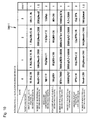
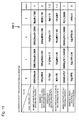
- Scoring information storage 54d is configured to store increased platelet destruction scoring information 54d-1 (see Fig. 10 ) that are information for generating discrimination support information on increased platelet destruction, and decreased platelet production scoring information 54d-2 (see Fig. 11 ) that are information for generating discrimination support information on decreased platelet production.
- scoring information storage 54d is configured to store information 54d-3 and 54d-4 (see Figs. 12 , 13 ) for generating discrimination support information on erythropenia to be described later, too. These information 54d-3 and 54-4 are described later.
- increased destruction score generator 58a selects analysis data (first target analysis data) used to generate discrimination support information on increased platelet destruction (first cause information) among the analysis data stored in analysis data storage 54c, by referring to increased platelet destruction scoring information 54d-1 (Step S11).
- Set in increased platelet destruction scoring information 54d-1 are first target analysis data on increased platelet destruction including: immature granulocyte fraction (IG%), the number of neutrophils (Neut#), hemoglobin concentration (Hgb), mean corpuscular volume (MCV), the number of reticulocytes (RET#), the number of platelets (PLT), immature platelet fraction (IPF%), and the number of monocytes (MONO#).
- Increased destruction score generator 58a reads these first target analysis data from analysis data storage 54c.
- decreased production score generator 58b selects analysis data (second target analysis data) used to generate discrimination support information on decreased platelet production (second cause information) among the analysis data stored in analysis data storage 54c, by referring to decreased platelet production scoring information 54d-2 (Step S11).
- Set in decreased platelet production scoring information 54d-2 are second target analysis data on decreased platelet production including: the number of neutrophils (Neut#), the number of red blood cells (RBC#), hemoglobin concentration (Hgb), mean corpuscular volume (MCV), the number of platelets (PLT), and immature platelet fraction (IPF%).
- Decreased production score generator 58b reads these second target analysis data from analysis data storage 54c.
- analysis channels (measurement systems) 61 to 67 are independent of each other in terms of analysis data generation.
- analysis data is generated in one analysis channel, measurement data of the analysis channel is used, but no measurement data of the other analysis channels are used.
- the present embodiment uses analysis data on the first blood cell type (red blood cell) and analysis data on the second blood cell type (white blood cell) other than analysis data on the predetermined blood cell type (platelet).
- discrimination support information on thrombocytopenia when discrimination support information on thrombocytopenia is generated, used are not only analysis data generated in fifth analysis channel 65 where analysis data on the predetermined blood cell type (platelet) (for example, immature platelet fraction (IPF%)) is generated, but also analysis data generated in another analysis channel (such as second analysis channel 62, fourth analysis channel 64, sixth analysis channel 66, seventh analysis channel 67).
- analysis data in the analysis channels are transversely used in generating the support information.
- increased destruction score generator 58a scores (normalizes) values of first target analysis data according to increased platelet destruction scoring information (table illustrating values of measurement ranges) 54d-1 illustrated in Fig. 10 .
- Increased platelet destruction scoring information (table illustrating values of measurement ranges) 54d-1 defines correspondences between values of first target analysis data and scores (0 to 3).
- Increased destruction score generator 58a converts the value of each first target analysis data into a score (first score) according to scoring information 54d-1 (Step S12).
- decreased production score generator 58b scores (normalizes) values of second target analysis data according to decreased platelet production scoring information (table illustrating values of measurement ranges) 54d-2 illustrated in Fig. 11 .
- Decreased platelet production scoring information (table illustrating values of measurement ranges) 54d-2 also defines correspondences between values of second target analysis data and scores (0 to 3).
- Decreased production score generator 58b converts the value of each second target analysis data into a score (second score) according to scoring information 54d-2 (Step S12).
- Scoring as described above facilitates support information generation with analysis data integrated.
- the present embodiment comprehensively considers analysis data on blood cell types (platelet, red blood cell, white blood cell).
- the analysis data include values in totally different units, accordingly making it difficult to comprehensively consider the analysis data if the values thereof are unchanged.
- setting scoring information 54d-1 to 54d-4 in advance as in the present embodiment and scoring analysis data according to the scoring information make it possible to calculate scores using simple calculation formulas as described later.
- increased destruction score generator 58a assigns a weight to the first score of each first target analysis data according to the importance characterizing the increased destruction state (i.e., multiplies the first scores by weights), sums up the weighted first scores, and divides the sum by the number of the first target analysis data to thus obtain an increased platelet destruction score (discrimination support information: first cause information) (Step S 13).
- the weight of each target analysis data is also set in scoring information 54d-1.
- an increased destruction score may be obtained by adding a value set according to the first special condition to the increased destruction score obtained as described above.
- the step may omit the operation of dividing the sum of the weighted first scores by the number of the first target analysis data.
- decreased production score generator 58b assigns a weight to the second score of each second target analysis data according to the importance characterizing the decreased production state (i.e., multiplies the second scores by weights), sums up the weighted second scores, and divides the sum by the number of the second target analysis data to thus obtain a decreased platelet production score (discrimination support information: second cause information) (Step S13). Note that the weight of each target analysis data is also set in scoring information 54d-2.
- a decreased production score may be obtained by adding a value set according to the second special condition to the decreased production score obtained as described above.
- the step may omit the operation of dividing the sum of the weighted second scores by the number of the second target analysis data.
- the following two conditions X 1 , X 2 can be set:
- the following two conditions X 1 , X 2 can be set:
- the increased destruction score is obtained according to the following calculation formula.
- B all score of immature granulocyte fraction IG % ⁇ 1 + [ score of the number of neutrophils Neut# ⁇ 1.5 ] + score of hemoglobin concentration Hgb ⁇ 2 + [ score of mean corpuscular volume MCV ⁇ 1 ] + [ score of the number of reticulocytes RET# ⁇ 1 ] + score of the number of plates PLT ⁇ 1 + [ score immature platelet fraction IPF % ⁇ 3 ] + score of the number of monocytes MONO# ⁇ 1.2
- the decreased production score is obtained according to the following calculation formula.
- B all score of the number of neutrophils Neut# ⁇ 1 + [ score of the number of red blood cells RBC# ⁇ 3 ] + score of hemoglobin concentration Hgb ⁇ 1.2 + [ score of mean corpuscular volume MCV ⁇ 1.1 ] + [ score of the number of platelets PLT ⁇ 1 ] + score of immature platelet fraction IPF % ⁇ 2
- the weight of the immature platelet fraction in the calculation formula for the increased destruction score is 3 whereas the weight of the immature platelet fraction in the calculation formula for the decreased production score is 2. Importance is placed on the immature platelet fraction more in the increased destruction score calculation.
- Support information storage 54e of hard disk 51d stores, as support information, the increased destruction score and the decreased production score of platelets calculated as described above (Step S 14).
- the discrimination ability of the increased destruction score obtained by the above calculation formula for the increased destruction score is evaluated on 227 cases of the disease (ITP) in the increased destruction state and on 221 cases of the disease (AA/MDS) in which the destruction is not increased.
- the cutoff value of the increased destruction score obtained by the above calculation formula for the increased destruction score is 1.8
- the positive rate of the former (ITP) is 73.6%
- the positive rate of the latter (AA/MDS) is 14.5%. Note that the positive means that a score exceeds the cutoff value, while negative means that a score is less than the cutoff value.
- the discrimination ability of the decreased production score obtained by the above calculation formula for the decreased production score is evaluated on the 221 cases of the disease (AA/MDS) in the decreased production state and on the 227 cases of the disease (ITP) in which the production is not decreased.
- the cutoff value of the decreased production score obtained by the above calculation formula for the decreased production score is 1.4
- the positive rate of the former (AA/MDS) is 86.4%
- the positive rate of the latter (ITP) is 18.1%. Note that the positive means that a score exceeds the cutoff value, while negative means that a score is less than the cutoff value.
- the increased destruction score and the decreased production score favorably exhibit a state suspected of the increased destruction and a state suspected of the decreased production, respectively.
- discrimination of thrombocytopenia is facilitated by using support information for supporting the discrimination, the information considering not only analysis data on platelets but also analysis data on red blood cells and white blood cells.
- presenting a physician with both the increased destruction score and the decreased production score facilitates discrimination by the physician in comparison with a case of presenting one of the scores.
- Increased destruction score generator 58a and decreased production score generator 58b described above are capable of not only generating information for supporting discrimination of thrombocytopenia but also generating information for supporting discrimination of erythropenia (increased red-blood-cell destruction score and decreased red-blood-cell production score).
- increased destruction score generator 58a selects analysis data (first target analysis data) used to generate discrimination support information on increased red-blood-cell destruction (first cause information) among the analysis data stored in analysis data storage 54c, by referring to increased destruction scoring information 54d-3 illustrated in Fig. 12 (Step S11).
- Set in increased red-blood-cell destruction scoring information 54d-3 are first target analysis data on increased red-blood-cell destruction including: mean corpuscular volume (MCV), the number of neutrophils (Neut#), the number of reticulocytes (RET#), the number of platelets (PLT), and fragmented red-blood-cell indicator (FRC#).
- Increased destruction score generator 58a reads these first target analysis data from analysis data storage 54c.
- decreased production score generator 58b selects analysis data (second target analysis data) used to generate discrimination support information on decreased red-blood-cell production (second cause information) among the analysis data stored in analysis data storage 54c, by referring to decreased production scoring information 54d-4 illustrated in Fig. 13 (Step S11).
- Set in decreased red-blood-cell production scoring information 54d-4 are second target analysis data on decreased red-blood-cell production including: the number of neutrophils (Neut#), the number of red blood cells (RBC#), the number of platelets (PLT), the number of reticulocytes (RET#), mean corpuscular volume (MCV), and red blood cell distribution width (RDW-SD).
- Decreased production score generator 58b reads these second target analysis data from analysis data storage 54c.
- increased destruction score generator 58a scores (normalizes) values of first target analysis data according to increased red-blood-cell destruction scoring information (table illustrating values of measurement ranges) 54d-3 illustrated in Fig. 12 .
- Increased red-blood-cell destruction scoring information (table illustrating values of measurement ranges) 54d-3 defines correspondences between values of first target analysis data and scores (0 to 3).
- Increased destruction score generator 58a converts the value of each first target analysis data into a score (first score) according to scoring information 54d-3 (Step S12).
- decreased production score generator 58b scores (normalizes) values of second target analysis data according to decreased red-blood-cell production scoring information (table illustrating values of measurement ranges) 54d-4 illustrated in Fig. 13 .
- Decreased red-blood-cell production scoring information (table illustrating values of measurement ranges) 54d-4 also defines correspondences between values of second target analysis data and scores (0 to 3).
- Decreased production score generator 58b converts the value of each second target analysis data into a score (second score) according to scoring information 54d-4 (Step S12).
- increased destruction score generator 58a calculates an increased destruction score, using the first scores of the first target analysis data (Step S 13).
- decreased production score generator 58b calculates a decreased production score, using the second scores of the second target analysis data (Step S13).
- the increased destruction score of red blood cells is obtained according to the following calculation formula.
- B all score of mean corpuscular volume MCV ⁇ 2 + [ score of the number of neutrophils Neut# ⁇ 1 ] + score of the number of reticulocytes RET# ⁇ 3 + [ score of the number of platelets PLT ⁇ 1 ] + score of fragmented red - blood - cell indicator FRC# ⁇ 2
- Increased destruction score of red blood cells B all ⁇ 5
- the decreased production score of red blood cells is obtained according to the following calculation formula. Note that no special condition is considered here, but a special condition may be considered as in the case of platelets.
- B all score of the number of neutrophils Neut# ⁇ 1 + [ score of the number of red blood cells RBC# ⁇ 1.5 ] + score of the number of platelets PLT ⁇ 1.2 + [ score of mean reticulocytes RET# ⁇ 3 ] + [ score of mean corpuscular volume MCV ⁇ 2 ] + score of red blood cell distribution width ⁇ RDW - SD ⁇ 1
- B all score of the number of neutrophils Neut# ⁇ 1 + [ score of the number of red blood cells RBC# ⁇ 1.5 ] + score of the number of platelets PLT ⁇ 1.2 + [ score of mean reticulocytes RET# ⁇ 3 ] + [ score of mean corpuscular volume MCV ⁇ 2 ] + score of red blood cell distribution width ⁇ RDW - SD ⁇ 1
- Support information storage 54e of hard disk 51 d stores, as support information, the increased destruction score and the decreased production score of red blood cells calculated as described above (Step S 14).
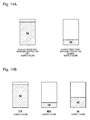
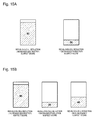
- Figs. 14A to 15B illustrate output examples of support information outputted to display unit (output unit) 52 in information output step S5 of Fig. 5 .
- Fig. 14A illustrates an example of displaying an increased platelet destruction score (platelet reduction/increased destruction suspect score) as first cause information and a decreased platelet production score (platelet reduction/decreased production suspect score) as second cause information respectively in graphs (bar graphs).
- a score outputted in output step S5 may be only the larger (largest) score.
- outputting both of the calculated scores as illustrated in Figs. 14A facilitates discrimination. For example, suppose a case where an increased destruction score is 50 out of 100 and a decreased production score is 20 out of 100. In this case, outputting the increased destruction score of 50 and also displaying the decreased production score of 20 more strongly suggest not a decreased production state but an increased destruction state. Thus, displaying scores in such a comparable manner facilitates the discrimination. Note that the comparison of scores is facilitated by, for example, outputting the scores simultaneously on display unit (output unit) 52 to display both of the scores on display unit 52.
- Fig. 14B illustrates an output example of support information in a case where the support information is constituted of the ITP suspect score (information indicating an ITP suspected state) as first cause information, an MDS suspect score (information indicating an MDS suspected state) as second cause information, and an AA suspect score (information indicating an AA suspected state) as third cause information.
- the support information is constituted of the ITP suspect score (information indicating an ITP suspected state) as first cause information, an MDS suspect score (information indicating an MDS suspected state) as second cause information, and an AA suspect score (information indicating an AA suspected state) as third cause information.
- the ITP suspect score can be calculated similarly to the increased platelet destruction score.
- the MDS suspect score can be calculated by using the above-described calculation formula for the decreased platelet production score, the calculation formula having been modified, for example, by increasing the weight of analysis data strongly characterizing MDS.
- the AA suspect score can be calculated by using the above-described calculation formula for the decreased platelet production score, the calculation formula having been modified, for example, by increasing the weight of analysis data strongly characterizing AA.
- Fig. 15A illustrates an example of displaying an increased red-blood-cell destruction score (red-blood-cell reduction/increased destruction suspect score) as first cause information and a decreased red-blood-cell production score (red-blood-cell reduction/decreased production suspect score) as second cause information respectively in graphs (bar graphs). Note that, in Fig. 15A also, any one of the scores may be outputted, but outputting both of the scores facilitates the discrimination.
- Fig. 15B illustrates an output example of support information in a case where the support information includes a red-blood-cell reduction/iron deficiency suspect score in addition to the red-blood-cell reduction/increased destruction suspect score and the red-blood-cell reduction/decreased production suspect score.
- red-blood-cell reduction/iron deficiency suspect score can be calculated by using the above-described calculation formula for the decreased red-blood-cell production score, the calculation formula having been modified, for example, by increasing the weight of analysis data strongly characterizing iron deficiency.
- a message may be outputted, depending on the scores, to urge the next test. Examples of the message used include “please measure ⁇ ,” “please check ⁇ ” “please check ⁇ in the ⁇ test,” and the like.
- the mode of outputting support information is not limited to the outputting in the form of bar graph illustrating a value of a score obtained according to a calculation formula as in Figs. 14A to 15B .
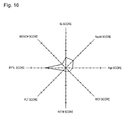
- Support information may be outputted in other graphic types such as radar chart as illustrated in Fig. 16 .
- the radar chart in Fig. 16 sets each score of analysis data as a value on the corresponding axis.
- the radar chart displays scores of analysis data (or weighted scores of the analysis data).
- the size of the area of a portion surrounded in the radar chart corresponds to a score such as an increased destruction score obtained according to the calculation formula for the increased destruction score.
- the modes for outputting support information illustrated in Figs. 14A to 16 are merely examples, and various other modes can be employed.
- the present embodiment makes it possible to improve the precision of information for supporting discrimination of a cause of a reduction in the number of blood cells.
Landscapes
- Health & Medical Sciences (AREA)
- Life Sciences & Earth Sciences (AREA)
- Engineering & Computer Science (AREA)
- Hematology (AREA)
- Immunology (AREA)
- Urology & Nephrology (AREA)
- Biomedical Technology (AREA)
- Chemical & Material Sciences (AREA)
- Molecular Biology (AREA)
- Cell Biology (AREA)
- Food Science & Technology (AREA)
- General Health & Medical Sciences (AREA)
- Biotechnology (AREA)
- Medicinal Chemistry (AREA)
- Physics & Mathematics (AREA)
- Analytical Chemistry (AREA)
- Biochemistry (AREA)
- Microbiology (AREA)
- General Physics & Mathematics (AREA)
- Pathology (AREA)
- Tropical Medicine & Parasitology (AREA)
- Ecology (AREA)
- Zoology (AREA)
- Virology (AREA)
- Investigating Or Analysing Biological Materials (AREA)
Applications Claiming Priority (1)
| Application Number | Priority Date | Filing Date | Title |
|---|---|---|---|
| JP2014071509A JP6170865B2 (ja) | 2014-03-31 | 2014-03-31 | 血液分析装置 |
Publications (2)
| Publication Number | Publication Date |
|---|---|
| EP2926732A1 true EP2926732A1 (de) | 2015-10-07 |
| EP2926732B1 EP2926732B1 (de) | 2019-06-12 |
Family
ID=52813908
Family Applications (1)
| Application Number | Title | Priority Date | Filing Date |
|---|---|---|---|
| EP15160051.7A Active EP2926732B1 (de) | 2014-03-31 | 2015-03-20 | Blutanalysator |
Country Status (4)
| Country | Link |
|---|---|
| US (1) | US10126292B2 (de) |
| EP (1) | EP2926732B1 (de) |
| JP (1) | JP6170865B2 (de) |
| CN (1) | CN104949944B (de) |
Families Citing this family (9)
| Publication number | Priority date | Publication date | Assignee | Title |
|---|---|---|---|---|
| CN106687810B (zh) * | 2014-12-31 | 2019-10-22 | 深圳迈瑞生物医疗电子股份有限公司 | 一种非诊断目的的有核红细胞报警方法、装置及流式细胞分析仪 |
| CN105334336A (zh) * | 2015-11-16 | 2016-02-17 | 青岛安倍康生物医药技术有限公司 | 自动血细胞计数系统及其控制方法 |
| JP7061757B2 (ja) * | 2017-09-29 | 2022-05-02 | 学校法人 川崎学園 | 脳梗塞の発症の予測方法、赤血球造血因子製剤の治療効果の判定方法、及び慢性腎臓病の病期判定方法 |
| CN110501504B (zh) * | 2018-05-16 | 2024-03-12 | 深圳市理邦精密仪器股份有限公司 | 血液含量检测方法和系统 |
| CN109508649B (zh) * | 2018-10-22 | 2023-07-18 | 迪瑞医疗科技股份有限公司 | 一种血细胞分析仪的脉冲信号分析识别方法 |
| CN113009163B (zh) * | 2019-12-20 | 2023-02-17 | 深圳市帝迈生物技术有限公司 | 一种用于样本分析仪的分析系统及样本分析仪 |
| JP7660123B2 (ja) | 2019-12-27 | 2025-04-10 | ベックマン コールター, インコーポレイテッド | サンプル調製器具 |
| JP7649506B2 (ja) | 2020-03-30 | 2025-03-21 | 学校法人順天堂 | 疾患鑑別支援方法、疾患鑑別支援装置、及び疾患鑑別支援コンピュータプログラム |
| CN115165862A (zh) * | 2022-07-08 | 2022-10-11 | 深圳市帝迈生物技术有限公司 | 一种血红蛋白测量方法、测量装置及样本分析装置 |
Citations (5)
| Publication number | Priority date | Publication date | Assignee | Title |
|---|---|---|---|---|
| US20050002826A1 (en) | 2003-07-04 | 2005-01-06 | Sysmex Corporation | Apparatus and method for measuring immature platelets |
| US20050255001A1 (en) * | 2004-05-14 | 2005-11-17 | Honeywell International Inc. | Portable sample analyzer with removable cartridge |
| EP1785720A2 (de) * | 2005-11-15 | 2007-05-16 | Sysmex Corporation | Blutanalysegerät und Methode zur Blutanalyse |
| US20090069639A1 (en) * | 2007-07-31 | 2009-03-12 | Sysmex Corporation | Diagnosis assisting system, diagnosis assisting information providing device and computer program product |
| EP2302377A2 (de) * | 2009-09-25 | 2011-03-30 | Sysmex Corporation | Blutzellenzähler, Diagnosehilfsverfahren und Computerprogrammprodukt |
Family Cites Families (19)
| Publication number | Priority date | Publication date | Assignee | Title |
|---|---|---|---|---|
| US6114173A (en) * | 1997-04-03 | 2000-09-05 | Bayer Corporation | Fully automated method and reagent composition therefor for rapid identification and characterization of reticulocytes erythrocytes and platelets in whole blood |
| JP3783808B2 (ja) | 1997-05-19 | 2006-06-07 | シスメックス株式会社 | 白血球分類計数用試薬 |
| JP2001086705A (ja) | 1999-09-13 | 2001-03-30 | Nikki Denso Kk | パワー半導体を用いたモータ駆動装置の高効率放熱手段 |
| JP2001269174A (ja) | 2000-03-24 | 2001-10-02 | Kirin Brewery Co Ltd | 骨髄異形成症候群(mds)の検出方法及びmdsの治療剤 |
| US8071051B2 (en) * | 2004-05-14 | 2011-12-06 | Honeywell International Inc. | Portable sample analyzer cartridge |
| JP3312204B2 (ja) | 2000-10-17 | 2002-08-05 | 学校法人 慶應義塾 | 血小板減少症の診断用キット |
| US6448085B1 (en) * | 2001-04-13 | 2002-09-10 | Sysmex Corporation | Quality control material and calibrator for nucleated red blood cell tested on hematology analyzer |
| CN1646910A (zh) | 2002-04-09 | 2005-07-27 | 学校法人东海大学 | 白血病、前白血病或非白血病性恶性血液疾病的判定方法以及诊断药 |
| JP2004184103A (ja) | 2002-11-29 | 2004-07-02 | Mitsubishi Kagaku Bio-Clinical Laboratories Inc | 骨髄異形成症候群の検査方法 |
| ES2342291T3 (es) | 2003-06-13 | 2010-07-05 | University Of Pittsburgh | Control de enfermedades inmunologicas, hematologicas e inflamatorias. |
| JP2005037343A (ja) | 2003-07-18 | 2005-02-10 | Miyazaki Toshiyasu | フローサイトメトリーによる骨髄異形成症候群細胞の解析法 |
| JP2005221323A (ja) | 2004-02-04 | 2005-08-18 | Nippon Medical School | 骨髄異形成症候群の検出方法 |
| JP2006010630A (ja) * | 2004-06-29 | 2006-01-12 | Sysmex Corp | 異常細胞の検出装置およびその検出方法 |
| JP3735676B1 (ja) | 2004-11-17 | 2006-01-18 | 国立大学法人金沢大学 | 再生不良性貧血患者血清に存在する自己抗体の検出方法 |
| JP4926812B2 (ja) * | 2007-02-01 | 2012-05-09 | シスメックス株式会社 | 血球分析装置および体液分析方法 |
| EP2215219A4 (de) | 2007-10-29 | 2011-04-13 | Beckman Coulter Inc | Verfahren für schnelle analyse von thrombozytenpopulationen auf antikörperbasis |
| JP5667353B2 (ja) * | 2009-09-25 | 2015-02-12 | シスメックス株式会社 | 血球計数装置、診断支援装置、診断支援方法及びコンピュータプログラム |
| JP5791095B2 (ja) | 2010-12-10 | 2015-10-07 | 国立大学法人金沢大学 | Pnh型白血球の検出方法 |
| JP2013145178A (ja) | 2012-01-13 | 2013-07-25 | Sapporo Medical Univ | 再生不良性貧血のマーカーおよびその利用 |
-
2014
- 2014-03-31 JP JP2014071509A patent/JP6170865B2/ja active Active
-
2015
- 2015-03-20 EP EP15160051.7A patent/EP2926732B1/de active Active
- 2015-03-23 US US14/664,997 patent/US10126292B2/en active Active
- 2015-03-25 CN CN201510132597.XA patent/CN104949944B/zh active Active
Patent Citations (5)
| Publication number | Priority date | Publication date | Assignee | Title |
|---|---|---|---|---|
| US20050002826A1 (en) | 2003-07-04 | 2005-01-06 | Sysmex Corporation | Apparatus and method for measuring immature platelets |
| US20050255001A1 (en) * | 2004-05-14 | 2005-11-17 | Honeywell International Inc. | Portable sample analyzer with removable cartridge |
| EP1785720A2 (de) * | 2005-11-15 | 2007-05-16 | Sysmex Corporation | Blutanalysegerät und Methode zur Blutanalyse |
| US20090069639A1 (en) * | 2007-07-31 | 2009-03-12 | Sysmex Corporation | Diagnosis assisting system, diagnosis assisting information providing device and computer program product |
| EP2302377A2 (de) * | 2009-09-25 | 2011-03-30 | Sysmex Corporation | Blutzellenzähler, Diagnosehilfsverfahren und Computerprogrammprodukt |
Non-Patent Citations (1)
| Title |
|---|
| LAERKE WALTHER JUNGGREEN HAVE ET AL: "Absolute immature platelet count may predict imminent platelet recovery in thrombocytopenic children following chemotherapy", PEDIATRIC BLOOD & CANCER, vol. 60, no. 7, 15 February 2013 (2013-02-15), pages 1198 - 1203, XP055194222, ISSN: 1545-5009, DOI: 10.1002/pbc.24484 * |
Also Published As
| Publication number | Publication date |
|---|---|
| EP2926732B1 (de) | 2019-06-12 |
| JP2015194358A (ja) | 2015-11-05 |
| US20150276720A1 (en) | 2015-10-01 |
| CN104949944B (zh) | 2018-10-26 |
| CN104949944A (zh) | 2015-09-30 |
| JP6170865B2 (ja) | 2017-07-26 |
| US10126292B2 (en) | 2018-11-13 |
Similar Documents
| Publication | Publication Date | Title |
|---|---|---|
| EP2926732B1 (de) | Blutanalysator | |
| US8017078B2 (en) | Blood cell analyzer, blood cell analyzing method, and computer program product | |
| US11415575B2 (en) | Sample analyzer and computer program product | |
| US9453790B2 (en) | Blood analyzer, blood analyzing method, and computer program product | |
| EP2202523B1 (de) | Diagnoseassistenzsystem | |
| JP4949898B2 (ja) | 血球分析装置 | |
| US9939453B2 (en) | Immature platelet enumeration systems and methods | |
| EP3260842A1 (de) | Hämatologischer analysator und verfahren zur analyse von körperflüssigkeiten | |
| CN104755905B (zh) | 具有凝集块校准的血小板计数的系统和方法 | |
| JP2017058158A (ja) | 血液分析装置、血液分析方法及びコンピュータプログラム | |
| JP2015522165A (ja) | 白血球数の測定方法及び測定装置 | |
| EP3882601A1 (de) | Zellklassifizierungsverfahren, klassifizierungsvorrichtung und programm | |
| JP2006010630A (ja) | 異常細胞の検出装置およびその検出方法 | |
| US20220334099A1 (en) | Blood analysis apparatus, blood analysis method, and storage medium | |
| JP2024095228A5 (de) | ||
| CN115398209B (zh) | 细胞分析方法、细胞分析仪及计算机可读存储介质 | |
| EP4492037A1 (de) | Verfahren zum nachweis von thrombozytenaggregation | |
| US20240344961A1 (en) | Sample analysis apparatus and sample analysis method | |
| WO2026070928A1 (ja) | 測定装置 | |
| CN117871370A (zh) | 血液分析仪、血液分析方法和计算机可读存储介质 |
Legal Events
| Date | Code | Title | Description |
|---|---|---|---|
| PUAI | Public reference made under article 153(3) epc to a published international application that has entered the european phase |
Free format text: ORIGINAL CODE: 0009012 |
|
| AK | Designated contracting states |
Kind code of ref document: A1 Designated state(s): AL AT BE BG CH CY CZ DE DK EE ES FI FR GB GR HR HU IE IS IT LI LT LU LV MC MK MT NL NO PL PT RO RS SE SI SK SM TR |
|
| AX | Request for extension of the european patent |
Extension state: BA ME |
|
| 17P | Request for examination filed |
Effective date: 20160406 |
|
| RBV | Designated contracting states (corrected) |
Designated state(s): AL AT BE BG CH CY CZ DE DK EE ES FI FR GB GR HR HU IE IS IT LI LT LU LV MC MK MT NL NO PL PT RO RS SE SI SK SM TR |
|
| STAA | Information on the status of an ep patent application or granted ep patent |
Free format text: STATUS: EXAMINATION IS IN PROGRESS |
|
| 17Q | First examination report despatched |
Effective date: 20180807 |
|
| GRAP | Despatch of communication of intention to grant a patent |
Free format text: ORIGINAL CODE: EPIDOSNIGR1 |
|
| STAA | Information on the status of an ep patent application or granted ep patent |
Free format text: STATUS: GRANT OF PATENT IS INTENDED |
|
| INTG | Intention to grant announced |
Effective date: 20190201 |
|
| GRAS | Grant fee paid |
Free format text: ORIGINAL CODE: EPIDOSNIGR3 |
|
| GRAA | (expected) grant |
Free format text: ORIGINAL CODE: 0009210 |
|
| STAA | Information on the status of an ep patent application or granted ep patent |
Free format text: STATUS: THE PATENT HAS BEEN GRANTED |
|
| AK | Designated contracting states |
Kind code of ref document: B1 Designated state(s): AL AT BE BG CH CY CZ DE DK EE ES FI FR GB GR HR HU IE IS IT LI LT LU LV MC MK MT NL NO PL PT RO RS SE SI SK SM TR |
|
| REG | Reference to a national code |
Ref country code: GB Ref legal event code: FG4D |
|
| REG | Reference to a national code |
Ref country code: CH Ref legal event code: EP |
|
| REG | Reference to a national code |
Ref country code: AT Ref legal event code: REF Ref document number: 1141519 Country of ref document: AT Kind code of ref document: T Effective date: 20190615 |
|
| REG | Reference to a national code |
Ref country code: DE Ref legal event code: R096 Ref document number: 602015031631 Country of ref document: DE |
|
| REG | Reference to a national code |
Ref country code: IE Ref legal event code: FG4D |
|
| REG | Reference to a national code |
Ref country code: NL Ref legal event code: MP Effective date: 20190612 |
|
| REG | Reference to a national code |
Ref country code: LT Ref legal event code: MG4D |
|
| PG25 | Lapsed in a contracting state [announced via postgrant information from national office to epo] |
Ref country code: AL Free format text: LAPSE BECAUSE OF FAILURE TO SUBMIT A TRANSLATION OF THE DESCRIPTION OR TO PAY THE FEE WITHIN THE PRESCRIBED TIME-LIMIT Effective date: 20190612 Ref country code: SE Free format text: LAPSE BECAUSE OF FAILURE TO SUBMIT A TRANSLATION OF THE DESCRIPTION OR TO PAY THE FEE WITHIN THE PRESCRIBED TIME-LIMIT Effective date: 20190612 Ref country code: NO Free format text: LAPSE BECAUSE OF FAILURE TO SUBMIT A TRANSLATION OF THE DESCRIPTION OR TO PAY THE FEE WITHIN THE PRESCRIBED TIME-LIMIT Effective date: 20190912 Ref country code: LT Free format text: LAPSE BECAUSE OF FAILURE TO SUBMIT A TRANSLATION OF THE DESCRIPTION OR TO PAY THE FEE WITHIN THE PRESCRIBED TIME-LIMIT Effective date: 20190612 Ref country code: HR Free format text: LAPSE BECAUSE OF FAILURE TO SUBMIT A TRANSLATION OF THE DESCRIPTION OR TO PAY THE FEE WITHIN THE PRESCRIBED TIME-LIMIT Effective date: 20190612 Ref country code: FI Free format text: LAPSE BECAUSE OF FAILURE TO SUBMIT A TRANSLATION OF THE DESCRIPTION OR TO PAY THE FEE WITHIN THE PRESCRIBED TIME-LIMIT Effective date: 20190612 |
|
| PG25 | Lapsed in a contracting state [announced via postgrant information from national office to epo] |
Ref country code: LV Free format text: LAPSE BECAUSE OF FAILURE TO SUBMIT A TRANSLATION OF THE DESCRIPTION OR TO PAY THE FEE WITHIN THE PRESCRIBED TIME-LIMIT Effective date: 20190612 Ref country code: RS Free format text: LAPSE BECAUSE OF FAILURE TO SUBMIT A TRANSLATION OF THE DESCRIPTION OR TO PAY THE FEE WITHIN THE PRESCRIBED TIME-LIMIT Effective date: 20190612 Ref country code: BG Free format text: LAPSE BECAUSE OF FAILURE TO SUBMIT A TRANSLATION OF THE DESCRIPTION OR TO PAY THE FEE WITHIN THE PRESCRIBED TIME-LIMIT Effective date: 20190912 Ref country code: GR Free format text: LAPSE BECAUSE OF FAILURE TO SUBMIT A TRANSLATION OF THE DESCRIPTION OR TO PAY THE FEE WITHIN THE PRESCRIBED TIME-LIMIT Effective date: 20190913 |
|
| REG | Reference to a national code |
Ref country code: AT Ref legal event code: MK05 Ref document number: 1141519 Country of ref document: AT Kind code of ref document: T Effective date: 20190612 |
|
| PG25 | Lapsed in a contracting state [announced via postgrant information from national office to epo] |
Ref country code: PT Free format text: LAPSE BECAUSE OF FAILURE TO SUBMIT A TRANSLATION OF THE DESCRIPTION OR TO PAY THE FEE WITHIN THE PRESCRIBED TIME-LIMIT Effective date: 20191014 Ref country code: AT Free format text: LAPSE BECAUSE OF FAILURE TO SUBMIT A TRANSLATION OF THE DESCRIPTION OR TO PAY THE FEE WITHIN THE PRESCRIBED TIME-LIMIT Effective date: 20190612 Ref country code: SK Free format text: LAPSE BECAUSE OF FAILURE TO SUBMIT A TRANSLATION OF THE DESCRIPTION OR TO PAY THE FEE WITHIN THE PRESCRIBED TIME-LIMIT Effective date: 20190612 Ref country code: EE Free format text: LAPSE BECAUSE OF FAILURE TO SUBMIT A TRANSLATION OF THE DESCRIPTION OR TO PAY THE FEE WITHIN THE PRESCRIBED TIME-LIMIT Effective date: 20190612 Ref country code: RO Free format text: LAPSE BECAUSE OF FAILURE TO SUBMIT A TRANSLATION OF THE DESCRIPTION OR TO PAY THE FEE WITHIN THE PRESCRIBED TIME-LIMIT Effective date: 20190612 Ref country code: NL Free format text: LAPSE BECAUSE OF FAILURE TO SUBMIT A TRANSLATION OF THE DESCRIPTION OR TO PAY THE FEE WITHIN THE PRESCRIBED TIME-LIMIT Effective date: 20190612 Ref country code: CZ Free format text: LAPSE BECAUSE OF FAILURE TO SUBMIT A TRANSLATION OF THE DESCRIPTION OR TO PAY THE FEE WITHIN THE PRESCRIBED TIME-LIMIT Effective date: 20190612 |
|
| PG25 | Lapsed in a contracting state [announced via postgrant information from national office to epo] |
Ref country code: ES Free format text: LAPSE BECAUSE OF FAILURE TO SUBMIT A TRANSLATION OF THE DESCRIPTION OR TO PAY THE FEE WITHIN THE PRESCRIBED TIME-LIMIT Effective date: 20190612 Ref country code: SM Free format text: LAPSE BECAUSE OF FAILURE TO SUBMIT A TRANSLATION OF THE DESCRIPTION OR TO PAY THE FEE WITHIN THE PRESCRIBED TIME-LIMIT Effective date: 20190612 Ref country code: IT Free format text: LAPSE BECAUSE OF FAILURE TO SUBMIT A TRANSLATION OF THE DESCRIPTION OR TO PAY THE FEE WITHIN THE PRESCRIBED TIME-LIMIT Effective date: 20190612 Ref country code: IS Free format text: LAPSE BECAUSE OF FAILURE TO SUBMIT A TRANSLATION OF THE DESCRIPTION OR TO PAY THE FEE WITHIN THE PRESCRIBED TIME-LIMIT Effective date: 20191012 |
|
| REG | Reference to a national code |
Ref country code: DE Ref legal event code: R097 Ref document number: 602015031631 Country of ref document: DE |
|
| PG25 | Lapsed in a contracting state [announced via postgrant information from national office to epo] |
Ref country code: TR Free format text: LAPSE BECAUSE OF FAILURE TO SUBMIT A TRANSLATION OF THE DESCRIPTION OR TO PAY THE FEE WITHIN THE PRESCRIBED TIME-LIMIT Effective date: 20190612 |
|
| PLBE | No opposition filed within time limit |
Free format text: ORIGINAL CODE: 0009261 |
|
| STAA | Information on the status of an ep patent application or granted ep patent |
Free format text: STATUS: NO OPPOSITION FILED WITHIN TIME LIMIT |
|
| PG25 | Lapsed in a contracting state [announced via postgrant information from national office to epo] |
Ref country code: PL Free format text: LAPSE BECAUSE OF FAILURE TO SUBMIT A TRANSLATION OF THE DESCRIPTION OR TO PAY THE FEE WITHIN THE PRESCRIBED TIME-LIMIT Effective date: 20190612 Ref country code: DK Free format text: LAPSE BECAUSE OF FAILURE TO SUBMIT A TRANSLATION OF THE DESCRIPTION OR TO PAY THE FEE WITHIN THE PRESCRIBED TIME-LIMIT Effective date: 20190612 |
|
| 26N | No opposition filed |
Effective date: 20200313 |
|
| PG25 | Lapsed in a contracting state [announced via postgrant information from national office to epo] |
Ref country code: SI Free format text: LAPSE BECAUSE OF FAILURE TO SUBMIT A TRANSLATION OF THE DESCRIPTION OR TO PAY THE FEE WITHIN THE PRESCRIBED TIME-LIMIT Effective date: 20190612 Ref country code: IS Free format text: LAPSE BECAUSE OF FAILURE TO SUBMIT A TRANSLATION OF THE DESCRIPTION OR TO PAY THE FEE WITHIN THE PRESCRIBED TIME-LIMIT Effective date: 20200224 |
|
| PG2D | Information on lapse in contracting state deleted |
Ref country code: IS |
|
| PG25 | Lapsed in a contracting state [announced via postgrant information from national office to epo] |
Ref country code: MC Free format text: LAPSE BECAUSE OF FAILURE TO SUBMIT A TRANSLATION OF THE DESCRIPTION OR TO PAY THE FEE WITHIN THE PRESCRIBED TIME-LIMIT Effective date: 20190612 |
|
| REG | Reference to a national code |
Ref country code: CH Ref legal event code: PL |
|
| REG | Reference to a national code |
Ref country code: BE Ref legal event code: MM Effective date: 20200331 |
|
| PG25 | Lapsed in a contracting state [announced via postgrant information from national office to epo] |
Ref country code: LU Free format text: LAPSE BECAUSE OF NON-PAYMENT OF DUE FEES Effective date: 20200320 |
|
| PG25 | Lapsed in a contracting state [announced via postgrant information from national office to epo] |
Ref country code: LI Free format text: LAPSE BECAUSE OF NON-PAYMENT OF DUE FEES Effective date: 20200331 Ref country code: CH Free format text: LAPSE BECAUSE OF NON-PAYMENT OF DUE FEES Effective date: 20200331 Ref country code: IE Free format text: LAPSE BECAUSE OF NON-PAYMENT OF DUE FEES Effective date: 20200320 Ref country code: FR Free format text: LAPSE BECAUSE OF NON-PAYMENT OF DUE FEES Effective date: 20200331 |
|
| PG25 | Lapsed in a contracting state [announced via postgrant information from national office to epo] |
Ref country code: BE Free format text: LAPSE BECAUSE OF NON-PAYMENT OF DUE FEES Effective date: 20200331 |
|
| GBPC | Gb: european patent ceased through non-payment of renewal fee |
Effective date: 20200320 |
|
| PG25 | Lapsed in a contracting state [announced via postgrant information from national office to epo] |
Ref country code: GB Free format text: LAPSE BECAUSE OF NON-PAYMENT OF DUE FEES Effective date: 20200320 |
|
| PG25 | Lapsed in a contracting state [announced via postgrant information from national office to epo] |
Ref country code: MT Free format text: LAPSE BECAUSE OF FAILURE TO SUBMIT A TRANSLATION OF THE DESCRIPTION OR TO PAY THE FEE WITHIN THE PRESCRIBED TIME-LIMIT Effective date: 20190612 Ref country code: CY Free format text: LAPSE BECAUSE OF FAILURE TO SUBMIT A TRANSLATION OF THE DESCRIPTION OR TO PAY THE FEE WITHIN THE PRESCRIBED TIME-LIMIT Effective date: 20190612 |
|
| PG25 | Lapsed in a contracting state [announced via postgrant information from national office to epo] |
Ref country code: MK Free format text: LAPSE BECAUSE OF FAILURE TO SUBMIT A TRANSLATION OF THE DESCRIPTION OR TO PAY THE FEE WITHIN THE PRESCRIBED TIME-LIMIT Effective date: 20190612 |
|
| PGFP | Annual fee paid to national office [announced via postgrant information from national office to epo] |
Ref country code: DE Payment date: 20260128 Year of fee payment: 12 |