EP2926839A1 - Hautauflage - Google Patents
Hautauflage Download PDFInfo
- Publication number
- EP2926839A1 EP2926839A1 EP15162677.7A EP15162677A EP2926839A1 EP 2926839 A1 EP2926839 A1 EP 2926839A1 EP 15162677 A EP15162677 A EP 15162677A EP 2926839 A1 EP2926839 A1 EP 2926839A1
- Authority
- EP
- European Patent Office
- Prior art keywords
- skin
- skin support
- layer
- wound
- active substance
- Prior art date
- Legal status (The legal status is an assumption and is not a legal conclusion. Google has not performed a legal analysis and makes no representation as to the accuracy of the status listed.)
- Granted
Links
- 239000007933 dermal patch Substances 0.000 title abstract description 10
- 239000007787 solid Substances 0.000 claims abstract description 42
- 239000013543 active substance Substances 0.000 claims abstract description 41
- 239000011575 calcium Substances 0.000 claims abstract description 27
- 150000003839 salts Chemical class 0.000 claims abstract description 18
- NBIIXXVUZAFLBC-UHFFFAOYSA-N Phosphoric acid Chemical compound OP(O)(O)=O NBIIXXVUZAFLBC-UHFFFAOYSA-N 0.000 claims abstract description 16
- 229910019142 PO4 Inorganic materials 0.000 claims abstract description 14
- 229910001420 alkaline earth metal ion Inorganic materials 0.000 claims abstract description 12
- NBIIXXVUZAFLBC-UHFFFAOYSA-K phosphate Chemical compound [O-]P([O-])([O-])=O NBIIXXVUZAFLBC-UHFFFAOYSA-K 0.000 claims abstract description 10
- 239000010452 phosphate Substances 0.000 claims abstract description 10
- 150000002500 ions Chemical class 0.000 claims abstract description 9
- UEZVMMHDMIWARA-UHFFFAOYSA-N Metaphosphoric acid Chemical compound OP(=O)=O UEZVMMHDMIWARA-UHFFFAOYSA-N 0.000 claims abstract description 8
- 229910000147 aluminium phosphate Inorganic materials 0.000 claims abstract description 8
- ROPDWRCJTIRLTR-UHFFFAOYSA-L calcium metaphosphate Chemical compound [Ca+2].[O-]P(=O)=O.[O-]P(=O)=O ROPDWRCJTIRLTR-UHFFFAOYSA-L 0.000 claims abstract description 8
- XPPKVPWEQAFLFU-UHFFFAOYSA-N diphosphoric acid Chemical compound OP(O)(=O)OP(O)(O)=O XPPKVPWEQAFLFU-UHFFFAOYSA-N 0.000 claims abstract description 8
- QORWJWZARLRLPR-UHFFFAOYSA-H tricalcium bis(phosphate) Chemical compound [Ca+2].[Ca+2].[Ca+2].[O-]P([O-])([O-])=O.[O-]P([O-])([O-])=O QORWJWZARLRLPR-UHFFFAOYSA-H 0.000 claims abstract description 8
- 206010052428 Wound Diseases 0.000 claims description 59
- 208000027418 Wounds and injury Diseases 0.000 claims description 58
- 239000000463 material Substances 0.000 claims description 21
- 239000000203 mixture Substances 0.000 claims description 19
- 239000000843 powder Substances 0.000 claims description 14
- 239000004698 Polyethylene Substances 0.000 claims description 13
- 239000007788 liquid Substances 0.000 claims description 13
- 229920000573 polyethylene Polymers 0.000 claims description 13
- 230000004888 barrier function Effects 0.000 claims description 12
- -1 polyethylene Polymers 0.000 claims description 10
- 239000004744 fabric Substances 0.000 claims description 9
- 239000008187 granular material Substances 0.000 claims description 9
- 229920000297 Rayon Polymers 0.000 claims description 8
- 239000000126 substance Substances 0.000 claims description 8
- 239000004695 Polyether sulfone Substances 0.000 claims description 7
- 239000004743 Polypropylene Substances 0.000 claims description 7
- 229920002678 cellulose Polymers 0.000 claims description 7
- 239000001913 cellulose Substances 0.000 claims description 7
- 229920006393 polyether sulfone Polymers 0.000 claims description 7
- 229920001155 polypropylene Polymers 0.000 claims description 7
- 239000001993 wax Substances 0.000 claims description 6
- 239000005313 bioactive glass Substances 0.000 claims description 5
- 239000012528 membrane Substances 0.000 claims description 5
- 230000029663 wound healing Effects 0.000 claims description 5
- 239000003102 growth factor Substances 0.000 claims description 4
- 230000001632 homeopathic effect Effects 0.000 claims description 4
- 238000005342 ion exchange Methods 0.000 claims description 4
- 230000035515 penetration Effects 0.000 claims description 4
- 229920001296 polysiloxane Polymers 0.000 claims description 4
- 102000004169 proteins and genes Human genes 0.000 claims description 4
- 108090000623 proteins and genes Proteins 0.000 claims description 4
- 239000000853 adhesive Substances 0.000 claims description 3
- 230000001070 adhesive effect Effects 0.000 claims description 3
- 239000002131 composite material Substances 0.000 claims description 3
- 230000002209 hydrophobic effect Effects 0.000 claims description 3
- 239000012188 paraffin wax Substances 0.000 claims description 3
- 229920000098 polyolefin Polymers 0.000 claims description 3
- 239000004814 polyurethane Substances 0.000 claims description 3
- 229910052708 sodium Inorganic materials 0.000 claims description 3
- 230000009885 systemic effect Effects 0.000 claims description 3
- 239000002759 woven fabric Substances 0.000 claims description 3
- 229920012266 Poly(ether sulfone) PES Polymers 0.000 claims description 2
- 239000003814 drug Substances 0.000 claims description 2
- 239000006260 foam Substances 0.000 claims description 2
- 239000008177 pharmaceutical agent Substances 0.000 claims description 2
- 238000009940 knitting Methods 0.000 claims 1
- 230000000699 topical effect Effects 0.000 claims 1
- XLYOFNOQVPJJNP-UHFFFAOYSA-N water Substances O XLYOFNOQVPJJNP-UHFFFAOYSA-N 0.000 abstract description 5
- 230000035699 permeability Effects 0.000 abstract description 2
- 239000010410 layer Substances 0.000 description 51
- 238000002360 preparation method Methods 0.000 description 15
- 235000021317 phosphate Nutrition 0.000 description 12
- 239000002245 particle Substances 0.000 description 7
- 230000008901 benefit Effects 0.000 description 5
- 239000008280 blood Substances 0.000 description 5
- 210000004369 blood Anatomy 0.000 description 5
- 238000009472 formulation Methods 0.000 description 4
- 150000003013 phosphoric acid derivatives Chemical class 0.000 description 4
- 229920003023 plastic Polymers 0.000 description 4
- 239000004033 plastic Substances 0.000 description 4
- 239000011734 sodium Substances 0.000 description 4
- 239000000243 solution Substances 0.000 description 4
- 210000001519 tissue Anatomy 0.000 description 4
- 229920001862 ultra low molecular weight polyethylene Polymers 0.000 description 4
- OYPRJOBELJOOCE-UHFFFAOYSA-N Calcium Chemical compound [Ca] OYPRJOBELJOOCE-UHFFFAOYSA-N 0.000 description 3
- 229910001413 alkali metal ion Inorganic materials 0.000 description 3
- 230000001225 therapeutic effect Effects 0.000 description 3
- 210000002700 urine Anatomy 0.000 description 3
- VAZJLPXFVQHDFB-UHFFFAOYSA-N 1-(diaminomethylidene)-2-hexylguanidine Chemical compound CCCCCCN=C(N)N=C(N)N VAZJLPXFVQHDFB-UHFFFAOYSA-N 0.000 description 2
- DGAQECJNVWCQMB-PUAWFVPOSA-M Ilexoside XXIX Chemical compound C[C@@H]1CC[C@@]2(CC[C@@]3(C(=CC[C@H]4[C@]3(CC[C@@H]5[C@@]4(CC[C@@H](C5(C)C)OS(=O)(=O)[O-])C)C)[C@@H]2[C@]1(C)O)C)C(=O)O[C@H]6[C@@H]([C@H]([C@@H]([C@H](O6)CO)O)O)O.[Na+] DGAQECJNVWCQMB-PUAWFVPOSA-M 0.000 description 2
- FYYHWMGAXLPEAU-UHFFFAOYSA-N Magnesium Chemical compound [Mg] FYYHWMGAXLPEAU-UHFFFAOYSA-N 0.000 description 2
- HFIGWKOFZLNOQK-UHFFFAOYSA-K [O-]P([O-])(=O)OP(=O)([O-])O.[Ca+2].[Na+] Chemical class [O-]P([O-])(=O)OP(=O)([O-])O.[Ca+2].[Na+] HFIGWKOFZLNOQK-UHFFFAOYSA-K 0.000 description 2
- 230000002745 absorbent Effects 0.000 description 2
- 239000002250 absorbent Substances 0.000 description 2
- 229910052791 calcium Inorganic materials 0.000 description 2
- UXXMRERKSQADPJ-UHFFFAOYSA-K calcium potassium [hydroxy(oxido)phosphoryl] phosphate Chemical class [O-]P([O-])(=O)OP(=O)([O-])O.[Ca+2].[K+] UXXMRERKSQADPJ-UHFFFAOYSA-K 0.000 description 2
- 239000000969 carrier Substances 0.000 description 2
- 150000001875 compounds Chemical class 0.000 description 2
- 238000010276 construction Methods 0.000 description 2
- 230000000249 desinfective effect Effects 0.000 description 2
- 238000009826 distribution Methods 0.000 description 2
- 230000000694 effects Effects 0.000 description 2
- 239000012530 fluid Substances 0.000 description 2
- 150000004820 halides Chemical class 0.000 description 2
- 239000000644 isotonic solution Substances 0.000 description 2
- 229910052749 magnesium Inorganic materials 0.000 description 2
- 239000011777 magnesium Substances 0.000 description 2
- 229940127554 medical product Drugs 0.000 description 2
- 238000002844 melting Methods 0.000 description 2
- 230000008018 melting Effects 0.000 description 2
- 238000000034 method Methods 0.000 description 2
- 239000004745 nonwoven fabric Substances 0.000 description 2
- 229940021222 peritoneal dialysis isotonic solution Drugs 0.000 description 2
- 229910001414 potassium ion Inorganic materials 0.000 description 2
- 230000008569 process Effects 0.000 description 2
- 238000010791 quenching Methods 0.000 description 2
- 230000000171 quenching effect Effects 0.000 description 2
- 229920006268 silicone film Polymers 0.000 description 2
- 229910001415 sodium ion Inorganic materials 0.000 description 2
- 230000001954 sterilising effect Effects 0.000 description 2
- 238000004659 sterilization and disinfection Methods 0.000 description 2
- 239000000725 suspension Substances 0.000 description 2
- 229920001169 thermoplastic Polymers 0.000 description 2
- 239000004416 thermosoftening plastic Substances 0.000 description 2
- 229920000742 Cotton Polymers 0.000 description 1
- 239000004952 Polyamide Substances 0.000 description 1
- 229920005830 Polyurethane Foam Polymers 0.000 description 1
- 208000004210 Pressure Ulcer Diseases 0.000 description 1
- 230000037374 absorbed through the skin Effects 0.000 description 1
- 239000004480 active ingredient Substances 0.000 description 1
- 230000006978 adaptation Effects 0.000 description 1
- 230000009286 beneficial effect Effects 0.000 description 1
- 229910001424 calcium ion Inorganic materials 0.000 description 1
- 239000002537 cosmetic Substances 0.000 description 1
- 230000007547 defect Effects 0.000 description 1
- 230000001419 dependent effect Effects 0.000 description 1
- 239000000945 filler Substances 0.000 description 1
- 210000004392 genitalia Anatomy 0.000 description 1
- 230000003993 interaction Effects 0.000 description 1
- 210000002751 lymph Anatomy 0.000 description 1
- 230000014759 maintenance of location Effects 0.000 description 1
- 229920002647 polyamide Polymers 0.000 description 1
- 229920002635 polyurethane Polymers 0.000 description 1
- 230000001737 promoting effect Effects 0.000 description 1
- 239000002356 single layer Substances 0.000 description 1
- 239000002344 surface layer Substances 0.000 description 1
- 210000003371 toe Anatomy 0.000 description 1
- 239000003860 topical agent Substances 0.000 description 1
- 238000009827 uniform distribution Methods 0.000 description 1
- 235000013311 vegetables Nutrition 0.000 description 1
Images

Classifications
-
- A—HUMAN NECESSITIES
- A61—MEDICAL OR VETERINARY SCIENCE; HYGIENE
- A61L—METHODS OR APPARATUS FOR STERILISING MATERIALS OR OBJECTS IN GENERAL; DISINFECTION, STERILISATION OR DEODORISATION OF AIR; CHEMICAL ASPECTS OF BANDAGES, DRESSINGS, ABSORBENT PADS OR SURGICAL ARTICLES; MATERIALS FOR BANDAGES, DRESSINGS, ABSORBENT PADS OR SURGICAL ARTICLES
- A61L15/00—Chemical aspects of, or use of materials for, bandages, dressings or absorbent pads
- A61L15/16—Bandages, dressings or absorbent pads for physiological fluids such as urine or blood, e.g. sanitary towels, tampons
- A61L15/18—Bandages, dressings or absorbent pads for physiological fluids such as urine or blood, e.g. sanitary towels, tampons containing inorganic materials
-
- A—HUMAN NECESSITIES
- A61—MEDICAL OR VETERINARY SCIENCE; HYGIENE
- A61K—PREPARATIONS FOR MEDICAL, DENTAL OR TOILETRY PURPOSES
- A61K33/00—Medicinal preparations containing inorganic active ingredients
-
- A—HUMAN NECESSITIES
- A61—MEDICAL OR VETERINARY SCIENCE; HYGIENE
- A61K—PREPARATIONS FOR MEDICAL, DENTAL OR TOILETRY PURPOSES
- A61K33/00—Medicinal preparations containing inorganic active ingredients
- A61K33/06—Aluminium, calcium or magnesium; Compounds thereof, e.g. clay
- A61K33/08—Oxides; Hydroxides
-
- A—HUMAN NECESSITIES
- A61—MEDICAL OR VETERINARY SCIENCE; HYGIENE
- A61K—PREPARATIONS FOR MEDICAL, DENTAL OR TOILETRY PURPOSES
- A61K33/00—Medicinal preparations containing inorganic active ingredients
- A61K33/42—Phosphorus; Compounds thereof
-
- A—HUMAN NECESSITIES
- A61—MEDICAL OR VETERINARY SCIENCE; HYGIENE
- A61L—METHODS OR APPARATUS FOR STERILISING MATERIALS OR OBJECTS IN GENERAL; DISINFECTION, STERILISATION OR DEODORISATION OF AIR; CHEMICAL ASPECTS OF BANDAGES, DRESSINGS, ABSORBENT PADS OR SURGICAL ARTICLES; MATERIALS FOR BANDAGES, DRESSINGS, ABSORBENT PADS OR SURGICAL ARTICLES
- A61L15/00—Chemical aspects of, or use of materials for, bandages, dressings or absorbent pads
- A61L15/16—Bandages, dressings or absorbent pads for physiological fluids such as urine or blood, e.g. sanitary towels, tampons
- A61L15/42—Use of materials characterised by their function or physical properties
- A61L15/44—Medicaments
Definitions
- the present invention relates to a skin support according to the preamble of independent claim 1.
- EP 1 339 417 B1 a composition for the treatment of flat, open wounds comprising a solid active component containing a salt of a biodegradable phosphate and calcium and alkali metal ions.
- This preparation has proven to be excellent in the treatment of wounds on surface tissues, which are caused for example by pressure ulcers, burns, UV rays or chemicals.
- the revelation of EP 1 339 417 B1 with regard to the preparation is hereby incorporated in full.
- the said preparation according to the EP 1 339 417 B1 has the significant advantage that it stimulates the treated tissue to growth, so that the new tissue not only a defect can be closed, but also a structure of a tissue structure can be stimulated.
- This effect of the preparation - also called substance - is in the WO 09/121616 Ades applicant disclosed, the disclosure of which is hereby also fully incorporated.
- the known preparations are applied directly to the wound or applied to a - preferably solid - carrier.
- Possible carriers are wax, wax films, wax stencils or silicone carriers. It has already been described that crater-shaped depressions of the wounds are filled in and leveled with the known preparations.
- a skin patch for application to the skin or a wound and for the delivery of ions according to the present invention comprises at least one layer of a solid, active substance and at least one skin-facing, water- and ion-permeable, skin-friendly permeability.
- the solid, active substance comprises at least one salt of a biodegradable phosphate from the group of phosphoric acid, metaphosphoric acid, diphosphoric acid and the counterions of these salts, preferably alkaline earth metal ions, more preferably calcium metaphosphate Ca (PO 3 ) 2 , beta tricalcium phosphate Ca 3 (PO 4 ) 2 and hydroxylapathite Ca 3 (PO 4 ) 3 OH.
- the alkali metal ions are sodium and / or potassium ions. These may be added to the formulation in any form from the corresponding halides or oxides, or they may already exist as counterions of the biodegradable phosphates in addition to the alkaline earth metal ions. Particularly preferred are sodium-calcium diphosphates and potassium-calcium diphosphates.
- another alkaline earth metal ion in addition to calcium, another alkaline earth metal ion, namely magnesium, is present. This may be added as a counterion of the biodegradable phosphates, as a halide salt, or as an oxide of the formulation.
- the skin support according to the invention now allows the solid, active substance no longer to be applied freely to the wound, which requires skill and effort during application and removal.
- the solid, active substance can be applied in a skin patch on the skin or on the wound.
- the advantage is that the solid, active substance already available in portions for application, can be applied immediately and in toto is removable again. It has proven to be particularly advantageous that no particles remain on the skin or in the wound and so that the prescribed length of stay of the material is not exceeded.
- the skin layer is sufficiently liquid-permeable (preferably fine-pored) and mechanically stable (in particular tear-resistant), so that the individual particles of the solid, active substance remain in the skin layer, but the release of dissolved ions is easily ensured and thus the effect of the solid, active substance, For example, a granules of bioactive glass, yet outward (to the skin or wound out) is unfolded.
- the skin patch may be removed without residue on the skin or wound, along with the remaining solid, active substance, after use as intended, even if it may have accumulated for several days. Even when used as a bandage or diaper ensures that no particles of the active substance remain on the skin in the genital area.
- the skin layer is characterized in that the solid active substance is from 27.1 to 39.9 mol% P 2 O 5 , 22.5 to 36.0 mol% CaO, 14.5 to 30.0 mol% M 2 O and 5.0 to 25 mol% MgO, wherein M 2 O contains 27.1 to 30.0 mol% Na 2 O and / or 0 to 12 mol% K 2 O.
- the skin support comprises at least one absorbent element, preferably of cellulose, cellulose flakes, viscose, superabsorbent or polyurethane (PU) foam, or a combination of them.
- the suction element advantageously serves, for example, for urine or blood emerging from a wound to be absorbed through the skin support, thus promoting an interaction with the solid, active substance. Volume and typical nature of such Saugelements are known in the art for the various applications.
- the skin patch has a barrier layer opposite the penetration layer, which is liquid impermeable.
- the barrier layer may serve to prevent the skin liner from leaking fluid exiting the body of the wearer of the skin pad, for example, from a wound, but in the skin pad, preferably in the position with the solid active substance and / or or the suction element remains. This may be advantageous if over the skin support clothes are attracted, which are thereby protected from the exiting from the body of the wearer of the skin support liquid.
- the barrier layer for embodiments in which the skin layer is a wound dressing, a bandage, a panty liner or a diaper.
- the skin support has a distributing arrangement, preferably a fleece of polyethersulfone (PES) or polyethylene (PE), arranged between the penetration layer and the suction element.
- the distribution may serve to distribute urine or localized blood emerging from a wound substantially evenly over the area in the skin pad, preferably in the form of a napkin or diaper, and to deliver it to the absorbent element. This is particularly advantageous since the suction element thereby comes into contact with the urine or blood substantially uniformly, thus ensuring more efficient utilization of the suction power and the retention volume.
- the solid, active substance is arranged between the passage position and the suction element.
- the passage layer is arranged between the solid, active substance and the skin or the wound and that the liquid which is sucked into the suction element passes through the layer with the solid, active substance and releases the ions there before it Suction element reached.
- the dissolved ions diffuse very quickly towards the body of the wearer of the skin pad.
- the skin patch may have one or more chambers. This has the advantage that the local treatment of all parts of a wound - ie nationwide - can be guaranteed.
- the individual chambers can ensure that the contents do not accumulate gravitationally in an edge or corner area of the bag, and large portions of the wound are unrelated to the solid, active substance.
- the chambers have a size and a content according to the abovementioned particularly preferred single-chamber skin coverings.
- the skin patch contains 8 to 12 g, more preferably 10 g of the solid active substance.
- the solid active substance is in powder form having a particle diameter in the range of 50 to 250 microns, more preferably between 50 and 150 microns, wherein the powder is preferably granulated for better handling, and preferably is a bioactive glass.
- the solid active substance is preferably prepared by melting the aforementioned oxides at a temperature of 1050 to 1550 ° C.
- a glassy material obtained is conveniently comminuted by quenching. It can then be ground, so that a powder with an average grain diameter in the range of 50 to 250 microns, more preferably between 50 and 150 microns is formed.
- the powder or granules may be mixed with plant, homeopathic and / or other pharmaceutical agents and / or wound healing assistants and / or growth factors, proteins, topical agents for systemic application or mixtures thereof.
- the solid, active substance can be present as a powder, granules or as a suspension. In the case of powders or granules, it has proved advantageous to moisten them before the actual treatment of the wound.
- Sterile isotonic solutions such as, for example, a Ringer's solution
- solutions which per se have a disinfecting action eg Lavasept®
- the pass-through layer may comprise a nonwoven layer, a woven fabric, a knitted fabric, a film or a membrane, preferably of polypropylene (PP), PE, PES or viscose, wherein the passage layer at least partially adhesive, wound-friendly materials such as hydrophobic, non-woven polyolefin Includes films that ensure fluid passage and ion exchange.
- PP polypropylene
- PE PE
- PES polypropylene
- viscose preferably of polypropylene
- wound-friendly materials such as hydrophobic, non-woven polyolefin Includes films that ensure fluid passage and ion exchange.
- the passage of liquid and the ion exchange can be ensured by perforations or openings or meshes of suitable size.
- the pass-through layer can be made, at least in regions, from natural fabric, knitted or nonwoven fabrics and preferably impregnated with skin-compatible substances, such as silicone, paraffin, wax and the like. Furthermore, the passage layer can be equipped with known hydrophilic finishes or coated with known hydrophilic membranes.
- the pervious layer may also comprise a suitable water-permeable thermoplastic such as polyethylene, in particular ultra-low density polyethylene (ULDPE), or permeable silicone film or other plastics, or compounds of natural materials and plastics.
- a suitable water-permeable thermoplastic such as polyethylene, in particular ultra-low density polyethylene (ULDPE), or permeable silicone film or other plastics, or compounds of natural materials and plastics.
- the passage layer may be single-layer or multi-layer, wherein the passage layer is made of a single material or composite materials.
- the material from which at least the body-facing pass-through layer of the skin support according to the invention is made is chosen such that it does not stick to the wound, clogs or otherwise with it combines.
- the skin patch material must be biocompatible and approved as a medical product.
- Sterilizable materials have proven to be particularly preferred which additionally ensure that the particles of layer with the solid, active substance-in the unused state of the skin layer-can not escape to the outside in order not to complicate the sterilization process.
- the skin patch may be formed as a pouch, sanitary napkin, panty liner, wound pad, bandage, wound pad or diaper.
- the trained as a bag skin layer may have a flat basic shape and preferably circular with a diameter of 5 to 7 cm, preferably 6 cm, rectangular or square with edge lengths of 5 to 7 cm, preferably 6 cm be formed.
- the skin support in the form of a bag is also referred to as an application bag in the context of the present invention.
- An application bag according to the present invention is filled with a composition, preferably a preparation in the form of a solid active substance.
- the application bag according to the invention now makes it possible that the preparation no longer has to be applied freely to the wound, which requires skill and effort in the application and removal.
- the preparation does not have to be applied with a carrier, which also requires some skill in the application.
- New is the composition in a bag, for example in a non-woven bag containing wound granules, be applied to the skin or in the wound.
- the advantage is that the composition is already portioned available to the application, can be used immediately and in toto is removable again. It has proved to be particularly advantageous that no particles remain in the wound and thus the prescribed service life of the material is not exceeded.
- the bags according to the invention comprising therapeutic compositions for direct wound treatment are composed of at least two wall surfaces which define and enclose a fillable or filled interior space, wherein at least the wall surfaces facing the body preferably completely, but at least over a large area, of a liquid-permeable, pliable material section for adaptation includes the wound surface.
- the flexible or flexible wall material can be removed after use as intended on the wound together with the remaining bag contents without residue. Although it may have been several days on the wound. In the wound care with the inventive application bag, it has proven to be advantageous to keep it with a semi-occlusive dressing on the wound.
- the application bags according to the present invention are according to preferred embodiments of two opposite walls with congruent Outlines of simple geometric shapes (circle, square, rectangle, oval, etc.) made.
- the bags are circular with a diameter of 5 to 7, preferably 6 cm. Or rectangular or square with edge lengths of 5 to 7, preferably 6 cm.
- the aforementioned bag sizes preferably contain 8 to 12, particularly preferably 10 g of the therapeutic preparation for direct wound treatment.
- these bags are preferably under-chambered.
- the chambers have a size and a content according to the aforementioned particularly preferred single-chamber bags.
- the application bags are preferably kidney-shaped or otherwise preformed to the spatial shape of the application site.
- the wall elements are either welded circumferentially, glued or sewn. If the application bag is made of a tubular wall material, it is sufficient to close the open ends after filling.
- the bags are manufactured with a closable opening which allows the end user to fill.
- the bag walls may be formed in one or more layers of a single material or of composite materials.
- the material from which at least the body-facing surface layer of the inventive application bag is made is chosen such that it does not stick to the wound, bakes or otherwise connects with her.
- the bag material must be biocompatible and approved as a medical product.
- natural fabric, knits or nonwovens are selected which are impregnated with skin-compatible substances such as silicone, paraffin, wax and the like, finished with known hydrophilic finishes or coated with known hydrophilic membranes.
- the water permeable portions of the bag wall may also be selected from a suitable water permeable thermoplastic such as polyethylene, especially ultra low density polyethylene (ULDPE), or permeable silicone film or other plastics, or natural and plastic compounds.
- a suitable water permeable thermoplastic such as polyethylene, especially ultra low density polyethylene (ULDPE), or permeable silicone film or other plastics, or natural and plastic compounds.
- the bags are not simply formed flat but in the form of a three-dimensional body as a wound filler.
- the proximal portions of the pouch wall coming into contact with the skin of the patient are made of adhesive, wound-preserving materials, such as hydrophobic, non-woven polyolefin films, such as polyethylene or polypropylene film, which are perforated or perforated or of a suitable size ensure the passage of liquid and ion exchange.
- adhesive, wound-preserving materials such as hydrophobic, non-woven polyolefin films, such as polyethylene or polypropylene film, which are perforated or perforated or of a suitable size ensure the passage of liquid and ion exchange.
- Sterilizable materials have proven to be particularly preferred, which also ensure that the particles from the interior of the bag - in the unused state of the bag - can not escape to the outside in order not to complicate the sterilization process.
- the composition for filling the bag preferably comprises a preparation in the form of a solid active substance, which in the broadest sense can be termed bioactive glass.
- the bioactive glass comprises a salt of a biodegradable phosphate from the group of phosphoric acid, metaphosphoric acid, diphosphoric acid and the counterions of these salts, preferably alkaline earth metal ions.
- Particularly preferred are calcium metaphosphate Ca (PO 3 ) 2 , beta-tricalcium phosphate Ca 3 (PO 4 ) 2 and hydroxylapathite Ca 3 (PO 4 ) 3 OH.
- These salts of a biodegradable phosphate can each occur alone or in mixtures.
- the alkali metal ions are sodium and / or potassium ions. These can be any form of the appropriate Halides or oxides may be added to the preparation, or they may already occur as counterions of the biodegradable phosphates in addition to the alkaline earth metal ions. Particularly preferred are sodium-calcium diphosphates and potassium-calcium diphosphates.
- another alkaline earth metal ion in addition to calcium, another alkaline earth metal ion, namely magnesium, is present. This may be added as a counterion of the biodegradable phosphates, as a halide salt, or as an oxide of the formulation.
- the preparation is composed of 27.1 to 39.9 mol% P 2 O 5 , 22.5 to 36.0 mol% CaO, 14.5 to 30.0 mol% M 2 O and 5.0 to 25 mol% MgO together, wherein M 2 O contains 27.1 to 30.0 mol% Na 2 O and / or 0 to 12 mol% K 2 O.
- the composition used to fill the bag comprises a preparation preferably prepared by melting the aforementioned oxides at a temperature of from 1050 ° C to 1550 ° C.
- a glass-like material obtained is conveniently comminuted by quenching. It can then be ground, so that a powder with an average grain diameter in the range of 50 to 250 microns, more preferably between 50 and 150 microns is formed.
- the powder can then be granulated for better handling.
- the powder or granules can subsequently be used to prepare the composition with vegetable, homeopathic and / or other pharmaceutical active ingredients and / or wound healing supporting substances and / or growth factors, proteins or the like.
- the composition used for filling the bag comprises herbal, homeopathic and / or other pharmaceutically active substances and / or wound healing assisting substances and / or growth factors, proteins, similar local therapeutics for systemic application or the like, or mixtures thereof.
- compositions used for filling the bag are preferably present either as a powder, granules or as a suspension.
- powders or granules it has proven to be advantageous to moisten them before the actual treatment of the wound.
- Suitable liquids for this purpose have been found to be sterile isotonic solutions (such as a Ringer's solution) or solutions which per se have a disinfecting action (e.g., Lavasept®).
- Fig. 1 shows an embodiment of the skin support as a wound dressing 1 in a cross-sectional view perpendicular to the expansion surface of the wound dressing 1.
- the wound dressing 1 comprises a skin-facing passage 3, which is water and ion permeable and preferably skin compatible.
- the passage layer 3 may be a nonwoven, a membrane or a film of PP, PE or PES.
- a layer 2 of a solid, active substance 21 is arranged at the passage 3.
- the solid active substance 21 may be, for example, a salt of a biodegradable phosphate from the group of phosphoric acid, metaphosphoric acid, diphosphoric acid and the counterions of these salts, preferably alkaline earth metal ions, more preferably calcium metaphosphate Ca (PO 3 ) 2 , beta tricalcium phosphate Ca 3 (PO 4 ) 2 and hydroxylapathite Ca 3 (PO 4 ) 3 OH.
- the solid active substance 21 may be granulated for ease of handling.
- a suction element 4 is arranged, which can be made, for example, of cellulose, cellulose flakes, viscose, superabsorbent or PU foam, or a combination thereof.
- a barrier layer 5 which is liquid impermeable and thus prevents For example, blood or lymph, which passes through the passage layer 3, via the layer 2 with the solid, active substance 21 to the suction element 4, further exits the wound dressing 1 via the barrier layer 5.
- the wound dressing 1 can be applied to a wound and, for example, a dress can be put on without the dress being soiled by the blood.
- the barrier layer 5 may be a film of PU.
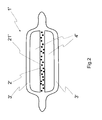
- Fig. 2 shows an embodiment of the skin support as a wound pad 1 'in a cross-sectional view perpendicular to the expansion surface of the wound pad 1'.
- the wound pad 1 ' comprises a passage layer 3', which is formed of Hüllvlies 3 'and the entire wound pad 1' wrapped.
- the Hüllvlies 3 ' may be made of viscose or PES.
- a layer 2 'with a solid, active substance 21' is arranged.
- the solid, active substance 21 ' may, for example, be a salt of a biodegradable phosphate from the group of phosphoric acid, metaphosphoric acid, diphosphoric acid and the counterions of these salts, preferably alkaline earth metal ions, more preferably calcium metaphosphate Ca (PO 3 ) 2 , beta tricalcium phosphate Ca 3 ( PO 4 ) 2 and hydroxylapathite Ca 3 (PO 4 ) 3 OH.
- two suction elements 4 ' are arranged on both sides of the layer 2'.
- the suction elements 4 ' may be made of viscose or PES.
- the wound pad 1 ' can be applied on both sides, which can be particularly advantageous in the case of rapid wound care, since it is ensured that the wound pad 1' is always correctly applied to a wound.
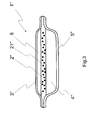
- Fig. 3 shows an embodiment of a skin support as a bandage 1 "in cross-sectional view perpendicular to the expansion surface of the napkin 1".
- Embodiments of the skin support as a panty liner or diaper have substantially the same structure as the bandage 1 "shown.”
- the bandage 1 "comprises a body-facing penetration layer 3", which is permeable to water and ions and tolerated by the skin. Be PE or PES.
- a distributing layer 6 is then arranged, which serves for the uniform distribution of liquid over the surface of the napkin 1".
- the distributing layer 6 is preferably a fleece of PES or PE.
- a layer 2 "with a solid, active substance 21" is arranged on the distribution part 6.
- the solid, active substance 21 " may be, for example, a salt of a biodegradable phosphate from the group of phosphoric acid, metaphosphoric acid, diphosphoric acid and the counterions of these salts, preferably alkaline earth metal ions, more preferably calcium metaphosphate Ca (PO 3 ) 2 , beta tricalcium phosphate Ca 3 ( PO 4 ) 2 and hydroxylapathite Ca 3 (PO 4 ) 3 OH, at the position 2 "a suction element 4" is then arranged, to which a barrier layer 5 "adjoins.
- a salt of a biodegradable phosphate from the group of phosphoric acid, metaphosphoric acid, diphosphoric acid and the counterions of these salts, preferably alkaline earth metal ions, more preferably calcium metaphosphate Ca (PO 3 ) 2 , beta tricalcium phosphate Ca 3 ( PO 4 ) 2 and hydroxylapath
- the suction element 4 can be made of cellulose fluff or superabsorber
- the barrier layer 5" is impermeable to liquid and prevents liquid from escaping from the napkin 1 "via the barrier layer 5".
- Such a construction as the bandage 1 "shown with the distributing layer 6 and the barrier layer 5" is also particularly advantageous for panty liners or diapers.
- the barrier layer 5 may be, for example, a PE film with a PP spunbonded nonwoven.
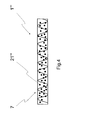
- Fig. 4 shows an embodiment of the skin support as a bandage 1 "'in cross-sectional view perpendicular to the expansion surface of the bandage 1"'.
- the bandage 1 "'comprises a fabric 7.
- the fabric 7 contains a solid, active substance 21"' which, for example, a salt of a biodegradable phosphate from the group of phosphoric acid, metaphosphoric acid, diphosphoric acid and the counterions of these salts, preferably alkaline earth metal ions, particularly preferred Calcium metaphosphate Ca (PO 3 ) 2 , beta-tricalcium phosphate Ca 3 (PO 4 ) 2, and hydroxylapathite Ca 3 (PO 4 ) 3 OH.
- the fabric 7 may be a cotton or viscose woven fabric with polyamide.
Landscapes
- Health & Medical Sciences (AREA)
- Chemical & Material Sciences (AREA)
- Public Health (AREA)
- Veterinary Medicine (AREA)
- Epidemiology (AREA)
- Life Sciences & Earth Sciences (AREA)
- Animal Behavior & Ethology (AREA)
- General Health & Medical Sciences (AREA)
- Inorganic Chemistry (AREA)
- Pharmacology & Pharmacy (AREA)
- Medicinal Chemistry (AREA)
- Hematology (AREA)
- Engineering & Computer Science (AREA)
- Materials Engineering (AREA)
- Materials For Medical Uses (AREA)
- Medicinal Preparation (AREA)
- Pharmaceuticals Containing Other Organic And Inorganic Compounds (AREA)
Abstract
Description
- Die vorliegende Erfindung betrifft eine Hautauflage gemäss dem Oberbegriff des unabhängigen Patentanspruchs 1.
- Vom Anmelder ist aus der
EP 1 339 417 B1 eine Zubereitung zur Behandlung von flächigen, offenen Wunden bekannt, welche eine feste aktive Komponente aufweist, die ein Salz eines biologisch abbaubaren Phosphates sowie Calzium- und Alkalimetallionen enthält. Diese Zubereitung hat sich bei der Behandlung von Wunden an Oberflächengeweben, die beispielsweise durch einen Dekubitus, Verbrennungen, UV-Strahlen oder Chemikalien hervorgerufen sind, hervorragend bewährt. Die Offenbarung derEP 1 339 417 B1 bezüglich der Zubereitung wird hiermit vollumfänglich mit einbezogen. - Die genannte Zubereitung gemäss der
EP 1 339 417 B1 hat den wesentlichen Vorteil, dass sie das behandelte Gewebe zum Wachstum anregt, so dass durch das neue Gewebe nicht nur ein Defekt verschlossen, sondern auch ein Aufbau einer Gewebestruktur angeregt werden kann. Diese Wirkung der Zubereitung-auch Substanz genannt - ist in derWO 09121616 - Die bekannten Zubereitungen werden direkt auf die Wunde aufgebracht oder aber auf einem - vorzugsweise festen - Träger appliziert. Mögliche Träger sind Wachs, Wachsfolien, Wachsschablonen oder Siliconträger. Es ist bereits beschrieben, dass kraterförmige Vertiefungen der Wunden mit den bekannten Zubereitungen ausgefüllt und eingeebnet werden.
- Trotz der beeindruckenden therapeutischen Erfolge bei der Wundheilung besteht das Bedürfnis die Anwendung der Zusammensetzungen weiter zu erleichtern und die Anwendungsbereiche der bekannten Zubereitungen zu vermehren.
- Zudem besteht ein anhaltendes Bedürfnis, die vorteilhaften Wirkungen dieser Zubereitung für weitere Indikationen im medizinischen und kosmetischen Bereich nutzbar zu machen.
- Diese Aufgaben werden von der Erfindung durch eine Hautauflage nach Anspruch 1 gelöst. Vorteilhafte Ausgestaltungen und weitere Ausführungsbeispiele sind in den abhängigen Ansprüchen beschrieben.
- Weiter werden diese Aufgaben von der Erfindung durch einen Applikationsbeutel gelöst.
- Eine Hautauflage zur Applikation auf der Haut oder einer Wunde und zur Abgabe von Ionen gemäss der vorliegenden Erfindung umfasst mindestens eine Lage einer festen, aktiven Substanz und mindestens eine hautzugewandte, wasser- und ionendurchlässige, hautverträgliche Durchlasslage. Die feste, aktive Substanz umfasst mindestens ein Salz eines biologisch abbaubaren Phosphates aus der Gruppe der Phosphorsäure, Metaphosphorsäure, Diphosphorsäure und die Gegenionen dieser Salze, vorzugsweise Erdalkalimetallionen, besonders bevorzugt Kalziummetaphosphat Ca(PO3)2, beta-Tricalziumphosphat Ca3(PO4)2 und Hydroxylapathit Ca3(PO4)3OH.
- In einer bevorzugten Ausführungsform sind die Alkalimetallionen Natrium- und/oder Kaliumionen. Diese können jeder Form von den entsprechenden Halogeniden oder Oxiden zu der Zubereitung zugegeben werden, oder sie können auch schon als Gegenionen der biologisch abbaubaren Phosphate neben den Erdalkalimetallionen vorkommen. Besonders bevorzugt sind Natrium-Calzium-Diphosphate und Kalium-Calzium-Diphosphate.
- In einer weiteren bevorzugten Ausführungsform kommt neben Kalzium ein weiteres Erdalkalimetallion, nämlich Magnesium, vor. Dies kann als Gegenion der biologisch abbaubaren Phosphate, als Halogenidsalz oder als Oxid der Zubereitung zugegeben werden.
- Die erfindungsgemässe Hautauflage erlaubt es nun, dass die feste, aktive Substanz nicht mehr frei auf die Wunde aufgetragen werden muss, was bei der Applikation und der Entfernung Geschicklichkeit und Aufwand erfordert. Neu kann die feste, aktive Substanz in einer Hautauflage auf der Haut oder auf der Wunde appliziert werden. Der Vorteil ist, dass die feste, aktive Substanz bereits portioniert zur Applikation zur Verfügung steht, sofort angewendet werden kann und in toto wieder entfernbar ist. Als besonders vorteilhaft hat sich erwiesen, dass keine Partikel auf der Haut oder in der Wunde verbleiben und so die vorgeschriebene Liegedauer des Materials nicht überschritten wird.
- Die Hautauflage ist ausreichend flüssigkeitsdurchlässig (vorzugsweise feinporig) und mechanisch stabil (insbesondere reissfest), so dass die einzelnen Partikel der festen, aktiven Substanz in der Hautauflage bleiben, der Austritt gelöster Ionen aber problemlos gewährleistet ist und damit die Wirkung der festen, aktiven Substanz, zum Beispiel eines Granulats aus bioaktivem Glas, trotzdem nach aussen (zur Haut oder Wunde hin) entfaltet wird.
- Die Hautauflage kann zum Beispiel nach dem bestimmungsgemässen Gebrauch auf der Haut oder einer Wunde zusammen mit der verbleibenden festen, aktiven Substanz rückstandslos entfernt werden, auch wenn sie möglicherweise mehrere Tage aufgelegen hat. Auch beim Einsatz als Binde oder Windel ist gewährleistet, dass keine Partikel der aktiven Substanz auf der Haut im Intimbereich zurückbleiben.
- In einer Ausführungsform ist die Hautauflage dadurch gekennzeichnet, dass die feste aktive Substanz sich aus 27,1 bis 39,9 mol% P2O5, 22,5 bis 36,0 mol% CaO, 14,5 bis 30,0 mol% M2O und 5,0 bis 25 mol% MgO zusammensetzt, wobei M2O 27,1 bis 30,0 mol% Na2O und/oder 0 bis 12 mol% K2O enthält.
- In einer Variante umfasst die Hautauflage mindestens ein Saugelement, vorzugsweise aus Zellulose, Zellulose-Flocken, Viskose, Superabsorber oder Polyurethan-(PU)-Schaum, oder eine Kombination davon. Das Saugelement dient vorteilhafterweise dazu, dass zum Beispiel Urin oder Blut, das aus einer Wunde austritt, durch die Hautauflage aufgesogen wird und so eine Wechselwirkung mit der festen, aktiven Substanz gefördert wird. Volumen und typische Beschaffenheit eines solchen Saugelements sind dem Fachmann für die verschiedenen Einsatzbereiche bekannt.
- In einer Ausführungsform weist die Hautauflage eine der Durchlasslage gegenüberliegende Barrierelage auf, welche flüssigkeitsundurchlässig ist. Die Barrierelage kann zum Beispiel dazu dienen, dass die Hautauflage Flüssigkeit, welche aus dem Körper des Trägers der Hautauflage, zum Beispiel aus einer Wunde, austritt, nicht durchlässt, sondern in der Hautauflage, vorzugsweise in der Lage mit der festen, aktiven Substanz und/oder dem Saugelement, verbleibt. Dies kann vorteilhaft sein, falls über die Hautauflage Kleider angezogen werden, welche dadurch vor der aus dem Körper des Trägers der Hautauflage austretenden Flüssigkeit geschützt werden. Besonders vorteilhaft ist die Barrierelage für Ausführungsformen, bei welchen die Hautauflage eine Wundauflage, eine Binde, eine Slipeinlage oder eine Windel ist.
- In einer Ausführungsform weist die Hautauflage eine zwischen Durchlasslage und Saugelement angeordnete Verteillage, vorzugsweise ein Vlies aus Polyethersulfon (PES) oder Polyethylen (PE), auf. Die Verteillage kann zum Beispiel dazu dienen, Urin oder lokalisiert aus einer Wunde austretendes Blut im Wesentlichen gleichmässig über die Fläche in der Hautauflage, vorzugsweise in Form einer Binde oder Windel, zu verteilen und dem Saugelement zuzuführen. Dies ist insbesondere vorteilhaft, da das Saugelement dadurch im Wesentlichen gleichmässig mit dem Urin oder Blut in Kontakt kommt und so eine effizientere Ausnutzung der Saugleistung und des Rückhaltevolumens gewährleistet wird.
- Vorzugsweise ist die feste, aktive Substanz zwischen der Durchlasslage und dem Saugelement angeordnet. Dies hat den Vorteil, dass zwischen der festen, aktiven Substanz und der Haut oder der Wunde die Durchlasslage angeordnet ist und dass die Flüssigkeit, welche zum Saugelement gesogen wird, die Lage mit der festen, aktiven Substanz passiert und dort die Ionen löst bevor sie das Saugelement erreicht. Die gelösten Ionen diffundieren sehr schnell zum Körper des Trägers der Hautauflage hin.
- Die Hautauflage kann eine oder mehrere Kammern aufweisen. Dies hat den Vorteil, dass die lokale Behandlung aller Anteile einer Wunde - also flächendeckend - gewährleistet werden kann. Die einzelnen Kammern können sicherstellen, dass sich der Inhalt nicht schwerkraftgetrieben in einem Kanten oder Eckbereich des Beutels sammelt und grosse Anteile der Wunde ohne Wirkverbindung mit der festen, aktiven Substanz sind. Die Kammern weisen gemäss bevorzugter Ausführungsformen eine Grösse und einen Inhalt gemäss der vorgenannten besonders bevorzugten Einkammer-Hautauflagen auf.
- In einer Ausführungsform enthält die Hautauflage 8 bis 12 g, besonders bevorzugt 10 g der festen aktiven Substanz.
- In einer Ausführungsform liegt die feste aktive Substanz in Pulverform mit einem Korndurchmesser im Bereich von 50 bis 250 µm, besonders bevorzugt zwischen 50 und 150 µm, vor, wobei das Pulver zur besseren Handhabbarkeit vorzugsweise granuliert ist und vorzugsweise ein bioaktives Glas ist.
- Die feste, aktive Substanz ist vorzugsweise dadurch hergestellt, dass die vorgenannten Oxide bei einer Temperatur von 1050 ºC bis 1550 ºC geschmolzen werden. Ein dabei erhaltenes glasartiges Material wird zweckmässigerweise durch Abschrecken zerkleinert. Es kann anschliessend gemahlen werden, so dass ein Pulver mit einem mittleren Korndurchmesser im Bereich von 50 bis 250 µm, besonders bevorzugt zwischen 50 und 150 µm gebildet wird.
- Das Pulver oder das Granulat kann mit pflanzlichen, homöopathischen und/oder anderen pharmazeutischen Wirkstoffen und/oder die Wundheilung unterstützenden Stoffen und/oder Wachstumsfaktoren, Proteinen, Lokaltherapeutika zur systemischen Applikation oder Gemischen davon gemischt werden.
- Die feste, aktive Substanz kann als Pulver, Granulat oder auch als Suspension vorliegen. Bei Pulvern oder Granulaten hat es sich als vorteilhaft erwiesen, diese vor der eigentlichen Behandlung der Wunde anzufeuchten. Als geeignete Flüssigkeiten dazu haben sich sterile isotonische Lösungen (wie zum Beispiel eine Ringer-Lösung) erwiesen oder Lösungen die per se eine desinfizierende Wirkung aufweisen (z.B. Lavasept ®)
- Die Durchlasslage kann eine Vlieslage, ein Gewebe, ein Gestrick, einen Film oder eine Membran, vorzugsweise aus Polypropylen (PP), PE, PES oder Viskose, umfassen, wobei die Durchlasslage zumindest bereichsweise adhäsive, wundschonende Materialien wie zum Beispiel hydrophobe, vliesartige Polyolefin-Folien umfasst, die Flüssigkeitsdurchtritt und Ionenaustausch gewährleisten.
- Der Flüssigkeitsdurchtritt und der Ionenaustausch können durch Perforationen bzw. Öffnungen oder Maschen geeigneter Grösse gewährleistet werden.
- Die Durchlasslage kann zumindest bereichsweise aus Naturstoff-Geweben, - Gestricken oder -Vliesen gefertigt sein und vorzugsweise mit hautverträglichen Substanzen, wie Silicon, Paraffin, Wachs und dergleichen imprägniert sein. Weiter kann die Durchlasslage mit bekannten hydrophilen Ausrüstungen ausgerüstet oder mit bekannten hydrophilen Membranen beschichtet sein.
- Die Durchlasslage kann auch einen geeigneten wasserdurchlässigen Thermoplasten wie zum Beispiel Polyethylen, insbesondere PE sehr geringer Dichte (ULDPE, ultra low density polyethylene), oder durchlässige Siliconfolie oder andere Kunststoffe, oder Verbindungen von Naturstoffen und Kunststoffen umfassen.
- Die Durchlasslage kann einlagig oder mehrlagig sein, wobei die Durchlasslage aus einem einzigen Material oder aus Verbundmaterialien gefertigt ist.
- Wesentlich ist, dass das Material, aus dem zumindest die dem Körper zugewandte Durchlasslage der erfindungsgemässen Hautauflage gefertigt ist, derart gewählt ist, dass es nicht mit der Wunde verklebt, verbackt oder sich sonstig mit ihr verbindet. Das Hautauflagenmaterial muss biokompatibel und als Medizinalprodukt zugelassen sein.
- Als besonders bevorzugt haben sich sterilisierbare Materialien erwiesen, die zudem sicherstellen, dass die Partikel aus Lage mit der festen, aktiven Substanz - im nicht benutzten Zustand der Hautauflage - nicht nach aussen gelangen können um den Sterilisationsprozess nicht zu erschweren.
- Die Hautauflage kann als Beutel, Binde, Slipeinlage, Wundauflage, Bandage, Wundpad oder Windel ausgebildet sein.
- Die als Beutel ausgebildete Hautauflage kann eine flächige Grundform aufweisen und vorzugsweise kreisrund mit einem Durchmesser von 5 bis 7 cm, vorzugsweise von 6 cm, rechteckig oder quadratisch mit Kantenlängen von 5 bis 7 cm, vorzugsweise von 6 cm ausgebildet sein.
- Die Hautauflage in Form eines Beutels wird im Zusammenhang mit der vorliegenden Erfindung auch als Applikationsbeutel bezeichnet.
- Ein Applikationsbeutel gemäss der vorliegenden Erfindung ist mit einer Zusammensetzung, vorzugsweise einer Zubereitung in Form einer festen aktiven Substanz, befüllt. Der erfindungsgemässe Applikationsbeutel erlaubt es nun dass die Zubereitung nicht mehr frei auf die Wunde aufgetragen werden muss, was bei der Applikation und der Entfernung Geschicklichkeit und Aufwand erfordert. Die Zubereitung muss auch nicht mehr mit einem Träger appliziert werden, was ebenfalls bei der Applikation einiges Geschick erfordert. Neu kann die Zusammensetzung in einem Beutel, zum Beispiel in einem Vlies-Beutel enthaltend Wundgranulat, auf der Haut oder in der Wunde appliziert werden. Der Vorteil ist, dass die Zusammensetzung bereits portioniert zur Applikation zur Verfügung steht, sofort angewendet werden kann und in toto wieder entfernbar ist. Als besonders vorteilhaft hat sich erwiesen, dass, das keine Partikel in der Wunde verbleiben und so die vorgeschriebene Liegedauer des Materials nicht überschritten wird.
- Die erfindungsgemässen Beutel beinhaltend therapeutische Zusammensetzungen zur direkten Wundbehandlung bauen sich aus mindestens zwei Wandflächen auf, die einen befüllbaren oder befüllten Innenraum definieren und umschliessen, wobei zumindest die dem Körper zugewandte Wandflächen vorzugsweise vollständig, zumindest aber grossflächig, aus einem flüssigkeitsdurchlässigen, schmiegsamen Materialabschnitt zur Anpassung an die Wundoberfläche umfasst.
- Das schmiegsame oder biegsame Wandmaterial kann nach dem bestimmungsgemässen Gebrauch auf der Wunde zusammen mit dem verbleibenden Beutelinhalt rückstandslos entfernt werden. Auch wenn es möglicherweise mehrere Tage auf der Wunde aufgelegen hat. Bei der Wundversorgung mit dem erfindungsgemässen Applikationsbeutel hat es sich als vorteilhaft erwiesen ihn mit einem semiokklusiven Verband an der Wunde zu halten.
- Die Applikationsbeutel gemäss der vorliegenden Erfindung sind gemäss bevorzugter Ausführungsformen aus zwei gegenüberliegenden Wänden mit deckungsgleichen Grundrissen einfacher geometrischer Formen (Kreis, Quadrat, Rechteck, Oval etc.) gefertigt.
- Besonders bevorzugt sind die Beutel kreisrund mit einem Durchmesser von 5 bis 7, vorzugsweise von 6 cm. Oder rechteckig oder quadratisch mit Kantenlängen von 5 bis 7, vorzugsweise von 6 cm. Die vorgenannten Beutelgrössen enthalten bevorzugter Weise 8 bis 12, besonders bevorzugt 10 g der therapeutischen Zubereitung zur direkten Wundbehandlung.
- Zur Behandlung von grösseren Wunden hat es sich als vorteilhaft erwiesen flächenmässig grössere Beutel mit mehr Inhalt herzustellen. Um sicherzustellen, dass die lokale Behandlung aller Anteile der Wunde - also flächendeckend - gewährleistet ist, werden diese Beutel vorzugsweise unterkammert. Die Kammern weisen gemäss bevorzugter Ausführungsformen eine Grösse und einen Inhalt gemäss der vorgenannten besonders bevorzugten Einkammer-Beutel auf.
- Für besondere Applikationen, wie zum Beispiel auf der Nase oder im Bereich der Finger oder Zehen sind die Applikationsbeutel vorzugsweise nierenförmig oder anderweitig an die räumliche Form der Applikationsstelle vorgeformt.
- Die Wandelemente werden entweder umlaufend verschweisst, verklebt oder vernäht. Wird der Applikationsbeutel aus einem schlauchförmigen Wandmaterial gefertigt, so genügt es die offenen Enden nach dem Befüllen zu verschliessen.
- Gemäss weiterer Ausführungsformen werden die Beutel mit einer verschliessbaren Öffnung gefertigt, die dem Endnutzer die Befüllung erlaubt.
- Die Beutelwände können ein oder mehrlagig aus einem einzigen Material oder aus Verbundmaterialien ausgebildet sein.
- Wesentlich ist, dass das Material, aus dem zumindest die dem Körper zugewandte Oberflächenlage der erfindungsgemässen Applikationsbeutel gefertigt ist, derart gewählt ist, dass es nicht mit der Wunde verklebt, verbackt oder sich sonstig mit ihr verbindet. Das Beutelmaterial muss biokompatibel und als Medizinalprodukt zugelassen sein.
- Gemäss erster Ausführungsformen werden Naturstoff-Gewebe, -Gestricke oder - Vliese gewählt, die mit hautverträglichen Substanzen, wie Silicon, Paraffin, Wachs und dgl. imprägniert, mit bekannten hydrophilen Ausrüstungen ausgerüstet oder mit bekannten hydrophilen Membranen beschichtet sind.
- Die wasserdurchlässigen Anteile der Beutelwand können auch aus einem geeigneten wasserdurchlässigen Thermoplasten wie zum Beispiel Polyethylen, insbesondere PE sehr geringer Dichte (ULDPE, ultra low density polyethlene), oder durchlässiger Siliconfolie oder anderen Kunststoffen, oder Verbindungen von Naturstoffen und Kunststoffen gewählt werden.
- Gemäss weiterer Ausführungsformen sind die Beutel nicht einfach flächig geformt sondern in Form eines dreidimensionalen Körpers als Wundfüller.
- Die in Kontakt mit der Haut des Patienten kommenden proximalen Anteile der Beutelwand sind gemäss bevorzugter Ausführungsformen aus adhäsiven, wundschonenden Materialien wie zum Beispiel hydrophoben, vliesartigen Polyolefin-Folien, wie Polyethylen- oder Polypropylen-Folie, die durch Perforationen bzw. Öffnungen oder Maschen geeigneter Grösse den Flüssigkeitsdurchtritt und Ionenaustausch gewährleisten.
- Als besonders bevorzugt haben sich sterilisierbare Materialien erwiesen, die zudem sicherstellen, dass die Partikel aus dem Inneren des Beutels - im nicht benutzten Zustand des Beutels - nicht nach aussen gelangen können um den Sterilisationsprozess nicht zu erschweren.
- Wie bereits erwähnt, umfasst die Zusammensetzung zur Befüllung des Beutels vorzugsweise eine Zubereitung in Form einer festen aktiven Substanz, die im weitesten Sinne als bioaktives Glas bezeichnet werden kann. Bevorzugt umfasst das bioaktive Glas ein Salz eines biologisch abbaubaren Phosphates aus der Gruppe der Phosphorsäure, Metaphosphorsäure, Diphosphorsäure und die Gegenionen dieser Salze vorzugsweise Erdalkalimetallionen. Besonders bevorzugt sind Kalziummetaphosphat Ca(PO3)2, beta-Tricalziumphosphat Ca3(PO4)2 und Hydroxylapathit Ca3(PO4)3OH. Diese Salze eines biologisch abbaubaren Phosphates können jeweils alleine oder in Mischungen vorkommen.
- In einer weiteren bevorzugten Ausführungsform sind die Alkalimetallionen Natrium- und/oder Kaliumionen. Diese können jeder Form von den entsprechenden Halogeniden oder Oxiden zu der Zubereitung zugegeben werden, oder sie können auch schon als Gegenionen der biologisch abbaubaren Phosphate neben den Erdalkalimetallionen vorkommen. Besonders bevorzugt sind Natrium-Calzium-Diphosphate und Kalium-Calzium-Diphosphate.
- In einer weiteren bevorzugten Ausführungsform kommt neben Kalzium ein weiteres Erdalkalimetallion, nämlich Magnesium, vor. Dies kann als Gegenion der biologisch abbaubaren Phosphate, als Halogenidsalz oder als Oxid der Zubereitung zugegeben werden.
- Gemäss einer bevorzugten Ausführungsform setzt sich die Zubereitung aus 27,1 bis 39,9 mol% P2O5, 22,5 bis 36,0 mol% CaO, 14,5 bis 30,0 mol% M2O und 5,0 bis 25 mol% MgO zusammen, wobei M2O 27,1 bis 30,0 mol% Na2O und/oder 0 bis 12 mol% K2O enthält.
- Die zur Befüllung des Beutels verwendete Zusammensetzung umfasst eine Zubereitung die vorzugsweise dadurch hergestellt ist, dass die vorgenannten Oxide bei einer Temperatur von 1050 ºC bis 1550 ºC geschmolzen werden. Ein dabei erhaltenes glas-artiges Material wird zweckmässigerweise durch Abschrecken zerkleinert. Es kann anschliessend gemahlen werden, so dass ein Pulver mit einem mittleren Korndurchmesser im Bereich von 50 bis 250 µm, besonders bevorzugt zwischen 50 und 150 µm gebildet wird. Das Pulver kann anschliessend zur besseren Handhabbarkeit granuliert werden. Das Pulver oder das Granulat können zur Herstellung der Zusammensetzung anschliessend mit pflanzlichen, homöopathischen und/oder anderen pharmazeutischen Wirkstoffen und/oder die Wundheilung unterstützenden Stoffen und/oder Wachstumsfaktoren, Proteinen oder dgl. gemischt werden.
- Die zur Befüllung des Beutels verwendete Zusammensetzung umfasst gemäss weiterer bevorzugter Ausführungsformen pflanzliche, homöopathische und/oder andere pharmazeutische Wirkstoffen und/oder die Wundheilung unterstützenden Stoffe und/oder Wachstumsfaktoren, Proteinen, ähnlichen Lokaltherapeutika zur systemischen Applikation oder dgl. oder Gemische davon.
- Alle zur Befüllung des Beutels verwendeten Zusammensetzungen liegen vorzugsweise entweder als Pulver, Granulat oder auch als Suspension vor. Bei Pulvern oder Granulaten hat es sich als vorteilhaft erwiesen diese vor der eigentlichen Behandlung der Wunde anzufeuchten. Als geeignete Flüssigkeiten dazu haben sich sterile isotonische Lösungen (wie zum Beispiel eine Ringer-Lösung) erwiesen oder Lösungen die per se eine desinfizierende Wirkung aufweisen (z.B. Lavasept ®).
- Ausführungsformen der Erfindung werden anhand der nachfolgenden Figuren und der dazugehörigen Beschreibungen näher erläutert. Es zeigen:
- Fig. 1
- eine Ausführungsform der Hautauflage als Wundauflage in schematischer Querschnittdarstellung;
- Fig. 2
- eine Ausführungsform der Hautauflage als Wundpad schematisch im Querschnitt;
- Fig. 3
- eine Ausführungsform der Hautauflage als Binde oder Slipeinlage oder Windel schematisch im Querschnitt;
- Fig. 4
- eine Ausführungsform der Hautauflage als Bandage in schematischer Querschnittdarstellung.
-
Fig. 1 zeigt eine Ausführungsform der Hautauflage als Wundauflage 1 in Querschnittdarstellung senkrecht zur Ausdehnungsfläche der Wundauflage 1. Die Wundauflage 1 umfasst eine hautzugewandte Durchlasslage 3, welche wasser- und ionendurchlässig und vorzugsweise hautverträglich ist. Die Durchlasslage 3 kann ein Vlies, eine Membran oder ein Film aus PP, PE oder PES sein. An der Durchlasslage 3 anschliessend ist eine Lage 2 einer festen, aktiven Substanz 21 angeordnet. Die feste, aktive Substanz 21 kann zum Beispiel ein Salz eines biologisch abbaubaren Phosphates aus der Gruppe der Phosphorsäure, Metaphosphorsäure, Diphosphorsäure und die Gegenionen dieser Salze, vorzugsweise Erdalkalimetallionen, besonders bevorzugt Kalziummetaphosphat Ca(PO3)2, beta-Tricalziumphosphat Ca3(PO4)2 und Hydroxylapathit Ca3(PO4)3OH sein. Die feste, aktive Substanz 21 kann zur besseren Handhabung granuliert sein. An der Lage 2 mit der festen, aktiven Substanz 21 anschliessend ist ein Saugelement 4 angeordnet, das zum Beispiel aus Zellulose, Zellulose-Flocken, Viskose, Superabsorber oder PU-Schaum, oder einer Kombination davon bestehen kann. Am Saugelement 4 anschliessend und der Durchlasslage 3 gegenüberliegend ist eine Barrierelage 5 angeordnet, welche flüssigkeitsundurchlässig ist und somit verhindert, dass zum Beispiel Blut oder Lymphe, welche durch die Durchlasslage 3, über die Lage 2 mit der festen, aktiven Substanz 21 zum Saugelement 4 tritt, weiter über die Barrierelage 5 aus der Wundauflage 1 austritt. Somit kann die Wundauflage 1 auf eine Wunde aufgebracht werden und darüber zum Beispiel ein Kleid angezogen werden, ohne dass das Kleid vom Blut beschmutzt wird. Die Barrierelage 5 kann ein Film aus PU sein. -
Fig. 2 zeigt eine Ausführungsform der Hautauflage als Wundpad 1' in einer Querschnittdarstellung senkrecht zur Ausdehnungsfläche des Wundpads 1'. Das Wundpad 1' umfasst eine Durchlasslage 3', welche aus Hüllvlies 3' ausgebildet ist und das ganze Wundpad 1' umhüllt. Das Hüllvlies 3' kann aus Viskose oder PES sein. Mittig ist eine Lage 2' mit einer festen, aktiven Substanz 21' angeordnet. Die feste, aktive Substanz 21' kann zum Beispiel ein Salz eines biologisch abbaubaren Phosphates aus der Gruppe der Phosphorsäure, Metaphosphorsäure, Diphosphorsäure und die Gegenionen dieser Salze, vorzugsweise Erdalkalimetallionen, besonders bevorzugt Kalziummetaphosphat Ca(PO3)2, beta-Tricalziumphosphat Ca3(PO4)2 und Hydroxylapathit Ca3(PO4)3OH sein. Zwischen der Lage 2' und der Durchlasslage 3' sind beidseits der Lage 2' zwei Saugelemente 4' angeordnet. Die Saugelemente 4' können aus Viskose oder PES sein. Durch die gezeigte symmetrische Anordnung der Saugelemente 4' und der Durchlasslage 3' kann das Wundpad 1' beidseitig angewendet werden, was bei einer schnellen Wundversorgung besonders vorteilhaft sein kann, da sichergestellt wird, dass das Wundpad 1' immer richtig auf eine Wunde aufgebracht wird. -
Fig. 3 zeigt eine Ausführungsform einer Hautauflage als Binde 1" in Querschnittdarstellung senkrecht zur Ausdehnungsfläche der Binde 1". Ausführungsformen der Hautauflage als Slipeinlage oder Windel haben im Wesentlichen den gleichen Aufbau wie der gezeigten Binde 1". Die Binde 1" umfasst eine körperzugewandte Durchlasslage 3", welche wasser- und ionendurchlässig und hautverträglich ist. Die Durchlasslage 3" kann ein Vlies aus PP, PE oder PES sein. An der Durchlasslage 3" anschliessend ist eine Verteillage 6 angeordnet, welche zur gleichmässigen Verteilung von Flüssigkeit über die Fläche der Binde 1" dient. Die Verteillage 6 ist vorzugsweise ein Vlies aus PES oder PE. An der Verteillage 6 anschliessend ist eine Lage 2" mit einer festen, aktiven Substanz 21" angeordnet. Die feste, aktive Substanz 21" kann zum Beispiel ein Salz eines biologisch abbaubaren Phosphates aus der Gruppe der Phosphorsäure, Metaphosphorsäure, Diphosphorsäure und die Gegenionen dieser Salze, vorzugsweise Erdalkalimetallionen, besonders bevorzugt Kalziummetaphosphat Ca(PO3)2, beta-Tricalziumphosphat Ca3(PO4)2 und Hydroxylapathit Ca3(PO4)3OH sein. An der Lage 2" anschliessend ist ein Saugelement 4" angeordnet, an welchem eine Barrierelage 5" anschliesst. Das Saugelement 4" kann aus Zellulose Fluff oder Superabsorber sein. Die Barrierelage 5" ist flüssigkeitsundurchlässig und verhindert, dass Flüssigkeit über die Barrierelage 5" aus der Binde 1" austritt. Ein solcher Aufbau wie die gezeigte Binde 1" mit der Verteillage 6 und der Barrierelage 5" ist auch besonders vorteilhaft für Slipeinlagen oder Windeln. Die Barrierelage 5" kann zum Beispiel ein PE-Film mit PP-Spinnvlies sein. -
Fig. 4 zeigt eine Ausführungsform der Hautauflage als Bandage 1"' in Querschnittdarstellung senkrecht zur Ausdehnungsfläche der Bandage 1"'. Die Bandage 1"' umfasst ein Gewebe 7. Das Gewebe 7 enthält eine feste, aktive Substanz 21 "', welche zum Beispiel ein Salz eines biologisch abbaubaren Phosphates aus der Gruppe der Phosphorsäure, Metaphosphorsäure, Diphosphorsäure und die Gegenionen dieser Salze, vorzugsweise Erdalkalimetallionen, besonders bevorzugt Kalziummetaphosphat Ca(PO3)2, beta-Tricalziumphosphat Ca3(PO4)2 und Hydroxylapathit Ca3(PO4)3OH sein kann. Das Gewebe 7 kann ein Webband aus Baumwolle oder Viskose mit Polyamid sein.
Claims (15)
- Hautauflage (1, 1', 1 ", 1'") zur Applikation auf der Haut oder einer Wunde und zur Abgabe von Ionen, die Hautauflage (1, 1', 1 ", 1'") umfassend mindestens eine Lage (2, 2', 2") einer festen, aktiven Substanz (21, 21', 21", 21"') und mindestens eine hautzugewandte, wasser- und ionendurchlässige, hautverträgliche Durchlasslage (3, 3', 3"), wobei die feste, aktive Substanz (21, 21', 21", 21'") mindestens ein Salz eines biologisch abbaubaren Phosphates aus der Gruppe der Phosphorsäure, Metaphosphorsäure, Diphosphorsäure und die Gegenionen dieser Salze, vorzugsweise Erdalkalimetallionen, besonders bevorzugt Kalziummetaphosphat Ca(PO3)2, beta-Tricalziumphosphat Ca3(PO4)2 und Hydroxylapathit Ca3(PO4)3OH, umfasst.
- Hautauflage (1, 1', 1 ", 1'") gemäss Anspruch 1, dadurch gekennzeichnet, dass die feste, aktive Substanz (21, 21', 21", 21"') sich aus 27,1 bis 39,9 mol% P2O5, 22,5 bis 36,0 mol% CaO, 14,5 bis 30,0 mol% M2O und 5,0 bis 25 mol% MgO zusammensetzt, wobei M2O 27,1 bis 30,0 mol% Na2O und/oder 0 bis 12 mol% K2O enthält.
- Hautauflage (1, 1', 1", 1'") gemäss einem der vorhergehenden Ansprüche, dadurch gekennzeichnet, dass die Hautauflage (1, 1', 1", 1'") mindestens ein Saugelement (4, 4', 4"), vorzugsweise aus Zellulose, Zellulose-Flocken, Viskose, Superabsorber oder Polyurethan-(PU)-Schaum, oder eine Kombination davon, umfasst.
- Hautauflage (1, 1 ") gemäss einem der vorhergehenden Ansprüche, dadurch gekennzeichnet, dass die Hautauflage (1, 1 ") eine der Durchlasslage (3, 3") gegenüberliegende Barrierelage (5, 5") aufweist, welche flüssigkeitsundurchlässig ist.
- Hautauflage (1 ") gemäss einem der Ansprüche 3 oder 4, dadurch gekennzeichnet, dass die Hautauflage (1 ") eine zwischen Durchlasslage (3") und Saugelement (4") angeordnete Verteillage (6), vorzugsweise ein Vlies aus Polyethersulfon (PES) oder Polyethylen (PE), aufweist.
- Hautauflage (1, 1', 1 ", 1'") gemäss einem der Ansprüche 3 bis 5, dadurch gekennzeichnet, dass die feste aktive Substanz (21, 21', 21", 21'") zwischen der Durchlasslage (3, 3', 3") und dem Saugelement (4, 4', 4") angeordnet ist.
- Hautauflage (1, 1', 1 ", 1'") gemäss einem der vorhergehenden Ansprüche, dadurch gekennzeichnet, dass die Hautauflage (1, 1', 1 ", 1'") eine oder mehrere Kammern aufweist.
- Hautauflage (1, 1', 1", 1'") gemäss einem der vorhergehenden Ansprüche, dadurch gekennzeichnet, dass die Hautauflage (1, 1', 1 ", 1'") 8 bis 12 g, besonders bevorzugt 10 g der festen aktiven Substanz (21, 21', 21 ", 21"') enthält.
- Hautauflage (1, 1', 1", 1'") gemäss einem der vorhergehenden Ansprüche, dadurch gekennzeichnet, dass die feste aktive Substanz (21, 21', 21 ", 21"') in Pulverform mit einem Korndurchmesser im Bereich von 50 bis 250 µm, besonders bevorzugt zwischen 50 und 150 µm, vorliegt, wobei das Pulver zur besseren Handhabbarkeit vorzugsweise granuliert ist und vorzugsweise ein bioaktives Glas ist.
- Hautauflage (1, 1', 1", 1'") gemäss Anspruch 9, dadurch gekennzeichnet, dass das Pulver oder das Granulat mit pflanzlichen, homöopathischen und/oder anderen pharmazeutischen Wirkstoffen und/oder die Wundheilung unterstützenden Stoffen und/oder Wachstumsfaktoren, Proteinen, Lokaltherapeutika zur systemischen Applikation oder Gemischen davon gemischt werden.
- Hautauflage (1, 1', 1", 1"') gemäss einem der vorhergehenden Ansprüche, dadurch gekennzeichnet, dass die Durchlasslage (3, 3', 3") eine Vlieslage, ein Gewebe, ein Gestrick, einen Film oder eine Membran, vorzugsweise aus Polypropylen (PP), PE, PES oder Viskose, umfasst, wobei die Durchlasslage (3, 3', 3") zumindest bereichsweise adhäsive, wundschonende Materialien wie zum Beispiel hydrophobe, vliesartige Polyolefin-Folien umfasst, die Flüssigkeitsdurchtritt und Ionenaustausch gewährleisten.
- Hautauflage (1, 1', 1", 1'") gemäss einem der vorhergehenden Ansprüche, dadurch gekennzeichnet, dass die Durchlasslage (3, 3', 3") zumindest bereichsweise aus Naturstoff-Geweben, -Gestricken oder -Vliesen gefertigt ist und vorzugsweise mit hautverträglichen Substanzen, wie Silicon, Paraffin, Wachs und dergleichen imprägniert sein kann.
- Hautauflage (1, 1', 1", 1'") gemäss einem der vorhergehenden Ansprüche, dadurch gekennzeichnet, dass die Durchlasslage (3, 3', 3") einlagig oder mehrlagig ist, wobei die Durchlasslage (3, 3', 3") aus einem einzigen Material oder aus Verbundmaterialien gefertigt ist.
- Hautauflage (1, 1', 1", 1'") gemäss einem der vorhergehenden Ansprüche, dadurch gekennzeichnet, dass die Hautauflage (1, 1', 1", 1"') als Beutel, Binde (1"), Slipeinlage (1 "), Wundauflage (1), Bandage (1"'), Wundpad (1') oder Windel (1 ") ausgebildet ist.
- Hautauflage (1, 1', 1", 1'") gemäss Patentanspruch 14, dadurch gekennzeichnet, dass die Hautauflage (1, 1', 1", 1'") als Beutel, der eine flächige Grundform aufweist und vorzugsweise kreisrund mit einem Durchmesser von 5 bis 7 cm, vorzugsweise von 6 cm, rechteckig oder quadratisch mit Kantenlängen von 5 bis 7 cm, vorzugsweise von 6 cm ausgebildet ist.
Applications Claiming Priority (1)
| Application Number | Priority Date | Filing Date | Title |
|---|---|---|---|
| CH00517/14A CH709509A1 (de) | 2014-04-03 | 2014-04-03 | Applikationsbeutel mit einer festen aktiven Substanz zur Behandlung von offenen Wunden. |
Publications (2)
| Publication Number | Publication Date |
|---|---|
| EP2926839A1 true EP2926839A1 (de) | 2015-10-07 |
| EP2926839B1 EP2926839B1 (de) | 2019-06-12 |
Family
ID=50774598
Family Applications (1)
| Application Number | Title | Priority Date | Filing Date |
|---|---|---|---|
| EP15162677.7A Active EP2926839B1 (de) | 2014-04-03 | 2015-04-07 | Hautauflage |
Country Status (2)
| Country | Link |
|---|---|
| EP (1) | EP2926839B1 (de) |
| CH (1) | CH709509A1 (de) |
Cited By (2)
| Publication number | Priority date | Publication date | Assignee | Title |
|---|---|---|---|---|
| CN109453415A (zh) * | 2018-10-12 | 2019-03-12 | 安徽迈德普斯医疗科技有限公司 | 一种复合医用无纺布 |
| CN109550071A (zh) * | 2018-12-05 | 2019-04-02 | 中国科学院深圳先进技术研究院 | 聚氨酯海绵材料及其制备方法、应用和聚氨酯海绵制品 |
Families Citing this family (1)
| Publication number | Priority date | Publication date | Assignee | Title |
|---|---|---|---|---|
| TWI780494B (zh) * | 2019-10-09 | 2022-10-11 | 德商卡爾科德寶兩合公司 | 複合材料在主動和/或被動冷卻的通電系統中用於吸收和分配液體的應用 |
Citations (4)
| Publication number | Priority date | Publication date | Assignee | Title |
|---|---|---|---|---|
| EP1339417B1 (de) | 2000-12-07 | 2005-02-16 | Stiftung für Plastische und Aesthetische Wundheilung im Sondervermögen der DT Deutschen Stiftungstreuhend AG | Zubereitung zur behandlung von flächigen, offenen wunden |
| WO2009121616A2 (de) | 2008-04-04 | 2009-10-08 | Gerolf Gehl | Verfahren zum herstellen eines nahrungsergänzungsmittels bzw. mittels zur inneren wundheilung bei lebewesen |
| US20100228174A1 (en) * | 2006-05-26 | 2010-09-09 | Huey Raymond J | Clay-based hemostatic agents and devices for the delivery thereof |
| CH705253A2 (de) * | 2011-07-11 | 2013-01-15 | Dr Gerolf Gehl | Mineralhaltige Heilpaste. |
Family Cites Families (1)
| Publication number | Priority date | Publication date | Assignee | Title |
|---|---|---|---|---|
| US9095569B2 (en) * | 2008-04-18 | 2015-08-04 | Collplant Ltd. | Methods of generating and using procollagen |
-
2014
- 2014-04-03 CH CH00517/14A patent/CH709509A1/de not_active Application Discontinuation
-
2015
- 2015-04-07 EP EP15162677.7A patent/EP2926839B1/de active Active
Patent Citations (4)
| Publication number | Priority date | Publication date | Assignee | Title |
|---|---|---|---|---|
| EP1339417B1 (de) | 2000-12-07 | 2005-02-16 | Stiftung für Plastische und Aesthetische Wundheilung im Sondervermögen der DT Deutschen Stiftungstreuhend AG | Zubereitung zur behandlung von flächigen, offenen wunden |
| US20100228174A1 (en) * | 2006-05-26 | 2010-09-09 | Huey Raymond J | Clay-based hemostatic agents and devices for the delivery thereof |
| WO2009121616A2 (de) | 2008-04-04 | 2009-10-08 | Gerolf Gehl | Verfahren zum herstellen eines nahrungsergänzungsmittels bzw. mittels zur inneren wundheilung bei lebewesen |
| CH705253A2 (de) * | 2011-07-11 | 2013-01-15 | Dr Gerolf Gehl | Mineralhaltige Heilpaste. |
Cited By (3)
| Publication number | Priority date | Publication date | Assignee | Title |
|---|---|---|---|---|
| CN109453415A (zh) * | 2018-10-12 | 2019-03-12 | 安徽迈德普斯医疗科技有限公司 | 一种复合医用无纺布 |
| CN109550071A (zh) * | 2018-12-05 | 2019-04-02 | 中国科学院深圳先进技术研究院 | 聚氨酯海绵材料及其制备方法、应用和聚氨酯海绵制品 |
| CN109550071B (zh) * | 2018-12-05 | 2021-08-24 | 中国科学院深圳先进技术研究院 | 聚氨酯海绵材料及其制备方法、应用和聚氨酯海绵制品 |
Also Published As
| Publication number | Publication date |
|---|---|
| CH709509A1 (de) | 2015-10-15 |
| EP2926839B1 (de) | 2019-06-12 |
Similar Documents
| Publication | Publication Date | Title |
|---|---|---|
| JP7712764B2 (ja) | 抗菌または創傷ケア材料、装置および使用 | |
| EP2567681B1 (de) | Wundauflage für den Abdominalbereich | |
| EP2379033B1 (de) | Wundauflage | |
| EP2537494B1 (de) | Wundpflegeartikel zur Extraktion und Kontrolle von Wundflüssigkeiten | |
| EP1942851B1 (de) | Absorptionskörper zur anbringung an menschliche oder tierische hautoberflächen | |
| EP2809363B1 (de) | Wundpflegeartikel, aufweisend mindestens eine oberfläche mit abrasiven eigenschaften | |
| EP2567682B1 (de) | Abdominal-Wundauflage mit Applikationshilfe | |
| WO2009019229A2 (de) | Wundpflegeartikel, aufweisend mindestens eine lage aufweisend superabsorbierende polymere, sowie eine lage aufweisend einen weichschaumstoff | |
| DE102007019622B4 (de) | Expandierbarer Wundverband | |
| EP2185206B1 (de) | Blutstillender wundpflegeartikel | |
| DE102008037888A1 (de) | Wundpflegeartikel, aufweisend Textilbänder mit Fasern mit gelbildenden Eigenschaften sowie Fasern mit nicht gelbildenden Eigenschaften | |
| EP2451498A1 (de) | Vorrichtung zur unterdrucktherapie von wunden | |
| EP2704674A1 (de) | Wundpflegeartikel | |
| DE102007049429A1 (de) | Wundpflegeartikel, aufweisend superabsorbierende Polymere in Faser- und/oder Garnform | |
| DE102012100842A1 (de) | Wundpflegeartikel, aufweisend mindestens eine Oberfläche mit abrasiven Eigenschaften | |
| DE102007049430A1 (de) | Wundpflegeartikel, aufweisend mindestens einen Anteil an stützenden Fasern und einen Anteil an hydroaktiven Polymeren | |
| DE102007063294A1 (de) | Wundauflage enthaltend superabsorbierende Polymere | |
| EP2926839B1 (de) | Hautauflage | |
| DE102012025125A1 (de) | Saugkörper zur therapeutischen Behandlung einer Wunde mittels Unterdruck | |
| Balusamy et al. | In vivo safety evaluations of electrospun nanofibers for biomedical applications | |
| EP2934410A1 (de) | Saugkörper zur therapeutischen behandlung einer wunde mittels unterdruck | |
| DE102007049428A1 (de) | Wundpflegeartikel, aufweisend mindestens eine Lage aufweisend superabsorbierende Polymere, sowie eine Lage aufweisend einen Weichschaumstoff | |
| EP2747793A1 (de) | Absorbierender hygiene- oder pflegeartikel aufweisend einen bahnförmigen bestandteil mit einem anteil an mindestens einem elementaren oder in ionenform vorliegenden schwermetall | |
| DE202008000101U1 (de) | Wundauflage | |
| DE102011050047A1 (de) | Wundpflegeartikel für Kavitäten |
Legal Events
| Date | Code | Title | Description |
|---|---|---|---|
| PUAI | Public reference made under article 153(3) epc to a published international application that has entered the european phase |
Free format text: ORIGINAL CODE: 0009012 |
|
| AK | Designated contracting states |
Kind code of ref document: A1 Designated state(s): AL AT BE BG CH CY CZ DE DK EE ES FI FR GB GR HR HU IE IS IT LI LT LU LV MC MK MT NL NO PL PT RO RS SE SI SK SM TR |
|
| AX | Request for extension of the european patent |
Extension state: BA ME |
|
| 17P | Request for examination filed |
Effective date: 20160405 |
|
| RBV | Designated contracting states (corrected) |
Designated state(s): AL AT BE BG CH CY CZ DE DK EE ES FI FR GB GR HR HU IE IS IT LI LT LU LV MC MK MT NL NO PL PT RO RS SE SI SK SM TR |
|
| STAA | Information on the status of an ep patent application or granted ep patent |
Free format text: STATUS: REQUEST FOR EXAMINATION WAS MADE |
|
| R17P | Request for examination filed (corrected) |
Effective date: 20160405 |
|
| STAA | Information on the status of an ep patent application or granted ep patent |
Free format text: STATUS: EXAMINATION IS IN PROGRESS |
|
| 17Q | First examination report despatched |
Effective date: 20171024 |
|
| GRAP | Despatch of communication of intention to grant a patent |
Free format text: ORIGINAL CODE: EPIDOSNIGR1 |
|
| STAA | Information on the status of an ep patent application or granted ep patent |
Free format text: STATUS: GRANT OF PATENT IS INTENDED |
|
| INTG | Intention to grant announced |
Effective date: 20181221 |
|
| GRAS | Grant fee paid |
Free format text: ORIGINAL CODE: EPIDOSNIGR3 |
|
| GRAA | (expected) grant |
Free format text: ORIGINAL CODE: 0009210 |
|
| STAA | Information on the status of an ep patent application or granted ep patent |
Free format text: STATUS: THE PATENT HAS BEEN GRANTED |
|
| AK | Designated contracting states |
Kind code of ref document: B1 Designated state(s): AL AT BE BG CH CY CZ DE DK EE ES FI FR GB GR HR HU IE IS IT LI LT LU LV MC MK MT NL NO PL PT RO RS SE SI SK SM TR |
|
| REG | Reference to a national code |
Ref country code: GB Ref legal event code: FG4D Free format text: NOT ENGLISH |
|
| REG | Reference to a national code |
Ref country code: CH Ref legal event code: EP |
|
| REG | Reference to a national code |
Ref country code: AT Ref legal event code: REF Ref document number: 1141744 Country of ref document: AT Kind code of ref document: T Effective date: 20190615 |
|
| REG | Reference to a national code |
Ref country code: IE Ref legal event code: FG4D Free format text: LANGUAGE OF EP DOCUMENT: GERMAN |
|
| REG | Reference to a national code |
Ref country code: DE Ref legal event code: R096 Ref document number: 502015009277 Country of ref document: DE |
|
| REG | Reference to a national code |
Ref country code: NL Ref legal event code: MP Effective date: 20190612 |
|
| REG | Reference to a national code |
Ref country code: LT Ref legal event code: MG4D |
|
| PG25 | Lapsed in a contracting state [announced via postgrant information from national office to epo] |
Ref country code: NO Free format text: LAPSE BECAUSE OF FAILURE TO SUBMIT A TRANSLATION OF THE DESCRIPTION OR TO PAY THE FEE WITHIN THE PRESCRIBED TIME-LIMIT Effective date: 20190912 Ref country code: FI Free format text: LAPSE BECAUSE OF FAILURE TO SUBMIT A TRANSLATION OF THE DESCRIPTION OR TO PAY THE FEE WITHIN THE PRESCRIBED TIME-LIMIT Effective date: 20190612 Ref country code: SE Free format text: LAPSE BECAUSE OF FAILURE TO SUBMIT A TRANSLATION OF THE DESCRIPTION OR TO PAY THE FEE WITHIN THE PRESCRIBED TIME-LIMIT Effective date: 20190612 Ref country code: AL Free format text: LAPSE BECAUSE OF FAILURE TO SUBMIT A TRANSLATION OF THE DESCRIPTION OR TO PAY THE FEE WITHIN THE PRESCRIBED TIME-LIMIT Effective date: 20190612 Ref country code: LT Free format text: LAPSE BECAUSE OF FAILURE TO SUBMIT A TRANSLATION OF THE DESCRIPTION OR TO PAY THE FEE WITHIN THE PRESCRIBED TIME-LIMIT Effective date: 20190612 Ref country code: HR Free format text: LAPSE BECAUSE OF FAILURE TO SUBMIT A TRANSLATION OF THE DESCRIPTION OR TO PAY THE FEE WITHIN THE PRESCRIBED TIME-LIMIT Effective date: 20190612 |
|
| PG25 | Lapsed in a contracting state [announced via postgrant information from national office to epo] |
Ref country code: LV Free format text: LAPSE BECAUSE OF FAILURE TO SUBMIT A TRANSLATION OF THE DESCRIPTION OR TO PAY THE FEE WITHIN THE PRESCRIBED TIME-LIMIT Effective date: 20190612 Ref country code: RS Free format text: LAPSE BECAUSE OF FAILURE TO SUBMIT A TRANSLATION OF THE DESCRIPTION OR TO PAY THE FEE WITHIN THE PRESCRIBED TIME-LIMIT Effective date: 20190612 Ref country code: GR Free format text: LAPSE BECAUSE OF FAILURE TO SUBMIT A TRANSLATION OF THE DESCRIPTION OR TO PAY THE FEE WITHIN THE PRESCRIBED TIME-LIMIT Effective date: 20190913 Ref country code: BG Free format text: LAPSE BECAUSE OF FAILURE TO SUBMIT A TRANSLATION OF THE DESCRIPTION OR TO PAY THE FEE WITHIN THE PRESCRIBED TIME-LIMIT Effective date: 20190912 |
|
| PG25 | Lapsed in a contracting state [announced via postgrant information from national office to epo] |
Ref country code: CZ Free format text: LAPSE BECAUSE OF FAILURE TO SUBMIT A TRANSLATION OF THE DESCRIPTION OR TO PAY THE FEE WITHIN THE PRESCRIBED TIME-LIMIT Effective date: 20190612 Ref country code: RO Free format text: LAPSE BECAUSE OF FAILURE TO SUBMIT A TRANSLATION OF THE DESCRIPTION OR TO PAY THE FEE WITHIN THE PRESCRIBED TIME-LIMIT Effective date: 20190612 Ref country code: SK Free format text: LAPSE BECAUSE OF FAILURE TO SUBMIT A TRANSLATION OF THE DESCRIPTION OR TO PAY THE FEE WITHIN THE PRESCRIBED TIME-LIMIT Effective date: 20190612 Ref country code: EE Free format text: LAPSE BECAUSE OF FAILURE TO SUBMIT A TRANSLATION OF THE DESCRIPTION OR TO PAY THE FEE WITHIN THE PRESCRIBED TIME-LIMIT Effective date: 20190612 Ref country code: NL Free format text: LAPSE BECAUSE OF FAILURE TO SUBMIT A TRANSLATION OF THE DESCRIPTION OR TO PAY THE FEE WITHIN THE PRESCRIBED TIME-LIMIT Effective date: 20190612 Ref country code: PT Free format text: LAPSE BECAUSE OF FAILURE TO SUBMIT A TRANSLATION OF THE DESCRIPTION OR TO PAY THE FEE WITHIN THE PRESCRIBED TIME-LIMIT Effective date: 20191014 |
|
| PG25 | Lapsed in a contracting state [announced via postgrant information from national office to epo] |
Ref country code: IT Free format text: LAPSE BECAUSE OF FAILURE TO SUBMIT A TRANSLATION OF THE DESCRIPTION OR TO PAY THE FEE WITHIN THE PRESCRIBED TIME-LIMIT Effective date: 20190612 Ref country code: IS Free format text: LAPSE BECAUSE OF FAILURE TO SUBMIT A TRANSLATION OF THE DESCRIPTION OR TO PAY THE FEE WITHIN THE PRESCRIBED TIME-LIMIT Effective date: 20191012 Ref country code: SM Free format text: LAPSE BECAUSE OF FAILURE TO SUBMIT A TRANSLATION OF THE DESCRIPTION OR TO PAY THE FEE WITHIN THE PRESCRIBED TIME-LIMIT Effective date: 20190612 Ref country code: ES Free format text: LAPSE BECAUSE OF FAILURE TO SUBMIT A TRANSLATION OF THE DESCRIPTION OR TO PAY THE FEE WITHIN THE PRESCRIBED TIME-LIMIT Effective date: 20190612 |
|
| REG | Reference to a national code |
Ref country code: DE Ref legal event code: R097 Ref document number: 502015009277 Country of ref document: DE |
|
| PG25 | Lapsed in a contracting state [announced via postgrant information from national office to epo] |
Ref country code: TR Free format text: LAPSE BECAUSE OF FAILURE TO SUBMIT A TRANSLATION OF THE DESCRIPTION OR TO PAY THE FEE WITHIN THE PRESCRIBED TIME-LIMIT Effective date: 20190612 |
|
| PLBE | No opposition filed within time limit |
Free format text: ORIGINAL CODE: 0009261 |
|
| STAA | Information on the status of an ep patent application or granted ep patent |
Free format text: STATUS: NO OPPOSITION FILED WITHIN TIME LIMIT |
|
| PG25 | Lapsed in a contracting state [announced via postgrant information from national office to epo] |
Ref country code: PL Free format text: LAPSE BECAUSE OF FAILURE TO SUBMIT A TRANSLATION OF THE DESCRIPTION OR TO PAY THE FEE WITHIN THE PRESCRIBED TIME-LIMIT Effective date: 20190612 Ref country code: DK Free format text: LAPSE BECAUSE OF FAILURE TO SUBMIT A TRANSLATION OF THE DESCRIPTION OR TO PAY THE FEE WITHIN THE PRESCRIBED TIME-LIMIT Effective date: 20190612 |
|
| 26N | No opposition filed |
Effective date: 20200313 |
|
| PG25 | Lapsed in a contracting state [announced via postgrant information from national office to epo] |
Ref country code: SI Free format text: LAPSE BECAUSE OF FAILURE TO SUBMIT A TRANSLATION OF THE DESCRIPTION OR TO PAY THE FEE WITHIN THE PRESCRIBED TIME-LIMIT Effective date: 20190612 Ref country code: IS Free format text: LAPSE BECAUSE OF FAILURE TO SUBMIT A TRANSLATION OF THE DESCRIPTION OR TO PAY THE FEE WITHIN THE PRESCRIBED TIME-LIMIT Effective date: 20200224 |
|
| PG2D | Information on lapse in contracting state deleted |
Ref country code: IS |
|
| REG | Reference to a national code |
Ref country code: DE Ref legal event code: R119 Ref document number: 502015009277 Country of ref document: DE |
|
| PG25 | Lapsed in a contracting state [announced via postgrant information from national office to epo] |
Ref country code: MC Free format text: LAPSE BECAUSE OF FAILURE TO SUBMIT A TRANSLATION OF THE DESCRIPTION OR TO PAY THE FEE WITHIN THE PRESCRIBED TIME-LIMIT Effective date: 20190612 |
|
| REG | Reference to a national code |
Ref country code: CH Ref legal event code: PL |
|
| PG25 | Lapsed in a contracting state [announced via postgrant information from national office to epo] |
Ref country code: LU Free format text: LAPSE BECAUSE OF NON-PAYMENT OF DUE FEES Effective date: 20200407 Ref country code: DE Free format text: LAPSE BECAUSE OF NON-PAYMENT OF DUE FEES Effective date: 20201103 Ref country code: CH Free format text: LAPSE BECAUSE OF NON-PAYMENT OF DUE FEES Effective date: 20200430 Ref country code: LI Free format text: LAPSE BECAUSE OF NON-PAYMENT OF DUE FEES Effective date: 20200430 Ref country code: FR Free format text: LAPSE BECAUSE OF NON-PAYMENT OF DUE FEES Effective date: 20200430 |
|
| REG | Reference to a national code |
Ref country code: BE Ref legal event code: MM Effective date: 20200430 |
|
| PG25 | Lapsed in a contracting state [announced via postgrant information from national office to epo] |
Ref country code: BE Free format text: LAPSE BECAUSE OF NON-PAYMENT OF DUE FEES Effective date: 20200430 |
|
| GBPC | Gb: european patent ceased through non-payment of renewal fee |
Effective date: 20200407 |
|
| PG25 | Lapsed in a contracting state [announced via postgrant information from national office to epo] |
Ref country code: IE Free format text: LAPSE BECAUSE OF NON-PAYMENT OF DUE FEES Effective date: 20200407 Ref country code: GB Free format text: LAPSE BECAUSE OF NON-PAYMENT OF DUE FEES Effective date: 20200407 |
|
| REG | Reference to a national code |
Ref country code: AT Ref legal event code: MM01 Ref document number: 1141744 Country of ref document: AT Kind code of ref document: T Effective date: 20200407 |
|
| PG25 | Lapsed in a contracting state [announced via postgrant information from national office to epo] |
Ref country code: AT Free format text: LAPSE BECAUSE OF NON-PAYMENT OF DUE FEES Effective date: 20200407 |
|
| PG25 | Lapsed in a contracting state [announced via postgrant information from national office to epo] |
Ref country code: MT Free format text: LAPSE BECAUSE OF FAILURE TO SUBMIT A TRANSLATION OF THE DESCRIPTION OR TO PAY THE FEE WITHIN THE PRESCRIBED TIME-LIMIT Effective date: 20190612 Ref country code: CY Free format text: LAPSE BECAUSE OF FAILURE TO SUBMIT A TRANSLATION OF THE DESCRIPTION OR TO PAY THE FEE WITHIN THE PRESCRIBED TIME-LIMIT Effective date: 20190612 |
|
| PG25 | Lapsed in a contracting state [announced via postgrant information from national office to epo] |
Ref country code: MK Free format text: LAPSE BECAUSE OF FAILURE TO SUBMIT A TRANSLATION OF THE DESCRIPTION OR TO PAY THE FEE WITHIN THE PRESCRIBED TIME-LIMIT Effective date: 20190612 |