EP2928069A2 - Systèmes utilisant un système de générateur CA de tension contrôlable - Google Patents
Systèmes utilisant un système de générateur CA de tension contrôlable Download PDFInfo
- Publication number
- EP2928069A2 EP2928069A2 EP15156683.3A EP15156683A EP2928069A2 EP 2928069 A2 EP2928069 A2 EP 2928069A2 EP 15156683 A EP15156683 A EP 15156683A EP 2928069 A2 EP2928069 A2 EP 2928069A2
- Authority
- EP
- European Patent Office
- Prior art keywords
- generation unit
- power generation
- generator
- voltage
- electric motor
- Prior art date
- Legal status (The legal status is an assumption and is not a legal conclusion. Google has not performed a legal analysis and makes no representation as to the accuracy of the status listed.)
- Withdrawn
Links
- 238000010248 power generation Methods 0.000 claims abstract description 62
- 230000008859 change Effects 0.000 claims abstract description 10
- 238000000034 method Methods 0.000 claims description 28
- 239000000446 fuel Substances 0.000 claims description 7
- 230000003247 decreasing effect Effects 0.000 claims description 3
- 230000004044 response Effects 0.000 claims description 3
- 238000001816 cooling Methods 0.000 description 16
- 230000004907 flux Effects 0.000 description 7
- 230000006698 induction Effects 0.000 description 4
- 230000005284 excitation Effects 0.000 description 2
- 230000005540 biological transmission Effects 0.000 description 1
- 238000007796 conventional method Methods 0.000 description 1
- 230000008878 coupling Effects 0.000 description 1
- 238000010168 coupling process Methods 0.000 description 1
- 238000005859 coupling reaction Methods 0.000 description 1
- 239000002184 metal Substances 0.000 description 1
- 239000000203 mixture Substances 0.000 description 1
- 238000012986 modification Methods 0.000 description 1
- 230000004048 modification Effects 0.000 description 1
- 230000009467 reduction Effects 0.000 description 1
- 230000009897 systematic effect Effects 0.000 description 1
- 238000004804 winding Methods 0.000 description 1
Images

Classifications
-
- H—ELECTRICITY
- H02—GENERATION; CONVERSION OR DISTRIBUTION OF ELECTRIC POWER
- H02P—CONTROL OR REGULATION OF ELECTRIC MOTORS, ELECTRIC GENERATORS OR DYNAMO-ELECTRIC CONVERTERS; CONTROLLING TRANSFORMERS, REACTORS OR CHOKE COILS
- H02P9/00—Arrangements for controlling electric generators for the purpose of obtaining a desired output
- H02P9/48—Arrangements for obtaining a constant output value at varying speed of the generator, e.g. on vehicle
-
- H—ELECTRICITY
- H02—GENERATION; CONVERSION OR DISTRIBUTION OF ELECTRIC POWER
- H02P—CONTROL OR REGULATION OF ELECTRIC MOTORS, ELECTRIC GENERATORS OR DYNAMO-ELECTRIC CONVERTERS; CONTROLLING TRANSFORMERS, REACTORS OR CHOKE COILS
- H02P25/00—Arrangements or methods for the control of AC motors characterised by the kind of AC motor or by structural details
- H02P25/16—Arrangements or methods for the control of AC motors characterised by the kind of AC motor or by structural details characterised by the circuit arrangement or by the kind of wiring
- H02P25/30—Arrangements or methods for the control of AC motors characterised by the kind of AC motor or by structural details characterised by the circuit arrangement or by the kind of wiring the motor being controlled by a control effected upon an AC generator supplying it
-
- H—ELECTRICITY
- H02—GENERATION; CONVERSION OR DISTRIBUTION OF ELECTRIC POWER
- H02P—CONTROL OR REGULATION OF ELECTRIC MOTORS, ELECTRIC GENERATORS OR DYNAMO-ELECTRIC CONVERTERS; CONTROLLING TRANSFORMERS, REACTORS OR CHOKE COILS
- H02P27/00—Arrangements or methods for the control of AC motors characterised by the kind of supply voltage
- H02P27/04—Arrangements or methods for the control of AC motors characterised by the kind of supply voltage using variable-frequency supply voltage, e.g. inverter or converter supply voltage
- H02P27/047—V/F converter, wherein the voltage is controlled proportionally with the frequency
-
- H—ELECTRICITY
- H02—GENERATION; CONVERSION OR DISTRIBUTION OF ELECTRIC POWER
- H02P—CONTROL OR REGULATION OF ELECTRIC MOTORS, ELECTRIC GENERATORS OR DYNAMO-ELECTRIC CONVERTERS; CONTROLLING TRANSFORMERS, REACTORS OR CHOKE COILS
- H02P9/00—Arrangements for controlling electric generators for the purpose of obtaining a desired output
- H02P9/14—Arrangements for controlling electric generators for the purpose of obtaining a desired output by variation of field
-
- B—PERFORMING OPERATIONS; TRANSPORTING
- B60—VEHICLES IN GENERAL
- B60K—ARRANGEMENT OR MOUNTING OF PROPULSION UNITS OR OF TRANSMISSIONS IN VEHICLES; ARRANGEMENT OR MOUNTING OF PLURAL DIVERSE PRIME-MOVERS IN VEHICLES; AUXILIARY DRIVES FOR VEHICLES; INSTRUMENTATION OR DASHBOARDS FOR VEHICLES; ARRANGEMENTS IN CONNECTION WITH COOLING, AIR INTAKE, GAS EXHAUST OR FUEL SUPPLY OF PROPULSION UNITS IN VEHICLES
- B60K25/00—Auxiliary drives
- B60K2025/005—Auxiliary drives driven by electric motors forming part of the propulsion unit
-
- B—PERFORMING OPERATIONS; TRANSPORTING
- B60—VEHICLES IN GENERAL
- B60Y—INDEXING SCHEME RELATING TO ASPECTS CROSS-CUTTING VEHICLE TECHNOLOGY
- B60Y2200/00—Type of vehicle
- B60Y2200/20—Off-Road Vehicles
- B60Y2200/24—Military vehicles
-
- B—PERFORMING OPERATIONS; TRANSPORTING
- B60—VEHICLES IN GENERAL
- B60Y—INDEXING SCHEME RELATING TO ASPECTS CROSS-CUTTING VEHICLE TECHNOLOGY
- B60Y2200/00—Type of vehicle
- B60Y2200/20—Off-Road Vehicles
- B60Y2200/25—Track vehicles
-
- F—MECHANICAL ENGINEERING; LIGHTING; HEATING; WEAPONS; BLASTING
- F01—MACHINES OR ENGINES IN GENERAL; ENGINE PLANTS IN GENERAL; STEAM ENGINES
- F01P—COOLING OF MACHINES OR ENGINES IN GENERAL; COOLING OF INTERNAL-COMBUSTION ENGINES
- F01P7/00—Controlling of coolant flow
- F01P7/02—Controlling of coolant flow the coolant being cooling-air
- F01P7/04—Controlling of coolant flow the coolant being cooling-air by varying pump speed, e.g. by changing pump-drive gear ratio
- F01P7/048—Controlling of coolant flow the coolant being cooling-air by varying pump speed, e.g. by changing pump-drive gear ratio using electrical drives
Definitions
- the present disclosure relates to systems using electric motors, more specifically to AC electric motor fans used in vehicles.
- Tracked vehicles e.g., tanks
- a multi-ratio gearbox to couple the prime mover to the vehicle tracks
- a hydraulic coupling system to drive a gear assembly, which is connected to a drive shaft that provides power to an angle gearbox on the cooling fan assembly.
- This mechanical drive train is used to provide variable speed operation for the vehicle cooling system fan.
- Such a complicated mechanical arrangement is constructed to allow the vehicle to save energy by allowing the cooling fan to run at less than its maximum speed when a cooling system does not demand full air flow.
- a system includes a controllable voltage AC generator that is configured to be connected to convert rotational energy to electrical energy (e.g., powered by a power generation unit shaft).
- the controllable voltage AC generator is configured to output a desired voltage irrespective of a change in a rotational speed of the controllable voltage AC generator.
- the system can also include an AC electric motor fan configured to cool a power generation unit.
- An AC electric bus can be configured to connect the controllable voltage AC generator to the AC electric motor fan for driving the motor.
- the system can further include a power generation unit operatively connected to the controllable voltage AC generator and configured to convert energy of a fuel to rotational energy of a power generation unit shaft.
- the system can further include a controller configured to control the controllable voltage AC generator to output the desired voltage.
- the controller can have a feedback system for determining at least one of a speed of the AC electric motor fan, a torque of the AC electric motor fan, an operational setting of the power generation unit, or a temperature of the power generation unit, and is operative to modify the voltage of the controllable voltage AC generator to achieve at least one of a desired motor speed, a desired torque, a desired setting for an operative condition, or a desired temperature of the power generation unit.
- a method includes controlling an output voltage of a controllable voltage generator attached to a power generation unit of a vehicle that is configured to convert energy of a fuel to rotational energy of a power generation unit shaft and allowing the controlled output voltage to power an AC electric motor fan disposed in the vehicle.
- the AC electric motor fan can be any suitable electric motor (e.g., an induction motor and/or any other suitable electric motor that is configured to tolerate slip).
- the method can further include determining at least one of a speed of the AC electric motor fan, a torque of the AC electric motor fan, an operational setting of the power generation unit, or a temperature of the power generation unit. In some embodiments, the method further includes modifying the voltage of the controllable voltage AC generator to achieve at least one of a desired motor speed, a desired torque, a desired setting for an operative condition, or a desired temperature of the power generation unit.
- the method can further include increasing the output voltage if at least one of the speed of the AC electric motor fan or the torque of the AC electric motor fan is determined to be below a desired value, or the temperature of the power generation unit is determined to be above a threshold temperature.
- the method can further include decreasing the output voltage if at least one of the speed of the AC electric motor fan or the torque of the AC electric motor fan is determined to be above a desired value, or the temperature of the power generation unit is determined to be below a threshold temperature.
- the method can further include actuating the controllable voltage AC generator to produce a constant voltage in response to a change in power generation unit shaft speed.
- the method can further include controlling multiple AC electric motor fans.
- the method can further include controlling the speed of the AC electric motor fan of the vehicle independently of the speed of the power generation unit shaft.
- an electrical system for a motorized system includes a controllable voltage AC generator configured to be connected to a power generation unit shaft and configured to convert rotational energy to electrical energy, wherein the controllable voltage AC generator is configured to output a desired voltage irrespective of a change in a rotational speed of the controllable voltage AC generator, and an AC bus operative to connect the controllable voltage AC generator to an AC electrical device.
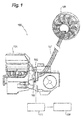
- FIG. 1 An exemplary embodiment of a system 100 in accordance with the disclosure is shown in Fig. 1 .
- Fig. 2 A systematic view of a system 100 is shown in Fig. 2 .
- the systems and methods disclosed herein can be used to power and/or control cooling fans and/or other AC powered electronics, or for any other suitable purpose.
- a system 100 includes a controllable voltage AC generator 103 that is configured to be connected to a power generation unit shaft 102 of a power generation unit 101 (e.g., a diesel piston engine or other vehicle power plant) and is configured to convert rotational energy to electrical energy.
- the controllable voltage AC generator 103 can be any suitable controllable voltage generator configured to modify output voltage for a given rotation speed of the controllable voltage generator 103.
- U.S. Patent No. 7,385,332 to Himmelmann discloses a suitable type of controllable voltage AC generator.
- Non-limiting examples of a controllable voltage AC generator include: 1) a wound field machine that can have its excitation current (applied to the main stage rotor) increased or reduced to vary the amount of magnetic flux interacting with the main stage stator; 2) An induction generator that can increase or decrease the frequency of the excitation field (thereby changing the slip rate), which then changes the magnetic flux on the rotor, thereby changing the main stage output voltage; 3) a permanent magnet machine that can have the rotor axially displaced out of the stator thereby changing the effective stack length of the machine, which changes the amount of rotor flux reacting with the stator, thereby altering the output voltage; 4) a permanent magnet machine that can have a metal sleeve partially or fully inserted between the rotor and the stator (a magnetic shutter) effectively short circuiting the magnetic flux on the rotor, thereby changing how much flux interacts with the stator, thereby altering the machine output voltage; 5) a permanent magnet machine that can have a two piece rotor, axial
- the system 100 can further include at least one power generation unit 101 configured to convert energy of a fuel to rotational energy of a power generation unit shaft 102 via reciprocation. While the power generation unit 101 is described herein as piston/reciprocating engine, it is contemplated that this generator 103 could be configured to operate with any other suitable power plant (e.g., a turbomachine).
- the power generation unit 101 can also be connected to a drive train of the vehicle configured to move the vehicle (e.g., one or more wheels of car, tracks of a tank, or the like).
- the controllable voltage AC generator 103 can be configured to output a desired voltage irrespective of any change in rotational speed of the power generation unit shaft 102.
- the generator 103 can output a desired voltage even if the speed of the power generation unit 101 changes due to fluctuating throttle setting, fuel flow, mixture, and/or other reasons.
- the desired voltage can be raised or lowered independent of the speed of the power generation unit 101.
- the system 100 can further include at least one AC electric motor fan 105 configured to cool the power generation unit 101 of the vehicle 300, and an AC bus 107 connecting the controllable voltage AC generator to each of the AC electric motor fans 105.
- the electric motor 105 can be any suitable electric motor configured to operate with alternating current (e.g., an induction motor and/or any other suitable electric motor configured to tolerate slip).
- the AC bus 107 can be any suitable connection to power the AC electric motor fan 105 (e.g., a three phase connection).
- the speed of the AC electric motor fan 105 can be monitored and/or limited by a suitable control system (e.g., cooling system controller 109) that is operatively connected to the AC electric motor fan 105, the power generation unit 101, and/or one or more sensors (e.g., configured to sense at least one of a temperature of the power generation unit 101, a speed of the power generation unit 101, a speed of the AC electric unit fan 105) disposed within the system 100 via any suitable circuitry, hardware, and/or software.
- a suitable control system e.g., cooling system controller 109
- sensors e.g., configured to sense at least one of a temperature of the power generation unit 101, a speed of the power generation unit 101, a speed of the AC electric unit fan 105
- the system 100 can further include a generator controller 111 configured to control the controllable voltage AC generator 103 to output the desired voltage.
- the generator controller 111 can have any suitable feedback system and/or be configured to communicate with the cooling system controller 109 and/or the AC electric motor fan 105 such that the generator controller can determine a state and/or temperature of the power generation unit 101 and/or the AC electric motor fan 105 to determine if an increase or decrease in voltage is desired.
- the generator controller 111 can be operative to modify the voltage output of the controllable voltage AC generator to achieve at least one of a desired motor speed, a desired torque, a desired setting for an operative condition, and/or a desired temperature of the power generation unit, or any other suitable setting.
- the generator controller 111 can be configured to modify the output voltage in accordance with a predetermined algorithm implemented via any suitable circuitry, hardware, or software, or via any other suitable program. For example, if the generator controller 111 or cooling system controller 109 determines that at least one of a desired motor speed, a desired torque of AC electric motor fan 105, or a desired setting for an operative condition is insufficient, and/or a desired temperature of the power generation unit 101 is above a threshold value, then the generator controller 111 can modify the controllable voltage AC generator 103 to output a higher voltage, and vice versa.
- the generator controller 111 can also be connected to the power generation unit 101 to determine a change in rotational speed of the power generation unit 101 such that the generator controller 111 can modify the output voltage setting of the generator 103 to maintain a constant/desired voltage output and/or anticipate the fluctuations of the power generation unit 101.
- a master controller 113 can be included in system 100 such that the master controller 113 includes both the cooling system controller 109 and the generator controller 111 implemented as software modules or the like. Alternatively, the cooling system controller 109 and the generator controller 111 can be independent of each other in any suitable manner. While an AC electric motor fan 105 is not shown connected in Fig. 2 , one or more AC electric motor fans 105 can be connected to the master controller 113 or any other suitable controller as disclosed herein in any suitable manner.
- Each controllable voltage generator 103 can be coaxially disposed on the power generation unit shaft 102 or in any other suitable manner.
- one or more generators 103 could also be connected to the power generation unit 101 via a gearbox, chains, belts, friction drives, or the like.
- a method includes controlling an output voltage of a controllable voltage generator 103 attached to a power generation unit 101 of a vehicle (e.g., a truck, a tank, an aircraft, or any other suitable vehicle) that is configured to convert energy of a fuel to rotational energy of a power generation unit shaft 102 and allowing the controlled voltage to power an AC electric motor fan 105 disposed in the vehicle.
- the AC electric motor fan 105 can be any suitable electric motor (e.g., an induction motor and/or any other suitable electric motor that is configured to tolerate slip).
- the method can further include determining a state and/or temperature of the power generation unit 101 and/or the AC electric motor fan 105. In some embodiments, the method further includes modifying the voltage of the controllable voltage AC generator 103 to achieve at least one of a desired motor speed, a desired torque of AC electric motor fan 105, a desired setting for an operative condition, or a desired temperature of the power generation unit 101.
- the method can include increasing the output voltage to increase cooling if the temperature of the power generation unit 101 is determined to be above a threshold value so as to increase the fan speed.
- the method can include decreasing the output voltage if the temperature is determined to be below a threshold value so as to decrease the fan speed.
- the method can include actuating the controllable voltage AC generator 103 to produce a constant voltage in response to a change in power generation unit shaft speed.
- the method can further include controlling the speed of the AC electric motor fan 105 of the vehicle 300 independently of the speed of the power generation unit 102.
- the generator 103 can be configured to allow inclusion of a suitable active and/or passive rectifier that can siphon some of the electric power from the electric motor fan system, allowing it to be used to power other pieces of equipment on the vehicle.
- an electrically powered cooling fan can be included on a suitable vehicle without complex and/or heavy electronics for converting or inverting electrical signals. This allows the fan to be operated at its most efficient speed/torque at all times instead of at its maximum speed. This can result in considerable reduction in the weight and cost of the existing systems and provide an overall efficiency increase.
- Embodiments of methods and systems of the present disclosure provide for vehicular systems with superior properties including a lightweight and efficient cooling system. While the apparatus and methods of the subject disclosure have been shown and described with reference to embodiments, those skilled in the art will readily appreciate that changes and/or modifications may be made thereto without departing from the scope of the subject disclosure.
Landscapes
- Engineering & Computer Science (AREA)
- Power Engineering (AREA)
- Control Of Eletrric Generators (AREA)
Applications Claiming Priority (1)
| Application Number | Priority Date | Filing Date | Title |
|---|---|---|---|
| US14/243,219 US20150288315A1 (en) | 2014-04-02 | 2014-04-02 | Systems utiilizing a controllable voltage ac generator system |
Publications (2)
| Publication Number | Publication Date |
|---|---|
| EP2928069A2 true EP2928069A2 (fr) | 2015-10-07 |
| EP2928069A3 EP2928069A3 (fr) | 2016-01-20 |
Family
ID=52577748
Family Applications (1)
| Application Number | Title | Priority Date | Filing Date |
|---|---|---|---|
| EP15156683.3A Withdrawn EP2928069A3 (fr) | 2014-04-02 | 2015-02-26 | Systèmes utilisant un système de générateur CA de tension contrôlable |
Country Status (2)
| Country | Link |
|---|---|
| US (2) | US20150288315A1 (fr) |
| EP (1) | EP2928069A3 (fr) |
Cited By (1)
| Publication number | Priority date | Publication date | Assignee | Title |
|---|---|---|---|---|
| CN108471271A (zh) * | 2018-04-16 | 2018-08-31 | 成都市极米科技有限公司 | 一种投影仪滑门电机控制方法及控制装置 |
Families Citing this family (1)
| Publication number | Priority date | Publication date | Assignee | Title |
|---|---|---|---|---|
| US10202178B2 (en) | 2017-06-23 | 2019-02-12 | Hamilton Sundstrand Corporation | Unmanned underwater vehicle propulsion system including an AC power distribution bus |
Citations (1)
| Publication number | Priority date | Publication date | Assignee | Title |
|---|---|---|---|---|
| US7385332B2 (en) | 2006-04-17 | 2008-06-10 | Hamilton Sundstrand Corporation | Permanent magnet dynamoelectric machine with axially displaceable permanent magnet rotor assembly |
Family Cites Families (20)
| Publication number | Priority date | Publication date | Assignee | Title |
|---|---|---|---|---|
| US2099468A (en) * | 1934-05-03 | 1937-11-16 | Eclipse Aviat Corp | Electrical generating and control system |
| US6066935A (en) * | 1991-06-03 | 2000-05-23 | Siemens Aktiengesellschaft | Pole-changing asynchronous fan motor with continuously adjustable speed |
| US6105697A (en) * | 1996-04-01 | 2000-08-22 | Weaver; Winstead B. | Hybrid turbine-electric motor system |
| JP2001119999A (ja) * | 1999-10-12 | 2001-04-27 | Mitsubishi Heavy Ind Ltd | カーエアコン駆動用発電機の保護方式 |
| JP2001263124A (ja) * | 2000-03-17 | 2001-09-26 | Tcm Corp | 産業用車両 |
| DE10042525A1 (de) * | 2000-08-30 | 2002-04-04 | Audi Ag | Regeleinrichtung für einen elektromotorischen Kühlventilator einer Antriebseinrichtung |
| DE10119668A1 (de) * | 2001-04-20 | 2002-10-24 | Walter Holzer | Verfahren zur Spannungsstabilisierung eines Wechselstromgenerators mit wechselnder Rotordrehzahl |
| US6772714B2 (en) * | 2001-08-16 | 2004-08-10 | Deere & Company | Electronic fan control |
| US6604360B1 (en) * | 2002-04-18 | 2003-08-12 | Deere & Company | Exhaust driven engine cooling system |
| US7170262B2 (en) * | 2003-12-24 | 2007-01-30 | Foundation Enterprises Ltd. | Variable frequency power system and method of use |
| JP4585842B2 (ja) * | 2004-12-10 | 2010-11-24 | 株式会社日立製作所 | 車両電気駆動装置 |
| US7471008B2 (en) * | 2006-03-10 | 2008-12-30 | Deere & Company | Method and system for controlling a rotational speed of a rotor of a turbogenerator |
| US8368236B2 (en) * | 2007-03-27 | 2013-02-05 | Rahamim Ben-David | System and method for generating an alternating current output signal |
| US20090261599A1 (en) * | 2008-04-21 | 2009-10-22 | Glacier Bay, Inc. | Power generation system |
| WO2012011184A1 (fr) * | 2010-07-22 | 2012-01-26 | トヨタ自動車株式会社 | Système de commande de véhicule |
| JP5682221B2 (ja) * | 2010-10-15 | 2015-03-11 | 日産自動車株式会社 | エンジン用燃料ポンプの制御装置 |
| US9982721B2 (en) * | 2010-11-14 | 2018-05-29 | Litens Automotive Partnership | Decoupler with tuned damping and methods associated therewith |
| JP5631824B2 (ja) * | 2011-08-31 | 2014-11-26 | 本田技研工業株式会社 | 発電機の出力制御装置 |
| US8823208B2 (en) * | 2011-11-16 | 2014-09-02 | C. E. Niehoff & Co. | Self-energizing voltage regulator with improved transient recovery |
| US20140008488A1 (en) * | 2012-07-06 | 2014-01-09 | Hamilton Sundstrand Corporation | Converter with taxi drive |
-
2014
- 2014-04-02 US US14/243,219 patent/US20150288315A1/en not_active Abandoned
-
2015
- 2015-02-26 EP EP15156683.3A patent/EP2928069A3/fr not_active Withdrawn
- 2015-10-15 US US14/883,721 patent/US20160036363A1/en not_active Abandoned
Patent Citations (1)
| Publication number | Priority date | Publication date | Assignee | Title |
|---|---|---|---|---|
| US7385332B2 (en) | 2006-04-17 | 2008-06-10 | Hamilton Sundstrand Corporation | Permanent magnet dynamoelectric machine with axially displaceable permanent magnet rotor assembly |
Cited By (1)
| Publication number | Priority date | Publication date | Assignee | Title |
|---|---|---|---|---|
| CN108471271A (zh) * | 2018-04-16 | 2018-08-31 | 成都市极米科技有限公司 | 一种投影仪滑门电机控制方法及控制装置 |
Also Published As
| Publication number | Publication date |
|---|---|
| US20160036363A1 (en) | 2016-02-04 |
| US20150288315A1 (en) | 2015-10-08 |
| EP2928069A3 (fr) | 2016-01-20 |
Similar Documents
| Publication | Publication Date | Title |
|---|---|---|
| US12368399B2 (en) | Synchronous inverter | |
| EP2928068A2 (fr) | Systèmes utilisant un système de générateur CA de tension contrôlable | |
| CN106941333B (zh) | 具有分段波形转换器的混合型装置 | |
| US9099882B2 (en) | Turbine engine hybrid power supply | |
| US20170267093A1 (en) | Electric drivetrain system and method having a single speed ratio direct drive | |
| US9166510B1 (en) | Systems utilizing a controllable voltage AC generator system | |
| EP2072320A1 (fr) | Procédé de fonctionnement d'un convertisseur électromécanique, contrôleur et produit de programme informatique | |
| EP2659116B1 (fr) | Générateur et motopompe intégrés | |
| US20170110976A1 (en) | Segmented Waveform Converter on Controlled Field Variable Speed Generator | |
| GB2522439A (en) | Variable speed magnetic gear | |
| EP2905162B1 (fr) | Entraînement électromécanique pour machine de travail | |
| US9481252B1 (en) | Regenerative braking system for reducing fuel consumption | |
| EP2928069A2 (fr) | Systèmes utilisant un système de générateur CA de tension contrôlable | |
| US20180222330A1 (en) | Using dc motor with a controller as a generator | |
| KR101573093B1 (ko) | 차량구동 시스템 및 전기 기계식 컨버터의 사용 | |
| EP3706307B1 (fr) | Architectures hybrides en série utilisant des machines à double alimentation composées | |
| US9035481B1 (en) | Using AC and DC generators with controllers as a regenerative power burn off device | |
| US9272628B2 (en) | Using AC induction motor as a generator in a utility vehicle | |
| CN105691240A (zh) | 车辆的驱动结构 | |
| WO2016188721A1 (fr) | Générateur indépendant de la vitesse |
Legal Events
| Date | Code | Title | Description |
|---|---|---|---|
| PUAI | Public reference made under article 153(3) epc to a published international application that has entered the european phase |
Free format text: ORIGINAL CODE: 0009012 |
|
| AK | Designated contracting states |
Kind code of ref document: A2 Designated state(s): AL AT BE BG CH CY CZ DE DK EE ES FI FR GB GR HR HU IE IS IT LI LT LU LV MC MK MT NL NO PL PT RO RS SE SI SK SM TR |
|
| AX | Request for extension of the european patent |
Extension state: BA ME |
|
| PUAL | Search report despatched |
Free format text: ORIGINAL CODE: 0009013 |
|
| AK | Designated contracting states |
Kind code of ref document: A3 Designated state(s): AL AT BE BG CH CY CZ DE DK EE ES FI FR GB GR HR HU IE IS IT LI LT LU LV MC MK MT NL NO PL PT RO RS SE SI SK SM TR |
|
| AX | Request for extension of the european patent |
Extension state: BA ME |
|
| RIC1 | Information provided on ipc code assigned before grant |
Ipc: B60R 16/03 20060101ALI20151215BHEP Ipc: F01P 7/04 20060101ALI20151215BHEP Ipc: H02P 23/00 20160101ALI20151215BHEP Ipc: H02P 27/04 20060101ALI20151215BHEP Ipc: H02P 9/48 20060101AFI20151215BHEP Ipc: H02K 7/14 20060101ALI20151215BHEP Ipc: B60H 1/32 20060101ALI20151215BHEP Ipc: B60K 11/00 20060101ALI20151215BHEP |
|
| 17P | Request for examination filed |
Effective date: 20160720 |
|
| RBV | Designated contracting states (corrected) |
Designated state(s): AL AT BE BG CH CY CZ DE DK EE ES FI FR GB GR HR HU IE IS IT LI LT LU LV MC MK MT NL NO PL PT RO RS SE SI SK SM TR |
|
| R17P | Request for examination filed (corrected) |
Effective date: 20160720 |
|
| STAA | Information on the status of an ep patent application or granted ep patent |
Free format text: STATUS: EXAMINATION IS IN PROGRESS |
|
| 17Q | First examination report despatched |
Effective date: 20180917 |
|
| STAA | Information on the status of an ep patent application or granted ep patent |
Free format text: STATUS: THE APPLICATION IS DEEMED TO BE WITHDRAWN |
|
| 18D | Application deemed to be withdrawn |
Effective date: 20190129 |