EP2929083B1 - Textile de fabrication de papier triple - Google Patents
Textile de fabrication de papier triple Download PDFInfo
- Publication number
- EP2929083B1 EP2929083B1 EP13824375.3A EP13824375A EP2929083B1 EP 2929083 B1 EP2929083 B1 EP 2929083B1 EP 13824375 A EP13824375 A EP 13824375A EP 2929083 B1 EP2929083 B1 EP 2929083B1
- Authority
- EP
- European Patent Office
- Prior art keywords
- yarns
- yarn
- fabric
- cmd
- binding
- Prior art date
- Legal status (The legal status is an assumption and is not a legal conclusion. Google has not performed a legal analysis and makes no representation as to the accuracy of the status listed.)
- Active
Links
Images

Classifications
-
- D—TEXTILES; PAPER
- D21—PAPER-MAKING; PRODUCTION OF CELLULOSE
- D21F—PAPER-MAKING MACHINES; METHODS OF PRODUCING PAPER THEREON
- D21F1/00—Wet end of machines for making continuous webs of paper
- D21F1/0027—Screen-cloths
-
- D—TEXTILES; PAPER
- D21—PAPER-MAKING; PRODUCTION OF CELLULOSE
- D21F—PAPER-MAKING MACHINES; METHODS OF PRODUCING PAPER THEREON
- D21F1/00—Wet end of machines for making continuous webs of paper
-
- D—TEXTILES; PAPER
- D21—PAPER-MAKING; PRODUCTION OF CELLULOSE
- D21F—PAPER-MAKING MACHINES; METHODS OF PRODUCING PAPER THEREON
- D21F1/00—Wet end of machines for making continuous webs of paper
- D21F1/0027—Screen-cloths
- D21F1/0036—Multi-layer screen-cloths
- D21F1/0045—Triple layer fabrics
-
- D—TEXTILES; PAPER
- D03—WEAVING
- D03D—WOVEN FABRICS; METHODS OF WEAVING; LOOMS
- D03D11/00—Double or multi-ply fabrics not otherwise provided for
-
- Y—GENERAL TAGGING OF NEW TECHNOLOGICAL DEVELOPMENTS; GENERAL TAGGING OF CROSS-SECTIONAL TECHNOLOGIES SPANNING OVER SEVERAL SECTIONS OF THE IPC; TECHNICAL SUBJECTS COVERED BY FORMER USPC CROSS-REFERENCE ART COLLECTIONS [XRACs] AND DIGESTS
- Y10—TECHNICAL SUBJECTS COVERED BY FORMER USPC
- Y10T—TECHNICAL SUBJECTS COVERED BY FORMER US CLASSIFICATION
- Y10T442/00—Fabric [woven, knitted, or nonwoven textile or cloth, etc.]
- Y10T442/30—Woven fabric [i.e., woven strand or strip material]
- Y10T442/3472—Woven fabric including an additional woven fabric layer
Definitions
- the present invention relates to a papermaking fabric, in particular intended for use as forming fabric in a forming section of a papermaking machine.
- the traditional Fourdrinier papermaking process substantially includes three subsequent steps, carried out in corresponding sections of the papermaking machine: forming section, pressing section, drying section.
- an aqueous pulp of cellulose fibers (and possibly other components) is arranged on a so-called forming fabric, loop-closed and supported by rollers.
- the removing of water from the pulp through the forming fabric leads to the gradual formation of a wet paper material web with still relatively high water content. Further removing of water takes place in the pressing section, in which the paper material is pressed passing through one or more pairs of rollers.
- the paper material is then sent to the drying section for removing the remaining moisture.
- the paper thus formed is ready for the subsequent steps of finishing and packaging.
- machine direction (abbreviated “MD) and “cross machine direction” (abbreviated “CMD”) are used to indicate a direction aligned with the feeding direction of the forming fabric in the papermaking machine and a direction parallel to the surface of the fabric and crosswise (orthogonal) to the feeding direction, respectively.
- MD machine direction
- CMD cross machine direction
- the direction or orientation of the warp and weft yarns of the forming fabric are also indicated with reference to machine direction and cross machine direction.
- the surface of the forming fabric in contact with the cellulose pulp is the top surface of the fabric and the opposite side facing the machine is the bottom surface.
- This reference will be adopted also to describe the vertical spatial arrangement of the yarns in the forming fabric.
- Some features of the papermaking fabrics are particularly important, such as the supporting capacity and the filtering capacity, especially in the forming section.
- papermaking fabrics must have excellent stability also when moved at high speed, high permeability for reducing the amount of water withheld in the pulp when it is transferred to the pressing section and a low energy consumption for moving them.
- WO2010/041123 A2 discloses a papermaking fabric according to the preamble of claim 1.
- the present invention therefore relates to a papermaking fabric as disclosed in essential terms in accompanying claim 1 and the additional features of which are disclosed in the dependent claims.
- the present invention further relates to the use of such a fabric in a papermaking machine, and specifically in the forming section of the machine, as well as a papermaking process using such a fabric, as disclosed in accompanying claims 13 and 14, respectively.
- reference numeral 100 indicates a papermaking fabric as a whole, in particular a forming fabric to be used in the forming section of a papermaking machine.
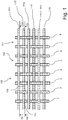
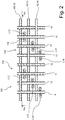
- the fabric 100 is a triple sixteen harness fabric and comprises a top layer 101 and a bottom layer 102 formed, as customary, by corresponding repeat units which form together a fabric repeat unit 104; figures 1 and 2 show a single fabric repeat unit 104; it is understood that in commercial and industrial applications the unit 104, as the repeat units of the single layers 101, 102, may be repeated several times, both in machine direction and in cross machine direction, for forming a fabric 100 of suitable size for use on a papermaking machine.
- the fabric 100 is formed by longitudinal warp yarns which extend in machine direction (MD) and by crosswise weft yarns, substantially orthogonal to the previous yarns, which extend in cross machine direction (CMD).
- MD yarns longitudinal warp yarns which extend in machine direction
- CMD yarns crosswise weft yarns which extend in cross machine direction
- a fabric repeat unit 104 of the fabric 100 includes: sixteen warp yarns or MD yarns 1-16, which are subdivided into eight top MD yarns 1-8 and eight bottom MD yarns 9-16; and nine weft yarns or CMD yarns P11,P14,P17; MC10,MC13,MC16; L12,L15,L18, and specifically three top CMD yarns P11,P14,P17, three bottom CMD yarns MC10,MC13,MC16 and three binding yarns L12,L15,L18, comprising respective support portions 115 and respective binding portions 116.
- the top layer 101 ( figure 1 ) includes the top MD yarns 1-8 and the top CMD yarns P11,P14,P17, as well as the support portions 115 of the binding yarns L12,L15,L18.
- the bottom layer 102 ( figure 2 ) comprises the bottom MD yarns 9-16 and the bottom CMD yarns MC10,MC13,MC16, as well as the binding portions 116 of the binding yarns L12,L15,L18 which extend to bind the bottom MD yarns 9-16.
- the fabric 100 has only one warp: the top MD yarns 1-8 and the bottom MD yarns 9-16 form a single warp, i.e. a single warp is mounted on the loop which makes the fabric 100; the MD yarns 1-16 alternatively form the top layer (top MD yarns 1-8) and the bottom layer (bottom MD yarns 9-16) according to their weave with the weft yarns (top CMD yarns P11,P14,P17; bottom CMD yarns MC10,MC13,MC16; binding yarns L12,L15,L18).
- the top CMD yarns P11,P14,P17 are interwoven only with the top MD yarns 1-8; the bottom CMD yarns MC10,MC13,MC16 are interwoven only with the bottom MD yarn 9-16.
- the binding yarns L12,L15,L18 bind the top MD yarns 1-8 to the bottom MD yarns 9-16.
- top MD yarns 1-8 and the top CMD yarns P11,P14,P17 are interwoven so that each top CMD yarn P11,P14,P17 passes alternatively over three top MD yarns and under one top MD yarn, specifically passing under a top MD yarn and over the following three top MD yarns, and thus again under a top MD yarn and under the following three top MD yarns.
- the top CMD yarn P11 passes under the top MD yarn 1, over the top MD yarns 2,3,4, under the top MD yarn 5, over the top MD yarns 6,7,8 and so forth.
- top CMD yarns P11,P14,P17 are offset in cross machine direction, precisely by two top MD yarns.
- Layers 101, 102 are joined and bound to one another to form the fabric 100 by means of binding yarns L12,L15,L18.
- Each binding yarn L12,L15,L18 in a fabric repeat unit 104 comprises a supporting portion 115, which is interwoven with the top MD yarns 1-8, and a binding portion 116, which is arranged under the top MD yarns 1-8 and is interwoven with the bottom MD yarns 9-16.
- each binding yarn L12,L15,L18 is arranged between two adjacent top CMD yarns P11,P14,P17.
- the fabric repeat unit 104 there are an equal number (three, in the case in point) of top CMD yarns P11,P14,P17 and of binding yarns L12,L15,L18, as well as of bottom CMD yarns MC10,MC13,MC16; and each binding yarn L12,L15,L18 is adjacent to a top CMD yarn P11,P14,P17 and forms a pair therewith; in each of these pairs, formed by a top CMD yarn P11,P14,P17 and by a binding yarn L12,L15,L18, the binding yarn passes over the top MD yarns under which the adjacent top CMD yarn passes, and vice versa passes under the top MD yarns over which the adjacent top CMD yarn passes.
- the top CMD yarn P11 passes under the top MD yarns 1 and 5 and over the top MD yarns 2-4 and 6-8, while the binding yarn L12 passes over the top MD yarns 1,5 and passes under the top MD yarns 2-4 and 6-8.
- the other binding yarns L15,L18 are interwoven with the same pattern but are offset in cross machine direction by two positions (i.e. by two top or bottom CMD yarns).
- the binding yarns L12,L15,L18 do not contribute in practice to the paper supporting function, because their support portions 115 have a limited extension passing over only single top MD yarns which are widely distanced apart.
- the binding yarns L12,L15,L18 instead have the function of joining the two layers 101, 102 of the fabric 100.
- each binding yarn L12,L15,L18 binds, in the fabric repeat unit 104, two top MD yarns and two bottom MD yarns; in particular, each binding yarn L12,L15,L18 binds a top MD yarn and a bottom MD yarn which are offset by two positions in cross machine direction; for example, the binding yarn L12 passes over the top MD yarn 1 and under the bottom MD yarn 11, which is offset by two positions in cross machine direction with respect to the top MD yarn 1.
- Each binding yarn L12,L15,L18 thus binds two top MD yarns and a bottom MD yarn arranged in the middle of the two top MD yarns bound by the same binding yarn, passing over the top MD yarn and under the bottom MD yarn displaced by two positions in cross machine direction with respect to the top MD yarn.
- Each binding yarn L12,L15,L18 passes over a top MD yarn and under the following three top MD yarns, and thus again over the following top MD yarn and so forth; and under a bottom MD yarn and over the following three bottom MD yarns, and so forth.
- binding yarns L12,L15,L18 are offset in cross machine direction, precisely by two top MD yarns.
- the interweave of the binding yarns L12,L15,L18 with the top MD yarns 1-8 and the bottom MD yarns 9-16 may take different forms.
- the top layer has a four harness satin structure.
- the bottom layer 102 comprises the bottom MD yarns 9-16, the bottom CMD yarns MC10,MC13,MC16 and the binding portions 116 of the binding yarns L12,L15,L18.
- the bottom CMD yarns MC10,MC13,MC16 are interwoven with the bottom MD yarns 9-16 in a "over-1/under-7" sequence.
- the bottom CMD yarn MC10 passes over the bottom MD yarn 10 and under the bottom MD yarns 9 and 11-16.
- the other bottom CMD yarns follow a similar "over-1/under-7" pattern with respect to the bottom MD yarns, but each is offset with respect to the adjacent bottom CMD yarn in cross machine direction in particular by three positions, i.e. by three bottom MD yarns.
- the bottom CMD yarns MC10,MC13,MC16 therefore pass over the bottom MD yarns 10,13,16 respectively, and under the others.
- the bottom layer 102 therefore has an eight harness satin structure.
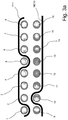
- the bottom layer 102 also includes ( figure 3 ) the binding portions 116 of the binding yarns L12,L15,L18.
- each binding yarn L12,L15,L18 passes with its own binding portion 116 under a lower MD yarn 9-16 so as to define a "under-1/over-3" sequence with respect to the bottom MD yarns 9-16.
- the binding yarn L12 ( figure 3b ) passes under the lower MD yarns 11 and 15 and over al the other bottom MD yarns 9-10,12-14,16.
- binding yarns L15,L18 follow the same "under-1/over-3" but a preferably offset with respect to the binding yarn L12, in particular by three bottom MD yarns.
- the fabric 100 has a ratio between weft yarns and warp yarns of 3:1.
- the fabric 100 there are three weft yarns for each warp yarn; this corresponds to the manufacturing method of the fabric: in the weaving on the loom, three weft yarns are inserted for each warp yarn.
- the fabric 100 thus has a sequence of three weft yarns which are repeated in machine direction for each warp yarn (which is alternatively a top yarn or a bottom yarn according to the weaving with the weft yarns).
- the repeat unit 104 of the fabric is formed by a single warp yarn (MD yarn) for every three weft yarns (CMD yarn): for every warp yarn (which may be a top MD yarn 1-8 or a bottom MD yarn 9-16, according to the weave with the warp CMD yarns), there are indeed a top CMD yarn (one of either P11,P14,P17), a bottom CMD yarn (one of MC10,MC13,MC16) and a binding yarn (one of L12,L15,L18).
- MD yarn for every three weft yarns
- the warp yarns are diagrammatically shown in figures 3a , 3b in pairs to form two layers; in fact, the warp yarns take this arrangement by effect of the weaving with the weft yarns, but only one warp yarn is repeated in cross machine direction.
- the 3:1 ratio between the weft yarns and the warp yarns reflects the weaving method of the fabric 100; three consequent weft yarns are inserted at each ledge (or insertion) of the fabric forming loom on each weft yarn.
- the fabric 100 therefore has one warp yarn every three weft insertions.
- Each top or bottom MD yarn is associated in each loom insertion or ledge, to a top CMD yarn, a bottom CMD yarn and a binding yarn.
- the number and/or the position of the pairs of binding yarns may be varied with respect to the number and/or position the top CMD yarns (e.g. there may be one binding yarn for every two or three top CMD yarns, or there may be two or three or more binding yarns for every top CMD yarn).
- top and bottom CMD yarns in the fabric repeat unit may vary with respect to the that described and illustrated by way of example only.
- all weave patterns or weaves described for the layers 101, 102 may differ from those illustrated and described; for example, the top surface of the fabric must not necessarily be formed by a four harness satin structure as shown, but may be of plain weave type, twill etc; and the bottom surface on the fabric does not necessarily need to be an eight harness satin structure, but may be any other form, such as a broken weave, a plain weave, a broken twill, a twill, etc.
- Other further variants of weave patterns may be used in the fabric according to the present invention.
- Yarns of various shapes may also be used.
- the shape of the yarns used in the fabric of the invention may be varied according to the properties intended to be imparted to the end product.
- the yarns may be monofilament yarns, flat monofilament yarns, multifilament yarns, twisted multifilament or monofilament yarns, yarns of any type, or any combination thereof.
- the materials with which yarns are made may be those commonly used in the field.
- polyester, polyamide, polyamide/polyester yarns or the like may be used.
- a person skilled in the art may select the materials of the yarns also according to the specific application for which the end product is intended.
- the top and bottom MD yarns, the top CMD yarns and the binding yarns may have (reciprocally equivalent or different) diameter from approximately 0,10 to 0,35 mm; the bottom MD yarns may have diameter from approximately 0,10 and 0,50 mm; it is understood that these sizes are only examples, and other sizes may be used according to specific needs.
- the mesh (i.e. the size of the mesh) of the fabric may also vary.
- the mesh size of the top surface must be comprised between approximately 17x17 and 19x30 (warp yarns per cm x weft insertions per cm) and the total mesh size may vary from approximately 34x26 to 38x60 (warp yarns per cm x weft insertions per cm).
- a fabric with 3:1 ratio and eight harness satin structure bottom layer according to the invention has the features shown in table 1.
- TABLE 1 YARN Size MD divided into: 0,27 mm Top MD 0,27 mm Bottom MD 0,27 mm Binding 0,25 mm Top CMD 0,30 mm Bottom CMD 0,50 mm Mesh (top surface) 18.5 x 22 * Mesh (total) 36 x 33 * (*) warp yarns per cm x weft mesh per cm
- the above-described fabric 100 is used in a papermaking process, in particular in the forming section of a papermaking machine.
- the process includes the steps of:
Landscapes
- Engineering & Computer Science (AREA)
- Textile Engineering (AREA)
- Paper (AREA)
- Woven Fabrics (AREA)
- Details Of Garments (AREA)
Claims (14)
- Textile triple pour la production de papier (100), ayant au moins une unité de répétition de tissu (104) qui comporte :- un jeu de seize fils de chaîne ou de fils (1-16) de direction machine (MD), qui s'étendent dans la direction de la machine (MD) et subdivise en huit fils MD de dessus (1-8) et huit fils (MD) de dessous (9-16) ;- un jeu de fils de trame ou fils transversaux (CMD) par rapport à la direction de machine (P11,P14,P17; MC10,MC13,MC16; L12,L15,L18), qui s'étendent en travers de la direction de la machine et comprennent : trois fils CMD de dessus (P11,P14,P17), trois fils CMD de dessous (MC10,MC13,MC16) et des fils de liaison (L12,L15,L18) ;dans lequel :- les fils CMD de dessus (P11,P14,P17) sont entrelacés uniquement avec les fils MD de dessus (1-8) pour former une couche supérieure (101) ;- les fils CMD de dessous (MC10,MC13,MC16) sont entrelacés uniquement avec les fils MD de dessous (9-16) pour former une couche inférieure (102) ;- les fils de liaison (12,15,18) sont entrelacés à la fois avec les fils MD de dessus (1-8) et les fils (MD) de dessous (9-16) ;de manière à lier la couche supérieure (101) avec la couche inférieure (102) ;le tissu étant caractérisé en ce que :le jeu de fils de trame ou fils transversaux (CMD) par rapport à la direction de machine est un jeu de neuf fils de trame (P11,P14,P17; MC10,MC13,MC16; L12,L15,L18), qui comprend :trois fils CMD de dessus (P11,P14,P17), trois fils CMD de dessous (MC10,MC13,MC16) et trois fils de liaison (L12,L15,L18) ; etle tissu (100) a une proportion de fils de trame par rapport aux fils de chaîne de 3:1.
- Tissu selon la revendication 1, dans lequel, dans l'unité de répétition de tissu (104), pour chaque fil de chaîne ou fils MD (1-16), qui est alternativement soit un fil MD (1-8) de dessus ou un fil MD (9-16) de dessous selon le tissage avec les fils de trame, il y a un fil CMD de dessus (P11,P14,P17), un fil CMD de dessous (MC10,MC13,MC16) et un fils de liaison (L12,L15,L18).
- Tissu selon l'une des revendications précédentes, dans lequel le tissu (100) a une seule chaîne, les fils de chaîne (1-16) étant divisés alternativement en fils MD de dessus (1-8), qui constituent la couche supérieure (101) et en fils MD de dessous (9-16), qui constituent la couche inférieure (102), en fonction du tissage avec les fils de trame (P11 ,P14,P17; MC10,MC13,MC16; L12,L15,L18).
- Tissu selon l'une des revendications précédentes, dans lequel chaque fils CMD de dessus (P11,P14,P17) passe alternativement sous un fil MD de dessus (1-8) et au-dessus des trois fils MD de dessus suivants (1-8) et ainsi de suite.
- Tissu selon l'une des revendications précédentes, dans lequel chaque fil de liaison (L12,L15,L18) est disposé entre deux fils CMD de dessus adjacents (P11,P14,P17) et dans l'unité de répétition de tissu (104) est entrelacé avec deux fils MD de dessus (1-8) et deux fils MD (9-16) de dessous.
- Tissu selon l'une des revendications précédentes, dans lequel chaque fil de liaison (L12,L15,L18) est adjacent à un fil CMD de dessus (P11,P14,P17) et forme une paire avec un tel CMD fil de dessus ; dans chaque paire formée par un fil CMD de dessus (P11,P14,P17) et un fil de liaison (L12,L15,L18) adjacent, le fil de liaison passe par-dessus les fils MD de dessus sous lesquels passe le fil CMD de dessus adjacent, et, vice versa, passe sous les fils MD de dessus par-dessus lesquels passe le fil CMD de dessus adjacent.
- Tissu selon l'une des revendications précédentes, dans lequel, dans l'unité de répétition de tissu (104), il y a un nombre égal de fils CMD de dessus (P11,P14,P17) de fils de liaison (L12,L15,L18) et de fils CMD de dessous (MC10,MC13,MC16).
- Tissu selon l'une des revendications précédentes, dans lequel chaque fil de liaison (L12,L15,L18) lie l'unité de reproduction de tissu (104), quatre fils MD (1-16) est spécifiquement deux fils MD de dessus (1-8) et deux fils MD de dessous (9-16) ; les quatre fils MD (1-16) liés par chacun des fils de liaison (L12,L15,L18) étant tous désaxés par rapport à deux positions dans la direction transversale par rapport à la direction machine, l'une par rapport à l'autre.
- Tissu selon l'une des revendications précédentes, dans lequel chaque fil de liaison (L12,L15,L18) passent au-dessus d'un fil MD de dessus (1-8) et en-dessous des trois fils MD de dessus suivants (1-8), et ainsi de suite ; et en dessous d'un fil MD de dessous (9-16) et au-dessus des trois prochains fils MD de dessous (9-16) et ainsi de suite.
- Tissu selon l'une des revendications précédentes, dans lequel la couche de dessus (101) a une structure de satin de quatre harnais.
- Tissu selon l'une des revendications précédentes, dans lequel la couche de dessous (102) a une structure de satin de huit harnais.
- Tissu selon l'une des revendications précédentes, dans lequel les fils CMD de dessous (MC10,MC13,MC16) sont entrelacés avec les fils MD de dessous (9-16) selon une séquence « au-dessus-1/en-dessous -7 ».
- Utilisation du tissu (100) selon l'une quelconque des revendications précédentes dans une machine de fabrication de papier pour convoyer de la pulpe de cellulose et/ou un matériau pour produire du papier.
- Procédé de fabrication de papier comprenant les étapes suivantes:(a) fournir un tissu destiné à fabriquer du papier selon l'une des revendications 1 à 12 ;(b) appliquer sur le tissu une pulpe de cellulose aqueuse et/ou un matériau pour produire du papier; et(c) retirer l'eau de la pulpe et/ou du matériau de papier.
Applications Claiming Priority (2)
| Application Number | Priority Date | Filing Date | Title |
|---|---|---|---|
| IT002101A ITMI20122101A1 (it) | 2012-12-10 | 2012-12-10 | Tessuto triplo di fabbricazione della carta |
| PCT/IB2013/060781 WO2014091409A1 (fr) | 2012-12-10 | 2013-12-10 | Textile de fabrication de papier triple |
Publications (2)
| Publication Number | Publication Date |
|---|---|
| EP2929083A1 EP2929083A1 (fr) | 2015-10-14 |
| EP2929083B1 true EP2929083B1 (fr) | 2017-06-21 |
Family
ID=47683848
Family Applications (1)
| Application Number | Title | Priority Date | Filing Date |
|---|---|---|---|
| EP13824375.3A Active EP2929083B1 (fr) | 2012-12-10 | 2013-12-10 | Textile de fabrication de papier triple |
Country Status (7)
| Country | Link |
|---|---|
| US (1) | US9856602B2 (fr) |
| EP (1) | EP2929083B1 (fr) |
| CA (1) | CA2894469C (fr) |
| ES (1) | ES2638982T3 (fr) |
| IT (1) | ITMI20122101A1 (fr) |
| RU (1) | RU2657998C9 (fr) |
| WO (1) | WO2014091409A1 (fr) |
Families Citing this family (1)
| Publication number | Priority date | Publication date | Assignee | Title |
|---|---|---|---|---|
| IT202000000637A1 (it) * | 2020-01-15 | 2021-07-15 | Feltri Marone S P A | Tessuto triplo di fabbricazione della carta |
Family Cites Families (3)
| Publication number | Priority date | Publication date | Assignee | Title |
|---|---|---|---|---|
| US7007722B2 (en) * | 2003-11-17 | 2006-03-07 | Voith Paper Patent Gmbh | Forming fabric |
| US7384513B2 (en) * | 2004-11-11 | 2008-06-10 | Albany International Corp. | Forming fabrics |
| IT1391374B1 (it) * | 2008-10-08 | 2011-12-13 | Feltri Marone S P A | Tessuto triplo di fabbricazione della carta |
-
2012
- 2012-12-10 IT IT002101A patent/ITMI20122101A1/it unknown
-
2013
- 2013-12-10 US US14/649,522 patent/US9856602B2/en active Active
- 2013-12-10 ES ES13824375.3T patent/ES2638982T3/es active Active
- 2013-12-10 WO PCT/IB2013/060781 patent/WO2014091409A1/fr not_active Ceased
- 2013-12-10 EP EP13824375.3A patent/EP2929083B1/fr active Active
- 2013-12-10 CA CA2894469A patent/CA2894469C/fr active Active
- 2013-12-10 RU RU2015127818A patent/RU2657998C9/ru active
Also Published As
| Publication number | Publication date |
|---|---|
| EP2929083A1 (fr) | 2015-10-14 |
| RU2015127818A (ru) | 2017-01-12 |
| CA2894469A1 (fr) | 2014-06-19 |
| US20150322628A1 (en) | 2015-11-12 |
| RU2657998C2 (ru) | 2018-06-18 |
| RU2657998C9 (ru) | 2018-12-24 |
| ITMI20122101A1 (it) | 2014-06-11 |
| WO2014091409A1 (fr) | 2014-06-19 |
| US9856602B2 (en) | 2018-01-02 |
| ES2638982T3 (es) | 2017-10-24 |
| CA2894469C (fr) | 2020-11-03 |
Similar Documents
| Publication | Publication Date | Title |
|---|---|---|
| EP2356279B1 (fr) | Toile de machine a papier triple son utilization et methode de fabrication de papier | |
| NO178633B (no) | Tolags papirmaskinvevnad | |
| US7878224B2 (en) | Forming fabric having binding warp yarns | |
| CN105189863A (zh) | 具有包含不同浮标长度的横向纱线的运行侧的造纸机前筛浆机 | |
| FI87667C (fi) | Beklaednad foer en arkformningsdel vid en pappersmaskin | |
| CA2894469C (fr) | Textile de fabrication de papier triple | |
| WO2014091410A1 (fr) | Textile de fabrication de papier triple | |
| EP3307943B1 (fr) | Tissu de fabrication de papier à trois couches | |
| EP2337893B1 (fr) | Toile pour machine a papier, en particulier pour la partie humide d'une machine a papier | |
| EP4090794B1 (fr) | Tissu de fabrication de papier à trois couches | |
| CN101644010B (zh) | 过滤及造纸用织物 |
Legal Events
| Date | Code | Title | Description |
|---|---|---|---|
| PUAI | Public reference made under article 153(3) epc to a published international application that has entered the european phase |
Free format text: ORIGINAL CODE: 0009012 |
|
| 17P | Request for examination filed |
Effective date: 20150611 |
|
| AK | Designated contracting states |
Kind code of ref document: A1 Designated state(s): AL AT BE BG CH CY CZ DE DK EE ES FI FR GB GR HR HU IE IS IT LI LT LU LV MC MK MT NL NO PL PT RO RS SE SI SK SM TR |
|
| AX | Request for extension of the european patent |
Extension state: BA ME |
|
| DAX | Request for extension of the european patent (deleted) | ||
| GRAP | Despatch of communication of intention to grant a patent |
Free format text: ORIGINAL CODE: EPIDOSNIGR1 |
|
| INTG | Intention to grant announced |
Effective date: 20170105 |
|
| GRAS | Grant fee paid |
Free format text: ORIGINAL CODE: EPIDOSNIGR3 |
|
| GRAA | (expected) grant |
Free format text: ORIGINAL CODE: 0009210 |
|
| AK | Designated contracting states |
Kind code of ref document: B1 Designated state(s): AL AT BE BG CH CY CZ DE DK EE ES FI FR GB GR HR HU IE IS IT LI LT LU LV MC MK MT NL NO PL PT RO RS SE SI SK SM TR |
|
| REG | Reference to a national code |
Ref country code: GB Ref legal event code: FG4D |
|
| REG | Reference to a national code |
Ref country code: CH Ref legal event code: EP |
|
| REG | Reference to a national code |
Ref country code: IE Ref legal event code: FG4D |
|
| REG | Reference to a national code |
Ref country code: AT Ref legal event code: REF Ref document number: 903048 Country of ref document: AT Kind code of ref document: T Effective date: 20170715 |
|
| REG | Reference to a national code |
Ref country code: DE Ref legal event code: R096 Ref document number: 602013022664 Country of ref document: DE |
|
| REG | Reference to a national code |
Ref country code: SE Ref legal event code: TRGR |
|
| REG | Reference to a national code |
Ref country code: ES Ref legal event code: FG2A Ref document number: 2638982 Country of ref document: ES Kind code of ref document: T3 Effective date: 20171024 |
|
| REG | Reference to a national code |
Ref country code: NL Ref legal event code: MP Effective date: 20170621 |
|
| PG25 | Lapsed in a contracting state [announced via postgrant information from national office to epo] |
Ref country code: GR Free format text: LAPSE BECAUSE OF FAILURE TO SUBMIT A TRANSLATION OF THE DESCRIPTION OR TO PAY THE FEE WITHIN THE PRESCRIBED TIME-LIMIT Effective date: 20170922 Ref country code: LT Free format text: LAPSE BECAUSE OF FAILURE TO SUBMIT A TRANSLATION OF THE DESCRIPTION OR TO PAY THE FEE WITHIN THE PRESCRIBED TIME-LIMIT Effective date: 20170621 Ref country code: NO Free format text: LAPSE BECAUSE OF FAILURE TO SUBMIT A TRANSLATION OF THE DESCRIPTION OR TO PAY THE FEE WITHIN THE PRESCRIBED TIME-LIMIT Effective date: 20170921 Ref country code: HR Free format text: LAPSE BECAUSE OF FAILURE TO SUBMIT A TRANSLATION OF THE DESCRIPTION OR TO PAY THE FEE WITHIN THE PRESCRIBED TIME-LIMIT Effective date: 20170621 |
|
| REG | Reference to a national code |
Ref country code: LT Ref legal event code: MG4D |
|
| REG | Reference to a national code |
Ref country code: AT Ref legal event code: MK05 Ref document number: 903048 Country of ref document: AT Kind code of ref document: T Effective date: 20170621 |
|
| PG25 | Lapsed in a contracting state [announced via postgrant information from national office to epo] |
Ref country code: LV Free format text: LAPSE BECAUSE OF FAILURE TO SUBMIT A TRANSLATION OF THE DESCRIPTION OR TO PAY THE FEE WITHIN THE PRESCRIBED TIME-LIMIT Effective date: 20170621 Ref country code: BG Free format text: LAPSE BECAUSE OF FAILURE TO SUBMIT A TRANSLATION OF THE DESCRIPTION OR TO PAY THE FEE WITHIN THE PRESCRIBED TIME-LIMIT Effective date: 20170921 Ref country code: RS Free format text: LAPSE BECAUSE OF FAILURE TO SUBMIT A TRANSLATION OF THE DESCRIPTION OR TO PAY THE FEE WITHIN THE PRESCRIBED TIME-LIMIT Effective date: 20170621 Ref country code: NL Free format text: LAPSE BECAUSE OF FAILURE TO SUBMIT A TRANSLATION OF THE DESCRIPTION OR TO PAY THE FEE WITHIN THE PRESCRIBED TIME-LIMIT Effective date: 20170621 |
|
| REG | Reference to a national code |
Ref country code: FR Ref legal event code: PLFP Year of fee payment: 5 |
|
| PG25 | Lapsed in a contracting state [announced via postgrant information from national office to epo] |
Ref country code: RO Free format text: LAPSE BECAUSE OF FAILURE TO SUBMIT A TRANSLATION OF THE DESCRIPTION OR TO PAY THE FEE WITHIN THE PRESCRIBED TIME-LIMIT Effective date: 20170621 Ref country code: AT Free format text: LAPSE BECAUSE OF FAILURE TO SUBMIT A TRANSLATION OF THE DESCRIPTION OR TO PAY THE FEE WITHIN THE PRESCRIBED TIME-LIMIT Effective date: 20170621 Ref country code: CZ Free format text: LAPSE BECAUSE OF FAILURE TO SUBMIT A TRANSLATION OF THE DESCRIPTION OR TO PAY THE FEE WITHIN THE PRESCRIBED TIME-LIMIT Effective date: 20170621 Ref country code: SK Free format text: LAPSE BECAUSE OF FAILURE TO SUBMIT A TRANSLATION OF THE DESCRIPTION OR TO PAY THE FEE WITHIN THE PRESCRIBED TIME-LIMIT Effective date: 20170621 Ref country code: EE Free format text: LAPSE BECAUSE OF FAILURE TO SUBMIT A TRANSLATION OF THE DESCRIPTION OR TO PAY THE FEE WITHIN THE PRESCRIBED TIME-LIMIT Effective date: 20170621 |
|
| PG25 | Lapsed in a contracting state [announced via postgrant information from national office to epo] |
Ref country code: IS Free format text: LAPSE BECAUSE OF FAILURE TO SUBMIT A TRANSLATION OF THE DESCRIPTION OR TO PAY THE FEE WITHIN THE PRESCRIBED TIME-LIMIT Effective date: 20171021 Ref country code: SM Free format text: LAPSE BECAUSE OF FAILURE TO SUBMIT A TRANSLATION OF THE DESCRIPTION OR TO PAY THE FEE WITHIN THE PRESCRIBED TIME-LIMIT Effective date: 20170621 Ref country code: PL Free format text: LAPSE BECAUSE OF FAILURE TO SUBMIT A TRANSLATION OF THE DESCRIPTION OR TO PAY THE FEE WITHIN THE PRESCRIBED TIME-LIMIT Effective date: 20170621 |
|
| REG | Reference to a national code |
Ref country code: DE Ref legal event code: R097 Ref document number: 602013022664 Country of ref document: DE |
|
| PLBE | No opposition filed within time limit |
Free format text: ORIGINAL CODE: 0009261 |
|
| STAA | Information on the status of an ep patent application or granted ep patent |
Free format text: STATUS: NO OPPOSITION FILED WITHIN TIME LIMIT |
|
| PG25 | Lapsed in a contracting state [announced via postgrant information from national office to epo] |
Ref country code: DK Free format text: LAPSE BECAUSE OF FAILURE TO SUBMIT A TRANSLATION OF THE DESCRIPTION OR TO PAY THE FEE WITHIN THE PRESCRIBED TIME-LIMIT Effective date: 20170621 |
|
| 26N | No opposition filed |
Effective date: 20180322 |
|
| REG | Reference to a national code |
Ref country code: CH Ref legal event code: PL |
|
| GBPC | Gb: european patent ceased through non-payment of renewal fee |
Effective date: 20171210 |
|
| PG25 | Lapsed in a contracting state [announced via postgrant information from national office to epo] |
Ref country code: SI Free format text: LAPSE BECAUSE OF FAILURE TO SUBMIT A TRANSLATION OF THE DESCRIPTION OR TO PAY THE FEE WITHIN THE PRESCRIBED TIME-LIMIT Effective date: 20170621 |
|
| REG | Reference to a national code |
Ref country code: IE Ref legal event code: MM4A |
|
| PG25 | Lapsed in a contracting state [announced via postgrant information from national office to epo] |
Ref country code: LU Free format text: LAPSE BECAUSE OF NON-PAYMENT OF DUE FEES Effective date: 20171210 Ref country code: MT Free format text: LAPSE BECAUSE OF NON-PAYMENT OF DUE FEES Effective date: 20171210 |
|
| REG | Reference to a national code |
Ref country code: BE Ref legal event code: MM Effective date: 20171231 |
|
| PG25 | Lapsed in a contracting state [announced via postgrant information from national office to epo] |
Ref country code: IE Free format text: LAPSE BECAUSE OF NON-PAYMENT OF DUE FEES Effective date: 20171210 |
|
| PG25 | Lapsed in a contracting state [announced via postgrant information from national office to epo] |
Ref country code: GB Free format text: LAPSE BECAUSE OF NON-PAYMENT OF DUE FEES Effective date: 20171210 Ref country code: BE Free format text: LAPSE BECAUSE OF NON-PAYMENT OF DUE FEES Effective date: 20171231 Ref country code: CH Free format text: LAPSE BECAUSE OF NON-PAYMENT OF DUE FEES Effective date: 20171231 Ref country code: LI Free format text: LAPSE BECAUSE OF NON-PAYMENT OF DUE FEES Effective date: 20171231 |
|
| PG25 | Lapsed in a contracting state [announced via postgrant information from national office to epo] |
Ref country code: MC Free format text: LAPSE BECAUSE OF FAILURE TO SUBMIT A TRANSLATION OF THE DESCRIPTION OR TO PAY THE FEE WITHIN THE PRESCRIBED TIME-LIMIT Effective date: 20170621 Ref country code: HU Free format text: LAPSE BECAUSE OF FAILURE TO SUBMIT A TRANSLATION OF THE DESCRIPTION OR TO PAY THE FEE WITHIN THE PRESCRIBED TIME-LIMIT; INVALID AB INITIO Effective date: 20131210 |
|
| PG25 | Lapsed in a contracting state [announced via postgrant information from national office to epo] |
Ref country code: CY Free format text: LAPSE BECAUSE OF FAILURE TO SUBMIT A TRANSLATION OF THE DESCRIPTION OR TO PAY THE FEE WITHIN THE PRESCRIBED TIME-LIMIT Effective date: 20170621 |
|
| PG25 | Lapsed in a contracting state [announced via postgrant information from national office to epo] |
Ref country code: MK Free format text: LAPSE BECAUSE OF FAILURE TO SUBMIT A TRANSLATION OF THE DESCRIPTION OR TO PAY THE FEE WITHIN THE PRESCRIBED TIME-LIMIT Effective date: 20170621 |
|
| PG25 | Lapsed in a contracting state [announced via postgrant information from national office to epo] |
Ref country code: TR Free format text: LAPSE BECAUSE OF FAILURE TO SUBMIT A TRANSLATION OF THE DESCRIPTION OR TO PAY THE FEE WITHIN THE PRESCRIBED TIME-LIMIT Effective date: 20170621 |
|
| PG25 | Lapsed in a contracting state [announced via postgrant information from national office to epo] |
Ref country code: PT Free format text: LAPSE BECAUSE OF FAILURE TO SUBMIT A TRANSLATION OF THE DESCRIPTION OR TO PAY THE FEE WITHIN THE PRESCRIBED TIME-LIMIT Effective date: 20170621 |
|
| PG25 | Lapsed in a contracting state [announced via postgrant information from national office to epo] |
Ref country code: AL Free format text: LAPSE BECAUSE OF FAILURE TO SUBMIT A TRANSLATION OF THE DESCRIPTION OR TO PAY THE FEE WITHIN THE PRESCRIBED TIME-LIMIT Effective date: 20170621 |
|
| P01 | Opt-out of the competence of the unified patent court (upc) registered |
Effective date: 20230509 |
|
| PGFP | Annual fee paid to national office [announced via postgrant information from national office to epo] |
Ref country code: IT Payment date: 20251112 Year of fee payment: 13 Ref country code: FI Payment date: 20251222 Year of fee payment: 13 |
|
| PGFP | Annual fee paid to national office [announced via postgrant information from national office to epo] |
Ref country code: FR Payment date: 20251223 Year of fee payment: 13 |
|
| PGFP | Annual fee paid to national office [announced via postgrant information from national office to epo] |
Ref country code: SE Payment date: 20251222 Year of fee payment: 13 |
|
| PGFP | Annual fee paid to national office [announced via postgrant information from national office to epo] |
Ref country code: ES Payment date: 20260122 Year of fee payment: 13 |
|
| PGFP | Annual fee paid to national office [announced via postgrant information from national office to epo] |
Ref country code: DE Payment date: 20251229 Year of fee payment: 13 |