EP2930261B1 - Verfahren zum betreiben einer waschmaschine und waschmaschine - Google Patents
Verfahren zum betreiben einer waschmaschine und waschmaschine Download PDFInfo
- Publication number
- EP2930261B1 EP2930261B1 EP15161681.0A EP15161681A EP2930261B1 EP 2930261 B1 EP2930261 B1 EP 2930261B1 EP 15161681 A EP15161681 A EP 15161681A EP 2930261 B1 EP2930261 B1 EP 2930261B1
- Authority
- EP
- European Patent Office
- Prior art keywords
- washing
- washing liquid
- temperature
- laundry
- tub
- Prior art date
- Legal status (The legal status is an assumption and is not a legal conclusion. Google has not performed a legal analysis and makes no representation as to the accuracy of the status listed.)
- Active
Links
Images

Classifications
-
- D—TEXTILES; PAPER
- D06—TREATMENT OF TEXTILES OR THE LIKE; LAUNDERING; FLEXIBLE MATERIALS NOT OTHERWISE PROVIDED FOR
- D06F—LAUNDERING, DRYING, IRONING, PRESSING OR FOLDING TEXTILE ARTICLES
- D06F33/00—Control of operations performed in washing machines or washer-dryers
- D06F33/30—Control of washing machines characterised by the purpose or target of the control
- D06F33/32—Control of operational steps, e.g. optimisation or improvement of operational steps depending on the condition of the laundry
-
- D—TEXTILES; PAPER
- D06—TREATMENT OF TEXTILES OR THE LIKE; LAUNDERING; FLEXIBLE MATERIALS NOT OTHERWISE PROVIDED FOR
- D06F—LAUNDERING, DRYING, IRONING, PRESSING OR FOLDING TEXTILE ARTICLES
- D06F2101/00—User input for the control of domestic laundry washing machines, washer-dryers or laundry dryers
- D06F2101/12—Washing temperature
-
- D—TEXTILES; PAPER
- D06—TREATMENT OF TEXTILES OR THE LIKE; LAUNDERING; FLEXIBLE MATERIALS NOT OTHERWISE PROVIDED FOR
- D06F—LAUNDERING, DRYING, IRONING, PRESSING OR FOLDING TEXTILE ARTICLES
- D06F2103/00—Parameters monitored or detected for the control of domestic laundry washing machines, washer-dryers or laundry dryers
- D06F2103/16—Washing liquid temperature
-
- D—TEXTILES; PAPER
- D06—TREATMENT OF TEXTILES OR THE LIKE; LAUNDERING; FLEXIBLE MATERIALS NOT OTHERWISE PROVIDED FOR
- D06F—LAUNDERING, DRYING, IRONING, PRESSING OR FOLDING TEXTILE ARTICLES
- D06F2103/00—Parameters monitored or detected for the control of domestic laundry washing machines, washer-dryers or laundry dryers
- D06F2103/18—Washing liquid level
-
- D—TEXTILES; PAPER
- D06—TREATMENT OF TEXTILES OR THE LIKE; LAUNDERING; FLEXIBLE MATERIALS NOT OTHERWISE PROVIDED FOR
- D06F—LAUNDERING, DRYING, IRONING, PRESSING OR FOLDING TEXTILE ARTICLES
- D06F2105/00—Systems or parameters controlled or affected by the control systems of washing machines, washer-dryers or laundry dryers
- D06F2105/10—Temperature of washing liquids; Heating means therefor
Definitions
- the invention relates to a method for operating a washing machine with a tub for holding washing liquid for treating laundry, a rotatably mounted in the tub drum for receiving the laundry, a radiator and a Umflut founded for conveying washing liquid from a lower portion of the tub in a Upper area, based on the operating position of the washing machine.
- the method includes performing a wash program at a predetermined dial temperature.
- the washing program comprises a heating step and a subsequent washing step, wherein a washing liquid level is formed in the tub during the heating step so that the heating body is below the washing liquid level and the drum is above the washing liquid level based on the operating position of the washing machine and steam by operating the heating body is produced.
- the post-washing step is carried out after the heating step. During the post-washing step, the laundry is moved in the drum.
- warmed up scrubbing liquid is located in the lower portion of the tub, which is unused during the post-washing because it does not come into contact with the laundry in the drum.
- the heating of washing liquid that is not used for washing is not efficient.
- the EP 2 348 151 A1 describes a method in which, in a post-heating step following the heating step, flooding only takes place when a desired temperature has been reached.
- the invention thus faces the problem of providing a method of operating a washing machine and a washing machine which are more efficient.
- the flooding device is activated during the subsequent washing step, depending on the selection temperature.
- the circulating device is activated, in particular, when it is efficient, the washing liquid heated in the lower region of the tub to promote in the upper region of the tub and thereby ensure a thorough mixing of the washing liquid with the laundry.
- the achievable with the present invention consist in addition to improved efficiency is that when activated the Umflut founded a better mixing of washing liquid and laundry achieved and thereby the washing effect can be increased.
- the post-wash step is performed without activating the flooding device.
- the activation of the flooding device as a function of the selection temperature during the subsequent washing step therefore enables the process to be carried out in such a way that a good washing effect and energy balance can be achieved.
- dialing temperature means the temperature that a washing machine user sets by selecting a washing program to be performed. Washing programs are usually associated with a dial and laundry temperature, e.g. Easy to clean 30 ° C or coloreds 60 ° C. By selecting the dialing temperature, the washing machine user sets the laundry temperature at which he wishes to wash the laundry.
- laundry temperature refers to the temperature at which the laundry is washed in the post-wash step, i. the actual temperature measurable in the washing machine during the final washing. The dial temperature is in this sense the target temperature during the Nachwasch intimids, while the wash temperature represents the actual temperature during the Nachwasch intimids.
- the post-washing step is carried out according to the specifications of the set washing program, regardless of whether the circulating device is activated or not.
- the laundry is moved by means of a rotating drum over a specified by the wash program Nachwasch period.
- the washing liquid covers the radiator disposed in the tub, but is below the drum. That is, before the heating step washing liquid has been introduced into the tub, wherein it has moistened the laundry located in the drum. The laundry has taken up washing liquid, but there is no free liquor in the drum.
- the washing liquid is heated by means of the radiator to the predetermined by the washing program wash temperature.
- the radiator is turned on, a temperature stratification sets in, which leads to microsolation occurring on the radiator surface after a period of time. Because of the short distance to the surface, the vapor bubbles manage to persist there, and they exit as vapor.
- the laundry Since energy can be transferred via the natural propagation behavior of the steam in principle into the wet laundry, the laundry is on the heated by the selection temperature predetermined wash temperature. After reaching the predetermined laundry temperature or a predetermined heating step for the heating step, the heating of the washing liquid is stopped. After the heating step, the post-washing step is carried out.
- washing liquid is conveyed from the lower region of the tub into the upper region of the tub.
- the lower portion of the tub is within the meaning of the present invention, the bottom of the washing machine.
- the sump is the lower part of the washing machine, in which the washing liquid introduced into the tub accumulates by gravity and is located below the drum.
- the upper portion of the tub in the context of the present invention, the area of the tub, which is located above the bottom.
- the flooding device is activated during the Nachwasch intimids if the selection temperature is less than or equal to a limit temperature.
- the relation of the temperature of the washing liquid at the lower region of the tub to the selection temperature plays a particular role in the decision as to whether the activation of the circulating device makes sense or not.
- the limit temperature therefore depends on the theoretically expected or measured during the heating step temperature of the washing liquid located in the lower region of the tub.
- the limit temperature is equal to the temperature of the washing liquid located in the lower region of the tub or preferably up to 5 ° C higher.
- the limit temperature is selected in a temperature range which is between the temperature of the washing liquid located in the lower region of the tub and a temperature which is higher by 5 ° C.
- the temperature of the washing liquid located in the lower region of the tub is about 45.degree.
- the selection temperature is equal to or up to 5 ° C higher than the temperature of the washing liquid located in the lower part of the tub, ie in the above example to 50 ° C, then probably the laundry temperature is not increased but rather slightly reduced, but an increase in the washing liquid in the laundry by activation of the flooding device can contribute to the improvement of the washing effect.
- the limit temperature is preferably between 40 ° C and 60 ° C, more preferably between 45 ° C and 50 ° C.
- the temperature of the washing liquid located in the lower region of the tub may vary at the end of the heating step.
- the temperature of the washing liquid located in the lower region of the tub is in the range of 35 to 55 ° C, more in the range of 40 to 45 ° C.
- the flooding device is deactivated after activation as a function of the washing liquid level and / or time-dependent. If no washing liquid can be pumped out of the sump, the circulating device is preferably deactivated so that it does not become damaged.
- the method may include a time control of the circulating device and / or a control fluid level-dependent control for determining the time of deactivation of the circulating device.
- the method may be deactivated after activation of the flooding device after a predetermined deactivation period.
- the Umflut can also be deactivated depending on the washing liquid level in the lower portion of the tub, which can be determined for example by means of sensor means.
- the flooding device is deactivated as a function of the washing liquid level when the amount of washing liquid to be conveyed by the flooding device is below a predetermined washing liquid quantity threshold value. Whether the amount of scrubbing liquid to be conveyed is below the predetermined scrubbing liquid amount threshold value depends on the level of scrubbing liquid in the lower area of the scrubber and can be determined, for example, by means of a sensor.
- the predetermined washing liquid quantity threshold value is preferably chosen such that the circulatory device is not damaged during the delivery due to an insufficient amount of washing liquid available to the washing liquid and / or its operation is ineffective.
- the flooding device is reactivated when the wash liquid level in the lower portion of the tub is above a predetermined wash liquid level threshold.
- the circulating device can be operated at intervals. Whether this makes sense can be determined for example by means of sensors which measure the washing temperature and the washing liquid temperature in the lower region of the tub. If the ratio of wash temperature and wash liquid temperature in the lower portion of the tub indicates that activation of the purge means contributes to the efficiency of the process, the purge means will be activated, otherwise not.
- the method is such that, in the case of activation of the flooding device, the flooding device at the beginning of the post-washing step, i. after the end of the heating step, is activated.
- the circulating device is deactivated during the Nachwasch intimids when the circulating device is no longer sufficient to be pumped washing liquid available and / or when a predetermined activation period has expired.
- the circulating device is preferably activated and deactivated once during the subsequent washing step, and the subsequent washing step is continued after the single-use operation of the circulating device.
- a one-time activation of the flooding device is sufficient in the case of a selection temperature suitable for activating the flooding device, in order to achieve an improved efficiency of the washing method in a simple manner.
- an amount of energy expended for operating the radiator during the heating step is adjusted such that the laundry temperature corresponds to the selection temperature.
- the washing machine user sets the target temperature for washing the laundry in the post-washing step.
- the washing temperature ie the actual temperature during the subsequent washing step, essentially depends on 3 input variables: 1. the selection temperature, 2. the amount of washing liquid and 3. the mixing temperature of washing liquid and laundry.
- the mixture of washing liquid and laundry results from the fact that the laundry absorbs the washing liquid introduced before the heating step.
- the amount of washing liquid to be heated is in Bottom of the tub, so that it covers the radiator, but is below the drum.
- Selecting the selection temperature sets the temperature to be reached.
- the amount of energy required during the heating step is adjusted such that the laundry temperature corresponds to the selection temperature.
- the invention further relates to a washing machine with a tub for receiving washing liquid, a rotatably mounted in the tub drum for receiving laundry to be treated, a radiator, a Umflut Sk and a control device for controlling a washing program.
- the control device is adapted to operate the washing machine during the implementation of the method described above.
- the control device is in particular configured to adjust the amount of washing liquid required for the selected wash program such that no free liquor is present in the drum, that the heating element generates steam during the heating step, and that the circulating device depends on the selection temperature is activated.
- the control device is adapted to disable the Umflut Nur in the case of activation time-dependent and / or washing liquid level dependent.
- the control device can preferably determine and adjust the amount of energy expended for operating the radiator.
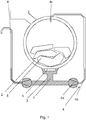
- Fig. 1 shows a partial view of a washing machine in a sketched sectional view. Shown is the tub 3 a washing machine in which a drum 2 is rotatably mounted. In the drum 2 laundry 5 is filled for washing laundry. During a washing program, the drum 2 may be driven by a motor (not shown) to move the laundry 5 in the drum 2.
- the drum 2 is provided in the present embodiment of stainless steel and with a plurality of openings for flooding with washing liquid.
- a radiator 1 is arranged in the lower region of the tub 3, . The radiator 1 can heat in the tub 3 located washing liquid.
- the radiator 1 is installed in the washing machine in such a way that with an appropriate level of washing liquid, the active heating surface of the radiator 1 is directly below the washing liquid surface, so that in this case steam forms on the surface of the washing liquid, which flows through the drum in the laundry.
- an inlet valve (not shown) is arranged in the upper area of the washing machine, which provides the washing machine with water from the supply network.
- the water is passed through a Ein Hugheskasten (not shown) in the tub 3, wherein optionally located in the dispenser detergent is flushed into the tub 3.
- the tub 3 is connected to a drain device 6, which leads spent washing liquid from the tub 3 when activating a drain pump and usually opens into a sewer.
- a flooding device 4 is further arranged to promote washing liquid 7 from the lower region of the tub 3 in the upper region of the tub 3.
- the flooding device 4 has a circulating pump 4a, a circulating line 4b and an outlet 4c.
- the circulating pump 4a is connected on the inlet or suction side to the lower region of the tub 3, the so-called sump, and can, when the circulating device 4 is activated, wash liquid 7 located therein via the circulating line 4b and an outlet 4c such as a nozzle in the upper region promote the tub 3 and the drum 2 and spray on the laundry 5.
- a control device (not shown) of the washing machine controls the inlet valve, the activity of the drainage device 6, the activity of the flooding device 4, the motor and the radiator 1.
- the control device activates the flooding device 4 as a function of the selection temperature. Below a predetermined washing liquid level (not shown), there is the risk that the circulating pump 4 a can no longer completely aspirate washing liquid when the circulating device 4 is activated. In this case, the flooding device 4 is deactivated by means of the control device. Furthermore, the washing machine sensor means, for example, a sensor for detecting the washing liquid level or pressure in the tub 3 have.
- Fig. 2 shows by way of example a timing of a washing program WP as a diagram, which in the in Fig. 1 Washing machine shown is carried out and to which reference is made herein.
- the sequence of the washing program comprises a detection phase ER, a washing phase Wa, a rinsing phase Sp and a spin phase Sc.
- the washing machine user selects a dialing temperature by setting a washing program.
- the washing program starts. At the beginning of the washing program, in the detection phase ER, the type and amount of laundry in the tub or in the drum is detected.
- washing liquid is introduced through the inlet valve via the dispenser, whereby the stored in the dispenser detergent is introduced into the tub, so that the washing liquid is in the tub.
- the scrubbing liquid wets the laundry in the drum while it is being let into the tub while free liquor collects by gravity in the lower region of the tub and covers the arranged in the tub radiator, but is below the drum as a washing liquid.
- the laundry has therefore added washing liquid, but there is no free liquor in the drum.
- the washing phase Wa starts.
- the washing liquid is heated by means of a radiator to the predetermined temperature of the washing program, which may be higher by any K than the selection temperature.
- the radiator When the radiator is turned on, a temperature stratification sets in, which leads to microsolation occurring on the radiator surface after a period of time. Because of the short distance to the surface, the vapor bubbles manage to persist there, and they exit as vapor. Since energy can be transmitted via the natural propagation behavior of the steam in principle into the wet laundry, the laundry is heated to the predetermined by the selection temperature wash temperature. After reaching the predetermined washing temperature or a predetermined time for the heating step, the heating of the washing liquid is stopped and a Nachwasch Colour Na follows. During the Nachwaschöns Na, the laundry is moved by means of a rotating drum. Depending on the selection temperature, the circulating device is activated or not activated.
- the circulating device is activated during the subsequent washing step, if the highest possible process efficiency can be achieved with the washing liquid conveyed from the lower region of the liquor container into the upper region of the liquor container.
- the circulating device is activated in particular if the selection temperature is less than 45 ° C.
- the circulating device is deactivated when a predetermined period of time has elapsed and / or when the washing liquid level in the lower region of the tub has dropped to a level such that the circulating pump can no longer completely draw in washing liquid. If the dialing temperature is more than 45 ° C, the post-washing step Na is carried out without activating the circulating device.
- the washing phase Wa is terminated by pumping out the washing liquid from the tub, wherein the drainage device is activated and the washing liquid is removed from the tub as far as possible. If necessary, the drum is operated at a high speed in order to remove the washing liquid present as a bound liquor from the textile fibers of the laundry as much as possible. Subsequently, fresh washing liquid, which consists essentially of water, is introduced into the tub. Then, a rinsing phase Sp starts, in which the drum moves the laundry in the washing liquid. Optionally, during the rinsing phase Sp, the flooding device can be activated. At the end of the rinsing phase Sp, the rinsing liquid is pumped off and removed via the drainage device.
- a spin phase Sc is performed, which is used to drain the laundry serves.
- the drum is rotated at a speed, so that the laundry is applied to the drum shell and the washing liquid is pulled out of the laundry through the openings of the drum due to the centrifugal force.
- the drain device is activated so that the washing liquid is removed from the tub.
Landscapes
- Engineering & Computer Science (AREA)
- Textile Engineering (AREA)
- Control Of Washing Machine And Dryer (AREA)
Description
- Verfahren zum Betreiben einer Waschmaschine und Waschmaschine
Die Erfindung betrifft ein Verfahren zum Betreiben einer Waschmaschine mit einem Laugenbehälter zur Aufnahme von Waschflüssigkeit zum Behandeln von Wäsche, einer in dem Laugenbehälter drehbar gelagerten Trommel zur Aufnahme der Wäsche, einem Heizkörper und einer Umfluteinrichtung zum Fördern von Waschflüssigkeit aus einem unteren Bereich des Laugenbehälters in einen oberen Bereich, bezogen auf die betriebsgemäße Aufstellposition der Waschmaschine. Das Verfahren weist die Durchführung eines Waschprogramms mit einer vorbestimmten Anwahltemperatur auf. Das Waschprogramm weist einen Heizschritt und einen Nachwaschschritt auf, wobei während des Heizschritts ein Waschflüssigkeitspegel in dem Laugenbehälter ausgebildet ist, sodass der Heizkörper unterhalb des Waschflüssigkeitspegels und die Trommel oberhalb des Waschflüssigkeitspegels liegt, bezogen auf die betriebsgemäße Aufstellposition der Waschmaschine, und Dampf mittels Betreiben des Heizkörpers erzeugt wird. Der Nachwaschschritt wird nach dem Heizschritt durchgeführt. Während des Nachwaschschritts wird die Wäsche in der Trommel bewegt. - Am Ende des Heizschritts befindet sich aufgewärmte Waschflüssigkeit in dem unteren Bereich des Laugenbehälters, die während des Nachwaschens ungenutzt ist, weil sie nicht mit der Wäsche in der Trommel in Berührung kommt. Die Erwärmung von Waschflüssigkeit, die nicht zum Waschen genutzt wird, ist nicht effizient.
- Die
EP 2 348 151 A1 beschreibt ein Verfahren, bei welchem in einem dem Heizschritt nachgelagerten Nachwaschschritt eine Umflutung erst stattfindet, wenn eine gewünschte Temperatur erreicht wurde. - Der Erfindung stellt sich somit das Problem, ein Verfahren zum Betreiben einer Waschmaschine und eine Waschmaschine bereitzustellen, die effizienter sind.
- Erfindungsgemäß wird dieses Problem durch ein Verfahren mit den Merkmalen des Patentanspruchs 1 und eine Waschmaschine mit den Merkmalen des Patentanspruchs 9 gelöst. Vorteilhafte Ausgestaltungen und Weiterbildungen der Erfindung ergeben sich aus den nachfolgenden Unteransprüchen.
- In dem Verfahren wird die Umfluteinrichtung während des Nachwaschschritts in Abhängigkeit von der Anwahltemperatur aktiviert. Die Umfluteinrichtung wird insbesondere dann aktiviert, wenn es effizient ist, die im unteren Bereich des Laugenbehälters erwärmte Waschflüssigkeit in den oberen Bereich des Laugenbehälters zu fördern und dadurch für eine Durchmischung der Waschflüssigkeit mit der Wäsche zu sorgen.
- Die mit der Erfindung erreichbaren Vorteile bestehen neben einer verbesserten Effizienz darin, dass bei Aktivierung der Umfluteinrichtung eine bessere Durchmischung von Waschflüssigkeit und Wäsche erreicht und dadurch die Waschwirkung erhöht werden kann. Wenn es hingegen nicht effizient ist, die Umfluteinrichtung zu aktivieren, wird der Nachwaschschritt ohne Aktivierung der Umfluteinrichtung durchgeführt. Die Aktivierung der Umfluteinrichtung in Abhängigkeit der Anwahltemperatur während des Nachwaschschritts befähigt daher, das Verfahren derart zu führen, dass eine gute Waschwirkungs- und Energiebilanz erzielt werden kann.
- Im Sinne der vorliegenden Erfindung meint der Ausdruck "Anwahltemperatur" die Temperatur, die ein Waschmaschinennutzer mittels Auswählen eines durchzuführenden Waschprogramms einstellt. Waschprogramme sind üblicherweise mit einer Anwahl- und Wäschetemperatur verknüpft, z.B. Pflegeleicht 30°C oder Buntwäsche 60°C. Mittels Auswählen der Anwahltemperatur stellt der Waschmaschinennutzer die Wäschetemperatur ein, bei der er die Wäsche waschen möchte. Der Ausdruck "Wäschetemperatur" bezeichnet die Temperatur, bei der die Wäsche in dem Nachwaschschritt gewaschen wird, d.h. die tatsächlich in der Waschmaschine während des Nachwaschens messbare Temperatur. Die Anwahltemperatur ist in diesem Sinne die Soll-Temperatur während des Nachwaschschritts, während die Wäschetemperatur die Ist-Temperatur während des Nachwaschschritts darstellt. Der Nachwaschschritt wird entsprechend den Vorgaben des eingestellten Waschprogramms ausgeführt, unabhängig davon, ob die Umfluteinrichtung aktiviert wird oder nicht. Während des Nachwaschschritts wird die Wäsche mittels rotierender Trommel über eine vom Waschprogramm vorgegebene Nachwasch-Zeitdauer bewegt.
- Während des Heizschritts bedeckt die Waschflüssigkeit den in dem Laugenbehälter angeordneten Heizkörper, befindet sich aber unterhalb der Trommel. D.h., vor dem Heizschritt ist Waschflüssigkeit in den Laugenbehälter eingelassen worden, wobei sie die sich in der Trommel befindende Wäsche durchfeuchtet hat. Die Wäsche hat Waschflüssigkeit aufgenommen, es befindet sich aber keine freie Flotte in der Trommel. Während des Heizschritts wird die Waschflüssigkeit mittels des Heizkörpers auf die von dem Waschprogramm vorgegebene Wäschetemperatur aufgeheizt. Bei eingeschaltetem Heizkörper stellt sich eine Temperaturschichtung ein, die dazu führt, dass nach einer Zeitdauer ein Mikrosieden an der Heizkörperoberfläche auftritt. Aufgrund der geringen Distanz bis zur Oberfläche gelingt es den Dampfblasen, bis dorthin bestehen zu bleiben, und sie treten als Dampf aus. Da Energie über das natürliche Ausbreitungsverhalten des Dampfes prinzipiell in die feuchte Wäsche übertragen werden kann, wird die Wäsche auf die durch die Anwahltemperatur vorgegebene Wäschetemperatur erwärmt. Nach Erreichen der vorgegebenen Wäschetemperatur oder einer für den Heizschritt vorbestimmten Heiz-Zeitdauer wird das Heizen der Waschflüssigkeit beendet. Nach dem Heizschritt wird der Nachwaschschritt durchgeführt.
- In Abhängigkeit von der Anwahltemperatur wird Waschflüssigkeit aus dem unteren Bereich des Laugenbehälters in den oberen Bereich des Laugenbehälters gefördert. Der untere Bereich des Laugenbehälters ist im Sinne der vorliegenden Erfindung der Sumpf der Waschmaschine. Der Sumpf ist der untere Bereich der Waschmaschine, in dem sich die in den Laugenbehälter eingelassene Waschflüssigkeit aufgrund der Schwerkraft ansammelt und sich unterhalb der Trommel befindet. Der obere Bereich des Laugenbehälters ist im Sinne der vorliegenden Erfindung der Bereich des Laugenbehälters, der sich über dem Sumpf befindet. Mittels der Aktivierung der Umfluteinrichtung wird die sich im Sumpf befindende Waschflüssigkeit in den oberen Bereich des Laugenbehälters gefördert und somit dem Sumpf entzogen.
- Erfindungsgemäß wird die Umfluteinrichtung während des Nachwaschschritts aktiviert, wenn die Anwahltemperatur kleiner oder gleich einer Grenztemperatur ist. Die Relation von der Temperatur der sich im unteren Bereich des Laugenbehälters befindenden Waschflüssigkeit zur Anwahltemperatur spielt insbesondere eine Rolle bei der Entscheidung, ob die Aktivierung der Umfluteinrichtung sinnvoll ist oder nicht. Die Grenztemperatur hängt daher von der theoretisch zu erwartenden oder während des Heizschritts gemessenen Temperatur der sich im unteren Bereich des Laugenbehälters befindenden Waschflüssigkeit ab.
- Die Grenztemperatur ist gleich der Temperatur der sich im unteren Bereich des Laugenbehälters befindenden Waschflüssigkeit oder bevorzugterweise bis zu 5°C höher.
- Die Grenztemperatur wird in einem Temperaturbereich gewählt, welche zwischen der Temperatur der sich im unteren Bereich des Laugenbehälters befindenden Waschflüssigkeit und einer um 5°C höheren Temperatur liegt. Beispielsweise beträgt die Temperatur der sich im unteren Bereich des Laugenbehälters befindenden Waschflüssigkeit etwa 45°C. Bei Waschprogrammen mit einer Anwahltemperatur bis zu 45°C ist es dann effizient, die Umfluteinrichtung zu aktivieren, weil die durch die Umfluteinrichtung geförderte Flüssigkeit einerseits zur Erhöhung der Wäschetemperatur beitragen kann und anderseits für eine bessere Durchmischung von Wäsche und Waschflüssigkeit gesorgt wird. Wenn die Anwahltemperatur gleich der oder bis zu 5°C höher als die Temperatur der sich im unteren Bereich des Laugenbehälters befindenden Waschflüssigkeit ist, also im obigen Beispiel bis 50°C, dann wird zwar wahrscheinlich die Wäschetemperatur nicht erhöht sondern eher geringfügig verringert, aber eine Erhöhung der Waschflüssigkeit in der Wäsche durch Aktivierung der Umfluteinrichtung kann zur Verbesserung der Waschwirkung beitragen.
- Die Grenztemperatur liegt vorzugsweise zwischen 40°C und 60°C, bevorzugter zwischen 45°C und 50°C. Je nach Waschmaschinentyp und beispielsweise den Abmessungen des Heizkörpers und den Abmessungen des unteren Bereichs des Laugenbehälters und der eingestellten Anwahltemperatur kann die Temperatur der sich im unteren Bereich des Laugenbehälters befindenden Waschflüssigkeit am Ende des Heizschritts variieren. Bei einer Haushaltwaschmaschine, bei der sich am Ende des Heizschritts 1,0 bis 2,0 Liter oder durchschnittlich ca. 1,5 Liter Waschflüssigkeit im unteren Bereich des Laugenbehälters befinden, liegt die Temperatur der sich im unteren Bereich des Laugenbehälters befindenden Waschflüssigkeit im Bereich von 35 bis 55 °C, eher im Bereich von 40 bis 45°C.
- In einer bevorzugten Ausführungsform wird die Umfluteinrichtung nach Aktivierung in Abhängigkeit des Waschflüssigkeitspegels und/oder zeitabhängig deaktiviert. Wenn aus dem Sumpf keine Waschflüssigkeit mehr gefördert werden kann, wird die Umfluteinrichtung vorzugsweise deaktiviert, damit sie keinen Schaden nimmt. Hierzu kann das Verfahren eine zeitliche Steuerung der Umfluteinrichtung und/oder eine waschflüssigkeitspegelabhängige Regelung zur Bestimmung des Zeitpunkts der Deaktivierung der Umfluteinrichtung aufweisen. Beispielsweise kann das Verfahren nach Aktivierung der Umfluteinrichtung nach einer vorbestimmten Deaktivierungs-Zeitdauer deaktiviert werden. Alternativ oder zusätzlich zur zeitlichen Steuerung der Deaktivierung der Umfluteinrichtung kann die Umfluteinrichtung auch in Abhängigkeit des Waschflüssigkeitspegels in dem unteren Bereich des Laugenbehälters deaktiviert werden, der beispielsweise mittels Sensormitteln ermittelt werden kann.
- Vorzugsweise wird die Umfluteinrichtung in Abhängigkeit des Waschflüssigkeitspegels deaktiviert, wenn die von der Umfluteinrichtung zu fördernde Waschflüssigkeitsmenge unterhalb eines vorbestimmten Waschflüssigkeitsmengen-Schwellenwerts liegt. Ob die zu fördernde Waschflüssigkeitsmenge unterhalb des vorbestimmten Waschflüssigkeitsmengen-Schwellenwerts liegt, hängt von dem Waschflüssigkeitspegel in dem unteren Bereich des Laugenbehälters ab und kann beispielsweise mittels eines Sensors ermittelt werden. Der vorbestimmte Waschflüssigkeitsmengen-Schwellenwert ist bevorzugt derart gewählt, dass die Umfluteinrichtung während der Förderung aufgrund einer zu geringen zur Verfügung stehenden Waschflüssigkeitsmenge der Waschflüssigkeit keinen Schaden nimmt und/oder ihr Betrieb ineffektiv ist.
- In einer bevorzugten Ausführungsform wird die Umfluteinrichtung nach Deaktivierung erneut aktiviert, wenn der Waschflüssigkeitspegel in dem unteren Bereich des Laugenbehälters oberhalb eines vorbestimmten Waschflüssigkeitspegel-Schwellenwerts liegt. In diesem Fall kann die Umfluteinrichtung intervallmäßig betrieben werden. Ob dies sinnvoll ist, kann beispielsweise mittels Sensoren ermittelt werden, die die Wäschetemperatur und die Waschflüssigkeitstemperatur in dem unteren Bereich des Laugenbehälters messen. Wenn das Verhältnis von Wäschetemperatur und Waschflüssigkeitstemperatur in dem unteren Bereich des Laugenbehälters ergibt, dass eine Aktivierung der Umfluteinrichtung zur Effizienz des Verfahrens beiträgt, wird die Umfluteinrichtung aktiviert, andernfalls nicht.
- Vorzugsweise ist das Verfahren derart ausgestaltet, dass im Falle einer Aktivierung der Umfluteinrichtung die Umfluteinrichtung zu Beginn des Nachwaschschritts, d.h. nach dem Ende des Heizschritts, aktiviert wird. Dadurch kann die zusätzliche Waschwirkung während des Nachwaschschritts optimal ausgenutzt werden. Die Umfluteinrichtung wird während des Nachwaschschritts deaktiviert, wenn der Umfluteinrichtung nicht mehr genügend zu fördernde Waschflüssigkeit zur Verfügung steht und/oder wenn eine vorbestimmte Aktivierungs-Zeitdauer abgelaufen ist. Bevorzugt wird die Umfluteinrichtung während des Nachwaschschritts im Falle einer Aktivierung einmal aktiviert und deaktiviert und der Nachwaschschritt wird nach des einmaligen Betriebs der Umfluteinrichtung fortgeführt. Eine einmalige Aktivierung der Umfluteinrichtung ist im Falle einer zur Aktivierung der Umfluteinrichtung geeigneten Anwahltemperatur ausreichend, um auf eine einfache Weise eine verbesserte Effizienz des Waschverfahrens zu erreichen.
- Im Falle einer mehrfachen Aktivierung und Deaktivierung der Umfluteinrichtung kann zwar eine verbesserte Durchmischung von Wäsche und Waschflüssigkeit erreicht werden, dem steht allerdings ein erhöhter verfahrenstechnischer und bautechnischer Aufwand entgegen. Die Vorteile und Nachteile einer einmaligen Aktivierung und Deaktivierung der Umfluteinrichtung sind daher gegenüber einer mehrmaligen Aktivierung und Deaktivierung der Umfluteinrichtung insbesondere in Abhängigkeit des vom Waschmaschinennutzer gewählten Waschprogramms abzuwägen.
- In einer bevorzugten Ausführungsform wird eine zum Betreiben des Heizkörpers während des Heizschritts aufzuwendende Energiemenge derart eingestellt, dass die Wäschetemperatur der Anwahltemperatur entspricht. Mit Auswählen der Anwahltemperatur stellt der Waschmaschinennutzer die Soll-Temperatur zum Waschen der Wäsche in dem Nachwaschschritt ein. Die Wäschetemperatur, d.h. die Ist-Temperatur während des Nachwaschschritts, hängt im Wesentlichen von 3 Eingangsgrößen ab: 1. der Anwahltemperatur, 2. der Waschflüssigkeitsmenge und 3. der Mischtemperatur von Waschflüssigkeit und Wäsche. Die Mischung von Waschflüssigkeit und Wäsche entsteht dadurch, dass die Wäsche die vor dem Heizschritt eingefüllte Waschflüssigkeit aufnimmt. Da die eingefüllte Waschflüssigkeitsmenge jedoch derart eingestellt wird, dass keine freie Flotte in der Trommel vorhanden ist, befindet sich die aufzuheizende Waschflüssigkeitsmenge im unteren Bereich des Laugenbehälters, sodass sie den Heizkörper bedeckt, sich aber unterhalb der Trommel befindet. Mittels Auswählen der Anwahltemperatur wird die zu erreichende Wäschetemperatur vorgegeben. In Abhängigkeit von der vor dem Heizschritt eingefüllten Waschflüssigkeitsmenge und der Mischtemperatur von Wäsche und Waschflüssigkeit wird nun die während des Heizschritts benötigte Energiemenge derart eingestellt, dass die Wäschetemperatur der Anwahltemperatur entspricht.
- Die Erfindung betrifft weiterhin eine Waschmaschine mit einem Laugenbehälter zur Aufnahme von Waschflüssigkeit, einer im Laugenbehälter drehbar gelagerten Trommel zur Aufnahme von zu behandelnder Wäsche, einem Heizkörper, einer Umfluteinrichtung und einer Regeleinrichtung zum Steuern eines Waschprogramms. Die Regeleinrichtung ist dazu eingerichtet, die Waschmaschine während der Durchführung des vorstehend beschriebenen Verfahrens zu betreiben. Um ein energieeffizientes Verfahren bereitzustellen, ist die Regeleinrichtung insbesondere dafür eingerichtet, die für das ausgewählte Waschprogramm benötigte Waschflüssigkeitsmenge derart einzustellen, dass keine freie Flotte in der Trommel vorhanden ist, dass der Heizkörper während des Heizschritts Dampf erzeugt, und dass die Umfluteinrichtung in Abhängigkeit der Anwahltemperatur aktiviert wird. Vorzugweise ist die Regeleinrichtung dafür eingerichtet, die Umfluteinrichtung im Falle einer Aktivierung zeitabhängig und/oder waschflüssigkeitspegelabhängig zu deaktivieren. Weiterhin kann die Regeleinrichtung vorzugsweise die zum Betreiben des Heizkörpers aufzuwendende Energiemenge ermitteln und einregeln.
- Ausführungsbeispiele der Erfindung sind in den Zeichnungen rein schematisch dargestellt und werden nachfolgend näher beschrieben. Es zeigt
- Fig. 1
- eine Waschmaschine in einer skizzierten Schnittdarstellung; und
- Fig. 2
- ein Waschprogramm als Diagramm im zeitlichen Ablauf.
-
Fig. 1 zeigt eine Teildarstellung einer Waschmaschine in einer skizzierten Schnittdarstellung. Gezeigt ist der Laugenbehälter 3 einer Waschmaschine, in dem eine Trommel 2 drehbar gelagert ist. In die Trommel 2 wird zum Wäschewaschen Wäsche 5 eingefüllt. Während eines Waschprogramms kann die Trommel 2 über einen Motor (nicht gezeigt) angetrieben werden, damit die Wäsche 5 in der Trommel 2 bewegt wird. Die Trommel 2 ist im vorliegenden Ausführungsbeispiel aus Edelstahl und mit einer Vielzahl von Öffnungen zur Durchflutung mit Waschflüssigkeit versehen. Im unteren Bereich des Laugenbehälters 3 ist ein Heizkörper 1 angeordnet. Der Heizkörper 1 kann sich im Laugenbehälter 3 befindliche Waschflüssigkeit erhitzen. Der Heizkörper 1 ist in die Waschmaschine derart eingebaut, dass bei entsprechendem Waschflüssigkeitsstand die aktive Heizfläche des Heizkörpers 1 direkt unterhalb der Waschflüssigkeitsoberfläche liegt, sodass sich in diesem Fall Dampf auf der Waschflüssigkeitsoberfläche bildet, welcher durch die Trommel in die Wäsche strömt. Zudem ist im oberen Bereich der Waschmaschine ein Einlassventil (nicht gezeigt) angeordnet, das der Waschmaschine Wasser aus dem Versorgungsnetz bereitstellt. Das Wasser wird über einen Einspülkasten (nicht gezeigt) in den Laugenbehälter 3 geleitet, wobei ggf. in dem Einspülkasten befindliches Waschmittel mit in den Laugenbehälter 3 gespült wird. Der Laugenbehälter 3 ist mit einer Ablaufeinrichtung 6 verbunden, die verbrauchte Waschflüssigkeit aus dem Laugenbehälter 3 bei Aktivierung einer Ablaufpumpe herausführt und in der Regel in einen Abwasserkanal mündet. Im unteren Bereich des Laugenbehälters 3 ist weiterhin eine Umfluteinrichtung 4 angeordnet, um Waschflüssigkeit 7 aus dem unteren Bereich des Laugenbehälters 3 in den oberen Bereich des Laugenbehälters 3 zu fördern. Die Umfluteinrichtung 4 weist eine Umflutpumpe 4a, eine Umflutleitung 4b und einen Auslass 4c auf. Die Umflutpumpe 4a ist auf der Eingangs- bzw. Saugseite mit dem unteren Bereich des Laugenbehälters 3, dem sogenannten Sumpf, verbunden und kann bei Aktivierung der Umfluteinrichtung 4 darin befindliche Waschflüssigkeit 7 über die Umflutleitung 4b und einen Auslass 4c wie eine Düse in den oberen Bereich des Laugenbehälters 3 bzw. der Trommel 2 fördern und auf die Wäsche 5 spritzen. Eine Regeleinrichtung (nicht gezeigt) der Waschmaschine steuert das Einlassventil, die Aktivität der Ablaufeinrichtung 6, die Aktivität der Umfluteinrichtung 4, den Motor und den Heizkörper 1. Die Regeleinrichtung aktiviert die Umfluteinrichtung 4 in Abhängigkeit der Anwahltemperatur. Unterhalb eines vorbestimmten Waschflüssigkeitspegels (nicht gezeigt) besteht die Gefahr, dass die Umflutpumpe 4a bei aktivierter Umfluteinrichtung 4 nicht mehr vollständig Waschflüssigkeit ansaugen kann. In diesem Fall wird die Umfluteinrichtung 4 mittels der Regeleinrichtung deaktiviert. Weiterhin kann die Waschmaschine Sensormittel beispielsweise einen Sensor zum Detektieren des Waschflüssigkeitspegels oder Drucks in dem Laugenbehälter 3 aufweisen. -
Fig. 2 zeigt beispielhaft einen zeitlichen Ablauf eines Waschprogramms WP als Diagramm, das in der inFig. 1 gezeigten Waschmaschine durchgeführt wird und auf die hierin Bezug genommen wird. In der nachstehenden Beschreibung der Figur erwähnte Bauteile beziehen sich auf die in derFig. 1 beschriebenen Bauteile. Auf der Zeitachse t sind einzelne Phasen des Waschprogramms WP dargestellt. Der Ablauf des Waschprogramms umfasst eine Erfassungsphase ER, eine Waschphase Wa, eine Spülphase Sp und eine Schleuderphase Sc. Der Waschmaschinennutzer wählt mittels Einstellen eines Waschprogramms eine Anwahltemperatur aus. Das Waschprogramm startet. Zu Beginn des Waschprogramms wird in der Erfassungsphase ER die Art und Menge der Wäsche in dem Laugenbehälter bzw. in der Trommel erfasst. Anschließend wird Wasser durch das Einlassventil über den Einspülkasten eingelassen, wodurch das in dem Einspülkasten bevorratete Waschmittel in den Laugenbehälter eingelassen wird, sodass sich die Waschflüssigkeit in dem Laugenbehälter befindet. Die Waschflüssigkeit durchfeuchtet während des Eingelassenwerdens in den Laugenbehälter die sich in der Trommel befindende Wäsche, während sich freie Flotte aufgrund der Schwerkraft in dem unteren Bereich des Laugenbehälters sammelt und den in dem Laugenbehälter angeordneten Heizkörper bedeckt, sich aber unterhalb der Trommel als Waschflüssigkeit befindet. Die Wäsche hat daher Waschflüssigkeit aufgenommen, es befindet sich aber keine freie Flotte in der Trommel. Dann startet die Waschphase Wa. Während eines Heizschritts Hz der Waschphase Wa wird die Waschflüssigkeit mittels eines Heizkörpers auf die von dem Waschprogramm vorgegebene Temperatur aufgeheizt, welche um beliebige K höher sein kann als die Anwahltemperatur. Bei eingeschaltetem Heizkörper stellt sich eine Temperaturschichtung ein, die dazu führt, dass nach einer Zeitdauer ein Mikrosieden an der Heizkörperoberfläche auftritt. Aufgrund der geringen Distanz bis zur Oberfläche gelingt es den Dampfblasen, bis dorthin bestehen zu bleiben, und sie treten als Dampf aus. Da Energie über das natürliche Ausbreitungsverhalten des Dampfes prinzipiell in die feuchte Wäsche übertragen werden kann, wird die Wäsche auf die durch die Anwahltemperatur vorgegebene Wäschetemperatur erwärmt. Nach Erreichen der vorgegebenen Wäschetemperatur oder einer für den Heizschritt vorbestimmten Zeitdauer wird das Heizen der Waschflüssigkeit beendet und ein Nachwaschschritt Na folgt. Während des Nachwaschschritts Na wird die Wäsche mittels rotierender Trommel bewegt. In Abhängigkeit von der Anwahltemperatur wird die Umfluteinrichtung aktiviert oder nicht aktiviert. Insbesondere wird die Umfluteinrichtung während des Nachwaschschritts aktiviert, wenn mit der aus dem unteren Bereich des Laugenbehälters in den oberen Bereich des Laugenbehälters geförderten Waschflüssigkeit eine möglichst hohe Verfahrenseffizienz erreicht werden kann. Die Umfluteinrichtung wird insbesondere aktiviert, wenn die Anwahltemperatur weniger als 45°C beträgt. Im Falle der Aktivierung wird die Umfluteinrichtung deaktiviert, wenn eine vorbestimmte Zeitdauer abgelaufen ist und/oder wenn der Waschflüssigkeitspegel in dem unteren Bereich des Laugenbehälters auf ein Niveau gefallen ist, sodass die Umflutpumpe nicht mehr vollständig Waschflüssigkeit ansaugen kann. Wenn die Anwahltemperatur mehr als 45°C beträgt, wird der Nachwaschschritt Na durchgeführt, ohne die Umfluteinrichtung zu aktivieren. Die Waschphase Wa wird mit Abpumpen der Waschflüssigkeit aus dem Laugenbehälter beendet, wobei die Ablaufeinrichtung aktiviert wird und die Waschflüssigkeit aus dem Laugenbehälter soweit wie möglich entfernt wird. Wenn nötig, wird die Trommel bei einer hohen Drehzahl betrieben, um die als gebundene Flotte vorliegende Waschflüssigkeit soweit möglich aus den Textilfasern der Wäsche zu entfernen. Anschließend wird frische Waschflüssigkeit, die im Wesentlichen aus Wasser besteht, in den Laugenbehälter eingelassen. Dann startet eine Spülphase Sp, in der die Trommel die Wäsche in der Waschflüssigkeit bewegt wird. Optional kann während der Spülphase Sp die Umfluteinrichtung aktiviert werden. Zum Ende der Spülphase Sp wird die Spülflüssigkeit abgepumpt und über die Ablaufeinrichtung entfernt. Anschließend wird eine Schleuderphase Sc durchgeführt, die zum Entwässern der Wäsche dient. Dabei wird die Trommel bei einer Drehzahl gedreht, sodass die Wäsche am Trommelmantel anliegt und die Waschflüssigkeit aufgrund der Zentrifugalkraft aus der Wäsche durch die Öffnungen der Trommel gezogen wird. Die Ablaufeinrichtung ist dabei aktiviert, sodass die Waschflüssigkeit aus dem Laugenbehälter entfernt wird. -
- ER
- Erfassungsphase
- Hz
- Heizschritt
- Na
- Nachwaschschritt
- Sc
- Schleuderphase
- Sp
- Spülphase
- Wa
- Waschphase
- 1
- Heizkörper
- 2
- Trommel
- 3
- Laugenbehälter
- 4
- Umfluteinrichtung
- 4a
- Umflutpumpe
- 4b
- Umflutleitung
- 4c
- Auslass
- 5
- Wäsche
- 6
- Ablaufeinrichtung
- 7
- Waschflüssigkeit
Claims (8)
- Verfahren zum Betreiben einer Waschmaschine mit einem Laugenbehälter (3) zur Aufnahme von Waschflüssigkeit zum Behandeln von Wäsche (5), einer in dem Laugenbehälter (3) drehbar gelagerten Trommel (2) zur Aufnahme der Wäsche (5), einem Heizkörper (1) und einer Umfluteinrichtung (4) zum Fördern von Waschflüssigkeit aus einem unteren Bereich des Laugenbehälters (3) in einen oberen Bereich, bezogen auf die betriebsgemäße Aufstellposition der Waschmaschine, wobei das Verfahren die Durchführung eines Waschprogramms aufweist, das einen Heizschritt und einen nach Vollendung des Heizschritts durchgeführten Nachwaschschritt aufweist, wobei während des Heizschritts ein Waschflüssigkeitspegel in dem Laugenbehälter (3) ausgebildet ist, sodass der Heizkörper (1) unterhalb des Waschflüssigkeitspegels und die Trommel (2) oberhalb des Waschflüssigkeitspegels liegt, bezogen auf die betriebsgemäße Aufstellposition der Waschmaschine, und Dampf mittels Betreiben des Heizkörpers (1) erzeugt wird,
dadurch gekennzeichnet, dass die Umfluteinrichtung (4) während des Nachwaschschritts aktiviert wird, wenn die Anwahltemperatur des Waschprogramms kleiner oder gleich einer Grenztemperatur ist, die gleich der Temperatur der sich im unteren Bereich des Laugenbehälters befindenden Waschflüssigkeit oder bis zu 5°C höher ist. - Verfahren nach einem der vorangehenden Ansprüche, dadurch gekennzeichnet, dass die Grenztemperatur zwischen 40°C und 60°C, bevorzugt zwischen 45°C und 50°C, liegt.
- Verfahren nach einem der vorangehenden Ansprüche, dadurch gekennzeichnet, dass die Umfluteinrichtung (4) nach Aktivierung in Abhängigkeit des Waschflüssigkeitspegels und/oder zeitabhängig deaktiviert wird.
- Verfahren nach Anspruch 3, dadurch gekennzeichnet, dass die Umfluteinrichtung (4) in Abhängigkeit des Waschflüssigkeitspegels deaktiviert wird, wenn die von der Umfluteinrichtung zu fördernde Waschflüssigkeitsmenge unterhalb eines vorbestimmten Waschflüssigkeitsmengen-Schwellenwert liegt.
- Verfahren nach Anspruch 3 oder 4, dadurch gekennzeichnet, dass die Umfluteinrichtung (4) nach Deaktivierung erneut aktiviert wird, wenn der Waschflüssigkeitspegel in dem unteren Bereich des Laugenbehälters (3) oberhalb eines vorbestimmten Waschflüssigkeitspegel-Schwellenwerts liegt und/oder wenn eine vorbestimmte Zeitdauer abgelaufen ist.
- Verfahren nach einem der vorangehenden Ansprüche, dadurch gekennzeichnet, dass im Falle einer Aktivierung der Umfluteinrichtung (4) die Umfluteinrichtung (4) zu Beginn des Nachwaschschritts aktiviert wird.
- Verfahren nach einem der vorangehenden Ansprüche, dadurch gekennzeichnet, dass eine die zum Betreiben des Heizkörpers (1) aufzuwendende Energiemenge während des Heizschritts derart eingestellt wird, dass die Wäschetemperatur der Anwahltemperatur entspricht.
- Waschmaschine mit einem Laugenbehälter (3) zur Aufnahme von Waschflüssigkeit, einer im Laugenbehälter (3) drehbar gelagerten Trommel (2) zur Aufnahme von zu behandelnder Wäsche (5), einem Heizkörper (1), einer Umfluteinrichtung (4) und einer Regeleinrichtung zum Steuern und/oder Regeln eines Waschprogramms, dadurch gekennzeichnet, dass die Regeleinrichtung dazu eingerichtet ist, die Waschmaschine während der Durchführung der Heiz- und Nachwaschschritte gemäß einem Verfahren nach einem der Ansprüche 1 bis 8 zu betreiben.
Applications Claiming Priority (1)
| Application Number | Priority Date | Filing Date | Title |
|---|---|---|---|
| DE102014105026.6A DE102014105026A1 (de) | 2014-04-09 | 2014-04-09 | Verfahren zum Betreiben einer Waschmaschine und Waschmaschine |
Publications (2)
| Publication Number | Publication Date |
|---|---|
| EP2930261A1 EP2930261A1 (de) | 2015-10-14 |
| EP2930261B1 true EP2930261B1 (de) | 2019-08-07 |
Family
ID=53180505
Family Applications (1)
| Application Number | Title | Priority Date | Filing Date |
|---|---|---|---|
| EP15161681.0A Active EP2930261B1 (de) | 2014-04-09 | 2015-03-30 | Verfahren zum betreiben einer waschmaschine und waschmaschine |
Country Status (2)
| Country | Link |
|---|---|
| EP (1) | EP2930261B1 (de) |
| DE (1) | DE102014105026A1 (de) |
Families Citing this family (4)
| Publication number | Priority date | Publication date | Assignee | Title |
|---|---|---|---|---|
| EP3649284B1 (de) * | 2017-07-04 | 2021-12-08 | Electrolux Appliances Aktiebolag | Verfahren zur steuerung des betriebs einer waschmaschine |
| DE102017219042A1 (de) * | 2017-10-25 | 2019-04-25 | BSH Hausgeräte GmbH | Wäschepflegegerät mit einer Steuerung |
| DE102018200147A1 (de) | 2018-01-08 | 2019-07-11 | BSH Hausgeräte GmbH | Verfahren zur Behandlung von Wäsche in einer Waschmaschine mit Umpumpsystem sowie Waschmaschine hierfür |
| DE102018122468A1 (de) * | 2018-09-14 | 2020-03-19 | Miele & Cie. Kg | Verfahren und Vorrichtung zum thermischen Aktivieren einer Reinigungslösung vor einem Waschgang für ein Reinigungsgerät |
Family Cites Families (5)
| Publication number | Priority date | Publication date | Assignee | Title |
|---|---|---|---|---|
| DE19908804C5 (de) * | 1999-03-01 | 2014-05-15 | BSH Bosch und Siemens Hausgeräte GmbH | Verfahren zum Betrieb einer Waschmaschine und automatisch gesteuerte Waschmaschine hierfür |
| EP1885935B1 (de) * | 2005-05-31 | 2019-09-04 | LG Electronics Inc. | Steuerverfahren für eine waschmaschine |
| DE102008046465A1 (de) * | 2008-09-09 | 2010-03-11 | Miele & Cie. Kg | Verfahren zum Betreiben einer Waschmaschine und Waschmaschine |
| EP2348151B1 (de) * | 2010-01-25 | 2017-07-05 | Miele & Cie. KG | Verfahren zum Betreiben einer Waschmaschine mit Umfluteinrichtung |
| ES2387648T5 (es) * | 2010-04-26 | 2021-04-09 | Miele & Cie | Procedimiento de funcionamiento de una máquina lavadora |
-
2014
- 2014-04-09 DE DE102014105026.6A patent/DE102014105026A1/de not_active Withdrawn
-
2015
- 2015-03-30 EP EP15161681.0A patent/EP2930261B1/de active Active
Non-Patent Citations (1)
| Title |
|---|
| None * |
Also Published As
| Publication number | Publication date |
|---|---|
| DE102014105026A1 (de) | 2015-10-15 |
| EP2930261A1 (de) | 2015-10-14 |
Similar Documents
| Publication | Publication Date | Title |
|---|---|---|
| EP3004448B1 (de) | Verfahren zum betrieb einer waschmaschine mit einer verbesserten restfeuchte der wäsche sowie hierzu geeignete waschmaschine | |
| EP2930262B1 (de) | Wasserzulaufsteuerung | |
| EP2246469B1 (de) | Verfahren zum Betrieb einer Waschmaschine und Waschmaschine mit Zirkulationspumpe und Schleuderphase | |
| EP2348151B1 (de) | Verfahren zum Betreiben einer Waschmaschine mit Umfluteinrichtung | |
| EP2161365B1 (de) | Verfahren zum Betreiben einer Waschmaschine und Waschmaschine | |
| DE102008055643A1 (de) | Verfahren zum Betreiben einer Waschmaschine und Waschmaschine | |
| EP3481987B1 (de) | Wäschepflegegerät mit einer steuerung und verfahren dafür | |
| DE102013104075A1 (de) | Verfahren zum Betreiben einer Waschmaschine und Waschmaschine | |
| EP3770314A1 (de) | Verfahren zum betreiben einer waschmaschine und waschmaschine | |
| EP3332059B1 (de) | Wäschepflegegerät mit einem zirkulationssystem | |
| EP3077580B1 (de) | Verfahren zur behandlung von wäsche mit verbesserter benetzungsphase und hierzu geeignete waschmaschine | |
| EP3739100B1 (de) | Wäschepflegegerät mit einer steuerung der waschflüssigkeitszuführeinrichtung und entsprechendes verfahren zum pflege von wäsche | |
| EP3170934B1 (de) | Wasserzulaufsteuerung | |
| EP2930261A1 (de) | Verfahren zum Betreiben einer Waschmaschine und Waschmaschine | |
| DE112017000598B4 (de) | Trommelwaschmaschine und verfahren zum reinigen einer wanne derselben | |
| EP1846607B1 (de) | Verfahren zum reinigen und imprägnieren von textilien | |
| DE102012109840A1 (de) | Verfahren zum Betreiben einer Waschmaschine | |
| DE102013106091B4 (de) | Waschverfahren und Waschmaschine | |
| WO2006066986A1 (de) | Verfahren zum imprägnieren von textilien | |
| EP2426246A1 (de) | Verfahren zum Betreiben einer Waschmaschine mit Umfluteinrichtung und Waschmaschine | |
| DE102010028141B4 (de) | Verfahren zur Behandlung von Wäsche in einer Trommelwaschmaschine unter verbesserten Schöpfbedingungen | |
| DE102014104088A1 (de) | Waschvollautomat und Wasserzulaufregelung desselben | |
| DE102013106097B4 (de) | Verfahren zum Betreiben einer Waschmaschine und Waschmaschine | |
| EP2256240B1 (de) | Verfahren zum Waschen von Wäsche in einer Waschmaschine und Waschmaschine | |
| DE102017103183A1 (de) | Verfahren zum Betreiben eines Waschautomaten und Waschautomat |
Legal Events
| Date | Code | Title | Description |
|---|---|---|---|
| PUAI | Public reference made under article 153(3) epc to a published international application that has entered the european phase |
Free format text: ORIGINAL CODE: 0009012 |
|
| AK | Designated contracting states |
Kind code of ref document: A1 Designated state(s): AL AT BE BG CH CY CZ DE DK EE ES FI FR GB GR HR HU IE IS IT LI LT LU LV MC MK MT NL NO PL PT RO RS SE SI SK SM TR |
|
| AX | Request for extension of the european patent |
Extension state: BA ME |
|
| 17P | Request for examination filed |
Effective date: 20160414 |
|
| RBV | Designated contracting states (corrected) |
Designated state(s): AL AT BE BG CH CY CZ DE DK EE ES FI FR GB GR HR HU IE IS IT LI LT LU LV MC MK MT NL NO PL PT RO RS SE SI SK SM TR |
|
| STAA | Information on the status of an ep patent application or granted ep patent |
Free format text: STATUS: EXAMINATION IS IN PROGRESS |
|
| 17Q | First examination report despatched |
Effective date: 20170302 |
|
| GRAP | Despatch of communication of intention to grant a patent |
Free format text: ORIGINAL CODE: EPIDOSNIGR1 |
|
| STAA | Information on the status of an ep patent application or granted ep patent |
Free format text: STATUS: GRANT OF PATENT IS INTENDED |
|
| RIC1 | Information provided on ipc code assigned before grant |
Ipc: D06F 35/00 20060101ALN20180108BHEP Ipc: D06F 33/02 20060101AFI20180108BHEP |
|
| RIC1 | Information provided on ipc code assigned before grant |
Ipc: D06F 33/02 20060101AFI20180118BHEP Ipc: D06F 35/00 20060101ALN20180118BHEP |
|
| INTG | Intention to grant announced |
Effective date: 20180201 |
|
| GRAJ | Information related to disapproval of communication of intention to grant by the applicant or resumption of examination proceedings by the epo deleted |
Free format text: ORIGINAL CODE: EPIDOSDIGR1 |
|
| STAA | Information on the status of an ep patent application or granted ep patent |
Free format text: STATUS: EXAMINATION IS IN PROGRESS |
|
| INTC | Intention to grant announced (deleted) | ||
| GRAP | Despatch of communication of intention to grant a patent |
Free format text: ORIGINAL CODE: EPIDOSNIGR1 |
|
| STAA | Information on the status of an ep patent application or granted ep patent |
Free format text: STATUS: GRANT OF PATENT IS INTENDED |
|
| RIC1 | Information provided on ipc code assigned before grant |
Ipc: D06F 35/00 20060101ALN20190301BHEP Ipc: D06F 33/02 20060101AFI20190301BHEP |
|
| INTG | Intention to grant announced |
Effective date: 20190404 |
|
| GRAS | Grant fee paid |
Free format text: ORIGINAL CODE: EPIDOSNIGR3 |
|
| GRAA | (expected) grant |
Free format text: ORIGINAL CODE: 0009210 |
|
| STAA | Information on the status of an ep patent application or granted ep patent |
Free format text: STATUS: THE PATENT HAS BEEN GRANTED |
|
| REG | Reference to a national code |
Ref country code: DE Ref legal event code: R084 Ref document number: 502015009857 Country of ref document: DE |
|
| AK | Designated contracting states |
Kind code of ref document: B1 Designated state(s): AL AT BE BG CH CY CZ DE DK EE ES FI FR GB GR HR HU IE IS IT LI LT LU LV MC MK MT NL NO PL PT RO RS SE SI SK SM TR |
|
| REG | Reference to a national code |
Ref country code: GB Ref legal event code: FG4D Free format text: NOT ENGLISH |
|
| REG | Reference to a national code |
Ref country code: CH Ref legal event code: EP Ref country code: AT Ref legal event code: REF Ref document number: 1164041 Country of ref document: AT Kind code of ref document: T Effective date: 20190815 |
|
| REG | Reference to a national code |
Ref country code: DE Ref legal event code: R096 Ref document number: 502015009857 Country of ref document: DE |
|
| REG | Reference to a national code |
Ref country code: IE Ref legal event code: FG4D Free format text: LANGUAGE OF EP DOCUMENT: GERMAN |
|
| REG | Reference to a national code |
Ref country code: DE Ref legal event code: R079 Ref document number: 502015009857 Country of ref document: DE Free format text: PREVIOUS MAIN CLASS: D06F0033020000 Ipc: D06F0033300000 |
|
| REG | Reference to a national code |
Ref country code: GB Ref legal event code: 746 Effective date: 20191114 Ref country code: NL Ref legal event code: MP Effective date: 20190807 |
|
| REG | Reference to a national code |
Ref country code: LT Ref legal event code: MG4D |
|
| PG25 | Lapsed in a contracting state [announced via postgrant information from national office to epo] |
Ref country code: FI Free format text: LAPSE BECAUSE OF FAILURE TO SUBMIT A TRANSLATION OF THE DESCRIPTION OR TO PAY THE FEE WITHIN THE PRESCRIBED TIME-LIMIT Effective date: 20190807 Ref country code: LT Free format text: LAPSE BECAUSE OF FAILURE TO SUBMIT A TRANSLATION OF THE DESCRIPTION OR TO PAY THE FEE WITHIN THE PRESCRIBED TIME-LIMIT Effective date: 20190807 Ref country code: BG Free format text: LAPSE BECAUSE OF FAILURE TO SUBMIT A TRANSLATION OF THE DESCRIPTION OR TO PAY THE FEE WITHIN THE PRESCRIBED TIME-LIMIT Effective date: 20191107 Ref country code: SE Free format text: LAPSE BECAUSE OF FAILURE TO SUBMIT A TRANSLATION OF THE DESCRIPTION OR TO PAY THE FEE WITHIN THE PRESCRIBED TIME-LIMIT Effective date: 20190807 Ref country code: NO Free format text: LAPSE BECAUSE OF FAILURE TO SUBMIT A TRANSLATION OF THE DESCRIPTION OR TO PAY THE FEE WITHIN THE PRESCRIBED TIME-LIMIT Effective date: 20191107 Ref country code: NL Free format text: LAPSE BECAUSE OF FAILURE TO SUBMIT A TRANSLATION OF THE DESCRIPTION OR TO PAY THE FEE WITHIN THE PRESCRIBED TIME-LIMIT Effective date: 20190807 Ref country code: HR Free format text: LAPSE BECAUSE OF FAILURE TO SUBMIT A TRANSLATION OF THE DESCRIPTION OR TO PAY THE FEE WITHIN THE PRESCRIBED TIME-LIMIT Effective date: 20190807 Ref country code: PT Free format text: LAPSE BECAUSE OF FAILURE TO SUBMIT A TRANSLATION OF THE DESCRIPTION OR TO PAY THE FEE WITHIN THE PRESCRIBED TIME-LIMIT Effective date: 20191209 |
|
| PG25 | Lapsed in a contracting state [announced via postgrant information from national office to epo] |
Ref country code: RS Free format text: LAPSE BECAUSE OF FAILURE TO SUBMIT A TRANSLATION OF THE DESCRIPTION OR TO PAY THE FEE WITHIN THE PRESCRIBED TIME-LIMIT Effective date: 20190807 Ref country code: IS Free format text: LAPSE BECAUSE OF FAILURE TO SUBMIT A TRANSLATION OF THE DESCRIPTION OR TO PAY THE FEE WITHIN THE PRESCRIBED TIME-LIMIT Effective date: 20191207 Ref country code: GR Free format text: LAPSE BECAUSE OF FAILURE TO SUBMIT A TRANSLATION OF THE DESCRIPTION OR TO PAY THE FEE WITHIN THE PRESCRIBED TIME-LIMIT Effective date: 20191108 Ref country code: ES Free format text: LAPSE BECAUSE OF FAILURE TO SUBMIT A TRANSLATION OF THE DESCRIPTION OR TO PAY THE FEE WITHIN THE PRESCRIBED TIME-LIMIT Effective date: 20190807 Ref country code: LV Free format text: LAPSE BECAUSE OF FAILURE TO SUBMIT A TRANSLATION OF THE DESCRIPTION OR TO PAY THE FEE WITHIN THE PRESCRIBED TIME-LIMIT Effective date: 20190807 Ref country code: AL Free format text: LAPSE BECAUSE OF FAILURE TO SUBMIT A TRANSLATION OF THE DESCRIPTION OR TO PAY THE FEE WITHIN THE PRESCRIBED TIME-LIMIT Effective date: 20190807 |
|
| PG25 | Lapsed in a contracting state [announced via postgrant information from national office to epo] |
Ref country code: EE Free format text: LAPSE BECAUSE OF FAILURE TO SUBMIT A TRANSLATION OF THE DESCRIPTION OR TO PAY THE FEE WITHIN THE PRESCRIBED TIME-LIMIT Effective date: 20190807 Ref country code: PL Free format text: LAPSE BECAUSE OF FAILURE TO SUBMIT A TRANSLATION OF THE DESCRIPTION OR TO PAY THE FEE WITHIN THE PRESCRIBED TIME-LIMIT Effective date: 20190807 Ref country code: DK Free format text: LAPSE BECAUSE OF FAILURE TO SUBMIT A TRANSLATION OF THE DESCRIPTION OR TO PAY THE FEE WITHIN THE PRESCRIBED TIME-LIMIT Effective date: 20190807 Ref country code: RO Free format text: LAPSE BECAUSE OF FAILURE TO SUBMIT A TRANSLATION OF THE DESCRIPTION OR TO PAY THE FEE WITHIN THE PRESCRIBED TIME-LIMIT Effective date: 20190807 |
|
| PG25 | Lapsed in a contracting state [announced via postgrant information from national office to epo] |
Ref country code: CZ Free format text: LAPSE BECAUSE OF FAILURE TO SUBMIT A TRANSLATION OF THE DESCRIPTION OR TO PAY THE FEE WITHIN THE PRESCRIBED TIME-LIMIT Effective date: 20190807 Ref country code: SK Free format text: LAPSE BECAUSE OF FAILURE TO SUBMIT A TRANSLATION OF THE DESCRIPTION OR TO PAY THE FEE WITHIN THE PRESCRIBED TIME-LIMIT Effective date: 20190807 Ref country code: IS Free format text: LAPSE BECAUSE OF FAILURE TO SUBMIT A TRANSLATION OF THE DESCRIPTION OR TO PAY THE FEE WITHIN THE PRESCRIBED TIME-LIMIT Effective date: 20200224 Ref country code: SM Free format text: LAPSE BECAUSE OF FAILURE TO SUBMIT A TRANSLATION OF THE DESCRIPTION OR TO PAY THE FEE WITHIN THE PRESCRIBED TIME-LIMIT Effective date: 20190807 |
|
| REG | Reference to a national code |
Ref country code: DE Ref legal event code: R097 Ref document number: 502015009857 Country of ref document: DE |
|
| PLBE | No opposition filed within time limit |
Free format text: ORIGINAL CODE: 0009261 |
|
| STAA | Information on the status of an ep patent application or granted ep patent |
Free format text: STATUS: NO OPPOSITION FILED WITHIN TIME LIMIT |
|
| PG2D | Information on lapse in contracting state deleted |
Ref country code: IS |
|
| 26N | No opposition filed |
Effective date: 20200603 |
|
| PG25 | Lapsed in a contracting state [announced via postgrant information from national office to epo] |
Ref country code: SI Free format text: LAPSE BECAUSE OF FAILURE TO SUBMIT A TRANSLATION OF THE DESCRIPTION OR TO PAY THE FEE WITHIN THE PRESCRIBED TIME-LIMIT Effective date: 20190807 |
|
| PG25 | Lapsed in a contracting state [announced via postgrant information from national office to epo] |
Ref country code: MC Free format text: LAPSE BECAUSE OF FAILURE TO SUBMIT A TRANSLATION OF THE DESCRIPTION OR TO PAY THE FEE WITHIN THE PRESCRIBED TIME-LIMIT Effective date: 20190807 |
|
| REG | Reference to a national code |
Ref country code: CH Ref legal event code: PL |
|
| REG | Reference to a national code |
Ref country code: BE Ref legal event code: MM Effective date: 20200331 |
|
| PG25 | Lapsed in a contracting state [announced via postgrant information from national office to epo] |
Ref country code: LU Free format text: LAPSE BECAUSE OF NON-PAYMENT OF DUE FEES Effective date: 20200330 |
|
| PG25 | Lapsed in a contracting state [announced via postgrant information from national office to epo] |
Ref country code: IE Free format text: LAPSE BECAUSE OF NON-PAYMENT OF DUE FEES Effective date: 20200330 Ref country code: LI Free format text: LAPSE BECAUSE OF NON-PAYMENT OF DUE FEES Effective date: 20200331 Ref country code: CH Free format text: LAPSE BECAUSE OF NON-PAYMENT OF DUE FEES Effective date: 20200331 |
|
| PG25 | Lapsed in a contracting state [announced via postgrant information from national office to epo] |
Ref country code: BE Free format text: LAPSE BECAUSE OF NON-PAYMENT OF DUE FEES Effective date: 20200331 |
|
| REG | Reference to a national code |
Ref country code: AT Ref legal event code: MM01 Ref document number: 1164041 Country of ref document: AT Kind code of ref document: T Effective date: 20200330 |
|
| PG25 | Lapsed in a contracting state [announced via postgrant information from national office to epo] |
Ref country code: AT Free format text: LAPSE BECAUSE OF NON-PAYMENT OF DUE FEES Effective date: 20200330 |
|
| PG25 | Lapsed in a contracting state [announced via postgrant information from national office to epo] |
Ref country code: MT Free format text: LAPSE BECAUSE OF FAILURE TO SUBMIT A TRANSLATION OF THE DESCRIPTION OR TO PAY THE FEE WITHIN THE PRESCRIBED TIME-LIMIT Effective date: 20190807 Ref country code: CY Free format text: LAPSE BECAUSE OF FAILURE TO SUBMIT A TRANSLATION OF THE DESCRIPTION OR TO PAY THE FEE WITHIN THE PRESCRIBED TIME-LIMIT Effective date: 20190807 |
|
| PG25 | Lapsed in a contracting state [announced via postgrant information from national office to epo] |
Ref country code: MK Free format text: LAPSE BECAUSE OF FAILURE TO SUBMIT A TRANSLATION OF THE DESCRIPTION OR TO PAY THE FEE WITHIN THE PRESCRIBED TIME-LIMIT Effective date: 20190807 |
|
| P01 | Opt-out of the competence of the unified patent court (upc) registered |
Effective date: 20230528 |
|
| PGFP | Annual fee paid to national office [announced via postgrant information from national office to epo] |
Ref country code: GB Payment date: 20240319 Year of fee payment: 10 |
|
| PGFP | Annual fee paid to national office [announced via postgrant information from national office to epo] |
Ref country code: TR Payment date: 20240319 Year of fee payment: 10 Ref country code: IT Payment date: 20240321 Year of fee payment: 10 Ref country code: FR Payment date: 20240326 Year of fee payment: 10 |
|
| GBPC | Gb: european patent ceased through non-payment of renewal fee |
Effective date: 20250330 |
|
| PG25 | Lapsed in a contracting state [announced via postgrant information from national office to epo] |
Ref country code: GB Free format text: LAPSE BECAUSE OF NON-PAYMENT OF DUE FEES Effective date: 20250330 |
|
| PG25 | Lapsed in a contracting state [announced via postgrant information from national office to epo] |
Ref country code: FR Free format text: LAPSE BECAUSE OF NON-PAYMENT OF DUE FEES Effective date: 20250331 Ref country code: IT Free format text: LAPSE BECAUSE OF NON-PAYMENT OF DUE FEES Effective date: 20250330 |
|
| PGFP | Annual fee paid to national office [announced via postgrant information from national office to epo] |
Ref country code: DE Payment date: 20260331 Year of fee payment: 12 |