EP2930264B1 - Verfahren zum Erfassen eines Wäschestücks - Google Patents
Verfahren zum Erfassen eines Wäschestücks Download PDFInfo
- Publication number
- EP2930264B1 EP2930264B1 EP15000404.2A EP15000404A EP2930264B1 EP 2930264 B1 EP2930264 B1 EP 2930264B1 EP 15000404 A EP15000404 A EP 15000404A EP 2930264 B1 EP2930264 B1 EP 2930264B1
- Authority
- EP
- European Patent Office
- Prior art keywords
- laundry
- item
- topography
- point
- capturing means
- Prior art date
- Legal status (The legal status is an assumption and is not a legal conclusion. Google has not performed a legal analysis and makes no representation as to the accuracy of the status listed.)
- Active
Links
Images


Classifications
-
- D—TEXTILES; PAPER
- D06—TREATMENT OF TEXTILES OR THE LIKE; LAUNDERING; FLEXIBLE MATERIALS NOT OTHERWISE PROVIDED FOR
- D06F—LAUNDERING, DRYING, IRONING, PRESSING OR FOLDING TEXTILE ARTICLES
- D06F95/00—Laundry systems or arrangements of apparatus or machines; Mobile laundries
-
- D—TEXTILES; PAPER
- D06—TREATMENT OF TEXTILES OR THE LIKE; LAUNDERING; FLEXIBLE MATERIALS NOT OTHERWISE PROVIDED FOR
- D06F—LAUNDERING, DRYING, IRONING, PRESSING OR FOLDING TEXTILE ARTICLES
- D06F93/00—Counting, sorting, or marking arrangements specially adapted for laundry purposes
-
- B—PERFORMING OPERATIONS; TRANSPORTING
- B25—HAND TOOLS; PORTABLE POWER-DRIVEN TOOLS; MANIPULATORS
- B25J—MANIPULATORS; CHAMBERS PROVIDED WITH MANIPULATION DEVICES
- B25J11/00—Manipulators not otherwise provided for
Definitions
- the invention relates to a method for detecting an item of laundry according to the preamble of claim 1.
- Washed items of laundry usually leave a washing machine intertwined in a pile of laundry. Before the items of laundry coming out of a washing machine are subjected to further treatment steps, for example ironing or sorting, they must be separated. Particularly because the further treatment steps of the washed items of laundry can vary depending on the type of item of laundry, it is essential to first separate the pile of laundry in order to be able to record each item of laundry individually and, if necessary, sort it.
- the invention is based on the object of creating a method for reliably and efficiently detecting an item of laundry.
- a method for solving this problem has the measures of claim 1. Because the topography of the item of laundry is determined by a three-dimensional image-generating imaging measure, such as a 3D camera, and based on this topography, at least one location on the item of laundry is determined at which the item of laundry is to be detected and/or preferably detected by a detection means can be, and the detection means is moved to the location in a targeted manner and the item of laundry is detected by the detection means, it can be achieved that only one item of laundry is reliably detected and / or the item of laundry is gripped at the intended location or detected in some other way.
- the topography of the item of laundry results from the entire surface or bottom surface and the edge areas of the item of laundry.
- the determined preferred location for detecting the item of laundry is the location that can be grasped particularly cheaply or quickly by the detection means and which is advantageous for further treatment of the item of laundry. This point is defined as the area of the laundry item with the greatest curvature, kink, fold, edge and/or corner.
- the invention further provides that the topography of the item of laundry is created by a laser scanner.
- the item of laundry can lie on any surface, for example on a conveyor that feeds the item of laundry to the detection means.
- the topography of the item of laundry is determined where the item of laundry is to be captured.
- the topography of the item of laundry can be determined by a conventional camera or digital camera that can be read by a computer and which creates a conventional two-dimensional image or photo of the item of laundry.
- the third spatial dimension of the photo can be determined based on the information from the two-dimensional photo and the scale.
- the topography of the item of laundry can be determined using a computer and a coordinate triplet X, Y, Z can be assigned to each point on the item of laundry.
- the topography or a height profile of the item of laundry can be calculated using a computer. Based on this height profile, it can be determined which area of the item of laundry is particularly advantageous for detecting and/or which areas of the item of laundry are particularly suitable for detecting due to the determined topography.
- 3D cameras can also be used to create the topography or height profile of the item of laundry in order to give the viewer a spatial impression of the item of laundry.
- a 3D camera By displaying the item of laundry using a 3D camera, the distances between all points on the item of laundry can be determined, in particular the coordinates X, Y, Z for each point on the item of laundry.
- Such a 3D camera can be a stereo camera in which the item of laundry is recorded simultaneously from different angles using at least two cameras. The distance between two camera lenses usually corresponds to the distance between human eyes. The resulting pair of images is presented to the viewer's eyes separately, creating a spatial impression.
- the images are processed in a computer and the distances between the points on the item of laundry or the coordinates and their height compared to a reference height are determined directly.
- Triangulation is another way to capture a three-dimensional image.
- a light source casts a defined pattern onto the item of laundry. This pattern is distorted on the surface of the wrinkled laundry item.
- Two cameras record this distorted pattern from two different angles and the topography or height profile of the item of laundry is determined by computer from the distortion of the pattern.
- the topography of the item of laundry can be determined using a laser scanner.
- Laser scanning is the process of scanning surfaces in a line or grid-like manner with a laser beam. During the sweep, the laser beam and the surface are recorded by a camera. By sweeping a laser beam over the surface, the surface is measured and a very precise image of this surface is created using this measurement data.
- a laser scanner consists of a scan head and driver or control electronics.
- the electronics consists of a power electronic part, which supplies the currents for the drives, and a z. B. on a computer or scanner software embedded in a system that corresponds to the driver electronics.
- the laser beam is deflected in the scanning head so that it continuously covers the entire surface of the object to be scanned. Multiple laser beams or a fan of laser beams can also be used.
- the laser beam is deflected, for example, by changing the orientation of a mirror in the scanning head (mirror scanner).
- the scan head has two mirrors for the X and Y axes as well as adjustable optics for the depth, i.e. the Z axis. This makes it possible for the laser to also control a third dimension.
- Another way to create a three-dimensional image of the laundry item is to use a 3D rig.
- This 3D rig combines two cameras into a 3D camera system to capture stereoscopic 3D photos.
- an area of the item of laundry with a greatest curvature, a bend, a fold, an edge and/or a corner of the item of laundry is determined as the location at which the item of laundry is preferably detected.
- the areas in which two adjacent points have tangents that form an acute or most acute angle are preferred lock in.
- the distance between these two neighboring points can be chosen arbitrarily.
- the curvature of the area or the angle between two tangents is determined using the information determined by one of the imaging measures mentioned above.
- the created topography of the item of laundry is used to specifically search for a bend, a fold, an edge and/or a corner of the item of laundry in order to grab it.
- the captured images are automatically compared with a library of images of creases, folds, corners and edges on a computer.
- a bend or an edge can be determined by having a maximum curvature or a minimum radius of curvature.
- a further advantageous development of the present invention is that the item of laundry is grasped at a fold or edge or a corner.
- the system After determining the topography of the item of laundry, the system has knowledge of the entire condition and orientation of the disordered item of laundry. This information can be used to decide where on the item of laundry it should be grabbed. For example, in the event that more edges or corners are determined than an item of laundry should have, at least one additional item of laundry is present. In such a case, the at least two related items of laundry are removed, subjected to the separation process again and/or reoriented. The individual items of laundry are then fed back to the detection means.
- the preferred location for detecting the item of laundry is selected from several alternatives.
- all maxima and minima of the height profile are determined. These measurement data are evaluated in such a way that, for example, particularly high areas that have a large radius of curvature are preferred and other areas that are more flat are less preferred.
- the edge areas or corners or folds represent opportunities for grasping the item of laundry.
- At least one such point on the item of laundry is determined that can be grasped particularly cheaply or quickly by the detection means.
- the item of laundry is gripped in a specific way or at a specific location.
- the item of laundry is fed to a ironer in the next treatment step, it could be advantageous if the item of laundry is gripped at a corner or an edge area or edge.
- the items of laundry picked up are merely sorted in the next treatment step, it does not matter how the items of laundry are picked up or where the items of laundry are picked up.
- the spatial orientation of the detection means is adapted accordingly to the location of the item of laundry to be gripped. If a location is particularly suitable for detecting the item of laundry, in particular for further treatment of the item of laundry, the detection means can be rotated from its initial orientation and moved in such a way that it can capture the location in question. For this purpose, it is provided that the detection means is assigned joints around which the detection means is moved.
- the item of laundry is captured by a detection means designed as a gripper or suction device.
- a detection means designed as a gripper or suction device.
- the gripper it is intended that the item of laundry is gripped by at least two gripping elements.
- the detection means is designed as a vacuum cleaner, the item of laundry is sucked in by a negative pressure that forms in an end region of the vacuum cleaner and held until the negative pressure decreases compared to atmospheric pressure.
- the invention preferably provides that the position of each point of the item of laundry in the room or its distance, in particular to the detection means, is determined and the positions at which the item of laundry can be grasped are determined based on the position.
- the information about the topography of the item of laundry is processed in such a way that the detection means can target any point on the item of laundry in a targeted and automated manner.
- the detection means receives the data from the determination of the control electronics Topography determined coordinates of those points that are particularly advantageous for detecting the item of laundry. After the item of laundry has been detected and the same has been deposited for further treatment, the coordinates of the item of laundry to be subsequently detected are transmitted to the detection means, so that the detection means has no idle times. However, it is also conceivable that the detection means returns to a starting position after the item of laundry has been removed.
- disruptive influences such as the image background
- the imaging measures preferably can be filtered out optically.
- the imaging measure is focused on the area of the item of laundry, all environmental influences are hidden.
- only information from the item of laundry is used to determine the topography.
- a particularly advantageous development of the present invention has proven to be that an item of laundry for which no location can be determined for detection is conveyed away and/or reoriented and the topography of the same item of laundry is then determined.
- the item of laundry may be oriented on the support or conveyor in such a way that no prominent location can be identified by the imaging measures. To ensure that such an event does not stop the entire process, the item of laundry is simply continued, reoriented if necessary and then fed again to determine the topography. If such an event occurs several times in a row for the same item of laundry, it can be removed from the process entirely.
- the detection means only a single item of laundry is picked up by the detection means. Because the location at which the item of laundry is detected is determined before the item of laundry is detected by the detection means, it is almost impossible for the detection means to detect two items or more. Rather, it is specifically intended that only a single item of laundry is detected by the detection means and, if necessary, is already turned or rotated by the detection means for further treatment of the laundry item in such a way that it can be fed directly to the next treatment step.
- this step is either carried out again or the item of laundry is conveyed away without being detected.
- a further advantageous embodiment of the method described above has the measure of claim 13. Accordingly, it is provided that the topography of the item of laundry is determined by a three-dimensional image-generating, imaging measure and, based on the topography, the item of laundry is fed to a corresponding further treatment device by the detection means.
- a further treatment device can be, for example, a mangle, another conveyor, a sorting container or something similar.
- the determined topography can be used to determine properties of the item of laundry, such as its size or shape. It is also envisaged that the topography is determined using imaging measures and properties of the item of laundry such as color or type of fabric are determined using conventional digital cameras. By determining these properties, a corresponding assignment for further treatment of the item of laundry is possible. In particular, this makes it possible to sort the laundry item according to its properties.
- the weight of the detected item of laundry is determined by the detection means.
- the detection means itself or its attachment has a scale, which is preferably read electronically.
- the pile of laundry is specifically isolated by detecting an item of laundry by the detection means. After the items of laundry leave the washing machine, they usually form a pile of loose, connected items of laundry.
- the detection means can thus specifically detect a piece of laundry that, for example, has an area protruding from the pile of laundry, and then pull it out of the pile of laundry. In this way, the individual items of laundry in the pile of laundry can be isolated one by one without having to separate the pile of laundry as a whole before the individual item of laundry is picked up.
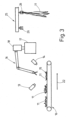
- the figures in the drawing show a method in which individual items of laundry are captured from a pile of laundry coming from a washing machine, for example.
- the detected item of laundry is then sent to a further treatment step depending on its properties.
- Washed laundry from a washing machine is often temporarily stored in a laundry cart 10 before further treatment.
- items of laundry 11 that are first collected before they are washed can also be collected or stored in such a laundry cart 10.
- 10 dirty laundry items 11 or washed laundry items 11 can be located in a laundry cart.
- the laundry items 11 form a laundry pile 12 in the laundry cart 10.
- individual items of laundry 11 can hardly be recognized or separated from one another. Rather, the individual items of laundry 11 form an apparently coherent pile of laundry 12 ( Fig. 1 ).
- the individual laundry items 11 For further treatment of the laundry items 11, such as ironing, the individual laundry items 11 must be separated. When separating, a detection means reaches into the pile of laundry 12. It happens that instead of one item of laundry 11, several or none at all are grabbed.
- the invention provides that first an image or a photo of the upward-facing side of the laundry pile 12 is created.
- This image is preferably a three-dimensional image. Since this three-dimensional image extends in three dimensions or spatial directions, namely in an 11 are formed. At This three-dimensional image of the item of laundry 11 can therefore also be referred to as a topography of the items of laundry 11.
- Fig. 1 To determine such a three-dimensional image or the topography of the laundry items 11, in Fig. 1 illustrated embodiment two cameras 13, 14 are provided. The positioning of the cameras 13, 14 above the laundry pile 12, in particular their distance, is only shown symbolically here and can rather be adapted to the recording conditions.
- a stereoscopic measure is used using the cameras 13, 14.
- an object here the laundry items 11, is viewed or recorded by at least two cameras from two different angles. This special recording of an object using two cameras from two different perspectives allows a three-dimensional image to be created or all three spatial coordinates to be determined.
- the images or information recorded by the cameras 13 and 14 are further processed using a computer, not shown.
- the images of the laundry items from three, four or more cameras, which simultaneously create images of the laundry items 11, are evaluated by a computer.
- the cameras record the laundry items 11 to determine the topography of the laundry items 11, it can be a continuous recording or a stroboscopic recording of photos, for example every second.
- locations 15 on the laundry items 11 that are particularly suitable for detecting or separating the laundry are determined.
- Places 15 that are particularly suitable for separating are those where an item of laundry 11 can be grasped and pulled out of the pile of laundry 12 without much resistance.
- Areas of the item of laundry 11 that have a small radius of curvature or a large curvature, such as a fold, a bend, an edge or a corner, are particularly suitable as such locations 15.
- the topography is evaluated by the computer in such a way that the angle between two tangents or tangential planes of each of two adjacent points is determined.
- this angle is flat, for example, the item of laundry 11 has a large radius of curvature at this point 15. On the other hand, if this angle is acute or the tangents do not intersect at all, then a small radius of curvature can be assumed. Such points 15 are particularly suitable for grasping an item of laundry 11.
- the detection means shown is a gripper 16. Alternatively, however, it can also be a suction device or a similar detection means.
- the in Fig. 1 The gripper 16 shown has a base 17 on which a gripper head 18 is rotatably located. Starting from the gripper head 18, a gripper arm 19 extends which consists of several links that are connected by joints. At the end of the gripper arm 19 there is a pliers-shaped clamp 20. This clamp 20 can be opened and closed automatically under computer control. To grasp an item of laundry 11, the clamp 20 is closed.
- the clip 20 is opened again.
- the gripper arm 19 is so flexible in interaction with the gripper head 18 that the gripper 16 can control any point within its reach with its clamp 20.
- the clamp 20 is closed.
- the clamp 20 is movable at the end of the gripper arm 19 in such a way that it can grip in almost all directions.
- a location 15 of the item of laundry 11 has been determined that is particularly suitable for grasping the item of laundry 11, the coordinates of the location 15 are transferred to the gripper 16, so that the clamp 20 of the gripper 16 is moved exactly to the location 15 of the item of laundry 11 becomes.
- the gripper 16 shown is just an exemplary embodiment.
- the gripper 16 can also take any other conceivable shape.
- locations 15 can be determined that are particularly suitable for detecting the item of laundry 11. If several such positions 15 are determined, an evaluation is made as to which position 15 is most suitable. It is also provided that special locations 15, such as an edge or a corner of an item of laundry 11, are recognized as such. For this recognition, the computer system can have a library with a large number of recorded corners or edges with which the recorded Image is matched. In some further treatment steps it is necessary that the item of laundry 11 is grasped at the corner or on an edge. This information can be transmitted to the gripper 16 via the computer.
- the properties of the item of laundry 11 can be determined either when the item of laundry 11 is still in the laundry pile 12 or when the item of laundry 11 has already been grasped by the gripper 16. After the item of laundry 11 has been grasped by the gripper 16, it sorts the item of laundry 11 into container 23. A separate container 23 or sorting container is provided for each property or for each sorting criterion of the laundry items. If there is a certain number of items of laundry in such a container 23, they are sent to the next treatment step.
- the gripper arm 19 or the clamp 20 of the gripper 16 has a means for determining the weight of the captured item of laundry 11. It is therefore also possible to sort the items of laundry 11 according to their weight or, if the individual item of laundry 11 has been previously identified using the imaging method, to determine the moisture state of the item of laundry 11 based on the weight.
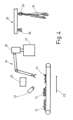
- the items of laundry 11 are fed to the gripper 16 individually, lying on a conveyor 24.
- the topography of the item of laundry 11 is determined by the cameras 13 and 14 as already described, while the item of laundry 11 is lying on the conveyor 24.
- the conveyor 24 is either stopped briefly or moves continuously.
- the topography is determined by stereoscopic measures by the cameras 13 and 14.
- the X, Y and Z coordinates of each point of the laundry item 11 are determined and preferably determined by points 15 for detection by the gripper 16 ( Fig. 3 ).
- the item of laundry 11 is captured at one of several possible locations 15 for further treatment.
- the captured item of laundry 11 is transferred from the gripper 16 to a hanging conveyor 25.
- This hanging conveyor 25 has a large number of transport hooks 26 or clamps, to each of which an item of laundry 11 is transferred by the gripper 16.
- the item of laundry 11 is then conveyed away hanging on a transport hook 26.
- the transport hooks 26 run in an endless loop on the overhead conveyor 25 and lead the item of laundry 11 to a further treatment station, not shown.
- the gripper 16 in which the laundry items 11 are transported hanging, it can be advantageous for the gripper 16 to immediately grasp the laundry item 11 at an edge or corner. This means that the item of laundry 11 can be transferred directly to the transport hooks 26 of the overhead conveyor 25 with this corner or edge.
- topography in addition to the topography, other properties such as color and type of tissue can also be determined by the camera 13.
- the process steps following the determination of the topography are identical to those described previously.
- the determination of the topography using laser scanning can therefore also be applied to the process steps of separating, sorting or forwarding the item of laundry 11.
Landscapes
- Engineering & Computer Science (AREA)
- Textile Engineering (AREA)
- Robotics (AREA)
- Mechanical Engineering (AREA)
- Treatment Of Fiber Materials (AREA)
Applications Claiming Priority (1)
| Application Number | Priority Date | Filing Date | Title |
|---|---|---|---|
| DE102014005355.5A DE102014005355A1 (de) | 2014-04-11 | 2014-04-11 | Verfahren zum Erfassen eines Wäschestücks |
Publications (2)
| Publication Number | Publication Date |
|---|---|
| EP2930264A1 EP2930264A1 (de) | 2015-10-14 |
| EP2930264B1 true EP2930264B1 (de) | 2023-11-15 |
Family
ID=52469580
Family Applications (1)
| Application Number | Title | Priority Date | Filing Date |
|---|---|---|---|
| EP15000404.2A Active EP2930264B1 (de) | 2014-04-11 | 2015-02-11 | Verfahren zum Erfassen eines Wäschestücks |
Country Status (4)
| Country | Link |
|---|---|
| US (1) | US9920470B2 (da) |
| EP (1) | EP2930264B1 (da) |
| DE (1) | DE102014005355A1 (da) |
| DK (1) | DK2930264T3 (da) |
Cited By (1)
| Publication number | Priority date | Publication date | Assignee | Title |
|---|---|---|---|---|
| EP2930264B1 (de) | 2014-04-11 | 2023-11-15 | Herbert Kannegiesser GmbH | Verfahren zum Erfassen eines Wäschestücks |
Families Citing this family (29)
| Publication number | Priority date | Publication date | Assignee | Title |
|---|---|---|---|---|
| DE102014017477A1 (de) * | 2014-11-26 | 2016-06-02 | Herbert Kannegiesser Gmbh | Verfahren und Vorrichtung zum Zuführen von Wäschestücken zu einer Mangel oder einer sonstigen Wäschebehandlungseinrichtung |
| DE102014017478A1 (de) * | 2014-11-26 | 2016-06-02 | Herbert Kannegiesser Gmbh | Verfahren zum Sortieren von Wäschestücken, insbesondere Schmutzwäschestücken |
| DE102015011602A1 (de) * | 2015-09-10 | 2017-03-16 | Herbert Kannegiesser Gmbh | Verfahren und Vorrichtung zum Ausbreiten eines Wäschestücks |
| JP2017079881A (ja) * | 2015-10-23 | 2017-05-18 | 株式会社プレックス | 布類の種類識別装置および種類識別方法 |
| JP6739157B2 (ja) * | 2015-10-23 | 2020-08-12 | 株式会社プレックス | 布類の種類識別装置 |
| CN106637853A (zh) * | 2015-11-04 | 2017-05-10 | 扬智科技股份有限公司 | 自动收晾装置与其操作方法 |
| US9715030B1 (en) * | 2016-03-07 | 2017-07-25 | Matias SaavedraSilvia | Object detection and removal apparatus |
| DE102016012274A1 (de) * | 2016-05-31 | 2017-11-30 | Herbert Kannegiesser Gmbh | Verfahren zum Zuführen von Wäschestücken zu einer Wäscheweiterbehandlungseinrichtung sowie Vorrichtung |
| DE102016225809A1 (de) * | 2016-12-21 | 2018-06-21 | Henkel Ag & Co. Kgaa | Ermittlung von Behandlungsparametern über eine Geometrieinformation einer Textilie |
| TW201843373A (zh) * | 2017-05-03 | 2018-12-16 | 康建忠 | 衣物清潔系統 |
| CN107904868B (zh) * | 2017-12-14 | 2023-12-05 | 宁波领智机械科技有限公司 | 具有激光定位功能的自动分类洗衣机 |
| US12386333B2 (en) | 2019-07-03 | 2025-08-12 | Sewts Gmbh | Method for positioning a limp, flat workpiece and positioning apparatus |
| NL2023652B1 (en) * | 2019-08-16 | 2021-03-24 | Laundry Robotics B V | Method and system for detecting and gripping a second corner of a flatwork item |
| NL2023653B1 (en) * | 2019-08-16 | 2021-03-24 | Laundry Robotics B V | Method and system for detecting and gripping a corner of a flatwork item |
| JP2022544535A (ja) * | 2019-08-16 | 2022-10-19 | ランドリー ロボティックス ベスローテン ヴェンノーツハップ | フラットワーク物品を搬送コンベア及び/又はフラットワーク処理装置に供給する方法及びシステム |
| NL2023651B1 (en) * | 2019-08-16 | 2021-02-24 | Laundry Robotics B V | Method and system feeding a flatwork item to a transport conveyor and/or a flatwork treating device |
| DK3828332T3 (da) | 2019-11-28 | 2024-01-22 | Kannegiesser H Gmbh Co | Fremgangsmåde til tilførsel af rektangulære tekstilgenstande til en behandlingsanordning |
| DE102019135659A1 (de) | 2019-11-28 | 2021-06-02 | Herbert Kannegiesser Gmbh | Verfahren und Vorrichtung zum Ergreifen rechteckiger textiler Gegenstände und/oder zum Zuführen rechtecktiger textiler Gegenstände zu einer Behandlungseinrichtung |
| EP4217533A1 (en) * | 2020-09-23 | 2023-08-02 | Inwatec ApS | A cloth processing plant, and an industrial laundry including such a plant |
| DK4056752T3 (da) * | 2021-03-11 | 2024-08-19 | Kannegiesser H Gmbh Co | Fremgangsmåde til behandling af vasketøjsstykker |
| DE102021113345A1 (de) * | 2021-05-21 | 2022-11-24 | LST-Automation GmbH | Verfahren zum Betreiben einer Greifvorrichtung zur Vereinzelung von Wäschestücken aus einem Wäschehaufen |
| US12024815B2 (en) | 2021-07-16 | 2024-07-02 | Mihir Kothari | System and method of laundry sorting |
| US11752525B2 (en) | 2021-07-16 | 2023-09-12 | Mihir Kothari | System and method of laundry sorting |
| US12077903B2 (en) * | 2022-02-22 | 2024-09-03 | Monotony.ai, Inc. | Autonomous devices, systems, and methods for packing unfolded laundry articles |
| EP4519489A1 (en) | 2022-05-06 | 2025-03-12 | Inwatec ApS | A device for capturing a cloth item, and a method of operating the device |
| WO2024015858A1 (en) | 2022-07-15 | 2024-01-18 | Mihir Kothari | Laundry sorting and evaluation system |
| US12584268B2 (en) | 2022-09-13 | 2026-03-24 | Mihir Kothari | System and method of laundry singulation and flattening |
| EP4560069A1 (de) * | 2023-11-24 | 2025-05-28 | Desion GmbH | Vorrichtung und verfahren zum mechanischen handhaben eines textilproduktes |
| DE102024110549A1 (de) * | 2023-11-24 | 2025-05-28 | Desion GmbH | Vorrichtung und Verfahren zum mechanischen Handhaben eines Textilproduktes |
Citations (6)
| Publication number | Priority date | Publication date | Assignee | Title |
|---|---|---|---|---|
| GB1556077A (en) | 1975-12-23 | 1979-11-21 | Kleindienst & Co | Method and apparatus for sorting washed individual articles of laundry for further processing |
| EP2113606A2 (de) | 2008-04-29 | 2009-11-04 | Herbert Kannegiesser GmbH | Verfahren und Vorrichtung zum Sortieren, Vereinzeln und/oder Übergeben von Wäschestücken |
| JP2010273732A (ja) | 2009-05-26 | 2010-12-09 | Purex:Kk | 布物の自動展開投入装置 |
| DE102012017328A1 (de) | 2011-09-09 | 2013-03-14 | Fanuc Corporation | Roboter mit einer Werkstückmassenmessfunktion |
| JP2014045801A (ja) | 2012-08-29 | 2014-03-17 | Kurabo Ind Ltd | 布片の縁部の自動検出方法とその装置、および、該装置を有する布片展開送り装置 |
| EP2930264A1 (de) | 2014-04-11 | 2015-10-14 | Herbert Kannegiesser GmbH | Verfahren zum Erfassen eines Wäschestücks |
Family Cites Families (7)
| Publication number | Priority date | Publication date | Assignee | Title |
|---|---|---|---|---|
| US5790687A (en) * | 1996-06-18 | 1998-08-04 | Levi Strauss & Co. | Method and apparatus for the optical determination of the orientation of a garment workpiece |
| CN102248537B (zh) * | 2007-06-27 | 2013-12-04 | 松下电器产业株式会社 | 机器手控制装置及控制方法、机器人 |
| DE102008028120B4 (de) * | 2008-06-13 | 2012-04-05 | Qualivision Ag | Verfahren und Vorrichtung zum Sortieren von Textilien |
| IT1391213B1 (it) * | 2008-08-18 | 2011-11-18 | I T A G Spa | Macchina industriale per il riconoscimento e/o la selezione di manufatti di biancheria e metodo attuato mediante tale macchina industriale |
| DE102010053080A1 (de) * | 2010-10-25 | 2012-04-26 | Herbert Kannegiesser Gmbh | Verfahren und Vorrichtung zum Vereinzeln und/oder Vermessen von Wäschestücken |
| FI20106387L (fi) * | 2010-12-30 | 2012-07-01 | Zenrobotics Oy | Menetelmä, tietokoneohjelma ja laite tartuntakohdan määrittämiseksi |
| DE102011075078A1 (de) * | 2011-05-02 | 2012-11-08 | BSH Bosch und Siemens Hausgeräte GmbH | Wäscheaufbewahrungsvorrichtung mit einem Wäschebehälter sowie Wäschepflegeeinrichtung |
-
2014
- 2014-04-11 DE DE102014005355.5A patent/DE102014005355A1/de active Pending
-
2015
- 2015-02-11 EP EP15000404.2A patent/EP2930264B1/de active Active
- 2015-02-11 DK DK15000404.2T patent/DK2930264T3/da active
- 2015-03-03 US US14/636,578 patent/US9920470B2/en active Active
Patent Citations (9)
| Publication number | Priority date | Publication date | Assignee | Title |
|---|---|---|---|---|
| GB1556077A (en) | 1975-12-23 | 1979-11-21 | Kleindienst & Co | Method and apparatus for sorting washed individual articles of laundry for further processing |
| EP2113606A2 (de) | 2008-04-29 | 2009-11-04 | Herbert Kannegiesser GmbH | Verfahren und Vorrichtung zum Sortieren, Vereinzeln und/oder Übergeben von Wäschestücken |
| DE102008021502A1 (de) | 2008-04-29 | 2009-11-05 | Herbert Kannegiesser Gmbh | Verfahren und Vorrichtung zum Sortieren, Vereinzeln und/oder Übergeben von Wäschestücken |
| JP2010273732A (ja) | 2009-05-26 | 2010-12-09 | Purex:Kk | 布物の自動展開投入装置 |
| DE102012017328A1 (de) | 2011-09-09 | 2013-03-14 | Fanuc Corporation | Roboter mit einer Werkstückmassenmessfunktion |
| JP2014045801A (ja) | 2012-08-29 | 2014-03-17 | Kurabo Ind Ltd | 布片の縁部の自動検出方法とその装置、および、該装置を有する布片展開送り装置 |
| EP2930264A1 (de) | 2014-04-11 | 2015-10-14 | Herbert Kannegiesser GmbH | Verfahren zum Erfassen eines Wäschestücks |
| DE102014005355A1 (de) | 2014-04-11 | 2015-10-15 | Herbert Kannegiesser Gmbh | Verfahren zum Erfassen eines Wäschestücks |
| EP2930264B1 (de) | 2014-04-11 | 2023-11-15 | Herbert Kannegiesser GmbH | Verfahren zum Erfassen eines Wäschestücks |
Non-Patent Citations (9)
| Title |
|---|
| ARNAU RAMISA ; GUILLEM ALENYA ; FRANCESC MORENO-NOGUER ; CARME TORRAS: "Using depth and appearance features for informed robot grasping of highly wrinkled clothes", ROBOTICS AND AUTOMATION (ICRA), 2012 IEEE INTERNATIONAL CONFERENCE ON, IEEE, 14 May 2012 (2012-05-14), pages 1703 - 1708, XP032450776, ISBN: 978-1-4673-1403-9, DOI: 10.1109/ICRA.2012.6225045 |
| H. KOBAYASHI: "A study on handling system for cloth using 3-D vision sensor", INDUSTRIAL ELECTRONICS, 2008. IECON 2008. 34TH ANNUAL CONFERENCE OF IEEE, IEEE, PISCATAWAY, NJ, USA, 1 November 2008 (2008-11-01) - 13 November 2008 (2008-11-13), Piscataway, NJ, USA , pages 3403 - 3408, XP093169314, ISBN: 978-1-4244-1767-4, DOI: 10.1109/IECON.2008.4758507 |
| HATA SEIJI ET AL: "Vision System and Flexible Robot Hand for Cloth Handling Robot System", 2008 INTERNATIONAL CONFERENCE ON CONTROL, AUTOMATION AND SYSTEMS, 14 October 2008 (2008-10-14) - 17 October 2008 (2008-10-17), Seoul, pages 692 - 697, XP055918338, ISBN: 978-89-932-1501-4, DOI: 10.1109/ICCAS.2008.4694590 * |
| HATA SEIJI, HIROYASU TAKEHISA, HAYASHI JUN'ICHIRO, HOJOH HIROTAKA, TOSHIHIRO HAMADA: "Vision system and flexible robot hand for cloth handling robot system", 2008 INTERNATIONAL CONFERENCE ON CONTROL, AUTOMATION AND SYSTEMS, 1 October 2008 (2008-10-01), pages 692 - 697, XP055918338, ISBN: 978-89-932-1501-4, DOI: 10.1109/ICCAS.2008.4694590 |
| JEREMY MAITIN-SHEPARD ; MARCO CUSUMANO-TOWNER ; JINNA LEI ; PIETER ABBEEL: "Cloth grasp point detection based on multiple-view geometric cues with application to robotic towel folding", 2010 IEEE INTERNATIONAL CONFERENCE ON ROBOTICS AND AUTOMATION : ICRA 2010 ; ANCHORAGE, ALASKA, USA, 3 - 8 MAY 2010., IEEE, PISCATAWAY, NJ, USA, 3 May 2010 (2010-05-03), Piscataway, NJ, USA , pages 2308 - 2315, XP031708546, ISBN: 978-1-4244-5038-1 |
| JEREMY MAITIN-SHEPARD ; MARCO CUSUMANO-TOWNER ; JINNA LEI ; PIETER ABBEEL: "Cloth grasp point detection based on multiple-view geometric cues with application to robotic towel folding", 2010 IEEE INTERNATIONAL CONFERENCE ON ROBOTICS AND AUTOMATION, 3 May 2010 (2010-05-03), Piscataway, NJ, USA , pages 2308 - 2315, XP031743374, ISBN: 978-1-4244-5038-1 |
| KRSEK PAVEL , LIBOR WAGNER , VLADIM´IR PETRIK: "Clothes Perception and Manipulation- D6.1 Visual Patterns", CLOOEMA, vol. 1.0, 10 February 2014 (2014-02-10), pages 1 - 62, XP093208994 |
| POL MONSO ; GUILLEM ALENYA ; CARME TORRAS: "POMDP approach to robotized clothes separation", INTELLIGENT ROBOTS AND SYSTEMS (IROS), 2012 IEEE/RSJ INTERNATIONAL CONFERENCE ON, IEEE, 7 October 2012 (2012-10-07), pages 1324 - 1329, XP032287857, ISBN: 978-1-4673-1737-5, DOI: 10.1109/IROS.2012.6386011 |
| SEIJI HATA: "Vision System and Flexible Robot Hand for Cloth Handling Robot System", INTERNATIONAL CONFERENCE ON CONTROL, AUTOMATION AND SYSTEMS 2008, 2008, XP031367977 |
Cited By (1)
| Publication number | Priority date | Publication date | Assignee | Title |
|---|---|---|---|---|
| EP2930264B1 (de) | 2014-04-11 | 2023-11-15 | Herbert Kannegiesser GmbH | Verfahren zum Erfassen eines Wäschestücks |
Also Published As
| Publication number | Publication date |
|---|---|
| DK2930264T3 (da) | 2024-02-12 |
| US20150292142A1 (en) | 2015-10-15 |
| US9920470B2 (en) | 2018-03-20 |
| EP2930264A1 (de) | 2015-10-14 |
| DE102014005355A1 (de) | 2015-10-15 |
Similar Documents
| Publication | Publication Date | Title |
|---|---|---|
| EP2930264B1 (de) | Verfahren zum Erfassen eines Wäschestücks | |
| DE102014016072B4 (de) | Vorrichtung und Verfahren zum Aufheben eines willkürlich aufgestapelten Gegenstands mittels eines Roboters | |
| DE102013109220B4 (de) | Robotervorrichtung und Verfahren zum Herausnehmen von Bulk-Ware aus einem Lager | |
| EP4015701B1 (de) | Verfahren zum zuführen von wäschestücken zu einer mangel oder einer sonstigen wäschebehandlungseinrichtung | |
| EP3026170B1 (de) | Verfahren zum sortieren von wäschestücken, insbesondere schmutzwäschestücken | |
| DE102014102943B4 (de) | Robotersystem mit Funktionalität zur Ortsbestimmung einer 3D- Kiste | |
| DE102016122678B4 (de) | Werkstückpositions-/-Stellungsberechnungssystem und Handhabungssystem | |
| DE102014016033A1 (de) | Vorrichtung und Verfahren zum Aufnehmen von regellos verteilten Gegenständen mit einem Roboter | |
| EP2765554A1 (en) | Feature extraction method, subject classification method, subject identification method, feature extraction device, subject classification device, subject identification device, feature extraction/subject classification/subject identification program and recording medium recording said program | |
| DE102016013986A1 (de) | Vorrichtung zum messen von positionen und stellungen einer mehrzahl von artikeln sowie die vorrichtung aufweisendes robotersystem | |
| DE102015102740A1 (de) | Vorrichtung und Verfahren zur Anordnung von Gegenständen mittels eines Roboters und Gegenstand-Transportsystem | |
| EP3993958B1 (de) | Verfahren zur positionierung eines biegeschlaffen flächenwerkstücks sowie positionierungsvorrichtung | |
| DE102022101825B3 (de) | Verfahren und System für automatisierte Materialhandhabung einschließlich einer 100%-Verifikation | |
| WO2023110135A1 (de) | Verfahren und vorrichtung zur lagebestimmung gewölbter artikel sowie zum aufsatteln solcher | |
| DE102020104050A1 (de) | Verfahren zum Steuern einer landwirtschaftlichen Maschine | |
| EP3828332B1 (de) | Verfahren zum zuführen rechteckiger textiler gegenstände zu einer behandlungseinrichtung | |
| EP3854731A1 (de) | Vorrichtung und verfahren zum vereinzeln von stückgütern | |
| DE102019106068B3 (de) | System zur beseitigung von überlagerungen zufällig angeordneter werkstücke | |
| DE102009009569B4 (de) | Verfahren zum Ermitteln einer Teilfläche eines Bauteils | |
| DE102024125317A1 (de) | Greifvorrichtung zum Greifen von Produkten aus einem Vorrat | |
| DE112023000857B4 (de) | Handhabungssystem, handhabungsverfahren, programm, informationsverarbeitungsvorrichtung und datenstruktur | |
| DE102020110624A1 (de) | Bildverarbeitungsvorrichtung, bildverarbeitungsverfahren und robotersystem | |
| EP4560069A1 (de) | Vorrichtung und verfahren zum mechanischen handhaben eines textilproduktes | |
| DE102008052440A1 (de) | Verfahren und Vorrichtung zum Vereinzeln von Bauteilen | |
| DE102024110549A1 (de) | Vorrichtung und Verfahren zum mechanischen Handhaben eines Textilproduktes |
Legal Events
| Date | Code | Title | Description |
|---|---|---|---|
| PUAI | Public reference made under article 153(3) epc to a published international application that has entered the european phase |
Free format text: ORIGINAL CODE: 0009012 |
|
| AK | Designated contracting states |
Kind code of ref document: A1 Designated state(s): AL AT BE BG CH CY CZ DE DK EE ES FI FR GB GR HR HU IE IS IT LI LT LU LV MC MK MT NL NO PL PT RO RS SE SI SK SM TR |
|
| AX | Request for extension of the european patent |
Extension state: BA ME |
|
| 17P | Request for examination filed |
Effective date: 20160407 |
|
| RBV | Designated contracting states (corrected) |
Designated state(s): AL AT BE BG CH CY CZ DE DK EE ES FI FR GB GR HR HU IE IS IT LI LT LU LV MC MK MT NL NO PL PT RO RS SE SI SK SM TR |
|
| STAA | Information on the status of an ep patent application or granted ep patent |
Free format text: STATUS: EXAMINATION IS IN PROGRESS |
|
| 17Q | First examination report despatched |
Effective date: 20200907 |
|
| TPAC | Observations filed by third parties |
Free format text: ORIGINAL CODE: EPIDOSNTIPA |
|
| TPAC | Observations filed by third parties |
Free format text: ORIGINAL CODE: EPIDOSNTIPA |
|
| TPAC | Observations filed by third parties |
Free format text: ORIGINAL CODE: EPIDOSNTIPA |
|
| GRAP | Despatch of communication of intention to grant a patent |
Free format text: ORIGINAL CODE: EPIDOSNIGR1 |
|
| STAA | Information on the status of an ep patent application or granted ep patent |
Free format text: STATUS: GRANT OF PATENT IS INTENDED |
|
| INTG | Intention to grant announced |
Effective date: 20230530 |
|
| GRAS | Grant fee paid |
Free format text: ORIGINAL CODE: EPIDOSNIGR3 |
|
| GRAA | (expected) grant |
Free format text: ORIGINAL CODE: 0009210 |
|
| STAA | Information on the status of an ep patent application or granted ep patent |
Free format text: STATUS: THE PATENT HAS BEEN GRANTED |
|
| AK | Designated contracting states |
Kind code of ref document: B1 Designated state(s): AL AT BE BG CH CY CZ DE DK EE ES FI FR GB GR HR HU IE IS IT LI LT LU LV MC MK MT NL NO PL PT RO RS SE SI SK SM TR |
|
| REG | Reference to a national code |
Ref country code: CH Ref legal event code: EP Ref country code: GB Ref legal event code: FG4D Free format text: NOT ENGLISH |
|
| REG | Reference to a national code |
Ref country code: DE Ref legal event code: R096 Ref document number: 502015016670 Country of ref document: DE |
|
| REG | Reference to a national code |
Ref country code: IE Ref legal event code: FG4D Free format text: LANGUAGE OF EP DOCUMENT: GERMAN |
|
| P01 | Opt-out of the competence of the unified patent court (upc) registered |
Effective date: 20231129 |
|
| REG | Reference to a national code |
Ref country code: DK Ref legal event code: T3 Effective date: 20240209 |
|
| REG | Reference to a national code |
Ref country code: NL Ref legal event code: FP |
|
| REG | Reference to a national code |
Ref country code: LT Ref legal event code: MG9D |
|
| PG25 | Lapsed in a contracting state [announced via postgrant information from national office to epo] |
Ref country code: GR Free format text: LAPSE BECAUSE OF FAILURE TO SUBMIT A TRANSLATION OF THE DESCRIPTION OR TO PAY THE FEE WITHIN THE PRESCRIBED TIME-LIMIT Effective date: 20240216 |
|
| PG25 | Lapsed in a contracting state [announced via postgrant information from national office to epo] |
Ref country code: IS Free format text: LAPSE BECAUSE OF FAILURE TO SUBMIT A TRANSLATION OF THE DESCRIPTION OR TO PAY THE FEE WITHIN THE PRESCRIBED TIME-LIMIT Effective date: 20240315 |
|
| PG25 | Lapsed in a contracting state [announced via postgrant information from national office to epo] |
Ref country code: LT Free format text: LAPSE BECAUSE OF FAILURE TO SUBMIT A TRANSLATION OF THE DESCRIPTION OR TO PAY THE FEE WITHIN THE PRESCRIBED TIME-LIMIT Effective date: 20231115 |
|
| PG25 | Lapsed in a contracting state [announced via postgrant information from national office to epo] |
Ref country code: ES Free format text: LAPSE BECAUSE OF FAILURE TO SUBMIT A TRANSLATION OF THE DESCRIPTION OR TO PAY THE FEE WITHIN THE PRESCRIBED TIME-LIMIT Effective date: 20231115 |
|
| PG25 | Lapsed in a contracting state [announced via postgrant information from national office to epo] |
Ref country code: LT Free format text: LAPSE BECAUSE OF FAILURE TO SUBMIT A TRANSLATION OF THE DESCRIPTION OR TO PAY THE FEE WITHIN THE PRESCRIBED TIME-LIMIT Effective date: 20231115 Ref country code: IS Free format text: LAPSE BECAUSE OF FAILURE TO SUBMIT A TRANSLATION OF THE DESCRIPTION OR TO PAY THE FEE WITHIN THE PRESCRIBED TIME-LIMIT Effective date: 20240315 Ref country code: GR Free format text: LAPSE BECAUSE OF FAILURE TO SUBMIT A TRANSLATION OF THE DESCRIPTION OR TO PAY THE FEE WITHIN THE PRESCRIBED TIME-LIMIT Effective date: 20240216 Ref country code: ES Free format text: LAPSE BECAUSE OF FAILURE TO SUBMIT A TRANSLATION OF THE DESCRIPTION OR TO PAY THE FEE WITHIN THE PRESCRIBED TIME-LIMIT Effective date: 20231115 Ref country code: BG Free format text: LAPSE BECAUSE OF FAILURE TO SUBMIT A TRANSLATION OF THE DESCRIPTION OR TO PAY THE FEE WITHIN THE PRESCRIBED TIME-LIMIT Effective date: 20240215 Ref country code: PT Free format text: LAPSE BECAUSE OF FAILURE TO SUBMIT A TRANSLATION OF THE DESCRIPTION OR TO PAY THE FEE WITHIN THE PRESCRIBED TIME-LIMIT Effective date: 20240315 |
|
| PG25 | Lapsed in a contracting state [announced via postgrant information from national office to epo] |
Ref country code: SE Free format text: LAPSE BECAUSE OF FAILURE TO SUBMIT A TRANSLATION OF THE DESCRIPTION OR TO PAY THE FEE WITHIN THE PRESCRIBED TIME-LIMIT Effective date: 20231115 Ref country code: RS Free format text: LAPSE BECAUSE OF FAILURE TO SUBMIT A TRANSLATION OF THE DESCRIPTION OR TO PAY THE FEE WITHIN THE PRESCRIBED TIME-LIMIT Effective date: 20231115 Ref country code: PL Free format text: LAPSE BECAUSE OF FAILURE TO SUBMIT A TRANSLATION OF THE DESCRIPTION OR TO PAY THE FEE WITHIN THE PRESCRIBED TIME-LIMIT Effective date: 20231115 Ref country code: NO Free format text: LAPSE BECAUSE OF FAILURE TO SUBMIT A TRANSLATION OF THE DESCRIPTION OR TO PAY THE FEE WITHIN THE PRESCRIBED TIME-LIMIT Effective date: 20240215 Ref country code: LV Free format text: LAPSE BECAUSE OF FAILURE TO SUBMIT A TRANSLATION OF THE DESCRIPTION OR TO PAY THE FEE WITHIN THE PRESCRIBED TIME-LIMIT Effective date: 20231115 Ref country code: HR Free format text: LAPSE BECAUSE OF FAILURE TO SUBMIT A TRANSLATION OF THE DESCRIPTION OR TO PAY THE FEE WITHIN THE PRESCRIBED TIME-LIMIT Effective date: 20231115 |
|
| PG25 | Lapsed in a contracting state [announced via postgrant information from national office to epo] |
Ref country code: CZ Free format text: LAPSE BECAUSE OF FAILURE TO SUBMIT A TRANSLATION OF THE DESCRIPTION OR TO PAY THE FEE WITHIN THE PRESCRIBED TIME-LIMIT Effective date: 20231115 |
|
| PG25 | Lapsed in a contracting state [announced via postgrant information from national office to epo] |
Ref country code: SK Free format text: LAPSE BECAUSE OF FAILURE TO SUBMIT A TRANSLATION OF THE DESCRIPTION OR TO PAY THE FEE WITHIN THE PRESCRIBED TIME-LIMIT Effective date: 20231115 |
|
| PG25 | Lapsed in a contracting state [announced via postgrant information from national office to epo] |
Ref country code: SM Free format text: LAPSE BECAUSE OF FAILURE TO SUBMIT A TRANSLATION OF THE DESCRIPTION OR TO PAY THE FEE WITHIN THE PRESCRIBED TIME-LIMIT Effective date: 20231115 Ref country code: SK Free format text: LAPSE BECAUSE OF FAILURE TO SUBMIT A TRANSLATION OF THE DESCRIPTION OR TO PAY THE FEE WITHIN THE PRESCRIBED TIME-LIMIT Effective date: 20231115 Ref country code: RO Free format text: LAPSE BECAUSE OF FAILURE TO SUBMIT A TRANSLATION OF THE DESCRIPTION OR TO PAY THE FEE WITHIN THE PRESCRIBED TIME-LIMIT Effective date: 20231115 Ref country code: IT Free format text: LAPSE BECAUSE OF FAILURE TO SUBMIT A TRANSLATION OF THE DESCRIPTION OR TO PAY THE FEE WITHIN THE PRESCRIBED TIME-LIMIT Effective date: 20231115 Ref country code: EE Free format text: LAPSE BECAUSE OF FAILURE TO SUBMIT A TRANSLATION OF THE DESCRIPTION OR TO PAY THE FEE WITHIN THE PRESCRIBED TIME-LIMIT Effective date: 20231115 Ref country code: CZ Free format text: LAPSE BECAUSE OF FAILURE TO SUBMIT A TRANSLATION OF THE DESCRIPTION OR TO PAY THE FEE WITHIN THE PRESCRIBED TIME-LIMIT Effective date: 20231115 |
|
| REG | Reference to a national code |
Ref country code: DE Ref legal event code: R026 Ref document number: 502015016670 Country of ref document: DE |
|
| PLBI | Opposition filed |
Free format text: ORIGINAL CODE: 0009260 |
|
| PLBI | Opposition filed |
Free format text: ORIGINAL CODE: 0009260 |
|
| PLAB | Opposition data, opponent's data or that of the opponent's representative modified |
Free format text: ORIGINAL CODE: 0009299OPPO |
|
| PLAX | Notice of opposition and request to file observation + time limit sent |
Free format text: ORIGINAL CODE: EPIDOSNOBS2 |
|
| 26 | Opposition filed |
Opponent name: MUELLER, WOLFRAM HUBERTUS Effective date: 20240802 |
|
| 26 | Opposition filed |
Opponent name: JENSEN DENMARK A/S Effective date: 20240814 |
|
| R26 | Opposition filed (corrected) |
Opponent name: JENSEN DENMARK A/S Effective date: 20240814 |
|
| PG25 | Lapsed in a contracting state [announced via postgrant information from national office to epo] |
Ref country code: MC Free format text: LAPSE BECAUSE OF FAILURE TO SUBMIT A TRANSLATION OF THE DESCRIPTION OR TO PAY THE FEE WITHIN THE PRESCRIBED TIME-LIMIT Effective date: 20231115 |
|
| REG | Reference to a national code |
Ref country code: CH Ref legal event code: PL |
|
| PG25 | Lapsed in a contracting state [announced via postgrant information from national office to epo] |
Ref country code: LU Free format text: LAPSE BECAUSE OF NON-PAYMENT OF DUE FEES Effective date: 20240211 |
|
| PG25 | Lapsed in a contracting state [announced via postgrant information from national office to epo] |
Ref country code: CH Free format text: LAPSE BECAUSE OF NON-PAYMENT OF DUE FEES Effective date: 20240229 |
|
| GBPC | Gb: european patent ceased through non-payment of renewal fee |
Effective date: 20240215 |
|
| PG25 | Lapsed in a contracting state [announced via postgrant information from national office to epo] |
Ref country code: SI Free format text: LAPSE BECAUSE OF FAILURE TO SUBMIT A TRANSLATION OF THE DESCRIPTION OR TO PAY THE FEE WITHIN THE PRESCRIBED TIME-LIMIT Effective date: 20231115 |
|
| PG25 | Lapsed in a contracting state [announced via postgrant information from national office to epo] |
Ref country code: SI Free format text: LAPSE BECAUSE OF FAILURE TO SUBMIT A TRANSLATION OF THE DESCRIPTION OR TO PAY THE FEE WITHIN THE PRESCRIBED TIME-LIMIT Effective date: 20231115 Ref country code: LU Free format text: LAPSE BECAUSE OF NON-PAYMENT OF DUE FEES Effective date: 20240211 Ref country code: CH Free format text: LAPSE BECAUSE OF NON-PAYMENT OF DUE FEES Effective date: 20240229 |
|
| REG | Reference to a national code |
Ref country code: BE Ref legal event code: MM Effective date: 20240229 |
|
| PLBB | Reply of patent proprietor to notice(s) of opposition received |
Free format text: ORIGINAL CODE: EPIDOSNOBS3 |
|
| PG25 | Lapsed in a contracting state [announced via postgrant information from national office to epo] |
Ref country code: BE Free format text: LAPSE BECAUSE OF NON-PAYMENT OF DUE FEES Effective date: 20240229 |
|
| PG25 | Lapsed in a contracting state [announced via postgrant information from national office to epo] |
Ref country code: GB Free format text: LAPSE BECAUSE OF NON-PAYMENT OF DUE FEES Effective date: 20240215 |
|
| PG25 | Lapsed in a contracting state [announced via postgrant information from national office to epo] |
Ref country code: IE Free format text: LAPSE BECAUSE OF NON-PAYMENT OF DUE FEES Effective date: 20240211 |
|
| PG25 | Lapsed in a contracting state [announced via postgrant information from national office to epo] |
Ref country code: IE Free format text: LAPSE BECAUSE OF NON-PAYMENT OF DUE FEES Effective date: 20240211 Ref country code: GB Free format text: LAPSE BECAUSE OF NON-PAYMENT OF DUE FEES Effective date: 20240215 Ref country code: BE Free format text: LAPSE BECAUSE OF NON-PAYMENT OF DUE FEES Effective date: 20240229 |
|
| REG | Reference to a national code |
Ref country code: AT Ref legal event code: MM01 Ref document number: 1631867 Country of ref document: AT Kind code of ref document: T Effective date: 20240211 |
|
| PG25 | Lapsed in a contracting state [announced via postgrant information from national office to epo] |
Ref country code: AT Free format text: LAPSE BECAUSE OF NON-PAYMENT OF DUE FEES Effective date: 20240211 |
|
| PG25 | Lapsed in a contracting state [announced via postgrant information from national office to epo] |
Ref country code: CY Free format text: LAPSE BECAUSE OF FAILURE TO SUBMIT A TRANSLATION OF THE DESCRIPTION OR TO PAY THE FEE WITHIN THE PRESCRIBED TIME-LIMIT; INVALID AB INITIO Effective date: 20150211 |
|
| PG25 | Lapsed in a contracting state [announced via postgrant information from national office to epo] |
Ref country code: HU Free format text: LAPSE BECAUSE OF FAILURE TO SUBMIT A TRANSLATION OF THE DESCRIPTION OR TO PAY THE FEE WITHIN THE PRESCRIBED TIME-LIMIT; INVALID AB INITIO Effective date: 20150211 |
|
| PG25 | Lapsed in a contracting state [announced via postgrant information from national office to epo] |
Ref country code: FI Free format text: LAPSE BECAUSE OF FAILURE TO SUBMIT A TRANSLATION OF THE DESCRIPTION OR TO PAY THE FEE WITHIN THE PRESCRIBED TIME-LIMIT Effective date: 20231115 |
|
| PG25 | Lapsed in a contracting state [announced via postgrant information from national office to epo] |
Ref country code: TR Free format text: LAPSE BECAUSE OF FAILURE TO SUBMIT A TRANSLATION OF THE DESCRIPTION OR TO PAY THE FEE WITHIN THE PRESCRIBED TIME-LIMIT Effective date: 20231115 |
|
| PGFP | Annual fee paid to national office [announced via postgrant information from national office to epo] |
Ref country code: NL Payment date: 20260218 Year of fee payment: 12 |
|
| PGFP | Annual fee paid to national office [announced via postgrant information from national office to epo] |
Ref country code: DE Payment date: 20260227 Year of fee payment: 12 Ref country code: DK Payment date: 20260217 Year of fee payment: 12 |
|
| PGFP | Annual fee paid to national office [announced via postgrant information from national office to epo] |
Ref country code: FR Payment date: 20260219 Year of fee payment: 12 |