EP2930687A2 - Bildsegmentierung mittels unschärfe und farbe - Google Patents
Bildsegmentierung mittels unschärfe und farbe Download PDFInfo
- Publication number
- EP2930687A2 EP2930687A2 EP15160428.7A EP15160428A EP2930687A2 EP 2930687 A2 EP2930687 A2 EP 2930687A2 EP 15160428 A EP15160428 A EP 15160428A EP 2930687 A2 EP2930687 A2 EP 2930687A2
- Authority
- EP
- European Patent Office
- Prior art keywords
- blur
- image
- segmenting
- super
- pixels
- Prior art date
- Legal status (The legal status is an assumption and is not a legal conclusion. Google has not performed a legal analysis and makes no representation as to the accuracy of the status listed.)
- Granted
Links
Images




Classifications
-
- G—PHYSICS
- G06—COMPUTING OR CALCULATING; COUNTING
- G06T—IMAGE DATA PROCESSING OR GENERATION, IN GENERAL
- G06T7/00—Image analysis
- G06T7/50—Depth or shape recovery
- G06T7/55—Depth or shape recovery from multiple images
- G06T7/571—Depth or shape recovery from multiple images from focus
-
- G—PHYSICS
- G06—COMPUTING OR CALCULATING; COUNTING
- G06T—IMAGE DATA PROCESSING OR GENERATION, IN GENERAL
- G06T7/00—Image analysis
- G06T7/10—Segmentation; Edge detection
- G06T7/11—Region-based segmentation
-
- G—PHYSICS
- G06—COMPUTING OR CALCULATING; COUNTING
- G06T—IMAGE DATA PROCESSING OR GENERATION, IN GENERAL
- G06T2207/00—Indexing scheme for image analysis or image enhancement
- G06T2207/10—Image acquisition modality
- G06T2207/10024—Color image
Definitions
- the exemplary and non-limiting embodiments relate generally to imaging and, more particularly, to image segmentation.
- image segmentation is the process of partitioning a digital image into multiple segments (sets of pixels in which all pixels in the same set share certain visual characteristic).
- Image segmentation is typically used to locate objects and boundaries (lines, curves, etc.) in images.
- the result of image segmentation is a set of segments that collectively cover the entire image.
- an example method comprises segmenting an image into different segments, where the segmenting is based at least partially upon an estimate of blur of areas of the image; and changing the segmenting of two or more of the sections based, at least partially, upon color in the image.
- an example embodiment is provided in an apparatus comprising at least one processor; and at least one non-transitory memory including computer program code, the at least one memory and the computer program code configured, with the at least one processor, cause the apparatus at least to: segment an image into different segments, where segmenting of the image into different segments is based at least partially upon an estimate of blur of areas of the image; and change the segmenting of two or more of the sections based, at least partially, upon color in the image.
- an example embodiment is provided in a non-transitory program storage device readable by a machine, tangibly embodying a program of instructions executable by the machine for performing operations, the operations comprising: segmenting an image into different segments, where the segmenting is based at least partially upon an estimate of blur of areas of the image; and changing the segmenting of two or more of the sections based, at least partially, upon color in the image.
- FIG. 1 there is shown a front view of an apparatus 10 incorporating features of an example embodiment.
- a front view of an apparatus 10 incorporating features of an example embodiment.
- the features will be described with reference to the example embodiments shown in the drawings, it should be understood that features can be embodied in many alternate forms of embodiments.
- any suitable size, shape or type of elements or materials could be used.
- the apparatus 10 may be a hand-held portable apparatus, such as a communications device which includes a telephone application for example.
- the apparatus 10 is a smartphone which includes a camera and a camera application.
- the apparatus 10 may additionally or alternatively comprise an Internet browser application, a video recorder application, a music player and recorder application, an email application, a navigation application, a gaming application, and/or any other suitable electronic device application.
- the apparatus might not be a smartphone, such as a digital camera or video recorder, a tablet computer, or a gaming handset for example.
- the apparatus 10 in this example embodiment, comprises a housing 12, a touchscreen 14, a receiver 16, a transmitter 18, a controller 20, a rechargeable battery 26 and a camera 30.
- the controller 20 may include at least one processor 22, at least one memory 24, and software 28.
- the electronic circuitry inside the housing 12 may comprise at least one printed wiring board (PWB) 21 having components such as the controller 20 thereon.
- PWB printed wiring board
- the receiver 16 and transmitter 18 form a primary communications system to allow the apparatus 10 to communicate with a wireless telephone system, such as a mobile telephone base station for example.
- the apparatus 10 includes the camera 30 which is located at the rear side 13 of the apparatus, a front camera 32, an LED 34, and a flash system 36.
- the LED 34 and the flash system 36 are also visible at the rear side of the apparatus, and are provided for the camera 30.
- the cameras 30, 32, the LED 34 and the flash system 36 are connected to the controller 20 such that the controller 20 may control their operation.
- the rear side may comprise more than one camera, and/or the front side could comprise more than one camera.
- the apparatus 10 includes a sound transducer provided as a microphone 38.
- the apparatus may comprise more than one microphone.
- the apparatus 10 includes a sound transducer provided as an earpiece 40, and a sound transducer provided as a speaker 42. More or less than one speaker may be provided.
- features as described herein may be used with automatic scene segmentation of a color image having non-uniform blurs, such as an image taken with the camera 3 for example.
- the features as described herein are in the fields of imaging, image blur estimation, and image segmentation and are not limited to use in a smartphone.
- scene segmentation may be used to extract logically meaningful regions (for example, foreground and background) from the image. This is a very challenging task since no semantic information is available.
- Most image segmentation approaches require user input.
- further information is provided, for example given an image with non-uniform blurs, it may be possible to use blur cues to assist automatic segmentation.
- an image with non-uniform blurs is shown in Fig. 3 where the foreground is in-focus and the background is out-of-focus.
- the in-focus foreground comprises the toy airplane 60 and the out-of-focus background includes the newspaper 62.
- example methods may comprise:
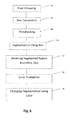
- Fig. 4 shows a flow chart of one example method.
- the steps in this example generally comprise grouping pixels as illustrated by block 44, determining or estimating a blur as illustrated by block 46, performing a threshold calculation as illustrated by block 48, performing a segmentation using the determined or estimated blur as illustrated by block 50, shrinking a segmented region boundary as illustrated by block 52, calculating a color probability as illustrated by block 54 and changing the segmentation using the color probability as illustrated by block 56.
- additional steps may be performed, and/or some of these steps may be modified, adjusted or omitted.
- the below detailed further explanation is merely exemplary, and should not be considered as limiting.
- clustering of the original image may be applied to form super-pixels.
- Well-known super-pixel algorithms such as Simple Linear Iterative Clustering (SLIC) for example, may be used at this step.
- SLIC Simple Linear Iterative Clustering
- each super pixel besides its label ID, geometry center, its neighbors, mean color values for each color channel (L, a, b) may be calculated. If the image is not in Lab color space, it may be converted to Lab color space first.
- Fig. 5 shows an example of a grouped super-pixel result from the image shown in Fig. 3 .
- the blur measurement of the super-pixels may be calculated.
- the blur of each super-pixel may be defined in any suitable way such as, for example, the maximum pixel blur of all the pixels inside the super-pixel, the sum of the blur of all the pixels inside the super-pixel, or the mean blur (the mean of the blur of all the pixels inside the super-pixel), etc.
- the mean blur of all the super pixel neighbors of Sp was calculated, and then the maximum of the mean blur was picked as the blur measurement of the super-pixel Sp.
- the information contained in a super pixel includes a blur measure br :
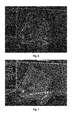
- Figs. 6 and 7 show examples of the blur measure for each pixel and each super-pixel, respectively, from the image shown in Fig. 3 .
- a simple segmentation algorithm may use thresholding; content adaptive thresholding selection for example. Thresholding is perhaps the simplest method of image segmentation. From a grayscale image, thresholding can be used to create binary images. For example, Otsu's algorithm (maximum variance), described in “ N. Otsu, A threshold selection method from gray-level histograms, IEEE Trans. Sys., Man. Cyber. 9 (1): 62-66, 1979 ", is a histogram based adaptive algorithm. However, histogram based algorithms in the past failed to consider local information in which neighboring pixels may have strong correlation on the segmentation result. Fig. 8 shows a segmentation result using thresholding of the image shown in Fig. 3 .
- an alpha-expansion algorithm such as described in " Boykov, Y. et al., Fast approximate energy minimization via graph cuts, IEEE Transactions on Pattern Analysis and Machine Intelligence, (Volume:23 , Issue: 11 )" for example, may be applied to label which super-pixel belongs to which blur layer.
- An alpha-expansion algorithm is described for example in U.S. patent publication No. 2013/0107010 A1 which is hereby incorporated by reference in its entirety.
- data cost is defined as how the blur measure of the super pixel compares against the selected adaptive threshold ( T ):
- the Binary cost may be defined as Potts model:
- a swap move algorithm may comprise, for example:
- An expansion move algorithm may comprise, for example:
- a segmentation map in which each super-pixel has one unique label (e.g., 0 for foreground and 1 for background) indicating which layer it belongs to.
- Fig. 9 shows an example of such a segmentation map for the image in Fig. 3 .
- the result in Fig. 9 is more compact. This is due to the binary term in alpha expansion to encourage smoothness.
- an image may contain more than two (2) layers (foreground and background).
- the problem can be first considered as a binary problem of foreground against another layer LA, which can be further processed as foreground against another.
- the problem may be converted to a series of binary (foreground/background) problems.
- each super-pixel may have one unique label indicating the different uniform blur layer to which it belongs.
- the problem is a binary problem where foreground is in-focus and background is out-of-focus.
- a super-pixel may be labeled as foreground if the super-pixel belongs to one layer; and another super-pixel may be labeled as background if it belongs to other layers.
- the blur segmentation result may cross over the foreground/background region because of the blur ambiguity along the depth border.
- shrinking may be applied for each foreground super-pixel and background super-pixel if it is located along the boundary between the foreground and the background. It should be noted that the shrinking process can be omitted. Alternatively, the shrinking process may be repeated multiple times.
- Fig. 10 shows an example of the shrinking result. The remaining foreground super-pixels may be considered as foreground, and the remaining background super-pixels may be considered as background to calculate color probability in the next step.
- a graph cut algorithm may be used to do foreground and background segmentation on the two color distributions. This time, the data cost is the color distribution and the binary cost may still be Pott's model as well.
- the graph cut algorithm may be, for example, similar to the method described in " Y.Y. Boykov and M.P. Jolly, Interactive graph cuts for optimal boundary and region segmentation of objects in n-d images," in ICCV01, 2001, pp 105-112 ", but in our case, we do not require user input.
- Fig. 11 shows the final result after 56; after the graph cut algorithm has been used for changing the segmentation of Fig. 10 . As can be seen, the in-focus airplane 60 of Fig. 3 is easily discernible in the segmented area 60'.
- automatic segmentation may be provided with no user input required. However user input can be easily combined into the framework.
- pixels may be grouped together into super-pixels to improve the robustness and improve the computational efficiency.
- color based segmentation may be used to improve segmentation from a previous method.
- An example method may comprise segmenting an image into different segments, where the segmenting is based at least partially upon an estimate of blur of areas of the image; and changing the segmenting of two or more of the sections based, at least partially, upon color in the image.
- Pixels of the image may be grouped together to form super-pixels, and where at least some of the areas having the estimate of blur are a respective one of the super-pixels.
- the estimate of blur for a respective one of the super-pixels may comprise one or more of a maximum pixel blur of all pixels inside the super-pixel, a sum of the blur of all the pixels inside the super-pixel, a mean of the blur of all the pixels inside the super-pixel.
- the segmenting may comprise applying thresholding to a first segmentation to produce a second segmentation.
- the segmenting may form a map comprising at least a first blur layer of the areas based upon the estimate of blur and a different second blur layer of the areas based upon the estimate of blur, and the method further comprises using shrinking along one or more boundaries between the first and second layers on the map.
- the method may further comprise calculating color probability of the areas, where the calculation of the color probability is used for the changing of the segmenting.
- the segmenting and/or the changing may comprise use of user input from a user.
- the changing, based upon color may comprise use of a graph cut algorithm to the different segments.
- An example embodiment may be provided in an apparatus comprising at least one processor; and at least one non-transitory memory including computer program code, the at least one memory and the computer program code configured, with the at least one processor, cause the apparatus at least to: segment an image into different segments, where segmenting of the image into different segments is based at least partially upon an estimate of blur of areas of the image; and change the segmenting of two or more of the sections based, at least partially, upon color in the image.
- Pixels of the image may be grouped together to form super-pixels, and where at least some of the areas having the estimate of blur are a respective one of the super-pixels.
- the estimate of blur for a respective one of the super-pixels may comprise one or more of: a maximum pixel blur of all pixels inside the super-pixel, a sum of the blur of all the pixels inside the super-pixel, a mean of the blur of all the pixels inside the super-pixel.
- the segment of the image may comprise applying thresholding to a first segmentation to produce a second segmentation.
- the segment of the image may form a map comprising at least a first blur layer of the areas based upon the estimate of blur and a different second blur layer of the areas based upon the estimate of blur, and the method further comprises using shrinking along one or more boundaries between the first and second layers on the map.
- the at least one memory and the computer program code may be configured, with the at least one processor, to cause the apparatus to calculate color probability of the areas, where the calculation of the color probability is used for the changing of the segmenting.
- the segment of the image and/or the change of the segment of the image may comprise use of user input from a user.
- the change of the segment of the image, based upon color, may comprise the at least one memory and the computer program code being configured, with the at least one processor, to use of a graph cut algorithm to the different segments.
- the apparatus may further comprise at least one printed wiring board having the at least one memory and the at least one processor thereon; an electrical display connected to the at least one printed wiring board; a receiver connected to the at least one printed wiring board; a transmitter connected to the at least one printed wiring board; and a battery connected to the at least one printed wiring board.
- An example embodiment may be provided in a non-transitory program storage device, such as memory 24 for example, readable by a machine, such as 10 for example, tangibly embodying a program of instructions executable by the machine for performing operations, the operations comprising: segmenting an image into different segments, where the segmenting is based at least partially upon an estimate of blur of areas of the image; and changing the segmenting of two or more of the sections based, at least partially, upon color in the image.
- a non-transitory program storage device such as memory 24 for example, readable by a machine, such as 10 for example, tangibly embodying a program of instructions executable by the machine for performing operations, the operations comprising: segmenting an image into different segments, where the segmenting is based at least partially upon an estimate of blur of areas of the image; and changing the segmenting of two or more of the sections based, at least partially, upon color in the image.
- the computer readable medium may be a computer readable signal medium or a non-transitory computer readable storage medium.
- a non-transitory computer readable storage medium does not include propagating signals and may be, for example, but not limited to, an electronic, magnetic, optical, electromagnetic, infrared, or semiconductor system, apparatus, or device, or any suitable combination of the foregoing.
- the computer readable storage medium would include the following: an electrical connection having one or more wires, a portable computer diskette, a hard disk, a random access memory (RAM), a read-only memory (ROM), an erasable programmable read-only memory (EPROM or Flash memory), an optical fiber, a portable compact disc read-only memory (CD-ROM), an optical storage device, a magnetic storage device, or any suitable combination of the foregoing.
- An example embodiment may be provided in an apparatus comprising means for segmenting an image into different segments, where segmenting of the image into different segments is based at least partially upon an estimate of blur of areas of the image; and means for changing the segmenting of two or more of the sections based, at least partially, upon color in the image.
Landscapes
- Engineering & Computer Science (AREA)
- Computer Vision & Pattern Recognition (AREA)
- Physics & Mathematics (AREA)
- General Physics & Mathematics (AREA)
- Theoretical Computer Science (AREA)
- Image Analysis (AREA)
- Color Image Communication Systems (AREA)
- Image Processing (AREA)
Applications Claiming Priority (1)
| Application Number | Priority Date | Filing Date | Title |
|---|---|---|---|
| US14/247,453 US9342754B2 (en) | 2014-04-08 | 2014-04-08 | Image segmentation using blur and color |
Publications (3)
| Publication Number | Publication Date |
|---|---|
| EP2930687A2 true EP2930687A2 (de) | 2015-10-14 |
| EP2930687A3 EP2930687A3 (de) | 2015-10-28 |
| EP2930687B1 EP2930687B1 (de) | 2017-10-11 |
Family
ID=52823457
Family Applications (1)
| Application Number | Title | Priority Date | Filing Date |
|---|---|---|---|
| EP15160428.7A Active EP2930687B1 (de) | 2014-04-08 | 2015-03-24 | Bildsegmentierung mittels unschärfe und farbe |
Country Status (2)
| Country | Link |
|---|---|
| US (1) | US9342754B2 (de) |
| EP (1) | EP2930687B1 (de) |
Families Citing this family (3)
| Publication number | Priority date | Publication date | Assignee | Title |
|---|---|---|---|---|
| JP6368149B2 (ja) * | 2014-06-04 | 2018-08-01 | キヤノン株式会社 | 画像伝送システム、画像処理装置、画像蓄積装置、及びそれらの制御方法 |
| WO2016203282A1 (en) | 2015-06-18 | 2016-12-22 | The Nielsen Company (Us), Llc | Methods and apparatus to capture photographs using mobile devices |
| US20190012789A1 (en) * | 2015-07-21 | 2019-01-10 | Heptagon Micro Optics Pte. Ltd. | Generating a disparity map based on stereo images of a scene |
Citations (2)
| Publication number | Priority date | Publication date | Assignee | Title |
|---|---|---|---|---|
| US20130107010A1 (en) | 2011-11-02 | 2013-05-02 | Microsoft Corporation | Surface segmentation from rgb and depth images |
| US20130127824A1 (en) | 2011-03-01 | 2013-05-23 | Scott D. Cohen | Object Selection in Stereo Image Pairs |
Family Cites Families (7)
| Publication number | Priority date | Publication date | Assignee | Title |
|---|---|---|---|---|
| DE69523135T2 (de) * | 1994-12-28 | 2002-05-02 | Canon K.K., Tokio/Tokyo | Bildverarbeitungsvorrichtung und Verfahren |
| US7660463B2 (en) | 2004-06-03 | 2010-02-09 | Microsoft Corporation | Foreground extraction using iterated graph cuts |
| US8175379B2 (en) * | 2008-08-22 | 2012-05-08 | Adobe Systems Incorporated | Automatic video image segmentation |
| US8503801B2 (en) * | 2010-09-21 | 2013-08-06 | Adobe Systems Incorporated | System and method for classifying the blur state of digital image pixels |
| US8472718B2 (en) | 2011-04-27 | 2013-06-25 | Sony Corporation | Superpixel segmentation methods and systems |
| EP2637139A1 (de) | 2012-03-05 | 2013-09-11 | Thomson Licensing | Verfahren und Vorrichtung für die Zweischichtsegmentierung |
| CN103208123B (zh) | 2013-04-19 | 2016-03-02 | 广东图图搜网络科技有限公司 | 图像分割方法与系统 |
-
2014
- 2014-04-08 US US14/247,453 patent/US9342754B2/en active Active
-
2015
- 2015-03-24 EP EP15160428.7A patent/EP2930687B1/de active Active
Patent Citations (2)
| Publication number | Priority date | Publication date | Assignee | Title |
|---|---|---|---|---|
| US20130127824A1 (en) | 2011-03-01 | 2013-05-23 | Scott D. Cohen | Object Selection in Stereo Image Pairs |
| US20130107010A1 (en) | 2011-11-02 | 2013-05-02 | Microsoft Corporation | Surface segmentation from rgb and depth images |
Non-Patent Citations (4)
| Title |
|---|
| BOYKOV, Y. ET AL.: "Fast approximate energy minimization via graph cuts", IEEE TRANSACTIONS ON PATTERN ANALYSIS AND MACHINE INTELLIGENCE, vol. 23, no. 11, XP011093916, DOI: doi:10.1109/34.969114 |
| C. YANG ET AL.: "Improved fast gauss transform and efficient kernel density estimation", IEEE INTERNATIONAL CONFERENCE ON COMPUTER VISION, 2003, pages 664 - 671 |
| N. OTSU: "A threshold selection method from gray-level histograms", IEEE TRANS. SYS., MAN. CYBER., vol. 9, no. 1, 1979, pages 62 - 66 |
| Y.Y. BOYKOV; M.P. JOLLY: "Interactive graph cuts for optimal boundary and region segmentation of objects in n-d images", ICCV01, 2001, pages 105 - 112, XP010553969 |
Also Published As
| Publication number | Publication date |
|---|---|
| US20150287209A1 (en) | 2015-10-08 |
| EP2930687B1 (de) | 2017-10-11 |
| US9342754B2 (en) | 2016-05-17 |
| EP2930687A3 (de) | 2015-10-28 |
Similar Documents
| Publication | Publication Date | Title |
|---|---|---|
| US11410277B2 (en) | Method and device for blurring image background, storage medium and electronic apparatus | |
| CN108765278B (zh) | 一种图像处理方法、移动终端及计算机可读存储介质 | |
| CN111327945B (zh) | 用于分割视频的方法和装置 | |
| EP2863362B1 (de) | Verfahren und Vorrichtung zur Szenensegmentation aus fokalen Stapelbildern | |
| JP6240199B2 (ja) | 画像における対象物の識別方法及び装置 | |
| US9542735B2 (en) | Method and device to compose an image by eliminating one or more moving objects | |
| CN105243371A (zh) | 一种人脸美颜程度的检测方法、系统及拍摄终端 | |
| CN111161299B (zh) | 影像分割方法、存储介质及电子装置 | |
| CN110781770B (zh) | 基于人脸识别的活体检测方法、装置及设备 | |
| US10872244B2 (en) | Road marking extraction from in-vehicle video | |
| CN108805838B (zh) | 一种图像处理方法、移动终端及计算机可读存储介质 | |
| CN108776800A (zh) | 一种图像处理方法、移动终端及计算机可读存储介质 | |
| EP2991036B1 (de) | Verfahren, vorrichtung und computerprogrammprodukt zur disparitätsschätzung von vordergrundobjekten in bildern | |
| WO2013144418A1 (en) | Image segmentation | |
| US9171357B2 (en) | Method, apparatus and computer-readable recording medium for refocusing photographed image | |
| EP2930687B1 (de) | Bildsegmentierung mittels unschärfe und farbe | |
| KR101592087B1 (ko) | 배경 영상의 위치를 이용한 관심맵 생성 방법 및 이를 기록한 기록 매체 | |
| CN104933688B (zh) | 一种数据处理方法及电子设备 | |
| JP5979008B2 (ja) | 画像処理装置、画像処理方法及びプログラム | |
| CN113012055A (zh) | 一种图像景物增强方法、装置、终端及存储介质 | |
| KR101537788B1 (ko) | 평균이동 기반의 영상분할 방식을 이용한 저조도 영상 대비증가 방법 | |
| CN116091785B (zh) | 识别模型的生成方法、装置、电子设备及存储介质 | |
| CN118172377B (zh) | 文本的前景轮廓、水印图获取方法、系统、装置及介质 | |
| CN112949356B (zh) | 活体检测的方法和装置 | |
| KR101749539B1 (ko) | 캐니 연산자의 가변적 임계값을 적용한 문자 추출 장치 및 방법 |
Legal Events
| Date | Code | Title | Description |
|---|---|---|---|
| PUAL | Search report despatched |
Free format text: ORIGINAL CODE: 0009013 |
|
| PUAI | Public reference made under article 153(3) epc to a published international application that has entered the european phase |
Free format text: ORIGINAL CODE: 0009012 |
|
| AK | Designated contracting states |
Kind code of ref document: A2 Designated state(s): AL AT BE BG CH CY CZ DE DK EE ES FI FR GB GR HR HU IE IS IT LI LT LU LV MC MK MT NL NO PL PT RO RS SE SI SK SM TR |
|
| AX | Request for extension of the european patent |
Extension state: BA ME |
|
| AK | Designated contracting states |
Kind code of ref document: A3 Designated state(s): AL AT BE BG CH CY CZ DE DK EE ES FI FR GB GR HR HU IE IS IT LI LT LU LV MC MK MT NL NO PL PT RO RS SE SI SK SM TR |
|
| AX | Request for extension of the european patent |
Extension state: BA ME |
|
| RIC1 | Information provided on ipc code assigned before grant |
Ipc: G06T 7/00 20060101AFI20150922BHEP |
|
| 17P | Request for examination filed |
Effective date: 20160425 |
|
| RBV | Designated contracting states (corrected) |
Designated state(s): AL AT BE BG CH CY CZ DE DK EE ES FI FR GB GR HR HU IE IS IT LI LT LU LV MC MK MT NL NO PL PT RO RS SE SI SK SM TR |
|
| REG | Reference to a national code |
Ref country code: DE Ref legal event code: R079 Ref document number: 602015005226 Country of ref document: DE Free format text: PREVIOUS MAIN CLASS: G06T0007000000 Ipc: G06T0007571000 |
|
| GRAP | Despatch of communication of intention to grant a patent |
Free format text: ORIGINAL CODE: EPIDOSNIGR1 |
|
| STAA | Information on the status of an ep patent application or granted ep patent |
Free format text: STATUS: GRANT OF PATENT IS INTENDED |
|
| RIC1 | Information provided on ipc code assigned before grant |
Ipc: G06T 7/571 20170101AFI20170418BHEP Ipc: G06T 7/11 20170101ALI20170418BHEP |
|
| INTG | Intention to grant announced |
Effective date: 20170518 |
|
| GRAS | Grant fee paid |
Free format text: ORIGINAL CODE: EPIDOSNIGR3 |
|
| GRAA | (expected) grant |
Free format text: ORIGINAL CODE: 0009210 |
|
| STAA | Information on the status of an ep patent application or granted ep patent |
Free format text: STATUS: THE PATENT HAS BEEN GRANTED |
|
| AK | Designated contracting states |
Kind code of ref document: B1 Designated state(s): AL AT BE BG CH CY CZ DE DK EE ES FI FR GB GR HR HU IE IS IT LI LT LU LV MC MK MT NL NO PL PT RO RS SE SI SK SM TR |
|
| REG | Reference to a national code |
Ref country code: GB Ref legal event code: FG4D |
|
| REG | Reference to a national code |
Ref country code: CH Ref legal event code: EP |
|
| REG | Reference to a national code |
Ref country code: IE Ref legal event code: FG4D |
|
| REG | Reference to a national code |
Ref country code: AT Ref legal event code: REF Ref document number: 936677 Country of ref document: AT Kind code of ref document: T Effective date: 20171115 |
|
| REG | Reference to a national code |
Ref country code: DE Ref legal event code: R096 Ref document number: 602015005226 Country of ref document: DE |
|
| REG | Reference to a national code |
Ref country code: NL Ref legal event code: MP Effective date: 20171011 |
|
| REG | Reference to a national code |
Ref country code: LT Ref legal event code: MG4D |
|
| REG | Reference to a national code |
Ref country code: AT Ref legal event code: MK05 Ref document number: 936677 Country of ref document: AT Kind code of ref document: T Effective date: 20171011 |
|
| PG25 | Lapsed in a contracting state [announced via postgrant information from national office to epo] |
Ref country code: NL Free format text: LAPSE BECAUSE OF FAILURE TO SUBMIT A TRANSLATION OF THE DESCRIPTION OR TO PAY THE FEE WITHIN THE PRESCRIBED TIME-LIMIT Effective date: 20171011 |
|
| PG25 | Lapsed in a contracting state [announced via postgrant information from national office to epo] |
Ref country code: SE Free format text: LAPSE BECAUSE OF FAILURE TO SUBMIT A TRANSLATION OF THE DESCRIPTION OR TO PAY THE FEE WITHIN THE PRESCRIBED TIME-LIMIT Effective date: 20171011 Ref country code: NO Free format text: LAPSE BECAUSE OF FAILURE TO SUBMIT A TRANSLATION OF THE DESCRIPTION OR TO PAY THE FEE WITHIN THE PRESCRIBED TIME-LIMIT Effective date: 20180111 Ref country code: ES Free format text: LAPSE BECAUSE OF FAILURE TO SUBMIT A TRANSLATION OF THE DESCRIPTION OR TO PAY THE FEE WITHIN THE PRESCRIBED TIME-LIMIT Effective date: 20171011 Ref country code: LT Free format text: LAPSE BECAUSE OF FAILURE TO SUBMIT A TRANSLATION OF THE DESCRIPTION OR TO PAY THE FEE WITHIN THE PRESCRIBED TIME-LIMIT Effective date: 20171011 Ref country code: FI Free format text: LAPSE BECAUSE OF FAILURE TO SUBMIT A TRANSLATION OF THE DESCRIPTION OR TO PAY THE FEE WITHIN THE PRESCRIBED TIME-LIMIT Effective date: 20171011 |
|
| PG25 | Lapsed in a contracting state [announced via postgrant information from national office to epo] |
Ref country code: BG Free format text: LAPSE BECAUSE OF FAILURE TO SUBMIT A TRANSLATION OF THE DESCRIPTION OR TO PAY THE FEE WITHIN THE PRESCRIBED TIME-LIMIT Effective date: 20180111 Ref country code: IS Free format text: LAPSE BECAUSE OF FAILURE TO SUBMIT A TRANSLATION OF THE DESCRIPTION OR TO PAY THE FEE WITHIN THE PRESCRIBED TIME-LIMIT Effective date: 20180211 Ref country code: AT Free format text: LAPSE BECAUSE OF FAILURE TO SUBMIT A TRANSLATION OF THE DESCRIPTION OR TO PAY THE FEE WITHIN THE PRESCRIBED TIME-LIMIT Effective date: 20171011 Ref country code: RS Free format text: LAPSE BECAUSE OF FAILURE TO SUBMIT A TRANSLATION OF THE DESCRIPTION OR TO PAY THE FEE WITHIN THE PRESCRIBED TIME-LIMIT Effective date: 20171011 Ref country code: LV Free format text: LAPSE BECAUSE OF FAILURE TO SUBMIT A TRANSLATION OF THE DESCRIPTION OR TO PAY THE FEE WITHIN THE PRESCRIBED TIME-LIMIT Effective date: 20171011 Ref country code: GR Free format text: LAPSE BECAUSE OF FAILURE TO SUBMIT A TRANSLATION OF THE DESCRIPTION OR TO PAY THE FEE WITHIN THE PRESCRIBED TIME-LIMIT Effective date: 20180112 Ref country code: HR Free format text: LAPSE BECAUSE OF FAILURE TO SUBMIT A TRANSLATION OF THE DESCRIPTION OR TO PAY THE FEE WITHIN THE PRESCRIBED TIME-LIMIT Effective date: 20171011 |
|
| REG | Reference to a national code |
Ref country code: DE Ref legal event code: R097 Ref document number: 602015005226 Country of ref document: DE |
|
| PG25 | Lapsed in a contracting state [announced via postgrant information from national office to epo] |
Ref country code: DK Free format text: LAPSE BECAUSE OF FAILURE TO SUBMIT A TRANSLATION OF THE DESCRIPTION OR TO PAY THE FEE WITHIN THE PRESCRIBED TIME-LIMIT Effective date: 20171011 Ref country code: SK Free format text: LAPSE BECAUSE OF FAILURE TO SUBMIT A TRANSLATION OF THE DESCRIPTION OR TO PAY THE FEE WITHIN THE PRESCRIBED TIME-LIMIT Effective date: 20171011 Ref country code: EE Free format text: LAPSE BECAUSE OF FAILURE TO SUBMIT A TRANSLATION OF THE DESCRIPTION OR TO PAY THE FEE WITHIN THE PRESCRIBED TIME-LIMIT Effective date: 20171011 Ref country code: CZ Free format text: LAPSE BECAUSE OF FAILURE TO SUBMIT A TRANSLATION OF THE DESCRIPTION OR TO PAY THE FEE WITHIN THE PRESCRIBED TIME-LIMIT Effective date: 20171011 |
|
| PLBE | No opposition filed within time limit |
Free format text: ORIGINAL CODE: 0009261 |
|
| STAA | Information on the status of an ep patent application or granted ep patent |
Free format text: STATUS: NO OPPOSITION FILED WITHIN TIME LIMIT |
|
| PG25 | Lapsed in a contracting state [announced via postgrant information from national office to epo] |
Ref country code: IT Free format text: LAPSE BECAUSE OF FAILURE TO SUBMIT A TRANSLATION OF THE DESCRIPTION OR TO PAY THE FEE WITHIN THE PRESCRIBED TIME-LIMIT Effective date: 20171011 Ref country code: SM Free format text: LAPSE BECAUSE OF FAILURE TO SUBMIT A TRANSLATION OF THE DESCRIPTION OR TO PAY THE FEE WITHIN THE PRESCRIBED TIME-LIMIT Effective date: 20171011 Ref country code: PL Free format text: LAPSE BECAUSE OF FAILURE TO SUBMIT A TRANSLATION OF THE DESCRIPTION OR TO PAY THE FEE WITHIN THE PRESCRIBED TIME-LIMIT Effective date: 20171011 Ref country code: RO Free format text: LAPSE BECAUSE OF FAILURE TO SUBMIT A TRANSLATION OF THE DESCRIPTION OR TO PAY THE FEE WITHIN THE PRESCRIBED TIME-LIMIT Effective date: 20171011 |
|
| 26N | No opposition filed |
Effective date: 20180712 |
|
| REG | Reference to a national code |
Ref country code: CH Ref legal event code: PL |
|
| PG25 | Lapsed in a contracting state [announced via postgrant information from national office to epo] |
Ref country code: MC Free format text: LAPSE BECAUSE OF FAILURE TO SUBMIT A TRANSLATION OF THE DESCRIPTION OR TO PAY THE FEE WITHIN THE PRESCRIBED TIME-LIMIT Effective date: 20171011 Ref country code: SI Free format text: LAPSE BECAUSE OF FAILURE TO SUBMIT A TRANSLATION OF THE DESCRIPTION OR TO PAY THE FEE WITHIN THE PRESCRIBED TIME-LIMIT Effective date: 20171011 |
|
| REG | Reference to a national code |
Ref country code: BE Ref legal event code: MM Effective date: 20180331 |
|
| REG | Reference to a national code |
Ref country code: IE Ref legal event code: MM4A |
|
| PG25 | Lapsed in a contracting state [announced via postgrant information from national office to epo] |
Ref country code: LU Free format text: LAPSE BECAUSE OF NON-PAYMENT OF DUE FEES Effective date: 20180324 |
|
| PG25 | Lapsed in a contracting state [announced via postgrant information from national office to epo] |
Ref country code: IE Free format text: LAPSE BECAUSE OF NON-PAYMENT OF DUE FEES Effective date: 20180324 |
|
| PG25 | Lapsed in a contracting state [announced via postgrant information from national office to epo] |
Ref country code: CH Free format text: LAPSE BECAUSE OF NON-PAYMENT OF DUE FEES Effective date: 20180331 Ref country code: BE Free format text: LAPSE BECAUSE OF NON-PAYMENT OF DUE FEES Effective date: 20180331 Ref country code: LI Free format text: LAPSE BECAUSE OF NON-PAYMENT OF DUE FEES Effective date: 20180331 |
|
| PG25 | Lapsed in a contracting state [announced via postgrant information from national office to epo] |
Ref country code: FR Free format text: LAPSE BECAUSE OF NON-PAYMENT OF DUE FEES Effective date: 20180331 |
|
| GBPC | Gb: european patent ceased through non-payment of renewal fee |
Effective date: 20190324 |
|
| PG25 | Lapsed in a contracting state [announced via postgrant information from national office to epo] |
Ref country code: GB Free format text: LAPSE BECAUSE OF NON-PAYMENT OF DUE FEES Effective date: 20190324 Ref country code: MT Free format text: LAPSE BECAUSE OF NON-PAYMENT OF DUE FEES Effective date: 20180324 |
|
| PG25 | Lapsed in a contracting state [announced via postgrant information from national office to epo] |
Ref country code: TR Free format text: LAPSE BECAUSE OF FAILURE TO SUBMIT A TRANSLATION OF THE DESCRIPTION OR TO PAY THE FEE WITHIN THE PRESCRIBED TIME-LIMIT Effective date: 20171011 |
|
| PG25 | Lapsed in a contracting state [announced via postgrant information from national office to epo] |
Ref country code: PT Free format text: LAPSE BECAUSE OF FAILURE TO SUBMIT A TRANSLATION OF THE DESCRIPTION OR TO PAY THE FEE WITHIN THE PRESCRIBED TIME-LIMIT Effective date: 20171011 |
|
| PG25 | Lapsed in a contracting state [announced via postgrant information from national office to epo] |
Ref country code: MK Free format text: LAPSE BECAUSE OF NON-PAYMENT OF DUE FEES Effective date: 20171011 Ref country code: CY Free format text: LAPSE BECAUSE OF FAILURE TO SUBMIT A TRANSLATION OF THE DESCRIPTION OR TO PAY THE FEE WITHIN THE PRESCRIBED TIME-LIMIT Effective date: 20171011 Ref country code: HU Free format text: LAPSE BECAUSE OF FAILURE TO SUBMIT A TRANSLATION OF THE DESCRIPTION OR TO PAY THE FEE WITHIN THE PRESCRIBED TIME-LIMIT; INVALID AB INITIO Effective date: 20150324 |
|
| PG25 | Lapsed in a contracting state [announced via postgrant information from national office to epo] |
Ref country code: AL Free format text: LAPSE BECAUSE OF FAILURE TO SUBMIT A TRANSLATION OF THE DESCRIPTION OR TO PAY THE FEE WITHIN THE PRESCRIBED TIME-LIMIT Effective date: 20171011 |
|
| P01 | Opt-out of the competence of the unified patent court (upc) registered |
Effective date: 20230527 |
|
| PGFP | Annual fee paid to national office [announced via postgrant information from national office to epo] |
Ref country code: DE Payment date: 20260204 Year of fee payment: 12 |