EP2930877A1 - Procédés et dispositifs de déchiffrement aveugle de texte chiffré au moyen d'un cryptosystème de Paillier - Google Patents
Procédés et dispositifs de déchiffrement aveugle de texte chiffré au moyen d'un cryptosystème de Paillier Download PDFInfo
- Publication number
- EP2930877A1 EP2930877A1 EP14305536.6A EP14305536A EP2930877A1 EP 2930877 A1 EP2930877 A1 EP 2930877A1 EP 14305536 A EP14305536 A EP 14305536A EP 2930877 A1 EP2930877 A1 EP 2930877A1
- Authority
- EP
- European Patent Office
- Prior art keywords
- value
- ciphertext
- modulus
- modulo
- blinded
- Prior art date
- Legal status (The legal status is an assumption and is not a legal conclusion. Google has not performed a legal analysis and makes no representation as to the accuracy of the status listed.)
- Withdrawn
Links
- 238000000034 method Methods 0.000 title claims description 46
- 238000004364 calculation method Methods 0.000 claims description 53
- 238000004590 computer program Methods 0.000 claims description 12
- 230000001939 inductive effect Effects 0.000 claims description 4
- 230000000670 limiting effect Effects 0.000 description 2
- 230000004044 response Effects 0.000 description 2
- 230000005540 biological transmission Effects 0.000 description 1
- 239000002131 composite material Substances 0.000 description 1
- 230000006870 function Effects 0.000 description 1
Images

Classifications
-
- H—ELECTRICITY
- H04—ELECTRIC COMMUNICATION TECHNIQUE
- H04L—TRANSMISSION OF DIGITAL INFORMATION, e.g. TELEGRAPHIC COMMUNICATION
- H04L9/00—Cryptographic mechanisms or cryptographic arrangements for secret or secure communications; Network security protocols
- H04L9/30—Public key, i.e. encryption algorithm being computationally infeasible to invert or user's encryption keys not requiring secrecy
- H04L9/3006—Public key, i.e. encryption algorithm being computationally infeasible to invert or user's encryption keys not requiring secrecy underlying computational problems or public-key parameters
-
- H—ELECTRICITY
- H04—ELECTRIC COMMUNICATION TECHNIQUE
- H04L—TRANSMISSION OF DIGITAL INFORMATION, e.g. TELEGRAPHIC COMMUNICATION
- H04L9/00—Cryptographic mechanisms or cryptographic arrangements for secret or secure communications; Network security protocols
- H04L9/30—Public key, i.e. encryption algorithm being computationally infeasible to invert or user's encryption keys not requiring secrecy
- H04L9/3006—Public key, i.e. encryption algorithm being computationally infeasible to invert or user's encryption keys not requiring secrecy underlying computational problems or public-key parameters
- H04L9/302—Public key, i.e. encryption algorithm being computationally infeasible to invert or user's encryption keys not requiring secrecy underlying computational problems or public-key parameters involving the integer factorization problem, e.g. RSA or quadratic sieve [QS] schemes
-
- H—ELECTRICITY
- H04—ELECTRIC COMMUNICATION TECHNIQUE
- H04L—TRANSMISSION OF DIGITAL INFORMATION, e.g. TELEGRAPHIC COMMUNICATION
- H04L9/00—Cryptographic mechanisms or cryptographic arrangements for secret or secure communications; Network security protocols
- H04L9/008—Cryptographic mechanisms or cryptographic arrangements for secret or secure communications; Network security protocols involving homomorphic encryption
-
- H—ELECTRICITY
- H04—ELECTRIC COMMUNICATION TECHNIQUE
- H04L—TRANSMISSION OF DIGITAL INFORMATION, e.g. TELEGRAPHIC COMMUNICATION
- H04L2209/00—Additional information or applications relating to cryptographic mechanisms or cryptographic arrangements for secret or secure communication H04L9/00
- H04L2209/76—Proxy, i.e. using intermediary entity to perform cryptographic operations
Definitions
- the present disclosure relates generally to cryptography, and in particular to blind decryption in public-key cryptosystems.
- Pascal Paillier proposed a new public-key cryptosystem [Pascal Paillier. Public-key cryptosystems based on composite degree residuosity classes.
- Jacques Stern, editor Advances in Cryptology - EUROCRYPT '99, volume 1592 of Lecture Notes in Computer Science, pages 223-238. Springer, 1999 ], which was later generalized by Damg ⁇ rd and Jurik [ Ivan Damg ⁇ rd and Mads Jurik.
- Kwangjo Kim editor, Public Key Cryptography, volume 1992 of Lecture Notes in Computer Science, pages 119-136. Springer, 2001 ] and which can be described as follows:
- the owner of the private decryption key ⁇ learns no information about a given plaintext.
- a user wishing to get the decryption of a given ciphertext blinds the ciphertext.
- the decryptor sends m * to the user.
- the disclosure is directed to a cryptographic device comprising: an interface configured to send a blinded ciphertext c 0 to a decryption device and to receive a return value ⁇ 1 from the decryption device; and a processor configured to: obtain a ciphertext c , the ciphertext c having been generated using an encryption method with a public key comprising a modulus N being the product of at least two primes p , q ; calculate the blinded ciphertext c 0 by taking the ciphertext c modulo a value based on the modulus N ; calculate a first value ⁇ 0 through a calculation involving an inverse of the blinded ciphertext c 0 modulo a value based on the modulus N ; generate a blinded plaintext m * through a calculation involving a multiplication of the ciphertext c and the first value ⁇ 0 ; and generate a plaintext m through a
- the disclosure is directed to a decryption device comprising: an interface configured to receive a blinded ciphertext c 0 from a cryptographic device and to send a return value ⁇ 1 to the cryptographic device; and a processor configured to: calculate a first key ⁇ 0 through a calculation involving an inversion of a modulus N modulo a value based on a private key ⁇ ; calculate a second value ⁇ 0 through a calculation involving the blinded ciphertext c 0 to the power of the first key ⁇ 0 modulo a value based on the modulus N ; calculate a third value through a calculation involving the second value ⁇ 0 to the power of the modulus N modulo a value based on the modulus N ; and calculate the return value ⁇ 1 through a calculation involving a multiplication of the third value and the blinded ciphertext c 0 .
- the disclosure is directed to a cryptographic device comprising: an interface configured to send a blinded ciphertext c 0 to a decryption device and to receive at least one return value from the decryption device; and a processor configured to: obtain a ciphertext c , the ciphertext c having been generated using an encryption method with a public key comprising a modulus N being the product of at least two primes p, q; calculate the blinded ciphertext c 0 by taking the ciphertext c modulo a value based on the modulus N; calculate a first value through a calculation involving an inverse of the blinded ciphertext c 0 modulo a value based on the modulus N ; obtain a third value from the at least one return value; calculate an exponent value (1 + N ) m modulo a value based on the modulus N through a calculation involving a multiplication between the ciphertext c and the third value
- the disclosure is directed to a decryption device comprising: an interface configured to receive a blinded ciphertext c 0 from a cryptographic device and to send at least one return value to the cryptographic device; and a processor configured to: calculate a first key ⁇ 0 through a calculation involving an inversion of a modulus N to the power of a value s having been used to generate a ciphertext c from which the blinded ciphertext c 0 was calculated, the inversion being taken modulo a value based on a private key ⁇ ; calculate a second value ⁇ 0 through a calculation involving the blinded ciphertext c 0 to the power of the first key ⁇ 0 modulo a value based on the modulus N; calculate a third value through a calculation involving the second value ⁇ 0 to the power of the modulus N to the power of the value s modulo a value based on the modulus N and the value s, the third
- the disclosure is directed to a cryptographic method for generating a plaintext m for a ciphertext c , the method comprising, in a device comprising a processor: obtaining a ciphertext c , the ciphertext c having been generated using an encryption method with a public key comprising a modulus N being the product of at least two primes p, q; calculating a blinded ciphertext c 0 by taking the ciphertext c modulo a value based on the modulus N; calculating a first value ⁇ 0 through a calculation involving an inverse of the blinded ciphertext c 0 modulo a value based on the modulus N; generating a blinded plaintext m * through a calculation involving a multiplication of the ciphertext c and the first value ⁇ 0 ; and generating the plaintext m through a calculation involving an addition of the blinded plaintext m * and the return
- the disclosure is directed to a cryptographic method for blind decryption of a blinded ciphertext c 0 , the method comprising, in a device comprising a processor: obtaining a first key ⁇ 0 , the first key ⁇ 0 having been generated through a calculation involving an inversion of a modulus N modulo a value based on a private key ⁇ ; calculating a second value ⁇ 0 through a calculation involving the blinded ciphertext c 0 to the power of the first key ⁇ 0 modulo a value based on the modulus N ; calculating a third value through a calculation involving the second value ⁇ 0 to the power of the modulus N modulo a value based on the modulus N ; calculating a return value ⁇ 1 through a calculation involving a multiplication of the third value and the blinded ciphertext c 0 ; and outputting the return value ⁇ 1 .
- the disclosure is directed to a cryptographic method for generating a plaintext m for a ciphertext c , the method comprising, in a device comprising a processor: obtaining the ciphertext c , the ciphertext c having been generated using an encryption method with a public key comprising a modulus N being the product of at least two primes p, q; calculating the blinded ciphertext c 0 by taking the ciphertext c modulo a value based on the modulus N ; calculating a first value ⁇ 0 through a calculation involving an inverse of the blinded ciphertext c 0 modulo a value based on the modulus N; obtaining a third value from the at least one return value; calculating an exponent value (1 + N ) m modulo a value based on the modulus N through a calculation involving a multiplication between the ciphertext c and the third value ; and obtaining the plaintext
- the disclosure is directed to a cryptographic method for blind decryption of a blinded ciphertext c 0 , the method comprising, in a device comprising a processor: obtaining a first key ⁇ 0 , the first key ⁇ 0 having been generated through a calculation involving an inversion of a modulus N to the power of a value s having been used to generate a ciphertext c from which the blinded ciphertext c 0 was calculated, the inversion being taken modulo a value based on a private key ⁇ ; calculating a second value ⁇ 0 through a calculation involving the blinded ciphertext c 0 to the power of the first key ⁇ 0 modulo a value based on the modulus N ; calculating a third value through a calculation involving the second value ⁇ 0 to the power of the modulus N to the power of the value s modulo a value based on the modulus N and the value s;
- the disclosure is directed to a computer program product storing instructions that, when executed by a processor, perform the method of the fifth aspect.
- the disclosure is directed to a computer program product storing instructions that, when executed by a processor, perform the method of the sixth aspect.
- the disclosure is directed to a computer program product storing instructions that, when executed by a processor, perform the method of the seventh aspect.
- the disclosure is directed to a computer program product storing instructions that, when executed by a processor, perform the method of the eighth aspect.
- m - ⁇ 1 mod ⁇ N c ⁇ ⁇ 0 mod N 2 - 1 N .
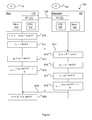
- Figure 1 illustrates a method for blind Paillier decryption according to the present disclosure.
- Figure 1 shows a system 100 comprising a user device 110 and a decryption device 120 ("decryptor").
- Each device 110, 120 comprises an interface 111, 121 configured for communication with the other device, at least one processor (“CPU") 112, 122 and memory 113, 123.
- the devices also comprise other necessary hardware and software components such as internal connections, but these are not shown to simplify the illustration.
- Also shown are a first non-transitory computer program storage medium 114 and a second non-transitory computer program storage medium 116 that store instruction that, when executed by a processor, respectively perform the methods of the user device 110 and the decryptor 120 described hereinafter.
- the decryptor 120 returns S19 the return value ⁇ 1 to the user device 110.
- the clear plaintext m can then for example be output to a user or stored for later retrieval.
- the technique can be generalized to the case s ⁇ 1; the expected relative gain then becomes ( s + 1)/ s .
- the technique is illustrated in Figure 2 .
- the Figure illustrates a simplified version of the user device 210 and the decryptor 220, but it is to be understood that these devices comprise the necessary hardware and software components, essentially those illustrated for the devices in Figure 1 .
- Figure 2 also illustrates a third non-transitory computer program storage medium 214 and a fourth non-transitory computer program storage medium 216 that store instruction that, when executed by a processor, respectively perform the methods of the user device 210 and the decryptor 220 described hereinafter.
- the clear plaintext m can then for example be output to a user or stored for later retrieval.
- the user device 210 and the decryptor 220 exchange c 0 and ⁇ 1 .
- c 0 is obtained by reduction modulo a positive integer multiple (greater than 1) of the modulus N, for example 2 N, which just requires the transmission of one more bit.
- the blind-decryption protocol of the present disclosure is bandwidth optimal. This is particularly advantageous when a large number of Paillier ciphertexts are exchanged, which for example is the case in the privacy-preserving recommendation system described by Nikolaenko, Weinsberg, loannidis, Joye, Boneh and Taft [Valeria Nikolaenko, Udi Weinsberg, Stratis loannidis, Marc Joye, Dan Boneh, and Nina Taft. Privacy-preserving ridge regression on hundreds of millions of records. In 34th IEEE Symposium on Security and Privacy (S&P 2013), pp. 334-348, IEEE Computer Society, 2013]
Landscapes
- Engineering & Computer Science (AREA)
- Computing Systems (AREA)
- Theoretical Computer Science (AREA)
- Computer Security & Cryptography (AREA)
- Computer Networks & Wireless Communication (AREA)
- Signal Processing (AREA)
- Storage Device Security (AREA)
Priority Applications (3)
| Application Number | Priority Date | Filing Date | Title |
|---|---|---|---|
| EP14305536.6A EP2930877A1 (fr) | 2014-04-11 | 2014-04-11 | Procédés et dispositifs de déchiffrement aveugle de texte chiffré au moyen d'un cryptosystème de Paillier |
| US14/679,109 US20150295710A1 (en) | 2014-04-11 | 2015-04-06 | Paillier-based blind decryption methods and devices |
| EP15162535.7A EP2930878A1 (fr) | 2014-04-11 | 2015-04-07 | Procédés et dispositifs de décryptage aveugle à partir du cryptosystème de paillier |
Applications Claiming Priority (1)
| Application Number | Priority Date | Filing Date | Title |
|---|---|---|---|
| EP14305536.6A EP2930877A1 (fr) | 2014-04-11 | 2014-04-11 | Procédés et dispositifs de déchiffrement aveugle de texte chiffré au moyen d'un cryptosystème de Paillier |
Publications (1)
| Publication Number | Publication Date |
|---|---|
| EP2930877A1 true EP2930877A1 (fr) | 2015-10-14 |
Family
ID=50624529
Family Applications (2)
| Application Number | Title | Priority Date | Filing Date |
|---|---|---|---|
| EP14305536.6A Withdrawn EP2930877A1 (fr) | 2014-04-11 | 2014-04-11 | Procédés et dispositifs de déchiffrement aveugle de texte chiffré au moyen d'un cryptosystème de Paillier |
| EP15162535.7A Withdrawn EP2930878A1 (fr) | 2014-04-11 | 2015-04-07 | Procédés et dispositifs de décryptage aveugle à partir du cryptosystème de paillier |
Family Applications After (1)
| Application Number | Title | Priority Date | Filing Date |
|---|---|---|---|
| EP15162535.7A Withdrawn EP2930878A1 (fr) | 2014-04-11 | 2015-04-07 | Procédés et dispositifs de décryptage aveugle à partir du cryptosystème de paillier |
Country Status (2)
| Country | Link |
|---|---|
| US (1) | US20150295710A1 (fr) |
| EP (2) | EP2930877A1 (fr) |
Cited By (2)
| Publication number | Priority date | Publication date | Assignee | Title |
|---|---|---|---|---|
| CN110493201A (zh) * | 2019-07-29 | 2019-11-22 | 北京多思安全芯片科技有限公司 | 一种数据的处理方法、装置和系统 |
| CN113468572A (zh) * | 2021-07-16 | 2021-10-01 | 华控清交信息科技(北京)有限公司 | 密文特征提取方法、装置及电子设备 |
Families Citing this family (4)
| Publication number | Priority date | Publication date | Assignee | Title |
|---|---|---|---|---|
| CN110011781B (zh) * | 2019-03-04 | 2020-05-19 | 华中科技大学 | 用于交易金额加密且支持零知识证明的同态加密方法和介质 |
| CN111131327B (zh) * | 2020-01-06 | 2022-04-01 | 湖北工业大学 | 基于球体的隐私保护的卫星碰撞检测方法及系统 |
| CN112988237B (zh) * | 2021-04-21 | 2021-07-23 | 深圳致星科技有限公司 | 一种Paillier解密系统、芯片和方法 |
| US20250247207A1 (en) * | 2024-01-26 | 2025-07-31 | Samsung Electronics Co., Ltd. | Method and apparatus with homomorphic encryption operation |
Family Cites Families (11)
| Publication number | Priority date | Publication date | Assignee | Title |
|---|---|---|---|---|
| US7640432B2 (en) * | 2000-12-11 | 2009-12-29 | International Business Machines Corporation | Electronic cash controlled by non-homomorphic signatures |
| JP2007510947A (ja) * | 2003-11-03 | 2007-04-26 | コーニンクレッカ フィリップス エレクトロニクス エヌ ヴィ | 多数当事者の効率的な乗算のための方法及び装置 |
| EP1835657B1 (fr) * | 2006-03-16 | 2014-11-12 | Sap Se | Procédés et systèmes de tri multipartite de valeurs privées |
| US7860244B2 (en) * | 2006-12-18 | 2010-12-28 | Sap Ag | Secure computation of private values |
| US20090210349A1 (en) * | 2008-02-14 | 2009-08-20 | Ahmed Ibrahim Al-Herz | Virtual account based new digital cash protocols |
| US8744077B2 (en) * | 2008-10-28 | 2014-06-03 | International Business Machines Corporation | Cryptographic encoding and decoding of secret data |
| US8837715B2 (en) * | 2011-02-17 | 2014-09-16 | Gradiant, Centro Tecnolóxico de Telecomunicacións de Galica | Method and apparatus for secure iterative processing and adaptive filtering |
| US9049011B1 (en) * | 2012-08-15 | 2015-06-02 | Washington State University | Secure key storage and distribution |
| US9165297B2 (en) * | 2012-09-10 | 2015-10-20 | King Fahd University Of Petroleum And Minerals | Virtual account and token-based digital cash protocols |
| US9825758B2 (en) * | 2014-12-02 | 2017-11-21 | Microsoft Technology Licensing, Llc | Secure computer evaluation of k-nearest neighbor models |
| US9565020B1 (en) * | 2016-02-02 | 2017-02-07 | International Business Machines Corporation | System and method for generating a server-assisted strong password from a weak secret |
-
2014
- 2014-04-11 EP EP14305536.6A patent/EP2930877A1/fr not_active Withdrawn
-
2015
- 2015-04-06 US US14/679,109 patent/US20150295710A1/en not_active Abandoned
- 2015-04-07 EP EP15162535.7A patent/EP2930878A1/fr not_active Withdrawn
Non-Patent Citations (6)
| Title |
|---|
| "Field Programmable Logic and Application", vol. 1992, 5 June 2001, SPRINGER BERLIN HEIDELBERG, Berlin, Heidelberg, ISBN: 978-3-54-045234-8, ISSN: 0302-9743, article IVAN DAMGÅRD ET AL: "A Generalisation, a Simpli.cation and Some Applications of Paillier's Probabilistic Public-Key System", pages: 119 - 136, XP055148869, DOI: 10.1007/3-540-44586-2_9 * |
| "Lecture Notes in Computer Science", vol. 1992, 2001, SPRINGER, article "Public Key Cryptography", pages: 119 - 136 |
| IVAN DAMGÃRD ET AL: "A generalization of Paillierâ s public-key system with applications to electronic voting", INTERNATIONAL JOURNAL OF INFORMATION SECURITY, SPRINGER, BERLIN, DE, vol. 9, no. 6, 30 September 2010 (2010-09-30), pages 371 - 385, XP019863855, ISSN: 1615-5270, DOI: 10.1007/S10207-010-0119-9 * |
| JACQUES STERN: "Lecture Notes in Computer Science", vol. 1592, 1999, SPRINGER, article "Advances in Cryptology - EUROCRYPT '99", pages: 223 - 238 |
| PAILLER P ED - STERN J (ED): "PUBLIC-KEY CRYPTOSYSTEMS BASED ON COMPOSITE DEGREE RESIDUOSITY CLASSES", 1 January 1999, ADVANCES IN CRYPTOLOGY - EUROCRYPT '99. INTERNATIONAL CONF. ON THE THEORY AND APPLICATION OF CRYPTOGRAPHIC TECHNIQUES. PRAGUE, CZ, MAY 2 - 6, 1999 PROCEEDINGS; [LECTURE NOTES IN COMPUTER SCIENCE], BERLIN : SPRINGER, DE, PAGE(S) 223 - 238, ISBN: 978-3-540-65889-4, XP000830710 * |
| VALERIA NIKOLAENKO; UDI WEINSBERG; STRATIS LOANNIDIS; MARC JOYE; DAN BONEH; NINA TAFT: "34th IEEE Symposium on Security and Privacy (S&P 2013)", 2013, IEEE COMPUTER SOCIETY, article "Privacy-preserving ridge regression on hundreds of millions of records", pages: 334 - 348 |
Cited By (3)
| Publication number | Priority date | Publication date | Assignee | Title |
|---|---|---|---|---|
| CN110493201A (zh) * | 2019-07-29 | 2019-11-22 | 北京多思安全芯片科技有限公司 | 一种数据的处理方法、装置和系统 |
| CN110493201B (zh) * | 2019-07-29 | 2022-03-18 | 北京多思安全芯片科技有限公司 | 一种数据的处理方法、装置和系统 |
| CN113468572A (zh) * | 2021-07-16 | 2021-10-01 | 华控清交信息科技(北京)有限公司 | 密文特征提取方法、装置及电子设备 |
Also Published As
| Publication number | Publication date |
|---|---|
| EP2930878A1 (fr) | 2015-10-14 |
| US20150295710A1 (en) | 2015-10-15 |
Similar Documents
| Publication | Publication Date | Title |
|---|---|---|
| US20190307790A1 (en) | Method and apparatus for establishing a key agreement protocol | |
| EP1467512B1 (fr) | Procédé de chiffrage utilisant un mappage chaotique et procédé de signature électronique | |
| EP2930878A1 (fr) | Procédés et dispositifs de décryptage aveugle à partir du cryptosystème de paillier | |
| US20080298582A1 (en) | Broadcast Cryptosystem, Crypto-Communication Method, Decryption Device, and Decryption Program | |
| US6898284B2 (en) | Cryptographic identification and digital signature method using efficient elliptic curve | |
| EP2742644B1 (fr) | Procédé de chiffrement et de déchiffrement | |
| Wu | Fully homomorphic encryption: Cryptography's holy grail | |
| US9356783B2 (en) | Method for ciphering and deciphering, corresponding electronic device and computer program product | |
| US6993136B2 (en) | Cryptographic key exchange method using efficient elliptic curve | |
| US12587364B2 (en) | Method of data transmission, and electronic device | |
| EP1675300B1 (fr) | Améliorations dans l'utlisation de correspondances bilinéaires dans des applications cryptographiques | |
| EP3244567A1 (fr) | Chiffrement pour dispositifs à faibles ressources par délégation de génération d'aléas | |
| Saeed et al. | Improved cloud storage security of using three layers cryptography algorithms | |
| US7062044B1 (en) | Method of elliptic curve cryptographic key agreement using coefficient splitting | |
| Liu et al. | New efficient identity based encryption without pairings | |
| Puneeth et al. | Preserving Confidentiality against Factorization Attacks using Fake Modulus ($\zeta $) Approach in RSA and its Security Analysis | |
| US20020025034A1 (en) | Cryptographic encryption method using efficient elliptic curve | |
| Zhigang et al. | Review of how to construct a fully homomorphic encryption scheme | |
| US8090099B2 (en) | Computer-readable recording medium recording program and apparatus for encryption/decryption, apparatus for multiplication in extension field | |
| US7505585B2 (en) | Method of generating cryptographic key using elliptic curve and expansion in joint sparse form and using same | |
| US20060251248A1 (en) | Public key cryptographic methods and systems with preprocessing | |
| Nitaj | A new attack on RSA and CRT-RSA | |
| Lizama-Perez | Non-invertible key exchange protocol | |
| EP0577000B1 (fr) | Procédé cryptographique à clé publique | |
| Akleylek et al. | New methods for public key cryptosystems based on XTR |
Legal Events
| Date | Code | Title | Description |
|---|---|---|---|
| PUAI | Public reference made under article 153(3) epc to a published international application that has entered the european phase |
Free format text: ORIGINAL CODE: 0009012 |
|
| AK | Designated contracting states |
Kind code of ref document: A1 Designated state(s): AL AT BE BG CH CY CZ DE DK EE ES FI FR GB GR HR HU IE IS IT LI LT LU LV MC MK MT NL NO PL PT RO RS SE SI SK SM TR |
|
| AX | Request for extension of the european patent |
Extension state: BA ME |
|
| STAA | Information on the status of an ep patent application or granted ep patent |
Free format text: STATUS: THE APPLICATION IS DEEMED TO BE WITHDRAWN |
|
| 18D | Application deemed to be withdrawn |
Effective date: 20160415 |