EP2930941A1 - Circuit d'attaque de haut parleur passif intelligent - Google Patents
Circuit d'attaque de haut parleur passif intelligent Download PDFInfo
- Publication number
- EP2930941A1 EP2930941A1 EP15159784.6A EP15159784A EP2930941A1 EP 2930941 A1 EP2930941 A1 EP 2930941A1 EP 15159784 A EP15159784 A EP 15159784A EP 2930941 A1 EP2930941 A1 EP 2930941A1
- Authority
- EP
- European Patent Office
- Prior art keywords
- mobile device
- impedance
- circuit
- loudspeaker
- switch
- Prior art date
- Legal status (The legal status is an assumption and is not a legal conclusion. Google has not performed a legal analysis and makes no representation as to the accuracy of the status listed.)
- Withdrawn
Links
Images

Classifications
-
- H—ELECTRICITY
- H04—ELECTRIC COMMUNICATION TECHNIQUE
- H04R—LOUDSPEAKERS, MICROPHONES, GRAMOPHONE PICK-UPS OR LIKE ACOUSTIC ELECTROMECHANICAL TRANSDUCERS; ELECTRIC HEARING AIDS; PUBLIC ADDRESS SYSTEMS
- H04R3/00—Circuits for transducers
-
- H—ELECTRICITY
- H04—ELECTRIC COMMUNICATION TECHNIQUE
- H04R—LOUDSPEAKERS, MICROPHONES, GRAMOPHONE PICK-UPS OR LIKE ACOUSTIC ELECTROMECHANICAL TRANSDUCERS; ELECTRIC HEARING AIDS; PUBLIC ADDRESS SYSTEMS
- H04R1/00—Details of transducers, loudspeakers or microphones
- H04R1/10—Earpieces; Attachments therefor ; Earphones; Monophonic headphones
- H04R1/1041—Mechanical or electronic switches, or control elements
-
- H—ELECTRICITY
- H04—ELECTRIC COMMUNICATION TECHNIQUE
- H04R—LOUDSPEAKERS, MICROPHONES, GRAMOPHONE PICK-UPS OR LIKE ACOUSTIC ELECTROMECHANICAL TRANSDUCERS; ELECTRIC HEARING AIDS; PUBLIC ADDRESS SYSTEMS
- H04R1/00—Details of transducers, loudspeakers or microphones
- H04R1/06—Arranging circuit leads; Relieving strain on circuit leads
-
- H—ELECTRICITY
- H04—ELECTRIC COMMUNICATION TECHNIQUE
- H04R—LOUDSPEAKERS, MICROPHONES, GRAMOPHONE PICK-UPS OR LIKE ACOUSTIC ELECTROMECHANICAL TRANSDUCERS; ELECTRIC HEARING AIDS; PUBLIC ADDRESS SYSTEMS
- H04R29/00—Monitoring arrangements; Testing arrangements
- H04R29/001—Monitoring arrangements; Testing arrangements for loudspeakers
-
- H—ELECTRICITY
- H04—ELECTRIC COMMUNICATION TECHNIQUE
- H04R—LOUDSPEAKERS, MICROPHONES, GRAMOPHONE PICK-UPS OR LIKE ACOUSTIC ELECTROMECHANICAL TRANSDUCERS; ELECTRIC HEARING AIDS; PUBLIC ADDRESS SYSTEMS
- H04R5/00—Stereophonic arrangements
- H04R5/033—Headphones for stereophonic communication
-
- H—ELECTRICITY
- H04—ELECTRIC COMMUNICATION TECHNIQUE
- H04R—LOUDSPEAKERS, MICROPHONES, GRAMOPHONE PICK-UPS OR LIKE ACOUSTIC ELECTROMECHANICAL TRANSDUCERS; ELECTRIC HEARING AIDS; PUBLIC ADDRESS SYSTEMS
- H04R5/00—Stereophonic arrangements
- H04R5/04—Circuit arrangements, e.g. for selective connection of amplifier inputs/outputs to loudspeakers, for loudspeaker detection, or for adaptation of settings to personal preferences or hearing impairments
-
- H—ELECTRICITY
- H04—ELECTRIC COMMUNICATION TECHNIQUE
- H04S—STEREOPHONIC SYSTEMS
- H04S7/00—Indicating arrangements; Control arrangements, e.g. balance control
- H04S7/30—Control circuits for electronic adaptation of the sound field
- H04S7/308—Electronic adaptation dependent on speaker or headphone connection
-
- H—ELECTRICITY
- H04—ELECTRIC COMMUNICATION TECHNIQUE
- H04R—LOUDSPEAKERS, MICROPHONES, GRAMOPHONE PICK-UPS OR LIKE ACOUSTIC ELECTROMECHANICAL TRANSDUCERS; ELECTRIC HEARING AIDS; PUBLIC ADDRESS SYSTEMS
- H04R2420/00—Details of connection covered by H04R, not provided for in its groups
- H04R2420/05—Detection of connection of loudspeakers or headphones to amplifiers
-
- H—ELECTRICITY
- H04—ELECTRIC COMMUNICATION TECHNIQUE
- H04R—LOUDSPEAKERS, MICROPHONES, GRAMOPHONE PICK-UPS OR LIKE ACOUSTIC ELECTROMECHANICAL TRANSDUCERS; ELECTRIC HEARING AIDS; PUBLIC ADDRESS SYSTEMS
- H04R2499/00—Aspects covered by H04R or H04S not otherwise provided for in their subgroups
- H04R2499/10—General applications
- H04R2499/11—Transducers incorporated or for use in hand-held devices, e.g. mobile phones, PDA's, camera's
Definitions
- This invention relates to an audio driver circuit for a mobile device.
- Such portable loudspeakers are widely available in the market and can play audio content from mobile devices through a wireless (typically a BluetoothTM link) or through a USB cable or a 3.5mm jack audio cable.
- Wireless loudspeakers are active speakers that are externally powered by their own power sources.
- USB based speakers may be USB-powered or can have their own external battery pack or other power source.
- Portable loudspeakers using a 3.5mm jack connection are generally battery-powered and can usually be charged using a USB adaptor cable.
- wired battery-powered loudspeakers combine the drawbacks of a wired connection and of a battery-powered device. Adding a battery to the external speaker increases cost, size, weight, form factor and extra efforts for charging the batteries. Moreover, once batteries become non-functional, the whole device typically becomes unusable.
- the headphone amplifier is either a separate integrated circuit (IC) or integrated in an audio "CODEC” IC, which interconnects all audio components (hands-free loudspeakers, earpiece, headphones and microphones) with the main processor through digital and analogue audio interfaces.
- a circuit embodied in a mobile device includes a headphone audio driver, a loudspeaker audio driver and a switch coupled to outputs of the headphone audio driver and the loudspeaker audio driver.
- the switch is configured to connect the output of the loudspeaker audio driver to an external speaker when the external speaker is connected to the mobile device.
- the circuit may also include an impedance detector to drive the switch based on an impedance measurement.
- a method executable in a mobile device includes measuring impedance of an external speaker connected to the mobile device and connecting a loudspeaker amplifier of the mobile device to the external speaker via a switch when measured impedance is below a pre-selected threshold value.
- a mobile device in yet another embodiment, includes a headphone audio driver and a loudspeaker audio driver.
- the mobile device also includes a switch coupled to outputs of the headphone audio driver and the loudspeaker audio driver and a user interface to enable a user of the mobile device to drive the switch based on a user preference.
- a computer readable media including programming instructions executable in a mobile device to format an operation.
- the operation includes measuring impedance of an external speaker connected to the mobile device and connecting a loudspeaker amplifier of the mobile device to the external speaker via a switch when measured impedance is below a pre-selected threshold value.
- the amplifiers driving the hands-free loudspeakers, the earpiece and the headphones typically all integrated in a same integrated circuit (IC). However, they remain functionally completely separated and are usually mutually exclusive (only one can be used at a time). For example, the loudspeaker amplifiers are only used to drive the integrated loudspeakers. It would however be desirable that when a loudspeaker is connected to the headphone jack, the connected loudspeaker could benefit from a much larger electrical capabilities of the integrated amplifiers for the hands-free loudspeakers.
- Systems and methods for optimally driving passive loudspeakers connected to the headphone jack output of a mobile device are disclosed. Based on an impedance-based detection of the connected transducer type (headphone or loudspeaker), the jack output is internally routed to the outputs of the appropriate amplifier, namely to the headphone amplifier if a headphone is detected or to the hands-free loudspeaker amplifiers if a loudspeaker is detected. Moreover this allows the external passive loudspeakers to benefit from the same smart audio processing enhancements than the integrated loudspeakers, such as (but not limited to) adaptive equalization based on resonance frequency tracking and distortion-controlled maximization.
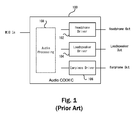
- FIG. 1 is a schematic of a traditional mobile audio CODEC 100.
- a mobile audio CODEC includes many other components as for example audio processing components 108. However, those components are being omitted in order not to obfuscate the relevant components.
- the mobile audio CODEC 100 includes a headphone driver 102, a loudspeaker driver 104 and an earpiece driver 106. These drivers may be coupled to other components that are not being shown in Figure 1 .
- the mobile audio CODEC 100 may include a MIC input port.
- the headphone driver 102 provides preprocessed audio output to a headphone when the headphone is connected to the mobile device.
- the loudspeaker driver 104 provides preprocessed electrical audio signal to the loudspeaker of the mobile device, when the loudspeaker is turned on.
- the earpiece driver 106 provided preprocessed audio signal to the earpiece of the mobile device.
- the output audio signals may be mono or stereo. However, in order not to obfuscate the disclosure, this distinction is being omitted because the embodiments described herein can be used for both mono and stereo use.
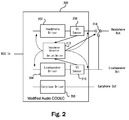
- Figure 2 illustrates an exemplary modified mobile audio CODEC 200 in relevant parts. Note that many components that are required for the operation of the modified mobile audio CODEC 200 are being omitted so as not to obfuscate the present disclosure. However, a person skilled in the art would realize that the omitted components are not required to be depicted in order to understand various embodiments of the present disclosure.
- the modified mobile audio CODEC 200 includes a headphone driver (or amplifier) 202, a loudspeaker driver 204, and an earpiece driver 206.
- the modified mobile audio CODEC 200 may also include a MIC input port and outputs from various audio drivers.
- the modified mobile audio CODEC 200 further includes one or more Voltage (V) and Current (I) Sensors 208, 210 and an impedance detector 212.
- a switch driver may also be included in the impedance detector 212.
- the switch driver can be a separate component that can be driven from the user interface or other modules of the mobile device 200.
- the other modules may include automatic accessory detection module, optical sensor, etc.
- the impedance detector/switch driver 212 is coupled to one or more VI sensors 208, 210.
- One of the functions of the impedance detector 212 is to measure impedance of the headphone audio path and the loudspeaker audio path based on current and voltage measurements received from one or more VI sensors 208, 210.
- the impedance detector 212 is configurable so that a pre-selected impedance threshold value may be inputted to the impedance detector 212.
- the pre-selected impedance threshold value may be stored in the mobile device by a user of the mobile device or the device vendor or an application vendor.
- the impedance detector/switch driver 212 is activated when the mobile device's automatic accessory detection mechanism detects an external audio device being connected or disconnected from the mobile device.
- the impedance detector 212 either continuously or at pre-selected regular intervals, measures the impedance in audio paths. Measurement of impedance of a speaker is well known in the art, hence a detailed description is being omitted.
- the modified mobile audio CODEC 200 also includes a switch 214 coupled to the headphone out and the loudspeaker out paths.
- the switch 214 may be inside or outside the modified mobile audio CODEC 200.
- the switch 214 is coupled to the impedance detector/switch driver 212.
- the switch 214 connects the external speaker to the loudspeaker driver 204 according to the impedance measurements on the headphone driver path and the loudspeaker driver path. It may be noted that in some embodiments, the switch 214 may be a software switch embodied in an audio processing software associated with the modified mobile audio CODEC 200.
- the modified mobile audio CODEC 200 may also include functionalities such as tracking of the resonance frequency to automatically adapt equalization filters when an external speaker is connected and tracking of loudspeaker non-linearities and to maximize the loudspeaker output up to a predefined level of non-linearities.
- FIG. 3 illustrates an exemplary method 300 of driving a switch according to impedance measurements.
- the impedance of the external speaker that is connected to the mobile device via the headphone jack or via USB or wirelessly is measured.
- step 302 is executed when the mobile device detects an accessory being attached to the mobile device and if the accessory being attached is an audio device. If no external speaker is connected to the mobile device, no further operations of the method 300 are performed.
- decision step 304 if the measured impedance is below a pre-selected threshold value, at step 306, the loudspeaker driver or amplifier 204 is connected to the external speaker.
- the headphone driver or amplifier 202 is connected to the externally connected listening device that may be a speaker or a headphone.
- the logic may be configured to compare the measured impedance with the pre-selected threshold value and connect the loudspeaker driver to the external speaker based on the comparison.
- the impedance detector/switch driver 212 is not used. Instead, a user of the mobile device may use the user interface of the mobile device to connect the loudspeaker driver to the external speaker. For example, the user interface may enable the user to set preferences to enable/disable connecting the loudspeaker driver to the external speaker.
- the process of impedance detection described herein is one of the methods that can be used to detect an external speaker when the external speaker is connected to the mobile device.
- the external speaker may be detected using methods such as as automatic accessory detection or optical sensing or a user configuration or a use action, etc.
- the mobile device may display a message on the user interface of the mobile device asking the user to confirm if the externally connected device is a speaker and asking the user to confirm if the internal speakerphone audio driver is to be used. If the user confirms affirmatively, the switch 214 is operated to connect the external device to the speaker phone audio driver 204. Therefore, the switch driver may be operated by using the user inputs, user configuration or automatic accessory detection circuit.
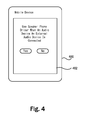
- Figure 4 illustrates an exemplary user interface of a mobile device 400.
- the mobile device 400 includes the modified mobile audio CODEC 200 as depicted in Figure 2 .
- the mobile device also includes a device configuration user interface 402 to enable a user to save configuration to instruct the switch 214 to connect the loudspeaker driver 204 to an external audio device that connects to the mobile device 400.
- the user may turn this configuration on or off using the user interface 402.
- the modified mobile audio CODEC 200 may not include a circuit for impedance detection. Instead, the switch driver will be driven based on the user configurations set by the user via the user interface 402. In another embodiment, if the modified mobile audio CODEC 200 includes the circuit for impedance detection, the configurations set via the user interface 402 will override the automatic switching performed by the impedance detector/switch driver 212.
- Embodiments may include the features described in the following numbered clauses.
- the circuit includes a headphone audio driver, a loudspeaker audio driver and a switch coupled to outputs of the headphone audio driver and the loudspeaker audio driver.
- the switch is configured to connect the output of the loudspeaker audio driver to an external speaker when an external speaker is connected to the mobile device.
- the external speaker may be detected using methods such as automatic accessory detection or impedance measurement or a user configuration or a use action.
- the circuit may also include an impedance detector to drive the switch based on an impedance measurement.
- a user interface is provided to enable a user of the mobile device to driver the switch based on user preferences.
Landscapes
- Physics & Mathematics (AREA)
- Engineering & Computer Science (AREA)
- Acoustics & Sound (AREA)
- Signal Processing (AREA)
- Health & Medical Sciences (AREA)
- General Health & Medical Sciences (AREA)
- Otolaryngology (AREA)
- Telephone Function (AREA)
- Circuit For Audible Band Transducer (AREA)
Applications Claiming Priority (1)
| Application Number | Priority Date | Filing Date | Title |
|---|---|---|---|
| US14/250,262 US9319780B2 (en) | 2014-04-10 | 2014-04-10 | Smart passive speaker drive |
Publications (1)
| Publication Number | Publication Date |
|---|---|
| EP2930941A1 true EP2930941A1 (fr) | 2015-10-14 |
Family
ID=52692522
Family Applications (1)
| Application Number | Title | Priority Date | Filing Date |
|---|---|---|---|
| EP15159784.6A Withdrawn EP2930941A1 (fr) | 2014-04-10 | 2015-03-19 | Circuit d'attaque de haut parleur passif intelligent |
Country Status (3)
| Country | Link |
|---|---|
| US (1) | US9319780B2 (fr) |
| EP (1) | EP2930941A1 (fr) |
| CN (1) | CN104980854A (fr) |
Cited By (2)
| Publication number | Priority date | Publication date | Assignee | Title |
|---|---|---|---|---|
| EP3177031A4 (fr) * | 2014-07-29 | 2017-08-16 | ZTE Corporation | Terminal mobile |
| WO2017166685A1 (fr) * | 2016-03-31 | 2017-10-05 | 乐视控股(北京)有限公司 | Procédé et appareil de commutation vers un haut-parleur externe |
Families Citing this family (7)
| Publication number | Priority date | Publication date | Assignee | Title |
|---|---|---|---|---|
| US9525928B2 (en) * | 2014-10-01 | 2016-12-20 | Michael G. Lannon | Exercise system with headphone detection circuitry |
| GB2544124B (en) * | 2015-11-05 | 2018-07-04 | Cirrus Logic Int Semiconductor Ltd | Methods and apparatuses for configuring a serial interface |
| GB2551779A (en) * | 2016-06-30 | 2018-01-03 | Nokia Technologies Oy | An apparatus, method and computer program for audio module use in an electronic device |
| WO2019073283A1 (fr) * | 2017-10-11 | 2019-04-18 | Institut Für Rundfunktechnik | Transducteur acoustique amélioré |
| GB2579677B (en) | 2018-12-11 | 2021-06-23 | Cirrus Logic Int Semiconductor Ltd | Load detection |
| US11974002B2 (en) * | 2019-12-27 | 2024-04-30 | Arris Enterprises Llc | Apparatus, system, method, and computer-readable recording medium for automatic routing of an audio output |
| US20250330738A1 (en) * | 2024-04-23 | 2025-10-23 | Dell Products Lp | System and method of automatic switching of audio output between an audio headset and a speaker docking station |
Citations (3)
| Publication number | Priority date | Publication date | Assignee | Title |
|---|---|---|---|---|
| US6359987B1 (en) * | 1997-05-16 | 2002-03-19 | Compaq Computer Corporation | Multimedia speaker detection circuit |
| US20130070930A1 (en) * | 2011-09-19 | 2013-03-21 | Apple Inc. | Auto-configuring audio output for audio performance and fault detection |
| US20140003616A1 (en) * | 2012-07-02 | 2014-01-02 | Timothy M. Johnson | Headset Impedance Detection |
Family Cites Families (6)
| Publication number | Priority date | Publication date | Assignee | Title |
|---|---|---|---|---|
| US7099481B2 (en) * | 2001-05-15 | 2006-08-29 | Lenovo (Singapore) Pte. Ltd. | Method and system for automatically detecting and powering PC speakers |
| US8472659B2 (en) * | 2005-04-15 | 2013-06-25 | Creative Technology Ltd | Multimode audio reproduction device |
| US7627352B2 (en) * | 2006-03-27 | 2009-12-01 | Gauger Jr Daniel M | Headset audio accessory |
| CN101521699A (zh) * | 2009-03-26 | 2009-09-02 | 中兴通讯股份有限公司 | 一种用内置天线接收频率调制信号的手机及其方法 |
| EP2453669A1 (fr) | 2010-11-16 | 2012-05-16 | Nxp B.V. | Contrôle de la sortie d'un haut-parleur |
| US9099967B2 (en) * | 2012-09-28 | 2015-08-04 | Apple Inc. | Increasing ground noise rejection in audio systems |
-
2014
- 2014-04-10 US US14/250,262 patent/US9319780B2/en active Active
-
2015
- 2015-03-19 EP EP15159784.6A patent/EP2930941A1/fr not_active Withdrawn
- 2015-04-10 CN CN201510170093.7A patent/CN104980854A/zh active Pending
Patent Citations (3)
| Publication number | Priority date | Publication date | Assignee | Title |
|---|---|---|---|---|
| US6359987B1 (en) * | 1997-05-16 | 2002-03-19 | Compaq Computer Corporation | Multimedia speaker detection circuit |
| US20130070930A1 (en) * | 2011-09-19 | 2013-03-21 | Apple Inc. | Auto-configuring audio output for audio performance and fault detection |
| US20140003616A1 (en) * | 2012-07-02 | 2014-01-02 | Timothy M. Johnson | Headset Impedance Detection |
Cited By (2)
| Publication number | Priority date | Publication date | Assignee | Title |
|---|---|---|---|---|
| EP3177031A4 (fr) * | 2014-07-29 | 2017-08-16 | ZTE Corporation | Terminal mobile |
| WO2017166685A1 (fr) * | 2016-03-31 | 2017-10-05 | 乐视控股(北京)有限公司 | Procédé et appareil de commutation vers un haut-parleur externe |
Also Published As
| Publication number | Publication date |
|---|---|
| CN104980854A (zh) | 2015-10-14 |
| US9319780B2 (en) | 2016-04-19 |
| US20150296291A1 (en) | 2015-10-15 |
Similar Documents
| Publication | Publication Date | Title |
|---|---|---|
| US9319780B2 (en) | Smart passive speaker drive | |
| US11791643B2 (en) | Earpiece charging case detection | |
| US11144277B2 (en) | Electronic device for controlling volume level of audio signal on basis of states of multiple speakers | |
| US8111841B2 (en) | Audio input/output device and method for switching input/output functions | |
| US9741334B2 (en) | Active noise cancellation in audio output device | |
| US20100104119A1 (en) | Audio output device | |
| KR101646964B1 (ko) | 휴대용 단말기에서 이어폰 인식 회로 장치 | |
| KR20190023302A (ko) | 지정된 주파수 대역의 신호를 이용하여 외부 객체의 근접을 확인하는 전자 장치 및 전자 장치 제어 방법 | |
| US20140029770A1 (en) | Hybrid analog/digital headset | |
| US20100098261A1 (en) | Arrangement and method for determining operational mode of a communication device | |
| US9258407B2 (en) | Portable electronic device having plurality of speakers and microphones | |
| CN107251571A (zh) | 个性化耳机 | |
| CN106716981A (zh) | 用于设备耳机插孔的电子接口 | |
| CN109644302A (zh) | 无线耳机系统 | |
| US9848270B2 (en) | Electronic device, earphone, and electronic device system | |
| US20170223449A1 (en) | Electronic device, earphone, and electronic device system | |
| KR20210001646A (ko) | 전자 장치 및 이를 이용한 오디오 신호를 처리하기 위한 음향 장치를 결정하는 방법 | |
| KR101648042B1 (ko) | ANC(Active Noise Cancellation) 기능을 가지는 휴대폰용 이어폰 시스템 | |
| KR101600429B1 (ko) | 환경 상황 적응 방식의 청력 보조 기기 및 멀티미디어 장치 연계를 위한 청력 보조 기기의 제어 방법 | |
| EP2645564B1 (fr) | Dispositif électronique avec immunité améliorée aux bruits audio provenant des courants à la terre de système | |
| EP2733958B1 (fr) | Dispositif électronique conçu pour détecter un système audio de véhicule | |
| CN108540903B (zh) | 一种音量放大配件、终端、音量放大配件识别方法 | |
| JP2005130176A5 (fr) | ||
| CN202907177U (zh) | 麦克风电路及移动终端 | |
| CN120855567A (zh) | 配有直通充电携带盒的电池供电配件的状态检测及运输模式机制 |
Legal Events
| Date | Code | Title | Description |
|---|---|---|---|
| PUAI | Public reference made under article 153(3) epc to a published international application that has entered the european phase |
Free format text: ORIGINAL CODE: 0009012 |
|
| AK | Designated contracting states |
Kind code of ref document: A1 Designated state(s): AL AT BE BG CH CY CZ DE DK EE ES FI FR GB GR HR HU IE IS IT LI LT LU LV MC MK MT NL NO PL PT RO RS SE SI SK SM TR |
|
| AX | Request for extension of the european patent |
Extension state: BA ME |
|
| STAA | Information on the status of an ep patent application or granted ep patent |
Free format text: STATUS: THE APPLICATION IS DEEMED TO BE WITHDRAWN |
|
| 18D | Application deemed to be withdrawn |
Effective date: 20160415 |