EP2930978B1 - Établissement de service d'équipement utilisateur multimode - Google Patents
Établissement de service d'équipement utilisateur multimode Download PDFInfo
- Publication number
- EP2930978B1 EP2930978B1 EP13859958.4A EP13859958A EP2930978B1 EP 2930978 B1 EP2930978 B1 EP 2930978B1 EP 13859958 A EP13859958 A EP 13859958A EP 2930978 B1 EP2930978 B1 EP 2930978B1
- Authority
- EP
- European Patent Office
- Prior art keywords
- base station
- user equipment
- mode user
- information
- targeted
- Prior art date
- Legal status (The legal status is an assumption and is not a legal conclusion. Google has not performed a legal analysis and makes no representation as to the accuracy of the status listed.)
- Active
Links
Images


Classifications
-
- H—ELECTRICITY
- H04—ELECTRIC COMMUNICATION TECHNIQUE
- H04W—WIRELESS COMMUNICATION NETWORKS
- H04W48/00—Access restriction; Network selection; Access point selection
- H04W48/20—Selecting an access point
-
- H—ELECTRICITY
- H04—ELECTRIC COMMUNICATION TECHNIQUE
- H04W—WIRELESS COMMUNICATION NETWORKS
- H04W36/00—Hand-off or reselection arrangements
- H04W36/0005—Control or signalling for completing the hand-off
- H04W36/0011—Control or signalling for completing the hand-off for data sessions of end-to-end connection
- H04W36/0027—Control or signalling for completing the hand-off for data sessions of end-to-end connection for a plurality of data sessions of end-to-end connections, e.g. multi-call or multi-bearer end-to-end data connections
-
- H—ELECTRICITY
- H04—ELECTRIC COMMUNICATION TECHNIQUE
- H04W—WIRELESS COMMUNICATION NETWORKS
- H04W48/00—Access restriction; Network selection; Access point selection
- H04W48/18—Selecting a network or a communication service
-
- H—ELECTRICITY
- H04—ELECTRIC COMMUNICATION TECHNIQUE
- H04W—WIRELESS COMMUNICATION NETWORKS
- H04W76/00—Connection management
- H04W76/10—Connection setup
- H04W76/11—Allocation or use of connection identifiers
-
- H—ELECTRICITY
- H04—ELECTRIC COMMUNICATION TECHNIQUE
- H04W—WIRELESS COMMUNICATION NETWORKS
- H04W88/00—Devices specially adapted for wireless communication networks, e.g. terminals, base stations or access point devices
- H04W88/02—Terminal devices
- H04W88/06—Terminal devices adapted for operation in multiple networks or having at least two operational modes, e.g. multi-mode terminals
-
- H—ELECTRICITY
- H04—ELECTRIC COMMUNICATION TECHNIQUE
- H04W—WIRELESS COMMUNICATION NETWORKS
- H04W36/00—Hand-off or reselection arrangements
- H04W36/0005—Control or signalling for completing the hand-off
- H04W36/0055—Transmission or use of information for re-establishing the radio link
- H04W36/0061—Transmission or use of information for re-establishing the radio link of neighbour cell information
-
- H—ELECTRICITY
- H04—ELECTRIC COMMUNICATION TECHNIQUE
- H04W—WIRELESS COMMUNICATION NETWORKS
- H04W88/00—Devices specially adapted for wireless communication networks, e.g. terminals, base stations or access point devices
- H04W88/08—Access point devices
- H04W88/10—Access point devices adapted for operation in multiple networks, e.g. multi-mode access points
-
- H—ELECTRICITY
- H04—ELECTRIC COMMUNICATION TECHNIQUE
- H04W—WIRELESS COMMUNICATION NETWORKS
- H04W88/00—Devices specially adapted for wireless communication networks, e.g. terminals, base stations or access point devices
- H04W88/12—Access point controller devices
Definitions
- the present invention relates to the field of communications, and more particularly, to a method and a network side device for service establishment for a multi-mode user equipment.
- a radio network includes multiple radio access technologies (multi-RAT), such as, for example, a global system for mobile communication (GMS), a universal mobile telecommunications system (UMTS), long term evolution (LTE) and wireless fidelity (WIFI), etc.
- multi-RAT radio access technologies
- GMS global system for mobile communication
- UMTS universal mobile telecommunications system
- LTE long term evolution
- WIFI wireless fidelity
- a centralized control entity (Controller) is introduced in the prior art to control the multiple RAT base stations, and an interface is present between the centralized control entity and each of the RAT base stations.
- the centralized control entity may receive information reported by each of the RAT base stations, such as load condition, position information of a user equipment and/or the like, and control the each of the RAT base station hereby.
- a single-card dual-standby solution is generally adopted for voice service and data service under multi-RAT.
- a user equipment when a user equipment is idle, the user equipment simultaneously camps on LTE and a second generation mobile network communication technology/third generation mobile network communication technology (2G/3G, 2nd Generation /3rd Generation) network, wherein the voice service is initiated via the 2G/3G network, and the data service is initiated via the LTE network. Since the user equipment needs to simultaneously camp on two networks, power consumption is increased. Therefore, a circuit switched fall back (CSFB) solution is further proposed in the prior art.
- CSFB circuit switched fall back
- a user equipment camps on the LTE network when being idle, and when a user initiates a call or receives a call, the user equipment switches to the 2G/3G network and switches back to the LTE network after the call is terminated.
- US 2007/291699 A1 discloses a handover method, in which an MSS transmits a service request message to a serving base station, wherein the service request message comprises information of a service flow to be activated and/or desired QoS parameters to receive the service.
- the serving base station transmits a handover pre-notification message to multiple base stations, and each of the multiple base stations transmits to the serving base station a handover pre-notification response message, wherein the handover pre-notification response message includes information regarding the presence of service estimation and information indicating estimated service levels of the admitted service flows which can be provided to the current MSS from each of the multiple base stations; the serving base station selects one targeted base station approriate for the handover execution from the multiple base stations; and the serving base station respectively transmits the information regarding the service levels that can be provided by the multiple base stations to the MSS.
- US 2010/234042 A1 discloses a method and system for load-balancing across access networks, in which the RAN is selected based on whether RAN supports the requested application service, one or more QoS parameter values, one or more service policy values corresponding to the terminal, one or more application service requirements (e.g., QoS requirements, service policy requirements corresponding to the terminal), and/or one or more perferences of a service provider of system, etc.
- the RAN is selected based on whether RAN supports the requested application service, one or more QoS parameter values, one or more service policy values corresponding to the terminal, one or more application service requirements (e.g., QoS requirements, service policy requirements corresponding to the terminal), and/or one or more perferences of a service provider of system, etc.
- the inventor of the present invention has found that, although the circuit switched fall back solution may reduce power consumption of a user equipment, the solution can only aim at voice service, and in the presence of voice service, the user equipment must switches to the 2G/3G network, while the 2G/3G network is not necessarily suitable for bearing the service at the moment, so a data transmission error may occur; and moreover, the solution can only falls from LTE back to the 2G/3G network, therfore, the solution has limitation and is not flexible enough.
- Embodiments of the present invention provide a method, and a network side device for service establishment for a multi-mode user equipment, which may select a proper RAT network more flexibly from multiple RAT networks so as to establish a service, and meanwhile, power consumption of a user equipment is not increased.
- a method for service establishment for a multi-mode user equipment according to the present invention is defined in claim 1.
- the obtaining base station information of respective base stations in a multi-radio access technology network may include:
- the determining targeted base station information according to the service request and the base station information may include: selecting, according to the service request and the base station information of the respective base stations in the base station set on which the first multi-mode user equipment can camp, a first targeted base station from a difference set of the base station set on which the first multi-mode user equipment can camp and the base station set on which the first multi-mode user equipment has camp; and selecting, according to the service request and the base station information of the respective base stations in the base station set on which the second multi-mode user equipment can camp, a second targeted base station from a difference set of the base station set on which the second multi-mode user equipment can camp and the base station set on which the second multi-mode user equipment has camped; and in this case, the initiating bearer establishment for the service according to the targeted base station information may be specifically: initiating bearer establishment for the service towards the first targeted base station and the second targeted base station respectively.
- the present invention further provides a network side device according to claim 4.
- the obtaining unit may be specifically configured to obtain, according to the identity of the first multi-mode user equipment and the identity of the second multi-mode user equipment, capability information, subscription data and position information of the first multi-mode user equipment, and capability information, subscription data and position information of the second multi-mode user equipment, respectively; obtain network coverage information of the respective base stations in the multi-radio access technology network; determine, according to the capability information, the subscription data and the position information of the first multi-mode user equipment and the network coverage information, a base station set on which the first multi-mode user equipment can camp; determine, according to the capability information, the subscription data and the position information of the second multi-mode user equipment and the network coverage information, a base station set on which the second multi-mode user equipment can camp; and obtain base station information of respective base stations in the base station set on which the first multi-mode user equipment can camp, and obtain base station information of respective base stations in the base station set on which the second multi-mode user equipment can camp.
- the determining unit is specifically configured to select, according to the service request and the base station information of the respective base stations in the base station set on which the first multi-mode user equipment can camp, a first targeted base station from a difference set of the base station set on which the first multi-mode user equipment can camp and the base station set on which the first multi-mode user equipment has camped; and select, according to the service request and the base station information of the respective base stations in the base station set on which the second multi-mode user equipment can camp, a second targeted base station from a difference set of the base station set on which the second multi-mode user equipment can camp and the base station set on which the second multi-mode user equipment has camped; and in this case, the processing unit is specifically configured to initiate bearer establishment for the service towards the first targeted base station and the second targeted base station respectively.
- the service request which is sent by the first multi-mode user equipment and carries the identity of the first multi-mode user equipment, the service type and the information about QoS required by the service, is received, the base station information of the respective base stations in the multi-RAT network is obtained, the targeted base station information is determined according to the service request and the base station information, and bearer establishment for the service is initiated according to the targeted base station information, or the targeted base station information is sent to the first multi-mode user equipment, such that the first multi-mode user equipment initiates bearer establishment for the service according to the targeted base station information.
- the centralized control entity in the solution may obtain the base station information of the repsective base stations in the multi-RAT network in real time and select proper RAT base station information in accordance with service demand of the user equipment, so as to initiate bearer establishment for the service.
- the present solution does not has particular limitation on a service, and moreover, a proper RAT network may be selected from multiple RAT networks more flexibly for each service without increasing power consumption of the user equipment, thus having wider adaptability.
- the embodiments of the present invention provide a method, an apparatus and a system for service establishment for a multi-mode user equipment. Detailed illustration will be given below respectively.
- Controller a centralized control entity
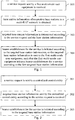
- a method for service establishment for a multi-mode user equipment includes: receiving a service request sent by a first multi-mode user equipment, wherein the service request carries an identity of the first multi-mode user equipment, a service type and information about quality of service required by a service; obtaining base station information of respective base stations in a multi-RAT network, wherein the base station information includes information about load of a base station and information about quality of service of a service that the base station can provide; determining targeted base station information according to the service request and the base station information; and initiating bearer establishment for the service according to the targeted base station information, or sending the targeted base station information to the first multi-mode user equipment, such that the first multi-mode user equipment initiates bearer establishment for the service according to the targeted base station information.
- a specific flow may be as follows:
- the service request may carry an identity of the first multi-mode user equipment, a service type and information about QoS required by a service.
- the service request may further carry information such as a base station set A1 on which the first multi-mode user equipment has camped, selection of user experience (e.g., cheapest, fastest and/or the like) and/or the like, wherein the base station set A1 on which the first multi-mode user equipment has camped may include information of each base station in the set A1, such as public land mobile network (PLMN) identity information, base station technology, base station identity and/or the like.
- PLMN public land mobile network
- the service request may also carry an identity of the second multi-mode user equipment, and certainly, the service request may optionally also carry other information such as selection of user experience and/or the like.
- base station information of respective base stations in a multi-RAT network is obtained.
- the base station information may include information such as information on load of a base station, information on quality of service of a service that the base station can provide and/or the like, wherein the information on quality of service of the service that the base station can provide may include information such as charging standards and supported rates of different operators and different technologies and/or the like.
- base station information of the respective base stations in the multi-RAT network When the base station information of the respective base stations in the multi-RAT network is obtained, base station information of all base stations in the multi-RAT network may be specifically obtained, or base station information of a part of base stations in the multi-RAT network may be obtained.
- base station information of all base stations in the multi-RAT network may be specifically obtained, or base station information of a part of base stations in the multi-RAT network may be obtained.
- a specific implementation may be as follows:
- a targeted base station may be firstly selected from the base station set A1 on which the first multi-mode user equipment has camped, and if no targeted base station is selected, the step of obtaining base station information of respective base stations in a multi-RAT network is performed.
- the base station set A1 on which the first multi-mode user equipment has camped may be provided to the centralized control entity by the first multi-mode user equipment, that is, if the service request further carries the base station set A1 on which the first multi-mode user equipment has camped, the method may further include:
- the identity of the involved another user equipment in this case may be further carried in the service request, such that targeted base station information for the another user equipment is selected.
- the received service request may further carry a base station set A1 on which the first multi-mode user equipment has camped and an identity of the second multi-mode user equipment, in this case, after the service request sent by the first multi-mode user equipment is received, the method may further include:
- step 102 the step of obtaining base station information of respective base stations in a multi-RAT network (i.e., step 102) may be specifically implemented as follows:
- targeted base station information is determined according to the service request received in step 101 and the base station information obtained in step 102.
- Proper targeted base station information may be specifically selected from the base station set B1 on which the first multi-mode user equipment can camp. Certainly, if it has been determined before step 103 that there does not exists proper targeted base station information in the base station set A1 on which the first multi-mode user equipment has camped, in order to improve processing efficiency, in this case, proper targeted base station information may also be selected from a difference set of the base station set B1 on which the first multi-mode user equipment can camp and the base station set A1 on which the first multi-mode user equipment has camped.
- the targeted base station when a targeted base station is selected for the second multi-mode user equipment, besides being directly selected from the base station set B2 on which the second multi-mode user equipment can camp, the targeted base station may also be selected from a difference set of the base station set B2 on which the second multi-mode user equipment can camp and the base station set A2 on which the second multi-mode user equipment has camped, wherein the targeted base station information may be a targeted base station and may also be a targeted base station list.
- the step 103 may be specifically implemented as follows:
- step 104 bearer establishment for the service is initiated according to the targeted base station information obtained in step 103, or the targeted base station information obtained in step 103 is sent to the first multi-mode user equipment, such that the first multi-mode user equipment initiates bearer establishment for a service according to the targeted base station information.
- the step 104 may be specifically implemented as follows:
- step 104 may be specifically implemented as follows:
- the method may further include: sending the second targeted base station list to the second multi-mode user equipment, such that the second multi-mode user equipment determines a second targeted base station according to the second targeted base station list and initiates bearer establishment for the service towards the second targeted base station.
- the targeted base station information may be sent to the first multi-mode user equipment in a form of independent signaling, or sent to the first multi-mode user equipment by being carried in a service request response.
- the targeted base station list may include information of each base station in the list such as PLMN information, base station technology, frequency point, base station identity and/or the like.
- the centralized control entity may also send the targeted base station to a user equipment (e.g., the first multi-mode user equipment and/or the second multi-mode user equipment), and the user equipment initiates bearer establishment for the service towards the targeted base station.
- a user equipment e.g., the first multi-mode user equipment and/or the second multi-mode user equipment
- the user equipment initiates bearer establishment for the service towards the targeted base station.
- signaling procedure may be saved and thus being more optimal.
- the method may further include:
- a service request reject message may be sent to the first multi-mode user equipment, so as to reject present service request of the first multi-mode user equipment, which will not be described redundantly herein.
- the service request which is sent by the first multi-mode user equipment and carries the identity of the first multi-mode user equipment, the service type and the information about QoS required by the service, is received, the base station information of the repsective base stations in the multi-RAT network is obtained, the targeted base station information is determined according to the service request and the base station information, and bearer establishment for the service is initiated according to the targeted base station information, or the targeted base station information is sent to the first multi-mode user equipment, such that the first multi-mode user equipment initiates bearer establishment for the service according to the targeted base station information.
- the centralized control entity in the solution may obtain the base station information of the repsective base stations in the multi-RAT network in real time and select proper RAT base station information in accordance with service demand of the user equipment, so as to initiate bearer establishment for the service.
- the present solution does not has particular limitation on a service, and moreover, a proper RAT network may be selected from multiple RAT networks more flexibly for each service without increasing power consumption of the user equipment, thus having wider adaptability.
- the present embodiment will be described from a perspective of a user equipment.
- the user equipment may be served as a first multi-mode user equipment in the embodiment of the present invention.
- the user equipment may be specifically a terminal device such as a mobile phone, a tablet computer or the like.
- a method for service establishment for a multi-mode user equipment includes: sending a service request to a centralized control entity, wherein the service request carries an identity of a first multi-mode user equipment, a service type and information about QoS required by a service; receiving targeted base station information sent by the centralized control entity according to the service request; and initiating bearer establishment for the service according to the targeted base station information.
- a specific flow may be as follows:
- the service request carries an identity of the first multi-mode user equipment, a service type and information about QoS required by a service.
- the service request may further carry information such as a base station set A1 on which the first multi-mode user equipment has camped, selection of user experience (e.g., cheapest, fastest and/or the like) and/or the like, wherein the base station set A1 on which the first multi-mode user equipment has camped may include information of each base station in the set A1, such as PLMN information, base station technology, base station identity and/or the like.
- the service request may also carry an identity of the second multi-mode user equipment, and certainly, the service request may optionally also carry other information such as selection of user experience and/or the like.
- targeted base station information sent by the centralized control entity according to the service request is received.
- a targeted base station sent by the centralized control entity according to the service request may be specifically received, or a targeted base station list sent by the centralized control entity according to the service request may be received.
- Embodiment 1 may be referred to for a method for determining the targeted base station or the targeted base station list, which will not be repeated redundantly herein.
- bearer establishment for the service is initiated according to the targeted base station information.
- bearer establishment for the service may be specifically initiated according to the targeted base station received in step 202; or, if a targeted base station list is received, a targeted base station may be selected from the targeted base station list, and bearer establishment for the service is then initiated according to the targeted base station.
- a method for initiating bearer establishment for the service according to the targeted base station may be specifically implemented as follows:
- the service request which is sent by the first multi-mode user equipment and carries the identity of the first multi-mode user equipment, the service type and the information about QoS required by the service, is sent to the centralized control entity, the targeted base station information sent by the centralized control entity is received, and bearer establishment for the service is then initiated according to the targeted base station information.
- the centralized control entity in the solution may obtain the base station information of the repsective base stations in the multi-RAT network in real time and select proper RAT base station information in accordance with service demand of the user equipment, so as to initiate bearer establishment for the service.
- the present solution does not has particular limitation on a service, and moreover, a proper RAT network may be selected from multiple RAT networks more flexibly for each service without increasing power consumption of the user equipment, thus having wider adaptability.
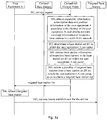
- the first multi-mode user equipment is specifically user equipment A and the targeted base station is determined by the user equipment.
- a specific flow of a method for service establishment for a multi-mode user equipment may be as follows:
- the service request may carry an identity of the user equipment A, a service type and information about QoS required by the service.
- the centralized control entity after receiving the service request, obtains capability information, subscription data and position information of the user equipment A according to the identity of the user equipment A, and obtains network coverage information of respective base stations in a multi-RAT network.
- the centralized control entity determines a base station set B1 on which the user equipment A can camp.
- the user equipment A has GSM, UMTS, LTE and WIFI capability, and the user equipment A camps on the GSM base station b2 at the moment.
- the centralized control entity determines that the base station set B1 on which the user equipment A can camp at the moment is ⁇ b1,b2,b4 ⁇ .
- the base station set A1 on which the user equipment A has camped is a subset of the base station set B1 on which the user equipment A can camp, namely, A 1 ⁇ B 1.
- the respective base stations in the base station set A1 on which the user equipment A has camped and the respective base stations in the base station set B1 on which the user equipment A can camp may be different base stations of a same operator and a same technology, or may be base stations of different operators and different technologies, or may be different base stations of different operators and a same technology.
- the centralized control entity obtains base station information of respective base stations in the base station set B1 on which the user equipment A can camp.
- base station information of the base station b1 base station information of the base station b2 and base station information of the base station b4 may be respectively obtained.
- the base station information may include information such as information on load of a base station, information on quality of service of a service that a base station can provide and/or the like, wherein the information on quality of service of a service that the base station can provide may include information such as charging standards and supported rates of different operators and different technologies and/or the like.
- the centralized control entity selects a plurality of targeted base stations from a base station set B1 on which the user equipment A can camp, so as to obtain a targeted base station list, and sends the obtained targeted base station list to the user equipment A.
- the targeted base station list may specifically be sent to the user equipment A via a service request response, wherein the targeted base station list includes information of each base station in the list such as PLMN information, base station technology, frequency point, base station identity and/or the like.
- the targeted base station list may include information of b1, b2 and b4, respectively, such as PLMN information, base station technology, frequency point, base station identity and/or the like.
- the targeted base station list may include information of b1 and b4, respectively, such as the PLMN information, base station technology, frequency point, base station identity and/or the like.
- the centralized control entity may send a service request reject message to the user equipment A, so as to reject the present service request of the user equipment A.
- the user equipment A selects a targeted base station from the targeted base station list.
- a base station set A1 on which the user equipment A has camped may be specifically obtained, and preferably, a targeted base station is selected from the base station set A1 on which the user equipment A has camped. If a proper targeted base station cannot be selected from the base station set A1 on which the user equipment A has camped, a proper targeted base station is selected from a difference set of the base station set B1 on which the user equipment A can camp and the base station set A1 on which the user equipment A has camped, namely, from B1-A1.
- the base station b2 may be preferably selected as the targeted base station, and if the base station b2 could not satisfy requirements of the user equipment A, the user equipment A may select a proper targeted base station from B1-A1, and for example, the user equipment selects the base station b1 or the like.
- the user equipment A determines whether itself (i.e., the user equipment A) has attached to a network to which the targeted base station belongs; if the user equipment has attached to the network, the user equipment hands over to the targeted base station and initiates bearer establishment for the service towards the targeted base station; and if the user equipment has not attached to the network, the user equipment initiates bearer establishment for the service towards the targeted base station after being attached to the network to which the targeted base station belongs.
- the user equipment A may determine whether itself has attached to a network to which the base station b1 belongs. Since the user equipment A has not attached to the network to which the base station b1 belongs, the user equipment A needs to firstly attach to the network to which the base station b1 belongs, and then initiate bearer establishment for the service towards the base station b1.
- the targeted base station determined in step 306 is the base station b2
- the base station b2 belongs to the base station set A1 on which the user equipment A has camped
- the user equipment does not need to perform base staion handover, and directly initiates bearer establishment for the service towards the base station b2 instead.
- the user equipment A has attached to the networkto which the base station b2 belongs, if the base station b2 does not belong to the base station set A1 on which the user equipment A has camped, the user equipment A needs to hand over to the base station b2, and then initiate bearer establishment for the service towards the base station b2.
- the centralized control entity may receive the service request which is sent by the user equipment A and carries the identity of the first multi-mode user equipment, the service type and the information about QoS required by the service, obtain the base station information of the repsective base stations in the multi-RAT network, and then obtain the targeted base station list according to the service request and the base station information, and send the targeted base station list to the user equipment A.
- the user equipment A determines the targeted base station according to the targeted base station list and initiates bearer establishment for the service according to the targeted base station.
- the centralized control entity in the solution may obtain the base station information of the repsective base stations in the multi-RAT network in real time and select proper RAT base station information in accordance with service demand of the user equipment, so as to initiate bearer establishment for the service.
- the present solution does not has particular limitation on a service, and moreover, a proper RAT network may be selected from multiple RAT networks more flexibly for each service without increasing power consumption of the user equipment, thus having wider adaptability.
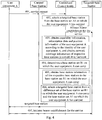
- the first multi-mode user equipment is specifically user equipment A
- difference between the present example and example 1 lies in that, in the present example, it is taken as an example for illustration that the targeted base station is determined by the centralized control entity.
- a specific flow of a method for service establishment for a multi-mode user equipment may be as follows:
- the service request may carry an identity of the user equipment A, a service type, information about QoS required by the service and a base station set A1 on which the user equipment A has camped.
- the service request may also carry other information such as, for example, selection of user experience and/or the like.
- the centralized control entity after receiving the service request, obtains base station information of respective base stations in the base station set A1 on which the user equipment A has camped; selects, according to the service request and the base station information of the respective base stations in the base station set A1 on which the user equipment A has camped, a targeted base station from the base station set A1 on which the user equipment A has camped; if the targeted base station can be selected from the base station set A1 on which the user equipment A has camped, the centralized control entity initiates bearer establishment for the service towards the targeted base station, and the flow is terminated; and if the targeted base station cannot be selected from the base station set A1 on which the user equipment A has camped, the centralized control entity performs step 403.
- the centralized control entity obtains capability information, subscription data and position information of the user equipment A according to the identity of the user equipment A, and obtains network coverage information of respective base stations in a multi-RAT network.
- the centralized control entity determines, according to the capability information, the subscription data and the position information of the user equipment A and the obtained network coverage information of the respective base stations in the multi-RAT network, a base station set B1 on which the user equipment A can camp.
- the user equipment A has GSM, UMTS, LTE and WIFI capability, and the user equipment A camps on the GSM base station b2 at the moment.
- the centralized control entity determines that the base station set B1 on which the user equipment A can camp at the moment is ⁇ b1,b2,b4 ⁇ .
- the base station set A1 on which the user equipment A has camped is a subset of the base station set B1 on which the user equipment A can camp, namely, A 1 ⁇ B 1.
- the respective base stations in the base station set A1 on which the user equipment A has camped and the respective base stations in the base station set B1 on which the user equipment A can camp may be different base stations of a same operator and a same technology, or may be base stations of different operators and different technologies, or may be different base stations of different operators and a same technology.
- the centralized control entity obtains base station information of the respective base stations in the base station set B1 on which the user equipment A can camp.
- base station information of the base station b1 base station information of the base station b2 and base station information of the base station b4 may be respectively obtained.
- the base station information may include information such as information on load of a base station, information on quality of service of a service that a base station can provide and/or the like, wherein the information on quality of service of the service that the base station can provide may include information such as charging standards and supported rates of different operators and different technologies and/or the like.
- the centralized control entity selects a targeted base station from a difference set of the base station set B1 on which the user equipment A can camp and the base station set A1 on which the user equipment A has camped, and sends the targeted base station to the user equipment A.
- the targeted base station may specifically be sent to the user equipment A via a service request response, wherein the targeted base station may include information of the base station such as PLMN information, base station technology, frequency point, base station identity and/or the like.
- the centralized control entity may select a targeted base station from a base station set B1-A1, and select the base station b for example, in this case, information of the base station b, such as PLMN information, base station technology, frequency point, base station identity and/or the like, may be sent to the user equipment A.
- the centralized control entity may send a service request reject message to the user equipment A, so as to reject the present service request of the user equipment A.
- the user equipment A determines whether itself (i.e., the user equipment A) has attached to a network to which the targeted base station belongs; if the user equipment has attached to the network, the user equipment hands over to the targeted base station and initiates bearer establishment for the service towards the targeted base station; and if the user equipment A has not attached to the network, the user equipment initiates bearer establishment for the service towards the targeted base station after being attached to the network to which the targeted base station belongs.
- the user equipment A may determine whether itself has attached to the network to which the base station b1 belongs. Since the user equipment A has not yet attached to the network to which the base station b1 belongs, the user equipment A needs to firstly attach to the network to which the base station b1 belongs, and then initiate bearer establishment for the service towards the base station b1.
- the targeted base station is the base station b2
- the base station b2 belongs to the base station set A1 on which the user equipment A has camped
- the user equipment does not need to hand over to another base staion, and directly initiates bearer establishment for the service towards the base station b2 instead.
- the user equipment A has attached to the network to which the base station b2 belongs, if the base station b2 does not belong to the base station set A1 on which the user equipment A has camped, the user equipment A needs to hand over to the base station b2, and then initiate bearer establishment for the service towards the base station b2.
- the centralized control entity may receive the service request which is sent by the user equipment A and carries the identity of the user equipment A, the service type, the information about QoS required by the service and the base station set A1 on which the user equipment A has camped, obtain the base station information of the respective base stations in the multi-RAT network, and then obtain the targeted base station according to the service request and the base station information and send the targeted base station to the user equipment A.
- the user equipment A initiates bearer establishment for the service according to the targeted base station.
- the centralized control entity in the solution may obtain the base station information of the repsective base stations in the multi-RAT network in real time and select proper RAT base station information in accordance with service demand of the user equipment, so as to initiate bearer establishment for the service.
- the present solution does not has particular limitation on a service, and moreover, a proper RAT network may be selected from multiple RAT networks more flexibly for each service without increasing power consumption of the user equipment, thus having wider adaptability.
- the targeted base station is determined by the centralized control entity, and difference between the present embodiment and example 2 lies in that, in the present embodiment the initiated service involves a second multi-mode user equipment.
- the first multi-mode user equipment is specifically user equipment A and the second multi-mode user equipment is specifically user equipment B.
- a specific flow of a method for service establishment for a multi-mode user equipment may be as follows:
- the service request may carry an identity of the user equipment A, an identity of the user equipment B, a service type, information about QoS required by the service and a base station set A1 on which the user equipment A has camped.
- the service request may also carry other information such as selection of user experience and/or the like.
- Fig. 5 the base station on which the user equipment A has camped and the base station on which the user equipment B has camped are not shown. It should be understood that, both the user equipment A and the user equipment B may communicate with the centralized control entity through their respective camped base stations.
- the centralized control entity may page the user equipment B via respective base stations in a multi-RAT network, and sends a camping information inquiry request to the user equipment B.
- the user equipment B after receiving the camping information inquiry request, the user equipment B sends the centralized control entity a base station set A2 on which the user equipment B has camped.
- the centralized control entity respectively performs the following operations in no particular order:
- a targeted base station of the user equipment A is called as the first targeted base station
- a targeted base station of the user equipment B is called as the second targeted base station. It should be understood that, no limitation is set to the above-mentioned names.
- the centralized control entity performs the following operations in no particular order:
- the centralized control entity performs the following operations in no particular order:
- the base station set A1 on which the user equipment A has camped is a subset of the base station set B1 on which the user equipment A can camp, namely, A 1 ⁇ B 1; and the base station set A2 on which the user equipment B has camped is a subset of the base station set B2 on which the user equipment B can camp, namely, A 2 ⁇ B 2 .
- the respective base stations in the base station set A1 on which the user equipment A has camped, in the base station set A2 on which the user equipment B has camped, in the base station set B1 on which the user equipment A can camp and in the base station set B2 on which the user equipment B can camp may be different base stations of a same operator and a same technology, or may be base stations of different operators and different technologies, or may be different base stations of different operators and a same technology.
- the centralized control entity performs the following operations in no particular order:
- the base station information may include information such as information on load of a base station, information on quality of service of a service that the base station can provide and/or the like, wherein the information on quality of service of a service that the base station can provide may include information such as charging standards and supported rates of different operators and different technologies and/or the like.
- the centralized control entity performs the following operations in no particular order:
- the second targeted base station may specifically be sent to the user equipment B via a service request response, wherein the second targeted base station may include information of the base station such as PLMN information, base station technology, frequency point, base station identity and/or the like.
- the centralized control entity may select the second targeted base station from a base station set B2-A2, and send the user equipment B information of the second targeted base station such as PLMN information, base station technology, frequency point, base station identity and/or the like.
- the centralized control entity may send a service request reject message to the user equipment A, so as to reject the present service request of the user equipment A.
- the user equipment A determines whether itself (i.e., the user equipment A) has attached to a network to which the first targeted base station belongs; if the user equipment A has attached to the network, the user equipment A hands over to the first targeted base station and initiates bearer establishment for the service towards the first targeted base station; and if the user equipment A has not attached to the network, the user equipment A initiates bearer establishment for the service towards the first targeted base station after being attached to the network to which the first targeted base station belongs.
- itself i.e., the user equipment A
- the user equipment A may determine whether it has attached to the network to which the base station b1 belongs. Since the user equipment A has not yet attached to the network to which the base station b1 belongs, the user equipment A needs to firstly attach to the network to which the base station b1 belongs, and then initiate bearer establishment for the service towards the base station b1.
- the targeted base station is the base station b2
- the base station b2 belongs to the base station set A1 on which the user equipment A has camped
- the user equipment does not need to hand over to another base staion, and directly initiates bearer establishment for the service towards the base station b2 instead.
- the user equipment A has attached to the network to which the base station b2 belongs, if the base station b2 does not belong to the base station set A1 on which the user equipment A has camped, the user equipment A needs to hand over to the base station b2, and then initiate bearer establishment for the service towards the base station b2.
- the user equipment B determines whether itself (i.e., the user equipment B) has attached to a network to which the second targeted base station belongs; if the user equipment B has attached to the network, the user equipment B hands over to the second targeted base station and initiates bearer establishment for the service towards the second targeted base station; and if the user equipment B has not attached to the network, the user equipment B initiates bearer establishment for the service towards the second targeted base station after being attached to the network to which the second targeted base station belongs.
- the step is the same as step 509, and will not be repeated redundantly herein.
- the centralized control entity may receive the service request which is sent by the user equipment A and carries the identity of the user equipment A, the identity of the user equipment B, the service type, the information about QoS required by the service and the base station set A1 on which the user equipment A has camped, obtain the base station information of the respective base stations in the multi-RAT network, and then select targeted base stations of the user equipment A and the user equipment B respectively according to the service request and the base station information, and send the targeted base stations to the user equipment A and the user equipment B, respectively.
- the user equipment A and the user equipment B initiate bearer establishment for the service according to the targeted base stations.
- the centralized control entity in the solution may obtain the base station information of the repsective base stations in the multi-RAT network in real time and select proper RAT base station information in accordance with service demand of the user equipment, so as to initiate bearer establishment for the service.
- the present solution does not has particular limitation on a service, and moreover, a proper RAT network may be selected from multiple RAT networks more flexibly for each service without increasing power consumption of the user equipment, thus having wider adaptability.
- the embodiment of the present invention further provides a network side device, which may be served as the centralized control entity in the embodiment of the present invention.
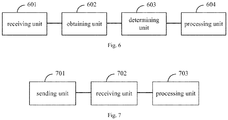
- the network side device includes a receiving unit 601, an obtaining unit 602, a determining unit 603 and a processing unit 604.
- the receiving unit 601 is configured to receive a service request sent by a first multi-mode user equipment.
- the service request may carry an identity of the first multi-mode user equipment, a service type and Information about QoS required by the service.
- the service request may further carry information such as a base station set A1 on which the first multi-mode user equipment has camped, selection of user experience (e.g., cheapest, fastest and/or the like) and/or the like, wherein the base station set A1 on which the first multi-mode user equipment has camped may include information of each base station in the set A1, such as PLMN identity information, base station technology, base station identity and/or the like.
- the service request may also carry an identity of the second multi-mode user equipment, and certainly, the service request may optionally also carry other information such as selection of user experience and/or the like.
- the obtaining unit 602 is configured to obtain base station information of respective base stations in a multi-radio access technology network, wherein the base station information comprises information on load of a base station and information on quality of service of a service that the base station can provide; wherein the information on quality of service of the service that the base station can provide may include information such as charging standards and supported rates of different operators and different technologies and/or the like.
- the determining unit 603 is configured to determine targeted base station information according to the service request and the base station information.
- the processing unit 604 is configured to initiate bearer establishment for the service according to the targeted base station information, or send the targeted base station information to the first multi-mode user equipment, such that the first multi-mode user equipment initiates bearer establishment for the service according to the targeted base station information.
- the obtaining unit 602 may specifically obtain base station information of all base stations in the multi-RAT network, or obtain base station information of a part of base stations in the multi-RAT network. For example, it may be specifically as follows:
- a plurality of targeted base stations may be selected from the base station set B1 on which the first multi-mode user equipment can camp, so as to obtain a targeted base station list, and the targeted base station list is then provided to the user equipment, and the user equipment determines the targeted base station, that is,
- the determining unit 603 may also be specifically configured to select, according to the service request and the base station information of the respective base stations in the base station set on which the first multi-mode user equipment can camp, a plurality of targeted base stations from the base station set B1 on which the first multi-mode user equipment can camp, so as to obtain a targeted base station list; and in this case, the processing unit 604 may be specifically configured to send the targeted base station list to the first multi-mode user equipment, such that the first multi-mode user equipment determines a targeted base station according to the targeted base station list and initiates bearer establishment for the service towards the targeted base station.
- a targeted base station may be firstly selected from the base station set A1 on which the first multi-mode user equipment has camped, and if no targeted base station is selected, the obtaining unit 602 performs the step of obtaining base station information of respective base stations in a multi-RAT network.
- the base station set A1 on which the first multi-mode user equipment has camped may be provided to the centralized control entity by the first multi-mode user equipment, that is, if the service request further carries the base station set A1 on which the first multi-mode user equipment has camped, the obtaining unit 602 may be further configured to obtain base station information of respective base stations in the base station set A1 on which the first multi-mode user equipment has camped; and in this case, the determining unit 603 may be further configured to select, according to the service request and the base station information of the respective base stations in the base station set A1 on which the first multi-mode user equipment has camped, a targeted base station from the base station set A1 on which the first multi-mode user equipment has camped; and the processing unit 604 is further configured to, if a targeted base station can be seleted from the base station set A1 on which the first multi-mode user equipment has camped, initiate bearer establishment for the service towards the targeted base station; and if a targeted base station cannot be seleted
- proper targeted base station information may also be selected from a difference set (i.e., B1-A1) of the base station set B1 on which the first multi-mode user equipment can camp and the base station set A1 on which the first multi-mode user equipment has camped, that is, the determining unit 603 may be specifically configured to select, according to the service request and the base station information of the respective base stations in the base station set B1 on which the first multi-mode user equipment can camp, a targeted base station from a difference set of the base station set B1 on which the first multi-mode user equipment can camp and the base station set A1 on which the first multi-mode user equipment has camped; and the processing unit 604 may be specifically configured to initiate bearer establishment for the service towards the targeted base station.
- a difference set i.e., B1-A1
- the processing unit 604 may be specifically configured to initiate bearer establishment for the service towards the targeted base station.
- the targeted base station may also be determined by the user equipment, namely, the determining unit 603 is specifically configured to select, according to the service request and the base station information of the respective base stations in the base station set B1 on which the first multi-mode user equipment can camp, a plurality of targeted base stations from a difference set of the base station set B1 on which the first multi-mode user equipment can camp and the base station set A1 on which the first multi-mode user equipment has camped, so as to obtain a targeted base station list; and the processing unit 604 may be specifically configured to send the targeted base station list to the first multi-mode user equipment, such that the first multi-mode user equipment determines a targeted base station according to the targeted base station list and initiates bearer establishment for the service towards the targeted base station.
- the determining unit 603 is specifically configured to select, according to the service request and the base station information of the respective base stations in the base station set B1 on which the first multi-mode user equipment can camp, a plurality of targeted base stations from a difference set of the base station set
- an identity of the involved another user equipment may be further carried in the service request, so as to select targeted base station information for the another user equipment.
- the network side device further includes a paging unit and an inquiry unit; wherein the paging unit is configured to page the second multi-mode user equipment via the respective base stations in the multi-radio access technology network; and the inquiry unit is configured to a camping information inquiry request to the second multi-mode user equipment, so as to obtain a base station set A2 on which the second multi-mode user equipment has camped.
- the obtaining unit 602 may be further configured to obtain base station information of respective base stations in the base station set A1 on which the first multi-mode user equipment has camped and base station information of respective base stations in the base station set A2 on which the second multi-mode user equipment has camped;
- the determining unit 603 may be further configured to select, according to the service request and the base station information of the respective base stations in the base station set A1 on which the first multi-mode user equipment has camped, a first targeted base station from the base station set A1 on which the first multi-mode user equipment has camped, and select, according to the service request and the base station information of the respective base stations in the base station set A2 on which the second multi-mode user equipment has camped, a second targeted base station from the base station set A2 on which the second multi-mode user equipment has camped; and the processing unit 604 may be further configured to, if a first targeted base station can be seleted from the base station set A1 on which the first multi-mode user equipment has camped and
- the obtaining unit 602 may specifically perform the step of obtaining base station information of respective base stations in a multi-RAT network as follows:
- the determining unit 603 may be specifically configured to select, according to the service request and the base station information of the respective base stations in the base station set B1 on which the first multi-mode user equipment can camp, a first targeted base station from a difference set B1 of the base station set on which the first multi-mode user equipment can camp and the base station set A1 on which the first multi-mode user equipment has camped; and select, according to the service request and the base station information of the respective base stations in the base station set B2 on which the second multi-mode user equipment can camp, a second targeted base station from a difference set of the base station set B2 on which the second multi-mode user equipment can camp and the base station set A2 on which the second multi-mode user equipment has camped; and the processing unit 604 may be specifically configured to initiate bearer establishment for the service towards the first targeted base station and the second targeted base station respectively.
- the targeted base station may also be determined by the user equipment, namely, the determining unit 603 is specifically configured to select, according to the service request and the base station information of the respective base stations in the base station set B1 on which the first multi-mode user equipment can camp, a plurality of first targeted base stations from a difference set of the base station set B1 on which the first multi-mode user equipment can camp and the base station set A1 on which the first multi-mode user equipment has camped, so as to obtain a first targeted base station list; and select, according to the service request and the base station information of the respective base stations in the base station set B2 on which the second multi-mode user equipment can camp, a plurality of second targeted base stations from a difference set of the base station set B2 on which the second multi-mode user equipment can camp and the base station set A2 on which the second multi-mode user equipment has camped, so as to obtain a second targeted base station list; and the processing unit 604 is specifically
- the targeted base station information may be sent to the first multi-mode user equipment in a form of independent signaling, or sent to the first multi-mode user equipment by being carried in a service request response.
- the targeted base station list may include information of each base station in the list such as PLMN information, base station technology, frequency point, base station identity and/or the like.
- the processing unit 604 may also send the targeted base station to a user equipment (e.g., the first multi-mode user equipment and/or the second multi-mode user equipment), and the user equipment initiates bearer establishment for the service towards the targeted base station.
- a user equipment e.g., the first multi-mode user equipment and/or the second multi-mode user equipment
- the user equipment initiates bearer establishment for the service towards the targeted base station.
- signaling procedure may be saved and thus being more optimal.
- the network side device may further include a response unit; wherein the response unit is configured to send, after the bearer establishment for the service is initiated according to the targeted base station information, a service request response to the first multi-mode user equipment, wherein the service request response carries a public land mobile network (PLMN) identity, a technology, a frequency point and a base station identity of the targeted base station.
- PLMN public land mobile network
- the response unit may also send a service request reject message to the first multi-mode user equipment, so as to reject the present service request of the first multi-mode user equipment, which will not be repeated redundantly herein.
- the above-mentioned respective units may be implemented with independent entities, or be randomly combined to be implemented with a same or multiple entities.
- the foregoing method embodiments may be referred to for a specific implementation of the above-mentioned respective units, which will not be repeated redundantly herein.
- the receiving unit 601 of the network side device receives the service request, which is sent by the first multi-mode user equipment and carries the identity of the first multi-mode user equipment, the service type and the information about QoS required by the service, the obtaining unit 602 obtains the base station information of the respective base stations in the multi-RAT network, and then the determining unit 603 determines the targeted base station information according to the service request and the base station information, and finally, the processing unit 604 initiates bearer establishment for the service according to the targeted base station information, or, the targeted base station information is sent to the first multi-mode user equipment, such that the first multi-mode user equipment initiates bearer establishment for the service according to the targeted base station information.
- the centralized control entity in the solution may obtain the base station information of the repsective base stations in the multi-RAT network in real time and select proper RAT base station information in accordance with service demand of the user equipment, so as to initiate bearer establishment for the service.
- the present solution does not has particular limitation on a service, and moreover, a proper RAT network may be selected from multiple RAT networks more flexibly for each service without increasing power consumption of the user equipment, thus having wider adaptability.
- an embodiment of the present invention further provides a user equipment, including a sending unit 701, a receiving unit 702 and a processing unit 703.
- the sending unit 701 is configured to send a service request to a centralized control entity; wherein the service request carries an identity of a first multi-mode user equipment, a service type and information about QoS required by a service.
- the service request may further carry information such as a base station set A1 on which the first multi-mode user equipment has camped, selection of user experience (e.g., cheapest, fastest and/or the like) and/or the like, wherein the base station set A1 on which the first multi-mode user equipment has camped may include information of each base station in the set A1, such as PLMN information, base station technology, base station identity and/or the like.
- the service request may also carry an identity of the second multi-mode user equipment, and certainly, the service request may optionally also carry other information such as selection of user experience and/or the like.
- the receiving unit 702 is configured to receive targeted base station information sent by the centralized control entity according to the service request.
- the processing unit 703 is configured to initiate bearer establishment for the service according to the targeted base station information.
- the receiving unit 702 may be specifically configured to receive a targeted base station list sent by the centralized control entity according to the service request; and in this case, the processing unit 703 may be specifically configured to select a targeted base station from the targeted base station list, and initiate bearer establishment for the service according to the targeted base station.
- the receiving unit 702 may also be specifically configured to receive a targeted base station sent by the centralized control entity according to the service request; and in this case, the processing unit 703 may be specifically configured to initiate bearer establishment for the service according to the targeted base station.
- the foregoing embodiments may be referred to for a method of determining the targeted base station or the targeted base station list, which will not be repeated redundantly herein.
- a method of initiating bearer establishment for the service according to the targeted base station may be specifically as follows:
- the user equipment may be specifically a terminal device such as a mobile phone, a tablet computer or the like.
- the above-mentioned respective units may be implemented with independent entities, or be randomly combined to be implemented with a same or multiple entities.
- the foregoing method embodiments may be referred to for a specific implementation of the above-mentioned respective units, which will not be repeated redundantly herein.
- the sending unit 701 may send the centralized control entity the service request carrying the identity of the first multi-mode user equipment, the service type and the information about QoS required by the service, the receiving unit 702 receives the targeted base station information sent by the centralized control entity, and then the processing unit 703 initiates bearer establishment for the service according to the targeted base station information.
- the centralized control entity in the solution may obtain the base station information of the repsective base stations in the multi-RAT network in real time and select proper RAT base station information in accordance with service demand of the user equipment, so as to initiate bearer establishment for the service.
- the present solution does not has particular limitation on a service, and moreover, a proper RAT network may be selected from multiple RAT networks more flexibly for each service without increasing power consumption of the user equipment, thus having wider adaptability.
- An embodiment of the present invention further provides a communication system, including any network side device and any user equipment provided by the embodiments of the present invention.
- embodiment 6 may be referred to for the network side device, and embodiment 7 may be referred for the user equipment, which will not be repeated redundantly herein.
- the communication system may also achieve a technical effect same as that of the network side device and the user equipment provided by the embodiments of the present invention, and will not be repeated redundantly herein.
- the storage medium may include a read only memory (ROM), a random access memory (RAM), a magnetic disk, an optical disk or the like.
Landscapes
- Engineering & Computer Science (AREA)
- Computer Networks & Wireless Communication (AREA)
- Signal Processing (AREA)
- Computer Security & Cryptography (AREA)
- Mobile Radio Communication Systems (AREA)
Claims (6)
- Procédé d'établissement de service pour un équipement utilisateur multimode mis en oeuvre par un dispositif côté réseau, le procédé comprenant les étapes suivantes :réception (101) d'une demande de service envoyée par un premier équipement utilisateur multimode lorsque le premier équipement utilisateur multimode lance un nouveau service, la demande de service véhiculant une identité du premier équipement utilisateur multimode, un type de service et des informations concernant une qualité de service exigée par le service ;obtention (102) d'informations de stations de base relatives à des stations de base respectives dans un réseau à technologie d'accès radio multiple, les informations de stations de base comprenant des informations sur une charge d'une station de base et des informations sur une qualité de service d'un service que la station de base est capable de fournir ;détermination (103) d'informations de stations de base cibles selon la demande de service et les informations de stations de base ; etlancement (104) d'un établissement de support pour le service selon les informations de stations de base cibles, ou envoi (104) des informations de stations de base cibles au premier équipement utilisateur multimode, de sorte que le premier équipement utilisateur multimode lance un établissement de support pour le service selon les informations de stations de base cibles ;la demande de service véhiculant en outre un ensemble de stations de base composé de stations de base respectives sur lesquelles le premier équipement utilisateur multimode s'est positionné et une identité d'un deuxième équipement utilisateur multimode vers lequel le premier équipement utilisateur multimode lance le nouveau service, et le procédé comprenant en outre, suite à l'étape de réception de la demande de service envoyée par le premier équipement utilisateur multimode, les étapes suivantes :appel unilatéral du deuxième équipement utilisateur multimode via les stations de base respectives dans le réseau à technologie d'accès radio multiple ;envoi d'une demande d'interrogation d'informations de positionnement au deuxième équipement utilisateur multimode aux fins d'obtenir un ensemble de stations de base composé de stations de base respectives sur lesquelles le deuxième équipement utilisateur multimode s'est positionné ;obtention d'informations de stations de base relatives à des stations de base respectives dans l'ensemble de stations de base sur lesquelles le premier équipement utilisateur multimode s'est positionné et d'informations de stations de base relatives à des stations de base respectives dans l'ensemble de stations de base sur lesquelles le deuxième équipement utilisateur multimode s'est positionné ;sélection, selon la demande de service et les informations de stations de base relatives aux stations de base respectives dans l'ensemble de stations de base sur lesquelles le premier équipement utilisateur multimode s'est positionné, d'une première station de base cible parmi l'ensemble de stations de base sur lesquelles le premier équipement utilisateur multimode s'est positionné ;sélection, selon la demande de service et les informations de stations de base relatives aux stations de base respectives dans l'ensemble de stations de base sur lesquelles le deuxième équipement utilisateur multimode s'est positionné, d'une deuxième station de base cible parmi l'ensemble de stations de base sur lesquelles le deuxième équipement utilisateur multimode s'est positionné ;si une première station de base cible peut être sélectionnée parmi l'ensemble de stations de base sur lesquelles le premier équipement utilisateur multimode s'est positionné et si une deuxième station de base cible peut être sélectionnée parmi l'ensemble de stations de base sur lesquelles le deuxième équipement utilisateur multimode s'est positionné, lancement d'un établissement de support pour le service respectivement vers la première station de base cible et vers la deuxième station de base cible ; etsi une première station de base cible ne peut pas être sélectionnée parmi l'ensemble de stations de base sur lesquelles le premier équipement utilisateur multimode s'est positionné ou si une deuxième station de base cible ne peut pas être sélectionnée parmi l'ensemble de stations de base sur lesquelles le deuxième équipement utilisateur multimode s'est positionné, exécution de l'étape d'obtention d'informations de stations de base relatives aux stations de base respectives dans le réseau à technologie d'accès radio multiple.
- Procédé selon la revendication 1, dans lequel l'étape d'obtention d'informations de stations de base relatives à des stations de base respectives dans un réseau à technologie d'accès radio multiple comprend les étapes suivantes :obtention, selon l'identité du premier équipement utilisateur multimode et l'identité du deuxième équipement utilisateur multimode, respectivement d'informations de capacité, de données d'abonnement et d'informations de position relatives au premier équipement utilisateur multimode, et d'informations de capacité, de données d'abonnement et d'informations de position relatives au deuxième équipement utilisateur multimode ;obtention d'informations de couverture réseau relatives aux stations de base respectives dans le réseau à technologie d'accès radio multiple ;détermination, selon les informations de capacité, les données d'abonnement et les informations de position relatives au premier équipement utilisateur multimode et les informations de couverture réseau, d'un ensemble de stations de base composé de stations de base respectives sur lesquelles le premier équipement utilisateur multimode peut se positionner ;détermination, selon les informations de capacité, les données d'abonnement et les informations de position relatives au deuxième équipement utilisateur multimode et les informations de couverture réseau, d'un ensemble de stations de base composé de stations de base respectives sur lesquelles le deuxième équipement utilisateur multimode peut se positionner ; etobtention d'informations de stations de base relatives à des stations de base respectives dans l'ensemble de stations de base sur lesquelles le premier équipement utilisateur multimode peut se positionner, et obtention d'informations de stations de base relatives à des stations de base respectives dans l'ensemble de stations de base sur lesquelles le deuxième équipement utilisateur multimode peut se positionner.
- Procédé selon la revendication 2, dans lequel l'étape de détermination d'informations de stations de base cibles selon la demande de service et les informations de stations de base comprend les étapes suivantes :sélection, selon la demande de service et les informations de stations de base relatives aux stations de base respectives dans l'ensemble de stations de base composé de stations de base respectives sur lesquelles le premier équipement utilisateur multimode peut se positionner, d'une première station de base cible parmi un ensemble de différence de l'ensemble de stations de base sur lesquelles le premier équipement utilisateur multimode peut se positionner et de l'ensemble de stations de base composé de stations de base respectives sur lesquelles le premier équipement utilisateur multimode s'est positionné ; etsélection, selon la demande de service et les informations de stations de base relatives aux stations de base respectives dans l'ensemble de stations de base composé de stations de base respectives sur lesquelles le deuxième équipement utilisateur multimode peut se positionner, d'une deuxième station de base cible parmi un ensemble de différence de l'ensemble de stations de base composé de stations de base respectives sur lesquelles le deuxième équipement utilisateur multimode peut se positionner et de l'ensemble de stations de base composé de stations de base respectives sur lesquelles le deuxième équipement utilisateur multimode s'est positionné ;et l'étape de lancement d'un établissement de support pour le service selon les informations de stations de base cibles comprenant plus particulièrement l'étape suivante : lancement d'un établissement de support pour le service respectivement vers la première station de base cible et vers la deuxième station de base cible.
- Dispositif côté réseau d'établissement de service pour un équipement utilisateur multimode, le dispositif côté réseau comprenant :une unité de réception (601), configurée pour recevoir une demande de service envoyée par le premier équipement utilisateur multimode lorsque le premier équipement utilisateur multimode lance un nouveau service, la demande de service véhiculant une identité du premier équipement utilisateur multimode, un type de service et des informations concernant une qualité de service exigée par le service ;une unité d'obtention (602), configurée pour obtenir des informations de stations de base relatives à des stations de base respectives dans un réseau à technologie d'accès radio multiple, les informations de stations de base comprenant des informations sur une charge d'une station de base et des informations sur une qualité de service d'un service que la station de base est capable de fournir ;une unité de détermination (603), configurée pour déterminer des informations de stations de base cibles selon la demande de service et les informations de stations de base ; etune unité de traitement (604), configurée pour lancer un établissement de support pour le service selon les informations de stations de base cibles, ou envoyer les informations de stations de base cibles au premier équipement utilisateur multimode, de sorte que le premier équipement utilisateur multimode lance un établissement de support pour le service selon les informations de stations de base cibles ;la demande de service véhiculant en outre un ensemble de stations de base composé de stations de base respectives sur lesquelles le premier équipement utilisateur multimode s'est positionné et une identité d'un deuxième équipement utilisateur multimode vers lequel le premier équipement utilisateur multimode lance le nouveau service, le dispositif côté réseau comprenant en outre une unité d'appel unilatéral et une unité d'interrogation ;l'unité d'appel unilatéral étant configurée pour appeler unilatéralement le deuxième équipement utilisateur multimode via les stations de base respectives dans le réseau à technologie d'accès radio multiple ;l'unité d'interrogation étant configurée pour envoyer une demande d'interrogation d'informations de positionnement au deuxième équipement utilisateur multimode aux fins d'obtenir un ensemble de stations de base composé de stations de base respectives sur lesquelles le deuxième équipement utilisateur multimode s'est positionné ;l'unité d'obtention (602) étant configurée en outre pour obtenir des informations de stations de base relatives à des stations de base respectives dans l'ensemble de stations de base sur lesquelles le premier équipement utilisateur multimode s'est positionné et d'informations de stations de base relatives à des stations de base respectives dans l'ensemble de stations de base sur lesquelles le deuxième équipement utilisateur multimode s'est positionné ;l'unité de détermination (603) étant configurée en outre pour sélectionner, selon la demande de service et les informations de stations de base relatives aux stations de base respectives dans l'ensemble de stations de base sur lesquelles le premier équipement utilisateur multimode s'est positionné, une première station de base cible parmi l'ensemble de stations de base sur lesquelles le premier équipement utilisateur multimode s'est positionné, et sélectionner, selon la demande de service et les informations de stations de base relatives aux stations de base respectives dans l'ensemble de stations de base sur lesquelles le deuxième équipement utilisateur multimode s'est positionné, une deuxième station de base cible parmi l'ensemble de stations de base sur lesquelles le deuxième équipement utilisateur multimode s'est positionné ; etl'unité de traitement (604) étant configurée en outre pour, si une première station de base cible peut être sélectionnée parmi l'ensemble de stations de base sur lesquelles le premier équipement utilisateur multimode s'est positionné et si une deuxième station de base cible peut être sélectionnée parmi l'ensemble de stations de base sur lesquelles le deuxième équipement utilisateur multimode s'est positionné, lancer un établissement de support pour le service respectivement vers la première station de base cible et vers la deuxième station de base cible ; et, si une première station de base cible ne peut pas être sélectionnée parmi l'ensemble de stations de base sur lesquelles le premier équipement utilisateur multimode s'est positionné ou si une deuxième station de base cible ne peut pas être sélectionnée parmi l'ensemble de stations de base sur lesquelles le deuxième équipement utilisateur multimode s'est positionné, déclencher l'unité d'obtention pour lui faire exécuter l'étape d'obtention d'informations de stations de base relatives aux stations de base respectives dans le réseau à technologie d'accès radio multiple.
- Dispositif côté réseau selon la revendication 4, dans lequel
l'unité d'obtention (602) est plus particulièrement configurée pour obtenir, selon l'identité du premier équipement utilisateur multimode et l'identité du deuxième équipement utilisateur multimode, respectivement des informations de capacité, des données d'abonnement et des informations de position relatives au premier équipement utilisateur multimode, et des informations de capacité, des données d'abonnement et des informations de position relatives au deuxième équipement utilisateur multimode ; obtenir des informations de couverture réseau relatives aux stations de base respectives dans le réseau à technologie d'accès radio multiple ; déterminer, selon les informations de capacité, les données d'abonnement et les informations de position relatives au premier équipement utilisateur multimode et les informations de couverture réseau, un ensemble de stations de base composé de stations de base respectives sur lesquelles le premier équipement utilisateur multimode peut se positionner ; déterminer, selon les informations de capacité, les données d'abonnement et les informations de position relatives au deuxième équipement utilisateur multimode et les informations de couverture réseau, un ensemble de stations de base composé de stations de base respectives sur lesquelles le deuxième équipement utilisateur multimode peut se positionner ; et obtenir des informations de stations de base relatives à des stations de base respectives dans l'ensemble de stations de base composé de stations de base respectives sur lesquelles le premier équipement utilisateur multimode peut se positionner, et obtenir des informations de stations de base relatives à des stations de base respectives dans l'ensemble de stations de base composé de stations de base respectives sur lesquelles le deuxième équipement utilisateur multimode peut se positionner. - Dispositif côté réseau selon la revendication 5, dans lequel
l'unité de détermination (603) est plus particulièrement configurée pour sélectionner, selon la demande de service et les informations de stations de base relatives aux stations de base respectives dans l'ensemble de stations de base sur lesquelles le premier équipement utilisateur multimode peut se positionner, une première station de base cible parmi un ensemble de différence de l'ensemble de stations de base composé de stations de base respectives sur lesquelles le premier équipement utilisateur multimode peut se positionner et de l'ensemble de stations de base composé de stations de base respectives sur lesquelles le premier équipement utilisateur multimode s'est positionné ; et sélectionner, selon la demande de service et les informations de stations de base relatives aux stations de base respectives dans l'ensemble de stations de base sur lesquelles le deuxième équipement utilisateur multimode peut se positionner, une deuxième station de base cible parmi un ensemble de différence de l'ensemble de stations de base composé de stations de base respectives sur lesquelles le deuxième équipement utilisateur multimode peut se positionner et de l'ensemble de stations de base composé de stations de base respectives sur lesquelles le deuxième équipement utilisateur multimode s'est positionné ; et
l'unité de traitement (604) étant plus particulièrement configurée pour lancer un établissement de support pour le service respectivement vers la première station de base cible et vers la deuxième station de base cible.
Applications Claiming Priority (2)
| Application Number | Priority Date | Filing Date | Title |
|---|---|---|---|
| CN201210523867.6A CN103857014B (zh) | 2012-12-07 | 2012-12-07 | 一种多模用户设备的业务建立方法、装置和系统 |
| PCT/CN2013/083703 WO2014086188A1 (fr) | 2012-12-07 | 2013-09-18 | Procédé, appareil et système d'établissement de service d'équipement utilisateur multimode |
Publications (3)
| Publication Number | Publication Date |
|---|---|
| EP2930978A1 EP2930978A1 (fr) | 2015-10-14 |
| EP2930978A4 EP2930978A4 (fr) | 2016-01-06 |
| EP2930978B1 true EP2930978B1 (fr) | 2018-04-25 |
Family
ID=50864116
Family Applications (1)
| Application Number | Title | Priority Date | Filing Date |
|---|---|---|---|
| EP13859958.4A Active EP2930978B1 (fr) | 2012-12-07 | 2013-09-18 | Établissement de service d'équipement utilisateur multimode |
Country Status (5)
| Country | Link |
|---|---|
| US (1) | US9661567B2 (fr) |
| EP (1) | EP2930978B1 (fr) |
| KR (1) | KR101688556B1 (fr) |
| CN (1) | CN103857014B (fr) |
| WO (1) | WO2014086188A1 (fr) |
Families Citing this family (12)
| Publication number | Priority date | Publication date | Assignee | Title |
|---|---|---|---|---|
| US20160183153A1 (en) * | 2014-05-15 | 2016-06-23 | Mediatek Inc. | Apparatus and method for switching networks |
| US9622145B2 (en) * | 2014-12-05 | 2017-04-11 | At&T Intellectual Property I, L.P. | Wireless network architecture for providing media content |
| CN105813133B (zh) * | 2014-12-30 | 2020-03-20 | 中国电信股份有限公司 | 网络负载均衡控制方法和系统、负载均衡控制装置 |
| WO2018094712A1 (fr) * | 2016-11-26 | 2018-05-31 | 华为技术有限公司 | Système, appareil et procédé de configuration de réseau d'accès sans fil |
| WO2018145252A1 (fr) * | 2017-02-07 | 2018-08-16 | 华为技术有限公司 | Procédé de re-sélection de réseau et dispositif |
| US11064415B2 (en) * | 2017-06-30 | 2021-07-13 | Beijing Xiaomi Mobile Software Co., Ltd. | Wireless communication method and apparatus |
| CN109257776B (zh) * | 2017-07-12 | 2022-03-22 | 中兴通讯股份有限公司 | 一种双卡终端电路域回落的方法及装置、终端 |
| JP7024290B2 (ja) * | 2017-09-29 | 2022-02-24 | 日本電気株式会社 | 無線通信システム、基地局、無線通信方法、およびプログラム |
| CN110337128B (zh) * | 2019-07-25 | 2021-07-27 | 中国联合网络通信集团有限公司 | 小区回落方法和系统 |
| US12034515B2 (en) | 2019-09-25 | 2024-07-09 | Telefonaktiebolaget Lm Ericsson (Publ) | Methods for indicating polarization capabilities of user equipment in a non-terrestrial network (NTN) |
| EP4002819B1 (fr) * | 2020-11-24 | 2024-07-24 | Volkswagen Ag | Véhicule, noeud de réseau, appareil, programme informatique et procédé de sélection d'un système de communications mobile pour un service de communications mobile |
| US20250023955A1 (en) * | 2021-11-29 | 2025-01-16 | Fanuc Corporation | Service providing device, service providing system, and computer-readable recording medium |
Family Cites Families (14)
| Publication number | Priority date | Publication date | Assignee | Title |
|---|---|---|---|---|
| US8849276B2 (en) * | 2000-12-29 | 2014-09-30 | At&T Mobility Ii Llc | Intelligent network selection based on quality of service and applications over different wireless networks |
| US7802292B2 (en) * | 2003-02-10 | 2010-09-21 | At&T Mobility Ii Llc | Application of dynamic profiles to the allocation and configuration of network resources |
| KR100689508B1 (ko) * | 2003-09-04 | 2007-03-02 | 삼성전자주식회사 | 통신 시스템에서 핸드오버 수행 방법 |
| KR101084113B1 (ko) * | 2004-03-05 | 2011-11-17 | 엘지전자 주식회사 | 이동통신의 핸드오버에 적용되는 서비스 정보 전달 방법 |
| CN102395210B (zh) | 2005-09-08 | 2015-02-11 | 苹果公司 | 具有多个异构物理层模式的空中接口协议体系结构的负荷平衡 |
| CN101146319A (zh) * | 2006-09-11 | 2008-03-19 | 华为技术有限公司 | 一种支持多模终端无缝切换的网关及其方法 |
| CN101198150B (zh) | 2006-12-06 | 2012-08-15 | 华为技术有限公司 | 在多制式无线网络中实现分路传输的方法、装置及系统 |
| EP2079254A1 (fr) * | 2008-01-14 | 2009-07-15 | Alcatel Lucent | Dispositif de gestion de transfert technique de trafic multimode et procédé de réseau d'accès sans fil à large bande |
| US20100178919A1 (en) * | 2009-01-15 | 2010-07-15 | Qualcomm Incorporated | Optimum technology selection |
| US8489108B2 (en) * | 2009-03-10 | 2013-07-16 | Verizon Patent And Licensing Inc. | Method and system for load-balancing across multiple access networks |
| US8452290B2 (en) * | 2009-03-31 | 2013-05-28 | Broadcom Corporation | Communication session soft handover |
| US8626234B2 (en) * | 2009-12-17 | 2014-01-07 | Alcatel Lucent | Method and apparatus for providing layered wireless networks |
| WO2011107886A1 (fr) * | 2010-03-05 | 2011-09-09 | France Telecom | Procédé et appareil pour assister la sélection d'une cellule de réseau d'un réseau sans fil |
| CN102761928A (zh) * | 2011-04-25 | 2012-10-31 | 上海无线通信研究中心 | 基于业务QoS的群组用户异构网络切换方法 |
-
2012
- 2012-12-07 CN CN201210523867.6A patent/CN103857014B/zh active Active
-
2013
- 2013-09-18 KR KR1020157018165A patent/KR101688556B1/ko active Active
- 2013-09-18 EP EP13859958.4A patent/EP2930978B1/fr active Active
- 2013-09-18 WO PCT/CN2013/083703 patent/WO2014086188A1/fr not_active Ceased
-
2015
- 2015-06-05 US US14/732,059 patent/US9661567B2/en active Active
Non-Patent Citations (1)
| Title |
|---|
| None * |
Also Published As
| Publication number | Publication date |
|---|---|
| CN103857014A (zh) | 2014-06-11 |
| KR20150094689A (ko) | 2015-08-19 |
| EP2930978A1 (fr) | 2015-10-14 |
| WO2014086188A1 (fr) | 2014-06-12 |
| KR101688556B1 (ko) | 2016-12-21 |
| CN103857014B (zh) | 2018-05-11 |
| US20150271749A1 (en) | 2015-09-24 |
| EP2930978A4 (fr) | 2016-01-06 |
| US9661567B2 (en) | 2017-05-23 |
Similar Documents
| Publication | Publication Date | Title |
|---|---|---|
| EP2930978B1 (fr) | Établissement de service d'équipement utilisateur multimode | |
| JP6089121B2 (ja) | 無線デバイスにおける複数の加入者識別支援の促進 | |
| EP2806673B1 (fr) | Procédé et système de communication entre dispositifs voisins, et dispositif côté réseau | |
| US9462523B2 (en) | Selective enabling of user equipment capability | |
| EP3322223B1 (fr) | Procédé d'accès à un réseau de communications sans fil, dispositif, processeur, et terminal sans fil | |
| TWI571085B (zh) | 用於在一無線通訊器件中支援多重用戶識別的方法與設備 | |
| TWI583238B (zh) | 支援用於無線通信裝置之多個用戶身分之平行通信之方法及設備 | |
| JP5434916B2 (ja) | マルチ・ネットワーク環境におけるplmnの選択 | |
| US9351212B2 (en) | PLMN selection method, mobile terminal, BSC and core network device | |
| CN103476073B (zh) | 小区回落方法及设备 | |
| CN102196531B (zh) | 选择接入核心网的方法及装置 | |
| US20110059739A1 (en) | Method of Radio Access Technology Selection and Related Communication Device | |
| KR20120085762A (ko) | 이동국의 무선 액세스 기술 능력에 관한 정보의 수신 | |
| WO2014184349A1 (fr) | Redirection étendue dans une configuration mocn | |
| CN109587744B (zh) | 切换方法、切换系统以及移动管理实体 | |
| US20110287800A1 (en) | Mobile communication method, mobile station, and network device | |
| CN102149155A (zh) | 一种双网双待终端进行通讯的方法和装置 | |
| US11356837B2 (en) | Station and method for LTE only attach optimization | |
| CN111918272B (zh) | 终端回落控制方法及装置 | |
| US9433000B2 (en) | Single-card dual-standby terminal and data service connecting method | |
| CN112135307A (zh) | 一种电话响应的方法和终端 | |
| JP6185980B2 (ja) | Lteにおけるcdma2000システムのシェアリング可能化 | |
| CN104969611A (zh) | 用于组合式单一无线电语音呼叫连续性和分组交换切换的节点和方法 | |
| WO2015154247A1 (fr) | Procédé et appareil pour un ajout de cellule voisine | |
| WO2021164490A1 (fr) | Procédés, appareil et équipement utilisateur pour communication sans fil |
Legal Events
| Date | Code | Title | Description |
|---|---|---|---|
| PUAI | Public reference made under article 153(3) epc to a published international application that has entered the european phase |
Free format text: ORIGINAL CODE: 0009012 |
|
| 17P | Request for examination filed |
Effective date: 20150618 |
|
| AK | Designated contracting states |
Kind code of ref document: A1 Designated state(s): AL AT BE BG CH CY CZ DE DK EE ES FI FR GB GR HR HU IE IS IT LI LT LU LV MC MK MT NL NO PL PT RO RS SE SI SK SM TR |
|
| AX | Request for extension of the european patent |
Extension state: BA ME |
|
| RA4 | Supplementary search report drawn up and despatched (corrected) |
Effective date: 20151209 |
|
| RIC1 | Information provided on ipc code assigned before grant |
Ipc: H04W 36/00 20090101AFI20151203BHEP Ipc: H04W 48/00 20090101ALI20151203BHEP |
|
| DAX | Request for extension of the european patent (deleted) | ||
| 17Q | First examination report despatched |
Effective date: 20170420 |
|
| REG | Reference to a national code |
Ref country code: DE Ref legal event code: R079 Ref document number: 602013036683 Country of ref document: DE Free format text: PREVIOUS MAIN CLASS: H04W0048000000 Ipc: H04W0048180000 |
|
| GRAP | Despatch of communication of intention to grant a patent |
Free format text: ORIGINAL CODE: EPIDOSNIGR1 |
|
| RIC1 | Information provided on ipc code assigned before grant |
Ipc: H04W 48/18 20090101AFI20170918BHEP |
|
| INTG | Intention to grant announced |
Effective date: 20171016 |
|
| GRAS | Grant fee paid |
Free format text: ORIGINAL CODE: EPIDOSNIGR3 |
|
| GRAJ | Information related to disapproval of communication of intention to grant by the applicant or resumption of examination proceedings by the epo deleted |
Free format text: ORIGINAL CODE: EPIDOSDIGR1 |
|
| GRAL | Information related to payment of fee for publishing/printing deleted |
Free format text: ORIGINAL CODE: EPIDOSDIGR3 |
|
| GRAA | (expected) grant |
Free format text: ORIGINAL CODE: 0009210 |
|
| GRAR | Information related to intention to grant a patent recorded |
Free format text: ORIGINAL CODE: EPIDOSNIGR71 |
|
| INTC | Intention to grant announced (deleted) | ||
| AK | Designated contracting states |
Kind code of ref document: B1 Designated state(s): AL AT BE BG CH CY CZ DE DK EE ES FI FR GB GR HR HU IE IS IT LI LT LU LV MC MK MT NL NO PL PT RO RS SE SI SK SM TR |
|
| INTG | Intention to grant announced |
Effective date: 20180316 |
|
| REG | Reference to a national code |
Ref country code: GB Ref legal event code: FG4D |
|
| REG | Reference to a national code |
Ref country code: CH Ref legal event code: EP |
|
| REG | Reference to a national code |
Ref country code: AT Ref legal event code: REF Ref document number: 994167 Country of ref document: AT Kind code of ref document: T Effective date: 20180515 |
|
| REG | Reference to a national code |
Ref country code: IE Ref legal event code: FG4D |
|
| REG | Reference to a national code |
Ref country code: DE Ref legal event code: R096 Ref document number: 602013036683 Country of ref document: DE |
|
| REG | Reference to a national code |
Ref country code: NL Ref legal event code: MP Effective date: 20180425 |
|
| REG | Reference to a national code |
Ref country code: LT Ref legal event code: MG4D |
|
| PG25 | Lapsed in a contracting state [announced via postgrant information from national office to epo] |
Ref country code: NL Free format text: LAPSE BECAUSE OF FAILURE TO SUBMIT A TRANSLATION OF THE DESCRIPTION OR TO PAY THE FEE WITHIN THE PRESCRIBED TIME-LIMIT Effective date: 20180425 |
|
| PG25 | Lapsed in a contracting state [announced via postgrant information from national office to epo] |
Ref country code: FI Free format text: LAPSE BECAUSE OF FAILURE TO SUBMIT A TRANSLATION OF THE DESCRIPTION OR TO PAY THE FEE WITHIN THE PRESCRIBED TIME-LIMIT Effective date: 20180425 Ref country code: BG Free format text: LAPSE BECAUSE OF FAILURE TO SUBMIT A TRANSLATION OF THE DESCRIPTION OR TO PAY THE FEE WITHIN THE PRESCRIBED TIME-LIMIT Effective date: 20180725 Ref country code: LT Free format text: LAPSE BECAUSE OF FAILURE TO SUBMIT A TRANSLATION OF THE DESCRIPTION OR TO PAY THE FEE WITHIN THE PRESCRIBED TIME-LIMIT Effective date: 20180425 Ref country code: SE Free format text: LAPSE BECAUSE OF FAILURE TO SUBMIT A TRANSLATION OF THE DESCRIPTION OR TO PAY THE FEE WITHIN THE PRESCRIBED TIME-LIMIT Effective date: 20180425 Ref country code: ES Free format text: LAPSE BECAUSE OF FAILURE TO SUBMIT A TRANSLATION OF THE DESCRIPTION OR TO PAY THE FEE WITHIN THE PRESCRIBED TIME-LIMIT Effective date: 20180425 Ref country code: NO Free format text: LAPSE BECAUSE OF FAILURE TO SUBMIT A TRANSLATION OF THE DESCRIPTION OR TO PAY THE FEE WITHIN THE PRESCRIBED TIME-LIMIT Effective date: 20180725 Ref country code: PL Free format text: LAPSE BECAUSE OF FAILURE TO SUBMIT A TRANSLATION OF THE DESCRIPTION OR TO PAY THE FEE WITHIN THE PRESCRIBED TIME-LIMIT Effective date: 20180425 |
|
| PG25 | Lapsed in a contracting state [announced via postgrant information from national office to epo] |
Ref country code: RS Free format text: LAPSE BECAUSE OF FAILURE TO SUBMIT A TRANSLATION OF THE DESCRIPTION OR TO PAY THE FEE WITHIN THE PRESCRIBED TIME-LIMIT Effective date: 20180425 Ref country code: LV Free format text: LAPSE BECAUSE OF FAILURE TO SUBMIT A TRANSLATION OF THE DESCRIPTION OR TO PAY THE FEE WITHIN THE PRESCRIBED TIME-LIMIT Effective date: 20180425 Ref country code: HR Free format text: LAPSE BECAUSE OF FAILURE TO SUBMIT A TRANSLATION OF THE DESCRIPTION OR TO PAY THE FEE WITHIN THE PRESCRIBED TIME-LIMIT Effective date: 20180425 Ref country code: GR Free format text: LAPSE BECAUSE OF FAILURE TO SUBMIT A TRANSLATION OF THE DESCRIPTION OR TO PAY THE FEE WITHIN THE PRESCRIBED TIME-LIMIT Effective date: 20180726 |
|
| REG | Reference to a national code |
Ref country code: AT Ref legal event code: MK05 Ref document number: 994167 Country of ref document: AT Kind code of ref document: T Effective date: 20180425 |
|
| PG25 | Lapsed in a contracting state [announced via postgrant information from national office to epo] |
Ref country code: PT Free format text: LAPSE BECAUSE OF FAILURE TO SUBMIT A TRANSLATION OF THE DESCRIPTION OR TO PAY THE FEE WITHIN THE PRESCRIBED TIME-LIMIT Effective date: 20180827 |
|
| REG | Reference to a national code |
Ref country code: DE Ref legal event code: R097 Ref document number: 602013036683 Country of ref document: DE |
|
| PG25 | Lapsed in a contracting state [announced via postgrant information from national office to epo] |
Ref country code: SK Free format text: LAPSE BECAUSE OF FAILURE TO SUBMIT A TRANSLATION OF THE DESCRIPTION OR TO PAY THE FEE WITHIN THE PRESCRIBED TIME-LIMIT Effective date: 20180425 Ref country code: RO Free format text: LAPSE BECAUSE OF FAILURE TO SUBMIT A TRANSLATION OF THE DESCRIPTION OR TO PAY THE FEE WITHIN THE PRESCRIBED TIME-LIMIT Effective date: 20180425 Ref country code: CZ Free format text: LAPSE BECAUSE OF FAILURE TO SUBMIT A TRANSLATION OF THE DESCRIPTION OR TO PAY THE FEE WITHIN THE PRESCRIBED TIME-LIMIT Effective date: 20180425 Ref country code: AT Free format text: LAPSE BECAUSE OF FAILURE TO SUBMIT A TRANSLATION OF THE DESCRIPTION OR TO PAY THE FEE WITHIN THE PRESCRIBED TIME-LIMIT Effective date: 20180425 Ref country code: EE Free format text: LAPSE BECAUSE OF FAILURE TO SUBMIT A TRANSLATION OF THE DESCRIPTION OR TO PAY THE FEE WITHIN THE PRESCRIBED TIME-LIMIT Effective date: 20180425 Ref country code: DK Free format text: LAPSE BECAUSE OF FAILURE TO SUBMIT A TRANSLATION OF THE DESCRIPTION OR TO PAY THE FEE WITHIN THE PRESCRIBED TIME-LIMIT Effective date: 20180425 |
|
| PG25 | Lapsed in a contracting state [announced via postgrant information from national office to epo] |
Ref country code: SM Free format text: LAPSE BECAUSE OF FAILURE TO SUBMIT A TRANSLATION OF THE DESCRIPTION OR TO PAY THE FEE WITHIN THE PRESCRIBED TIME-LIMIT Effective date: 20180425 Ref country code: IT Free format text: LAPSE BECAUSE OF FAILURE TO SUBMIT A TRANSLATION OF THE DESCRIPTION OR TO PAY THE FEE WITHIN THE PRESCRIBED TIME-LIMIT Effective date: 20180425 |
|
| PLBE | No opposition filed within time limit |
Free format text: ORIGINAL CODE: 0009261 |
|
| STAA | Information on the status of an ep patent application or granted ep patent |
Free format text: STATUS: NO OPPOSITION FILED WITHIN TIME LIMIT |
|
| REG | Reference to a national code |
Ref country code: DE Ref legal event code: R119 Ref document number: 602013036683 Country of ref document: DE |
|
| 26N | No opposition filed |
Effective date: 20190128 |
|
| PG25 | Lapsed in a contracting state [announced via postgrant information from national office to epo] |
Ref country code: MC Free format text: LAPSE BECAUSE OF FAILURE TO SUBMIT A TRANSLATION OF THE DESCRIPTION OR TO PAY THE FEE WITHIN THE PRESCRIBED TIME-LIMIT Effective date: 20180425 |
|
| REG | Reference to a national code |
Ref country code: CH Ref legal event code: PL |
|
| PG25 | Lapsed in a contracting state [announced via postgrant information from national office to epo] |
Ref country code: SI Free format text: LAPSE BECAUSE OF FAILURE TO SUBMIT A TRANSLATION OF THE DESCRIPTION OR TO PAY THE FEE WITHIN THE PRESCRIBED TIME-LIMIT Effective date: 20180425 |
|
| REG | Reference to a national code |
Ref country code: BE Ref legal event code: MM Effective date: 20180930 |
|
| REG | Reference to a national code |
Ref country code: IE Ref legal event code: MM4A |
|
| PG25 | Lapsed in a contracting state [announced via postgrant information from national office to epo] |
Ref country code: LU Free format text: LAPSE BECAUSE OF NON-PAYMENT OF DUE FEES Effective date: 20180918 |
|
| PG25 | Lapsed in a contracting state [announced via postgrant information from national office to epo] |
Ref country code: DE Free format text: LAPSE BECAUSE OF NON-PAYMENT OF DUE FEES Effective date: 20190402 Ref country code: IE Free format text: LAPSE BECAUSE OF NON-PAYMENT OF DUE FEES Effective date: 20180918 |
|
| PG25 | Lapsed in a contracting state [announced via postgrant information from national office to epo] |
Ref country code: FR Free format text: LAPSE BECAUSE OF NON-PAYMENT OF DUE FEES Effective date: 20180930 Ref country code: BE Free format text: LAPSE BECAUSE OF NON-PAYMENT OF DUE FEES Effective date: 20180930 Ref country code: LI Free format text: LAPSE BECAUSE OF NON-PAYMENT OF DUE FEES Effective date: 20180930 Ref country code: CH Free format text: LAPSE BECAUSE OF NON-PAYMENT OF DUE FEES Effective date: 20180930 |
|
| PG25 | Lapsed in a contracting state [announced via postgrant information from national office to epo] |
Ref country code: AL Free format text: LAPSE BECAUSE OF FAILURE TO SUBMIT A TRANSLATION OF THE DESCRIPTION OR TO PAY THE FEE WITHIN THE PRESCRIBED TIME-LIMIT Effective date: 20180425 |
|
| PG25 | Lapsed in a contracting state [announced via postgrant information from national office to epo] |
Ref country code: MT Free format text: LAPSE BECAUSE OF NON-PAYMENT OF DUE FEES Effective date: 20180918 |
|
| PG25 | Lapsed in a contracting state [announced via postgrant information from national office to epo] |
Ref country code: TR Free format text: LAPSE BECAUSE OF FAILURE TO SUBMIT A TRANSLATION OF THE DESCRIPTION OR TO PAY THE FEE WITHIN THE PRESCRIBED TIME-LIMIT Effective date: 20180425 |
|
| PG25 | Lapsed in a contracting state [announced via postgrant information from national office to epo] |
Ref country code: HU Free format text: LAPSE BECAUSE OF FAILURE TO SUBMIT A TRANSLATION OF THE DESCRIPTION OR TO PAY THE FEE WITHIN THE PRESCRIBED TIME-LIMIT; INVALID AB INITIO Effective date: 20130918 Ref country code: MK Free format text: LAPSE BECAUSE OF NON-PAYMENT OF DUE FEES Effective date: 20180425 Ref country code: CY Free format text: LAPSE BECAUSE OF FAILURE TO SUBMIT A TRANSLATION OF THE DESCRIPTION OR TO PAY THE FEE WITHIN THE PRESCRIBED TIME-LIMIT Effective date: 20180425 |
|
| PG25 | Lapsed in a contracting state [announced via postgrant information from national office to epo] |
Ref country code: IS Free format text: LAPSE BECAUSE OF FAILURE TO SUBMIT A TRANSLATION OF THE DESCRIPTION OR TO PAY THE FEE WITHIN THE PRESCRIBED TIME-LIMIT Effective date: 20180825 |
|
| PGFP | Annual fee paid to national office [announced via postgrant information from national office to epo] |
Ref country code: GB Payment date: 20250731 Year of fee payment: 13 |