EP2933162A2 - Procédé et dispositif de commande optimisant la consommation d'un véhicule automobile - Google Patents
Procédé et dispositif de commande optimisant la consommation d'un véhicule automobile Download PDFInfo
- Publication number
- EP2933162A2 EP2933162A2 EP14004192.2A EP14004192A EP2933162A2 EP 2933162 A2 EP2933162 A2 EP 2933162A2 EP 14004192 A EP14004192 A EP 14004192A EP 2933162 A2 EP2933162 A2 EP 2933162A2
- Authority
- EP
- European Patent Office
- Prior art keywords
- limit value
- gas emission
- operating mode
- motor vehicle
- fuel consumption
- Prior art date
- Legal status (The legal status is an assumption and is not a legal conclusion. Google has not performed a legal analysis and makes no representation as to the accuracy of the status listed.)
- Withdrawn
Links
- 238000000034 method Methods 0.000 title claims abstract description 20
- 239000000446 fuel Substances 0.000 claims abstract description 83
- CURLTUGMZLYLDI-UHFFFAOYSA-N Carbon dioxide Chemical compound O=C=O CURLTUGMZLYLDI-UHFFFAOYSA-N 0.000 claims description 76
- 229910002092 carbon dioxide Inorganic materials 0.000 claims description 38
- 239000001569 carbon dioxide Substances 0.000 claims description 38
- 230000004913 activation Effects 0.000 claims description 19
- 238000012544 monitoring process Methods 0.000 claims description 5
- 230000003213 activating effect Effects 0.000 claims description 4
- 238000010438 heat treatment Methods 0.000 claims 1
- 239000007789 gas Substances 0.000 description 69
- 238000005265 energy consumption Methods 0.000 description 10
- 238000002485 combustion reaction Methods 0.000 description 9
- 239000003344 environmental pollutant Substances 0.000 description 9
- 231100000719 pollutant Toxicity 0.000 description 9
- 230000007613 environmental effect Effects 0.000 description 5
- OKTJSMMVPCPJKN-UHFFFAOYSA-N Carbon Chemical compound [C] OKTJSMMVPCPJKN-UHFFFAOYSA-N 0.000 description 4
- 229910052799 carbon Inorganic materials 0.000 description 4
- 230000008859 change Effects 0.000 description 4
- 230000008901 benefit Effects 0.000 description 3
- 230000009467 reduction Effects 0.000 description 3
- 239000000126 substance Substances 0.000 description 3
- QVGXLLKOCUKJST-UHFFFAOYSA-N atomic oxygen Chemical compound [O] QVGXLLKOCUKJST-UHFFFAOYSA-N 0.000 description 2
- 239000003575 carbonaceous material Substances 0.000 description 2
- 150000001875 compounds Chemical class 0.000 description 2
- 230000009849 deactivation Effects 0.000 description 2
- 229910052760 oxygen Inorganic materials 0.000 description 2
- 239000001301 oxygen Substances 0.000 description 2
- 230000005540 biological transmission Effects 0.000 description 1
- 230000001419 dependent effect Effects 0.000 description 1
- 230000008030 elimination Effects 0.000 description 1
- 238000003379 elimination reaction Methods 0.000 description 1
- 230000003647 oxidation Effects 0.000 description 1
- 238000007254 oxidation reaction Methods 0.000 description 1
- 230000004044 response Effects 0.000 description 1
Images
Classifications
-
- B—PERFORMING OPERATIONS; TRANSPORTING
- B60—VEHICLES IN GENERAL
- B60W—CONJOINT CONTROL OF VEHICLE SUB-UNITS OF DIFFERENT TYPE OR DIFFERENT FUNCTION; CONTROL SYSTEMS SPECIALLY ADAPTED FOR HYBRID VEHICLES; ROAD VEHICLE DRIVE CONTROL SYSTEMS FOR PURPOSES NOT RELATED TO THE CONTROL OF A PARTICULAR SUB-UNIT
- B60W30/00—Purposes of road vehicle drive control systems not related to the control of a particular sub-unit, e.g. of systems using conjoint control of vehicle sub-units
- B60W30/18—Propelling the vehicle
- B60W30/188—Controlling power parameters of the driveline, e.g. determining the required power
-
- B—PERFORMING OPERATIONS; TRANSPORTING
- B60—VEHICLES IN GENERAL
- B60W—CONJOINT CONTROL OF VEHICLE SUB-UNITS OF DIFFERENT TYPE OR DIFFERENT FUNCTION; CONTROL SYSTEMS SPECIALLY ADAPTED FOR HYBRID VEHICLES; ROAD VEHICLE DRIVE CONTROL SYSTEMS FOR PURPOSES NOT RELATED TO THE CONTROL OF A PARTICULAR SUB-UNIT
- B60W30/00—Purposes of road vehicle drive control systems not related to the control of a particular sub-unit, e.g. of systems using conjoint control of vehicle sub-units
- B60W30/18—Propelling the vehicle
- B60W30/182—Selecting between different operative modes, e.g. comfort and performance modes
-
- B—PERFORMING OPERATIONS; TRANSPORTING
- B60—VEHICLES IN GENERAL
- B60W—CONJOINT CONTROL OF VEHICLE SUB-UNITS OF DIFFERENT TYPE OR DIFFERENT FUNCTION; CONTROL SYSTEMS SPECIALLY ADAPTED FOR HYBRID VEHICLES; ROAD VEHICLE DRIVE CONTROL SYSTEMS FOR PURPOSES NOT RELATED TO THE CONTROL OF A PARTICULAR SUB-UNIT
- B60W50/00—Details of control systems for road vehicle drive control not related to the control of a particular sub-unit, e.g. process diagnostic or vehicle driver interfaces
- B60W50/08—Interaction between the driver and the control system
- B60W50/082—Selecting or switching between different modes of propelling
-
- B—PERFORMING OPERATIONS; TRANSPORTING
- B60—VEHICLES IN GENERAL
- B60W—CONJOINT CONTROL OF VEHICLE SUB-UNITS OF DIFFERENT TYPE OR DIFFERENT FUNCTION; CONTROL SYSTEMS SPECIALLY ADAPTED FOR HYBRID VEHICLES; ROAD VEHICLE DRIVE CONTROL SYSTEMS FOR PURPOSES NOT RELATED TO THE CONTROL OF A PARTICULAR SUB-UNIT
- B60W50/00—Details of control systems for road vehicle drive control not related to the control of a particular sub-unit, e.g. process diagnostic or vehicle driver interfaces
- B60W50/08—Interaction between the driver and the control system
- B60W50/085—Changing the parameters of the control units, e.g. changing limit values, working points by control input
-
- B—PERFORMING OPERATIONS; TRANSPORTING
- B60—VEHICLES IN GENERAL
- B60W—CONJOINT CONTROL OF VEHICLE SUB-UNITS OF DIFFERENT TYPE OR DIFFERENT FUNCTION; CONTROL SYSTEMS SPECIALLY ADAPTED FOR HYBRID VEHICLES; ROAD VEHICLE DRIVE CONTROL SYSTEMS FOR PURPOSES NOT RELATED TO THE CONTROL OF A PARTICULAR SUB-UNIT
- B60W2510/00—Input parameters relating to a particular sub-units
- B60W2510/30—Auxiliary equipments
-
- B—PERFORMING OPERATIONS; TRANSPORTING
- B60—VEHICLES IN GENERAL
- B60W—CONJOINT CONTROL OF VEHICLE SUB-UNITS OF DIFFERENT TYPE OR DIFFERENT FUNCTION; CONTROL SYSTEMS SPECIALLY ADAPTED FOR HYBRID VEHICLES; ROAD VEHICLE DRIVE CONTROL SYSTEMS FOR PURPOSES NOT RELATED TO THE CONTROL OF A PARTICULAR SUB-UNIT
- B60W2510/00—Input parameters relating to a particular sub-units
- B60W2510/30—Auxiliary equipments
- B60W2510/305—Power absorbed by auxiliaries
-
- B—PERFORMING OPERATIONS; TRANSPORTING
- B60—VEHICLES IN GENERAL
- B60W—CONJOINT CONTROL OF VEHICLE SUB-UNITS OF DIFFERENT TYPE OR DIFFERENT FUNCTION; CONTROL SYSTEMS SPECIALLY ADAPTED FOR HYBRID VEHICLES; ROAD VEHICLE DRIVE CONTROL SYSTEMS FOR PURPOSES NOT RELATED TO THE CONTROL OF A PARTICULAR SUB-UNIT
- B60W2710/00—Output or target parameters relating to a particular sub-units
- B60W2710/06—Combustion engines, Gas turbines
- B60W2710/0677—Engine power
-
- B—PERFORMING OPERATIONS; TRANSPORTING
- B60—VEHICLES IN GENERAL
- B60W—CONJOINT CONTROL OF VEHICLE SUB-UNITS OF DIFFERENT TYPE OR DIFFERENT FUNCTION; CONTROL SYSTEMS SPECIALLY ADAPTED FOR HYBRID VEHICLES; ROAD VEHICLE DRIVE CONTROL SYSTEMS FOR PURPOSES NOT RELATED TO THE CONTROL OF A PARTICULAR SUB-UNIT
- B60W2710/00—Output or target parameters relating to a particular sub-units
- B60W2710/08—Electric propulsion units
- B60W2710/086—Power
-
- B—PERFORMING OPERATIONS; TRANSPORTING
- B60—VEHICLES IN GENERAL
- B60W—CONJOINT CONTROL OF VEHICLE SUB-UNITS OF DIFFERENT TYPE OR DIFFERENT FUNCTION; CONTROL SYSTEMS SPECIALLY ADAPTED FOR HYBRID VEHICLES; ROAD VEHICLE DRIVE CONTROL SYSTEMS FOR PURPOSES NOT RELATED TO THE CONTROL OF A PARTICULAR SUB-UNIT
- B60W2710/00—Output or target parameters relating to a particular sub-units
- B60W2710/30—Auxiliary equipments
-
- B—PERFORMING OPERATIONS; TRANSPORTING
- B60—VEHICLES IN GENERAL
- B60Y—INDEXING SCHEME RELATING TO ASPECTS CROSS-CUTTING VEHICLE TECHNOLOGY
- B60Y2300/00—Purposes or special features of road vehicle drive control systems
- B60Y2300/47—Engine emissions
-
- Y—GENERAL TAGGING OF NEW TECHNOLOGICAL DEVELOPMENTS; GENERAL TAGGING OF CROSS-SECTIONAL TECHNOLOGIES SPANNING OVER SEVERAL SECTIONS OF THE IPC; TECHNICAL SUBJECTS COVERED BY FORMER USPC CROSS-REFERENCE ART COLLECTIONS [XRACs] AND DIGESTS
- Y02—TECHNOLOGIES OR APPLICATIONS FOR MITIGATION OR ADAPTATION AGAINST CLIMATE CHANGE
- Y02T—CLIMATE CHANGE MITIGATION TECHNOLOGIES RELATED TO TRANSPORTATION
- Y02T10/00—Road transport of goods or passengers
- Y02T10/10—Internal combustion engine [ICE] based vehicles
- Y02T10/40—Engine management systems
-
- Y—GENERAL TAGGING OF NEW TECHNOLOGICAL DEVELOPMENTS; GENERAL TAGGING OF CROSS-SECTIONAL TECHNOLOGIES SPANNING OVER SEVERAL SECTIONS OF THE IPC; TECHNICAL SUBJECTS COVERED BY FORMER USPC CROSS-REFERENCE ART COLLECTIONS [XRACs] AND DIGESTS
- Y02—TECHNOLOGIES OR APPLICATIONS FOR MITIGATION OR ADAPTATION AGAINST CLIMATE CHANGE
- Y02T—CLIMATE CHANGE MITIGATION TECHNOLOGIES RELATED TO TRANSPORTATION
- Y02T10/00—Road transport of goods or passengers
- Y02T10/80—Technologies aiming to reduce greenhouse gasses emissions common to all road transportation technologies
- Y02T10/84—Data processing systems or methods, management, administration
Definitions
- the invention relates to a method for consumption-optimized control of a motor vehicle. Furthermore, the invention relates to a device for consumption-optimized control of a motor vehicle.
- control systems for motor vehicles which for example have special transmission modes, by means of which an engine power is optimally adjusted.
- Such control systems are for example from the DE 44 11 940 A1 known.
- the invention is based on the object to provide an improved method for consumption-optimized control of a motor vehicle and an improved device for consumption-optimized control of the motor vehicle.
- the object is achieved by the features specified in claim 1.
- the object is achieved by the features specified in claim 9.
- the motor vehicle is controlled in such a way that at most the prescribed limit value for the average fuel consumption and / or for the gas emission is consumed.
- the advantages of the invention are that can be operated by the control of the motor vehicle depending on the determined limit value for the average fuel consumption and / or gas emission, the motor vehicle with optimal, especially reduced or lowest fuel consumption and pollutant emissions and thus particularly economical and cost-saving ,
- the driver of the motor vehicle can individually specify a, in particular minimum, limit value for the average fuel consumption and / or the gas emission.
- a gas emission means carbon dioxide emission.
- Carbon dioxide or carbon dioxide is a chemical compound of carbon and oxygen, the carbon dioxide being produced during gas emission or combustion of carbonaceous substances.
- Carbon-containing substances are fuels and / or fuels, in particular gasoline.
- the motor vehicle comprises a drive unit or a drive motor, in particular an internal combustion engine, such as a gas or fuel driven internal combustion engine / engine, or an electric machine or a combination of an internal combustion engine and electric machine / motor.
- an internal combustion engine such as a gas or fuel driven internal combustion engine / engine, or an electric machine or a combination of an internal combustion engine and electric machine / motor.
- the optimum operating mode is activated manually and the limit value for the average fuel consumption and / or the gas emission is manually specified.
- the optimum operating mode is activated by means of a switch or voice-controlled or menu-controlled, for example in a menu of a control unit.
- the optimum operating mode is activated manually and a limit value for the gas emission, in particular an average carbon dioxide emission, manually specified. Carbon dioxide is expelled in response to combustion of a fuel and / or fuel, and by activating the optimum operating mode, the average fuel consumption limit and / or the gas emission limit simultaneously sets an average carbon dioxide emission limit.
- the carbon dioxide emissions also referred to as pollutant emissions, are kept low, whereby the emission of pollutants is largely reduced to allow a largely environmentally friendly and consumption-optimized use of the motor vehicle.
- a development of the invention provides that the optimum operating mode is automatically activated when an approximately constant driving style is identified in a predetermined monitoring period.
- a constant driving style is identified in particular when the motor vehicle is for example outside a start or cold phase in a normal operation during a city or land travel or when the motor vehicle drives in particular largely at a constant speed and little or only slight changes in speed over the predetermined monitoring period ,
- the limit value for the average fuel consumption and / or for the gas emission can be changed in the activated optimum operating mode. This allows the driver of the motor vehicle to adjust the fuel consumption to his needs and driving habits.
- the limit may be changed to the average carbon dioxide emissions in the activated optimal operating mode, whereby the driver of the motor vehicle can adjust the carbon dioxide emissions to environmental needs and / or as a contribution to climate protection.
- an activation of the optimal operating mode is output.
- the predetermined limit value for the average fuel consumption and a determined instantaneous actual average fuel consumption and / or the gas emission and a determined instantaneous actual gas emission are output. This allows the driver of the motor vehicle to monitor the activation of the optimal operating mode and the currently set limit value for the average fuel consumption (target average fuel consumption) and / or for the gas emission (target gas emission) and to change again if necessary ,
- the predetermined limit value for the gas emission in particular the average carbon dioxide emission and / or a determined momentary average actual carbon dioxide emission are output, such an output being an output unit, in particular a display of a so-called energy saving and / or pollutant class, whereby, for example, this indicator assigns the average carbon dioxide emission to so-called pollutant classes.
- the driver can change or adjust the carbon dioxide emissions.
- an increase in environmental awareness is possible, whereby the driver is made aware of the indication of the pollutant class on average carbon dioxide emissions.
- the relevant unit if this is not necessary for normal operation of the motor vehicle, is switched off or alternatively controlled in such a way that the energy consumption is reduced.
- non-operational units such as a seat heater
- non-operational units can be disabled or turned off.
- Such an elimination or deactivation of non-operational aggregates reduces the energy consumption and thus the fuel consumption of the motor vehicle due to the reduction of the load of the drive unit by reducing the number of active units.
- a further embodiment provides that at least one performance variable of a drive train, in particular an engine torque, a power, a rotational speed of a drive unit, such as a drive motor of the motor vehicle, is determined based on sensor signals, optionally with activated optimal operating mode, the at least one performance characteristic as a function of modified limit value for the average fuel consumption and / or for the gas emission.
- a power control body for. As a throttle valve, are operated reduced or operated so that the position of the power control member is maintained or changed so that the power of the drive unit is kept constant or approximately constant.
- the inventive device for consumption-optimized control of a motor vehicle comprises an activation unit for activating an optimum operating mode for controlling the motor vehicle, an input unit for specifying a limit value for average fuel consumption and / or for the gas emission and a control device which is set up to check whether the predetermined optimum operating mode for controlling the motor vehicle is activated and the limit value for a fuel average consumption and / or for the gas emission is predetermined, with activated optimal Operating mode and determined limit value for the average fuel consumption and / or for the gas emission, the control unit is set up to control the motor vehicle such that maximum the predetermined limit value for the average fuel consumption and / or gas emission is consumed. This ensures that the driver of the motor vehicle can individually influence the consumption of the motor vehicle by the driver of the motor vehicle individually specifying a, in particular minimum limit value for the average fuel consumption as desired average fuel consumption and / or for the gas emission as desired gas emission can.
- the device comprises at least one sensor unit for detecting at least one aggregate characteristic of at least one unit and / or at least one performance characteristic of a drive motor.
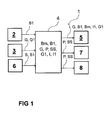
- FIG. 1 schematically shows a device 1 for consumption-optimized control of a motor vehicle, not shown.
- the device 1 comprises an activation unit 2 for activating an optimum operating mode for controlling the motor vehicle, at least one Input unit 3 for specifying a limit value G for average fuel consumption and / or a limit value G1 for a gas emission and a control unit 4 for controlling the motor vehicle in at least one operating mode Bm.
- the gas emission is also understood to mean a carbon dioxide emission associated with the gas emission.
- Carbon dioxide or carbon dioxide is a chemical compound of carbon and oxygen, where the carbon dioxide is the gas emission or combustion of carbonaceous substances.
- Carbon-containing substances are fuels and / or fuels, in particular gasoline.
- the motor vehicle includes in a manner not shown a drive unit or a drive motor, in particular an internal combustion engine, such as a gas or fuel-powered internal combustion engine / engine, or an electric machine or a combination of an internal combustion engine and electric motor / motor.
- an internal combustion engine such as a gas or fuel-powered internal combustion engine / engine, or an electric machine or a combination of an internal combustion engine and electric motor / motor.
- the device 1 comprises at least one output unit 5.
- the output unit 5 is or are, for example, an indicator in a fitting and / or a loudspeaker.
- the device 1 comprises at least one sensor unit 6 for detecting at least one aggregate characteristic of at least one unit 7 of the motor vehicle and / or at least one performance characteristic of a drive train 8, these parameters being the sensor unit S of the control unit 4 be supplied for further processing and for controlling the motor vehicle in the at least one operating mode Bm.
- the activation unit 2 is formed in the simple embodiment in a manner not shown as a switch or an actuator on the steering wheel and / or on a valve of the motor vehicle. In this case, by means of the activation unit 2 as the at least one operating mode Bm, an optimum operating mode B1 can be manually activated or deactivated. In an alternative embodiment, the activation unit 2 is designed as an operating function of a voice control and / or as a menu item of a menu-guided operation, for example of a touch screen.
- the input unit 3 is in particular a key or an actuating element on the steering wheel and / or on a fitting of the motor vehicle and / or a microphone of a voice control.
- the input unit 3 is used for manual input of a limit value G for the average fuel consumption as nominal fuel average consumption and / or a limit value G1 for the gas emission as nominal gas emission.
- the control unit 4 is set up for consumption-optimized control of the motor vehicle such that it is checked whether a predetermined optimum operating mode B1 for controlling the motor vehicle is activated as an operating mode Bm and a limit value G for a fuel average consumption and / or a limit G1 for a Gas emission is specified, with activated optimum operating mode B1 and determined limit value G for the average fuel consumption and / or determined limit G1 for the gas emission, the motor vehicle is controlled such that maximum the predetermined limit G for the average fuel consumption and / or maximum predetermined limit G1 is consumed for the gas emission.
- the motor vehicle is controlled in such a way that a determined average actual fuel consumption is at least the predetermined limit value G for the average fuel consumption and / or a determined actual gas emission corresponds at most to the predetermined limit value G1 for the gas emission and thus to a predetermined target consumption and / or a target emission.
- At least one parameter P and / or a manipulated variable SS of the at least one unit 7 and / or the drive train 8 of the motor vehicle is set accordingly.
- At least one aggregate characteristic, in particular energy consumption, of at least one active aggregate 7, in particular an electrical and / or hydraulic consumer, is determined on the basis of sensor signals S supplied to the control unit 4 for further processing. For example, it is identified which units 7 of the motor vehicle are activated and in operation. In addition, the instantaneous energy consumption of at least one active unit 7 is determined. For example, the current energy consumption of an alternator, a rear window heater, a windscreen heater, an air conditioner, a heat pump, a heat exchanger, an air compressor, a fan and / or other active units 7 is determined.
- the controller 4 then optionally takes into account the predetermined limit value G of the average fuel consumption and the determined instantaneous average fuel consumption I, in particular if the difference between the limit value G and the actual average fuel consumption I, at least one parameter P to be set and / or a manipulated variable SS to be set for setting and / or controlling the unit / s 7 or the drive train 8 are generated.
- Such a procedure also applies taking into account the predetermined limit value G1 of the gas emission and the determined instantaneous actual gas emission I1.
- control unit 4 is set up in such a way that, if the activated optimum operating mode B1 is identified, the at least one aggregate characteristic of the at least one active unit 7 depends on the preset limit value G for the average fuel consumption and / or on the predefined limit value G1 Gas emission is changed or adjusted.
- an alternator or a rear window heater can be switched to a economy mode in which the energy consumption is significantly reduced, whereby the average fuel consumption and / or the gas emission is lowered or be.
- the control unit 4 non-operational units 7, such as a seat heater be disabled or turned off.
- further units 7 such as retractable or extendable attachments on the motor vehicle, can be positioned, in particular retracted, such that they optimize the aerodynamics of the motor vehicle, in particular reduce the aerodynamic drag of the motor vehicle.
- Such repositioning, switching off and / or deactivation of non-operational units 7 reduces the energy requirement and thus the fuel consumption and / or the associated gas emission of the motor vehicle due to the reduction of the load of the drive unit by reducing the number of active units. 7
- Performance characteristic of the drive train 8 in particular an engine torque, a power, a rotational speed of a drive unit, such as a drive motor of the motor vehicle, determined.
- control unit 4 is set up such that when the activated optimum operating mode B1 is identified, the at least one performance variable is changed or adjusted as a function of the preset limit value G for the average fuel consumption and / or the predetermined limit value G1 of the gas emission.
- a power control member such as a throttle, may be operated reduced or operated to maintain the position of the power control member or to vary the power of the power unit to be constant or approximately constant.
- a further embodiment provides that the optimum operating mode B1 is activated manually by means of the activation unit 2 and the limit value G for the
- the activation unit 2 and the input unit 3 can be designed as separate elements or as a multi-function switch or as a multifunction menu of an operating unit, such as a touch screen.
- control unit 4 can be set up such that the optimum operating mode B1 is automatically activated if an approximately constant driving style of the motor vehicle is identified in a predetermined monitoring period.
- a constant driving style is identified in particular when the motor vehicle is for example outside a start or cold phase in a normal operation during a city or land travel or when the motor vehicle drives in particular largely at a constant speed and little or only slight changes in speed over the predetermined monitoring period ,
- the motor vehicle is controlled such that the determined instantaneous actual gas emission I1, in particular a determined average actual carbon dioxide emissions, a maximum of a predetermined limit G1 for the gas emission and the average carbon dioxide emissions and thus a predetermined target Gas emissions or target emissions.
- At least one carbon dioxide emission quantity is determined as a function of the average fuel consumption and / or the gas emission.
- the carbon dioxide emission is detected by means of the sensor unit 6, wherein additionally a further sensor unit for detecting the carbon dioxide emission may be provided.
- the input unit 3 particularly serves for manually inputting an average carbon dioxide emission limit value G1 as an average carbon dioxide emission target value, thereby emitting carbon dioxide in conjunction with chemical oxidation during gas emission.
- the limit value G1 for the gas emission or the average carbon dioxide emission is set at the same time.
- the output unit 5 in particular an output of a so-called energy-saving and / or pollutant class for average fuel consumption and / or gas emission, in particular a carbon dioxide emission and / or in the fitting and / or by means of at least a loudspeaker.
- a so-called energy-saving and / or pollutant class for average fuel consumption and / or gas emission in particular a carbon dioxide emission and / or in the fitting and / or by means of at least a loudspeaker.
- this activation can be confirmed or deactivated by means of an input by the driver of the motor vehicle via the input unit 3 and / or the activation unit 2.
- the set or changed limit value G can moreover be output on the output unit 5, in particular displayed, so that the driver of the motor vehicle has a feedback about the currently set or predetermined limit value G for the average fuel consumption and / or the limit value G1 of the gas emission.
- a determined instantaneous actual average fuel consumption I and / or a determined instantaneous actual gas emission I1 can be output, in particular indicated.
- an additional feedback about the activation of the optimal operating mode B1 can be output on the output unit 5, in particular displayed.
- the driver when information is output, the driver is informed both about the activation of the optimal operating mode B1 and about the currently set limit value G and the currently determined actual average fuel consumption I and / or about the currently set limit value G1 and the currently determined actual gas emission I1 always informed about the current fuel consumption and operating conditions and can additionally adjust its driving behavior for even further reduction of fuel consumption and / or the preset limit G for the average fuel consumption and / or the preset limit G1 of the gas emission.
- the advantages of the invention are that the motor vehicle with optimal, in particular reduced or lowest fuel consumption, reduced gas emission and pollutant emissions and thus by the control of the motor vehicle in dependence on the determined limit G for the average fuel consumption and / or the determined limit G1 of the gas emission can be operated particularly economically and cost-saving.
Landscapes
- Engineering & Computer Science (AREA)
- Automation & Control Theory (AREA)
- Transportation (AREA)
- Mechanical Engineering (AREA)
- Human Computer Interaction (AREA)
- Control Of Vehicle Engines Or Engines For Specific Uses (AREA)
- Vehicle Body Suspensions (AREA)
Priority Applications (2)
| Application Number | Priority Date | Filing Date | Title |
|---|---|---|---|
| EP15804671.4A EP3230141B1 (fr) | 2014-12-12 | 2015-11-18 | Procédé et dispositif de commande optimisée en termes de consommation d'un véhicule automobile |
| PCT/EP2015/002300 WO2016091352A1 (fr) | 2014-12-12 | 2015-11-18 | Procédé et dispositif de commande optimisée en termes de consommation d'un véhicule automobile |
Applications Claiming Priority (1)
| Application Number | Priority Date | Filing Date | Title |
|---|---|---|---|
| DE102013021129.8A DE102013021129A1 (de) | 2013-12-13 | 2013-12-13 | Verfahren und Vorrichtung zur verbrauchsoptimierten Steuerung eines Kraftfahrzeuges |
Publications (2)
| Publication Number | Publication Date |
|---|---|
| EP2933162A2 true EP2933162A2 (fr) | 2015-10-21 |
| EP2933162A3 EP2933162A3 (fr) | 2016-05-11 |
Family
ID=52144341
Family Applications (1)
| Application Number | Title | Priority Date | Filing Date |
|---|---|---|---|
| EP14004192.2A Withdrawn EP2933162A3 (fr) | 2013-12-13 | 2014-12-12 | Procédé et dispositif de commande optimisant la consommation d'un véhicule automobile |
Country Status (2)
| Country | Link |
|---|---|
| EP (1) | EP2933162A3 (fr) |
| DE (1) | DE102013021129A1 (fr) |
Cited By (1)
| Publication number | Priority date | Publication date | Assignee | Title |
|---|---|---|---|---|
| CN111148650A (zh) * | 2017-08-23 | 2020-05-12 | Cpk汽车业有限责任两合公司 | 用于影响马达的能量消耗的方法 |
Families Citing this family (1)
| Publication number | Priority date | Publication date | Assignee | Title |
|---|---|---|---|---|
| CN114248777B (zh) * | 2021-12-13 | 2024-03-19 | 潍柴动力股份有限公司 | 降低油耗的方法、装置、存储介质和电子设备 |
Citations (1)
| Publication number | Priority date | Publication date | Assignee | Title |
|---|---|---|---|---|
| DE4411940A1 (de) | 1994-04-07 | 1995-10-12 | Porsche Ag | Steuerverfahren und Steuereinrichtung für ein stufenloses Getriebe |
Family Cites Families (8)
| Publication number | Priority date | Publication date | Assignee | Title |
|---|---|---|---|---|
| DE3138371A1 (de) * | 1981-09-26 | 1983-04-14 | Daimler-Benz Ag, 7000 Stuttgart | "vorrichtung zur regelung einer antriebsmotor-getriebe-einheit eines kraftfahrzeuges |
| DE102005005002B4 (de) * | 2005-02-03 | 2007-03-29 | Güttler, Gerhard, Prof. Dr. | Verfahren und Vorrichtung zum Einsparen von Energie in einem Fahrzeug |
| DE102007050504A1 (de) * | 2007-10-19 | 2009-04-23 | Daimler Ag | Vorrichtung zur Unterstützung des Fahrers eines Fahrzeugs beim Betreiben des Fahrzeugs in einer emissionsreduzierten Fahrweise |
| DE102008001669A1 (de) * | 2008-05-08 | 2009-11-12 | Robert Bosch Gmbh | Vorrichtung zur Fahrbetriebseinstellung eines Hybridfahrzeugs sowie entsprechendes Verfahren |
| ES2395576T3 (es) * | 2008-08-05 | 2013-02-13 | General Electric Company | Procedimiento de funcionamiento de un vehículo y sistema asociado |
| DE102009002385A1 (de) * | 2009-04-15 | 2010-10-21 | Robert Bosch Gmbh | Verfahren zum Betreiben eines Kraftfahrzeugs |
| FR2982824B1 (fr) * | 2011-11-17 | 2013-11-22 | IFP Energies Nouvelles | Procede de commande en regime transitoire d'un systeme de propulsion hybride d'un vehicule |
| EP2620339B8 (fr) * | 2012-01-24 | 2016-02-24 | C.R.F. Società Consortile per Azioni | Contrôle d'un mode roue libre pour un véhicule à moteur avec le moteur à l'arrêt |
-
2013
- 2013-12-13 DE DE102013021129.8A patent/DE102013021129A1/de not_active Withdrawn
-
2014
- 2014-12-12 EP EP14004192.2A patent/EP2933162A3/fr not_active Withdrawn
Patent Citations (1)
| Publication number | Priority date | Publication date | Assignee | Title |
|---|---|---|---|---|
| DE4411940A1 (de) | 1994-04-07 | 1995-10-12 | Porsche Ag | Steuerverfahren und Steuereinrichtung für ein stufenloses Getriebe |
Cited By (1)
| Publication number | Priority date | Publication date | Assignee | Title |
|---|---|---|---|---|
| CN111148650A (zh) * | 2017-08-23 | 2020-05-12 | Cpk汽车业有限责任两合公司 | 用于影响马达的能量消耗的方法 |
Also Published As
| Publication number | Publication date |
|---|---|
| EP2933162A3 (fr) | 2016-05-11 |
| DE102013021129A1 (de) | 2015-06-18 |
Similar Documents
| Publication | Publication Date | Title |
|---|---|---|
| DE102015206671A1 (de) | Zusatzheizungssystem für fahrzeuge | |
| DE102009039373A1 (de) | Energieassistent in einem Kraftfahrzeug | |
| EP2209687A1 (fr) | Système d'assistance à l'économie d'énergie pour véhicule à moteur | |
| DE102014106649A1 (de) | HLK-Steuerung für Fahrzeuge mit Start/Stopp-Automatik | |
| EP1694959B1 (fr) | Procede de mise en marche/arret automatique d'un moteur a combustion interne | |
| DE102018205690A1 (de) | Verfahren und System zur Steuerung einer Benutzeroberfläche und einer Klimatisierungseinheit | |
| DE102013218127A1 (de) | Verfahren zur Steuerung des Betriebs zumindest einer Antriebs- oder Lastkomponente eines Hybrid- oder Elektrofahrzeugs und Verfahren zur Erzeugung eines Betriebsoptimierungshinweises für einen derartigen Betrieb | |
| DE102014226296A1 (de) | Geschwindigkeitsregelanlage und Verfahren zur Betriebszustandsoptimierung eines Fahrzeuges | |
| DE102015104579A1 (de) | System und verfahren zum steuern von heizmodi für ein hybridelektrofahrzeug (hev) | |
| EP3378721B1 (fr) | Véhicule, en particulier véhicule utilitaire et procédé de fonctionnement du véhicule | |
| EP2933162A2 (fr) | Procédé et dispositif de commande optimisant la consommation d'un véhicule automobile | |
| EP3230141B1 (fr) | Procédé et dispositif de commande optimisée en termes de consommation d'un véhicule automobile | |
| DE102020119513A1 (de) | Steuerung eines Kraftfahrzeugs | |
| DE102012219848A1 (de) | Verfahren zur Steuerung oder Regelung eines Fahrerassistenzsystems | |
| DE102013214264B4 (de) | Verfahren zum Steuern wenigstens eines Verbrauchers eines Kraftfahrzeugs und Kraftfahrzeug mit wenigstens einem Verbraucher | |
| CH718858A2 (de) | Verfahren zum steuern eines nutzmodus, wie eines pausenmodus, in umweldfreundlichen fahrzeugen und fahrzeugsystem. | |
| WO2013004463A1 (fr) | Procédé de commande d'un entraînement hybride de véhicule | |
| WO2013139625A1 (fr) | Procédé et dispositif de réglage de la vitesse d'un véhicule à moteur | |
| DE102016207002A1 (de) | Verfahren und Vorrichtung zur Steuerung einer Abgasklappe | |
| DE102017119291B4 (de) | Verfahren zur Beeinflussung des Energieverbrauchs eines Motors | |
| EP3045695B1 (fr) | Procede de fonctionnement d'un systeme de refroidissement pour un vehicule, en particulier pour un vehicule utilitaire | |
| DE102008028424A1 (de) | Verfahren zum Betrieb einer Steuereinrichtung eines Kraftfahrzeuges und Steuereinrichtung eines Kraftfahrzeuges zur Durchführung des Verfahrens | |
| DE102009008872A1 (de) | Verfahren zur Steuerung eines Fahrzeugs | |
| DE102010062373A1 (de) | Pedalwertgeberanordnung | |
| DE102006015270B4 (de) | Vorrichtung zur Reduzierung des CO2-Ausstoßes in Kraftfahrzeugen |
Legal Events
| Date | Code | Title | Description |
|---|---|---|---|
| PUAI | Public reference made under article 153(3) epc to a published international application that has entered the european phase |
Free format text: ORIGINAL CODE: 0009012 |
|
| AK | Designated contracting states |
Kind code of ref document: A2 Designated state(s): AL AT BE BG CH CY CZ DE DK EE ES FI FR GB GR HR HU IE IS IT LI LT LU LV MC MK MT NL NO PL PT RO RS SE SI SK SM TR |
|
| AX | Request for extension of the european patent |
Extension state: BA ME |
|
| PUAL | Search report despatched |
Free format text: ORIGINAL CODE: 0009013 |
|
| AK | Designated contracting states |
Kind code of ref document: A3 Designated state(s): AL AT BE BG CH CY CZ DE DK EE ES FI FR GB GR HR HU IE IS IT LI LT LU LV MC MK MT NL NO PL PT RO RS SE SI SK SM TR |
|
| AX | Request for extension of the european patent |
Extension state: BA ME |
|
| RIC1 | Information provided on ipc code assigned before grant |
Ipc: B60W 30/182 20120101ALI20160406BHEP Ipc: B60W 30/188 20120101ALI20160406BHEP Ipc: B60W 50/08 20120101ALI20160406BHEP Ipc: B60W 40/12 20120101AFI20160406BHEP |
|
| STAA | Information on the status of an ep patent application or granted ep patent |
Free format text: STATUS: THE APPLICATION IS DEEMED TO BE WITHDRAWN |
|
| 18D | Application deemed to be withdrawn |
Effective date: 20161112 |