EP2933164B1 - Procédé d'informations et système d'informations pour le conducteur d'un véhicule automobile - Google Patents
Procédé d'informations et système d'informations pour le conducteur d'un véhicule automobile Download PDFInfo
- Publication number
- EP2933164B1 EP2933164B1 EP15160288.5A EP15160288A EP2933164B1 EP 2933164 B1 EP2933164 B1 EP 2933164B1 EP 15160288 A EP15160288 A EP 15160288A EP 2933164 B1 EP2933164 B1 EP 2933164B1
- Authority
- EP
- European Patent Office
- Prior art keywords
- safety
- detected
- motor vehicle
- driver
- information
- Prior art date
- Legal status (The legal status is an assumption and is not a legal conclusion. Google has not performed a legal analysis and makes no representation as to the accuracy of the status listed.)
- Active
Links
Images


Classifications
-
- B—PERFORMING OPERATIONS; TRANSPORTING
- B60—VEHICLES IN GENERAL
- B60W—CONJOINT CONTROL OF VEHICLE SUB-UNITS OF DIFFERENT TYPE OR DIFFERENT FUNCTION; CONTROL SYSTEMS SPECIALLY ADAPTED FOR HYBRID VEHICLES; ROAD VEHICLE DRIVE CONTROL SYSTEMS FOR PURPOSES NOT RELATED TO THE CONTROL OF A PARTICULAR SUB-UNIT
- B60W40/00—Estimation or calculation of non-directly measurable driving parameters for road vehicle drive control systems not related to the control of a particular sub unit, e.g. by using mathematical models
- B60W40/08—Estimation or calculation of non-directly measurable driving parameters for road vehicle drive control systems not related to the control of a particular sub unit, e.g. by using mathematical models related to drivers or passengers
- B60W40/09—Driving style or behaviour
-
- G—PHYSICS
- G07—CHECKING-DEVICES
- G07C—TIME OR ATTENDANCE REGISTERS; REGISTERING OR INDICATING THE WORKING OF MACHINES; GENERATING RANDOM NUMBERS; VOTING OR LOTTERY APPARATUS; ARRANGEMENTS, SYSTEMS OR APPARATUS FOR CHECKING NOT PROVIDED FOR ELSEWHERE
- G07C5/00—Registering or indicating the working of vehicles
- G07C5/08—Registering or indicating performance data other than driving, working, idle, or waiting time, with or without registering driving, working, idle or waiting time
- G07C5/0816—Indicating performance data, e.g. occurrence of a malfunction
-
- B—PERFORMING OPERATIONS; TRANSPORTING
- B60—VEHICLES IN GENERAL
- B60W—CONJOINT CONTROL OF VEHICLE SUB-UNITS OF DIFFERENT TYPE OR DIFFERENT FUNCTION; CONTROL SYSTEMS SPECIALLY ADAPTED FOR HYBRID VEHICLES; ROAD VEHICLE DRIVE CONTROL SYSTEMS FOR PURPOSES NOT RELATED TO THE CONTROL OF A PARTICULAR SUB-UNIT
- B60W50/00—Details of control systems for road vehicle drive control not related to the control of a particular sub-unit, e.g. process diagnostic or vehicle driver interfaces
- B60W50/08—Interaction between the driver and the control system
- B60W50/14—Means for informing the driver, warning the driver or prompting a driver intervention
- B60W2050/146—Display means
-
- B—PERFORMING OPERATIONS; TRANSPORTING
- B60—VEHICLES IN GENERAL
- B60W—CONJOINT CONTROL OF VEHICLE SUB-UNITS OF DIFFERENT TYPE OR DIFFERENT FUNCTION; CONTROL SYSTEMS SPECIALLY ADAPTED FOR HYBRID VEHICLES; ROAD VEHICLE DRIVE CONTROL SYSTEMS FOR PURPOSES NOT RELATED TO THE CONTROL OF A PARTICULAR SUB-UNIT
- B60W2530/00—Input parameters relating to vehicle conditions or values, not covered by groups B60W2510/00 or B60W2520/00
- B60W2530/209—Fuel quantity remaining in tank
-
- B—PERFORMING OPERATIONS; TRANSPORTING
- B60—VEHICLES IN GENERAL
- B60W—CONJOINT CONTROL OF VEHICLE SUB-UNITS OF DIFFERENT TYPE OR DIFFERENT FUNCTION; CONTROL SYSTEMS SPECIALLY ADAPTED FOR HYBRID VEHICLES; ROAD VEHICLE DRIVE CONTROL SYSTEMS FOR PURPOSES NOT RELATED TO THE CONTROL OF A PARTICULAR SUB-UNIT
- B60W2540/00—Input parameters relating to occupants
- B60W2540/043—Identity of occupants
-
- B—PERFORMING OPERATIONS; TRANSPORTING
- B60—VEHICLES IN GENERAL
- B60W—CONJOINT CONTROL OF VEHICLE SUB-UNITS OF DIFFERENT TYPE OR DIFFERENT FUNCTION; CONTROL SYSTEMS SPECIALLY ADAPTED FOR HYBRID VEHICLES; ROAD VEHICLE DRIVE CONTROL SYSTEMS FOR PURPOSES NOT RELATED TO THE CONTROL OF A PARTICULAR SUB-UNIT
- B60W2540/00—Input parameters relating to occupants
- B60W2540/26—Incapacity
-
- B—PERFORMING OPERATIONS; TRANSPORTING
- B60—VEHICLES IN GENERAL
- B60W—CONJOINT CONTROL OF VEHICLE SUB-UNITS OF DIFFERENT TYPE OR DIFFERENT FUNCTION; CONTROL SYSTEMS SPECIALLY ADAPTED FOR HYBRID VEHICLES; ROAD VEHICLE DRIVE CONTROL SYSTEMS FOR PURPOSES NOT RELATED TO THE CONTROL OF A PARTICULAR SUB-UNIT
- B60W2554/00—Input parameters relating to objects
-
- B—PERFORMING OPERATIONS; TRANSPORTING
- B60—VEHICLES IN GENERAL
- B60W—CONJOINT CONTROL OF VEHICLE SUB-UNITS OF DIFFERENT TYPE OR DIFFERENT FUNCTION; CONTROL SYSTEMS SPECIALLY ADAPTED FOR HYBRID VEHICLES; ROAD VEHICLE DRIVE CONTROL SYSTEMS FOR PURPOSES NOT RELATED TO THE CONTROL OF A PARTICULAR SUB-UNIT
- B60W2554/00—Input parameters relating to objects
- B60W2554/80—Spatial relation or speed relative to objects
- B60W2554/801—Lateral distance
-
- B—PERFORMING OPERATIONS; TRANSPORTING
- B60—VEHICLES IN GENERAL
- B60W—CONJOINT CONTROL OF VEHICLE SUB-UNITS OF DIFFERENT TYPE OR DIFFERENT FUNCTION; CONTROL SYSTEMS SPECIALLY ADAPTED FOR HYBRID VEHICLES; ROAD VEHICLE DRIVE CONTROL SYSTEMS FOR PURPOSES NOT RELATED TO THE CONTROL OF A PARTICULAR SUB-UNIT
- B60W2555/00—Input parameters relating to exterior conditions, not covered by groups B60W2552/00, B60W2554/00
- B60W2555/60—Traffic rules, e.g. speed limits or right of way
Definitions
- the present invention relates to an information method for the driver of a motor vehicle. Furthermore, the invention relates to an information system for the driver of a motor vehicle with at least one driver assistance system for detecting safety-relevant parameters when driving the motor vehicle.
- driver assistance systems support the driver when driving the motor vehicle and thus increase traffic safety.
- driver assistance systems can stabilize the motor vehicle while driving.
- driver assistance systems can include an anti-lock braking system, traction control and vehicle dynamics control.
- Other assistance functions relate to the trajectory of the motor vehicle.
- These assistance functions include, for example, adaptive cruise control (ACC), frontal collision protection systems and a lane departure warning system (LDW).
- ACC adaptive cruise control
- LWD lane departure warning system
- driver assistance systems include a large number of sensors, by means of which the surroundings of the motor vehicle and the traffic situation can be recorded and analyzed.
- the driver of the motor vehicle does not perceive the function of the various driver assistance systems, or only very rarely, since they are only used in very safety-critical traffic situations. If such situations do not occur, the driver does not realize that the driver assistance systems are still making a continuous contribution to safety when driving the motor vehicle. This is disadvantageous since the driver cannot assess the support provided by the assistance functions and evaluate it while driving.
- a method and a system are known with which the driving style of the driver can be monitored and analyzed.
- the position of the vehicle is monitored while driving.
- parameters assigned to the vehicle are monitored and a driver profile is generated, which characterizes the driver's driving style.
- the driver can be given a bonus or a penalty depending on how safe and/or how economical he drives and how much exhaust gas he produces.
- a motor vehicle with a display is known on which various information relating to the motor vehicle is displayed.
- the display is divided into two display areas. Operating actions by the driver of the motor vehicle that have a positive evaluation are assigned to one display area, and operating actions by the driver that have a negative evaluation are assigned to the other display area.
- the operator actions of the driver are understood to mean, in particular, those operator actions which negatively or positively influence the fuel consumption of the motor vehicle and/or the pollutant emissions of the motor vehicle.
- a method for driver information in a motor vehicle is known.
- information about the past driving behavior of the driver is reproduced in a display area of a display device, this information conveying the extent to which a determined driving behavior of the driver conforms to an operating mode.
- the operating mode represents a corresponding driving style.
- the driving style can be resource-saving, dynamic or normal.
- the U.S. 2013/135092 A1 which serves as the basis for the two-part version of the claim, describes a method for analyzing the driving behavior of a driver. Data on the driving safety of the driver are recorded. Furthermore, the data is analyzed and a driving safety signal is generated. The driving safety signal is issued so that the driver can assess his current driving behavior promptly.
- the DE 10 2005 044771 A1 describes an apparatus for providing information about a vehicle journey.
- a traffic hazard potential is determined on the basis of evaluation rules.
- the traffic hazard potential is currently made available to the driver DE 10 2006 047311 A1 describes a system for increasing the driving safety of a vehicle.
- driving safety information is displayed on a display device based on the data and signals from the safety and assistance systems of the vehicle. The driver can also be informed about his driving behavior over the last 24 hours.
- the driving style of the driver is recorded.
- the driving style can be output using a trip report for a specific time.
- the U.S. 2009/284361 A1 describes an evaluation system by means of which a driver's driving style is evaluated. A starting value of one hundred points is assumed. Points are deducted for each unsafe driving maneuver. Points are added for each safe driving manoeuvre. The points are continuously displayed to the driver so that he can assess his driving behavior.
- the present invention is based on the object of providing an information method and an information system of the type mentioned at the outset, with which the driver of the motor vehicle is provided with information on safety when driving the vehicle.
- safety-relevant parameters are recorded when driving the motor vehicle using at least one driver assistance system.
- a safety level is determined from the recorded parameters, which indicates for a time or distance interval how safely the driver of the motor vehicle drove.
- the current security level is then displayed.
- the driver By displaying the safety level, the driver is given feedback on his past driving behavior in such a way that he can use a displayed parameter to recognize a degree of safety, which may result from the parameters of a number of driver assistance systems.
- the parameters are continuously recorded and the security level is continuously updated accordingly. This allows the driver Furthermore, the functionality of the driver assistance systems is conveyed, even if these do not actively intervene in the driving process or intervene with warnings.
- the distance of the motor vehicle from other road users and/or objects can be detected as a safety-relevant parameter.
- the distance that the motor vehicle maintains from a vehicle driving in front can be detected.
- the lateral distance to the vehicle that is being overtaken can be detected, for example, when overtaking.
- parking it can be detected how close the motor vehicle comes to stationary objects.
- These distance values are relevant to safety when driving the vehicle, since there is a risk of a collision with another road user or an object, particularly if the distance values are too small.
- the distance values are optionally taken into account in conjunction with other parameters such as the speed or acceleration of the motor vehicle.
- a safety-relevant parameter it can also be recorded whether the direction indicator was detected when changing lanes. Changing lanes without activating the direction indicator is relevant to safety when driving the motor vehicle.
- the filling level of operating liquids is recorded as a safety-relevant parameter. For example, driving without washing water, in particular for the windshield of the motor vehicle, is relevant to safety when driving the motor vehicle. Furthermore, vehicle status errors can be recorded and taken into account as safety-relevant parameters. If, for example, the vehicle status indicates that the brake system is faulty, driving the motor vehicle is relevant to safety when driving the vehicle despite this fault in the vehicle status.
- traffic signs valid for the journey can be detected in the method according to the invention. Following or not following the rules corresponding to these traffic signs can then be recorded as a safety-relevant parameter.
- the speed of the motor vehicle or any overtaking maneuvers can be taken into account.
- the duration of a route that has been covered without a break is determined.
- Exceeding a specific maximum duration can then be recorded as a safety-relevant parameter.
- the tiredness of the driver can be detected by sensors. If it is detected that the driver has exceeded a tiredness threshold, this is relevant to safety when driving the vehicle.
- the safety level is determined in connection with these parameters, among other things, so that the driver is advantageously shown a realistic indication of how safely he has driven the motor vehicle.
- dangerous situations are detected using the parameters.
- driver assistance systems for safety do not necessarily intervene.
- the dangerous situations detected can already influence the safety level, so that the function of the driver assistance systems is already illustrated to the driver when these assistance systems are not yet intervening in the driving process or issuing warnings.
- the safety level is increased in particular if no dangerous situations have been detected in a part-time or part-distance interval.
- the safety level is thus increased cumulatively when the motor vehicle is moved without dangerous situations occurring. This also advantageously explains the function of the driver assistance systems to the driver.
- the safety level is lowered in particular if a dangerous situation has been detected in a partial time interval or partial route interval.
- a potential hazard is advantageously signaled to the driver directly in this way, although the driver assistance systems have not yet necessarily issued a warning or intervened in the driving process.
- the size of the danger of a dangerous situation is detected by means of the parameters.
- the extent of the lowering of the security level then depends on the magnitude of the danger detected dangerous situation. This advantageously gives the driver a realistic indication of how safely he is driving the motor vehicle via the safety level.
- a change in the security level is indicated by a change in the size of a symbol.
- the icon may increase in size or fill out more and more.
- the symbol can comprise a plurality of sub-symbols, with the number of sub-symbols displayed being increased as the security level increases.
- the interval can begin when the engine is started and the motor vehicle drives off and end when the engine is stopped and then switched off.
- the interval can also correspond to a route of a navigation system of the motor vehicle.
- the interval could also include the time and distance traveled between two refueling events.
- the security level is reset to the original value.
- the person of the driver of the motor vehicle can be recorded and the safety level can be recorded in a driver-specific manner.
- the time or route interval includes interruptions during which the driver may change, it is advantageous to manage the safety level separately for each driver.
- a standstill of the motor vehicle is detected and, if it has been detected that the motor vehicle is stationary, information about at least one past detected dangerous situation is output to the driver.
- the driver can be informed promptly when a dangerous situation has occurred, even if a driver assistance system has not yet intervened in the driving process or has issued a warning.
- tips for an improved driving style can also be issued in order to avoid such dangerous situations in the future. This advantageously gives the driver the opportunity to improve his driving behavior.
- the information system according to the invention comprises at least one driver assistance system for detecting safety-relevant parameters when driving the motor vehicle. Furthermore, the information system includes an evaluation device which is coupled to the at least one driver assistance system. A safety level can be determined from the detected parameters by means of the evaluation device, the safety level for a time or distance interval indicating how safely the driver drove the motor vehicle. Furthermore, the information system according to the invention comprises a display device which is coupled to the evaluation device. The current security level can be displayed by means of the display device.
- the information system according to the invention serves in particular to carry out the information method according to the invention. It therefore has the same advantages as the information method according to the invention.
- the driver assistance system of the information system includes in particular at least one sensor for detecting the distance of the motor vehicle from other road users and/or objects.
- the security level can be determined at least partially from the detected distances by means of the evaluation device.
- the information system thus advantageously uses the sensors of a driver assistance system that are usually present anyway and determines the safety level based on the measured values of these sensors.
- the driver assistance system can also include at least one sensor for detecting the fill level of operating fluids.
- the safety level is determined at least in part from the recorded filling levels by means of the evaluation device.
- a driver assistance system is understood to mean any system that supports the driver in any way in driving the motor vehicle. This also includes the monitoring of operating parameters of the motor vehicle.
- the driver assistance system can include a unit for detecting traffic signs that are valid for the journey.
- the safety level can be determined at least partially from the detected traffic signs by means of the evaluation unit.
- other parameters such as the speed of the vehicle or any overtaking maneuvers, are taken into account in particular for determining the safety level. These can also be detected by the driver assistance system.
- this includes an identification device for detecting the identity of the driver of the motor vehicle.
- the evaluation device is designed in such a way that the safety level is recorded in a driver-specific manner.
- different safety levels it is advantageously possible for different safety levels to be determined for different drivers. Since drivers' driving styles usually differ, each driver can find out for himself, based on the safety level, how safely he drove the motor vehicle in the past.
- the information system 1 comprises a display device 2, which can be arranged, for example, in the instrument cluster or in the center console of the motor vehicle. Furthermore, the information system 1 includes a driver assistance system 3. This driver assistance system 3 can optionally be composed of a large number of partial assistance systems. Driver assistance system 3 is coupled to a large number of sensors 4 .
- the sensors 4 can be used to detect the following, among other things: The distance of the motor vehicle from other road users and objects is detected by means of one or more sensors 4 .
- the sensors 4 used for this are, for example, radar sensors, infrared sensors and optical sensors, the measurement data from which are evaluated by the driver assistance system 3 in order to calculate the corresponding distances.
- the sensors 4 also detect the fill level of operating fluids in the motor vehicle. These operating fluids include the washing water for the windshield and the rear window, the engine oil and transmission oil, the cooling water and the brake fluid and possibly other fluids that are relevant to driving the vehicle safely.
- the sensors 4 also include a camera that takes pictures of the surroundings of the motor vehicle. By evaluating the images from the camera, the driver assistance system 3 can recognize traffic signs that are valid for the journey and detect other road users, such as pedestrians and cyclists, in the vicinity of the motor vehicle.
- the sensors 4 can also be used to detect whether there are errors in the vehicle status. Such errors are stored, for example, in the control units of the motor vehicle.
- the sensors 4 are also used to detect whether a person is sitting on a seat in the motor vehicle and whether this person has put on the seat belt. Furthermore, the sensors 4 detect whether a door or a flap of the motor vehicle is open or closed.
- the information system 1 also includes an identification device 5, by means of which the identity of the driver of the motor vehicle can be recorded.
- the driver can use the identification device 5 to enter his identity, if necessary by means of a code.
- the driver can also be detected in other ways. For example, a camera in the interior of the motor vehicle can recognize the driver based on his face or based on biometric features.
- each driver can be assigned a specific key, which transmits the identity of the driver to the identification device 5 by radio.
- the display device 2, the driver assistance system 3 and the identification device 5 are coupled to an evaluation device 6 in terms of data technology.
- the evaluation device 6 receives from the driver assistance system 3 all parameters relevant to safety when driving the motor vehicle. These parameters are transmitted continuously, so that the evaluation device 6 can detect any change in these parameters.
- the identification device 5 transmits data on the person of the current driver to the evaluation device 6.
- the evaluation device 6 determines a safety level that indicates for a time or distance interval how safely the driver of the motor vehicle drove. The manner in which the security level is determined will be discussed later with reference to the embodiment of the invention procedure explained.
- the current safety level is then displayed in a visible manner for the driver by means of the display device 2 in the interior of the motor vehicle.
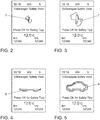
- FIG. 2 and 3 a first example of such a display is reproduced.
- An icon 7 is displayed, the size of which indicates the value of the current security level. Is the symbol smaller, as in 4 shown, if the security level is lower, the icon is larger, as in 3 shown, the security level is higher.
- FIG. 4 and 5 shows another example of the security level display.
- the symbol 8 which in this case represents the outline of a vehicle, fills up as the security level increases.
- the symbol 9 comprises several sub-symbols.
- the number of sub-symbols displayed in the symbol 9 reflects the value of the security level.
- the identification device 5 records the person of the driver after he has got into the motor vehicle, but before the engine has been started. Data on the driver's identity are transmitted from the identification device 5 to the evaluation device 6 .
- the evaluation device 6 sets the safety level for this driver to the value zero.
- the evaluation device 6 continuously records the time driven and the distance covered. Furthermore, data from the driver assistance system 3 is continuously transmitted to the evaluation device 6 .
- the evaluation device 6 uses this data to determine safety-related parameters.
- the safety-relevant parameters are then used to determine whether a dangerous situation existed and, if this was the case, the size of the danger of the dangerous situation. The circumstances under which a traffic situation determined using the safety-relevant parameters is evaluated as a dangerous situation. Corresponding limit values for the safety-relevant parameters are stored in the evaluation device 6 .
- the following traffic situations which are determined using the data transmitted by the driver assistance system 3, are recorded as a dangerous situation, with the following list being only examples: If a certain safety distance is not reached, this is evaluated as a dangerous situation. To determine the safety distance, the speed of the vehicle and the distance to a vehicle in front are taken into account. For example, a specific value for the required safety distance can be stored in the evaluation device 6 for each speed value. If the speed falls below this value at a certain speed, it is evaluated as a dangerous situation. The magnitude of the danger of this dangerous situation results from the extent to which the safety distance is not reached.
- An excessive rear end when overtaking is evaluated as a dangerous situation.
- the distance to a vehicle driving ahead and the relative speed to this vehicle driving ahead, as well as an image from a camera, if applicable, are taken into account.
- a lane change without activating the direction indicator is evaluated as a dangerous situation.
- the images from a camera are used to record that a lane change has taken place.
- a sensor 4 simultaneously detects whether the direction indicator has been actuated. If this was not the case when changing lanes, this is classified as a dangerous situation.
- Driving without washing water is rated as a dangerous situation. For this purpose, the measured values of the filling level sensor for the washing water are taken into account.
- Driving despite an error in the vehicle status is detected as a dangerous situation.
- the vehicle status is recognized via the fault memory of the motor vehicle's control units. If, for example, there is a fault in the brake system of the motor vehicle, this is transmitted to evaluation device 6 . If the driver drives despite this error message, this represents a dangerous situation.
- the permissible maximum speed is recognized by means of traffic sign recognition or by means of data from the navigation system of the motor vehicle.
- a traffic sign such as a red traffic light or a stop sign
- driving over a traffic sign is evaluated as a dangerous situation.
- the traffic sign or traffic sign recognition is recorded or by means of data from the navigation system.
- Pedestrians approaching too closely is also recorded as a dangerous situation.
- Pedestrian detection is also carried out in this case using the images from the camera.
- Another dangerous situation is driving without putting on the seat belt.
- the status of the seat belt is recorded by a sensor 4 .
- a door contact sensor records the status of the door.
- the sensors 4 can include a tiredness sensor. This fatigue sensor can, for example, analyze the movement pattern of the journey. Furthermore, it is possible to analyze the steering behavior or features of the driver's face in order to detect excessive driver fatigue.
- the trip is divided by the evaluation device 6 into partial distance intervals or partial time intervals. If no dangerous situation has occurred in such a sub-interval, the value of the safety level is increased. With each sub-interval in which no dangerous situation has occurred, the safety level is further increased cumulatively. This will be like in the Figures 2 to 7 represented by an enlargement of a symbol 7, a filling of a symbol 8 or by the number of partial symbols in a symbol 9 on the display device 2.
- the value of the safety level is reduced and the display on the display device 2 is changed accordingly.
- the amount by which the security level is lowered also depends on the magnitude of the danger of a hazardous situation. If the magnitude of the danger of the hazardous situation was particularly great, the degree of lowering of the safety level is also particularly great.
- the evaluation device 6 detects that the motor vehicle is stationary, the display device 2 displays information about the last dangerous situation. Information is also displayed on how these dangerous situations can be avoided in the future. For example, the message is displayed: "Keep a safe distance".
- the security level for a specific driver can also only be reset after the end of a navigation route or only when the vehicle is refuelled. If necessary, the driver can also set the time at which the security level is reset manually.
- the evaluation device 6 then always displays the safety level on the display device 2 that is assigned to the current driver. It can also show when the current time interval started.
Landscapes
- Engineering & Computer Science (AREA)
- Physics & Mathematics (AREA)
- Automation & Control Theory (AREA)
- Mathematical Physics (AREA)
- Transportation (AREA)
- Mechanical Engineering (AREA)
- General Physics & Mathematics (AREA)
- Traffic Control Systems (AREA)
- Control Of Driving Devices And Active Controlling Of Vehicle (AREA)
- Electric Propulsion And Braking For Vehicles (AREA)
Claims (13)
- Procédé d'information du conducteur d'un véhicule automobile, procédé dans lequeldes paramètres importants pour la sécurité sont détectés lors de la conduite du véhicule automobile au moyen d'au moins un système d'aide à la conduite (3),un niveau de sécurité est déterminé à partir des paramètres détectés, lequel niveau de sécurité indique pendant un intervalle de temps ou de distance la sécurité avec laquelle le conducteur du véhicule automobile conduit, des situations dangereuses étant détectées au moyen des paramètres, des valeurs limites étant mémorisées pour les paramètres importants pour la sécurité, lesquelles valeurs limites définissent des circonstances dans lesquelles une situation de circulation, déterminée sur la base des paramètres importants pour la sécurité, est évaluée comme situation dangereuse, etle niveau de sécurité actuel est affiché,caractérisé en ce que
un arrêt du véhicule automobile est détecté et, s'il a été détecté que le véhicule automobile est à l'arrêt, des informations sur au moins une situation dangereuse précédemment détectée sont délivrées au conducteur, même si un système d'aide à la conduite n'est pas encore intervenu dans la conduite ou a délivré un avertissement. - Procédé d'information selon la revendication 1,
caractérisé en ce que
la distance entre le véhicule automobile et les autres usagers de la route et/ou des objets est détectée comme paramètre important pour la sécurité. - Procédé d'information selon la revendication 1 ou 2,
caractérisé en ce que
le niveau de liquides de fonctionnement et/ou d'erreurs d'un état de véhicule est détecté comme paramètre important pour la sécurité. - Procédé d'information selon l'une des revendications précédentes,
caractérisé en ce que
des panneaux de signalisation valables pour le trajet et le respect des règles correspondant à ces panneaux de signalisation sont détectés comme paramètres importants pour la sécurité. - Procédé d'information selon l'une des revendications précédentes,
caractérisé en ce que
la durée d'un itinéraire qui a été parcouru sans interruption est déterminée et un dépassement d'une durée maximale est détecté comme paramètre important pour la sécurité. - Procédé d'information selon l'une des revendications précédentes,
caractérisé en ce que
le niveau de sécurité est augmenté si aucune situation dangereuse n'a été détectée dans une partie d'intervalle de temps ou de distance. - Procédé d'information selon l'une des revendications précédentes,
caractérisé en ce que
le niveau de sécurité est abaissé si une situation dangereuse a été détectée dans une partie d'intervalle de temps ou de distance. - Procédé d'information selon l'une des revendications précédentes,
caractérisé en ce que
l'importance du danger d'une situation dangereuse est détectée au moyen des paramètres et l'étendue de l'abaissement du niveau de sécurité dépend de l'importance du danger d'une situation dangereuse détectée. - Procédé d'information selon l'une des revendications précédentes,
caractérisé en ce que
une variation du niveau de sécurité est indiquée par une variation de la taille d'un symbole (7). - Système (1) d'information du conducteur d'un véhicule automobile, ledit système d'information comprenantau moins un système d'aide à la conduite (3) destiné à détecter des paramètres importants pour la sécurité lors de la conduite du véhicule automobile,un moyen d'évaluation (6) qui est couplé à l'au moins un système d'aide à la conduite (3) pour déterminer un niveau de sécurité à partir des paramètres détectés, le niveau de sécurité indiquant la sécurité avec laquelle le conducteur conduit le véhicule automobile pendant un intervalle de temps ou de distance, etle moyen d'évaluation (6) étant conçu pour mémoriser, pour les paramètres importants pour la sécurité, des valeurs limites qui déterminent les circonstances dans lesquelles une situation de circulation, déterminée sur la base des paramètres importants pour la sécurité, est évaluée comme situation dangereuse, et pour détecter des situations dangereuses au moyen des paramètres, etun dispositif d'affichage (2) couplé au moyen d'évaluation (6) pour afficher le niveau de sécurité actuel,caractérisé en ce quele moyen d'évaluation (6) est conçu pour détecter un arrêt du véhicule automobile et, s'il a été détecté que le véhicule automobile est à l'arrêt, pour fournir au conducteur des informations sur au moins une situation dangereuse précédemment détectée, même si le système d'aide à la conduite n'est pas encore intervenu dans la conduite ou a délivré un avertissement.
- Système d'information (1) selon la revendication 10,
caractérisé en ce que
le système d'aide à la conduite (3) comprend au moins un capteur (4) destiné à détecter la distance entre le véhicule automobile et d'autres usagers de la route et/ou des objets et le moyen d'évaluation (6) est conçu pour déterminer le niveau de sécurité au moins en partie à partir des distances détectées. - Système d'information (1) selon la revendication 10 ou 11,
caractérisé en ce que
le système d'aide à la conduite comprend au moins un capteur (4) destiné à détecter le niveau des liquides de fonctionnement et/ou une unité destinée à détecter des panneaux de signalisation valables pour le trajet et le moyen d'évaluation (6) est conçu pour déterminer le niveau de sécurité au moins en partie à partir des niveaux détectés et/ou des panneaux de signalisation détectés. - Système d'information (1) selon l'une des revendications 10 à 12,
caractérisé en ce que
le système d'information (1) comprend un moyen d'identification (5) destiné à détecter la personne du conducteur du véhicule automobile et en ce que le moyen d'évaluation (6) est conçu pour détecter le niveau de sécurité d'une manière spécifique au conducteur.
Applications Claiming Priority (1)
| Application Number | Priority Date | Filing Date | Title |
|---|---|---|---|
| DE102014206769.3A DE102014206769A1 (de) | 2014-04-08 | 2014-04-08 | Informationsverfahren und Informationssystem für den Fahrer eines Kraftfahrzeugs |
Publications (3)
| Publication Number | Publication Date |
|---|---|
| EP2933164A2 EP2933164A2 (fr) | 2015-10-21 |
| EP2933164A3 EP2933164A3 (fr) | 2017-06-14 |
| EP2933164B1 true EP2933164B1 (fr) | 2022-01-12 |
Family
ID=52780842
Family Applications (1)
| Application Number | Title | Priority Date | Filing Date |
|---|---|---|---|
| EP15160288.5A Active EP2933164B1 (fr) | 2014-04-08 | 2015-03-23 | Procédé d'informations et système d'informations pour le conducteur d'un véhicule automobile |
Country Status (2)
| Country | Link |
|---|---|
| EP (1) | EP2933164B1 (fr) |
| DE (1) | DE102014206769A1 (fr) |
Families Citing this family (5)
| Publication number | Priority date | Publication date | Assignee | Title |
|---|---|---|---|---|
| DE102019206511A1 (de) * | 2019-05-07 | 2020-11-12 | Volkswagen Aktiengesellschaft | Verfahren zur Erkennung eines gefährlichen Fahrverhaltens eines Verkehrsteilnehmers sowie Warnsystem |
| CN111959517B (zh) * | 2020-08-20 | 2021-09-24 | 中国第一汽车股份有限公司 | 一种距离的提示方法、装置、计算机设备和存储介质 |
| WO2022233676A1 (fr) * | 2021-05-04 | 2022-11-10 | Continental Autonomous Mobility Germany GmbH | Procédé de mesure du comportement de conducteur de véhicule envers les cyclistes |
| DE102021206053A1 (de) | 2021-06-14 | 2022-12-15 | Volkswagen Aktiengesellschaft | Verfahren und System zum Ausgeben eines Gesamtsicherheitsstatus für einen Insassen eines Fahrzeugs |
| CN116572991B (zh) * | 2023-06-21 | 2025-09-12 | 重庆长安汽车股份有限公司 | 驾驶规划方法及系统、车辆 |
Family Cites Families (9)
| Publication number | Priority date | Publication date | Assignee | Title |
|---|---|---|---|---|
| DE10339647A1 (de) * | 2003-08-28 | 2005-03-24 | Robert Bosch Gmbh | Vorrichtung zur Fahrerwarnung |
| DE102005044771A1 (de) * | 2005-09-20 | 2007-03-29 | Robert Bosch Gmbh | Vorrichtung zur Bereitstellung von Informationen über eine Fahrzeugfahrt |
| DE102006047311A1 (de) * | 2005-11-04 | 2007-06-14 | Continental Teves Ag & Co. Ohg | System zum Erhöhen der Fahrsicherheit eines Fahrzeugs |
| GB2434346B (en) | 2006-01-18 | 2011-01-05 | Airmax Group Plc | Method and system for driver style monitoring and analysing |
| US20090284361A1 (en) * | 2008-05-19 | 2009-11-19 | John Boddie | Driver scoring system with lane changing detection and warning system |
| DE102009023867A1 (de) | 2009-06-04 | 2010-12-09 | Bayerische Motoren Werke Aktiengesellschaft | Verfahren zur Fahrerinformation in einem Fahrzeug, insbesondere in einem Kraftfahrzeug |
| DE102010011088B4 (de) * | 2010-03-12 | 2021-11-04 | Volkswagen Ag | Verfahren und Vorrichtung zum Anzeigen von Informationen in einem Kraftfahrzeug und Kraftfahrzeug mit einer solchen Anzeigevorrichtung |
| DE102010027221B4 (de) | 2010-07-15 | 2017-03-30 | Volkswagen Ag | Kraftfahrzeug mit einem Display und Verfahren zum Betrieb eines Kraftfahrzeuges mit einem Display |
| TWI447039B (zh) * | 2011-11-25 | 2014-08-01 | 億像科技股份有限公司 | 駕駛行為分析警示系統與方法 |
-
2014
- 2014-04-08 DE DE102014206769.3A patent/DE102014206769A1/de not_active Withdrawn
-
2015
- 2015-03-23 EP EP15160288.5A patent/EP2933164B1/fr active Active
Also Published As
| Publication number | Publication date |
|---|---|
| EP2933164A2 (fr) | 2015-10-21 |
| EP2933164A3 (fr) | 2017-06-14 |
| DE102014206769A1 (de) | 2015-10-08 |
Similar Documents
| Publication | Publication Date | Title |
|---|---|---|
| EP2774133B1 (fr) | Procédé d'émission de messages d'alerte d'un système d'aide à la conduite et système d'aide à la conduite associé | |
| EP3052363B1 (fr) | Dispositif pour la conduite automatique d'un véhicule | |
| EP1610971B1 (fr) | Procede de reglage de la vitesse d'un vehicule automobile en fonction des risques et equipement correspondant | |
| EP3543059A1 (fr) | Procédé de calcul d'une surimpression des informations supplémentaires pour un affichage sur une unité d'affichage, dispositif de mise en uvre du procédé, ainsi que véhicule automobile et programme informatique | |
| DE102013000131B4 (de) | Feedbacksystem für ein Kraftfahrzeug und Verfahren zum Bereitstellen eines Feedbacks | |
| EP3718097A1 (fr) | Procédé d'affichage du tracé d'une zone de sécurité devant un véhicule ou un objet avec une unité d'affichage, dispositif pour la mise en uvre du procédé ainsi que véhicule automobile et programme informatique | |
| EP1997092A1 (fr) | Procédé et dispositif d'assistance de conduite d'un véhicule | |
| DE102015209137A1 (de) | Verfahren und System zur Steuerung einer Fahrfunktion eines Fahrzeuges | |
| DE102017109073B4 (de) | Informationsanzeigevorrichtung | |
| DE102012004791A1 (de) | Verfahren zum Warnen des Fahrers eines Kraftfahrzeugs vor einer sich anbahnenden Gefahrensituation infolge eines unbeabsichtigten Driftens auf eine Gegenverkehrsfahrspur | |
| DE102014220759A1 (de) | Überwachung eines Aufmerksamkeitsgrads eines Fahrers eines Fahrzeugs | |
| WO2015049231A1 (fr) | Procédé afférent à un système d'aide à la conduite d'un véhicule | |
| EP3569465A1 (fr) | Dispositif et système de fourniture d'une fonction d'automatisation pour un véhicule | |
| DE102018203121A1 (de) | Verfahren zur Berechnung einer AR-Einblendung von Zusatzinformationen für eine Anzeige auf einer Anzeigeeinheit, Vorrichtung zur Durchführung des Verfahrens sowie Kraftfahrzeug und Computerprogramm | |
| EP1932742A2 (fr) | Procédé pour un système d'assistance au conducteur et système d'assistance au conducteur | |
| DE102012023630B4 (de) | Verfahren zur Information eines Fahrzeugführers hinsichtlich eines von einem auf Umgebungsdaten basierten Fahrerassistenzsystems eines Fahrzeugs ausgeführten automatischen Fahrmanövers | |
| DE102015225409A1 (de) | Steuereinheit und Verfahren zur Abgrenzung von Bewegungsbereichen | |
| WO2005023595A1 (fr) | Dispositif pour avertir le conducteur d'un vehicule | |
| DE102011007329A1 (de) | Verfahren zum Betreiben eines Kraftfahrzeugs, Vorrichtung | |
| EP1974981B1 (fr) | Procédé et dispositif d'affichage d'états de dispositifs d'un véhicule | |
| DE102017003399A1 (de) | Technik zur Ausgabe von Fahrzeugmeldungen | |
| DE102015210780A1 (de) | Verfahren und Steuereinheit zur Kommunikation zwischen einem autonomen Fahrzeug und einem Insassen | |
| DE102016225268A1 (de) | Verfahren und Vorrichtung zum Betreiben eines Anzeigesystems mit einer Datenbrille | |
| WO2015043865A1 (fr) | Procédé de fonctionnement d'un dispositif avertisseur d'un véhicule, dispositif avertisseur | |
| DE102021004191A1 (de) | Verfahren zur Erkennung einer Überholabsicht und/oder Vorhersage von Einschermanövern von Fahrzeugen vor einem Ego-Fahrzeug |
Legal Events
| Date | Code | Title | Description |
|---|---|---|---|
| PUAI | Public reference made under article 153(3) epc to a published international application that has entered the european phase |
Free format text: ORIGINAL CODE: 0009012 |
|
| AK | Designated contracting states |
Kind code of ref document: A2 Designated state(s): AL AT BE BG CH CY CZ DE DK EE ES FI FR GB GR HR HU IE IS IT LI LT LU LV MC MK MT NL NO PL PT RO RS SE SI SK SM TR |
|
| AX | Request for extension of the european patent |
Extension state: BA ME |
|
| PUAL | Search report despatched |
Free format text: ORIGINAL CODE: 0009013 |
|
| AK | Designated contracting states |
Kind code of ref document: A3 Designated state(s): AL AT BE BG CH CY CZ DE DK EE ES FI FR GB GR HR HU IE IS IT LI LT LU LV MC MK MT NL NO PL PT RO RS SE SI SK SM TR |
|
| AX | Request for extension of the european patent |
Extension state: BA ME |
|
| RIC1 | Information provided on ipc code assigned before grant |
Ipc: B60W 40/09 20120101ALI20170511BHEP Ipc: B60W 50/14 20120101AFI20170511BHEP Ipc: G07C 5/08 20060101ALI20170511BHEP |
|
| STAA | Information on the status of an ep patent application or granted ep patent |
Free format text: STATUS: REQUEST FOR EXAMINATION WAS MADE |
|
| 17P | Request for examination filed |
Effective date: 20171214 |
|
| RBV | Designated contracting states (corrected) |
Designated state(s): AL AT BE BG CH CY CZ DE DK EE ES FI FR GB GR HR HU IE IS IT LI LT LU LV MC MK MT NL NO PL PT RO RS SE SI SK SM TR |
|
| STAA | Information on the status of an ep patent application or granted ep patent |
Free format text: STATUS: EXAMINATION IS IN PROGRESS |
|
| 17Q | First examination report despatched |
Effective date: 20210412 |
|
| GRAP | Despatch of communication of intention to grant a patent |
Free format text: ORIGINAL CODE: EPIDOSNIGR1 |
|
| STAA | Information on the status of an ep patent application or granted ep patent |
Free format text: STATUS: GRANT OF PATENT IS INTENDED |
|
| INTG | Intention to grant announced |
Effective date: 20211027 |
|
| GRAS | Grant fee paid |
Free format text: ORIGINAL CODE: EPIDOSNIGR3 |
|
| GRAA | (expected) grant |
Free format text: ORIGINAL CODE: 0009210 |
|
| STAA | Information on the status of an ep patent application or granted ep patent |
Free format text: STATUS: THE PATENT HAS BEEN GRANTED |
|
| AK | Designated contracting states |
Kind code of ref document: B1 Designated state(s): AL AT BE BG CH CY CZ DE DK EE ES FI FR GB GR HR HU IE IS IT LI LT LU LV MC MK MT NL NO PL PT RO RS SE SI SK SM TR |
|
| REG | Reference to a national code |
Ref country code: GB Ref legal event code: FG4D Free format text: NOT ENGLISH |
|
| REG | Reference to a national code |
Ref country code: CH Ref legal event code: EP |
|
| REG | Reference to a national code |
Ref country code: DE Ref legal event code: R096 Ref document number: 502015015569 Country of ref document: DE |
|
| REG | Reference to a national code |
Ref country code: IE Ref legal event code: FG4D Free format text: LANGUAGE OF EP DOCUMENT: GERMAN |
|
| REG | Reference to a national code |
Ref country code: AT Ref legal event code: REF Ref document number: 1462180 Country of ref document: AT Kind code of ref document: T Effective date: 20220215 |
|
| REG | Reference to a national code |
Ref country code: LT Ref legal event code: MG9D |
|
| REG | Reference to a national code |
Ref country code: NL Ref legal event code: MP Effective date: 20220112 |
|
| PG25 | Lapsed in a contracting state [announced via postgrant information from national office to epo] |
Ref country code: NL Free format text: LAPSE BECAUSE OF FAILURE TO SUBMIT A TRANSLATION OF THE DESCRIPTION OR TO PAY THE FEE WITHIN THE PRESCRIBED TIME-LIMIT Effective date: 20220112 |
|
| PG25 | Lapsed in a contracting state [announced via postgrant information from national office to epo] |
Ref country code: SE Free format text: LAPSE BECAUSE OF FAILURE TO SUBMIT A TRANSLATION OF THE DESCRIPTION OR TO PAY THE FEE WITHIN THE PRESCRIBED TIME-LIMIT Effective date: 20220112 Ref country code: RS Free format text: LAPSE BECAUSE OF FAILURE TO SUBMIT A TRANSLATION OF THE DESCRIPTION OR TO PAY THE FEE WITHIN THE PRESCRIBED TIME-LIMIT Effective date: 20220112 Ref country code: PT Free format text: LAPSE BECAUSE OF FAILURE TO SUBMIT A TRANSLATION OF THE DESCRIPTION OR TO PAY THE FEE WITHIN THE PRESCRIBED TIME-LIMIT Effective date: 20220512 Ref country code: NO Free format text: LAPSE BECAUSE OF FAILURE TO SUBMIT A TRANSLATION OF THE DESCRIPTION OR TO PAY THE FEE WITHIN THE PRESCRIBED TIME-LIMIT Effective date: 20220412 Ref country code: LT Free format text: LAPSE BECAUSE OF FAILURE TO SUBMIT A TRANSLATION OF THE DESCRIPTION OR TO PAY THE FEE WITHIN THE PRESCRIBED TIME-LIMIT Effective date: 20220112 Ref country code: HR Free format text: LAPSE BECAUSE OF FAILURE TO SUBMIT A TRANSLATION OF THE DESCRIPTION OR TO PAY THE FEE WITHIN THE PRESCRIBED TIME-LIMIT Effective date: 20220112 Ref country code: ES Free format text: LAPSE BECAUSE OF FAILURE TO SUBMIT A TRANSLATION OF THE DESCRIPTION OR TO PAY THE FEE WITHIN THE PRESCRIBED TIME-LIMIT Effective date: 20220112 Ref country code: BG Free format text: LAPSE BECAUSE OF FAILURE TO SUBMIT A TRANSLATION OF THE DESCRIPTION OR TO PAY THE FEE WITHIN THE PRESCRIBED TIME-LIMIT Effective date: 20220412 |
|
| PG25 | Lapsed in a contracting state [announced via postgrant information from national office to epo] |
Ref country code: PL Free format text: LAPSE BECAUSE OF FAILURE TO SUBMIT A TRANSLATION OF THE DESCRIPTION OR TO PAY THE FEE WITHIN THE PRESCRIBED TIME-LIMIT Effective date: 20220112 Ref country code: LV Free format text: LAPSE BECAUSE OF FAILURE TO SUBMIT A TRANSLATION OF THE DESCRIPTION OR TO PAY THE FEE WITHIN THE PRESCRIBED TIME-LIMIT Effective date: 20220112 Ref country code: GR Free format text: LAPSE BECAUSE OF FAILURE TO SUBMIT A TRANSLATION OF THE DESCRIPTION OR TO PAY THE FEE WITHIN THE PRESCRIBED TIME-LIMIT Effective date: 20220413 Ref country code: FI Free format text: LAPSE BECAUSE OF FAILURE TO SUBMIT A TRANSLATION OF THE DESCRIPTION OR TO PAY THE FEE WITHIN THE PRESCRIBED TIME-LIMIT Effective date: 20220112 |
|
| PG25 | Lapsed in a contracting state [announced via postgrant information from national office to epo] |
Ref country code: IS Free format text: LAPSE BECAUSE OF FAILURE TO SUBMIT A TRANSLATION OF THE DESCRIPTION OR TO PAY THE FEE WITHIN THE PRESCRIBED TIME-LIMIT Effective date: 20220512 |
|
| REG | Reference to a national code |
Ref country code: DE Ref legal event code: R097 Ref document number: 502015015569 Country of ref document: DE |
|
| PG25 | Lapsed in a contracting state [announced via postgrant information from national office to epo] |
Ref country code: SM Free format text: LAPSE BECAUSE OF FAILURE TO SUBMIT A TRANSLATION OF THE DESCRIPTION OR TO PAY THE FEE WITHIN THE PRESCRIBED TIME-LIMIT Effective date: 20220112 Ref country code: SK Free format text: LAPSE BECAUSE OF FAILURE TO SUBMIT A TRANSLATION OF THE DESCRIPTION OR TO PAY THE FEE WITHIN THE PRESCRIBED TIME-LIMIT Effective date: 20220112 Ref country code: RO Free format text: LAPSE BECAUSE OF FAILURE TO SUBMIT A TRANSLATION OF THE DESCRIPTION OR TO PAY THE FEE WITHIN THE PRESCRIBED TIME-LIMIT Effective date: 20220112 Ref country code: MC Free format text: LAPSE BECAUSE OF FAILURE TO SUBMIT A TRANSLATION OF THE DESCRIPTION OR TO PAY THE FEE WITHIN THE PRESCRIBED TIME-LIMIT Effective date: 20220112 Ref country code: EE Free format text: LAPSE BECAUSE OF FAILURE TO SUBMIT A TRANSLATION OF THE DESCRIPTION OR TO PAY THE FEE WITHIN THE PRESCRIBED TIME-LIMIT Effective date: 20220112 Ref country code: DK Free format text: LAPSE BECAUSE OF FAILURE TO SUBMIT A TRANSLATION OF THE DESCRIPTION OR TO PAY THE FEE WITHIN THE PRESCRIBED TIME-LIMIT Effective date: 20220112 Ref country code: CZ Free format text: LAPSE BECAUSE OF FAILURE TO SUBMIT A TRANSLATION OF THE DESCRIPTION OR TO PAY THE FEE WITHIN THE PRESCRIBED TIME-LIMIT Effective date: 20220112 |
|
| REG | Reference to a national code |
Ref country code: CH Ref legal event code: PL |
|
| PLBE | No opposition filed within time limit |
Free format text: ORIGINAL CODE: 0009261 |
|
| STAA | Information on the status of an ep patent application or granted ep patent |
Free format text: STATUS: NO OPPOSITION FILED WITHIN TIME LIMIT |
|
| PG25 | Lapsed in a contracting state [announced via postgrant information from national office to epo] |
Ref country code: AL Free format text: LAPSE BECAUSE OF FAILURE TO SUBMIT A TRANSLATION OF THE DESCRIPTION OR TO PAY THE FEE WITHIN THE PRESCRIBED TIME-LIMIT Effective date: 20220112 |
|
| REG | Reference to a national code |
Ref country code: BE Ref legal event code: MM Effective date: 20220331 |
|
| 26N | No opposition filed |
Effective date: 20221013 |
|
| PG25 | Lapsed in a contracting state [announced via postgrant information from national office to epo] |
Ref country code: LU Free format text: LAPSE BECAUSE OF NON-PAYMENT OF DUE FEES Effective date: 20220323 Ref country code: LI Free format text: LAPSE BECAUSE OF NON-PAYMENT OF DUE FEES Effective date: 20220331 Ref country code: IE Free format text: LAPSE BECAUSE OF NON-PAYMENT OF DUE FEES Effective date: 20220323 Ref country code: CH Free format text: LAPSE BECAUSE OF NON-PAYMENT OF DUE FEES Effective date: 20220331 |
|
| PG25 | Lapsed in a contracting state [announced via postgrant information from national office to epo] |
Ref country code: SI Free format text: LAPSE BECAUSE OF FAILURE TO SUBMIT A TRANSLATION OF THE DESCRIPTION OR TO PAY THE FEE WITHIN THE PRESCRIBED TIME-LIMIT Effective date: 20220112 Ref country code: BE Free format text: LAPSE BECAUSE OF NON-PAYMENT OF DUE FEES Effective date: 20220331 |
|
| REG | Reference to a national code |
Ref country code: AT Ref legal event code: MM01 Ref document number: 1462180 Country of ref document: AT Kind code of ref document: T Effective date: 20220323 |
|
| P01 | Opt-out of the competence of the unified patent court (upc) registered |
Effective date: 20230523 |
|
| PG25 | Lapsed in a contracting state [announced via postgrant information from national office to epo] |
Ref country code: IT Free format text: LAPSE BECAUSE OF FAILURE TO SUBMIT A TRANSLATION OF THE DESCRIPTION OR TO PAY THE FEE WITHIN THE PRESCRIBED TIME-LIMIT Effective date: 20220112 Ref country code: AT Free format text: LAPSE BECAUSE OF NON-PAYMENT OF DUE FEES Effective date: 20220323 |
|
| PG25 | Lapsed in a contracting state [announced via postgrant information from national office to epo] |
Ref country code: HU Free format text: LAPSE BECAUSE OF FAILURE TO SUBMIT A TRANSLATION OF THE DESCRIPTION OR TO PAY THE FEE WITHIN THE PRESCRIBED TIME-LIMIT; INVALID AB INITIO Effective date: 20150323 |
|
| PG25 | Lapsed in a contracting state [announced via postgrant information from national office to epo] |
Ref country code: MK Free format text: LAPSE BECAUSE OF FAILURE TO SUBMIT A TRANSLATION OF THE DESCRIPTION OR TO PAY THE FEE WITHIN THE PRESCRIBED TIME-LIMIT Effective date: 20220112 Ref country code: CY Free format text: LAPSE BECAUSE OF FAILURE TO SUBMIT A TRANSLATION OF THE DESCRIPTION OR TO PAY THE FEE WITHIN THE PRESCRIBED TIME-LIMIT Effective date: 20220112 |
|
| PG25 | Lapsed in a contracting state [announced via postgrant information from national office to epo] |
Ref country code: TR Free format text: LAPSE BECAUSE OF FAILURE TO SUBMIT A TRANSLATION OF THE DESCRIPTION OR TO PAY THE FEE WITHIN THE PRESCRIBED TIME-LIMIT Effective date: 20220112 |
|
| PG25 | Lapsed in a contracting state [announced via postgrant information from national office to epo] |
Ref country code: MT Free format text: LAPSE BECAUSE OF FAILURE TO SUBMIT A TRANSLATION OF THE DESCRIPTION OR TO PAY THE FEE WITHIN THE PRESCRIBED TIME-LIMIT Effective date: 20220112 |
|
| PGFP | Annual fee paid to national office [announced via postgrant information from national office to epo] |
Ref country code: GB Payment date: 20260323 Year of fee payment: 12 |
|
| PGFP | Annual fee paid to national office [announced via postgrant information from national office to epo] |
Ref country code: DE Payment date: 20260331 Year of fee payment: 12 |
|
| PGFP | Annual fee paid to national office [announced via postgrant information from national office to epo] |
Ref country code: FR Payment date: 20260323 Year of fee payment: 12 |