EP2933237A2 - Vorrichtung zur herstellung von flachglas - Google Patents
Vorrichtung zur herstellung von flachglas Download PDFInfo
- Publication number
- EP2933237A2 EP2933237A2 EP15000710.2A EP15000710A EP2933237A2 EP 2933237 A2 EP2933237 A2 EP 2933237A2 EP 15000710 A EP15000710 A EP 15000710A EP 2933237 A2 EP2933237 A2 EP 2933237A2
- Authority
- EP
- European Patent Office
- Prior art keywords
- glass
- liquid
- alkaline earth
- transport path
- cover layer
- Prior art date
- Legal status (The legal status is an assumption and is not a legal conclusion. Google has not performed a legal analysis and makes no representation as to the accuracy of the status listed.)
- Granted
Links
Images

Classifications
-
- C—CHEMISTRY; METALLURGY
- C03—GLASS; MINERAL OR SLAG WOOL
- C03B—MANUFACTURE, SHAPING, OR SUPPLEMENTARY PROCESSES
- C03B13/00—Rolling molten glass, i.e. where the molten glass is shaped by rolling
- C03B13/04—Rolling non-patterned sheets continuously
-
- C—CHEMISTRY; METALLURGY
- C03—GLASS; MINERAL OR SLAG WOOL
- C03B—MANUFACTURE, SHAPING, OR SUPPLEMENTARY PROCESSES
- C03B17/00—Forming molten glass by flowing-out, pushing-out, extruding or drawing downwardly or laterally from forming slits or by overflowing over lips
- C03B17/06—Forming glass sheets
- C03B17/061—Forming glass sheets by lateral drawing or extrusion
- C03B17/062—Forming glass sheets by lateral drawing or extrusion combined with flowing onto a solid or gaseous support from which the sheet is drawn
-
- C—CHEMISTRY; METALLURGY
- C03—GLASS; MINERAL OR SLAG WOOL
- C03B—MANUFACTURE, SHAPING, OR SUPPLEMENTARY PROCESSES
- C03B35/00—Transporting of glass products during their manufacture, e.g. hot glass lenses, prisms
- C03B35/14—Transporting hot glass sheets or ribbons, e.g. by heat-resistant conveyor belts or bands
- C03B35/22—Transporting hot glass sheets or ribbons, e.g. by heat-resistant conveyor belts or bands on a fluid support bed, e.g. on molten metal
- C03B35/24—Transporting hot glass sheets or ribbons, e.g. by heat-resistant conveyor belts or bands on a fluid support bed, e.g. on molten metal on a gas support bed
- C03B35/246—Transporting continuous glass ribbons
Definitions
- the invention relates to a device for the continuous production of flat glass, in which calibrated from a melting tank, a viscous glass ribbon is fed in a conveying direction to a slightly downwardly inclined to horizontal transport path on which it solidifies cooling and at the other end a conveyor for the solidified flat glass is connected, wherein the transport path has a porous cover layer through which a liquid rises below the solidifying glass ribbon whose heat from the liquid forms a vapor cushion on which the glass ribbon is suspended without contact, which is referred to as the so-called Leidenfrost phenomenon.
- the porous cover layer is made of, for example, hydrophilic carbon or a polymeric material of natural or synthetic resin or metal or metal oxide such as alumina or zinc oxide, or of a nitrite or carbide of a metal or silicon. Since the porosity of these materials is low, a resulting excess vapor can not escape through the cover layer, which is why the cover layer is interrupted transversely to the conveying direction of the glass ribbon by grooves, which makes the supply of the remaining cover layer strip consuming and makes the vapor layer inhomogeneous.
- a calibration roller with a similar cover layer of porous material for spacing the glass ribbon is disclosed with a vapor cushion.
- the cover layer strips are uniformly provided with pores or fibrous and each include a trough from above, which is fed via an associated controller with a liquid, so that it is steam-forming promoted by the top layer strips under the transported flat glass and this brings to float.
- calcium aluminates according to DE 10 2005 052 380 B4 such as WO 2011/063791 A1 , which can be used for even higher temperatures, and according to EP 2 516 347 B1 Calcium silicate hydrate, in which carbon is embedded in the form of graphite and / or carbon black particles and is suitable for use in strand, pressure and casting, namely in metal and glass production.
- the use of capillary property and gas convection is not provided; rather, the extremely low infiltration of oil or oil-water emulsions is used.
- the plate is made of sintered quartz foam or crystallized alkaline earth fluoride, silicate, titanate, aluminate or cordierite, eg cordierite sintered glass ceramic. These materials do not exhibit sufficient capillarity to provide a viable vapor cushion. In addition, they are produced in a complex sintering process.
- the object of the invention is to improve the device described above and simplify.
- the cover layer 8 of the transport path 6 consists mainly of alkaline earth silicate hydrate or alkaline earth aluminate hydrate, with a porosity of over 60%, and it is grooved bottom for a steam outlet and with remaining web portions 12, the transverse to the conveying direction F, the liquid 10 contacted and promotes capillary active to the surface.
- Another subtask is to improve the properties of the glass produced.
- the liquid to be evaporated water and / or alcohols with additions of substances which are present in the liquid phase and at elevated temperature, the boiling point of the liquid change the glass composition on the glass surface , in particular with regard to the surface hardness, strength, weather resistance and optical properties such as reduction of the reflection from visible light and heat radiation.
- the liquid to be evaporated may contain aluminum chloride.
- Essential fields of application of the flat glass produced on the device according to the invention is in particular the covering of solar energy collectors, but also the glazing of large greenhouses and halls and facades of buildings.
- glass thicknesses of 4 mm were previously provided, which, thanks to the solidification now to be carried out, should be reduced to 2 mm, which results in weight, material, energy and cost savings.
- a major advantage of the inventively provided capillary cover layers is their thermal insulation property. Due to the very high porosity of 60% and more, preferably over 80%, consisting of micro and macropores, low thermal conductivities of 0.04 - 0.3 W / (m * K) are given, which promotes the evaporation of liquid passing through and largely prevents re-cooling. This is a significant advantage over the use of the previously known bored otherwise massive cover layers of metal, ceramic, plastic or carbon.
- the glass ribbon can also be drawn off the transport path from a tin bath of a float glass pan, which causes a complete uniform distribution of the flat glass. This creates a glass of very high optical quality.
- Fig. 1 shows an example of a rolled glass plant for the production of flat glass.
- a melting tank 2 the glass mass 3 is melted, which is applied by the sizing rollers 4a, 4b as a glass ribbon 5, which is guided over the transport path 6 during the solidification phase, in which it is withdrawn with the Rollenfordervoriques 7 in the conveying direction F.
- the transport path 6 carries a cover layer 8 over which a vapor cushion 9 extends on which the glass ribbon 5 floats.
- the cover layer 8 is highly porous and capillary active, so that it receives liquid 10 below and leads to the surface where it evaporates by the heat of the glass ribbon 5.
- grooves 11 are preferably formed from below into the cover layer 8, so that excess steam can escape there.
- the remaining between the grooves 11 web portions 12 of the cover layer 8 provide capillary for the liquid replenishment to the surface.
- the calibrating rollers 4a, 4b are also each covered with a porous cover layer 8a, 8b, which is fed from the interior 12a, 12b through holes with liquid 10.
- a feed pump 13 provides water and / or alcohols 10 with additions of glass surface modifying substances, e.g. Water enriched with aluminum chloride 10 via volume and / or level controller 15a, 15b, 15c respectively into the interior spaces 12a, 12b or sizing rollers 4a, 4b or in a trough 14, in which the web portions 12 of the cover layer 8 protrude.
- glass surface modifying substances e.g. Water enriched with aluminum chloride 10
- the porous covering layers 8a, 8b can also be supplied with the liquid 10 in a known manner by means of a spraying device and / or a wetting roller. Also a spraying of the upper glass surface is provided.
- the non-contact transport of the glass mass during calibration on the vapor cushion 9a, 9b and the glass ribbon 5 during its cooling and solidification on the vapor cushion 9 provides a schlieren- and interference-free flat glass, which is flat and with a thickness of 2 mm significantly thinner than before.
- the liquid 10 used is preferably water or a solution of ethanol and aluminum chloride. In general, it is advantageous to use water and / or alcohols 10 with additions of substances having glass-surface-altering action.
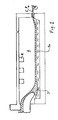
- Fig. 2 shows a float chamber of known type, the exhaust side to a according to Fig. 1 pictured transport path 6 is to be connected to the steaming cover layer according to the invention on the line AA.
- the glass mass 3 is kept hot on a tin bath Sn by heaters H in a protective gas atmosphere G and thus kept viscous and thereby brought to the desired glass band width and thickness by means of so-called Top Roller until they are withdrawn as glass ribbon 5 on the output side in the conveying direction F. becomes where the handover takes place.
Landscapes
- Chemical & Material Sciences (AREA)
- Engineering & Computer Science (AREA)
- Materials Engineering (AREA)
- Organic Chemistry (AREA)
- Re-Forming, After-Treatment, Cutting And Transporting Of Glass Products (AREA)
- Joining Of Glass To Other Materials (AREA)
- Glass Compositions (AREA)
Abstract
Description
- Die Erfindung betrifft eine Vorrichtung zum kontinuierlichen Herstellen von Flachglas, in der aus einer Schmelzwanne ein zähflüssiges Glasband kalibriert, in einer Förderrichtung auf eine schwach abwärts geneigte bis horizontale Transportbahn aufgegeben wird, auf der es sich abkühlend verfestigt und an dessen anderem Ende eine Fördervorrichtung für das erstarrte Flachglas angeschlossen ist, wobei die Transportbahn eine poröse Deckschicht aufweist, durch die eine Flüssigkeit unter das erstarrende Glasband steigt, dessen Wärme aus der Flüssigkeit ein Dampfpolster bildet, auf dem das Glasband berührungslos schwebt, was als sogenanntes Leidenfrost-Phänomen bezeichnet wird.
- Eine derartige Vorrichtung ist aus der
EP 1 553 061 A1 bekannt. Diese dient insbesondere zur Herstellung dünnen Glases für optische Anzeigetafeln, das zur Vermeidung optischer Fehler langsam erstarren muss und dabei möglichst reibungs- und biegefrei transportiert wird. Die poröse Deckschicht besteht beispielsweise aus hydrophilem Kohlenstoff oder einem Polymermaterial aus natürlichem oder synthetischem Harz oder Metall oder Metalloxid, wie Aluminiumoxid oder Zinkoxid, oder aus einem Nitrit oder Carbid von einem Metall oder von Silizium. Da die Porosität dieser Materialien nur gering ist, kann ein entstehender Dampfüberschuss nicht durch die Deckschicht entweichen, weshalb die Deckschicht quer zur Förderrichtung des Glasbandes durch Nuten unterbrochen ist, was die Versorgung der verbleibenden Deckschichtstreifen aufwendig macht und die Dampfschicht inhomogen macht. Außer der flachen Transportbahn ist auch eine Kalibrierwalze mit einer gleichartigen Deckschicht aus porösem Material zur Abstandhaltung zum Glasband mit einem Dampfpolster offenbart. - Weiterhin ist aus der
US 7,337,633 B2 eine ähnliche Vorrichtung bekannt. Bei dieser sind in der Förderrichtung die Nuten zwischen den verbleibenden Deckschichtstreifen abnehmend, weit ausgebildet oder die Deckschichtstreifen zunehmend breit ausgebildet, um die unterschiedliche Dampfmenge, die aufgrund des Glastemperaturverlaufs anfällt, möglichst adäquat abzuleiten. - Die Deckschichtstreifen sind gleichmäßig mit Poren versehen oder faserig ausgebildet und schließen jeweils eine Wanne obenseitig ab, die über einen zugehörigen Regler mit einer Flüssigkeit gespeist wird, so dass diese durch die Deckschichtstreifen dampfbildend unter das darüber transportierte Flachglas gefördert wird und dieses zum Schweben bringt.
- Es werden Glasmassen mit Temperaturen zwischen 900 °C bis 1200 °C und maximal bei 1400 °C aufgegeben; das erfordert entsprechend beständige Deckschichtenmaterialien.
- Weiterhin ist es aus der
DE 10 2006 034 431 A1 bekannt, Glasoberflächen alkalihaltiger Gläser beim Abkühlen um den Transformationsbereich durch das Aufbringen von Aluminiumchlorid aus der Dampfphase zu veredeln. Es wird die Festigkeit erheblich gesteigert und die Löslichkeit von Alkalibestandteilen stark verringert. Der wesentliche Nachteil der durch das Aufbringen von Aluminiumchlorid entsteht, ist Korrosion der Glasmaschinenteile aus Metall. - Weiterhin sind aus der
EP 0 263 436 B1 als auch derDE 197 06 223 C2 Calciumhydrosilikat Bausteine bekannt, die ein Porenvolumen von über 90 % aufweisen und eine hohe Gaskonvektion als auch Kapillaraktivität aufweisen. Ein Einsatz bis 1100 °C ist vorgesehen. - Andere hochporöse Stoffe sind Calcium-Aluminate gemäß
DE 10 2005 052 380 B4 sowieWO 2011/063791 A1 , die für noch höhere Temperaturen einsetzbar sind, sowie gemäßEP 2 516 347 B1 Calcium-Silikat-Hydrat, in das Kohlenstoff in Form von Graphit- und/oder Rußpartikeln eingebettet ist und zur Verwendung bei Strang-, Druck- und Formguss geeignet ist und zwar bei Metall- und Glasherstellung. Die Nutzung der kapillaren Eigenschaft und der Gaskonvektion ist nicht vorgesehen; vielmehr wird die äußerst geringe Infiltrierbarkeit von Öl oder Öl-Wasser-Emulsionen genutzt. - Weiterhin ist aus der
DE 100 62 187 A1 ein Verfahren und eine Vorrichtung zum Keramisieren des Ausgangsglases einer Glaskeramik bekannt, bei der erweichtes Glas über eine Infrarotstrahlung reflektierende poröse oder perforierte Platte gefördert wird, die von unten so mit einem Gas unter Druck beaufschlagt wird, dass das Glas schwebt, und bei der das Glas obenseitig mit Infrarotstrahlung beaufschlagt wird, um es längere Zeit auf einer Keramisierungstemperatur zu halten. Eine Flüssigkeitszufuhr und Dampferzeugung findet nicht statt. Die Dampftemperatur würde eine zu schnelle Abkühlung des Glases bewirken, so dass keine Keramisierung erreicht würde. Die Platte besteht aus gesintertem Quarzschaum oder kristallisiertem Erdalkali-Fluorid, -Silicat, -Titanat, -Aluminat oder Cordierit, z.B. Cordierit-Sinterglaskeramik. Diese Materialien zeigen keine ausreichende Kapillarität, um ein tragfähiges Dampfpolster zu erbringen. Zudem sind sie in einem aufwendigen Sinterprozess herzustellen. - Aufgabe der Erfindung ist es, die eingangs bezeichnete Vorrichtung zu verbessern und zu vereinfachen.
- Die Lösung besteht darin, dass die Deckschicht 8 der Transportbahn 6 überwiegend aus Erdalkali-Silikat-Hydrat oder Erdalkali-Aluminat-Hydrat, mit einer Porosität von über 60 % besteht, und sie untenseitig für einen Dampfaustritt genutet ist und mit verbleibenden Stegbereichen 12, die quer zur Förderrichtung F verlaufen, die Flüssigkeit 10 kontaktiert und sie kapillaraktiv zur Oberfläche fördert.
- Vorteilhafte Ausgestaltungen sind in den Unteransprüchen angegeben.
- Eine weitere Teilaufgabe besteht darin, die Eigenschaften des erzeugten Glases zu verbessern.
- Diese Teilaufgabe wird dadurch gelöst, dass zumindest in einem Teilbereich der Deckschicht die zu verdampfende Flüssigkeit Wasser und/oder Alkohole mit Zusätzen von Substanzen ist, die in der flüssigen Phase vorliegen und bei erhöhter Temperatur, der Siedetemperatur der Flüssigkeit, die Glaszusammensetzung an der Glasoberfläche verändern, insbesondere hinsichtlich der Oberflächenhärte, Festigkeit, Witterungsbeständigkeit sowie optischer Eigenschaften wie Verminderung der Reflexion vom sichtbarem Licht und Wärmeeinstrahlung. Beispielsweise kann die zu verdampfende Flüssigkeit Aluminiumchlorid enthalten.
- Weiterhin ist ein Bausatz zur Nachrüstung vorhandener Flachglasstraßen beansprucht.
- Wesentliche Anwendungsgebiete des auf der erfindungsgemäßen Vorrichtung erzeugten Flachglases ist insbesondere die Abdeckung von Sonnenenergiekollektoren, aber auch die Verglasung von Großgewächshäusern sowie Hallen und Fassaden an Gebäuden.
- Hierzu wurden bisher Glasdicken von 4 mm vorgesehen, die dank der nun vorzunehmenden Verfestigung auf 2 mm abzusenken ist, was Gewichts-, Material-, Energie- und Kosteneinsparungen erbringt.
- Vorteilhaft können vorhandene Flachglasfertigungsanlagen, die heute ausschließlich aus Rollenbahnen bestehen, mit den neuartigen Deckschichten nachgerüstet werden, wobei deren Auswahl nach den jeweiligen Verhältnissen fachmännisch getroffen werden muss und eine Versorgung mit der jeweils benötigten Flüssigkeitsmenge darauf abzustimmen ist, was durch die Auswahl der Dicke und der Porosität geschieht.
- Ein großer Vorteil der erfindungsgemäß vorgesehenen kapillaren Deckschichten ist deren Wärmedämmungseigenschaft. Aufgrund der sehr hohen Porosität von 60 % und mehr, vorzugsweise über 80 %, bestehend aus Mikro- und Makroporen, sind geringe Wärmeleitfähigkeiten von 0,04 - 0,3 W/(m*K) gegeben, die die Verdampfung durchtretender Flüssigkeit begünstigt und eine Rückkühlung weitgehend verhindert. Hierin liegt ein erheblicher Vorteil gegenüber der Verwendung der vorbekannten mit Bohrungen versehenen ansonsten massiven Deckschichten aus Metall, Keramik, Kunststoff oder Kohlenstoff.
- Es können zur Erleichterung des Dampfdurchtritts durch die Deckschicht untenseitig Nuten quer zur Glasförderrichtung mit begrenzter Tiefe eingebracht sein, so dass die bedampfte Oberfläche geschlossen bleibt und die zwischen die Nuten liegenden Stegbereiche die zugeführte Flüssigkeit kontaktieren und ansaugen.
- In Bereichen hohen Dampfanfalls werden zweckmäßig von der Oberfläche der Deckschicht zu den untenseitigen Nuten dünne Bohrungen eingebracht, die die bereits hohe Dampfdurchlässigkeit zusätzlich steigern.
- Werden konventionelle Walzglasanlagen mit Kalibrierwalzen umgerüstet, so empfiehlt es sich auch, diese mit einer Verdampfungs-Deckschicht zu belegen, um den direkten Kontakt zur Glasmasse zu unterbinden. Zweckmäßig kommt das gleiche Deckschichtmaterial zum Einsatz. Die zu verdampfende Flüssigkeit wird von innen oder von außen der Deckschicht zugeführt. Auch diese Flüssigkeit wird vorteilhaft mit Zusätzen von Substanzen, die die Glaszusammensetzung an der Glasoberfläche verändern, versetzt.
- Das Glasband kann auch von einem Zinnbad einer Floatglaswanne, das eine völlige Gleichverteilung des Flachglases bewirkt, auf die Transportbahn abgezogen werden. Es entsteht so ein Glas sehr hoher optischer Qualität.
-
Fig. 1 zeigt beispielhaft eine Walzglasanlage zur Erzeugung von Flachglas. In einer Schmelzwanne 2 wird die Glasmasse 3 aufgeschmolzen, die durch die Kalibrierwalzen 4a, 4b als ein Glasband 5 ausgebracht wird, das über die Transportbahn 6 während der Erstarrungsphase geführt wird, in dem es mit der Rollenfordervorrichtung 7 in der Förderrichtung F abgezogen wird. Die Transportbahn 6 trägt eine Deckschicht 8 über der sich ein Dampfpolster 9 erstreckt auf dem das Glasband 5 schwebt. Die Deckschicht 8 ist hochporös und kapillaraktiv, so dass sie unten Flüssigkeit 10 aufnimmt und zur Oberfläche führt, wo diese durch die Wärme des Glasbandes 5 verdampft. - Im Bereich hoher Glastemperatur, in der viel Dampf anfällt, sind bevorzugt Nuten 11 von unten in die Deckschicht 8 eingeformt, so dass überschüssiger Dampf dort austreten kann. Die zwischen den Nuten 11 verbleibenden Stegbereiche 12 der Deckschicht 8 sorgen kapillar für den Flüssigkeitsnachschub zur Oberfläche. Die Kalibrierwalzen 4a, 4b sind ebenfalls je mit einer porösen Deckschicht 8a, 8b belegt, die vom Innenraum 12a, 12b durch Bohrungen mit Flüssigkeit 10 gespeist wird.
- Eine Speisepumpe 13 liefert Wasser und/oder Alkohole 10 mit Zusätzen von Substanzen mit glasoberflächenverändernder Wirkung, z.B. mit Aluminiumchlorid angereichertes Wasser 10 über Mengen- und/oder Pegelregler 15a, 15b, 15c jeweils in die Innenräume 12a, 12b oder Kalibrierwalzen 4a, 4b bzw. in eine Wanne 14, in die die Stegbereiche 12 der Deckschicht 8 hineinragen.
- Statt der Versorgung der Kalibrierwalzen 4a, 4b von innen können die porösen Deckschichten 8a, 8b auch in bekannter Weise durch eine Sprüheinrichtung und/oder eine Benetzungswalze mit der Flüssigkeit 10 versorgt werden. Auch ein Besprühen der oberen Glasoberfläche ist vorgesehen.
- Der berührungslose Transport der Glasmasse beim Kalibrieren auf dem Dampfpolster 9a, 9b und des Glasbandes 5 während seiner Abkühlung und der Erstarrung auf dem Dampfpolster 9 erbringt ein schlieren- und störstellenfreies Flachglas, welches eben und mit einer Dicke von 2 mm deutlich dünner als bisher ist.
- Als Flüssigkeit 10 kommt vorzugsweise Wasser oder eine Lösung von Ethanol und Aluminiumchlorid zum Einsatz, ganz allgemein lässt sich vorteilhaft Wasser und/oder Alkohole 10 mit Zusätzen von Substanzen mit glasoberflächenverändernder Wirkung anwenden.
- Im Bereich hohen Dampfanfalls sind Bohrungen 16 oberhalb der Nuten 11 eingebracht.
-
Fig. 2 zeigt eine Floatkammer bekannter Art, die abzugsseitig an eine gemäßFig. 1 abgebildeten Transportbahn 6 mit der erfindungsgemäßen dampfenden Deckschicht an der Linie A-A anzuschließen ist. In der Kammer wird die Glasmasse 3 auf einem Zinnbad Sn schwimmend durch Heizungen H in einer Schutzgasatmosphäre G heiß und somit viskos gehalten und dabei auf die gewünschte Glasbandbreite und -dicke mittels sogenannter Top Roller gebracht, bis sie als Glasband 5 ausgangsseitig in der Förderrichtung F abgezogen wird, wo die Übergabe erfolgt. -
- 1
- Flachglas
- 2
- Schmelzwanne
- 3
- Glasmasse
- 4, 4a, 4b
- Kalibrierwalzen
- 5
- Glasband
- 6
- Transportbahn
- 7
- Fördervorrichtung
- 8
- Deckschicht auf 6
- 8a, 8b
- Deckschicht auf 4a, 4b
- 9
- Dampfpolster
- 9a, 9b
- Dampfpolster auf 4a, 4b
- 10
- Flüssigkeit
- 11
- Nuten
- 12
- Stegbereiche
- 12a, 12b
- Innenraum zu 4a, 4b
- 13
- Speisepumpe
- 14
- Wanne für 10
- 15
- Pegel-/Mengenregler zu 14
- 15a, 15b
- Pegel-/Mengenregler zu 4a, 4b
- 16
- Bohrungen
- F
- Förderrichtung
- G
- Schutzgas
- Sn
- Zinnbad
- H
- Heizung
Claims (10)
- Vorrichtung zum kontinuierlichen Herstellen von Flachglas (1) in der aus einer Schmelzwanne (2) ein zähflüssiges Glasband (5) kalibriert in einer Förderrichtung auf eine schwach abwärts geneigte bis horizontale Transportbahn (6) aufgegeben wird, auf der es sich abkühlend verfestigt und an deren anderem Ende eine Fördervorrichtung (7) für das erstarrte Flachglas (1) angeschlossen ist, wobei die Transportbahn (6) eine poröse Deckschicht (8) aufweist, durch die eine Flüssigkeit (10) unter das erstarrende Glasband (5) steigt, dessen Wärme aus der Flüssigkeit (10) ein Dampfpolster (9) bildet, auf dem das Glasband (5) berührungslos schwebt, wobei überschüssiger Dampf zwischen Deckschichtbereichen seitlich abströmt, dadurch gekennzeichnet, dass die Deckschicht (8) der Transportbahn (6) überwiegend aus Erdalkali-Silikat-Hydrat oder Erdalkali-Aluminat-Hydrat, mit einer Porosität von über 60 % besteht, und sie untenseitig für einen Dampfaustritt genutet ist und mit verbleibenden Stegbereichen (12), die quer zur Förderrichtung (F) verlaufen, die Flüssigkeit (10) kontaktiert und sie kapillaraktiv zur Oberfläche fördert.
- Vorrichtung nach Anspruch 1, dadurch gekennzeichnet, dass das Erdalkali-Silikat-Hydrat oder das Erdalkali-Aluminat-Hydrat mit bis zu 40 M.-% Kohlenstoff beladen ist.
- Vorrichtung nach Anspruch 1 oder Anspruch 2, dadurch gekennzeichnet, dass der Transportbahn (6) eine Schmelzwanne (2) mit einem Zinnbad vorgeschaltet ist, aus dem das Glasband (5) abgezogen wird.
- Vorrichtung nach Anspruch 1 oder Anspruch 2, dadurch gekennzeichnet, dass der Transportbahn (6) ein oder mehrere Kalibrierwalzen (4a, 4b) vorgelagert sind, und mindestens eine der Kalibrierwalzen (4a, 4b) eine poröse, kapillaraktive Deckschicht (8a, 8b) aus Erdalkali-Silikat-Hydrat oder Erdalkali-Aluminat-Hydrat trägt, und dass die Kalibrierwalze (4a, 4b) jeweils von innen oder außen mit einer verdampfenden Flüssigkeit (10) beaufschlagt ist und so durch ein Dampfpolster (9a, 9b) von der zähflüssigen Glasmasse (3) beabstandet ist.
- Vorrichtung nach Anspruch 1, dadurch gekennzeichnet, dass die Deckschicht (8) in den genuteten Bereichen von engen Bohrungen (16) durchsetzt ist.
- Vorrichtung nach einem der vorstehenden Ansprüche, dadurch gekennzeichnet, dass eine Speisepumpe (13) die Flüssigkeit (10) niveaugeregelt und/oder mengengeregelt den Stegbereichen (12) zuführt.
- Vorrichtung nach einem der vorhergehenden Ansprüche, dadurch gekennzeichnet, dass die Flüssigkeit Wasser oder ein Wasser-Ethanol-Gemisch ist.
- Vorrichtung nach Anspruch 7, dadurch gekennzeichnet, dass die Flüssigkeit mit einer in der Dampfphase oberflächenveränderten Substanz, die die Glaszusammensetzung und Glaseigenschaft verändert, versetzt ist.
- Vorrichtung nach Anspruch 7 oder Anspruch 8, dadurch gekennzeichnet, dass die Substanz Aluminiumchlorid ist.
- Bausatz zum Ausrüsten einer Vorrichtung zum Herstellen von Flachglas (1) aus einem Glasband (5), das auf einer Transportbahn (6) gefördert wird, zur Montage in der Transportbahn (6) unter dem Glasband (5) bestehend aus einer Deckschicht (8) aus Erdalkali-Silikat-Hydrat oder Erdalkali-Aluminat-Hydrat mit einer Porosität über 60 %, die untenseitig genutet ist und mit dadurch verbleibenden kapillaraktiven Stegbereichen (12) in eine Wanne (14) hineinragt, die mit einer Speisepumpe (13) verbunden ist, die eine Flüssigkeit (10) niveau-oder mengengeregelt fördert.
Applications Claiming Priority (1)
| Application Number | Priority Date | Filing Date | Title |
|---|---|---|---|
| DE102014003257.4A DE102014003257B4 (de) | 2014-03-12 | 2014-03-12 | Vorrichtung zur Herstellung von Flachglas und Bausatz |
Publications (3)
| Publication Number | Publication Date |
|---|---|
| EP2933237A2 true EP2933237A2 (de) | 2015-10-21 |
| EP2933237A3 EP2933237A3 (de) | 2015-12-02 |
| EP2933237B1 EP2933237B1 (de) | 2017-10-04 |
Family
ID=52692333
Family Applications (1)
| Application Number | Title | Priority Date | Filing Date |
|---|---|---|---|
| EP15000710.2A Active EP2933237B1 (de) | 2014-03-12 | 2015-03-11 | Vorrichtung zur herstellung von flachglas |
Country Status (2)
| Country | Link |
|---|---|
| EP (1) | EP2933237B1 (de) |
| DE (1) | DE102014003257B4 (de) |
Cited By (1)
| Publication number | Priority date | Publication date | Assignee | Title |
|---|---|---|---|---|
| CN111470761A (zh) * | 2020-03-31 | 2020-07-31 | 台玻安徽玻璃有限公司 | 浮法玻璃制造装置及浮法玻璃 |
Families Citing this family (3)
| Publication number | Priority date | Publication date | Assignee | Title |
|---|---|---|---|---|
| DE112021003309A5 (de) * | 2020-06-17 | 2023-04-06 | GET Glass Engineering & Technologies GmbH | Verfahren und Schäumungsofen zur Herstellung von Schaumglasschotter |
| CN114671597A (zh) * | 2022-03-11 | 2022-06-28 | 湖南巨强再生资源科技发展有限公司 | 一种压延和浮法相结合的平板玻璃成型装置及其方法 |
| CN116344419B (zh) * | 2023-02-28 | 2025-09-16 | 广东利元亨智能装备股份有限公司 | 一种硅片输送装置及输送方法 |
Citations (9)
| Publication number | Priority date | Publication date | Assignee | Title |
|---|---|---|---|---|
| EP0263436B1 (de) | 1986-10-07 | 1994-11-17 | Calsitherm Silikatbaustoffe GmbH | Formkörper für Wärmeisolationszwecke und Verfahren zu seiner Herstellung |
| DE19706223C2 (de) | 1997-02-18 | 2000-11-30 | Cape Calsil Deutschland Gmbh | Wandsanierungsplatte für salzbelastete Mauern |
| DE10062187A1 (de) | 2000-12-14 | 2002-06-27 | Schott Glas | Verfahren und Vorrichtung zum Keramisieren des Ausgangsglases einer Glaskeramik |
| EP1553061A1 (de) | 2002-07-08 | 2005-07-13 | Asahi Glass Company Ltd. | Vorrichtung zur herstellung von tafelglas |
| DE102005052380A1 (de) | 2005-10-31 | 2007-05-03 | Calsitherm Silikatbaustoffe Gmbh | Hochtemperaturfester Aluminat-Wärmedämmstoff |
| DE102006034431A1 (de) | 2006-07-26 | 2008-01-31 | Technische Universität Bergakademie Freiberg | Verfahren zur Oberflächenveredlung alkalihaltiger Gläser |
| US7337633B2 (en) | 2002-06-24 | 2008-03-04 | Asahi Glass Company, Limited | Process for producing flat glass |
| WO2011063791A1 (de) | 2009-11-26 | 2011-06-03 | Calsitherm Verwaltungs Gmbh | Alkaliresistenter erdalkali-aluminium-wärmedämmstoff, verfahren zu seiner herstellung und seine verwendung |
| EP2516347B1 (de) | 2010-01-18 | 2013-05-01 | Calsitherm Verwaltungs GmbH | Hochtemperaturfester hybridwerkstoff aus calciumsilikat und kohlenstoff |
Family Cites Families (5)
| Publication number | Priority date | Publication date | Assignee | Title |
|---|---|---|---|---|
| DE2160723C3 (de) * | 1971-12-07 | 1974-11-28 | United Glass Ltd., Staines, Middlesex (Grossbritannien) | Verfahren zur Herstellung von Glasbehältern hoher mechanischer Festigkeit und Abriebbeständigkeit |
| IT1104849B (it) * | 1977-04-19 | 1985-10-28 | Kloeckner Humboldt Deutz Ag | Procedimento ed impianto per produrre vetro in lastre |
| JPS62283831A (ja) * | 1986-05-30 | 1987-12-09 | Hoya Corp | 板ガラスの成形方法 |
| DE10122593B4 (de) * | 2001-05-10 | 2005-09-29 | Schott Ag | Gasbett zum Tragen eines Glaskörpers |
| DE102004034694B3 (de) * | 2004-07-17 | 2006-01-05 | Schott Ag | Verfahren zur kontinuierlichen Erzeugung von Flachglas durch Walzen |
-
2014
- 2014-03-12 DE DE102014003257.4A patent/DE102014003257B4/de active Active
-
2015
- 2015-03-11 EP EP15000710.2A patent/EP2933237B1/de active Active
Patent Citations (9)
| Publication number | Priority date | Publication date | Assignee | Title |
|---|---|---|---|---|
| EP0263436B1 (de) | 1986-10-07 | 1994-11-17 | Calsitherm Silikatbaustoffe GmbH | Formkörper für Wärmeisolationszwecke und Verfahren zu seiner Herstellung |
| DE19706223C2 (de) | 1997-02-18 | 2000-11-30 | Cape Calsil Deutschland Gmbh | Wandsanierungsplatte für salzbelastete Mauern |
| DE10062187A1 (de) | 2000-12-14 | 2002-06-27 | Schott Glas | Verfahren und Vorrichtung zum Keramisieren des Ausgangsglases einer Glaskeramik |
| US7337633B2 (en) | 2002-06-24 | 2008-03-04 | Asahi Glass Company, Limited | Process for producing flat glass |
| EP1553061A1 (de) | 2002-07-08 | 2005-07-13 | Asahi Glass Company Ltd. | Vorrichtung zur herstellung von tafelglas |
| DE102005052380A1 (de) | 2005-10-31 | 2007-05-03 | Calsitherm Silikatbaustoffe Gmbh | Hochtemperaturfester Aluminat-Wärmedämmstoff |
| DE102006034431A1 (de) | 2006-07-26 | 2008-01-31 | Technische Universität Bergakademie Freiberg | Verfahren zur Oberflächenveredlung alkalihaltiger Gläser |
| WO2011063791A1 (de) | 2009-11-26 | 2011-06-03 | Calsitherm Verwaltungs Gmbh | Alkaliresistenter erdalkali-aluminium-wärmedämmstoff, verfahren zu seiner herstellung und seine verwendung |
| EP2516347B1 (de) | 2010-01-18 | 2013-05-01 | Calsitherm Verwaltungs GmbH | Hochtemperaturfester hybridwerkstoff aus calciumsilikat und kohlenstoff |
Cited By (2)
| Publication number | Priority date | Publication date | Assignee | Title |
|---|---|---|---|---|
| CN111470761A (zh) * | 2020-03-31 | 2020-07-31 | 台玻安徽玻璃有限公司 | 浮法玻璃制造装置及浮法玻璃 |
| CN111470761B (zh) * | 2020-03-31 | 2022-05-27 | 台玻安徽玻璃有限公司 | 浮法玻璃制造装置及浮法玻璃 |
Also Published As
| Publication number | Publication date |
|---|---|
| EP2933237A3 (de) | 2015-12-02 |
| DE102014003257A1 (de) | 2015-09-17 |
| EP2933237B1 (de) | 2017-10-04 |
| DE102014003257B4 (de) | 2017-08-31 |
Similar Documents
| Publication | Publication Date | Title |
|---|---|---|
| DE1471910A1 (de) | Verfahren zur Herstellung von Tafel- oder Walzenglas | |
| DE102009015089B4 (de) | Verfahren und Vorrichtung zur Keramisierung von Gläsern, Glaskeramikartikel und seine Verwendung | |
| EP2878584B1 (de) | Verfahren zur Herstellung eines beschichteten Bauteils aus Quarzglas oder Quarzgut | |
| DE102014003257B4 (de) | Vorrichtung zur Herstellung von Flachglas und Bausatz | |
| DE69718296T2 (de) | Verfahren zur herstellung von flachglas | |
| DE3136107A1 (de) | Verfahren zum verhindern des woelbens von glasplatten im rollenbestueckten ofen einer waagerecht-temperanlage | |
| DE102014203567B4 (de) | Floatverfahren zur Herstellung einer Floatglasscheibe | |
| DE102013104589A1 (de) | Verfahren zur Einstelllung einer Verwölbung einer chemisch vorgespannten Glasscheibe und verfahrensgemäß herstellbare Glasscheibe | |
| DE102004034694B3 (de) | Verfahren zur kontinuierlichen Erzeugung von Flachglas durch Walzen | |
| DE102004023726B4 (de) | Verfahren und Vorrichtung zur Temperaturkontrolle bei der Glasherstellung | |
| DE1263996B (de) | Verfahren zur Herstellung eines Feuerpolitur aufweisenden Glasbandes und Anlage zur Durchfuehrung des Verfahrens | |
| DE112006000285B4 (de) | Floatbad und Floatformatverfahren | |
| DE102005019646B4 (de) | Vorrichtung zum Überführen von Glasschmelze auf ein Floatbad | |
| DE102010017731A1 (de) | Verfahren zur Herstellung von Glasrohren mit zumindest einem Rohrendabschnitt reduzierter Spannung | |
| DE1471911B2 (de) | Vorrichtung zur herstellung von tafelglas | |
| EP4371964A1 (de) | Verfahren zur behandlung von porösen substraten sowie behandeltes substrat und dessen verwendung | |
| DE1796141C3 (de) | Verfahren und Vorrichtung zur kontinuierlichen Herstellung eines durch eine Metalldrahteinlage verstärkten Glasbandes | |
| DE2740070A1 (de) | Giessrohr | |
| DE1471826B2 (de) | Verfahren zur Läuterung der Glasschmelze für die kontinuierliche Herstellung von Tafelglas | |
| DE3029788A1 (de) | Verfahren zum verhindern eines thermischen abplatzens an einem keramischen gegenstand | |
| DE102006041106B4 (de) | Elektrodensystem für Glasschmelzöfen | |
| DE1065142B (de) | Verfahren und Vorrichtung zur Herstellung von Glasscheiben mit ebener Oberflaeche und von poliertem Aussehen | |
| DE102006059356B4 (de) | Floatbadwanne und Verfahren zur Herstellung von Flachglas | |
| DE1596630A1 (de) | Verfahren zur Herstellung zellfoermigen Materials | |
| DE102014107768A1 (de) | Verfahren zur Herstellung von Blechen |
Legal Events
| Date | Code | Title | Description |
|---|---|---|---|
| PUAI | Public reference made under article 153(3) epc to a published international application that has entered the european phase |
Free format text: ORIGINAL CODE: 0009012 |
|
| AK | Designated contracting states |
Kind code of ref document: A2 Designated state(s): AL AT BE BG CH CY CZ DE DK EE ES FI FR GB GR HR HU IE IS IT LI LT LU LV MC MK MT NL NO PL PT RO RS SE SI SK SM TR |
|
| AX | Request for extension of the european patent |
Extension state: BA ME |
|
| PUAL | Search report despatched |
Free format text: ORIGINAL CODE: 0009013 |
|
| RIC1 | Information provided on ipc code assigned before grant |
Ipc: C03B 35/24 20060101AFI20151022BHEP Ipc: C03B 17/06 20060101ALI20151022BHEP Ipc: C03B 13/04 20060101ALI20151022BHEP |
|
| AK | Designated contracting states |
Kind code of ref document: A3 Designated state(s): AL AT BE BG CH CY CZ DE DK EE ES FI FR GB GR HR HU IE IS IT LI LT LU LV MC MK MT NL NO PL PT RO RS SE SI SK SM TR |
|
| AX | Request for extension of the european patent |
Extension state: BA ME |
|
| 17P | Request for examination filed |
Effective date: 20160524 |
|
| 17Q | First examination report despatched |
Effective date: 20160817 |
|
| GRAP | Despatch of communication of intention to grant a patent |
Free format text: ORIGINAL CODE: EPIDOSNIGR1 |
|
| INTG | Intention to grant announced |
Effective date: 20170331 |
|
| GRAJ | Information related to disapproval of communication of intention to grant by the applicant or resumption of examination proceedings by the epo deleted |
Free format text: ORIGINAL CODE: EPIDOSDIGR1 |
|
| GRAP | Despatch of communication of intention to grant a patent |
Free format text: ORIGINAL CODE: EPIDOSNIGR1 |
|
| INTC | Intention to grant announced (deleted) | ||
| INTG | Intention to grant announced |
Effective date: 20170612 |
|
| GRAS | Grant fee paid |
Free format text: ORIGINAL CODE: EPIDOSNIGR3 |
|
| GRAA | (expected) grant |
Free format text: ORIGINAL CODE: 0009210 |
|
| AK | Designated contracting states |
Kind code of ref document: B1 Designated state(s): AL AT BE BG CH CY CZ DE DK EE ES FI FR GB GR HR HU IE IS IT LI LT LU LV MC MK MT NL NO PL PT RO RS SE SI SK SM TR |
|
| REG | Reference to a national code |
Ref country code: GB Ref legal event code: FG4D Free format text: NOT ENGLISH |
|
| REG | Reference to a national code |
Ref country code: CH Ref legal event code: EP |
|
| REG | Reference to a national code |
Ref country code: AT Ref legal event code: REF Ref document number: 933829 Country of ref document: AT Kind code of ref document: T Effective date: 20171015 |
|
| REG | Reference to a national code |
Ref country code: IE Ref legal event code: FG4D Free format text: LANGUAGE OF EP DOCUMENT: GERMAN |
|
| REG | Reference to a national code |
Ref country code: DE Ref legal event code: R096 Ref document number: 502015001987 Country of ref document: DE |
|
| REG | Reference to a national code |
Ref country code: NL Ref legal event code: MP Effective date: 20171004 |
|
| REG | Reference to a national code |
Ref country code: LT Ref legal event code: MG4D |
|
| REG | Reference to a national code |
Ref country code: FR Ref legal event code: PLFP Year of fee payment: 4 |
|
| PG25 | Lapsed in a contracting state [announced via postgrant information from national office to epo] |
Ref country code: NL Free format text: LAPSE BECAUSE OF FAILURE TO SUBMIT A TRANSLATION OF THE DESCRIPTION OR TO PAY THE FEE WITHIN THE PRESCRIBED TIME-LIMIT Effective date: 20171004 |
|
| PG25 | Lapsed in a contracting state [announced via postgrant information from national office to epo] |
Ref country code: SE Free format text: LAPSE BECAUSE OF FAILURE TO SUBMIT A TRANSLATION OF THE DESCRIPTION OR TO PAY THE FEE WITHIN THE PRESCRIBED TIME-LIMIT Effective date: 20171004 Ref country code: FI Free format text: LAPSE BECAUSE OF FAILURE TO SUBMIT A TRANSLATION OF THE DESCRIPTION OR TO PAY THE FEE WITHIN THE PRESCRIBED TIME-LIMIT Effective date: 20171004 Ref country code: ES Free format text: LAPSE BECAUSE OF FAILURE TO SUBMIT A TRANSLATION OF THE DESCRIPTION OR TO PAY THE FEE WITHIN THE PRESCRIBED TIME-LIMIT Effective date: 20171004 Ref country code: NO Free format text: LAPSE BECAUSE OF FAILURE TO SUBMIT A TRANSLATION OF THE DESCRIPTION OR TO PAY THE FEE WITHIN THE PRESCRIBED TIME-LIMIT Effective date: 20180104 Ref country code: LT Free format text: LAPSE BECAUSE OF FAILURE TO SUBMIT A TRANSLATION OF THE DESCRIPTION OR TO PAY THE FEE WITHIN THE PRESCRIBED TIME-LIMIT Effective date: 20171004 |
|
| PG25 | Lapsed in a contracting state [announced via postgrant information from national office to epo] |
Ref country code: IS Free format text: LAPSE BECAUSE OF FAILURE TO SUBMIT A TRANSLATION OF THE DESCRIPTION OR TO PAY THE FEE WITHIN THE PRESCRIBED TIME-LIMIT Effective date: 20180204 Ref country code: GR Free format text: LAPSE BECAUSE OF FAILURE TO SUBMIT A TRANSLATION OF THE DESCRIPTION OR TO PAY THE FEE WITHIN THE PRESCRIBED TIME-LIMIT Effective date: 20180105 Ref country code: HR Free format text: LAPSE BECAUSE OF FAILURE TO SUBMIT A TRANSLATION OF THE DESCRIPTION OR TO PAY THE FEE WITHIN THE PRESCRIBED TIME-LIMIT Effective date: 20171004 Ref country code: RS Free format text: LAPSE BECAUSE OF FAILURE TO SUBMIT A TRANSLATION OF THE DESCRIPTION OR TO PAY THE FEE WITHIN THE PRESCRIBED TIME-LIMIT Effective date: 20171004 Ref country code: BG Free format text: LAPSE BECAUSE OF FAILURE TO SUBMIT A TRANSLATION OF THE DESCRIPTION OR TO PAY THE FEE WITHIN THE PRESCRIBED TIME-LIMIT Effective date: 20180104 Ref country code: LV Free format text: LAPSE BECAUSE OF FAILURE TO SUBMIT A TRANSLATION OF THE DESCRIPTION OR TO PAY THE FEE WITHIN THE PRESCRIBED TIME-LIMIT Effective date: 20171004 |
|
| REG | Reference to a national code |
Ref country code: DE Ref legal event code: R097 Ref document number: 502015001987 Country of ref document: DE |
|
| PG25 | Lapsed in a contracting state [announced via postgrant information from national office to epo] |
Ref country code: SK Free format text: LAPSE BECAUSE OF FAILURE TO SUBMIT A TRANSLATION OF THE DESCRIPTION OR TO PAY THE FEE WITHIN THE PRESCRIBED TIME-LIMIT Effective date: 20171004 Ref country code: CZ Free format text: LAPSE BECAUSE OF FAILURE TO SUBMIT A TRANSLATION OF THE DESCRIPTION OR TO PAY THE FEE WITHIN THE PRESCRIBED TIME-LIMIT Effective date: 20171004 Ref country code: EE Free format text: LAPSE BECAUSE OF FAILURE TO SUBMIT A TRANSLATION OF THE DESCRIPTION OR TO PAY THE FEE WITHIN THE PRESCRIBED TIME-LIMIT Effective date: 20171004 Ref country code: DK Free format text: LAPSE BECAUSE OF FAILURE TO SUBMIT A TRANSLATION OF THE DESCRIPTION OR TO PAY THE FEE WITHIN THE PRESCRIBED TIME-LIMIT Effective date: 20171004 |
|
| PLBE | No opposition filed within time limit |
Free format text: ORIGINAL CODE: 0009261 |
|
| STAA | Information on the status of an ep patent application or granted ep patent |
Free format text: STATUS: NO OPPOSITION FILED WITHIN TIME LIMIT |
|
| PG25 | Lapsed in a contracting state [announced via postgrant information from national office to epo] |
Ref country code: RO Free format text: LAPSE BECAUSE OF FAILURE TO SUBMIT A TRANSLATION OF THE DESCRIPTION OR TO PAY THE FEE WITHIN THE PRESCRIBED TIME-LIMIT Effective date: 20171004 Ref country code: SM Free format text: LAPSE BECAUSE OF FAILURE TO SUBMIT A TRANSLATION OF THE DESCRIPTION OR TO PAY THE FEE WITHIN THE PRESCRIBED TIME-LIMIT Effective date: 20171004 Ref country code: PL Free format text: LAPSE BECAUSE OF FAILURE TO SUBMIT A TRANSLATION OF THE DESCRIPTION OR TO PAY THE FEE WITHIN THE PRESCRIBED TIME-LIMIT Effective date: 20171004 |
|
| 26N | No opposition filed |
Effective date: 20180705 |
|
| PG25 | Lapsed in a contracting state [announced via postgrant information from national office to epo] |
Ref country code: MT Free format text: LAPSE BECAUSE OF FAILURE TO SUBMIT A TRANSLATION OF THE DESCRIPTION OR TO PAY THE FEE WITHIN THE PRESCRIBED TIME-LIMIT Effective date: 20171004 |
|
| REG | Reference to a national code |
Ref country code: CH Ref legal event code: PL |
|
| PG25 | Lapsed in a contracting state [announced via postgrant information from national office to epo] |
Ref country code: MC Free format text: LAPSE BECAUSE OF FAILURE TO SUBMIT A TRANSLATION OF THE DESCRIPTION OR TO PAY THE FEE WITHIN THE PRESCRIBED TIME-LIMIT Effective date: 20171004 Ref country code: SI Free format text: LAPSE BECAUSE OF FAILURE TO SUBMIT A TRANSLATION OF THE DESCRIPTION OR TO PAY THE FEE WITHIN THE PRESCRIBED TIME-LIMIT Effective date: 20171004 |
|
| REG | Reference to a national code |
Ref country code: IE Ref legal event code: MM4A |
|
| PG25 | Lapsed in a contracting state [announced via postgrant information from national office to epo] |
Ref country code: LU Free format text: LAPSE BECAUSE OF NON-PAYMENT OF DUE FEES Effective date: 20180311 |
|
| PG25 | Lapsed in a contracting state [announced via postgrant information from national office to epo] |
Ref country code: IE Free format text: LAPSE BECAUSE OF NON-PAYMENT OF DUE FEES Effective date: 20180311 |
|
| PG25 | Lapsed in a contracting state [announced via postgrant information from national office to epo] |
Ref country code: LI Free format text: LAPSE BECAUSE OF NON-PAYMENT OF DUE FEES Effective date: 20180331 Ref country code: CH Free format text: LAPSE BECAUSE OF NON-PAYMENT OF DUE FEES Effective date: 20180331 |
|
| PGFP | Annual fee paid to national office [announced via postgrant information from national office to epo] |
Ref country code: TR Payment date: 20190319 Year of fee payment: 13 |
|
| GBPC | Gb: european patent ceased through non-payment of renewal fee |
Effective date: 20190311 |
|
| PG25 | Lapsed in a contracting state [announced via postgrant information from national office to epo] |
Ref country code: GB Free format text: LAPSE BECAUSE OF NON-PAYMENT OF DUE FEES Effective date: 20190311 |
|
| PG25 | Lapsed in a contracting state [announced via postgrant information from national office to epo] |
Ref country code: TR Free format text: LAPSE BECAUSE OF FAILURE TO SUBMIT A TRANSLATION OF THE DESCRIPTION OR TO PAY THE FEE WITHIN THE PRESCRIBED TIME-LIMIT Effective date: 20171004 |
|
| PG25 | Lapsed in a contracting state [announced via postgrant information from national office to epo] |
Ref country code: PT Free format text: LAPSE BECAUSE OF FAILURE TO SUBMIT A TRANSLATION OF THE DESCRIPTION OR TO PAY THE FEE WITHIN THE PRESCRIBED TIME-LIMIT Effective date: 20171004 |
|
| PG25 | Lapsed in a contracting state [announced via postgrant information from national office to epo] |
Ref country code: HU Free format text: LAPSE BECAUSE OF FAILURE TO SUBMIT A TRANSLATION OF THE DESCRIPTION OR TO PAY THE FEE WITHIN THE PRESCRIBED TIME-LIMIT; INVALID AB INITIO Effective date: 20150311 Ref country code: MK Free format text: LAPSE BECAUSE OF NON-PAYMENT OF DUE FEES Effective date: 20171004 Ref country code: CY Free format text: LAPSE BECAUSE OF FAILURE TO SUBMIT A TRANSLATION OF THE DESCRIPTION OR TO PAY THE FEE WITHIN THE PRESCRIBED TIME-LIMIT Effective date: 20171004 |
|
| PG25 | Lapsed in a contracting state [announced via postgrant information from national office to epo] |
Ref country code: AL Free format text: LAPSE BECAUSE OF FAILURE TO SUBMIT A TRANSLATION OF THE DESCRIPTION OR TO PAY THE FEE WITHIN THE PRESCRIBED TIME-LIMIT Effective date: 20171004 |
|
| PG25 | Lapsed in a contracting state [announced via postgrant information from national office to epo] |
Ref country code: FR Free format text: LAPSE BECAUSE OF NON-PAYMENT OF DUE FEES Effective date: 20200331 |
|
| P01 | Opt-out of the competence of the unified patent court (upc) registered |
Effective date: 20230530 |
|
| REG | Reference to a national code |
Ref country code: DE Ref legal event code: R082 Ref document number: 502015001987 Country of ref document: DE Representative=s name: WICKORD BUSER PATENTANWAELTE PARTG MBB, DE |
|
| PGFP | Annual fee paid to national office [announced via postgrant information from national office to epo] |
Ref country code: IT Payment date: 20250331 Year of fee payment: 11 |
|
| PGFP | Annual fee paid to national office [announced via postgrant information from national office to epo] |
Ref country code: DE Payment date: 20260325 Year of fee payment: 12 |
|
| PGFP | Annual fee paid to national office [announced via postgrant information from national office to epo] |
Ref country code: AT Payment date: 20260319 Year of fee payment: 12 |
|
| PGFP | Annual fee paid to national office [announced via postgrant information from national office to epo] |
Ref country code: BE Payment date: 20260323 Year of fee payment: 12 |