EP2933875B1 - Élément de conversion photoélectrique, cellule solaire sensibilisée aux colorants, colorant complexe métallique, solution de colorant, électrode à colorant adsorbé et procédé de fabrication de cellule solaire sensibilisée aux colorants - Google Patents
Élément de conversion photoélectrique, cellule solaire sensibilisée aux colorants, colorant complexe métallique, solution de colorant, électrode à colorant adsorbé et procédé de fabrication de cellule solaire sensibilisée aux colorants Download PDFInfo
- Publication number
- EP2933875B1 EP2933875B1 EP13865285.4A EP13865285A EP2933875B1 EP 2933875 B1 EP2933875 B1 EP 2933875B1 EP 13865285 A EP13865285 A EP 13865285A EP 2933875 B1 EP2933875 B1 EP 2933875B1
- Authority
- EP
- European Patent Office
- Prior art keywords
- ring
- formula
- dye
- substituent
- group
- Prior art date
- Legal status (The legal status is an assumption and is not a legal conclusion. Google has not performed a legal analysis and makes no representation as to the accuracy of the status listed.)
- Not-in-force
Links
- 0 CC(C(*)N)C(N)O Chemical compound CC(C(*)N)C(N)O 0.000 description 27
- BAYGVMXZJBFEMB-UHFFFAOYSA-N Oc1ccc(C(F)(F)F)cc1 Chemical compound Oc1ccc(C(F)(F)F)cc1 BAYGVMXZJBFEMB-UHFFFAOYSA-N 0.000 description 5
- QYCNDOYWTAFSQY-UHFFFAOYSA-N CC1=CC(C(C(C2=O)=O)=C2O)=CCN1 Chemical compound CC1=CC(C(C(C2=O)=O)=C2O)=CCN1 QYCNDOYWTAFSQY-UHFFFAOYSA-N 0.000 description 3
- KUNOBQCJIDXQFE-UHFFFAOYSA-N Cc1cc(C(C(C2=O)=O)=C2O)ccn1 Chemical compound Cc1cc(C(C(C2=O)=O)=C2O)ccn1 KUNOBQCJIDXQFE-UHFFFAOYSA-N 0.000 description 3
- KPHJRWYUXMIDCK-UHFFFAOYSA-N Cc(nc1)cnc1C(C(C1=O)=O)=C1O Chemical compound Cc(nc1)cnc1C(C(C1=O)=O)=C1O KPHJRWYUXMIDCK-UHFFFAOYSA-N 0.000 description 2
- YMSUDDFJYRQSSZ-UHFFFAOYSA-N OC1C=CC(C(F)(F)F)=CC1 Chemical compound OC1C=CC(C(F)(F)F)=CC1 YMSUDDFJYRQSSZ-UHFFFAOYSA-N 0.000 description 2
- DGCLQRYQQNHVRA-UHFFFAOYSA-N CC(C)C(C(F)(F)F)NN Chemical compound CC(C)C(C(F)(F)F)NN DGCLQRYQQNHVRA-UHFFFAOYSA-N 0.000 description 1
- UGMRQESVWTYAJX-UHFFFAOYSA-N CC(C1)N=CC=C1O Chemical compound CC(C1)N=CC=C1O UGMRQESVWTYAJX-UHFFFAOYSA-N 0.000 description 1
- LFQCTZZKXNVGRT-UHFFFAOYSA-N CC(C1)NCC=C1C(C(C1=O)=O)=C1O Chemical compound CC(C1)NCC=C1C(C(C1=O)=O)=C1O LFQCTZZKXNVGRT-UHFFFAOYSA-N 0.000 description 1
- JKZQKMVLXUVVJH-UHFFFAOYSA-N CC1NC(C)=CC(C(O)=O)=C1 Chemical compound CC1NC(C)=CC(C(O)=O)=C1 JKZQKMVLXUVVJH-UHFFFAOYSA-N 0.000 description 1
- HPOSXBMOUQKCOS-ALCCZGGFSA-N CCC(C)/N=C\C Chemical compound CCC(C)/N=C\C HPOSXBMOUQKCOS-ALCCZGGFSA-N 0.000 description 1
- ZQIFYNFXKODGRG-UHFFFAOYSA-N CCCCCCc1c(-c2cc(-c3ccccc3O)nc(-c(cccc3)c3O)n2)[s]cc1 Chemical compound CCCCCCc1c(-c2cc(-c3ccccc3O)nc(-c(cccc3)c3O)n2)[s]cc1 ZQIFYNFXKODGRG-UHFFFAOYSA-N 0.000 description 1
- NLGKKPXTHKWWNU-UHFFFAOYSA-N CCCCCCc1c(-c2cc(Cl)nc(Cl)n2)[s]cc1 Chemical compound CCCCCCc1c(-c2cc(Cl)nc(Cl)n2)[s]cc1 NLGKKPXTHKWWNU-UHFFFAOYSA-N 0.000 description 1
- VEKSEAXKKUNTMT-UHFFFAOYSA-N Cc1cc(-c2ccc(C(C(C3=O)=O)=C3O)[o]2)ccn1 Chemical compound Cc1cc(-c2ccc(C(C(C3=O)=O)=C3O)[o]2)ccn1 VEKSEAXKKUNTMT-UHFFFAOYSA-N 0.000 description 1
- JCEHRWCOZZGFEW-UHFFFAOYSA-N Cc1cc(-c2ccc(C(O)=O)[s]2)ccn1 Chemical compound Cc1cc(-c2ccc(C(O)=O)[s]2)ccn1 JCEHRWCOZZGFEW-UHFFFAOYSA-N 0.000 description 1
- PRAFLUMTYHBEHE-UHFFFAOYSA-N Cc1nc(C)cc(O)c1 Chemical compound Cc1nc(C)cc(O)c1 PRAFLUMTYHBEHE-UHFFFAOYSA-N 0.000 description 1
- AKSGGHGLDJJWQS-UHFFFAOYSA-N Cc1nccc(-c2ccc(C(C(C3=O)=O)=C3O)[s]2)c1 Chemical compound Cc1nccc(-c2ccc(C(C(C3=O)=O)=C3O)[s]2)c1 AKSGGHGLDJJWQS-UHFFFAOYSA-N 0.000 description 1
- LIOOJHPQBIDYNG-UHFFFAOYSA-N Cc1nccc(-c2ccc(C(C(C3=O)=O)=C3[Mn])[s]2)c1 Chemical compound Cc1nccc(-c2ccc(C(C(C3=O)=O)=C3[Mn])[s]2)c1 LIOOJHPQBIDYNG-UHFFFAOYSA-N 0.000 description 1
- NDVJMGHFYHHXGN-UHFFFAOYSA-N Cc1nccc(C(C(C(C(C2=O)=O)=O)O)C2=O)c1 Chemical compound Cc1nccc(C(C(C(C(C2=O)=O)=O)O)C2=O)c1 NDVJMGHFYHHXGN-UHFFFAOYSA-N 0.000 description 1
- DPVIABCMTHHTGB-UHFFFAOYSA-N Clc1cc(Cl)nc(Cl)n1 Chemical compound Clc1cc(Cl)nc(Cl)n1 DPVIABCMTHHTGB-UHFFFAOYSA-N 0.000 description 1
- HAUXWGUHYZWMQL-UHFFFAOYSA-N OC(C1=C2C=CCC1)=CC2=O Chemical compound OC(C1=C2C=CCC1)=CC2=O HAUXWGUHYZWMQL-UHFFFAOYSA-N 0.000 description 1
- OBYLLRIBSHIEOB-UHFFFAOYSA-N OC(CC1)=CC=C1C(F)(F)F Chemical compound OC(CC1)=CC=C1C(F)(F)F OBYLLRIBSHIEOB-UHFFFAOYSA-N 0.000 description 1
- IYOACPADVUMZJN-UHFFFAOYSA-N OC(CC1)CC=C1C(F)(F)F Chemical compound OC(CC1)CC=C1C(F)(F)F IYOACPADVUMZJN-UHFFFAOYSA-N 0.000 description 1
- DUKYBTGOOUJVIY-UHFFFAOYSA-N OC1C=CC(F)=CC1 Chemical compound OC1C=CC(F)=CC1 DUKYBTGOOUJVIY-UHFFFAOYSA-N 0.000 description 1
- GEXVFZLVSITTRO-UHFFFAOYSA-N [O-][N+](C(C=C1)=CCC1O)=O Chemical compound [O-][N+](C(C=C1)=CCC1O)=O GEXVFZLVSITTRO-UHFFFAOYSA-N 0.000 description 1
- ROFVEXUMMXZLPA-UHFFFAOYSA-N c1cc(-c2ccccn2)ncc1 Chemical compound c1cc(-c2ccccn2)ncc1 ROFVEXUMMXZLPA-UHFFFAOYSA-N 0.000 description 1
Images

Classifications
-
- C—CHEMISTRY; METALLURGY
- C07—ORGANIC CHEMISTRY
- C07D—HETEROCYCLIC COMPOUNDS
- C07D213/00—Heterocyclic compounds containing six-membered rings, not condensed with other rings, with one nitrogen atom as the only ring hetero atom and three or more double bonds between ring members or between ring members and non-ring members
- C07D213/02—Heterocyclic compounds containing six-membered rings, not condensed with other rings, with one nitrogen atom as the only ring hetero atom and three or more double bonds between ring members or between ring members and non-ring members having three double bonds between ring members or between ring members and non-ring members
- C07D213/04—Heterocyclic compounds containing six-membered rings, not condensed with other rings, with one nitrogen atom as the only ring hetero atom and three or more double bonds between ring members or between ring members and non-ring members having three double bonds between ring members or between ring members and non-ring members having no bond between the ring nitrogen atom and a non-ring member or having only hydrogen or carbon atoms directly attached to the ring nitrogen atom
- C07D213/24—Heterocyclic compounds containing six-membered rings, not condensed with other rings, with one nitrogen atom as the only ring hetero atom and three or more double bonds between ring members or between ring members and non-ring members having three double bonds between ring members or between ring members and non-ring members having no bond between the ring nitrogen atom and a non-ring member or having only hydrogen or carbon atoms directly attached to the ring nitrogen atom with substituted hydrocarbon radicals attached to ring carbon atoms
- C07D213/54—Radicals substituted by carbon atoms having three bonds to hetero atoms with at the most one bond to halogen, e.g. ester or nitrile radicals
- C07D213/55—Acids; Esters
-
- C—CHEMISTRY; METALLURGY
- C07—ORGANIC CHEMISTRY
- C07D—HETEROCYCLIC COMPOUNDS
- C07D213/00—Heterocyclic compounds containing six-membered rings, not condensed with other rings, with one nitrogen atom as the only ring hetero atom and three or more double bonds between ring members or between ring members and non-ring members
- C07D213/02—Heterocyclic compounds containing six-membered rings, not condensed with other rings, with one nitrogen atom as the only ring hetero atom and three or more double bonds between ring members or between ring members and non-ring members having three double bonds between ring members or between ring members and non-ring members
- C07D213/04—Heterocyclic compounds containing six-membered rings, not condensed with other rings, with one nitrogen atom as the only ring hetero atom and three or more double bonds between ring members or between ring members and non-ring members having three double bonds between ring members or between ring members and non-ring members having no bond between the ring nitrogen atom and a non-ring member or having only hydrogen or carbon atoms directly attached to the ring nitrogen atom
- C07D213/60—Heterocyclic compounds containing six-membered rings, not condensed with other rings, with one nitrogen atom as the only ring hetero atom and three or more double bonds between ring members or between ring members and non-ring members having three double bonds between ring members or between ring members and non-ring members having no bond between the ring nitrogen atom and a non-ring member or having only hydrogen or carbon atoms directly attached to the ring nitrogen atom with hetero atoms or with carbon atoms having three bonds to hetero atoms with at the most one bond to halogen, e.g. ester or nitrile radicals, directly attached to ring carbon atoms
- C07D213/78—Carbon atoms having three bonds to hetero atoms, with at the most one bond to halogen, e.g. ester or nitrile radicals
- C07D213/79—Acids; Esters
-
- C—CHEMISTRY; METALLURGY
- C07—ORGANIC CHEMISTRY
- C07D—HETEROCYCLIC COMPOUNDS
- C07D231/00—Heterocyclic compounds containing 1,2-diazole or hydrogenated 1,2-diazole rings
- C07D231/02—Heterocyclic compounds containing 1,2-diazole or hydrogenated 1,2-diazole rings not condensed with other rings
- C07D231/10—Heterocyclic compounds containing 1,2-diazole or hydrogenated 1,2-diazole rings not condensed with other rings having two or three double bonds between ring members or between ring members and non-ring members
- C07D231/14—Heterocyclic compounds containing 1,2-diazole or hydrogenated 1,2-diazole rings not condensed with other rings having two or three double bonds between ring members or between ring members and non-ring members with hetero atoms or with carbon atoms having three bonds to hetero atoms with at the most one bond to halogen, e.g. ester or nitrile radicals, directly attached to ring carbon atoms
- C07D231/38—Nitrogen atoms
-
- C—CHEMISTRY; METALLURGY
- C07—ORGANIC CHEMISTRY
- C07D—HETEROCYCLIC COMPOUNDS
- C07D401/00—Heterocyclic compounds containing two or more hetero rings, having nitrogen atoms as the only ring hetero atoms, at least one ring being a six-membered ring with only one nitrogen atom
- C07D401/02—Heterocyclic compounds containing two or more hetero rings, having nitrogen atoms as the only ring hetero atoms, at least one ring being a six-membered ring with only one nitrogen atom containing two hetero rings
- C07D401/04—Heterocyclic compounds containing two or more hetero rings, having nitrogen atoms as the only ring hetero atoms, at least one ring being a six-membered ring with only one nitrogen atom containing two hetero rings directly linked by a ring-member-to-ring-member bond
-
- C—CHEMISTRY; METALLURGY
- C07—ORGANIC CHEMISTRY
- C07D—HETEROCYCLIC COMPOUNDS
- C07D401/00—Heterocyclic compounds containing two or more hetero rings, having nitrogen atoms as the only ring hetero atoms, at least one ring being a six-membered ring with only one nitrogen atom
- C07D401/14—Heterocyclic compounds containing two or more hetero rings, having nitrogen atoms as the only ring hetero atoms, at least one ring being a six-membered ring with only one nitrogen atom containing three or more hetero rings
-
- C—CHEMISTRY; METALLURGY
- C07—ORGANIC CHEMISTRY
- C07D—HETEROCYCLIC COMPOUNDS
- C07D409/00—Heterocyclic compounds containing two or more hetero rings, at least one ring having sulfur atoms as the only ring hetero atoms
- C07D409/02—Heterocyclic compounds containing two or more hetero rings, at least one ring having sulfur atoms as the only ring hetero atoms containing two hetero rings
- C07D409/04—Heterocyclic compounds containing two or more hetero rings, at least one ring having sulfur atoms as the only ring hetero atoms containing two hetero rings directly linked by a ring-member-to-ring-member bond
-
- C—CHEMISTRY; METALLURGY
- C07—ORGANIC CHEMISTRY
- C07D—HETEROCYCLIC COMPOUNDS
- C07D409/00—Heterocyclic compounds containing two or more hetero rings, at least one ring having sulfur atoms as the only ring hetero atoms
- C07D409/14—Heterocyclic compounds containing two or more hetero rings, at least one ring having sulfur atoms as the only ring hetero atoms containing three or more hetero rings
-
- C—CHEMISTRY; METALLURGY
- C07—ORGANIC CHEMISTRY
- C07D—HETEROCYCLIC COMPOUNDS
- C07D417/00—Heterocyclic compounds containing two or more hetero rings, at least one ring having nitrogen and sulfur atoms as the only ring hetero atoms, not provided for by group C07D415/00
- C07D417/14—Heterocyclic compounds containing two or more hetero rings, at least one ring having nitrogen and sulfur atoms as the only ring hetero atoms, not provided for by group C07D415/00 containing three or more hetero rings
-
- C—CHEMISTRY; METALLURGY
- C07—ORGANIC CHEMISTRY
- C07F—ACYCLIC, CARBOCYCLIC OR HETEROCYCLIC COMPOUNDS CONTAINING ELEMENTS OTHER THAN CARBON, HYDROGEN, HALOGEN, OXYGEN, NITROGEN, SULFUR, SELENIUM OR TELLURIUM
- C07F15/00—Compounds containing elements of Groups 8, 9, 10 or 18 of the Periodic Table
- C07F15/0006—Compounds containing elements of Groups 8, 9, 10 or 18 of the Periodic Table compounds of the platinum group
- C07F15/0046—Ruthenium compounds
- C07F15/0053—Ruthenium compounds without a metal-carbon linkage
-
- C—CHEMISTRY; METALLURGY
- C09—DYES; PAINTS; POLISHES; NATURAL RESINS; ADHESIVES; COMPOSITIONS NOT OTHERWISE PROVIDED FOR; APPLICATIONS OF MATERIALS NOT OTHERWISE PROVIDED FOR
- C09B—ORGANIC DYES OR CLOSELY-RELATED COMPOUNDS FOR PRODUCING DYES, e.g. PIGMENTS; MORDANTS; LAKES
- C09B23/00—Methine or polymethine dyes, e.g. cyanine dyes
- C09B23/0008—Methine or polymethine dyes, e.g. cyanine dyes substituted on the polymethine chain
- C09B23/0025—Methine or polymethine dyes, e.g. cyanine dyes substituted on the polymethine chain the substituent being bound through an oxygen atom
-
- C—CHEMISTRY; METALLURGY
- C09—DYES; PAINTS; POLISHES; NATURAL RESINS; ADHESIVES; COMPOSITIONS NOT OTHERWISE PROVIDED FOR; APPLICATIONS OF MATERIALS NOT OTHERWISE PROVIDED FOR
- C09B—ORGANIC DYES OR CLOSELY-RELATED COMPOUNDS FOR PRODUCING DYES, e.g. PIGMENTS; MORDANTS; LAKES
- C09B23/00—Methine or polymethine dyes, e.g. cyanine dyes
- C09B23/0008—Methine or polymethine dyes, e.g. cyanine dyes substituted on the polymethine chain
- C09B23/005—Methine or polymethine dyes, e.g. cyanine dyes substituted on the polymethine chain the substituent being a COOH and/or a functional derivative thereof
-
- C—CHEMISTRY; METALLURGY
- C09—DYES; PAINTS; POLISHES; NATURAL RESINS; ADHESIVES; COMPOSITIONS NOT OTHERWISE PROVIDED FOR; APPLICATIONS OF MATERIALS NOT OTHERWISE PROVIDED FOR
- C09B—ORGANIC DYES OR CLOSELY-RELATED COMPOUNDS FOR PRODUCING DYES, e.g. PIGMENTS; MORDANTS; LAKES
- C09B23/00—Methine or polymethine dyes, e.g. cyanine dyes
- C09B23/0008—Methine or polymethine dyes, e.g. cyanine dyes substituted on the polymethine chain
- C09B23/005—Methine or polymethine dyes, e.g. cyanine dyes substituted on the polymethine chain the substituent being a COOH and/or a functional derivative thereof
- C09B23/0058—Methine or polymethine dyes, e.g. cyanine dyes substituted on the polymethine chain the substituent being a COOH and/or a functional derivative thereof the substituent being CN
-
- C—CHEMISTRY; METALLURGY
- C09—DYES; PAINTS; POLISHES; NATURAL RESINS; ADHESIVES; COMPOSITIONS NOT OTHERWISE PROVIDED FOR; APPLICATIONS OF MATERIALS NOT OTHERWISE PROVIDED FOR
- C09B—ORGANIC DYES OR CLOSELY-RELATED COMPOUNDS FOR PRODUCING DYES, e.g. PIGMENTS; MORDANTS; LAKES
- C09B23/00—Methine or polymethine dyes, e.g. cyanine dyes
- C09B23/0066—Methine or polymethine dyes, e.g. cyanine dyes the polymethine chain being part of a carbocyclic ring,(e.g. benzene, naphtalene, cyclohexene, cyclobutenene-quadratic acid)
-
- C—CHEMISTRY; METALLURGY
- C09—DYES; PAINTS; POLISHES; NATURAL RESINS; ADHESIVES; COMPOSITIONS NOT OTHERWISE PROVIDED FOR; APPLICATIONS OF MATERIALS NOT OTHERWISE PROVIDED FOR
- C09B—ORGANIC DYES OR CLOSELY-RELATED COMPOUNDS FOR PRODUCING DYES, e.g. PIGMENTS; MORDANTS; LAKES
- C09B23/00—Methine or polymethine dyes, e.g. cyanine dyes
- C09B23/02—Methine or polymethine dyes, e.g. cyanine dyes the polymethine chain containing an odd number of >CH- or >C[alkyl]- groups
- C09B23/04—Methine or polymethine dyes, e.g. cyanine dyes the polymethine chain containing an odd number of >CH- or >C[alkyl]- groups one >CH- group, e.g. cyanines, isocyanines, pseudocyanines
-
- C—CHEMISTRY; METALLURGY
- C09—DYES; PAINTS; POLISHES; NATURAL RESINS; ADHESIVES; COMPOSITIONS NOT OTHERWISE PROVIDED FOR; APPLICATIONS OF MATERIALS NOT OTHERWISE PROVIDED FOR
- C09B—ORGANIC DYES OR CLOSELY-RELATED COMPOUNDS FOR PRODUCING DYES, e.g. PIGMENTS; MORDANTS; LAKES
- C09B23/00—Methine or polymethine dyes, e.g. cyanine dyes
- C09B23/10—The polymethine chain containing an even number of >CH- groups
- C09B23/105—The polymethine chain containing an even number of >CH- groups two >CH- groups
-
- C—CHEMISTRY; METALLURGY
- C09—DYES; PAINTS; POLISHES; NATURAL RESINS; ADHESIVES; COMPOSITIONS NOT OTHERWISE PROVIDED FOR; APPLICATIONS OF MATERIALS NOT OTHERWISE PROVIDED FOR
- C09B—ORGANIC DYES OR CLOSELY-RELATED COMPOUNDS FOR PRODUCING DYES, e.g. PIGMENTS; MORDANTS; LAKES
- C09B29/00—Monoazo dyes prepared by diazotising and coupling
- C09B29/0003—Monoazo dyes prepared by diazotising and coupling from diazotized anilines
-
- C—CHEMISTRY; METALLURGY
- C09—DYES; PAINTS; POLISHES; NATURAL RESINS; ADHESIVES; COMPOSITIONS NOT OTHERWISE PROVIDED FOR; APPLICATIONS OF MATERIALS NOT OTHERWISE PROVIDED FOR
- C09B—ORGANIC DYES OR CLOSELY-RELATED COMPOUNDS FOR PRODUCING DYES, e.g. PIGMENTS; MORDANTS; LAKES
- C09B29/00—Monoazo dyes prepared by diazotising and coupling
- C09B29/0025—Monoazo dyes prepared by diazotising and coupling from diazotized amino heterocyclic compounds
- C09B29/0029—Monoazo dyes prepared by diazotising and coupling from diazotized amino heterocyclic compounds the heterocyclic ring containing only nitrogen as heteroatom
- C09B29/0037—Monoazo dyes prepared by diazotising and coupling from diazotized amino heterocyclic compounds the heterocyclic ring containing only nitrogen as heteroatom containing a five-membered heterocyclic ring with two nitrogen atoms
-
- C—CHEMISTRY; METALLURGY
- C09—DYES; PAINTS; POLISHES; NATURAL RESINS; ADHESIVES; COMPOSITIONS NOT OTHERWISE PROVIDED FOR; APPLICATIONS OF MATERIALS NOT OTHERWISE PROVIDED FOR
- C09B—ORGANIC DYES OR CLOSELY-RELATED COMPOUNDS FOR PRODUCING DYES, e.g. PIGMENTS; MORDANTS; LAKES
- C09B29/00—Monoazo dyes prepared by diazotising and coupling
- C09B29/10—Monoazo dyes prepared by diazotising and coupling from coupling components containing hydroxy as the only directing group
- C09B29/12—Monoazo dyes prepared by diazotising and coupling from coupling components containing hydroxy as the only directing group of the benzene series
-
- C—CHEMISTRY; METALLURGY
- C09—DYES; PAINTS; POLISHES; NATURAL RESINS; ADHESIVES; COMPOSITIONS NOT OTHERWISE PROVIDED FOR; APPLICATIONS OF MATERIALS NOT OTHERWISE PROVIDED FOR
- C09B—ORGANIC DYES OR CLOSELY-RELATED COMPOUNDS FOR PRODUCING DYES, e.g. PIGMENTS; MORDANTS; LAKES
- C09B45/00—Complex metal compounds of azo dyes
- C09B45/02—Preparation from dyes containing in o-position a hydroxy group and in o'-position hydroxy, alkoxy, carboxyl, amino or keto groups
- C09B45/14—Monoazo compounds
-
- C—CHEMISTRY; METALLURGY
- C09—DYES; PAINTS; POLISHES; NATURAL RESINS; ADHESIVES; COMPOSITIONS NOT OTHERWISE PROVIDED FOR; APPLICATIONS OF MATERIALS NOT OTHERWISE PROVIDED FOR
- C09B—ORGANIC DYES OR CLOSELY-RELATED COMPOUNDS FOR PRODUCING DYES, e.g. PIGMENTS; MORDANTS; LAKES
- C09B45/00—Complex metal compounds of azo dyes
- C09B45/02—Preparation from dyes containing in o-position a hydroxy group and in o'-position hydroxy, alkoxy, carboxyl, amino or keto groups
- C09B45/14—Monoazo compounds
- C09B45/22—Monoazo compounds containing other metals
-
- C—CHEMISTRY; METALLURGY
- C09—DYES; PAINTS; POLISHES; NATURAL RESINS; ADHESIVES; COMPOSITIONS NOT OTHERWISE PROVIDED FOR; APPLICATIONS OF MATERIALS NOT OTHERWISE PROVIDED FOR
- C09B—ORGANIC DYES OR CLOSELY-RELATED COMPOUNDS FOR PRODUCING DYES, e.g. PIGMENTS; MORDANTS; LAKES
- C09B55/00—Azomethine dyes
-
- C—CHEMISTRY; METALLURGY
- C09—DYES; PAINTS; POLISHES; NATURAL RESINS; ADHESIVES; COMPOSITIONS NOT OTHERWISE PROVIDED FOR; APPLICATIONS OF MATERIALS NOT OTHERWISE PROVIDED FOR
- C09B—ORGANIC DYES OR CLOSELY-RELATED COMPOUNDS FOR PRODUCING DYES, e.g. PIGMENTS; MORDANTS; LAKES
- C09B57/00—Other synthetic dyes of known constitution
- C09B57/007—Squaraine dyes
-
- C—CHEMISTRY; METALLURGY
- C09—DYES; PAINTS; POLISHES; NATURAL RESINS; ADHESIVES; COMPOSITIONS NOT OTHERWISE PROVIDED FOR; APPLICATIONS OF MATERIALS NOT OTHERWISE PROVIDED FOR
- C09B—ORGANIC DYES OR CLOSELY-RELATED COMPOUNDS FOR PRODUCING DYES, e.g. PIGMENTS; MORDANTS; LAKES
- C09B57/00—Other synthetic dyes of known constitution
- C09B57/10—Metal complexes of organic compounds not being dyes in uncomplexed form
-
- C—CHEMISTRY; METALLURGY
- C09—DYES; PAINTS; POLISHES; NATURAL RESINS; ADHESIVES; COMPOSITIONS NOT OTHERWISE PROVIDED FOR; APPLICATIONS OF MATERIALS NOT OTHERWISE PROVIDED FOR
- C09B—ORGANIC DYES OR CLOSELY-RELATED COMPOUNDS FOR PRODUCING DYES, e.g. PIGMENTS; MORDANTS; LAKES
- C09B62/00—Reactive dyes, i.e. dyes which form covalent bonds with the substrates or which polymerise with themselves
- C09B62/02—Reactive dyes, i.e. dyes which form covalent bonds with the substrates or which polymerise with themselves with the reactive group directly attached to a heterocyclic ring
- C09B62/20—Reactive dyes, i.e. dyes which form covalent bonds with the substrates or which polymerise with themselves with the reactive group directly attached to a heterocyclic ring to a pyrimidine ring
- C09B62/205—Specific dyes not provided for in groups C09B62/22 - C09B62/26
-
- C—CHEMISTRY; METALLURGY
- C09—DYES; PAINTS; POLISHES; NATURAL RESINS; ADHESIVES; COMPOSITIONS NOT OTHERWISE PROVIDED FOR; APPLICATIONS OF MATERIALS NOT OTHERWISE PROVIDED FOR
- C09B—ORGANIC DYES OR CLOSELY-RELATED COMPOUNDS FOR PRODUCING DYES, e.g. PIGMENTS; MORDANTS; LAKES
- C09B62/00—Reactive dyes, i.e. dyes which form covalent bonds with the substrates or which polymerise with themselves
- C09B62/02—Reactive dyes, i.e. dyes which form covalent bonds with the substrates or which polymerise with themselves with the reactive group directly attached to a heterocyclic ring
- C09B62/343—Reactive dyes, i.e. dyes which form covalent bonds with the substrates or which polymerise with themselves with the reactive group directly attached to a heterocyclic ring to a five membered ring
- C09B62/3435—Specific dyes not provided for in groups C09B62/345 - C09B62/357
-
- C—CHEMISTRY; METALLURGY
- C09—DYES; PAINTS; POLISHES; NATURAL RESINS; ADHESIVES; COMPOSITIONS NOT OTHERWISE PROVIDED FOR; APPLICATIONS OF MATERIALS NOT OTHERWISE PROVIDED FOR
- C09B—ORGANIC DYES OR CLOSELY-RELATED COMPOUNDS FOR PRODUCING DYES, e.g. PIGMENTS; MORDANTS; LAKES
- C09B62/00—Reactive dyes, i.e. dyes which form covalent bonds with the substrates or which polymerise with themselves
- C09B62/02—Reactive dyes, i.e. dyes which form covalent bonds with the substrates or which polymerise with themselves with the reactive group directly attached to a heterocyclic ring
- C09B62/343—Reactive dyes, i.e. dyes which form covalent bonds with the substrates or which polymerise with themselves with the reactive group directly attached to a heterocyclic ring to a five membered ring
- C09B62/347—Azo dyes
- C09B62/355—Metal complex azo dyes
-
- C—CHEMISTRY; METALLURGY
- C09—DYES; PAINTS; POLISHES; NATURAL RESINS; ADHESIVES; COMPOSITIONS NOT OTHERWISE PROVIDED FOR; APPLICATIONS OF MATERIALS NOT OTHERWISE PROVIDED FOR
- C09B—ORGANIC DYES OR CLOSELY-RELATED COMPOUNDS FOR PRODUCING DYES, e.g. PIGMENTS; MORDANTS; LAKES
- C09B62/00—Reactive dyes, i.e. dyes which form covalent bonds with the substrates or which polymerise with themselves
- C09B62/02—Reactive dyes, i.e. dyes which form covalent bonds with the substrates or which polymerise with themselves with the reactive group directly attached to a heterocyclic ring
- C09B62/36—Reactive dyes, i.e. dyes which form covalent bonds with the substrates or which polymerise with themselves with the reactive group directly attached to a heterocyclic ring to some other heterocyclic ring
- C09B62/365—Specific dyes not provided for in groups C09B62/38 - C09B62/42
-
- H—ELECTRICITY
- H01—ELECTRIC ELEMENTS
- H01G—CAPACITORS; CAPACITORS, RECTIFIERS, DETECTORS, SWITCHING DEVICES, LIGHT-SENSITIVE OR TEMPERATURE-SENSITIVE DEVICES OF THE ELECTROLYTIC TYPE
- H01G9/00—Electrolytic capacitors, rectifiers, detectors, switching devices, light-sensitive or temperature-sensitive devices; Processes of their manufacture
- H01G9/20—Light-sensitive devices
- H01G9/2027—Light-sensitive devices comprising an oxide semiconductor electrode
- H01G9/2031—Light-sensitive devices comprising an oxide semiconductor electrode comprising titanium oxide, e.g. TiO2
-
- H—ELECTRICITY
- H01—ELECTRIC ELEMENTS
- H01G—CAPACITORS; CAPACITORS, RECTIFIERS, DETECTORS, SWITCHING DEVICES, LIGHT-SENSITIVE OR TEMPERATURE-SENSITIVE DEVICES OF THE ELECTROLYTIC TYPE
- H01G9/00—Electrolytic capacitors, rectifiers, detectors, switching devices, light-sensitive or temperature-sensitive devices; Processes of their manufacture
- H01G9/20—Light-sensitive devices
- H01G9/2059—Light-sensitive devices comprising an organic dye as the active light absorbing material, e.g. adsorbed on an electrode or dissolved in solution
-
- H—ELECTRICITY
- H01—ELECTRIC ELEMENTS
- H01M—PROCESSES OR MEANS, e.g. BATTERIES, FOR THE DIRECT CONVERSION OF CHEMICAL ENERGY INTO ELECTRICAL ENERGY
- H01M14/00—Electrochemical current or voltage generators not provided for in groups H01M6/00 - H01M12/00; Manufacture thereof
- H01M14/005—Photoelectrochemical storage cells
-
- H—ELECTRICITY
- H10—SEMICONDUCTOR DEVICES; ELECTRIC SOLID-STATE DEVICES NOT OTHERWISE PROVIDED FOR
- H10K—ORGANIC ELECTRIC SOLID-STATE DEVICES
- H10K85/00—Organic materials used in the body or electrodes of devices covered by this subclass
- H10K85/30—Coordination compounds
- H10K85/341—Transition metal complexes, e.g. Ru(II)polypyridine complexes
- H10K85/344—Transition metal complexes, e.g. Ru(II)polypyridine complexes comprising ruthenium
-
- Y—GENERAL TAGGING OF NEW TECHNOLOGICAL DEVELOPMENTS; GENERAL TAGGING OF CROSS-SECTIONAL TECHNOLOGIES SPANNING OVER SEVERAL SECTIONS OF THE IPC; TECHNICAL SUBJECTS COVERED BY FORMER USPC CROSS-REFERENCE ART COLLECTIONS [XRACs] AND DIGESTS
- Y02—TECHNOLOGIES OR APPLICATIONS FOR MITIGATION OR ADAPTATION AGAINST CLIMATE CHANGE
- Y02E—REDUCTION OF GREENHOUSE GAS [GHG] EMISSIONS, RELATED TO ENERGY GENERATION, TRANSMISSION OR DISTRIBUTION
- Y02E10/00—Energy generation through renewable energy sources
- Y02E10/50—Photovoltaic [PV] energy
- Y02E10/542—Dye sensitized solar cells
-
- Y—GENERAL TAGGING OF NEW TECHNOLOGICAL DEVELOPMENTS; GENERAL TAGGING OF CROSS-SECTIONAL TECHNOLOGIES SPANNING OVER SEVERAL SECTIONS OF THE IPC; TECHNICAL SUBJECTS COVERED BY FORMER USPC CROSS-REFERENCE ART COLLECTIONS [XRACs] AND DIGESTS
- Y02—TECHNOLOGIES OR APPLICATIONS FOR MITIGATION OR ADAPTATION AGAINST CLIMATE CHANGE
- Y02E—REDUCTION OF GREENHOUSE GAS [GHG] EMISSIONS, RELATED TO ENERGY GENERATION, TRANSMISSION OR DISTRIBUTION
- Y02E10/00—Energy generation through renewable energy sources
- Y02E10/50—Photovoltaic [PV] energy
- Y02E10/549—Organic PV cells
-
- Y—GENERAL TAGGING OF NEW TECHNOLOGICAL DEVELOPMENTS; GENERAL TAGGING OF CROSS-SECTIONAL TECHNOLOGIES SPANNING OVER SEVERAL SECTIONS OF THE IPC; TECHNICAL SUBJECTS COVERED BY FORMER USPC CROSS-REFERENCE ART COLLECTIONS [XRACs] AND DIGESTS
- Y02—TECHNOLOGIES OR APPLICATIONS FOR MITIGATION OR ADAPTATION AGAINST CLIMATE CHANGE
- Y02P—CLIMATE CHANGE MITIGATION TECHNOLOGIES IN THE PRODUCTION OR PROCESSING OF GOODS
- Y02P70/00—Climate change mitigation technologies in the production process for final industrial or consumer products
- Y02P70/50—Manufacturing or production processes characterised by the final manufactured product
Definitions
- the present invention relates to a photoelectric conversion element, a dye-sensitized solar cell, a metal complex dye, a dye solution, a dye-adsorbed electrode and a method of producing the dye-sensitized solar cell.
- Photoelectric conversion elements are used in various photosensors, copying machines, solar cells, and the like. These photoelectric conversion elements have adopted various systems to be put into use, such as elements utilizing metals, elements utilizing semiconductors, elements utilizing organic pigments or dyes, or combinations of these elements.
- solar cells that make use of non-exhaustive solar energy do not necessitate fuels, and full-fledged practicalization of solar cells as an inexhaustible clean energy is being highly expected.
- silicon-based solar cells have long been in progress. Many countries also support policy-wise considerations, and thus dissemination of silicon-based solar cells is still in progress.
- silicon is an inorganic material, and has its own limitations in terms of improving throughput and cost, and the like.
- Patent Literature 2 or 3 a ruthenium metal complex dye having a bidentate or tridentate ligand having a specific aromatic-ring anion at the coordination atom of a ligand.
- Patent Literature 1 a ruthenium metal complex dye having a specific ligand combination using (pyridylazo)resorcinol, and the like, as a bidentate ligand, is also known (see Patent Literature 1).
- the improvements of durability and photoelectric conversion efficiency in a long wavelength range of 900 nm or more are not always satisfactory.
- the present invention aims to provide a photoelectric conversion element and a dye-sensitized solar cell which are excellent in durability as well as improved with the photoelectric conversion efficiency by increasing the optical absorption in a long wavelength range in the absorption properties of the metal complex dye so as to improve the spectral sensitivity characteristics in the long wavelength range.
- the present invention also aims to provide a metal complex dye, a dye solution and a dye-adsorbed electrode, and a method for producing dye-sensitized solar cell.
- the present inventors have conducted various investigations to improve the spectral sensitivity characteristics, namely the quantum yield (IPCE), in a long wavelength range, especially sensitivity characteristics in 900 nm to 1000 nm, since conventional metal complex dyes do not always have sufficient spectral sensitivity characteristics in a long wavelength range.
- IPCE quantum yield
- the present inventors found that, in a ligand that is used along with a ligand having a function capable of being adsorbed onto the surfaces of semiconductor fine-particles, a tridentate ligand having unshared electron pair at a coordination atom has excellent spectral sensitivity characteristic and durability. Therefore, the present inventors completed the present invention.
- substituents or the like may be the same or different from one another, unless otherwise specified. This also applies to definition of the number of substituents or the like.
- a plurality of substituents or the like when a plurality of substituents or the like are close to one another (particularly adjacent to each other), they may be linked to one another to form a ring, unless otherwise specified.
- a ring for example, an aliphatic ring, an aromatic ring, or a heterocycle, may be ring-fused to form a fused ring.
- each substituent may be further substituted with another substituent, unless otherwise specified.
- an optical absorption of a long wavelength range is increased, and also, a spectral sensitivity characteristic in the long wavelength range is improved, thereby it is possible to provide a photoelectric conversion element and a dye-sensitized solar cell having excellent photoelectric conversion efficiency and durability, and a metal complex dye, a dye solution, and a dye-adsorbed electrode, which are used for the element and solar cell, and a method of producing the dye-sensitized solar cell.
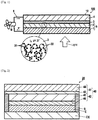
- the photoelectric conversion element 10 is composed of: an electrically-conductive support 1; a photoconductor layer 2 containing semiconductor fine-particles which has been sensitized by a dye (metal complex dye) 21; a charge-transfer layer 3 which is a hole-transport layer, and a counter electrode 4.
- a co-adsorbent has been adsorbed, together with the dye (metal complex dye) 21, onto semiconductor fine-particles 22.
- the electrically conductive support 1 in which the photoconductor layer 2 has been provided functions as a working electrode in the photoelectric conversion element 10.
- the photoelectric conversion element 10 is shown as a system 100 utilizing a dye-sensitized solar cell, in which the photoelectric conversion element 10 is made to usable for a cell purpose which makes an operation means M to work via an external circuit 6.
- a light-receiving electrode 5 is formed of an electrically conductive support 1, and a photoconductor layer 2 containing semiconductor fine particles to which the dye (metal complex dye) 21 has been adsorbed.
- the photoconductor layer 2 is designed according to the intended purpose, and it may have a single-layer structure or a multilayer structure.
- the dye (metal complex dye) 21 in one photoconductor layer may be a single species or a mixture, but as at least one of them, the above-described metal complex dye of the present invention is used. Light incident to the photoconductor layer 2 excites the dye (metal complex dye) 21.
- the excited dye has electrons having high energy, and these electrons are transferred from the dye (metal complex dye) 21 to a conduction band of the semiconductor fine particles 22, and further reach the electrically conductive support 1 by diffusion. At this time, the dye (metal complex dye) 21 is in an oxidized form.
- the electrons on the electrode, while working in an external circuit 6, return through the counter electrode 4 to the photoconductor layer 2 in which the oxidized form of the dye (metal complex dye) 21 and the electrolyte exist, to function as the solar cell.
- the photoconductor layer is a layer that contains an electrolyte described later and semiconductor fine-particles carrying a sensitizing dye including the following metal complex dye of the present invention.
- a metal complex dye according to the present invention is represented by the following formula (I). M(LD)(LA) ⁇ (CI) formula (I)
- M represents a metal ion.
- LD represents a tridentate ligand represented by any one of the following formulas (DL-1) to (DL-4).
- LA represents a tridentate ligand represented by the following formula (AL).
- CI represents a counter ion necessary to neutralize an electric charge.
- Y 1 and Y 2 each independently represent an oxygen atom, a sulfur atom, a substituted or unsubstituted nitrogen atom, or a substituted or unsubstituted phosphorus atom, each of which coordinates with the metal ion M.
- the ring AD and the ring BD each independently represents a hydrocarbon ring or a hetero ring.
- L represents a linking group represented by any one of the following formulas (L-1) to (L-4).
- Ra and Rb each independently represent a substituent.
- R L1 represents a hydrogen atom or a substituent.
- X represents a nitrogen atom or a carbon atom; the ring CD represents a nitrogen-containing hetero ring containing X.
- the bond between X and the carbon atom bonded with X and N may be a single bond or a double bond.
- the ring CD may have a substituent.
- T represents -O-, -S-, -NR L2 - or -PR L3 -; R L2 and R L3 each independently represent a hydrogen atom or a substituent.
- Alk represents an alkylene group, which may have a substituent.
- the ring A, the ring B, and the ring C each independently represent a nitrogen-containing aromatic hetero ring.
- the bond between Z 1 and N and the bond between Z 2 and N may be a single bond or a double bond.
- Z 1 and Z 2 each independently represent a carbon atom or a nitrogen atom.
- Anc1 to Anc3 each independently represent -CO 2 H, -SO 3 H, -PO 3 H 2 , -OH, -SH or a salt thereof.
- X 1 , X 2 and X 3 each independently represent a single bond or a linking group.
- 11 to 13 each independently represent an integer of 1 to 5.
- m1 and m3 each independently represent an integer of 0 to 4.
- m2 represent an integer of 0 to 3.
- the total of m1 to m3 is 1 or more.
- R 1 to R 3 each independently represent a substituent other than Anc1 to Anc3.
- n1 and n3 each independently represent an integer of 0 to 2.
- n2 represents 0 or 1.
- M represents a central metal ion of the metal complex dye, and such a metal may be element numbers 6 to 12 on the long-form periodic table of the elements.
- Such elements include Ru, Fe, Os, Cu, W, Cr, Mo, Ni, Pd, Pt, Co, Ir, Rh, Re, Mn and Zn.
- M is preferably Os 2+ , Ru 2+ , or Fe 2+ , and particularly preferably Ru 2+ among them.
- the valence of M may be changed by the redox reaction with the surrounding material.
- the ligand LD is classified into a donor ligand, and is preferably a ligand which does not have an adsorptive group that adsorbs onto the surface of semiconductor fine particles.
- the adsorptive group that adsorbs onto the surface of semiconductor fine particles is a group represented by Anc1 to Anc3 in a ligand LA described later or a group including any of these groups.
- the ligand LD is a tridentate ligand represented by any one of the aforementioned formulas (DL-1) to (DL-4).
- Y 1 and Y 2 each independently represent an oxygen atom, a sulfur atom, a substituted or unsubstituted nitrogen atom, or a substituted or unsubstituted phosphorus atom, each of which coordinates with the metal ion M.
- the nitrogen atom may have a hydrogen atom or a substituent on the nitrogen atom
- the phosphorus atom may have a hydrogen atom or a substituent.
- the substituent which the nitrogen atom and the phosphorus atom may have includes substituent T described later.
- an electron-withdrawing substituent is preferable.
- examples thereof include an alkyl- or aryl-sulfonyl group, an acyl group, an alkoxycarbonyl group, a carbamoyl group, a sulfamoyl group, and the like, and among them, an alkyl- or aryl-sulfonyl group is preferable, and an alkylsulfonyl group is more preferable.
- the number of carbon atoms of the substituent is preferably 1 to 10, more preferably 1 to 4, and particularly preferably 1 or 2.
- the substituent that the phosphorus atom may have includes the substituent T described later.
- a preferred substituent of the phosphorus atom may be an alkyl group, an aryl group, and an alkoxy group.
- a trivalent phosphorus atom is preferred.
- Y 1 binding to the ring AD and Y 2 binding to the ring BD each may preferably be positioned at an adjacent atom (an ortho position) to the site (atom) to which L is bonded to either of these rings.
- Y 1 and Y 2 preferably represent an oxygen atom, a sulfur atom, or a substituted or unsubstituted nitrogen atom, and particularly preferably an oxygen atom.
- the hydrocarbon ring for the ring AD and the ring BD may be an aromatic ring, a non-aromatic unsaturated ring, or an alicyclic ring having no unsaturated bond in its ring structure.
- the hydrocarbon ring is preferably a 5-membered ring or a 6-membered ring, more preferably an aromatic ring, and still more preferably a benzene ring.
- the hydrocarbon ring may form a fused ring with a hydrocarbon ring or a hetero ring, or may have a substituent.
- substituent T described below can be mentioned.
- the hetero ring for the ring AD and the ring BD preferably includes at least one of nitrogen atom, oxygen, and a sulfur atom as a ring-constituting atom, and a 5-membered ring or a 6-membered ring is preferable.
- the hetero ring may form a fused-ring with a hydrocarbon ring or another hetero ring. Further, the hetero ring may have a substituent, and such a substituent includes substituent T described below.
- hetero ring examples include a pyrrole ring, a pyrazole ring, an imidazole ring, a triazole ring, a tetrazole ring, an oxazole ring, a thiazole ring, an isothiazole ring, a thiadiazole ring, an oxadiazole ring, a 1,2,4-thiadiazole ring, a 1,2,4-oxadiazole ring, a pyridine ring, a pyrazine ring, a pyrimidine ring, a triazine ring, an indole ring, an indazole ring, a benzimidazole ring, a benzoxazole ring, a benzothiazole ring, a pyrazolone ring, a 2-pyridone ring, an uracil ring, a thiophene-1,1-dioxide ring.
- a pyrazole ring preferred are a pyrazole ring, a pyrazolone ring, a 2-pyridone ring, an uracil ring, a triazole ring, a pyrrole ring, an indole ring, an imidazole ring, a benzimidazole ring, and thiophene-1,1-dioxide ring; and more preferred are a pyrazole ring, an imidazole ring, and a triazole ring.
- the ring AD and the ring BD preferably represent a benzene ring, a pyrazole ring, an imidazole, or a triazole ring, more preferably a benzene ring, a pyrazole ring, or a triazole ring, and particularly preferably a benzene ring or a pyrazole ring.
- Ra and Rb represent a substituent.
- Such a substituent includes substituent T described below.
- Ra preferably represents an alkyl group or an aryl group.
- Rb is preferably an electron-withdrawing group; and examples thereof include an acyl group, an alkoxycarbonyl group, an alkyl- or aryl-sulfonyl group, a carbamoyl group, a sulfamoyl group, and a cyano group.
- * is a part bonded to the double bond.
- the ring to be formed is preferably a 6-membered ring.
- L represents a linking group represented by any one of the aforementioned formulas (L-1) to (L-4).
- R L1 represents a hydrogen atom or a substituent, and such a substituent includes substituent T described later.
- R L1 preferably represents a hydrogen atom, an alkyl group, an aryl group, or a hetero ring group, more preferably a hydrogen atom, an alkyl group or an aryl group, furthermore preferably a hydrogen atom or an alkyl group, and particularly preferably a hydrogen atom.
- X represents a nitrogen atom or a carbon atom
- the ring CD represents a nitrogen-containing hetero ring that contains X.
- the nitrogen-containing hetero ring includes at least one nitrogen atom as a ring-constituting atom, and also, preferably includes an oxygen atom and/or a sulfur atom as other hetero atom, and a 5-membered ring or a 6-membered ring is preferable.
- the hetero ring may be an aromatic ring or a non-aromatic ring, and preferably an aromatic ring.
- the nitrogen-containing hetero ring may have a substituent, and such a substituent includes substituent T described later.
- nitrogen-containing hetero ring for the ring CD among the examples described for the ring AD and the ring BD, those having a nitrogen atom as a ring-constituting atom can be mentioned.
- the ring CD may have a substituent, and as the substituent of the ring CD, the substituent T described later can be used; and an alkyl group, an aryl group, a hetero ring group, an alkoxy group, and an amino group are preferable, and a thiophene ring group and a diarylamino group are more preferable.
- substituents may further have a substituent, and such a substituent includes substituent T described later.
- T represents -O-, -S-, -NR L2 - or -PR L3 -; and R L2 and R L3 represent a hydrogen atom or a substituent.
- a substituent includes substituent T described later.
- R L2 preferably represents a hydrogen atom, an alkyl group, or an aryl group, more preferably an alkyl group or an aryl group, and furthermore preferably an aryl group.
- T preferably represents -NR L2 - or -PR L3 -.
- Alk represents an alkylene group, and the alkylene group may have a substituent.
- a substituent includes substituent T described later, and among them, an alkyl group is preferable.
- the number of carbon atoms of the alkylene group is preferably 1 to 10, more preferably 1 to 4, furthermore preferred are methylene, ethylene, and propylene, still preferred are methylene and ethylene, and particularly preferred is methylene.
- the formulas (L-1) to (L-4) are preferred, and the formula (L-1) or (L-3) is more preferred.
- L is formula (L-1) in formulas (DL-1) to (DL-4) representing the ligand LD
- the following ligands are preferable as the ligand LD.
- substituents including one or more carbon atoms are preferable.
- substituents including one or more carbon atoms are preferable.
- the case where one of the ring AD and the ring BD has an electron-donating substituent or an electron-withdrawing substituent and the other of the ring AD and the ring BD is unsubstituted and the case where both of the ring AD and the ring BD have an electron-donating substituent are more preferable.
- the electron-donating substituent a substituted or unsubstituted alkyl group, a substituted or unsubstituted aryl group, and a substituted or unsubstituted hetero aryl group are more preferable.
- the substituent T described later can be mentioned.
- L is formula (L-3) in formulas (DL-1) to (DL-4) representing the ligand LD
- the following ligands are preferable as the ligand LD.
- substituents including one or more carbon atoms are preferable.
- substituents including one or more carbon atoms are preferable.
- a substituted or unsubstituted alkyl group, a substituted or unsubstituted aryl group, and a substituted or unsubstituted hetero aryl group are more preferable.
- the substituent T described later can be mentioned.
- the ligand LD is preferably a ligand, in which L is formula (L-1) or formula (L-3).
- L is formula (L-1)
- the ring AD is a benzene ring
- the ring BD is a benzene ring, a pyrazole ring, an imidazole ring, or a triazole ring, Y 1 each independently represent -O - , -S - , or -NR - (R represents a hydrogen atom or a substituent);
- the ring AD is a a ring, in formula (DL-3
- L is formula (L-3), preferred are the cases wherein, in formula (DL-1), the ring AD and the ring BD are benzene rings, Y 1 and Y 2 each independently represent -O - , -S - , or -NR - (R represents a hydrogen atom or a substituent); and in formula (DL-2), the ring AD is a benzene ring, the ring BD is a benzene ring, a pyrazole ring, an imidazole ring, or a triazole ring, and Y 1 represents -O - , -S - , or -NR - (R represents a hydrogen atom or a substituent).
- the ligand LD is more preferably a ligand, in which L is formula (L-3), and, in formula (DL-1), the ring AD and the ring BD are benzene rings, Y 1 and Y 2 each independently represent -O - , -S - , or -NR - (R represents a hydrogen atom or a substituent); and in formula (DL-2), the ring AD is a benzene ring, the ring BD is a benzene ring, a pyrazole ring, an imidazole ring, or a triazole ring, and Y 1 represents -O - , -S - , or -NR - (R represents a hydrogen atom or a substituent).
- the ligand LD is further more preferably a ligand, in which L is formula (L-3), and, in formula (DL-2), the ring AD is a benzene ring, the ring BD is a benzene ring, a pyrazole ring, an imidazole ring, or a triazole ring, and Y 1 represents -O - , -S - , or -NR - (R represents a hydrogen atom or a substituent).
- ligand LD Specific examples of the ligand LD are shown below, but the present invention is not limited to these.
- Y 1 in the ring AD and Y 2 in the ring BD are shown as “-O”, “-S”, or “-N-SO 2 CH 3 ", and coordinates to the metal ion M, but these are "-O - ", "-S - “, and "-N - -SO 2 CH 3 " when consider the ligand itself.
- the ligand LD can be synthesized by a general diazotization-coupling reaction, a general imine synthesis reaction, a general cross coupling reaction, and the like.
- the ligand LA represents a tridentate ligand represented by the aforementioned formulas (AL).
- the ligand LA is a ligand which has an adsorptive group that adsorbs onto the surface of semiconductor fine particles.
- the aromatic hetero ring for the ring A to the ring C may be any rings as long as it has a nitrogen atom as a ring-constituting hetero atom, and also is an aromatic ring.
- the aromatic hetero ring for the ring A to the ring C is preferably a 5-membered ring or a 6-membered ring, and the aromatic hetero ring may fuse with an aromatic hydrocarbon ring, an aromatic hetero ring, a non-aromatic hetero ring, or an alicyclic ring.
- the ring-constituting hetero atom of the aromatic hetero ring may be 2 to 4 nitrogen atoms, and also may include other hetero atoms, for example, oxygen atom and sulfur atom, in addition to nitrogen atoms.
- the aromatic hetero ring is preferably a non-fused 6-membered ring or a 5-membered ring fused with a benzene ring.
- Examples of the aromatic hetero ring may include a pyridine ring, a pyrimidine ring, a pyrazine ring, a triazine ring, a quinoline ring, and a quinazoline ring as the 6-membered ring, and a pyrrole ring, an imidazole ring, a pyrazole ring, an oxazole ring, a thiazole ring, an indoline ring, an indazole ring, and a benzothiazole ring as the 5-membered ring.
- the ring A and the ring B are preferably an unfused 5-membered ring or 6-membered ring, a fused (preferably, benzo-fused) 5-membered ring, and are preferably the rings exemplified as the aromatic hetero ring.
- the ring B is preferably an unfused 6-membered ring, more preferably a pyridine ring, a pyrazine ring, a pyrimidine ring, and a triazole ring, and among them, a pyridine ring is preferable.
- the ring A, the ring B, and the ring C be any one of a pyridine ring, a pyrimidine ring, or a thiazole ring; it is more preferred that the ring B be a pyridine ring and the ring A and the ring C be a pyridine ring, a quinoline ring, or a pyrimidine ring; and it is still more preferred that all the ring A to the ring C be pyridine rings.
- At least one of Z 1 and Z 2 is a carbon atom, and it is more preferable that both of Z 1 and Z 2 are carbon atoms.
- Anc1 to Anc3 each are an adsorptive group that adsorbs onto the surface of semiconductor fine particles, and at least one adsorptive group of these adsorbs onto the surface of semiconductor fine particles.
- Anc1 to Anc3 preferably represent -CO 2 H or -OH.
- X 1 , X 2 and X 3 each independently represent a single bond or a linking group.
- linking group preferred is a linking group that links, with ⁇ conjugation, to the nitrogen-containing aromatic hetero ring to be bonded.
- linking group divalent groups derived from the substituent T described later can be mentioned.
- Examples thereof may preferably include an ethenylene group, an ethynylene group, an arylene group, a hetero aromatic ring group, and a group of any combination of these. These groups may have a substituent, and examples of the substituent include the substituent T described later.
- Anc1 to Anc3 are -OH, it is preferred that Anc1-X 1 -, Anc2-X 2 -, Anc3-X 3 -, or a partial structure including a part of these linking group X 1 to X 3 is represented by the following formula (AncX).
- nx is an integer of 1 to 3.
- R a1 and R a2 each independently represent a substituent.
- -OH in formula (AncX) may form a salt.
- R a1 and R a2 an alkyl group, an aryl group, a heterocyclic group, a cyano group, an acyl group, a sulfonyl group, an alkoxycarbonyl group, an aryloxycarbonyl group, a carbamoyl group, and a sulfamoyl group are more preferable, and an alkyl group, an aryl group, and a cyano group are further preferable.
- the group or partial structure represented by formula (AncX) is preferably a group or partial structure represented by any one of the following formulas (Anc-1) to (Anc-5).
- R a1 to R a4 each independently represent a substituent.
- -OH may form a salt.
- R a1 to R a4 have the same meanings as those of the above-described R a1 and R a2 , and the preferable range thereof are also the same.
- the group represented by formula (Anc-1) or (Anc-5) is preferable, the group represented by formula (Anc-1) is more preferable.
- Anc1 to Anc3 each are -OH, it is preferred that Anc1-X 1 -, Anc2-X 2 -, Anc3-X 3 -, or a partial structure including a part of these linking group X 1 to X 3 is represented by the following formula (AncY).
- W 4 has the same meaning as that of W 1 to W 3 in the above-described formula (AncX), and the preferable range thereof is also the same.
- Anc1 to Anc3 each are -CO 2 H, it is preferred that Anc1-X 1 -, Anc2-X 2 -, Anc3-X 3 -, or a partial structure including a part of these linking group X 1 to X 3 is represented by the following formula (AncZ).
- Rz represents a substituent having the ⁇ p value in Hammett's rule of 0.30 or more.
- Examples of the group may include a cyano group, an acyl group, a sulfonyl group, an alkoxycarbonyl group, an aryloxycarbonyl group, a carbamoyl group, a sulfamoyl group, a perfluoroalkyl group, and a nitro group.
- Rz is preferably a cyano group, an acyl group (preferably an acetyl group), or a perfluoroalkyl group (preferably a trifluoromethyl group), and particularly preferably a cyano group.
- 11 to 13 are an integer of 1 to 5, and 11 to 13 are preferably 1 or 2 and more preferably 1.
- m1 and m3 each represent an integer of 0 to 4.
- m2 represents an integer of 0 to 3.
- the sum of m1 to m3 is 1 or more.
- the sum of m1 to m3 is preferably 1 to 3, more preferably 2 or 3, and particularly preferably 3. Among them, it is preferred that any two or three of m1 to m3 are 1, and it is more preferred that all m1 to m3 are 1.
- R 1 to R 3 represent a substituent, and examples of the substituent include substituent T described later.
- R 1 to R 3 are preferably an alkyl group, an aryl group, a hetero ring group, an amino group, an alkoxy group, an aryloxy group, an alkylthio group, an arylthio group, and an electron-withdrawing group having a positive Hammett ⁇ p value, such as, a halogen atom, a cyano group, and a sulfonyl group.
- R 1 to R 3 are more preferably an alkyl group, an aryl group, a hetero ring group, an amino group, a halogen atom, and a cyano group.
- n1 and n3 each independently represent an integer of 0 to 2.
- n2 represents 0 or 1.
- n1 and n3 are preferably 0 or 1, and n2 is preferably 1.
- all of n1 to n3 are 0.
- the ligand represented by the above formula (AL) is preferably a ligand represented by any one of the following formulas (AL-1) to (AL-4).
- Anc 1 to Anc 3 each independently represent -CO 2 H, -SO 3 H, -PO 3 H 2 , or a salt thereof.
- R AL represents a substituent other than Anc 1 to Anc 3 .
- b1 represent an integer of 0 to 4.
- X 2a represents -O-, -S-, -NR'-, a divalent saturated aliphatic group, a divalent aromatic hydrocarbon ring group, a divalent non-aromatic hydrocarbon ring group, a divalent aromatic hetero ring group, a divalent non-aromatic hetero ring group, or a linking group formed by any combination of these.
- R' represents a hydrogen atom or a substituent.
- X 1a represents a linking group.
- X 3 represents a single bond or a linking group.
- m4 represents 0 or 1.
- Anc 1 to Anc 3 each preferably represent -CO 2 H or a salt thereof.
- the substituent for R AL may be the substituent T described later, and preferably, an alkyl group, an alkenyl group, an aryl group, and a hetero ring group (preferably a hetero aromatic ring group, and more preferably thiophene ring and furan ring).
- b1 preferably represents an integer of 0 to 3, more preferably an integer of 0 to 2, and particularly preferably 0 or 1.
- R' includes the substituent T described later.
- R' preferably represents a hydrogen atom, an alkyl group, an aryl group, and a heterocyclic group.
- the divalent saturated aliphatic group, the divalent aromatic hydrocarbon ring group, the divalent non-aromatic hydrocarbon ring group, the divalent aromatic hetero ring group, and the divalent non-aromatic hetero ring group may have a substituent, and as the substituent, the substituent T described later can be mentioned.
- the divalent saturated aliphatic group may be either of a linear chain and a branched chain.
- Especially preferred divalent saturated aliphatic group is an alkylene group, and an alkylene group having 1 to 6 carbon atoms, such as, methylene, ethylene, propylene, and butylene can be mentioned.
- Examples of the divalent aromatic hydrocarbon ring group may include the group corresponding to the aryl group and the like in the substituent T described later, and specifically, a phenylene group and a naphthylene group.
- the divalent non-aromatic hydrocarbon ring group includes a divalent saturated hydrocarbon ring group (a cycloalkylene group), and a divalent unsaturated hydrocarbon ring group which is, for an example, a divalent hydrocarbon ring group having one or two or more of carbon-carbon double bond(s) or carbon-carbon triple bond(s) so as not to satisfy the Hückel's rule.
- a divalent saturated hydrocarbon ring group a cycloalkylene group
- a divalent unsaturated hydrocarbon ring group which is, for an example, a divalent hydrocarbon ring group having one or two or more of carbon-carbon double bond(s) or carbon-carbon triple bond(s) so as not to satisfy the Hückel's rule.
- an enol structure can be taken as tautomer, and thus, formally, for example, becomes 6 ⁇ conjugation, but they are classified into a di
- divalent aromatic hetero ring group a divalent group of any of the rings mentioned as the nitrogen-containing hetero ring group for the Ring A to Ring C can be enumerated.
- aromatic hetero ring in the divalent aromatic hetero ring group a pyridine ring, a pyrimidine ring, a triazine ring, a triazole ring, a pyrazole ring, a thiophene ring, a benzothiophene ring, and a furan ring can be mentioned.
- benzene ring group substituted by an ethenylene group or ethynylene group, or a group having a thiophene ring structure, a group in which two or more of the group having thiophene ring structure are combined, and the like.
- X 2a is preferably a linear or branched divalent aliphatic hydrocarbon group, a divalent aromatic hydrocarbon ring group, or a divalent aromatic hetero ring group, more preferably a divalent aromatic hydrocarbon ring group, and still more preferably a benzene ring as such a ring.
- X 1a represents a linking group.
- a linking group does not include a single bond.
- the linking group for X 1a and X 3 preferably includes the linking group for X 2a , and a divalent unsaturated hydrocarbon group, such as, an ethenylene group, an ethynylene group, and the like.
- the linking group for X 1a and X 3 is preferably a linking group that links between its atom bonded with Anc 1 or Anc 3 and the pyridine ring, with ⁇ conjugation. By this, improvement of an absorption characteristic may be expected by the extension of ⁇ conjugation system.
- a linking group may be an ethenylene group, an ethynylene group, an arylene group, a divalent aromatic hetero ring group, or a linking group of any combination of these groups.
- the divalent non-aromatic hydrocarbon ring group or the divalent non-aromatic hetero ring group also preferred are those which can extend ⁇ conjugation system.
- R h1 to R h8 each independently represent a hydrogen atom or a substituent.
- the substituent for R h1 to R h8 the substituent T described later can be mentioned.
- the substituent for R h7 may be an electron-withdrawing group among the substituents T described later, and for example, preferably a cyano group, and the like.
- Examples of X 1a and X 3 include the linking group for X 2a , and as described above, preferably a group that links with ⁇ conjugation.
- a group more preferred are an ethenylene group, an ethynylene group, an arylene group (preferably, a phenylene group), a divalent thiophene ring, and any combination of these groups.
- Examples thereof may include -ethenylene-phenylene-, -ethynylene-phenylene-, - ethenylene-divalent thiophene ring-, -ethynylene-divalent thiophene ring-, and -divalent thiophene ring-divalent thiophene ring-.
- the linking group may be substituted with the substituent T described later, and among them, may be preferably substituted with an electron-withdrawing substituent.
- the molar absorption coefficient of the metal complex dye is increased to improve photoelectric conversion efficiency, and also, reduce performance fluctuation.
- an electron-withdrawing group for example, a fluoroalkyl group, a halogen atom, an alkylcarbonyl group, an arylcarbonyl group, an alkylsulfonyl group, an arylsulfonyl group, a substituted or unsubstituted amino sulfonyl group, a nitro group, a substituted or unsubstituted amide group, and a cyano group are suitable.
- X 1a and X 3 each are preferably an ethynylene group that may have a substituent, a divalent thiophene ring group, an unsaturated hetero ring group having a thiophene skeleton or a linking group of any combination of these groups.
- R e1 to R e10 and R s1 to R s3 each independently represent a hydrogen atom or a substituent, and a plurality of substituents may be bonded, directly or by being intervened with a linking group, to form a ring.
- the substituents of R e1 to R e10 and R s1 to R s3 may be the substituent T described later, and among them, an electron-withdrawing group is preferable.
- m4 represents 0 or 1
- m4 preferably represents 1.
- the ligand LA may be synthesized by a metal halogen exchange reaction, a cross coupling reaction, a Knoevenagel condensation reaction, and the like.
- CI represents a counter ion in the case where the counter ion is necessary to neutralize an electric charge.
- a dye is cationic or anionic, or has a net ionic charge, depends on the metal, the ligand and the substituent, in the metal complex dye.
- the metal complex dye may have a negative charge arising from dissociation.
- an electric charge of the metal complex dye as a whole is electrically neutralized by CI.
- examples of the counter ion CI include an inorganic or organic ammonium ion (for example, tetraalkyl ammonium ion such as tetrabutylammonium ion; triethyl benzyl ammonium ion, pyridinium ion, and the like), a phosphonium ion (for example, tetraalkyl phosphonium ion such as tetrabutyl phosphonium ion, alkyltriphenyl phosphonium ion, triethyl phenyl phosphonium ion, and the like), an alkali metal ion, a metal complex ion and a proton.
- an inorganic or organic ammonium ion for example, tetraalkyl ammonium ion such as tetrabutylammonium ion; triethyl benzyl ammonium ion, pyridinium
- an inorganic or organic ammonium ion for example, triethylammonium ion, tetrabutylammonium ion, and the like
- a proton is preferable.
- examples of the counter ion CI include an inorganic or organic ammonium ion (for example, tetraalkyl ammonium ion, pyridinium ion, and the like), a phosphonium ion (for example, a tetralkylphosphonium ion, an alkyltriphenylphosphonium ion, and the like), an alkali metal ion, metal complex ion and a proton.
- an inorganic or organic ammonium ion triethylammonium ion, tetrabutyl ammonium ion, and the like
- a proton is preferable.
- the counter ion CI When the counter ion CI is a negative counter ion, the counter ion CI may be an inorganic negative ion or an organic negative ion. Examples thereof include a hydroxide ion, a halogen negative ion (for example, fluoride ion, chloride ion, bromide ion, iodide ion), a substituted or unsubstituted alkylcarboxylate ion (for example, acetate ion, trifluoroacetate ion), a substituted or unsubstituted arylcarboxylate ion (for example, benzoate ion), a substituted or unsubstituted alkylsulfonate ion (for example, methanesulfonate ion, trifluoromethanesulfonate ion), a substituted or unsubstituted arylsulfonate ion (for
- an ionic polymer or another dye with an opposite charge from the dye in interest may be used.
- a metal complex ion for example, bis(benzene-1,2-dithiolato)nickel (III) and the like
- III bis(benzene-1,2-dithiolato)nickel
- a halogen anion a substituted or unsubstituted alkylcarboxylate ion, a substituted or unsubstituted alkylsulfonate ion, a substituted or unsubstituted arylsulfonate ion, an aryldisulfonate ion, a perchlorate ion, and a hexafluorophosphate ion are preferred; and a halogen anion and a hexafluorophosphate ion are more preferred.
- the metal complex dye represented by Formula (I) of the present invention can be synthesized referring to the method described in any one of Chemistry - A European Journal, 17(39), 10871 to 10878 (2011 ); Angewandte Chemie, 84, 824 to 826 (1972 ), Dalton Transactions ,5, 770 to 772 (2009 ), and JP-A-2001-291534 or a method according to the method cited in JP-A-2001-291534 , and a method according to the method described in Angew. Chem. Int. Ed., 50, 2054 to 2058 (2011 ).
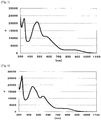
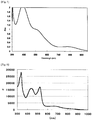
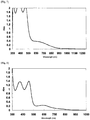
- the metal complex dye of present invention has a maximum absorption wavelength in a solution in a range of preferably from 300 to 1,000 nm, more preferably from 350 to 950 nm, and especially preferably from 370 to 900 nm.
- the metal complex dye of the present invention also has an absorption range even in 900 to 1000 nm.
- the metal complex dye of the present invention and another dye may be used in combination.
- the dye to be used in combination includes: a Ru complex dye described in JP-T-7-500630 (in particular, dyes synthesized in Examples 1 to 19 described in from line 5 on left lower column on page 5 to line 7 on right upper column on page 7) (the term "JP-T” means a published Japanese translation of a PCT patent application), a Ru complex dye described in JP-T-2002-512729 (in particular, dyes synthesized in Examples 1 to 16 described in line 3 from the bottom of page 20 to line 23 on page 29), a Ru complex dye described in JP-A-2001-59062 (in particular, dyes described in paragraph Nos.
- JP-T-7-500630 in particular, dyes synthesized in Examples 1 to 19 described in from line 5 on left lower column on page 5 to line 7 on right upper column on page 7
- JP-T means a published Japanese translation of a PCT patent application
- a Ru complex dye described in JP-T-2002-512729 in particular, dyes synthesized in Examples 1 to 16
- a Ru complex dye described in JP-A-2001-6760 in particular, dyes described in paragraph Nos. 0093 to 0102
- a Ru complex dye described in JP-A-2001-253894 in particular, dyes described in paragraph Nos. 0009 to 0010
- a Ru complex dye described in JP-A-2003-212851 in particular, dyes described in paragraph No. 0005
- a Ru complex dye described in WO 2007/91525 pamphlet in particular, dyes described in paragraph No. [0067]
- a Ru complex dye described in JP-A-2001-291534 in particular, dyes described in paragraph Nos.
- JP-A-2012-012570 in particular, dyes described in paragraph Nos. 0095 to 0103
- a squarylium cyanine dye described in JP-A-11-214730 in particular, dyes described in paragraph Nos. 0036 to 0047
- a squarylium cyanine dye described in JP-A-2012-144688 in particular, dyes described in paragraph Nos. 0039 to 0046 and 0054 to 0060
- a squarylium cyanine dye described in JP-A-2012-84503 in particular, dyes described in paragraph Nos.
- Preferable dyes to be used in combination include Ru complex dyes, squaryrium cyanine dyes, or organic dyes.
- a ratio of mass of the metal complex dye of the present invention/mass of another dye is preferably from 95/5 to 10/90, more preferably from 95/5 to 50/50, still more preferably from 95/5 to 60/40, particularly preferably from 95/5 to 65/35, and most preferably from 95/5 to 70/30.
- the electrically-conductive support is preferably a support having electroconductivity by itself, such as a metal, or a glass or plastic support having an electrically-conductive film layer on the surface.
- a transparent polymer film described in paragraph No. 0153 of JP-A-2001-291534 can be mentioned.
- the support in addition to the glass and plastic, ceramic ( JP-A-2005-135902 ), an electrically-conductive resin ( JP-A-2001-160425 ), or the like may be used.
- the electrically-conductive support may be provided with a light management function at the surface, and for example, the anti-reflective film in which a high refractive index film and a low refractive index oxide film are alternately laminated, as described in JP-A-2003-123859 , and the light guide function as described in JP-A-2002-260746 may be mentioned.
- the thickness of the electrically-conductive layer is preferably 0.01 to 30 ⁇ m, more preferably 0.03 to 25 ⁇ m, and particularly preferably 0.05 to 20 ⁇ m.
- the electrically-conductive support is substantially transparent.
- substantially transparent means that the transmittance of light is 10% or more, preferably 50% or more, and particularly preferably 80% or more.
- a support formed from glass or plastic and coated with an electrically-conductive metal oxide is preferable.
- the metal oxide tin oxide is preferable, and indium-tin oxide and fluorine-doped oxide are particularly preferable.
- the coating amount of the electrically-conductive metal oxide is preferably 0.1 to 100 g, per square meter of the support made of glass or plastic. In the case of using a transparent electrically-conductive support, it is preferable that light is incident from the support side.
- fine-particles of chalcogenides of metals for example, oxides, sulfides and selenides
- fine-particles of perovskites may be used with preference.
- Preferred examples of the chalcogenides of metals include oxides of titanium, tin, zinc, tungsten, zirconium, hafnium, strontium, indium, cerium, yttrium, lanthanum, vanadium, niobium or tantalum, cadmium sulfide, and cadmium selenide.
- Preferred examples of the perovskites include strontium titanate, and calcium titanate. Among these, titanium oxide (titania), zinc oxide, tin oxide, and tungsten oxide are particularly preferred.
- Examples of the crystal structure of titania include structures of anatase type, brookite type and rutile type, and anatase type and brookite type structures are preferred.
- a titania nanotube, nanowire, or nanorod may be mixed with titania fine-particles or may be used as a semiconductor electrode.
- a particle size of the semiconductor fine-particles is expressed in terms of an average particle size using a diameter when a projected area is converted into a circle, and is preferably 0.001 to 1 ⁇ m as primary particles, and 0.01 to 100 ⁇ m as an average particle size of dispersions.
- Examples of the method for coating the semiconductor fine-particles on the electrically-conductive support include a wet method, a dry method or other methods.
- the semiconductor fine-particles it is preferable to form a short circuit-preventing layer between the transparent electrically-conductive film and the photoconductor layer ("semiconductor layer"), so as to prevent reverse current due to a direct contact between the electrolyte liquid and the electrode. It is preferable to employ a spacer or a separator, so as to prevent contact between the photoelectrode and the counter electrode. It is preferable for the semiconductor fine-particles to have a large surface area, so that a large amount of dye can adsorb to the surface. For example, in a state of the semiconductor fine-particles being coated on the support, the surface area is preferably 10 times or more, and more preferably 100 times or more, relative to the projected surface area.
- the upper limit of this value is not particularly limited, and the upper limit is generally about 5,000 times.
- the thickness of the layer containing semiconductor fine particles increases, the amount of dye that can be carried per unit area increases, and therefore, the light absorption efficiency is increased.
- the thickness is typically 0.1 to 100 ⁇ m.
- the thickness of the semiconductor fine-particle layer is preferably 1 to 50 ⁇ m, and more preferably 3 to 30 ⁇ m.
- the semiconductor fine-particles may be calcined after being applied on the support, at a temperature of 100 to 800°C for 10 minutes to 10 hours, so as to bring about cohesion of the particles.
- the film-forming temperature is preferably 400 to 600°C.
- the amount of coating of the semiconductor fine-particles per square meter of the support is preferably 0.5 to 500 g, and more preferably 5 to 100 g.
- the overall amount of use of the dye is preferably 0.01 to 100 millimoles, more preferably 0.1 to 50 millimoles, and particularly preferably 0.1 to 10 millimoles, per square meter of the support.
- the amount of use of the metal complex dye of the present invention is preferably set to 5% by mole or more.
- the amount of the dye adsorbed to the semiconductor fine-particles is preferably 0.001 to 1 millimole, and more preferably 0.1 to 0.5 millimoles, based on 1 g of the semiconductor fine-particles. When the amount of the dye is set to such a range, the sensitization effect in the semiconductor fine particles can be sufficiently obtained.
- a counter ion of the above specific metal complex dye is not particularly limited. Examples thereof include an alkali metal ion and a quaternary ammonium ion.
- the surface of the semiconductor fine-particles may be treated using amines.
- amines include pyridines (e.g., 4-tert-butylpyridine, and polyvinylpyridine). These may be used directly when the compounds are liquids, or may be used in a state of being dissolved in an organic solvent.
- the photoelectric conversion element for example, a photoelectric conversion element 10
- the dye-sensitized solar cell for example, dye-sensitized solar cell 20
- at least the metal complex dye of the present invention is used.
- the charge transfer layer for use in the photoelectric conversion element of the present invention is a layer having a function to replenish electrons to the oxidized form of the dye, and it is provided between the light-receiving electrode and the counter electrode (an opposite electrode).
- the charge-transfer layer contains an electrolyte.
- the electrolyte include a liquid electrolyte having a redox pair dissolved in an organic solvent, a so-called gel electrolyte in which a liquid having a redox pair dissolved in an organic solvent is impregnated in a polymer matrix, and a molten salt containing a redox pair. In order to enhance photoelectric conversion efficiency, a liquid electrolyte is preferred.
- a nitrile compound As a solvent of the liquid electrolyte, a nitrile compound, an ether compound, an ester compound, or the like, is used, and a nitrile compound is preferred, and acetonitrile and methoxypropionitrile are particularly preferred.
- Examples of the redox pair include a combination of iodine and an iodide (preferably an iodide salt, or an iodide ionic liquid; more preferably lithium iodide, tetrabutylammonium iodide, tetrapropylammonium iodide, or methylpropylimidazolium iodide), a combination of an alkylviologen (for example, methylviologen chloride, hexylviologen bromide, or benzylviologen tetrafluoroborate) and a reductant thereof, a combination of a polyhydroxybenzene (for example, hydroquinone, naphthohydroquinone, or the like) and an oxidized form thereof, a combination of a divalent iron complex and a trivalent iron complex (for example, a combination of potassium ferricyanide and potassium ferrocyanide), and a combination of a divalent cobalt complex and
- the cobalt complex is preferably a complex represented by the following formula (CC). Co(LL)ma(X)mb ⁇ CI formula (CC)
- LL represents a bidentate or tridentate ligand.
- X represents a monodentate ligand.
- ma represents an integer of 0 to 3.
- mb represents an integer of 0 to 6.
- CI represents a counter ion in the case where the counter ion is necessary to neutralize an electric charge.
- Examples of CI include those of CI in formula (I).
- LL is preferably a ligand represented by the following formula (LC).
- Z LC1 , Z LC2 and Z LC3 each independently represent a group of nonmetallic atoms necessary to form a 5- or 6-membered ring.
- Each of Z LC1 , Z LC2 and Z LC3 may have a substituent, and may form a ring-closure together with an adjacent ring through a substituent.
- X LC1 and X LC3 represent a carbon atom or a nitrogen atom.
- q represents 0 or 1. Examples of the substituent include the substituent T described later.
- X is preferably a halogen ion.
- the ligand represented by formula (LC) is preferably a ligand represented by any one of the following formulas (LC-1) to (LC-4).
- R LC1 to R LC11 each independently represent a substituent.
- q1, q2, q6, and q7 each independently represent an integer of 0 to 4.
- q3, q5, q10, and q11 each independently represent an integer of 0 to 3.
- q4 represents an integer of 0 to 2.
- examples of the substituent R LC1 to R LC11 include an aliphatic group, an aromatic group, a heterocyclic group or the like. Specific examples of the substituent include an alkyl group, an alkoxy group, an alkylthio group, an aryl group, an aryloxy group, an arylthio group, and a heterocycle.
- Preferred examples include an alkyl group (for example, methyl, ethyl, n-butyl, n-hexyl, isobutyl, sec-butyl, t-butyl, n-dodecyl, cyclohexyl, or benzyl), an aryl group (for example, phenyl, tolyl, or naphthyl), an alkoxy group (for example, methoxy, ethoxy, isopropoxy, or butoxy), an alkylthio group (for example, methylthio, n-butylthio, n-hexylthio, or 2-ethylhexylthio), an aryloxy group (for example, phenoxy, or naphthoxy), an arylthio group (for example, phenylthio, or naphthylthio), and a heterocyclic group (for example, 2-thienyl, or 2-furyl).
- cobalt complex represented by formula (LC) include the following complexes.
- iodine and an iodide are used in combination, as an electrolyte, it is preferred that a 5- or 6-membered-ring nitrogen-containing aromatic cation iodide salt is additionally used in combination with them.
- organic solvent that dissolves these redox pairs include aprotic polar solvents (for example, acetonitrile, propylene carbonate, ethylene carbonate, dimethylformamide, dimethylsulfoxide, sulfolane, 1,3-dimethylimidazolinone, and 3-methyloxazolidinone).
- aprotic polar solvents for example, acetonitrile, propylene carbonate, ethylene carbonate, dimethylformamide, dimethylsulfoxide, sulfolane, 1,3-dimethylimidazolinone, and 3-methyloxazolidinone.
- polymer used for a matrix of a gel electrolyte include polyacrylonitrile, polyvinylidene fluoride, and the like.
- the molten salts include, for example, a molten salt to which fluidity at room temperature has been imparted by mixing lithium iodide and at least one kind of other lithium salt (for example, lithium acetate or lithium perchlorate) with polyethylene oxide.
- the amount of addition of the polymer in this case is 1 to 50% by mass.
- the electrolyte liquid may contain y-butyrolactone, and this increases the diffusion efficiency of iodide ions, and thereby the conversion efficiency is enhanced.
- additives to the electrolyte include 4-tert-butylpyridine mentioned above, as well as aminopyridine-based compounds, benzimidazole-based compounds, aminotriazole-based compounds, aminothiazole-based compounds, imidazole-based compounds, aminotriazine-based compounds, urea derivatives, amide compounds, pyrimidine-based compounds, and heterocycles that do not contain nitrogen.
- a method of controlling the water content of the electrolyte liquid in order to enhance the photoelectric conversion efficiency.
- Preferred examples of the method of controlling the water content include a method of controlling the concentration, and a method of adding a dehydrating agent.
- a clathrate compound of iodine with cyclodextrin may be used.
- a method of supplying moisture on a steady basis may be used.
- a cyclic amidine may be used; or an oxidation inhibitor, a hydrolysis inhibitor, a decomposition inhibitor or zinc iodide may be added.
- a molten salt may also be used as the electrolyte, and preferred examples of the molten salt include an ionic liquid containing an imidazolium or triazolium type cation, an oxazolium-based salt, a pyridinium-based salt, a guanidium-based salt, and combinations of these. These cations may be used in combination with particular anions. Additives may be added to these molten salts.
- the molten salt may have a substituent having liquid crystalline properties. Furthermore, the quaternary ammonium salt-based molten salt may also be used.
- Molten salts other than those described above include, for example, a molten salt to which fluidity at room temperature has been imparted by mixing lithium iodide and at least one kind of other lithium salt (for example, lithium acetate or lithium perchlorate) with polyethylene oxide.
- the electrolyte may be quasi-solidified by adding a gelling agent to an electrolyte liquid including an electrolyte and a solvent, and gelling the electrolyte liquid thereby.
- a gelling agent include an organic compound having a molecular weight of 1000 or less, an Si-containing compound having a molecular weight in the range of 500 to 5000, an organic salt obtained from a particular acidic compound and a particular basic compound, a sorbitol derivative, and polyvinylpyridine.
- a method of confining a matrix polymer, a crosslinking type polymer compound or monomer, a crosslinking agent, an electrolyte, and a solvent, in a polymer may be used.
- the matrix polymer include a polymer having a nitrogen-containing heterocyclic ring in a repeating unit in the main chain or in a side chain, and a crosslinked structure formed by reacting the polymer with an electrophilic compound; a polymer having a triazine structure, a polymer having a ureide structure, a polymer containing a liquid crystalline compound, a polymer having an ether bond, a polyvinylidene fluoride-based polymer, a methacrylate or acrylate-based polymer, a thermosetting resin, crosslinked polysiloxane, polyvinyl alcohol (PVA), a clathrate compound of polyalkylene glycol and dextrin, a system incorporated with an oxygen-containing or sulfur-containing polymer, and a naturally occurring polymer.
- a system containing, as a matrix polymer, a crosslinked polymer formed by reacting a bifunctional or higher-functional isocyanate as one component with a functional group such as a hydroxyl group, an amino group or a carboxyl group, may also be used.
- a crosslinked polymer by a hydrosilyl group and a double-bonded compound, a crosslinking method involving reacting polysulfonic acid, polycarboxylic acid or the like with a divalent or higher-valent metal ion compound, and the like may also be used.
- Examples of the solvent that can be used with preference in combination with the quasi-solid electrolyte described above include particular phosphates, a mixed solvent containing ethylene carbonate, a solvent having a particular relative permittivity, and the like.
- a liquid electrolyte solution may be retained in a solid electrolyte membrane or in pores, and preferred examples of the method include the usage of an electrically conductive polymer membrane, a fibrous solid, and a fabric-like solid such as filter.
- a solid-state charge-transport layer such as a p-type semiconductor or a hole-transporting material, for example, CuI or CuNCS, may also be used in place of a liquid electrolyte and a quasi-solid-state electrolyte as described above. Moreover, electrolytes described in Nature, vol. 486, p. 487 (2012 ) and the like may be used.
- an organic hole-transporting material may be used for a solid charge-transport layer.
- the hole-transport layer include electrically conductive polymers such as polythiophene, polyaniline, polypyrrole, and polysilane; a spiro compound in which two rings share a central element adopting a tetrahedral structure, such as C and Si; aromatic amine derivatives such as triarylamine; triphenylene derivatives; nitrogen-containing heterocycle derivatives; and liquid crystalline cyano derivatives.
- the redox pair serves as an electron carrier, and thus it is required to have a certain concentration.
- concentration is preferably 0.01 mol/L or more, more preferably 0.1 mol/L or more, and particularly preferably 0.3 mol/L or more, in total.
- the upper limit in this case is not particularly limited but is usually about 5 mol/L.
- a co-adsorbent is preferably used in combination with the metal complex dye of the present invention or another dye to be used if necessary.
- a co-adsorbent having at least one acidic group (preferably a carboxyl group or a salt thereof) is preferable, and examples of the co-adsorbent include a fatty acid and a compound having a steroid skeleton.
- the fatty acid may be a saturated fatty acid or an unsaturated fatty acid.
- Examples thereof include a butanoic acid, a hexanoic acid, an octanoic acid, a decanoic acid, a hexadecanoic acid, a dodecanoic acid, a palmitic acid, a stearic acid, an oleic acid, a linoleic acid, and a linolenic acid.
- Examples of the compound having a steroid skeleton include a cholic acid, a glycocholic acid, a chenodeoxycholic acid, a hyocholic acid, a deoxycholic acid, a lithocholic acid, and ursodeoxycholic acid.
- a cholic acid, a deoxycholic acid, and a chenodeoxycholic acid are preferable; and a chenodeoxycholic acid is more preferable.
- a preferred co-adsorbent is a compound represented by the following formula (CA).
- R A1 represents a substituent having an acidic group.
- R A2 represents a substituent.
- nA represents an integer of 0 or more.
- the acidic group has the same meaning as described above, and the preferable range is also the same.
- R A1 is preferably an alkyl group substituted with any one of a carboxyl group, a sulfo group, and a salt thereof; and further preferably -CH(CH 3 )CH 2 CH 2 CO 2 H, or -CH(CH 3 )CH 2 CH 2 CONHCH 2 CH 2 SO 3 H.
- R A2 examples include those exemplified as the substituent T described later. Of these, an alkyl group, a hydroxyl group, an acyloxy group, an alkylaminocarbonyloxy group, and an arylaminocarbonyloxy group are preferable; and an alkyl group, a hydroxyl group, and an acyloxy group are more preferable.
- nA is preferably from 2 to 4.
- Examples of the specific compounds include the compounds mentioned as the compound having a steroid skeleton.
- the co-adsorbent that can be used in the present invention exhibits an effect on suppressing the inefficient association of the dye, and preventing reverse electron transfer from the semiconductor fine-particle surface to the redox system in the electrolyte.
- An amount to be used of the co-adsorbent is not particularly limited, and it is preferred, from the viewpoint of exhibiting effectively the effects, that the amount is preferably from 1 to 200 moles, more preferably from 10 to 150 moles, and particularly preferably from 20 to 50 moles, with respect to 1 mole of the dyes.
- the substituent T includes the followings:
- the compound or the substituent or the like contains an alkyl group or an alkenyl group, these may be a straight chain or a branched chain, and these may be substituted or unsubstituted. Further, in the case of containing an aryl group, a heterocyclic group or the like, these may be a single ring or a fused ring, and may be substituted or unsubstituted.
- the counter electrode is preferably an electrode working as a positive electrode in the dye-sensitized solar cell (photoelectrochemical cell).
- the counter electrode usually has the same meaning as the electrically-conductive support described above, but in a construction which is likely to maintain a sufficient strength, a support is not necessarily required.
- a preferred structure of the counter electrode is a structure having a high charge collecting effect.
- At least one of the electrically-conductive support and the counter electrode as mentioned above should be substantially transparent, in order for light to reach the photoconductor layer.
- the electrically-conductive support is preferably transparent to allow sunlight to inject from the support side.
- the counter electrode further preferably has properties of reflecting light.
- a glass or plastic plate on which a metal or an electrically-conductive oxide is deposited is preferable, and a glass plate on which platinum is deposited is particularly preferable.
- a lateral side of the cell is preferably sealed with a polymer, an adhesive, or the like, in order to prevent evaporation of the component.
- the present invention can be applied to the photoelectric conversion elements and the dye-sensitized solar cells described, for example, in Japanese Patent No. 4260494 , JP-A-2004-146425 , JP-A-2000-340269 , JP-A-2002-289274 , JP-A-2004-152613 , JP-A-9-27352 .
- the present invention can be applied to the photoelectric conversion elements and the dye-sensitized solar cells described, for example, in JP-A-2004-152613 , JP-A-2000-90989 , JP-A-2003-217688 , JP-A-2002-367686 , JP-A-2003-323818 , JP-A-2001-43907 , JP-A-2000-340269 , JP-A-2005-85500 , JP-A-2004-273272 , JP-A-2000-323190 , JP-A-2000-228234 , JP-A-2001-266963 , JP-A-2001-185244 , JP-T-2001-525108 , JP-A-2001-203377 , JP-A-2000-100483 , JP-A-2001-210390 , JP-A-2002-280587 , JP-A-2001-273937 , JP-A-2000-
- a dye-adsorbed electrode is preferably produced using a dye solution containing the metal complex dye of the present invention.
- the foregoing dye solution contains the metal complex dye of the present invention dissolved in a solvent, and may comprise a co-adsorbent and other ingredients as needed.
- the solvent to be used examples include solvents described in JP-A-2001-291534 , but the solvent is not particularly limited thereto.
- organic solvents are preferred. More preferred are alcohols, amides, nitriles, hydrocarbons, and a mixed solvent of two or more kinds of these solvents.
- the mixed solvent preferred are mixed solvents of alcohols and a solvent selected from amides, nitriles, and hydrocarbons. More preferred are mixed solvents of alcohols and amides and mixed solvents of alcohols and hydrocarbons, and particularly preferred are mixed solvents of alcohols and amides.
- methanol, ethanol, propanol, butanol, dimethylformamide, and dimethylacetamide are preferred.
- the dye solution preferably contains a co-adsorbent, and the co-adsorbent is preferably the aforementioned ones. Among them, the compound represented by Formula (CA) is preferred.
- the dye solution of the present invention is preferably one in which the concentrations of the metal complex dye and the co-adsorbent have been adjusted so that the dye solution can be used as it is at the time of preparation of a photoelectric conversion element or a dye-sensitized solar cell.
- the metal complex dye of the present invention is preferably contained in an amount of from 0.001 to 0.1% by mass.
- the content (content rate) of water is adjusted to the range of from 0 to 0.1% by mass.
- the water content in the electrolyte in a photoelectric conversion element and a dye-sensitized solar cell in order to achieve the effects of the present invention effectively.
- the content (content rate) of water in the electrolyte solution is adjusted to the range of from 0 to 0.1% by mass.
- the foregoing adjustment of the electrolyte is particularly preferably carried out with the dye solution.
- a dye-adsorbed electrode is preferably a semiconductor electrode for dye-sensitized solar cell, which is prepared by allowing the surface of the semiconductor fine particles provided on the semiconductor electrode, to carry the metal complex dye, with using the above dye solution.
- the dye-adsorbed electrode for dye-sensitized solar cell preferably has a photoconductor layer which is obtained by coating a composition obtained from the aforementioned dye solution, on an electrically-conductive support provided with semiconductor fine particles, and curing the composition after coating.
- a dye-sensitized solar cell be produced by using the dye-adsorbed electrode for dye-sensitized solar cell, preparing an electrolyte and a counter electrode, and performing an assembly with using them.
- Metal complex dye Dye-1 was synthesized according to the following reaction scheme.
- Fig. 3 is a spectrum diagram when the solvent for measurement was N,N-dimethylformamide (DMF)
- Fig. 4 is a spectrum diagram in a methanol solution containing tetrabutylammonium hydroxide (TBAOH) at 340 mmol/L.
- DMF N,N-dimethylformamide
- TAAOH tetrabutylammonium hydroxide
- Fig. 5 shows a visible absorption spectrum in a model semiconductor film (a titanium oxide film on which metal complex dye Dye-1 had been adsorbed), in accordance with the sample No. 101 in Example 2 described later.
- Metal complex dye Dye-5 was synthesized according to the following reaction scheme.
- reaction solution including the diazonium salt was slowly added dropwise and reacted for 1 hour. After bringing back the temperature thereof to room temperature, the precipitate was filtered, washed with water, and washed with the mixed solution of isopropyl alcohol and hexane, to obtain 520 mg of Compound 5.
- the visible absorption spectrum is shown in Fig. 6 .
- the measuring was performed in the same manner as Metal complex dye Dye-1.
- the measuring solvent was a 340 mmol/L tetrabutylammonium hydroxide (TBAOH) methanol solution.
- Fig. 7 illustrates a visible absorption spectrum in a model semiconductor film (a titanium oxide film on which metal complex dye Dye-5 had been adsorbed), in the same manner as metal complex dye Dye-1.
- Metal complex dye Dye-6 was synthesized in the same manner as Metal complex dye Dye-1 and Dye-5.
- Fig. 8 illustrates a visible absorption spectrum in a model semiconductor film (a titanium oxide film on which metal complex dye Dye-6 had been adsorbed), in the same manner as metal complex dye Dye-1.
- Metal complex dye Dye-11 was synthesized according to the following reaction scheme.
- Fig. 9 illustrates the visible absorption spectrum in a 340 mmol/L tetrabutylammonium hydroxide (TBAOH) methanol solution, in the same manner as metal complex dye Dye-1.
- Fig. 10 illustrates a visible absorption spectrum in a model semiconductor film (a titanium oxide film on which metal complex dye Dye-11 had been adsorbed), in the same manner as metal complex dye Dye-1.
- Metal complex dye Dye-12 was synthesized in the same manner as Metal complex dye Dye-1 or 5.
- Fig. 11 illustrates a visible absorption spectrum in a model semiconductor film (a titanium oxide film on which metal complex dye Dye-12 had been adsorbed), in the same manner as metal complex dye Dye-1.
- dye-sensitized solar cells were prepared.
- a photoelectrode having the same configuration as that of the photoelectrode 12 shown in Fig. 5 of JP-A-2002-289274 was produced, and using the photoelectrode, a dye-sensitized solar cell of a scale of 10 mm ⁇ 10 mm having the same configuration as that of the dye-sensitized solar cell 20 shown in Fig. 3 of JP-A-2002-289274 except for the photoelectrode, was produced.
- the specific configuration thereof was shown in Fig. 2 attached to the present application. In Fig.
- 41 denotes a transparent electrode
- 42 denotes a semiconductor electrode
- 43 denotes a transparent electrically-conductive film
- 44 denotes a substrate
- 45 denotes a semiconductor layer
- 46 denotes a light-scattering layer
- 40 denotes a photoelectrode
- 20 denotes a dye-sensitized solar cell
- CE denotes a counter electrode
- E denotes an electrolyte
- S denotes a spacer.
- Spherical TiO 2 particles (anatase, a mean particle diameter; 25 nm, hereinafter, referred to as spherical TiO 2 particles A) were put into a nitric acid solution, and the resultant mixture was stirred to prepare titania slurry. Next, a cellulose-based binder was added to the titania slurry as a thickening agent, and the resultant mixture was kneaded to prepare a paste.
- Spherical TiO 2 particles A and spherical TiO 2 particles (anatase, a mean particle diameter; 200 nm, hereinafter, referred to as spherical TiO 2 particles B) were put into a nitric acid solution, and the resultant mixture was stirred to prepare titania slurry.
- a transparent electrode was prepared in which a fluorine-doped SnO 2 electrically-conductive film (thickness: 500 nm) was formed on a glass substrate.
- the paste 1 was applied to by screen printing, followed by drying. Then, the paste was calcined under the conditions of 450°C in the air. Further, by repeating this screen printing and calcination using the paste 2, the semiconductor electrode having the same configuration as that of the semiconductor electrode 42 shown in Fig.
- a dye was adsorbed to the semiconductor electrode not containing a dye, as follows. First, using anhydrous ethanol dehydrated over magnesium ethoxide as a solvent, each of the metal complex dye described in Table 2 below was dissolved to be 3 ⁇ 10 -4 mol/L. Further, as a co-adsorbent, 20 mol of equimolar mixture of chenodeoxycholic acid and cholic acid was added per 1 mol of metal complex dye, to prepare each dye solution. The measurement of the moisture content in each of the dye solution based on Karl Fisher titration showed that water was less than 0.01% by mass. Next, the semiconductor electrode was immersed into this solution, to complete a photoelectrode 10 in which about 1.5 ⁇ 10 -7 mol/cm 2 of dye was adsorbed onto the semiconductor electrode.
- a platinum electrode thinness of Pt thin film, 100nm
- an electrolyte E an iodine-based redox solution containing: iodine, lithium iodide, and 4-tert-butylpyridine.
- a spacer-S (trade name: "Surlyn") manufactured by DuPont, which had a shape matching to the size of the semiconductor electrode, was prepared. As shown in Fig.
- IPCE quantitative yield in the wavelength of 300 to 1000 nm was measured with an IPCE measuring device manufactured by Peccell Technologies, Inc. Among them, the IPCE in 900 nm and 950 nm were evaluated based on the following criteria.
- the heat resistance test was conducted by introducing each of the dye-sensitized solar cells, into a thermostatic chamber at 40°C.
- the current was evaluated for the dye-sensitized solar cells before being subjected to the heat resistance test and the dye-sensitized solar cells after being subjected to the heat resistance test for 12 hours.
- the value obtained by dividing a decrease of the current value after the heat resistance test by the current value before the heat resistance test, was adopted as the thermal deterioration rate.
- the thermal deterioration rate obtained in this manner was evaluated according to the following criteria in comparison with that of Comparative compound (1).
- the above comparative compounds (1) to (3) are metal complex dyes as described below.
Landscapes
- Chemical & Material Sciences (AREA)
- Organic Chemistry (AREA)
- Engineering & Computer Science (AREA)
- Power Engineering (AREA)
- Microelectronics & Electronic Packaging (AREA)
- Materials Engineering (AREA)
- Chemical Kinetics & Catalysis (AREA)
- Electrochemistry (AREA)
- General Chemical & Material Sciences (AREA)
- Crystallography & Structural Chemistry (AREA)
- Inorganic Chemistry (AREA)
- Hybrid Cells (AREA)
- Photovoltaic Devices (AREA)
- Electroluminescent Light Sources (AREA)
Claims (16)
- Élément de conversion photoélectrique, présentant un support électriquement conducteur, une couche photoconductrice contenant un électrolyte, une couche de transfert de charge contenant un électrolyte, et une contre-électrode, dans lequel la couche photoconductrice contient de fines particules de semi-conducteur supportant un colorant complexe métallique représenté par la formule (I) suivante :
M(LD)(LA)·(CI) Formule (I)
dans lequel, dans la formule, M représente un ion de métal, de préférence Fe2+, Ru2+ ou Os2+;LD représente un ligand tridenté représenté par l'une quelconque des formules (DL-1) à (DL-4) suivantes;LA représente un ligand tridenté représenté par la formule (AL) suivante ; etCI représente un contre-ion nécessaire à la neutralisation d'une charge électrique :dans lequel, dans les formules, Y1 et Y2 représentent chacun indépendamment un atome d'oxygène, un atome de soufre, un atome d'azote substitué ou non substitué, ou un atome de phosphore substitué ou non substitué, dont chacun se coordonne avec l'ion de métal M ; le cycle AD et le cycle BD représentent chacun indépendamment un cycle hydrocarbure ou un hétérocycle ; L représente un groupe de liaison représenté par l'une quelconque des formules (L-1) à (L-4) suivantes; et Ra et Rb représentent chacun indépendamment un substituant,

 dans lequel, dans les formules, le cycle A, le cycle B, et le cycle C représentent chacun indépendamment un hétérocycle aromatique contenant de l'azote, de préférence un cycle pyridine, un cycle pyrimidine, ou un cycle thiazole ; ici, la liaison entre Z1 et N et la liaison entre Z2 et N peuvent être une liaison simple ou une liaison double ; Z1 et Z2 représentent chacun indépendamment un atome de carbone ou un atome d'azote ;Anc1 à Anc3 représentent chacun indépendamment -CO2H, -SO3H, -PO3H2, -OH, -SH ou un sel de ceux-ci ; X1, X2 et X3 représentent chacun indépendamment une liaison simple ou un groupe de liaison ; l1 à l3 représentent chacun indépendamment un entier de 1 à 5 ; m1 et m3 représentent chacun indépendamment un entier de 0 à 4 ; m2 représente un entier de 0 à 3 ; un total de m1 à m3 est de 1 ou plus ;R1 à R3 représentent chacun indépendamment un substituant autre que Anc1 à Anc3 ; n1 et n3 représentent chacun indépendamment un entier de 0 à 2 ; et n2 représente 0 ou 1.
 - Élément de conversion photoélectrique selon la revendication 1, dans lequel LD représente un ligand tridenté représenté par la formule (DL-1) ou la formule (DL-2) ; et L dans la formule (DL-1) ou la formule (DL-2) est un groupe de liaison représenté par la formule (L-1) ou la formule (L-3).
- Élément de conversion photoélectrique selon l'une quelconque des revendications 1 ou 2, dans lequel le cycle CD dans la formule (L-3) est un cycle pyridine, un cycle pyrimidine, ou un cycle triazine.
- Élément de conversion photoélectrique selon l'une quelconque des revendications 1 à 3, dans lequel le cycle AD et le cycle BD dans les formules (DL-1) à (DL-4) sont un cycle benzénique, un cycle pyrazole, ou un cycle triazole.
- Élément de conversion photoélectrique selon la revendication 1, dans lequel L représente un groupe de liaison représenté par la formule (L-1) ou un groupe de liaison représenté par la formule (L-3) ; et
lorsque L est un groupe de liaison représenté par la formule (L-1),
dans la formule (DL-1), le cycle AD et le cycle BD représentent chacun indépendamment un cycle benzénique, un cycle pyrazole, ou un cycle imidazole ; Y1 et Y2 représentent chacun indépendamment -O-, -S-, ou -NR-, ici R représente un atome d'hydrogène ou un substituant ;
dans la formule (DL-2), le cycle AD représente un cycle benzénique, et le cycle BD représente un cycle benzénique, un cycle pyrazole, un cycle imidazole, ou un cycle triazole; Y1 représente -O-, -S-, ou -NR-, ici R représente un atome d'hydrogène ou un substituant ;
dans la formule (DL-3), le cycle AD représente un cycle benzénique ; et Y1 et Y2 représentent chacun indépendamment -O-, -S-, ou -NR-, ici R représente un atome d'hydrogène ou un substituant ; et
lorsque L est un groupe de liaison représenté par la formule (L-3),
dans la formule (DL-1), le cycle AD et le cycle BD représentent chacun un cycle benzénique; Y1 et Y2 représentent chacun indépendamment -O-, -S-, ou -NR-, ici R représente un atome d'hydrogène ou un substituant ;
dans la formule (DL-2), le cycle AD représente un cycle benzénique, le cycle BD représente un cycle benzénique, un cycle pyrazole, un cycle imidazole, ou un cycle triazole ; et Y1 représente -O-, -S-, ou -NR-, ici R représente un atome d'hydrogène ou un substituant. - Élément de conversion photoélectrique selon l'une quelconque des revendications 1 à 5, dans lequel la formule (AL) est l'une quelconque des formules (AL-1) à (AL-4) suivantes :


X2a représente -O-, -S-, -NR'-, un groupe aliphatique saturé divalent, un groupe cyclique hydrocarbure aromatique divalent, un groupe cyclique hydrocarbure non aromatique divalent, un groupe hétérocyclique aromatique divalent, un groupe hétérocyclique non aromatique divalent, ou un groupe de liaison formé par n'importe quelle combinaison de ceux-ci ; ici R' représente un atome d'hydrogène ou un substituant ; X1a représente un groupe de liaison ; X3 représente une liaison simple ou un groupe de liaison ; et m4 représente 0 ou 1. - Élément de conversion photoélectrique selon l'une quelconque des revendications 1 à 6, dans lequel un co-adsorbant présentant un ou plusieurs groupes acides est transporté par les fines particules de semi-conducteur ; et de préférence le co-adsorbant est représenté par la formule (CA) suivante :

- Cellule solaire sensibilisée aux colorants, contenant l'élément de conversion photoélectrique selon l'une quelconque des revendications 1 à 7.
- Colorant complexe métallique, qui est représenté par la formule (I) suivante :
M(LD)(LA)·(CI) Formule (I)
dans lequel, dans la formule, M représente un ion de métal ;LD représente un ligand tridenté représenté par l'une quelconque des formules (DL-1) à (DL-4) suivantes ;LA représente un ligand tridenté représenté par la formule (AL) suivante ; etCI représente un contre-ion nécessaire à la neutralisation d'une charge électrique : dans lequel, dans les formules, Y1 et Y2 représentent chacun indépendamment un atome d'oxygène, un atome de soufre, un atome d'azote substitué ou non substitué, ou un atome de phosphore substitué ou non substitué, dont chacun se coordonne avec un ion de métal M ; le cycle AD et le cycle BD représentent chacun indépendamment un cycle hydrocarbure ou un hétérocycle ; L représente un groupe de liaison représenté par l'une quelconque des formules (L-1) à (L-4) suivantes ; et Ra et Rb représentent chacun indépendamment un substituant,
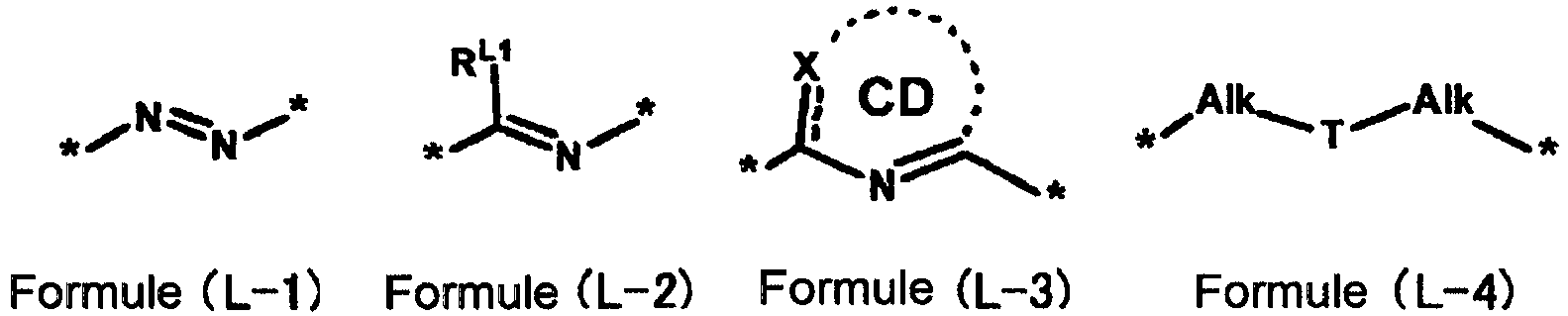 dans lequel, dans les formules, RL1 représente un atome d'hydrogène ou un substituant ; X représente un atome d'azote ou un atome de carbone ; le cycle CD représente un hétérocycle contenant de l'azote contenant X; la liaison entre X et l'atome de carbone lié à X et N peut être une liaison simple ou une liaison double ; le cycle CD peut présenter un substituant; T représente -O-, -S-, -NRL2- ou -PRL3- ; RL2 et RL3 représentent chacun indépendamment un atome d'hydrogène ou un substituant ; et Alk représente un groupe alkylène, qui peut présenter un substituant,
 dans lequel, dans la formule, le cycle A, le cycle B, et le cycle C représentent chacun indépendamment un hétérocycle aromatique contenant de l'azote ; ici, la liaison entre Z1 et N et la liaison entre Z2 et N peuvent être une liaison simple ou une liaison double ; Z1 et Z2 représentent chacun indépendamment un atome de carbone ou un atome d'azote ;Anc1 à Anc3 représentent chacun indépendamment -CO2H, -SO3H, -PO3H2, -OH, -SH ou un sel de ceux-ci ; X1, X2 et X3 représentent chacun indépendamment une liaison simple ou un groupe de liaison ; l1 à l3 représentent chacun indépendamment un entier de 1 à 5 ; m1 et m3 représentent chacun indépendamment un entier de 0 à 4 ; m2 représente un entier de 0 à 3 ; un total de m1 à m3 est de 1 ou plus ;R1 à R3 représentent chacun indépendamment un substituant autre que Anc1 à Anc3 ; n1 et n3 représentent chacun indépendamment un entier de 0 à 2 ; et n2 représente 0 ou 1.
 - Colorant complexe métallique selon la revendication 9, dans lequel L représente un groupe de liaison représenté par la formule (L-1) ou un groupe de liaison représenté par la formule (L-3) ; et
lorsque L est la formule (L-1),
dans la formule (DL-1), le cycle AD et le cycle BD représentent chacun indépendamment un cycle benzénique, un cycle pyrazole, ou un cycle imidazole ; Y1 et Y2 représentent chacun indépendamment -O-, -S-, ou -NR-, ici R représente un atome d'hydrogène ou un substituant ;
dans la formule (DL-2), le cycle AD représente un cycle benzénique, et le cycle BD représente un cycle benzénique, un cycle pyrazole, un cycle imidazole, ou un cycle triazole ; Y1 représente -O-, -S-, ou -NR-, ici R représente un atome d'hydrogène ou un substituant ;
dans la formule (DL-3), le cycle AD représente un cycle benzénique ; et Y1 et Y2 représentent chacun indépendamment -O-, -S-, ou -NR-, ici R représente un atome d'hydrogène ou un substituant ; et
lorsque L est la formule (L-3),
dans la formule (DL-1), le cycle AD et le cycle BD représentent chacun un cycle benzénique; Y1 et Y2 représentent chacun indépendamment -O-, -S-, ou -NR-, ici R représente un atome d'hydrogène ou un substituant ;
dans la formule (DL-2), le cycle AD représente un cycle benzénique, et le cycle BD représente un cycle benzénique, un cycle pyrazole, un cycle imidazole, ou un cycle triazole; et Y1 représente -O-, -S-, ou -NR-, ici R représente un atome d'hydrogène ou un substituant. - Colorant complexe métallique selon la revendication 9 ou 10, dans lequel la formule (AL) est l'une quelconque des formules (AL-1) à (AL-4) suivantes :


- Solution de colorant, dans laquelle est dissous le colorant complexe métallique selon l'une quelconque des revendications 9 à 11.
- Solution de colorant selon la revendication 12, dans laquelle, dans un solvant organique, le colorant complexe métallique est contenu en une quantité de 0,001 à 0,1 % en masse, et l'eau est limitée à 0,1 % en masse ou moins.
- Solution de colorant selon la revendication 12 ou 13, contenant en outre un co-adsorbant, et de préférence le co-adsorbant est représenté par la formule (CA) suivante :

- Électrode à colorant adsorbé pour une cellule solaire sensibilisée aux colorants, présentant une couche photoconductrice qui est formée en appliquant une composition obtenue de la solution de colorant selon l'une quelconque des revendications 12 à 14 sur un support électriquement conducteur fourni avec un semi-conducteur, et ensuite, en durcissant la composition après son application.
- Procédé de fabrication d'une cellule solaire sensibilisée aux colorants, le procédé comprenant l'assemblage de l'électrode à colorant adsorbé selon la revendication 15 et des matériaux destinés à être un électrolyte et une contre-électrode.
Applications Claiming Priority (3)
| Application Number | Priority Date | Filing Date | Title |
|---|---|---|---|
| JP2012275139 | 2012-12-17 | ||
| JP2013258323A JP5944372B2 (ja) | 2012-12-17 | 2013-12-13 | 光電変換素子、色素増感太陽電池、金属錯体色素、色素溶液、色素吸着電極および色素増感太陽電池の製造方法 |
| PCT/JP2013/083660 WO2014098045A1 (fr) | 2012-12-17 | 2013-12-16 | Élément de conversion photoélectrique, cellule solaire sensibilisée aux colorants, colorant complexe métallique, solution de colorant, électrode à colorant absorbé et procédé de fabrication de cellule solaire sensibilisée aux colorants |
Publications (3)
| Publication Number | Publication Date |
|---|---|
| EP2933875A1 EP2933875A1 (fr) | 2015-10-21 |
| EP2933875A4 EP2933875A4 (fr) | 2015-12-16 |
| EP2933875B1 true EP2933875B1 (fr) | 2017-03-29 |
Family
ID=50978373
Family Applications (1)
| Application Number | Title | Priority Date | Filing Date |
|---|---|---|---|
| EP13865285.4A Not-in-force EP2933875B1 (fr) | 2012-12-17 | 2013-12-16 | Élément de conversion photoélectrique, cellule solaire sensibilisée aux colorants, colorant complexe métallique, solution de colorant, électrode à colorant adsorbé et procédé de fabrication de cellule solaire sensibilisée aux colorants |
Country Status (7)
| Country | Link |
|---|---|
| US (1) | US9614165B2 (fr) |
| EP (1) | EP2933875B1 (fr) |
| JP (1) | JP5944372B2 (fr) |
| KR (1) | KR101692174B1 (fr) |
| CN (1) | CN104885171B (fr) |
| TW (1) | TWI594480B (fr) |
| WO (1) | WO2014098045A1 (fr) |
Families Citing this family (4)
| Publication number | Priority date | Publication date | Assignee | Title |
|---|---|---|---|---|
| WO2018061983A1 (fr) | 2016-09-29 | 2018-04-05 | 富士フイルム株式会社 | Élément de conversion photoélectrique, cellule solaire à colorant, colorant à complexe métallique, solution de colorant et électrode à oxyde semi-conducteur |
| EP3584814A4 (fr) | 2017-02-17 | 2020-12-16 | Fujifilm Corporation | Élément de conversion photoélectrique, cellule solaire à colorant, colorant au complexe métallique, solution de colorant et électrode semi-conductrice d'oxyde |
| US12144241B2 (en) | 2017-09-05 | 2024-11-12 | Samsung Electronics Co., Ltd. | Organometallic compound, organic light-emitting device including the organometallic compound, and diagnostic composition including the organometallic compound |
| CN110194780B (zh) * | 2019-05-15 | 2021-09-07 | 天津师范大学 | 一种具有光电导效应的有机无机杂化材料晶体及其应用 |
Family Cites Families (61)
| Publication number | Priority date | Publication date | Assignee | Title |
|---|---|---|---|---|
| JPS60106859A (ja) * | 1983-11-14 | 1985-06-12 | Hodogaya Chem Co Ltd | 金属錯塩化合物 |
| EP0179823B1 (fr) | 1984-04-30 | 1989-07-12 | Stiftung, R. E. | Procede de sensibilisation d'un photo-catalyseur d'oxydo-reduction et photo-catalyseur ainsi obtenu |
| CH674596A5 (fr) | 1988-02-12 | 1990-06-15 | Sulzer Ag | |
| ES2080313T3 (es) | 1990-04-17 | 1996-02-01 | Ecole Polytech | Celulas fotovoltaicas. |
| DE4207659A1 (de) | 1992-03-11 | 1993-09-16 | Abb Patent Gmbh | Verfahren zur herstellung einer photoelektrochemischen zelle sowie eine demgemaess hergestellte zelle |
| GB9217811D0 (en) | 1992-08-21 | 1992-10-07 | Graetzel Michael | Organic compounds |
| JP3579078B2 (ja) | 1994-03-11 | 2004-10-20 | 石原産業株式会社 | 光電変換材料用半導体 |
| JP3599859B2 (ja) | 1994-12-29 | 2004-12-08 | 石原産業株式会社 | 多孔性物質−高分子固体電解質複合体およびその製造方法ならびにそれを用いた光電変換素子 |
| DE19711713A1 (de) | 1997-03-20 | 1998-10-01 | Hoechst Ag | Photovoltaische Zelle |
| JP4298799B2 (ja) | 1997-05-07 | 2009-07-22 | エコール ポリテクニーク フェデラル ドゥ ローザンヌ | 金属複合体光増感剤および光起電力セル |
| JP4148374B2 (ja) | 1997-07-18 | 2008-09-10 | 富士フイルム株式会社 | 光電変換素子および光電気化学電池 |
| JP4024942B2 (ja) | 1998-09-16 | 2007-12-19 | 株式会社東芝 | 色素増感型光化学電池 |
| JP2000100483A (ja) | 1998-09-22 | 2000-04-07 | Sharp Corp | 光電変換素子及びその製造方法及びこれを用いた太陽電池 |
| JP2000190641A (ja) * | 1998-12-29 | 2000-07-11 | Tdk Corp | 光記録媒体 |
| JP4360569B2 (ja) | 1999-02-05 | 2009-11-11 | 富士フイルム株式会社 | 光電変換素子および光電気化学電池 |
| JP2000340269A (ja) | 1999-03-25 | 2000-12-08 | Showa Denko Kk | 色素増感型光電変換素子 |
| JP2000285977A (ja) | 1999-03-31 | 2000-10-13 | Fuji Photo Film Co Ltd | 光電変換素子および光電池 |
| JP4285671B2 (ja) | 1999-06-14 | 2009-06-24 | 富士フイルム株式会社 | 光電変換素子および光電気化学電池ならびに金属錯体色素 |
| JP4363553B2 (ja) | 1999-05-14 | 2009-11-11 | 富士フイルム株式会社 | 電解質組成物、光電変換素子および光電気化学電池 |
| JP4077594B2 (ja) | 1999-05-27 | 2008-04-16 | 触媒化成工業株式会社 | 光電気セルおよび金属酸化物半導体膜形成用塗布液、光電気セル用金属酸化物半導体膜の製造方法 |
| JP4162106B2 (ja) | 1999-06-17 | 2008-10-08 | 富士フイルム株式会社 | 光電変換素子および光電気化学電池ならびに金属錯体色素 |
| JP2001160425A (ja) | 1999-12-02 | 2001-06-12 | Japan Gore Tex Inc | 光半導体電極及びその製造方法 |
| JP4414036B2 (ja) | 1999-12-27 | 2010-02-10 | シャープ株式会社 | 色素増感型太陽電池の作製方法 |
| JP4477729B2 (ja) | 2000-01-19 | 2010-06-09 | シャープ株式会社 | 光電変換素子及びそれを用いた太陽電池 |
| JP3982968B2 (ja) | 2000-01-26 | 2007-09-26 | シャープ株式会社 | 高分子電解質を用いた色素増感型太陽電池およびその作製方法 |
| JP4874454B2 (ja) | 2000-01-31 | 2012-02-15 | 富士フイルム株式会社 | 光電変換素子および光電池 |
| JP3430254B2 (ja) | 2000-03-13 | 2003-07-28 | 独立行政法人産業技術総合研究所 | β−ジケトナートを有する金属錯体及びその製法、光電変換素子並びに、光化学電池 |
| JP4443713B2 (ja) | 2000-03-24 | 2010-03-31 | 富士フイルム株式会社 | 半導体微粒子、光電変換素子および光電池 |
| JP4638973B2 (ja) | 2000-03-27 | 2011-02-23 | 富士フイルム株式会社 | 光電変換素子および光電池 |
| JP2001320068A (ja) | 2000-05-01 | 2001-11-16 | Fuji Photo Film Co Ltd | 透明光電変換素子、及びこれを用いた光電池、光センサー並びに窓ガラス |
| JP4162116B2 (ja) | 2000-12-08 | 2008-10-08 | 富士フイルム株式会社 | 光電変換素子および光電気化学電池 |
| JP4185285B2 (ja) | 2002-01-18 | 2008-11-26 | シャープ株式会社 | 色素増感型光電変換素子およびそれを用いた太陽電池 |
| JP4213355B2 (ja) | 2001-02-28 | 2009-01-21 | 株式会社豊田中央研究所 | 色素増感型太陽電池及び色素増感型太陽電池モジュール |
| JP4617014B2 (ja) | 2001-03-21 | 2011-01-19 | 富士フイルム株式会社 | 光電変換素子の製造方法 |
| JP4812956B2 (ja) | 2001-03-27 | 2011-11-09 | 株式会社豊田中央研究所 | 光電極及びこれを備えた色素増感型太陽電池 |
| JP5050301B2 (ja) | 2001-06-12 | 2012-10-17 | アイシン精機株式会社 | 色素増感型太陽電池及びその製造方法 |
| JP2003123859A (ja) | 2001-10-19 | 2003-04-25 | Bridgestone Corp | 有機色素増感型金属酸化物半導体電極及びこの半導体電極を有する太陽電池 |
| JP3985040B2 (ja) | 2002-01-22 | 2007-10-03 | 独立行政法人産業技術総合研究所 | 増感剤として有用なルテニウム錯体、酸化物半導体電極及びそれを用いた太陽電池 |
| JP4260494B2 (ja) | 2002-02-26 | 2009-04-30 | 株式会社フジクラ | 透明電極用基材の製法、光電変換素子の製法、及び色素増感太陽電池の製法 |
| JP4187476B2 (ja) | 2002-07-29 | 2008-11-26 | 三菱製紙株式会社 | 光電変換材料、半導体電極、並びにそれを用いた光電変換素子 |
| JP4503226B2 (ja) | 2002-10-22 | 2010-07-14 | 株式会社フジクラ | 電極基板、光電変換素子、並びに色素増感太陽電池 |
| JP2004152613A (ja) | 2002-10-30 | 2004-05-27 | Toyota Central Res & Dev Lab Inc | 色素増感型太陽電池 |
| JP4423857B2 (ja) | 2003-01-16 | 2010-03-03 | 東洋インキ製造株式会社 | 光機能材料 |
| JP4235728B2 (ja) | 2003-03-07 | 2009-03-11 | 独立行政法人産業技術総合研究所 | ベンズイミダゾール系化合物を含む電解質溶液を用いた光電変換素子及びそれを用いた色素増感型太陽電池 |
| JP3671183B2 (ja) | 2003-09-04 | 2005-07-13 | 司 吉田 | 色素増感型太陽電池の製造方法 |
| JP2005135902A (ja) | 2003-10-06 | 2005-05-26 | Ngk Spark Plug Co Ltd | 色素増感型太陽電池 |
| JP2005123033A (ja) | 2003-10-16 | 2005-05-12 | Mitsubishi Paper Mills Ltd | 光電変換材料、半導体電極並びにそれを用いた光電変換素子 |
| CN101151164B (zh) * | 2005-03-29 | 2010-12-29 | 三菱化学媒体株式会社 | 光学记录介质、金属络合物及有机色素化合物 |
| JP4519795B2 (ja) * | 2005-03-29 | 2010-08-04 | 三菱化学メディア株式会社 | 光学記録媒体及び金属錯体化合物 |
| US8106198B2 (en) | 2006-02-08 | 2012-01-31 | Shimane Prefectural Government | Photosensitizer dye |
| JP4925224B2 (ja) | 2006-03-31 | 2012-04-25 | 独立行政法人産業技術総合研究所 | 有機化合物及びそれを用いた半導体薄膜電極、光電変換素子、光電気化学太陽電池 |
| US8653279B2 (en) | 2006-04-17 | 2014-02-18 | Samsung Sdi Co., Ltd. | Dye for dye-sensitized solar cell, and solar cell prepared from same |
| JP5185518B2 (ja) | 2006-09-14 | 2013-04-17 | 三菱製紙株式会社 | 光電変換材料、半導体電極並びにそれを用いた光電変換素子 |
| JP5135777B2 (ja) | 2006-11-27 | 2013-02-06 | コニカミノルタビジネステクノロジーズ株式会社 | 色素増感型光電変換素子及び色素増感型太陽電池 |
| EP2036955B1 (fr) | 2007-09-17 | 2012-05-16 | JSR Corporation | Colorants, pile solaire sensibilisée aux colorants et son procédé de fabrication |
| WO2011032269A1 (fr) * | 2009-09-16 | 2011-03-24 | Berlinguette Curtis P | Complexes colorants cyclométallés et leur utilisation dans des piles solaires sensibilisées par colorant |
| JP5620314B2 (ja) | 2010-05-31 | 2014-11-05 | 富士フイルム株式会社 | 光電変換素子、光電気化学電池、光電変換素子用色素及び光電変換素子用色素溶液 |
| JP4980479B2 (ja) | 2010-06-02 | 2012-07-18 | 富士フイルム株式会社 | 金属錯体色素、光電変換素子及び色素増感太陽電池 |
| JP5572029B2 (ja) * | 2010-08-03 | 2014-08-13 | 富士フイルム株式会社 | 金属錯体色素、光電変換素子及び光電気化学電池 |
| JP5620316B2 (ja) | 2010-09-09 | 2014-11-05 | 富士フイルム株式会社 | 光電変換素子、光電気化学電池及び色素 |
| TWI419878B (zh) | 2010-09-28 | 2013-12-21 | Nat Univ Tsing Hua | 雜配、雙三芽釕錯合物以及敏化染料太陽能電池製備 |
-
2013
- 2013-12-13 JP JP2013258323A patent/JP5944372B2/ja not_active Expired - Fee Related
- 2013-12-16 EP EP13865285.4A patent/EP2933875B1/fr not_active Not-in-force
- 2013-12-16 CN CN201380065886.1A patent/CN104885171B/zh not_active Expired - Fee Related
- 2013-12-16 WO PCT/JP2013/083660 patent/WO2014098045A1/fr not_active Ceased
- 2013-12-16 KR KR1020157016884A patent/KR101692174B1/ko not_active Expired - Fee Related
- 2013-12-16 TW TW102146455A patent/TWI594480B/zh not_active IP Right Cessation
-
2015
- 2015-06-16 US US14/740,827 patent/US9614165B2/en not_active Expired - Fee Related
Also Published As
| Publication number | Publication date |
|---|---|
| TW201431157A (zh) | 2014-08-01 |
| KR101692174B1 (ko) | 2017-01-02 |
| EP2933875A4 (fr) | 2015-12-16 |
| EP2933875A1 (fr) | 2015-10-21 |
| WO2014098045A1 (fr) | 2014-06-26 |
| JP2014139931A (ja) | 2014-07-31 |
| US20150280145A1 (en) | 2015-10-01 |
| CN104885171B (zh) | 2017-09-22 |
| CN104885171A (zh) | 2015-09-02 |
| US9614165B2 (en) | 2017-04-04 |
| KR20150088857A (ko) | 2015-08-03 |
| TWI594480B (zh) | 2017-08-01 |
| JP5944372B2 (ja) | 2016-07-05 |
Similar Documents
| Publication | Publication Date | Title |
|---|---|---|
| EP2922137B1 (fr) | Élément de conversion photoélectrique, cellule solaire sensible aux colorants, colorant au complexe métallique, solution de colorant, électrode adsorbée de colorant, et procédé pour la fabrication d'une cellule solaire sensible aux colorants | |
| KR101711315B1 (ko) | 금속 착물 색소, 광전 변환 소자, 색소 증감 태양전지 및 금속 착물 색소를 함유하는 색소 용액 | |
| JP5972849B2 (ja) | 金属錯体、金属錯体色素、光電変換素子、色素増感太陽電池、色素溶液、色素吸着電極および色素増感太陽電池の製造方法 | |
| EP2933875B1 (fr) | Élément de conversion photoélectrique, cellule solaire sensibilisée aux colorants, colorant complexe métallique, solution de colorant, électrode à colorant adsorbé et procédé de fabrication de cellule solaire sensibilisée aux colorants | |
| TWI617626B (zh) | 光電轉換元件、色素增感太陽電池、金屬錯合物色素及溶解金屬錯合物色素而成的色素溶液 | |
| EP2903080A1 (fr) | Élément de conversion photoélectrique et cellule solaire sensibilisée aux colorants | |
| EP2903078B1 (fr) | Colorant à complexe métallique, élément de conversion photoélectrique, cellule solaire à colorant, solution de colorant, et électrode à colorant adsorbé | |
| WO2014050528A1 (fr) | Élément de conversion photoélectrique et cellule solaire à colorant | |
| JP6026236B2 (ja) | 金属錯体色素、光電変換素子、色素増感太陽電池、色素溶液、色素吸着電極及び色素増感太陽電池の製造方法 | |
| JP6154177B2 (ja) | 光電変換素子、色素増感太陽電池、金属錯体色素、色素溶液、色素吸着電極および色素増感太陽電池の製造方法 | |
| KR101690902B1 (ko) | 광전 변환 소자, 색소 증감 태양 전지 및 이에 이용하는 금속 착체 색소 | |
| JP6204603B2 (ja) | 光電変換素子、色素増感太陽電池、金属錯体色素および色素溶液 | |
| JP2015029074A (ja) | 光電変換素子、色素増感太陽電池、金属錯体色素、配位子、色素溶液、色素吸着電極および色素増感太陽電池の製造方法 | |
| JP6033144B2 (ja) | 光電変換素子、色素増感太陽電池、金属錯体、金属錯体色素、色素溶液、色素吸着電極の製造方法および色素増感太陽電池の製造方法 | |
| JP2015220262A (ja) | 光電変換素子及び色素増感太陽電池 |
Legal Events
| Date | Code | Title | Description |
|---|---|---|---|
| PUAI | Public reference made under article 153(3) epc to a published international application that has entered the european phase |
Free format text: ORIGINAL CODE: 0009012 |
|
| 17P | Request for examination filed |
Effective date: 20150629 |
|
| AK | Designated contracting states |
Kind code of ref document: A1 Designated state(s): AL AT BE BG CH CY CZ DE DK EE ES FI FR GB GR HR HU IE IS IT LI LT LU LV MC MK MT NL NO PL PT RO RS SE SI SK SM TR |
|
| AX | Request for extension of the european patent |
Extension state: BA ME |
|
| A4 | Supplementary search report drawn up and despatched |
Effective date: 20151113 |
|
| RIC1 | Information provided on ipc code assigned before grant |
Ipc: H01L 31/04 20140101ALI20151109BHEP Ipc: H01M 14/00 20060101AFI20151109BHEP Ipc: C07D 409/14 20060101ALI20151109BHEP Ipc: C07D 213/79 20060101ALI20151109BHEP Ipc: C07D 417/14 20060101ALI20151109BHEP Ipc: C07D 213/55 20060101ALI20151109BHEP Ipc: C09B 57/10 20060101ALI20151109BHEP Ipc: C07F 15/00 20060101ALI20151109BHEP Ipc: C09B 55/00 20060101ALI20151109BHEP Ipc: C07D 401/14 20060101ALI20151109BHEP Ipc: C09B 45/14 20060101ALI20151109BHEP Ipc: C07D 401/04 20060101ALI20151109BHEP Ipc: C07D 409/04 20060101ALI20151109BHEP Ipc: C09B 45/22 20060101ALI20151109BHEP Ipc: C07D 231/38 20060101ALI20151109BHEP |
|
| DAX | Request for extension of the european patent (deleted) | ||
| RAP1 | Party data changed (applicant data changed or rights of an application transferred) |
Owner name: FUJIFILM CORPORATION |
|
| GRAP | Despatch of communication of intention to grant a patent |
Free format text: ORIGINAL CODE: EPIDOSNIGR1 |
|
| INTG | Intention to grant announced |
Effective date: 20161114 |
|
| GRAS | Grant fee paid |
Free format text: ORIGINAL CODE: EPIDOSNIGR3 |
|
| GRAA | (expected) grant |
Free format text: ORIGINAL CODE: 0009210 |
|
| AK | Designated contracting states |
Kind code of ref document: B1 Designated state(s): AL AT BE BG CH CY CZ DE DK EE ES FI FR GB GR HR HU IE IS IT LI LT LU LV MC MK MT NL NO PL PT RO RS SE SI SK SM TR |
|
| REG | Reference to a national code |
Ref country code: GB Ref legal event code: FG4D |
|
| REG | Reference to a national code |
Ref country code: CH Ref legal event code: EP |
|
| REG | Reference to a national code |
Ref country code: AT Ref legal event code: REF Ref document number: 880537 Country of ref document: AT Kind code of ref document: T Effective date: 20170415 |
|
| REG | Reference to a national code |
Ref country code: IE Ref legal event code: FG4D |
|
| REG | Reference to a national code |
Ref country code: DE Ref legal event code: R096 Ref document number: 602013019301 Country of ref document: DE |
|
| PG25 | Lapsed in a contracting state [announced via postgrant information from national office to epo] |
Ref country code: HR Free format text: LAPSE BECAUSE OF FAILURE TO SUBMIT A TRANSLATION OF THE DESCRIPTION OR TO PAY THE FEE WITHIN THE PRESCRIBED TIME-LIMIT Effective date: 20170329 Ref country code: NO Free format text: LAPSE BECAUSE OF FAILURE TO SUBMIT A TRANSLATION OF THE DESCRIPTION OR TO PAY THE FEE WITHIN THE PRESCRIBED TIME-LIMIT Effective date: 20170629 Ref country code: LT Free format text: LAPSE BECAUSE OF FAILURE TO SUBMIT A TRANSLATION OF THE DESCRIPTION OR TO PAY THE FEE WITHIN THE PRESCRIBED TIME-LIMIT Effective date: 20170329 Ref country code: GR Free format text: LAPSE BECAUSE OF FAILURE TO SUBMIT A TRANSLATION OF THE DESCRIPTION OR TO PAY THE FEE WITHIN THE PRESCRIBED TIME-LIMIT Effective date: 20170630 Ref country code: FI Free format text: LAPSE BECAUSE OF FAILURE TO SUBMIT A TRANSLATION OF THE DESCRIPTION OR TO PAY THE FEE WITHIN THE PRESCRIBED TIME-LIMIT Effective date: 20170329 |
|
| REG | Reference to a national code |
Ref country code: NL Ref legal event code: MP Effective date: 20170329 |
|
| REG | Reference to a national code |
Ref country code: AT Ref legal event code: MK05 Ref document number: 880537 Country of ref document: AT Kind code of ref document: T Effective date: 20170329 |
|
| PG25 | Lapsed in a contracting state [announced via postgrant information from national office to epo] |
Ref country code: BG Free format text: LAPSE BECAUSE OF FAILURE TO SUBMIT A TRANSLATION OF THE DESCRIPTION OR TO PAY THE FEE WITHIN THE PRESCRIBED TIME-LIMIT Effective date: 20170629 Ref country code: RS Free format text: LAPSE BECAUSE OF FAILURE TO SUBMIT A TRANSLATION OF THE DESCRIPTION OR TO PAY THE FEE WITHIN THE PRESCRIBED TIME-LIMIT Effective date: 20170329 Ref country code: SE Free format text: LAPSE BECAUSE OF FAILURE TO SUBMIT A TRANSLATION OF THE DESCRIPTION OR TO PAY THE FEE WITHIN THE PRESCRIBED TIME-LIMIT Effective date: 20170329 Ref country code: LV Free format text: LAPSE BECAUSE OF FAILURE TO SUBMIT A TRANSLATION OF THE DESCRIPTION OR TO PAY THE FEE WITHIN THE PRESCRIBED TIME-LIMIT Effective date: 20170329 |
|
| PG25 | Lapsed in a contracting state [announced via postgrant information from national office to epo] |
Ref country code: NL Free format text: LAPSE BECAUSE OF FAILURE TO SUBMIT A TRANSLATION OF THE DESCRIPTION OR TO PAY THE FEE WITHIN THE PRESCRIBED TIME-LIMIT Effective date: 20170329 |
|
| PG25 | Lapsed in a contracting state [announced via postgrant information from national office to epo] |
Ref country code: AT Free format text: LAPSE BECAUSE OF FAILURE TO SUBMIT A TRANSLATION OF THE DESCRIPTION OR TO PAY THE FEE WITHIN THE PRESCRIBED TIME-LIMIT Effective date: 20170329 Ref country code: IT Free format text: LAPSE BECAUSE OF FAILURE TO SUBMIT A TRANSLATION OF THE DESCRIPTION OR TO PAY THE FEE WITHIN THE PRESCRIBED TIME-LIMIT Effective date: 20170329 Ref country code: ES Free format text: LAPSE BECAUSE OF FAILURE TO SUBMIT A TRANSLATION OF THE DESCRIPTION OR TO PAY THE FEE WITHIN THE PRESCRIBED TIME-LIMIT Effective date: 20170329 Ref country code: RO Free format text: LAPSE BECAUSE OF FAILURE TO SUBMIT A TRANSLATION OF THE DESCRIPTION OR TO PAY THE FEE WITHIN THE PRESCRIBED TIME-LIMIT Effective date: 20170329 Ref country code: EE Free format text: LAPSE BECAUSE OF FAILURE TO SUBMIT A TRANSLATION OF THE DESCRIPTION OR TO PAY THE FEE WITHIN THE PRESCRIBED TIME-LIMIT Effective date: 20170329 Ref country code: SK Free format text: LAPSE BECAUSE OF FAILURE TO SUBMIT A TRANSLATION OF THE DESCRIPTION OR TO PAY THE FEE WITHIN THE PRESCRIBED TIME-LIMIT Effective date: 20170329 Ref country code: CZ Free format text: LAPSE BECAUSE OF FAILURE TO SUBMIT A TRANSLATION OF THE DESCRIPTION OR TO PAY THE FEE WITHIN THE PRESCRIBED TIME-LIMIT Effective date: 20170329 |
|
| PG25 | Lapsed in a contracting state [announced via postgrant information from national office to epo] |
Ref country code: IS Free format text: LAPSE BECAUSE OF FAILURE TO SUBMIT A TRANSLATION OF THE DESCRIPTION OR TO PAY THE FEE WITHIN THE PRESCRIBED TIME-LIMIT Effective date: 20170729 Ref country code: SM Free format text: LAPSE BECAUSE OF FAILURE TO SUBMIT A TRANSLATION OF THE DESCRIPTION OR TO PAY THE FEE WITHIN THE PRESCRIBED TIME-LIMIT Effective date: 20170329 Ref country code: PL Free format text: LAPSE BECAUSE OF FAILURE TO SUBMIT A TRANSLATION OF THE DESCRIPTION OR TO PAY THE FEE WITHIN THE PRESCRIBED TIME-LIMIT Effective date: 20170329 |
|
| REG | Reference to a national code |
Ref country code: DE Ref legal event code: R097 Ref document number: 602013019301 Country of ref document: DE |
|
| PG25 | Lapsed in a contracting state [announced via postgrant information from national office to epo] |
Ref country code: DK Free format text: LAPSE BECAUSE OF FAILURE TO SUBMIT A TRANSLATION OF THE DESCRIPTION OR TO PAY THE FEE WITHIN THE PRESCRIBED TIME-LIMIT Effective date: 20170329 |
|
| PLBE | No opposition filed within time limit |
Free format text: ORIGINAL CODE: 0009261 |
|
| STAA | Information on the status of an ep patent application or granted ep patent |
Free format text: STATUS: NO OPPOSITION FILED WITHIN TIME LIMIT |
|
| 26N | No opposition filed |
Effective date: 20180103 |
|
| PG25 | Lapsed in a contracting state [announced via postgrant information from national office to epo] |
Ref country code: SI Free format text: LAPSE BECAUSE OF FAILURE TO SUBMIT A TRANSLATION OF THE DESCRIPTION OR TO PAY THE FEE WITHIN THE PRESCRIBED TIME-LIMIT Effective date: 20170329 |
|
| REG | Reference to a national code |
Ref country code: DE Ref legal event code: R119 Ref document number: 602013019301 Country of ref document: DE |
|
| REG | Reference to a national code |
Ref country code: CH Ref legal event code: PL |
|
| REG | Reference to a national code |
Ref country code: IE Ref legal event code: MM4A |
|
| PG25 | Lapsed in a contracting state [announced via postgrant information from national office to epo] |
Ref country code: MT Free format text: LAPSE BECAUSE OF NON-PAYMENT OF DUE FEES Effective date: 20171216 Ref country code: LU Free format text: LAPSE BECAUSE OF NON-PAYMENT OF DUE FEES Effective date: 20171216 |
|
| REG | Reference to a national code |
Ref country code: FR Ref legal event code: ST Effective date: 20180831 |
|
| REG | Reference to a national code |
Ref country code: BE Ref legal event code: MM Effective date: 20171231 |
|
| PG25 | Lapsed in a contracting state [announced via postgrant information from national office to epo] |
Ref country code: DE Free format text: LAPSE BECAUSE OF NON-PAYMENT OF DUE FEES Effective date: 20180703 Ref country code: IE Free format text: LAPSE BECAUSE OF NON-PAYMENT OF DUE FEES Effective date: 20171216 Ref country code: FR Free format text: LAPSE BECAUSE OF NON-PAYMENT OF DUE FEES Effective date: 20180102 |
|
| PG25 | Lapsed in a contracting state [announced via postgrant information from national office to epo] |
Ref country code: BE Free format text: LAPSE BECAUSE OF NON-PAYMENT OF DUE FEES Effective date: 20171231 Ref country code: LI Free format text: LAPSE BECAUSE OF NON-PAYMENT OF DUE FEES Effective date: 20171231 Ref country code: CH Free format text: LAPSE BECAUSE OF NON-PAYMENT OF DUE FEES Effective date: 20171231 |
|
| PG25 | Lapsed in a contracting state [announced via postgrant information from national office to epo] |
Ref country code: MC Free format text: LAPSE BECAUSE OF FAILURE TO SUBMIT A TRANSLATION OF THE DESCRIPTION OR TO PAY THE FEE WITHIN THE PRESCRIBED TIME-LIMIT Effective date: 20170329 Ref country code: HU Free format text: LAPSE BECAUSE OF FAILURE TO SUBMIT A TRANSLATION OF THE DESCRIPTION OR TO PAY THE FEE WITHIN THE PRESCRIBED TIME-LIMIT; INVALID AB INITIO Effective date: 20131216 |
|
| PG25 | Lapsed in a contracting state [announced via postgrant information from national office to epo] |
Ref country code: CY Free format text: LAPSE BECAUSE OF FAILURE TO SUBMIT A TRANSLATION OF THE DESCRIPTION OR TO PAY THE FEE WITHIN THE PRESCRIBED TIME-LIMIT Effective date: 20170329 |
|
| PG25 | Lapsed in a contracting state [announced via postgrant information from national office to epo] |
Ref country code: MK Free format text: LAPSE BECAUSE OF FAILURE TO SUBMIT A TRANSLATION OF THE DESCRIPTION OR TO PAY THE FEE WITHIN THE PRESCRIBED TIME-LIMIT Effective date: 20170329 |
|
| PG25 | Lapsed in a contracting state [announced via postgrant information from national office to epo] |
Ref country code: TR Free format text: LAPSE BECAUSE OF FAILURE TO SUBMIT A TRANSLATION OF THE DESCRIPTION OR TO PAY THE FEE WITHIN THE PRESCRIBED TIME-LIMIT Effective date: 20170329 |
|
| PGFP | Annual fee paid to national office [announced via postgrant information from national office to epo] |
Ref country code: GB Payment date: 20191213 Year of fee payment: 7 |
|
| PG25 | Lapsed in a contracting state [announced via postgrant information from national office to epo] |
Ref country code: PT Free format text: LAPSE BECAUSE OF FAILURE TO SUBMIT A TRANSLATION OF THE DESCRIPTION OR TO PAY THE FEE WITHIN THE PRESCRIBED TIME-LIMIT Effective date: 20170329 |
|
| PG25 | Lapsed in a contracting state [announced via postgrant information from national office to epo] |
Ref country code: AL Free format text: LAPSE BECAUSE OF FAILURE TO SUBMIT A TRANSLATION OF THE DESCRIPTION OR TO PAY THE FEE WITHIN THE PRESCRIBED TIME-LIMIT Effective date: 20170329 |
|
| GBPC | Gb: european patent ceased through non-payment of renewal fee |
Effective date: 20201216 |
|
| PG25 | Lapsed in a contracting state [announced via postgrant information from national office to epo] |
Ref country code: GB Free format text: LAPSE BECAUSE OF NON-PAYMENT OF DUE FEES Effective date: 20201216 |