EP2934037A1 - Technik zur Auswertung einer Parametereinstellung in einem mobilen Kommunikationsnetz - Google Patents
Technik zur Auswertung einer Parametereinstellung in einem mobilen Kommunikationsnetz Download PDFInfo
- Publication number
- EP2934037A1 EP2934037A1 EP14001377.2A EP14001377A EP2934037A1 EP 2934037 A1 EP2934037 A1 EP 2934037A1 EP 14001377 A EP14001377 A EP 14001377A EP 2934037 A1 EP2934037 A1 EP 2934037A1
- Authority
- EP
- European Patent Office
- Prior art keywords
- parameter
- network entity
- performance metric
- performance
- network
- Prior art date
- Legal status (The legal status is an assumption and is not a legal conclusion. Google has not performed a legal analysis and makes no representation as to the accuracy of the status listed.)
- Granted
Links
- 238000000034 method Methods 0.000 title claims abstract description 74
- 238000010295 mobile communication Methods 0.000 title claims abstract description 48
- 238000011156 evaluation Methods 0.000 title claims description 14
- 230000008859 change Effects 0.000 claims abstract description 38
- 238000009826 distribution Methods 0.000 claims description 48
- 238000005457 optimization Methods 0.000 claims description 30
- 238000005259 measurement Methods 0.000 claims description 20
- 238000004590 computer program Methods 0.000 claims description 7
- 230000004931 aggregating effect Effects 0.000 claims description 4
- 230000000694 effects Effects 0.000 description 15
- 230000006870 function Effects 0.000 description 14
- 238000007726 management method Methods 0.000 description 14
- 238000013459 approach Methods 0.000 description 12
- 230000008569 process Effects 0.000 description 11
- 230000009466 transformation Effects 0.000 description 11
- 238000004458 analytical method Methods 0.000 description 8
- 230000006872 improvement Effects 0.000 description 7
- 230000015556 catabolic process Effects 0.000 description 6
- 239000000523 sample Substances 0.000 description 6
- 238000006731 degradation reaction Methods 0.000 description 5
- 238000012545 processing Methods 0.000 description 5
- 230000002776 aggregation Effects 0.000 description 4
- 238000004220 aggregation Methods 0.000 description 4
- 230000000875 corresponding effect Effects 0.000 description 4
- 230000007423 decrease Effects 0.000 description 4
- 238000005516 engineering process Methods 0.000 description 4
- 238000010586 diagram Methods 0.000 description 3
- 230000007774 longterm Effects 0.000 description 3
- 230000000737 periodic effect Effects 0.000 description 3
- 230000008901 benefit Effects 0.000 description 2
- 230000001413 cellular effect Effects 0.000 description 2
- 230000002596 correlated effect Effects 0.000 description 2
- 230000003247 decreasing effect Effects 0.000 description 2
- 230000001419 dependent effect Effects 0.000 description 2
- 238000005315 distribution function Methods 0.000 description 2
- 238000013439 planning Methods 0.000 description 2
- 238000000844 transformation Methods 0.000 description 2
- 206010038933 Retinopathy of prematurity Diseases 0.000 description 1
- 230000009471 action Effects 0.000 description 1
- 239000000969 carrier Substances 0.000 description 1
- HPNSNYBUADCFDR-UHFFFAOYSA-N chromafenozide Chemical compound CC1=CC(C)=CC(C(=O)N(NC(=O)C=2C(=C3CCCOC3=CC=2)C)C(C)(C)C)=C1 HPNSNYBUADCFDR-UHFFFAOYSA-N 0.000 description 1
- 238000004891 communication Methods 0.000 description 1
- 150000001875 compounds Chemical class 0.000 description 1
- 238000010276 construction Methods 0.000 description 1
- 230000001934 delay Effects 0.000 description 1
- 238000011161 development Methods 0.000 description 1
- 230000003116 impacting effect Effects 0.000 description 1
- 238000007689 inspection Methods 0.000 description 1
- 230000003993 interaction Effects 0.000 description 1
- 230000004807 localization Effects 0.000 description 1
- 238000013507 mapping Methods 0.000 description 1
- 239000000203 mixture Substances 0.000 description 1
- 238000007781 pre-processing Methods 0.000 description 1
- 239000004065 semiconductor Substances 0.000 description 1
- 230000011664 signaling Effects 0.000 description 1
- 230000003595 spectral effect Effects 0.000 description 1
- 238000003860 storage Methods 0.000 description 1
- 238000012731 temporal analysis Methods 0.000 description 1
- 238000000700 time series analysis Methods 0.000 description 1
- 238000013024 troubleshooting Methods 0.000 description 1
Images






Classifications
-
- H—ELECTRICITY
- H04—ELECTRIC COMMUNICATION TECHNIQUE
- H04W—WIRELESS COMMUNICATION NETWORKS
- H04W24/00—Supervisory, monitoring or testing arrangements
- H04W24/08—Testing, supervising or monitoring using real traffic
-
- H—ELECTRICITY
- H04—ELECTRIC COMMUNICATION TECHNIQUE
- H04L—TRANSMISSION OF DIGITAL INFORMATION, e.g. TELEGRAPHIC COMMUNICATION
- H04L43/00—Arrangements for monitoring or testing data switching networks
- H04L43/06—Generation of reports
- H04L43/062—Generation of reports related to network traffic
-
- H—ELECTRICITY
- H04—ELECTRIC COMMUNICATION TECHNIQUE
- H04W—WIRELESS COMMUNICATION NETWORKS
- H04W24/00—Supervisory, monitoring or testing arrangements
- H04W24/02—Arrangements for optimising operational condition
Definitions
- the present disclosure generally relates to managing performance of a mobile communications network.
- the present disclosure relates to an evaluation of the effects of a parameter adjustment on a performance metric.
- the technique may be embodied in one or more of methods, computer programs; and devices.
- NMS Network Management System
- OSS Operations Support System
- KPIs Key Performance Indicators
- Efficiency and service quality in mobile communications networks are influenced by a large number of parameters. For example, throughput is influenced by the radio channel quality of a given user terminal but also depends on the number of other active user terminals in the cell, the traffic of those user terminals, Internet side bandwidth, delays and server limitations, just to name a few.
- optimizing the mobile communications network is an important task that may be used to increase network efficiency and service quality at the same time. Due to the inter-dependence between individual parameters that influence a given performance metric, a parameter adjustment with respect to one network entity, such as a radio cell, may influence the operation of other network elements, such as neighboring radio cells. This fact renders network optimization a complex task.
- a performance degradation seen in the mobile communications network may have a number of reasons. In some cases low performance can immediately be attributed to severe network incidents (e.g., cell outage) visible directly from a fault management system. In other cases, however, the decrease in performance cannot be easily explained. For example, there may be no direct connection to any severe network problems or incidents. In particular, there are many parameters in the network that can have direct or indirect impact on performance. These parameters might depend on each other. Thus, it is not trivial to find the cause of the performance problems due to the multivariate dependence of the performance on the parameters and the complicated inter-dependence between the parameters.
- WO 98/53621 A2 suggests collecting measurements in a mobile communications network and using the collected measurements as input to a heuristic-based appraoch.
- the approach evaluates the effects of a parameter adjustment in the mobile communications network by initially performing an incremental parameter adjustment and then iteratively repeating the steps of collecting measurements and performing further incremental parameter adjustments.
- a method of evaluating a parameter adjustment in a mobile communications network using a multivariate performance model comprising determining, using the multivariate performance model, a change of the performance metric for the first network entity, that results from the parameter adjustment.
- the method also comprises determining, using the multivariate performance model, a change of the performance metric for the second network entity, that results from the parameter adjustment for the first network entity.
- the method comprises evaluating the parameter adjustment based on the performance metric changes for the first network entity and the second network entity.
- the method may further comprise selecting the parameter that is to be adjusted. Also, the first network entity for which the selected parameter is to be adjusted may be selected. After those two selection steps, one or more second network entities potentially affected by adjustment of the selected parameter for the selected first network entity may be determined.
- the first and second network entities may belong to a radio access domain of the mobile communications network.
- the first and second network entities may be selected from the group comprising radio carriers, radio cells, radio base stations, and radio network controllers.
- the multivariate performance model may be configured to model a dependency of the performance metric on a first parameter and at least one second parameter.
- the dependency may be modelled based on a respective distribution of the first parameter and the at least one second parameter.
- There may exist an inter-dependence between the first parameter and the at least one second parameter. This inter-dependence may extend across the individual network entities. As an example, an adjustment of the first parameter for the first network entity may potentially result in a change of the at least one second parameter for the second network entity.
- the performance metric change for the first network entity may be determined based on the adjustment of the first parameter.
- the influence of the adjustment of the first parameter on the performance metric may be modelled. This can be done by changing the distribution of the first parameter in the model responsive to the parameter adjustment and calculating the resulting performance metric change for the first network entity.
- the performance metric change for the second network entity may be determined based on the change of the at least one second parameter for the at least one second network entity, that results from the adjustment of the first parameter. This can be done by changing in the model the distribution of the second parameter responsive to the parameter adjustment and calculating the resulting performance metric for the second network entity.
- the first parameter and the second parameter may be selected from the parameter set comprising signal strength, interference, network load, load of the first network entity, load of the second network entity, and type of user terminal served by the network entities.
- the parameter set may comprise additional parameters, including parameters directly impacted by or impacting the listed parameters.
- the parameter adjustment may be evaluated in various ways.
- the performance metric changes for the first network entity and the (least one) second network entity may be aggregated and the aggregated performance metric changes may be assessed.
- the process of aggregating the performance metric changes may include summing up the performance metric changes for the first network entity and for the one or more second network entities.
- a statistical parameter e.g., an average or distribution
- the parameter adjustment may be repeatedly evaluated for different combinations of network entities.
- the method may comprise determining a new first network entity in the mobile communications network for which the selected parameter is to be adjusted, and determining a new second network entity potentially affected by the parameter adjustment for the new first network entity. Then a change of the performance metric for the new first network entity that results from the parameter adjustment may be determined using the multivariate performance model. Further, a change of the performance metric for the new second network entity, that results from the parameter adjustment for the new first network entity may be determined using the multivariate performance model. Further, the parameter adjustment may be evaluated based on the performance metric changes for the new first network entity and the new second network entity.
- the (previous) second network entity is determined as the new first network entity. Moreover, the (previous) first network entity may become the new second network entity.
- the mobile communications network comprises a set of three or more network entities, each network entity of that set may become a first network entity, and for that particular first network entity an individual determination of one or more second network entities potentially affected by the parameter adjustment for that particular first network entity may be determined.
- the network entity with the highest optimization potential may be identified from the parameter adjustment evaluations.
- results of the parameter adjustment evaluations may be ordered in accordance with the associated (optionally aggregated) performance metric changes.
- the multivariate performance model may model a dependency of the performance metric on distributions of the at least two parameters.
- the parameter adjustment may be modelled by changing the distribution of the selected parameter in the multivariate performance model.
- the parameter adjustment may be modelled by replacing the distribution of the selected parameter in the multivariate performance model with a distribution of the selected parameter that has been measured or estimated.
- the parameter adjustment may be modelled by shifting the distribution of the selected parameter in the multivariate performance model by a predefined offset value.
- the multivariate performance model may be based on measurements of at least one of the at least two parameters. Of course, also all parameters may be acquired by measurements. In certain implementations, at least one of the at least two parameters may be obtained by a registry look-up operation (e.g., in a Home Location Register, HLR).
- HLR Home Location Register
- the method may also comprise generating the multivariate performance model.
- Generating the multivariate performance model may comprise receiving performance metric values, first parameter values and second parameters values.
- a particular performance metric value may be associated with the first and second parameter values that were prevailing when the particular performance metric value was acquired (e.g., measured or looked-up).
- Each parameter may be categorized in at least two non-overlapping sets of parameter values, wherein different combinations of a first parameter value set and a second parameter value set (e.g., in the form of permutations) can be defined.
- Generating the multivariate performance model may further comprise identifying groups of performance metric values for which the received first and second parameter values match the first and second parameter value sets of an individual combination. The multivariate performance model may then be generated from the identified groups of performance metric values.
- the individual parameter value sets and parameter value set combinations may each be defined by bins.
- a particular parameter value set may be given by a range of continuous or discontinuous numerical values. The range may be open on one side. Ranges given for the same parameter may be equidistant or not.
- a particular parameter value set is defined by a non-numerical value, for example an operating system type or a terminal type associated with a particular user terminal.
- the method may also comprise acquiring the performance metric values and the first and second parameter values.
- the acquisition may be performed by measurements, registry look-ups, or otherwise.
- the performance metric values may be measured.
- the acquisitions may be performed by the same network entity (e.g., network node) that also performs the methods and method aspects disclosed herein, or by another network component.
- a particular performance metric value and the associated first and second parameter values are acquired such that a dependency of the particular performance metric value on the first and second parameters will be captured.
- these values may be measured or derived otherwise substantially at the same point in time and combined in a single data set.
- the step of receiving the performance metric values, the first parameter values and the second parameter values may comprise receiving multiple such data sets.
- Performance metric statistics may be generated by processing the performance metric values on a group-by-group basis.
- the performance metric values of a particular group may be processed, optionally together with a group size metric of the particular group.
- the performance metric values may be processed by determining one or more of a distribution, an average, a histogram, a percentile, and a similar measure of the performance metric values of each group.
- the multivariate performance model may be derived, which reflects the dependency of the performance metric statistics on the first parameter and the second parameter in more general terms.
- the computer program product may be stored on a computer-readable recording medium (e.g., a CD-ROM, DVD or semiconductor memory), or may be provided for download via a computer network (e.g., the Internet or a proprietary network).
- a computer-readable recording medium e.g., a CD-ROM, DVD or semiconductor memory
- a computer network e.g., the Internet or a proprietary network
- the mobile communications network comprises multiple network entities and the multivariate performance model is configured to model a dependency of a performance metric of the mobile communications network on at least two parameters, wherein a parameter is selected to be adjusted for a first network entity, and a second network entity is potentially affected by the parameter adjustment for the first network entity.
- the device is configured to determine, using the multivariate performance model, a change of the performance metric for the first network entity, that results from the parameter adjustment.
- the device is further configured to determine, using the multivariate performance model, a change of the performance metric for the second network entity, that results from the parameter adjustment for the first network entity.
- the device is configured to evaluate the parameter adjustment based on the performance metric changes for the first network entity and the second network entity.
- the device may furthermore be configured to perform any of the method aspects and method steps disclosed herein.
- network management system comprising the device.
- an operations support system could also be referred to as network management system.
- the device described herein may be installed on one or more nodes of a network management system or operations support system for the mobile communications network.
- the mobile communications network may be a cellular or non-cellular network.
- one or more of the apparatuses may be configured to acquire the values of interest, for example by measurements or retrieval from a local or remote registry.
- LTE Long Term Evolution
- LTE-A LTE-Advanced
- GSM Global System for Mobile Communications
- TSs Technical Specifications
- 3GPP Third Generation Partnership Project
- PM Performance Management
- Fig. 1 illustrates a mobile communications network 100 in which the Performance Management (PM) aspects presented herein can be implemented.
- PM Performance Management
- Such aspects include, inter alia, the generation of a multivariate performance model as well as the evaluation of optimization potential in the mobile communications network 100 using the model.
- the mobile communications network 100 may in one exemplary realization substantially conform to 3GPP TS 32.401 V11.0.0 (see, e.g., Section 4 and others).
- 3GPP provides particular performance measurement definitions, e.g., for GSM and later mobile communications networks.
- the generation of the performance measurement results may be performed either by aggregating and calculating statistical information of events or by exposing internal variables.
- the performance measurement types can be classified into categories as defined, e.g., in TS 32.401 V11.0.0 (Section 4.2.2).
- the mobile communications network 100 comprises a Network Management System (NMS) 1001 and multiple Network Elements (NEs) 1002-1, 1002-2,... , 1002-n (also generally referred to as network entities herein) attached t the NMS 1001.
- the NEs 1002-1, 1002-2,... , 1002-n are not restricted to one network entity type or one network domain. Rather, they can be of multiple network entity types from multiple domains of the mobile communications network 100 (e.g., an evolved NodeB (eNB) from RAN, a Multimedia Management Entity (MME), a Serving Gateway (S-GW) of the Core Network (CN), etc.).
- the NEs 1002-1, 1002-2,... , 1002-n may be realized as or co-located with Deep Packet Inspection (DPI) probe modules listening on standard interfaces between the NEs 1002-1, 1002-2,... , 1002-n for data aquisition.
- DPI Deep Packet Inspection
- Each of the NEs 1002-1, 1002-2,... , 1002-n is configured for data acquisition for use in connection with the present disclosure.
- the data acquisition results may be one or more of logged, counted via counters, and reported to the NMS 1001. Events may contain low-level, high-granularity information obtained from the NEs 1002-1, 1002-2,... , 1002-n.
- Example fields (sometimes also referred to as "parameters") in an event record from the event log may be a timestamp, user ID, cell/node ID, event-related parameters, result codes, etc.
- the data acquisitions performed by the NEs 1002-1, 1002-2,... , 1002-n are reported to the NMS 1001. There are basically two types of reporting, one resides in (typically periodic) reports of counters, and the other one is event reporting.
- the NMS 1001 may aggregate the received reports.
- the NMS 1001 may additionally, or as an alternative, perform logging and counting on its own, for example by probing the NEs 1002-1, 1002-2,... , 1002-n.
- Performance management by the NMS 1001 provides tools for generating long-term statistics, time-series analysis and trend analysis. This may be achieved by regularly collecting counters reported by the NEs 1002-1, 1002-2,... , 1002-n at the end of a pre-defined granularity period, also called Result Output Period (ROP), with a typical length of 15 minutes.
- the counters collected in ROPs on a minute timescale provide a possibility to generate long-term statistics for the acquired parameters separately.
- PM may also be based on more detailed logs such as event logs to keep track of the operations on a finer timescale (such as seconds, milliseconds).
- the event logs can be used for troubleshooting and more detailed analysis. It is also possible to collect event logs from various sources (e.g., from the multiple NEs 1002-1, 1002-2,... , 1002-n) in the network and combine (e.g., correlate) them, thus providing an end-to-end (E2E) PM functionality (such as an E2E fault localization or E2E optimization).
- E2E end-to-end
- the events, such as KPIs, collected from the different NEs 1002-1, 1002-2,... , 1002-n depend on a large number of parameters. This fact enables an operator to determine dependencies between KPIs and other network parameters, and further facilitates root cause analysis of performance degradation and network optimization tasks. It should be noted that an individual KPI may have a double-role in that it may constitute in some cases a performance metric itself and a parameter for another performance metric in other cases.
- One approach presented by this disclosure is a statistics, modelling and optimization framework in which sets of associated performance metric values and prevailing values of multiple parameters are substantially collected at the same time by at least one of the NMS 1001 and the NEs 1002-1, 1002-2,... , 1002-n (see Fig. 1 ).
- a data aggregation is provided, wherein the amount of data is reduced compared to detailed event logs but dependencies between the performance metric and the parameters are still preserved.
- the preserved dependencies can be exploited for generating performance metric statistics that may again be used for modelling purposes.
- the modelling in turn, can be exploited for root cause analysis (e.g., to determine performance bottlenecks) and network optimization (e.g., to evaluate the effects of parameter adjustments).
- a multivariate performance model for each individual performance metric is created such that the dependency of the performance metric on an underlying set of parameters is captured by the model.
- the model is in one variant continuously built and updated based on network measurements.
- the model reflects a multi-dimensional distribution of the acquired performance metric values in the dimensions of its parameters. When sufficient number of measurements have been acquired (potentially also from different networks), the whole multi-dimensional space can be scanned.
- Another solution presented by the present disclosure is related to using the performance model for bottleneck identification and root cause analysis.
- the measurement samples of that cell or connection are placed in a multi-dimensional space to establish a dependency model that permits an analysis as to which parameter dimension should be improved in order to achieve the largest improvement in the target performance metric of a particular NE or a particular set of NEs.
- Fig. 2 shows components comprised in an exemplary device realized in the form of the NMS 1001, the NEs 1002-1, 1002-2,... , 1002-n, or otherwise (e.g., distributed over several network entities).
- the following description of Fig. 2 will exemplarily focus on the NMS 1001.
- the NMS 1001 comprises a core functionality (e.g., one or more of a Central Processing Unit (CPU), dedicated circuitry and/or a software module) 2021, an optional memory (and/or database) 2022, an optional transmitter 2023 and an optional receiver 2024. It is to be noted that the transmitter 2023 and the receiver 2024 may be provided as an integral transceiver, as indicated in Fig. 2 .
- the NMS 1001 comprises an identifier 2025, a generator 2026, a determiner 2027 and an evaluator 2028. In some variants of the NMS 1001 only the determiner 2027 and the evaluator 2028 may be implemented.
- the components 2023 to 2028 may at least partially be functionalities running on the CPU 2021, or may alternatively be separate functional entities or means controlled by the CPU 2021 and supplying the same with information.
- the transmitter and receiver 2023, 2024 may be realized to comprise suitable hardware and/or software interfaces.
- the CPU 2021 may be configured, for example, using software residing in the memory 2022, to process various data inputs and to control or execute the functions of the components 2023 to 2028.
- the memory 2022 may serve for storing program code for carrying out the methods according to the aspects disclosed herein, when executed by the CPU 2021.
- Fig. 3 shows a flow chart of a method for generating a multivariate performance model in accordance with the present disclosure.
- Fig. 3 also reflects the interaction between the components of the device embodiment illustrated in Fig. 2 .
- time aspects between method steps are reflected in the vertical arrangement of the step sequence as well as in the step numbers. It is to be noted that the time aspects indicated in Fig. 3 do not necessarily restrict any of the method steps shown to the step sequence outlined in Fig. 3 . This applies in particular to method steps that are functionally disjunctive with each other.
- the method of Fig. 3 models the dependency of a performance metric of the mobile communications 100 on multiple parameters and exploits the resulting model for evaluating parameter adjustements.
- the performance metric has a dependency on at least a first parameter and a second parameter.
- Each of the first parameter and the second parameter has been categorized in two or more non-overlapping sets (e.g., ranges or non-numerical classes) of parameter values.
- the first parameter may be categorized in M sets
- the second parameter may be categorized in N sets. Different combinations (or mappings) of a first parameter value set and a second parameter value set are defined. In the exemplary case of M sets for the first parameter values and N sets for the second parameter value, up to M x N different combinations may be defined.
- the method comprises in step 302 receiving performance metric values, first parameter values and second parameter values.
- the values may be received in individual data sets in which a particular performance metric value is associated with the first and second parameters values prevailing when the particular performance metric value was acquired. As such, a dependency of a particular performance metric value from the parameter values may be preserved in a particular data set.
- the data sets may, for example, be received via an interface integrated in the receiver 2024 of the NMS 1002 of Fig. 2 from event logs of the NEs 1002-1, 1002-2,... , 1002-n of Fig. 1 .
- the method further comprises in step 304 identifying groups of performance metric values for which the associated first and second parameter values match the first and second parameter value sets of an individual combination.
- Step 304 can be performed by the identifier 2025 of Fig. 2 .
- the method comprises in step 306 generating performance metric statistics from the identified groups of performance metric values.
- Step 306 may comprise a group-wise processing of the individual performance metric values so as to derive a distribution of performance metric values for an individual group, or any other statistics measure.
- the performance metric statistics of an individual group may have been generated taking into account a group size metric.
- Step 306 can be performed by the generator 2026 of Fig. 2 .
- the multivariate performance model is generated by the generator 2026 from the performance metric statistics.
- the performance model is generated to reflect, or model, a dependency of the performance metric from the first and second (and, optionally, further) parameters.
- the performance model may describe a dependency of the performance metric from distributions of the first and second parameters.
- the performance model may itself be indicative of a distribution of the performance metric.
- there may be provided functions or components in the NMS 1001 for calculating distributions and model generation (not shown in Fig. 2 ).
- step 310 one of the first parameter and the second parameter is selected for parameter adjustment evaluation. It will be appreciated that in case the multivariate performance model depends on more than two parameters, also any of the further parameters may be selected in step 310.
- step 312 one of the NEs 1002-1, 1002-2, ... 1002-n is selected as a candidate implementing the parameter adjustment (see Fig. 1 ).
- NE 1002-1 may be selected in step 312.
- one or more further NEs 1002 are selected that are potentially affected by the parameter adjustment for NE 1002-1.
- a parameter adjustment for NE 1002-1 may affect NEs 1002-2 and 1002-3.
- the NEs 1002 are configured as radio cells, it may be determined that an adjustment of the selected parameter (e.g., an increase in signal strength) for cell 1002-1 may affect neighboring cells 1002-2, 1002-3 in terms of an increased interference level.
- step 316 the multivariate performance model generated in step 308 is used to determine a change of the performance metric for NE 1002-1 (as selected in step 312) that results from the parameter adjustment at NE 1002-1.
- a change of the performance metric for NE 1002-2 and NE 1002-3 (as determined in step 314) is determined using the multivariate performance model. It will be appreciated that the performance metric change determined in step 318 is a result of the parameter adjustment for NE 1002-1. If, for example, it is determined in steps 310 and 312 that the signal strength is to be increased for NE 1002-1, a corresponding performance metric gain for NE 1002-1 can be determined in step 316. At the same time, the interference level for the neighboring NEs 1002-2 and 1002-3 will increase, so that for each of NE 1002-2 and NE 1002-3 a corresponding performance metric decrease is determined in step 318. In step 318, the performance metric change will individually be determined for each of the two neighboring NEs 1002-2 and 1002-3.
- an intermediate step (not shown in Fig. 3 ) may in each case be performed.
- absolute values for the performance metric may be determined for the NEs 1002 (based on the multivariate performance model) before and after the parameter adjustment. From the absolute performance matric values before and after the parameter adjustment the performance metric changes may then be determined.
- the parameter adjustment is evaluated based on the performance metric changes that were determined for NE 1002-1 on the one hand and its neighboring NEs 1002-2 and 1002-3 on the other hand.
- the performance metric gain for NE 1002-1 resulting from an increased signal strength as well as the resulting performance metric decreases for the neighboring NEs 1002-2 and 1002-3 may be aggregated (e.g., summed up), and the aggregated performance metric change may be assessed to determine possible optimization potential.
- steps 312 to 320 may be repeated for some or all of the NEs 1002 in the mobile communications network 100 (e.g., in the above example, by first performing step 316 for NE 1002-2 and step 318 for NEs 1002-1 and 1002-3, and by then performing step 316 for NE 1002-3 and step 318 for NEs 1002-1 and 1002-2).
- steps 312 to 318 an individual parameter adjustment evaluation will be obtained, which permits selecting the optimal NE (e.g., in the above example, out of NEs 1002-1, 1002-2 and 1002-3) as the most promising candidate for a particular parameter adjustment.
- the determining steps 316 and 318 may be performed by the determiner 2027, and the evaluation step 320 may performed by the evaluator 2028 in Fig. 2 .
- one or more further components may be provided in the NMS 1001 of Fig. 2 for performing steps 310, 312 and 314.
- generation of a multivariate performance model for the performance metric of interest comprises the following process:
- first two steps could be performed “offline” and based on expert knowledge.
- the third and fourth steps may then be performed automatically to derive statistics for the target performance metric of interest and an associated model.
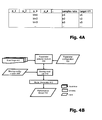
- the resulting multi-dimensional bins from the above process may have a generic data structure format as exemplarily illustrated in Fig. 4A .
- the dimensions (p_1, p_2, p_3, ...) represent the parameter space on which the target performance metric value depends (e.g., radio quality, cell load, etc. in case the target performance metric is throughput).
- the parameter space is divided into a number of categories, or bins (e.g., in p_1, there are bins p_11, p_12, ... p_1M, similarly, in p_2 there are bins p_21, p_22, ... p_2N, etc.).
- bins e.g., in p_1, there are bins p_11, p_12, ... p_1M, similarly, in p_2 there are bins p_21, p_22, ... p_2N, etc.
- the multi-dimensional space there will be a "combine
- a metric called samples ratio (e.g., n1) is defined that indicates how many of the samples aggregated in the data structure of Fig. 4A actually fall in a particular combined bin.
- This metric may generally be based on (i.e., derived from) a counter. In the present case the metric thus indicates the size of a sample group that has been placed in the particular combined bin.
- This "group size metric” may also be indicated in the form of a percentage.
- target performance metric statistics are statistically aggregated (e.g., v1).
- the aggregation may comprise calculating an average or a distribution of all performance metric values placed in the combined bin.
- individual parameter values may be collected in the data structure of Fig. 4A , either in the form of individual values or in a statistically aggregated form (e.g., as an average or distribution).
- samples acquired by measurement or otherwise are collected from the mobile communications network 100 (see, e.g., Fig. 1 ), where each sample includes one value of the measured target performance metric, e.g., the throughput measured during the last few seconds, and the prevailing parameter values, e.g., radio signal quality, cell load, etc., measured or acquired otherwise substantially at the same time to preserve their inter-dependency.
- the measured target performance metric e.g., the throughput measured during the last few seconds
- the prevailing parameter values e.g., radio signal quality, cell load, etc.
- correlation and pre-processing of event logs e.g., measurement logs
- the different items of information may come from different parts of the network and/or from different information records, etc.
- the multivariate performance model will be derived therefrom (as will be explained in greater detail below). Creation of the performance model includes analyzing the collected parameters and the statistically aggregated performance metric values (e.g., the performance metric statistics). Typically, not only the performance metric statistics will enter into the performance model, but also the number of samples (e.g., in terms of the multiple-dimensional parameters distribution).
- One exemplary implementation derives performance metric statistics and the multivariate performance model from network events (such as compound or correlated events) in event logs as illustrated in Fig. 4B .
- a parameter selector module 406 Based on a specific parameter configuration 404 selected offline for a target performance metric, a parameter selector module 406 automatically retrieves the samples of interest from distributed event logs 402 (e.g., in the NEs 1002 of Fig. 1 ). The retrieved samples are then binned by a binning module 410. Operation of the binning module 410 is controlled by a binning configuration 408 selected offline.
- the binning configuration 408 may take the form of a raw (i.e., un-populated) data structure as illustrated in Fig. 4A .
- the output of the binning module 410 is a populated data structure onto which the samples have been statistically aggregated to generate the performance metric statistics.
- a generator 412 finally generates the multivariate performance model 414 from the performance
- Fig. 5A shows a use case example of performance metrics, the parameters to be selected and associated bins (categories).
- the exemplary performance metric Packet Data Convergence Protocol (PDCP) throughput depends on parameters such as radio throughput, load, radio signal strength, interference and bandwidth, to name a few.
- PDCP Packet Data Convergence Protocol
- NMS or OSS solutions those items of information are logged together with other event parameters in the same data set in an event log (e.g., as shown in Fig. 1 ).
- performance metrics and parameters are regarded to be on the same level. They both may be granulized or otherwise categorized, and an individual multi-dimensional data structure reflecting a particular performance metric statistics (see, e.g., Fig.
- the 4A may contain a mixture of different parameters on which the performance metric depends.
- the categorizing, or binning may be performed so that the bins, or parameter value sets, are not too small to get sufficient numbers of samples in the bins.
- the bin width should not be too large in order to get relevant statistical relations between the parameters and the performance metric.
- a single range, or parameter value set, Rx in each parameter is illustrated in Fig. 5A .
- a possible combination of parameter value sets Rx, or bins could be defined as follows:
- PDCP throughput is measured at the PDCP layer in an LTE network, which is very close to the TCP level throughput that any user application would perceive. Therefore, it is for many network operators a relevant target performance metric.
- Exemplary parameter dimensions in Fig. 5B are radio throughput, cell load and terminal type (see also Fig. 5A ).
- Radio throughput is the "raw" link rate the LTE User Equipment (UE) can see when scheduled, i.e., it is highly dependent on the radio quality of the connection (it can be expressed in terms of bps/Hz, also called spectral efficiency of the link).
- UE User Equipment
- the PDCP throughput i.e., what the UE ultimately receives, directly depends on radio throughput and cell load.
- the UE When the UE has a very good channel (i.e., high radio throughput) but there is a high congestion in the cell, it will receive a low PDCP throughput (due to the fact that it can be scheduled only less frequently in a congested cell).
- the UE may have a poor radio link (low radio throughput) but no congestion in the cell, it can be scheduled frequently but due to poor link quality it will at the end receive low PDCP throughput again.
- the UE type There can be, of course, all kinds of mixed cases as well, and the UE type may be considered in addition here.
- the target performance metric statistics derived based on the data structure of Fig. 5B it is possible to judge in a particular situation to what extent each factor limits the PDCP throughput.
- the performance metric statistics can be further elaborated to deeper levels, e.g., such that the radio throughput further depends on signal strength and interference, etc., see Fig. 5C .
- FIG. 6A An example of the multi-dimensional distribution of radio throughput versus signal strength and interference is shown in Fig. 6A .
- the distribution of samples (i.e., samples ratio) for the same model is illustrated in Fig. 6B .
- the multivariate performance model may be created.
- FIG. 7 A flow chart 700 of an exemplary data aggregation and model creation approach is illustrated in Fig. 7 .
- KPI Key Performance Indicator
- the model is defined as the function M, which gives the desired statistics of the target KPI, such as the average value of the KPI, for each given parameter value combination. That is, M ⁇ KPI
- the model can be used to obtain the probability distribution function of the target KPI for given distributions of the input parameters (F_p1(x), F_p2(x), ). That is, the probability of P ⁇ KPI ⁇ T
- the probability of a parameter combination is obtained from the distribution functions of the input parameters.
- the average value of the KPI is often used as the metric of interest, instead of the distribution of the KPI.
- the evaluation can be performed in a realistic and practical way as it will be based on a multivariate performance model that is based on the acquisition of "live" data.
- Such a model may thus overcome the drawbacks of purely heuristics-based analytical models.
- the effects of a parameter adjustment in one NE can be predicted accurately and will also take into account resulting effects of the parameter adjustment for other NEs.
- the overall performance gain (or decrease) over multiple NEs 1002 can be evaluated taking into account any parameter inter-dependence.
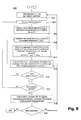
- Fig. 8 illustrates a flow chart 800 of an evaluation method that is based on the multivariate performance model generated in accordance with the flow chart 700 of Fig. 7 .
- a parameter p_i to be adjusted for optimization purposes in the network 100 is selected in step 802.
- This parameter p_i belongs to the model parameters for a particular target KPI. It can be, for instance, a NE configuration parameter (e.g., antenna tilt or transmit power of a cell) or a parameter directly connected to a configuration parameter (e.g., the signal strength in terms of Received Signal Reference Power, RSRP, is directly impacted by the antenna tilt of a cell).
- RSRP Received Signal Reference Power
- an individual NE (e.g., NE 1002-1 in Fig. 1 , see also description of Fig. 3 ) is selected as starting point for evaluating the optimization potential in the network 100.
- a cell is discussed as an exemplary NE.
- the NE could alternatively be a radio carrier, a Radio Base Station (RBS), Radio Network Controller (RNC), and so on.
- RBS Radio Base Station
- RNC Radio Network Controller
- a further step 806 other cells (S k (p_i)) are identified (e.g., NEs 1002-2 and 1002-3, see also the description of Fig. 3 ) that are potentially impacted by the adjustment of the parameter p_i in the cell selected in step 804. For instance, if RSRP is improved in the selected cell by, e.g., uptilting the antenna of the cell, one may degrade the target KPIs in neighboring cells, since the interference is increased there.
- S k (p_i) are identified (e.g., NEs 1002-2 and 1002-3, see also the description of Fig. 3 ) that are potentially impacted by the adjustment of the parameter p_i in the cell selected in step 804. For instance, if RSRP is improved in the selected cell by, e.g., uptilting the antenna of the cell, one may degrade the target KPIs in neighboring cells, since the interference is increased there.
- step 808 the distribution of p_i in the selected cell is transformed to a desired distribution (F_pi(x) ⁇ F'_pi(x)) indicative of the parameter adjustment to be evaluated.
- the parameter adjustment could also be modelled otherwise.
- the transformation applied in step 808 can be an arbitrary operation on the distribution of p_i.
- the transformation can be a shift in the RSRP values by, e.g., 2 dB.
- the distribution of p_i can also be replaced with an estimated or measured RSRP distribution after a tilt change.
- the RSPR is just mentioned as an example, and other performance metrics and parameters may be used in other examples.
- step 810 the new (absolute) target KPI values are calculated for the cell selected in step 804 as well as for each of the impacted neighboring cells identified in step 806. Still in step 810, the absolute target KPI values in cell k as well as in the impacted cells S k are aggregated.
- the distribution of the signal strength (e.g., in terms of RSRP) is changed in cell k, this will automatically cause changes for the interference metric in the neighboring cells S k in the model.
- the distribution of p_i is changed in cell k, there is typically no need to explicitely perform any "manual" transformation in the distribution of the impacted parameter p_j in cells S k as the dependence is reflected in the model. If a parameter p_i' is changed in cell k, which has no effect in the neighboring cells, then no parameter distribution change will occur in cells S k .
- the proposed modelling approach based on a multivariate performance model thus permits an efficient optimization of cell parameters that have a "multi-cell effect".
- the reason is that the modelling takes into account how distributions of other (dependent) parameters change in other cells S k upon a parameter change in one particular cell k.
- the overall effect (e.g., improvement) of the parameter adjustment on the selected and impacted cells is calculated using some utilization function.
- utilization function can be, for instance, the signed difference between the sum of KPI values before and after the transformation of the distribution of parameter p_i.
- other utilization functions can be used, such as the signed difference between the weighted sum of the KPI values before and after the transformation. In such a case, the number of samples, the number of users or other numbers may be used as weights.
- RSRP values of the cell selected in step 804 can be shifted by +2 dB as well as -2 dB.
- steps 806 to 812 may be repeated for each cell of a predefined cell set within the network 100.
- the method loops back to step 804 until all cells in the set (e.g., in the whole network 100) have been evaluated. Then, the cells can be ordered based on the output of the utilization function (improvement potential) and the optimization procedure can be implemented for the cell having the highest optimization potential (see step 818).
- the method can continue from step 802 by selecting another parameter (p_j) for optimization.
- the optimization steps of Fig. 8 may be repeated multiple times on the same parameter as long as the highest improvement potential (e.g., of the highest ranking cell) is above some threshold (i.e., as long as it is technically still reasonable to apply a parameter adjustment).
- the proposed approach still results in fast convergence, since the multivariate performance model enables multiple transformations on the distribution of a parameter to observe the effect of a change without the actual implementation of the change.
- Fig. 9 illustrates three partially overlapping radio cells 902, 904, 906.
- the coverage area of an individual radio cell is determined by the pattern of the electromagnetic power of the cell measured on the field. There are spots with weak radio power (usually far from the base station) and spots with strong radio power (usually close to the base station).
- the radio cells 902, 904, 906 are planned so that the coverage areas of the neighboring cells are overlapping to some extent to provide full coverage. If the overlapping area is small then there might be weak spots or coverage holes on the field. However, if the overlapping area is large then the radio signals of the neighboring cells will interfere with each other.
- Certain cell parameters are used to control the coverage areas of the radio cells 902, 904, 906.
- the optimization of the parameter settings is not trivial due to several reasons.
- the coverage pattern is complicated due to shadings, reflections, hills, and so on.
- there are spots with high occurrence of user terminals while there are empty spots where user terminals do not occur at all.
- the terrain conditions on the coverage area may also change in time (e.g., new buildings are built).
- not all parameters can be set remotely. For example, antenna height, azimuth and, in some cases, tilt can only be adjusted mechanically which makes the process cumbersome, expensive and slow. There is thus a need in the scenario of Fig. 9 to modify the proper parameters in a proper way to get the highest improvement in the network.
- FIG. 10 is an extract of the flow chart 800 of Fig. 8 tailored to the planning problem illustrated in Fig. 9 . Due to the exhaustive description of the flow chart 800 above, steps 1002 to 1016 of the flow chart 1000 of Fig. 10 will not be described in detail. Rather, only the particular parameters used in the flow chart 1000 for optimization of the scenario illustrated in Fig. 9 will be explained in the following.
- the NE 1002 is again the radio cell configured in an RBS in a wireless access network.
- the KPI is the radio throughput (the "raw" link rate a user terminal can see when scheduled) and the parameter list consists of the signal strength (measured by RSRP) and the interference (measured as the RSRP of the neighboring cells, denoted by nbr_RSRP).
- the RSRP and nbr_RSRP can be directly influenced by, e.g., the antenna tilt parameter of the cell. Therefore, for illustration purposes, the optimization parameter is assumed to be the RSRP itself.
- the set of NEs affected by the optimization parameter is the set of neighbor cells.
- the transformation applied to the distribution of RSRP is shifting RSRP by 2 dB.
- the distribution of RSRP can also be replaced with an estimated or measured RSRP distribution after a tilt change resulting in more accurate modeling of the impact of a tilt change.
- the model is created in the format as shown in Figs. 4 to 7 .
- the transformation made in cell k affects the cell k itself via RSRP and the neighbor cells via nbr_RSRP.
- the utilization function to aggregate the overall effect of the parameter change is set as the sum of the KPI changes.
- Fig. 10 The outcome of the optimization process illustrated in Fig. 10 is a list of cells where the improvement potential after the transformation is highlighted for each cell.
- Fig. 11 shows the overall gain in the average radio throughput of the cell and the neighbor cells after the transformation (shifting RSRP by +2dB/-2dB). The two curves indicate the throughput gain for each cell after shifting RSRP up and down by 2dB. Positive gain indicates performance improvement and negative gain indicates performance degradation.
- shifting the RSRP up by 2dB improves the overall performance for the majority of the cells.
- the majority of the cells suffer performance degradation.
- performance improves in some cells due to decreasing interference in the neighboring cells.
Landscapes
- Engineering & Computer Science (AREA)
- Computer Networks & Wireless Communication (AREA)
- Signal Processing (AREA)
- Mobile Radio Communication Systems (AREA)
Priority Applications (2)
| Application Number | Priority Date | Filing Date | Title |
|---|---|---|---|
| EP14001377.2A EP2934037B1 (de) | 2014-04-15 | 2014-04-15 | Technik zur Auswertung einer Parametereinstellung in einem mobilen Kommunikationsnetz |
| US14/685,996 US20150296395A1 (en) | 2014-04-15 | 2015-04-14 | Technique for Evaluation of a Parameter Adjustment in a Mobile Communications Network |
Applications Claiming Priority (1)
| Application Number | Priority Date | Filing Date | Title |
|---|---|---|---|
| EP14001377.2A EP2934037B1 (de) | 2014-04-15 | 2014-04-15 | Technik zur Auswertung einer Parametereinstellung in einem mobilen Kommunikationsnetz |
Publications (2)
| Publication Number | Publication Date |
|---|---|
| EP2934037A1 true EP2934037A1 (de) | 2015-10-21 |
| EP2934037B1 EP2934037B1 (de) | 2016-04-13 |
Family
ID=50513644
Family Applications (1)
| Application Number | Title | Priority Date | Filing Date |
|---|---|---|---|
| EP14001377.2A Not-in-force EP2934037B1 (de) | 2014-04-15 | 2014-04-15 | Technik zur Auswertung einer Parametereinstellung in einem mobilen Kommunikationsnetz |
Country Status (2)
| Country | Link |
|---|---|
| US (1) | US20150296395A1 (de) |
| EP (1) | EP2934037B1 (de) |
Cited By (2)
| Publication number | Priority date | Publication date | Assignee | Title |
|---|---|---|---|---|
| CN106685757A (zh) * | 2016-12-16 | 2017-05-17 | 烟台中科网络技术研究所 | 一种评估网络性能的方法及装置 |
| WO2021007019A1 (en) * | 2019-07-08 | 2021-01-14 | Google Llc | Optimizing a cellular network using machine learning |
Families Citing this family (12)
| Publication number | Priority date | Publication date | Assignee | Title |
|---|---|---|---|---|
| US20170215094A1 (en) * | 2016-01-22 | 2017-07-27 | Hitachi, Ltd. | Method for analyzing and inferring wireless network performance |
| US11115287B2 (en) | 2018-12-28 | 2021-09-07 | Hcl Technologies Limited | System and method for predicting key performance indicator (KPI) in a telecommunication network |
| US10592544B1 (en) | 2019-02-12 | 2020-03-17 | Live Objects, Inc. | Generation of process models in domains with unstructured data |
| US10607042B1 (en) | 2019-02-12 | 2020-03-31 | Live Objects, Inc. | Dynamically trained models of named entity recognition over unstructured data |
| CN112105063A (zh) * | 2019-06-18 | 2020-12-18 | 半导体元件工业有限责任公司 | 基于多维输入的无线自适应 |
| US11630718B2 (en) * | 2020-05-14 | 2023-04-18 | At&T Intellectual Property I, L.P. | Using user equipment data clusters and spatial temporal graphs of abnormalities for root cause analysis |
| FI129525B (en) | 2020-09-09 | 2022-03-31 | Elisa Oyj | Evaluating the impact of a change in a communication network |
| FI129705B (en) * | 2021-03-08 | 2022-07-15 | Elisa Oyj | A method for analyzing parameters in a communication network |
| CN113453114B (zh) * | 2021-06-30 | 2023-04-07 | Oppo广东移动通信有限公司 | 编码控制方法、装置、无线耳机及存储介质 |
| JP7461398B2 (ja) * | 2022-03-25 | 2024-04-03 | アンリツ株式会社 | 移動端末試験システム及び移動端末試験方法 |
| CN117131950A (zh) * | 2022-05-16 | 2023-11-28 | 中国电信股份有限公司 | 分析服务模型性能检测方法、装置、存储介质及设备 |
| US20240313921A1 (en) * | 2023-03-13 | 2024-09-19 | Apple Inc. | Antenna Transmit Diversity in Frequency Domain |
Citations (6)
| Publication number | Priority date | Publication date | Assignee | Title |
|---|---|---|---|---|
| WO1998053621A2 (en) | 1997-05-19 | 1998-11-26 | Qualcomm Incorporated | Method and apparatus for optimization of a cellular network |
| US20060083170A1 (en) * | 2004-10-19 | 2006-04-20 | Silva Claudio B | Method and apparatus for automatically determining the manner in which to allocate available capital to achieve a desired level of network quality performance |
| EP1868320A2 (de) * | 2006-06-16 | 2007-12-19 | Groundhog Technologies Inc. | Verwaltungssystem und Verfahren für ein drahtloses Kommunikationsnetz und zugehörige grafische Benutzerschnittstelle |
| US20120188880A1 (en) * | 2012-01-31 | 2012-07-26 | Comtech Ef Data Corp. | Method and System for Performing Multi-Layer, Multi-Dimensional Link Budget Analysis (LBA) Using Real-Time Network, Weather, Satellite Ephemeras and Ionospheric Information |
| US20120295609A1 (en) * | 2011-05-20 | 2012-11-22 | ReVerb Networks, Inc. | Methods and apparatus for underperforming cell detection and recovery in a wireless network |
| WO2013030429A1 (en) * | 2011-09-01 | 2013-03-07 | Oy Omnitele Ab | Intelligent capacity management |
Family Cites Families (5)
| Publication number | Priority date | Publication date | Assignee | Title |
|---|---|---|---|---|
| US6842431B2 (en) * | 1999-11-04 | 2005-01-11 | Lucent Technologies Inc. | Methods and apparatus for characterization, adjustment and optimization of wireless networks |
| US6611500B1 (en) * | 1999-11-04 | 2003-08-26 | Lucent Technologies, Inc. | Methods and apparatus for derivative-based optimization of wireless network performance |
| US6745033B1 (en) * | 2002-06-07 | 2004-06-01 | Ericsson Inc. | Method of optimizing handoff hysteresis values in a cellular telecommunications network |
| FI20055589A0 (fi) * | 2005-11-02 | 2005-11-02 | Nokia Corp | Emulointilaite |
| US20150065108A1 (en) * | 2013-09-04 | 2015-03-05 | Nokia Siemens Networks Oy | Coordinated scheduling with adaptive muting |
-
2014
- 2014-04-15 EP EP14001377.2A patent/EP2934037B1/de not_active Not-in-force
-
2015
- 2015-04-14 US US14/685,996 patent/US20150296395A1/en not_active Abandoned
Patent Citations (6)
| Publication number | Priority date | Publication date | Assignee | Title |
|---|---|---|---|---|
| WO1998053621A2 (en) | 1997-05-19 | 1998-11-26 | Qualcomm Incorporated | Method and apparatus for optimization of a cellular network |
| US20060083170A1 (en) * | 2004-10-19 | 2006-04-20 | Silva Claudio B | Method and apparatus for automatically determining the manner in which to allocate available capital to achieve a desired level of network quality performance |
| EP1868320A2 (de) * | 2006-06-16 | 2007-12-19 | Groundhog Technologies Inc. | Verwaltungssystem und Verfahren für ein drahtloses Kommunikationsnetz und zugehörige grafische Benutzerschnittstelle |
| US20120295609A1 (en) * | 2011-05-20 | 2012-11-22 | ReVerb Networks, Inc. | Methods and apparatus for underperforming cell detection and recovery in a wireless network |
| WO2013030429A1 (en) * | 2011-09-01 | 2013-03-07 | Oy Omnitele Ab | Intelligent capacity management |
| US20120188880A1 (en) * | 2012-01-31 | 2012-07-26 | Comtech Ef Data Corp. | Method and System for Performing Multi-Layer, Multi-Dimensional Link Budget Analysis (LBA) Using Real-Time Network, Weather, Satellite Ephemeras and Ionospheric Information |
Cited By (5)
| Publication number | Priority date | Publication date | Assignee | Title |
|---|---|---|---|---|
| CN106685757A (zh) * | 2016-12-16 | 2017-05-17 | 烟台中科网络技术研究所 | 一种评估网络性能的方法及装置 |
| CN106685757B (zh) * | 2016-12-16 | 2019-12-17 | 烟台中科网络技术研究所 | 一种评估网络性能的方法及装置 |
| WO2021007019A1 (en) * | 2019-07-08 | 2021-01-14 | Google Llc | Optimizing a cellular network using machine learning |
| EP4344287A1 (de) * | 2019-07-08 | 2024-03-27 | Google Llc | Optimierung eines zellularen netzwerks mittels maschinenlernen |
| US12096246B2 (en) | 2019-07-08 | 2024-09-17 | Google Llc | Optimizing a cellular network using machine learning |
Also Published As
| Publication number | Publication date |
|---|---|
| US20150296395A1 (en) | 2015-10-15 |
| EP2934037B1 (de) | 2016-04-13 |
Similar Documents
| Publication | Publication Date | Title |
|---|---|---|
| EP2934037B1 (de) | Technik zur Auswertung einer Parametereinstellung in einem mobilen Kommunikationsnetz | |
| US9491285B2 (en) | Technique for performance management in a mobile communications network | |
| US10917797B2 (en) | Method and system for detecting and resolving anomalies in a wireless network | |
| JP6411435B2 (ja) | 携帯電話ネットワークを維持しまたは最適化する方法およびシステム | |
| US10517007B2 (en) | Received signal strength based interferer classification of cellular network cells | |
| WO2020093017A1 (en) | Passive intermodulation detection in wireless networks | |
| Galindo-Serrano et al. | Automated coverage hole detection for cellular networks using radio environment maps | |
| EP2508021A1 (de) | Abdeckungslocherkennung | |
| Barco et al. | Learning of model parameters for fault diagnosis in wireless networks | |
| US9392472B2 (en) | Technique for evaluating events in a telecommunication network | |
| EP2730039B1 (de) | Steuerung der konfiguration eines senders für eine basisstation | |
| US20230292156A1 (en) | Trajectory based performance monitoring in a wireless communication network | |
| EP3700253B1 (de) | Vorhersage der geografischen verteilung der mobilkommunikationsnetzqualität | |
| Lehtimäki et al. | A knowledge-based model for analyzing GSM network performance | |
| US12556258B2 (en) | Beam grid optimization | |
| US20250328850A1 (en) | Customer experience index estimator for a smart service analyzer | |
| US12556463B2 (en) | Normalizing a trend deviation-based quantitative key performance indictor (KPI) | |
| US20250330398A1 (en) | Key performance indicator (kpi) normalization for a smart service analyzer | |
| Li et al. | Analytics and Machine Learning Powered Wireless Network Optimization and Planning | |
| CN119654850A (zh) | 方法、装置和计算机程序 | |
| Turkka | Aspects of knowledge mining on minimizing drive tests in self-organizing cellular networks. |
Legal Events
| Date | Code | Title | Description |
|---|---|---|---|
| PUAI | Public reference made under article 153(3) epc to a published international application that has entered the european phase |
Free format text: ORIGINAL CODE: 0009012 |
|
| 17P | Request for examination filed |
Effective date: 20150420 |
|
| AK | Designated contracting states |
Kind code of ref document: A1 Designated state(s): AL AT BE BG CH CY CZ DE DK EE ES FI FR GB GR HR HU IE IS IT LI LT LU LV MC MK MT NL NO PL PT RO RS SE SI SK SM TR |
|
| AX | Request for extension of the european patent |
Extension state: BA ME |
|
| GRAP | Despatch of communication of intention to grant a patent |
Free format text: ORIGINAL CODE: EPIDOSNIGR1 |
|
| RIC1 | Information provided on ipc code assigned before grant |
Ipc: H04W 24/02 20090101ALI20151123BHEP Ipc: H04W 24/08 20090101AFI20151123BHEP |
|
| INTG | Intention to grant announced |
Effective date: 20151209 |
|
| RAP1 | Party data changed (applicant data changed or rights of an application transferred) |
Owner name: TELEFONAKTIEBOLAGET L M ERICSSON (PUBL) |
|
| GRAS | Grant fee paid |
Free format text: ORIGINAL CODE: EPIDOSNIGR3 |
|
| GRAA | (expected) grant |
Free format text: ORIGINAL CODE: 0009210 |
|
| AK | Designated contracting states |
Kind code of ref document: B1 Designated state(s): AL AT BE BG CH CY CZ DE DK EE ES FI FR GB GR HR HU IE IS IT LI LT LU LV MC MK MT NL NO PL PT RO RS SE SI SK SM TR |
|
| REG | Reference to a national code |
Ref country code: GB Ref legal event code: FG4D |
|
| REG | Reference to a national code |
Ref country code: AT Ref legal event code: REF Ref document number: 791239 Country of ref document: AT Kind code of ref document: T Effective date: 20160415 Ref country code: CH Ref legal event code: EP |
|
| REG | Reference to a national code |
Ref country code: IE Ref legal event code: FG4D |
|
| REG | Reference to a national code |
Ref country code: DE Ref legal event code: R096 Ref document number: 602014001436 Country of ref document: DE |
|
| REG | Reference to a national code |
Ref country code: LT Ref legal event code: MG4D |
|
| PG25 | Lapsed in a contracting state [announced via postgrant information from national office to epo] |
Ref country code: BE Free format text: LAPSE BECAUSE OF NON-PAYMENT OF DUE FEES Effective date: 20160430 |
|
| REG | Reference to a national code |
Ref country code: AT Ref legal event code: MK05 Ref document number: 791239 Country of ref document: AT Kind code of ref document: T Effective date: 20160413 |
|
| REG | Reference to a national code |
Ref country code: NL Ref legal event code: MP Effective date: 20160413 |
|
| PG25 | Lapsed in a contracting state [announced via postgrant information from national office to epo] |
Ref country code: NL Free format text: LAPSE BECAUSE OF FAILURE TO SUBMIT A TRANSLATION OF THE DESCRIPTION OR TO PAY THE FEE WITHIN THE PRESCRIBED TIME-LIMIT Effective date: 20160413 Ref country code: LT Free format text: LAPSE BECAUSE OF FAILURE TO SUBMIT A TRANSLATION OF THE DESCRIPTION OR TO PAY THE FEE WITHIN THE PRESCRIBED TIME-LIMIT Effective date: 20160413 Ref country code: FI Free format text: LAPSE BECAUSE OF FAILURE TO SUBMIT A TRANSLATION OF THE DESCRIPTION OR TO PAY THE FEE WITHIN THE PRESCRIBED TIME-LIMIT Effective date: 20160413 Ref country code: PL Free format text: LAPSE BECAUSE OF FAILURE TO SUBMIT A TRANSLATION OF THE DESCRIPTION OR TO PAY THE FEE WITHIN THE PRESCRIBED TIME-LIMIT Effective date: 20160413 Ref country code: NO Free format text: LAPSE BECAUSE OF FAILURE TO SUBMIT A TRANSLATION OF THE DESCRIPTION OR TO PAY THE FEE WITHIN THE PRESCRIBED TIME-LIMIT Effective date: 20160713 |
|
| REG | Reference to a national code |
Ref country code: DE Ref legal event code: R119 Ref document number: 602014001436 Country of ref document: DE |
|
| PG25 | Lapsed in a contracting state [announced via postgrant information from national office to epo] |
Ref country code: ES Free format text: LAPSE BECAUSE OF FAILURE TO SUBMIT A TRANSLATION OF THE DESCRIPTION OR TO PAY THE FEE WITHIN THE PRESCRIBED TIME-LIMIT Effective date: 20160413 Ref country code: HR Free format text: LAPSE BECAUSE OF FAILURE TO SUBMIT A TRANSLATION OF THE DESCRIPTION OR TO PAY THE FEE WITHIN THE PRESCRIBED TIME-LIMIT Effective date: 20160413 Ref country code: PT Free format text: LAPSE BECAUSE OF FAILURE TO SUBMIT A TRANSLATION OF THE DESCRIPTION OR TO PAY THE FEE WITHIN THE PRESCRIBED TIME-LIMIT Effective date: 20160816 Ref country code: AT Free format text: LAPSE BECAUSE OF FAILURE TO SUBMIT A TRANSLATION OF THE DESCRIPTION OR TO PAY THE FEE WITHIN THE PRESCRIBED TIME-LIMIT Effective date: 20160413 Ref country code: GR Free format text: LAPSE BECAUSE OF FAILURE TO SUBMIT A TRANSLATION OF THE DESCRIPTION OR TO PAY THE FEE WITHIN THE PRESCRIBED TIME-LIMIT Effective date: 20160714 Ref country code: SE Free format text: LAPSE BECAUSE OF FAILURE TO SUBMIT A TRANSLATION OF THE DESCRIPTION OR TO PAY THE FEE WITHIN THE PRESCRIBED TIME-LIMIT Effective date: 20160413 Ref country code: RS Free format text: LAPSE BECAUSE OF FAILURE TO SUBMIT A TRANSLATION OF THE DESCRIPTION OR TO PAY THE FEE WITHIN THE PRESCRIBED TIME-LIMIT Effective date: 20160413 Ref country code: LV Free format text: LAPSE BECAUSE OF FAILURE TO SUBMIT A TRANSLATION OF THE DESCRIPTION OR TO PAY THE FEE WITHIN THE PRESCRIBED TIME-LIMIT Effective date: 20160413 |
|
| PG25 | Lapsed in a contracting state [announced via postgrant information from national office to epo] |
Ref country code: IT Free format text: LAPSE BECAUSE OF FAILURE TO SUBMIT A TRANSLATION OF THE DESCRIPTION OR TO PAY THE FEE WITHIN THE PRESCRIBED TIME-LIMIT Effective date: 20160413 Ref country code: BE Free format text: LAPSE BECAUSE OF FAILURE TO SUBMIT A TRANSLATION OF THE DESCRIPTION OR TO PAY THE FEE WITHIN THE PRESCRIBED TIME-LIMIT Effective date: 20160413 |
|
| REG | Reference to a national code |
Ref country code: IE Ref legal event code: MM4A |
|
| PG25 | Lapsed in a contracting state [announced via postgrant information from national office to epo] |
Ref country code: CZ Free format text: LAPSE BECAUSE OF FAILURE TO SUBMIT A TRANSLATION OF THE DESCRIPTION OR TO PAY THE FEE WITHIN THE PRESCRIBED TIME-LIMIT Effective date: 20160413 Ref country code: MC Free format text: LAPSE BECAUSE OF FAILURE TO SUBMIT A TRANSLATION OF THE DESCRIPTION OR TO PAY THE FEE WITHIN THE PRESCRIBED TIME-LIMIT Effective date: 20160413 Ref country code: SK Free format text: LAPSE BECAUSE OF FAILURE TO SUBMIT A TRANSLATION OF THE DESCRIPTION OR TO PAY THE FEE WITHIN THE PRESCRIBED TIME-LIMIT Effective date: 20160413 Ref country code: EE Free format text: LAPSE BECAUSE OF FAILURE TO SUBMIT A TRANSLATION OF THE DESCRIPTION OR TO PAY THE FEE WITHIN THE PRESCRIBED TIME-LIMIT Effective date: 20160413 Ref country code: DK Free format text: LAPSE BECAUSE OF FAILURE TO SUBMIT A TRANSLATION OF THE DESCRIPTION OR TO PAY THE FEE WITHIN THE PRESCRIBED TIME-LIMIT Effective date: 20160413 Ref country code: DE Free format text: LAPSE BECAUSE OF NON-PAYMENT OF DUE FEES Effective date: 20161101 Ref country code: RO Free format text: LAPSE BECAUSE OF FAILURE TO SUBMIT A TRANSLATION OF THE DESCRIPTION OR TO PAY THE FEE WITHIN THE PRESCRIBED TIME-LIMIT Effective date: 20160413 |
|
| PLBE | No opposition filed within time limit |
Free format text: ORIGINAL CODE: 0009261 |
|
| STAA | Information on the status of an ep patent application or granted ep patent |
Free format text: STATUS: NO OPPOSITION FILED WITHIN TIME LIMIT |
|
| PG25 | Lapsed in a contracting state [announced via postgrant information from national office to epo] |
Ref country code: SM Free format text: LAPSE BECAUSE OF FAILURE TO SUBMIT A TRANSLATION OF THE DESCRIPTION OR TO PAY THE FEE WITHIN THE PRESCRIBED TIME-LIMIT Effective date: 20160413 |
|
| REG | Reference to a national code |
Ref country code: FR Ref legal event code: ST Effective date: 20170215 |
|
| 26N | No opposition filed |
Effective date: 20170116 |
|
| PG25 | Lapsed in a contracting state [announced via postgrant information from national office to epo] |
Ref country code: FR Free format text: LAPSE BECAUSE OF NON-PAYMENT OF DUE FEES Effective date: 20160613 |
|
| PG25 | Lapsed in a contracting state [announced via postgrant information from national office to epo] |
Ref country code: SI Free format text: LAPSE BECAUSE OF FAILURE TO SUBMIT A TRANSLATION OF THE DESCRIPTION OR TO PAY THE FEE WITHIN THE PRESCRIBED TIME-LIMIT Effective date: 20160413 Ref country code: IE Free format text: LAPSE BECAUSE OF NON-PAYMENT OF DUE FEES Effective date: 20160415 |
|
| REG | Reference to a national code |
Ref country code: CH Ref legal event code: PL |
|
| PG25 | Lapsed in a contracting state [announced via postgrant information from national office to epo] |
Ref country code: LI Free format text: LAPSE BECAUSE OF NON-PAYMENT OF DUE FEES Effective date: 20170430 Ref country code: CH Free format text: LAPSE BECAUSE OF NON-PAYMENT OF DUE FEES Effective date: 20170430 |
|
| PG25 | Lapsed in a contracting state [announced via postgrant information from national office to epo] |
Ref country code: HU Free format text: LAPSE BECAUSE OF FAILURE TO SUBMIT A TRANSLATION OF THE DESCRIPTION OR TO PAY THE FEE WITHIN THE PRESCRIBED TIME-LIMIT; INVALID AB INITIO Effective date: 20140415 |
|
| PG25 | Lapsed in a contracting state [announced via postgrant information from national office to epo] |
Ref country code: MT Free format text: LAPSE BECAUSE OF NON-PAYMENT OF DUE FEES Effective date: 20160430 Ref country code: MK Free format text: LAPSE BECAUSE OF FAILURE TO SUBMIT A TRANSLATION OF THE DESCRIPTION OR TO PAY THE FEE WITHIN THE PRESCRIBED TIME-LIMIT Effective date: 20160413 Ref country code: IS Free format text: LAPSE BECAUSE OF FAILURE TO SUBMIT A TRANSLATION OF THE DESCRIPTION OR TO PAY THE FEE WITHIN THE PRESCRIBED TIME-LIMIT Effective date: 20160413 Ref country code: CY Free format text: LAPSE BECAUSE OF FAILURE TO SUBMIT A TRANSLATION OF THE DESCRIPTION OR TO PAY THE FEE WITHIN THE PRESCRIBED TIME-LIMIT Effective date: 20160413 Ref country code: LU Free format text: LAPSE BECAUSE OF NON-PAYMENT OF DUE FEES Effective date: 20160415 |
|
| PG25 | Lapsed in a contracting state [announced via postgrant information from national office to epo] |
Ref country code: BG Free format text: LAPSE BECAUSE OF FAILURE TO SUBMIT A TRANSLATION OF THE DESCRIPTION OR TO PAY THE FEE WITHIN THE PRESCRIBED TIME-LIMIT Effective date: 20160413 |
|
| PG25 | Lapsed in a contracting state [announced via postgrant information from national office to epo] |
Ref country code: TR Free format text: LAPSE BECAUSE OF FAILURE TO SUBMIT A TRANSLATION OF THE DESCRIPTION OR TO PAY THE FEE WITHIN THE PRESCRIBED TIME-LIMIT Effective date: 20160413 Ref country code: AL Free format text: LAPSE BECAUSE OF FAILURE TO SUBMIT A TRANSLATION OF THE DESCRIPTION OR TO PAY THE FEE WITHIN THE PRESCRIBED TIME-LIMIT Effective date: 20160413 |
|
| PGFP | Annual fee paid to national office [announced via postgrant information from national office to epo] |
Ref country code: GB Payment date: 20190429 Year of fee payment: 6 |
|
| GBPC | Gb: european patent ceased through non-payment of renewal fee |
Effective date: 20200415 |
|
| PG25 | Lapsed in a contracting state [announced via postgrant information from national office to epo] |
Ref country code: GB Free format text: LAPSE BECAUSE OF NON-PAYMENT OF DUE FEES Effective date: 20200415 |