EP2934408B1 - Article absorbant - Google Patents
Article absorbant Download PDFInfo
- Publication number
- EP2934408B1 EP2934408B1 EP12890399.4A EP12890399A EP2934408B1 EP 2934408 B1 EP2934408 B1 EP 2934408B1 EP 12890399 A EP12890399 A EP 12890399A EP 2934408 B1 EP2934408 B1 EP 2934408B1
- Authority
- EP
- European Patent Office
- Prior art keywords
- liquid
- foam
- absorbent
- layer
- receiving
- Prior art date
- Legal status (The legal status is an assumption and is not a legal conclusion. Google has not performed a legal analysis and makes no representation as to the accuracy of the status listed.)
- Not-in-force
Links
Images

Classifications
-
- A—HUMAN NECESSITIES
- A61—MEDICAL OR VETERINARY SCIENCE; HYGIENE
- A61F—FILTERS IMPLANTABLE INTO BLOOD VESSELS; PROSTHESES; DEVICES PROVIDING PATENCY TO, OR PREVENTING COLLAPSING OF, TUBULAR STRUCTURES OF THE BODY, e.g. STENTS; ORTHOPAEDIC, NURSING OR CONTRACEPTIVE DEVICES; FOMENTATION; TREATMENT OR PROTECTION OF EYES OR EARS; BANDAGES, DRESSINGS OR ABSORBENT PADS; FIRST-AID KITS
- A61F13/00—Bandages or dressings; Absorbent pads
- A61F13/15—Absorbent pads, e.g. sanitary towels, swabs or tampons for external or internal application to the body; Supporting or fastening means therefor; Tampon applicators
- A61F13/53—Absorbent pads, e.g. sanitary towels, swabs or tampons for external or internal application to the body; Supporting or fastening means therefor; Tampon applicators characterised by the absorbing medium
-
- A—HUMAN NECESSITIES
- A61—MEDICAL OR VETERINARY SCIENCE; HYGIENE
- A61F—FILTERS IMPLANTABLE INTO BLOOD VESSELS; PROSTHESES; DEVICES PROVIDING PATENCY TO, OR PREVENTING COLLAPSING OF, TUBULAR STRUCTURES OF THE BODY, e.g. STENTS; ORTHOPAEDIC, NURSING OR CONTRACEPTIVE DEVICES; FOMENTATION; TREATMENT OR PROTECTION OF EYES OR EARS; BANDAGES, DRESSINGS OR ABSORBENT PADS; FIRST-AID KITS
- A61F13/00—Bandages or dressings; Absorbent pads
- A61F13/15—Absorbent pads, e.g. sanitary towels, swabs or tampons for external or internal application to the body; Supporting or fastening means therefor; Tampon applicators
- A61F13/15203—Properties of the article, e.g. stiffness or absorbency
-
- A—HUMAN NECESSITIES
- A61—MEDICAL OR VETERINARY SCIENCE; HYGIENE
- A61F—FILTERS IMPLANTABLE INTO BLOOD VESSELS; PROSTHESES; DEVICES PROVIDING PATENCY TO, OR PREVENTING COLLAPSING OF, TUBULAR STRUCTURES OF THE BODY, e.g. STENTS; ORTHOPAEDIC, NURSING OR CONTRACEPTIVE DEVICES; FOMENTATION; TREATMENT OR PROTECTION OF EYES OR EARS; BANDAGES, DRESSINGS OR ABSORBENT PADS; FIRST-AID KITS
- A61F13/00—Bandages or dressings; Absorbent pads
- A61F13/15—Absorbent pads, e.g. sanitary towels, swabs or tampons for external or internal application to the body; Supporting or fastening means therefor; Tampon applicators
- A61F13/45—Absorbent pads, e.g. sanitary towels, swabs or tampons for external or internal application to the body; Supporting or fastening means therefor; Tampon applicators characterised by the shape
- A61F13/47—Sanitary towels, incontinence pads or napkins
- A61F13/4704—Sanitary towels, incontinence pads or napkins having preferential bending zones, e.g. fold lines or grooves
-
- A—HUMAN NECESSITIES
- A61—MEDICAL OR VETERINARY SCIENCE; HYGIENE
- A61F—FILTERS IMPLANTABLE INTO BLOOD VESSELS; PROSTHESES; DEVICES PROVIDING PATENCY TO, OR PREVENTING COLLAPSING OF, TUBULAR STRUCTURES OF THE BODY, e.g. STENTS; ORTHOPAEDIC, NURSING OR CONTRACEPTIVE DEVICES; FOMENTATION; TREATMENT OR PROTECTION OF EYES OR EARS; BANDAGES, DRESSINGS OR ABSORBENT PADS; FIRST-AID KITS
- A61F13/00—Bandages or dressings; Absorbent pads
- A61F13/15—Absorbent pads, e.g. sanitary towels, swabs or tampons for external or internal application to the body; Supporting or fastening means therefor; Tampon applicators
- A61F13/53—Absorbent pads, e.g. sanitary towels, swabs or tampons for external or internal application to the body; Supporting or fastening means therefor; Tampon applicators characterised by the absorbing medium
- A61F13/534—Absorbent pads, e.g. sanitary towels, swabs or tampons for external or internal application to the body; Supporting or fastening means therefor; Tampon applicators characterised by the absorbing medium having an inhomogeneous composition through the thickness of the pad
- A61F13/535—Absorbent pads, e.g. sanitary towels, swabs or tampons for external or internal application to the body; Supporting or fastening means therefor; Tampon applicators characterised by the absorbing medium having an inhomogeneous composition through the thickness of the pad inhomogeneous in the plane of the pad, e.g. core absorbent layers being of different sizes
-
- A—HUMAN NECESSITIES
- A61—MEDICAL OR VETERINARY SCIENCE; HYGIENE
- A61F—FILTERS IMPLANTABLE INTO BLOOD VESSELS; PROSTHESES; DEVICES PROVIDING PATENCY TO, OR PREVENTING COLLAPSING OF, TUBULAR STRUCTURES OF THE BODY, e.g. STENTS; ORTHOPAEDIC, NURSING OR CONTRACEPTIVE DEVICES; FOMENTATION; TREATMENT OR PROTECTION OF EYES OR EARS; BANDAGES, DRESSINGS OR ABSORBENT PADS; FIRST-AID KITS
- A61F13/00—Bandages or dressings; Absorbent pads
- A61F13/15—Absorbent pads, e.g. sanitary towels, swabs or tampons for external or internal application to the body; Supporting or fastening means therefor; Tampon applicators
- A61F13/551—Packaging before or after use
- A61F13/5513—Packaging before or after use packaging of feminine sanitary napkins
- A61F13/55135—Packaging before or after use packaging of feminine sanitary napkins before use
- A61F13/5514—Packaging before or after use packaging of feminine sanitary napkins before use each item packaged single
-
- A—HUMAN NECESSITIES
- A61—MEDICAL OR VETERINARY SCIENCE; HYGIENE
- A61F—FILTERS IMPLANTABLE INTO BLOOD VESSELS; PROSTHESES; DEVICES PROVIDING PATENCY TO, OR PREVENTING COLLAPSING OF, TUBULAR STRUCTURES OF THE BODY, e.g. STENTS; ORTHOPAEDIC, NURSING OR CONTRACEPTIVE DEVICES; FOMENTATION; TREATMENT OR PROTECTION OF EYES OR EARS; BANDAGES, DRESSINGS OR ABSORBENT PADS; FIRST-AID KITS
- A61F13/00—Bandages or dressings; Absorbent pads
- A61F13/15—Absorbent pads, e.g. sanitary towels, swabs or tampons for external or internal application to the body; Supporting or fastening means therefor; Tampon applicators
- A61F13/551—Packaging before or after use
- A61F13/5513—Packaging before or after use packaging of feminine sanitary napkins
- A61F13/55135—Packaging before or after use packaging of feminine sanitary napkins before use
- A61F13/55145—Packaging before or after use packaging of feminine sanitary napkins before use multiple packaged items
-
- A—HUMAN NECESSITIES
- A61—MEDICAL OR VETERINARY SCIENCE; HYGIENE
- A61F—FILTERS IMPLANTABLE INTO BLOOD VESSELS; PROSTHESES; DEVICES PROVIDING PATENCY TO, OR PREVENTING COLLAPSING OF, TUBULAR STRUCTURES OF THE BODY, e.g. STENTS; ORTHOPAEDIC, NURSING OR CONTRACEPTIVE DEVICES; FOMENTATION; TREATMENT OR PROTECTION OF EYES OR EARS; BANDAGES, DRESSINGS OR ABSORBENT PADS; FIRST-AID KITS
- A61F13/00—Bandages or dressings; Absorbent pads
- A61F13/15—Absorbent pads, e.g. sanitary towels, swabs or tampons for external or internal application to the body; Supporting or fastening means therefor; Tampon applicators
- A61F13/15203—Properties of the article, e.g. stiffness or absorbency
- A61F2013/15284—Properties of the article, e.g. stiffness or absorbency characterized by quantifiable properties
- A61F2013/15357—Stiffness, e.g. Taber rigidity
-
- A—HUMAN NECESSITIES
- A61—MEDICAL OR VETERINARY SCIENCE; HYGIENE
- A61F—FILTERS IMPLANTABLE INTO BLOOD VESSELS; PROSTHESES; DEVICES PROVIDING PATENCY TO, OR PREVENTING COLLAPSING OF, TUBULAR STRUCTURES OF THE BODY, e.g. STENTS; ORTHOPAEDIC, NURSING OR CONTRACEPTIVE DEVICES; FOMENTATION; TREATMENT OR PROTECTION OF EYES OR EARS; BANDAGES, DRESSINGS OR ABSORBENT PADS; FIRST-AID KITS
- A61F13/00—Bandages or dressings; Absorbent pads
- A61F13/15—Absorbent pads, e.g. sanitary towels, swabs or tampons for external or internal application to the body; Supporting or fastening means therefor; Tampon applicators
- A61F13/15203—Properties of the article, e.g. stiffness or absorbency
- A61F2013/15284—Properties of the article, e.g. stiffness or absorbency characterized by quantifiable properties
- A61F2013/15463—Absorbency
-
- A—HUMAN NECESSITIES
- A61—MEDICAL OR VETERINARY SCIENCE; HYGIENE
- A61F—FILTERS IMPLANTABLE INTO BLOOD VESSELS; PROSTHESES; DEVICES PROVIDING PATENCY TO, OR PREVENTING COLLAPSING OF, TUBULAR STRUCTURES OF THE BODY, e.g. STENTS; ORTHOPAEDIC, NURSING OR CONTRACEPTIVE DEVICES; FOMENTATION; TREATMENT OR PROTECTION OF EYES OR EARS; BANDAGES, DRESSINGS OR ABSORBENT PADS; FIRST-AID KITS
- A61F13/00—Bandages or dressings; Absorbent pads
- A61F13/15—Absorbent pads, e.g. sanitary towels, swabs or tampons for external or internal application to the body; Supporting or fastening means therefor; Tampon applicators
- A61F13/53—Absorbent pads, e.g. sanitary towels, swabs or tampons for external or internal application to the body; Supporting or fastening means therefor; Tampon applicators characterised by the absorbing medium
- A61F2013/530131—Absorbent pads, e.g. sanitary towels, swabs or tampons for external or internal application to the body; Supporting or fastening means therefor; Tampon applicators characterised by the absorbing medium being made in fibre but being not pulp
-
- A—HUMAN NECESSITIES
- A61—MEDICAL OR VETERINARY SCIENCE; HYGIENE
- A61F—FILTERS IMPLANTABLE INTO BLOOD VESSELS; PROSTHESES; DEVICES PROVIDING PATENCY TO, OR PREVENTING COLLAPSING OF, TUBULAR STRUCTURES OF THE BODY, e.g. STENTS; ORTHOPAEDIC, NURSING OR CONTRACEPTIVE DEVICES; FOMENTATION; TREATMENT OR PROTECTION OF EYES OR EARS; BANDAGES, DRESSINGS OR ABSORBENT PADS; FIRST-AID KITS
- A61F13/00—Bandages or dressings; Absorbent pads
- A61F13/15—Absorbent pads, e.g. sanitary towels, swabs or tampons for external or internal application to the body; Supporting or fastening means therefor; Tampon applicators
- A61F13/53—Absorbent pads, e.g. sanitary towels, swabs or tampons for external or internal application to the body; Supporting or fastening means therefor; Tampon applicators characterised by the absorbing medium
- A61F2013/530802—Absorbent pads, e.g. sanitary towels, swabs or tampons for external or internal application to the body; Supporting or fastening means therefor; Tampon applicators characterised by the absorbing medium characterized by the foam or sponge other than superabsorbent
- A61F2013/530854—Absorbent pads, e.g. sanitary towels, swabs or tampons for external or internal application to the body; Supporting or fastening means therefor; Tampon applicators characterised by the absorbing medium characterized by the foam or sponge other than superabsorbent being collapsed or collapsible foam
Definitions
- the invention relates to a folded absorbent product that has at least one fold in the transverse direction of the product, wherein the absorbent product comprises an absorption body.
- absorbent products such as sanitary napkins, panty liners and incontinence pads are packaged in such a way so they take up as little volume in the packaging as possible. If the product takes up a small volume in the packaging, i.e. during storage and transport, the transport cost is reduced and also the size of the storage space that is required for the absorbent products manufactured.
- Absorbent products such as sanitary napkins, panty liners and incontinence pads often have one or more folds in the packaging, therefore, for example in the transverse direction of the product.
- creases can be formed in the product along the fold. These creases can be troublesome during the use of the products. If the products are folded in their transverse direction, for example, creases are often obtained in the transverse direction of the product, making it possible for liquid to run along the creases and be transported out to the product's edges and create a liquid leakage. Furthermore, creases due to folding of the product in its transverse direction can cause material breaks in the material layer of the absorption body along the fold, which leads to an impaired capacity to spread and distribute the liquid in the absorption body. Such creases risk impairing the liquid-absorbent capacity of the absorption body. Material breaks in the absorption body can also impair the function of the absorption body as a shaping element, and mean that the absorption body crumples.
- JP 2010178932 A relates to a folded towel, the towel having one or more continuous channels that each extend along both the longitudinal and the transverse direction of the product, wherein the channels in the transverse direction of the product coincide with the fold line that is formed due to the product having been folded together in the transverse direction of the product during packing.
- the channels in the product's longitudinal direction assist in guiding the liquid along the channels in the product's longitudinal direction, which counteracts the liquid being guided along the product's transverse fold line, which reduces the risk of lateral leakage.
- US2005/0131371A1 and US2008/0103468A1 disclose folded absorbent articles.
- creases can make attachment of the product in the user's briefs difficult.
- Towels are often attached in the briefs by means of an adhesive on the underside of the backing layer and for the adhesive to be attached to the briefs it is essential that the towel is relatively flat upon attachment, i.e. does not have creases and/or folds, which can mean that the full extension of the adhesive does not stick down to the briefs.
- the absorbent product is experienced as reliable and that the user has a feeling of reliability in that the product shall function well.
- a product made in accordance with the invention is distinguished principally in that the absorption body comprises a liquid-receiving, flexible foam layer and a liquid-absorbent fibrous layer, wherein the liquid-receiving, flexible foam layer has a total surface in the plane extension of the product that at least covers the entire surface of the liquid-absorbent, fibrous layer in the plane extension, wherein the liquid-receiving, flexible foam layer has a bending stiffness that is lower than 0.30 newtons measured according to the modified Circular Bend Procedure method, and that the liquid-absorbent, fibrous layer has a bending stiffness that is higher than 2.0 newtons, measured according to the modified Circular Bend Procedure method.
- liquid-absorbent layer having a bending stiffness that is greater than 2.0 newtons creates a relatively stiff and stable product, which means that the liquid-absorbent layer also functions as a stiffening element.
- the bending stiffness means that the product does not become so limp and that it cannot so readily shrink together and create undesired creases in the crotch area.
- the liquid-receiving layer is a flexible foam material. Flexible foam materials can spring back, i.e. return to substantially their original shape in all directions after having been exposed to external loading.
- the flexible foam material thus has a resilient effect and is not appreciably influenced, therefore, by the force that the material is exposed to upon folding.
- the flexible foam material can also dampen the force that the product's underlying fibrous liquid-absorbent layer is exposed to upon folding.
- the foam material thus has a shock-absorbing effect in relation to the fibrous, liquid-absorbent layer.
- the creases are not so strong due to this, and on removal of the product from its packaging, the product unfolds in its plane better than an absorbent product that does not have a liquid-receiving, flexible foam layer with a bending stiffness that is lower than 0.30 newtons, measured according to the modified Circular Bend Procedure method.
- the liquid-receiving layer falls within the invention since the bending stiffness is lower than 0.3 newtons according to the modified Circular Bend Procedure method in any area of the liquid-receiving layer, i.e. in at least one area of the liquid-absorbent layer.
- the surface of the liquid-absorbent layer in the plane extension can have local differences in the bending stiffness. It is important, however, that the bending stiffness over any area on the surface of the liquid-absorbent layer is greater than 2.0 newtons, i.e. the liquid-absorbent layer falls within the invention since the bending stiffness is greater than 2.0 newtons according to the modified Circular Bend Procedure method in any area of the liquid-absorbent layer.
- the surface of the liquid-absorbent layer in the plane extension has at least two different areas with a bending stiffness that is greater than 2.0 newtons according to the modified Circular Bend Procedure method.
- the liquid-absorbent layer has a bending stiffness that is greater than 2.0 newtons according to the modified Circular Bend Procedure method over its entire surface.
- the liquid-receiving foam layer has a bending stiffness that is lower than 0.25 newtons according to the modified Circular Bend Procedure method.
- the liquid-receiving layer falls within this embodiment since the bending stiffness is lower than 0.25 newtons according to the modified Circular Bend Procedure method in any area of the liquid-receiving layer, i.e. in at least one area of the liquid-receiving layer.
- the liquid-receiving foam layer is a continuous structure. Due to the fact that the foam layer is a continuous structure, it has a good pliability and resilient capacity after it has been exposed to external loading. Fibre and/or filament-based liquid-receiving layers consist of a great number of discrete fibres and/or filaments that are often intermittently joined to one another, but the joining points do not create a continuous structure such as is created by a foamed material, however. Fibre and/or filament-based layers do not have an equally good ability to spring back and regain their original shape following external loading, therefore. Liquid-receiving foam layers have a good capacity for regaining their original shape in all directions following external loading.
- the pliability and resilient capacity of the foam also mean that there is a smaller risk of creases arising, or of the layer crumpling, compared with fibre and/or filament-based layers.
- the liquid-receiving foam layer is an open-cell continuous structure and acquires a good liquid-receiving capacity in this way.
- the liquid-absorbent fibrous layer has a bending stiffness that is higher than 3.0 newtons, measured according to the modified Circular Bend Procedure method.
- each longitudinally running side edge of the liquid-receiving flexible foam layer extends at least along a part of its length outside of each longitudinally running side edge of the liquid-absorbent, fibrous layer.
- Each longitudinally running side edge of the flexible liquid-receiving foam layer preferably extends outside of each longitudinally running side edge of the liquid-absorbent, fibrous layer along its entire length.
- the flexible foam material can spring back, i.e. regain substantially its original shape after having been exposed to external loading.
- the flexible foam material also has a padding effect such that the foam material lines the stiff edges and creates a soft distancing element between the user's skin and the stiff edges of the liquid-absorbent layer.
- the liquid-receiving foam layer consists of polyolefin-based foam, polystyrene-based foam, PVC foam, polyvinyl alcohol foam, acrylate foam, for example manufactured according to HIPE technology, polyurethane foam, epoxy foam, latex foam, urea-formaldehyde foam, melamine-formaldehyde foam, silicone foam, viscose foam, carboxymethyl cellulose (CMC) foam, starch form, chitosan foam, alginate foam, polyactide foam, polyglycolide foam and polycaprolactone foam.
- CMC carboxymethyl cellulose
- liquid-receiving layer has an opacity that is greater than 35%, it turned out that the user experiences the product as more pleasing than a product that has liquid-receiving layers that have an opacity that is less than 35%, for example fibre layers of airy, nonwoven material. It is also important that the user finds before using the product that it is a reliable and aesthetically pleasing product. Due to the fact that the liquid-receiving layer has an opacity that is greater than 35%, the difference in size of the absorbent layers in the plane extension is not seen as distinctly, which gives a more reliable impression of the product even before use.
- the liquid-receiving flexible foam layer has an absorption capacity that is lower than 0.15 grams of liquid/cm 3 of dry test material measured according to the method CRC material layer .
- An advantage of a liquid-receiving foam layer with a low absorption capacity in grams of liquid/cm 3 of dry test material is that a smaller area is moistened on the material layer than for a material layer that has a high absorption capacity in grams of liquid/ cm 3 .
- a liquid-receiving layer with a low absorption capacity is drained more easily of liquid by an underlying liquid-absorbent layer.
- each longitudinally running side edge of the liquid-receiving, flexible foam layer extends at least 5.0 millimetres outside of each longitudinally running side edge of the liquid-absorbent fibrous layer.
- the width of the surface of the liquid-receiving foam material in the longitudinal direction of the product extending outside of the surface of the underlying liquid-absorbent layer should be adapted in such a manner that good flexibility is obtained. It turned out that the width on each longitudinally running side edge of the liquid-receiving layer extending outside of the underlying absorbent layer is preferably between 5-15 mm.
- the flexible foam material has a padding effect such that the foam material lines the stiff edges.
- the ability of the foam material to spring back i.e. to return to substantially its original shape after having been exposed to external loading, is also an important property.
- the foam material has the ability to regain its original shape in all directions, not only in the direction of the thickness of the material.
- the total surface of the liquid-receiving flexible foam layer in its plane extension is at least 1.7 times as great as the total surface of the liquid-absorbent, fibrous layer in the plane extension of the product.
- the total surface of the liquid-absorbent, fibrous layer does not need to be equally great, which means that for such products it can be advantageous if the total surface of the liquid-receiving foam layer in its plane extension is at least 2.0 times as great as the total surface of the liquid-absorbent, fibrous layer in the plane extension of the product.
- the open-cell, liquid-receiving foam layer has an opacity that is greater than 35%, the difference in size of the layers is not seen as clearly, which makes the product more aesthetically pleasing and gives the product a more reliable impression.
- a high opacity of the liquid-receiving layer is especially advantageous, therefore, for products with a large difference of the surface between the liquid-receiving layer and the liquid-absorbent layer.
- a small surface of the liquid-absorbent layer can be desirable for certain products, in part for making them thin and discreet and in part for reducing the material cost. Furthermore, an advantage with a large difference on the surface between the liquid-receiving layer and the liquid-absorbent layer is that when the liquid-absorbent layer also functions as a shaping element that follows the body when it moves, a certain difference of the layers can be required for obtaining the desired shaping.
- the absorbent product comprises a liquid-permeable surface material and a liquid-tight backing material, wherein the absorption body is arranged between the liquid-permeable surface material and the liquid-tight backing material, and that the liquid-receiving foam layer is placed against the liquid-permeable surface material and the liquid-absorbent, fibrous layer is placed against the liquid-tight backing material.
- the absorbent product does not have a separate liquid-permeable surface material.
- the liquid-receiving layer is placed closest to the user when the product is being used and thus the surface closest to the user consists of a flexible foam.
- the invention also relates to folded absorbent products, which have two or more folds in the transverse direction of the product.
- the invention also relates to a single-unit packaging containing a folded absorbent product according to one/some of the described embodiments, and a packaging containing a plurality of folded absorbent products according to one/some of the embodiments described.
- the liquid-receiving flexible foam layer expands relatively quickly from its folded compressed state when the product is removed from its packaging, and in this way the product regains a relatively flat extension relatively quickly, which makes application of the product to the user's briefs easier, and reduces the existing fold lines in the transverse direction of the product.
- the folded absorbent product in the single-unit packaging thus has a more compressed structure than corresponding absorbent products have in their unfolded state.
- each of the folded absorbent products in a packaging containing a plurality of folded absorbent products has a more compressed structure than corresponding absorbent products have in their unfolded state.
- the folded products are stacked in piles, wherein each pile contains a plurality of products.
- the stack with a plurality of products is higher before the compression stage than after the compression stage.
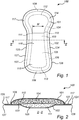
- the sanitary napkin 100 shown in figures 1 and 2 is elongated with a longitudinal direction and a transverse direction.
- the sanitary napkin 100 comprises a liquid-permeable surface material 101 arranged on the top side of the sanitary napkin, i.e. the side of the sanitary napkin intended to be turned toward a user during use, a liquid-tight backing material 102, and an absorption body 103 arranged between the surface material 101 and the backing material 102.
- the absorption body 103 comprises a flexible, liquid-receiving foam layer 104 placed against the liquid-permeable surface material 101 and a liquid-absorbent fibrous layer 105 placed against the liquid-tight backing material 102, wherein the liquid-receiving foam layer 104 has two opposing, longitudinally running side edges 106, 107 extending in the longitudinal direction and two opposing transverse edges 108, 109 extending in the transverse direction, and the liquid-absorbent, fibrous layer 105 has two opposing longitudinally running side edges 110, 111 extending in the longitudinal direction, and two opposing transverse edges 112, 113 extending in the transverse direction.
- the liquid-receiving foam layer 104 has a total surface in the plane extension of the product that covers the entire surface of the liquid-absorbent, fibrous layer 105 in its plane extension, and each longitudinally running side edge 106, 107 of the liquid-receiving foam layer 104 extends at least along a part of its length outside of each longitudinally running side edge 110, 111 of the liquid-absorbent, fibrous layer.
- the surface material 101 and the backing material 102 have substantially the same plane form as the absorption body 103 but have a somewhat greater extension in the plane, as a result of which they form a projecting edge 117 around the entire periphery of the absorption body 103.
- Cover layers 102, 103 are mutually connected inside the projecting edge 105, for example by gluing, sewing or welding with heat or ultrasound. It is also possible to design the sanitary towel so that the liquid-receiving layer 104 has the same extension in the plane as the surface material and backing material, wherein both the surface material 101, backing material 102 and also the liquid-receiving layer 104 form a projecting edge 117 along the entire periphery of the liquid-absorbent, fibrous layer 105.
- the sanitary napkin in figure 1 is formed with a front part 114, a back part 115 and an intermediate crotch part 116.
- the front part 114 has a rounded form and is wider than the crotch part 116. It has turned out that all users have a critical area between the groins where the distance between the muscles running down on the inside of the thighs is approximately 30-35 mm.
- the width of the sanitary towel in the crotch area is limited in front by said distance between said muscle sinews right in front of the users' groins.
- the liquid-absorbent layer 105 has a distance M that does not exceed 40 mm and is preferably 30-35 mm.
- it is the width of the liquid-absorbent layer 105 in the transition between the crotch part 116 and the front part 114 that should not be too wide.
- the width of the liquid-absorbent layer 105 in the crotch part 116 of the product which is most important is that it is this layer that contributes to the product's stiffness.
- the width of the liquid-absorbent, fibrous layer 105 which also functions as a stiffening element, can continuously increase to a magnitude of 1.5 times the width M without a risk that the liquid-absorbent layer 105 chafes the user in the crotch.
- a relatively narrow distance M, at least on the liquid-absorbent layer 105, is also an advantage from the viewpoint of fastening, since a sanitary napkin where the difference in width between the front part 114 and the width of the narrowest part on the crotch part 116 is large, yields a good fastening effect against the user's legs and prevents the sanitary napkin from gliding backwards during use.
- the liquid-permeable surface material 101 suitably consists of a conventional liquid-permeable material.
- suitable materials are perforated plastic films, non-woven materials, plastic nets or the like.
- the liquid-tight backing material 102 is a conventional type and can thus consist of any liquid-tight material suitable for the purpose. Examples of such materials are various types of thin plastic films or nonwoven materials treated to resist the penetration of liquid, for example, by being coated with plastic, wax or the like. Other treatments such as heat calendering for melting a material that was permeable in the beginning to a mainly liquid-tight layer can also be used. Furthermore, the liquid-tight backing material 103 can consist of a liquid-tight surface on absorption body 103. In order to produce an airy product, it is customary to use liquid-tight backing material that is breathable, i.e., has good air permeability.
- the liquid-tight backing material preferably consists of a breathable material.
- breathable materials are perforated films, microporous films, macroporous films, nanoporous films, monolithic films, fibrous nonwoven ones and their laminates.
- a liquid-absorbent, fibrous layer 105 with a high absorption capacity and a good capacity for transporting liquid is the fibrous material described in WO 94/10953 and WO 94/10956 .
- These materials are present in the form of dry-formed fibre layers with a high density and stiffness and are used directly in an absorbent product without being defibrated at first.
- the stiffening and absorbent element can also be made from a laminate of several nonwoven layers or tissue layers that are mutually fixed for increased stiffness and that have highly absorbent particles between individual layers. The fixing of the individual layers to each other can take place with binding agents such as adhesive or melted fibres. The highly absorbent particles can also contribute to the bonding.
- the stiffness is controlled by selecting the number of layers and the amount of binding agent used and by the selection of highly absorbent material and how its adhesive capacity is utilised.
- liquid-absorbent layer is one or more layers of airlaid cellulose layers. This can be prefabricated material which is supplied in roll form for being then cut out in a suitable size, or alternatively the liquid-absorbent layer can be mat-formed and formed in-line during the actual manufacture of the absorbent product.
- the compression of the liquid-absorbent, fibrous layer can be done in several ways.
- An example of a common process is one that is called “high-density compression” (HDC), which is described in detail in EP-B-1427658 .
- the compression can also be done in two to three steps that include a preliminary compression and thereafter a compression in one or two steps.
- the surface of the liquid-absorbent layer in plane extension can thus exhibit local differences in bending stiffness.
- the surface of the liquid-absorbent layer in its plane extension comprises at least two different areas with a bending stiffness that is greater than 2.0 newtons according to the modified bending stiffness method.
- the surface that has a bending stiffness greater than 2.0 newtons according to the modified Circular Bend Procedure method should be able to be measured on two different areas on the surface of the liquid-absorbent layer, which two areas can be adjacent to one another or can be placed at a distance from one another.
- the liquid-absorbent layer preferably has a bending stiffness greater than 2.0 newtons according to the modified Circular Bend Procedure method over the entire liquid-absorbent layer. According to this embodiment no area on the liquid-absorbent layer may have a bending stiffness that is lower than 2.0 newtons when measured according to the modified Circular Bend Procedure method.
- a suitable liquid-receiving foam layer 104 is polyurethane foam.
- Polyurethane is a two-component product consisting of polyol and isocyanate that are mixed to polyurethane foam.
- Polyurethane has either open or closed cells.
- polyurethane foam with open cells is used.
- polyurethane foam can have different stiffness and for our purpose can be viewed as flexible foams.
- the liquid-receiving foam is flexible with a low bending stiffness and springs back well, i.e. after being loaded the foam returns to substantially its original form.
- the liquid-receiving foam layer can consist of thermoplastic foam or thermosetting foams.
- foams examples include polyolefin-based foam, polystyrene-based foam, PVC foam, polyvinyl alcohol foam, acrylate foam, for example manufactured according to HIPE technology, polyurethane foam, epoxy foam, latex foam, urea-formaldehyde foam, melamine-formaldehyde foam, silicone foam, viscose foam, carboxymethyl cellulose (CMC) foam, starch foam, chitosan foam, alginate foam, polylactide foam, polyglycolide foam and polycaprolactone foam.
- CMC carboxymethyl cellulose
- a fastening element in the form of a rectangular area of self-adhesive glue extending in the longitudinal direction is arranged on the outside of the liquid-tight backing layer.
- the fastening element is protected in a conventional manner, for example, by being covered by a protective layer of paper or plastic treated with silicone, or is embossed so that it can be readily separated from the glue when the sanitary towel is to be used.
- the glue can obviously be alternatively arranged in any pattern suitable for the purpose such as a plurality of longitudinally running strands, an entire covering, arranged in areas only at the front part and/or the back part or the like.
- other types of fastening elements can be used such as friction covering, press studs, clamps, fastening flaps or the like.
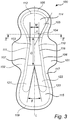
- FIG 3 shows an alternative embodiment of the sanitary napkin 100 in accordance with the invention.
- Figure 3 shows the sanitary napkin from above.
- the liquid-absorbent, fibrous layer 105 has a shape like a keyhole.
- the liquid-receiving layer 104 also has a shape like a keyhole but with a greater extension in the longitudinal direction as well as in the transverse direction than the liquid-absorbent, fibrous layer 105.
- the liquid-absorbent, fibrous layer 105 is also intended to function as a stiffening element and is designed to reduce the risk that the sanitary napkin deforms in an uncontrolled manner.
- the liquid-absorbent, fibrous layer 105 has a size, shape and stiffness that means that the product retains during the entire time of use a predetermined shape and furthermore is held fast at the intended location on the user.
- the liquid-absorbent layer has a width M in the transition between the crotch part 116 and the front part 114, which width is less than 40 mm, preferably 30-35 mm. Both side edges of the front part 114 diverge in a forward direction in the product from said transition M. In this manner the product is prevented from shifting backwards between the user's legs.
- the sanitary napkin 100 in figure 3 is formed with a crotch length adapted to the user's anatomy.
- a sanitary napkin in accordance with the invention the fact was utilised that most women have a crotch length in the order of 80-100 mm. Therefore, the liquid-absorbent, fibrous layer 105 was created with a corresponding crotch length G in the order of 70-120 mm.
- the sanitary napkin in accordance with the invention is shaped so as to be relatively stiff laterally, i.e. it is sufficiently stiff so as to not be deformed laterally and form creases.
- the liquid-absorbent, fibrous layer Since it is important that the liquid-absorbent, fibrous layer has a good absorption capacity, it is important to be able to utilise accessible space between the user's legs in the crotch.
- the width of the sanitary napkin in the crotch area is limited in front by said distance between said muscle sinews right in front of the user's groins.
- the width of the liquid-absorbent, fibrous layer 105 which also functions as a stiffening element, can continuously increase to the size of 1.5 times the width M in the transition between crotch part and front part without the risk that the liquid-absorbent layer 105 chafes the user in the crotch.
- the liquid-absorbent layer 105 extends slightly over the product's back part 115.
- the liquid-absorbent layer 105 has a recess 120 in the back part 115 and extending from its end edge and in the direction toward the crotch part 116, by means of which the product can fold along a longitudinally running line in the recess and by means of which the parts, the legs 121 and 122, which are located on both sides of the recess 120, become more flexible than the wider crotch part 116.
- This recess 120 is for obtaining a good adaptation to and pliability with the body.
- the recess 120 is wedge-shaped and symmetrically located relative to the longitudinally running line of symmetry L of the product and forms an angle ⁇ with a magnitude of 20°. This angle can vary within broad limits but is of course dependent on the shape of the back part 115.
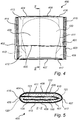
- Figure 4 and 5 show a single-unit packaging 400 in which the sanitary napkin 100 is packed.
- the single-unit packaging 400 is a packaging wrapper and in the description is called packaging wrapper 400.
- the packaging wrapper 400 is formed by a piece of material 401 with a rectangular shape, wherein the piece of material 401 has two side edges 402, 403, which also form side edges 402, 403 on the packaging wrapper 400, and two end edges 404, 405.
- Suitable materials for a packaging wrapper 400 according to the invention are thin plastic films, for example polythene films, or polypropylene films. It is of course also possible to use paper or nonwoven material.
- packaging wrapper 400 is also to serve as release material for an adhesive fastening arrangement on the sanitary napkin 100, it is customary for the surface of the packaging wrapper 400 that comes into contact with the fastening arrangement to be treated with release agent in some way.
- a common release agent treatment is siliconisation.
- the packaging wrapper 400 is folded together along a first fold line 406 and a second fold line 407 so that two end panels 408, 410 are formed, and a centre panel 409.
- the first end panel 408 forms the cover part 411 of the packaging wrapper.
- the second end panel 410, and the centre panel 409 located between the end panels 408, 410 together form the container part 412 of the packaging wrapper.
- the container part 412 is closed along the side edges 402, 403 of the packaging wrapper 400 by edge joints 414,415.
- the edge joints are embossed welds, but it is naturally possible to achieve edge joints in another way, for example with glue.
- the cover part 411 is also fixed in the edge joints, which means that the packaging wrapper as shown in figure 4 and 5 is in a closed position. It is advantageous if the cover part 411 can easily be detached from the container part along the edge joints 414, 415 without the packaging material being torn apart. This can be achieved by making the edge joints 414, 415 openable at least between the cover part 411 and the container part 412.
- the edge joints 414, 415 are preferably fully openable, since it is desirable to be able to unwrap the packaging wrapper completely when the sanitary napkin 100 is to be removed from the packaging wrapper 400.
- the packaging wrapper 400 has two side edges 402, 403 in its folded and joined form. Furthermore, the packaging wrapper has a first end edge 416 and a second end edge 417, which extend perpendicularly to the side edges 402, 403 and which coincide with the first and second fold line 406, 407 of the packaging wrapper.
- the first end edge 316 also forms an inner edge on the cover part, while the outer edge 405 of the cover part 411 coincides with the one end edge 405 on the piece of material 401 and is located a little way down on the second end panel 410 on the outside of the container part 412.
- Figure 5 shows a section along the line II - II through the packaging wrapper in figure 4 , wherein the sanitary napkin 100 has a first fold 120 in the transverse direction of the sanitary napkin along the first fold line 406 of the packaging wrapper, and a second fold 121 in the sanitary napkin's transverse direction along the second fold line 407 of the packaging wrapper, wherein the two end parts 122, 123 of the sanitary napkin 100 and the crotch part 124 of the sanitary napkin are folded against one another so that one end part 122 of the sanitary napkin rests against the second end panel 410 of the packaging wrapper and the crotch part 124 of the sanitary napkin rests against the centre panel 409 of the packaging wrapper and the second end part 123 of the sanitary napkin 100 lies between the first end part 122 and the crotch part 124 of the sanitary napkin 100.
- the sanitary napkin 100 is composed as previously described of a liquid-permeable surface material 101, a liquid-tight backing material 102 and an absorption body 103 arranged between the surface material and the backing material, wherein the absorption body 103 comprises a liquid-receiving flexible foam layer 104 placed against the liquid-permeable surface material 101 and a liquid-absorbent fibrous layer 105 placed against the liquid-tight backing material 102.
- the material layers forming part of the sanitary napkin 100 are pressed together, wherein transversely running fold lines are created in the sanitary towel in the folding process.
- the size of the fold line i.e. the degree of compression that is formed on the sanitary napkin in the folding process, is smaller for the sanitary napkin 100 constructed from a liquid-receiving layer of a flexible foam than for a sanitary napkin with a liquid-receiving layer of fibres.
- SAP Super-absorbent particles manufactured from crossbonded and partially neutralized acrylic acid
- Multi-bond airlaid consists primarily of cellulose fibres that are bound with tex bi-component molten fibres and binding agent of ethylene vinylacetate copolymer
- HDC High Density Compression is in the example a highly compressed, defibrated and mat-formed chemical sulphate mass with or without SAP
- the materials in examples 12 and 13 are based on fling-dried CTMP mass with or without SAP.
- Materials 1-8 relate to liquid-receiving layers and materials 9-13 relate to liquid-absorbent layers.
- materials 1-6 relate to liquid-receiving, open-cell foam layers and materials 7 and 8 relate to liquid-receiving, fibrous layers.
- liquid-absorbent layers 9-13 all relate to liquid-absorbent, fibrous layers.
- the material specimen to be measured is clipped out of the material layer.
- a loading pressure of 0.5 kPa is applied to the material specimen by a foot with an area of 45x45 mm and that is less than the area of the material specimen.
- the thickness of the material specimen is measured.
- the surface weight of the material sample i.e. gram/cm 2 , is weighed and calculated forward.
- the average density of the material specimen is calculated by dividing the surface weight by the thickness.
- the method for the modified Circular Bend Procedure was carried out according to a modified version of ASTM D 4032-82 (Circular Bend Procedure). The method for the modified Circular Bend Procedure is described in detail in EP 336 578 . The measuring was carried out in the same manner as described in EP 336 578 .
- the apparatus that was used is the Instron Model No 5965.
- Instron Model No 5965 is manufactured by Instron Engineering Corporation.
- the bending resistance in the material sample was measured by measuring the maximum bending stiffness.
- the maximum bending stiffness is constituted by a simultaneous deformation in several directions of a material sample, wherein one of the surfaces of the material sample becomes concave and the other surface of the material sample becomes convex.
- the method for the modified Circular Bend Procedure supplies a force value that is the bending resistance, i.e. simultaneous medium stiffness in all directions.
- the equipment used for the method of the modified Circular Bend Procedure is a modified Circular Bend Stiffness Tester that has the following parts:
- the liquid-receiving- respectively the liquid-absorbent material layer from five absorbent products was measured and then the average value was calculated.
- liquid-absorbent layer comprises areas with different bending stiffness, for example, an area that is more compressed than an adjacent area
- the liquid-absorbent layer falls within the scope of protection, since any area has a bending stiffness that is greater than 2.0 newtons.
- liquid-receiving foam layer comprises areas with different bending stiffness, for example, an area that is more compressed than an adjacent area
- the liquid-receiving foam layer falls in a corresponding manner within the scope of protection, since any area has a bending stiffness that is lower than that which is indicated in the claim.
- liquid-receiving foam layer is separated from the liquid-absorbent layer with great care so that the material layers do not break into pieces during the separating.
- the implementation was made exactly in accordance with the description in EP 0 336 578 A1 .
- the material specimens are stamped out or cut out and have an area of 37.5 x 37.5 mm.
- the material specimens were conditioned for two hours at a temperature of 21 ⁇ 1 °C and a relative air humidity of 50 ⁇ 2%.
- the pressure rod should be moved downward at a rate of 50.0 cm/min.
- Materials 1-8 are liquid-receiving layers. The result shows that layers 1-6 that are open-cell foam materials and also material 7, that is a carded through air-bound nonwoven material, have a bending stiffness that is lower than 0.30 newtons. In contrast thereto, material 8, which is a cellulose-based, multi-bound airlaid, exhibits a bending stiffness that is greater than 0.30 newtons. Materials 9-13 are liquid-absorbent layers that exhibit a bending stiffness greater than 2.0 newtons.
- CRC matenal layer is based on WSP 241.3, which is a standard method for superabsorbent polyacrylate in powder or granular form.
- WSP 241.3 is modified according to the following with the aim of adapting the method to sheet- and mat-shaped material with a thickness of 0.5 mm - 4.0 mm measured under a load that is 0.5 kPa.
- Centrifuging was carried out according to WSP 241.3, wherein the acceleration was 95 g and an inner diameter of "basket or rotor mesh" that is 235 mm was used.
- Test specimen according to WSP 241.3, between 0.180 grams and 0.220 grams of superabsorbent is weighed and placed in a teabag (nonwoven bag), see para. 8.3 Procedure. On measuring according to the invention, the stamped out, circular test material with a diameter that is 80 mm was weighed and placed in the teabag (nonwoven bag).
- the dry polymer is weighed.
- the stamped out, circular test material is weighed.
- At least 1 litre of saline solution is used for 10 teabags (nonwoven bags). On measuring according to the invention, at least 1 litre of saline solution is used for 4 teabags (nonwoven bags).
- test specimen will absorb the saline solution for 30 minutes.
- test specimen will absorb the saline solution for 10 minutes.
- the centrifuge is set to obtain a centrifugal acceleration of 250 g.
- the centrifuge is set to obtain a centrifugal acceleration of 95 g.
- CRC matenal layer is a method that measures the absorption capacity in grams liquid/ cm 3 dry material , and is a measure of how easily a material layer is drained of liquid.
- a low value of CRC matenal layer i.e. a low absorption capacity in grams liquid/ cm 3 dry material , is obtained for liquid-receiving layers with good drainage.
- a high value of CRC matenal layer i.e. a high absorption capacity in grams liquid/ cm 3 dry material , is obtained for liquid-receiving layers that have low drainage.
- liquid-receiving open-cell foam layers with a low absorption capacity in grams liquid/ cm 3 is that the surface of the material layer is drier after wetting than a material layer with a higher absorption capacity.
- Opacity is a concept and a magnitude in optics that is used to indicate transparency, that is, translucency. Opacity measures the degree of impenetrability for radiation through a material or transmission medium. Material that entirely lacks the ability to let light through is called opaque. The opacity was measured with a spectrophotometer with measurement in the YXY colour system (CIE 1931). The spectrophotometer used was of the brand Minolta Chroma Meter CR 300 (the y value was used) (CIE Illuminant D65). Calibration plate No. 16133079 was used as white standard background with a reflectance of 0.89. Black velvet was used as black standard background with a reflectance of 0.005.
Landscapes
- Health & Medical Sciences (AREA)
- Epidemiology (AREA)
- Engineering & Computer Science (AREA)
- Biomedical Technology (AREA)
- Heart & Thoracic Surgery (AREA)
- Vascular Medicine (AREA)
- Life Sciences & Earth Sciences (AREA)
- Animal Behavior & Ethology (AREA)
- General Health & Medical Sciences (AREA)
- Public Health (AREA)
- Veterinary Medicine (AREA)
- Absorbent Articles And Supports Therefor (AREA)
- Orthopedics, Nursing, And Contraception (AREA)
Claims (14)
- Produit absorbant plié (100) ayant au moins un pli dans le sens transversal du produit, le produit absorbant comprenant un corps d'absorption (103), le produit absorbant étant une serviette hygiénique, un protège-slip ou une serviette pour incontinent, caractérisé en ce que le corps d'absorption (103) comprend dans le sens de l'épaisseur une couche de mousse souple recevant les liquides (104) et une couche fibreuse absorbant les liquides (105), la couche de mousse souple recevant les liquides (104) ayant une surface totale dans l'extension plane du produit qui recouvre au moins la totalité de la surface de la couche fibreuse absorbant les liquides (105) dans l'extension plane, la couche de mousse souple recevant les liquides (104) étant constituée de mousse à base de polyoléfine, de mousse à base de polystyrène, de mousse de PVC, de mousse de poly(alcool vinylique), de mousse d'acrylate, de mousse de polyuréthane, de mousse d'époxyde, de mousse de latex, de mousse d'urée-formaldéhyde, de mousse de mélamine-formaldéhyde, de mousse de silicone, de mousse de viscose, de mousse de carboxyméthylcellulose (CMC), de mousse d'amidon, de mousse de chitosane, de mousse d'alginate, de mousse de polylactide, de mousse de polyglycolide ou de mousse de polycaprolactone et ayant une rigidité en flexion mesurée selon la méthode de la procédure de flexion circulaire modifiée qui est inférieure à 0,30 newton et en ce que la couche fibreuse absorbant les liquides (105) a une rigidité en flexion mesurée selon la méthode de la procédure de flexion circulaire modifiée supérieure à 2,0 newtons, et dans lequel la couche de mousse souple recevant les liquides (104) a une capacité d'absorption mesurée selon la méthode CRCcouche de matériau qui est inférieure à 0,15 gramme de liquide/cm3 de matériau testé sec.
- Produit absorbant plié (100) selon la revendication 1, dans lequel la couche de mousse souple recevant les liquides (104) est constituée d'une structure continue à alvéoles ouverts.
- Produit absorbant plié selon la revendication 1 ou la revendication 2, dans lequel la couche fibreuse absorbant les liquides (105) a une rigidité en flexion mesurée selon la méthode de la procédure de flexion circulaire modifiée qui est supérieure à 3,0 newtons.
- Produit absorbant plié selon l'une quelconque des revendications 1-3, dans lequel chacun des bords latéraux courant longitudinalement (106, 107) de la couche de mousse souple recevant les liquides (104) s'étend au moins le long d'une partie de sa longueur à l'extérieur de chacun des bords latéraux courant longitudinalement (110, 111) de la couche fibreuse absorbant les liquides (105).
- Produit absorbant plié selon la revendication 4, dans lequel chaque bord latéral courant longitudinalement (106, 107) de la couche de mousse souple recevant les liquides (104) s'étend à l'extérieur de chaque bord latéral courant longitudinalement (110, 111) de la couche fibreuse absorbant les liquides (105) le long de toute sa longueur.
- Produit absorbant plié selon l'une quelconque des revendications précédentes, dans lequel la couche de mousse souple recevant les liquides (104) a une opacité qui est supérieure à 35 %.
- Produit absorbant plié selon l'une quelconque des revendications précédentes, dans lequel chaque bord latéral courant longitudinalement (106, 107) de la couche de mousse souple recevant les liquides (104) s'étend au moins sur 5,0 millimètres à l'extérieur de chaque bord latéral courant longitudinalement (110, 111) de la couche fibreuse absorbant les liquides (105).
- Produit absorbant selon l'une quelconque des revendications précédentes, dans lequel la surface totale de la couche de mousse souple recevant les liquides (104) dans l'extension plane est au moins 1,7 fois plus grande que la surface totale de la couche fibreuse absorbant les liquides (105) dans l'extension plane du produit.
- Produit absorbant selon l'une quelconque des revendications précédentes, le produit comprenant une matière de surface perméable aux liquides (101) et une matière d'envers étanche aux liquides (102), dans lequel le corps d'absorption (103) est disposé entre la matière de surface perméable aux liquides (101) et la matière d'envers étanche aux liquides (102) et la couche de mousse souple recevant les liquides (104) est placée contre la matière de surface perméable aux liquides (101) et la couche fibreuse absorbant les liquides (105) est placée contre la matière d'envers étanche aux liquides (102).
- Produit absorbant plié selon l'une quelconque des revendications précédentes contenu dans un emballage individuel.
- Produit absorbant plié selon la revendication 10, le produit absorbant plié dans l'emballage individuel ayant une structure plus comprimée que les produits absorbants correspondants dans leur état déplié.
- Pluralité de produits absorbants pliés selon l'une quelconque des revendications 1-9 précédentes contenus dans un emballage.
- Pluralité de produits absorbants pliés selon la revendication 12, chacun des produits absorbants pliés dans l'emballage ayant une structure plus comprimée que les produits absorbants correspondants dans leur état déplié.
- Pluralité de produits absorbants pliés et comprimés selon l'une quelconque des revendications 1-9 compris dans une pile, la longueur de la pile étant plus grande avant l'étape de compression qu'après l'étape de compression.
Applications Claiming Priority (1)
| Application Number | Priority Date | Filing Date | Title |
|---|---|---|---|
| PCT/SE2012/051462 WO2014098679A1 (fr) | 2012-12-20 | 2012-12-20 | Article absorbant |
Publications (3)
| Publication Number | Publication Date |
|---|---|
| EP2934408A1 EP2934408A1 (fr) | 2015-10-28 |
| EP2934408A4 EP2934408A4 (fr) | 2016-08-03 |
| EP2934408B1 true EP2934408B1 (fr) | 2018-04-04 |
Family
ID=50978829
Family Applications (1)
| Application Number | Title | Priority Date | Filing Date |
|---|---|---|---|
| EP12890399.4A Not-in-force EP2934408B1 (fr) | 2012-12-20 | 2012-12-20 | Article absorbant |
Country Status (8)
| Country | Link |
|---|---|
| US (1) | US20150313763A1 (fr) |
| EP (1) | EP2934408B1 (fr) |
| CN (1) | CN104869965A (fr) |
| AU (1) | AU2012397332B2 (fr) |
| BR (1) | BR112015014598B1 (fr) |
| MX (1) | MX2015007962A (fr) |
| RU (1) | RU2618431C2 (fr) |
| WO (1) | WO2014098679A1 (fr) |
Families Citing this family (15)
| Publication number | Priority date | Publication date | Assignee | Title |
|---|---|---|---|---|
| WO2015155716A1 (fr) * | 2014-04-08 | 2015-10-15 | Pantex International S.P.A. | Matériau multicouche et article hygiénique absorbant le comprenant |
| US10400105B2 (en) | 2015-06-19 | 2019-09-03 | The Research Foundation For The State University Of New York | Extruded starch-lignin foams |
| JP6353871B2 (ja) * | 2016-06-30 | 2018-07-04 | ユニ・チャーム株式会社 | 吸収性物品 |
| EP3634352B1 (fr) | 2017-06-09 | 2022-02-09 | Essity Hygiene and Health Aktiebolag | Article d'hygiène jetable à ajustement amélioré |
| WO2018226133A1 (fr) | 2017-06-09 | 2018-12-13 | Essity Hygiene And Health Aktiebolag | Article d'hygiène jetable à ajustement amélioré |
| US11123239B2 (en) | 2017-06-09 | 2021-09-21 | Essity Hygiene And Health Aktiebolag | Disposable hygiene article with improved fit |
| RU2760648C2 (ru) | 2017-06-30 | 2021-11-29 | Джонсон энд Джонсон Консьюмер Инк. | Сложенное индивидуальное изделие в круглой упаковке |
| CA3068523A1 (fr) | 2017-06-30 | 2019-01-03 | Johnson & Johnson Consumer Inc. | Article individuel plie dans un emballage circulaire |
| BR112020009543A2 (pt) | 2017-12-08 | 2020-11-03 | Essity Hygiene And Health Aktiebolag | artigo absorvente e métodos de produção de artigos absorventes |
| MY196154A (en) | 2018-12-05 | 2023-03-17 | Essity Hygiene & Health Ab | Disposable Hygiene Article With Improved Fit |
| US11253403B2 (en) | 2018-12-05 | 2022-02-22 | Essity Hygiene And Health Aktiebolag | Disposable hygiene article with improved fit |
| WO2020117108A1 (fr) | 2018-12-05 | 2020-06-11 | Essity Hygiene And Health Aktiebolag | Article d'hygiène jetable à ajustement amélioré |
| WO2020154481A1 (fr) * | 2019-01-23 | 2020-07-30 | The Procter & Gamble Company | Produit de type serviette d'hygiène féminine emballé conçu pour un transport et un accès discrets et procédé de fabrication |
| EP3711736A1 (fr) | 2019-03-18 | 2020-09-23 | Ontex BVBA | Articles absorbants ayant une couche d'acquisition en mousse anisotrope |
| JP7431635B2 (ja) * | 2020-03-26 | 2024-02-15 | 大王製紙株式会社 | 包装吸収性物品 |
Family Cites Families (14)
| Publication number | Priority date | Publication date | Assignee | Title |
|---|---|---|---|---|
| US4950264A (en) | 1988-03-31 | 1990-08-21 | The Procter & Gamble Company | Thin, flexible sanitary napkin |
| SE9200529L (sv) * | 1992-02-21 | 1993-08-22 | Moelnlycke Ab | Förfarande för att förpacka och komprimera absorberande engångsartiklar samt förpackningen tillverad enligt förfarandet |
| SE508961C2 (sv) | 1992-11-17 | 1998-11-23 | Sca Hygiene Prod Ab | Absorberande struktur och absorberande alster innehållande strukturen ifråga |
| SE9503818L (sv) * | 1995-10-30 | 1997-04-28 | Moelnlycke Ab | Absorberande alster med längsgående utskjutande fastsättningsflikar i ett förpackningsomslag samt förpackning för ett absorberande alster |
| US5827258A (en) * | 1997-07-25 | 1998-10-27 | The Procter & Gamble Company | Adjustable compound sanitary napkin |
| US6945967B2 (en) * | 2001-04-20 | 2005-09-20 | Sca Hygiene Products Ab | Absorbent product with improved fit |
| SE520009C2 (sv) | 2001-09-17 | 2003-05-06 | Sca Hygiene Prod Ab | Förfarande och anordning för komprimering av fiberkroppar |
| US20050131371A1 (en) * | 2003-12-10 | 2005-06-16 | Fell David A. | Fold line resistant absorbent articles |
| SE0303560D0 (sv) * | 2003-12-30 | 2003-12-30 | Sca Hygiene Prod Ab | Förpackningsmodul |
| PL1901692T3 (pl) | 2005-07-13 | 2014-12-31 | Sca Hygiene Prod Ab | Wyrób chłonny o ulepszonym dopasowaniu |
| CA2624289A1 (fr) * | 2005-10-11 | 2007-04-19 | Johnson & Johnson Inc. | Article absorbant enroule jetable |
| JP5380095B2 (ja) | 2009-02-05 | 2014-01-08 | 花王株式会社 | 吸収性物品の個包装体 |
| US9549858B2 (en) * | 2010-01-06 | 2017-01-24 | Ching-Yun Morris Yang | Ultra-thin absorbent article |
| IT1403062B1 (it) * | 2010-06-15 | 2013-10-04 | Gdm Spa | Metodo di piegatura di assorbenti igienici. |
-
2012
- 2012-12-20 AU AU2012397332A patent/AU2012397332B2/en not_active Ceased
- 2012-12-20 MX MX2015007962A patent/MX2015007962A/es unknown
- 2012-12-20 WO PCT/SE2012/051462 patent/WO2014098679A1/fr not_active Ceased
- 2012-12-20 EP EP12890399.4A patent/EP2934408B1/fr not_active Not-in-force
- 2012-12-20 US US14/654,049 patent/US20150313763A1/en not_active Abandoned
- 2012-12-20 RU RU2015129482A patent/RU2618431C2/ru active
- 2012-12-20 CN CN201280077840.7A patent/CN104869965A/zh active Pending
- 2012-12-20 BR BR112015014598-1A patent/BR112015014598B1/pt not_active IP Right Cessation
Non-Patent Citations (1)
| Title |
|---|
| None * |
Also Published As
| Publication number | Publication date |
|---|---|
| RU2015129482A (ru) | 2017-01-26 |
| CN104869965A (zh) | 2015-08-26 |
| EP2934408A1 (fr) | 2015-10-28 |
| MX2015007962A (es) | 2015-10-08 |
| BR112015014598B1 (pt) | 2021-01-26 |
| EP2934408A4 (fr) | 2016-08-03 |
| BR112015014598A2 (pt) | 2018-06-19 |
| WO2014098679A1 (fr) | 2014-06-26 |
| US20150313763A1 (en) | 2015-11-05 |
| AU2012397332A1 (en) | 2015-07-09 |
| RU2618431C2 (ru) | 2017-05-03 |
| AU2012397332B2 (en) | 2016-05-12 |
Similar Documents
| Publication | Publication Date | Title |
|---|---|---|
| US20150313763A1 (en) | Absorbent article | |
| EP3648715B1 (fr) | Article absorbant et procédé de fabrication d'un article absorbant | |
| EP3648716B1 (fr) | Article absorbant et procédé de fabrication d'un article absorbant | |
| EP2934414B1 (fr) | Article absorbant offrant un confort accru | |
| US6610902B1 (en) | Absorbent structure for use in an absorbent article | |
| RU2742091C1 (ru) | Впитывающее изделие | |
| AU2012397330B2 (en) | Absorbent article with increased comfortability | |
| CZ296731B6 (cs) | Absorpcní výrobek | |
| JP7039798B2 (ja) | 吸収性物品 | |
| EP3923893B1 (fr) | Article d'hygiène | |
| JP7424928B2 (ja) | 吸収性物品 | |
| JP2025075522A (ja) | 吸収性物品 | |
| MXPA05002279A (es) | Articulo absorbente. |
Legal Events
| Date | Code | Title | Description |
|---|---|---|---|
| PUAI | Public reference made under article 153(3) epc to a published international application that has entered the european phase |
Free format text: ORIGINAL CODE: 0009012 |
|
| 17P | Request for examination filed |
Effective date: 20150618 |
|
| AK | Designated contracting states |
Kind code of ref document: A1 Designated state(s): AL AT BE BG CH CY CZ DE DK EE ES FI FR GB GR HR HU IE IS IT LI LT LU LV MC MK MT NL NO PL PT RO RS SE SI SK SM TR |
|
| AX | Request for extension of the european patent |
Extension state: BA ME |
|
| DAX | Request for extension of the european patent (deleted) | ||
| A4 | Supplementary search report drawn up and despatched |
Effective date: 20160630 |
|
| RIC1 | Information provided on ipc code assigned before grant |
Ipc: A61F 13/53 20060101AFI20160624BHEP Ipc: A61F 13/472 20060101ALI20160624BHEP Ipc: A61F 13/534 20060101ALI20160624BHEP |
|
| STAA | Information on the status of an ep patent application or granted ep patent |
Free format text: STATUS: EXAMINATION IS IN PROGRESS |
|
| 17Q | First examination report despatched |
Effective date: 20170510 |
|
| GRAP | Despatch of communication of intention to grant a patent |
Free format text: ORIGINAL CODE: EPIDOSNIGR1 |
|
| STAA | Information on the status of an ep patent application or granted ep patent |
Free format text: STATUS: GRANT OF PATENT IS INTENDED |
|
| INTG | Intention to grant announced |
Effective date: 20171020 |
|
| GRAS | Grant fee paid |
Free format text: ORIGINAL CODE: EPIDOSNIGR3 |
|
| GRAA | (expected) grant |
Free format text: ORIGINAL CODE: 0009210 |
|
| STAA | Information on the status of an ep patent application or granted ep patent |
Free format text: STATUS: THE PATENT HAS BEEN GRANTED |
|
| RAP1 | Party data changed (applicant data changed or rights of an application transferred) |
Owner name: SCA HYGIENE PRODUCTS AB |
|
| AK | Designated contracting states |
Kind code of ref document: B1 Designated state(s): AL AT BE BG CH CY CZ DE DK EE ES FI FR GB GR HR HU IE IS IT LI LT LU LV MC MK MT NL NO PL PT RO RS SE SI SK SM TR |
|
| REG | Reference to a national code |
Ref country code: GB Ref legal event code: FG4D |
|
| REG | Reference to a national code |
Ref country code: CH Ref legal event code: EP |
|
| REG | Reference to a national code |
Ref country code: AT Ref legal event code: REF Ref document number: 984779 Country of ref document: AT Kind code of ref document: T Effective date: 20180415 |
|
| REG | Reference to a national code |
Ref country code: IE Ref legal event code: FG4D |
|
| REG | Reference to a national code |
Ref country code: DE Ref legal event code: R096 Ref document number: 602012044934 Country of ref document: DE |
|
| RAP2 | Party data changed (patent owner data changed or rights of a patent transferred) |
Owner name: ESSITY HYGIENE AND HEALTH AB |
|
| REG | Reference to a national code |
Ref country code: NL Ref legal event code: MP Effective date: 20180404 |
|
| RAP2 | Party data changed (patent owner data changed or rights of a patent transferred) |
Owner name: ESSITY HYGIENE AND HEALTH AKTIEBOLAG |
|
| REG | Reference to a national code |
Ref country code: LT Ref legal event code: MG4D |
|
| PG25 | Lapsed in a contracting state [announced via postgrant information from national office to epo] |
Ref country code: NL Free format text: LAPSE BECAUSE OF FAILURE TO SUBMIT A TRANSLATION OF THE DESCRIPTION OR TO PAY THE FEE WITHIN THE PRESCRIBED TIME-LIMIT Effective date: 20180404 |
|
| PG25 | Lapsed in a contracting state [announced via postgrant information from national office to epo] |
Ref country code: NO Free format text: LAPSE BECAUSE OF FAILURE TO SUBMIT A TRANSLATION OF THE DESCRIPTION OR TO PAY THE FEE WITHIN THE PRESCRIBED TIME-LIMIT Effective date: 20180704 Ref country code: FI Free format text: LAPSE BECAUSE OF FAILURE TO SUBMIT A TRANSLATION OF THE DESCRIPTION OR TO PAY THE FEE WITHIN THE PRESCRIBED TIME-LIMIT Effective date: 20180404 Ref country code: AL Free format text: LAPSE BECAUSE OF FAILURE TO SUBMIT A TRANSLATION OF THE DESCRIPTION OR TO PAY THE FEE WITHIN THE PRESCRIBED TIME-LIMIT Effective date: 20180404 Ref country code: BG Free format text: LAPSE BECAUSE OF FAILURE TO SUBMIT A TRANSLATION OF THE DESCRIPTION OR TO PAY THE FEE WITHIN THE PRESCRIBED TIME-LIMIT Effective date: 20180704 Ref country code: PL Free format text: LAPSE BECAUSE OF FAILURE TO SUBMIT A TRANSLATION OF THE DESCRIPTION OR TO PAY THE FEE WITHIN THE PRESCRIBED TIME-LIMIT Effective date: 20180404 Ref country code: SE Free format text: LAPSE BECAUSE OF FAILURE TO SUBMIT A TRANSLATION OF THE DESCRIPTION OR TO PAY THE FEE WITHIN THE PRESCRIBED TIME-LIMIT Effective date: 20180404 Ref country code: ES Free format text: LAPSE BECAUSE OF FAILURE TO SUBMIT A TRANSLATION OF THE DESCRIPTION OR TO PAY THE FEE WITHIN THE PRESCRIBED TIME-LIMIT Effective date: 20180404 Ref country code: LT Free format text: LAPSE BECAUSE OF FAILURE TO SUBMIT A TRANSLATION OF THE DESCRIPTION OR TO PAY THE FEE WITHIN THE PRESCRIBED TIME-LIMIT Effective date: 20180404 |
|
| PG25 | Lapsed in a contracting state [announced via postgrant information from national office to epo] |
Ref country code: HR Free format text: LAPSE BECAUSE OF FAILURE TO SUBMIT A TRANSLATION OF THE DESCRIPTION OR TO PAY THE FEE WITHIN THE PRESCRIBED TIME-LIMIT Effective date: 20180404 Ref country code: RS Free format text: LAPSE BECAUSE OF FAILURE TO SUBMIT A TRANSLATION OF THE DESCRIPTION OR TO PAY THE FEE WITHIN THE PRESCRIBED TIME-LIMIT Effective date: 20180404 Ref country code: LV Free format text: LAPSE BECAUSE OF FAILURE TO SUBMIT A TRANSLATION OF THE DESCRIPTION OR TO PAY THE FEE WITHIN THE PRESCRIBED TIME-LIMIT Effective date: 20180404 Ref country code: GR Free format text: LAPSE BECAUSE OF FAILURE TO SUBMIT A TRANSLATION OF THE DESCRIPTION OR TO PAY THE FEE WITHIN THE PRESCRIBED TIME-LIMIT Effective date: 20180705 |
|
| REG | Reference to a national code |
Ref country code: AT Ref legal event code: MK05 Ref document number: 984779 Country of ref document: AT Kind code of ref document: T Effective date: 20180404 |
|
| PG25 | Lapsed in a contracting state [announced via postgrant information from national office to epo] |
Ref country code: PT Free format text: LAPSE BECAUSE OF FAILURE TO SUBMIT A TRANSLATION OF THE DESCRIPTION OR TO PAY THE FEE WITHIN THE PRESCRIBED TIME-LIMIT Effective date: 20180806 |
|
| REG | Reference to a national code |
Ref country code: DE Ref legal event code: R097 Ref document number: 602012044934 Country of ref document: DE |
|
| PG25 | Lapsed in a contracting state [announced via postgrant information from national office to epo] |
Ref country code: EE Free format text: LAPSE BECAUSE OF FAILURE TO SUBMIT A TRANSLATION OF THE DESCRIPTION OR TO PAY THE FEE WITHIN THE PRESCRIBED TIME-LIMIT Effective date: 20180404 Ref country code: CZ Free format text: LAPSE BECAUSE OF FAILURE TO SUBMIT A TRANSLATION OF THE DESCRIPTION OR TO PAY THE FEE WITHIN THE PRESCRIBED TIME-LIMIT Effective date: 20180404 Ref country code: AT Free format text: LAPSE BECAUSE OF FAILURE TO SUBMIT A TRANSLATION OF THE DESCRIPTION OR TO PAY THE FEE WITHIN THE PRESCRIBED TIME-LIMIT Effective date: 20180404 Ref country code: RO Free format text: LAPSE BECAUSE OF FAILURE TO SUBMIT A TRANSLATION OF THE DESCRIPTION OR TO PAY THE FEE WITHIN THE PRESCRIBED TIME-LIMIT Effective date: 20180404 Ref country code: DK Free format text: LAPSE BECAUSE OF FAILURE TO SUBMIT A TRANSLATION OF THE DESCRIPTION OR TO PAY THE FEE WITHIN THE PRESCRIBED TIME-LIMIT Effective date: 20180404 Ref country code: SK Free format text: LAPSE BECAUSE OF FAILURE TO SUBMIT A TRANSLATION OF THE DESCRIPTION OR TO PAY THE FEE WITHIN THE PRESCRIBED TIME-LIMIT Effective date: 20180404 |
|
| PLBE | No opposition filed within time limit |
Free format text: ORIGINAL CODE: 0009261 |
|
| STAA | Information on the status of an ep patent application or granted ep patent |
Free format text: STATUS: NO OPPOSITION FILED WITHIN TIME LIMIT |
|
| PG25 | Lapsed in a contracting state [announced via postgrant information from national office to epo] |
Ref country code: IT Free format text: LAPSE BECAUSE OF FAILURE TO SUBMIT A TRANSLATION OF THE DESCRIPTION OR TO PAY THE FEE WITHIN THE PRESCRIBED TIME-LIMIT Effective date: 20180404 Ref country code: SM Free format text: LAPSE BECAUSE OF FAILURE TO SUBMIT A TRANSLATION OF THE DESCRIPTION OR TO PAY THE FEE WITHIN THE PRESCRIBED TIME-LIMIT Effective date: 20180404 |
|
| 26N | No opposition filed |
Effective date: 20190107 |
|
| PG25 | Lapsed in a contracting state [announced via postgrant information from national office to epo] |
Ref country code: SI Free format text: LAPSE BECAUSE OF FAILURE TO SUBMIT A TRANSLATION OF THE DESCRIPTION OR TO PAY THE FEE WITHIN THE PRESCRIBED TIME-LIMIT Effective date: 20180404 |
|
| REG | Reference to a national code |
Ref country code: CH Ref legal event code: PL |
|
| PG25 | Lapsed in a contracting state [announced via postgrant information from national office to epo] |
Ref country code: MC Free format text: LAPSE BECAUSE OF FAILURE TO SUBMIT A TRANSLATION OF THE DESCRIPTION OR TO PAY THE FEE WITHIN THE PRESCRIBED TIME-LIMIT Effective date: 20180404 Ref country code: LU Free format text: LAPSE BECAUSE OF NON-PAYMENT OF DUE FEES Effective date: 20181220 |
|
| REG | Reference to a national code |
Ref country code: IE Ref legal event code: MM4A |
|
| REG | Reference to a national code |
Ref country code: BE Ref legal event code: MM Effective date: 20181231 |
|
| PG25 | Lapsed in a contracting state [announced via postgrant information from national office to epo] |
Ref country code: IE Free format text: LAPSE BECAUSE OF NON-PAYMENT OF DUE FEES Effective date: 20181220 |
|
| PG25 | Lapsed in a contracting state [announced via postgrant information from national office to epo] |
Ref country code: BE Free format text: LAPSE BECAUSE OF NON-PAYMENT OF DUE FEES Effective date: 20181231 |
|
| PG25 | Lapsed in a contracting state [announced via postgrant information from national office to epo] |
Ref country code: LI Free format text: LAPSE BECAUSE OF NON-PAYMENT OF DUE FEES Effective date: 20181231 Ref country code: CH Free format text: LAPSE BECAUSE OF NON-PAYMENT OF DUE FEES Effective date: 20181231 |
|
| REG | Reference to a national code |
Ref country code: DE Ref legal event code: R082 Ref document number: 602012044934 Country of ref document: DE Ref country code: DE Ref legal event code: R082 Ref document number: 602012044934 Country of ref document: DE Representative=s name: HOFFMANN - EITLE PATENT- UND RECHTSANWAELTE PA, DE |
|
| REG | Reference to a national code |
Ref country code: DE Ref legal event code: R082 Ref document number: 602012044934 Country of ref document: DE Representative=s name: HOFFMANN - EITLE PATENT- UND RECHTSANWAELTE PA, DE |
|
| PG25 | Lapsed in a contracting state [announced via postgrant information from national office to epo] |
Ref country code: MT Free format text: LAPSE BECAUSE OF NON-PAYMENT OF DUE FEES Effective date: 20181220 |
|
| PG25 | Lapsed in a contracting state [announced via postgrant information from national office to epo] |
Ref country code: TR Free format text: LAPSE BECAUSE OF FAILURE TO SUBMIT A TRANSLATION OF THE DESCRIPTION OR TO PAY THE FEE WITHIN THE PRESCRIBED TIME-LIMIT Effective date: 20180404 |
|
| PG25 | Lapsed in a contracting state [announced via postgrant information from national office to epo] |
Ref country code: MK Free format text: LAPSE BECAUSE OF NON-PAYMENT OF DUE FEES Effective date: 20180404 Ref country code: CY Free format text: LAPSE BECAUSE OF FAILURE TO SUBMIT A TRANSLATION OF THE DESCRIPTION OR TO PAY THE FEE WITHIN THE PRESCRIBED TIME-LIMIT Effective date: 20180404 Ref country code: HU Free format text: LAPSE BECAUSE OF FAILURE TO SUBMIT A TRANSLATION OF THE DESCRIPTION OR TO PAY THE FEE WITHIN THE PRESCRIBED TIME-LIMIT; INVALID AB INITIO Effective date: 20121220 |
|
| PG25 | Lapsed in a contracting state [announced via postgrant information from national office to epo] |
Ref country code: IS Free format text: LAPSE BECAUSE OF FAILURE TO SUBMIT A TRANSLATION OF THE DESCRIPTION OR TO PAY THE FEE WITHIN THE PRESCRIBED TIME-LIMIT Effective date: 20180804 |
|
| PGFP | Annual fee paid to national office [announced via postgrant information from national office to epo] |
Ref country code: GB Payment date: 20211028 Year of fee payment: 10 Ref country code: DE Payment date: 20211027 Year of fee payment: 10 Ref country code: FR Payment date: 20211115 Year of fee payment: 10 |
|
| REG | Reference to a national code |
Ref country code: DE Ref legal event code: R119 Ref document number: 602012044934 Country of ref document: DE |
|
| GBPC | Gb: european patent ceased through non-payment of renewal fee |
Effective date: 20221220 |
|
| PG25 | Lapsed in a contracting state [announced via postgrant information from national office to epo] |
Ref country code: GB Free format text: LAPSE BECAUSE OF NON-PAYMENT OF DUE FEES Effective date: 20221220 Ref country code: DE Free format text: LAPSE BECAUSE OF NON-PAYMENT OF DUE FEES Effective date: 20230701 |
|
| PG25 | Lapsed in a contracting state [announced via postgrant information from national office to epo] |
Ref country code: FR Free format text: LAPSE BECAUSE OF NON-PAYMENT OF DUE FEES Effective date: 20221231 |