EP2934508B1 - Liaisons de complexes de fe(iii)-2-oxo-butanediamide pour le traitement et la prophylaxie des carences en fer et des anémies - Google Patents
Liaisons de complexes de fe(iii)-2-oxo-butanediamide pour le traitement et la prophylaxie des carences en fer et des anémies Download PDFInfo
- Publication number
- EP2934508B1 EP2934508B1 EP13814901.8A EP13814901A EP2934508B1 EP 2934508 B1 EP2934508 B1 EP 2934508B1 EP 13814901 A EP13814901 A EP 13814901A EP 2934508 B1 EP2934508 B1 EP 2934508B1
- Authority
- EP
- European Patent Office
- Prior art keywords
- iron
- iron deficiency
- iii
- group
- prophylaxis
- Prior art date
- Legal status (The legal status is an assumption and is not a legal conclusion. Google has not performed a legal analysis and makes no representation as to the accuracy of the status listed.)
- Active
Links
- 0 CN(*)C(CC(C(N(*)*)O)=O)=O Chemical compound CN(*)C(CC(C(N(*)*)O)=O)=O 0.000 description 2
- KHWBZVZAEYISSN-UHFFFAOYSA-K CCC(O1)=CC(NCCO)=[O][Fe]1(OC(CC)=C1)(OC(CC)=C2)([O]=C1N1CCOCC1)[O]=C2N1CCOCC1 Chemical compound CCC(O1)=CC(NCCO)=[O][Fe]1(OC(CC)=C1)(OC(CC)=C2)([O]=C1N1CCOCC1)[O]=C2N1CCOCC1 KHWBZVZAEYISSN-UHFFFAOYSA-K 0.000 description 1
- DZFWVBUPVMZNET-UHFFFAOYSA-N CCN(CC)C(CC(C(N(C)C)=O)=O)=O Chemical compound CCN(CC)C(CC(C(N(C)C)=O)=O)=O DZFWVBUPVMZNET-UHFFFAOYSA-N 0.000 description 1
Classifications
-
- A—HUMAN NECESSITIES
- A61—MEDICAL OR VETERINARY SCIENCE; HYGIENE
- A61K—PREPARATIONS FOR MEDICAL, DENTAL OR TOILETRY PURPOSES
- A61K31/00—Medicinal preparations containing organic active ingredients
- A61K31/28—Compounds containing heavy metals
- A61K31/295—Iron group metal compounds
-
- A—HUMAN NECESSITIES
- A61—MEDICAL OR VETERINARY SCIENCE; HYGIENE
- A61K—PREPARATIONS FOR MEDICAL, DENTAL OR TOILETRY PURPOSES
- A61K31/00—Medicinal preparations containing organic active ingredients
- A61K31/33—Heterocyclic compounds
- A61K31/555—Heterocyclic compounds containing heavy metals, e.g. hemin, hematin, melarsoprol
-
- A—HUMAN NECESSITIES
- A61—MEDICAL OR VETERINARY SCIENCE; HYGIENE
- A61K—PREPARATIONS FOR MEDICAL, DENTAL OR TOILETRY PURPOSES
- A61K45/00—Medicinal preparations containing active ingredients not provided for in groups A61K31/00 - A61K41/00
- A61K45/06—Mixtures of active ingredients without chemical characterisation, e.g. antiphlogistics and cardiaca
-
- A—HUMAN NECESSITIES
- A61—MEDICAL OR VETERINARY SCIENCE; HYGIENE
- A61P—SPECIFIC THERAPEUTIC ACTIVITY OF CHEMICAL COMPOUNDS OR MEDICINAL PREPARATIONS
- A61P43/00—Drugs for specific purposes, not provided for in groups A61P1/00-A61P41/00
-
- A—HUMAN NECESSITIES
- A61—MEDICAL OR VETERINARY SCIENCE; HYGIENE
- A61P—SPECIFIC THERAPEUTIC ACTIVITY OF CHEMICAL COMPOUNDS OR MEDICINAL PREPARATIONS
- A61P7/00—Drugs for disorders of the blood or the extracellular fluid
- A61P7/06—Antianaemics
Definitions
- the invention relates to iron (III) -2-oxo-butanediamide complex compounds and their pharmaceutical compositions comprising them for use as medicaments, in particular for the treatment and / or prophylaxis of iron deficiency symptoms and iron deficiency anemias.
- Iron is an essential trace element for almost all living beings and is particularly relevant for growth and blood formation.
- the balance of the iron balance is regulated primarily at the level of iron recovery from hemoglobin from aging erythrocytes and the duodenal absorption of dietary iron.
- the released iron is taken up via the intestine in particular by specific transport systems (DMT-1, ferroportin, transferrin, transferrin receptors), transported into the bloodstream and forwarded to the corresponding tissues and organs.
- DMT-1 specific transport systems
- ferroportin, transferrin, transferrin receptors specific transport systems
- the element iron is in the human body, among other things, for oxygen transport, oxygen uptake, cell functions, such as mitochondrial electron transport and ultimately for the entire energy metabolism of great importance.
- the human body contains on average 4 to 5 g of iron, which is present in enzymes, in hemoglobin and myoglobin, as well as depot or reserve iron in the form of ferritin and hemosiderin. About half of this iron is about 2 g as heme iron bound in the hemoglobin of the red blood cells. Because erythrocytes have a limited lifespan (75-150 days), new ones must be constantly formed and old ones have to be eliminated (more than 2 million red blood cells are regenerated per second). This high neoplasm capacity is achieved by macrophages by phagocytic take up the aging erythrocytes, lyse and thus can recycle the iron contained in the iron budget. Thus, the daily required for erythropoiesis amount of iron of about 25 mg is provided for the most part.
- the daily iron requirement of an adult human is between 0.5 and 1.5 mg per day, in infants and women in pregnancy, the iron requirement is 2 to 5 mg per day.
- the daily loss of iron for example by exfoliation of skin and epithelial cells is low, increased iron losses occur, for example, in the menstrual bleeding in women.
- blood loss can significantly reduce the iron balance since about 1 mg of iron is lost per 2 ml of blood.
- the normal daily iron loss of about 1 mg is usually replaced by the daily food intake in an adult, healthy person.
- the iron metabolism is regulated by absorption, with the absorption rate of the iron present in the diet being between 6 and 12%; in the case of iron deficiency the absorption rate is up to 25%.
- the resorption rate is regulated by the organism depending on the iron demand and the iron storage size.
- the human organism uses both divalent and trivalent iron ions.
- iron (III) compounds are dissolved in the stomach at a sufficiently acidic pH and thus made available for absorption.
- the absorption of iron takes place in the upper small intestine by mucosa cells.
- trivalent non-heme iron is first reduced to Fe (II) in the intestinal cell membrane by ferrireductase (membrane-bound, duodenal cytochrome b), for example, in order to be transported into the intestinal cells by the transport protein DMT1 (divalent metal transporter 1).
- DMT1 divalent metal transporter 1
- iron is either stored as a depot iron in ferritin or released into the blood by the transport protein ferroportin.
- hepcidin plays a central role, as it is the essential regulator of iron uptake.
- the divalent iron transported into the blood by the ferroportin is oxidized by oxidases (ceruloplasmin, Hephaestin) into trivalent iron, which is then transported by means of transferrin to the relevant sites in the organism (see, for example: " Balancing acts: molecular control of mammalian iron metabolism. "MW Hentze, Cell 117,2004,285-297 .)
- the mammalian organism can not excrete iron actively. Iron metabolism is primarily controlled by hepcidin via the cellular release of iron from macrophages, hepatocytes and enterocytes.
- a reduced serum iron level leads to a reduced content of hemoglobin, reduced erythrocyte production and thus to anemia in pathological cases.
- External symptoms of anemia include tiredness, paleness, and decreased attention capacity.
- the clinical symptoms of anemia include low serum iron levels (hypoferremia), low hemoglobin levels, low hematocrit levels, reduced red blood cell counts, reduced reticulocytes, and elevated levels of soluble transferrin receptors.
- Iron deficiency or iron anemia is treated by iron.
- the substitution with iron takes place either by the oral route or by intravenous iron administration.
- erythropoietin and other erythropoietin-stimulating substances may also be used in the treatment of anemias.
- Anemia can often be attributed to malnutrition or low-iron diets or unbalanced, low-iron dietary habits.
- anemias occur due to decreased or poor iron absorption, for example due to gastrectomies or diseases such as Crohn's disease.
- an iron deficiency can occur as a result of increased blood loss, for example, by injury, heavy menstrual bleeding or blood donation.
- iron deficiency does not only lead to decreased red blood cell production, But it also leads to a poor supply of oxygen to the body, which can lead to the above-mentioned symptoms such as tiredness, paleness and lack of concentration especially in adolescents to long-term negative effects on cognitive development, is a well-effective and well-tolerated therapy of particular Interest.
- Fe (III) complex compounds according to the invention it is possible to effectively treat iron deficiency anemia and iron deficiency anaemias by oral administration, without the great side effect potential of the classical preparations, the Fe (II) iron salts, such as FeSO 4 , caused by oxidative stress. to accept. This avoids poor compliance, which is often the reason for the lack of elimination of iron deficiency.
- iron complexes for the treatment of iron deficiency states are known in the art.
- a very large proportion of these complex compounds consists of polymeric structures.
- Most complex compounds are iron-polysaccharide complex compounds ( WO20081455586 . WO2007062546 . WO20040437865 . US2003236224 . EP150085 ).
- medications are already available on the market (such as Maltofer, Venofer, Ferinject, Dexferrum, Ferumoxytol).
- Another large component of the group of polymeric complex compounds are the iron-peptide complex compounds ( CN101481404 . EP939083 . JP02083400 ).
- the literature also describes Fe complexes which are structurally derived from macromolecules such as hemoglobin, chlorophyll, curcumin and heparin ( US474670 . CN1687089 . Biometals, 2009, 22, 701-710 ).
- Fe complexes are also described in the literature.
- a variety of these Fe complex compounds include carboxylic acids and amino acids as ligands. Especially here are aspartate ( US2009035385 ) and citrate ( EP308362 ) as ligands in the foreground.
- Fe complex compounds containing derivatized phenylalanine residues as ligands are described ( ES2044777 ).
- US 2005/0192315 discloses pharmaceutical compositions containing quinoline compounds which formally have a 2- (hydroxymethylene) propanediamide, that is, a propanediamide structural element. Accordingly, they do not have a 2-oxobandanediamide structural element.
- the literature also describes Fe complexes with pyrimidine-2-ol-1-oxide ligands which are to be used for the treatment of iron-deficiency anaemias ( WO2012130882 ).
- the WO2012163938 describes iron (III) -2,4-dioxo-1-carbonyl complex compounds which are also to be used for the treatment of iron deficiency anemia.
- iron salts e.g., ferrous sulfate, ferrous fumarate, ferric chloride, ferrous aspartate, ferrous succinate.
- the object of the present invention was to develop new therapeutically active compounds with good activity or Eisenutilisation, complex stability and solubility, in particular good stability and good solubility in the pH of neutral aqueous media, which is an effective for oral treatment of iron deficiency symptoms and iron deficiency anemia Present therapy.
- Just good stability and good solubility are very important for effective oral iron therapy.
- these iron complexes should at the same time show significantly less side effects or low toxicity, in particular in comparison to the conventionally used Fe (II) salts.
- these new iron complexes In comparison to the known polymeric iron complex compounds, these new iron complexes should have a defined structure (stoichiometry) and be representable by simple synthetic routes.
- the new iron complexes should be such that they are absorbed directly into the intestinal cells via the membrane in order to deliver their complexed iron directly to the ferritin or to the transferrin or to enter the bloodstream directly as an intact complex.
- These new complexes should be due to their Properties practically do not lead to the appearance of high levels of free iron ions. Because free iron ions cause the appearance of ROS, which are ultimately responsible for the side effects that occur.
- the inventors developed novel potent Fe (III) complex compounds of not too high molecular weight, intermediate lipophilicity, very good activity or ironutilization, high water solubility and optimum pH-dependent complex stability.
- the stability improvement should not be at the expense of solubility, especially in the neutral aqueous medium, since solubility for oral applications is a very important criterion.
- This combined goal is achieved with the Fe complexes of the invention. These show good stability in an aqueous medium at neutral pH and at the same time have very good water solubility.
- the iron complex compounds according to the invention make it possible to achieve a significantly faster treatment success.
- the invention thus iron (III) -2-oxo-butanediamide complex compounds or their salts, in particular pharmaceutically acceptable salts for use as medicaments.
- the invention accordingly also iron (III) -2-oxo-butanediamide complex compounds or their pharmaceutically acceptable salts for use in a method for the therapeutic treatment of the human or animal body.
- the molecular weight of the iron (III) -2-oxobutandiamide complex compounds according to the invention is preferably less than 1000 g / mol, more preferably less than 800 g / mol (in each case determined from the structural formula).
- the stated alkyl groups may optionally each preferably carry 1 to 3 substituents. More preferably, they carry no substituents.
- the substituents of alkyl are preferably selected from the group consisting of hydroxy, alkoxy, alkoxycarbonyl, aminocarbonyl (H 2 NCO-), monoalkylaminocarbonyl and dialkylaminocarbonyl, especially as defined below.
- alkyl groups in said substituent groups alkoxy, alkoxycarbonyl, monoalkylaminocarbonyl and dialkylaminocarbonyl, reference may be made to the above and below definition of alkyl.
- the substituents of alkyl are preferably selected from the group consisting of: hydroxy and optionally substituted alkoxy, in particular as defined below.
- one or two carbon atoms may optionally be replaced by oxygen.
- one or two methylene groups (-CH 2 -) in the alkyl radicals may be replaced by -O-.
- alkyl radicals having 1 to 6 carbon atoms include methyl group, ethyl group, n-propyl group, i-propyl group, n-butyl group, i-butyl group, sec-butyl group, t-butyl group, n- A pentyl group, an i-pentyl group, a sec-pentyl group, a t-pentyl group, a 2-methylbutyl group, an n-hexyl group, a 1-methylpentyl group, a 2-methylpentyl group, a 3-methylpentyl group, a 4-methylpentyl group, a 1- Ethylbutyl group, a 2-ethylbutyl group, a 3-ethylbutyl group, a 1,1-dimethylbutyl group, a 2,2-dimethylbutyl group, a 3,3-dimethylbutyl group, a 1-ethyl group
- Cycloalkyl radicals having 3 to 6 carbon atoms include a cyclopropyl group, a cyclobutyl group, a cyclopentyl group and a cyclohexyl group.
- the cycloalkyl radicals may be optionally substituted, preferably with a substituent such as hydroxy, methyl or methoxy.
- optionally substituted alkyl groups also includes alkyl groups substituted by cycloalkyl groups as defined above, such as cyclopropylmethyl, cyclobutylmethyl, cyclopentylmethyl or cyclohexylmethyl.
- Examples of a hydroxy-substituted alkyl group include the above-mentioned alkyl groups having 1 to 2 hydroxyl groups such as hydroxymethyl, 2-hydroxyethyl, 3-hydroxypropyl, 4-hydroxybutyl, etc.
- Optionally substituted alkoxy includes, for example, linear or branched alkoxy groups preferably having up to 4 carbon atoms, such as a methoxy group, an ethoxy group, an n-propyloxy group and an i-propyloxy group.
- the alkoxy groups may optionally be substituted, as for example with the possible substituents mentioned for alkyl, in particular with 1 to 3, more preferably 1 substituent.
- Preferred alkoxy is methoxy and ethoxy.
- Monoalkylaminocarbonyl and dialkylaminocarbonyl in the context of the invention schematically include radicals of the formulas HRN-C (OO) - and R 2 NC (OO) -, wherein with respect to the alkyl groups (R) reference may be made to the above definition of alkyl. Examples include methylaminocarbonyl and dimethylaminocarbonyl.
- the mesomeric boundary forms A and C are analytically indistinguishable. In the present invention, in any case, all forms are included, but in the context of the present invention in the ligands generally only the keto form is drawn.
- the ligand is formally formed by cleavage of a proton from the corresponding enol forms A or C: So, formally carries a simple negative charge. Also in the case of the iron complex compounds, only one of the two localized boundary formulas is always shown in the context of the present invention: due to the lower electron density at the amidic oxygen atom of the amide group in the 1,3 position relative to the keto group, it is to be expected that the limiting formula C should prevail. An analytical distinction of the boundary formulas A and C is not possible, as I said. The other amide group, which is in the 1,2-position of the keto group, does not appear to be involved in the iron-binding mode due to the analytical data. IR measurements on the complex showed that only a very small shift of the IR bands between the free ligand and the complex was observed for this amide group, which argues against binding of this carbonyl group to the iron complex.
- the invention further relates to a process for the preparation of the iron (III) complex compounds according to the invention which comprises the reaction of a 2-oxobutandiamide (III) with a ferric salt (IV).
- 2-oxobutanediamides especially include those of formula (III): wherein R 1 to R 4 are as defined above.
- iron (III) salts include: ferric chloride, ferric acetate, ferric sulfate, ferric nitrate and ferric acetylacetonate, among which iron (III ) chloride is preferred.
- R 1 to R 4 are as defined above
- X is an anion such as halide such as chloride, a carboxylate such as acetate, sulfate, nitrate and acetylacetonate
- base is a common organic or inorganic base.
- the method according to the invention are preferably 3-5 eq ligand (III) using suitable iron (III) salts (IV) (particularly suitable here Fe (III) chloride, Fe (III) acetate, Fe (III) - sulfate and Fe (III) acetylacetonate) to the corresponding complexes, of the general formula (II), under standard conditions.
- suitable iron (III) salts (IV) particularly suitable here Fe (III) chloride, Fe (III) acetate, Fe (III) - sulfate and Fe (III) acetylacetonate
- the synthesis is carried out under the optimal pH conditions for the complex formation.
- the optimum pH is achieved by addition of base (V), particularly suitable here being the use of sodium acetate, triethylamine, sodium carbonate, sodium bicarbonate, sodium methoxide, sodium ethoxide, potassium carbonate, potassium bicarbonate or potassium hydroxide. Methanolate, adjusted.
- the ligands (III) required for the preparation of the complexes are either commercially available or were prepared by the following synthesis method. For this purpose, the following synthetic route was followed.
- Suitable bases are various condensation bases such as, for example, butyllithium, lithium diisopropylamine, sodium, sodium hydride, sodium amide, sodium alkoxides, potassium, potassium hydride, potassium amide and potassium alkoxides, potassium tert-butylate being preferred.
- ester 6 is converted into a metal complex 7.
- metal copper is preferred, although other transition metals are also suitable.
- the metal complex 7 is reacted with the corresponding amine to form a metal complex of amide (III).
- Amide (III) is finally released from the corresponding metal complex with dilute mineral acid ( A. Ichiba et al, Journal of the Scientific Research Institute, Tokyo, 1948, 23, 23-29 ), with dilute sulfuric acid being preferred in the case of copper. Should the amide (III) be too soluble in water, the release can also be carried out with hydrogen sulphide in an organic solvent, with methanol being preferred.
- ester 6 can also be reacted with ortho-formic acid alkyl esters to ketal 8 .
- This is then reacted in each case with the corresponding amines to the respective diamide complex, which in the case of aqueous acidic workup to amide (III) is hydrolyzed.
- W. Kantlehner et al Liebigs Annalen der Chemie, 1980, 9, 1448-1454 ).
- the metal copper is preferred, although other transition metals are also suitable.
- the metal complex 7a is reacted with the corresponding amine to form a metal complex of amide (III).
- Amide (III) is finally released from the corresponding metal complex with dilute mineral acid ( A. Ichiba et al, Journal ofthe Scientific Research Institute, Tokyo, 1948, 23, 23-29 ), with dilute sulfuric acid being preferred in the case of copper. Should amide III be too soluble in water, the release can also be carried out with hydrogen sulfide in an organic solvent, with methanol being preferred.
- Suitable bases are various condensation bases such as butyllithium, lithium diisopropylamine, sodium, sodium hydride, sodium amide, sodium alkoxides, potassium, potassium hydride, potassium amide and potassium alkoxides, preference being given to potassium tert-butylate.
- the radicals R 1 to R 4 are as described and as defined above.
- salts of the compounds of the present invention in which the ferric complex is formally charged positively include, for example, salts with suitable anions such as carboxylates, sulfonates, sulfates, chlorides, bromides, iodides, phosphates, tartrates, methanesulfonates, hydroxyethanesulfonates , Glycinates, maleates, propionates, fumarates, toluenesulfonates, benzenesulfonates, trifluoroacetates, naphthalenedisulfonates-1,5, salicylates, benzoates, lactates, malic acid salts, salts of 3-hydroxy-2-naphthoic acid-2, citrates and acetates.
- suitable anions such as carboxylates, sulfonates, sulfates, chlorides, bromides, iodides, phosphates, tartrates, methanesulfonates
- compositions of the compounds of the present invention in which the ferric complex formally carries a negative charge include, for example, salts with suitable pharmaceutically acceptable bases, such as salts with alkali or alkaline earth hydroxides such as NaOH, KOH, Ca (OH).
- amine compounds such as ethylamine, diethylamine, triethylamine, ethyldiisopropylamine, ethanolamine, diethanolamine, triethanolamine, methylglucamine, dicyclohexylamine, dimethylaminoethanol, procaine, dibenzylamine, N-methylmorpholine, arginine, lysine, ethylenediamine, N-methylpiperidine 2-Amino-2-methyl-propanol- (1), 2-amino-2-methylpropanediol- (1,3), 2-amino-2-hydroxyl-methyl-propanediol- (1,3) (TRIS) ,
- the solubility in water or the solubility in physiological saline solution and thus possibly also the activity of the compounds according to the invention can be significantly influenced by salt formation in general, especially by the choice of the counterion.
- the compounds according to the invention preferably represent neutral complex compounds.
- iron (III) -2-oxobutandiamide complex compounds which are the subject of the present invention and represented in particular by the general structural formula (II) are stable bioavailable iron complexes and are suitable for use as medicaments Treatment and prophylaxis of iron deficiency symptoms and iron deficiency anemia and the associated symptoms are suitable.
- the medicaments containing the compounds according to the invention are suitable for use in human and veterinary medicine.
- the compounds of the invention are thus also useful in the preparation of a medicament for the treatment of patients suffering from iron deficiency anemia symptoms such as: fatigue, lack of drive, lack of concentration, low cognitive efficiency, difficulties in finding the right words, forgetfulness, unnatural paleness, irritability, acceleration heart rate (tachycardia), sore or swollen tongue, enlarged spleen, prurient pregnancy (pica), headache, loss of appetite, increased susceptibility to infection or depressive moods.
- iron deficiency anemia symptoms such as: fatigue, lack of drive, lack of concentration, low cognitive efficiency, difficulties in finding the right words, forgetfulness, unnatural paleness, irritability, acceleration heart rate (tachycardia), sore or swollen tongue, enlarged spleen, prurient pregnancy (pica), headache, loss of appetite, increased susceptibility to infection or depressive moods.
- the iron (III) complex compounds of the present invention are further useful in the treatment of iron deficiency anemia in pregnant women, iron deficiency anemia in children and adolescents, iron deficiency anemia due to gastrointestinal abnormalities, iron deficiency anemia due to blood loss such as gastrointestinal bleeding (eg due to ulcers, carcinomas, Hemorrhoids, inflammatory disorders, ingestion of acetylsalicylic acid), iron deficiency anemia due to menses, iron deficiency anemia due to injury, iron deficiency anemia due to psilosis (sprue), iron deficiency anemia due to decreased dietary iron intake, especially to selectively eating children and adolescents, immunodeficiency caused by iron deficiency anemia, impaired brain function caused by iron deficiency anemia, restless leg syndrome caused by iron deficiency anemia, iron deficiency anemia in cancer, iron deficiency anemia caused by chemotherapy, iron deficiency anemia triggered by inflammation (AI), iron defici
- the normal range is generally the range in which the Hb values are 96 percent of all healthy people.
- the normal range of hemoglobin in humans is as follows (see Wikipedia): g / dl mmol / l Men 13.5 to 17.5 8.4 to 10.9 women 12-16 7.4 to 9.9 newborn 19 11.8 (The determination of the Hb value can be carried out, for example, according to DIN 58931).
- the administration may be for a period of several months until the iron status is improved, reflected for example by the hemoglobin value, the transferrin saturation and the serum ferritin value of the patients, or the desired improvement in iron deficiency anemia-induced impairment of health.
- the preparation according to the invention can be taken by children, adolescents and adults.
- the compounds used according to the invention can be administered both orally and parenterally. Preferred is oral administration.
- the compounds according to the invention and the abovementioned combinations of the compounds according to the invention with other active substances or medicaments can thus be used in particular for the production of medicaments for the treatment of iron deficiency anemia, such as iron deficiency anemia in pregnant women, latent iron deficiency anemia in children and adolescents, iron deficiency anemia as a result of gastrointestinal abnormalities, iron deficiency anemia as a result of blood loss, such as gastrointestinal bleeding (eg due to ulcers, carcinomas, hemorrhoids, inflammatory disorders, ingestion of acetylsalicylic acid), menstruation, injuries, iron deficiency anemia due to psilosis (sprue), iron deficiency anemia due to reduced dietary iron intake, especially for selectively eating Infants and adolescents, immunodeficiency caused by iron deficiency anemia, impaired brain function caused by iron deficiency anemia, residual its leg syndrome.
- iron deficiency anemia such as iron deficiency anemia in
- the application according to the invention leads to an improvement in the iron, hemoglobin, ferritin and transferrin values, which are improved in the short-term memory test (STM), in the long-term memory test (LTM), in the test of the progressive matrices, in particular in adolescents and children but also in adults Raven, in the Welscher Adult Intelligence Scale (WAIS) and / or in the emotional coefficient (Baron EQ-i, YV-Test, youth version), or to improve neutrophil levels, antibody levels and / or lymphocyte function.
- STM short-term memory test
- LTM long-term memory test
- WAIS Welscher Adult Intelligence Scale
- Baron EQ-i, YV-Test youth version
- the present invention further relates to pharmaceutical compositions comprising one or more of the compounds according to the invention, in particular of formula (II), and optionally one or more further pharmaceutically active compound and optionally one or more pharmacologically acceptable carriers and / or excipients and / or solvents.
- the mentioned Pharmaceutical compositions contain, for example, up to 99% by weight or up to 90% by weight or up to 80% by weight or up to 70% by weight of the compounds according to the invention, the remainder being in each case by pharmacologically acceptable carriers and / or adjuvants and / or solvent is formed.
- Said pharmaceutical compositions are for example suitable for intravenous, intraperitoneal, intramuscular, intravaginal, intrabuccal, percutaneous, subcutaneous, mucocutaneous, oral, rectal, transdermal, topical, intradermal, intragastric or intracutaneous administration and are for example in the form of pills, tablets, enteric-coated tablets , Film-coated tablets, coated tablets, sustained-release formulations for oral, subcutaneous or cutaneous administration (in particular as a plaster), depot formulation, dragees, suppositories, gels, ointments, syrups, granules, suppositories, emulsions, dispersions, microcapsules, microformulations, nanoformulations, liposomal formulations, capsules, gastro-resistant capsules, powders, inhalable powders, microcrystalline formulations, inhalation sprays, powders, drops, nose drops, nasal sprays, aerosols, ampoules, solutions,
- the iron complex compounds are administered in the form of a tablet or capsule.
- a tablet or capsule may, for example, be present as acid-resistant forms or with pH-dependent coatings.
- the compounds according to the invention and pharmaceutical compositions containing such compounds are preferably administered orally, although other forms, such as parenteral, in particular intravenous, are also possible.
- the compounds according to the invention are preferably in pharmaceutical compositions in the form of pills, tablets, enteric-coated tablets, film-coated tablets, shift tablets, sustained-release formulations for oral administration, Depot formulations, dragees, granules, emulsions, dispersions, microcapsules, microformulations, nanoformulations, liposomal formulations, capsules, enteric capsules, powders, microcrystalline formulations, powders, drops, ampoules, solutions, suspensions, infusion solutions or injection solutions.
- the compounds of the present invention may be administered in pharmaceutical composition which may contain various organic or inorganic carrier and / or adjuvant materials commonly used for pharmaceutical purposes, in particular solid drug formulations, such as excipients (such as sucrose, starch, mannitol, sorbitol, Lactose, glucose, cellulose, talc, calcium phosphate, calcium carbonate), binders (such as cellulose, methylcellulose, hydroxypropylcellulose, polypropylpyrrolidone, gelatin, gum arabic, polyethylene glycol, sucrose, starch), disintegrants (such as starch, hydrolyzed starch, carboxymethylcellulose, calcium salt of carboxymethylcellulose, hydroxypropyl starch , Sodium glycol starch, sodium bicarbonate, calcium phosphate, calcium citrate), lubricants (such as magnesium stearate, talc, sodium lauryl sulfate), a flavoring agent (such as citric acid, menthol, glycine, orange powder), Konserv stabilize
- Liquid drug formulations such as solutions, suspensions and gels usually contain a liquid carrier such as water and / or pharmaceutically acceptable organic solvents. Furthermore, such liquid formulations may also contain pH adjusting agents, emulsifying or dispersing agents, buffering agents, preservatives, wetting agents, gelling agents (e.g. methylcellulose), coloring agents and / or flavoring agents.
- the compositions can be isotonic, that is, these may have the same osmotic pressure as blood.
- the isotonicity of the composition can be adjusted by the use of sodium chloride or other pharmaceutically acceptable agents such as dextrose, maltose, boric acid, sodium tartrate, propylene glycol or other inorganic or organic soluble substances.
- the viscosity of the liquid compositions can be adjusted using a pharmaceutically acceptable thickener such as methyl cellulose.
- suitable thickening agents include, for example, xanthan, carboxymethyl cellulose, hydroxypropyl cellulose, carbomer and the like. The preferred concentration of thickening agent will depend on the agent selected.
- Pharmaceutically acceptable preservatives can be used to increase the shelf life of the liquid composition. Benzyl alcohol may be suitable, although a variety of preservatives including, for example, paraben, thimerosal, chlorobutanol or benzalkonium chloride may also be used.
- the active ingredient may be administered, for example, at a unit dose of from 0.001 mg / kg to 500 mg / kg of body weight, for example up to 1 to 4 times a day. However, the dosage may be increased or decreased depending on the age, weight, condition of the patient, severity of the disease or mode of administration.
- the copper complex was suspended in 960 ml of chloroform and stirred at room temperature. 266 ml of 10% sulfuric acid were added and the mixture was stirred for 30 minutes. The phases were separated and the aqueous phase was extracted twice more 960ml chloroform. The combined organic phases were dried over sodium sulfate and concentrated on a rotary evaporator to dryness. The residue was boiled with 156 ml of ethyl acetate and crystallized overnight at 4 ° C. The crystalline product was filtered off and dried in vacuo. The yield of N, 4 N 4 -dimethyl-2-oxobutandiamid was 15.5g (66%).
- the copper complex was suspended in 410 ml of chloroform and stirred at room temperature. 122 ml of 10% sulfuric acid were added and the mixture was left to stir for 35 minutes. The phases were separated and the aqueous phase was extracted twice more with 400 ml of chloroform. The combined organic phases were dried over sodium sulfate and concentrated on a rotary evaporator to dryness. The residue was boiled with 80 ml of ethyl acetate and crystallized overnight at 4 ° C. The crystalline product was filtered off and dried in vacuo. The yield of 4- (morpholin-4-yl) -2,4-dioxobutanamide was 5.3 g (34%).
- IR in substance, cm -1 ): 3453, 3342, 3285, 3180, 2985, 2932, 2873, 1716, 1635, 1576, 1485, 1463, 1442, 1381, 1330, 1303, 1272, 1243, 1195, 1132, 1103, 1066, 1049, 978, 940, 905, 850, 819, 795, 767, 726, 665.
- IR in., Cm -1 : 2952, 2880, 1722, 1632, 1602, 1503, 1445, 1415, 1354, 1338, 1253, 1224, 1163, 1141, 1060, 1033, 975, 952, 915, 890, 870, 848, 812, 765, 728, 695.
- IR in., Cm -1 : 2935, 1612, 1498, 1458, 1427, 1362, 1260, 1193, 1153, 1114, 1062, 1022, 950, 842, 814, 787, 724, 694, 674.
- the excellent Fe utilizations that can be achieved by the Fe complexes of the invention were measured by the following mouse model.
- Table 1 below shows the iron utilization of the compound of Example 1 and compares these to the corresponding value used for the compound of Example 32 of the present invention WO11117225A1 was obtained: Table 1: Example no. Utilization n 15 d (abs.%) 1 98 2 75 4 92 5 82 7 68 11 50 12 80 13 70 16 65 17 91 18 78 21 86 Comparative Example (Example 32 of the WO11117225A1 ) 81
- test results show that the iron complex compounds of the present invention have excellent iron utilization, so that they are useful as an agent for the treatment of iron deficiency anemia and its associated symptoms.
- test results further show that the compound according to Example 1 of the present application significantly improved Eisenutilisation compared to Example 32 of WO11117225A1 having.
- a certain amount of the investigated iron (III) complex was generally in the range of 0.4-0.8 mg / ml, based on the amount of iron in the complex, in an aqueous medium (water) with adjusted pH (pH 6.5) and stirred at 25 ° C for the specified time (4h).
- the pH was adjusted to 6.5 with phthalate buffer (0.1 M).
- the iron content of the solution in mg / ml based on iron was determined photometrically (cuvettes: disposable cuvettes 1 cm Plastibrand PS 2.5 ml ISO cert. 9001 14001, instrument: UV apparatus of type SPECORD 205 manufacturer Jena Analytik). This value is the solubility of the iron complex.
- the iron (III) complex compounds according to the invention preferably have a solubility in water at 25 ° C. at pH 6.5 of at least 0.3 mg / ml, based on iron, which was determined photometrically as stated above.
- Preferred iron (III) complex compounds have a solubility in water at 25 ° C at pH 6.5 of at least 0.4 mg / ml based on iron.
- Particularly preferred iron (III) complex compounds have a solubility in water at 25 ° C at pH 6.5 of at least 0.5 mg / ml based on iron.
- Example 32 of the WO11117225A1 9.43 6.5 4h 6.7 0.75 No red +++ 0.1 .3764 0.206 example 1 11.28 6.5 4h 5.5 0.61 Yes red +++ 0.1 .9643 > 0.529
- Example 5 8.43 6.5 4h 7.5 0.53 Yes red +++ 0.1 1.1340 > 0.55
- Example 11 7.88 6.5 4h 7.7 0.51 Yes orange +++ 0.1 .6783 > 0.33
- Example 12 6.20 6.5 4h 9.5 0.49 Yes orange +++ 0.1 1.0464 > 0.51
- Example 13 6.02 6.5 4h 9.8 0.49 Yes orange +++ 0.1 1.0656 > 0.52
- Example 16 7.21 6.5 4h 8.2 0.49 No orange +++ 0.1 .9226 0.45
- Example 17 6.64 6.5 4h 9.2 0.51 No orange +++ 0.1 .9607 0.47
- Example 18 5.05 6.5 4h 12.0 0.51 No orange +++ 0.1 1.2031 0.58
- Example 21 7.34 6.5 4h 7.0 0.
- IR in substance, cm -1 : 3454, 3367, 3178, 2968, 2877, 1685, 1627, 1560, 1493, 1474, 1457, 1367, 1254, 1225, 1182, 1134, 1116, 1059, 1026, 972, 938, 916, 856, 814, 769, 717, 659. Elemental analysis: C 47.45%, H 5.6%, N 13.32%. Fe content: 8.8% [m / m].
- IR in., Cm -1 : 3396, 3317, 2983, 2938, 2289, 2051, 1760, 1743, 1723, 1668, 1625, 1588, 1483, 1428, 1406, 1361, 1280, 1256, 1201, 1178, 1095, 1061, 1022, 994, 931, 873, 853, 822, 770, 751. Elemental analysis: C 44.88%, H 5.9%, N 10.4%. Fe content: 6.8% [m / m].
Landscapes
- Health & Medical Sciences (AREA)
- Chemical & Material Sciences (AREA)
- Public Health (AREA)
- Animal Behavior & Ethology (AREA)
- Veterinary Medicine (AREA)
- General Health & Medical Sciences (AREA)
- Life Sciences & Earth Sciences (AREA)
- Pharmacology & Pharmacy (AREA)
- Medicinal Chemistry (AREA)
- Epidemiology (AREA)
- Organic Chemistry (AREA)
- Engineering & Computer Science (AREA)
- Chemical Kinetics & Catalysis (AREA)
- Bioinformatics & Cheminformatics (AREA)
- Nuclear Medicine, Radiotherapy & Molecular Imaging (AREA)
- General Chemical & Material Sciences (AREA)
- Diabetes (AREA)
- Hematology (AREA)
- Pharmaceuticals Containing Other Organic And Inorganic Compounds (AREA)
- Acyclic And Carbocyclic Compounds In Medicinal Compositions (AREA)
- Medicines That Contain Protein Lipid Enzymes And Other Medicines (AREA)
- Organic Low-Molecular-Weight Compounds And Preparation Thereof (AREA)
- Hydrogenated Pyridines (AREA)
Claims (15)
- Des composés complexes de 2-oxobutanediamide de fer (III) ou des sels pharmaceutiquement acceptables de ceux-ci pour l'utilisation dans le traitement et la prophylaxie des symptômes de carence en fer et des anémies ferriprives.
- Des composés complexes de fer (III) pour l'utilisation dans le traitement et la prophylaxie des symptômes de carence en fer et des anémies ferriprives selon la revendication 1, contenant au moins un ligand de la formule (I) :

les flèches représentent chacune une liaison covalente de coordination à un atome de fer ou à des atomes de fer différents,R1 et R2 sont identiques ou différents et sont chacun sélectionnés dans le groupe, qui est constitué de l'hydrogène, de l'alkyle éventuellement substitué et du cycloalkyle éventuellement substitué, un ou deux atomes de carbone dans les groupes d'alkyle mentionnés pouvant être éventuellement remplacés par l'oxygène,
ouR1 et R2 forment un cycle à 3 jusqu'à 6 chaînons éventuellement substitué ensemble avec l'atome d'azote, auquel ils sont liés, lequel cycle peut éventuellement comprendre un autre hétéroatome,R3 et R4 sont identiques ou différents et sont chacun sélectionnés dans le groupe, qui consiste en hydrogène, de l'alkyle éventuellement substitué et du cycloalkyle éventuellement substitué, un ou deux atomes de carbone dans les groupes d'alkyle mentionnés pouvant être éventuellement remplacés par l'oxygène, ouR3 et R4 forment un cycle à 3 jusqu'à 6 chaînons éventuellement substitué ensemble avec l'atome d'azote, auquel ils sont liés, lequel cycle peut éventuellement comprendre un autre hétéroatome. - Des composés complexes de fer (III) pour l'utilisation dans le traitement et la prophylaxie des symptômes de carence en fer et des anémies ferriprives selon la revendication 1 ou la revendication 2, contenant au moins un ligand de la formule (I) :

les flèches représentent chacune une liaison covalente de coordination à un atome de fer ou à des atomes de fer différents,R1 et R2 sont identiques ou différents et sont chacun sélectionnés dans le groupe, qui est constitué de l'hydrogène, du méthyle, de l'éthyle, du propyle, du i-propyle, du n-butyle, du sec-butyle et du t-butyle, et dans laquelle les groupes alkyle mentionnés peuvent être substitués par un substituant, qui est sélectionné dans le groupe constitué de : alcoxy, alcoxycarbonyle, aminocarbonyle (H2NCO-), monoalkylaminocarbonyle et dialkylaminocarbonyle, ouR1 et R2 forment un cycle à 5 jusqu'à 6 chaînons éventuellement substitué ensemble avec l'atome d'azote, auquel ils sont liés, lequel cycle peut éventuellement comprendre un autre hétéroatome,R3 et R4 sont identiques ou différents et sont chacun sélectionnés dans le groupe, qui est constitué de l'hydrogène, de l'alkyle éventuellement substitué et du cycloalkyle éventuellement substitué, un ou deux atomes de carbone dans les groupes d'alkyle mentionnés pouvant être éventuellement remplacés par l'oxygène, ouR3 et R4 forment un cycle à 3 jusqu'à 6 chaînons éventuellement substitué ensemble avec l'atome d'azote, auquel ils sont liés, lequel cycle peut éventuellement comprendre un autre hétéroatome. - Des composés complexes de fer (III) pour l'utilisation dans le traitement et la prophylaxie des symptômes de carence en fer et des anémies ferriprives selon la revendication 1 ou la revendication 2, contenant au moins un ligand de la formule (I) :

les flèches représentent chacune une liaison covalente de coordination à un atome de fer ou à des atomes de fer différents,R1 et R2 sont identiques ou différents et sont chacun sélectionnés dans le groupe, qui est constitué de l'hydrogène, du méthyle, de l'éthyle, du propyle, du i-propyle, du n-butyle, du sec-butyle et du t-butyle, et dans laquelle les groupes alkyle peuvent être substitués par un substituant, qui est sélectionné dans le groupe constitué de l'alcoxy, de l'alcoxycarbonyle, de l'aminocarbonyle (H2NCO-), du monoalkylaminocarbonyle et du dialkylaminocarbonyle, ouR1 et R2 forment du pyrrolidinyle ensemble avec l'atome d'azote, auquel ils sont liés,R3 et R4 sont identiques ou différents et sont chacun sélectionnés dans le groupe, qui est constitué de l'hydrogène, de l'alkyle et du cycloalkyle, l'alkyle et le cycloalkyle pouvant être substitués par un substituant, qui est sélectionné dans le groupe constitué de l'hydroxy, de l'alcoxy, de l'alcoxycarbonyle, de l'aminocarbonyle (H2NCO-), du monoalkylaminocarbonyle et du dialkylaminocarbonyle,R3 et R4 forment du morpholinyle ou du pyrrolidinyle ensemble avec l'atome d'azote, auquel ils sont liés, les groupes cycliques mentionnés pouvant être substitués par l'hydroxy. - Des composés complexes de fer (III) pour l'utilisation dans le traitement et la prophylaxie des symptômes de carence en fer et des anémies ferriprives selon la revendication 1 ou la revendication 2, contenant au moins un ligand de la formule (I) :

les flèches représentent chacune une liaison covalente de coordination à un atome de fer ou à des atomes de fer différents,R1 et R2 sont identiques ou différents et sont chacun sélectionnés dans le groupe, qui est constitué de l'hydrogène, du méthyle, de l'éthyle, du propyle, du i-propyle, du n-butyle, du sec-butyle et du t-butyleR3 et R4 sont identiques ou différents et sont chacun sélectionnés dans le groupe, qui est constitué de l'hydrogène, de l'alkyle éventuellement substitué et du cycloalkyle éventuellement substitué, un ou deux atomes de carbone dans les groupes d'alkyle mentionnés pouvant être éventuellement remplacés par l'oxygène, ouR3 et R4 forment un cycle à 3 jusqu'à 6 chaînons éventuellement substitué ensemble avec l'atome d'azote, auquel ils sont liés, lequel cycle peut éventuellement comprendre un autre hétéroatome. - Des composés complexes de fer (III) pour l'utilisation dans le traitement et la prophylaxie des symptômes de carence en fer et des anémies ferriprives selon l'une des revendications 1, 2 ou 5 contenant au moins un ligand de la formule (I) :
 R1 et R2 sont identiques ou différents et sont chacun sélectionnés dans le groupe, qui est constitué de l'hydrogène et du méthyle,R3 et R4 sont identiques ou différents et sont chacun sélectionnés dans le groupe, qui est constitué de l'hydrogène, de l'alkyle éventuellement substitué et du cycloalkyle éventuellement substitué, un ou deux atomes de carbone dans les groupes d'alkyle mentionnés pouvant être éventuellement remplacés par l'oxygène.
 - Des composés complexes de fer (III) pour l'utilisation dans le traitement et la prophylaxie des symptômes de carence en fer et des anémies ferriprives selon l'une des revendications 1 à 6 de la formule (II) :

- Des composés complexes de fer (III) pour l'utilisation dans le traitement et la prophylaxie des symptômes de carence en fer et des anémies ferriprives selon l'une des revendications 2, 5 à 7, dans lesquels
R1 et R2 sont chacun de l'hydrogène, et
R3 et R4 sont identiques ou différents et sont sélectionnés dans le groupe, qui est constitué du méthyle et de l'éthyle. - Des composés complexes de fer (III) ou des sels pharmaceutiquement acceptables de ceux-ci pour l'utilisation dans le traitement et la prophylaxie des symptômes de carence en fer et des anémies ferriprives selon l'une des revendications 1 à 8, les composés complexes de fer (III) étant sélectionnés dans le groupe, qui est constitué de :


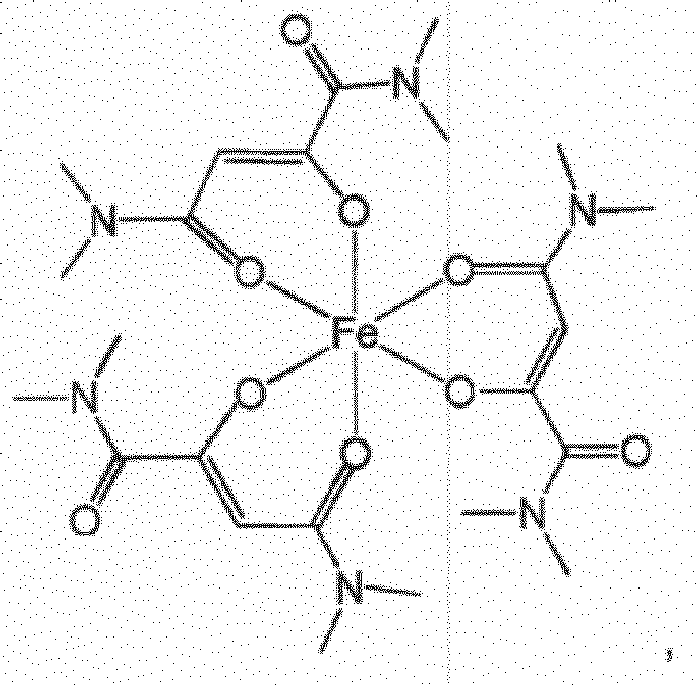
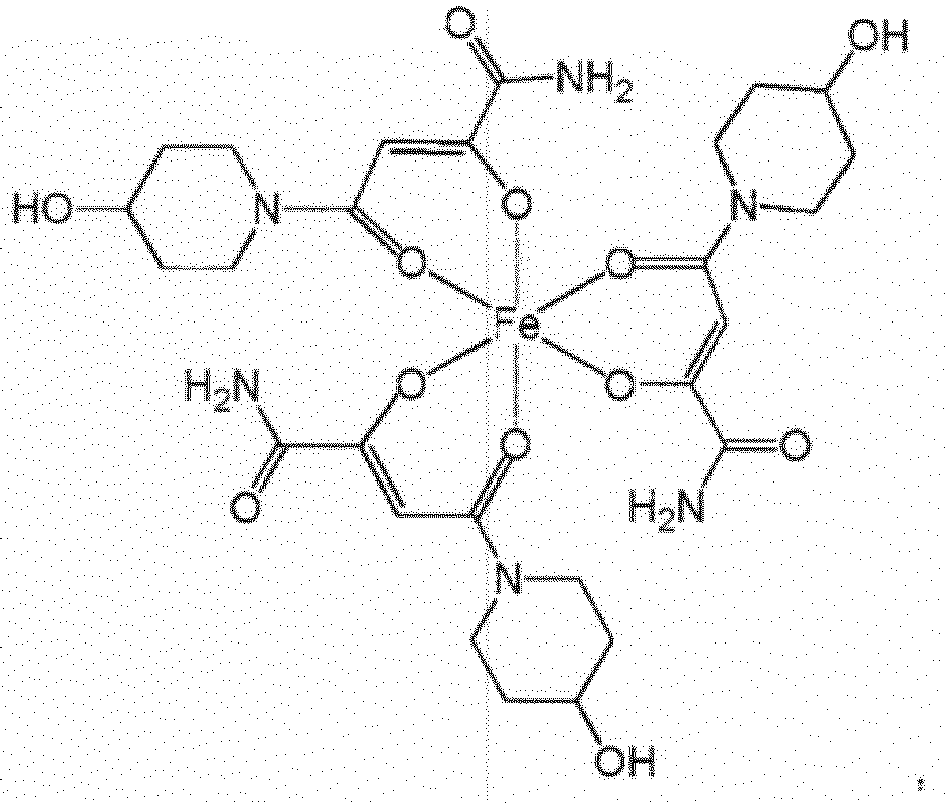

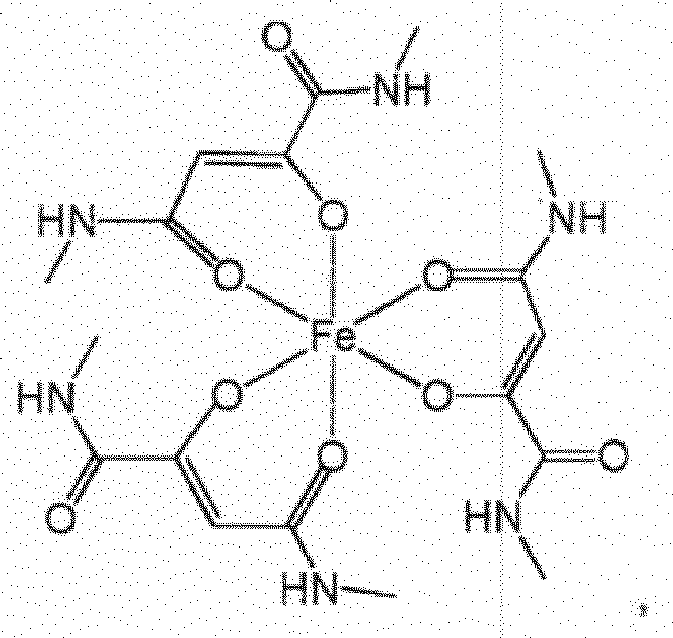


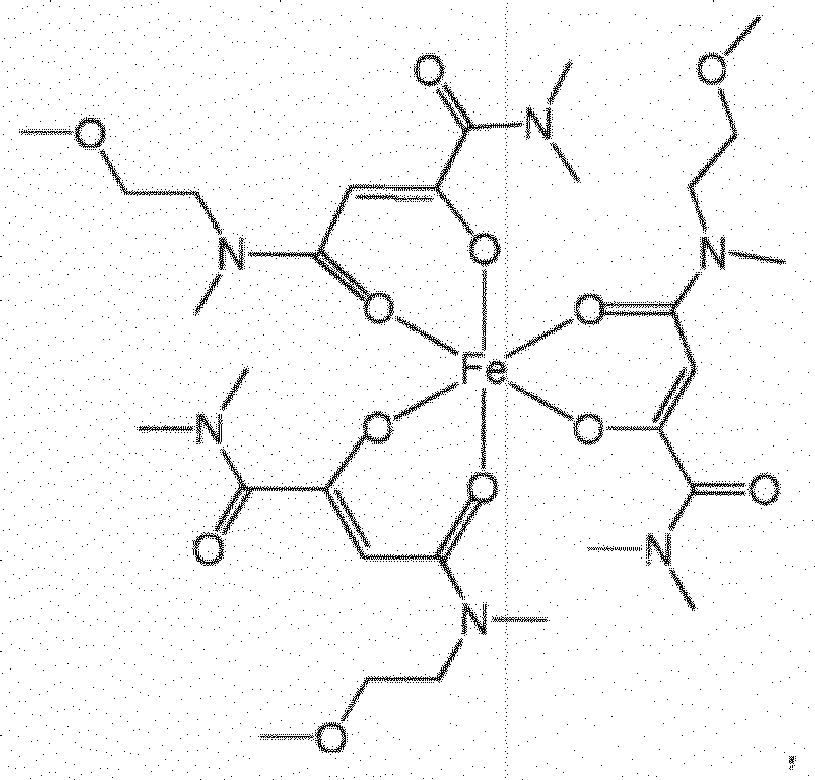


- Des composés complexes de fer (III) ou des sels pharmaceutiquement acceptables de ceux-ci pour l'utilisation dans le traitement et la prophylaxie des symptômes de carence en fer et des anémies ferriprives selon l'une des revendications 1 à 9, comprenant une solubilité dans l'eau à 25°C et à pH 6,5 d'au moins 0,3 mg/ml basé sur le fer.
- Des composés complexes de fer (III) pour l'utilisation dans le traitement et la prophylaxie des symptômes de carence en fer et des anémies ferriprives selon l'une des revendications 1 à 10 pour le traitement et la prophylaxie des symptômes de carence en fer et des anémies ferriprives,
les symptômes comprenant notamment : la fatigue, l'apathie, le manque de concentration, l'efficacité cognitive faible, des difficultés de trouver les bons mots, des troubles de mémoire, une pâleur non-naturelle, l'irritabilité, l'augmentation du rythme cardiaque (tachycardie), la langue endolorie ou gonflée, une rate gonflée, des envies de femmes enceintes (pica), des maux de tête, le manque d'appétit, la susceptibilité accrue aux infections, des états dépressifs. - Des composés complexes de fer (III) pour l'utilisation dans le traitement et la prophylaxie des symptômes de carence en fer et des anémies ferriprives selon l'une des revendications 1 à 11 pour le traitement et la prophylaxie de l'anémie ferriprive chez les femmes enceintes, de l'anémie ferriprive latente chez les enfants et les adolescents, de l'anémie ferriprive causée par des anormalités gastro-intestinales, de l'anémie ferriprive causée par des pertes de sang, telles que des saignements gastro-intestinaux causés par des ulcères, des carcinomes, des hémorroïdes, par des troubles inflammatoires ainsi que par la prise d'acide acétylsalicylique, de l'anémie ferriprive causée par la menstruation, de l'anémie ferriprive causée par des blessures, de l'anémie ferriprive causée par le psilosis (maladie coeliaque), de l'anémie ferriprive causée par un apport réduit en fer dans l'alimentation, notamment chez des enfants et des adolescents, qui mangent sélectivement, de l'immunodéficience causée par l'anémie ferriprive, de la déficience de la capacité cérébrale causée par les anémies ferriprives, du syndrome de jambes sans repos causé par les anémies ferriprives, des anémies ferriprives en cas de cancer, des anémies ferriprives causées par des chimiothérapies, des anémies ferriprives causées par une inflammation (AI), des anémies ferriprives en cas de défaillance cardiaque congestive (CHF, congestive heart failure), des anémies ferriprives en cas d'insuffisance rénale chronique stade 3-5 ; chronic kidney diseases stage 3-5), des anémies ferriprives causées par une inflammation chronique (ACD), des anémies ferriprives en cas d'arthrite rhumatoïde (RA ; rheumatoid arthritis), des anémies ferriprives en cas de Lupus érythémateux disséminé (SLE ; systemic lupus erythematosus), des anémies ferriprives en cas de maladie inflammatoire de l'intestin (IBD ; inflammatory bowel diseases), de l'anémie ferriprive en cas de taux d'hémoglobine dans la plage normale.
- Des composés complexes de fer (III) pour l'utilisation dans le traitement et la prophylaxie des symptômes de carence en fer et des anémies ferriprives selon l'une des revendications 1 à 12 pour l'administration orale, notamment pour l'administration sous forme d'un comprimé ou d'une capsule.
- Produit pharmaceutique pour l'utilisation dans le traitement et la prophylaxie des symptômes de carence en fer et des anémies ferriprives, contenant des composés complexes de fer (III) tels que définis selon l'une des revendications 1 à 10.
- Produit pharmaceutique pour l'utilisation dans le traitement et la prophylaxie des symptômes de carence en fer et des anémies ferriprives, contenant des composés complexes de fer (III) tels que définis selon l'une des revendications 1 à 10 ainsi qu'au moins un porteur ou excipient physiologiquement acceptable et/ou au moins un autre produit pharmaceutique, qui agit sur le métabolisme du fer.
Priority Applications (1)
| Application Number | Priority Date | Filing Date | Title |
|---|---|---|---|
| EP13814901.8A EP2934508B1 (fr) | 2012-12-21 | 2013-12-19 | Liaisons de complexes de fe(iii)-2-oxo-butanediamide pour le traitement et la prophylaxie des carences en fer et des anémies |
Applications Claiming Priority (3)
| Application Number | Priority Date | Filing Date | Title |
|---|---|---|---|
| EP12199075 | 2012-12-21 | ||
| EP13814901.8A EP2934508B1 (fr) | 2012-12-21 | 2013-12-19 | Liaisons de complexes de fe(iii)-2-oxo-butanediamide pour le traitement et la prophylaxie des carences en fer et des anémies |
| PCT/EP2013/077383 WO2014096193A1 (fr) | 2012-12-21 | 2013-12-19 | Composés à base de complexes de fe(iii) pour le traitement et la prévention de carences en fer et d'anémies ferriprives |
Publications (2)
| Publication Number | Publication Date |
|---|---|
| EP2934508A1 EP2934508A1 (fr) | 2015-10-28 |
| EP2934508B1 true EP2934508B1 (fr) | 2017-12-06 |
Family
ID=47500992
Family Applications (1)
| Application Number | Title | Priority Date | Filing Date |
|---|---|---|---|
| EP13814901.8A Active EP2934508B1 (fr) | 2012-12-21 | 2013-12-19 | Liaisons de complexes de fe(iii)-2-oxo-butanediamide pour le traitement et la prophylaxie des carences en fer et des anémies |
Country Status (14)
| Country | Link |
|---|---|
| US (1) | US9452152B2 (fr) |
| EP (1) | EP2934508B1 (fr) |
| JP (1) | JP6172691B2 (fr) |
| KR (1) | KR101798605B1 (fr) |
| CN (1) | CN105246473B (fr) |
| AR (1) | AR094237A1 (fr) |
| AU (1) | AU2013366649B2 (fr) |
| BR (1) | BR112015014917A2 (fr) |
| CA (1) | CA2891572A1 (fr) |
| ES (1) | ES2658818T3 (fr) |
| MX (1) | MX2015007974A (fr) |
| RU (1) | RU2641030C2 (fr) |
| TW (1) | TW201429470A (fr) |
| WO (1) | WO2014096193A1 (fr) |
Families Citing this family (2)
| Publication number | Priority date | Publication date | Assignee | Title |
|---|---|---|---|---|
| US8976994B2 (en) | 2012-06-20 | 2015-03-10 | Apple Inc. | Earphone having an acoustic tuning mechanism |
| RU2759044C1 (ru) * | 2020-09-23 | 2021-11-09 | Федеральное государственное бюджетное учреждение "Российский научно-исследовательский институт гематологии и трансфузиологии Федерального медико-биологического агентства" (ФГБУ РосНИИГТ ФМБА России) | Способ коррекции анемии в предоперационном периоде у больных раком желудка |
Family Cites Families (22)
| Publication number | Priority date | Publication date | Assignee | Title |
|---|---|---|---|---|
| US474670A (en) | 1892-05-10 | Automatic fire-alarm | ||
| EP0107458B1 (fr) | 1982-10-22 | 1987-07-29 | National Research Development Corporation | Compositions pharmaceutiques |
| GB8325496D0 (en) | 1983-09-23 | 1983-10-26 | Hider R C | Pharmaceutical compositions |
| US4788281A (en) | 1984-01-04 | 1988-11-29 | Tosoni Anthony L | Dextran hexonic acid derivative, ferric hydroxide complex and method manufacture thereof |
| GB8410289D0 (en) | 1984-04-19 | 1984-05-31 | Callingham B A | Pharmaceutical compositions |
| IT1222654B (it) | 1987-09-14 | 1990-09-12 | Schering Ag | Complesso micellare di ferro-citrato |
| JPH0283400A (ja) | 1988-09-21 | 1990-03-23 | Snow Brand Milk Prod Co Ltd | 鉄カゼインの製造方法 |
| ES2044777B1 (es) | 1992-03-03 | 1994-08-01 | Dabeer Sa | Procedimiento de obtencion de un quelato de hierro de gran solubilidad. |
| US20030236224A1 (en) | 1997-12-09 | 2003-12-25 | Hedlund Bo E. | Modified polysaccharides exhibiting altered biological recognition |
| IT1297022B1 (it) | 1997-12-24 | 1999-08-03 | Chemi Spa | Complesso di ferro-succinilcaseina, processo per la sua preparazione e composizioni farmaceutiche che lo contengono |
| DE10253843B3 (de) | 2002-11-14 | 2004-05-06 | Bizerba Gmbh & Co. Kg | Etikettiervorrichtung für bewegte Gegenstände und Verfahren zur Etikettierung von bewegten Gegenständen |
| SE0400235D0 (sv) | 2004-02-06 | 2004-02-06 | Active Biotech Ab | New composition containing quinoline compounds |
| MX2007004036A (es) | 2004-10-08 | 2007-05-24 | Unilever Nv | Complejo de hierro para uso en el tratamiento y/o prevencion de trastornos nutricionales. |
| US20090035385A1 (en) | 2004-12-22 | 2009-02-05 | Drugtech Corporation | Compositions including iron |
| CN100443485C (zh) | 2005-04-08 | 2008-12-17 | 吴华君 | 叶绿酸合铁钠盐衍生物、制备方法及用途 |
| WO2007062546A1 (fr) | 2005-11-30 | 2007-06-07 | Chongqing Pharmaceutical Research Institute Co., Ltd. | Complexes fer-saccharide faciles a reconstituer et leur procede de fabrication |
| EP1947120A1 (fr) * | 2007-01-19 | 2008-07-23 | Vifor (International) Ag | Liaisons complexes d'hydrate de carbone de fer |
| FR2916592B1 (fr) | 2007-05-25 | 2017-04-14 | Groupe Des Ecoles De Telecommunications(Get)-Ecole Nat Superieure Des Telecommunications(Enst) | Procede de securisation d'echange d'information,dispositif, et produit programme d'ordinateur correspondant |
| CN101481404B (zh) | 2008-12-17 | 2011-10-05 | 中国农业大学 | 一种酶解乳蛋白亚铁络合物微胶囊补铁剂及其制备方法 |
| BR112012023780A2 (pt) | 2010-03-23 | 2018-07-24 | Vifor (International) Ag | compostos complexos de ferro (iii) - b - cetoamida ou sais farmaceuticamente toleráveis desses, processo para a produção dos compostos complexos de ferro (iii), uso de compostos complexos de ferro (iii), fármaco contendo compostos complexos de ferro (iii) e composição contendo compostos complexos de ferro (iii) |
| PE20141319A1 (es) | 2011-03-29 | 2014-10-29 | Vifor Int Ag | Compuesto de complejos de fe(iii) para el tratamiento y profilaxis de sintomas de deficiencia de hierro y anemias por deficiencia de hierro |
| US20140248342A1 (en) | 2011-05-31 | 2014-09-04 | Vifor (International) Ag | Fe(III) 2,4-Dioxo-1-Carbonyl Complexes For Treatment And Prophylaxis Of Iron Deficiency Symptoms And Iron Deficiency Anaemias |
-
2013
- 2013-12-19 BR BR112015014917A patent/BR112015014917A2/pt not_active Application Discontinuation
- 2013-12-19 MX MX2015007974A patent/MX2015007974A/es active IP Right Grant
- 2013-12-19 JP JP2015548577A patent/JP6172691B2/ja not_active Expired - Fee Related
- 2013-12-19 CN CN201380066912.2A patent/CN105246473B/zh not_active Expired - Fee Related
- 2013-12-19 WO PCT/EP2013/077383 patent/WO2014096193A1/fr not_active Ceased
- 2013-12-19 KR KR1020157016537A patent/KR101798605B1/ko not_active Expired - Fee Related
- 2013-12-19 EP EP13814901.8A patent/EP2934508B1/fr active Active
- 2013-12-19 RU RU2015129842A patent/RU2641030C2/ru active
- 2013-12-19 ES ES13814901.8T patent/ES2658818T3/es active Active
- 2013-12-19 CA CA2891572A patent/CA2891572A1/fr not_active Abandoned
- 2013-12-19 AU AU2013366649A patent/AU2013366649B2/en not_active Ceased
- 2013-12-19 US US14/650,325 patent/US9452152B2/en not_active Expired - Fee Related
- 2013-12-20 TW TW102147461A patent/TW201429470A/zh unknown
- 2013-12-20 AR ARP130104974A patent/AR094237A1/es unknown
Also Published As
| Publication number | Publication date |
|---|---|
| MX2015007974A (es) | 2016-03-09 |
| TW201429470A (zh) | 2014-08-01 |
| KR20150099755A (ko) | 2015-09-01 |
| US9452152B2 (en) | 2016-09-27 |
| KR101798605B1 (ko) | 2017-11-16 |
| CN105246473A (zh) | 2016-01-13 |
| RU2015129842A (ru) | 2017-01-25 |
| RU2641030C2 (ru) | 2018-01-15 |
| AR094237A1 (es) | 2015-07-22 |
| WO2014096193A1 (fr) | 2014-06-26 |
| BR112015014917A2 (pt) | 2017-07-11 |
| AU2013366649A1 (en) | 2015-06-04 |
| CN105246473B (zh) | 2018-07-13 |
| ES2658818T3 (es) | 2018-03-12 |
| US20150313864A1 (en) | 2015-11-05 |
| AU2013366649B2 (en) | 2018-02-01 |
| CA2891572A1 (fr) | 2014-06-26 |
| EP2934508A1 (fr) | 2015-10-28 |
| JP2016508975A (ja) | 2016-03-24 |
| JP6172691B2 (ja) | 2017-08-02 |
Similar Documents
| Publication | Publication Date | Title |
|---|---|---|
| EP2549991B1 (fr) | Liaisons de complexes de fe(iii) pour le traitement et la prophylaxie des carences en fer et des anémies | |
| DE69223157T2 (de) | Sauerstoff-substituierte derivate von nucleophil-stickstoffoxid-addukten und ihre verwendung als stickstoffoxid-donor-prodrugs | |
| EP2833890B1 (fr) | Complexes de fe(iii)-pyrazine pour le traitement et la prophylaxie des carences en fer et des anémies | |
| EP2978427B1 (fr) | Liaisons de complexes de fe(iii) pour le traitement et la prophylaxie des carences en fer et des anémies | |
| EP2691376B1 (fr) | Composés à base de complexes de fe(iii) pour le traitement et la prévention de carences en fer et d'anémies dues à une carence en fer | |
| EP2934508A1 (fr) | Composés à base de complexes de fe(iii) pour le traitement et la prévention de carences en fer et d'anémies ferriprives | |
| EP2714030B1 (fr) | Complexes de type 2,4-dioxo-1-carbonyle de fe(iii) pour leur utilisation dans le traitement et la prophylaxie de carences en fer et d'anemies ferriprives | |
| DE19510229A1 (de) | Antimikrobiell und antineoplastisch wirkende Bismutverbindungen mit Tropolon-, Thiosemicarbazon- und Dithiocarbazonsäureesterverbindungen und diese enthaltende Arzneimittel | |
| DE60202944T2 (de) | Neue salze und kristalline formen von (2r)-anti-5-3-(4-(10,11-difluoromethanodibenzosuber-5-yl)piperazin-1-yl)-2-hydroxypropoxy quinolin | |
| DE4102921A1 (de) | Neue indol-derivate, verfahren zu deren herstellung, deren anwendung als medikamente und sie enthaltende zusammensetzungen |
Legal Events
| Date | Code | Title | Description |
|---|---|---|---|
| PUAI | Public reference made under article 153(3) epc to a published international application that has entered the european phase |
Free format text: ORIGINAL CODE: 0009012 |
|
| 17P | Request for examination filed |
Effective date: 20150520 |
|
| AK | Designated contracting states |
Kind code of ref document: A1 Designated state(s): AL AT BE BG CH CY CZ DE DK EE ES FI FR GB GR HR HU IE IS IT LI LT LU LV MC MK MT NL NO PL PT RO RS SE SI SK SM TR |
|
| AX | Request for extension of the european patent |
Extension state: BA ME |
|
| DAX | Request for extension of the european patent (deleted) | ||
| GRAP | Despatch of communication of intention to grant a patent |
Free format text: ORIGINAL CODE: EPIDOSNIGR1 |
|
| RIC1 | Information provided on ipc code assigned before grant |
Ipc: A61P 7/06 20060101ALI20170306BHEP Ipc: A61K 31/555 20060101ALI20170306BHEP Ipc: A61K 45/06 20060101ALI20170306BHEP Ipc: A61K 31/295 20060101AFI20170306BHEP |
|
| INTG | Intention to grant announced |
Effective date: 20170328 |
|
| GRAS | Grant fee paid |
Free format text: ORIGINAL CODE: EPIDOSNIGR3 |
|
| GRAJ | Information related to disapproval of communication of intention to grant by the applicant or resumption of examination proceedings by the epo deleted |
Free format text: ORIGINAL CODE: EPIDOSDIGR1 |
|
| GRAL | Information related to payment of fee for publishing/printing deleted |
Free format text: ORIGINAL CODE: EPIDOSDIGR3 |
|
| GRAR | Information related to intention to grant a patent recorded |
Free format text: ORIGINAL CODE: EPIDOSNIGR71 |
|
| INTC | Intention to grant announced (deleted) | ||
| INTG | Intention to grant announced |
Effective date: 20170922 |
|
| GRAA | (expected) grant |
Free format text: ORIGINAL CODE: 0009210 |
|
| AK | Designated contracting states |
Kind code of ref document: B1 Designated state(s): AL AT BE BG CH CY CZ DE DK EE ES FI FR GB GR HR HU IE IS IT LI LT LU LV MC MK MT NL NO PL PT RO RS SE SI SK SM TR |
|
| REG | Reference to a national code |
Ref country code: GB Ref legal event code: FG4D Free format text: NOT ENGLISH |
|
| REG | Reference to a national code |
Ref country code: AT Ref legal event code: REF Ref document number: 951749 Country of ref document: AT Kind code of ref document: T Effective date: 20171215 Ref country code: CH Ref legal event code: EP Ref country code: CH Ref legal event code: NV Representative=s name: E. BLUM AND CO. AG PATENT- UND MARKENANWAELTE , CH |
|
| REG | Reference to a national code |
Ref country code: FR Ref legal event code: PLFP Year of fee payment: 5 |
|
| REG | Reference to a national code |
Ref country code: IE Ref legal event code: FG4D Free format text: LANGUAGE OF EP DOCUMENT: GERMAN |
|
| REG | Reference to a national code |
Ref country code: DE Ref legal event code: R096 Ref document number: 502013008984 Country of ref document: DE |
|
| REG | Reference to a national code |
Ref country code: ES Ref legal event code: FG2A Ref document number: 2658818 Country of ref document: ES Kind code of ref document: T3 Effective date: 20180312 |
|
| REG | Reference to a national code |
Ref country code: NL Ref legal event code: MP Effective date: 20171206 |
|
| REG | Reference to a national code |
Ref country code: LT Ref legal event code: MG4D |
|
| PG25 | Lapsed in a contracting state [announced via postgrant information from national office to epo] |
Ref country code: NO Free format text: LAPSE BECAUSE OF FAILURE TO SUBMIT A TRANSLATION OF THE DESCRIPTION OR TO PAY THE FEE WITHIN THE PRESCRIBED TIME-LIMIT Effective date: 20180306 Ref country code: LT Free format text: LAPSE BECAUSE OF FAILURE TO SUBMIT A TRANSLATION OF THE DESCRIPTION OR TO PAY THE FEE WITHIN THE PRESCRIBED TIME-LIMIT Effective date: 20171206 Ref country code: FI Free format text: LAPSE BECAUSE OF FAILURE TO SUBMIT A TRANSLATION OF THE DESCRIPTION OR TO PAY THE FEE WITHIN THE PRESCRIBED TIME-LIMIT Effective date: 20171206 Ref country code: SE Free format text: LAPSE BECAUSE OF FAILURE TO SUBMIT A TRANSLATION OF THE DESCRIPTION OR TO PAY THE FEE WITHIN THE PRESCRIBED TIME-LIMIT Effective date: 20171206 |
|
| PG25 | Lapsed in a contracting state [announced via postgrant information from national office to epo] |
Ref country code: RS Free format text: LAPSE BECAUSE OF FAILURE TO SUBMIT A TRANSLATION OF THE DESCRIPTION OR TO PAY THE FEE WITHIN THE PRESCRIBED TIME-LIMIT Effective date: 20171206 Ref country code: BG Free format text: LAPSE BECAUSE OF FAILURE TO SUBMIT A TRANSLATION OF THE DESCRIPTION OR TO PAY THE FEE WITHIN THE PRESCRIBED TIME-LIMIT Effective date: 20180306 Ref country code: HR Free format text: LAPSE BECAUSE OF FAILURE TO SUBMIT A TRANSLATION OF THE DESCRIPTION OR TO PAY THE FEE WITHIN THE PRESCRIBED TIME-LIMIT Effective date: 20171206 Ref country code: GR Free format text: LAPSE BECAUSE OF FAILURE TO SUBMIT A TRANSLATION OF THE DESCRIPTION OR TO PAY THE FEE WITHIN THE PRESCRIBED TIME-LIMIT Effective date: 20180307 Ref country code: LV Free format text: LAPSE BECAUSE OF FAILURE TO SUBMIT A TRANSLATION OF THE DESCRIPTION OR TO PAY THE FEE WITHIN THE PRESCRIBED TIME-LIMIT Effective date: 20171206 |
|
| PG25 | Lapsed in a contracting state [announced via postgrant information from national office to epo] |
Ref country code: NL Free format text: LAPSE BECAUSE OF FAILURE TO SUBMIT A TRANSLATION OF THE DESCRIPTION OR TO PAY THE FEE WITHIN THE PRESCRIBED TIME-LIMIT Effective date: 20171206 |
|
| PG25 | Lapsed in a contracting state [announced via postgrant information from national office to epo] |
Ref country code: SK Free format text: LAPSE BECAUSE OF FAILURE TO SUBMIT A TRANSLATION OF THE DESCRIPTION OR TO PAY THE FEE WITHIN THE PRESCRIBED TIME-LIMIT Effective date: 20171206 Ref country code: CZ Free format text: LAPSE BECAUSE OF FAILURE TO SUBMIT A TRANSLATION OF THE DESCRIPTION OR TO PAY THE FEE WITHIN THE PRESCRIBED TIME-LIMIT Effective date: 20171206 Ref country code: EE Free format text: LAPSE BECAUSE OF FAILURE TO SUBMIT A TRANSLATION OF THE DESCRIPTION OR TO PAY THE FEE WITHIN THE PRESCRIBED TIME-LIMIT Effective date: 20171206 |
|
| PG25 | Lapsed in a contracting state [announced via postgrant information from national office to epo] |
Ref country code: SM Free format text: LAPSE BECAUSE OF FAILURE TO SUBMIT A TRANSLATION OF THE DESCRIPTION OR TO PAY THE FEE WITHIN THE PRESCRIBED TIME-LIMIT Effective date: 20171206 Ref country code: PL Free format text: LAPSE BECAUSE OF FAILURE TO SUBMIT A TRANSLATION OF THE DESCRIPTION OR TO PAY THE FEE WITHIN THE PRESCRIBED TIME-LIMIT Effective date: 20171206 Ref country code: RO Free format text: LAPSE BECAUSE OF FAILURE TO SUBMIT A TRANSLATION OF THE DESCRIPTION OR TO PAY THE FEE WITHIN THE PRESCRIBED TIME-LIMIT Effective date: 20171206 |
|
| REG | Reference to a national code |
Ref country code: DE Ref legal event code: R097 Ref document number: 502013008984 Country of ref document: DE |
|
| REG | Reference to a national code |
Ref country code: IE Ref legal event code: MM4A |
|
| PG25 | Lapsed in a contracting state [announced via postgrant information from national office to epo] |
Ref country code: MT Free format text: LAPSE BECAUSE OF FAILURE TO SUBMIT A TRANSLATION OF THE DESCRIPTION OR TO PAY THE FEE WITHIN THE PRESCRIBED TIME-LIMIT Effective date: 20171206 Ref country code: LU Free format text: LAPSE BECAUSE OF NON-PAYMENT OF DUE FEES Effective date: 20171219 Ref country code: MC Free format text: LAPSE BECAUSE OF FAILURE TO SUBMIT A TRANSLATION OF THE DESCRIPTION OR TO PAY THE FEE WITHIN THE PRESCRIBED TIME-LIMIT Effective date: 20171206 |
|
| PLBE | No opposition filed within time limit |
Free format text: ORIGINAL CODE: 0009261 |
|
| STAA | Information on the status of an ep patent application or granted ep patent |
Free format text: STATUS: NO OPPOSITION FILED WITHIN TIME LIMIT |
|
| REG | Reference to a national code |
Ref country code: BE Ref legal event code: MM Effective date: 20171231 |
|
| PG25 | Lapsed in a contracting state [announced via postgrant information from national office to epo] |
Ref country code: IE Free format text: LAPSE BECAUSE OF NON-PAYMENT OF DUE FEES Effective date: 20171219 |
|
| 26N | No opposition filed |
Effective date: 20180907 |
|
| PG25 | Lapsed in a contracting state [announced via postgrant information from national office to epo] |
Ref country code: SI Free format text: LAPSE BECAUSE OF FAILURE TO SUBMIT A TRANSLATION OF THE DESCRIPTION OR TO PAY THE FEE WITHIN THE PRESCRIBED TIME-LIMIT Effective date: 20171206 Ref country code: DK Free format text: LAPSE BECAUSE OF FAILURE TO SUBMIT A TRANSLATION OF THE DESCRIPTION OR TO PAY THE FEE WITHIN THE PRESCRIBED TIME-LIMIT Effective date: 20171206 Ref country code: BE Free format text: LAPSE BECAUSE OF NON-PAYMENT OF DUE FEES Effective date: 20171231 |
|
| PG25 | Lapsed in a contracting state [announced via postgrant information from national office to epo] |
Ref country code: HU Free format text: LAPSE BECAUSE OF FAILURE TO SUBMIT A TRANSLATION OF THE DESCRIPTION OR TO PAY THE FEE WITHIN THE PRESCRIBED TIME-LIMIT; INVALID AB INITIO Effective date: 20131219 |
|
| PG25 | Lapsed in a contracting state [announced via postgrant information from national office to epo] |
Ref country code: CY Free format text: LAPSE BECAUSE OF FAILURE TO SUBMIT A TRANSLATION OF THE DESCRIPTION OR TO PAY THE FEE WITHIN THE PRESCRIBED TIME-LIMIT Effective date: 20171206 |
|
| PG25 | Lapsed in a contracting state [announced via postgrant information from national office to epo] |
Ref country code: MK Free format text: LAPSE BECAUSE OF FAILURE TO SUBMIT A TRANSLATION OF THE DESCRIPTION OR TO PAY THE FEE WITHIN THE PRESCRIBED TIME-LIMIT Effective date: 20171206 |
|
| REG | Reference to a national code |
Ref country code: AT Ref legal event code: MM01 Ref document number: 951749 Country of ref document: AT Kind code of ref document: T Effective date: 20181219 |
|
| PG25 | Lapsed in a contracting state [announced via postgrant information from national office to epo] |
Ref country code: TR Free format text: LAPSE BECAUSE OF FAILURE TO SUBMIT A TRANSLATION OF THE DESCRIPTION OR TO PAY THE FEE WITHIN THE PRESCRIBED TIME-LIMIT Effective date: 20171206 |
|
| PG25 | Lapsed in a contracting state [announced via postgrant information from national office to epo] |
Ref country code: AT Free format text: LAPSE BECAUSE OF NON-PAYMENT OF DUE FEES Effective date: 20181219 |
|
| PG25 | Lapsed in a contracting state [announced via postgrant information from national office to epo] |
Ref country code: PT Free format text: LAPSE BECAUSE OF FAILURE TO SUBMIT A TRANSLATION OF THE DESCRIPTION OR TO PAY THE FEE WITHIN THE PRESCRIBED TIME-LIMIT Effective date: 20171206 |
|
| PG25 | Lapsed in a contracting state [announced via postgrant information from national office to epo] |
Ref country code: AL Free format text: LAPSE BECAUSE OF FAILURE TO SUBMIT A TRANSLATION OF THE DESCRIPTION OR TO PAY THE FEE WITHIN THE PRESCRIBED TIME-LIMIT Effective date: 20171206 Ref country code: IS Free format text: LAPSE BECAUSE OF FAILURE TO SUBMIT A TRANSLATION OF THE DESCRIPTION OR TO PAY THE FEE WITHIN THE PRESCRIBED TIME-LIMIT Effective date: 20180406 |
|
| PGFP | Annual fee paid to national office [announced via postgrant information from national office to epo] |
Ref country code: IT Payment date: 20221129 Year of fee payment: 10 Ref country code: GB Payment date: 20221215 Year of fee payment: 10 Ref country code: FR Payment date: 20221215 Year of fee payment: 10 |
|
| PGFP | Annual fee paid to national office [announced via postgrant information from national office to epo] |
Ref country code: ES Payment date: 20230103 Year of fee payment: 10 Ref country code: CH Payment date: 20221215 Year of fee payment: 10 |
|
| PGFP | Annual fee paid to national office [announced via postgrant information from national office to epo] |
Ref country code: DE Payment date: 20221223 Year of fee payment: 10 |
|
| REG | Reference to a national code |
Ref country code: DE Ref legal event code: R119 Ref document number: 502013008984 Country of ref document: DE |
|
| REG | Reference to a national code |
Ref country code: CH Ref legal event code: PL |
|
| GBPC | Gb: european patent ceased through non-payment of renewal fee |
Effective date: 20231219 |
|
| PG25 | Lapsed in a contracting state [announced via postgrant information from national office to epo] |
Ref country code: DE Free format text: LAPSE BECAUSE OF NON-PAYMENT OF DUE FEES Effective date: 20240702 |
|
| PG25 | Lapsed in a contracting state [announced via postgrant information from national office to epo] |
Ref country code: GB Free format text: LAPSE BECAUSE OF NON-PAYMENT OF DUE FEES Effective date: 20231219 |
|
| PG25 | Lapsed in a contracting state [announced via postgrant information from national office to epo] |
Ref country code: FR Free format text: LAPSE BECAUSE OF NON-PAYMENT OF DUE FEES Effective date: 20231231 |
|
| PG25 | Lapsed in a contracting state [announced via postgrant information from national office to epo] |
Ref country code: CH Free format text: LAPSE BECAUSE OF NON-PAYMENT OF DUE FEES Effective date: 20231231 |
|
| PG25 | Lapsed in a contracting state [announced via postgrant information from national office to epo] |
Ref country code: GB Free format text: LAPSE BECAUSE OF NON-PAYMENT OF DUE FEES Effective date: 20231219 Ref country code: FR Free format text: LAPSE BECAUSE OF NON-PAYMENT OF DUE FEES Effective date: 20231231 Ref country code: DE Free format text: LAPSE BECAUSE OF NON-PAYMENT OF DUE FEES Effective date: 20240702 Ref country code: CH Free format text: LAPSE BECAUSE OF NON-PAYMENT OF DUE FEES Effective date: 20231231 |
|
| REG | Reference to a national code |
Ref country code: ES Ref legal event code: FD2A Effective date: 20250131 |
|
| PG25 | Lapsed in a contracting state [announced via postgrant information from national office to epo] |
Ref country code: ES Free format text: LAPSE BECAUSE OF NON-PAYMENT OF DUE FEES Effective date: 20231220 |
|
| PG25 | Lapsed in a contracting state [announced via postgrant information from national office to epo] |
Ref country code: IT Free format text: LAPSE BECAUSE OF NON-PAYMENT OF DUE FEES Effective date: 20231219 |