EP2934793B1 - Herstellung von edelmetall-nanopartikeln - Google Patents
Herstellung von edelmetall-nanopartikeln Download PDFInfo
- Publication number
- EP2934793B1 EP2934793B1 EP13819044.2A EP13819044A EP2934793B1 EP 2934793 B1 EP2934793 B1 EP 2934793B1 EP 13819044 A EP13819044 A EP 13819044A EP 2934793 B1 EP2934793 B1 EP 2934793B1
- Authority
- EP
- European Patent Office
- Prior art keywords
- metal
- electrode
- pulse
- particles
- nanoparticles
- Prior art date
- Legal status (The legal status is an assumption and is not a legal conclusion. Google has not performed a legal analysis and makes no representation as to the accuracy of the status listed.)
- Active
Links
Images

Classifications
-
- B—PERFORMING OPERATIONS; TRANSPORTING
- B22—CASTING; POWDER METALLURGY
- B22F—WORKING METALLIC POWDER; MANUFACTURE OF ARTICLES FROM METALLIC POWDER; MAKING METALLIC POWDER; APPARATUS OR DEVICES SPECIALLY ADAPTED FOR METALLIC POWDER
- B22F9/00—Making metallic powder or suspensions thereof
- B22F9/16—Making metallic powder or suspensions thereof using chemical processes
- B22F9/18—Making metallic powder or suspensions thereof using chemical processes with reduction of metal compounds
- B22F9/24—Making metallic powder or suspensions thereof using chemical processes with reduction of metal compounds starting from liquid metal compounds, e.g. solutions
-
- C—CHEMISTRY; METALLURGY
- C25—ELECTROLYTIC OR ELECTROPHORETIC PROCESSES; APPARATUS THEREFOR
- C25C—PROCESSES FOR THE ELECTROLYTIC PRODUCTION, RECOVERY OR REFINING OF METALS; APPARATUS THEREFOR
- C25C5/00—Electrolytic production, recovery or refining of metal powders or porous metal masses
- C25C5/02—Electrolytic production, recovery or refining of metal powders or porous metal masses from solutions
-
- B—PERFORMING OPERATIONS; TRANSPORTING
- B22—CASTING; POWDER METALLURGY
- B22F—WORKING METALLIC POWDER; MANUFACTURE OF ARTICLES FROM METALLIC POWDER; MAKING METALLIC POWDER; APPARATUS OR DEVICES SPECIALLY ADAPTED FOR METALLIC POWDER
- B22F1/00—Metallic powder; Treatment of metallic powder, e.g. to facilitate working or to improve properties
- B22F1/05—Metallic powder characterised by the size or surface area of the particles
- B22F1/054—Nanosized particles
- B22F1/056—Submicron particles having a size above 100 nm up to 300 nm
-
- C—CHEMISTRY; METALLURGY
- C25—ELECTROLYTIC OR ELECTROPHORETIC PROCESSES; APPARATUS THEREFOR
- C25C—PROCESSES FOR THE ELECTROLYTIC PRODUCTION, RECOVERY OR REFINING OF METALS; APPARATUS THEREFOR
- C25C1/00—Electrolytic production, recovery or refining of metals by electrolysis of solutions
- C25C1/14—Electrolytic production, recovery or refining of metals by electrolysis of solutions of tin
-
- C—CHEMISTRY; METALLURGY
- C25—ELECTROLYTIC OR ELECTROPHORETIC PROCESSES; APPARATUS THEREFOR
- C25C—PROCESSES FOR THE ELECTROLYTIC PRODUCTION, RECOVERY OR REFINING OF METALS; APPARATUS THEREFOR
- C25C1/00—Electrolytic production, recovery or refining of metals by electrolysis of solutions
- C25C1/20—Electrolytic production, recovery or refining of metals by electrolysis of solutions of noble metals
-
- C—CHEMISTRY; METALLURGY
- C25—ELECTROLYTIC OR ELECTROPHORETIC PROCESSES; APPARATUS THEREFOR
- C25C—PROCESSES FOR THE ELECTROLYTIC PRODUCTION, RECOVERY OR REFINING OF METALS; APPARATUS THEREFOR
- C25C7/00—Constructional parts, or assemblies thereof, of cells; Servicing or operating of cells
- C25C7/02—Electrodes; Connections thereof
-
- C—CHEMISTRY; METALLURGY
- C25—ELECTROLYTIC OR ELECTROPHORETIC PROCESSES; APPARATUS THEREFOR
- C25C—PROCESSES FOR THE ELECTROLYTIC PRODUCTION, RECOVERY OR REFINING OF METALS; APPARATUS THEREFOR
- C25C7/00—Constructional parts, or assemblies thereof, of cells; Servicing or operating of cells
- C25C7/06—Operating or servicing
-
- B—PERFORMING OPERATIONS; TRANSPORTING
- B22—CASTING; POWDER METALLURGY
- B22F—WORKING METALLIC POWDER; MANUFACTURE OF ARTICLES FROM METALLIC POWDER; MAKING METALLIC POWDER; APPARATUS OR DEVICES SPECIALLY ADAPTED FOR METALLIC POWDER
- B22F2999/00—Aspects linked to processes or compositions used in powder metallurgy
Definitions
- the present invention relates to the manufacture of noble metal nanoparticles.
- the present invention concerns a method of producing nanoparticles by electrodeposition.
- Electrodeposition provides a cost effective ( G. Staikov, Electrocrystallisation in Nanotechnology, Wiley-VCH Verlag GmbH & Co KGaA, Weinheim, 2007 ) and non-equipment intensive method for the preparation of nanocrystalline and nanophase metallic materials (metals, alloys, compositionally modulated alloys and composites) as free standing objects even in complex shapes. Electrodeposition can be used with conventional or modified electroplating baths and conditions to produce grain sizes in the range from essentially amorphous to micrometric. The production of nanostructured materials/nanoparticles by electrochemical procedures is very advantageous because of the crucial steps in nanocrystal formation, nuclei formation and nuclei growth, can be controlled by physical parameters i.e.
- Ultramicroelectrodes are the best tools to study concentrated electrolytes ( R. M. Wightman, D. O. Wipf, "Voltammetry at Ultramicro-electrodes" in: A. J. Bard (Ed), Electroanalytical Chemistry, Vol. 15, Marcel Dekker, NY, 1988 .). Ultramicroelectrodes arrays can be easily used in a commercial process and can be manufactured at low cost using well established methods. The usage of ultramicroelectrodes makes the electrodeposition process very efficient mostly due to the increase of mass transport of electroactive species.
- the pulsed electrodeposition technique is a versatile method for the preparation of nanostructured metals and alloys because this technique ( Puippe and Leaman (Ed.), Theory and Practice of Pulse Plating, American Electroplaters and Surface Finishers Society, Orlando, Florida, 1986 ) allows for the preparation of large bulk samples with high purity, low porosity and enhanced thermal stability.
- This electrochemical process enables the adjustment of the nanostructure (grain-size, grain size distribution, microstress) which is responsible for physical and chemical properties.
- metal nuclei are formed during a short nucleation pulse with a high overpotential. The nucleation pulse is followed by the growth pulse, where the nuclei slowly grow at low overpotential to their final size.
- HOPG highly oriented pyrolytic graphite
- boron doped epitaxial 100-oriented diamond layers using a potentiostatic double pulse technique with a particle size in the range of 5 to 30 nm in case of HOPG.
- metallic nanoparticles in the mesoscopic range with average particle diameters of 50 nm and above and very narrow particle size distributions on HOPG ( Penner et al., J. Phys. Chem. B 106 (2002) 3339-3353 ; Liu et al., J. Phys.Chem. B 104 (2000) 9131-9139 ; Ueda et al., Electrochim.
- Patent publication JP 2007327117 A presents utilization of pulse electrolysis and ultrasonic oscillation to provide nano-sized partciles.
- nanoparticle-decorated nanowires serve as a desirable structure for applications including batteries, dye-sensitized solar cells, photoelectrochemical water splitting and catalysis (Feng et al. 2012).
- Silver nanoparticles obtained by chemical reduction technique display appealing properties such as catalytic and antibacterial activity ( Mukherjee et al., Nonoletters, 10 (2001) 515 ; Soudi et al. J. Colloid. Interface Sci.
- Noble metal nanoparticles exhibit increased photochemical activity because of their high surface/volume ratio and unusual electronic properties.
- Noble metal nanoclusters in the nanometer scale display numerous interesting optical, electronic and chemical properties that depend on size enabling them for manifold applications in the development of biological nanosensors and optoelectronic devices.
- inorganic nanoparticles especially bimetallic nanoparticles have attracted much interest among the broad scientific community since the catalytic properties and electronic structures of such nanomaterials can be tuned by varying their compositions and structures ( Schmid et al., Angew Chem. Int. Ed. 30 (1991) 874 ; Joshima et al. Langmuir 1994, 104574. 1994 ; Sinfelt, J. Catal. 29 (1973) 308 ).
- noble metal nanoparticles are produced by a series of different processes depending on the necessary product size and parts.
- Methods such as microemeulsion method yield narrow particle size distributions, but the variation of particle sizes is difficult.
- Sputtering followed by thermal treatment is a convenient deposition method allowing adjustment of different coverage, however the distribution of particle sizes is rather broad.
- the present invention is based on the idea of extracting metal nanoparticles from electrolytic solutions containing ions of the corresponding metals through an electrochemical process on an electrode, wherein the electrolytic solution is subjected to potentiostatic pulse electrolysis in the presence of a first electrode and a second electrode such that electrochemical nucleaction takes a place at the first electrode. Metal particles are extracted from the electrolytic solution.
- metal particles having a maximum dimension of 1 micron or less are produced from a first and a second salt in aqueous solution, the first salt comprising transition metal or semi-metal and the second salt comprising alkali metal or alkaline earth metals, and both of the salts further comprising NO 3 - , SO 4 2- , PO 4 3- , BO 3 3- , ClO 4 - , (COO) 2 2- or halo.
- the aqueous is subjected to a voltage between electrodes such that transition metal or semi-metal particles are formed and dispersed within the aqueous solution, said particles having an average maximum dimension of less than 1 micron; and said particles are separated from the solution, e.g. by filtering.
- the present invention provides for efficient production of metal particles, in particular of particles in one embodiment, nanoparticles, consisting at least to 95% or more of a desired element, are extracted from electrolytic solutions containing two or more metals or metal ions. In a further embodiment, nanoparticles of other elements, consisting at least to 95% or more of a desired element, are sequentially extracted from electrolytic solutions containing two or more metals or metal ions.
- the present invention relates to the manufacture of metal or metalloy nanoparticles from multimetal electrolytes/complex matrix industrial electrolytes by using potentiostatic pulse electrodeposition process.
- the process is suitable for noble metals and transition metals.
- noble metals and transition metals include Ag, Sn, Cu, Au, and Ni; preferred are noble metals, such as Ag, Au and Pt, as well as transition metals, such as Sn and Ni.
- the present technology comprises the steps of extracting metal nanoparticles from electrolytic solutions through an electrochemical process on an electrode, comprising that the metal ions containing electrolytic solution undergoes potentiostatic pulse electrolysis in the presence of a first electrode, which for example is an array electrode containing plurality of micrometer or sub-micrometer sized electrodes, and a second electrode.
- the electrochemical nucleaction takes a place at the first electrode and the metal particles are or extracted, preferably continuously, from the electrolytic solution.
- nanoparticles consisting at least to 95% or more of a desired element, are extracted from electrolytic solutions containing two or more metals or metal ions.
- the desired metal nanoparticles are formed through an electrochemical process on an electrode, wherein the electrolytic solution is subjected to potentiostatic pulse electrolysis in the presence of a first electrode and a second electrode such that electrochemical nucleaction takes a place at the first electrode.
- Metal particles, containing 95% or more of desired metal can be extracted from the electrolytic solution leaving undesired metals in the electrolyte.
- nanoparticles of other elements are sequentially extracted from electrolytic solutions containing two or more metals or metal ions.
- the desired metal nanoparticles are formed through an electrochemical process on an electrode, wherein the electrolytic solution is subjected to potentiostatic pulse electrolysis in the presence of a first electrode and a second electrode such that electrochemical nucleaction takes a place at the first electrode.
- Metal particles, containing 95% or more of desired metal can be extracted from the electrolytic solution leaving undesired metals in the electrolyte. Once the first desired metal has been extracted, process parameters are adjusted to permit removal of a second or further elements.
- metal particle extraction is achieved by combining potentiostatic pulse electrodeposition technique using ultramicroelectrodes (UME) and synchronized ultrasound in the presence of a megasonic transducer.
- UAE ultramicroelectrodes
- the electrolyte is formed by metal ions and corresponding anions of a soluble metal salt in an aqueous medium.
- the electrolyte preferably additionally comprises an acid. It is particularly preferred to employ salts and corresponding acids.
- mineral acids and corresponding metal salts are employed such as hydrochloric acid and chlorides, or suitably nitric acid and nitrates of sulphuric acid and sulphates.
- the electrolytic solution has a pH of less than 7.
- the pH lies in particular in the range from 1 to 6.
- One embodiment of the invention relates to the formation of Ag nanoparticles on the stainless steel (SS) substrate.
- Metal in the form of nanopowders are deposited on the SS surface by potentiostatic pulse electrodeposition from a solution comprising metal nitrate and nitric acid.
- One of the pulse electrodeposition processes includes applying a number of electrical pulses having a pulse width. The number of electrical pulse cycles may be up to 400 and the pulse duration may be from 0-0.1s.
- the number of nanoparticles formed per unit area of the stainless steel surface may be affected by controlling the duration of electrical pulses used for deposition.
- the composition of the nanoparticles placed on the surface of SS substrate may be affected by controlling the chemical composition of the precursor solution.
- the invention comprises producing nanoparticles of a D 100 of less than 100 nm.
- only one type of the metals is extracted from the electrolytic solution.
- only one type of the metals is extracted from the polymetallic electrolytic solution selectively.
- the polymetallic solution may contain impurities as such or other metal salts may have been added in the solution to alter the electrolyte conductivity.
- the number of electrical pulses or pulse cycles is, preferably, less than 450.
- the electrolytic process comprises an ultrasonic or megasonic transducer.
- the first electrode is a diode.
- the diode is a photo diode.
- one the first electrode is a diode, the first electrode passes the current once the diode is activated by a light.
- the potentiostatic pulse changes current direction.
- the anodic potential E a can be about 2.5 V.
- the cathodic potential E c can be about -1.0 V.
- the pulse in the anodic potential is for a period (t a ) of about 0.1 s.
- the pulse in the cathodic potential is for a period (t c ) of about 0.1 s
- the potentiostatic pulse changes current direction.
- the anodic potential E a is regulated to permit selective production of metal nanoparticles with elemental purity of 95% or more.
- the cathodic potential E c can similarly be regulated.
- the pulse in the anodic potential is for a period (t a ) of about 0.1 s.
- the pulse in the cathodic potential is for a period (t c ) of about 0.1 s
- the extracted metal nucleates does not adhere on the cathode and returns back to the plating solution as free particles or nanoparticles.
- the present method makes it possible to regulate the size of the particles by simply adjusting the distance between the electrodes.
- the electrodes are spaced apart at a first distance in order to produce particles having a first size and then the electrodes are shifted so as to be spaced apart at a second distance in order to produce particles having a second size, second size being greater than the first size when the second distance is smaller than the first distance.
- the method is carried out in an apparatus for obtaining Ag or Sn nanopowders from industrial electrolytes through electrochemical deposition of Ag or Sn on the cathode.
- the electrolytic solution comprises Ag ions, for example at a concentration of about 5 g/L to 80 g/L.
- the electrolytic solution comprises Sn ions for example at a concentration of about 1.19 g/L to 45 g/L.
- the apparatus comprises an electrolytic chamber (such as an ultrasonic bath as mentioned below) for the electrolyte; means for providing a potentiostatic pulse electrolysis; an ultramicroelectrode cathode, such as a microelectrode comprising of stainless steel; an anode for example comprising Pt coated titanium mesh plates; and means for regulating the processing temperature of the electrolytic chamber.
- the process is carried out at a temperature of about 5 to 90 °C, for example about 10 to 70 °C, in particular about 15 to 50 °C, for example 20 to 30°C, or about 25 °C.
- Another embodiment, outside the scope of the present invention relates to a method of making Ag nanoparticles including performing pulse electrodeposition in a solution comprising of a nanoparticle precursor placed in an ultrasonic bath to form a metal powder/precipitate at the bottom of the electrochemical cell during the potentiostatic cycles and annealing the filtered precipitate to form the nanoparticles wherein the average diameter of Ag nanoparticles is capable of being arbitrarily controlled during processing from about 200 nm-325 nm.
- Another aspect of the disclosure is to produce Sn nanoparticles with particle sizes of up to 200 nm.
- Formed or precipitate metal particles are separated from the electrodes.
- ultrasound can be directed to the electrolyte or electrodes or both.
- one embodiment for making metal particles comprises the steps of
- the electrolytic solution has a pH of less than 7, preferably a pH of from 1 to 6.
- the potentiostatic electrolysis comprises a series of voltage pulses having a pulse width of less than 1 second, for example the pulse width is less than 0.5 second, in particular less than 0.1 second.
- the transition metal salt comprises a transition metal selected from Ni, W, Pb, Ti, Zn, V, Fe, Co, Cr, Mo, Mn and Ru.
- the transition metal salt is a nitrate, sulphate, carbonate, phosphate or halogen salt.
- the soluble conductivity enhancing compound is an acid, in particular the conductivity enhancing compound is, for example, a water soluble acid, such as sulphuric acid, nitric acid, a chlorine containing acid, phosphoric acid or carbonic acid.
- a water soluble acid such as sulphuric acid, nitric acid, a chlorine containing acid, phosphoric acid or carbonic acid.
- the soluble, conductivity enhancing compound is a halogen containing salt or acid.
- the soluble conductivity enhancing compound is a salt, for example .a transition metal salt comprises a late transition metal.
- Both the transition metal salt and the soluble conductivity enhancing compound may comprise the same nitrate, sulphate, carbonate, phosphate or halogen group element or ion derived therof.
- a method for forming metal particles having a maximum dimension of less than 1 micron comprises the steps of:
- a method of forming metal particles having a maximum dimension of 1 micron or less comprises:
- the first salt may comprise a noble metal and Y may be NO 3 - or (COOH) 2 .
- the first salt may comprise Sn, or the first salt may comprise a metal selected from group 10 or group 11 of the periodic table.
- the voltage provided across the electrodes is provided as alternating positive and negative potentials between the electrodes.
- the transition metal or semi-metal is Ag, Sn, Cu, Au, Cu or Ni.
- the alkali metal is Na or K.
- the voltage is provided across the electrodes as a series of voltage pulses.
- the voltage pulses are provided as a series of alternating positive and negative pulses.
- the particles formed are crystalline particles.
- a stainless steel plate serving as a cathode and a Pt-coated titanium mesh plate serving as a reference electrode (anode) were placed in an electrochemical cell.
- the width of the electrodes was: anode 1 mm, cathode 1 mm).
- the cathode and the anode were immersed at equivalent depth into the electrolyte yielding an area ratio of 1:1.
- the electrolyte consisted of 80 g/L of AgNO 3 and 120 g/L of HNO 3 .
- the distance between the anode and cathode was adjusted to 2 cm.
- a precipitate formed during the electrodeposition on the cathode The precipitate continuously settled toward the bottom of the electrochemical cell during the potentiostatic cycles.
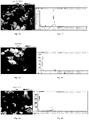
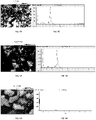
- the precipitate was removed from the solution by filtration, dried and analyzed using SEM-EDS. The analysis confirmed that the precipitate was 100 % Ag and the smallest Ag- particles exhibited a size of ca. 300 nm, determined by SEM.
- the particle size was determined to be 1400 nm with a polydispersity index of 0.81 by DLS after re-dispersion and dilution.
- the precipitate was removed from the solution by filtration, dried and analyzed using SEM-EDS. The analysis confirmed that the precipitate was 100% Ag and the smallest ag particles size determined by SEM-measurement was ca 200 nm. The particle size was determined to be 750 nm with a polydispersity index of 0.90 by DLS after re-dispersion and dilution. The distance between anode and cathode has an influence on the particle size nucleation.
- the procedure in Reference Example 3 was repeated.
- the electrolyte was diluted to 5 g/L of AgNO 3 and 15 g/L of HNO 3 .
- the electrochemical cell was placed in an ultrasonic bath during the nanoparticle synthesis.
- the cathode and the anode were immersed to equivalent depth into the electrolyte yielding an area ratio of 1:2 SEM-EDS analysis confirmed that the collected precipitate was 100 % Ag and the smallest Ag-particles size determined by SEM-measurement was ca 200 nm.
- the particle size was determined to be 325 nm with a polydispersity index of 0.91 by DLS after re-dispersion and dilution.
- a stainless steel plate serving as a cathode and a Pt-coated titanium mesh plate as a reference electrode (anode).
- the width of the electrodes was (anode 1 mm, cathode 1 mm).
- the cathode and the anode were immersed to equivalent depth into the electrolyte yielding an area ratio of 1:2.
- the distance between the anode and cathode was adjusted to 3.5cm.
- the precipitate continuously settled toward the bottom of the electrochemical cell during the potentiostatic cycles.
- the precipitate was removed from the solution by filtration, dried and analyzed using SEM-EDS.
- the analysis confirmed that the precipitate was 97 % Sn and its smallest particle had a size, determined by SEM, to be ca. 200 nm.
- the particle size was determined to be 740 nm with a polydispersity index of 0.81 by DLS after re-dispersion and dilution.
- An electrolyte solution of CuSO 4 in aqueous H 2 SO 4 was prepared by weighing 200g of CuSO 4 •5H 2 O and 240g of concentrated H 2 SO 4 into de-ionized water and the total volume was diluted to 3L.
- a stainless steel plate serving as a cathode and a Pt-coated titanium mesh plate serving as a reference electrode (anode) were placed in an electrochemical cell. The width of the electrodes was: anode 1 mm, cathode 1 mm). The cathode and the anode were immersed at equivalent depth into the electrolyte yielding an area ratio of 1:1. The distance between the anode and cathode was adjusted to 5 cm.
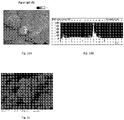
- a precipitate formed during the electrodeposition on the cathode After 2min, the precipite was collected, washed with water, dried and analyzed using SEM-EDS. The analysis confirmed that the precipitate was 100 % Cu and the diameter of smallest Cu-particles were less than 100 nm, determined by SEM.
- An electrolyte solution containing CuSO 4 was prepared by weighing 100g of a enriched ore and allowing the components to dissolve in 300g of 8% aqueous aqueous H 2 SO 4 .
- Main elements in this ore were Cu (673 mg/g), Al (7 mg/g), Fe (31 mg/g), Mg (2 mg/g) and Zn (1 mg/g).
- the process in example 1 was repeated for 3h.
- a precipitate formed during the electrodeposition on the cathode. After 2min, the precipitate was collected, washed with water, dried and analyzed using SEM-EDS. The EDS analysis confirmed that the precipitate was pure Cu.
- the procedure in Reference Example 2 was repeated.
- the electrolyte consisted of 20 g/L of AgNO 3 and 30 g/L of HNO 3 .
- CuSO 4 was added into the electrolyte as an impurity to obtain a 20% metal ion impurity level.
- the electrolyte and the pulse sequence was held as in Reference Example 1 and the experiment was carried out for 3h.
- the precipitate was removed from the solution by filtration, dried and analyzed using SEM-EDS. The EDS-analysis confirmed that the precipitate was pure Ag.
- aqueous electrolyte solution containing 20g/L Ag (as nitrate) and 40g/L of KNO3 was prepared.
- the precipitate formed was removed from the solution by filtration, dried and analyzed using SEM-EDS. The EDS-analysis confirmed that the precipitate was pure Ag.
Landscapes
- Chemical & Material Sciences (AREA)
- Engineering & Computer Science (AREA)
- Chemical Kinetics & Catalysis (AREA)
- Organic Chemistry (AREA)
- Materials Engineering (AREA)
- Metallurgy (AREA)
- Electrochemistry (AREA)
- Nanotechnology (AREA)
- Inorganic Chemistry (AREA)
- General Chemical & Material Sciences (AREA)
- Electroplating Methods And Accessories (AREA)
- Electrolytic Production Of Non-Metals, Compounds, Apparatuses Therefor (AREA)
- Catalysts (AREA)
- Electrolytic Production Of Metals (AREA)
Claims (14)
- Verfahren zum Extrahieren von Übergangsmetall- oder Halbmetall-Nanopartikeln aus elektrolytischen Lösungen, die Metallionen enthalten, durch ein elektrochemisches Verfahren an einer Elektrode, wobei die elektrolytische Lösung in Anwesenheit einer ersten Elektrode und einer zweiten Elektrode einer potentiostatischen Impulselektrolyse unterzogen wird, und die elektrochemische Keimbildung an der ersten Elektrode stattfindet, wobei die Elektroden in einem ersten Abstand voneinander beabstandet sind, um Partikel mit einer ersten Größe zu erzeugen, und dann die Elektroden so verschoben werden, dass sie in einem zweiten Abstand voneinander beabstandet sind, um Partikel mit einer zweiten Größe zu erzeugen, wobei die zweite Größe größer als die erste Größe ist, wenn der zweite Abstand kleiner als der erste Abstand ist, und die Metallpartikel aus der elektrolytischen Lösung extrahiert werden, wobei das Verfahren weiter die Durchführung einer Pulselektroabscheidung in einer Lösung umfasst, die einen Nanopartikel-Vorläufer umfasst, der in ein Ultraschallbad gegeben wird, um ein Metallpulver oder einen Niederschlag am Boden der elektrochemischen Zelle während der potentiostatischen Zyklen zu bilden, wobei das Verfahren weiter das Tempern des gefilterten Niederschlags umfasst, um die Nanopartikel zu bilden, wobei die Nanopartikel kleiner als D100 100nm sind, bestimmt durch SEM.
- Verfahren nach Anspruch 1, wobei die Metalle aus der elektrolytischen Lösung als Pulver oder Nanopulver extrahiert werden, wobei das Nanopulver mindestens eines der Metalle Silber, Gold und Zinn umfasst.
- Verfahren nach Anspruch 1 oder 2, wobei die erste Elektrode ein Array ist und eine Vielzahl von Elektroden in Mikrometer- oder Submikrometergröße enthält.
- Verfahren nach einem der vorstehenden Ansprüche, wobei nur eine Art der Metalle selektiv aus der elektrolytischen Lösung extrahiert wird oder das extrahierte Metall eine Legierung ist.
- Verfahren nach einem der vorstehenden Ansprüche, wobei die Anzahl der elektrischen Impulse oder Impulszyklen weniger als 450 beträgt.
- Verfahren nach einem der vorstehenden Ansprüche, wobei der elektrolytische Prozess einen Ultraschall- oder Megaschall-Wandler umfasst.
- Verfahren nach einem der vorstehenden Ansprüche, wobei die erste Elektrode eine Kathode und die zweite eine Anode ist.
- Verfahren nach einem der vorstehenden Ansprüche, wobei die erste Elektrode eine Diode ist und so konfiguriert ist, dass sie den Strom durchlässt, sobald sie durch ein Licht aktiviert wird.
- Verfahren nach einem der vorstehenden Ansprüche, wobei der potentiostatische Impuls die Stromrichtung ändert.
- Verfahren nach einem der vorstehenden Ansprüche, wobei der Impuls im anodischen Potential für eine Periode (ta) von 0-0,1 s und der Impuls im kathodischen Potential für eine Periode (tc) von 0-0,1 s erfolgt.
- Verfahren nach einem der vorstehenden Ansprüche, wobei die extrahierten Metallkeime nicht an der Kathode haften und als freie Partikel oder Nanopartikel in die Plattierungslösung zurückkehren.
- Verfahren nach einem der vorstehenden Ansprüche, umfassend die Herstellung von Ag- oder Sn-Nanopulvern aus industriellen Elektrolyten durch elektrochemische Abscheidung von Ag auf der Kathode, umfassend eine elektrolytische Lösung von Ag-Ionen mit einer Konzentration von 5 g/L - 80 g/L, basierend auf dem Gewicht des entsprechenden Ag-Salzes, oder eine elektrolytische Lösung von Sn-Ionen mit einer Konzentration von 1,19 g/L - 45 g/L, basierend auf dem Gewicht des entsprechenden Sn-Salzes.
- Verfahren nach Anspruch 1-12, wobei die elektrolytische Lösung ein erstes Salz umfasst mit a) einem Kation, ausgewählt aus Übergangsmetall- und Halbmetallionen, und b) einem Anion, ausgewählt aus NO3 -, SO4 2-, PO4 3-, BO3 3-, ClO4 -, (COO)2 2- und Ionen eines Elements der Halogengruppe, und ein zweites Salz mit a) einem Kation, ausgewählt aus Alkalimetall-, wie Na- oder K- und Erdalkalimetallionen, und b) einem Anion, ausgewählt aus NO3 -, SO4 2-, PO4 3-, BO3 3-, ClO4 -, (COO)2 2- oder einer Halogengruppe.
- Verfahren nach Anspruch 13, wobei das erste Salz Sn umfasst oder das erste Salz ein Metall umfasst, das aus der Gruppe 10 oder der Gruppe 11 des Periodensystems ausgewählt ist.
Applications Claiming Priority (3)
| Application Number | Priority Date | Filing Date | Title |
|---|---|---|---|
| US201261740532P | 2012-12-21 | 2012-12-21 | |
| FI20126373A FI126197B (en) | 2012-12-21 | 2012-12-21 | A method for extracting metal nanoparticles from solutions |
| PCT/FI2013/051201 WO2014096556A2 (en) | 2012-12-21 | 2013-12-23 | Manufacture of noble metal nanoparticles |
Publications (2)
| Publication Number | Publication Date |
|---|---|
| EP2934793A2 EP2934793A2 (de) | 2015-10-28 |
| EP2934793B1 true EP2934793B1 (de) | 2022-06-01 |
Family
ID=50979327
Family Applications (1)
| Application Number | Title | Priority Date | Filing Date |
|---|---|---|---|
| EP13819044.2A Active EP2934793B1 (de) | 2012-12-21 | 2013-12-23 | Herstellung von edelmetall-nanopartikeln |
Country Status (3)
| Country | Link |
|---|---|
| EP (1) | EP2934793B1 (de) |
| FI (1) | FI126197B (de) |
| WO (1) | WO2014096556A2 (de) |
Families Citing this family (17)
| Publication number | Priority date | Publication date | Assignee | Title |
|---|---|---|---|---|
| US9849512B2 (en) | 2011-07-01 | 2017-12-26 | Attostat, Inc. | Method and apparatus for production of uniformly sized nanoparticles |
| WO2016030577A1 (en) | 2014-08-28 | 2016-03-03 | Inkron Ltd | Crystalline transition metal oxide particles and continuous method of producing the same |
| US12610952B2 (en) | 2014-09-23 | 2026-04-28 | Evoq Nano, Inc. | Antimicrobial compositions and methods |
| CN104308177A (zh) * | 2014-10-14 | 2015-01-28 | 钱景 | 一种石墨烯负载纳米银复合材料的制备方法 |
| CN104259481A (zh) * | 2014-10-14 | 2015-01-07 | 钱景 | 一种纳米银的制备方法 |
| CN104308178A (zh) * | 2014-10-14 | 2015-01-28 | 钱景 | 一种石墨烯-纳米银复合材料的制备方法 |
| CN104439231B (zh) * | 2014-11-15 | 2016-03-23 | 吉林大学 | 一种Au修饰Zn/ZnO微纳米材料的制备方法 |
| CN104630826B (zh) * | 2015-01-29 | 2017-02-22 | 中南大学 | 一种从锡阳极泥中回收锡的工艺 |
| US9839652B2 (en) | 2015-04-01 | 2017-12-12 | Attostat, Inc. | Nanoparticle compositions and methods for treating or preventing tissue infections and diseases |
| CN107614629B (zh) | 2015-04-13 | 2026-03-24 | 阿托斯塔特公司 | 抗腐蚀纳米颗粒组合物 |
| US11473202B2 (en) | 2015-04-13 | 2022-10-18 | Attostat, Inc. | Anti-corrosion nanoparticle compositions |
| US11018376B2 (en) | 2017-11-28 | 2021-05-25 | Attostat, Inc. | Nanoparticle compositions and methods for enhancing lead-acid batteries |
| US11646453B2 (en) | 2017-11-28 | 2023-05-09 | Attostat, Inc. | Nanoparticle compositions and methods for enhancing lead-acid batteries |
| US12115250B2 (en) | 2019-07-12 | 2024-10-15 | Evoq Nano, Inc. | Use of nanoparticles for treating respiratory infections associated with cystic fibrosis |
| CN111790918B (zh) * | 2020-09-07 | 2020-12-22 | 西安宏星电子浆料科技股份有限公司 | 一种低热收缩率银粉的制备方法 |
| US12456759B2 (en) | 2021-03-30 | 2025-10-28 | Evoq Nano, Inc. | Nanoparticle-enhanced lead-acid electrode paste and improved lead-acid batteries made therefrom |
| WO2025168985A1 (ru) * | 2024-02-05 | 2025-08-14 | Аршак ХАЧАТРЯН | Способ и устройство для производства порошков металлов, предпочтительно порошков благородных металлов, более предпочтительно порошка серебра |
Citations (1)
| Publication number | Priority date | Publication date | Assignee | Title |
|---|---|---|---|---|
| JP2007327117A (ja) * | 2006-06-09 | 2007-12-20 | Univ Waseda | 電極、金属微粒子の製造装置および金属微粒子の製造方法 |
Family Cites Families (2)
| Publication number | Priority date | Publication date | Assignee | Title |
|---|---|---|---|---|
| WO2009126341A2 (en) * | 2008-01-14 | 2009-10-15 | Taofang Zeng | Method for making nanoparticles or fine particles |
| PL212865B1 (pl) | 2009-03-20 | 2012-12-31 | Inst Chemii Przemyslowej Im Prof Ignacego Moscickiego | Sposób otrzymywania proszków i nanoproszków miedzi z elektrolitów przemyslowych, takze odpadowych |
-
2012
- 2012-12-21 FI FI20126373A patent/FI126197B/en active IP Right Grant
-
2013
- 2013-12-23 WO PCT/FI2013/051201 patent/WO2014096556A2/en not_active Ceased
- 2013-12-23 EP EP13819044.2A patent/EP2934793B1/de active Active
Patent Citations (1)
| Publication number | Priority date | Publication date | Assignee | Title |
|---|---|---|---|---|
| JP2007327117A (ja) * | 2006-06-09 | 2007-12-20 | Univ Waseda | 電極、金属微粒子の製造装置および金属微粒子の製造方法 |
Also Published As
| Publication number | Publication date |
|---|---|
| EP2934793A2 (de) | 2015-10-28 |
| FI126197B (en) | 2016-08-15 |
| WO2014096556A2 (en) | 2014-06-26 |
| WO2014096556A3 (en) | 2014-08-21 |
Similar Documents
| Publication | Publication Date | Title |
|---|---|---|
| FI126197B (en) | A method for extracting metal nanoparticles from solutions | |
| Tahira et al. | Advanced Co3O4–CuO nano-composite based electrocatalyst for efficient hydrogen evolution reaction in alkaline media | |
| Nekouie et al. | Effect of organic additives on synthesis of copper nano powders by pulsing electrolysis | |
| Cheshideh et al. | Cyclic voltammetry deposition of nickel nanoparticles on TiO2 nanotubes and their enhanced properties for electro-oxidation of methanol | |
| Arulkumar et al. | Influence of deposition parameters for Cu2O and CuO thin films by electrodeposition technique: a short review | |
| Lu et al. | Magnetic metal phosphide nanorods as effective hydrogen-evolution electrocatalysts | |
| JP5502983B2 (ja) | 廃棄工業用電解質を含む工業用電解質からの銅粉末および銅ナノ粉末を得るための方法 | |
| Su et al. | Mass transport-enhanced electrodeposition for the efficient recovery of copper and selenium from sulfuric acid solution | |
| Jiang et al. | Electrocatalytic performance of micro–nano-nickel electrodes via magnetic field-assisted jet electrodeposition method | |
| CN102367582B (zh) | 双金属电极脉冲直流偏置电沉积制备纳米金属颗粒的方法 | |
| Genovese et al. | Electrochemical deposition of Ag2Se nanostructures | |
| Zhang et al. | Influence of Mn2+ ions on the corrosion mechanism of lead-based anodes and the generation of heavy metal anode slime in zinc sulfate electrolyte | |
| Kang et al. | Preparation of Ag–Cu bimetallic dendritic nanostructures and their hydrogen peroxide electroreduction property | |
| Nikolić et al. | Morphological and crystallographic characteristics of lead powder obtained by electrodeposition from an environmentally friendly electrolyte | |
| Wang et al. | Controllable production of Ag/Zn and Ag particles from hydrometallurgical zinc solutions | |
| Hu et al. | Electrochemical deposition and characterization of cuprous oxide crystallites on stainless substrates: Growth mechanism and morphological analysis | |
| Kozak et al. | Thermal selenization of electrochemically obtained cobalt thin-films and nanowire arrays | |
| Gomes et al. | Annealed Ti/Zn-TiO2 nanocomposites tested as photoanodes for the degradation of Ibuprofen | |
| JP2015182923A (ja) | 過酸化銀を含む銀酸化物メソ結晶及びその製造方法 | |
| Devendra et al. | Advanced strategies for hydrogen generation by Rhodium metal catalysts coated by the electrodeposition method | |
| Paul | Nanomaterials synthesis by electrodeposition techniques for high-energetic electrodes in fuel cell | |
| Ru et al. | Eco-friendly and facile electrochemical synthesis of sub-micrometer lead powders in deep eutectic solvents using galena as a raw material | |
| Divya et al. | Shape-controlled synthesis of palladium nanostructures from flowers to thorns: electrocatalytic oxidation of ethanol | |
| Ahmed et al. | Green synthesis of nanomaterials via electrochemical method | |
| KR100767703B1 (ko) | 전기분해를 이용한 은(Ag) 나노분말의 제조 방법 |
Legal Events
| Date | Code | Title | Description |
|---|---|---|---|
| PUAI | Public reference made under article 153(3) epc to a published international application that has entered the european phase |
Free format text: ORIGINAL CODE: 0009012 |
|
| 17P | Request for examination filed |
Effective date: 20150720 |
|
| AK | Designated contracting states |
Kind code of ref document: A2 Designated state(s): AL AT BE BG CH CY CZ DE DK EE ES FI FR GB GR HR HU IE IS IT LI LT LU LV MC MK MT NL NO PL PT RO RS SE SI SK SM TR |
|
| AX | Request for extension of the european patent |
Extension state: BA ME |
|
| DAX | Request for extension of the european patent (deleted) | ||
| STAA | Information on the status of an ep patent application or granted ep patent |
Free format text: STATUS: EXAMINATION IS IN PROGRESS |
|
| 17Q | First examination report despatched |
Effective date: 20180522 |
|
| RIC1 | Information provided on ipc code assigned before grant |
Ipc: B22F 1/00 20060101ALN20211026BHEP Ipc: C25C 1/20 20060101ALI20211026BHEP Ipc: C25C 1/14 20060101ALI20211026BHEP Ipc: C25C 5/02 20060101ALI20211026BHEP Ipc: B22F 9/24 20060101AFI20211026BHEP |
|
| GRAP | Despatch of communication of intention to grant a patent |
Free format text: ORIGINAL CODE: EPIDOSNIGR1 |
|
| STAA | Information on the status of an ep patent application or granted ep patent |
Free format text: STATUS: GRANT OF PATENT IS INTENDED |
|
| RIC1 | Information provided on ipc code assigned before grant |
Ipc: B22F 1/00 20060101ALN20211129BHEP Ipc: C25C 1/20 20060101ALI20211129BHEP Ipc: C25C 1/14 20060101ALI20211129BHEP Ipc: C25C 5/02 20060101ALI20211129BHEP Ipc: B22F 9/24 20060101AFI20211129BHEP |
|
| INTG | Intention to grant announced |
Effective date: 20211221 |
|
| GRAS | Grant fee paid |
Free format text: ORIGINAL CODE: EPIDOSNIGR3 |
|
| GRAA | (expected) grant |
Free format text: ORIGINAL CODE: 0009210 |
|
| STAA | Information on the status of an ep patent application or granted ep patent |
Free format text: STATUS: THE PATENT HAS BEEN GRANTED |
|
| AK | Designated contracting states |
Kind code of ref document: B1 Designated state(s): AL AT BE BG CH CY CZ DE DK EE ES FI FR GB GR HR HU IE IS IT LI LT LU LV MC MK MT NL NO PL PT RO RS SE SI SK SM TR |
|
| REG | Reference to a national code |
Ref country code: GB Ref legal event code: FG4D |
|
| REG | Reference to a national code |
Ref country code: AT Ref legal event code: REF Ref document number: 1495027 Country of ref document: AT Kind code of ref document: T Effective date: 20220615 Ref country code: CH Ref legal event code: EP |
|
| REG | Reference to a national code |
Ref country code: IE Ref legal event code: FG4D |
|
| REG | Reference to a national code |
Ref country code: DE Ref legal event code: R096 Ref document number: 602013081775 Country of ref document: DE |
|
| REG | Reference to a national code |
Ref country code: LT Ref legal event code: MG9D |
|
| REG | Reference to a national code |
Ref country code: NL Ref legal event code: MP Effective date: 20220601 |
|
| PG25 | Lapsed in a contracting state [announced via postgrant information from national office to epo] |
Ref country code: SE Free format text: LAPSE BECAUSE OF FAILURE TO SUBMIT A TRANSLATION OF THE DESCRIPTION OR TO PAY THE FEE WITHIN THE PRESCRIBED TIME-LIMIT Effective date: 20220601 Ref country code: NO Free format text: LAPSE BECAUSE OF FAILURE TO SUBMIT A TRANSLATION OF THE DESCRIPTION OR TO PAY THE FEE WITHIN THE PRESCRIBED TIME-LIMIT Effective date: 20220901 Ref country code: LT Free format text: LAPSE BECAUSE OF FAILURE TO SUBMIT A TRANSLATION OF THE DESCRIPTION OR TO PAY THE FEE WITHIN THE PRESCRIBED TIME-LIMIT Effective date: 20220601 Ref country code: HR Free format text: LAPSE BECAUSE OF FAILURE TO SUBMIT A TRANSLATION OF THE DESCRIPTION OR TO PAY THE FEE WITHIN THE PRESCRIBED TIME-LIMIT Effective date: 20220601 Ref country code: GR Free format text: LAPSE BECAUSE OF FAILURE TO SUBMIT A TRANSLATION OF THE DESCRIPTION OR TO PAY THE FEE WITHIN THE PRESCRIBED TIME-LIMIT Effective date: 20220902 Ref country code: FI Free format text: LAPSE BECAUSE OF FAILURE TO SUBMIT A TRANSLATION OF THE DESCRIPTION OR TO PAY THE FEE WITHIN THE PRESCRIBED TIME-LIMIT Effective date: 20220601 Ref country code: ES Free format text: LAPSE BECAUSE OF FAILURE TO SUBMIT A TRANSLATION OF THE DESCRIPTION OR TO PAY THE FEE WITHIN THE PRESCRIBED TIME-LIMIT Effective date: 20220601 Ref country code: BG Free format text: LAPSE BECAUSE OF FAILURE TO SUBMIT A TRANSLATION OF THE DESCRIPTION OR TO PAY THE FEE WITHIN THE PRESCRIBED TIME-LIMIT Effective date: 20220901 |
|
| REG | Reference to a national code |
Ref country code: AT Ref legal event code: MK05 Ref document number: 1495027 Country of ref document: AT Kind code of ref document: T Effective date: 20220601 |
|
| PG25 | Lapsed in a contracting state [announced via postgrant information from national office to epo] |
Ref country code: RS Free format text: LAPSE BECAUSE OF FAILURE TO SUBMIT A TRANSLATION OF THE DESCRIPTION OR TO PAY THE FEE WITHIN THE PRESCRIBED TIME-LIMIT Effective date: 20220601 Ref country code: PL Free format text: LAPSE BECAUSE OF FAILURE TO SUBMIT A TRANSLATION OF THE DESCRIPTION OR TO PAY THE FEE WITHIN THE PRESCRIBED TIME-LIMIT Effective date: 20220601 Ref country code: LV Free format text: LAPSE BECAUSE OF FAILURE TO SUBMIT A TRANSLATION OF THE DESCRIPTION OR TO PAY THE FEE WITHIN THE PRESCRIBED TIME-LIMIT Effective date: 20220601 |
|
| PG25 | Lapsed in a contracting state [announced via postgrant information from national office to epo] |
Ref country code: NL Free format text: LAPSE BECAUSE OF FAILURE TO SUBMIT A TRANSLATION OF THE DESCRIPTION OR TO PAY THE FEE WITHIN THE PRESCRIBED TIME-LIMIT Effective date: 20220601 |
|
| PG25 | Lapsed in a contracting state [announced via postgrant information from national office to epo] |
Ref country code: SM Free format text: LAPSE BECAUSE OF FAILURE TO SUBMIT A TRANSLATION OF THE DESCRIPTION OR TO PAY THE FEE WITHIN THE PRESCRIBED TIME-LIMIT Effective date: 20220601 Ref country code: SK Free format text: LAPSE BECAUSE OF FAILURE TO SUBMIT A TRANSLATION OF THE DESCRIPTION OR TO PAY THE FEE WITHIN THE PRESCRIBED TIME-LIMIT Effective date: 20220601 Ref country code: RO Free format text: LAPSE BECAUSE OF FAILURE TO SUBMIT A TRANSLATION OF THE DESCRIPTION OR TO PAY THE FEE WITHIN THE PRESCRIBED TIME-LIMIT Effective date: 20220601 Ref country code: PT Free format text: LAPSE BECAUSE OF FAILURE TO SUBMIT A TRANSLATION OF THE DESCRIPTION OR TO PAY THE FEE WITHIN THE PRESCRIBED TIME-LIMIT Effective date: 20221003 Ref country code: EE Free format text: LAPSE BECAUSE OF FAILURE TO SUBMIT A TRANSLATION OF THE DESCRIPTION OR TO PAY THE FEE WITHIN THE PRESCRIBED TIME-LIMIT Effective date: 20220601 Ref country code: CZ Free format text: LAPSE BECAUSE OF FAILURE TO SUBMIT A TRANSLATION OF THE DESCRIPTION OR TO PAY THE FEE WITHIN THE PRESCRIBED TIME-LIMIT Effective date: 20220601 Ref country code: AT Free format text: LAPSE BECAUSE OF FAILURE TO SUBMIT A TRANSLATION OF THE DESCRIPTION OR TO PAY THE FEE WITHIN THE PRESCRIBED TIME-LIMIT Effective date: 20220601 |
|
| PG25 | Lapsed in a contracting state [announced via postgrant information from national office to epo] |
Ref country code: IS Free format text: LAPSE BECAUSE OF FAILURE TO SUBMIT A TRANSLATION OF THE DESCRIPTION OR TO PAY THE FEE WITHIN THE PRESCRIBED TIME-LIMIT Effective date: 20221001 |
|
| REG | Reference to a national code |
Ref country code: DE Ref legal event code: R097 Ref document number: 602013081775 Country of ref document: DE |
|
| PG25 | Lapsed in a contracting state [announced via postgrant information from national office to epo] |
Ref country code: AL Free format text: LAPSE BECAUSE OF FAILURE TO SUBMIT A TRANSLATION OF THE DESCRIPTION OR TO PAY THE FEE WITHIN THE PRESCRIBED TIME-LIMIT Effective date: 20220601 |
|
| PLBE | No opposition filed within time limit |
Free format text: ORIGINAL CODE: 0009261 |
|
| STAA | Information on the status of an ep patent application or granted ep patent |
Free format text: STATUS: NO OPPOSITION FILED WITHIN TIME LIMIT |
|
| PG25 | Lapsed in a contracting state [announced via postgrant information from national office to epo] |
Ref country code: DK Free format text: LAPSE BECAUSE OF FAILURE TO SUBMIT A TRANSLATION OF THE DESCRIPTION OR TO PAY THE FEE WITHIN THE PRESCRIBED TIME-LIMIT Effective date: 20220601 |
|
| 26N | No opposition filed |
Effective date: 20230302 |
|
| PG25 | Lapsed in a contracting state [announced via postgrant information from national office to epo] |
Ref country code: SI Free format text: LAPSE BECAUSE OF FAILURE TO SUBMIT A TRANSLATION OF THE DESCRIPTION OR TO PAY THE FEE WITHIN THE PRESCRIBED TIME-LIMIT Effective date: 20220601 |
|
| REG | Reference to a national code |
Ref country code: CH Ref legal event code: PL |
|
| GBPC | Gb: european patent ceased through non-payment of renewal fee |
Effective date: 20221223 |
|
| REG | Reference to a national code |
Ref country code: BE Ref legal event code: MM Effective date: 20221231 |
|
| PG25 | Lapsed in a contracting state [announced via postgrant information from national office to epo] |
Ref country code: LU Free format text: LAPSE BECAUSE OF NON-PAYMENT OF DUE FEES Effective date: 20221223 |
|
| PG25 | Lapsed in a contracting state [announced via postgrant information from national office to epo] |
Ref country code: LI Free format text: LAPSE BECAUSE OF NON-PAYMENT OF DUE FEES Effective date: 20221231 Ref country code: IE Free format text: LAPSE BECAUSE OF NON-PAYMENT OF DUE FEES Effective date: 20221223 Ref country code: GB Free format text: LAPSE BECAUSE OF NON-PAYMENT OF DUE FEES Effective date: 20221223 Ref country code: CH Free format text: LAPSE BECAUSE OF NON-PAYMENT OF DUE FEES Effective date: 20221231 |
|
| PG25 | Lapsed in a contracting state [announced via postgrant information from national office to epo] |
Ref country code: FR Free format text: LAPSE BECAUSE OF NON-PAYMENT OF DUE FEES Effective date: 20221231 Ref country code: BE Free format text: LAPSE BECAUSE OF NON-PAYMENT OF DUE FEES Effective date: 20221231 |
|
| PG25 | Lapsed in a contracting state [announced via postgrant information from national office to epo] |
Ref country code: IT Free format text: LAPSE BECAUSE OF FAILURE TO SUBMIT A TRANSLATION OF THE DESCRIPTION OR TO PAY THE FEE WITHIN THE PRESCRIBED TIME-LIMIT Effective date: 20220601 |
|
| PG25 | Lapsed in a contracting state [announced via postgrant information from national office to epo] |
Ref country code: HU Free format text: LAPSE BECAUSE OF FAILURE TO SUBMIT A TRANSLATION OF THE DESCRIPTION OR TO PAY THE FEE WITHIN THE PRESCRIBED TIME-LIMIT; INVALID AB INITIO Effective date: 20131223 |
|
| PG25 | Lapsed in a contracting state [announced via postgrant information from national office to epo] |
Ref country code: CY Free format text: LAPSE BECAUSE OF FAILURE TO SUBMIT A TRANSLATION OF THE DESCRIPTION OR TO PAY THE FEE WITHIN THE PRESCRIBED TIME-LIMIT Effective date: 20220601 |
|
| PG25 | Lapsed in a contracting state [announced via postgrant information from national office to epo] |
Ref country code: MK Free format text: LAPSE BECAUSE OF FAILURE TO SUBMIT A TRANSLATION OF THE DESCRIPTION OR TO PAY THE FEE WITHIN THE PRESCRIBED TIME-LIMIT Effective date: 20220601 |
|
| PG25 | Lapsed in a contracting state [announced via postgrant information from national office to epo] |
Ref country code: MC Free format text: LAPSE BECAUSE OF FAILURE TO SUBMIT A TRANSLATION OF THE DESCRIPTION OR TO PAY THE FEE WITHIN THE PRESCRIBED TIME-LIMIT Effective date: 20220601 |
|
| PG25 | Lapsed in a contracting state [announced via postgrant information from national office to epo] |
Ref country code: TR Free format text: LAPSE BECAUSE OF FAILURE TO SUBMIT A TRANSLATION OF THE DESCRIPTION OR TO PAY THE FEE WITHIN THE PRESCRIBED TIME-LIMIT Effective date: 20220601 Ref country code: MC Free format text: LAPSE BECAUSE OF FAILURE TO SUBMIT A TRANSLATION OF THE DESCRIPTION OR TO PAY THE FEE WITHIN THE PRESCRIBED TIME-LIMIT Effective date: 20220601 |
|
| PG25 | Lapsed in a contracting state [announced via postgrant information from national office to epo] |
Ref country code: MT Free format text: LAPSE BECAUSE OF FAILURE TO SUBMIT A TRANSLATION OF THE DESCRIPTION OR TO PAY THE FEE WITHIN THE PRESCRIBED TIME-LIMIT Effective date: 20220601 |
|
| PG25 | Lapsed in a contracting state [announced via postgrant information from national office to epo] |
Ref country code: BG Free format text: LAPSE BECAUSE OF FAILURE TO SUBMIT A TRANSLATION OF THE DESCRIPTION OR TO PAY THE FEE WITHIN THE PRESCRIBED TIME-LIMIT Effective date: 20220601 |
|
| PG25 | Lapsed in a contracting state [announced via postgrant information from national office to epo] |
Ref country code: BG Free format text: LAPSE BECAUSE OF FAILURE TO SUBMIT A TRANSLATION OF THE DESCRIPTION OR TO PAY THE FEE WITHIN THE PRESCRIBED TIME-LIMIT Effective date: 20220601 |
|
| REG | Reference to a national code |
Ref country code: DE Ref legal event code: R081 Ref document number: 602013081775 Country of ref document: DE Owner name: INKRON OY, FI Free format text: FORMER OWNERS: INKRON LTD., HONG KONG, CN; RANTALA, JUHA, HONG KONG, CN |
|
| PGFP | Annual fee paid to national office [announced via postgrant information from national office to epo] |
Ref country code: DE Payment date: 20251211 Year of fee payment: 13 |