EP2935530B1 - Compositions de combustible dérivées du procédé fischer-tropsch - Google Patents
Compositions de combustible dérivées du procédé fischer-tropsch Download PDFInfo
- Publication number
- EP2935530B1 EP2935530B1 EP13811931.8A EP13811931A EP2935530B1 EP 2935530 B1 EP2935530 B1 EP 2935530B1 EP 13811931 A EP13811931 A EP 13811931A EP 2935530 B1 EP2935530 B1 EP 2935530B1
- Authority
- EP
- European Patent Office
- Prior art keywords
- fuel
- middle distillate
- fischer
- composition
- tropsch derived
- Prior art date
- Legal status (The legal status is an assumption and is not a legal conclusion. Google has not performed a legal analysis and makes no representation as to the accuracy of the status listed.)
- Active
Links
Images



Classifications
-
- C—CHEMISTRY; METALLURGY
- C10—PETROLEUM, GAS OR COKE INDUSTRIES; TECHNICAL GASES CONTAINING CARBON MONOXIDE; FUELS; LUBRICANTS; PEAT
- C10L—FUELS NOT OTHERWISE PROVIDED FOR; NATURAL GAS; SYNTHETIC NATURAL GAS OBTAINED BY PROCESSES NOT COVERED BY SUBCLASSES C10G OR C10K; LIQUIFIED PETROLEUM GAS; USE OF ADDITIVES TO FUELS OR FIRES; FIRE-LIGHTERS
- C10L1/00—Liquid carbonaceous fuels
- C10L1/10—Liquid carbonaceous fuels containing additives
- C10L1/14—Organic compounds
- C10L1/16—Hydrocarbons
- C10L1/1625—Hydrocarbons macromolecular compounds
- C10L1/1633—Hydrocarbons macromolecular compounds homo- or copolymers obtained by reactions only involving carbon-to carbon unsaturated bonds
- C10L1/1641—Hydrocarbons macromolecular compounds homo- or copolymers obtained by reactions only involving carbon-to carbon unsaturated bonds from compounds containing aliphatic monomers
-
- C—CHEMISTRY; METALLURGY
- C10—PETROLEUM, GAS OR COKE INDUSTRIES; TECHNICAL GASES CONTAINING CARBON MONOXIDE; FUELS; LUBRICANTS; PEAT
- C10L—FUELS NOT OTHERWISE PROVIDED FOR; NATURAL GAS; SYNTHETIC NATURAL GAS OBTAINED BY PROCESSES NOT COVERED BY SUBCLASSES C10G OR C10K; LIQUIFIED PETROLEUM GAS; USE OF ADDITIVES TO FUELS OR FIRES; FIRE-LIGHTERS
- C10L1/00—Liquid carbonaceous fuels
- C10L1/10—Liquid carbonaceous fuels containing additives
- C10L1/14—Organic compounds
- C10L1/18—Organic compounds containing oxygen
-
- C—CHEMISTRY; METALLURGY
- C10—PETROLEUM, GAS OR COKE INDUSTRIES; TECHNICAL GASES CONTAINING CARBON MONOXIDE; FUELS; LUBRICANTS; PEAT
- C10L—FUELS NOT OTHERWISE PROVIDED FOR; NATURAL GAS; SYNTHETIC NATURAL GAS OBTAINED BY PROCESSES NOT COVERED BY SUBCLASSES C10G OR C10K; LIQUIFIED PETROLEUM GAS; USE OF ADDITIVES TO FUELS OR FIRES; FIRE-LIGHTERS
- C10L1/00—Liquid carbonaceous fuels
- C10L1/10—Liquid carbonaceous fuels containing additives
- C10L1/14—Organic compounds
- C10L1/18—Organic compounds containing oxygen
- C10L1/192—Macromolecular compounds
- C10L1/195—Macromolecular compounds obtained by reactions involving only carbon-to-carbon unsaturated bonds
- C10L1/197—Macromolecular compounds obtained by reactions involving only carbon-to-carbon unsaturated bonds derived from monomers containing a carbon-to-carbon unsaturated bond and an acyloxy group of a saturated carboxylic or carbonic acid
- C10L1/1973—Macromolecular compounds obtained by reactions involving only carbon-to-carbon unsaturated bonds derived from monomers containing a carbon-to-carbon unsaturated bond and an acyloxy group of a saturated carboxylic or carbonic acid mono-carboxylic
-
- C—CHEMISTRY; METALLURGY
- C10—PETROLEUM, GAS OR COKE INDUSTRIES; TECHNICAL GASES CONTAINING CARBON MONOXIDE; FUELS; LUBRICANTS; PEAT
- C10L—FUELS NOT OTHERWISE PROVIDED FOR; NATURAL GAS; SYNTHETIC NATURAL GAS OBTAINED BY PROCESSES NOT COVERED BY SUBCLASSES C10G OR C10K; LIQUIFIED PETROLEUM GAS; USE OF ADDITIVES TO FUELS OR FIRES; FIRE-LIGHTERS
- C10L10/00—Use of additives to fuels or fires for particular purposes
- C10L10/14—Use of additives to fuels or fires for particular purposes for improving low temperature properties
-
- C—CHEMISTRY; METALLURGY
- C10—PETROLEUM, GAS OR COKE INDUSTRIES; TECHNICAL GASES CONTAINING CARBON MONOXIDE; FUELS; LUBRICANTS; PEAT
- C10L—FUELS NOT OTHERWISE PROVIDED FOR; NATURAL GAS; SYNTHETIC NATURAL GAS OBTAINED BY PROCESSES NOT COVERED BY SUBCLASSES C10G OR C10K; LIQUIFIED PETROLEUM GAS; USE OF ADDITIVES TO FUELS OR FIRES; FIRE-LIGHTERS
- C10L10/00—Use of additives to fuels or fires for particular purposes
- C10L10/14—Use of additives to fuels or fires for particular purposes for improving low temperature properties
- C10L10/16—Pour-point depressants
-
- C—CHEMISTRY; METALLURGY
- C10—PETROLEUM, GAS OR COKE INDUSTRIES; TECHNICAL GASES CONTAINING CARBON MONOXIDE; FUELS; LUBRICANTS; PEAT
- C10L—FUELS NOT OTHERWISE PROVIDED FOR; NATURAL GAS; SYNTHETIC NATURAL GAS OBTAINED BY PROCESSES NOT COVERED BY SUBCLASSES C10G OR C10K; LIQUIFIED PETROLEUM GAS; USE OF ADDITIVES TO FUELS OR FIRES; FIRE-LIGHTERS
- C10L2200/00—Components of fuel compositions
- C10L2200/04—Organic compounds
- C10L2200/0461—Fractions defined by their origin
- C10L2200/0469—Renewables or materials of biological origin
- C10L2200/0492—Fischer-Tropsch products
-
- C—CHEMISTRY; METALLURGY
- C10—PETROLEUM, GAS OR COKE INDUSTRIES; TECHNICAL GASES CONTAINING CARBON MONOXIDE; FUELS; LUBRICANTS; PEAT
- C10L—FUELS NOT OTHERWISE PROVIDED FOR; NATURAL GAS; SYNTHETIC NATURAL GAS OBTAINED BY PROCESSES NOT COVERED BY SUBCLASSES C10G OR C10K; LIQUIFIED PETROLEUM GAS; USE OF ADDITIVES TO FUELS OR FIRES; FIRE-LIGHTERS
- C10L2250/00—Structural features of fuel components or fuel compositions, either in solid, liquid or gaseous state
- C10L2250/04—Additive or component is a polymer
-
- C—CHEMISTRY; METALLURGY
- C10—PETROLEUM, GAS OR COKE INDUSTRIES; TECHNICAL GASES CONTAINING CARBON MONOXIDE; FUELS; LUBRICANTS; PEAT
- C10L—FUELS NOT OTHERWISE PROVIDED FOR; NATURAL GAS; SYNTHETIC NATURAL GAS OBTAINED BY PROCESSES NOT COVERED BY SUBCLASSES C10G OR C10K; LIQUIFIED PETROLEUM GAS; USE OF ADDITIVES TO FUELS OR FIRES; FIRE-LIGHTERS
- C10L2270/00—Specifically adapted fuels
- C10L2270/02—Specifically adapted fuels for internal combustion engines
- C10L2270/026—Specifically adapted fuels for internal combustion engines for diesel engines, e.g. automobiles, stationary, marine
Definitions
- the present invention relates to Fischer-Tropsch derived fuel compositions, and to the use thereof as a fuel in cold climates.
- the present invention relates to the use of a cold flow improver in a "hard-to-treat" fuel.
- distillate fuels are comprised of a mixture of hydrocarbons including normal (linear) and branched-chain (iso-) paraffins, olefins, aromatics and other polar and non-polar compounds, and cold flow behavior is a function of the relative proportion of these various hydrocarbon components.
- Normal paraffins typically have the lowest solubility and therefore tend to be the first solids to separate from the fuel as the temperature is decreased. At first, individual paraffin crystals will appear but as more crystals form they will ultimately create a gel-like network which inhibits flow.
- the compositional makeup of fuels can vary widely depending on the crude oil source and how deeply the refiner cuts into the crude oil.
- Refiners increasingly produce distillate fuels with amounts and types of hydrocarbon components which render the fuels unresponsive to additives which were before capable of imparting acceptable cold flow properties to the fuels (so-called "hard-to-treat” fuels).
- New groups of additives have been developed for treating such fuels.
- MDFI middle distillate flow improver
- This additive type delivers an operability related response measured by CFPP (Cold Filter Plugging Point), which temperature is a parameter that is regulated in some major diesel fuel specifications (such as CEN EN590) or alternative laboratory filterability tests.
- Fischer-Tropsch derived fuels also called Gas-To-Liquid fuels or GTL fuels
- GTL fuels Gas-To-Liquid fuels
- Fischer-Tropsch derived fuels are the reaction products of the Fischer-Tropsch methane condensation processes, for example the process known as Shell Middle Distillate Synthesis ( van der Burgt et al, "The Shell Middle Distillate Synthesis Process", paper delivered at the 5th Synfuels Worldwide Symposium, Washington DC, November 1985 ; see also the November 1989 publication of the same title from Shell International Petroleum Company Ltd, London, UK).
- a unique composition has been found of an "essentially only” up to 100% Fischer-Tropsch derived middle distillate fuel that is fit-for-purpose in climates requiring low temperature flow to -25 °C or lower (as measured in the CFPP test), e.g. for the northern European and Arctic climates.
- an embodiment of the present invention is a fuel composition
- a Fischer-Tropsch derived middle distillate fuel and a middle distillate flow improver the remainder of the composition being another fuel component or mixture of fuel components, the fuel component being selected from a petroleum derived middle distillate fuel, hydrogenated vegetable oil, fatty acid methyl esters, and other Fischer Tropsch products such as light F-T base oil; wherein the amount of the Fischer-Tropsch derived middle distillate fuel is more than 80% v/v of the total composition; the maximum weight content in the carbon number distribution of the n-paraffins in the Fischer-Tropsch derived middle distillate fuel is below C16 and the weight ratio of iso to normal paraffins in the Fischer-Tropsch derived middle distillate fuel is 3.5:1 or higher; and wherein the middle distillate flow improver is a substituted ethylene polymer, being a single long alkyl chain substituted with acetate ester groups and 2-ethylhexanoate ester groups and further carrying some methyl branches,
- compositions according to the present invention have exceptionally good cold flow properties at relatively low treat rates of the MDFI.
- the treat rates are of 125-4000 mg/kg.
- the CFPP is below -20 °C, and preferably it is below -25 °C.
- the fuel composition of the present invention is particularly suitable for use as a diesel fuel, and in particular when used in climates requiring low temperature flow to around -25 °C or lower (as measured in the CFPP test). Accordingly, a further embodiment of the invention relates to the use of the fuel composition of the present invention as a fuel in a direct or indirect injection diesel engine, in particular wherein the engine runs at temperatures around -25 °C or lower.
- the MDFI used in the fuel compositions of the present invention is a member of the class of oil-soluble ethylene terpolymers containing ethylene units and different vinyl ester units, such as disclosed in WO 96/07718 .
- M n number average molecular weight of the polymer, as measured by GPC, is approximately 12000.
- the values for the ratio of acetate to 2-ethylhexanoate, the mole percentage of acetate and 2-ethylhexanoate and the degree of branching, as used herein in the definition of the MDFI are averages over all the molecules in the polymer. In general, the side chains are distributed randomly over the polymer.
- An embodiment of the present invention is a process for the preparation of the fuel compositions according to the invention comprising the step of combining warm MDFI injected into warm Fischer-Tropsch derived middle distillate fuel which ensures the MDFI is mixed and solubilised, wherein the MDFI is a single long alkyl chain substituted with acetate ester groups and 2-ethylhexanoate ester groups and further carrying some methyl branches, wherein the average ratio of acetate to 2-ethylhexanoate is 1:8, the mole percentage of acetate is 2 % and 2-ethylhexanoate 16 %, and the average number of methyl branches per 100 methylene groups is 4.9, and wherein the maximum weight content in the carbon number distribution of the n-paraffins in the Fischer-Trop
- a further embodiment of the invention concerns the use of a MDFI which is a substituted ethylene polymer, being a single long alkyl chain substituted with acetate ester groups and 2-ethylhexanoate ester groups and further carrying some methyl branches, wherein the average ratio of acetate to 2-ethylhexanoate is 1:8, and the mole percentage of acetate is 2 % and 2-ethylhexanoate 16 %, and the average number of methyl branches per 100 methylene groups is 4.9, for the purpose of improving the cold flow properties of a fuel composition comprising an amount of a Fischer-Tropsch derived middle distillate fuel of more than 80% v/v of the total composition, wherein the maximum weight content in the carbon number distribution of the n-paraffins in the Fischer-Tropsch derived middle distillate fuel is below C16 and the weight ratio of iso to normal paraffins in the Fischer-Tropsch derived middle distillate fuel is 3.5:1 or higher, and wherein the
- the treat rate of the MDFI in the fuel composition of the present invention is 125 - 4000 mg/kg, preferably 250 - 4000 mg/kg, more preferred 500 - 3000 mg/kg, and especially 750 - 2000 mg/kg.
- the fuel composition according to the present invention preferably comprise an amount of the Fischer-Tropsch derived middle distillate fuel of at least 90%, more preferred at least 95%, especially at least 98% v/v, in particular at least 99% v/v of the total composition and most preferred is a fuel composition wherein the Fischer-Tropsch derived middle distillate fuel is the only fuel component in the fuel composition.
- the Fischer-Tropsch derived middle distillate fuel will typically satisfy the requirements of a fuel specification, for example CEN TS 15940 (Automotive Fuels- Paraffinic Diesel Fuel from Synthesis or Hydrotreatment- Requirements and Test Methods).
- CEN TS 15940 Automotive Fuels- Paraffinic Diesel Fuel from Synthesis or Hydrotreatment- Requirements and Test Methods.
- the Fischer-Tropsch derived middle distillate fuel should be suitable for use as a diesel fuel. Its components (or the majority, for instance 95% v/v or greater, thereof) should therefore have boiling points within the typical diesel fuel ("gas oil") range, i.e. from about 150 to 400°C or from 170 to 370°C. It will suitably have a 90% v/v distillation temperature of from 300 to 370°C.
- Fischer-Tropsch derived is meant that the fuel is, or derives from, a synthesis product of a Fischer-Tropsch condensation process.
- the carbon monoxide and hydrogen may themselves be derived from organic or inorganic, natural or synthetic sources, typically either from natural gas or from organically derived methane.
- a middle distillate fuel product may be obtained directly from the Fischer-Tropsch reaction, or indirectly for instance by fractionation of a Fischer-Tropsch synthesis product or from a hydrotreated Fischer-Tropsch synthesis product.
- Hydrotreatment can involve hydrocracking to adjust the boiling range (see, e. g. GB2077289 and EP0147873 ) and/or hydroisomerisation which can improve cold flow properties by increasing the proportion of branched paraffins.
- EP0583836 describes a two-step hydrotreatment process in which a Fischer-Tropsch synthesis product is firstly subjected to hydroconversion under conditions such that it undergoes substantially no isomerisation or hydrocracking (this hydrogenates the olefinic and oxygen-containing components), and then at least part of the resultant product is hydroconverted under conditions such that hydrocracking and isomerisation occur to yield a substantially paraffinic hydrocarbon fuel.
- the desired middle distillate fuel fraction(s) may subsequently be isolated for instance by distillation.
- Typical catalysts for the Fischer-Tropsch synthesis of paraffinic hydrocarbons comprise, as the catalytically active component, a metal from Group VIII of the periodic table, in particular ruthenium, iron, cobalt or nickel. Suitable such catalysts are described for instance in EP0583836 .
- Fischer-Tropsch based process is the SMDS (Shell Middle Distillate Synthesis) described in " The Shell Middle Distillate Synthesis Process", van der Burgt et al (vide supra ) .
- This process produces middle distillate range products by conversion of a natural gas (primarily methane) derived synthesis gas into a heavy long-chain hydrocarbon (paraffin) wax which can then be hydroconverted and fractionated to produce liquid transport fuels such as the gas oils useable in diesel fuel compositions.
- Versions of the SMDS process utilising fixed-bed reactors for the catalytic conversion step, are currently in use in Bintulu, Malaysia, and in Pearl GTL, Ras Laffan, Kuwait.
- Middle distillate fuels prepared by the SMDS process are commercially available for instance from the Royal Dutch/Shell Group of Companies.
- Such Fischer-Tropsch middle distillate fuels are described in Technical Specification CEN TS 15940.
- the Fischer-Tropsch derived middle distillate fuel will consist of at least 95% w/w, more preferably at least 98% w/w, and most preferably up to 100% w/w of paraffinic components, preferably iso- and normal paraffins. Some cyclic paraffins may also be present.
- the weight ratio of iso-paraffins to normal paraffins is at least 3.5, in particular at least 4.0, and preferably from 4.0 to 7.5.
- Fischer-Tropsch derived middle distillate fuel samples wherein the weight ratio of iso-paraffins to normal paraffins is lower than 3.5, e.g. between 1 and 2 do not show similar favourable effects in their CFFP when treated with the MDFI used in the fuel compositions of the present invention.
- the maximum weight content in the carbon number distribution of the n-paraffins in the Fischer-Tropsch derived middle distillate fuel is below C16.
- Fischer-Tropsch derived middle distillate fuel samples with a peak higher than C16 do not show similar favourable effects in their CFFP when treated with the MDFI used in the fuel compositions of the present invention.
- a Fischer-Tropsch derived middle distillate fuel has essentially no, or undetectable levels of, sulfur and nitrogen. Compounds containing these heteroatoms tend to act as poisons for Fischer-Tropsch catalysts and are therefore removed from the synthesis gas feed. Further, the process as usually operated produces no or virtually no aromatic components.
- the aromatics content of a Fischer-Tropsch middle distillate fuel will typically be below 1% w/w, preferably below 0.5% w/w and more preferably below 0.1% w/w.
- the Fischer-Tropsch derived middle distillate fuel used in the present invention will typically have a density from 0.76 to 0.79 g/cm 3 at 15°C; a cetane number (ASTM D613) greater than 70, suitably from 74 to 85; a kinematic viscosity (ASTM D445) from 2 to 4.5, preferably 2.5 to 4.0, more preferably from 2.9 to 3.7, mm 2 /s at 40°C; and a sulfur content (ASTM D2622) of 5 ppmw (parts per million by weight) or less, preferably of 2 ppmw or less.
- the Fischer-Tropsch derived middle distillate fuel according to the present invention is a product prepared by a Fischer-Tropsch methane condensation reaction using a hydrogen/carbon monoxide ratio of less than 2.5, preferably less than 1.75, more preferably from 0.4 to 1.5.
- the Fischer-Tropsch derived middle distillate fuel according to the present invention is a product prepared by the SMDS process, utilising fixed-bed multi-tubular reactors and a promoted cobalt catalyst. Suitably it will have been obtained from a hydrocracked Fischer-Tropsch synthesis product, or more preferably a product from a two-stage hydroconversion process such as that described in EP0583836 .
- the fuel composition may be additivated with further additives.
- the (active matter) concentration of each such additive in a fuel composition is preferably up to 10000 ppmw, more preferably in the range from 5 to 1000 ppmw, advantageously from 75 to 300 ppmw, such as from 95 to 150 ppmw.
- Such additives may be added at various stages during the production of a fuel composition; those added to a base fuel at the refinery for example might be selected from anti-static agents, pipeline drag reducers, flow improvers (e.g., ethylene/vinyl acetate copolymers or acrylate/maleic anhydride copolymers), lubricity enhancers, anti-oxidants and wax anti-settling agents.
- anti-static agents e.g., pipeline drag reducers, flow improvers (e.g., ethylene/vinyl acetate copolymers or acrylate/maleic anhydride copolymers), lubricity enhancers, anti-oxidants and wax anti-settling agents.
- the fuel composition may for instance include a detergent, by which is meant an agent (suitably a surfactant) which can act to remove, and/or to prevent the build up of, combustion related deposits within an engine, in particular in the fuel injection system such as in the injector nozzles.
- a detergent by which is meant an agent (suitably a surfactant) which can act to remove, and/or to prevent the build up of, combustion related deposits within an engine, in particular in the fuel injection system such as in the injector nozzles.
- a detergent preferred concentrations are in the range 20 to 500 ppmw active matter detergent based on the overall fuel composition, more preferably 40 to 500 ppmw, most preferably 40 to 300 ppmw or 100 to 300 ppmw or 150 to 300 ppmw.
- Detergent-containing diesel fuel additives are known and commercially available.
- suitable detergent additives include polyolefin substituted succinimides or succinamides of polyamines, for instance polyisobutylene succinimides or polyisobutylene amine succinamides, aliphatic amines, Mannich bases or amines and polyolefin (e.g. polyisobutylene) maleic anhydrides.
- polyolefin substituted succinimides such as polyisobutylene succinimides.
- lubricity enhancers include lubricity enhancers; dehazers, e.g. alkoxylated phenol formaldehyde polymers; anti-foaming agents (e.g. commercially available polyether-modified polysiloxanes); ignition improvers (cetane improvers) (e.g. 2-ethylhexyl nitrate (EHN), cyclohexyl nitrate, di-tert-butyl peroxide and those disclosed in US4208190 at column 2, line 27 to column 3, line 21); anti-rust agents (e.g.
- dehazers e.g. alkoxylated phenol formaldehyde polymers
- anti-foaming agents e.g. commercially available polyether-modified polysiloxanes
- ignition improvers cetane improvers
- cetane improvers e.g. 2-ethylhexyl nitrate (EHN), cyclohexy
- a propane-1,2-diol semi-ester of tetrapropenyl succinic acid, or polyhydric alcohol esters of a succinic acid derivative the succinic acid derivative having on at least one of its alpha-carbon atoms an unsubstituted or substituted aliphatic hydrocarbon group containing from 20 to 500 carbon atoms, e.g. the pentaerythritol diester of polyisobutylene-substituted succinic acid); corrosion inhibitors; reodorants; anti-wear additives; anti-oxidants (e.g.
- phenolics such as 2,6-di-tert-butylphenol, or phenylenediamines such as N,N'-di-sec-butyl-p-phenylenediamine); metal deactivators; static dissipator additives; and mixtures thereof.
- the additive contain an anti-foaming agent, more preferably in combination with an anti-rust agent and/or a corrosion inhibitor and/or a lubricity additive.
- a lubricity enhancer be included in the fuel composition, especially when it has a low (e.g. 500 ppmw or less) sulfur content.
- the lubricity enhancer is conveniently present at a concentration from 50 to 1000 ppmw, preferably from 100 to 1000 ppmw, based on the overall fuel composition.
- the (active matter) concentration of any dehazer in the fuel composition will preferably be in the range from 1 to 20 ppmw, more preferably from 1 to 15 ppmw, still more preferably from 1 to 10 ppmw and advantageously from 1 to 5 ppmw.
- the (active matter) concentration of any ignition improver present will preferably be 600 ppmw or less, more preferably 500 ppmw or less, conveniently from 300 to 500 ppmw.
- the present invention may in particular be applicable where the fuel composition is used or intended to be used in a direct injection diesel engine, for example of the rotary pump, in-line pump, unit pump, electronic unit injector or common rail type, or in an indirect injection diesel engine.
- the fuel composition may be suitable for use in heavy-and/or light-duty diesel engines, emissions benefits often being more marked in heavy-duty engines.
- the invention is illustrated by the following nonlimiting examples.
- the MDFI used in the fuel compositions of the present invention is a member of the class of oil-soluble ethylene terpolymers containing ethylene units and different vinyl ester units, such as disclosed in WO 96/07718 .
- the MDFI was commercially obtained from Infineum and analysed.
- a sample of the MDFI additive was separated by the process of dialysis, which will be familiar to those skilled in the art of fuel and lubricant analysis.
- a solution of the sample was contained in a rubber membrane with a suitable dialysing solvent, such as petroleum spirit, continually circulating around the outside of the membrane.
- the sample was dialysed for a set period of time to allow the low molecular weight material to diffuse through the membrane.
- the solvent was then removed from each fraction to produce a dialysis residue (the higher molecular weight additives) and the dialysate (the oil and lower molecular weight additives).
- Dialysate (%m/m) Dialysis Residue (%m/m) Recovery (%m/m) 37.2 62.8 100.0
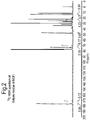
- the 13 C NMR spectrum of the MDFI is shown in Figure 2 .
- the spectrum is consistent with the sample being a terpolymer of ethylene, vinyl acetate and vinyl 2-ethylhexanoate. Clear evidence for the presence of both types of vinyl monomer appears in the carbonyl region of the spectrum: the signals from 2-ethylhexanoate carbonyls are around 176ppm and are resolved from the acetate peaks at about 171ppm. Integration of these signals indicates that the molar ratio of the monomers is 0.12 acetate units to every 2-ethylhexanoate unit. This ratio can also be calculated from the 1 H NMR (as C/3B) and the same value is obtained.
- Paraffin content and distribution were determined via GC. To develop response curves for each GTL Fuel, samples of each fuel were additivated with treat rates of between 0 to 4000 mg/kg of the MDFI described in Example 1.
- the Cold Filter Plugging Point is an estimate of the lowest temperature at which a fuel will give trouble-free flow in certain fuel systems.
- the MDFI described in Example 1 was mixed with a Fischer-Tropsch-derived gasoil (GTL1) to obtain solutions covering a range of concentrations between 0-4000 mg/kg (parts per million by weight, or ppmw).
- GTL1 Fischer-Tropsch-derived gasoil
- Properties of GTL 1 are listed in Table 1.
- the carbon number distribution of the normal paraffins (unbranched alkanes) in GTL 1 is shown in Figure 3 . Solutions were prepared by weighing an appropriate amount of the MDFI into an empty, tared container on an analytical balance, then adding GTL until the target weight was obtained. The containers were sealed with a cap and shaken thoroughly to ensure adequate mixing of the contents.
- Example 2 The MDFI described in Example 1 was used to prepare solutions in a second Fischer-Tropsch-derived gasoil (GTL 2) according to the same procedure outlined in Example 2. Properties of GTL 2 are listed in Table 1. The carbon number distribution of the normal paraffins (unbranched alkanes) in GTL 2 is shown in Figure 3 . Results of CFPP tests on the samples for Example 3 are shown in Figure 4 .
- Example 1 The MDFI described in Example 1 was used to prepare solutions in another Fischer-Tropsch-derived gasoil (Comparative Example 1) at concentrations between 0 and 4000 mg/kg (ppmw) using the same procedure outlined in Example 2.
- Properties of Comparative Example 1 are listed in Table 1.
- the carbon number distribution of the normal paraffins (unbranched alkanes)in Comparative Example 1 is shown in Figure 3 .
- Results of CFPP tests on the samples for Comparative Example 1 are shown in Figure 4 .
- Example 2 The MDFI described in Example 1 was used to prepare solutions in another Fischer-Tropsch-derived gasoil (Comparative Example 2) at concentrations of 0, 2000 and 4000 mg/kg(ppmw) using the same procedure outlined in Example 2.
- Properties of Comparative Example 2 are listed in Table 1.
- the carbon number distribution of the normal paraffins (unbranched alkanes)in Comparative Example 1 is shown in Figure 3 .
- Results of CFPP tests on the samples for Comparative Example 2 are shown in Figure 4 .
- Example 3 The MDFI described in Example 1 was used to prepare solutions in another Fischer-Tropsch-derived gasoil (Comparative Example 3) at concentrations between 0 and 4000 mg/kg (ppmw) using the same procedure outlined in Example 2.
- Properties of Comparative Example 3 are listed in Table 1.
- the carbon number distribution of the normal paraffins (unbranched alkanes)in Comparative Example 3 is shown in Figure 3 .
- Results of CFPP tests on the samples for Comparative Example 3 are shown in Figure 4 .
Landscapes
- Chemical & Material Sciences (AREA)
- Oil, Petroleum & Natural Gas (AREA)
- Engineering & Computer Science (AREA)
- Organic Chemistry (AREA)
- Chemical Kinetics & Catalysis (AREA)
- General Chemical & Material Sciences (AREA)
- Combustion & Propulsion (AREA)
- Health & Medical Sciences (AREA)
- Emergency Medicine (AREA)
- Liquid Carbonaceous Fuels (AREA)
Claims (11)
- Composition de combustible comprenant un combustible de distillat moyen dérivé du procédé Fischer-Tropsch et un agent d'amélioration d'écoulement de distillat moyen, le reste de la composition étant un autre composant combustible ou mélange de composants combustibles, l'autre composant combustible étant choisi parmi un combustible de distillat moyen dérivé du pétrole, une huile végétale hydrogénée, des esters méthyliques d'acides gras et d'autres produits Fischer-Tropsch tels qu'une huile de base F-T légère ;
la quantité du combustible de distillat moyen dérivé du procédé Fischer-Tropsch étant supérieure à 80 % en volume de la composition totale ;
la teneur maximale en poids dans la distribution du nombre d'atomes de carbone des n-paraffines dans le combustible de distillat moyen dérivé du procédé Fischer-Tropsch étant inférieure à C16 et le rapport pondéral des isoparaffines aux paraffines normales dans le combustible de distillat moyen dérivé du procédé Fischer-Tropsch étant supérieur ou égal à 3,5:1 ; et
l'agent d'amélioration d'écoulement de distillat moyen étant un polymère d'éthylène substitué, constituant une seule chaîne alkyle longue substituée par des groupes ester d'acétate et des groupes ester de 2-éthylhexanoate et portant en outre des ramifications méthyle, le rapport moyen d'acétate à 2-éthylhexanoate étant de 1:8, le pourcentage en moles étant de 2 % pour l'acétate et de 16 % pour le 2-éthylhexanoate et le nombre moyen de ramifications méthyle pour 100 groupes méthylène étant de 4,9 ; et
l'agent d'amélioration d'écoulement de distillat moyen étant présent dans la composition à un taux de traitement de 125 à 4 000 mg/kg. - Composition de combustible selon la revendication 1, dans laquelle l'agent d'amélioration d'écoulement de distillat moyen est présent dans la composition à un taux de traitement de 250 à 4 000 mg/kg, de manière davantage préférée de 500 à 3 000 mg/kg et en particulier de 750 à 2 000 mg/kg.
- Composition de combustible selon la revendication 1 ou 2, dans laquelle la quantité du combustible de distillat moyen dérivé du procédé Fischer-Tropsch est d'au moins 90 %, de manière davantage préférée d'au moins 95 %, notamment d'au moins 98 % en volume, en particulier d'au moins 99 % en volume de la composition totale et de manière préférée entre toutes le combustible de distillat moyen dérivé du procédé Fischer-Tropsch est le seul composant combustible dans la composition de combustible.
- Composition de combustible selon l'une quelconque des revendications 1 à 3, dans laquelle le combustible de distillat moyen dérivé du procédé Fischer-Tropsch est constitué d'au moins 95 % en poids, de manière davantage préférée d'au moins 98 % en poids et de manière préférée entre toutes jusqu'à 100 % en poids de composants paraffiniques.
- Composition de combustible selon l'une quelconque des revendications 1 à 4, dans laquelle le CFPP est inférieur à -20°C et de préférence inférieur à -25°C.
- Composition de combustible selon l'une quelconque des revendications précédentes, dans laquelle le rapport pondéral des isoparaffines aux paraffines normales dans le combustible de distillat moyen dérivé du procédé Fischer-Tropsch est d'au moins 4,0 et de préférence de 4,0 à 7,5.
- Utilisation de la composition de combustible selon l'une quelconque des revendications précédentes en tant que combustible diesel.
- Utilisation selon la revendication 7 destinée à être utilisée dans des climats nécessitant un écoulement à basse température jusqu'à -25°C ou moins tel que mesuré lors du test CFPP.
- Utilisation de la composition de combustible selon l'une quelconque des revendications précédentes en tant que combustible dans un moteur diesel à injection directe ou indirecte.
- Utilisation selon la revendication 9, dans laquelle le moteur tourne à des températures d'environ -25°C ou moins.
- Utilisation d'un agent d'amélioration d'écoulement de distillat moyen qui est un polymère d'éthylène substitué, constituant une seule chaîne alkyle longue substituée par des groupes ester d'acétate et des groupes ester de 2-éthylhexanoate et portant en outre des ramifications méthyle, le rapport moyen d'acétate à 2-éthylhexanoate étant de 1:8, et le pourcentage en moles étant de 2 % pour l'acétate et de 16 % pour le 2-éthylhexanoate, et le nombre moyen de ramifications méthyle pour 100 groupes méthylène étant de 4,9, dans le but d'améliorer les propriétés d'écoulement à froid d'une composition de combustible comprenant une quantité d'un combustible de distillat moyen dérivé du procédé Fischer-Tropsch supérieure à 80 % en volume de la composition totale, la teneur maximale en poids de la distribution en nombre d'atomes de carbone des n-paraffines dans le combustible de distillat moyen dérivé du procédé Fischer-Tropsch étant inférieure à C16 et le rapport pondéral des isoparaffines aux paraffines normales dans le combustible de distillat moyen dérivé du procédé Fischer-Tropsch étant supérieur ou égal à 3,5:1, l'agent d'amélioration d'écoulement de distillat moyen étant présent dans la composition à un taux de traitement de 125 à 4 000 mg/kg et les propriétés d'écoulement à froid étant améliorées pour atteindre un CFPP d'environ -25°C ou moins.
Priority Applications (1)
| Application Number | Priority Date | Filing Date | Title |
|---|---|---|---|
| EP13811931.8A EP2935530B1 (fr) | 2012-12-20 | 2013-12-19 | Compositions de combustible dérivées du procédé fischer-tropsch |
Applications Claiming Priority (3)
| Application Number | Priority Date | Filing Date | Title |
|---|---|---|---|
| EP12198659 | 2012-12-20 | ||
| PCT/EP2013/077342 WO2014096169A1 (fr) | 2012-12-20 | 2013-12-19 | Compositions de combustible dérivées de fischer-tropsch |
| EP13811931.8A EP2935530B1 (fr) | 2012-12-20 | 2013-12-19 | Compositions de combustible dérivées du procédé fischer-tropsch |
Publications (2)
| Publication Number | Publication Date |
|---|---|
| EP2935530A1 EP2935530A1 (fr) | 2015-10-28 |
| EP2935530B1 true EP2935530B1 (fr) | 2019-03-27 |
Family
ID=47500985
Family Applications (1)
| Application Number | Title | Priority Date | Filing Date |
|---|---|---|---|
| EP13811931.8A Active EP2935530B1 (fr) | 2012-12-20 | 2013-12-19 | Compositions de combustible dérivées du procédé fischer-tropsch |
Country Status (4)
| Country | Link |
|---|---|
| US (1) | US10041013B2 (fr) |
| EP (1) | EP2935530B1 (fr) |
| DK (1) | DK2935530T3 (fr) |
| WO (1) | WO2014096169A1 (fr) |
Families Citing this family (4)
| Publication number | Priority date | Publication date | Assignee | Title |
|---|---|---|---|---|
| FR3092334B1 (fr) * | 2019-01-31 | 2022-06-17 | Total Marketing Services | Utilisation d’une composition de carburant à base d’hydrocarbures paraffiniques pour nettoyer les parties internes des moteurs diesels |
| US11608787B2 (en) * | 2020-09-08 | 2023-03-21 | Southwest Research Institute | Internal combustion engine having carbon dioxide capture and fuel additive synthesis system |
| CA3203136A1 (fr) * | 2020-12-11 | 2022-06-16 | Shell Internationale Research Maatschappij B.V. | Utilisation d'un gazole paraffinique |
| US20240052268A1 (en) | 2022-08-15 | 2024-02-15 | Energizer Auto, Inc. | Surface treating formulation and method of making and using the same |
Family Cites Families (13)
| Publication number | Priority date | Publication date | Assignee | Title |
|---|---|---|---|---|
| US4208190A (en) | 1979-02-09 | 1980-06-17 | Ethyl Corporation | Diesel fuels having anti-wear properties |
| NL8003313A (nl) | 1980-06-06 | 1982-01-04 | Shell Int Research | Werkwijze voor de bereiding van middeldestillaten. |
| IN161735B (fr) | 1983-09-12 | 1988-01-30 | Shell Int Research | |
| DE3584184D1 (de) | 1984-05-09 | 1991-10-31 | Analog Devices Inc | Verfahren zum herstellen einer ic-scheibe mit vergrabener zenerdiode. |
| US5718734A (en) * | 1992-06-30 | 1998-02-17 | Exxon Chemical Patents Inc. | Oil additives and compositions |
| CA2104158C (fr) | 1992-08-18 | 2005-11-15 | Jacobus Eilers | Procede de preparation de combustible hydrocarbones |
| GB9417670D0 (en) | 1994-09-02 | 1994-10-19 | Exxon Chemical Patents Inc | Oil additives, compositions and polymers for use therein |
| GB9716533D0 (en) | 1997-08-05 | 1997-10-08 | Exxon Chemical Patents Inc | Additives for oil compositions |
| US7217852B1 (en) * | 1998-10-05 | 2007-05-15 | Sasol Technology (Pty) Ltd. | Process for producing middle distillates and middle distillates produced by that process |
| US20050138859A1 (en) * | 2003-12-16 | 2005-06-30 | Graham Jackson | Cold flow improver compositions for fuels |
| KR101283093B1 (ko) * | 2005-02-11 | 2013-07-05 | 인피늄 인터내셔날 리미티드 | 연료 오일 조성물 |
| EP1690919B1 (fr) | 2005-02-11 | 2016-03-02 | Infineum International Limited | Compositions d'huile combustible |
| US7906246B2 (en) | 2006-11-23 | 2011-03-15 | I-Chuan Lin | Powdered fuel cell |
-
2013
- 2013-12-19 WO PCT/EP2013/077342 patent/WO2014096169A1/fr not_active Ceased
- 2013-12-19 US US14/653,389 patent/US10041013B2/en active Active
- 2013-12-19 EP EP13811931.8A patent/EP2935530B1/fr active Active
- 2013-12-19 DK DK13811931.8T patent/DK2935530T3/da active
Non-Patent Citations (1)
| Title |
|---|
| None * |
Also Published As
| Publication number | Publication date |
|---|---|
| US20150315507A1 (en) | 2015-11-05 |
| US10041013B2 (en) | 2018-08-07 |
| DK2935530T3 (da) | 2019-07-01 |
| EP2935530A1 (fr) | 2015-10-28 |
| WO2014096169A1 (fr) | 2014-06-26 |
Similar Documents
| Publication | Publication Date | Title |
|---|---|---|
| US8273137B2 (en) | Fuel composition | |
| US8876923B2 (en) | Fuel compositions | |
| AU2004269169B2 (en) | Fuel compositions comprising Fischer-Tropsch derived fuel | |
| US10041013B2 (en) | Fischer-Tropsch derived fuel compositions | |
| EP2370553B1 (fr) | COMPOSITIONS DE CARBURANT contenant de la tetrahydroquinoline | |
| EP3022278B1 (fr) | Compositions de combustible haute puissance | |
| US8771385B2 (en) | Fuel compositions | |
| US10407637B2 (en) | Fuel composition | |
| EP4232530A1 (fr) | Utilisation d'une composition de carburant diesel | |
| EP3374471B1 (fr) | Procédé de préparation d'une composition de carburant diesel | |
| EP2078744A1 (fr) | Composition de carburant | |
| WO2018206729A1 (fr) | Procédé de préparation d'une fraction de gazole automobile | |
| WO2018077976A1 (fr) | Procédé de préparation d'un gazole automobile |
Legal Events
| Date | Code | Title | Description |
|---|---|---|---|
| PUAI | Public reference made under article 153(3) epc to a published international application that has entered the european phase |
Free format text: ORIGINAL CODE: 0009012 |
|
| 17P | Request for examination filed |
Effective date: 20150708 |
|
| AK | Designated contracting states |
Kind code of ref document: A1 Designated state(s): AL AT BE BG CH CY CZ DE DK EE ES FI FR GB GR HR HU IE IS IT LI LT LU LV MC MK MT NL NO PL PT RO RS SE SI SK SM TR |
|
| AX | Request for extension of the european patent |
Extension state: BA ME |
|
| DAX | Request for extension of the european patent (deleted) | ||
| RAP1 | Party data changed (applicant data changed or rights of an application transferred) |
Owner name: SHELL INTERNATIONALE RESEARCH MAATSCHAPPIJ B.V. |
|
| GRAP | Despatch of communication of intention to grant a patent |
Free format text: ORIGINAL CODE: EPIDOSNIGR1 |
|
| STAA | Information on the status of an ep patent application or granted ep patent |
Free format text: STATUS: GRANT OF PATENT IS INTENDED |
|
| INTG | Intention to grant announced |
Effective date: 20181022 |
|
| GRAS | Grant fee paid |
Free format text: ORIGINAL CODE: EPIDOSNIGR3 |
|
| GRAA | (expected) grant |
Free format text: ORIGINAL CODE: 0009210 |
|
| STAA | Information on the status of an ep patent application or granted ep patent |
Free format text: STATUS: THE PATENT HAS BEEN GRANTED |
|
| AK | Designated contracting states |
Kind code of ref document: B1 Designated state(s): AL AT BE BG CH CY CZ DE DK EE ES FI FR GB GR HR HU IE IS IT LI LT LU LV MC MK MT NL NO PL PT RO RS SE SI SK SM TR |
|
| REG | Reference to a national code |
Ref country code: GB Ref legal event code: FG4D |
|
| REG | Reference to a national code |
Ref country code: CH Ref legal event code: EP |
|
| REG | Reference to a national code |
Ref country code: AT Ref legal event code: REF Ref document number: 1113068 Country of ref document: AT Kind code of ref document: T Effective date: 20190415 |
|
| REG | Reference to a national code |
Ref country code: IE Ref legal event code: FG4D |
|
| REG | Reference to a national code |
Ref country code: DE Ref legal event code: R096 Ref document number: 602013053040 Country of ref document: DE |
|
| REG | Reference to a national code |
Ref country code: DK Ref legal event code: T3 Effective date: 20190627 |
|
| REG | Reference to a national code |
Ref country code: SE Ref legal event code: TRGR |
|
| PG25 | Lapsed in a contracting state [announced via postgrant information from national office to epo] |
Ref country code: LT Free format text: LAPSE BECAUSE OF FAILURE TO SUBMIT A TRANSLATION OF THE DESCRIPTION OR TO PAY THE FEE WITHIN THE PRESCRIBED TIME-LIMIT Effective date: 20190327 |
|
| REG | Reference to a national code |
Ref country code: NL Ref legal event code: MP Effective date: 20190327 |
|
| PG25 | Lapsed in a contracting state [announced via postgrant information from national office to epo] |
Ref country code: BG Free format text: LAPSE BECAUSE OF FAILURE TO SUBMIT A TRANSLATION OF THE DESCRIPTION OR TO PAY THE FEE WITHIN THE PRESCRIBED TIME-LIMIT Effective date: 20190627 Ref country code: GR Free format text: LAPSE BECAUSE OF FAILURE TO SUBMIT A TRANSLATION OF THE DESCRIPTION OR TO PAY THE FEE WITHIN THE PRESCRIBED TIME-LIMIT Effective date: 20190628 Ref country code: NL Free format text: LAPSE BECAUSE OF FAILURE TO SUBMIT A TRANSLATION OF THE DESCRIPTION OR TO PAY THE FEE WITHIN THE PRESCRIBED TIME-LIMIT Effective date: 20190327 Ref country code: HR Free format text: LAPSE BECAUSE OF FAILURE TO SUBMIT A TRANSLATION OF THE DESCRIPTION OR TO PAY THE FEE WITHIN THE PRESCRIBED TIME-LIMIT Effective date: 20190327 Ref country code: RS Free format text: LAPSE BECAUSE OF FAILURE TO SUBMIT A TRANSLATION OF THE DESCRIPTION OR TO PAY THE FEE WITHIN THE PRESCRIBED TIME-LIMIT Effective date: 20190327 Ref country code: LV Free format text: LAPSE BECAUSE OF FAILURE TO SUBMIT A TRANSLATION OF THE DESCRIPTION OR TO PAY THE FEE WITHIN THE PRESCRIBED TIME-LIMIT Effective date: 20190327 |
|
| REG | Reference to a national code |
Ref country code: NO Ref legal event code: T2 Effective date: 20190327 |
|
| REG | Reference to a national code |
Ref country code: AT Ref legal event code: MK05 Ref document number: 1113068 Country of ref document: AT Kind code of ref document: T Effective date: 20190327 |
|
| PG25 | Lapsed in a contracting state [announced via postgrant information from national office to epo] |
Ref country code: IT Free format text: LAPSE BECAUSE OF FAILURE TO SUBMIT A TRANSLATION OF THE DESCRIPTION OR TO PAY THE FEE WITHIN THE PRESCRIBED TIME-LIMIT Effective date: 20190327 Ref country code: CZ Free format text: LAPSE BECAUSE OF FAILURE TO SUBMIT A TRANSLATION OF THE DESCRIPTION OR TO PAY THE FEE WITHIN THE PRESCRIBED TIME-LIMIT Effective date: 20190327 Ref country code: RO Free format text: LAPSE BECAUSE OF FAILURE TO SUBMIT A TRANSLATION OF THE DESCRIPTION OR TO PAY THE FEE WITHIN THE PRESCRIBED TIME-LIMIT Effective date: 20190327 Ref country code: SK Free format text: LAPSE BECAUSE OF FAILURE TO SUBMIT A TRANSLATION OF THE DESCRIPTION OR TO PAY THE FEE WITHIN THE PRESCRIBED TIME-LIMIT Effective date: 20190327 Ref country code: AL Free format text: LAPSE BECAUSE OF FAILURE TO SUBMIT A TRANSLATION OF THE DESCRIPTION OR TO PAY THE FEE WITHIN THE PRESCRIBED TIME-LIMIT Effective date: 20190327 Ref country code: EE Free format text: LAPSE BECAUSE OF FAILURE TO SUBMIT A TRANSLATION OF THE DESCRIPTION OR TO PAY THE FEE WITHIN THE PRESCRIBED TIME-LIMIT Effective date: 20190327 Ref country code: PT Free format text: LAPSE BECAUSE OF FAILURE TO SUBMIT A TRANSLATION OF THE DESCRIPTION OR TO PAY THE FEE WITHIN THE PRESCRIBED TIME-LIMIT Effective date: 20190727 Ref country code: ES Free format text: LAPSE BECAUSE OF FAILURE TO SUBMIT A TRANSLATION OF THE DESCRIPTION OR TO PAY THE FEE WITHIN THE PRESCRIBED TIME-LIMIT Effective date: 20190327 |
|
| PG25 | Lapsed in a contracting state [announced via postgrant information from national office to epo] |
Ref country code: SM Free format text: LAPSE BECAUSE OF FAILURE TO SUBMIT A TRANSLATION OF THE DESCRIPTION OR TO PAY THE FEE WITHIN THE PRESCRIBED TIME-LIMIT Effective date: 20190327 Ref country code: PL Free format text: LAPSE BECAUSE OF FAILURE TO SUBMIT A TRANSLATION OF THE DESCRIPTION OR TO PAY THE FEE WITHIN THE PRESCRIBED TIME-LIMIT Effective date: 20190327 |
|
| PG25 | Lapsed in a contracting state [announced via postgrant information from national office to epo] |
Ref country code: IS Free format text: LAPSE BECAUSE OF FAILURE TO SUBMIT A TRANSLATION OF THE DESCRIPTION OR TO PAY THE FEE WITHIN THE PRESCRIBED TIME-LIMIT Effective date: 20190727 Ref country code: AT Free format text: LAPSE BECAUSE OF FAILURE TO SUBMIT A TRANSLATION OF THE DESCRIPTION OR TO PAY THE FEE WITHIN THE PRESCRIBED TIME-LIMIT Effective date: 20190327 |
|
| REG | Reference to a national code |
Ref country code: DE Ref legal event code: R097 Ref document number: 602013053040 Country of ref document: DE |
|
| PLBE | No opposition filed within time limit |
Free format text: ORIGINAL CODE: 0009261 |
|
| STAA | Information on the status of an ep patent application or granted ep patent |
Free format text: STATUS: NO OPPOSITION FILED WITHIN TIME LIMIT |
|
| PG25 | Lapsed in a contracting state [announced via postgrant information from national office to epo] |
Ref country code: SI Free format text: LAPSE BECAUSE OF FAILURE TO SUBMIT A TRANSLATION OF THE DESCRIPTION OR TO PAY THE FEE WITHIN THE PRESCRIBED TIME-LIMIT Effective date: 20190327 |
|
| 26N | No opposition filed |
Effective date: 20200103 |
|
| PG25 | Lapsed in a contracting state [announced via postgrant information from national office to epo] |
Ref country code: TR Free format text: LAPSE BECAUSE OF FAILURE TO SUBMIT A TRANSLATION OF THE DESCRIPTION OR TO PAY THE FEE WITHIN THE PRESCRIBED TIME-LIMIT Effective date: 20190327 |
|
| REG | Reference to a national code |
Ref country code: CH Ref legal event code: PL |
|
| REG | Reference to a national code |
Ref country code: BE Ref legal event code: MM Effective date: 20191231 |
|
| PG25 | Lapsed in a contracting state [announced via postgrant information from national office to epo] |
Ref country code: MC Free format text: LAPSE BECAUSE OF FAILURE TO SUBMIT A TRANSLATION OF THE DESCRIPTION OR TO PAY THE FEE WITHIN THE PRESCRIBED TIME-LIMIT Effective date: 20190327 |
|
| GBPC | Gb: european patent ceased through non-payment of renewal fee |
Effective date: 20191219 |
|
| PG25 | Lapsed in a contracting state [announced via postgrant information from national office to epo] |
Ref country code: FR Free format text: LAPSE BECAUSE OF NON-PAYMENT OF DUE FEES Effective date: 20191231 Ref country code: IE Free format text: LAPSE BECAUSE OF NON-PAYMENT OF DUE FEES Effective date: 20191219 Ref country code: GB Free format text: LAPSE BECAUSE OF NON-PAYMENT OF DUE FEES Effective date: 20191219 Ref country code: LU Free format text: LAPSE BECAUSE OF NON-PAYMENT OF DUE FEES Effective date: 20191219 |
|
| PG25 | Lapsed in a contracting state [announced via postgrant information from national office to epo] |
Ref country code: LI Free format text: LAPSE BECAUSE OF NON-PAYMENT OF DUE FEES Effective date: 20191231 Ref country code: CH Free format text: LAPSE BECAUSE OF NON-PAYMENT OF DUE FEES Effective date: 20191231 Ref country code: BE Free format text: LAPSE BECAUSE OF NON-PAYMENT OF DUE FEES Effective date: 20191231 |
|
| PG25 | Lapsed in a contracting state [announced via postgrant information from national office to epo] |
Ref country code: CY Free format text: LAPSE BECAUSE OF FAILURE TO SUBMIT A TRANSLATION OF THE DESCRIPTION OR TO PAY THE FEE WITHIN THE PRESCRIBED TIME-LIMIT Effective date: 20190327 |
|
| PG25 | Lapsed in a contracting state [announced via postgrant information from national office to epo] |
Ref country code: MT Free format text: LAPSE BECAUSE OF FAILURE TO SUBMIT A TRANSLATION OF THE DESCRIPTION OR TO PAY THE FEE WITHIN THE PRESCRIBED TIME-LIMIT Effective date: 20190327 Ref country code: HU Free format text: LAPSE BECAUSE OF FAILURE TO SUBMIT A TRANSLATION OF THE DESCRIPTION OR TO PAY THE FEE WITHIN THE PRESCRIBED TIME-LIMIT; INVALID AB INITIO Effective date: 20131219 |
|
| PG25 | Lapsed in a contracting state [announced via postgrant information from national office to epo] |
Ref country code: MK Free format text: LAPSE BECAUSE OF FAILURE TO SUBMIT A TRANSLATION OF THE DESCRIPTION OR TO PAY THE FEE WITHIN THE PRESCRIBED TIME-LIMIT Effective date: 20190327 |
|
| P01 | Opt-out of the competence of the unified patent court (upc) registered |
Effective date: 20230425 |
|
| PGFP | Annual fee paid to national office [announced via postgrant information from national office to epo] |
Ref country code: DE Payment date: 20250930 Year of fee payment: 13 |
|
| PGFP | Annual fee paid to national office [announced via postgrant information from national office to epo] |
Ref country code: NO Payment date: 20251210 Year of fee payment: 13 |
|
| PGFP | Annual fee paid to national office [announced via postgrant information from national office to epo] |
Ref country code: FI Payment date: 20251211 Year of fee payment: 13 Ref country code: DK Payment date: 20251212 Year of fee payment: 13 |
|
| PGFP | Annual fee paid to national office [announced via postgrant information from national office to epo] |
Ref country code: SE Payment date: 20251001 Year of fee payment: 13 |