EP2936712B1 - Procédés et appareils pour limiter des interférences entre cellules sur un canal de commande - Google Patents
Procédés et appareils pour limiter des interférences entre cellules sur un canal de commande Download PDFInfo
- Publication number
- EP2936712B1 EP2936712B1 EP13863876.2A EP13863876A EP2936712B1 EP 2936712 B1 EP2936712 B1 EP 2936712B1 EP 13863876 A EP13863876 A EP 13863876A EP 2936712 B1 EP2936712 B1 EP 2936712B1
- Authority
- EP
- European Patent Office
- Prior art keywords
- ues
- group
- resources
- pucch
- base station
- Prior art date
- Legal status (The legal status is an assumption and is not a legal conclusion. Google has not performed a legal analysis and makes no representation as to the accuracy of the status listed.)
- Active
Links
Images




Classifications
-
- H—ELECTRICITY
- H04—ELECTRIC COMMUNICATION TECHNIQUE
- H04J—MULTIPLEX COMMUNICATION
- H04J11/00—Orthogonal multiplex systems, e.g. using WALSH codes
- H04J11/0023—Interference mitigation or co-ordination
- H04J11/005—Interference mitigation or co-ordination of intercell interference
-
- H—ELECTRICITY
- H04—ELECTRIC COMMUNICATION TECHNIQUE
- H04J—MULTIPLEX COMMUNICATION
- H04J11/00—Orthogonal multiplex systems, e.g. using WALSH codes
-
- H—ELECTRICITY
- H04—ELECTRIC COMMUNICATION TECHNIQUE
- H04L—TRANSMISSION OF DIGITAL INFORMATION, e.g. TELEGRAPHIC COMMUNICATION
- H04L5/00—Arrangements affording multiple use of the transmission path
- H04L5/0001—Arrangements for dividing the transmission path
- H04L5/0014—Three-dimensional division
- H04L5/0016—Time-frequency-code
-
- H—ELECTRICITY
- H04—ELECTRIC COMMUNICATION TECHNIQUE
- H04L—TRANSMISSION OF DIGITAL INFORMATION, e.g. TELEGRAPHIC COMMUNICATION
- H04L5/00—Arrangements affording multiple use of the transmission path
- H04L5/003—Arrangements for allocating sub-channels of the transmission path
- H04L5/0053—Allocation of signalling, i.e. of overhead other than pilot signals
-
- H—ELECTRICITY
- H04—ELECTRIC COMMUNICATION TECHNIQUE
- H04L—TRANSMISSION OF DIGITAL INFORMATION, e.g. TELEGRAPHIC COMMUNICATION
- H04L5/00—Arrangements affording multiple use of the transmission path
- H04L5/003—Arrangements for allocating sub-channels of the transmission path
- H04L5/0058—Allocation criteria
- H04L5/0073—Allocation arrangements that take into account other cell interferences
-
- H—ELECTRICITY
- H04—ELECTRIC COMMUNICATION TECHNIQUE
- H04W—WIRELESS COMMUNICATION NETWORKS
- H04W16/00—Network planning, e.g. coverage or traffic planning tools; Network deployment, e.g. resource partitioning or cells structures
- H04W16/02—Resource partitioning among network components, e.g. reuse partitioning
-
- H—ELECTRICITY
- H04—ELECTRIC COMMUNICATION TECHNIQUE
- H04W—WIRELESS COMMUNICATION NETWORKS
- H04W72/00—Local resource management
- H04W72/20—Control channels or signalling for resource management
-
- H—ELECTRICITY
- H04—ELECTRIC COMMUNICATION TECHNIQUE
- H04W—WIRELESS COMMUNICATION NETWORKS
- H04W72/00—Local resource management
- H04W72/50—Allocation or scheduling criteria for wireless resources
- H04W72/54—Allocation or scheduling criteria for wireless resources based on quality criteria
Definitions
- the present disclosure relates generally to a method and an apparatus for controlling the inter-cell interference (ICI) between cells when receiving control signals.
- ICI inter-cell interference
- a mobile radio network covers a geographical area which is divided into cell areas, wherein each cell area is generally served by a radio network node.
- a radio network node may be a Radio Base Station (RBS), also sometimes referred to as e.g. "eNB”, “eNodeB”, or BTS (Base Transceiver Station).
- RBS Radio Base Station
- a radio network node or RBS may provide radio coverage to one or more cells.
- the radio network nodes communicate with user equipments (UEs) also referred to as mobile stations, mobile terminals, wireless terminals, mobile telephones, cellular telephones or smart phones situated within its radio network cell. Other examples of UEs are laptops, notebooks, tablets and handheld devices. All of those having wireless communication capabilities.
- a radio mobile communication may be performed between two or more UEs, two or more radio network nodes or two or more radio network core nodes. All of the above-mentioned pieces form part of a radio mobile network.
- each of these equipments communicates within a frequency band or channel allocated to one operator in a radio network.
- the frequency band may be a whole spectrum chunk whilst a channel may be a subset of the spectrum resources of the frequency band used for resource management purposes.
- LTE Long Term Evolution
- the LTE-system has a Physical Uplink Control Channel (PUCCH) which is used to carry the Layer 1 and Layer 2 (L1/L2) control information.
- the transmitted control information is mainly a periodic channel state report e.g. Channel Quality Indicator, CQI, a hybrid-ARQ (Automatic Repeat Request) acknowledgement ACK/ non-acknowledgement NACK) corresponding to the downlink transmission or a scheduling request (SR).
- CQI Channel Quality Indicator
- SR Automatic Repeat Request
- Different information needs different number of bits and different PUCCH formats are defined to classify those. In this application, we focus on the scheduling request, SR, on PUCCH.
- the scheduling request, SR is a request from a user equipment, UE, to a Radio Base Station (RBS) to be allocated resources for uplink communication.
- the RBS receives the SR and identifies which UE the SR belongs to. This is possible because each of the UEs is allocated a static and unique PUCCH SR resource which is configured by RBS.
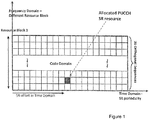
- Figure 1 shows an allocated PUCCH SR resource for a UE.
- the scheduler in an RBS needs to be aware of the queue status in each UE in order to perform an adequate scheduling in the uplink, i.e. in the direction from the UE to the RBS. For this reason, a "UE send buffer status report" is transmitted to the RBS to inform about the send buffer status.
- a SR is sent/triggered by the UE, in order to ask for an UL scheduling resource. Consequently, a SR is transmitted by the UE on a SR resource (on the PUCCH) selected by the RBS when a buffer status report is to be sent, e.g. , when new data have arrived to a previously empty UE buffer, or when newly arrived data have higher priority than the existing data stored in the UE buffer.
- VoIP Voice over IP
- VoIP Voice over IP
- the SRs are to be transmitted on the PUCCH and only one PUCCH SR resource is allocated.
- the SRs may still be transmitted but on the contention based Random Access Channel (RA-SR).
- RA-SR contention based Random Access Channel
- the PUCCH SR should be unique in at least one of three dimensions, i.e. time domain, frequency domain and coding domain.
- SR periodicity is introduced to achieve the time domain SR multiplexing, where a UE only can send SR periodically with a certain offset in time.
- Different UEs are able to send SRs on different resource blocks (RB) pairs or with different coded sequences resulting in the frequency domain and coding domain multiplexing.
- the different coded sequence refers to different orthogonal sequences or cyclic shifts. If the three domains are multiplexed, the capacity of the PUCCH SR is highly improved and a large number of UEs obtain their own unique PUCCH SRs. In total, there are a maximum of 36 code sequences for PUCCH SRs in one RB pair, which means that a maximum of 36 UEs can send SRs at the same time with the same RB pair.
- PUCCH SRs are orthogonal within a cell, which entails that no intra-cell interference is generated.
- the inter-cell SR interference is significant when users belonging to different cells are transmitting SRs at the same time using the same resource block (RB).
- RB resource block
- PUCCH SR interference is generated. This is because the interference will only be generated when the PUCCH SR resource is utilized, i.e. when an SR is sent. As previously explained, the SR is triggered only for uplink data transmission and different types of users/UEs will generate a different amount of SRs.
- EP 2 385 651 discloses a method for handling an acknowledgement/negative acknowledgement (ACH/NACK) transmission for a mobile device with a carrier aggregation (CA) in a wireless communication system.
- the method comprises receiving a configuration or an activation of the CA with at least one UL component carrier and at least one downlink (DL) component carrier from a network of the wireless communication system.
- the UL control information is transmitted on at least one control channel region of the at least one UL component carrier.
- the at least one UL component carrier has a bandwidth configuration sufficient to accommodate the at least one control channel region for transmitting the UL control information.
- WO2010/060455 discloses a method for transmitting a scheduling request on a physical uplink control channel (PUCCH) using multiple antennas with spatial transmit diversity. Each antenna group comprises one or more antenna elements. Control information is received on the physical uplink control channel separately from one or more resources, determining whether specific resources are occupied with control information. Specific PUCCH resources are combined and it is decided on whether to schedule the transmitter of the control information for an uplink transmission or not.
- PUCCH physical uplink control channel
- a method is provided to be performed by a base station.
- the method comprising determining a type of service associated with a UE.
- the method further comprises determining whether the UE belongs to a first group of UEs or a second group of UEs, based on the type of service associated with the UE.
- the method comprises, when the UE is determined to belong to the first group of UEs, allocating resources on the PUCCH to the UE in a first section of PUCCH resources; and then receiving SRs from the UE in the allocated resources in the first section of PUCCH resources.
- the method further comprises, when the UE is determined to belong to the second group of UEs, allocating resources on the PUCCH to the UE in a second section of PUCCH resources; and then receiving SRs from the UE in the allocated resources in the second section of PUCCH resources.
- a method is provided to be performed by a UE.
- the method comprises transmitting SRs to a base station on the resources allocated to the UE by the base station. Further, when a change associated with the UE implies that the UE should be associated with the other one of a first and a second group of UEs; an indication is received from the base station, indicative of other resources on the PUCCH, to be used by the UE for transmission of SRs to the base station, instead of the previously used resources.
- the method further comprises transmitting SRs to the base station on the indicated resources.
- a method is provided to be performed by a base station. This method is for coordinating the PUCCH resources for the different UE groups between neighboring base stations.
- the method comprises receiving information regarding resources used by a neighboring base station, BS2, for PUCCH, the information comprising an indication regarding a division into at least a first and a second section of the PUCCH resources in time, frequency and/or code, wherein the first section is associated with a first group of UEs, and the second section is associated with a second group of UEs.
- the method further comprises determining, from amongst corresponding sections of PUCCH resources in time, frequency and/or code, a section that is to be used by BS1 for the first group of UEs; such that the determined section does not coincide with the section used by the neighboring base station for the first group of UEs. Further, the method comprises allocating PUCCH resources to UEs belonging to the first group in the determined section and PUCCH resources to UEs belonging to a second group in another section.
- the embodiments described here may be provided to decrease and control the PUCCH SR interference between cells by managing the allocated PUCCH SR resources between cells in the time, frequency and/or code domain and among different categories of users or UEs.
- the controlling of the PUCCH SR resources may avoid interference peaks by separating high SR utilization UEs and Low SR utilization UEs in different regions even at high load scenarios where all the PUCCH SR resources are allocated.
- High SR utilization UEs and “Low SR utilization UEs” are reflecting the amount of SRs that a UE is generating in a certain time. This amount of SRs is very much dependent on the characteristic of the traffic that the UE is carrying.
- VoIP is a type of traffic that generates a large number of SRs.
- the UEs that carries this type of traffic may be referred to as High SR Utilization UEs.
- Low SR Utilization UEs which could be UEs applying services like chat, web browsing or any OTT (Over-the-top) application which has pushing service, e.g. twitter or facebook.
- the PUCCH interference problem arises when a large amount of High SR utilization UEs start to get into the network. For example, when many of the High SR utilization UEs are allocated SR resources on the PUCCH at the same time in neighboring cells, there may be PUCCH SR peaks, which may result in severe ICI on the PUCCH. Moreover, since the PUCCH SR is transmitted periodically without any backoff mechanism, once the high interference results into misdetection of PUCCH SR and PUCCH SR retransmission, the same amount of interference will occur at all the PUSCCH SR retransmission occasion. Therefore, it is critical to solve the ICI on PUCCH.
- SR masking logical Channel SR-Mask defined in 3GPP 36.321
- the SR masking can help to decrease the SR inter cell interference for some specific data traffic.
- SR masking requires a special scheduling algorithm, so-called semi-persistent scheduling, which is not applicable in many cases.
- the SR interference is still a huge problem as described above.
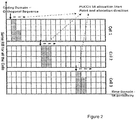
- FIG. 2 shows three coordinated cells with different starting points when searching for PUCCH SR resources.
- the same resource block (RB) pair is used for the PUCCH in all three cells with different coding, and a separation in the time domain creates improved interference avoidance between the cells.
- the PUCCH resources allocated to a user in one cell may coincide with the PUCCH resources allocated to another user in a neighboring cell.
- An overlap may arise e.g. in the time domain, as shown in figure 3 , which degrades the gain.
- the PUCCH SR resources may be divided among different "types" of users/UEs, and the resources used for High SR utilization UEs may be divided among, i.e. separate for, neighboring cells, in order to reduce or avoid the PUCCH SR ICI.
- the classified UE type could be changed for a UE following the change of traffic. For example, a web browsing UE, classified as a Low SR utilization UE, should be reclassified/changed into a High SR utilization UE when initiating a VoLTE call, and the PUCCH SR resource should be reconfigured accordingly.
- the UE category may be further re-evaluated by the RBS, based on the number of received SRs from the UE during a certain time unit, e.g. a window.
- the base station denoted BS1 in the example, is operable to serve a number of UEs in a wireless communication system.
- Figure 4 illustrates the method comprising determining 401 a type of service associated with a UE.
- the method further comprises determining 402 whether the UE belongs to a first group of UEs or a second group of UEs, based on the type of service associated with the UE. Further, the method comprises, when the UE is determined to belong to the first group of UEs, allocating 403 resources on the PUCCH to the UE in a first section of PUCCH resources; and then receiving 404 SRs from the UE in the allocated resources in the first section of PUCCH resources.
- the method further comprises, when the UE is determined to belong to the second group of UEs, allocating 407 resources on the PUCCH to the UE in a second section of PUCCH resources; and then receiving 408 SRs from the UE in the allocated resources in the second section of PUCCH resources.
- the type of service associated with a UE could be determined in different ways, which will be further described below.
- the groups of UEs may be defined in slightly different ways, but the main idea is that UEs generating a lot of SRs, due to the type of services associated with the UE, should belong to one group, and UEs that generate few SRs (in comparison), and thus generates less PUCCH inter cell interference , should belong to another group.
- the resources on the PUCCH are divided into a plurality of sections, where it has been decided at some point, e.g. during initialization, which section is to be used for which group of UEs.
- section 1 should be used for UEs belonging to group 1 and section 2 should be used for UEs belonging to group 2.
- the UE group creating most ICI due to SRs could be allocated to different PUCCH sections (resources) in neighboring cells.
- the different sections, or at least part thereof, should preferably be orthogonal between neighboring cells in at least one of time, frequency and code.
- resources should be allocated for this UE in a section on the PUCCH which is assigned for group 1 UEs, e.g. section 1.
- the information on the allocated resources is signaled to the UE, which then transmits SRs on the allocated resources in section 1.
- the UE need not be aware of the different sections, but only does as it is told.
- resources should be allocated for this UE in a section on the PUCCH which is assigned for group 2 UEs, e.g. section 2.
- the information on the allocated resources is signaled to the UE, which then transmits SRs on the allocated resources in section 2.
- a change of the services applied by the UE may result in a change of the classified UE group, which may further result in a reallocation of the assigned PUCCH resource. This will be further described below
- the type of service associated with a UE may be determined based on information related to a setup or release, or shut down, of a service bearer for the UE. Such information could be received from the UE, derived from information received from the UE, or the base station may determine which bearers that are associated with the UE without involvement of the UE. The base station may be aware of or informed by core network a mapping between a type of service and a bearer, and may conclude which type of service the UE is engaged in based on the bearers associated with the UE. Thus, when the UE belongs e.g.
- UE group 2 a new service bearer is to be set up for the UE, for a service having the characteristics belonging to group 1, the UE should be associated to UE group 1 instead of UE group 2, and could thus be re-allocated to another section on the PUCCH.
- the type of service could be determined by that the base station counts the number of SRs received from the UE during a period of time, e.g. a time window of 1-5 seconds. For a UE which was previously classified as a High SR utilization UE, if the number of SRs received during the measuring window is lower than a threshold, with hysteresis, the RBS should change the UE category to Low SR utilization UE, and reconfigure the PUCCH SR resource to a "Low SR utilization"-resource.
- the threshold value may be different for different implementations.
- the threshold could depend on the status of the UEs in the cell, such that the threshold represents the number of SR per time unit generated by the top 20-30% of UEs on average with respect to SR generation.
- 5-10 SR/Sec may be a good threshold value to start with if no typical statistic information is available for a cell.
- the hysteresis is used to avoid the so-called ping-pong effect, when the category of the UE oscillates back and forth. Typically, the hysteresis should be set to 20%-40% of the threshold value.
- the RBS should change the UE category to Low SR utilization UE, and reconfigure the PUCCH SR resource for the UE to a "High SR utilization"-resource.
- a first UE group may comprise UEs currently applying services generating bursty traffic, and thus generating significantly more SRs per time unit than a second group of UEs.
- the second UE group then comprises UEs applying services generating less bursty traffic than UEs in the first group.
- the UEs of the second group thus generates significantly less SRs per time unit than UEs in the first group.
- the UEs of the first group have been denoted "High SR utilization UEs”
- the UEs of the second group have been denoted "Low SR utilization UEs".
- services are divided into services generating bursty traffic and services generating non-bursty traffic, or at least less bursty traffic than the first type of services.
- Examples of services generating bursty traffic are VoIP and online gaming.
- Examples of services generating non-bursty traffic is e.g. web-browsing and chat services.
- the burstyness of a service is not necessarily related to the data rate of the service. For example, uploading of a large video file may generate a lot of traffic, but not many SRs. Other, bursty services may generate an SR for every packet that is sent, e.g. 50 SRs and 50 packets per second.
- RBS should originally classify the UE category based on the service type that is associated to the UE or following the indication of the higher layer, like Core network and configure the PUCCH SR resource accordingly. Furthermore, the RBS should re-evaluate the UE category based on the received number of SRs, and reconfigure the PUCCH SR resources accordingly.
- a threshold may be formulated based on statistics of generation of SRs of different types of services, and services where the number of generated SRs per time unit, e.g. in average, exceeds the threshold are associated to group 1; and services where the number of generated SRs per time unit, e.g. in average, falls below the threshold are associated to group 2.
- a hysteresis algorithm and a timer function may be applied to protect the system from any ping-pong effects.
- the evaluation of the UE category is triggered at the change 701 of the traffic of a UE, and, at the expiry of a predefined evaluation timer 707.
- the RBS evaluates the UE category based on the characteristic of the existing service, and the PUCCH resource should be reconfigured 704 upon the change of UE category.
- the RBS may further count 705 the number of SRs that are generated by the UE in/during a certain measurement window, to check if the UE category is estimated correctly.
- the length of the measuring window may be implementation dependent, depending e.g. on the capacity of the RBS. In most cases, a window of a duration of 1-5 seconds would be adequate.
- the RBS should change 706 the UE category to Low SR utilization UE, and reconfigure 704 the PUCCH SR resource.
- the threshold value could vary between different implementations, and depend e.g. on the status of the UEs in the cell.
- the threshold could e.g. represent the number of SRs generated by the top 20-30% of the UEs in the cell, on average. As previously mentioned 5-10 SR/sec is a good start value if no cell statistics are available.
- the RBS should change the UE category 706 to High SR utilization UE, and reconfigure 704 the PUCCH SR resource accordingly.
- an evaluation Timer 707 or "Re-evaluation timer” could be used to trigger a re-evaluation of the UE category. For example, at the expiry of the timer the RBS should start to count the number of SRs generated by the UE for a certain measurement window, to check if the UE category is still correctly classified.
- the characteristics of the evaluation, or reevaluation, timer is very much an implementation decision, where the RBS capacity should be considered. An exemplifying timer value of 100-500 seconds is a good example, if there are no specific requirements.
- the determining of whether a UE should belong to, or be associated to, a first or a second group of UEs may further be based on the "geometry" or location of the UE, e.g. the location within a cell associated with the base station with regard to the distance from the base station and also with regard to e.g. the distance to the neighboring cells/base stations.
- the geometry of the UE will impact the threshold of number of SRs for the classification of UE category. For example, for a UE at the center of a cell, a higher or larger threshold value could be used. That is, a UE at the center of a cell would need to generate more SRs per time unit to be classified as a High SR utilization UE than a UE located closer to the cell border and thus closer to neighboring cells/base stations.
- the movement of the UE may also be considered for the UE classification.
- a UE with a certain high speed could e.g. be excluded from the otherwise performed evaluation of UE category, and directly be classified as a High SR utilization UE regardless, as long as it moves at said high speed
- UEs applying services that generate many SRs per time unit are sensitive to interference on the PUCCH, and the reason for grouping such sensitive UEs is to be able to protect them from ICI.
- a PUCCH interference sensitive UE is in less need of being protected from ICI
- a more non-sensitive UE may be in need of interference protection.
- a PUCCH interference sensitive UE which is located close to the base station is less subjected to ICI than when located at the cell border.
- a non-sensitive UE which is moving e.g. at high speed will be more sensitive to PUCCH interference than when being stationary, and may thus need interference protection.
- the UE could be associated to, placed in, another group than the group they would have been associated to if going strictly by the criterion related to the services applied by the UE. That is the decision whether a UE belongs to a first or a second group could be based on the type of services applied by the UE and one or both of the location, e.g. in relation to serving base station and/or cell border or neighboring cells/base stations, and the movement, in terms e.g. of velocity and/or acceleration.
- Embodiments herein also relate to a method performed by a UE, which will be described below with reference to figure 5 .
- the method performed by the UE is linked to the method performed by the base station described above in that it enables the UE to change the PUCCH resources on which it transmits SRs to the base station. This is not possible in prior art UEs.
- the UE performing the method is associated with resources on a PUCCH, which resources have been allocated to the UE by a base station for transmission of SRs.
- the UE is associated with one of a first and a second group of UEs, as described above, although the UE need not be aware of this association to a group, or what characterizes a certain group.
- the method performed by a UE comprises transmitting 501 SRs to the base station on the resources allocated to the UE by the base station. Further, when a change associated with the UE implies that the UE should be associated with the other one of the first and the second group of UEs; an indication is received 503 from the base station, indicative of other resources on the PUCCH, to be used by the UE for transmission of SRs to the base station, instead of the previously used resources. The method further comprises transmitting 504 SRs to the base station on the indicated resources.
- the UE has been allocated (assigned) resources on the PUCCH based on the concept of UE groups described above. Then, when there is a change e.g. in the set of services applied by the UE, e.g. that one service is terminated, or another service is started, and this change implies that the UE does no longer belong to e.g. UE group 1 (high SR activity) but to UE group 2 (low SR activity).
- This change may be determined or observed by the UE, but could alternatively be entirely determined in the base station. In figure 5 , this change is illustrated as the action 502. However, as previously mentioned, the UE need not be aware of the concept of groups.
- the change associated with the UE could be e.g. one or more of: a change of services; a change of location and a change of movement, in analogy with what was described above in association with the method for a base station.
- this change could be determined based on information related to a setup or release/shut down of a service bearer. This could be performed in the UE, as previously mentioned, but the determining could alternatively be performed in the base station.
- the UE groups are of the same type as described above.
- Embodiments herein also relate to a method performed by a base station, which will be described below with reference to figure 6 .
- the method performed by the base station is linked to the methods performed by the base station and UE described above in that it enables automatic dividing of PUCCH resources between neighboring base stations, such that PUCCH SR interference may be avoided for sensitive UEs.
- the method is to be performed e.g. in an initializing phase.
- the method comprises receiving 601 information regarding resources used by a neighboring base station, BS2, for PUCCH, the information comprising an indication regarding a division into at least a first and a second section of the PUCCH resources in time, frequency and/or code, wherein the first section is associated with a first group of UEs, and the second section is associated with a second group of UEs.
- the method further comprises determining 602, from amongst corresponding sections of PUCCH resources in time, frequency and/or code, a section that is to be used by BS1 for the first group of UEs; such that the determined section does not coincide with the section used by the neighboring base station for the first group of UEs. Further, the method comprises allocating 603 PUCCH resources to UEs belonging to the first group in the determined section and PUCCH resources to UEs belonging to a second group in another section.
- the method may further comprise providing information to a neighboring base station regarding a determined section of PUCCH resources in time, frequency and/or code, which is to be used by BS1 for the first group of UEs.
- the resources in time, frequency and/or code may be negotiated between the neighboring BSs in an iterative manner. That is, during a process of dividing the PUCCH resources between BSs, a BS can receive information from a neighboring BS; determine which PUCCH resources to use for different groups of UEs; provide information of these determined PUCCH resources to one or more neighboring base stations; and then receive new information from a neighboring BS, which has changed the PUCCH resources to use for a certain group of UEs. The process may then be iterated, until the BSs have divided the PUCCH resources between them in an adequate manner. This process could be supervised and/or controlled e.g. by a maintenance node in a higher hierarchical level in the communication network.
- the base stations/nodes in the communication network may function as a "self organizing network" in regard of the division of PUCCH resources for use with certain groups of UEs.
- FIGS. 8a and 8b Two examples of the described method of separating the High SR utilization PUCCH regions between neighboring coordinated cells are illustrated in figures 8a and 8b .
- FIG 8a resources used for High SR Utilization UEs are illustrated in grey for three different cells.
- the "High SR usage" resources are separated in time and coding between cells, but uses the same RB (i.e. frequencies) in all three cells.
- Figure 8b illustrates another type of separation of in the time domain to avoid inter-cell SR interference. Other types of separations may also, or alternatively, be used.
- the division of the High SR utilization regions may for example be determined by a splitting factor. Further, when a High SR utilization UE enters into a cell, the RBS may first search for available PUCCH SR resource in a High SR utilization region, to see if any resource in this region is available for the UE. When the High SR utilization region is filled e.g. up to a predetermined threshold, the UE may be given a resource in a Low SR utilization region. In the same way, when a Low SR utilization UE enters into a cell, the UE is allocated a PUCCH resource in a Low SR utilization region, but if no resources are available in such a region, the UE may be allocated a resource in a High SR utilization region.
- the UE type may change when setting up a new service or ending a service. This may be determined e.g. based on information related to service bearer setup or service bearer release (shut down).
- the RBS may then reallocate the UE, and move it to a new PUCCH resource in a region used for UEs of the newly entered UE type. For example, if a UE releases a high SR utilization bearer and "becomes" a Low SR utilization user, the RBS may search for a free PUCCH SR resource in a Low SR utilization region and accordingly reallocate the UE, given it was not already allocated in such a region. If there are no PUCCH SR resources available in the new type region, the UE may remain in the region where it was allocated.
- Embodiments described herein also relate to a base station.
- the base station is associated with the same technical features, objects and advantages as the method described above and illustrated e.g. in figure 4 .
- the base station will be described in brief in order to avoid unnecessary repetition.
- the base station is operable to serve a number of UEs.
- the base station 900a is illustrated as to communicate with other entities via a communication unit 902a, which may be considered to comprise conventional means for wireless and/or wired communication in accordance with a communication standard within which the receiving node is operable.
- the arrangement and/or base station may further comprise one or more storage units, 906a.
- the arrangement and/or receiving node may further comprise other functional units 907a, for providing e.g. regular base station functions, such as scheduling and coding of signals.
- the part of the base station which is mostly related to the herein suggested solution is illustrated as an arrangement 901a surrounded by a broken/dashed line.
- the arrangement and possibly other parts of the base station are adapted to enable the performance of one or more of the methods or procedures described above and illustrated e.g. in figure 4 .
- the base station illustrated in figure 9a comprises processing means, in this example in form of a processor 903a and a memory 904a, wherein said memory is containing instructions 905a executable by said processor.
- the processing means are operative to determine a type of service associated with a UE, and to determine whether the UE belongs to a first group of UEs or a second group of UEs, based on a/the type of service(s) associated with the UE.
- the processing means are further operable to, when the UE belongs to the first group of UEs, allocate resources on the PUCCH to the UE in a first section of PUCCH resources; and further of receiving scheduling requests, SRs, from the UE in the first section of PUCCH resources.
- the processing means are further operable to, when the UE belongs to the second group of UEs, allocate resources on the PUCCH to the UE in a second section of PUCCH resources; and to receive SRs from the UE in the second section of PUCCH resources.
- the first and second section of resources on the PUCCH are separated in at least one of the dimensions time, frequency and code.
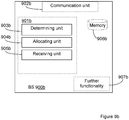
- the arrangement 901a may alternatively be implemented and/or schematically described as illustrated in figure 9b .
- the arrangement 901b comprises a determining unit 904b, for determining a type of service associated with a UE; and for determining whether the UE belongs to a first group of UEs or a second group of UEs, based on a/the type of service associated with the UE.
- the arrangement 901b further comprises an allocating unit 904b for, when the UE belongs to the first group of UEs, allocating resources on the PUCCH to the UE in a first section of PUCCH resources; and for, when the UE belongs to the second group of UEs, allocating resources on the PUCCH to the UE in a second section of PUCCH resources.
- the arrangement 901b further comprises a receiving unit 905b for, when the UE belongs to the first group of UEs, receiving SRs from the UE in the first section of PUCCH resources; and for, when the UE belongs to the second group of UEs, receiving SRs from the UE in the second section of PUCCH resources.
- the arrangement 901b may comprise units operable to perform actions previously described herein, e.g. determining the type of service based on information related to the setup or release of a service bearer for the UE; and/or the number of SRs received from the UE during a predefined time window; or determining whether the UE belongs to the first or second group of UEs further based on the location of the UE and/or the movement of the UE.
- the arrangement 901b, and other parts of the base station 900b could be implemented e.g. by one or more of: a processor or a micro processor and adequate software and storage therefore, a Programmable Logic Device (PLD) or other electronic component(s)/processing circuit(s) configured to perform the actions mentioned above.
- PLD Programmable Logic Device
- Embodiments described herein also relate to a UE.
- the UE is associated with the same technical features, objects and advantages as the method described above and illustrated e.g. in figure 5 .
- the UE will be described in brief in order to avoid unnecessary repetition.
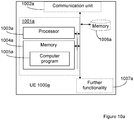
- the UE 1000a is illustrated as to communicate with other entities via a communication unit 1002a, which may be considered to comprise conventional means for wireless communication in accordance with a communication standard within which the UE is operable.
- the arrangement and/or UE may further comprise one or more storage units, 1006a.
- the arrangement and/or UE may further comprise other functional units 1007a, for providing e.g. regular UE functions, such as channel measurements and coding of signals.
- the part of the UE which is mostly related to the herein suggested solution is illustrated as an arrangement 1001a surrounded by a broken/dashed line.
- the arrangement and possibly other parts of the UE are adapted to enable the performance of one or more of the methods or procedures described above and illustrated e.g. in figure 5 .
- the UE is operable to be associated with resources on a PUCCH, said resources being allocated to the UE by a base station, for transmission of scheduling requests, SRs, the UE being further operable to be associated with one of a first and a second group of UEs, the UE comprising processing means, in this example in form of a processor 1003a and a memory 1004a, wherein said memory is containing instructions 1005a executable by said processor.
- the instructions When the instructions are executed by the processor, they cause the base station to perform the actions described below.
- the processing means are operative to transmit SRs to the base station on the resources allocated to the UE by the base station; and further to, when a change associated with the UE implies that the UE should be associated with the other one of the first and the second group of UEs; receive, from the base station, an indication of other resources on the PUCCH, to be used by the UE for transmission of SRs to the base station, instead of the previously used resources.
- the processing means are further operable to transmit SRs to the base station on the indicated resources.
- the change may be a change of services; a change of location and/or a change of movement/velocity.
- the processing means may further be operable to determine a change of service based on information related to a setup or release of a service bearer and/or the number of SRs received from the UE during a predefined time window.
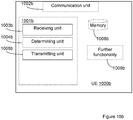
- the arrangement 1001a may alternatively be implemented and/or schematically described as illustrated in figure 10b .
- the arrangement 1001b comprises a receiving unit 1003b, for, when a change associated with the UE implies that the UE should be associated with the other one of the first and the second group of UEs, receiving from the base station, an indication of other resources on the PUCCH, to be used by the UE for transmission of SRs to the base station, instead of the previously used resources.
- the arrangement comprises a transmitting unit 1005b for transmitting SRs to the base station on the indicated resources.
- the transmitting unit 1005b may also be used for transmitting SRs on the resources denoted "the previously used resources" before the change of resources to the indicated resources.
- the "previously used resources" are associated with another UE group than the indicated resources.
- the arrangement could also comprise a determining unit 1004b for determining e.g. when to end the second reception mode.
- the arrangement 1001b, and other parts of the UE 1000b could be implemented e.g. by one or more of: a processor or a micro processor and adequate software and storage therefore, a Programmable Logic Device (PLD) or other electronic component(s)/processing circuit(s) configured to perform the actions mentioned above.
- PLD Programmable Logic Device
- Embodiments described herein also relate to a base station for coordinating the PUCCH SR resources between neighboring base stations/cells.
- the base station is associated with the same technical features, objects and advantages as the method described above and illustrated e.g. in figure 6 .
- the base station will be described in brief in order to avoid unnecessary repetition.
- the base station is operable to serve a number of UEs.
- the base station 1100a is illustrated as to communicate with other entities via a communication unit 1102a, which may be considered to comprise conventional means for wireless and/or wired communication in accordance with a communication standard within which the receiving node is operable.
- the arrangement and/or base station may further comprise one or more storage units, 1106a
- the arrangement and/or receiving node may further comprise other functional units 1107a, for providing e.g. regular base station functions, such as scheduling and coding of signals.
- the part of the base station which is mostly related to the herein suggested solution is illustrated as an arrangement 1101a surrounded by a broken/dashed line.
- the arrangement and possibly other parts of the base station are adapted to enable the performance of one or more of the methods or procedures described above and illustrated e.g. in figure 6 .
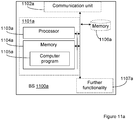
- the base station illustrated in figure 11 a comprises processing means, in this example in form of a processor 1103a and a memory 1104a, wherein said memory is containing instructions 1105a executable by said processor.
- the processing means are operative to receive information regarding resources used by a neighboring base station, BS2, for PUCCH, the information comprising an indication regarding a division into at least a first and a second section of the PUCCH resources in time, frequency and/or code, wherein the first section is associated with a first group of UEs, and the second section is associated with a second group of UEs.
- the processing means are further operative to determine, from amongst corresponding sections of PUCCH resources in time, frequency and/or code, a section that is to be used by BS1 for the first group of UEs; such that the determined section does not coincide with the section used by the neighboring base station for the first group of UEs. Further, the processing means are operable to allocate PUCCH resources to UEs belonging to the first group in the determined section and PUCCH resources to UEs belonging to a second group in another section.
- the processing means may further be operative to provide information to a neighboring base station regarding a determined section of PUCCH resources in time, frequency and/or code, which is to be used by BS1 for the first group of UEs
- the arrangement 1101a may alternatively be implemented and/or schematically described as illustrated in figure 11 b.
- the arrangement 1101b comprises a receiving unit 1103b, for receiving information regarding resources used by a neighboring base station for PUCCH, the information comprising an indication regarding a division into at least a first and a second section of the PUCCH resources in time, frequency and/or code, wherein the first section is associated with a first group of UEs, and the second section is associated with a second group of UEs.
- the arrangement further comprises a determining unit 1104b, for determining, from amongst corresponding sections of PUCCH resources in time, frequency and/or code, a section that is to be used by BS1 for the first group of UEs; such that the determined section does not coincide with the section used by the neighboring base station for the first group of UEs.
- the arrangement further comprises an allocating unit 1105b, for allocating PUCCH resources to UEs belonging to the first group in the determined section and PUCCH resources to UEs belonging to a second group in another section.
- the arrangement 1101b may comprise a transmitting unit 1106b for transmitting information, to a neighboring base station, BS2, regarding a determined section of PUCCH resources in time, frequency and/or code, which is to be used by BS1 for the first group of UEs.
- the arrangement 1101b, and other parts of the base station 1100b could be implemented e.g. by one or more of: a processor or a micro processor and adequate software and storage therefore, a Programmable Logic Device (PLD) or other electronic component(s)/processing circuit(s) configured to perform the actions mentioned above.
- PLD Programmable Logic Device
- Figure 12 schematically shows an embodiment of an arrangement 1200 in a base station, which also can be a way of disclosing an embodiment of the arrangement 901a in a base station illustrated in figure 9a .
- a processing unit 1206 e.g. with a DSP (Digital Signal Processor).
- the processing unit 1206 may be a single unit or a plurality of units to perform different actions of procedures described herein.
- the arrangement 1200 may also comprise an input unit 1202 for receiving signals from other entities, and an output unit 1204 for providing signal(s) to other entities.
- the input unit 1202 and the output unit 1204 may be arranged as an integrated entity.
- the arrangement 1200 comprises at least one computer program product 1208 in the form of a non-volatile or volatile memory, e.g. an EEPROM (Electrically Erasable Programmable Read-Only Memory), a flash memory and/or a hard drive.
- EEPROM Electrically Erasable Programmable Read-Only Memory
- flash memory e.g. a flash memory
- hard drive e.g. a hard drive
- the computer program product 1208 comprises a computer program 1210, which comprises code means, which when executed in the processing unit 1206 in the arrangement 1200 causes the arrangement and/or the base station to perform the actions e.g. of any of the procedures or methods described earlier, e.g. in conjunction with any of figures 4 or 7 .
- the computer program 1210 may be configured as a computer program code structured in computer program modules.
- the code means in the computer program 1210 of the arrangement 1200 comprises a determining module 1210a for determining a type of service associated with a UE; and for determining whether the UE belongs to a first group of UEs or a second group of UEs, based on a type of service associated with the UE s.
- the computer program 1210 further comprises an allocating module 1210b for, when the UE belongs to the first group of UEs, allocating resources on the Physical Uplink Control Channel, PUCCH to the UE in a first section of PUCCH resources; and when the UE belongs to the second group of UEs, allocating resources on the PUCCH to the UE in a second section of PUCCH resources.
- an allocating module 1210b for, when the UE belongs to the first group of UEs, allocating resources on the Physical Uplink Control Channel, PUCCH to the UE in a first section of PUCCH resources; and when the UE belongs to the second group of UEs, allocating resources on the PUCCH to the UE in a second section of PUCCH resources.
- the computer program 1210 further comprises a receiving module 1210c for, when the UE belongs to the first group of UEs, receiving SRs from the UE in the first section of PUCCH resources; and, when the UE belongs to the second group of UEs, receiving SRs from the UE in the second section of PUCCH resources.
- the modules 1210a-c could essentially perform, at least part of, the actions indicted in any of figure 4 .
- the different modules 1210a-c are executed in the processing unit 1206, they may correspond to the units 903b-905b of figure 9b .
- FIG. 13 illustrates such an arrangement for use in a UE.
- the difference from the arrangement in figure 12 is the computer program modules, which instead comprises code which when executed in the processing unit 1306 in the arrangement 1300 causes the arrangement and/or the UE to perform the actions e.g. of any of the procedure described earlier, e.g. in conjunction with figure 5 .
- FIG. 14 an arrangement for use in a base station could be implemented, which is illustrated in figure 14 .
- the difference from the arrangements in figures 12 and 13 is the computer program modules, which instead comprises code which when executed in the processing unit 1406 in the arrangement 1400 causes the arrangement and/or the base station to perform the actions e.g. of any of the procedure described earlier, e.g. in conjunction with figure 6
- code means in the embodiments disclosed above in conjunction with figures 12-14 are implemented as computer program modules which when executed in the processing unit causes the arrangement and/or node to perform the actions described above in the conjunction with figures mentioned above, at least one of the code means may in alternative embodiments be implemented at least partly as hardware circuits.
- the processor may be a single CPU (Central processing unit), but could also comprise two or more processing units.
- the processor may include general purpose microprocessors; instruction set processors and/or related chips sets and/or special purpose microprocessors such as ASICs (Application Specific Integrated Circuit).
- the processor may also comprise board memory for caching purposes.
- the computer program may be carried by a computer program product connected to the processor.
- the computer program product may comprise a computer readable medium on which the computer program is stored.
- the computer program product may be a flash memory, a RAM (Random-access memory) ROM (Read-Only Memory), an EEPROM and/or a USB memory, and the computer program modules described above could in alternative embodiments be distributed on different computer program products in the form of memories within the network node.
Landscapes
- Engineering & Computer Science (AREA)
- Signal Processing (AREA)
- Computer Networks & Wireless Communication (AREA)
- Mobile Radio Communication Systems (AREA)
Claims (14)
- Procédé mis en oeuvre par une station de base, BS1, dans un réseau de communication sans fil, la station de base étant exploitable de manière à desservir un nombre d'équipements d'utilisateur, UEs, le procédé comportant les étapes ci-dessous consistant à :- déterminer (401) un type de service associé à un UE sur la base du nombre de demandes de planification, SR, reçues en provenance de l'UE au cours d'une période de temps ;- déterminer (402) si l'UE appartient à un premier groupe d'UEs ou à un second groupe d'UEs, dans lequel le premier groupe comporte des UEs appliquant actuellement des services générant du trafic par rafales, et générant par conséquent considérablement plus de demandes SR par unité de temps que le second groupe d'UEs, et où le second groupe comporte des UEs appliquant des services générant moins de trafic par rafales que des UEs dans le premier groupe, générant par conséquent considérablement moins de demandes SR par unité de temps que des UEs dans le premier groupe ; etlorsque l'UE appartient au premier groupe d'UEs :- affecter (403) des ressources sur le canal de commande de liaison montante physique, PUCCH, à l'UE, dans une première section de ressources de canal PUCCH ;- recevoir (404) des demandes SR en provenance de l'UE dans les ressources affectées dans la première section de ressources de canal PUCCH ; etlorsque l'UE appartient au second groupe d'UEs :- affecter (407) des ressources sur le canal PUCCH, à l'UE, dans une seconde section de ressources de canal PUCCH ;- recevoir (408) des demandes SR, en provenance de l'UE, dans la seconde section de ressources de canal PUCCH ;dans lequel les première et seconde sections de ressources sur le canal PUCCH sont séparées en au moins l'une des dimensions : temps, fréquence et code ; ce qui permet par conséquent la protection des UEs dans le premier groupe contre un brouillage entre cellules sur le canal PUCCH.
- Procédé selon la revendication 1, dans lequel le type de service associé à l'UE est en outre déterminé sur la base
d'informations connexes à un établissement ou à une libération d'une porteuse de service pour l'UE. - Procédé selon l'une quelconque des revendications précédentes, dans lequel l'étape consistant à déterminer si l'UE appartient au premier ou second groupe d'UEs est en outre basée sur l'emplacement de l'UE et/ou sur le mouvement de l'UE.
- Procédé mis en oeuvre par un équipement d'utilisateur, UE, associé à des ressources sur un canal de commande de liaison montante physique, PUCCH, lesdites ressources étant affectées à l'UE par une station de base, à des fins de transmission de demandes de planification, SR, l'UE étant associé à l'un parmi un premier groupe d'UEs et un second groupe d'UEs, dans lequel le premier groupe comporte des UEs appliquant actuellement des services générant du trafic par rafales et générant par conséquent considérablement plus de demandes SR par unité de temps que le second groupe d'UEs, et où le second groupe comporte des UEs appliquant des services générant moins de trafic par rafales que des UEs dans le premier groupe, générant par conséquent considérablement moins de demandes SR par unité de temps que des UEs dans le premier groupe, le procédé comportant les étapes ci-dessous consistant à :- transmettre (501) des demandes SR, à la station de base, sur les ressources affectées à l'UE par une station de base ; etlorsqu'un changement associé à l'UE implique que l'UE doit être associé à l'autre des premier et second groupes d'UEs :- recevoir (503), en provenance de la station de base, une indication d'autres ressources sur le canal PUCCH, devant être utilisées par l'UE à des fins de transmission de demandes SR à la station de base, au lieu des ressources utilisées précédemment ;- transmettre (504) des demandes SR à la station de base sur les ressources indiquées ;ce qui permet par conséquent à la station de base de protéger des UEs, associés au premier groupe, contre un brouillage entre cellules sur le canal PUCCH.
- Procédé selon la revendication 4, dans lequel le changement correspond à au moins l'un parmi :- un changement de services ;- un changement d'emplacement ; et- un changement de mouvement.
- Procédé selon la revendication 4 ou 5, dans lequel le changement est un changement de service associé à l'UE, lequel est déterminé sur la base :- d'informations connexes à un établissement ou à une libération d'une porteuse de service.
- Procédé, mis en oeuvre par une station de base, BS1, de coordination de ressources sur un canal de commande de liaison montante physique, PUCCH, entre des stations de base voisines, le procédé comportant les étapes ci-dessous consistant à :- recevoir (601) des informations concernant des ressources utilisées par une station de base voisine pour le canal PUCCH, les informations comportant une indication concernant une division en au moins une première section et une seconde section des ressources de canal PUCCH, en temps, fréquence et/ou code, dans lequel la première section est associée à un premier groupe d'UEs, et la seconde section est associée à un second groupe d'UEs, et dans lequel le premier groupe comporte des UEs appliquant actuellement des services générant du trafic par rafales et générant par conséquent considérablement plus de demandes SR par unité de temps que le second groupe d'UEs, et où le second groupe comporte des UEs appliquant des services générant moins de trafic par rafales que des UEs dans le premier groupe, générant par conséquent considérablement moins de demandes SR par unité de temps que des UEs dans le premier groupe ;- déterminer (602), parmi des sections correspondantes de ressources de canal PUCCH en temps, fréquence et/ou code, une section qui doit être utilisée par la station BS 1 pour le premier groupe d'UEs, de sorte que la section déterminée ne coïncide pas avec la section utilisée par la station de base voisine pour le premier groupe d'UEs ;- affecter (603) des ressources de canal PUCCH à des UEs appartenant au premier groupe dans la section déterminée, et des ressources de canal PUCCH à des UEs appartenant à un second groupe dans une autre section.
- Procédé selon la revendication 7, comportant en outre l'étape ci-dessous consistant à :- fournir des informations à une station de base voisine, concernant une section déterminée de ressources de canal PUCCH en temps, fréquence et/ou code, qui doit être utilisée par la station BS1 pour le premier groupe d'UEs.
- Procédé selon la revendication 7 ou 8, dans lequel les ressources en temps, fréquence et/ou code sont négociées entre les stations BS voisines de manière itérative.
- Station de base, BS1, (900a, 900b), dans un réseau de communication sans fil, la station de base étant exploitable de manière à desservir un nombre d'équipements d'utilisateur, UE, la station de base comportant des moyens de traitement (901a, 901b) exploitables de manière à :- déterminer un type de service associé à un UE sur la base du nombre de demandes de planification, SR, reçues en provenance de l'UE au cours d'une période de temps ;- déterminer si l'UE appartient à un premier groupe d'UEs ou à un second groupe d'UEs, dans lequel le premier groupe comporte des UEs appliquant actuellement des services générant du trafic par rafales, et générant par conséquent considérablement plus de demandes SR par unité de temps que le second groupe d'UEs, et où le second groupe comporte des UEs appliquant des services générant moins de trafic par rafales que des UEs dans le premier groupe, générant par conséquent considérablement moins de demandes SR par unité de temps que des UEs dans le premier groupe ; etlorsque l'UE appartient au premier groupe d'UEs :- affecter des ressources sur le canal de commande de liaison montante physique, PUCCH, à l'UE, dans une première section de ressources de canal PUCCH ;- recevoir des demandes SR, en provenance de l'UE, dans la première section de ressources de canal PUCCH ; etlorsque l'UE appartient au second groupe d'UEs :- affecter des ressources sur le canal PUCCH, à l'UE, dans une seconde section de ressources de canal PUCCH ;- recevoir des demandes SR, en provenance de l'UE, dans la seconde section de ressources de canal PUCCH ;où les première et seconde sections de ressources sur le canal PUCCH sont séparées en au moins l'une des dimensions : temps, fréquence et code ; ce qui permet par conséquent la protection des UEs, dans le premier groupe, contre un brouillage entre cellules sur le canal PUCCH.
- Équipement d'utilisateur, UE (1000a, 1000b), exploitable de manière à être associé à des ressources sur un canal de commande de liaison montante physique, PUCCH, lesdites ressources étant affectées à l'UE par une station de base, à des fins de transmission de demandes de planification, SR, l'UE étant en outre exploitable de manière à être associé à l'un parmi un premier groupe d'UEs et un second groupe d'UEs, dans lequel le premier groupe comporte des UEs appliquant actuellement des services générant du trafic par rafales et générant par conséquent considérablement plus de demandes SR par unité de temps que le second groupe d'UEs, et où le second groupe comporte des UEs appliquant des services générant moins de trafic par rafales que des UEs dans le premier groupe, générant par conséquent considérablement moins de demandes SR par unité de temps que des UEs dans le premier groupe, et l'UE comportant des moyens de traitement (1001a, 1001b) exploitables de manière à :- transmettre des demandes SR, à la station de base, sur les ressources affectées à l'UE par une station de base ; etlorsqu'un changement associé à l'UE implique que l'UE doit être associé à l'autre des premier et second groupes d'UEs :- recevoir, en provenance de la station de base, une indication d'autres ressources sur le canal PUCCH, devant être utilisées par l'UE à des fins de transmission de demandes SR à la station de base, au lieu des ressources utilisées précédemment ; et à- transmettre des demandes SR à la station de base sur les ressources indiquées.
- Station de base, BS1 (1100a, 1100b), destinée à coordonner des ressources sur un canal de commande de liaison montante physique, PUCCH, entre des stations de base voisines, la station de base comportant un moyen de traitement (1101a, 1101b) exploitable de manière à :- recevoir des informations concernant des ressources utilisées par une station de base voisine pour le canal PUCCH, les informations comportant une indication concernant une division en au moins une première section et une seconde section des ressources de canal PUCCH, en temps, fréquence et/ou code, dans lequel la première section est associée à un premier groupe d'UEs, et la seconde section est associée à un second groupe d'UEs, dans lequel le premier groupe comporte des UEs appliquant actuellement des services générant du trafic par rafales et générant par conséquent considérablement plus de demandes SR par unité de temps que le second groupe d'UEs, et où le second groupe comporte des UEs appliquant des services générant moins de trafic par rafales que des UEs dans le premier groupe, générant par conséquent considérablement moins de demandes SR par unité de temps que des UEs dans le premier groupe ;- déterminer, parmi des sections correspondantes de ressources de canal PUCCH en temps, fréquence et/ou code, une section qui doit être utilisée par la station BS 1 pour le premier groupe d'UEs, de sorte que la section déterminée ne coïncide pas avec la section utilisée par la station de base voisine pour le premier groupe d'UEs ;- affecter des ressources de canal PUCCH à des UEs appartenant au premier groupe dans la section déterminée, et des ressources de canal PUCCH à des UEs appartenant à un second groupe dans une autre section.
- Programme informatique (1210) comportant un code de programme informatique, qui, lorsqu'il est exécuté dans une station de base, amène la station de base à mettre en oeuvre le procédé selon l'une quelconque des revendications 1 à 3 et 7 à 9.
- Programme informatique (1310), comportant un code de programme informatique, qui, lorsqu'il est exécuté dans un équipement d'utilisateur, UE, amène l'UE à mettre en oeuvre le procédé selon l'une quelconque des revendications 4 à 6.
Applications Claiming Priority (2)
| Application Number | Priority Date | Filing Date | Title |
|---|---|---|---|
| US201261740527P | 2012-12-21 | 2012-12-21 | |
| PCT/SE2013/051428 WO2014098719A1 (fr) | 2012-12-21 | 2013-12-02 | Procédés et appareils pour limiter des interférences entre cellules sur un canal de commande |
Publications (3)
| Publication Number | Publication Date |
|---|---|
| EP2936712A1 EP2936712A1 (fr) | 2015-10-28 |
| EP2936712A4 EP2936712A4 (fr) | 2016-09-14 |
| EP2936712B1 true EP2936712B1 (fr) | 2017-09-20 |
Family
ID=50978856
Family Applications (1)
| Application Number | Title | Priority Date | Filing Date |
|---|---|---|---|
| EP13863876.2A Active EP2936712B1 (fr) | 2012-12-21 | 2013-12-02 | Procédés et appareils pour limiter des interférences entre cellules sur un canal de commande |
Country Status (3)
| Country | Link |
|---|---|
| US (1) | US9844034B2 (fr) |
| EP (1) | EP2936712B1 (fr) |
| WO (1) | WO2014098719A1 (fr) |
Families Citing this family (10)
| Publication number | Priority date | Publication date | Assignee | Title |
|---|---|---|---|---|
| US20150358976A1 (en) * | 2013-01-28 | 2015-12-10 | Telefonaktiebolaget L M Ericsson (Publ) | Protecting UL Control Channels in Dynamic/Flexible TDD |
| CN106068662B (zh) * | 2014-01-30 | 2020-01-14 | 诺基亚技术有限公司 | 用于设备至设备发现信号传输的负载控制系统 |
| WO2015114700A1 (fr) | 2014-01-31 | 2015-08-06 | パナソニック インテレクチュアル プロパティ コーポレーション オブ アメリカ | Terminal, station de base, procédé d'émission et procédé de réception |
| CN104837207B (zh) * | 2015-04-15 | 2018-03-13 | 上海华为技术有限公司 | 一种资源分配方法、基站及通讯系统 |
| KR102606781B1 (ko) * | 2016-09-02 | 2023-11-27 | 삼성전자 주식회사 | 무선 통신 시스템에서 효율적인 데이터 송수신 방법 및 장치 |
| CN107872894B (zh) * | 2016-09-23 | 2022-04-19 | 中兴通讯股份有限公司 | 一种实现sr处理的方法、装置和基站 |
| CN109644344B (zh) * | 2017-02-08 | 2021-07-06 | Oppo广东移动通信有限公司 | 业务的传输方法、终端和网络设备 |
| EP3471322B1 (fr) * | 2017-03-23 | 2024-02-14 | LG Electronics Inc. | Procédé de transmission ou de réception de signal de liaison montante pour terminal prenant en charge une pluralité d'intervalles de temps de transmission, une pluralité d'intervalles de sous-porteuse, ou une pluralité de temps de traitement dans un système de communication sans fil, et dispositif associé |
| JP7199516B2 (ja) * | 2018-11-02 | 2023-01-05 | オッポ広東移動通信有限公司 | 上り制御情報の決定方法及び通信デバイス |
| EP3949628B1 (fr) * | 2019-03-26 | 2025-07-16 | Telefonaktiebolaget LM Ericsson (publ) | Attribution de ressources sur la base d'un regroupement de dispositifs sans fil |
Family Cites Families (8)
| Publication number | Priority date | Publication date | Assignee | Title |
|---|---|---|---|---|
| US20110211546A1 (en) * | 2008-11-03 | 2011-09-01 | Kari Juhani Hooli | Transmitting Scheduling Request with Multiple Antennas |
| US20120106472A1 (en) * | 2009-03-31 | 2012-05-03 | Nokia Siemens Networks Oy | Methods, Apparatuses, System, Related Computer Program Product and Data Structure for Uplink Scheduling |
| US20100309876A1 (en) * | 2009-06-04 | 2010-12-09 | Qualcomm Incorporated | Partitioning of control resources for communication in a dominant interference scenario |
| US8208937B2 (en) * | 2009-06-12 | 2012-06-26 | Futurewei Technologies, Inc. | System and method for uplink inter cell interference coordination in a wireless access system |
| WO2011051981A1 (fr) * | 2009-10-26 | 2011-05-05 | Telecom Italia S.P.A. | Planification de ressources radio pour une coordination d'interférences intrasystèmes dans des systèmes de communication sans fil |
| EP2385650A3 (fr) | 2010-05-06 | 2012-04-25 | HTC Corporation | Procédé de gestion de transmission de canal de contrôle de liaison montante physique et dispositif de communication associé |
| US20110292823A1 (en) * | 2010-05-27 | 2011-12-01 | Qualcomm Incorporated | Sounding reference signal (srs) in heterogeneous network (hetnet) with time division multiplexing (tdm) partitioning |
| WO2012149953A1 (fr) * | 2011-05-02 | 2012-11-08 | Nokia Siemens Networks Oy | Améliorations de demandes de programmation |
-
2013
- 2013-12-02 WO PCT/SE2013/051428 patent/WO2014098719A1/fr not_active Ceased
- 2013-12-02 US US14/654,094 patent/US9844034B2/en not_active Expired - Fee Related
- 2013-12-02 EP EP13863876.2A patent/EP2936712B1/fr active Active
Non-Patent Citations (1)
| Title |
|---|
| None * |
Also Published As
| Publication number | Publication date |
|---|---|
| US20150327231A1 (en) | 2015-11-12 |
| US9844034B2 (en) | 2017-12-12 |
| EP2936712A4 (fr) | 2016-09-14 |
| WO2014098719A1 (fr) | 2014-06-26 |
| EP2936712A1 (fr) | 2015-10-28 |
Similar Documents
| Publication | Publication Date | Title |
|---|---|---|
| US9844034B2 (en) | Methods and apparatuses for controlling control channel inter cell interference | |
| US12052720B2 (en) | Uplink control information collision handling | |
| CN110474736B (zh) | 通信方法和通信装置 | |
| CN109151833B (zh) | 传输控制信息的方法和装置 | |
| CN103686858B (zh) | 上行控制信息的反馈方法、基站及用户设备 | |
| WO2021098858A1 (fr) | Communication de liaison latérale à préemption de ressources | |
| US12238530B2 (en) | Using unlicensed and licensed spectrum | |
| EP3404985A1 (fr) | Duplex intégral des directions de liaison montante et de liaison descendante | |
| CN103222295B (zh) | 频谱共享的方法和基站 | |
| US12495436B2 (en) | Delay information | |
| EP3707944B1 (fr) | Procédés et dispositifs de transmission par sélection entre des ressources de liaison montante | |
| CN115843457A (zh) | 无线通信的信道占用 | |
| US20190014590A1 (en) | Scheduling in cellular networks | |
| WO2019090605A1 (fr) | Agrégation de porteuses pour communications de liaison latérale | |
| US11653263B2 (en) | Packet compression enhancements | |
| US20240340654A1 (en) | Sidelink inter-user equipment coordination (iuc) for beam management in resource selection | |
| KR102702084B1 (ko) | 무선 통신 시스템에서 자원 할당 방법 및 장치 | |
| US20140016588A1 (en) | Apparatus and Corresponding Method for Allocating a Component Carrier to a Cell in a Communication System | |
| WO2019096386A1 (fr) | Réduction d'interférence de liaison montante pour réseaux sans fil | |
| KR20210102802A (ko) | 복수의 충돌 자원에 대한 우선화 방법 및 장치 | |
| EP3198813B1 (fr) | Procédé, appareil et système | |
| WO2025081426A9 (fr) | Contrôle de congestion de liaison latérale | |
| KR101422578B1 (ko) | 셀간 간섭 분리 기법을 이용한 자원 할당 방법 및 장치 | |
| WO2018059683A1 (fr) | Nœud de réseau, dispositif client et procédés associés |
Legal Events
| Date | Code | Title | Description |
|---|---|---|---|
| PUAI | Public reference made under article 153(3) epc to a published international application that has entered the european phase |
Free format text: ORIGINAL CODE: 0009012 |
|
| 17P | Request for examination filed |
Effective date: 20150706 |
|
| AK | Designated contracting states |
Kind code of ref document: A1 Designated state(s): AL AT BE BG CH CY CZ DE DK EE ES FI FR GB GR HR HU IE IS IT LI LT LU LV MC MK MT NL NO PL PT RO RS SE SI SK SM TR |
|
| AX | Request for extension of the european patent |
Extension state: BA ME |
|
| DAX | Request for extension of the european patent (deleted) | ||
| A4 | Supplementary search report drawn up and despatched |
Effective date: 20160818 |
|
| RIC1 | Information provided on ipc code assigned before grant |
Ipc: H04L 5/00 20060101ALI20160811BHEP Ipc: H04W 72/04 20090101ALI20160811BHEP Ipc: H04W 16/02 20090101ALI20160811BHEP Ipc: H04J 11/00 20060101AFI20160811BHEP |
|
| REG | Reference to a national code |
Ref country code: DE Ref legal event code: R079 Ref document number: 602013026989 Country of ref document: DE Free format text: PREVIOUS MAIN CLASS: H04J0011000000 Ipc: H04W0072120000 |
|
| GRAP | Despatch of communication of intention to grant a patent |
Free format text: ORIGINAL CODE: EPIDOSNIGR1 |
|
| RIC1 | Information provided on ipc code assigned before grant |
Ipc: H04W 72/12 20090101AFI20170405BHEP |
|
| INTG | Intention to grant announced |
Effective date: 20170425 |
|
| GRAS | Grant fee paid |
Free format text: ORIGINAL CODE: EPIDOSNIGR3 |
|
| GRAA | (expected) grant |
Free format text: ORIGINAL CODE: 0009210 |
|
| AK | Designated contracting states |
Kind code of ref document: B1 Designated state(s): AL AT BE BG CH CY CZ DE DK EE ES FI FR GB GR HR HU IE IS IT LI LT LU LV MC MK MT NL NO PL PT RO RS SE SI SK SM TR |
|
| REG | Reference to a national code |
Ref country code: GB Ref legal event code: FG4D |
|
| REG | Reference to a national code |
Ref country code: CH Ref legal event code: EP |
|
| REG | Reference to a national code |
Ref country code: AT Ref legal event code: REF Ref document number: 931071 Country of ref document: AT Kind code of ref document: T Effective date: 20171015 |
|
| REG | Reference to a national code |
Ref country code: IE Ref legal event code: FG4D |
|
| REG | Reference to a national code |
Ref country code: DE Ref legal event code: R096 Ref document number: 602013026989 Country of ref document: DE |
|
| REG | Reference to a national code |
Ref country code: NL Ref legal event code: FP |
|
| PG25 | Lapsed in a contracting state [announced via postgrant information from national office to epo] |
Ref country code: NO Free format text: LAPSE BECAUSE OF FAILURE TO SUBMIT A TRANSLATION OF THE DESCRIPTION OR TO PAY THE FEE WITHIN THE PRESCRIBED TIME-LIMIT Effective date: 20171220 Ref country code: FI Free format text: LAPSE BECAUSE OF FAILURE TO SUBMIT A TRANSLATION OF THE DESCRIPTION OR TO PAY THE FEE WITHIN THE PRESCRIBED TIME-LIMIT Effective date: 20170920 Ref country code: SE Free format text: LAPSE BECAUSE OF FAILURE TO SUBMIT A TRANSLATION OF THE DESCRIPTION OR TO PAY THE FEE WITHIN THE PRESCRIBED TIME-LIMIT Effective date: 20170920 Ref country code: LT Free format text: LAPSE BECAUSE OF FAILURE TO SUBMIT A TRANSLATION OF THE DESCRIPTION OR TO PAY THE FEE WITHIN THE PRESCRIBED TIME-LIMIT Effective date: 20170920 Ref country code: HR Free format text: LAPSE BECAUSE OF FAILURE TO SUBMIT A TRANSLATION OF THE DESCRIPTION OR TO PAY THE FEE WITHIN THE PRESCRIBED TIME-LIMIT Effective date: 20170920 |
|
| REG | Reference to a national code |
Ref country code: LT Ref legal event code: MG4D |
|
| REG | Reference to a national code |
Ref country code: AT Ref legal event code: MK05 Ref document number: 931071 Country of ref document: AT Kind code of ref document: T Effective date: 20170920 |
|
| PG25 | Lapsed in a contracting state [announced via postgrant information from national office to epo] |
Ref country code: RS Free format text: LAPSE BECAUSE OF FAILURE TO SUBMIT A TRANSLATION OF THE DESCRIPTION OR TO PAY THE FEE WITHIN THE PRESCRIBED TIME-LIMIT Effective date: 20170920 Ref country code: BG Free format text: LAPSE BECAUSE OF FAILURE TO SUBMIT A TRANSLATION OF THE DESCRIPTION OR TO PAY THE FEE WITHIN THE PRESCRIBED TIME-LIMIT Effective date: 20171220 Ref country code: LV Free format text: LAPSE BECAUSE OF FAILURE TO SUBMIT A TRANSLATION OF THE DESCRIPTION OR TO PAY THE FEE WITHIN THE PRESCRIBED TIME-LIMIT Effective date: 20170920 Ref country code: GR Free format text: LAPSE BECAUSE OF FAILURE TO SUBMIT A TRANSLATION OF THE DESCRIPTION OR TO PAY THE FEE WITHIN THE PRESCRIBED TIME-LIMIT Effective date: 20171221 |
|
| PG25 | Lapsed in a contracting state [announced via postgrant information from national office to epo] |
Ref country code: CZ Free format text: LAPSE BECAUSE OF FAILURE TO SUBMIT A TRANSLATION OF THE DESCRIPTION OR TO PAY THE FEE WITHIN THE PRESCRIBED TIME-LIMIT Effective date: 20170920 Ref country code: ES Free format text: LAPSE BECAUSE OF FAILURE TO SUBMIT A TRANSLATION OF THE DESCRIPTION OR TO PAY THE FEE WITHIN THE PRESCRIBED TIME-LIMIT Effective date: 20170920 Ref country code: PL Free format text: LAPSE BECAUSE OF FAILURE TO SUBMIT A TRANSLATION OF THE DESCRIPTION OR TO PAY THE FEE WITHIN THE PRESCRIBED TIME-LIMIT Effective date: 20170920 Ref country code: RO Free format text: LAPSE BECAUSE OF FAILURE TO SUBMIT A TRANSLATION OF THE DESCRIPTION OR TO PAY THE FEE WITHIN THE PRESCRIBED TIME-LIMIT Effective date: 20170920 |
|
| PG25 | Lapsed in a contracting state [announced via postgrant information from national office to epo] |
Ref country code: IS Free format text: LAPSE BECAUSE OF FAILURE TO SUBMIT A TRANSLATION OF THE DESCRIPTION OR TO PAY THE FEE WITHIN THE PRESCRIBED TIME-LIMIT Effective date: 20180120 Ref country code: IT Free format text: LAPSE BECAUSE OF FAILURE TO SUBMIT A TRANSLATION OF THE DESCRIPTION OR TO PAY THE FEE WITHIN THE PRESCRIBED TIME-LIMIT Effective date: 20170920 Ref country code: EE Free format text: LAPSE BECAUSE OF FAILURE TO SUBMIT A TRANSLATION OF THE DESCRIPTION OR TO PAY THE FEE WITHIN THE PRESCRIBED TIME-LIMIT Effective date: 20170920 Ref country code: AT Free format text: LAPSE BECAUSE OF FAILURE TO SUBMIT A TRANSLATION OF THE DESCRIPTION OR TO PAY THE FEE WITHIN THE PRESCRIBED TIME-LIMIT Effective date: 20170920 Ref country code: SM Free format text: LAPSE BECAUSE OF FAILURE TO SUBMIT A TRANSLATION OF THE DESCRIPTION OR TO PAY THE FEE WITHIN THE PRESCRIBED TIME-LIMIT Effective date: 20170920 Ref country code: SK Free format text: LAPSE BECAUSE OF FAILURE TO SUBMIT A TRANSLATION OF THE DESCRIPTION OR TO PAY THE FEE WITHIN THE PRESCRIBED TIME-LIMIT Effective date: 20170920 |
|
| REG | Reference to a national code |
Ref country code: DE Ref legal event code: R097 Ref document number: 602013026989 Country of ref document: DE |
|
| PLBE | No opposition filed within time limit |
Free format text: ORIGINAL CODE: 0009261 |
|
| STAA | Information on the status of an ep patent application or granted ep patent |
Free format text: STATUS: NO OPPOSITION FILED WITHIN TIME LIMIT |
|
| PG25 | Lapsed in a contracting state [announced via postgrant information from national office to epo] |
Ref country code: DK Free format text: LAPSE BECAUSE OF FAILURE TO SUBMIT A TRANSLATION OF THE DESCRIPTION OR TO PAY THE FEE WITHIN THE PRESCRIBED TIME-LIMIT Effective date: 20170920 |
|
| REG | Reference to a national code |
Ref country code: CH Ref legal event code: PL |
|
| 26N | No opposition filed |
Effective date: 20180621 |
|
| REG | Reference to a national code |
Ref country code: IE Ref legal event code: MM4A |
|
| PG25 | Lapsed in a contracting state [announced via postgrant information from national office to epo] |
Ref country code: LU Free format text: LAPSE BECAUSE OF NON-PAYMENT OF DUE FEES Effective date: 20171202 Ref country code: MT Free format text: LAPSE BECAUSE OF NON-PAYMENT OF DUE FEES Effective date: 20171202 |
|
| REG | Reference to a national code |
Ref country code: FR Ref legal event code: ST Effective date: 20180831 |
|
| REG | Reference to a national code |
Ref country code: BE Ref legal event code: MM Effective date: 20171231 |
|
| PG25 | Lapsed in a contracting state [announced via postgrant information from national office to epo] |
Ref country code: IE Free format text: LAPSE BECAUSE OF NON-PAYMENT OF DUE FEES Effective date: 20171202 Ref country code: FR Free format text: LAPSE BECAUSE OF NON-PAYMENT OF DUE FEES Effective date: 20180102 |
|
| PG25 | Lapsed in a contracting state [announced via postgrant information from national office to epo] |
Ref country code: BE Free format text: LAPSE BECAUSE OF NON-PAYMENT OF DUE FEES Effective date: 20171231 Ref country code: LI Free format text: LAPSE BECAUSE OF NON-PAYMENT OF DUE FEES Effective date: 20171231 Ref country code: CH Free format text: LAPSE BECAUSE OF NON-PAYMENT OF DUE FEES Effective date: 20171231 Ref country code: SI Free format text: LAPSE BECAUSE OF FAILURE TO SUBMIT A TRANSLATION OF THE DESCRIPTION OR TO PAY THE FEE WITHIN THE PRESCRIBED TIME-LIMIT Effective date: 20170920 |
|
| PG25 | Lapsed in a contracting state [announced via postgrant information from national office to epo] |
Ref country code: HU Free format text: LAPSE BECAUSE OF FAILURE TO SUBMIT A TRANSLATION OF THE DESCRIPTION OR TO PAY THE FEE WITHIN THE PRESCRIBED TIME-LIMIT; INVALID AB INITIO Effective date: 20131202 Ref country code: MC Free format text: LAPSE BECAUSE OF FAILURE TO SUBMIT A TRANSLATION OF THE DESCRIPTION OR TO PAY THE FEE WITHIN THE PRESCRIBED TIME-LIMIT Effective date: 20170920 |
|
| PG25 | Lapsed in a contracting state [announced via postgrant information from national office to epo] |
Ref country code: CY Free format text: LAPSE BECAUSE OF FAILURE TO SUBMIT A TRANSLATION OF THE DESCRIPTION OR TO PAY THE FEE WITHIN THE PRESCRIBED TIME-LIMIT Effective date: 20170920 |
|
| PG25 | Lapsed in a contracting state [announced via postgrant information from national office to epo] |
Ref country code: MK Free format text: LAPSE BECAUSE OF FAILURE TO SUBMIT A TRANSLATION OF THE DESCRIPTION OR TO PAY THE FEE WITHIN THE PRESCRIBED TIME-LIMIT Effective date: 20170920 |
|
| PG25 | Lapsed in a contracting state [announced via postgrant information from national office to epo] |
Ref country code: TR Free format text: LAPSE BECAUSE OF FAILURE TO SUBMIT A TRANSLATION OF THE DESCRIPTION OR TO PAY THE FEE WITHIN THE PRESCRIBED TIME-LIMIT Effective date: 20170920 |
|
| PG25 | Lapsed in a contracting state [announced via postgrant information from national office to epo] |
Ref country code: PT Free format text: LAPSE BECAUSE OF FAILURE TO SUBMIT A TRANSLATION OF THE DESCRIPTION OR TO PAY THE FEE WITHIN THE PRESCRIBED TIME-LIMIT Effective date: 20170920 |
|
| PG25 | Lapsed in a contracting state [announced via postgrant information from national office to epo] |
Ref country code: AL Free format text: LAPSE BECAUSE OF FAILURE TO SUBMIT A TRANSLATION OF THE DESCRIPTION OR TO PAY THE FEE WITHIN THE PRESCRIBED TIME-LIMIT Effective date: 20170920 |
|
| PGFP | Annual fee paid to national office [announced via postgrant information from national office to epo] |
Ref country code: NL Payment date: 20221226 Year of fee payment: 10 |
|
| PGFP | Annual fee paid to national office [announced via postgrant information from national office to epo] |
Ref country code: DE Payment date: 20221228 Year of fee payment: 10 |
|
| REG | Reference to a national code |
Ref country code: DE Ref legal event code: R119 Ref document number: 602013026989 Country of ref document: DE |
|
| REG | Reference to a national code |
Ref country code: NL Ref legal event code: MM Effective date: 20240101 |
|
| PG25 | Lapsed in a contracting state [announced via postgrant information from national office to epo] |
Ref country code: NL Free format text: LAPSE BECAUSE OF NON-PAYMENT OF DUE FEES Effective date: 20240101 |
|
| PG25 | Lapsed in a contracting state [announced via postgrant information from national office to epo] |
Ref country code: NL Free format text: LAPSE BECAUSE OF NON-PAYMENT OF DUE FEES Effective date: 20240101 |
|
| PG25 | Lapsed in a contracting state [announced via postgrant information from national office to epo] |
Ref country code: DE Free format text: LAPSE BECAUSE OF NON-PAYMENT OF DUE FEES Effective date: 20240702 |
|
| PG25 | Lapsed in a contracting state [announced via postgrant information from national office to epo] |
Ref country code: DE Free format text: LAPSE BECAUSE OF NON-PAYMENT OF DUE FEES Effective date: 20240702 |
|
| PGFP | Annual fee paid to national office [announced via postgrant information from national office to epo] |
Ref country code: GB Payment date: 20251229 Year of fee payment: 13 |