EP2936833B1 - Ein hörgerätesystem zur bereitstellung eines verbesserten klangs und ein verfahren zur erzeugung eines verbesserten klangs - Google Patents
Ein hörgerätesystem zur bereitstellung eines verbesserten klangs und ein verfahren zur erzeugung eines verbesserten klangs Download PDFInfo
- Publication number
- EP2936833B1 EP2936833B1 EP12810289.4A EP12810289A EP2936833B1 EP 2936833 B1 EP2936833 B1 EP 2936833B1 EP 12810289 A EP12810289 A EP 12810289A EP 2936833 B1 EP2936833 B1 EP 2936833B1
- Authority
- EP
- European Patent Office
- Prior art keywords
- level
- band
- hearing aid
- signal
- sound
- Prior art date
- Legal status (The legal status is an assumption and is not a legal conclusion. Google has not performed a legal analysis and makes no representation as to the accuracy of the status listed.)
- Active
Links
Images


Classifications
-
- H—ELECTRICITY
- H04—ELECTRIC COMMUNICATION TECHNIQUE
- H04R—LOUDSPEAKERS, MICROPHONES, GRAMOPHONE PICK-UPS OR LIKE ACOUSTIC ELECTROMECHANICAL TRANSDUCERS; ELECTRIC HEARING AIDS; PUBLIC ADDRESS SYSTEMS
- H04R25/00—Electric hearing aids
- H04R25/45—Prevention of acoustic reaction, i.e. acoustic oscillatory feedback
-
- H—ELECTRICITY
- H04—ELECTRIC COMMUNICATION TECHNIQUE
- H04R—LOUDSPEAKERS, MICROPHONES, GRAMOPHONE PICK-UPS OR LIKE ACOUSTIC ELECTROMECHANICAL TRANSDUCERS; ELECTRIC HEARING AIDS; PUBLIC ADDRESS SYSTEMS
- H04R25/00—Electric hearing aids
- H04R25/35—Electric hearing aids using translation techniques
- H04R25/353—Frequency, e.g. frequency shift or compression
-
- H—ELECTRICITY
- H04—ELECTRIC COMMUNICATION TECHNIQUE
- H04R—LOUDSPEAKERS, MICROPHONES, GRAMOPHONE PICK-UPS OR LIKE ACOUSTIC ELECTROMECHANICAL TRANSDUCERS; ELECTRIC HEARING AIDS; PUBLIC ADDRESS SYSTEMS
- H04R25/00—Electric hearing aids
- H04R25/35—Electric hearing aids using translation techniques
- H04R25/356—Amplitude, e.g. amplitude shift or compression
-
- H—ELECTRICITY
- H04—ELECTRIC COMMUNICATION TECHNIQUE
- H04R—LOUDSPEAKERS, MICROPHONES, GRAMOPHONE PICK-UPS OR LIKE ACOUSTIC ELECTROMECHANICAL TRANSDUCERS; ELECTRIC HEARING AIDS; PUBLIC ADDRESS SYSTEMS
- H04R25/00—Electric hearing aids
- H04R25/40—Arrangements for obtaining a desired directivity characteristic
- H04R25/407—Circuits for combining signals of a plurality of transducers
-
- H—ELECTRICITY
- H04—ELECTRIC COMMUNICATION TECHNIQUE
- H04R—LOUDSPEAKERS, MICROPHONES, GRAMOPHONE PICK-UPS OR LIKE ACOUSTIC ELECTROMECHANICAL TRANSDUCERS; ELECTRIC HEARING AIDS; PUBLIC ADDRESS SYSTEMS
- H04R25/00—Electric hearing aids
- H04R25/50—Customised settings for obtaining desired overall acoustical characteristics
- H04R25/502—Customised settings for obtaining desired overall acoustical characteristics using analog signal processing
-
- H—ELECTRICITY
- H04—ELECTRIC COMMUNICATION TECHNIQUE
- H04R—LOUDSPEAKERS, MICROPHONES, GRAMOPHONE PICK-UPS OR LIKE ACOUSTIC ELECTROMECHANICAL TRANSDUCERS; ELECTRIC HEARING AIDS; PUBLIC ADDRESS SYSTEMS
- H04R25/00—Electric hearing aids
- H04R25/50—Customised settings for obtaining desired overall acoustical characteristics
- H04R25/505—Customised settings for obtaining desired overall acoustical characteristics using digital signal processing
-
- H—ELECTRICITY
- H04—ELECTRIC COMMUNICATION TECHNIQUE
- H04R—LOUDSPEAKERS, MICROPHONES, GRAMOPHONE PICK-UPS OR LIKE ACOUSTIC ELECTROMECHANICAL TRANSDUCERS; ELECTRIC HEARING AIDS; PUBLIC ADDRESS SYSTEMS
- H04R25/00—Electric hearing aids
- H04R25/75—Electric tinnitus maskers providing an auditory perception
-
- H—ELECTRICITY
- H04—ELECTRIC COMMUNICATION TECHNIQUE
- H04R—LOUDSPEAKERS, MICROPHONES, GRAMOPHONE PICK-UPS OR LIKE ACOUSTIC ELECTROMECHANICAL TRANSDUCERS; ELECTRIC HEARING AIDS; PUBLIC ADDRESS SYSTEMS
- H04R2225/00—Details of deaf aids covered by H04R25/00, not provided for in any of its subgroups
- H04R2225/43—Signal processing in hearing aids to enhance the speech intelligibility
-
- H—ELECTRICITY
- H04—ELECTRIC COMMUNICATION TECHNIQUE
- H04R—LOUDSPEAKERS, MICROPHONES, GRAMOPHONE PICK-UPS OR LIKE ACOUSTIC ELECTROMECHANICAL TRANSDUCERS; ELECTRIC HEARING AIDS; PUBLIC ADDRESS SYSTEMS
- H04R2430/00—Signal processing covered by H04R, not provided for in its groups
- H04R2430/03—Synergistic effects of band splitting and sub-band processing
Definitions
- the present invention relates to hearing aids.
- the invention more specifically relates to a hearing aid system, configured to provide enriched sound.
- the invention also relates to a method of generating enriched sound.
- a hearing aid system is understood as meaning any device which provides an output signal that can be perceived as an acoustic signal by a user or contributes to providing such an output signal and which has means which are customized to compensate for an individual hearing loss of the user or contribute to compensating for the hearing loss of the user or contribute to compensating for the hearing loss.
- They are, in particular, hearing aids which can be worn on the body or by the ear, in particular on or in the ear, and can be fully or partially implanted.
- those devices whose main aim is not to compensate for a hearing loss but which have, however, measures for compensating for an individual hearing loss are also concomitantly included, for example consumer electronic devices (televisions, hi-fi systems, mobile phones, MP3 players etc.).
- a traditional hearing aid can be understood as a small, battery-powered, microelectronic device designed to be worn behind or in the human ear by a hearing-impaired user.
- the hearing aid Prior to use, the hearing aid is adjusted by a hearing aid fitter according to a prescription.
- the prescription is based on a hearing test, resulting in a so-called audiogram, of the performance of the hearing-impaired user's unaided hearing.
- the prescription is developed to reach a setting where the hearing aid will alleviate a hearing loss by amplifying sound at frequencies in those parts of the audible frequency range where the user suffers a hearing deficit.
- a hearing aid comprises one or more microphones, a battery, a microelectronic circuit comprising a signal processor, and an acoustic output transducer.
- the signal processor is preferably a digital signal processor.
- the hearing aid is enclosed in a casing suitable for fitting behind or in a human ear.
- a traditional hearing aid system may comprise a hearing aid for both the left and right ear and in that case be denoted a binaural hearing aid system.
- a hearing aid system need not be binaural.
- an enriched sound should be understood as a sound having a quality whereby it is easy to relax and be relieved of e.g. stress and anxiety when subjected to it.
- the sounds of nature is one example of enriched sound. It has been suggested within the art of tinnitus alleviation to use enriched sound as a means of disguising silence, whereby the brains attention may be diverted away from the silence and hereby away from the tinnitus. Additionally people suffering from tinnitus may benefit from enriched sound since this can lessen the perceived contrast between the tinnitus and the sound environment.
- Tinnitus Retraining Theraphy is another method that has been used to try to alleviate tinnitus.
- TRT methods generally uses white noise provided to the tinnitus patient at a level below the tinnitus.
- EP-B 1-2132957 discloses a sound enrichment system for the provision of tinnitus relief, wherein a noise signal is random or pseudo-random modulated whereby the monotony of the noise signal is reduced and the resulting sound made more comfortable to listen to for many users. Random modulation of the amplitude and the frequency characteristics of the noise signal are disclosed.
- US-B2-6816599 discloses one type of enriched sound that can be generated by a music synthesizer in a way that is very well suited for implementation in e.g. a hearing aid.
- US-A-5403262 discloses a tinnitus masking device.
- the masking signal (noise) is bandpass-filtered, whereby the center frequency and bandwidth are selectable by the user, see fig.7.
- the invention in a first aspect, provides a hearing aid system according to claim 1.
- This provides a hearing aid system with means for generating enriched sound with improved listening comfort.
- the invention in a second aspect, provides a method according to claim 14.
- This provides a method for the generation of enriched sound with improved listening comfort.
- enriched sound represents sound that is generated synthetically in order to help people feel more relaxed and comfortable, to reduce stress and to make people feel less anxious.
- the enriched sound can help to achieve this by masking unwanted and disturbing sounds. In another aspect it has been found that the enriched sound can by itself help to achieve this independent on whether the surroundings are quiet or relatively noisy.
- the enriched sound can assist in alleviating tinnitus by directing the users attention away from the tinnitus or by lowering the perceived contrast between the tinnitus and sound environment.
- the sound enrichment system 100 comprises a white noise generator 101, a noise modulator 102, four dynamic second order band-pass filters 103a, 103b, 103c and 103d, a memory 104, a harmonic controller 105, a level modulator 106, a timing controller 107, four multiplication points 108a, 108b, 108c and 108d and three summing units 109a, 109b and 109c.
- the white noise generator 101 provides a white noise signal that subsequently is modulated by the noise modulator 102 hereby providing a coloured noise signal.
- the coloured noise signal is split into four branches and in each branch the coloured noise signal is fed to one of the band-pass filters 103a, 103b, 103c and 103d.
- the band-pass filters 103a, 103b, 103c and 103d are dynamic such that the center frequencies can be set by the harmonic controller 105.
- the harmonic controller 105 selects the center frequencies under the restriction that a first center frequency falls within a first predetermined interval, a second center frequency falls within a second predetermined interval and the third center frequency falls within a third predetermined interval.
- the three intervals overlap slightly and span a range of 2 octaves, the first interval spans the range from 55 to 220 Hz, the second interval spans the range from 150 - 600 Hz and the third interval spans the range from 400 - 1600.
- the center frequency of the fourth band-pass filter may be selected from within any of the three intervals.
- the allowed band-pass center frequencies for each of the three frequency intervals are stored in the memory 104.
- the band-pass center frequencies can be selected based on a deterministic algorithm or be the result of an at least partly random selection. Especially a deterministic algorithm can be designed to provide sound with a certain harmonic structure and harmonic progression.
- the level modulator 106 initiates a chord progression by gradually increasing the level of the signal from the fourth band-pass filter while decreasing the level of the signal from the band-pass filter with a center frequency selected from the same range as the center frequency of the fourth band-pass filter.
- the level of the signals from the band-pass filters is controlled using the level modulator 106 and the four multiplication points 108a, 108b, 108c and 108d.
- the dynamic range of the level variations is typically in the range between between 3 and 10 dB, but may be up to 15 dB or even higher if a user has special preferences.
- the dynamic range of the level variations will normally be set such that the dynamic range is comparable to the tinnitus sensation level.
- all the band-pass filters are second order band-pass filters, with a 3 dB bandwidth of 40 Hz. This means that the fraction of the 3 dB bandwidth relative to the width of the frequency intervals varies. In variations the 3 dB bandwidth may be in the range between 25 Hz and 500 Hz.
- the 3 dB bandwidth may be determined as a constant fraction of the corresponding frequency intervals.
- the fraction of the 3 dB bandwidths relative to the width of the frequency intervals can be selected from a wide range of between 2 % and 50 %, depending on user preference.
- the relatively broad noise background may render the enriched sound provided by a system according to the present invention, using these filters, suitable for use in e.g. TRT methods and in fact any other application where a broad frequency spectrum is desirable.
- the level of the noise background is slightly above the audible level, e.g. in the range between 2 and 6 dB above the audible level.
- the noise background need not be audible in all hearing aid frequency bands.
- the timing controller 107 controls the onset, rise and fall time for the level modulation of the output from the band-pass filters and determines when the harmonic controller 105 changes the center frequency of a band-pass filter.
- the timing controller 107 is adapted to trigger that a new center frequency, for a band-pass filter, is selected, by the harmonic controller 105, when the level modulator 106 has increased or decreased the gain value applied by one of the multiplication points 108a, 108b, 108c and 108d to a predetermined level.
- the new center frequency is selected such that it belongs to the same interval as the center frequency of one of the two band-pass filter for which the gain value applied by the multiplication point was constant in the previous cycle.
- the new center frequency is always selected for the band-pass filter that in the previous cycle had its level decreased to a predetermined level.
- the band-pass filter with the new center frequency will be selected for having its level increased and the band-pass filter with its center frequency in the same interval as the new center frequency will be selected for having its level decreased.
- the rise and fall time for the level modulation are equal and preferably in the range between half a second and 10 minutes, even more preferably in the range between 10 and 30 seconds.
- the increase and decrease in level is logarithmic (i.e. linear in dB), hereby providing sound that will be perceived as relatively stable.
- the output signals from the band-pass filters 103a, 103b, 103c and 103d, including level modulation, are summed in summing units 109a, 109b and 109c to provide a signal representing enriched sound 110.
- TRT Tinnitus Retraining Theraphy
- chord progressions are less disturbing for a user when currying out her daily tasks and therefore presumably also more efficient for alleviating e.g. tinnitus as opposed to e.g. enriched sound comprising a melodic or rhythmic structure.
- the white noise generator 101 may be any kind of noise generator, i.e. a generator that provides pink, blue or red noise or in fact any type of coloured noise.
- the modulator 102 may be omitted or integrated into the white noise generator.
- the noise generator may comprise a filter bank, a multi-band hearing aid compressor and a summing unit.
- the filter bank splits the input signal, comprising some sort of noise such as e.g white noise, coloured noise or the noise of an acoustical-electrical transducer, into a multitude of frequency bands
- the corresponding multi-band compressor applies a gain according to an expansion characteristic having an expansion ratio in the range between 1:1.5 and 1:5
- a summing unit sums the frequency bands and provides a very comfortable sound resembling running water or waves at the beach.
- this sound can in itself be the enriched sound, whereby a very simple method and system for providing a comfortable enriched sound is provided.
- the memory 104 can be omitted and the allowed center frequencies be determined by an algorithm, comprised in the harmonic controller 105, capable of taking the selected scale and the predetermined frequency intervals into account.
- any musical scale can be selected in order to determine the allowed center frequencies.
- the enriched sound can be specifically adapted to a variety of geographical locations and cultures and even to the user's personal preferences.
- any scale can be used such as e.g.: the diatonic, chromatic, whole tone, pentatonic, octatonic, hexatonic, heptatonic, tritonic, tetratonic and microtonal scales, but also non-western scales such as e.g. the Hejaz, Pelog and Slendro scales, or the swaras of Indian music that may comprise of only five, six or seven tones and may use intervals smaller than a semitone or one of the seventy two different scales of Arabic maqam music.
- non-western scales such as e.g. the Hejaz, Pelog and Slendro scales, or the swaras of Indian music that may comprise of only five, six or seven tones and may use intervals smaller than a semitone or one of the seventy two different scales of Arabic maqam music.
- any kind of scale tuning may be used, e.g. tempered or non-tempered scales.
- two or more of the digital components comprised in the sound enrichment system 100 may be integrated in a single or a multitude of digital signal processors.
- the band-pass filters are configured such that the combined output from the band-pass filters covers the audible spectrum.
- the band-pass filters are configured such that the bandwidth of the combined output from the band-pass filters exceeds the audible spectrum and therefore allows the band-pass filters to overlap in the spectral domain.
- the predetermined frequency ranges, wherefrom the band-pass center frequencies are selected together span a range with a lower limit between 40 and 100 Hz and an upper limit between 1000 and 2000 Hz.
- band-pass center frequencies outside this range are not suitable for providing chords that are perceived as comfortable to listen to.
- any filter type having a shape similar to the second order band-pass filter can be used, or in fact any suitable filter.
- the band-pass filters may be implemented as Finite Impulse Response (FIR), Infinite Impulse Response (IIR) or basically any other type. Especially it may be considered to use a comb type filter, whereby both the center frequency and some of the harmonics can be output from each of the branches.
- FIR Finite Impulse Response
- IIR Infinite Impulse Response
- each of the center frequencies is selected from its own predetermined frequency interval.
- chords formed by four harmonics may be provided.
- a smooth transition between two chords is ensured by gradually increasing the level of the signal from e.g. the first band-pass filter 103a and simultaneously decreasing the level of the signal from e.g. the second band-pass filter 103b.
- the level of the signal from either of the band-pass filters is preferably always above the audible level.
- the provided chords may consist of basically any number of harmonic frequencies, although practical implementation considerations, such as the available number of band-pass filters, will limit the number of harmonic frequencies in the chords.
- the number of band-pass filters is one larger than the number of predetermined frequency intervals. According to other embodiments the number of band-pass filters equals the number of predetermined frequency intervals. If the number of band-pass filters is larger than four, it may especially be attractive to let the number of predetermined frequency intervals be the same.
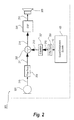
- FIG. 2 highly schematically illustrates a hearing aid 200 according to an embodiment of the invention.
- the hearing aid 200 comprises an acoustical-electrical transducer 201, a first filter bank 202, a summing unit 203, a digital signal processor 204, an electrical-acoustical transducer 205, the sound enrichment system 100, a second filter bank 206 and an equalizer 207.
- the acoustical-electrical transducer 201 transforms an acoustic signal from the surroundings into an electrical audio signal 210, which is provided to the first filter bank 202 that splits the electrical audio signal 210 into a multitude of hearing aid frequency bands, that in Fig. 2 are illustrated by a single bolder signal line 211 which is provided to a first input of the summing unit 203.
- the sound enrichment system 100 provides that an electrical signal representing the enriched sound 110 is provided to the second filter bank 206 that splits the electrical audio signal representing the enriched sound 110 into a multitude of hearing aid frequency bands, that in Fig. 2 are illustrated by a single bolder signal line 212, which is provided to the equalizer 207 that applies a gain to each of the frequency bands such that the level of the noise background provided by the enriched sound is a few dB higher than the audible limit, preferably in the range of 0.5 to 5 dB above the audible limit.
- the output from the equalizer 207 provides a signal 213, that represents equalized enriched sound, and is provided to a second input of the summing unit 203, whereby the summing unit 203 provides a sum signal 214 that is the sum of the electrical signal representing the equalized enriched sound 213 and the band-pass filtered electrical audio signal 211.
- the sum signal 214 is provided to an input of the signal processor 204 for further standard hearing aid signal processing adapted for alleviating a hearing deficit of the hearing aid user.
- the signal processor 204 provides an electrical output signal 215 to the electrical-acoustical transducer 205 for converting the electrical output signal 215 into sound.
- Fig. 3 illustrates highly schematically a sound enrichment system 300 according to an embodiment of the invention.
- the sound enrichment system 300 is identical to the sound enrichment system 100 of Fig. 1 , except that the coloured noise signal is split into five branches instead of four branches, and that the fifth branch comprises a noise background controller 301, that applies a gain to the coloured noise signal hereby providing a level adjusted noise signal 302.
- the level adjusted noise signal 302 is added to the electrical signal representing the enriched sound 110 in summing unit 303 hereby providing an electrical signal 304 representing enriched sound wherein the noise background level is freely adjustable.
- This embodiment is specifically advantageous in that the level of the spectral peak of the output signals from the band-pass filters 103a-d relative to the level of the noise background given by the level adjusted noise signal 302 is freely adjustable. This provides a significant relaxation of the requirements to the filter design, since the band-pass filters according to this embodiment can be selected e.g. purely based on the spectral width of the band-pass filter peak and thus need not take the desired level of the noise background of the enriched sound into account.
- the noise background can't be defined as a specific number, but it will readily within the capability of a person skilled in the art to provide a reasonable estimate of the noise background, also in this case.
- the enriched sound is provided based on sound that is not necessarily based on a noise signal.
- the spectral peaks used to form the chords are provided by a set of parallel music synthesizers, such as e.g. disclosed in EP-B1-1205904 .
Landscapes
- Health & Medical Sciences (AREA)
- General Health & Medical Sciences (AREA)
- Neurosurgery (AREA)
- Otolaryngology (AREA)
- Physics & Mathematics (AREA)
- Engineering & Computer Science (AREA)
- Acoustics & Sound (AREA)
- Signal Processing (AREA)
- Soundproofing, Sound Blocking, And Sound Damping (AREA)
Claims (13)
- Hörgerätesystem, umfassend- einen akustisch-elektrischen Wandler (201) ausgebildet zum Umwandeln eines akustischen Eingangstons in ein elektrisches Audiosignal,- einen Rauschgenerator (101, 102) ausgebildet zum Bereitstellen eines Rauschgeneratorausgangssignals;- einen Signalteiler ausgelegt zum Teilen des Rauschgeneratorausgangssignals in zumindest N parallele Zweige (103);- N Bandpassfilter, wobei jeder der N Zweige einen der N Bandpassfilter, ausgebildet zum Bereitstellen eines Ausgangssignals, umfasst;- Niveaumodellierungsmittel (106) ausgebildet zum Steuern des Niveaus des Ausgangssignals von den Bandpassfiltern, hierdurch Bereitstellen niveaumodellierter Bandpassfilterausgangssignale und weiterhin ausgebildet zum Erhöhen des Niveaus des Ausgangssignals von einem der Bandpassfilter, während das Niveau des Ausgangssignals von einem anderen der Bandpassfilter verringert wird,- erste Summiermittel (109) ausgebildet zum summieren der niveaumodellierten Bandpassfilterausgangssignale von den N Zweigen, hierdurch Bereitstellen eines klangangereicherten Tonsignals;- harmonische Steuermittel (105) ausgebildet zum Setzen der Mittenfrequenzen der Bandpassfilter in Übereinstimmung mit einer vorgegebenen musikalischen Skala und so, dass zumindest N-1 der Bandpassfilter-Mittenfrequenzen ausgewählt sind von N-1 verschiedenen vorgegebenen Frequenzintervallen und ausgebildet zum Ändern der Mittenfrequenz von zumindest einem der Bandpassfilter als Reaktion auf ein Auslöseereignis;- Taktsteuermittel (107) ausgebildet zum Auslösen des harmonischen Steuermittels zum Ändern der Mittenfrequenz von zumindest einem der Bandpassfilter als Reaktion auf das Ereignis, dass das Niveaumodellierungsmittel ein Spitzenniveau des Ausgangssignals von einem der Bandpassfilter auf ein erstes vorgegebenes Niveau erhöht hat oder ein Spitzenniveau des Ausgangssignals von einem der Bandpassfilter auf ein zweites vorgegebenes Niveau verringert hat;- zweite Summiermittel zum Hinzufügen des klangangereicherten Tonsignals zu dem elektrischen Audiosignal, hierdurch Bereitstellen eines elektrischen Eingangssignals;- Signalverarbeitungsmittel ausgelegt zum Verstärken des elektrischen Eingangssignals, um einen Hörverlust eines Hörgerätebenutzers zu mildern, hierdurch Bereitstellen eines elektrischen Ausgangssignals; und- einen elektrisch-akustischen Ausgangswandler zum Umwandeln des elektrischen Ausgangssignals in Ton.
- Hörgerätesystem nach Anspruch 1, wobei die musikalische Skala ausgewählt ist von einer Gruppe von Musikalischen Skalen, umfassend: die diatonischen, chromatischen, Ganzton-, pentatonischen, octatonischen, hexatonischen, heptatonischen tritonischen, tetratonischen und mikrotonalen Skalen.
- Hörgerätesystem nach Anspruch 1 oder 2, wobei das Niveaumodellierungsmittel (106) ausgebildet ist zum Erhöhen des Spitzenniveaus des Ausgangs von einem ersten der Bandpassfilter von dem zweiten vorgegebenen Niveau und auf das erste vorgegebene Niveau und zum gleichzeitigen Verringern des Spitzenniveaus des Ausgangs von einem zweiten der Bandpassfilter von dem ersten Niveau und auf das zweite Niveau.
- Hörgerätesystem nach Anspruch 3, wobei das Niveaumodellierungsmittel (106) ausgebildet ist zum Bereitstellen, dass der Ausgang von einem Bandpassfilterzwischen dem ersten vorgegebenen Niveau und dem zweiten vorgegebenen Niveau innerhalb einer Zeitdauer in dem Beriech von 10 bis 300 Sekunden vorankommen kann.
- Hörgerätesystem nach Anspruch 3 oder 4, wobei das Niveaumodellierungsmittel (106) ausgebildet ist zum Bereitstellen, dass der Unterschied in dem Spitzenniveau zwischen dem ersten vorgegebenen Niveau und dem zweiten vorgegebenen Niveau sich in dem Bereich von 3 bis 15 dB befindet.
- Hörgerätesystem nach einem der vorhergehenden Ansprüche, wobei der Signalteiler (103) ausgelegt ist zum Teilen des Rauschgeneratorausgangssignals in vier parallele Zweige und wobei drei der Bandpassfilter-Mittenfrequenzen ausgewählt sind aus drei verschiedenen vorgegebenen Frequenzintervalls.
- Hörgerätesystem nach einem der vorhergehenden Ansprüche, wobei jedes der vorgegebenen Frequenzintervalle einen Bereich zwischen 1 und 3 Oktaven überspannt.
- Hörgerätesystem nach einem der vorhergehenden Ansprüche, wobei die vorgegebenen Frequenzintervalle zumindest teilweise nicht überlappen.
- Hörgerätesystem nach einem der vorhergehenden Ansprüche, wobei die vorgegebenen Frequenzintervalle überlappen und wobei die Breite die Überlappungen sich in dem Beriech zwischen 50 Hz und 500 Hz befinden.
- Hörgerätesystem nach einem der vorhergehenden Ansprüche, wobei die vorgegebenen Frequenzintervalle einen Frequenzbereich mit einer Untergrenze zwischen 40 und 100 Hz und eine Obergrenze zwischen 1000 und 5000 Hz überspannen.
- Hörgerätesystem nach einem der vorhergehenden Ansprüche, umfassend einen Entzerrfilter (207) ausgebildet zum Teilen des klangangereicherten Signals in eine Vielzahl von Hörgerätefrequenzbändern und einen Equalizer ausgebildet zum Verstärken jedes der Vielzahl von Hörgerätefrequenzbändern, so dass das Niveau des Geräuschhintergrunds des klangangereicherten Signals sich in dem Bereich von 2-6 dB über der Hörgrenze befindet.
- Hörgerätesystem nach einem der vorhergehenden Ansprüche, wobei der Rauschgenerator einen mehrbandigen Kompressor umfasst, der ausgebildet ist zum Ausführen einer Erweiterung in dem Bereich von 1:1,5 und 1:5.
- Hörgerätesystem nach einem der vorhergehenden Ansprüche, wobei der Signalteiler das Signal in N+1 Zweige teilt, und wobei ein zusätzlicher Zweig eine Geräuschhintergrundsteuervorrichtung (301) umfasst, ausgebildet zum Bereitstellen eines Geräuschhintergrunds mit einem vorgegebenen Niveau bezüglich dem Spitzenniveau des Ausgangssignals von einem der Bandpassfilter.
Applications Claiming Priority (1)
| Application Number | Priority Date | Filing Date | Title |
|---|---|---|---|
| PCT/EP2012/076581 WO2014094867A1 (en) | 2012-12-21 | 2012-12-21 | A hearing aid system adapted for providing enriched sound and a method of generating enriched sound |
Publications (2)
| Publication Number | Publication Date |
|---|---|
| EP2936833A1 EP2936833A1 (de) | 2015-10-28 |
| EP2936833B1 true EP2936833B1 (de) | 2016-10-26 |
Family
ID=47504991
Family Applications (1)
| Application Number | Title | Priority Date | Filing Date |
|---|---|---|---|
| EP12810289.4A Active EP2936833B1 (de) | 2012-12-21 | 2012-12-21 | Ein hörgerätesystem zur bereitstellung eines verbesserten klangs und ein verfahren zur erzeugung eines verbesserten klangs |
Country Status (4)
| Country | Link |
|---|---|
| US (1) | US9699571B2 (de) |
| EP (1) | EP2936833B1 (de) |
| DK (1) | DK2936833T3 (de) |
| WO (1) | WO2014094867A1 (de) |
Families Citing this family (10)
| Publication number | Priority date | Publication date | Assignee | Title |
|---|---|---|---|---|
| EP3232927B1 (de) | 2014-12-19 | 2021-11-24 | Widex A/S | Verfahren zum betrieb eines hörhilfesystems sowie ein hörhilfesystem |
| US9883300B2 (en) * | 2015-02-23 | 2018-01-30 | Oticon A/S | Method and apparatus for controlling a hearing instrument to relieve tinitus, hyperacusis, and hearing loss |
| WO2016180704A1 (en) * | 2015-05-08 | 2016-11-17 | Dolby International Ab | Dialog enhancement complemented with frequency transposition |
| US10225671B2 (en) * | 2016-05-27 | 2019-03-05 | Cochlear Limited | Tinnitus masking in hearing prostheses |
| US10821027B2 (en) | 2017-02-08 | 2020-11-03 | Intermountain Intellectual Asset Management, Llc | Devices for filtering sound and related methods |
| US10375489B2 (en) | 2017-03-17 | 2019-08-06 | Robert Newton Rountree, SR. | Audio system with integral hearing test |
| IT201700097652A1 (it) * | 2017-08-30 | 2019-03-02 | Roberto Girolin | Metodo e dispositivo di generazione di segnali acustici per il trattamento di un soggetto con disturbi dell’udito |
| US11806530B2 (en) | 2020-04-21 | 2023-11-07 | Cochlear Limited | Balance compensation |
| US12502537B2 (en) | 2020-07-24 | 2025-12-23 | Cochlear Limited | Vestibular clinical support system functionality |
| US20250221860A1 (en) * | 2024-01-10 | 2025-07-10 | National Cheng Kung University | Device, system, and method for tinnitus treatment |
Family Cites Families (8)
| Publication number | Priority date | Publication date | Assignee | Title |
|---|---|---|---|---|
| US5403262A (en) * | 1993-03-09 | 1995-04-04 | Microtek Medical, Inc. | Minimum energy tinnitus masker |
| US6816599B2 (en) | 2000-11-14 | 2004-11-09 | Topholm & Westermann Aps | Ear level device for synthesizing music |
| JP2007017572A (ja) * | 2005-07-06 | 2007-01-25 | Rion Co Ltd | 外国語学習装置、外国語学習方法、外国語学習の記録媒体およびプログラム |
| US9913053B2 (en) | 2007-03-07 | 2018-03-06 | Gn Hearing A/S | Sound enrichment for the relief of tinnitus |
| JP5338401B2 (ja) * | 2009-03-13 | 2013-11-13 | ヤマハ株式会社 | 鍵駆動装置、アップライト型自動演奏ピアノ及びプログラム |
| DE102010039589A1 (de) * | 2010-08-20 | 2012-02-23 | Siemens Medical Instruments Pte. Ltd. | Hörhilfe- und/oder Tinnitus-Therapie-Gerät |
| DK2533550T4 (da) * | 2011-06-06 | 2021-07-05 | Oticon As | Et høreapparat til at reducere tinnitus-lydstyrken |
| US9331649B2 (en) * | 2012-01-27 | 2016-05-03 | Cochlear Limited | Feature-based level control |
-
2012
- 2012-12-21 EP EP12810289.4A patent/EP2936833B1/de active Active
- 2012-12-21 WO PCT/EP2012/076581 patent/WO2014094867A1/en not_active Ceased
- 2012-12-21 DK DK12810289.4T patent/DK2936833T3/en active
-
2015
- 2015-03-26 US US14/670,133 patent/US9699571B2/en active Active
Non-Patent Citations (1)
| Title |
|---|
| None * |
Also Published As
| Publication number | Publication date |
|---|---|
| EP2936833A1 (de) | 2015-10-28 |
| WO2014094867A1 (en) | 2014-06-26 |
| US9699571B2 (en) | 2017-07-04 |
| US20150256948A1 (en) | 2015-09-10 |
| DK2936833T3 (en) | 2016-12-19 |
Similar Documents
| Publication | Publication Date | Title |
|---|---|---|
| US9699571B2 (en) | Hearing aid system adapted for providing enriched sound and a method of generating enriched sound | |
| CA2410709C (en) | Binaural hearing system and method of synthesizing music | |
| US10219082B2 (en) | Method of operating a hearing aid system and a hearing aid system | |
| CN103747403A (zh) | 用于依赖于声音环境分类缓解耳鸣的声音富集 | |
| AU2002219093A1 (en) | Binaural hearing system and method of synthesizing music | |
| JP5073724B2 (ja) | 聴取空間基盤の指向性音源制御方法及び装置 | |
| WO2007024585A2 (en) | Adaptation resistant anti-stuttering devices and related methods | |
| TW200919953A (en) | Automatic gain control device and method | |
| Bauer et al. | Researches in loudness measurement | |
| CN101904183A (zh) | 助听器 | |
| CN119676611A (zh) | 用于产生单耳或双耳节拍的听力系统和方法 | |
| CN101149918B (zh) | 具练唱功能的声音处理装置 | |
| US12101605B2 (en) | Adaptive hearing normalization and correction system with automatic tuning | |
| CN118338220A (zh) | 减轻耳鸣的助听器音频输出方法、音频输出设备及计算机可读存储介质 | |
| JP2012063614A (ja) | マスキング音生成装置 | |
| CN105686902B (zh) | 耳鸣治疗装置以及合成掩蔽声信号的方法 | |
| US20220345831A1 (en) | Endoscopic three-dimensional imaging systems and methods | |
| CN119676612A (zh) | 用于产生单耳或双耳节拍的听力系统和方法 | |
| CN107049598B (zh) | 一种基于ifs分形算法的耳鸣康复音合成方法 | |
| Negi et al. | Comparative analysis of octave and band pass filter for improving hearing capability of deaf people | |
| Vencovský | Modeling roughness perception for complex stimuli using a model of cochlear hydrodynamics | |
| Miśkiewicz et al. | A psychophysical pitch function determined by absolute magnitude estimation and its relation to the musical pitch scale | |
| JP2019158932A (ja) | 音信号生成装置、及び音信号生成方法 | |
| Sheffield | Telephone speech enhancement for elderly hearing-impaired listeners | |
| JP2000352991A (ja) | スペクトル補正機能つき音声合成器 |
Legal Events
| Date | Code | Title | Description |
|---|---|---|---|
| PUAI | Public reference made under article 153(3) epc to a published international application that has entered the european phase |
Free format text: ORIGINAL CODE: 0009012 |
|
| 17P | Request for examination filed |
Effective date: 20150721 |
|
| AK | Designated contracting states |
Kind code of ref document: A1 Designated state(s): AL AT BE BG CH CY CZ DE DK EE ES FI FR GB GR HR HU IE IS IT LI LT LU LV MC MK MT NL NO PL PT RO RS SE SI SK SM TR |
|
| AX | Request for extension of the european patent |
Extension state: BA ME |
|
| DAX | Request for extension of the european patent (deleted) | ||
| GRAP | Despatch of communication of intention to grant a patent |
Free format text: ORIGINAL CODE: EPIDOSNIGR1 |
|
| GRAS | Grant fee paid |
Free format text: ORIGINAL CODE: EPIDOSNIGR3 |
|
| GRAA | (expected) grant |
Free format text: ORIGINAL CODE: 0009210 |
|
| INTG | Intention to grant announced |
Effective date: 20160831 |
|
| AK | Designated contracting states |
Kind code of ref document: B1 Designated state(s): AL AT BE BG CH CY CZ DE DK EE ES FI FR GB GR HR HU IE IS IT LI LT LU LV MC MK MT NL NO PL PT RO RS SE SI SK SM TR |
|
| REG | Reference to a national code |
Ref country code: GB Ref legal event code: FG4D |
|
| REG | Reference to a national code |
Ref country code: CH Ref legal event code: EP |
|
| REG | Reference to a national code |
Ref country code: AT Ref legal event code: REF Ref document number: 840748 Country of ref document: AT Kind code of ref document: T Effective date: 20161115 |
|
| REG | Reference to a national code |
Ref country code: IE Ref legal event code: FG4D |
|
| REG | Reference to a national code |
Ref country code: DE Ref legal event code: R096 Ref document number: 602012024651 Country of ref document: DE |
|
| REG | Reference to a national code |
Ref country code: DK Ref legal event code: T3 Effective date: 20161216 |
|
| REG | Reference to a national code |
Ref country code: LT Ref legal event code: MG4D |
|
| PG25 | Lapsed in a contracting state [announced via postgrant information from national office to epo] |
Ref country code: LV Free format text: LAPSE BECAUSE OF FAILURE TO SUBMIT A TRANSLATION OF THE DESCRIPTION OR TO PAY THE FEE WITHIN THE PRESCRIBED TIME-LIMIT Effective date: 20161026 |
|
| REG | Reference to a national code |
Ref country code: NL Ref legal event code: MP Effective date: 20161026 |
|
| REG | Reference to a national code |
Ref country code: AT Ref legal event code: MK05 Ref document number: 840748 Country of ref document: AT Kind code of ref document: T Effective date: 20161026 |
|
| PG25 | Lapsed in a contracting state [announced via postgrant information from national office to epo] |
Ref country code: LT Free format text: LAPSE BECAUSE OF FAILURE TO SUBMIT A TRANSLATION OF THE DESCRIPTION OR TO PAY THE FEE WITHIN THE PRESCRIBED TIME-LIMIT Effective date: 20161026 Ref country code: NO Free format text: LAPSE BECAUSE OF FAILURE TO SUBMIT A TRANSLATION OF THE DESCRIPTION OR TO PAY THE FEE WITHIN THE PRESCRIBED TIME-LIMIT Effective date: 20170126 Ref country code: SE Free format text: LAPSE BECAUSE OF FAILURE TO SUBMIT A TRANSLATION OF THE DESCRIPTION OR TO PAY THE FEE WITHIN THE PRESCRIBED TIME-LIMIT Effective date: 20161026 Ref country code: GR Free format text: LAPSE BECAUSE OF FAILURE TO SUBMIT A TRANSLATION OF THE DESCRIPTION OR TO PAY THE FEE WITHIN THE PRESCRIBED TIME-LIMIT Effective date: 20170127 |
|
| PG25 | Lapsed in a contracting state [announced via postgrant information from national office to epo] |
Ref country code: AT Free format text: LAPSE BECAUSE OF FAILURE TO SUBMIT A TRANSLATION OF THE DESCRIPTION OR TO PAY THE FEE WITHIN THE PRESCRIBED TIME-LIMIT Effective date: 20161026 Ref country code: NL Free format text: LAPSE BECAUSE OF FAILURE TO SUBMIT A TRANSLATION OF THE DESCRIPTION OR TO PAY THE FEE WITHIN THE PRESCRIBED TIME-LIMIT Effective date: 20161026 Ref country code: IS Free format text: LAPSE BECAUSE OF FAILURE TO SUBMIT A TRANSLATION OF THE DESCRIPTION OR TO PAY THE FEE WITHIN THE PRESCRIBED TIME-LIMIT Effective date: 20170226 Ref country code: HR Free format text: LAPSE BECAUSE OF FAILURE TO SUBMIT A TRANSLATION OF THE DESCRIPTION OR TO PAY THE FEE WITHIN THE PRESCRIBED TIME-LIMIT Effective date: 20161026 Ref country code: PL Free format text: LAPSE BECAUSE OF FAILURE TO SUBMIT A TRANSLATION OF THE DESCRIPTION OR TO PAY THE FEE WITHIN THE PRESCRIBED TIME-LIMIT Effective date: 20161026 Ref country code: PT Free format text: LAPSE BECAUSE OF FAILURE TO SUBMIT A TRANSLATION OF THE DESCRIPTION OR TO PAY THE FEE WITHIN THE PRESCRIBED TIME-LIMIT Effective date: 20170227 Ref country code: FI Free format text: LAPSE BECAUSE OF FAILURE TO SUBMIT A TRANSLATION OF THE DESCRIPTION OR TO PAY THE FEE WITHIN THE PRESCRIBED TIME-LIMIT Effective date: 20161026 Ref country code: BE Free format text: LAPSE BECAUSE OF FAILURE TO SUBMIT A TRANSLATION OF THE DESCRIPTION OR TO PAY THE FEE WITHIN THE PRESCRIBED TIME-LIMIT Effective date: 20161026 Ref country code: RS Free format text: LAPSE BECAUSE OF FAILURE TO SUBMIT A TRANSLATION OF THE DESCRIPTION OR TO PAY THE FEE WITHIN THE PRESCRIBED TIME-LIMIT Effective date: 20161026 Ref country code: ES Free format text: LAPSE BECAUSE OF FAILURE TO SUBMIT A TRANSLATION OF THE DESCRIPTION OR TO PAY THE FEE WITHIN THE PRESCRIBED TIME-LIMIT Effective date: 20161026 |
|
| REG | Reference to a national code |
Ref country code: DE Ref legal event code: R097 Ref document number: 602012024651 Country of ref document: DE |
|
| PG25 | Lapsed in a contracting state [announced via postgrant information from national office to epo] |
Ref country code: EE Free format text: LAPSE BECAUSE OF FAILURE TO SUBMIT A TRANSLATION OF THE DESCRIPTION OR TO PAY THE FEE WITHIN THE PRESCRIBED TIME-LIMIT Effective date: 20161026 Ref country code: CZ Free format text: LAPSE BECAUSE OF FAILURE TO SUBMIT A TRANSLATION OF THE DESCRIPTION OR TO PAY THE FEE WITHIN THE PRESCRIBED TIME-LIMIT Effective date: 20161026 Ref country code: RO Free format text: LAPSE BECAUSE OF FAILURE TO SUBMIT A TRANSLATION OF THE DESCRIPTION OR TO PAY THE FEE WITHIN THE PRESCRIBED TIME-LIMIT Effective date: 20161026 Ref country code: SK Free format text: LAPSE BECAUSE OF FAILURE TO SUBMIT A TRANSLATION OF THE DESCRIPTION OR TO PAY THE FEE WITHIN THE PRESCRIBED TIME-LIMIT Effective date: 20161026 |
|
| PG25 | Lapsed in a contracting state [announced via postgrant information from national office to epo] |
Ref country code: SM Free format text: LAPSE BECAUSE OF FAILURE TO SUBMIT A TRANSLATION OF THE DESCRIPTION OR TO PAY THE FEE WITHIN THE PRESCRIBED TIME-LIMIT Effective date: 20161026 Ref country code: BG Free format text: LAPSE BECAUSE OF FAILURE TO SUBMIT A TRANSLATION OF THE DESCRIPTION OR TO PAY THE FEE WITHIN THE PRESCRIBED TIME-LIMIT Effective date: 20170126 Ref country code: IT Free format text: LAPSE BECAUSE OF FAILURE TO SUBMIT A TRANSLATION OF THE DESCRIPTION OR TO PAY THE FEE WITHIN THE PRESCRIBED TIME-LIMIT Effective date: 20161026 |
|
| PLBE | No opposition filed within time limit |
Free format text: ORIGINAL CODE: 0009261 |
|
| STAA | Information on the status of an ep patent application or granted ep patent |
Free format text: STATUS: NO OPPOSITION FILED WITHIN TIME LIMIT |
|
| GBPC | Gb: european patent ceased through non-payment of renewal fee |
Effective date: 20170126 |
|
| PG25 | Lapsed in a contracting state [announced via postgrant information from national office to epo] |
Ref country code: MC Free format text: LAPSE BECAUSE OF FAILURE TO SUBMIT A TRANSLATION OF THE DESCRIPTION OR TO PAY THE FEE WITHIN THE PRESCRIBED TIME-LIMIT Effective date: 20161026 |
|
| REG | Reference to a national code |
Ref country code: FR Ref legal event code: ST Effective date: 20170831 |
|
| 26N | No opposition filed |
Effective date: 20170727 |
|
| REG | Reference to a national code |
Ref country code: IE Ref legal event code: MM4A |
|
| PG25 | Lapsed in a contracting state [announced via postgrant information from national office to epo] |
Ref country code: LU Free format text: LAPSE BECAUSE OF NON-PAYMENT OF DUE FEES Effective date: 20161221 Ref country code: FR Free format text: LAPSE BECAUSE OF NON-PAYMENT OF DUE FEES Effective date: 20170102 |
|
| PG25 | Lapsed in a contracting state [announced via postgrant information from national office to epo] |
Ref country code: SI Free format text: LAPSE BECAUSE OF FAILURE TO SUBMIT A TRANSLATION OF THE DESCRIPTION OR TO PAY THE FEE WITHIN THE PRESCRIBED TIME-LIMIT Effective date: 20161026 Ref country code: IE Free format text: LAPSE BECAUSE OF NON-PAYMENT OF DUE FEES Effective date: 20161221 Ref country code: GB Free format text: LAPSE BECAUSE OF NON-PAYMENT OF DUE FEES Effective date: 20170126 |
|
| PG25 | Lapsed in a contracting state [announced via postgrant information from national office to epo] |
Ref country code: HU Free format text: LAPSE BECAUSE OF FAILURE TO SUBMIT A TRANSLATION OF THE DESCRIPTION OR TO PAY THE FEE WITHIN THE PRESCRIBED TIME-LIMIT; INVALID AB INITIO Effective date: 20121221 |
|
| PG25 | Lapsed in a contracting state [announced via postgrant information from national office to epo] |
Ref country code: MK Free format text: LAPSE BECAUSE OF FAILURE TO SUBMIT A TRANSLATION OF THE DESCRIPTION OR TO PAY THE FEE WITHIN THE PRESCRIBED TIME-LIMIT Effective date: 20161026 Ref country code: CY Free format text: LAPSE BECAUSE OF FAILURE TO SUBMIT A TRANSLATION OF THE DESCRIPTION OR TO PAY THE FEE WITHIN THE PRESCRIBED TIME-LIMIT Effective date: 20161026 |
|
| PG25 | Lapsed in a contracting state [announced via postgrant information from national office to epo] |
Ref country code: MT Free format text: LAPSE BECAUSE OF NON-PAYMENT OF DUE FEES Effective date: 20161221 |
|
| PG25 | Lapsed in a contracting state [announced via postgrant information from national office to epo] |
Ref country code: TR Free format text: LAPSE BECAUSE OF FAILURE TO SUBMIT A TRANSLATION OF THE DESCRIPTION OR TO PAY THE FEE WITHIN THE PRESCRIBED TIME-LIMIT Effective date: 20161026 |
|
| PG25 | Lapsed in a contracting state [announced via postgrant information from national office to epo] |
Ref country code: AL Free format text: LAPSE BECAUSE OF FAILURE TO SUBMIT A TRANSLATION OF THE DESCRIPTION OR TO PAY THE FEE WITHIN THE PRESCRIBED TIME-LIMIT Effective date: 20161026 |
|
| REG | Reference to a national code |
Ref country code: CH Ref legal event code: U11 Free format text: ST27 STATUS EVENT CODE: U-0-0-U10-U11 (AS PROVIDED BY THE NATIONAL OFFICE) Effective date: 20260101 |
|
| PGFP | Annual fee paid to national office [announced via postgrant information from national office to epo] |
Ref country code: DE Payment date: 20251126 Year of fee payment: 14 |
|
| PGFP | Annual fee paid to national office [announced via postgrant information from national office to epo] |
Ref country code: DK Payment date: 20251119 Year of fee payment: 14 |
|
| PGFP | Annual fee paid to national office [announced via postgrant information from national office to epo] |
Ref country code: CH Payment date: 20260101 Year of fee payment: 14 |