EP2941088A1 - Procédé pour gérer plusieurs profils dans un élément sécurisé - Google Patents
Procédé pour gérer plusieurs profils dans un élément sécurisé Download PDFInfo
- Publication number
- EP2941088A1 EP2941088A1 EP14305627.3A EP14305627A EP2941088A1 EP 2941088 A1 EP2941088 A1 EP 2941088A1 EP 14305627 A EP14305627 A EP 14305627A EP 2941088 A1 EP2941088 A1 EP 2941088A1
- Authority
- EP
- European Patent Office
- Prior art keywords
- command
- token
- swap
- logical channel
- profile
- Prior art date
- Legal status (The legal status is an assumption and is not a legal conclusion. Google has not performed a legal analysis and makes no representation as to the accuracy of the status listed.)
- Withdrawn
Links
- 238000000034 method Methods 0.000 title claims abstract description 14
- 230000006870 function Effects 0.000 claims abstract description 22
- 230000004044 response Effects 0.000 claims description 12
- 101000869690 Homo sapiens Protein S100-A8 Proteins 0.000 claims description 5
- 102100032442 Protein S100-A8 Human genes 0.000 claims description 5
- 230000008901 benefit Effects 0.000 description 3
- 230000003213 activating effect Effects 0.000 description 2
- 230000001419 dependent effect Effects 0.000 description 1
- 230000007246 mechanism Effects 0.000 description 1
- 229910000679 solder Inorganic materials 0.000 description 1
- 230000008685 targeting Effects 0.000 description 1
- 230000001960 triggered effect Effects 0.000 description 1
Images


Classifications
-
- H—ELECTRICITY
- H04—ELECTRIC COMMUNICATION TECHNIQUE
- H04W—WIRELESS COMMUNICATION NETWORKS
- H04W92/00—Interfaces specially adapted for wireless communication networks
- H04W92/04—Interfaces between hierarchically different network devices
- H04W92/08—Interfaces between hierarchically different network devices between user and terminal device
-
- H—ELECTRICITY
- H04—ELECTRIC COMMUNICATION TECHNIQUE
- H04W—WIRELESS COMMUNICATION NETWORKS
- H04W8/00—Network data management
- H04W8/18—Processing of user or subscriber data, e.g. subscribed services, user preferences or user profiles; Transfer of user or subscriber data
- H04W8/183—Processing at user equipment or user record carrier
Definitions
- the present invention relates to methods of managing profiles in a token. It relates particularly to methods of changing the current enabled profile in a token from an application in the host device.
- a secure element is a tamper-resistant physical component able to store data and to provide services in a secure manner.
- a secure element has a limited amount of memory, a processor with limited capabilities and is devoid of battery.
- a UICC Universal Integrated Circuit Card
- a secure element can be installed, fixedly or not, in a terminal, like a mobile phone for example.
- the terminals are constituted by machines that communicate with other machines for M2M (Machine to Machine) applications.
- a secure element can be in the format of a smart card, or may be in any other format such as for example but not limited to a packaged chip as described in PCT/SE2008/050380 , or any other format.
- a UICC can be used in mobile terminals in GSM, CDMA and UMTS networks for instance. The UICC ensures network authentication, integrity and security of all kinds of personal data. The UICC communicates and cooperates with the baseband (also called baseband processor or baseband radio processor) of the terminal equipment.
- a secure element may contain a profile which can include a set of applications, a set of personal data and a set of secret data.
- the profile could be linked to a subscription. It may contain network access applications (NAA), payment applications or third party applications providing security for a specific service (e.g. NFC applications).
- NAA network access applications
- payment applications or third party applications providing security for a specific service (e.g. NFC applications).
- third party applications providing security for a specific service (e.g. NFC applications).
- a physical secure element can emulate several virtual secure elements, each one represented as one profile. In such a case, these profiles are called logical profiles or virtual profiles.
- An emulated profile is hereinafter called virtual profile.
- each virtual profile is a software based profile.
- a secure element may also be implemented as a pure software component acting as a physical secure element.
- the word token encompasses both a physical secure element and a software component acting as a physical secure element.
- the invention concerns a way to manage several virtual profiles which are run one after the other in a single token. Only one virtual profile is active at a time in a device session.
- the basic behaviour to swap a virtual profile to another one is to reset the whole secure element (ex: reset as defined by ISO7816-3 standard for a smart card). After this low-level reset, the Operating System of the secure element enables the newly selected virtual profile.
- a proactive Refresh command is sent by the UICC to the baseband of the host device to request a reboot of the baseband.
- the Refresh command triggers the reboot of a part of the baseband called the radio functions manager RM which is in charge of the management of both the radio functions of the baseband and to the communication with the secure element.
- the reboot of the baseband allows taking into account the settings of the newly selected virtual profile in the baseband and to reset the UICC. Then, the baseband needs to perform an authentication with the server of the Mobile Network Operator (MNO) to attach to the network. Due to the master-slave relation between the host device and the secure element, the secure element cannot spontaneously send the Refresh command. The secure element must wait for the receipt of an incoming command on a dedicated logical channel to have the opportunity to send the CAT (Card Application Toolkit) Refresh command in response through this dedicated logical channel.
- the Refresh command is also named a proactive command.
- An application of the terminal can send to the secure element a request for swapping to a new profile. This sending is performed through a logical channel distinct from the dedicated logical channel. On receipt of the swapping request, the secure element cannot send the Refresh command to the baseband due to the difference between the used logical channels. In practice, the secure element waits for a command on the dedicated logical channel to respond by sending the proactive Refresh command. This waiting phase can take a long time during which the swap of profile is not performed.
- An object of the invention is to solve the above mentioned technical problem.
- the object of the present invention is a method for managing the swap of current virtual profile in a token acting as an UICC.
- the token comprises a plurality of virtual profiles and is connected to a host machine that comprises an application and a baseband which includes a radio functions manager.
- the method comprising the steps:
- the first command may be the STATUS command as defined by ETSI TS 102 221
- the triggering command may be an AT+CSIM command or an AT+CRSM command as defined by ESTI TS 127 007 which contains a STATUS command as defined by ETSI TS 102 221.
- the triggering command may be an AT+CGLA command or an AT+CRLA command as defined by ESTI TS 127 007 which contains a STATUS command as defined by ETSI TS 102 221.
- the token may register a request for profile swap in response to receiving the swap command and the token may send a CAT REFRESH command through said second logical channel in response to receiving the first command only if a request for profile swap is currently registered.
- Another object of the invention is a terminal equipment comprising an application and a baseband which includes a radio functions manager.
- the terminal equipment is configured to connect a token which acts as an UICC and which comprises a plurality of virtual profiles.
- the application is able to send a swap command requesting a swap of current virtual profile to the token through a first logical channel.
- the application is configured to send a triggering command to the radio functions manager immediately after sending the swap command.
- the triggering command forces the sending of a first command by the baseband to the token through a second logical channel different from the first logical channel.
- the first command may be the STATUS command as defined by TS 102 221.
- the triggering command may be an AT+CSIM command or an AT+CRSM command as defined by ESTI TS 127 007 which contains a STATUS command as defined by ETSI TS 102 221.
- the triggering command may be an AT+CGLA command or an AT+CRLA command as defined by as defined by ESTI TS 127 007 which contains a STATUS command as defined by ETSI TS 102 221.
- Another object of the invention is a system comprising a terminal equipment according to the invention and an token including an operating system configured to register a request for profile swap in response to receiving the swap command.
- the operating system is configured to send a CAT REFRESH command through the second logical channel in response to receiving the first command only if a request for profile swap is currently registered.
- the invention may apply to any types of token intended to contain several virtual profiles.
- the token may be a smart card, an UICC, an embedded-UICC, an embedded-SIM, a software UICC or a software eUICC.
- the token may be coupled to any type of host machine having a baseband and able to establish a communication session with the token.
- the host machine may be a mobile phone, tablet PC, a vehicle, a meter, a slot machine, a TV or a computer.
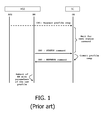
- Figure 1 shows the sequence allowing to swap the current virtual profile in a token SC according to the prior art.
- the token SC is an embedded UICC which is connected to a host device HO2 which includes a software application AP2 and a baseband.
- the baseband comprises a radio functions manager RM.
- First the software application AP2 sends a request for swap of profile to the token SC via a logical channel number CH1.
- the token sets a flag to the newly selected profile and waits for a further command received through the logical channel number CH0.
- the radio functions manager RM After a while, the radio functions manager RM sends a Status command via the logical channel number CH0. In response, the token SC commits the profile swap and sends a proactive Refresh command through the logical channel number CH0. At receipt of the Refresh command, the radio functions manager RM reboots by taking into account parameters corresponding to the newly selected profile.
- Figure 2 shows the sequence allowing swapping the current virtual profile in a token SC according to the invention.
- the token SC is connected to a host device HO which includes an application AP1 and a baseband.
- the baseband comprises a radio functions manager RM.
- First the application AP1 sends a request for swap of profile to the token SC via the logical channel number CH1.
- the token sets a flag to the newly selected profile and waits for a further command received through the logical channel number CH0.
- the application AP1 Immediately after sending the request for swap of profile, the application AP1 sends a trigger command TC to the radio functions manager RM.
- the trigger command TC is designed to force the sending of a command C2 by the radio functions manager RM to the token SC via the logical channel number CH0.
- the command C2 may be a STATUS command as defined by ETSI TS 102 221.
- the command C2 may be any other command defined by the ETSI TS 102 221.
- the command C2 may be an Update Binary command or an Update Record targeting a file dedicated to this mechanism.
- the trigger command TC may be an AT+CSIM command as defined by ESTI TS 127 007 and which contains a STATUS command.
- the trigger command TC may be an AT+CRSM command as defined by ESTI TS 127 007 and which contains a STATUS command.
- the trigger command TC may be an AT+CGLA command as defined by ESTI TS 127 007 which contains a STATUS command.
- the trigger command TC may be an AT+CRLA command as defined by ESTI TS 127 007 which contains a STATUS command.
- the trigger command TC may be sent using any API exposed to applications and services (running on top of the Application), allowing APDU exchanges with a UICC card.
- the operating system OS of the token SC checks if a swap request is registered before sending the Refresh command. If no swap request has been registered, the token SC does not send any Refresh command.
- Figure 3 shows a system SY comprising a host device HO and a token SC according to the invention.
- the host device HO is a mobile phone having a single hardware communication interfaces DP for communicating with a token.
- the host device HO comprises a baseband BB which is designed to communicate with tokens of UICC type.
- the baseband BB comprises a radio functions manager RM able to manage the radio functions of the baseband and to use services provided by the token SC.
- the host device HO comprises a software application AP1 configured to send a trigger command TC to the radio functions manager RM immediately after sending a swap request C1 to the token SC.
- the trigger command TC forces the sending of a command C2 by the baseband BB to the token SC through the logical channel which is used by the token to send CAT Refresh commands.
- the application AP1 is run in the execution environment of the host device HO.
- the application AP1 may be embedded in the baseband BB and run into the baseband.
- the token SC is an embedded UICC which comprises a physical communication interface SP and an execution environment XE.
- the execution environment XE comprises an operating system OS and two virtual profiles PR1 and PR2.
- the token SC may be configured to send a Refresh command only if an enable profile request (i.e. a request of profile swap) has been registered since the last Refresh sending.
- an enable profile request i.e. a request of profile swap
- sequence may be as follow.
- An advantage of the invention is to be fully compliant with existing Telecom standards.
- An advantage of the invention is to be fully compliant with existing basebands.
- the duration required for activating a new virtual profile is independent of the polling frequency of the baseband.
- the token may comprise any number of virtual profiles.
- the architecture of the host device and the architecture of the token shown at Figure 3 are provided as examples only. These architectures may be different.
- the baseband may comprise the application AP1.
- the invention is not limited to a token of UICC type and may apply to any token able to act as a UICC.
- the above described communication interfaces are physical interfaces which may work in either contact mode or in contactless mode.
Landscapes
- Engineering & Computer Science (AREA)
- Computer Networks & Wireless Communication (AREA)
- Signal Processing (AREA)
- Mobile Radio Communication Systems (AREA)
Priority Applications (3)
| Application Number | Priority Date | Filing Date | Title |
|---|---|---|---|
| EP14305627.3A EP2941088A1 (fr) | 2014-04-28 | 2014-04-28 | Procédé pour gérer plusieurs profils dans un élément sécurisé |
| EP15718451.6A EP3138360B1 (fr) | 2014-04-28 | 2015-03-24 | Procédé pour gérer plusieurs profils dans un élément sécurisé |
| PCT/EP2015/056305 WO2015165650A1 (fr) | 2014-04-28 | 2015-03-24 | Procédé de gestion de profils sur un jeton |
Applications Claiming Priority (1)
| Application Number | Priority Date | Filing Date | Title |
|---|---|---|---|
| EP14305627.3A EP2941088A1 (fr) | 2014-04-28 | 2014-04-28 | Procédé pour gérer plusieurs profils dans un élément sécurisé |
Publications (1)
| Publication Number | Publication Date |
|---|---|
| EP2941088A1 true EP2941088A1 (fr) | 2015-11-04 |
Family
ID=50736010
Family Applications (2)
| Application Number | Title | Priority Date | Filing Date |
|---|---|---|---|
| EP14305627.3A Withdrawn EP2941088A1 (fr) | 2014-04-28 | 2014-04-28 | Procédé pour gérer plusieurs profils dans un élément sécurisé |
| EP15718451.6A Active EP3138360B1 (fr) | 2014-04-28 | 2015-03-24 | Procédé pour gérer plusieurs profils dans un élément sécurisé |
Family Applications After (1)
| Application Number | Title | Priority Date | Filing Date |
|---|---|---|---|
| EP15718451.6A Active EP3138360B1 (fr) | 2014-04-28 | 2015-03-24 | Procédé pour gérer plusieurs profils dans un élément sécurisé |
Country Status (2)
| Country | Link |
|---|---|
| EP (2) | EP2941088A1 (fr) |
| WO (1) | WO2015165650A1 (fr) |
Cited By (1)
| Publication number | Priority date | Publication date | Assignee | Title |
|---|---|---|---|---|
| WO2021226768A1 (fr) * | 2020-05-09 | 2021-11-18 | Qualcomm Incorporated | Gestion de profil de carte universelle à circuit intégré (uicc) |
Citations (3)
| Publication number | Priority date | Publication date | Assignee | Title |
|---|---|---|---|---|
| WO2012163436A1 (fr) * | 2011-05-27 | 2012-12-06 | Telefonica, S.A. | Procédé pour commuter des abonnements d'un dispositif personnel prenant en charge des abonnements multiples |
| EP2555547A1 (fr) * | 2011-08-04 | 2013-02-06 | Huawei Device Co., Ltd. | Procédé et système de commutation de IMSI |
| WO2013192358A2 (fr) * | 2012-06-20 | 2013-12-27 | Qualcomm Incorporated | Activation de module d'identité d'abonné durant un appel de données actives |
-
2014
- 2014-04-28 EP EP14305627.3A patent/EP2941088A1/fr not_active Withdrawn
-
2015
- 2015-03-24 EP EP15718451.6A patent/EP3138360B1/fr active Active
- 2015-03-24 WO PCT/EP2015/056305 patent/WO2015165650A1/fr not_active Ceased
Patent Citations (3)
| Publication number | Priority date | Publication date | Assignee | Title |
|---|---|---|---|---|
| WO2012163436A1 (fr) * | 2011-05-27 | 2012-12-06 | Telefonica, S.A. | Procédé pour commuter des abonnements d'un dispositif personnel prenant en charge des abonnements multiples |
| EP2555547A1 (fr) * | 2011-08-04 | 2013-02-06 | Huawei Device Co., Ltd. | Procédé et système de commutation de IMSI |
| WO2013192358A2 (fr) * | 2012-06-20 | 2013-12-27 | Qualcomm Incorporated | Activation de module d'identité d'abonné durant un appel de données actives |
Non-Patent Citations (2)
| Title |
|---|
| "Smart Cards; UICC-Terminal interface; Physical and logical characteristics (Release 11)", TECHNICAL SPECIFICATION, EUROPEAN TELECOMMUNICATIONS STANDARDS INSTITUTE (ETSI), 650, ROUTE DES LUCIOLES ; F-06921 SOPHIA-ANTIPOLIS ; FRANCE, vol. SCP TEC, no. V11.1.0, 1 November 2013 (2013-11-01), XP014180137 * |
| SCP: "Addition of new TLV to indicate the conditions to proceed with REFRESH proactive command;SCP(12)000258r2_CR_102_223_R11__240r2__Addition_of_new_TLV_to_indicate_the_c", ETSI DRAFT; SCP(12)000258R2_CR_102_223_R11__240R2__ADDITION_OF_NEW_TLV_TO_INDICATE_THE_C, EUROPEAN TELECOMMUNICATIONS STANDARDS INSTITUTE (ETSI), 650, ROUTE DES LUCIOLES ; F-06921 SOPHIA-ANTIPOLIS ; FRANCE, vol. SCP, 11 July 2013 (2013-07-11), pages 1 - 5, XP014163792 * |
Cited By (1)
| Publication number | Priority date | Publication date | Assignee | Title |
|---|---|---|---|---|
| WO2021226768A1 (fr) * | 2020-05-09 | 2021-11-18 | Qualcomm Incorporated | Gestion de profil de carte universelle à circuit intégré (uicc) |
Also Published As
| Publication number | Publication date |
|---|---|
| WO2015165650A1 (fr) | 2015-11-05 |
| EP3138360A1 (fr) | 2017-03-08 |
| EP3138360B1 (fr) | 2018-02-28 |
Similar Documents
| Publication | Publication Date | Title |
|---|---|---|
| US11805397B2 (en) | IMEI binding and dynamic IMEI provisioning for wireless devices | |
| US9843674B2 (en) | Managing selection and triggering of applications on a card computing device | |
| US10015165B2 (en) | Methods and apparatus to support GlobalPlatform™ usage on an embedded UICC (eUICC) | |
| US10833715B2 (en) | Embedded subscriber identity module including communication profiles | |
| EP3286934B1 (fr) | Système et procédé pour la gestion de canaux logiques pour accéder à plusieurs profils virtuels dans un élément sécurisé | |
| CN105009617A (zh) | 用于有嵌入的sim功能的多sim设备的方法和装置 | |
| EP3905740B1 (fr) | Procédé et appareil d'enregistrement de carte sim, dispositif informatique, et support d'informations | |
| US9867045B2 (en) | Method of managing communication between a secure element and a host device | |
| EP2908561A1 (fr) | Procédé pour gestion de plusieurs profils dans un élément sécurisé | |
| EP3210403B1 (fr) | Procédé de transmission de données entre un appareil sécurisé et un serveur distant | |
| EP3138360B1 (fr) | Procédé pour gérer plusieurs profils dans un élément sécurisé | |
| KR101952793B1 (ko) | 가입자 아이덴티티 모듈(sim)액세스 프로파일(sap)의 개선들 | |
| EP3486827A1 (fr) | Transfert de clé de session de cryptage par fenêtre temporelle | |
| US9332374B2 (en) | Communication interface method for SE equipped on mobile terminal and SE using the same | |
| US20150281965A1 (en) | Management server, data processing method, and program | |
| US10346630B2 (en) | Method of managing several profiles in a secure element | |
| US20150304426A1 (en) | Method of managing an application in a secure element |
Legal Events
| Date | Code | Title | Description |
|---|---|---|---|
| PUAI | Public reference made under article 153(3) epc to a published international application that has entered the european phase |
Free format text: ORIGINAL CODE: 0009012 |
|
| AK | Designated contracting states |
Kind code of ref document: A1 Designated state(s): AL AT BE BG CH CY CZ DE DK EE ES FI FR GB GR HR HU IE IS IT LI LT LU LV MC MK MT NL NO PL PT RO RS SE SI SK SM TR |
|
| AX | Request for extension of the european patent |
Extension state: BA ME |
|
| STAA | Information on the status of an ep patent application or granted ep patent |
Free format text: STATUS: THE APPLICATION IS DEEMED TO BE WITHDRAWN |
|
| 18D | Application deemed to be withdrawn |
Effective date: 20160505 |