EP2942246B1 - Systèmes et procédés d'estimation de refroidissement de frein - Google Patents
Systèmes et procédés d'estimation de refroidissement de frein Download PDFInfo
- Publication number
- EP2942246B1 EP2942246B1 EP15154286.7A EP15154286A EP2942246B1 EP 2942246 B1 EP2942246 B1 EP 2942246B1 EP 15154286 A EP15154286 A EP 15154286A EP 2942246 B1 EP2942246 B1 EP 2942246B1
- Authority
- EP
- European Patent Office
- Prior art keywords
- cool
- brake assembly
- temperature
- time
- estimated total
- Prior art date
- Legal status (The legal status is an assumption and is not a legal conclusion. Google has not performed a legal analysis and makes no representation as to the accuracy of the status listed.)
- Active
Links
Images


Classifications
-
- B—PERFORMING OPERATIONS; TRANSPORTING
- B60—VEHICLES IN GENERAL
- B60T—VEHICLE BRAKE CONTROL SYSTEMS OR PARTS THEREOF; BRAKE CONTROL SYSTEMS OR PARTS THEREOF, IN GENERAL; ARRANGEMENT OF BRAKING ELEMENTS ON VEHICLES IN GENERAL; PORTABLE DEVICES FOR PREVENTING UNWANTED MOVEMENT OF VEHICLES; VEHICLE MODIFICATIONS TO FACILITATE COOLING OF BRAKES
- B60T17/00—Component parts, details, or accessories of power brake systems not covered by groups B60T8/00, B60T13/00 or B60T15/00, or presenting other characteristic features
- B60T17/18—Safety devices; Monitoring
- B60T17/22—Devices for monitoring or checking brake systems; Signal devices
-
- B—PERFORMING OPERATIONS; TRANSPORTING
- B60—VEHICLES IN GENERAL
- B60T—VEHICLE BRAKE CONTROL SYSTEMS OR PARTS THEREOF; BRAKE CONTROL SYSTEMS OR PARTS THEREOF, IN GENERAL; ARRANGEMENT OF BRAKING ELEMENTS ON VEHICLES IN GENERAL; PORTABLE DEVICES FOR PREVENTING UNWANTED MOVEMENT OF VEHICLES; VEHICLE MODIFICATIONS TO FACILITATE COOLING OF BRAKES
- B60T5/00—Vehicle modifications to facilitate cooling of brakes
-
- B—PERFORMING OPERATIONS; TRANSPORTING
- B64—AIRCRAFT; AVIATION; COSMONAUTICS
- B64C—AEROPLANES; HELICOPTERS
- B64C25/00—Alighting gear
- B64C25/32—Alighting gear characterised by elements which contact the ground or similar surface
- B64C25/42—Arrangement or adaptation of brakes
-
- F—MECHANICAL ENGINEERING; LIGHTING; HEATING; WEAPONS; BLASTING
- F16—ENGINEERING ELEMENTS AND UNITS; GENERAL MEASURES FOR PRODUCING AND MAINTAINING EFFECTIVE FUNCTIONING OF MACHINES OR INSTALLATIONS; THERMAL INSULATION IN GENERAL
- F16D—COUPLINGS FOR TRANSMITTING ROTATION; CLUTCHES; BRAKES
- F16D65/00—Parts or details
- F16D65/78—Features relating to cooling
-
- F—MECHANICAL ENGINEERING; LIGHTING; HEATING; WEAPONS; BLASTING
- F16—ENGINEERING ELEMENTS AND UNITS; GENERAL MEASURES FOR PRODUCING AND MAINTAINING EFFECTIVE FUNCTIONING OF MACHINES OR INSTALLATIONS; THERMAL INSULATION IN GENERAL
- F16D—COUPLINGS FOR TRANSMITTING ROTATION; CLUTCHES; BRAKES
- F16D65/00—Parts or details
- F16D65/78—Features relating to cooling
- F16D2065/783—Features relating to cooling cooling control or adjustment
Definitions
- the present disclosure relates to methods and systems for the estimation of cooling time for brakes, like the state of the art example disclosed in WO 91/19 632 .
- RTO refers generally to engagement of aircraft brakes during an aborted take-off.
- a RTO typically includes high braking loads over a short time period, which in turn correlates to a rapid increase in brake temperature. If aircraft brakes above the predetermined temperature are used in an RTO, brake malfunction may become more likely. Waiting a fixed period of time between landing and take-off tends to lead to wasted time, as the brakes may have cooled to the predetermined temperature prior to the end of the waiting period.
- the invention relates to a system, according to claim 1, comprising a processor, a tangible, non-transitory memory configured to communicate with the processor, the tangible, non-transitory memory having instructions stored thereon that, in response to execution by the processor, cause the processor to perform operations comprising receiving a temperature of a brake assembly, determining a peak brake assembly temperature, determining a temperature decay coefficient (" ⁇ ") of the brake assembly, calculating an estimated total time to cool the brake assembly to a predetermined temperature based on the peak brake assembly temperature and an ambient temperature data, and adjusting the estimated total time to cool the brake assembly to the predetermined temperature based on an amount of time elapsed after receiving the temperature of the brake assembly.
- ⁇ temperature decay coefficient
- a second aspect of the invention concerns a method according to claim 9, including receiving, by a brake control system unit (“BCSU”) comprising a processor and a tangible, non-transitory memory, a temperature of the brake assembly, determining, by the BCSU, a peak brake assembly temperature, determining, by the BCSU, a temperature decay coefficient (" ⁇ ") of the brake assembly, calculating, by the BCSU, an estimated total time to cool the brake assembly to a predetermined temperature based on the peak brake assembly temperature and an ambient temperature data, and adjusting, by the BCSU, the estimated total time to cool the brake assembly to a predetermined temperature based on an amount of time elapsed after the receiving the temperature of the brake assembly.
- BCSU brake control system unit
- ⁇ temperature decay coefficient
- thermodynamics of a brake assembly are complex systems to model. Sophisticated models that incorporate many environmental variables and other data may be used with a high level of accuracy. However, such sophisticated models are associated with systems that are capable of providing a wide number of environmental variables and utilize significant processor and memory overhead. Such systems also tend to rely on a constant power supply during operation. Thus, power interruption may impair the ability of such a system to function.
- Q is the quantity of heat exchanged between the brake assembly and the ambient air
- K is a heat transfer constant
- T BTMS (t) is the temperature of the brake assembly at time t, for example, as measured by the brake temperature monitoring system
- T amb is the ambient air temperature.
- T init the peak temperature of the brake assembly
- ⁇ a temperature decay coefficient greater than zero
- T BTMS (t) the temperature of the brake assembly at time t
- T amb the ambient air temperature
- T BTMS (t 1 ) is the temperature of the brake assembly at a first time ("t 1 ")
- T BTMS (t 2 ) is the temperature of the brake assembly at second time ("t 2 ").
- ⁇ 1 t 1 ⁇ t 2 ⁇ ln T 2 ⁇ T amb T 1 ⁇ T am ! b
- T 1 is a temperature of the brake assembly at a first time ("t 1 ")
- T 2 is a temperature of the brake assembly at a second time (“t 2 ")
- T amb is the ambient temperature data
- the estimated total time to cool the brake assembly may be filtered with a low-pass filter to provide a smooth and/or continuous estimation.
- the particular type of low-pass filter is not particularly limited and can include any digital filter.
- various low-pass filters can include first order low-pass filters, second order low-pass filters, third order low pass filters, etc.
- the low-pass filters can include smoothing parameters, such as a tuning parameter.
- the sampling period is not particularly limited and, in various embodiments, may include periods of 5 minutes, 2 minutes, 1 minute, 45 seconds, 30 seconds, and 15 seconds.
- a brake control system unit (BCSU) or other processor may adjust the estimated total time to cool the brake assembly with a low-pass filter for each new period.
- various systems and methods include reporting the adjusted estimation with an output device.
- the output device may be in at least one of electrical communication and radio frequency ("RF") communication with the processor, for example, the processor of a BCSU.
- RF radio frequency
- a BCSU may be in communication with one or more brake pedals and downstream components that receive commands from the BCSU, either directly or indirectly, to effect and control braking.
- the BCSU may receive pedal commands, process the pedal commands, and then command and electromechanical actuator controllers (EMACs) and electromechanical brake actuators (EBAs) or command a shutoff valve (SOV) and/or brake servo valves (BSV) in hydraulic brakes.
- EMCs electromechanical actuator controllers
- EBAs electromechanical brake actuators
- SOV shutoff valve
- BSV brake servo valves
- System 300 may comprise BCSU 310.
- BCSU 310 may comprise a processor 312, a tangible, non-transitory memory 314, a transceiver 316, and may be communicatively connected to brake temperature monitoring system (BTMS) 326, for example through electrical connection 330.
- Tangible, non-transitory memory 314 may contain logic to allow processor 312 to estimate the cooling time of a brake assembly according to various embodiments.
- BCSU 310 may thus receive brake temperature from BTMS 326, for example, continuously or in a random access fashion.
- BCSU 310 may receive the temperature of a brake assembly (step 410). The BCSU 310 may then determine a peak brake assembly temperature (step 420). In various embodiments, the BCSU 310 may determine the temperature decay coefficient (" ⁇ ") of the brake assembly (step 430).
- T init is the peak temperature of the brake assembly
- ⁇ is a temperature decay coefficient greater than zero
- T BTMS( t) is the temperature of the brake assembly at time t
- T amb is the ambient air temperature.
- the calculation of the temperature decay coefficient (“ ⁇ ") is not particularly limited and may be calculated in a variety of ways, such as with the use of mathematical equations or a look-up table, according to various embodiments.
- the BCSU 310 may calculate an estimated total time to cool (step 440).
- the BCSU 310 may adjust the estimated total time to cool to produce an adjusted estimated time to cool (step 450). For example, in various embodiments, the BCSU 310 may adjust the estimated total time to cool to compensate for the time that has elapsed since the time of the peak temperature measurement. Furthermore, in various embodiments, the adjustment may include using a filter, such as a low-pass filter.
- various low-pass filters can include first order low-pass filters, second order low-pass filters, third order low pass filters, etc.
- the low-pass filters can include smoothing parameters, such as a tuning parameter.
- Exemplary sampling periods may include periods of 5 minutes, 2 minutes, 1 minute, 45 seconds, 30 seconds, and 15 seconds.
- activation method 500 may be used, for example, by a BCSU or other processor to control calculations relevant to the estimation of a time to cool a brake assembly.
- activation method 500 commences at step (step 510). A determination of whether the braking system is currently in a braking event may be made (step 520). If it is determined that the braking system is in a braking event, the estimation of cooling time of the brake assembly is disabled (step 540) and method concludes (step 550).
- activation method 500 may be repeated continuously. In various embodiments, activation method 500 may be repeated after a predetermined condition, such as the passing of a period of time, when power is supplied to the processor, after a braking event, and combinations thereof.
- braking event in various embodiments, may refer to any event which imparts energy (e.g., heat) into a brake assembly.
- a braking event would include the application of brakes during landing and taxing.
- application of a parking brake to a stationary aircraft may be excluded from the term "braking event” and, thus, the estimation of time to cool a brake assembly may be activated while the aircraft is parked between flights. According to various embodiments, this may allow maintenance of the aircraft and boarding of the aircraft while systems and methods disclosed herein estimate the cooling time of a brake assembly to a predetermined temperature.
- Method 600 may comprise activating a time to cool function for a processor such as in a BCSU (step 610).
- the processor may determine whether the brake assembly is above a predetermined temperature (step 620).
- predetermined temperature may include maximum safe operating temperatures of braking systems for immediate dispatch. If the brake assembly is not above a predetermined temperature, then the output for the time to cool may be set to zero (step 630) and the method may terminate (step 670).
- the indication that the brakes are cool can be indicated by a variety of methods, such as an via an indication light, via a display that may show symbols or words indicating that the brakes are sufficiently cool, etc.
- the processor may receive (e.g., poll) the temperature data to determine a peak temperature (step 640).
- a peak temperature may be determined by observing a decrease in brake assembly temperature.
- a hysteresis may be used with BTMS temperature data to prevent repeated and constant activation due to temperature fluctuations and/or anomalies. It has been found that in various embodiments, brake temperature data may peak a few minutes after large amounts of braking has occurred. Accordingly, in various embodiments, sampling periods may include periods of 5 minutes, 2 minutes, 1 minute, 45 seconds, 30 seconds, and 15 seconds between each sample to help account for fluctuations in brake assembly temperature and to facilitate determination of the peak temperature.
- the method may terminate (step 670).
- the estimated time to cool may be computed and reported (step 660).
- the computing of the estimated time to cool may comprise determining a temperature decay coefficient (" ⁇ ") of the brake assembly, calculating an estimated total time to cool the brake assembly to a predetermined temperature based on the peak brake assembly temperature and an ambient temperature data, and adjusting the estimated total time to cool the brake assembly to determine an adjusted estimated time to cool to the predetermined temperature based on an amount of time elapsed after the receiving the temperature of the brake assembly.
- the adjusted estimated time to cool can then be reported (step 660) and the method may terminate (step 670).
- methods 400, 500, 600, and combinations thereof may be repeated to provide updated information on the estimated time to cool the brake assembly.
- systems and methods for determining the cooling time for a brake assembly may adapt cooling profiles based on changing environmental conditions. For example, if a pilot takes off with the brakes excessively hot, disclosed systems and methods may inform the pilot how long he/she must fly with the gear extended before retraction.
- various embodiments may also be able to adapt to changing environmental conditions, for example, if fans are turned on to cool the brakes or if wind conditions are present.
- a hysteresis may be used with BTMS temperature data to prevent repeated and constant activation. Accordingly, in various embodiments, such as those where the cooling time is reported to an output device (e.g., to a control panel in the cockpit), the output device may be prevented from switching on and off repeatedly within a period of time.
- Various disclosed systems and methods may be independent of whether the BCSU has been turned off after landing. Accordingly, algorithms may resume once power is restored to disclosed systems allowing for prediction of the time to cool the brake assembly with the new detected initial conditions upon re-power up. In various embodiments, this may allow for more user-friendly systems and methods.
- disclosed systems and methods may require reduced computation from on-board systems as compared to conventional methods, therefore making it easier to maintain memory and other computational equipment.
- Disclosed methods also reduce the number of tunable parameters when compared to conventional systems and methods.
- references to "one embodiment”, “an embodiment”, “an example embodiment”, etc. indicate that the embodiment described may include a particular feature, structure, or characteristic, but every embodiment may not necessarily include the particular feature, structure, or characteristic. Moreover, such phrases are not necessarily referring to the same embodiment. Further, when a particular feature, structure, or characteristic is described in connection with an embodiment, it is submitted that it is within the knowledge of one skilled in the art to affect such feature, structure, or characteristic in connection with other embodiments whether or not explicitly described. After reading the description, it will be apparent to one skilled in the relevant art(s) how to implement the disclosure in alternative embodiments.
Landscapes
- Engineering & Computer Science (AREA)
- Mechanical Engineering (AREA)
- Transportation (AREA)
- General Engineering & Computer Science (AREA)
- Aviation & Aerospace Engineering (AREA)
- Braking Arrangements (AREA)
- Regulating Braking Force (AREA)
- Valves And Accessory Devices For Braking Systems (AREA)
Claims (15)
- Système comprenant :un processeur (312),une mémoire tangible, non transitoire (314) configurée pour communiquer avec le processeur, la mémoire tangible, non transitoire ayant des instructions stockées sur celle-ci qui, en réponse à l'exécution par le processeur, font traiter par le processeur des opérations comprenant :la réception d'une température d'un ensemble de freinage ;la détermination d'un pic de température d'ensemble de freinage ;la détermination d'un coefficient de diminution de la température (« α ») de l'ensemble de freinage ;caractérisé en ce que les instructions font traiter par le processeur les opérations comprenantle calcul d'une durée totale estimée pour refroidir l'ensemble de freinage jusqu'à une température prédéterminée sur la base du pic de température de l'ensemble de freinage et de données de température ambiante ; etl'ajustement de la durée totale estimée pour refroidir l'ensemble de freinage jusqu'à la température prédéterminée sur la base du temps écoulé après la réception de la température de l'ensemble de freinage.
- Système selon la revendication 1, dans lequel α est supérieur à zéro et satisfait une équation

- Système selon la revendication 1, dans lequel α est supérieur à zéro et satisfait une équation
- Système selon la revendication 3, dans lequel le calcul de la durée totale estimée pour refroidir l'ensemble de freinage jusqu'à une température prédéterminée comprend une équation

- Système selon la revendication 4, dans lequel l'ajustement de la durée totale estimée pour refroidir l'ensemble de freinage comprend le filtrage de la durée totale estimée pour refroidir l'ensemble de freinage avec un filtre passe-bas.
- Système selon la revendication 5, dans lequel le filtrage de la durée totale estimée pour refroidir l'ensemble de freinage avec un filtre passe-bas comprend une équation

- Système selon la revendication 6, dans lequel la durée totale estimée pour refroidir l'ensemble de freinage sur la base du temps écoulé après la réception de la température de l'ensemble de freinage est ajustée par une équation

- Système selon la revendication 1, comprenant en outre un dispositif de sortie (326) en au moins une communication électrique et une communication par radiofréquence (« RF ») avec le processeur.
- Procédé d'estimation d'une durée de refroidissement d'un ensemble de freinage, comprenant :la réception, par une unité de système de contrôle de freinage (« BCSU ») (310) comprenant un processeur (312) et une mémoire tangible, non transitoire (314), d'une température de l'ensemble de freinage ;la détermination, par le BCSU, d'un pic de température d'ensemble de freinage ;la détermination, par le BCSU, d'un coefficient de diminution de la température (« α ») de l'ensemble de freinage ;caractérisé parle calcul, par le BCSU, d'une durée totale estimée pour refroidir l'ensemble de freinage jusqu'à une température prédéterminée sur la base du pic de température de l'ensemble de freinage et de données de température ambiante ; etl'ajustement, par le BCSU, de la durée totale estimée pour refroidir l'ensemble de freinage jusqu'à une température prédéterminée sur la base du temps écoulé après la réception de la température de l'ensemble de freinage.
- Procédé selon la revendication 9, comprenant en outre le fait que le BCSU détermine si l'ensemble de freinage connaît actuellement un événement de freinage.
- Procédé selon la revendication 9, dans lequel α est supérieur à zéro et satisfait une équation

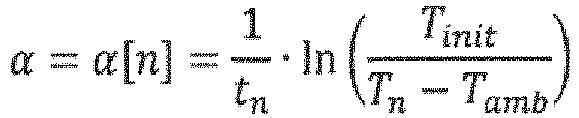
- Système selon la revendication 11, dans lequel α[n] est supérieur à zéro et la durée totale estimée pour refroidir l'ensemble de freinage jusqu'à une température prédéterminée est fondée sur une équation

- Système selon la revendication 9, dans lequel le BCSU ajuste la durée totale estimée pour refroidir l'ensemble de freinage avec un filtre passe-bas.
- Système selon la revendication 13, dans lequel le filtre passe-bas comprend le filtrage de la durée totale estimée pour refroidir l'ensemble de freinage avec une équation

- Système selon la revendication 14, dans lequel la durée totale estimée pour refroidir l'ensemble de freinage sur la base du temps écoulé après la réception de la température de l'ensemble de freinage est ajustée par une équation

Applications Claiming Priority (1)
| Application Number | Priority Date | Filing Date | Title |
|---|---|---|---|
| US14/177,884 US9180855B2 (en) | 2014-02-11 | 2014-02-11 | Brake cooling estimation methods and systems |
Publications (3)
| Publication Number | Publication Date |
|---|---|
| EP2942246A2 EP2942246A2 (fr) | 2015-11-11 |
| EP2942246A3 EP2942246A3 (fr) | 2016-02-10 |
| EP2942246B1 true EP2942246B1 (fr) | 2017-04-05 |
Family
ID=52465247
Family Applications (1)
| Application Number | Title | Priority Date | Filing Date |
|---|---|---|---|
| EP15154286.7A Active EP2942246B1 (fr) | 2014-02-11 | 2015-02-09 | Systèmes et procédés d'estimation de refroidissement de frein |
Country Status (2)
| Country | Link |
|---|---|
| US (1) | US9180855B2 (fr) |
| EP (1) | EP2942246B1 (fr) |
Families Citing this family (7)
| Publication number | Priority date | Publication date | Assignee | Title |
|---|---|---|---|---|
| DE102014018990A1 (de) * | 2014-12-18 | 2016-06-23 | GM Global Technology Operations LLC (n. d. Ges. d. Staates Delaware) | Kraftfahrzeug mit belüftetem Radkasten |
| GB2549736A (en) * | 2016-04-26 | 2017-11-01 | Airbus Operations Ltd | Predicting brake cooling periods |
| GB2563630A (en) * | 2017-06-21 | 2018-12-26 | Airbus Operations Ltd | Controlling vehicle brakes |
| GB2576937A (en) * | 2018-09-07 | 2020-03-11 | Airbus Operations Ltd | Controlling aircraft wheel brakes |
| US11407397B2 (en) * | 2019-10-09 | 2022-08-09 | Goodrich Corporation | Brake temperature and turnaround time estimation systems and methods |
| EP3862737B1 (fr) | 2020-02-05 | 2026-04-08 | Goodrich Corporation | Estimation de la température de frein d'avion à base de modèle |
| FR3165477A1 (fr) * | 2024-08-07 | 2026-02-13 | Safran | PROCEDE de contrôle de l’usure de freins |
Family Cites Families (6)
| Publication number | Priority date | Publication date | Assignee | Title |
|---|---|---|---|---|
| US5136508A (en) * | 1990-06-19 | 1992-08-04 | Allied-Signal Inc. | Brake lining temperature prediction for a traction control system |
| US6244391B1 (en) * | 1996-12-12 | 2001-06-12 | Federal-Mogul Technology Limited | Disc brake system with ABS |
| DE10259529B4 (de) * | 2002-12-19 | 2005-02-17 | Daimlerchrysler Ag | Verfahren zur Ermittlung eines Bremsenzustands |
| US8151944B2 (en) | 2007-11-14 | 2012-04-10 | Goodrich Corporation | Algorithm to determine wheel and brake cooling |
| US8380418B2 (en) * | 2009-08-26 | 2013-02-19 | GM Global Technology Operations LLC | Method for maintaining a brake rotor |
| KR101459454B1 (ko) * | 2012-12-21 | 2014-11-07 | 현대자동차 주식회사 | 연료전지 하이브리드 차량의 파워넷 시스템 및 충방전 제어 방법 |
-
2014
- 2014-02-11 US US14/177,884 patent/US9180855B2/en active Active
-
2015
- 2015-02-09 EP EP15154286.7A patent/EP2942246B1/fr active Active
Non-Patent Citations (1)
| Title |
|---|
| None * |
Also Published As
| Publication number | Publication date |
|---|---|
| US20150224974A1 (en) | 2015-08-13 |
| EP2942246A3 (fr) | 2016-02-10 |
| EP2942246A2 (fr) | 2015-11-11 |
| US9180855B2 (en) | 2015-11-10 |
Similar Documents
| Publication | Publication Date | Title |
|---|---|---|
| EP3048018B1 (fr) | Refroidissement de frein, systèmes et procédés d'estimation | |
| EP2942246B1 (fr) | Systèmes et procédés d'estimation de refroidissement de frein | |
| US11364884B2 (en) | Selective braking of carbon brakes to improve life | |
| EP3239007B1 (fr) | Prédiction des périodes de refroidissement de frein | |
| US11407397B2 (en) | Brake temperature and turnaround time estimation systems and methods | |
| EP2899081B1 (fr) | Système et procédé de surveillance de l'état de frein d'avion | |
| CN104044747B (zh) | 监控飞行器着陆系统的组件的方法和装置 | |
| SG10201802524VA (en) | Brake health indicator systems using input and output energy | |
| EP3354523A1 (fr) | Détection de défauts en fonction du couple de freinage et de la température | |
| CN109094772B (zh) | 一种用于控制交通工具的制动的设备及飞行器 | |
| US11970151B2 (en) | Systems and methods for aircraft antiskid braking | |
| US20150286215A1 (en) | Methods and apparatus to predict landing system operating parameters | |
| CN104229149A (zh) | 着陆阶段的飞行器驾驶辅助方法和系统 | |
| EP3947070B1 (fr) | Procédé de contrôle d'un vérin, vérin und système de freinage électromécanique | |
| EP4180287B1 (fr) | Système et procédé de surveillance de l'état des freins | |
| US12497164B2 (en) | Methods and brake systems to reduce brake wear during aircraft taxiing | |
| EP3269604A1 (fr) | Système de commande de frein antidérapant avec fonction de freinage automatique selon une interruption minimale | |
| US20250162564A1 (en) | Method for monitoring the temperature of brakes of landing gear of an aircraft | |
| EP2060456B1 (fr) | Algorithme pour déterminer le refroidissement de roue et de frein | |
| CN116394683B (zh) | 一种轮胎胎压和胎温智能管理系统 | |
| US20220185259A1 (en) | Brake temperature estimation |
Legal Events
| Date | Code | Title | Description |
|---|---|---|---|
| PUAI | Public reference made under article 153(3) epc to a published international application that has entered the european phase |
Free format text: ORIGINAL CODE: 0009012 |
|
| AK | Designated contracting states |
Kind code of ref document: A2 Designated state(s): AL AT BE BG CH CY CZ DE DK EE ES FI FR GB GR HR HU IE IS IT LI LT LU LV MC MK MT NL NO PL PT RO RS SE SI SK SM TR |
|
| AX | Request for extension of the european patent |
Extension state: BA ME |
|
| PUAL | Search report despatched |
Free format text: ORIGINAL CODE: 0009013 |
|
| AK | Designated contracting states |
Kind code of ref document: A3 Designated state(s): AL AT BE BG CH CY CZ DE DK EE ES FI FR GB GR HR HU IE IS IT LI LT LU LV MC MK MT NL NO PL PT RO RS SE SI SK SM TR |
|
| AX | Request for extension of the european patent |
Extension state: BA ME |
|
| RIC1 | Information provided on ipc code assigned before grant |
Ipc: B64C 25/42 20060101ALI20160107BHEP Ipc: B60T 5/00 20060101AFI20160107BHEP Ipc: F16D 65/78 20060101ALI20160107BHEP Ipc: B60T 17/22 20060101ALI20160107BHEP |
|
| 17P | Request for examination filed |
Effective date: 20160804 |
|
| RBV | Designated contracting states (corrected) |
Designated state(s): AL AT BE BG CH CY CZ DE DK EE ES FI FR GB GR HR HU IE IS IT LI LT LU LV MC MK MT NL NO PL PT RO RS SE SI SK SM TR |
|
| GRAP | Despatch of communication of intention to grant a patent |
Free format text: ORIGINAL CODE: EPIDOSNIGR1 |
|
| INTG | Intention to grant announced |
Effective date: 20161028 |
|
| GRAS | Grant fee paid |
Free format text: ORIGINAL CODE: EPIDOSNIGR3 |
|
| GRAA | (expected) grant |
Free format text: ORIGINAL CODE: 0009210 |
|
| AK | Designated contracting states |
Kind code of ref document: B1 Designated state(s): AL AT BE BG CH CY CZ DE DK EE ES FI FR GB GR HR HU IE IS IT LI LT LU LV MC MK MT NL NO PL PT RO RS SE SI SK SM TR |
|
| REG | Reference to a national code |
Ref country code: GB Ref legal event code: FG4D |
|
| REG | Reference to a national code |
Ref country code: CH Ref legal event code: EP |
|
| REG | Reference to a national code |
Ref country code: AT Ref legal event code: REF Ref document number: 881499 Country of ref document: AT Kind code of ref document: T Effective date: 20170415 |
|
| REG | Reference to a national code |
Ref country code: IE Ref legal event code: FG4D |
|
| REG | Reference to a national code |
Ref country code: DE Ref legal event code: R096 Ref document number: 602015002061 Country of ref document: DE |
|
| REG | Reference to a national code |
Ref country code: NL Ref legal event code: MP Effective date: 20170405 |
|
| REG | Reference to a national code |
Ref country code: LT Ref legal event code: MG4D |
|
| REG | Reference to a national code |
Ref country code: AT Ref legal event code: MK05 Ref document number: 881499 Country of ref document: AT Kind code of ref document: T Effective date: 20170405 |
|
| PG25 | Lapsed in a contracting state [announced via postgrant information from national office to epo] |
Ref country code: NL Free format text: LAPSE BECAUSE OF FAILURE TO SUBMIT A TRANSLATION OF THE DESCRIPTION OR TO PAY THE FEE WITHIN THE PRESCRIBED TIME-LIMIT Effective date: 20170405 |
|
| PG25 | Lapsed in a contracting state [announced via postgrant information from national office to epo] |
Ref country code: LT Free format text: LAPSE BECAUSE OF FAILURE TO SUBMIT A TRANSLATION OF THE DESCRIPTION OR TO PAY THE FEE WITHIN THE PRESCRIBED TIME-LIMIT Effective date: 20170405 Ref country code: GR Free format text: LAPSE BECAUSE OF FAILURE TO SUBMIT A TRANSLATION OF THE DESCRIPTION OR TO PAY THE FEE WITHIN THE PRESCRIBED TIME-LIMIT Effective date: 20170706 Ref country code: HR Free format text: LAPSE BECAUSE OF FAILURE TO SUBMIT A TRANSLATION OF THE DESCRIPTION OR TO PAY THE FEE WITHIN THE PRESCRIBED TIME-LIMIT Effective date: 20170405 Ref country code: NO Free format text: LAPSE BECAUSE OF FAILURE TO SUBMIT A TRANSLATION OF THE DESCRIPTION OR TO PAY THE FEE WITHIN THE PRESCRIBED TIME-LIMIT Effective date: 20170705 Ref country code: ES Free format text: LAPSE BECAUSE OF FAILURE TO SUBMIT A TRANSLATION OF THE DESCRIPTION OR TO PAY THE FEE WITHIN THE PRESCRIBED TIME-LIMIT Effective date: 20170405 Ref country code: AT Free format text: LAPSE BECAUSE OF FAILURE TO SUBMIT A TRANSLATION OF THE DESCRIPTION OR TO PAY THE FEE WITHIN THE PRESCRIBED TIME-LIMIT Effective date: 20170405 Ref country code: FI Free format text: LAPSE BECAUSE OF FAILURE TO SUBMIT A TRANSLATION OF THE DESCRIPTION OR TO PAY THE FEE WITHIN THE PRESCRIBED TIME-LIMIT Effective date: 20170405 |
|
| PG25 | Lapsed in a contracting state [announced via postgrant information from national office to epo] |
Ref country code: LV Free format text: LAPSE BECAUSE OF FAILURE TO SUBMIT A TRANSLATION OF THE DESCRIPTION OR TO PAY THE FEE WITHIN THE PRESCRIBED TIME-LIMIT Effective date: 20170405 Ref country code: SE Free format text: LAPSE BECAUSE OF FAILURE TO SUBMIT A TRANSLATION OF THE DESCRIPTION OR TO PAY THE FEE WITHIN THE PRESCRIBED TIME-LIMIT Effective date: 20170405 Ref country code: IS Free format text: LAPSE BECAUSE OF FAILURE TO SUBMIT A TRANSLATION OF THE DESCRIPTION OR TO PAY THE FEE WITHIN THE PRESCRIBED TIME-LIMIT Effective date: 20170805 Ref country code: RS Free format text: LAPSE BECAUSE OF FAILURE TO SUBMIT A TRANSLATION OF THE DESCRIPTION OR TO PAY THE FEE WITHIN THE PRESCRIBED TIME-LIMIT Effective date: 20170405 Ref country code: PL Free format text: LAPSE BECAUSE OF FAILURE TO SUBMIT A TRANSLATION OF THE DESCRIPTION OR TO PAY THE FEE WITHIN THE PRESCRIBED TIME-LIMIT Effective date: 20170405 Ref country code: BG Free format text: LAPSE BECAUSE OF FAILURE TO SUBMIT A TRANSLATION OF THE DESCRIPTION OR TO PAY THE FEE WITHIN THE PRESCRIBED TIME-LIMIT Effective date: 20170705 |
|
| REG | Reference to a national code |
Ref country code: DE Ref legal event code: R097 Ref document number: 602015002061 Country of ref document: DE |
|
| REG | Reference to a national code |
Ref country code: FR Ref legal event code: PLFP Year of fee payment: 4 |
|
| PG25 | Lapsed in a contracting state [announced via postgrant information from national office to epo] |
Ref country code: SK Free format text: LAPSE BECAUSE OF FAILURE TO SUBMIT A TRANSLATION OF THE DESCRIPTION OR TO PAY THE FEE WITHIN THE PRESCRIBED TIME-LIMIT Effective date: 20170405 Ref country code: DK Free format text: LAPSE BECAUSE OF FAILURE TO SUBMIT A TRANSLATION OF THE DESCRIPTION OR TO PAY THE FEE WITHIN THE PRESCRIBED TIME-LIMIT Effective date: 20170405 Ref country code: CZ Free format text: LAPSE BECAUSE OF FAILURE TO SUBMIT A TRANSLATION OF THE DESCRIPTION OR TO PAY THE FEE WITHIN THE PRESCRIBED TIME-LIMIT Effective date: 20170405 Ref country code: RO Free format text: LAPSE BECAUSE OF FAILURE TO SUBMIT A TRANSLATION OF THE DESCRIPTION OR TO PAY THE FEE WITHIN THE PRESCRIBED TIME-LIMIT Effective date: 20170405 Ref country code: EE Free format text: LAPSE BECAUSE OF FAILURE TO SUBMIT A TRANSLATION OF THE DESCRIPTION OR TO PAY THE FEE WITHIN THE PRESCRIBED TIME-LIMIT Effective date: 20170405 |
|
| PLBE | No opposition filed within time limit |
Free format text: ORIGINAL CODE: 0009261 |
|
| STAA | Information on the status of an ep patent application or granted ep patent |
Free format text: STATUS: NO OPPOSITION FILED WITHIN TIME LIMIT |
|
| PG25 | Lapsed in a contracting state [announced via postgrant information from national office to epo] |
Ref country code: IT Free format text: LAPSE BECAUSE OF FAILURE TO SUBMIT A TRANSLATION OF THE DESCRIPTION OR TO PAY THE FEE WITHIN THE PRESCRIBED TIME-LIMIT Effective date: 20170405 Ref country code: SM Free format text: LAPSE BECAUSE OF FAILURE TO SUBMIT A TRANSLATION OF THE DESCRIPTION OR TO PAY THE FEE WITHIN THE PRESCRIBED TIME-LIMIT Effective date: 20170405 |
|
| 26N | No opposition filed |
Effective date: 20180108 |
|
| PG25 | Lapsed in a contracting state [announced via postgrant information from national office to epo] |
Ref country code: SI Free format text: LAPSE BECAUSE OF FAILURE TO SUBMIT A TRANSLATION OF THE DESCRIPTION OR TO PAY THE FEE WITHIN THE PRESCRIBED TIME-LIMIT Effective date: 20170405 |
|
| REG | Reference to a national code |
Ref country code: DE Ref legal event code: R119 Ref document number: 602015002061 Country of ref document: DE |
|
| REG | Reference to a national code |
Ref country code: CH Ref legal event code: PL |
|
| PG25 | Lapsed in a contracting state [announced via postgrant information from national office to epo] |
Ref country code: MC Free format text: LAPSE BECAUSE OF FAILURE TO SUBMIT A TRANSLATION OF THE DESCRIPTION OR TO PAY THE FEE WITHIN THE PRESCRIBED TIME-LIMIT Effective date: 20170405 |
|
| REG | Reference to a national code |
Ref country code: IE Ref legal event code: MM4A |
|
| REG | Reference to a national code |
Ref country code: BE Ref legal event code: MM Effective date: 20180228 |
|
| PG25 | Lapsed in a contracting state [announced via postgrant information from national office to epo] |
Ref country code: LU Free format text: LAPSE BECAUSE OF NON-PAYMENT OF DUE FEES Effective date: 20180209 Ref country code: CH Free format text: LAPSE BECAUSE OF NON-PAYMENT OF DUE FEES Effective date: 20180228 Ref country code: LI Free format text: LAPSE BECAUSE OF NON-PAYMENT OF DUE FEES Effective date: 20180228 |
|
| PG25 | Lapsed in a contracting state [announced via postgrant information from national office to epo] |
Ref country code: IE Free format text: LAPSE BECAUSE OF NON-PAYMENT OF DUE FEES Effective date: 20180209 Ref country code: DE Free format text: LAPSE BECAUSE OF NON-PAYMENT OF DUE FEES Effective date: 20180901 |
|
| PG25 | Lapsed in a contracting state [announced via postgrant information from national office to epo] |
Ref country code: BE Free format text: LAPSE BECAUSE OF NON-PAYMENT OF DUE FEES Effective date: 20180228 |
|
| PG25 | Lapsed in a contracting state [announced via postgrant information from national office to epo] |
Ref country code: MT Free format text: LAPSE BECAUSE OF NON-PAYMENT OF DUE FEES Effective date: 20180209 |
|
| PG25 | Lapsed in a contracting state [announced via postgrant information from national office to epo] |
Ref country code: TR Free format text: LAPSE BECAUSE OF FAILURE TO SUBMIT A TRANSLATION OF THE DESCRIPTION OR TO PAY THE FEE WITHIN THE PRESCRIBED TIME-LIMIT Effective date: 20170405 |
|
| PG25 | Lapsed in a contracting state [announced via postgrant information from national office to epo] |
Ref country code: PT Free format text: LAPSE BECAUSE OF FAILURE TO SUBMIT A TRANSLATION OF THE DESCRIPTION OR TO PAY THE FEE WITHIN THE PRESCRIBED TIME-LIMIT Effective date: 20170405 |
|
| PG25 | Lapsed in a contracting state [announced via postgrant information from national office to epo] |
Ref country code: HU Free format text: LAPSE BECAUSE OF FAILURE TO SUBMIT A TRANSLATION OF THE DESCRIPTION OR TO PAY THE FEE WITHIN THE PRESCRIBED TIME-LIMIT; INVALID AB INITIO Effective date: 20150209 Ref country code: MK Free format text: LAPSE BECAUSE OF NON-PAYMENT OF DUE FEES Effective date: 20170405 Ref country code: CY Free format text: LAPSE BECAUSE OF FAILURE TO SUBMIT A TRANSLATION OF THE DESCRIPTION OR TO PAY THE FEE WITHIN THE PRESCRIBED TIME-LIMIT Effective date: 20170405 |
|
| PG25 | Lapsed in a contracting state [announced via postgrant information from national office to epo] |
Ref country code: AL Free format text: LAPSE BECAUSE OF FAILURE TO SUBMIT A TRANSLATION OF THE DESCRIPTION OR TO PAY THE FEE WITHIN THE PRESCRIBED TIME-LIMIT Effective date: 20170405 |
|
| P01 | Opt-out of the competence of the unified patent court (upc) registered |
Effective date: 20230522 |
|
| PGFP | Annual fee paid to national office [announced via postgrant information from national office to epo] |
Ref country code: GB Payment date: 20260121 Year of fee payment: 12 |
|
| PGFP | Annual fee paid to national office [announced via postgrant information from national office to epo] |
Ref country code: FR Payment date: 20260121 Year of fee payment: 12 |