EP2943457B1 - Herstellung von methacrylsäure - Google Patents
Herstellung von methacrylsäure Download PDFInfo
- Publication number
- EP2943457B1 EP2943457B1 EP14700240.6A EP14700240A EP2943457B1 EP 2943457 B1 EP2943457 B1 EP 2943457B1 EP 14700240 A EP14700240 A EP 14700240A EP 2943457 B1 EP2943457 B1 EP 2943457B1
- Authority
- EP
- European Patent Office
- Prior art keywords
- oxygenate
- methacrylic acid
- monopropylene glycol
- propanoic acid
- acid
- Prior art date
- Legal status (The legal status is an assumption and is not a legal conclusion. Google has not performed a legal analysis and makes no representation as to the accuracy of the status listed.)
- Not-in-force
Links
- CERQOIWHTDAKMF-UHFFFAOYSA-N Methacrylic acid Chemical compound CC(=C)C(O)=O CERQOIWHTDAKMF-UHFFFAOYSA-N 0.000 title claims description 31
- 238000004519 manufacturing process Methods 0.000 title description 11
- DNIAPMSPPWPWGF-UHFFFAOYSA-N Propylene glycol Chemical compound CC(O)CO DNIAPMSPPWPWGF-UHFFFAOYSA-N 0.000 claims description 58
- PEDCQBHIVMGVHV-UHFFFAOYSA-N Glycerine Chemical compound OCC(O)CO PEDCQBHIVMGVHV-UHFFFAOYSA-N 0.000 claims description 45
- 238000000034 method Methods 0.000 claims description 32
- WSFSSNUMVMOOMR-UHFFFAOYSA-N Formaldehyde Chemical compound O=C WSFSSNUMVMOOMR-UHFFFAOYSA-N 0.000 claims description 27
- XBDQKXXYIPTUBI-UHFFFAOYSA-N dimethylselenoniopropionate Natural products CCC(O)=O XBDQKXXYIPTUBI-UHFFFAOYSA-N 0.000 claims description 27
- 235000019260 propionic acid Nutrition 0.000 claims description 26
- DUWWHGPELOTTOE-UHFFFAOYSA-N n-(5-chloro-2,4-dimethoxyphenyl)-3-oxobutanamide Chemical compound COC1=CC(OC)=C(NC(=O)CC(C)=O)C=C1Cl DUWWHGPELOTTOE-UHFFFAOYSA-N 0.000 claims description 25
- BDERNNFJNOPAEC-UHFFFAOYSA-N propan-1-ol Chemical compound CCCO BDERNNFJNOPAEC-UHFFFAOYSA-N 0.000 claims description 18
- 125000004430 oxygen atom Chemical group O* 0.000 claims description 16
- 235000000346 sugar Nutrition 0.000 claims description 15
- NBBJYMSMWIIQGU-UHFFFAOYSA-N Propionic aldehyde Chemical compound CCC=O NBBJYMSMWIIQGU-UHFFFAOYSA-N 0.000 claims description 14
- BSABBBMNWQWLLU-UHFFFAOYSA-N lactaldehyde Chemical compound CC(O)C=O BSABBBMNWQWLLU-UHFFFAOYSA-N 0.000 claims description 14
- RXKJFZQQPQGTFL-UHFFFAOYSA-N dihydroxyacetone Chemical compound OCC(=O)CO RXKJFZQQPQGTFL-UHFFFAOYSA-N 0.000 claims description 12
- XLSMFKSTNGKWQX-UHFFFAOYSA-N hydroxyacetone Chemical compound CC(=O)CO XLSMFKSTNGKWQX-UHFFFAOYSA-N 0.000 claims description 9
- SRBFZHDQGSBBOR-IOVATXLUSA-N D-xylopyranose Chemical compound O[C@@H]1COC(O)[C@H](O)[C@H]1O SRBFZHDQGSBBOR-IOVATXLUSA-N 0.000 claims description 6
- 229940120503 dihydroxyacetone Drugs 0.000 claims description 6
- 239000002243 precursor Substances 0.000 claims description 4
- 229930091371 Fructose Natural products 0.000 claims description 3
- RFSUNEUAIZKAJO-ARQDHWQXSA-N Fructose Chemical compound OC[C@H]1O[C@](O)(CO)[C@@H](O)[C@@H]1O RFSUNEUAIZKAJO-ARQDHWQXSA-N 0.000 claims description 3
- 239000005715 Fructose Substances 0.000 claims description 3
- WQZGKKKJIJFFOK-GASJEMHNSA-N Glucose Natural products OC[C@H]1OC(O)[C@H](O)[C@@H](O)[C@@H]1O WQZGKKKJIJFFOK-GASJEMHNSA-N 0.000 claims description 3
- 229930006000 Sucrose Natural products 0.000 claims description 3
- PYMYPHUHKUWMLA-UHFFFAOYSA-N arabinose Natural products OCC(O)C(O)C(O)C=O PYMYPHUHKUWMLA-UHFFFAOYSA-N 0.000 claims description 3
- SRBFZHDQGSBBOR-UHFFFAOYSA-N beta-D-Pyranose-Lyxose Natural products OC1COC(O)C(O)C1O SRBFZHDQGSBBOR-UHFFFAOYSA-N 0.000 claims description 3
- WQZGKKKJIJFFOK-VFUOTHLCSA-N beta-D-glucose Chemical compound OC[C@H]1O[C@@H](O)[C@H](O)[C@@H](O)[C@@H]1O WQZGKKKJIJFFOK-VFUOTHLCSA-N 0.000 claims description 3
- 150000001875 compounds Chemical class 0.000 claims description 3
- 239000008103 glucose Substances 0.000 claims description 3
- 239000005720 sucrose Substances 0.000 claims description 3
- 125000000185 sucrose group Chemical group 0.000 claims 1
- 238000006243 chemical reaction Methods 0.000 description 31
- CSCPPACGZOOCGX-UHFFFAOYSA-N Acetone Chemical compound CC(C)=O CSCPPACGZOOCGX-UHFFFAOYSA-N 0.000 description 12
- VQTUBCCKSQIDNK-UHFFFAOYSA-N Isobutene Chemical compound CC(C)=C VQTUBCCKSQIDNK-UHFFFAOYSA-N 0.000 description 12
- 239000003054 catalyst Substances 0.000 description 12
- LYCAIKOWRPUZTN-UHFFFAOYSA-N Ethylene glycol Chemical compound OCCO LYCAIKOWRPUZTN-UHFFFAOYSA-N 0.000 description 11
- OKKJLVBELUTLKV-UHFFFAOYSA-N Methanol Chemical compound OC OKKJLVBELUTLKV-UHFFFAOYSA-N 0.000 description 10
- QQONPFPTGQHPMA-UHFFFAOYSA-N Propene Chemical compound CC=C QQONPFPTGQHPMA-UHFFFAOYSA-N 0.000 description 8
- 125000002915 carbonyl group Chemical group [*:2]C([*:1])=O 0.000 description 8
- LELOWRISYMNNSU-UHFFFAOYSA-N hydrogen cyanide Chemical compound N#C LELOWRISYMNNSU-UHFFFAOYSA-N 0.000 description 8
- 238000006356 dehydrogenation reaction Methods 0.000 description 7
- 239000007789 gas Substances 0.000 description 7
- 125000002887 hydroxy group Chemical group [H]O* 0.000 description 7
- 230000003647 oxidation Effects 0.000 description 7
- 238000007254 oxidation reaction Methods 0.000 description 7
- 239000000126 substance Substances 0.000 description 7
- ATUOYWHBWRKTHZ-UHFFFAOYSA-N Propane Chemical compound CCC ATUOYWHBWRKTHZ-UHFFFAOYSA-N 0.000 description 6
- QAOWNCQODCNURD-UHFFFAOYSA-N Sulfuric acid Chemical compound OS(O)(=O)=O QAOWNCQODCNURD-UHFFFAOYSA-N 0.000 description 6
- QVGXLLKOCUKJST-UHFFFAOYSA-N atomic oxygen Chemical compound [O] QVGXLLKOCUKJST-UHFFFAOYSA-N 0.000 description 6
- 239000001257 hydrogen Substances 0.000 description 6
- 229910052739 hydrogen Inorganic materials 0.000 description 6
- 238000005984 hydrogenation reaction Methods 0.000 description 6
- 239000001301 oxygen Substances 0.000 description 6
- 229910052760 oxygen Inorganic materials 0.000 description 6
- 239000002028 Biomass Substances 0.000 description 5
- 238000007327 hydrogenolysis reaction Methods 0.000 description 5
- 150000008163 sugars Chemical class 0.000 description 5
- UFHFLCQGNIYNRP-UHFFFAOYSA-N Hydrogen Chemical compound [H][H] UFHFLCQGNIYNRP-UHFFFAOYSA-N 0.000 description 4
- 229910052751 metal Inorganic materials 0.000 description 4
- 239000002184 metal Substances 0.000 description 4
- 239000000047 product Substances 0.000 description 4
- -1 ammonium sulfate Chemical class 0.000 description 3
- 125000004432 carbon atom Chemical group C* 0.000 description 3
- 238000006555 catalytic reaction Methods 0.000 description 3
- 230000018044 dehydration Effects 0.000 description 3
- 238000006297 dehydration reaction Methods 0.000 description 3
- 239000001294 propane Substances 0.000 description 3
- 239000007858 starting material Substances 0.000 description 3
- 229920002488 Hemicellulose Polymers 0.000 description 2
- 229920001202 Inulin Polymers 0.000 description 2
- VVQNEPGJFQJSBK-UHFFFAOYSA-N Methyl methacrylate Chemical compound COC(=O)C(C)=C VVQNEPGJFQJSBK-UHFFFAOYSA-N 0.000 description 2
- 229920002472 Starch Polymers 0.000 description 2
- CZMRCDWAGMRECN-UGDNZRGBSA-N Sucrose Chemical compound O[C@H]1[C@H](O)[C@@H](CO)O[C@@]1(CO)O[C@@H]1[C@H](O)[C@@H](O)[C@H](O)[C@@H](CO)O1 CZMRCDWAGMRECN-UGDNZRGBSA-N 0.000 description 2
- 150000001298 alcohols Chemical class 0.000 description 2
- 125000003172 aldehyde group Chemical group 0.000 description 2
- BFNBIHQBYMNNAN-UHFFFAOYSA-N ammonium sulfate Chemical compound N.N.OS(O)(=O)=O BFNBIHQBYMNNAN-UHFFFAOYSA-N 0.000 description 2
- 229910052921 ammonium sulfate Inorganic materials 0.000 description 2
- 235000011130 ammonium sulphate Nutrition 0.000 description 2
- 238000000508 aqueous-phase reforming Methods 0.000 description 2
- 125000004429 atom Chemical group 0.000 description 2
- 150000001720 carbohydrates Chemical class 0.000 description 2
- 235000014633 carbohydrates Nutrition 0.000 description 2
- 229910052799 carbon Inorganic materials 0.000 description 2
- 239000011203 carbon fibre reinforced carbon Substances 0.000 description 2
- 125000002843 carboxylic acid group Chemical group 0.000 description 2
- 239000001913 cellulose Substances 0.000 description 2
- 229920002678 cellulose Polymers 0.000 description 2
- 239000010779 crude oil Substances 0.000 description 2
- 150000002431 hydrogen Chemical class 0.000 description 2
- 125000004435 hydrogen atom Chemical group [H]* 0.000 description 2
- JYJIGFIDKWBXDU-MNNPPOADSA-N inulin Chemical compound O[C@H]1[C@H](O)[C@@H](CO)O[C@@]1(CO)OC[C@]1(OC[C@]2(OC[C@]3(OC[C@]4(OC[C@]5(OC[C@]6(OC[C@]7(OC[C@]8(OC[C@]9(OC[C@]%10(OC[C@]%11(OC[C@]%12(OC[C@]%13(OC[C@]%14(OC[C@]%15(OC[C@]%16(OC[C@]%17(OC[C@]%18(OC[C@]%19(OC[C@]%20(OC[C@]%21(OC[C@]%22(OC[C@]%23(OC[C@]%24(OC[C@]%25(OC[C@]%26(OC[C@]%27(OC[C@]%28(OC[C@]%29(OC[C@]%30(OC[C@]%31(OC[C@]%32(OC[C@]%33(OC[C@]%34(OC[C@]%35(OC[C@]%36(O[C@@H]%37[C@@H]([C@@H](O)[C@H](O)[C@@H](CO)O%37)O)[C@H]([C@H](O)[C@@H](CO)O%36)O)[C@H]([C@H](O)[C@@H](CO)O%35)O)[C@H]([C@H](O)[C@@H](CO)O%34)O)[C@H]([C@H](O)[C@@H](CO)O%33)O)[C@H]([C@H](O)[C@@H](CO)O%32)O)[C@H]([C@H](O)[C@@H](CO)O%31)O)[C@H]([C@H](O)[C@@H](CO)O%30)O)[C@H]([C@H](O)[C@@H](CO)O%29)O)[C@H]([C@H](O)[C@@H](CO)O%28)O)[C@H]([C@H](O)[C@@H](CO)O%27)O)[C@H]([C@H](O)[C@@H](CO)O%26)O)[C@H]([C@H](O)[C@@H](CO)O%25)O)[C@H]([C@H](O)[C@@H](CO)O%24)O)[C@H]([C@H](O)[C@@H](CO)O%23)O)[C@H]([C@H](O)[C@@H](CO)O%22)O)[C@H]([C@H](O)[C@@H](CO)O%21)O)[C@H]([C@H](O)[C@@H](CO)O%20)O)[C@H]([C@H](O)[C@@H](CO)O%19)O)[C@H]([C@H](O)[C@@H](CO)O%18)O)[C@H]([C@H](O)[C@@H](CO)O%17)O)[C@H]([C@H](O)[C@@H](CO)O%16)O)[C@H]([C@H](O)[C@@H](CO)O%15)O)[C@H]([C@H](O)[C@@H](CO)O%14)O)[C@H]([C@H](O)[C@@H](CO)O%13)O)[C@H]([C@H](O)[C@@H](CO)O%12)O)[C@H]([C@H](O)[C@@H](CO)O%11)O)[C@H]([C@H](O)[C@@H](CO)O%10)O)[C@H]([C@H](O)[C@@H](CO)O9)O)[C@H]([C@H](O)[C@@H](CO)O8)O)[C@H]([C@H](O)[C@@H](CO)O7)O)[C@H]([C@H](O)[C@@H](CO)O6)O)[C@H]([C@H](O)[C@@H](CO)O5)O)[C@H]([C@H](O)[C@@H](CO)O4)O)[C@H]([C@H](O)[C@@H](CO)O3)O)[C@H]([C@H](O)[C@@H](CO)O2)O)[C@@H](O)[C@H](O)[C@@H](CO)O1 JYJIGFIDKWBXDU-MNNPPOADSA-N 0.000 description 2
- 229940029339 inulin Drugs 0.000 description 2
- NNPPMTNAJDCUHE-UHFFFAOYSA-N isobutane Chemical compound CC(C)C NNPPMTNAJDCUHE-UHFFFAOYSA-N 0.000 description 2
- 238000006317 isomerization reaction Methods 0.000 description 2
- 150000004702 methyl esters Chemical class 0.000 description 2
- SNVLJLYUUXKWOJ-UHFFFAOYSA-N methylidenecarbene Chemical compound C=[C] SNVLJLYUUXKWOJ-UHFFFAOYSA-N 0.000 description 2
- 239000007800 oxidant agent Substances 0.000 description 2
- 238000005839 oxidative dehydrogenation reaction Methods 0.000 description 2
- 239000012071 phase Substances 0.000 description 2
- 230000008707 rearrangement Effects 0.000 description 2
- 150000003839 salts Chemical class 0.000 description 2
- 235000019698 starch Nutrition 0.000 description 2
- 239000008107 starch Substances 0.000 description 2
- 150000005846 sugar alcohols Chemical class 0.000 description 2
- 230000001131 transforming effect Effects 0.000 description 2
- XLYOFNOQVPJJNP-UHFFFAOYSA-N water Substances O XLYOFNOQVPJJNP-UHFFFAOYSA-N 0.000 description 2
- DNIAPMSPPWPWGF-VKHMYHEASA-N (+)-propylene glycol Chemical compound C[C@H](O)CO DNIAPMSPPWPWGF-VKHMYHEASA-N 0.000 description 1
- YPFDHNVEDLHUCE-UHFFFAOYSA-N 1,3-propanediol Substances OCCCO YPFDHNVEDLHUCE-UHFFFAOYSA-N 0.000 description 1
- SMZOUWXMTYCWNB-UHFFFAOYSA-N 2-(2-methoxy-5-methylphenyl)ethanamine Chemical compound COC1=CC=C(C)C=C1CCN SMZOUWXMTYCWNB-UHFFFAOYSA-N 0.000 description 1
- NIXOWILDQLNWCW-UHFFFAOYSA-N 2-Propenoic acid Natural products OC(=O)C=C NIXOWILDQLNWCW-UHFFFAOYSA-N 0.000 description 1
- AKXKFZDCRYJKTF-UHFFFAOYSA-N 3-Hydroxypropionaldehyde Chemical compound OCCC=O AKXKFZDCRYJKTF-UHFFFAOYSA-N 0.000 description 1
- LFQSCWFLJHTTHZ-UHFFFAOYSA-N Ethanol Chemical compound CCO LFQSCWFLJHTTHZ-UHFFFAOYSA-N 0.000 description 1
- 239000002253 acid Substances 0.000 description 1
- 150000001299 aldehydes Chemical class 0.000 description 1
- 150000001335 aliphatic alkanes Chemical class 0.000 description 1
- 150000001336 alkenes Chemical class 0.000 description 1
- BIGPRXCJEDHCLP-UHFFFAOYSA-N ammonium bisulfate Chemical compound [NH4+].OS([O-])(=O)=O BIGPRXCJEDHCLP-UHFFFAOYSA-N 0.000 description 1
- ZTQSAGDEMFDKMZ-UHFFFAOYSA-N butyric aldehyde Natural products CCCC=O ZTQSAGDEMFDKMZ-UHFFFAOYSA-N 0.000 description 1
- 239000006227 byproduct Substances 0.000 description 1
- 150000001735 carboxylic acids Chemical class 0.000 description 1
- 238000004517 catalytic hydrocracking Methods 0.000 description 1
- 230000000694 effects Effects 0.000 description 1
- 238000006056 electrooxidation reaction Methods 0.000 description 1
- 230000032050 esterification Effects 0.000 description 1
- 238000005886 esterification reaction Methods 0.000 description 1
- 150000004676 glycans Chemical class 0.000 description 1
- PCHJSUWPFVWCPO-UHFFFAOYSA-N gold Chemical compound [Au] PCHJSUWPFVWCPO-UHFFFAOYSA-N 0.000 description 1
- 239000010931 gold Substances 0.000 description 1
- 229910052737 gold Inorganic materials 0.000 description 1
- 239000001282 iso-butane Substances 0.000 description 1
- 150000002576 ketones Chemical class 0.000 description 1
- 239000007791 liquid phase Substances 0.000 description 1
- 125000000956 methoxy group Chemical group [H]C([H])([H])O* 0.000 description 1
- 229910000510 noble metal Inorganic materials 0.000 description 1
- JRZJOMJEPLMPRA-UHFFFAOYSA-N olefin Natural products CCCCCCCC=C JRZJOMJEPLMPRA-UHFFFAOYSA-N 0.000 description 1
- 150000004965 peroxy acids Chemical class 0.000 description 1
- 229920001282 polysaccharide Polymers 0.000 description 1
- 239000005017 polysaccharide Substances 0.000 description 1
- 229920000166 polytrimethylene carbonate Polymers 0.000 description 1
- IUVKMZGDUIUOCP-BTNSXGMBSA-N quinbolone Chemical compound O([C@H]1CC[C@H]2[C@H]3[C@@H]([C@]4(C=CC(=O)C=C4CC3)C)CC[C@@]21C)C1=CCCC1 IUVKMZGDUIUOCP-BTNSXGMBSA-N 0.000 description 1
- 239000011973 solid acid Substances 0.000 description 1
- 238000006276 transfer reaction Methods 0.000 description 1
Images
Classifications
-
- C—CHEMISTRY; METALLURGY
- C07—ORGANIC CHEMISTRY
- C07C—ACYCLIC OR CARBOCYCLIC COMPOUNDS
- C07C51/00—Preparation of carboxylic acids or their salts, halides or anhydrides
- C07C51/347—Preparation of carboxylic acids or their salts, halides or anhydrides by reactions not involving formation of carboxyl groups
- C07C51/353—Preparation of carboxylic acids or their salts, halides or anhydrides by reactions not involving formation of carboxyl groups by isomerisation; by change of size of the carbon skeleton
-
- C—CHEMISTRY; METALLURGY
- C07—ORGANIC CHEMISTRY
- C07C—ACYCLIC OR CARBOCYCLIC COMPOUNDS
- C07C45/00—Preparation of compounds having >C = O groups bound only to carbon or hydrogen atoms; Preparation of chelates of such compounds
- C07C45/51—Preparation of compounds having >C = O groups bound only to carbon or hydrogen atoms; Preparation of chelates of such compounds by pyrolysis, rearrangement or decomposition
- C07C45/52—Preparation of compounds having >C = O groups bound only to carbon or hydrogen atoms; Preparation of chelates of such compounds by pyrolysis, rearrangement or decomposition by dehydration and rearrangement involving two hydroxy groups in the same molecule
-
- C—CHEMISTRY; METALLURGY
- C07—ORGANIC CHEMISTRY
- C07C—ACYCLIC OR CARBOCYCLIC COMPOUNDS
- C07C51/00—Preparation of carboxylic acids or their salts, halides or anhydrides
- C07C51/16—Preparation of carboxylic acids or their salts, halides or anhydrides by oxidation
- C07C51/21—Preparation of carboxylic acids or their salts, halides or anhydrides by oxidation with molecular oxygen
- C07C51/23—Preparation of carboxylic acids or their salts, halides or anhydrides by oxidation with molecular oxygen of oxygen-containing groups to carboxyl groups
- C07C51/235—Preparation of carboxylic acids or their salts, halides or anhydrides by oxidation with molecular oxygen of oxygen-containing groups to carboxyl groups of —CHO groups or primary alcohol groups
Definitions
- the present invention relates to a process for producing methacrylic acid.
- Methacrylic acid is a chemical for which the worldwide demand is high, about 4 Mt/a (million ton per annum) in 2008, which demand is expected to increase significantly.
- a known route for the production of methacrylic acid and then methyl methacrylate, which is the methyl ester of methacrylic acid, is the reaction of acetone with hydrogen cyanide (HCN) followed by sulfuric acid (H 2 SO 4 ) catalysed dehydration and esterification with methanol to methyl methacrylate.
- HCN hydrogen cyanide
- SO 4 sulfuric acid
- a disadvantage of the above-mentioned route for the production of methacrylic acid and its methyl ester is that said route is accompanied by the undesired production of salts, such as above-mentioned ammonium sulfate, in large amounts, as disclosed by J.-P. Lange in Green Chemistry, 2002, 4, p. 546-550 .
- a disadvantage of the above-mentioned route for the production of methacrylic acid is that two oxygen atoms have to be introduced into the isobutene by the use of an oxygen containing gas at high temperature (about 350 °C) and with release of a large amount of heat (about 600 kJ/mol).
- a further disadvantage for both said routes for the production of methacrylic acid is that non-renewable, fossil feedstocks have to be used. Namely, acetone in the first route which acetone may be derived from propene, which propene may be derived from propane. Both propene and propane are currently only readily available as fossil feedstocks and are therefore not renewable. Likewise, in the second route, isobutene has to be used, which isobutene may be derived from isobutane or from crude oil which are also non-renewable, fossil feedstocks.
- monoethylene glycol is also a chemical for which the worldwide demand is high, about 20 Mt/a (million ton per annum) in 2008.
- Monoethylene glycol may be advantageously produced from sugar sources, such as sucrose, glucose, xylose or fructose and the corresponding polysaccharides, cellulose, hemicellulose, starch and inulin.
- sugar sources such as sucrose, glucose, xylose or fructose and the corresponding polysaccharides, cellulose, hemicellulose, starch and inulin.
- a disadvantage of this route is that in addition to monoethylene glycol, also a lot of monopropylene glycol is formed. It may even be the case that two to three times more monopropylene glycol is formed than monoethylene glycol. See for example " Hydrogenolysis Goes Bio: From Carbohydrates and Sugar Alcohols to Platform Chemicals" by Agnieszka M. Ruppert et al. in Angew. Chem. Int. Ed., 2012, 51, p
- the above-mentioned monopropylene glycol is just one example of a C3-oxygenate.
- C3-oxygenates contain 3 carbon atoms and 1 or more oxygen atoms.
- C3-oxygenates other than monopropylene glycol which may contain 1, 2 or 3 oxygen atoms and which are also formed as undesired (by)products in biomass conversion processes.
- Such biomass conversion process may be the aqueous phase reforming of sugars, as disclosed by N. Li et al. in Journal of Catalysis, 2010, 270, p. 48-59 .
- Examples of such other C3-oxygenates are: 1-propanol, monohydroxyacetone, 2-hydroxypropanal, glycerol and dihydroxyacetone.
- the above-mentioned C3-oxygenates can be valorized by using them in a process for producing methacrylic acid, by first converting them into propanoic acid and then converting the propanoic acid into methacrylic acid.
- the C3-oxygenate is converted into a chemical for which the worldwide demand is high, namely methacrylic acid.
- methacrylic acid is produced from a renewable feedstock since the starting C3-oxygenates originate from biomass conversion processes.
- the present invention relates to a process for producing methacrylic acid, comprising:
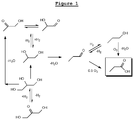
- Figure 1 shows a number of preparation routes starting from C3-oxygenates and resulting in propanoic acid.
- a C3-oxygenate is converted into methacrylic acid via propanoic acid as an intermediate.
- the propanoic acid is reacted with formaldehyde or a precursor of formaldehyde into methacrylic acid.
- a suitable example of a precursor of formaldehyde is methanol.
- the starting material is a C3-oxygenate.
- a C3-oxygenate means a compound which contains 3 carbon atoms and 1, 2 or 3 oxygen atoms. The other atoms in such C3-oxygenate are hydrogen atoms.
- the C3-oxygenate is not propanoic acid, because by C3-oxygenate reference is made herein only to the starting material of the present process.
- C3-oxygenates containing 1 oxygen atom which may suitably be used in the present invention is 1-propanol.
- C3-oxygenates containing 2 oxygen atoms which may suitably be used in the present invention are monopropylene glycol, monohydroxyacetone and 2-hydroxypropanal.
- C3-oxygenates containing 3 oxygen atoms which may suitably be used in the present invention are glycerol, and dihydroxyacetone.
- the C3-oxygenate contains 2 oxygen atoms. More preferably, such C3-oxygenate containing 2 oxygen atoms is monopropylene glycol, monohydroxyacetone or 2-hydroxypropanal, most preferably monopropylene glycol.
- a disadvantage of the route for the production of methacrylic acid from acetone using hydrogen cyanide and sulfuric acid is that said route is accompanied by the undesired production of salts, such as ammonium sulfate, in large amounts.
- a disadvantage of the alternative route for the production of methacrylic acid by oxidation of isobutene is that two oxygen atoms have to be introduced into the isobutene by the use of an oxygen containing gas at high temperature (about 350 °C) and with release of a large amount of heat (about 600 kJ/mol).
- a further disadvantage for both said routes for the production of methacrylic acid is that non-renewable, fossil feedstocks have to be used, such as propene, propane and/or crude oil.
- C3-oxygenates such as for example monopropylene glycol or glycerol, which is formed as undesired (by)products in biomass conversion processes, as discussed above, are valorized by transforming them into a chemical for which the worldwide demand is indeed high, namely methacrylic acid.
- the C3-oxygenates for example monopropylene glycol and glycerol, originate from converting sugar sources, a renewable feedstock, such as sucrose, glucose, xylose or fructose, into such C3-oxygenates, for example by means of hydrogenolysis or hydrocracking of such sugar sources.
- a renewable feedstock such as sucrose, glucose, xylose or fructose
- These sugars may be used alone or in admixture. Further, these sugars may be present in monomeric, dimeric or polymeric form. Suitable polymeric sugars are cellulose, starch, inulin and hemicellulose.
- monoethylene glycol, monopropylene glycol and glycerol may be produced by the hydrogenolysis of one or more of the above-mentioned sugar sources. After separating the monopropylene glycol and glycerol from the monoethylene glycol, the monopropylene glycol and glycerol may advantageously be used as the C3-oxygenate in the present process.
- Such hydrogenolysis of sugar sources may be performed in any way, for example as described in above-mentioned " Hydrogenolysis Goes Bio: From Carbohydrates and Sugar Alcohols to Platform Chemicals" by Agnieszka M. Ruppert et al. in Angew. Chem. Int. Ed., 2012, 51, p. 2564-2601 . Further reference is made to the above-mentioned disclosure of aqueous phase reforming of sugars by N. Li et al. in Journal of Catalysis, 2010, 270, p. 48-59 .
- the propanoic acid may be obtained from the C3-oxygenate in a variety of ways.
- Figure 1 a number of preparation routes starting from C3-oxygenates and resulting in propanoic acid are shown.
- C3-oxygenates which may suitably be used in the present process wherein propanoic acid is an intermediate
- the C3-oxygenate contains 1 or 2 oxygen atoms, such as the C3-oxygenates as shown in Figure 1 (excluding propanoic acid). More preferably, the C3-oxygenate contains 2 oxygen atoms. Most preferably, the C3-oxygenate is monopropylene glycol.
- the C3-oxygenate is a C3-diol, in which case the process comprises:
- Said C3-diol contains 3 carbon atoms and 2 oxygen atoms in the form of 2 hydroxyl groups.
- the other atoms in such C3-diol are hydrogen atoms.
- said C3-diol is preferably monopropylene glycol.
- the designation "-H 2 " refers to dehydrogenation in general. Such dehydrogenation may be either an endothermic dehydrogenation or an exothermic oxidative dehydrogenation wherein oxygen is added and water is released or a hydrogen transfer reaction. Therefore, in Figure 1 , the designation “-H 2 " also covers "+0.5 O 2 /-H 2 O” (i.e. exothermic oxidative dehydrogenation) and hydrogen transfer, according to which H 2 is not released as H 2 or H 2 O but as hydrogenated product such as alcohol (from a ketone) or alkane (from an olefin).
- the designation "+0.5 O 2 " refers to oxidation in general. In some cases such as the oxidation of aldehydes to carboxylic acids, the desired conversion may also be achieved by adding water and release of hydrogen. Therefore, in Figure 1 , the designation "+0.5 O 2 " may also cover “+H 2 O/-H 2 ".
- the oxidation step may use oxidants such as H 2 O 2 , N 2 O, peracids and other known organic and inorganic oxidants as well as electrochemical oxidation.
- Reactions involving hydrogenation of a carbonyl group to a hydroxyl group as mentioned above under (1) may be carried out at a relatively low temperature, for example below 200 °C, and a relatively high hydrogen pressure, for example higher than 10 bar.
- the catalyst may be a supported metal catalyst.
- Reactions involving dehydrogenation of a hydroxyl group to a carbonyl group or dehydrogenation of a carbonyl group to an ⁇ , ⁇ -unsaturated carbonyl group as mentioned above under (2), may be carried out at a relatively high temperature, for example above 200 °C, and a relatively low hydrogen pressure, for example lower than 1 bar.
- the catalyst may be a supported metal catalyst.
- Reactions involving oxidation of an aldehyde group or a primary hydroxyl group to a carboxylic acid group as mentioned above under (3) may be carried out in the liquid phase at a relatively low temperature, for example at or below 200 °C, in the presence of a base and an oxygen containing gas.
- the catalyst may be a supported metal catalyst, wherein the metal may be a noble metal, such as gold.
- it may be carried out in the gas phase at a relatively high temperature, for example of from 250 to 350 °C, in the presence of an oxygen containing gas.
- the catalyst may be a mixed oxide that may be partly reduced under the reaction conditions.
- Reactions involving dehydration of alcohols as mentioned above under (4) may be carried out in the gas phase at a relatively high temperature, for example at or above 150 °C, suitably of from 150 to 400 °C, using a solid acid and/or base catalyst.
- a relatively high temperature for example at or above 150 °C, suitably of from 150 to 400 °C
- the acid/base catalyst may also contain some hydrogenation activity.
- Such hydrogenation reaction may be carried out at a relatively high hydrogen pressure, for example higher than 10 bar.
- Reactions involving hydroxyl-carbonyl isomerisation as mentioned above under (6) may be carried out using any catalyst at a relatively low temperature, for example higher than 100°C, and may even be carried in the absence of a catalyst at an elevated temperature.
Landscapes
- Chemical & Material Sciences (AREA)
- Organic Chemistry (AREA)
- Engineering & Computer Science (AREA)
- Oil, Petroleum & Natural Gas (AREA)
- Chemical Kinetics & Catalysis (AREA)
- Organic Low-Molecular-Weight Compounds And Preparation Thereof (AREA)
Claims (7)
- Verfahren zum Herstellen von Methacrylsäure, umfassend:Umwandeln eines erneuerbaren Ausgangsstoffes in ein C3-Oxygenat, wobei der erneuerbare Ausgangsstoff eine Zuckerquelle ist und wobei das C3-Oxygenat eine Verbindung ist, die aus der Gruppe ausgewählt wurde, die aus 1-Propanol, Monopropylenglycol, Monohydroxyaceton, 2-Hydroxypropanal, Glycerin und Dihydroxyaceton besteht;Umwandeln eines C3-Oxygenats in Propansäure; undReagieren der Propansäure mit Formaldehyd oder einem Vorläufer von Formaldehyd zu Metacrylsäure.
- Verfahren nach Anspruch 1, wobei das C3-Oxygenat aus der Gruppe ausgewählt wurde, die aus 1-Propanol, Monohydroxyaceton, 2-Hydroxypropanal, Glycerin und Dihydroxyaceton besteht.
- Verfahren nach Anspruch 1, wobei das C3-Oxygenat 2 Sauerstoffatome enthält.
- Verfahren nach Anspruch 3, wobei das C3-Oxygenat, das 2 Sauerstoffatome enthält, Monopropylenglycol, Monohydroxyaceton oder 2-Hydroxypropanal ist.
- Verfahren nach Anspruch 4, wobei das C3-Oxygenat Monopropylenglycol ist.
- Verfahren nach einem der Ansprüche 1 bis 5, wobei die Zuckerquelle Saccharose, Glucose, Xylose oder Fructose ist.
- Verfahren nach einem der Ansprüche 1 bis 6, wobei das C3-Oxygenat ein C3-Diol ist, umfassend:Umwandeln des C3-Diols in Propanal;Umwandeln des Propanals in Propansäure; undReagieren der Propansäure mit Formaldehyd zu Metacrylsäure.
Priority Applications (1)
| Application Number | Priority Date | Filing Date | Title |
|---|---|---|---|
| EP14700240.6A EP2943457B1 (de) | 2013-01-08 | 2014-01-08 | Herstellung von methacrylsäure |
Applications Claiming Priority (3)
| Application Number | Priority Date | Filing Date | Title |
|---|---|---|---|
| EP13150521 | 2013-01-08 | ||
| EP14700240.6A EP2943457B1 (de) | 2013-01-08 | 2014-01-08 | Herstellung von methacrylsäure |
| PCT/EP2014/050182 WO2014108416A1 (en) | 2013-01-08 | 2014-01-08 | Production of methacrylic acid |
Publications (2)
| Publication Number | Publication Date |
|---|---|
| EP2943457A1 EP2943457A1 (de) | 2015-11-18 |
| EP2943457B1 true EP2943457B1 (de) | 2018-03-28 |
Family
ID=47458831
Family Applications (1)
| Application Number | Title | Priority Date | Filing Date |
|---|---|---|---|
| EP14700240.6A Not-in-force EP2943457B1 (de) | 2013-01-08 | 2014-01-08 | Herstellung von methacrylsäure |
Country Status (6)
| Country | Link |
|---|---|
| US (1) | US9394222B2 (de) |
| EP (1) | EP2943457B1 (de) |
| CN (1) | CN104903284B (de) |
| BR (1) | BR112015015886A2 (de) |
| CA (1) | CA2892564A1 (de) |
| WO (1) | WO2014108416A1 (de) |
Family Cites Families (4)
| Publication number | Priority date | Publication date | Assignee | Title |
|---|---|---|---|---|
| DE3561456D1 (en) * | 1984-05-21 | 1988-02-25 | Toa Gosei Chem Ind | Process for the production of acrylic acid or methacrylic acid |
| TWI347936B (en) * | 2004-06-14 | 2011-09-01 | Sumitomo Chemical Co | Method of producing 帢,帣-unsaturated carboxylic acid compounds |
| WO2009024549A2 (de) * | 2007-08-21 | 2009-02-26 | Basf Se | Verfahren und vorrichtung zur oxidation organischer verbindungen |
| FR2934264B1 (fr) * | 2008-07-22 | 2012-07-20 | Arkema France | Fabrication d'esters de vinyle a partir de matieres renouvelables, esters de vinyle obtenus et utilisations |
-
2014
- 2014-01-08 CN CN201480004215.9A patent/CN104903284B/zh not_active Expired - Fee Related
- 2014-01-08 WO PCT/EP2014/050182 patent/WO2014108416A1/en not_active Ceased
- 2014-01-08 EP EP14700240.6A patent/EP2943457B1/de not_active Not-in-force
- 2014-01-08 US US14/759,470 patent/US9394222B2/en not_active Expired - Fee Related
- 2014-01-08 CA CA2892564A patent/CA2892564A1/en not_active Abandoned
- 2014-01-08 BR BR112015015886A patent/BR112015015886A2/pt not_active Application Discontinuation
Also Published As
| Publication number | Publication date |
|---|---|
| US9394222B2 (en) | 2016-07-19 |
| CA2892564A1 (en) | 2014-07-17 |
| WO2014108416A1 (en) | 2014-07-17 |
| CN104903284B (zh) | 2018-03-27 |
| CN104903284A (zh) | 2015-09-09 |
| BR112015015886A2 (pt) | 2017-07-11 |
| US20150353462A1 (en) | 2015-12-10 |
| EP2943457A1 (de) | 2015-11-18 |
Similar Documents
| Publication | Publication Date | Title |
|---|---|---|
| EP3154927B1 (de) | Verfahren zur herstellung von muconsäuren und furanen aus aldarsäuren | |
| CN111253200B (zh) | 一种用醇做还原剂的多羟基化合物脱氧脱水制备烯烃的方法 | |
| EP2565175B1 (de) | Katalysatorverfahren zur Herstellung von 1,2-propandiol aus einem Rohglycerolstrom | |
| EP3015446B1 (de) | Verfahren zur herstellung von allylalkohol und dadurch hergestellter allylalkohol | |
| EP2943457B1 (de) | Herstellung von methacrylsäure | |
| EP2943459B1 (de) | Herstellung von acrylsäure | |
| EP2943461B1 (de) | Herstellung von acrylsäure | |
| AU2019253288B2 (en) | Dehydration and cracking of alpha-, beta-dihydroxy carbonyl compounds to lactic acid and other products | |
| CN110357782B (zh) | 一种中长链脂肪醇及其酯的制备方法 | |
| RU2801218C2 (ru) | Дегидратация и расщепление альфа-, бета-дигидроксикарбонильных соединений до молочной кислоты и других продуктов | |
| CA3096386C (en) | Dehydration and cracking of alpha-, beta-dihydroxy carbonyl compounds to lactic acid and other products | |
| CA2892358A1 (en) | Production of acrylic acid |
Legal Events
| Date | Code | Title | Description |
|---|---|---|---|
| PUAI | Public reference made under article 153(3) epc to a published international application that has entered the european phase |
Free format text: ORIGINAL CODE: 0009012 |
|
| 17P | Request for examination filed |
Effective date: 20150605 |
|
| AK | Designated contracting states |
Kind code of ref document: A1 Designated state(s): AL AT BE BG CH CY CZ DE DK EE ES FI FR GB GR HR HU IE IS IT LI LT LU LV MC MK MT NL NO PL PT RO RS SE SI SK SM TR |
|
| AX | Request for extension of the european patent |
Extension state: BA ME |
|
| DAX | Request for extension of the european patent (deleted) | ||
| STAA | Information on the status of an ep patent application or granted ep patent |
Free format text: STATUS: EXAMINATION IS IN PROGRESS |
|
| 17Q | First examination report despatched |
Effective date: 20170320 |
|
| GRAP | Despatch of communication of intention to grant a patent |
Free format text: ORIGINAL CODE: EPIDOSNIGR1 |
|
| STAA | Information on the status of an ep patent application or granted ep patent |
Free format text: STATUS: GRANT OF PATENT IS INTENDED |
|
| INTG | Intention to grant announced |
Effective date: 20171026 |
|
| GRAS | Grant fee paid |
Free format text: ORIGINAL CODE: EPIDOSNIGR3 |
|
| GRAA | (expected) grant |
Free format text: ORIGINAL CODE: 0009210 |
|
| STAA | Information on the status of an ep patent application or granted ep patent |
Free format text: STATUS: THE PATENT HAS BEEN GRANTED |
|
| AK | Designated contracting states |
Kind code of ref document: B1 Designated state(s): AL AT BE BG CH CY CZ DE DK EE ES FI FR GB GR HR HU IE IS IT LI LT LU LV MC MK MT NL NO PL PT RO RS SE SI SK SM TR |
|
| RAP1 | Party data changed (applicant data changed or rights of an application transferred) |
Owner name: SHELL INTERNATIONALE RESEARCH MAATSCHAPPIJ B.V. |
|
| REG | Reference to a national code |
Ref country code: GB Ref legal event code: FG4D |
|
| REG | Reference to a national code |
Ref country code: CH Ref legal event code: EP |
|
| REG | Reference to a national code |
Ref country code: AT Ref legal event code: REF Ref document number: 983273 Country of ref document: AT Kind code of ref document: T Effective date: 20180415 |
|
| REG | Reference to a national code |
Ref country code: IE Ref legal event code: FG4D |
|
| REG | Reference to a national code |
Ref country code: DE Ref legal event code: R096 Ref document number: 602014022920 Country of ref document: DE |
|
| REG | Reference to a national code |
Ref country code: NL Ref legal event code: FP |
|
| PG25 | Lapsed in a contracting state [announced via postgrant information from national office to epo] |
Ref country code: LT Free format text: LAPSE BECAUSE OF FAILURE TO SUBMIT A TRANSLATION OF THE DESCRIPTION OR TO PAY THE FEE WITHIN THE PRESCRIBED TIME-LIMIT Effective date: 20180328 Ref country code: NO Free format text: LAPSE BECAUSE OF FAILURE TO SUBMIT A TRANSLATION OF THE DESCRIPTION OR TO PAY THE FEE WITHIN THE PRESCRIBED TIME-LIMIT Effective date: 20180628 Ref country code: HR Free format text: LAPSE BECAUSE OF FAILURE TO SUBMIT A TRANSLATION OF THE DESCRIPTION OR TO PAY THE FEE WITHIN THE PRESCRIBED TIME-LIMIT Effective date: 20180328 Ref country code: FI Free format text: LAPSE BECAUSE OF FAILURE TO SUBMIT A TRANSLATION OF THE DESCRIPTION OR TO PAY THE FEE WITHIN THE PRESCRIBED TIME-LIMIT Effective date: 20180328 |
|
| REG | Reference to a national code |
Ref country code: LT Ref legal event code: MG4D |
|
| PG25 | Lapsed in a contracting state [announced via postgrant information from national office to epo] |
Ref country code: RS Free format text: LAPSE BECAUSE OF FAILURE TO SUBMIT A TRANSLATION OF THE DESCRIPTION OR TO PAY THE FEE WITHIN THE PRESCRIBED TIME-LIMIT Effective date: 20180328 Ref country code: LV Free format text: LAPSE BECAUSE OF FAILURE TO SUBMIT A TRANSLATION OF THE DESCRIPTION OR TO PAY THE FEE WITHIN THE PRESCRIBED TIME-LIMIT Effective date: 20180328 Ref country code: SE Free format text: LAPSE BECAUSE OF FAILURE TO SUBMIT A TRANSLATION OF THE DESCRIPTION OR TO PAY THE FEE WITHIN THE PRESCRIBED TIME-LIMIT Effective date: 20180328 Ref country code: GR Free format text: LAPSE BECAUSE OF FAILURE TO SUBMIT A TRANSLATION OF THE DESCRIPTION OR TO PAY THE FEE WITHIN THE PRESCRIBED TIME-LIMIT Effective date: 20180629 Ref country code: BG Free format text: LAPSE BECAUSE OF FAILURE TO SUBMIT A TRANSLATION OF THE DESCRIPTION OR TO PAY THE FEE WITHIN THE PRESCRIBED TIME-LIMIT Effective date: 20180628 |
|
| PG25 | Lapsed in a contracting state [announced via postgrant information from national office to epo] |
Ref country code: RO Free format text: LAPSE BECAUSE OF FAILURE TO SUBMIT A TRANSLATION OF THE DESCRIPTION OR TO PAY THE FEE WITHIN THE PRESCRIBED TIME-LIMIT Effective date: 20180328 Ref country code: PL Free format text: LAPSE BECAUSE OF FAILURE TO SUBMIT A TRANSLATION OF THE DESCRIPTION OR TO PAY THE FEE WITHIN THE PRESCRIBED TIME-LIMIT Effective date: 20180328 Ref country code: AL Free format text: LAPSE BECAUSE OF FAILURE TO SUBMIT A TRANSLATION OF THE DESCRIPTION OR TO PAY THE FEE WITHIN THE PRESCRIBED TIME-LIMIT Effective date: 20180328 Ref country code: ES Free format text: LAPSE BECAUSE OF FAILURE TO SUBMIT A TRANSLATION OF THE DESCRIPTION OR TO PAY THE FEE WITHIN THE PRESCRIBED TIME-LIMIT Effective date: 20180328 Ref country code: EE Free format text: LAPSE BECAUSE OF FAILURE TO SUBMIT A TRANSLATION OF THE DESCRIPTION OR TO PAY THE FEE WITHIN THE PRESCRIBED TIME-LIMIT Effective date: 20180328 |
|
| PG25 | Lapsed in a contracting state [announced via postgrant information from national office to epo] |
Ref country code: SM Free format text: LAPSE BECAUSE OF FAILURE TO SUBMIT A TRANSLATION OF THE DESCRIPTION OR TO PAY THE FEE WITHIN THE PRESCRIBED TIME-LIMIT Effective date: 20180328 Ref country code: SK Free format text: LAPSE BECAUSE OF FAILURE TO SUBMIT A TRANSLATION OF THE DESCRIPTION OR TO PAY THE FEE WITHIN THE PRESCRIBED TIME-LIMIT Effective date: 20180328 Ref country code: CZ Free format text: LAPSE BECAUSE OF FAILURE TO SUBMIT A TRANSLATION OF THE DESCRIPTION OR TO PAY THE FEE WITHIN THE PRESCRIBED TIME-LIMIT Effective date: 20180328 |
|
| REG | Reference to a national code |
Ref country code: AT Ref legal event code: MK05 Ref document number: 983273 Country of ref document: AT Kind code of ref document: T Effective date: 20180328 |
|
| PG25 | Lapsed in a contracting state [announced via postgrant information from national office to epo] |
Ref country code: PT Free format text: LAPSE BECAUSE OF FAILURE TO SUBMIT A TRANSLATION OF THE DESCRIPTION OR TO PAY THE FEE WITHIN THE PRESCRIBED TIME-LIMIT Effective date: 20180730 |
|
| REG | Reference to a national code |
Ref country code: DE Ref legal event code: R097 Ref document number: 602014022920 Country of ref document: DE |
|
| PG25 | Lapsed in a contracting state [announced via postgrant information from national office to epo] |
Ref country code: AT Free format text: LAPSE BECAUSE OF FAILURE TO SUBMIT A TRANSLATION OF THE DESCRIPTION OR TO PAY THE FEE WITHIN THE PRESCRIBED TIME-LIMIT Effective date: 20180328 Ref country code: DK Free format text: LAPSE BECAUSE OF FAILURE TO SUBMIT A TRANSLATION OF THE DESCRIPTION OR TO PAY THE FEE WITHIN THE PRESCRIBED TIME-LIMIT Effective date: 20180328 |
|
| PLBE | No opposition filed within time limit |
Free format text: ORIGINAL CODE: 0009261 |
|
| STAA | Information on the status of an ep patent application or granted ep patent |
Free format text: STATUS: NO OPPOSITION FILED WITHIN TIME LIMIT |
|
| PG25 | Lapsed in a contracting state [announced via postgrant information from national office to epo] |
Ref country code: IT Free format text: LAPSE BECAUSE OF FAILURE TO SUBMIT A TRANSLATION OF THE DESCRIPTION OR TO PAY THE FEE WITHIN THE PRESCRIBED TIME-LIMIT Effective date: 20180328 |
|
| 26N | No opposition filed |
Effective date: 20190103 |
|
| PGFP | Annual fee paid to national office [announced via postgrant information from national office to epo] |
Ref country code: NL Payment date: 20190116 Year of fee payment: 6 Ref country code: DE Payment date: 20181228 Year of fee payment: 6 |
|
| PG25 | Lapsed in a contracting state [announced via postgrant information from national office to epo] |
Ref country code: SI Free format text: LAPSE BECAUSE OF FAILURE TO SUBMIT A TRANSLATION OF THE DESCRIPTION OR TO PAY THE FEE WITHIN THE PRESCRIBED TIME-LIMIT Effective date: 20180328 |
|
| PG25 | Lapsed in a contracting state [announced via postgrant information from national office to epo] |
Ref country code: MC Free format text: LAPSE BECAUSE OF FAILURE TO SUBMIT A TRANSLATION OF THE DESCRIPTION OR TO PAY THE FEE WITHIN THE PRESCRIBED TIME-LIMIT Effective date: 20180328 |
|
| REG | Reference to a national code |
Ref country code: CH Ref legal event code: PL |
|
| GBPC | Gb: european patent ceased through non-payment of renewal fee |
Effective date: 20190108 |
|
| PG25 | Lapsed in a contracting state [announced via postgrant information from national office to epo] |
Ref country code: LU Free format text: LAPSE BECAUSE OF NON-PAYMENT OF DUE FEES Effective date: 20190108 |
|
| REG | Reference to a national code |
Ref country code: BE Ref legal event code: MM Effective date: 20190131 |
|
| REG | Reference to a national code |
Ref country code: IE Ref legal event code: MM4A |
|
| PG25 | Lapsed in a contracting state [announced via postgrant information from national office to epo] |
Ref country code: FR Free format text: LAPSE BECAUSE OF NON-PAYMENT OF DUE FEES Effective date: 20190131 |
|
| PG25 | Lapsed in a contracting state [announced via postgrant information from national office to epo] |
Ref country code: BE Free format text: LAPSE BECAUSE OF NON-PAYMENT OF DUE FEES Effective date: 20190131 |
|
| PG25 | Lapsed in a contracting state [announced via postgrant information from national office to epo] |
Ref country code: CH Free format text: LAPSE BECAUSE OF NON-PAYMENT OF DUE FEES Effective date: 20190131 Ref country code: LI Free format text: LAPSE BECAUSE OF NON-PAYMENT OF DUE FEES Effective date: 20190131 Ref country code: GB Free format text: LAPSE BECAUSE OF NON-PAYMENT OF DUE FEES Effective date: 20190108 |
|
| PG25 | Lapsed in a contracting state [announced via postgrant information from national office to epo] |
Ref country code: IE Free format text: LAPSE BECAUSE OF NON-PAYMENT OF DUE FEES Effective date: 20190108 |
|
| PG25 | Lapsed in a contracting state [announced via postgrant information from national office to epo] |
Ref country code: TR Free format text: LAPSE BECAUSE OF FAILURE TO SUBMIT A TRANSLATION OF THE DESCRIPTION OR TO PAY THE FEE WITHIN THE PRESCRIBED TIME-LIMIT Effective date: 20180328 |
|
| PG25 | Lapsed in a contracting state [announced via postgrant information from national office to epo] |
Ref country code: MT Free format text: LAPSE BECAUSE OF NON-PAYMENT OF DUE FEES Effective date: 20190108 |
|
| REG | Reference to a national code |
Ref country code: DE Ref legal event code: R119 Ref document number: 602014022920 Country of ref document: DE |
|
| REG | Reference to a national code |
Ref country code: NL Ref legal event code: MM Effective date: 20200201 |
|
| PG25 | Lapsed in a contracting state [announced via postgrant information from national office to epo] |
Ref country code: NL Free format text: LAPSE BECAUSE OF NON-PAYMENT OF DUE FEES Effective date: 20200201 Ref country code: DE Free format text: LAPSE BECAUSE OF NON-PAYMENT OF DUE FEES Effective date: 20200801 |
|
| PG25 | Lapsed in a contracting state [announced via postgrant information from national office to epo] |
Ref country code: CY Free format text: LAPSE BECAUSE OF FAILURE TO SUBMIT A TRANSLATION OF THE DESCRIPTION OR TO PAY THE FEE WITHIN THE PRESCRIBED TIME-LIMIT Effective date: 20180328 |
|
| PG25 | Lapsed in a contracting state [announced via postgrant information from national office to epo] |
Ref country code: IS Free format text: LAPSE BECAUSE OF FAILURE TO SUBMIT A TRANSLATION OF THE DESCRIPTION OR TO PAY THE FEE WITHIN THE PRESCRIBED TIME-LIMIT Effective date: 20180728 |
|
| PG25 | Lapsed in a contracting state [announced via postgrant information from national office to epo] |
Ref country code: HU Free format text: LAPSE BECAUSE OF FAILURE TO SUBMIT A TRANSLATION OF THE DESCRIPTION OR TO PAY THE FEE WITHIN THE PRESCRIBED TIME-LIMIT; INVALID AB INITIO Effective date: 20140108 |
|
| PG25 | Lapsed in a contracting state [announced via postgrant information from national office to epo] |
Ref country code: MK Free format text: LAPSE BECAUSE OF FAILURE TO SUBMIT A TRANSLATION OF THE DESCRIPTION OR TO PAY THE FEE WITHIN THE PRESCRIBED TIME-LIMIT Effective date: 20180328 |