EP2943598B1 - Verfahren zur herstellung eines al-tic-nanokompositmaterials - Google Patents
Verfahren zur herstellung eines al-tic-nanokompositmaterials Download PDFInfo
- Publication number
- EP2943598B1 EP2943598B1 EP14700190.3A EP14700190A EP2943598B1 EP 2943598 B1 EP2943598 B1 EP 2943598B1 EP 14700190 A EP14700190 A EP 14700190A EP 2943598 B1 EP2943598 B1 EP 2943598B1
- Authority
- EP
- European Patent Office
- Prior art keywords
- tic
- process according
- duration
- grinding
- enclosure
- Prior art date
- Legal status (The legal status is an assumption and is not a legal conclusion. Google has not performed a legal analysis and makes no representation as to the accuracy of the status listed.)
- Not-in-force
Links
Images

Classifications
-
- C—CHEMISTRY; METALLURGY
- C04—CEMENTS; CONCRETE; ARTIFICIAL STONE; CERAMICS; REFRACTORIES
- C04B—LIME, MAGNESIA; SLAG; CEMENTS; COMPOSITIONS THEREOF, e.g. MORTARS, CONCRETE OR LIKE BUILDING MATERIALS; ARTIFICIAL STONE; CERAMICS; REFRACTORIES; TREATMENT OF NATURAL STONE
- C04B14/00—Use of inorganic materials as fillers, e.g. pigments, for mortars, concrete or artificial stone; Treatment of inorganic materials specially adapted to enhance their filling properties in mortars, concrete or artificial stone
- C04B14/02—Granular materials, e.g. microballoons
- C04B14/32—Carbides; Nitrides; Borides ; Silicides
- C04B14/322—Carbides
-
- C—CHEMISTRY; METALLURGY
- C22—METALLURGY; FERROUS OR NON-FERROUS ALLOYS; TREATMENT OF ALLOYS OR NON-FERROUS METALS
- C22C—ALLOYS
- C22C32/00—Non-ferrous alloys containing at least 5% by weight but less than 50% by weight of oxides, carbides, borides, nitrides, silicides or other metal compounds, e.g. oxynitrides, sulfides, whether added as such or formed in situ
- C22C32/0047—Non-ferrous alloys containing at least 5% by weight but less than 50% by weight of oxides, carbides, borides, nitrides, silicides or other metal compounds, e.g. oxynitrides, sulfides, whether added as such or formed in situ with carbides, nitrides, borides or silicides as the main non-metallic constituents
- C22C32/0052—Non-ferrous alloys containing at least 5% by weight but less than 50% by weight of oxides, carbides, borides, nitrides, silicides or other metal compounds, e.g. oxynitrides, sulfides, whether added as such or formed in situ with carbides, nitrides, borides or silicides as the main non-metallic constituents only carbides
-
- C—CHEMISTRY; METALLURGY
- C22—METALLURGY; FERROUS OR NON-FERROUS ALLOYS; TREATMENT OF ALLOYS OR NON-FERROUS METALS
- C22C—ALLOYS
- C22C1/00—Making non-ferrous alloys
- C22C1/04—Making non-ferrous alloys by powder metallurgy
- C22C1/05—Mixtures of metal powder with non-metallic powder
- C22C1/051—Making hard metals based on borides, carbides, nitrides, oxides or silicides; Preparation of the powder mixture used as the starting material therefor
- C22C1/053—Making hard metals based on borides, carbides, nitrides, oxides or silicides; Preparation of the powder mixture used as the starting material therefor with in situ formation of hard compounds
- C22C1/055—Making hard metals based on borides, carbides, nitrides, oxides or silicides; Preparation of the powder mixture used as the starting material therefor with in situ formation of hard compounds using carbon
Definitions
- the present invention relates to a process for producing an Al / TiC nanocomposite material, namely a material comprising an aluminum matrix in which nanoscale TiC reinforcements are dispersed.
- This process can notably be applied in the fields of aeronautics and the automobile.
- CMM metal matrix materials
- metal matrix materials which comprise a metal matrix (metal or metal alloy) in which are incorporated reinforcements (particles, fibers or other) metal or ceramic
- CMM metal matrix materials
- the advantage of CMM compared to light alloys (based on aluminum, magnesium or titanium) is that they have ratios E / p (elastic modulus / density) and ⁇ / ⁇ (limit of elasticity / density) very high.
- Al / TiC composites which are aluminum alloys reinforced with titanium carbide particles, are particularly valuable materials because they combine ductility, electrical and thermal conductivity of the aluminum matrix, with the mechanical strength, rigidity and hardness of titanium carbide. This combination of properties makes the Al / TiC composites particularly attractive for use in the automotive or aerospace industries, because besides their mechanical properties, they also allow an interesting saving of weight.
- Al / TiC composites are also of great interest because of the good thermochemical stability of titanium carbide, which makes it possible to manufacture in situ these composites by solidification methods since the liquid state from the three constituent elements Al , Ti, C.
- the realization of Al / TiC composites is not so simple.
- the CMM materials which are obtained by solidification (mixing, infiltration %) or by diffusion welding have constraints of elaboration (problems of wettability of the reinforcements by the molten metal, difficulties of obtaining a homogeneous distribution reinforcements, appearance of parasitic reactions at the reinforcing / molten metal interface), which has the effect of deteriorating the mechanical properties of the CMM materials thus produced.
- Nukami and Flemings describe in document [1] the in situ synthesis of aluminum matrix composites reinforced with TiC particles by solidification. More particularly, the composite is obtained by infiltrating an Al-Ti-C preform, obtained by compacting powders of Al, Ti, C, with molten aluminum.
- the Al / TiC composite can therefore be prepared in different ways according to different reaction paths, which has the consequence that it is difficult to control the chemical composition and the microstructure of the composite thus obtained.
- Another way of proceeding to obtain an Al / TiC composite consists in grinding the three basic constituent elements, Al, Ti, C.
- the main advantage of this solution is that it makes it possible to control the composition of the composite, but the disadvantage
- the major problem is that, starting from more or less ductile compounds, there is a risk, in addition to the bonding of the powders, of generating inhomogeneities of composition within the composite obtained.
- the inventors have set themselves the objective of setting up a method of manufacturing a NCMM Al / TiC material with a very fine dispersion of titanium carbide, which not only makes it possible to reinforce the aluminum matrix, but also to guarantee a very low surface roughness.
- nanocomposite means a composite having at least two phases and at least one of these phases has at least one of its dimensions which is nanometric. In this case, it is the reinforcements (the TiC particles) which have a nanometric size.
- the term "size”, applied to particles or crystallites, denotes the largest dimension of these grains or these crystallites.
- nanometric means greater than or equal to 1 nm and less than or equal to 100 nanometers.
- micrometric means greater than or equal to 1 micrometer and less than 1000 micrometers.
- particles designates elements whose ratio of the largest dimension to the smallest dimension is less than or equal to 2.
- the particles may therefore be spherical or quasi-spherical, cubic or quasi-cubic, rhombohedral or quasi-rhombohedral ...
- the method which is the subject of the invention according to claim 1 is based on the combination of two complementary techniques which do not require any nano-sized raw material for producing a nanocomposite material comprising an aluminum matrix reinforced with titanium carbide particles. (TiC) of nanometric size.
- the first technique is a mechano-synthesis (also known as mechanical grinding with high energy or "mechanical alloying" in English) whose role is twofold: it is, on the one hand, homogenize to the the finest possible scale, the precursors, Al 3 Ti and C, in order to promote the complete formation of the Al / TiC composite by a subsequent heat treatment (reactive sintering) and, on the other hand, to minimize the amount of TiC formed in During grinding, the presence of TiC grains, very hard and very abrasive, resulting in an inevitable contamination of the powder by elements from the grinding device (for example, tearing of steel particles from the grinding chamber).
- the technique of mechano-synthesis consists in grinding, in a device of the grinder or attritor type, powders of micrometric size or greater than a compound A (here, graphite) and a compound B (1). titanium aluminide Al 3 Ti) for a sufficient time (often several hours) to try to obtain an intimately mixed powder having a phase A and a phase B.
- a compound A here, graphite
- a compound B titanium aluminide Al 3 Ti
- a second mixture of powders is thus obtained, all or part of the particles of which are formed of a graphite phase and a phase of Al 3 Ti graphite aluminide (there is coexistence of these two phases within the same particle).
- these two phases are intimately mixed and the distribution of these two phases is homogeneous at the finest possible scale.
- the second technique is a reactive sintering which aims, on the one hand, to form the desired composite material and, on the other hand, to densify the material obtained as much as possible.
- the mechano-synthesis can be carried out according to particular conditions.
- the mechanosynthesis can be carried out for a period of between 24 and 48 hours and this duration is preferably equal to 36 hours.
- the mechano-synthesis can be carried out in a chamber of a grinding device, said enclosure not being cooled during the mechano-synthesis. In fact, during grinding, the repeated shocks between the particles between them or against the wall of the enclosure produce heat. If the enclosure is not cooled, the mechanosynthesis is performed at a temperature above room temperature and can for example reach a temperature of 80 ° C.
- the mechano-synthesis can be carried out in a chamber of a grinding device, this chamber being provided with a rotor which, during the mechano-synthesis, performs successive milling and deagglomeration cycles, the rotating rotor, at each cycle, at a first speed during a first duration during the grinding phase of said cycle and at a second speed during a second speed during the disagglomeration phase of said cycle, the first speed being at least 200 rpm; min faster than the second gear and the first gear being at least twice as long as the second gear.
- the first speed can be between 1400 and 800 rpm and the second speed between 1000 and 400 rpm.
- the first duration can be between 1 and 5 minutes and the second duration between 20 seconds and 3 minutes.
- the mechanosynthesis can be carried out in an enclosure of a grinding device, said enclosure being filled between 15 and 30% of its volume, preferably 25%.
- the ratio of the volume of the first mixture of powders to the volume of the grinding balls is preferably between 5 and 12%.
- the second mixture of powders comprises at most 35% by weight of TiC.
- the c) compression step of the second mixture it may for example be a pelletizing to obtain one or more pellets.
- the compression of the second mixture may include placing the second mixture in a mold of suitable shape to form one or more tablets and applying uniaxial pressing or cold isostatic pressing to the contents. said mold.
- step d) of sintering it can be carried out at a temperature of between 900 ° C. and 1400 ° C.
- the sintering time is understood as the time from the time when the sintering temperature is reached.
- the sintering temperature can be attained by heating the tablet (s) at a rate between 100 ° C / min and 400 ° C / min. This heating rate is preferably at least 300 ° C / min. A fast heating rate makes it possible to limit the magnification of the grains (crystallites), while preserving the densification of the material. It is specified that the cooling rate is preferably identical or substantially identical (plus or minus 5%) to the heating rate.
- the sintering is carried out at a temperature of 1000 ° C and for a time of between 1 and 5 minutes, the sintering temperature being reached by heating the compressed (s) at a speed of 300 ° C / min.
- the method according to the invention further comprises, after step b) and before step c), a sieving step of the second mixture of powders, to select particles having a size of between 50 and 200 micrometers .
- the process according to the invention makes it possible to obtain nanocomposites having an elongation at break close to 7%, which is much better than that obtained by the nanocomposites of the prior art obtained by introducing a dispersed phase of micron-sized carbide into the aluminum, which are struggling to achieve the low value of elongation at break required for the use of CMM, which is 3%.
- the process according to the invention has the advantage of not using nanometric powders during the manufacture of the NCMM, which is a major advantage vis-à-vis the drastic constraints of use of nanometric materials in industry (dissemination, pyrophoricity ).
- the starting materials are of micrometer size or larger (preferably of micron size, but greater than 100 microns). Nanostructuring occurs in situ during the final heat treatment, eliminating any risk associated with the use of nanoscale particles.
- the method according to the invention makes it possible to obtain a dense composite material with a low surface roughness, which combines lightness and good thermomechanical properties and which has improved shaping (machining in particular).
- a dense composite material with a low surface roughness, which combines lightness and good thermomechanical properties and which has improved shaping (machining in particular).
- Such a material can be used in the aeronautics and in the automobile, for example for the production of pistons of combustion engines.
- the nanocomposite material is obtained according to the following reaction: Al 3 Ti (s) + C (s) ⁇ TiC (s) + 3 Al (1)
- reaction (4) corresponds to reaction (5) as mentioned by Nukami and Flemings in [1].
- reaction (4) as mentioned in this document also allows, in theory, to achieve an Al / TiC composite.
- thermodynamic calculations show that the reaction (4) is easily done at 777 ° C (1050K), while the reaction (5) is possible whatever the temperature.
- reaction (5) grinding is used, in the context of the present invention, to mix at the finest scale possible different constituents and minimize contamination by grinding tools.
- Reaction (5) really begins only during the reactive sintering heat treatment and leads to the formation of the Al / TiC composite. Since the Al 3 Ti and C phases have been homogeneously dispersed during grinding, the reactive sintering makes it possible to obtain an Al / TiC nanocomposite having reinforcements of TiC of nanometric sizes.
- Two of the five parameters involve the amount of powder introduced into the mill. This is the filling rate of the grinding chamber (enclosure) and the ratio between the volumes of powder and balls introduced.
- Two other parameters are related to the grinding cycle: the durations of the bearings at the two different speeds at which the rotor turns during grinding, a first speed during the grinding phase and a second speed, lower than the first speed, during the disagglomeration phase . These speeds are arbitrarily chosen equal to 1200 and 800 tr.min -1.
- the factorial design plan consists in making all the possible combinations between the various factors considered.
- the experimental design thus makes it possible to measure the effects of all the factors as well as taking into account the interactions between these factors.
- the two values we chose to test are 15 and 25%. The lowest value corresponds to the filling rate recommended by the mill manufacturer during grinding operations carried out in a similar mill equipped with a 2-liter enclosure.
- the two values we chose to test correspond to a volume of powder used of 5 and 12% of the volume of beads used.
- the value recommended by the manufacturer (%) serves as a reference.
- the grinding is carried out according to n cycles, each cycle comprising a grinding phase, carried out at a first speed, and a deagglomeration phase, carried out at another speed, slower than the first speed.
- the durations of each phase of the n cycles have been defined arbitrarily equal to two or four minutes for the high speed and thirty seconds or two minutes for the low speed, which is supposed to be used mainly to "break" the grinding cycle (fracturing, welding ) and thus promote the disagglomeration of the particles.
- the grinding temperature is not, strictly speaking, the parameter considered since the mill is not equipped with any regulation system. However, it is provided with a cooling system of the enclosure by circulating water between the two walls of the enclosure. Thanks to the circulation of water, the temperature equilibrates at about 25 ° C.
- a temperature control device for example a device of the Eurotherm type, makes it possible to heat the enclosure up to 80 ° C. We therefore chose to test the grinding at 25 ° C and 80 ° C.
- graphite as a carbon source for TiC synthesis.
- solid graphite lubricant due to its structure in sheets, to limit the sticking of the metal powder to the walls of the enclosure during grinding.
- the graphite powder In order to avoid oxygen contamination, it is preferable to subject the graphite powder to a heat treatment of degassing at high temperature before introducing it into the grinding chamber.
- Al 3 Ti With regard to Al 3 Ti, the choice of this intermetallic is justified by its fragile nature, which allows it to be more easily mixed with the graphite during grinding and to minimize contamination. The choice of Al 3 Ti is also justified by the fact that this intermetallic is, as can be seen on the Al-Ti equilibrium diagram ( figure 1 ), the richest intermetallic compound in aluminum.
- the compound Al 3 Ti can crystallize in three crystallographic phases: D0 22 , D0 23 and L1 2 .
- V P / V B 12%, rather than a ratio equal to 5%, and a filling ratio of 25% rather than 15%.
- the crusher chamber that we use has a volume of 0.5L, the mass of powders introduced into the grinding chamber is 63g, while the mass of beads is 1261.7g.
- the temperature of the chamber is maintained at 80 ° C throughout the duration of grinding.
- the mechanosynthesis or high energy grinding must be carried out for a time sufficient to obtain an intimately mixed powder having a phase Al 3 Ti and a phase C.
- the time required for grinding is several hours.
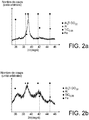
- composition of these two powders was analyzed by the technique of X-ray diffraction (X-ray diffractometry or XRD technique, this technique allowing us to determine the nature of the crystallized phases).
- the ground powder for 36 hours is preferably sieved to select the powder having a particle size between 50 and 200 ⁇ m.
- the powder, milled for 36 hours, optionally sieved, is then compacted in the form of pellets.
- a simple uniaxial compacting (2 GPa) or cold isostatic pressing (CIF) of the ground powder, which is degassed beforehand, can be carried out. This degassing makes it possible to avoid the formation of porosities during compaction.
- pellets 8 mm in diameter having a relative density of about 80% are obtained.
- the sintering temperature must allow both the complete formation of titanium carbide and the densification of Al / TiC.
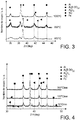
- this sintering temperature is between 2/3 and% of the melting temperature of the majority compound in a mixture. In the present case, this melting temperature is about 1370 ° C. Three sintering temperatures were therefore tested with a dilatometer on the pellets of the ground powder 36 hours: 900 ° C, 950 ° C and 1000 ° C.
- the heating rate is 100 ° C./min and the sample is maintained for 15 minutes in steps and then cooled to 100 ° C./min.
- X-ray diffractometry XRD is then used to analyze the phases present in the sintered material ( figure 3 ).
- Ti-O-C oxy-carbide phase
- the behavior of the milled and compacted powder will be different depending on the heating rate used and reveals various phenomena that are not without consequences on the final microstructure of the sintered material.
- the large magnification of the grains of phase D0 23 to 400 ° C is also a major event that must be taken into account since it results in a loss of the nanostructure of the powder and involves a limited subsequent reactivity of the aluminide with the graphite.
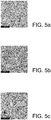
- the Figures 5a to 5c show the evolution of the microstructure during the annealing time.
- the "ideal" heat treatment among the values tested would therefore be annealing with a temperature rise rate of 300 ° C./min at 1000 ° C. for 1 minute.
- a material comprising nanometric particles of titanium carbide coated in an aluminum matrix.
- the typical microstructure consists mainly of micrometer-sized domains of aluminum rich in nanoscale particles of TiC, coexisting with domains depleted of TiC; all these areas being separated by pure aluminum nets.
- the density of the sintered material is 3.07, which corresponds to about 91% of the theoretical density.
Landscapes
- Chemical & Material Sciences (AREA)
- Engineering & Computer Science (AREA)
- Materials Engineering (AREA)
- Organic Chemistry (AREA)
- Mechanical Engineering (AREA)
- Metallurgy (AREA)
- Ceramic Engineering (AREA)
- Civil Engineering (AREA)
- Structural Engineering (AREA)
- Powder Metallurgy (AREA)
- Chemical Kinetics & Catalysis (AREA)
Claims (14)
- Verfahren zur Herstellung eines AI/TiC Nanokomposit-Materials, umfassend eine Matrix aus Aluminium, in der TiC-enthaltende Teilchen dispergiert sind, welche eine Größe im Nanobereich aufweisen, wobei das Verfahren die folgenden Schritte umfasst:a) die Herstellung einer ersten Pulvermischung durch Inkontaktbringen eines Graphitpulvers und eines Titanaluminidpulvers der Formel Al3Ti, wobei die zwei Pulver Partikel in Mikrometergröße oder größer aufweisen;b) die Herstellung einer zweiten Pulvermischung durch Mechanosynthese der ersten Pulvermischung, wobei die zweite Pulvermischung vollständig oder teilweise gebildet wird aus Partikeln, welche gleichzeitig Titanaluminid und Graphit enthalten;c) Kompression der beiden Pulvermischungen, um ein oder mehrere Presslinge zu erhalten;d) Reaktionssintern des oder der Presslinge, wodurch man das AI/TiC Nanokomposit-Material erhält.
- Verfahren nach Anspruch 1, worin die Mechanosynthese über einen Zeitraum von 24-48 Stunden, vorzugsweise 36 Stunden durchgeführt wird.
- Verfahren nach Anspruch 1 oder 2, worin Mechanosynthese in einer Kammer einer Zerkleinerungsvorrichtung durchgeführt wird, wobei die Kammer während der Mechanosynthese nicht gekühlt wird.
- Verfahren nach einem der Ansprüche 1 bis 3, worin die Mechanosynthese in einer Kammer einer Zerkleinerungsvorrichtung durchgeführt wird, wobei die Kammer mit einem Rotor ausgestattet ist, der während der mechanischen Synthese Zerkleinerungs- und Desagglomerationszyklen sukzessiv ausführt, wobei der Rotor in jedem Zyklus mit einer ersten Geschwindigkeit während einer ersten Dauer der Zerkleinerungsphase des genannten Zyklus, und bei einer zweiten Geschwindigkeit während einer zweiten Dauer der Phase der Desagglomeration des genannten Zyklus rotiert, wobei die erste Geschwindigkeit mindestens 200 Umdrehungen pro Minute schneller als die zweite Geschwindigkeit ist und die erste Dauer mindestens zweimal solange wie die zweite Dauer beträgt.
- Verfahren nach Anspruch 4, worin die erste Geschwindigkeit zwischen 1400 und 800 Umdrehungen pro Minute und die zweite Geschwindigkeit zwischen 1000 und 400 Umdrehungen pro Minute beträgt.
- Verfahren nach Anspruch 4 oder 5, worin die erste Dauer zwischen 1 und 5 Minuten und die zweite Dauer zwischen 20 Sekunden und 3 Minuten beträgt.
- Verfahren nach einem der Ansprüche 1 bis 4, worin die Mechanosynthese in einer Kammer einer Zerkleinerungsvorrichtung durchgeführt wird, wobei die Kammer zu 15 bis 30% ihres Volumens gefüllt ist.
- Verfahren nach Anspruch 7, worin die Kammer Mahlperlen enthält und das Verhältnis des Volumens der ersten Pulvermischung zum Volumen der Mahlperlen zwischen 5 und 12% beträgt.
- Verfahren nach einem der vorhergehenden Ansprüche, worin die zweite Pulvermischung höchstens 35 Gew.% TiC umfasst.
- Verfahren nach Anspruch 1, worin das Sintern bei einer Temperatur zwischen 900 und 1400°C erfolgt.
- Verfahren nach Anspruch 10, worin das Sintern über einen Zeitraum von 1 bis 15 Minuten erfolgt.
- Verfahren nach Anspruch 10 oder 11, worin die Sintertemperatur durch Aufheizen des oder der Presslinge mit einer Geschwindigkeit von 100°C/min bis 400°C/min eingestellt wird.
- Verfahren nach Anspruch 1, worin das Sintern bei einer Temperatur von 1000°C und für eine Dauer von 1 bis 5 Minuten durchgeführt wird, wobei die Sintertemperatur eingestellt wird durch Aufheizen des oder der Presslinge mit einer Geschwindigkeit von 300°C/min.
- Verfahren nach Anspruch 1, umfassend zudem nach Schritt b) und vor Schritt c), einen Siebschritt der zweiten Pulvermischung, um Partikel auszuwählen, welche eine Größe von 50 bis 200 Mikrometer aufweisen.
Applications Claiming Priority (2)
| Application Number | Priority Date | Filing Date | Title |
|---|---|---|---|
| FR1350249A FR3000968B1 (fr) | 2013-01-11 | 2013-01-11 | Procede d'elaboration d'un materiau nanocomposite al/tic |
| PCT/EP2014/050322 WO2014108470A1 (fr) | 2013-01-11 | 2014-01-09 | PROCÉDÉ D'ÉLABORATION D'UN MATÉRIAU NANOCOMPOSITE Al/TiC |
Publications (2)
| Publication Number | Publication Date |
|---|---|
| EP2943598A1 EP2943598A1 (de) | 2015-11-18 |
| EP2943598B1 true EP2943598B1 (de) | 2017-06-21 |
Family
ID=48139976
Family Applications (1)
| Application Number | Title | Priority Date | Filing Date |
|---|---|---|---|
| EP14700190.3A Not-in-force EP2943598B1 (de) | 2013-01-11 | 2014-01-09 | Verfahren zur herstellung eines al-tic-nanokompositmaterials |
Country Status (5)
| Country | Link |
|---|---|
| US (1) | US9650295B2 (de) |
| EP (1) | EP2943598B1 (de) |
| JP (1) | JP6342916B2 (de) |
| FR (1) | FR3000968B1 (de) |
| WO (1) | WO2014108470A1 (de) |
Families Citing this family (5)
| Publication number | Priority date | Publication date | Assignee | Title |
|---|---|---|---|---|
| RU2664747C1 (ru) * | 2017-06-23 | 2018-08-22 | Федеральное государственное автономное образовательное учреждение высшего образования "Национальный исследовательский технологический университет "МИСиС" | Композиционный материал с прочной металлической матрицей и упрочняющими частицами карбида титана и способ его изготовления |
| CN109967749B (zh) * | 2018-11-28 | 2022-03-29 | 陕西理工大学 | 一种制动盘用先进金属基复合材料的制备方法 |
| CN109513943A (zh) * | 2019-01-07 | 2019-03-26 | 华南理工大学 | 一种经纳米陶瓷颗粒修饰的3d打印铝合金粉末及制备方法 |
| CN113073226B (zh) * | 2021-03-24 | 2022-04-22 | 国网河北能源技术服务有限公司 | 一种Cu-TiC电接触复合材料及其制备方法 |
| CN113174518A (zh) * | 2021-04-20 | 2021-07-27 | 苏州阿罗米科技有限公司 | 一种单壁碳纳米管协同增强铝基复合材料及其制备方法 |
Family Cites Families (11)
| Publication number | Priority date | Publication date | Assignee | Title |
|---|---|---|---|---|
| US4515746A (en) * | 1983-09-06 | 1985-05-07 | General Electric Company | Microcomposite of metal carbide and ceramic particles |
| US4539141A (en) * | 1983-09-06 | 1985-09-03 | General Electric Company | Microcomposite of metal carbide and ceramic particles |
| CA1289748C (en) * | 1985-03-01 | 1991-10-01 | Abinash Banerji | Producing titanium carbide |
| USRE34262E (en) * | 1988-05-06 | 1993-05-25 | Inco Alloys International, Inc. | High modulus Al alloys |
| US5114505A (en) * | 1989-11-06 | 1992-05-19 | Inco Alloys International, Inc. | Aluminum-base composite alloy |
| US5169461A (en) * | 1990-11-19 | 1992-12-08 | Inco Alloys International, Inc. | High temperature aluminum-base alloy |
| US5171381A (en) * | 1991-02-28 | 1992-12-15 | Inco Alloys International, Inc. | Intermediate temperature aluminum-base alloy |
| US6344271B1 (en) * | 1998-11-06 | 2002-02-05 | Nanoenergy Corporation | Materials and products using nanostructured non-stoichiometric substances |
| AU2007215394B2 (en) * | 2006-02-17 | 2013-06-27 | Gravitas Technologies Pty Ltd | Crystalline ternary ceramic precursors |
| US20090041609A1 (en) * | 2007-08-07 | 2009-02-12 | Duz Volodymyr A | High-strength discontinuously-reinforced titanium matrix composites and method for manufacturing the same |
| FR2978776B1 (fr) | 2011-08-04 | 2013-09-27 | Commissariat Energie Atomique | Procede de fabrication ameliore d'une piece a geometrie tubulaire en materiau composite a matrice ceramique |
-
2013
- 2013-01-11 FR FR1350249A patent/FR3000968B1/fr not_active Expired - Fee Related
-
2014
- 2014-01-09 US US14/760,391 patent/US9650295B2/en not_active Expired - Fee Related
- 2014-01-09 EP EP14700190.3A patent/EP2943598B1/de not_active Not-in-force
- 2014-01-09 WO PCT/EP2014/050322 patent/WO2014108470A1/fr not_active Ceased
- 2014-01-09 JP JP2015552047A patent/JP6342916B2/ja not_active Expired - Fee Related
Also Published As
| Publication number | Publication date |
|---|---|
| JP2016509627A (ja) | 2016-03-31 |
| US20150353424A1 (en) | 2015-12-10 |
| WO2014108470A1 (fr) | 2014-07-17 |
| JP6342916B2 (ja) | 2018-06-13 |
| FR3000968A1 (fr) | 2014-07-18 |
| US9650295B2 (en) | 2017-05-16 |
| EP2943598A1 (de) | 2015-11-18 |
| FR3000968B1 (fr) | 2015-07-03 |
Similar Documents
| Publication | Publication Date | Title |
|---|---|---|
| Chen et al. | In situ TiC/Inconel 625 nanocomposites fabricated by selective laser melting: Densification behavior, microstructure evolution, and wear properties | |
| Zhang et al. | Effect of NiCoFeAlTi high entropy intermetallic reinforcement particle size on the microstructure and mechanical properties of CoCrFeMnNi high-entropy alloy composites fabricated by selective laser melting | |
| EP2826045B1 (de) | Verfahren zur herstellung eines magnetokalorischen bauteils | |
| Parvin et al. | Preparation and mechanical properties of SiC-reinforced Al6061 composite by mechanical alloying | |
| EP2943598B1 (de) | Verfahren zur herstellung eines al-tic-nanokompositmaterials | |
| US8562714B2 (en) | Article having a dispersion of ultrafine titanium boride particles in a titanium-base matrix | |
| FR2933972A1 (fr) | Procede de preparation d'une piece en carbure de silicium ne necessitant pas l'usage d'ajouts de frittage | |
| EP3747573A1 (de) | Verfahren zur additiven fertigung eines werkstücks aus einer cca-nitrid-legierung | |
| FR3096990A1 (fr) | Alliage CCA nitruré à durcissement structural | |
| FR2991207A1 (fr) | Procede de fabrication d'un materiau thermoelectrique | |
| FR3096988A1 (fr) | Procédé de fabrication par frittage d’une pièce en un alliage CCA nitruré | |
| FR2985521A1 (fr) | Procede d'obtention d'un alliage cuivreux presentant un tres haut niveau de caracteristiques mecaniques | |
| FR2977251A1 (fr) | Procede de fabrication de pieces colorees en ceramique par pim | |
| WO2025046198A1 (fr) | Procédé de fabrication d'un aimant hautement coercitif | |
| JP7266269B2 (ja) | Mg基焼結複合材とその製造方法および摺動部材 | |
| Chen et al. | Annealing induced shrinkage-fill effect of tungsten‑potassium alloys with trace titanium doping | |
| EP3325681B1 (de) | Verfahren zur herstellung eines al/alb48c2 verbunds. | |
| Cintas Físico et al. | Influence of PCA content on mechanical properties of sintered MA aluminium | |
| FR2795430A1 (fr) | Materiau tungstene a haute densite fritte a basse temperature | |
| FR3152634A1 (fr) | Procédé de fabrication d’un aimant hautement texturé | |
| FR2899574A1 (fr) | Fabrication de materiaux denses, en carbures de metaux de transition. | |
| EP2847261B1 (de) | Mit polyolefin und actinidpulver gefüllte zusammensetzung | |
| Ye | B (4) C reinforced nanocrystalline aluminum composites: Synthesis, mechanical behavior and cost analysis | |
| EP4313446A1 (de) | Verfahren zur herstellung von metallteilen und metallteilen, die durch sps-sintern erhalten werden | |
| Naeem | The Effects of Nickel Additions on Microstructural and Hardness of Ball Milled of Al-6wt% Zn-3wt% Mg-2wt% Cu Alloys Underwent the Artificial Aging |
Legal Events
| Date | Code | Title | Description |
|---|---|---|---|
| PUAI | Public reference made under article 153(3) epc to a published international application that has entered the european phase |
Free format text: ORIGINAL CODE: 0009012 |
|
| 17P | Request for examination filed |
Effective date: 20150721 |
|
| AK | Designated contracting states |
Kind code of ref document: A1 Designated state(s): AL AT BE BG CH CY CZ DE DK EE ES FI FR GB GR HR HU IE IS IT LI LT LU LV MC MK MT NL NO PL PT RO RS SE SI SK SM TR |
|
| AX | Request for extension of the european patent |
Extension state: BA ME |
|
| DAX | Request for extension of the european patent (deleted) | ||
| 17Q | First examination report despatched |
Effective date: 20160422 |
|
| GRAP | Despatch of communication of intention to grant a patent |
Free format text: ORIGINAL CODE: EPIDOSNIGR1 |
|
| STAA | Information on the status of an ep patent application or granted ep patent |
Free format text: STATUS: GRANT OF PATENT IS INTENDED |
|
| RIC1 | Information provided on ipc code assigned before grant |
Ipc: C22C 1/05 20060101ALI20161223BHEP Ipc: C04B 14/32 20060101ALI20161223BHEP Ipc: C22C 32/00 20060101AFI20161223BHEP |
|
| INTG | Intention to grant announced |
Effective date: 20170125 |
|
| GRAS | Grant fee paid |
Free format text: ORIGINAL CODE: EPIDOSNIGR3 |
|
| GRAA | (expected) grant |
Free format text: ORIGINAL CODE: 0009210 |
|
| STAA | Information on the status of an ep patent application or granted ep patent |
Free format text: STATUS: THE PATENT HAS BEEN GRANTED |
|
| AK | Designated contracting states |
Kind code of ref document: B1 Designated state(s): AL AT BE BG CH CY CZ DE DK EE ES FI FR GB GR HR HU IE IS IT LI LT LU LV MC MK MT NL NO PL PT RO RS SE SI SK SM TR |
|
| REG | Reference to a national code |
Ref country code: GB Ref legal event code: FG4D Free format text: NOT ENGLISH |
|
| REG | Reference to a national code |
Ref country code: CH Ref legal event code: EP |
|
| REG | Reference to a national code |
Ref country code: IE Ref legal event code: FG4D Free format text: LANGUAGE OF EP DOCUMENT: FRENCH |
|
| REG | Reference to a national code |
Ref country code: AT Ref legal event code: REF Ref document number: 903002 Country of ref document: AT Kind code of ref document: T Effective date: 20170715 |
|
| REG | Reference to a national code |
Ref country code: DE Ref legal event code: R096 Ref document number: 602014010959 Country of ref document: DE |
|
| REG | Reference to a national code |
Ref country code: SE Ref legal event code: TRGR |
|
| REG | Reference to a national code |
Ref country code: NL Ref legal event code: MP Effective date: 20170621 |
|
| PG25 | Lapsed in a contracting state [announced via postgrant information from national office to epo] |
Ref country code: GR Free format text: LAPSE BECAUSE OF FAILURE TO SUBMIT A TRANSLATION OF THE DESCRIPTION OR TO PAY THE FEE WITHIN THE PRESCRIBED TIME-LIMIT Effective date: 20170922 Ref country code: LT Free format text: LAPSE BECAUSE OF FAILURE TO SUBMIT A TRANSLATION OF THE DESCRIPTION OR TO PAY THE FEE WITHIN THE PRESCRIBED TIME-LIMIT Effective date: 20170621 Ref country code: HR Free format text: LAPSE BECAUSE OF FAILURE TO SUBMIT A TRANSLATION OF THE DESCRIPTION OR TO PAY THE FEE WITHIN THE PRESCRIBED TIME-LIMIT Effective date: 20170621 Ref country code: FI Free format text: LAPSE BECAUSE OF FAILURE TO SUBMIT A TRANSLATION OF THE DESCRIPTION OR TO PAY THE FEE WITHIN THE PRESCRIBED TIME-LIMIT Effective date: 20170621 Ref country code: NO Free format text: LAPSE BECAUSE OF FAILURE TO SUBMIT A TRANSLATION OF THE DESCRIPTION OR TO PAY THE FEE WITHIN THE PRESCRIBED TIME-LIMIT Effective date: 20170921 |
|
| REG | Reference to a national code |
Ref country code: LT Ref legal event code: MG4D |
|
| REG | Reference to a national code |
Ref country code: AT Ref legal event code: MK05 Ref document number: 903002 Country of ref document: AT Kind code of ref document: T Effective date: 20170621 |
|
| PG25 | Lapsed in a contracting state [announced via postgrant information from national office to epo] |
Ref country code: RS Free format text: LAPSE BECAUSE OF FAILURE TO SUBMIT A TRANSLATION OF THE DESCRIPTION OR TO PAY THE FEE WITHIN THE PRESCRIBED TIME-LIMIT Effective date: 20170621 Ref country code: NL Free format text: LAPSE BECAUSE OF FAILURE TO SUBMIT A TRANSLATION OF THE DESCRIPTION OR TO PAY THE FEE WITHIN THE PRESCRIBED TIME-LIMIT Effective date: 20170621 Ref country code: BG Free format text: LAPSE BECAUSE OF FAILURE TO SUBMIT A TRANSLATION OF THE DESCRIPTION OR TO PAY THE FEE WITHIN THE PRESCRIBED TIME-LIMIT Effective date: 20170921 Ref country code: LV Free format text: LAPSE BECAUSE OF FAILURE TO SUBMIT A TRANSLATION OF THE DESCRIPTION OR TO PAY THE FEE WITHIN THE PRESCRIBED TIME-LIMIT Effective date: 20170621 |
|
| PG25 | Lapsed in a contracting state [announced via postgrant information from national office to epo] |
Ref country code: CZ Free format text: LAPSE BECAUSE OF FAILURE TO SUBMIT A TRANSLATION OF THE DESCRIPTION OR TO PAY THE FEE WITHIN THE PRESCRIBED TIME-LIMIT Effective date: 20170621 Ref country code: AT Free format text: LAPSE BECAUSE OF FAILURE TO SUBMIT A TRANSLATION OF THE DESCRIPTION OR TO PAY THE FEE WITHIN THE PRESCRIBED TIME-LIMIT Effective date: 20170621 Ref country code: RO Free format text: LAPSE BECAUSE OF FAILURE TO SUBMIT A TRANSLATION OF THE DESCRIPTION OR TO PAY THE FEE WITHIN THE PRESCRIBED TIME-LIMIT Effective date: 20170621 Ref country code: EE Free format text: LAPSE BECAUSE OF FAILURE TO SUBMIT A TRANSLATION OF THE DESCRIPTION OR TO PAY THE FEE WITHIN THE PRESCRIBED TIME-LIMIT Effective date: 20170621 Ref country code: SK Free format text: LAPSE BECAUSE OF FAILURE TO SUBMIT A TRANSLATION OF THE DESCRIPTION OR TO PAY THE FEE WITHIN THE PRESCRIBED TIME-LIMIT Effective date: 20170621 |
|
| REG | Reference to a national code |
Ref country code: FR Ref legal event code: PLFP Year of fee payment: 5 |
|
| PG25 | Lapsed in a contracting state [announced via postgrant information from national office to epo] |
Ref country code: IS Free format text: LAPSE BECAUSE OF FAILURE TO SUBMIT A TRANSLATION OF THE DESCRIPTION OR TO PAY THE FEE WITHIN THE PRESCRIBED TIME-LIMIT Effective date: 20171021 Ref country code: PL Free format text: LAPSE BECAUSE OF FAILURE TO SUBMIT A TRANSLATION OF THE DESCRIPTION OR TO PAY THE FEE WITHIN THE PRESCRIBED TIME-LIMIT Effective date: 20170621 Ref country code: SM Free format text: LAPSE BECAUSE OF FAILURE TO SUBMIT A TRANSLATION OF THE DESCRIPTION OR TO PAY THE FEE WITHIN THE PRESCRIBED TIME-LIMIT Effective date: 20170621 Ref country code: ES Free format text: LAPSE BECAUSE OF FAILURE TO SUBMIT A TRANSLATION OF THE DESCRIPTION OR TO PAY THE FEE WITHIN THE PRESCRIBED TIME-LIMIT Effective date: 20170621 Ref country code: IT Free format text: LAPSE BECAUSE OF FAILURE TO SUBMIT A TRANSLATION OF THE DESCRIPTION OR TO PAY THE FEE WITHIN THE PRESCRIBED TIME-LIMIT Effective date: 20170621 |
|
| REG | Reference to a national code |
Ref country code: DE Ref legal event code: R097 Ref document number: 602014010959 Country of ref document: DE |
|
| PLBE | No opposition filed within time limit |
Free format text: ORIGINAL CODE: 0009261 |
|
| STAA | Information on the status of an ep patent application or granted ep patent |
Free format text: STATUS: NO OPPOSITION FILED WITHIN TIME LIMIT |
|
| PG25 | Lapsed in a contracting state [announced via postgrant information from national office to epo] |
Ref country code: DK Free format text: LAPSE BECAUSE OF FAILURE TO SUBMIT A TRANSLATION OF THE DESCRIPTION OR TO PAY THE FEE WITHIN THE PRESCRIBED TIME-LIMIT Effective date: 20170621 |
|
| 26N | No opposition filed |
Effective date: 20180322 |
|
| PG25 | Lapsed in a contracting state [announced via postgrant information from national office to epo] |
Ref country code: SI Free format text: LAPSE BECAUSE OF FAILURE TO SUBMIT A TRANSLATION OF THE DESCRIPTION OR TO PAY THE FEE WITHIN THE PRESCRIBED TIME-LIMIT Effective date: 20170621 |
|
| REG | Reference to a national code |
Ref country code: CH Ref legal event code: PL |
|
| PG25 | Lapsed in a contracting state [announced via postgrant information from national office to epo] |
Ref country code: MT Free format text: LAPSE BECAUSE OF FAILURE TO SUBMIT A TRANSLATION OF THE DESCRIPTION OR TO PAY THE FEE WITHIN THE PRESCRIBED TIME-LIMIT Effective date: 20170621 |
|
| PG25 | Lapsed in a contracting state [announced via postgrant information from national office to epo] |
Ref country code: LU Free format text: LAPSE BECAUSE OF NON-PAYMENT OF DUE FEES Effective date: 20180109 |
|
| REG | Reference to a national code |
Ref country code: IE Ref legal event code: MM4A |
|
| REG | Reference to a national code |
Ref country code: BE Ref legal event code: MM Effective date: 20180131 |
|
| PG25 | Lapsed in a contracting state [announced via postgrant information from national office to epo] |
Ref country code: BE Free format text: LAPSE BECAUSE OF NON-PAYMENT OF DUE FEES Effective date: 20180131 Ref country code: LI Free format text: LAPSE BECAUSE OF NON-PAYMENT OF DUE FEES Effective date: 20180131 Ref country code: CH Free format text: LAPSE BECAUSE OF NON-PAYMENT OF DUE FEES Effective date: 20180131 |
|
| PG25 | Lapsed in a contracting state [announced via postgrant information from national office to epo] |
Ref country code: IE Free format text: LAPSE BECAUSE OF NON-PAYMENT OF DUE FEES Effective date: 20180109 |
|
| PG25 | Lapsed in a contracting state [announced via postgrant information from national office to epo] |
Ref country code: MC Free format text: LAPSE BECAUSE OF FAILURE TO SUBMIT A TRANSLATION OF THE DESCRIPTION OR TO PAY THE FEE WITHIN THE PRESCRIBED TIME-LIMIT Effective date: 20170621 |
|
| PG25 | Lapsed in a contracting state [announced via postgrant information from national office to epo] |
Ref country code: TR Free format text: LAPSE BECAUSE OF FAILURE TO SUBMIT A TRANSLATION OF THE DESCRIPTION OR TO PAY THE FEE WITHIN THE PRESCRIBED TIME-LIMIT Effective date: 20170621 |
|
| PGFP | Annual fee paid to national office [announced via postgrant information from national office to epo] |
Ref country code: SE Payment date: 20200115 Year of fee payment: 7 Ref country code: DE Payment date: 20200113 Year of fee payment: 7 Ref country code: GB Payment date: 20200131 Year of fee payment: 7 |
|
| PG25 | Lapsed in a contracting state [announced via postgrant information from national office to epo] |
Ref country code: PT Free format text: LAPSE BECAUSE OF FAILURE TO SUBMIT A TRANSLATION OF THE DESCRIPTION OR TO PAY THE FEE WITHIN THE PRESCRIBED TIME-LIMIT Effective date: 20170621 |
|
| PG25 | Lapsed in a contracting state [announced via postgrant information from national office to epo] |
Ref country code: HU Free format text: LAPSE BECAUSE OF FAILURE TO SUBMIT A TRANSLATION OF THE DESCRIPTION OR TO PAY THE FEE WITHIN THE PRESCRIBED TIME-LIMIT; INVALID AB INITIO Effective date: 20140109 Ref country code: CY Free format text: LAPSE BECAUSE OF FAILURE TO SUBMIT A TRANSLATION OF THE DESCRIPTION OR TO PAY THE FEE WITHIN THE PRESCRIBED TIME-LIMIT Effective date: 20170621 Ref country code: MK Free format text: LAPSE BECAUSE OF NON-PAYMENT OF DUE FEES Effective date: 20170621 |
|
| PG25 | Lapsed in a contracting state [announced via postgrant information from national office to epo] |
Ref country code: AL Free format text: LAPSE BECAUSE OF FAILURE TO SUBMIT A TRANSLATION OF THE DESCRIPTION OR TO PAY THE FEE WITHIN THE PRESCRIBED TIME-LIMIT Effective date: 20170621 |
|
| REG | Reference to a national code |
Ref country code: DE Ref legal event code: R119 Ref document number: 602014010959 Country of ref document: DE |
|
| REG | Reference to a national code |
Ref country code: SE Ref legal event code: EUG |
|
| GBPC | Gb: european patent ceased through non-payment of renewal fee |
Effective date: 20210109 |
|
| PG25 | Lapsed in a contracting state [announced via postgrant information from national office to epo] |
Ref country code: SE Free format text: LAPSE BECAUSE OF NON-PAYMENT OF DUE FEES Effective date: 20210110 Ref country code: DE Free format text: LAPSE BECAUSE OF NON-PAYMENT OF DUE FEES Effective date: 20210803 Ref country code: GB Free format text: LAPSE BECAUSE OF NON-PAYMENT OF DUE FEES Effective date: 20210109 |
|
| PGFP | Annual fee paid to national office [announced via postgrant information from national office to epo] |
Ref country code: FR Payment date: 20240118 Year of fee payment: 11 |
|
| PG25 | Lapsed in a contracting state [announced via postgrant information from national office to epo] |
Ref country code: FR Free format text: LAPSE BECAUSE OF NON-PAYMENT OF DUE FEES Effective date: 20250131 |