EP2944250A1 - Topographie de la peau comme marqueur de maturation de la peau - Google Patents
Topographie de la peau comme marqueur de maturation de la peau Download PDFInfo
- Publication number
- EP2944250A1 EP2944250A1 EP14305714.9A EP14305714A EP2944250A1 EP 2944250 A1 EP2944250 A1 EP 2944250A1 EP 14305714 A EP14305714 A EP 14305714A EP 2944250 A1 EP2944250 A1 EP 2944250A1
- Authority
- EP
- European Patent Office
- Prior art keywords
- skin
- maturation
- sample
- level
- determining
- Prior art date
- Legal status (The legal status is an assumption and is not a legal conclusion. Google has not performed a legal analysis and makes no representation as to the accuracy of the status listed.)
- Withdrawn
Links
Images

Classifications
-
- G—PHYSICS
- G01—MEASURING; TESTING
- G01N—INVESTIGATING OR ANALYSING MATERIALS BY DETERMINING THEIR CHEMICAL OR PHYSICAL PROPERTIES
- G01N33/00—Investigating or analysing materials by specific methods not covered by groups G01N1/00 - G01N31/00
- G01N33/48—Biological material, e.g. blood, urine; Haemocytometers
- G01N33/50—Chemical analysis of biological material, e.g. blood, urine; Testing involving biospecific ligand binding methods; Immunological testing
- G01N33/5005—Chemical analysis of biological material, e.g. blood, urine; Testing involving biospecific ligand binding methods; Immunological testing involving human or animal cells
- G01N33/5008—Chemical analysis of biological material, e.g. blood, urine; Testing involving biospecific ligand binding methods; Immunological testing involving human or animal cells for testing or evaluating the effect of chemical or biological compounds, e.g. drugs, cosmetics
- G01N33/502—Chemical analysis of biological material, e.g. blood, urine; Testing involving biospecific ligand binding methods; Immunological testing involving human or animal cells for testing or evaluating the effect of chemical or biological compounds, e.g. drugs, cosmetics for testing non-proliferative effects
- G01N33/5026—Chemical analysis of biological material, e.g. blood, urine; Testing involving biospecific ligand binding methods; Immunological testing involving human or animal cells for testing or evaluating the effect of chemical or biological compounds, e.g. drugs, cosmetics for testing non-proliferative effects on cell morphology
-
- A—HUMAN NECESSITIES
- A61—MEDICAL OR VETERINARY SCIENCE; HYGIENE
- A61B—DIAGNOSIS; SURGERY; IDENTIFICATION
- A61B5/00—Measuring for diagnostic purposes; Identification of persons
- A61B5/44—Detecting, measuring or recording for evaluating the integumentary system, e.g. skin, hair or nails
- A61B5/441—Skin evaluation, e.g. for skin disorder diagnosis
- A61B5/442—Evaluating skin mechanical properties, e.g. elasticity, hardness, texture, wrinkle assessment
-
- A—HUMAN NECESSITIES
- A61—MEDICAL OR VETERINARY SCIENCE; HYGIENE
- A61B—DIAGNOSIS; SURGERY; IDENTIFICATION
- A61B5/00—Measuring for diagnostic purposes; Identification of persons
- A61B5/48—Other medical applications
- A61B5/4848—Monitoring or testing the effects of treatment, e.g. of medication
-
- G—PHYSICS
- G01—MEASURING; TESTING
- G01N—INVESTIGATING OR ANALYSING MATERIALS BY DETERMINING THEIR CHEMICAL OR PHYSICAL PROPERTIES
- G01N33/00—Investigating or analysing materials by specific methods not covered by groups G01N1/00 - G01N31/00
- G01N33/48—Biological material, e.g. blood, urine; Haemocytometers
- G01N33/50—Chemical analysis of biological material, e.g. blood, urine; Testing involving biospecific ligand binding methods; Immunological testing
- G01N33/5005—Chemical analysis of biological material, e.g. blood, urine; Testing involving biospecific ligand binding methods; Immunological testing involving human or animal cells
- G01N33/5008—Chemical analysis of biological material, e.g. blood, urine; Testing involving biospecific ligand binding methods; Immunological testing involving human or animal cells for testing or evaluating the effect of chemical or biological compounds, e.g. drugs, cosmetics
- G01N33/5044—Chemical analysis of biological material, e.g. blood, urine; Testing involving biospecific ligand binding methods; Immunological testing involving human or animal cells for testing or evaluating the effect of chemical or biological compounds, e.g. drugs, cosmetics involving specific cell types
-
- G—PHYSICS
- G06—COMPUTING OR CALCULATING; COUNTING
- G06T—IMAGE DATA PROCESSING OR GENERATION, IN GENERAL
- G06T7/00—Image analysis
- G06T7/0002—Inspection of images, e.g. flaw detection
- G06T7/0012—Biomedical image inspection
-
- G—PHYSICS
- G06—COMPUTING OR CALCULATING; COUNTING
- G06T—IMAGE DATA PROCESSING OR GENERATION, IN GENERAL
- G06T2207/00—Indexing scheme for image analysis or image enhancement
- G06T2207/10—Image acquisition modality
- G06T2207/10056—Microscopic image
-
- G—PHYSICS
- G06—COMPUTING OR CALCULATING; COUNTING
- G06T—IMAGE DATA PROCESSING OR GENERATION, IN GENERAL
- G06T2207/00—Indexing scheme for image analysis or image enhancement
- G06T2207/30—Subject of image; Context of image processing
- G06T2207/30004—Biomedical image processing
- G06T2207/30088—Skin; Dermal
Definitions
- the skin is the largest organ of the human body and it has several functions. The most important is to protect the body against external influences.
- the skin is a complex and multifunctional organ that consists of three main layers: the epidermis, the dermis and the subcutaneous connective tissue (also known as hypodermis or hypoderm).
- the epidermis which main role is the protection of the body, constitutes the most superficial layer of the body and ensures the impermeability of the skin and the resistance thereof.
- the epidermis is joined to the dermis by a zone rich in extracellular matrix and growth factors, called the dermo-epidermal junction, which ensures that the dermis adheres to the epidermis and thus maintains the dermo-epidermal cohesion.
- This structure has a mechanical support role which is partly responsible for the skin tonicity.
- the dermis is the skin layer between the epidermis and subcutaneous tissues.
- the dermis is primarily made up of connective tissue, such as collagen and elastin, which give the skin its elasticity and toughness. It thus cushions the body from stress and strain.
- hypodermis is the innermost and thickest layer of the skin. It invaginates into the dermis and is attached to the latter, immediately above it, by collagen and elastin fibers. As it is essentially composed of adipocytes, cells specialized in accumulating and storing fats, it primarily acts as an energy reserve.
- the skin surface is not flat. It is characterized by a special relief which probably reproduces the three dimensional organization of the deeper layers. This skin relief structure expresses the physical state of the integument, the organizational, mechanical, and sensorial properties thereof, and its possible alteration by physical factors or aging.
- the organization of the skin, as well as its biomechanical and sensorial properties, is directly reflected by the topography of the skin surface. They are of great importance as they contribute to or are responsible for skin health and disease, structural integrity, cosmesis, and aging. They depend primarily on the nature and organization of the dermal collagen and elastic fibers network, which extend into the dermo-epidermal junction and the hypodermis, with less contribution by epidermis and stratum corneum.
- the dermis provides tensile strength and elasticity to the skin through an extracellular matrix composed of collagen fibers, microfibrers, and elastic fibers, embedded in proteoglycans.
- the collagen fibers (type I and type III) are responsible for mechanical properties of skin, while the elastic fibers give elasticity and suppleness to the skin.
- the evolution and maturation of the skin is thus an important consideration in a number of cosmetic and clinical implications for children.
- knowledge of the evolution/maturation stage of a subject's skin can help to quantify effectiveness (prevention and treatment) of cosmetic products such as creams or lotions, and to adapt these products to this specific child in relation to the maturation stage of his/her skin.
- changes in the evolution and maturation of the skin due to skin diseases in children may play a role in a better understanding and treatment of these diseases.
- the present inventors have shown that the level of maturation of the skin, and thus of its organization, of its mechanical properties, and of it sensorial features, can easily be determined by evaluating the topography of the skin.
- the inventors have developed a new, quantitative method which enables to reliably and reproducibly assess the maturation of the skin topography in children.
- the “evolution of the skin” means the processes through which the structure and the organization of the layers of the skin changes from birth to death.
- maturation of the skin it is herein referred to the evolution of the skin in children. Without being bound by theory, it is thought that the maturation of the skin is associated with the construction of an organized and dense network of collagen and elastin fibers.
- the present invention thus relates to a method for determining the degree of maturation of the skin of a subject.
- the present inventors have observed that the degree of maturation of the skin is closely correlated with the development of the relief of the said skin.
- the barrier organization/function of the skin is associated with the isotropy/anisotropy of the skin surface (unpublished data).
- the degree of maturation of the skin surface reflects the organization of deeper layers of the skin, i.e. mostly the dermis, with a contribution from the dermo-epidermal junction and the hypodermis.
- a “child” means according to the invention an individual whose age is less than 16 years. In particular, are included within the category of children according to the invention, neonates of 1 to 15 days, infants of 5/6 weeks, infants of 6 months ⁇ 1 month, infants of 1 year, and infants of 4 to 5 years, 7 years and 10 years. To avoid ambiguity, the term "child” used in this application without further explanation must be understood in its broadest sense, that is to say, as referring to a person under 16 years.
- An "adult” within the meaning of the present invention is a person who is not a child, i.e. a person aged over 16 years.
- the method of the invention can be used regardless of ethnicity or geographical skin, or phototype of it. It may well be of Caucasian, African, Asian, South American, Melanesian or any other origin; it can present a phototype I, II, III, IV, V or VI, without thereby affecting the invention.
- the method of the invention is indeed directed to the determination of skin maturation, regardless of the skin type, but depending only on donor age.
- the present invention thus relates to a method for determining the degree of maturation of the skin of a subject, said method comprising a step of assessing the relief of the said skin.
- the skin surface relief or skin surface topography, combines schematically two types of relief, i.e. the microrelief and the macrorelief.
- microrelief corresponds to the very fine lines network corresponds to the very fine lines network limiting geometrical shapes and which mainly results from the three- dimensional organization of the fibers (present in the superficial dermis) and the dermo-epidermal junction.
- the microrelief is mainly affected by the aging or/and the photoaging processes.
- the "macrorelief” according to the invention includes deeper wrinkles and furrows. It is influenced not only by aging and photoaging processes but also by all mechanical stress induced by movement of muscles, bones, joints and expressions and mimics on the face.
- the method of the invention thus comprises a step of assessing the microrelief or the macrorelief of the skin.
- the method of the invention comprises a step of assessing the microrelief of the skin.
- Skin is a highly non-linear, anisotropic, viscoelastic and nearly incompressible material. Its properties vary with age, from site to site and per person. This leads to difficulties in obtaining quantitative descriptions of mechanical properties of the skin. A second problem is the large variety of instruments, units and measurement conditions that was used which makes it hard to compare results.
- the present inventors have found a new way of circumventing these problems. They have observed that the relief, and thus the degree of maturation of the skin, can be assessed by determining the developed surface of the said skin in children.
- the present invention relates to a method of determining whether the skin of a child is mature or immature in its organization/function, said method comprising the steps of:
- the inventors have shown that the rate of increase of the developed skin surface is very high until 1 year, showing rapid maturation and reorganization of the skin.
- the period between 1 year and 4-5 years corresponds to a second phase of construction of the skin, slower, but also more complex.
- the rate of increase is much slower and more regular than in the previous phase, indicating that the skin reaches progressively a mature organization.
- this period corresponds to a period of fine-tuning of the skin maturation and organization, where changes are incremental rather than dramatic.
- the developed surface of the said skin sample can be compared to a reference obtained from the compilation of previous experimental results.
- a reference subject it is herein meant a subject whose age is known.
- a reference subject is a newborn of 1 to 15 days, an infant of 5/6 weeks, an infant of 6 months ⁇ 1 month, an infant of 1 year, an infant of 4 to 5 years, 7 years, 10 years or an adult of over 16 years.
- a “skin sample” according to the invention comprises any sample reproducing the topography of the skin surface.
- the said skin sample is obtained from the surface of the skin by making a replica of the said skin surface. It is preferable to use replicas which are small enough to be laid flat on the child's skin. The person of skills in the art will be able to appreciate which replica to use depending on the child.
- the said replica is a negative replica of the said skin surface. Such replicas have been widely used in the field and are thus well known to the person of skills in the art ( Corcuff et al., J. Soc. Cosmet.
- the said replica is made of silicon polymer.
- Various devices useful for this purpose are commercially available, such as, e.g. the ReplicaTM - Repliflo Cartridge Kit (CuDerm) or the SILFLO kit (Monaderm).
- the present invention relates to a method of determining whether the skin of a child is mature or immature in its organization/function, said method comprising the steps of:
- the developed skin surface of the skin sample can be determined using any of the various methods of skin imaging known to the person of skills in the art.
- the said methods of skin imaging enable the person of skills in the art to observe and distinguish the topography of the skin.
- the said method enables the detection of the various planes and valleys constituting the relief of the skin.
- the skilled person can use any of the microscopy techniques commonly used in the laboratory. These techniques include, for example, methods of optical microscopy, such as conventional light microscopy, fluorescence microscopy, confocal/multiphoton microscopy and stimulated emission depletion; scanning probe microscopy, including scanning tunneling microscopy (STM), atomic force microscopy (AFM), near-field scanning optical microscopy and others; electronic microscopy; optical tomography, including optical coherence tomography; and optical profiling.
- Electronic microscopy techniques suitable for the method of the invention comprise such techniques as e.g. transmission electron microscopy (TEM), scanning transmission electron microscopy (STEM), focus ion beam microscopy (FIB) and scanning electron microscopy (SEM).
- TEM transmission electron microscopy
- STEM scanning transmission electron microscopy
- FIB focus ion beam microscopy
- SEM scanning electron microscopy
- the developed skin surface is determined using an optical profiler.
- An optical profiler is an interference microscope, and is used to measure height variations, such as surface roughness, on surfaces with great precision using the wavelength of light as the ruler.
- Optical interference profiling is a well-established method in the art of obtaining accurate surface measurements.
- Optical profiling uses the wave properties of light to compare the optical path difference between a test surface and a reference surface.
- An optical profiler scans the material, i.e. the skin sample of the invention, vertically. As the material in the field of view passes through the focal plane, it creates interference. Each level of height in the said skin sample reaches optimal focus (and therefore greatest interference and contrast) at a different time. With well-calibrated optical profilers, accuracy well below a nanometer can be obtained.
- Preferred optical profilers according to the invention include confocal microscopes and low coherence interferometers.
- Optical profiling thus represents a very precise method for direct analysis of the topography of the skin sample. With its resolution it enables a high quality three-dimensional picture of skin topography and ultrastructure. More preferably, the developed surface of the said skin sample is determined by performing optical profiling. According to this embodiment, the developed skin surface is determined using the image of the skin sample obtained by optical profiling thus examined.
- the said invention thus enables the person of skills in the art to determine whether a skin is mature or not, by taking a skin sample from a subject, said skin sample being a replica of the skin surface, performing optical profiling on the said skin sample, and determining the developed skin surface.
- the present invention relates to a method of determining whether the skin surface of a child is mature or immature in its organization/function, said method comprising the steps of:
- said basic surface is determined by the root mean square plane method, i.e. establishing the root mean square going through the experimental points. This method aims at minimizing the variations in relation to each of the coefficients of the average plane ( Zahouani and Vargiolu, in "Measuring the Skin", P. Agache & P. Humbert Eds, Springer, 2004 ).
- the BSA of the subject is normalized to the average BSA in the adult population, resulting in a correction factor.
- the corrected developed skin surface is obtained by multiplying the developed skin surface by this correction factor.
- the present invention relates to a method of determining whether the skin surface of a child is mature or immature in its organization/function, said method comprising the steps of:
- Functional and structural skin adaptation is a dynamic process which starts immediately after birth in humans, and which involves changes of the major properties of the skin as the skin matures, including modification of the organization of the skin, of its mechanical properties, and of it sensorial features. It would thus be desirable to use cosmetic products, i.e. active agents, cosmetic raw materials and/or cosmetic formulations, which are suited to the maturation level of the skin.
- the invention has the advantage of enabling the easy isolation and characterization of active agents, cosmetic raw materials and/or cosmetic formulations.
- tolerance, skin penetration and efficiency of an active agent can easily be checked with the method of the invention.
- the present invention enables to verify that these agents are suited to the maturation stage of the skin of a specific class age.
- the invention thus enables the isolation of active agents having an effect on the skin of children and, more particularly, to the skin of newborns of 1 to 15 days, infants of 5/6 weeks, infants of 6 months ⁇ 1 month, infants of 1 year, and infants of 4 to 5 years, 7 years and 10 years.
- the identification of the maturation stage of the skin according to the method of the invention enables the identification of active agents reinforcing or maintaining the resistance function of the said skin.
- the invention therefore also relates to a method for identifying an active agent for the preparation of a dermo-cosmetic composition for child, said method comprising the steps of:
- the child from which the sample (A) is obtained is a newborn of 1 to 15 days, an infant of 5/6 weeks, an infant of 6 months ⁇ 1 month, an infant of 1 year, or an infant of 4 to 5 years, 7 years and 10 years.
- the control sample according to the invention is a sample that has not been in contact with the candidate active agent, thus allowing a significant comparison between the skin maturation level of step c) and that of step d).
- the sample (A) that has not been contacted with the candidate can be used as a control.
- the maturation of the skin is evaluated in the sample (A) before and after being brought into contact with the candidate active agent.
- the candidate is an active agent for preparing a cosmetic composition for the skin of a child, if said active agent maintains or improves the maturation level of the skin.
- the active agent of the invention is capable of restoring the normal level of skin maturation.
- normal level it is herein referred to the level of maturation of the skin commonly observed in a population of healthy subjects of the same age as the subject.
- the treated skin displays a topography which is the same as the one observed in a population of healthy subjects of the same age.
- the developed surface is the same as the one observed in a population of healthy subjects of the same age.
- the active agent of the invention is capable of leading to an improved level of skin maturation.
- improved level it is herein referred to the level of maturation of the skin commonly observed in a population of healthy subjects of the same age as the subject.
- the topography of the treated skin is more developed than the one observed in a population of healthy subjects of the same age.
- the developed surface of the treated skin is superior to the one observed in a population of healthy subjects of the same age.
- the invention enables the isolation of raw materials, which can be used in the development of formulations for the skin of the child and, more particularly, to the skin of newborns of 1 to 15 days, infants of 5/6 weeks, infants of 6 months ⁇ 1 month, infants of 1 year, infants of 4 to 5 years, 7 years and 10 years.
- a formulation of the invention is a preparation obtained by mixing different raw materials, to meet a demand expressed generally in terms of properties.
- the formulations of the invention can be used in cosmetics, pharmaceutical, food and/or nutraceutical. They can be used in humans or animals, by oral or topical application.
- the invention thus enables the identification of raw materials increasing tolerance and skin penetration.
- the determination of the skin maturation level according to the method of the invention allows the identification of raw materials or not modulating the said maturation.
- the invention therefore also relates to a method for identifying a raw material that can be used for the preparation of a cosmetic, pharmaceutical, food and/or nutraceutical formulation for children, said method comprising the steps of:
- the child from which the sample (A) is obtained is a newborn of 1 to 15 days, an infant of 5/6 weeks, an infant of 6 months ⁇ 1 month, an infant of 1 year, or an infant of 4 to 5 years, 7 years or 10 years.
- the control sample according to the invention is a sample that has not been in contact with the candidate raw material, thus allowing a significant comparison between the skin maturation level of step c) and that of step d).
- the sample (A) that has not been contacted with the candidate raw material can be used as a control.
- the maturation of the skin is evaluated in the sample (A) before and after being brought into contact with the candidate raw material.
- the invention thus not only enables the isolation and characterization of raw materials that can be used in cosmetic, pharmaceutical, food and/or nutraceutical formulations, but also to test said formulations already made and to identify those that have optimal qualities of tolerance, efficacy, toxicology and skin penetration vis-à-vis a child's skin.
- the identification of the maturation level of the skin according to the method of the invention is crucial in determining whether a formulation can be used on the skin of children.
- the invention therefore also relates to a method for identifying a cosmetic, pharmaceutical, food and/or nutraceutical formulation for the skin of children, said method comprising the steps of:
- the child from which the sample (A) is obtained is a newborn of 1 to 15 days, an infant of 5/6 weeks, an infant of 6 months ⁇ 1 month, an infant of 1 year, or an infant of 4 to 5 years, 7 years or 10 years.
- the control sample according to the invention is a sample that has not been in contact with the candidate formulation, thus allowing a significant comparison between the skin maturation level of step c) and that of step d).
- the sample (A) that has not been contacted with the candidate formulation can be used as a control.
- the maturation of the skin is evaluated in the sample (A) before and after being brought into contact with the candidate formulation.
- the level of maturation of the skin can be used to characterize skin disorders affecting children. Specifically, it is possible to characterize, using said maturation level of the invention, skin diseases affecting newborns, infants and / or children whose age is between 2 and 16.
- skin disorder it is herein referred to all abnormal reactions that can affect the skin of an individual. These conditions affect both the skin itself (that is to say, the epidermis, the dermo-epidermal junction, the dermis and/or the hypodermis), the pores of the skin, sweat and sebaceous glands attached thereto, hair or nails.
- the skin disorders of the invention affect the deeper layers of the skin, that is the dermoepidermal junction, the dermis and/or the hypodermis.
- Skin disorders according to the invention result in injuries, which correspond to a damaged skin or a skin in poor condition.
- Damaged skin includes such reactive sensitive skin, dry skin, skin damaged by the sun, by radiation, by the cold, by stress or pollution, by an allergy, urticaria, eczema and by other forms of dermatitis such as atopic dermatitis, impetigo, irritative dermatitis, particularly irritant dermatitis of the seat or diaper rash, contact dermatitis, seborrheic dermatitis of the skin and scalp (cradle cap), psoriasis, disease-Lainer Moussous, or through wounds or burns.
- Skin disorder is therefore meant to include disorders as diverse as herpes, angiomas (including tuberous, subcutaneous or plans), hemangiomas, baby acne, adolescent acne, ichthyoses (e.g. vulgaris, congenital, lamellaris...) etc..
- a skin disorder can be caused or exacerbated by an external infection example of parasitic, viral, bacterial or fungal.
- skin disorder as used herein is also meant to encompass as well the warts, strophulus prurigo, scabies, head lice, or fungal infections. The latter are caused by parasitic fungi proliferation of parasites in the body.
- the most common fungal infections comprise candidiasis and pityrosporoses, which are caused by yeast overgrowth of the skin.
- Such skin disorders can have potentially deleterious effects on the skin organizational, mechanical, and sensorial properties, including its capacity to resist to aggression, as is the case for, e.g., dry skin. Such effects could translate into an alteration of the maturation level of the skin.
- the invention provides a method of determining if a skin disorder affects the maturation of the skin, said method comprising the following steps:
- the child from which the sample (A) is obtained is a newborn of 1 to 15 days, an infant of 5/6 weeks, an infant of 6 months ⁇ 1 month, an infant of 1 year, or an infant of 4 to 5 years, 7 years or 10 years .
- the invention therefore also relates to a method for identifying an active agent for treating a particular skin disorder in children, said method comprising the steps of:
- the child from which the sample (A) is obtained is a newborn of 1 to 15 days, an infant of 5/6 weeks, an infant of 6 months ⁇ 1 month, an infant of 1 year, or an infant of 4 to 5 years, 7 years or 10 years.
- the active agent of the invention is capable of restoring the normal level of skin maturation.
- normal level it is herein referred to the level of maturation of the skin commonly observed in a population of healthy subjects of the same age as the patient affected by the said disorder.
- the relief of the treated skin is the same as the one observed in a population of healthy subjects of the same age.
- the developed surface of the treated skin is the same as the one observed in a population of healthy subjects of the same age.
- the active agent of the invention is capable of leading to an improved level of skin maturation.
- improved level it is herein referred to the level of maturation of the skin commonly observed in a population of healthy subjects of the same age as the patient affected by the said disorder.
- the treated skin shows a relief more developed than the one observed in a population of healthy subjects of the same age.
- the developed surface of the treated skin is superior to the one observed in a population of healthy subjects of the same age.
- a quantitative method of cutaneous relief imaging has been developed, wherein the topographical profile is considered as a distribution of heights spaced out at regular intervals (Zahouani and Vargiolu, in “Measuring the Skin", P. Agache & P. Humbert Eds, Springer, 2004).
- the said method thus makes use of quantitative parameters which enable monitoring the changes of the skin surface relief.
- both micro- and macroreliefs can be analyzed with this method at the same time.
- the said method enables the determination of the developed skin surface.
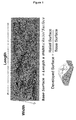
- the developed surface corresponds to the ratio between the area of the local elementary surfaces and the area of the measured zone ( Fig. 1 ).
- a first step according to this method is the identification of a reference plane of skin relief.
- leveling the surface requires establishing the root mean square plane going through the experimental points.
- This method aims at minimizing the variations in relation to each of the coefficients of the average plane.
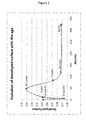
- the resulting value showed a bell-shape distribution, with a peak at around 4-5 years ( Fig. 2 ). This suggested a change in the maturation rate of the skin surface when children reached that age.
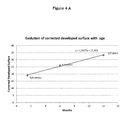
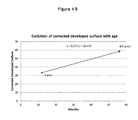
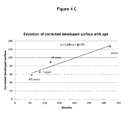
- Fig. 3 shows the increase in the corrected developed surface area as a function of age.
- the inventors have shown that the major part of the maturation of the relief of the skin is complete by the time the children reach 4-5 years. In the following years, the maturation of the skin continues, albeit at a slower rate, which likely corresponds to a period of fine-tuning of the skin organization.
Landscapes
- Health & Medical Sciences (AREA)
- Life Sciences & Earth Sciences (AREA)
- Engineering & Computer Science (AREA)
- Biomedical Technology (AREA)
- Molecular Biology (AREA)
- General Health & Medical Sciences (AREA)
- Physics & Mathematics (AREA)
- Immunology (AREA)
- Pathology (AREA)
- Medical Informatics (AREA)
- Hematology (AREA)
- Cell Biology (AREA)
- Urology & Nephrology (AREA)
- Chemical & Material Sciences (AREA)
- General Physics & Mathematics (AREA)
- Animal Behavior & Ethology (AREA)
- Heart & Thoracic Surgery (AREA)
- Surgery (AREA)
- Biophysics (AREA)
- Public Health (AREA)
- Veterinary Medicine (AREA)
- Biochemistry (AREA)
- Food Science & Technology (AREA)
- Analytical Chemistry (AREA)
- Bioinformatics & Cheminformatics (AREA)
- Toxicology (AREA)
- Tropical Medicine & Parasitology (AREA)
- Biotechnology (AREA)
- Medicinal Chemistry (AREA)
- Microbiology (AREA)
- Dermatology (AREA)
- Computer Vision & Pattern Recognition (AREA)
- Nuclear Medicine, Radiotherapy & Molecular Imaging (AREA)
- Radiology & Medical Imaging (AREA)
- Quality & Reliability (AREA)
- Theoretical Computer Science (AREA)
- Physiology (AREA)
- Investigating Or Analysing Biological Materials (AREA)
- Measurement Of The Respiration, Hearing Ability, Form, And Blood Characteristics Of Living Organisms (AREA)
Priority Applications (5)
| Application Number | Priority Date | Filing Date | Title |
|---|---|---|---|
| EP14305714.9A EP2944250A1 (fr) | 2014-05-15 | 2014-05-15 | Topographie de la peau comme marqueur de maturation de la peau |
| PCT/EP2015/060796 WO2015173413A1 (fr) | 2014-05-15 | 2015-05-15 | Topographie de la peau utilisée en tant que marqueur pour la maturation de la peau |
| CA2948216A CA2948216A1 (fr) | 2014-05-15 | 2015-05-15 | Topographie de la peau utilisee en tant que marqueur pour la maturation de la peau |
| US15/310,303 US10458977B2 (en) | 2014-05-15 | 2015-05-15 | Skin topography as a marker for skin maturation |
| EP15724587.9A EP3142544B1 (fr) | 2014-05-15 | 2015-05-15 | Topographie de la peau comme marqueur de maturation de la peau |
Applications Claiming Priority (1)
| Application Number | Priority Date | Filing Date | Title |
|---|---|---|---|
| EP14305714.9A EP2944250A1 (fr) | 2014-05-15 | 2014-05-15 | Topographie de la peau comme marqueur de maturation de la peau |
Publications (1)
| Publication Number | Publication Date |
|---|---|
| EP2944250A1 true EP2944250A1 (fr) | 2015-11-18 |
Family
ID=50842206
Family Applications (2)
| Application Number | Title | Priority Date | Filing Date |
|---|---|---|---|
| EP14305714.9A Withdrawn EP2944250A1 (fr) | 2014-05-15 | 2014-05-15 | Topographie de la peau comme marqueur de maturation de la peau |
| EP15724587.9A Active EP3142544B1 (fr) | 2014-05-15 | 2015-05-15 | Topographie de la peau comme marqueur de maturation de la peau |
Family Applications After (1)
| Application Number | Title | Priority Date | Filing Date |
|---|---|---|---|
| EP15724587.9A Active EP3142544B1 (fr) | 2014-05-15 | 2015-05-15 | Topographie de la peau comme marqueur de maturation de la peau |
Country Status (4)
| Country | Link |
|---|---|
| US (1) | US10458977B2 (fr) |
| EP (2) | EP2944250A1 (fr) |
| CA (1) | CA2948216A1 (fr) |
| WO (1) | WO2015173413A1 (fr) |
Families Citing this family (4)
| Publication number | Priority date | Publication date | Assignee | Title |
|---|---|---|---|---|
| EP2944250A1 (fr) * | 2014-05-15 | 2015-11-18 | Laboratoires Expanscience | Topographie de la peau comme marqueur de maturation de la peau |
| EP3746792A1 (fr) * | 2018-02-01 | 2020-12-09 | Ecole Centrale de Lyon | Procédé non invasif pour l'évaluation de la qualité de tissus conjonctifs denses internes |
| US11574405B2 (en) | 2019-01-31 | 2023-02-07 | Dr. Maksym Breslavets Medicine Professional Corp. | Analysis of the severity of skin disease through entropy quantification |
| FR3098405B1 (fr) | 2019-07-12 | 2021-06-25 | Expanscience Lab | Composition comprenant des polyphénols de graines de passiflore, des peptides d’avocat et un extrait d’hamamélis et utilisation pour traiter et/ou prévenir les vergetures |
Citations (1)
| Publication number | Priority date | Publication date | Assignee | Title |
|---|---|---|---|---|
| US20050053637A1 (en) * | 2003-09-07 | 2005-03-10 | Ma'or Ze'ev | Personalized cosmetics |
Family Cites Families (3)
| Publication number | Priority date | Publication date | Assignee | Title |
|---|---|---|---|---|
| US5353790A (en) * | 1992-01-17 | 1994-10-11 | Board Of Regents, The University Of Texas System | Method and apparatus for optical measurement of bilirubin in tissue |
| FR2993282B1 (fr) * | 2012-07-13 | 2017-11-10 | Expanscience Lab | Procede d'identification de marqueurs moleculaires de la peau d'enfant |
| EP2944250A1 (fr) * | 2014-05-15 | 2015-11-18 | Laboratoires Expanscience | Topographie de la peau comme marqueur de maturation de la peau |
-
2014
- 2014-05-15 EP EP14305714.9A patent/EP2944250A1/fr not_active Withdrawn
-
2015
- 2015-05-15 EP EP15724587.9A patent/EP3142544B1/fr active Active
- 2015-05-15 CA CA2948216A patent/CA2948216A1/fr not_active Abandoned
- 2015-05-15 WO PCT/EP2015/060796 patent/WO2015173413A1/fr not_active Ceased
- 2015-05-15 US US15/310,303 patent/US10458977B2/en active Active
Patent Citations (1)
| Publication number | Priority date | Publication date | Assignee | Title |
|---|---|---|---|---|
| US20050053637A1 (en) * | 2003-09-07 | 2005-03-10 | Ma'or Ze'ev | Personalized cosmetics |
Non-Patent Citations (14)
| Title |
|---|
| A D POTORAC ET AL: "In vivo skin relief measurement using a new optical profilometer Introduction", SKIN RESEARCH AND TECHNOLOGY, 1 January 1996 (1996-01-01), XP055152490, Retrieved from the Internet <URL:http://onlinelibrary.wiley.com/store/10.1111/j.1600-0846.1996.tb00061.x/asset/j.1600-0846.1996.tb00061.x.pdf?v=1&t=i2ejwh7w&s=5ed0d16826f9ec39551d811978719398070f657d> [retrieved on 20141112] * |
| CORCUFF ET AL., J. SOC. COSMET. CHEM., vol. 34, 1983, pages 177 - 190 |
| FRIEDMAN ET AL., DERMATOL SURG, vol. 28, 2002, pages 199 - 204 |
| LATREILLE ET AL., XXXVLÈMES JOURN6ES DE STATISTIQUES, 24 May 2004 (2004-05-24) |
| LEVEQUE, J EUR ACAD DERMATOL VENEREOL, vol. 12, 1999, pages 103 - 114 |
| LEVEQUE, J EUR ACAD DERMATOL VENEREOL, vol. 12, no. 2, 1999, pages 103 - 114 |
| MOSTELLER, N ENGL J MED, vol. 317, no. 17, 1987, pages 1098 |
| P CORCUFF ET AL: "Skin relief and aging", J. SOC. COSMET. CHEM, 1 July 1983 (1983-07-01), pages 177 - 190, XP055152473, Retrieved from the Internet <URL:http://journal.scconline.org/pdf/cc1983/cc034n04/p00177-p00190.pdf> [retrieved on 20141112] * |
| RHYU ET AL., KOREAN J. MICROSCOPY, vol. 40, no. 4, 2010, pages 267 - 270 |
| RODRIGUES, SKIN PHARMACOL APPL SKIN PHYSIOL, vol. 14, 2001, pages 52 - 67 |
| TCHVIALEVA ET AL.: "Skin Roughness Assessment, New Developments in Biomedical Engineering", 2010, INTECH |
| VERBRAECKEN ET AL., METABOLISM, vol. 55, no. 4, 2006, pages 515 - 524 |
| VERBRAECKEN ET AL: "Body surface area in normal-weight, overweight, and obese adults. A comparison study", METABOLISM, CLINICAL AND EXPERIMENTAL, W.B. SAUNDERS CO., PHILADELPHIA, PA, US, vol. 55, no. 4, 1 April 2006 (2006-04-01), pages 515 - 524, XP005339195, ISSN: 0026-0495, DOI: 10.1016/J.METABOL.2005.11.004 * |
| ZAHOUANI; VARGIOLU: "Measuring the Skin", 2004, SPRINGER |
Also Published As
| Publication number | Publication date |
|---|---|
| US20170241985A1 (en) | 2017-08-24 |
| WO2015173413A1 (fr) | 2015-11-19 |
| EP3142544B1 (fr) | 2024-04-10 |
| EP3142544A1 (fr) | 2017-03-22 |
| CA2948216A1 (fr) | 2015-11-19 |
| US10458977B2 (en) | 2019-10-29 |
Similar Documents
| Publication | Publication Date | Title |
|---|---|---|
| RoBERTSoN et al. | Variation in epidermal morphology in human skin at different body sites as measured by reflectance confocal microscopy | |
| Sotoodian et al. | Noninvasive test methods for epidermal barrier function | |
| van Zuijlen et al. | Scar assessment tools: implications for current research | |
| US10620189B2 (en) | Surface isotropy as a marker for epidermal maturation | |
| Hoppel et al. | Validation of the combined ATR-FTIR/tape stripping technique for monitoring the distribution of surfactants in the stratum corneum | |
| TWI588484B (zh) | Cosmetics evaluation method | |
| Guerra-Tapia et al. | Diagnosis and treatment of sensitive skin syndrome: an algorithm for clinical practice | |
| EP3142544B1 (fr) | Topographie de la peau comme marqueur de maturation de la peau | |
| KR20080050404A (ko) | 피부의 상태의 판정 방법 및 피부의 두께의 예측 방법 | |
| Zahouani et al. | Contribution of human skin topography to the characterization of dynamic skin tension during senescence: morpho-mechanical approach | |
| Kawałkiewicz et al. | Instrumental diagnosis of facial skin—A necessity or a pretreatment recommendation in esthetic medicine | |
| Uchegbulam et al. | Effect of seasonal change on the biomechanical and physical properties of the human skin | |
| Rayner et al. | Measurement of morphological and physiological skin properties in aged care residents: a test–retest reliability pilot study | |
| Shen et al. | Characterization of skin moisture and evaluation of cosmetic moisturizing properties using miniature near-infrared spectrometer | |
| Ayadh et al. | LC-OCT imaging for studying the variation of morphological properties of human skin in vivo according to age and body area: the forearm and the thigh | |
| De Viragh et al. | Human scalp hair follicle development from birth to adulthood: statistical study with special regard to putative stem cells in the bulge and proliferating cells in the matrix | |
| Miyamae et al. | A combined near-infrared diffuse reflectance spectroscopy and principal component analysis method of assessment for the degree of photoaging and physiological aging of human skin | |
| Blanchard | Measurement of human skin mechanical properties: variations according to the effect of different stresses. | |
| KR101758203B1 (ko) | 피부의 유연성 및 화장료의 유연성 개선도 평가방법 | |
| Atrux-Tallau et al. | Effects of physical and chemical treatments upon biophysical properties and micro-relief of human skin | |
| JP6534951B2 (ja) | 皮膚ターンオーバーの評価方法 | |
| Maibach | Noninvasive test methods for epidermal barrier function | |
| Jang et al. | 173 a study on skin properties related to chronic psychological stress | |
| Stamatas | The structural and functional development of skin during the first year of life: investigations using non-invasive methods | |
| Shlivko et al. | Noninvasive study of structural and functional features of neonatal skin |
Legal Events
| Date | Code | Title | Description |
|---|---|---|---|
| PUAI | Public reference made under article 153(3) epc to a published international application that has entered the european phase |
Free format text: ORIGINAL CODE: 0009012 |
|
| AK | Designated contracting states |
Kind code of ref document: A1 Designated state(s): AL AT BE BG CH CY CZ DE DK EE ES FI FR GB GR HR HU IE IS IT LI LT LU LV MC MK MT NL NO PL PT RO RS SE SI SK SM TR |
|
| AX | Request for extension of the european patent |
Extension state: BA ME |
|
| STAA | Information on the status of an ep patent application or granted ep patent |
Free format text: STATUS: THE APPLICATION HAS BEEN WITHDRAWN |
|
| 18W | Application withdrawn |
Effective date: 20160520 |