EP2944478A2 - Élément de sécurité, document de valeur et procédé pour les fabriquer - Google Patents
Élément de sécurité, document de valeur et procédé pour les fabriquer Download PDFInfo
- Publication number
- EP2944478A2 EP2944478A2 EP15001449.6A EP15001449A EP2944478A2 EP 2944478 A2 EP2944478 A2 EP 2944478A2 EP 15001449 A EP15001449 A EP 15001449A EP 2944478 A2 EP2944478 A2 EP 2944478A2
- Authority
- EP
- European Patent Office
- Prior art keywords
- security element
- substrate
- value document
- window
- region
- Prior art date
- Legal status (The legal status is an assumption and is not a legal conclusion. Google has not performed a legal analysis and makes no representation as to the accuracy of the status listed.)
- Granted
Links
Images



Classifications
-
- B—PERFORMING OPERATIONS; TRANSPORTING
- B42—BOOKBINDING; ALBUMS; FILES; SPECIAL PRINTED MATTER
- B42D—BOOKS; BOOK COVERS; LOOSE LEAVES; PRINTED MATTER CHARACTERISED BY IDENTIFICATION OR SECURITY FEATURES; PRINTED MATTER OF SPECIAL FORMAT OR STYLE NOT OTHERWISE PROVIDED FOR; DEVICES FOR USE THEREWITH AND NOT OTHERWISE PROVIDED FOR; MOVABLE-STRIP WRITING OR READING APPARATUS
- B42D25/00—Information-bearing cards or sheet-like structures characterised by identification or security features; Manufacture thereof
- B42D25/30—Identification or security features, e.g. for preventing forgery
- B42D25/351—Translucent or partly translucent parts, e.g. windows
-
- B—PERFORMING OPERATIONS; TRANSPORTING
- B42—BOOKBINDING; ALBUMS; FILES; SPECIAL PRINTED MATTER
- B42D—BOOKS; BOOK COVERS; LOOSE LEAVES; PRINTED MATTER CHARACTERISED BY IDENTIFICATION OR SECURITY FEATURES; PRINTED MATTER OF SPECIAL FORMAT OR STYLE NOT OTHERWISE PROVIDED FOR; DEVICES FOR USE THEREWITH AND NOT OTHERWISE PROVIDED FOR; MOVABLE-STRIP WRITING OR READING APPARATUS
- B42D25/00—Information-bearing cards or sheet-like structures characterised by identification or security features; Manufacture thereof
- B42D25/20—Information-bearing cards or sheet-like structures characterised by identification or security features; Manufacture thereof characterised by a particular use or purpose
- B42D25/29—Securities; Bank notes
-
- B—PERFORMING OPERATIONS; TRANSPORTING
- B42—BOOKBINDING; ALBUMS; FILES; SPECIAL PRINTED MATTER
- B42D—BOOKS; BOOK COVERS; LOOSE LEAVES; PRINTED MATTER CHARACTERISED BY IDENTIFICATION OR SECURITY FEATURES; PRINTED MATTER OF SPECIAL FORMAT OR STYLE NOT OTHERWISE PROVIDED FOR; DEVICES FOR USE THEREWITH AND NOT OTHERWISE PROVIDED FOR; MOVABLE-STRIP WRITING OR READING APPARATUS
- B42D25/00—Information-bearing cards or sheet-like structures characterised by identification or security features; Manufacture thereof
- B42D25/40—Manufacture
- B42D25/45—Associating two or more layers
- B42D25/465—Associating two or more layers using chemicals or adhesives
- B42D25/47—Associating two or more layers using chemicals or adhesives using adhesives
Definitions
- the invention relates to a security element, a value document with a security element and a method for producing a value document.
- Value documents within the meaning of the invention include banknotes, stocks, bonds, certificates, vouchers, checks, air tickets, high-quality admission tickets, labels for product security, credit or debit cards, "but also other forgery-prone documents such as passports, identity cards or other identity documents.
- Value documents are usually produced from value-document substrates, for example paper substrates, which have special security features such as, for example, a security thread incorporated at least partially into the paper and a watermark and which are generally made of cotton fibers.
- window films can be used. Window films are usually made essentially of a synthetic / artificial polymer / plastic. Typically, an area is taken out of the paper of a value document, so that a hole or an opening is formed. This hole is then covered again with a window film.
- the window film is often transparent, but may additionally be printed and / or have optical security elements such as holograms, in order to ensure better protection against counterfeiting.
- window foils can not be re-imaged by mere copying with photocopiers since the area of the window foil appears black in a copy. Also, the feel of a window film is different compared to that of paper. Consequently, copying can not achieve the different haptics of paper compared to a window film.
- window films In the case of existing value documents with window film, however, it is disadvantageous that these window films must be introduced by means of a complex processing method into the value document in order to ensure secure integration of the window film with the remaining document of value and at the same time not impair properties such as good stackability.
- a typical problem with value documents with window film is that the value documents are less dimensionally stable and, for example, tend to curl up, which can also considerably complicate the processing or handling of value documents.
- the transitions from window foil to value document substrate may be weakened areas that are more prone to mechanical damage such as tearing / tearing.
- a first aspect of the invention relates to a security element for connecting to a value document substrate comprising a window area having two opposed window areas each defining a major surface of the security element and a predetermined thickness of the window area extending toward the major surface normal; and at least one connection region arranged laterally on the window region, for connecting the at least one connection region to at least one contact surface of the value document substrate, wherein the connection region has a fixed thickness which extends in the direction of the main surface normal and which is smaller than the predetermined thickness of the window region.
- a security element may include one or more films or a multilayer substrate, wherein the multilayer substrate may also comprise a combination of fabric substrates and films.
- the window area of the security element serves to define a hole or break in a value document substrate, e.g. a paper substrate of the document of value to fill or close.
- a security window can be provided or formed in a value document with the security element.
- the window areas (as the top and bottom sides) of the window area are preferably parallel to the top and bottom of the value document substrate.
- the top and bottom of the value document substrate as well as the window area may also be referred to as major areas.
- These major surfaces form (together) the main surface of a value document and render relevant information to a user. Consequently, the main surfaces are visible to a user who views a value document with a security element.
- a major surface of a bill may represent the value of the bill as well as its serial number.
- an upper and lower side of the window area of a security element may be the same as that of a value document or substrates are also regarded as the first and second major surface.
- thickness which extends in the direction of the main surface normals in particular means the distance of the main surfaces of the window region of the security element from one another with respect to the window region.
- a defined thickness is in particular a material height / thickness to be understood, which is predetermined or fixed.
- a thickness of a window area set before the manufacture of the security element is to be understood as a predetermined thickness. Accordingly, a predetermined thickness can be considered as a measure with or without tolerance having a window area after manufacture.
- connection region arranged laterally on the window region and suitable for connection in the value document is to be understood in particular as meaning that a proximal end of the connection region is arranged on the window region.
- the window area can have different shapes.
- the window area may be rectangular, round, oval, polygonal, etc.
- connection region is connected to the value document substrate at a contact surface of the value document substrate.
- the connection area is applied to a value document substrate of the value document.
- the connection region has at least one connection surface which, when the security element is connected to the value document substrate, connects to the contact surface of the value document substrate is brought into contact or applied to this.
- the connection area is an application area.
- the term "fixed thickness which extends in the direction of the main surface normal” means, in particular, the distance of the top and bottom of the connection region of a security element from one another.
- a specified thickness is to be understood in particular as a material height / thickness which is predetermined.
- a thickness of a joint portion set before the formation of the security member is to be understood as a predetermined thickness. Accordingly, a specified thickness can be considered as a measure with or without tolerance, which has a connection area after production.
- the thickness of the connection area is less than the thickness of the window area.
- the predetermined thickness of the window region is in a range of 60 microns to 120 microns. More preferably, the predetermined thickness of the window region is in the range of 70 microns to 80 microns, 80 microns to 90 microns, and / or 90 microns to 100 microns. Further preferably, the predetermined thickness of the bonding region is in a range of 3 ⁇ m to 60 ⁇ m.
- the thickness of the connection region is in the range of 3 ⁇ m to 12 ⁇ m, 4 ⁇ m to 12 ⁇ m, 12 ⁇ m to 18 ⁇ m, 18 ⁇ m to 24 ⁇ m, 24 ⁇ m to 30 ⁇ m, 30 ⁇ m to 40 ⁇ m, 40 ⁇ m to 50 ⁇ m and / or 50 ⁇ m to 60 ⁇ m.
- connection region preferably has an adhesive layer for bonding to the contact surface of the value document substrate.
- connection area preferably adjoins the window area laterally. This is to be understood in particular as meaning that the connection region directly adjoins the window region or the window region transitions directly into the connection region.
- connection region may completely or partially surround the window region.
- bonding area may encompass the perimeter of the window area between 100% and 75% or between 80% to 50% or between 60% to 30%.
- connection region may enclose the circumference of the window region to 50% or 25%.
- the security element can be arranged at a corner or outer edge of a value document.
- the corners and / or edges of a value document can thereby be reinforced.
- the security element preferably has two opposite connection areas adjoining the window area laterally.
- the window area viewed in plan view of the top / window surface, has a rectangular cross-section.
- the security element has two laterally adjacent to the window area, opposite connection areas.
- the window region can have a longitudinal extent that runs parallel to an edge of the value document. Furthermore, the longitudinal extent of the window area preferably corresponds to the parallel edge length of the value document.
- the longitudinal extent orthogonal width / transverse extent of the window area has a width between 0.5 mm to 16 cm, preferably 1 mm to 20 mm.
- the window region may be formed as a (window) strip which extends over the entire length or width of the document of value.
- the security element preferably has two or more connection regions adjoining the window region laterally. Preferably, at least two connection areas are opposite each other.
- the security element preferably has precisely one connection area which adjoins the window area laterally and encloses the window area.
- the security element has in plan view exactly on the side adjacent to the window area, the window area enclosing connection area.
- connection regions may annularly surround the window region.
- annular is to be understood such that the one or more connecting regions surround the window area without gaps.
- the security element preferably has a carrier substrate with a window section and at least one connecting section. Further preferably, a window substrate is arranged in the window section of the carrier substrate.
- the carrier substrate preferably comprises essentially polyethylene terephthalate (PET) or polypropylene (PP). Further preferably the window substrate is essentially polyethylene terephthalate (PET) or polypropylene (PP).
- the window substrate may comprise a metal layer or be a (multilayer) film having at least partially metallized areas.
- the window area of the security element is not transparent or only partially transparent.
- the window substrate may be printed or printable.
- an adhesive layer is disposed between the window substrate and the carrier substrate.
- Two-component adhesives so-called “cold systems”, for example, which are preferably applied at temperatures between 20 and 50 ° C., can be used for the adhesive layer. These are preferably used for the lamination of film on film or synthetic / artificial polymer on synthetic / artificial polymer / plastic.
- Two-component adhesives, so-called “hot systems” are preferably applied at temperatures between 80 ° C to 100 ° C.
- the security element has no perforations which are suitable for embedding the security element in a value-document substrate or for paper-making.
- the window portion of the carrier substrate is not perforated.
- the connecting portion of the supporting substrate is not perforated.
- the carrier substrate, ie, the window portion and the connecting portion of the security element is not perforated.
- connection area is not embedded in the value document substrate.
- An embedding would be present, for example, if, during the production of the value document, the security element, similar to a security thread, would be introduced into the paper machine (into the value document substrate) during paper production. If embedding, paper fibers could be deposited on the connection area in such a way that a paper-making connection / embedding of the security element with the value document substrate would be possible.
- the security element is not paper-mechanically bonded to a value document substrate because it is non-perforated or has no perforations suitable for embedding the security element (paper-making) in value document substrate.
- Another aspect relates to a security element starting material comprising a plurality of security elements.
- the security element starting material comprises security elements according to the security element, as described above.
- Security element starting material may be, for example, film material on which a multiplicity of security elements are arranged next to one another.
- Security element starting material can be rolled up on rolls, for example, so that the security element starting material can be applied to the value document substrate by means of a roll-to-roll process.
- Another aspect relates to a value document, in particular banknote, with a value document substrate having at least one contact surface and a security element.
- a contact surface is, in particular, an outer surface or outer surface of the value document substrate, which serves to enable the at least one connection region to be connected to the value document substrate or to be applied thereto.
- the security element is connected to the value document substrate. Consequently, no introduction or embedding of the security element takes place in the screen area of the paper machine or is not embedded in papermaking.
- connection region of the security element is applied to or arranged on the contact surface of the (manufactured) value document substrate.
- the security element and the value document substrate are connected to one another via the connection of the contact surface of the value document substrate and the connection surface of the security element.
- connection region of the security element is preferably connected to the value document substrate by means of gluing or lamination, so that the connection region of the security element is firmly attached to the value document substrate.
- the security element connected to the value document comprises one or more of the embodiments or features explained with regard to the first aspect.
- the value document substrate is based on a paper, so that the connection region of the security element is connected to the paper, preferably by application, and the window in the value document substrate, in which the window area of the security element is arranged, is made of paper fibers.
- paper based value document substrate is to be understood in particular to mean that the paper comprises natural fibers / natural polymer and may additionally comprise artificial fiber components or artificial / synthetic polymer / fibers such as polyamide or other additives.
- the value document substrate may be made entirely of synthetic polymer or synthetic fibers.
- the value document substrate can consist of plastic films.
- the value document substrate may comprise multiple layers wherein one or more layers are synthetic fibers / synthetic polymer fibers or synthetic polymer / plastic films and one or more layers are natural polymer or blends of natural polymer (fibers) and synthetic polymer (s).
- the security element can be combined with the value document substrate by means of the kiss-print method.
- the value document substrate preferably already has a cutout / window opening, i. Wertdocumentsubstratget areas which are closed or filled with the security element.
- the value document substrate and the security element can be registered (laminated) and / or glued, ie the security element is connected to the value document substrate in such a way that the window area of the security element is superimposed in register with the window opening.
- the security element with the value document substrate becomes the connection area provided on an the Wertdocumentsubstrat facing side or connecting surface with an adhesive layer.
- the contact surface of the value document substrate, to which the connection region / connection surface of the security element is arranged is provided with an adhesive layer.
- connection area extends (at least) to the edges of the value document substrate so that the (finished) value document has a substantially uniform thickness.
- this allows a good connection of the security element in the value document substrate and at the same time a value document with a substantially constant thickness are provided, whereby such a document of value has a good handling and processability, for example, in terms of stackability and mechanical strength.
- the value document substrate has at least one tapering region.
- the tapering region is preferably a region which adjoins or adjoins the window opening or the recess / opening in which the window region of the security element is arranged.
- the tapering region has a thickness that is smaller in the direction of the main surface normal of the value document substrate than the maximum thickness of the value document substrate.
- the contact surface is arranged in the tapering region.
- the at least one tapering region may be formed as a return of one or both major surfaces of the value document substrate.
- the amount of taper of the tapering region substantially corresponds to the thickness of the connecting portion of the security element. This is particularly the case when the at least one tapering region is formed by means of a return of a single main surface.
- connection region preferably has a thickness such that a value document with the (applied) security element in the area where the connection region is applied to the value document substrate has essentially the same thickness as the other value document substrate. In other words, there should be no or only a slight thickening of the value document in the area of the connection area.
- the thickness of the window area of the security element essentially corresponds to the thickness of the value document.
- the thickness of the window area of the security element substantially corresponds to the (maximum) thickness of the value document substrate or, if appropriate, the value document substrate and the connection area, if a difference of the two thicknesses is not greater than 20%, particularly preferably not greater than 10%.
- a value document ie a value document substrate with a security element applied thereto, has a substantially identical / uniform thickness.
- a transition between value document substrate and window portion of the security element substantially continuously.
- the thickness of the window area is set such that the thickness of the window area corresponds to the thickness of the value document substrate with which the security element is to be connected.
- the major surfaces of the document of value are at least partially covered with a first cover substrate and / or a second cover substrate.
- the major surfaces of the value document visible to an observer i. the main surfaces of the value document substrate and the security element that are visible to a viewer are at least partially covered by a first cover substrate.
- the main surfaces of the value document substrate and the security element which are visible to a viewer can at least partially be covered by a second cover substrate.
- the first cover substrate extends at least to an edge of the value document or value document substrate. Furthermore, preferably up to all edges of the value document or value document substrate.
- the second cover substrate extends at least to an edge of the value document or value document substrate. Furthermore, preferably up to all edges of the value document or value document substrate.
- the first and second cover substrates are disposed on opposite major surfaces of the value document and the value document substrate, respectively.
- the first and the second cover substrate are preferably laminated or lamination.
- the value document substrate has at least one taper area and the contact area of the value document substrate is placed in the taper area.
- the step "connecting " comprises that the connection region of the security element is applied by means of an adhesive bond on the contact surface of the value document substrate.
- the connection is made by means of a laminating and / or kiss-printing process.
- connection region of the security element to the contact surface of the value document substrate by means of an adhesive layer.
- the method for producing a value document comprises one or more of the embodiments or features explained with regard to the first aspect and / or the further aspects.
- Fig.1 shows a schematic representation of a security element 100 in plan view.
- the security element 100 comprises a window area 102 and two connection areas 104 and 106.
- the connection areas 104 and 106 adjoin the window area 102.
- the connection region 104 adjoins the window region 102 laterally at its proximal end 110.
- the connection region 106 is coupled laterally to the window region 102 with its proximal end 114.
- the entire security element 100 has a width BS which extends from the distal end 112 of the connection region 104 to the distal end 116 of the connection region 106.
- the width BS of the security element 100 is composed of the sum of the width b V1 of the connection region 104, the width b F of the window region 102, and the width b V2 of the connection region 106.
- the widths b V1 and b V2 of the connecting portions 104,106 are in the range of 1 to 160 mm.
- the width b F is in the range of 1 mm to 20 mm.
- the security element 100 also has a length or longitudinal extent LS, which lies in a range of 1 mm to 100 mm, preferably in a range of 4 mm to 80 mm.
- the window area 102 is according to the example in FIG Fig.1 designed strip-shaped.
- Fig. 2 shows a schematic representation of a security element 200 in plan view.
- the security element 200 comprises a window area 202 having a main area HF F and a connection area 204 Fig. 2 it can be seen, the connection region 204 laterally adjoins the window region 202.
- connection area 204 completely encloses the window area 202 along the (lateral) perimeter of the window area 202.
- the security element 200 is configured such that the window area in a value document forms, for example, a see-through window or patch, while comparatively the window area 102 of the security element 100 forms a strip or security window strip. These are also the essential differences between the security element 200 and the security element 100.
- Fig. 3 shows a schematic structure of a security element 300 in a sectional view.
- the security element 300 may correspond, for example, to a security element 100 or 200.
- the security element 300 comprises a carrier substrate 302, and a window substrate 312.
- the security element 300 comprises a connection region 306 or 308.
- the connection areas 306, 308 form a common connection area.
- the connection regions 306, 308 are configured as connection sections of the carrier substrate 302.
- the connecting portions 306, 388 adjoin the window area 304 of the security element 300.
- the window portion 304 comprises a window portion of the support substrate 302 and the window substrate 312.
- the window portion of the support substrate 302 and the window substrate 312 have opposite finished surfaces forming main surfaces of the security element HF F1 , HF F2 .
- the window substrate 312 is connected to the window portion of the support substrate 302.
- the window substrate 312 is applied to the window portion of the support substrate 302 by means of an adhesive layer 310.
- the window substrate 312 may be integrally formed with the support substrate 203.
- a width BS of the security element 300 results from the sum of the widths of the connecting portions 306 and 308 and the window area 304.
- the thickness dv of the connection portion 306, 308 is less than the thickness d F of the window region 304 of the security element 300.
- the thickness d V of Connecting portion and the thickness d F of the window portion 304 extend into Direction or parallel to the main surface normals of the main surfaces HF F1 , HF F2 .
- the connection areas 306 and 308 have connection areas HF V1 , HF V1 .
- Fig. 4 shows a schematic representation of a security element 400 in plan view.
- the security element 400 comprises a window area 402 having a main area HF F and a connection area 404 Fig. 4 4, the connection region 404 laterally adjoins the window region 402 and completely encloses the window region 402 along the (lateral) circumference of the window region 402.
- the window region 402 has a more complex contour, which is composed of a plurality of geometric shapes.
- the connection area 404 has a connection area HFv which is associated with a value document substrate to form a value document.
- Fig. 5 shows a schematic structure of a security element 500 in a sectional view.
- the security element 500 may, for example, correspond to the security element 400 along the section line AA.
- the security element 500 comprises a carrier substrate 502 and a window substrate 512.
- the security element 500 comprises a connection region 506 or 508.
- the connection regions 506, 508 are designed as connection sections of the carrier substrate 502.
- the connection portions 506, 508 adjoin the window area 504 of the security element 500.
- the window area 504 has opposite window areas that form main areas of the security element HF F1 , HF F2 .
- the window substrate 512 is with the window portion of the carrier substrate 302 is preferably connected by means of an adhesive connection 510.
- a width BS of the security element 500 results from the sum of the widths of the connection regions 506 and 508 as well as the window region 504, wherein in the embodiment according to FIG Fig. 5 , the connection area 506 has a greater width than the connection area 508.
- the thicknesses dv of the connection areas 506, 508 are smaller than the thickness d F of the window area 504.
- the connection areas 506 and 508 have connection areas HFvi, HF V1 .
- the window area according to one of FIGS. 1 to 5 is preferably transparent. Additionally or alternatively, one or both major surfaces of the window area may be printed.
- the window area can be designed as a patch or window.
- the window substrate and / or the carrier substrate comprises as a (base) material polyethylene terephthalate (PET) and / or polypropylene (PP). Further preferably, the window portion may also include diamond-shaped, circular shapes.
- a security element according to one of FIGS. 1 to 5 can be prepared by various methods.
- a security element can be produced by means of a sealing or self-adhesive operation.
- a PET substrate preferably with a thickness of 12 ⁇ m
- a window foil is applied by means of a heat-sealing process.
- the PET substrate is coated in a window section with a transparent (seal) adhesive.
- the window film is on the adhesive coated Window section applied. Patches can for example be applied in accordance with a self-adhesive label application in the register.
- Strips may also be applied in this manner, such strips being applied to a siliconized donor substrate and being severally wound or withdrawn from the donor substrate shortly before application.
- the window foil preferably comprises further layers, such as a release lacquer layer and / or a release foil, which are already on the window foil before the window foil is applied to the PET substrate.
- a security element can be produced by means of a laminating process.
- a laminating adhesive having 0.5 g / m 2 to 2.0 g / m 2 may be applied to both major surfaces of a support substrate. This can be done for example with roller printing and / or with a gravure printing process.
- a window film is applied to the carrier substrate.
- the carrier substrate preferably has a thickness of approximately 12 ⁇ m, while the window film has a thickness of approximately 40 ⁇ m.
- the laminating adhesive layer between the carrier substrate and the window foil has a thickness of about 1 ⁇ m.
- This difference in thickness between adhesive and window foil counteracts the risk of squeezing out of the adhesive and thus blocking of the rollers or the gravure printing machine.
- UV curing systems can be used.
- the laminated strips or security elements are lined up and therefore form a long band, which is typically rolled up onto a roll.
- the laminated strips or the security elements are close together, resulting in a piston formation in the role. This is advantageous in terms of the winding pressure during curing.
- a base substrate 600 is provided.
- the base substrate 600 includes at least one main surface HF B.
- a release coating 602 is applied or applied on the main surface HF B.
- An adhesive layer 604 is applied to the release lacquer / release lacquer layer 602 and to the window area 610 of the base substrate 600.
- the adhesive 604 is a laminating adhesive to which a window film 606 is applied.
- the window foil 606 is wider than a window area 610 of the base substrate 600 and protrudes into the connection areas 608.
- the release lacquer layer 602 is preferably colored for better controllability during the manufacturing process. At the edges or at the borders of the window area 610 adjoining the connecting areas 608, weakenings 612 are introduced by means of punching, laser or knife. In the next step, the excess window foil, the adhesive layer 604, and the release lacquer layer 602 are removed from the bonding area 608 of the base substrate 600. As a result, a security element 614, as in FIG Fig. 6c shown, received.
- FIGS. 7a-7d show schematic sectional views of intermediate stages for producing a value document according to a first variant.
- Fig. 7a FIG. 11 shows a value document substrate 700 having substrate regions 704 and a cutout or (window) recess 706.
- the substrate regions 704 include, for example, natural fiber and / or plastic / synthetic fiber components that form a single-layer or multi-layer substrate 702.
- the recess 706 is free of substrate 702.
- the recess 706 has a shape which is a negative of the shape of a Window portion of the security element to be connected to the value document substrate.
- the value document substrate 700 further has major surfaces HF S.
- the security element 708, which one of the security elements according to FIGS. 1 to 5 corresponds to the value document substrate 700.
- the connecting regions 716 of the security element 708 are connected to the substrate regions 704.
- the connection surfaces HFvi, HF V2 of the security element 700 are brought into contact with the main surfaces HFs of the value document substrate 700.
- the main surfaces HFs of the value document substrate 700, to which the connection surfaces of the security element 700 are applied, serve here as contact surfaces KF.
- the application or connection of the connection surfaces with the contact surfaces KF is preferably carried out by means of an adhesive layer 714.
- the connection of the security element 708 to the value document substrate 700 can also be done by means of laminating.
- the connecting portions 716 of the security element 700 portions of a support substrate 712.
- the recess 706 is preferably filled by the window portion or the window substrate 710 of the security element 700.
- the security element 708 has a (total) width that corresponds to the width of the value document substrate 700.
- the width of the security element 708 corresponds to a width that results from the sum of the widths of the substrate regions 704 and the recess 706.
- the security element 708 or its connection regions 716 extends (at least) as far as the edges 703 of the value document substrate 700.
- an adhesive or filler 716 may be filled into possible gaps in the window area 706 between the value document substrate 700 and the substrate 702 and the security element 708, respectively.
- a (first) cover layer or cover substrate 718 can be applied on one of the contact surface (s) KF opposite side of the value document substrate 700.
- this also increases the stability of a value document 722.
- the filler 716 may be dispensed into the possible interspaces simultaneously with application of the first cover substrate 718 so that only a single process step is required.
- the first cover substrate 718 may preferably be bonded to the value document substrate 700 and the security element 708 by means of an adhesive layer 720.
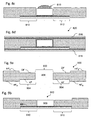
- FIG. 8a shows schematic sectional views of intermediate stages for producing a value document according to a second variant.
- FIG. 8a shows a value document substrate 800 having a cutout or (window) recess 804.
- the recess 804 is free of substrate of the value document substrate.
- the value document substrate 800 has major surfaces HF S. Furthermore, the value document substrate 800 has taper regions 802. These taper regions 802 are configured as recesses from the major surfaces HFs. In the tapering regions 802, the contact surfaces KF are arranged, on which the connecting regions 812 of the security element 806 are applied.
- the recesses are sufficiently deep, so that the connecting portions of the security element 806 are substantially or completely absorbed in the recesses.
- the transition from value document substrate to connection region 812 of security element 806 is substantially continuous.
- an adhesive or filler 810 may be filled into possible interstices in the window area 804 between the value document substrate 800 and the security element 806.
- a (first) cover layer or cover substrate 816 may be applied on one of the contact surface (s) KF opposite side of the value document substrate 800.
- this also increases the stability of a value document 820.
- a (second) cover layer or cover substrate 818 can be applied.
- this also further increases the stability of a value document.
- Figures 9a-9c show schematic sectional views of intermediate stages for producing a value document 918 according to a third variant.
- FIG. 9a shows a value document substrate 900 having a cutout or (window) recess 902. The recess 902 is free from the substrate of the value document substrate.
- the value document substrate 900 has major surfaces of HFs. Furthermore, the value document substrate 900 has taper regions 904. These taper regions 904 are as recesses from the major surfaces HFs designed. In the tapering regions 904, the contact surfaces KF are arranged on one side of the value document substrate 900, to which the connecting regions 910 of the security element 912 are applied.
- the recesses are sufficiently deep, so that the connecting portions 910 of the security element 912 are substantially or completely absorbed in the recesses.
- the transition from value document substrate 900 to connection area 910 of security element 912 is essentially stepless.
- the width of the connecting portion 910 corresponds to the width of the recess.
- an adhesive or filler 914 may be filled into possible interstices in the window area 902 between the value document substrate 900 and the security element 912.
- a (first) cover layer or cover substrate 916 can be applied on one of the contact surface (s) KF opposite side of the value document substrate 900.
- this also further increases the stability of a value document.
- the first cover layer / substrate 916 is also arranged in a recess, wherein the first cover layer 916 is applied to a cover surface DK of the value document substrate 900.
- the width of the first cover substrate 916 is consistent with the width of the top surface and the return, respectively.
- a (second) cover layer or cover substrate be applied / be (not shown).
- this also further increases the stability of a value document 918.
- FIG. 10a shows a document of value 1000 comprising a plurality of security elements with window areas 1002 and value document substrate 1006.
- the value document substrate 1006 with the plurality of security elements with window areas 1002 can be assembled into a plurality of individual value documents by cutting along the section lines A and B.
- the assembled value documents then contain security elements with window areas 1002 which are arranged at the corners or outer edges of the value documents.
- the corners and / or outer edges of a value document can thereby be reinforced.
- FIG. 10b shows by way of example a security element 1010b with a window area 1002b and a connection area 1004b.
- the window area 1002b of the security element 1010b may correspond to the window area 1002a in FIG Figure. 10a correspond.
- connection area 1004 may enclose the perimeter of the window area by 50%.
- FIG. 10c shows by way of example a security element 1010c with four window areas 1002c and a connection area 1004c.
- a ready-made value document can have such a security element, ie after a document of value has been cut.
- the security element 1010c may also be considered as a combined security element having multiple security elements.
- a combined security element may have multiple contiguous security elements, such as security element 1010b.
- a document of value as in FIG. 10a 4, a plurality of contiguous security elements may be included, which are separated from one another by the slicing of the document of value documents into a plurality of value documents and thus contain security elements, as in FIG. 10b or 10c.
Landscapes
- Business, Economics & Management (AREA)
- Accounting & Taxation (AREA)
- Finance (AREA)
- Health & Medical Sciences (AREA)
- Chemical & Material Sciences (AREA)
- Chemical Kinetics & Catalysis (AREA)
- General Chemical & Material Sciences (AREA)
- General Health & Medical Sciences (AREA)
- Toxicology (AREA)
- Engineering & Computer Science (AREA)
- Manufacturing & Machinery (AREA)
- Credit Cards Or The Like (AREA)
- Aiming, Guidance, Guns With A Light Source, Armor, Camouflage, And Targets (AREA)
- Absorbent Articles And Supports Therefor (AREA)
- Undergarments, Swaddling Clothes, Handkerchiefs Or Underwear Materials (AREA)
Applications Claiming Priority (1)
| Application Number | Priority Date | Filing Date | Title |
|---|---|---|---|
| DE102014007108.1A DE102014007108A1 (de) | 2014-05-14 | 2014-05-14 | Sicherheitselement |
Publications (3)
| Publication Number | Publication Date |
|---|---|
| EP2944478A2 true EP2944478A2 (fr) | 2015-11-18 |
| EP2944478A3 EP2944478A3 (fr) | 2015-12-02 |
| EP2944478B1 EP2944478B1 (fr) | 2020-04-29 |
Family
ID=53188840
Family Applications (1)
| Application Number | Title | Priority Date | Filing Date |
|---|---|---|---|
| EP15001449.6A Active EP2944478B1 (fr) | 2014-05-14 | 2015-05-13 | Document de valeur et son procédé de fabrication |
Country Status (3)
| Country | Link |
|---|---|
| EP (1) | EP2944478B1 (fr) |
| DE (1) | DE102014007108A1 (fr) |
| ES (1) | ES2794610T3 (fr) |
Cited By (3)
| Publication number | Priority date | Publication date | Assignee | Title |
|---|---|---|---|---|
| WO2018068889A1 (fr) * | 2016-10-10 | 2018-04-19 | Giesecke+Devrient Currency Technology Gmbh | Procédé d'intégration de fils de sécurité dans des documents de valeur |
| EP3414104B1 (fr) | 2016-02-10 | 2020-11-18 | Oberthur Fiduciaire SAS | Procédé de fabrication de documents de sécurité et documents correspondants |
| CN113524944A (zh) * | 2017-05-24 | 2021-10-22 | 捷德货币技术有限责任公司 | 用于制造多单元条带的方法及其应用 |
Families Citing this family (2)
| Publication number | Priority date | Publication date | Assignee | Title |
|---|---|---|---|---|
| DE102017001347A1 (de) | 2017-02-10 | 2018-08-16 | Giesecke+Devrient Currency Technology Gmbh | Datenträger mit Fenstersicherheitselement |
| WO2024246573A1 (fr) * | 2023-05-26 | 2024-12-05 | Linxens Holding | Structure pré-stratifiée avec fenêtre transparente et son procédé de formation |
Family Cites Families (5)
| Publication number | Priority date | Publication date | Assignee | Title |
|---|---|---|---|---|
| AT401365B (de) * | 1993-10-11 | 1996-08-26 | Oesterr Nationalbank | Wertpapier |
| DE4334847A1 (de) * | 1993-10-13 | 1995-04-20 | Kurz Leonhard Fa | Wertdokument mit Fenster |
| AUPO260296A0 (en) * | 1996-09-26 | 1996-10-24 | Reserve Bank Of Australia | Banknotes incorporating security devices |
| RU2344219C1 (ru) * | 2007-07-18 | 2009-01-20 | Федеральное Государственное Унитарное Предприятие "Гознак" (Фгуп "Гознак") | Способ изготовления бумаги, защищенной от подделки, (варианты) и бумага, защищенная от подделки (варианты) |
| DE102008062475A1 (de) * | 2008-12-16 | 2010-06-17 | Giesecke & Devrient Gmbh | Sicherheitselement und Sicherheitspapier |
-
2014
- 2014-05-14 DE DE102014007108.1A patent/DE102014007108A1/de not_active Withdrawn
-
2015
- 2015-05-13 ES ES15001449T patent/ES2794610T3/es active Active
- 2015-05-13 EP EP15001449.6A patent/EP2944478B1/fr active Active
Non-Patent Citations (1)
| Title |
|---|
| None |
Cited By (5)
| Publication number | Priority date | Publication date | Assignee | Title |
|---|---|---|---|---|
| EP3414104B1 (fr) | 2016-02-10 | 2020-11-18 | Oberthur Fiduciaire SAS | Procédé de fabrication de documents de sécurité et documents correspondants |
| WO2018068889A1 (fr) * | 2016-10-10 | 2018-04-19 | Giesecke+Devrient Currency Technology Gmbh | Procédé d'intégration de fils de sécurité dans des documents de valeur |
| CN109803836A (zh) * | 2016-10-10 | 2019-05-24 | 捷德货币技术有限责任公司 | 用于将防伪线嵌入有价值的文件中的方法 |
| CN109803836B (zh) * | 2016-10-10 | 2021-01-15 | 捷德货币技术有限责任公司 | 用于将防伪线嵌入有价值的文件中的方法 |
| CN113524944A (zh) * | 2017-05-24 | 2021-10-22 | 捷德货币技术有限责任公司 | 用于制造多单元条带的方法及其应用 |
Also Published As
| Publication number | Publication date |
|---|---|
| DE102014007108A1 (de) | 2015-11-19 |
| ES2794610T3 (es) | 2020-11-18 |
| EP2944478A3 (fr) | 2015-12-02 |
| EP2944478B1 (fr) | 2020-04-29 |
Similar Documents
| Publication | Publication Date | Title |
|---|---|---|
| EP3505361B1 (fr) | Dispositif applicateur | |
| EP2860042B1 (fr) | Procédé et dispositif de fabrication d'un substrat de document de valeur | |
| EP2944478B1 (fr) | Document de valeur et son procédé de fabrication | |
| DE102008047641A1 (de) | Sicherheitselement-Transfermaterial mit mehrschichtigem Träger | |
| DE102007040865A1 (de) | Sicherheitspapier | |
| DE102008053096A1 (de) | Verfahren und Vorrichtung zur Herstellung von Datenträgern und Datenträgerhalbzeugen, sowie Datenträger und Datenträgerhalbzeug | |
| EP3111280B1 (fr) | Procédé de fabrication de documents de sécurité | |
| DE102006022703A1 (de) | Banknote | |
| EP3521052B1 (fr) | Procédé de fabrication d'un matériau de transfert d'éléments de sécurité et matériau de transfert d'éléments de sécurité | |
| DE102016009318A1 (de) | Verfahren und Transferfolie zum Übertragen von motivförmigen Sicherheitselementen auf ein Zielsubstrat | |
| EP2891561B1 (fr) | Element de securite, document de valeur et procede de sa fabrication | |
| DE102007021496A1 (de) | Verfahren zur Herstellung eines Datenblattes | |
| EP2934898B1 (fr) | Feuille substrat pour la réalisation de documents de sécurité et de documents de valeur | |
| EP2295234B1 (fr) | Billet de banque en film composite et son procédé de fabrication | |
| EP4274738A1 (fr) | Procédé de fabrication d'un substrat de document stratifié multicouche pourvu d'un insert | |
| EP2993057B1 (fr) | Billet de banque avec fenêtre | |
| EP3165378A1 (fr) | Page de données comprenant une charnière pour un passeport et procédé de sa fabrication | |
| WO2020070335A1 (fr) | Produit fonctionnel multicouche comprenant une séparation de couche pouvant être retirée | |
| EP4426563B1 (fr) | Matériau d'élément de sécurité de transfert et document de valeur comprenant un élément de sécurité | |
| DE102022001403A1 (de) | Transfer-Sicherheitselement-Material und Wertdokument mit einem Sicherheitselement | |
| EP4214063A1 (fr) | Matériau de transfert d'éléments de sécurité permettant le transfert, dans un bon registre, d'éléments de sécurité à des documents de valeur | |
| DE102011114648A1 (de) | Sicherheitssubstrat für Sicherheitspapiere, Wertdokumente oder dergleichen |
Legal Events
| Date | Code | Title | Description |
|---|---|---|---|
| PUAL | Search report despatched |
Free format text: ORIGINAL CODE: 0009013 |
|
| PUAI | Public reference made under article 153(3) epc to a published international application that has entered the european phase |
Free format text: ORIGINAL CODE: 0009012 |
|
| AK | Designated contracting states |
Kind code of ref document: A2 Designated state(s): AL AT BE BG CH CY CZ DE DK EE ES FI FR GB GR HR HU IE IS IT LI LT LU LV MC MK MT NL NO PL PT RO RS SE SI SK SM TR |
|
| AX | Request for extension of the european patent |
Extension state: BA ME |
|
| AK | Designated contracting states |
Kind code of ref document: A3 Designated state(s): AL AT BE BG CH CY CZ DE DK EE ES FI FR GB GR HR HU IE IS IT LI LT LU LV MC MK MT NL NO PL PT RO RS SE SI SK SM TR |
|
| AX | Request for extension of the european patent |
Extension state: BA ME |
|
| RIC1 | Information provided on ipc code assigned before grant |
Ipc: B42D 25/00 20140101ALI20151026BHEP Ipc: B42D 15/00 20060101AFI20151026BHEP |
|
| 17P | Request for examination filed |
Effective date: 20160602 |
|
| RBV | Designated contracting states (corrected) |
Designated state(s): AL AT BE BG CH CY CZ DE DK EE ES FI FR GB GR HR HU IE IS IT LI LT LU LV MC MK MT NL NO PL PT RO RS SE SI SK SM TR |
|
| RAP1 | Party data changed (applicant data changed or rights of an application transferred) |
Owner name: GIESECKE+DEVRIENT CURRENCY TECHNOLOGY GMBH |
|
| STAA | Information on the status of an ep patent application or granted ep patent |
Free format text: STATUS: EXAMINATION IS IN PROGRESS |
|
| 17Q | First examination report despatched |
Effective date: 20180503 |
|
| GRAP | Despatch of communication of intention to grant a patent |
Free format text: ORIGINAL CODE: EPIDOSNIGR1 |
|
| STAA | Information on the status of an ep patent application or granted ep patent |
Free format text: STATUS: GRANT OF PATENT IS INTENDED |
|
| INTG | Intention to grant announced |
Effective date: 20191202 |
|
| GRAS | Grant fee paid |
Free format text: ORIGINAL CODE: EPIDOSNIGR3 |
|
| GRAA | (expected) grant |
Free format text: ORIGINAL CODE: 0009210 |
|
| STAA | Information on the status of an ep patent application or granted ep patent |
Free format text: STATUS: THE PATENT HAS BEEN GRANTED |
|
| AK | Designated contracting states |
Kind code of ref document: B1 Designated state(s): AL AT BE BG CH CY CZ DE DK EE ES FI FR GB GR HR HU IE IS IT LI LT LU LV MC MK MT NL NO PL PT RO RS SE SI SK SM TR |
|
| REG | Reference to a national code |
Ref country code: GB Ref legal event code: FG4D Free format text: NOT ENGLISH |
|
| REG | Reference to a national code |
Ref country code: CH Ref legal event code: EP |
|
| REG | Reference to a national code |
Ref country code: DE Ref legal event code: R096 Ref document number: 502015012392 Country of ref document: DE |
|
| REG | Reference to a national code |
Ref country code: AT Ref legal event code: REF Ref document number: 1262716 Country of ref document: AT Kind code of ref document: T Effective date: 20200515 |
|
| REG | Reference to a national code |
Ref country code: IE Ref legal event code: FG4D Free format text: LANGUAGE OF EP DOCUMENT: GERMAN |
|
| REG | Reference to a national code |
Ref country code: NL Ref legal event code: FP |
|
| REG | Reference to a national code |
Ref country code: LT Ref legal event code: MG4D |
|
| PG25 | Lapsed in a contracting state [announced via postgrant information from national office to epo] |
Ref country code: SE Free format text: LAPSE BECAUSE OF FAILURE TO SUBMIT A TRANSLATION OF THE DESCRIPTION OR TO PAY THE FEE WITHIN THE PRESCRIBED TIME-LIMIT Effective date: 20200429 Ref country code: LT Free format text: LAPSE BECAUSE OF FAILURE TO SUBMIT A TRANSLATION OF THE DESCRIPTION OR TO PAY THE FEE WITHIN THE PRESCRIBED TIME-LIMIT Effective date: 20200429 Ref country code: IS Free format text: LAPSE BECAUSE OF FAILURE TO SUBMIT A TRANSLATION OF THE DESCRIPTION OR TO PAY THE FEE WITHIN THE PRESCRIBED TIME-LIMIT Effective date: 20200829 Ref country code: NO Free format text: LAPSE BECAUSE OF FAILURE TO SUBMIT A TRANSLATION OF THE DESCRIPTION OR TO PAY THE FEE WITHIN THE PRESCRIBED TIME-LIMIT Effective date: 20200729 Ref country code: PT Free format text: LAPSE BECAUSE OF FAILURE TO SUBMIT A TRANSLATION OF THE DESCRIPTION OR TO PAY THE FEE WITHIN THE PRESCRIBED TIME-LIMIT Effective date: 20200831 Ref country code: GR Free format text: LAPSE BECAUSE OF FAILURE TO SUBMIT A TRANSLATION OF THE DESCRIPTION OR TO PAY THE FEE WITHIN THE PRESCRIBED TIME-LIMIT Effective date: 20200730 Ref country code: FI Free format text: LAPSE BECAUSE OF FAILURE TO SUBMIT A TRANSLATION OF THE DESCRIPTION OR TO PAY THE FEE WITHIN THE PRESCRIBED TIME-LIMIT Effective date: 20200429 |
|
| REG | Reference to a national code |
Ref country code: ES Ref legal event code: FG2A Ref document number: 2794610 Country of ref document: ES Kind code of ref document: T3 Effective date: 20201118 |
|
| PG25 | Lapsed in a contracting state [announced via postgrant information from national office to epo] |
Ref country code: LV Free format text: LAPSE BECAUSE OF FAILURE TO SUBMIT A TRANSLATION OF THE DESCRIPTION OR TO PAY THE FEE WITHIN THE PRESCRIBED TIME-LIMIT Effective date: 20200429 Ref country code: HR Free format text: LAPSE BECAUSE OF FAILURE TO SUBMIT A TRANSLATION OF THE DESCRIPTION OR TO PAY THE FEE WITHIN THE PRESCRIBED TIME-LIMIT Effective date: 20200429 Ref country code: BG Free format text: LAPSE BECAUSE OF FAILURE TO SUBMIT A TRANSLATION OF THE DESCRIPTION OR TO PAY THE FEE WITHIN THE PRESCRIBED TIME-LIMIT Effective date: 20200729 Ref country code: RS Free format text: LAPSE BECAUSE OF FAILURE TO SUBMIT A TRANSLATION OF THE DESCRIPTION OR TO PAY THE FEE WITHIN THE PRESCRIBED TIME-LIMIT Effective date: 20200429 |
|
| REG | Reference to a national code |
Ref country code: DE Ref legal event code: R119 Ref document number: 502015012392 Country of ref document: DE |
|
| PG25 | Lapsed in a contracting state [announced via postgrant information from national office to epo] |
Ref country code: AL Free format text: LAPSE BECAUSE OF FAILURE TO SUBMIT A TRANSLATION OF THE DESCRIPTION OR TO PAY THE FEE WITHIN THE PRESCRIBED TIME-LIMIT Effective date: 20200429 |
|
| PG25 | Lapsed in a contracting state [announced via postgrant information from national office to epo] |
Ref country code: RO Free format text: LAPSE BECAUSE OF FAILURE TO SUBMIT A TRANSLATION OF THE DESCRIPTION OR TO PAY THE FEE WITHIN THE PRESCRIBED TIME-LIMIT Effective date: 20200429 Ref country code: CH Free format text: LAPSE BECAUSE OF NON-PAYMENT OF DUE FEES Effective date: 20200531 Ref country code: CZ Free format text: LAPSE BECAUSE OF FAILURE TO SUBMIT A TRANSLATION OF THE DESCRIPTION OR TO PAY THE FEE WITHIN THE PRESCRIBED TIME-LIMIT Effective date: 20200429 Ref country code: MC Free format text: LAPSE BECAUSE OF FAILURE TO SUBMIT A TRANSLATION OF THE DESCRIPTION OR TO PAY THE FEE WITHIN THE PRESCRIBED TIME-LIMIT Effective date: 20200429 Ref country code: LI Free format text: LAPSE BECAUSE OF NON-PAYMENT OF DUE FEES Effective date: 20200531 Ref country code: SM Free format text: LAPSE BECAUSE OF FAILURE TO SUBMIT A TRANSLATION OF THE DESCRIPTION OR TO PAY THE FEE WITHIN THE PRESCRIBED TIME-LIMIT Effective date: 20200429 Ref country code: EE Free format text: LAPSE BECAUSE OF FAILURE TO SUBMIT A TRANSLATION OF THE DESCRIPTION OR TO PAY THE FEE WITHIN THE PRESCRIBED TIME-LIMIT Effective date: 20200429 Ref country code: DK Free format text: LAPSE BECAUSE OF FAILURE TO SUBMIT A TRANSLATION OF THE DESCRIPTION OR TO PAY THE FEE WITHIN THE PRESCRIBED TIME-LIMIT Effective date: 20200429 |
|
| PG25 | Lapsed in a contracting state [announced via postgrant information from national office to epo] |
Ref country code: SK Free format text: LAPSE BECAUSE OF FAILURE TO SUBMIT A TRANSLATION OF THE DESCRIPTION OR TO PAY THE FEE WITHIN THE PRESCRIBED TIME-LIMIT Effective date: 20200429 Ref country code: PL Free format text: LAPSE BECAUSE OF FAILURE TO SUBMIT A TRANSLATION OF THE DESCRIPTION OR TO PAY THE FEE WITHIN THE PRESCRIBED TIME-LIMIT Effective date: 20200429 |
|
| PLBE | No opposition filed within time limit |
Free format text: ORIGINAL CODE: 0009261 |
|
| STAA | Information on the status of an ep patent application or granted ep patent |
Free format text: STATUS: NO OPPOSITION FILED WITHIN TIME LIMIT |
|
| REG | Reference to a national code |
Ref country code: BE Ref legal event code: MM Effective date: 20200531 |
|
| GBPC | Gb: european patent ceased through non-payment of renewal fee |
Effective date: 20200729 |
|
| PG25 | Lapsed in a contracting state [announced via postgrant information from national office to epo] |
Ref country code: LU Free format text: LAPSE BECAUSE OF NON-PAYMENT OF DUE FEES Effective date: 20200513 |
|
| 26N | No opposition filed |
Effective date: 20210201 |
|
| PG25 | Lapsed in a contracting state [announced via postgrant information from national office to epo] |
Ref country code: IE Free format text: LAPSE BECAUSE OF NON-PAYMENT OF DUE FEES Effective date: 20200513 Ref country code: GB Free format text: LAPSE BECAUSE OF NON-PAYMENT OF DUE FEES Effective date: 20200729 |
|
| PG25 | Lapsed in a contracting state [announced via postgrant information from national office to epo] |
Ref country code: BE Free format text: LAPSE BECAUSE OF NON-PAYMENT OF DUE FEES Effective date: 20200531 Ref country code: DE Free format text: LAPSE BECAUSE OF NON-PAYMENT OF DUE FEES Effective date: 20201201 Ref country code: SI Free format text: LAPSE BECAUSE OF FAILURE TO SUBMIT A TRANSLATION OF THE DESCRIPTION OR TO PAY THE FEE WITHIN THE PRESCRIBED TIME-LIMIT Effective date: 20200429 |
|
| REG | Reference to a national code |
Ref country code: AT Ref legal event code: MM01 Ref document number: 1262716 Country of ref document: AT Kind code of ref document: T Effective date: 20200513 |
|
| PGFP | Annual fee paid to national office [announced via postgrant information from national office to epo] |
Ref country code: FR Payment date: 20210521 Year of fee payment: 7 Ref country code: NL Payment date: 20210519 Year of fee payment: 7 Ref country code: IT Payment date: 20210531 Year of fee payment: 7 |
|
| PG25 | Lapsed in a contracting state [announced via postgrant information from national office to epo] |
Ref country code: AT Free format text: LAPSE BECAUSE OF NON-PAYMENT OF DUE FEES Effective date: 20200513 |
|
| PGFP | Annual fee paid to national office [announced via postgrant information from national office to epo] |
Ref country code: ES Payment date: 20210618 Year of fee payment: 7 |
|
| PG25 | Lapsed in a contracting state [announced via postgrant information from national office to epo] |
Ref country code: TR Free format text: LAPSE BECAUSE OF FAILURE TO SUBMIT A TRANSLATION OF THE DESCRIPTION OR TO PAY THE FEE WITHIN THE PRESCRIBED TIME-LIMIT Effective date: 20200429 Ref country code: MT Free format text: LAPSE BECAUSE OF FAILURE TO SUBMIT A TRANSLATION OF THE DESCRIPTION OR TO PAY THE FEE WITHIN THE PRESCRIBED TIME-LIMIT Effective date: 20200429 Ref country code: CY Free format text: LAPSE BECAUSE OF FAILURE TO SUBMIT A TRANSLATION OF THE DESCRIPTION OR TO PAY THE FEE WITHIN THE PRESCRIBED TIME-LIMIT Effective date: 20200429 |
|
| PG25 | Lapsed in a contracting state [announced via postgrant information from national office to epo] |
Ref country code: MK Free format text: LAPSE BECAUSE OF FAILURE TO SUBMIT A TRANSLATION OF THE DESCRIPTION OR TO PAY THE FEE WITHIN THE PRESCRIBED TIME-LIMIT Effective date: 20200429 |
|
| REG | Reference to a national code |
Ref country code: NL Ref legal event code: MM Effective date: 20220601 |
|
| PG25 | Lapsed in a contracting state [announced via postgrant information from national office to epo] |
Ref country code: FR Free format text: LAPSE BECAUSE OF NON-PAYMENT OF DUE FEES Effective date: 20220531 |
|
| REG | Reference to a national code |
Ref country code: ES Ref legal event code: FD2A Effective date: 20230627 |
|
| PG25 | Lapsed in a contracting state [announced via postgrant information from national office to epo] |
Ref country code: NL Free format text: LAPSE BECAUSE OF NON-PAYMENT OF DUE FEES Effective date: 20220601 |
|
| PG25 | Lapsed in a contracting state [announced via postgrant information from national office to epo] |
Ref country code: IT Free format text: LAPSE BECAUSE OF NON-PAYMENT OF DUE FEES Effective date: 20220513 Ref country code: ES Free format text: LAPSE BECAUSE OF NON-PAYMENT OF DUE FEES Effective date: 20220514 |