EP2945482B1 - Zusammensetzungen und methoden zur stabilisierung von 1-methylcyclopropen in lösungen - Google Patents
Zusammensetzungen und methoden zur stabilisierung von 1-methylcyclopropen in lösungen Download PDFInfo
- Publication number
- EP2945482B1 EP2945482B1 EP14733391.8A EP14733391A EP2945482B1 EP 2945482 B1 EP2945482 B1 EP 2945482B1 EP 14733391 A EP14733391 A EP 14733391A EP 2945482 B1 EP2945482 B1 EP 2945482B1
- Authority
- EP
- European Patent Office
- Prior art keywords
- cyclopropene
- sugar
- plant
- composition
- encapsulating agent
- Prior art date
- Legal status (The legal status is an assumption and is not a legal conclusion. Google has not performed a legal analysis and makes no representation as to the accuracy of the status listed.)
- Active
Links
Images
Classifications
-
- A—HUMAN NECESSITIES
- A01—AGRICULTURE; FORESTRY; ANIMAL HUSBANDRY; HUNTING; TRAPPING; FISHING
- A01N—PRESERVATION OF BODIES OF HUMANS OR ANIMALS OR PLANTS OR PARTS THEREOF; BIOCIDES, e.g. AS DISINFECTANTS, AS PESTICIDES OR AS HERBICIDES; PEST REPELLANTS OR ATTRACTANTS; PLANT GROWTH REGULATORS
- A01N27/00—Biocides, pest repellants or attractants, or plant growth regulators containing hydrocarbons
-
- A—HUMAN NECESSITIES
- A01—AGRICULTURE; FORESTRY; ANIMAL HUSBANDRY; HUNTING; TRAPPING; FISHING
- A01N—PRESERVATION OF BODIES OF HUMANS OR ANIMALS OR PLANTS OR PARTS THEREOF; BIOCIDES, e.g. AS DISINFECTANTS, AS PESTICIDES OR AS HERBICIDES; PEST REPELLANTS OR ATTRACTANTS; PLANT GROWTH REGULATORS
- A01N25/00—Biocides, pest repellants or attractants, or plant growth regulators, characterised by their forms, or by their non-active ingredients or by their methods of application, e.g. seed treatment or sequential application; Substances for reducing the noxious effect of the active ingredients to organisms other than pests
- A01N25/02—Biocides, pest repellants or attractants, or plant growth regulators, characterised by their forms, or by their non-active ingredients or by their methods of application, e.g. seed treatment or sequential application; Substances for reducing the noxious effect of the active ingredients to organisms other than pests containing liquids as carriers, diluents or solvents
-
- A—HUMAN NECESSITIES
- A01—AGRICULTURE; FORESTRY; ANIMAL HUSBANDRY; HUNTING; TRAPPING; FISHING
- A01N—PRESERVATION OF BODIES OF HUMANS OR ANIMALS OR PLANTS OR PARTS THEREOF; BIOCIDES, e.g. AS DISINFECTANTS, AS PESTICIDES OR AS HERBICIDES; PEST REPELLANTS OR ATTRACTANTS; PLANT GROWTH REGULATORS
- A01N25/00—Biocides, pest repellants or attractants, or plant growth regulators, characterised by their forms, or by their non-active ingredients or by their methods of application, e.g. seed treatment or sequential application; Substances for reducing the noxious effect of the active ingredients to organisms other than pests
- A01N25/22—Biocides, pest repellants or attractants, or plant growth regulators, characterised by their forms, or by their non-active ingredients or by their methods of application, e.g. seed treatment or sequential application; Substances for reducing the noxious effect of the active ingredients to organisms other than pests containing ingredients stabilising the active ingredients
-
- A—HUMAN NECESSITIES
- A01—AGRICULTURE; FORESTRY; ANIMAL HUSBANDRY; HUNTING; TRAPPING; FISHING
- A01N—PRESERVATION OF BODIES OF HUMANS OR ANIMALS OR PLANTS OR PARTS THEREOF; BIOCIDES, e.g. AS DISINFECTANTS, AS PESTICIDES OR AS HERBICIDES; PEST REPELLANTS OR ATTRACTANTS; PLANT GROWTH REGULATORS
- A01N3/00—Preservation of plants or parts thereof, e.g. inhibiting evaporation, improvement of the appearance of leaves or protection against physical influences such as UV radiation using chemical compositions; Grafting wax
- A01N3/02—Keeping cut flowers fresh chemically
-
- A—HUMAN NECESSITIES
- A01—AGRICULTURE; FORESTRY; ANIMAL HUSBANDRY; HUNTING; TRAPPING; FISHING
- A01N—PRESERVATION OF BODIES OF HUMANS OR ANIMALS OR PLANTS OR PARTS THEREOF; BIOCIDES, e.g. AS DISINFECTANTS, AS PESTICIDES OR AS HERBICIDES; PEST REPELLANTS OR ATTRACTANTS; PLANT GROWTH REGULATORS
- A01N43/00—Biocides, pest repellants or attractants, or plant growth regulators containing heterocyclic compounds
- A01N43/02—Biocides, pest repellants or attractants, or plant growth regulators containing heterocyclic compounds having rings with one or more oxygen or sulfur atoms as the only ring hetero atoms
- A01N43/04—Biocides, pest repellants or attractants, or plant growth regulators containing heterocyclic compounds having rings with one or more oxygen or sulfur atoms as the only ring hetero atoms with one hetero atom
- A01N43/14—Biocides, pest repellants or attractants, or plant growth regulators containing heterocyclic compounds having rings with one or more oxygen or sulfur atoms as the only ring hetero atoms with one hetero atom six-membered rings
- A01N43/16—Biocides, pest repellants or attractants, or plant growth regulators containing heterocyclic compounds having rings with one or more oxygen or sulfur atoms as the only ring hetero atoms with one hetero atom six-membered rings with oxygen as the ring hetero atom
-
- A—HUMAN NECESSITIES
- A23—FOODS OR FOODSTUFFS; TREATMENT THEREOF, NOT COVERED BY OTHER CLASSES
- A23B—PRESERVATION OF FOODS, FOODSTUFFS OR NON-ALCOHOLIC BEVERAGES; CHEMICAL RIPENING OF FRUIT OR VEGETABLES
- A23B7/00—Preservation of fruit or vegetables; Chemical ripening of fruit or vegetables
- A23B7/14—Preserving or ripening with chemicals not covered by group A23B7/08 or A23B7/10
- A23B7/153—Preserving or ripening with chemicals not covered by group A23B7/08 or A23B7/10 in the form of liquids or solids
- A23B7/154—Organic compounds; Microorganisms; Enzymes
-
- A—HUMAN NECESSITIES
- A23—FOODS OR FOODSTUFFS; TREATMENT THEREOF, NOT COVERED BY OTHER CLASSES
- A23V—INDEXING SCHEME RELATING TO FOODS, FOODSTUFFS OR NON-ALCOHOLIC BEVERAGES AND LACTIC OR PROPIONIC ACID BACTERIA USED IN FOODSTUFFS OR FOOD PREPARATION
- A23V2002/00—Food compositions, function of food ingredients or processes for food or foodstuffs
Definitions
- the cyclopropene is often in the form of a complex with a molecular encapsulating agent.
- a complex is useful, for example, for use in treating plants or plant parts by contacting the plants or plant parts with the complex in order to bring about contact between the plants or plant parts and the cyclopropene.
- Such treatment of plants or plant parts is often effective at desirably interrupting one or more ethylene- mediated process in the plants or plant parts.
- such treatment of plant parts can sometimes desirably delay unwanted ripening.
- such treatment of crop plants prior to harvest can sometimes improve the yield of the crop.
- US 6,313,068 discloses grinding and milling of dried powder of a complex of cyclodextrin and methylcyclopropene.
- EP 1192859 and EP 1304035 describes complexes formed from molecular encapsulation agents such as cyclodextrin, and cyclopropene and its derivatives such as methylcyclopropene, which are capable of inhibiting the ethylene response in plants.
- EP 2389814 a method of treating plant parts comprising forming a coating on the surface of said plant parts by applying a layer of a coating composition to said surface of said plant parts, wherein said coating composition comprises (a) one or more wax, and (b) one or more cyclopropene compound.
- EP 2283727 describes a method of treating ornamental plants comprising contacting said plants with a liquid composition comprising of one or more cyclopropene compound.
- the cyclopropene is 1-methylcyclopropene.
- compositions comprising an aqueous solution of at least one cyclopropene and at least one sugar. Also provided are methods of using such compositions for inhibiting an ethylene response in a plant.
- composition comprising an aqueous solution of a cyclopropene molecular complex comprising a cyclopropene and a molecular encapsulating agent, and at least one sugar, wherein the cyclopropene is 1-methylcyclopropene, wherein the molecular encapsulating agent comprises a cyclodextrin; and wherein the aqueous solution is at least 25% saturated with the at least one sugar.
- the cyclopropene molecular complex is an inclusion complex.
- the molecular encapsulating agent is selected from the group consisting of substituted cyclodextrins, unsubstituted cyclodextrins and combinations thereof.
- the molecular encapsulating agent is selected from the group consisting of alpha-cyclodextrin, beta-cyclodextrin, gamma-cyclodextrin, and combinations thereof.
- the molecular encapsulating agent comprises alpha-cyclodextrin.
- the compositions comprises from 0.1 to 10 percent (w/w) of a cyclopropene. In another embodiment, the compositions comprises from 0.3 to 3 percent (w/w) of a cyclopropene. In some embodiments, the composition may comprise 0.1, 0.2, 0.3, 0.4, 0.5, 0.6, 0.7, 0.8, 0.9, 1, 1.1, 1.2, 1.3, 1.4, 1.5, 1.6, 1.7, 1.8, 1.9, 2, 2.1, 2.2, 2.3, 2.4, 2.5, 2.6, 2.7, 2.8, 2.9, 3, 3.5, 4, 4.5, 5, 5.5, 6, 6.5, 7, 7.5, 8, 8.5, 9, 9.5, or 10 percent (w/w) of a cyclopropene. In another embodiment, the composition comprises at least 0.1 or 1 percent (w/w) of a cyclopropene.
- the aqueous solution is 25-35%, 25-50%, or 35-60% saturated with the at least one sugar. In another embodiment, the aqueous solution is 90- 100% saturated with sucrose.
- the at least one sugar is selected from the group consisting of monosaccarides, disaccharides, and combinations thereof. In another embodiment, the at least one sugar comprises sucrose.
- the cyclopropene content of the composition is stable over a period of at least ten (10), twenty (20), thirty (30), or sixty (60) days. In another embodiment, the cyclopropene content of the composition is stable over a period of one month, two months, three months, six months, or twelve months. In another embodiment, the cyclopropene content of the composition is stable over a period of one year, two years, or three years.
- composition of a cyclopropene molecular complex comprising 1-methylcyclopropene and a molecular encapsulating agent, and at least one sugar, comprising:
- a method of inhibiting an ethylene response in a plant comprising treating the plant with the composition provided herein.
- the cyclopropene molecular complex is an inclusion complex.
- the molecular encapsulating agent is selected from the group consisting of substituted cyclodextrins, unsubstituted cyclodextrins and combinations thereof.
- the molecular encapsulating agent is selected from the group consisting of alpha-cyclodextrin, beta-cyclodextrin, gamma-cyclodextrin, and combinations thereof.
- the molecular encapsulating agent comprises alpha-cyclodextrin.
- the aqueous solution is 25-35%, 25-50%, or 35-60% saturated with the at least one sugar. In another embodiment, the aqueous solution is 90-100% saturated with sucrose. In another embodiment, the at least one sugar is selected from the group consisting of monosaccarides, disaccharides, and combinations thereof. In another embodiment, the at least one sugar comprises sucrose.
- the cyclopropene content of the composition is stable over a period of at least ten (10), twenty (20), thirty (30), or sixty (60) days. In another embodiment, the cyclopropene content of the composition is stable over a period of one month, two months, three months, six months, or twelve months. In another embodiment, the cyclopropene content of the composition is stable over a period of one year, two years, or three years.
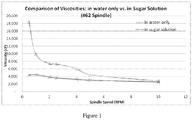
- Figure 1 shows a representative comparison of viscosities between formulations with or without sugar.
- the 1-methylcyclopropene may be prepared by any method.
- Some suitable methods of preparation of cyclopropenes include the processes disclosed in U.S. Patents No. 5,518,988 and 6,017,849 .
- cyclopropene molecular complex A complex that contains a cyclopropene molecule or a portion of a cyclopropene molecule encapsulated in a molecule of a molecular encapsulating agent is known herein as a "cyclopropene molecular complex" or "cyclopropene compound complex.”
- cyclopropene molecular complexes may comprise at least 1, 2, 3, 4, 5, 6, 7, 8, 9, 10, 20, 30, 32, 40, 50, 60, 70, 80, or 90% (w/w) of the solution.
- At least one cyclopropene molecular complex may be present as an inclusion complex.
- the molecular encapsulating agent forms a cavity, and the cyclopropene or a portion of the cyclopropene is located within that cavity.
- the interior of the cavity of the molecular encapsulating agent may be substantially apolar or hydrophobic or both, and the cyclopropene (or the portion of the cyclopropene located within that cavity) is also substantially apolar or hydrophobic or both. While the present invention is not limited to any particular theory or mechanism, it is contemplated that, in such apolar cyclopropene molecular complexes, van der Waals forces, or hydrophobic interactions, or both, cause the cyclopropene molecule or portion thereof to remain within the cavity of the molecular encapsulating agent.
- the 1-methylcyclopropene molecular complexes may be prepared by any means.
- such complexes may be prepared by contacting the cyclopropene with a solution or slurry of the molecular encapsulating agent and then isolating the complex, using, for example, processes disclosed in U.S. Patent No. 6,017,849 .
- the cyclopropene gas may be bubbled through a solution of molecular encapsulating agent in water, from which the complex first precipitates and is then isolated by filtration.
- Complexes may be made by either of the above methods and, after isolation, may be dried and stored in solid form, for example as a powder, for later addition to useful compositions.
- the amount of molecular encapsulating agent may be characterized by the ratio of moles of molecular encapsulating agent to moles of cyclopropene.
- the ratio of moles of molecular encapsulating agent to moles of cyclopropene may be 0.1 or larger; 0.2 or larger; 0.5 or larger; or 0.9 or larger.
- the ratio of moles of molecular encapsulating agent to moles of cyclopropene may be 2 or lower; or 1.5 or lower.
- the encapsulating agent may be alpha-cyclodextrin, beta-cyclodextrin, gamma-cyclodextrin, or a mixture thereof.
- alpha-cyclodextrin may be used. Any cyclodextrin or mixture of cyclodextrins, cyclodextrin polymers, modified cyclodextrins, or mixtures thereof may also be utilized. Some cyclodextrins are available, for example, from Wacker Biochem Inc., Adrian, MI or Cerestar USA, Hammond, IN, as well as other vendors.
- sugar refers to any water-soluble crystalline carbohydrates.
- “Sugar” includes monomer (monosaccharide), dimer (disaccharide), trimer (trisaccharide), multimer (multisaccharide), or polymer (polysaccharide) of pentose (five-member ring sugar) or hexose (six-member ring sugar). Examples of such pentoses or hexoses include glucose, mannose, arabinose, galactose, and fructose.
- sugar of the subject invention includes dextrins and maltodextrins, for example Maltrin M040 from Grain Processing Corporation, which are soluble in water up to 40% and includes syrup.
- sugar of the subject invention comprises sucrose, which is a disaccharide of glucose and fructose.
- the one or more sugars may be a monosaccharide, a disaccharide, or combinations thereof.
- monosaccharides include glucoses, galactoses, riboses, and fructoses.
- sugars include ⁇ -D-Glucose, ⁇ -D-Glucose 6 phosphate, ⁇ -D-Glucosamine, N-Acetyl- ⁇ -D-Glucosamine, N-Actylmuramic acid, ⁇ -D-Gluconate, Galactosamine, Glucosamine, Glucuronate Gluconate, Sialic acid, Deoxyribose, Fucoses, and Rhamnoses.
- disaccharides include sucrose, maltose, and lactose.
- the aqueous solution may be at least 30%, 40%, 50%, 60%, 70%, 75%, 80%, 90%, 95%, or 100% saturated with the one or more sugars at standard temperature and pressure.
- the aqueous solution may be supersaturated by the one or more sugars.
- “100 % saturated” is an aqueous solution wherein the solution can dissolve no more of the one or more sugars at standard temperature and pressure.
- a "50% saturated” solution is an aqueous solution that comprises 50% of the sugar of a 100% saturated solution.
- the phrase "stable" refer to cyclopropene content at ambient temperature over time, for example after one (1) year, in a solution with no more than 15% loss as compared to day zero (0).
- the solution is a “stable” cyclopropene formulation or cyclopropene solution.
- an aqueous solution comprising one or more cyclopropene molecular complexes and one or more sugars as defined herein has more stable cyclopropene content over time than an aqueous solution of one or more cyclopropene molecular complexes that does not include one or more sugars.
- Embodiments include methods of treating plants with the compositions described herein.
- treating the plant with the composition inhibits the ethylene response in the plant.
- the term "plant” is used generically to also include woody-stemmed plants in addition to field crops, potted plants, cut flowers, harvested fruits and vegetables and ornamentals. Examples of plants that can be treated by embodiments include those listed below.
- a plant may be treated at levels of cyclopropene that inhibit the ethylene response in the plant. In some embodiments, a plant may be treated at levels that are below phytotoxic levels. The phytotoxic level may vary not only by plant but also by cultivar. Treatment may be performed on growing plants or on plant parts that have been harvested from growing plants. It is contemplated that, in performing the treatment on growing plants, the composition may be contacted with the entire plant or may be contacted with one or more plant parts. Plant parts include any part of a plant, including flowers, buds, blooms, seeds, cuttings, roots, bulbs, fruits, vegetables, leaves, and combinations thereof. In some embodiments, plants may be treated with compositions described herein prior to or after the harvesting of the useful plant parts.
- compositions described herein may be brought into contact with plants or plant parts by any method, including, for example, spraying, dipping, drenching, fogging, and combinations thereof. In some embodiments, spraying is used.
- Suitable treatments may be performed on a plant that is planted in a field, in a garden, in a building (for example, a greenhouse), or in another location. Suitable treatments may be performed on a plant that is planted in open ground, in one or more containers (for example, a pot, planter, or vase), in confined or raised beds, or in other places. In some embodiments, treatment may be performed on a plant that is in a location other than in a building. In some embodiments, a plant may be treated while it is growing in a container, for example, a pot, flats, or portable bed.
- compositions described herein may be diluted prior to the treatment of a plant therewith.
- compositions described herein prevent numerous ethylene effects, many of which have been disclosed in U.S. Pat. Nos. 5,518,988 and 3,879,188 .
- the embodiments described herein may be employed to influence one or more of the plant ethylene responses.
- Ethylene responses may be initiated by either exogenous or endogenous sources of ethylene.
- Ethylene responses include (i) the ripening and/or senescence of flowers, fruits and vegetables, (ii) the abscission of foliage, flowers and fruit, (iii) the prolongation of the life of ornamentals, e.g. potted plants, cut flowers, shrubbery and dormant seedlings, (iv) the inhibition of growth in some plants e.g. the pea plant, and (v) the stimulation of plant growth in some plants e.g. the rice plant.
- Vegetables which may be treated to inhibit senescence include leafy green vegetables e.g. lettuce (e.g., Lactuea sativa), spinach (Spinaca oleracea) and cabbage (Brassica oleracea); various roots e.g. potatoes (Solanum tuberosum), carrots (Daucus); bulbs e.g. onions (Allium sp.); herbs e.g.
- basil Opimum basilicum
- oregano Origanum vulgare
- dill Adill
- soybean Glycine max
- lima beans Phaseolus limensis
- peas Lathyrus sp.
- corn Zea mays
- broccoli Brass Sica oleracea italica
- cauliflower Brass Sica oleracea botrytis
- asparagus Asparagus officinalis
- Fruits which may be treated by the methods of the present invention to inhibit ripening include tomatoes (Lycopersicon esculentum), apples (Malus domestica), bananas (Musa sapientum), pears (Pyros communis), papaya (Carica papya), mangoes (Mangifera indica), peaches (Prunus persica), apricots (Prunus armeniaca), nectarines (Prunus persica nectarina), oranges (Citrus sp.), lemons (Citrus limonia), limes (Citrus aurantifolia), grapefruit (Citrus paradisi), tangerines (Citrus nobilis deliciosa), kiwi (Actinidia chinenus), melons such as cantaloupes (C.
- cantalupensis and musk melons (C. melo), pineapples (Aranae comosus), persimmon (Diospyros sp.) and raspberries (e.g., Fragaria or Rubus ursinus), blueberries (Vaccinium sp.), green beans (Phaseolus vulgaris), members of the genus Cucumis e.g. cucumber (C. sativus) and avocados (Persea americana).
- Ornamental plants which may be treated by the methods of the present invention to inhibit senescence and/or to prolong flower life and appearance (e.g. the delay of wilting), include potted ornamentals and cut flowers.
- Potted ornamentals and cut flowers which may be treated include azalea (Rhododendron spp.), hydrangea (Macrophylla hydrangea), hibiscus (Hibiscus rosasanensis), snapdragons (Antirrhinum sp.), poinsettia (Euphorbia pulcherima), cactus (e.g., Cactaceae schlumbergera truncata), begonias (Begonia sp.), roses (Rosa sp.), tulips (Tulipa sp.), daffodils (Narcissus sp.), petunias (Petunia hybrida), carnation (Dianthus caryophyll
- Plants which may be treated to inhibit abscission of foliage, flowers, and fruit include cotton (Gossypium spp.), apples, pears, cherries (Prunus avium), pecans (Carva illinoensis), grapes (Vitis vinifera), olives (e.g., Olea europaea), coffee (Cofffea arabica), snapbeans (Phaseolus vulgaris), and weeping fig (Ficus benjamina), as well as dormant seedlings include those of various fruit trees including apple, ornamental plants, shrubbery, and tree seedlings.
- shrubbery which may be treated to inhibit abscission of foliage include privet (Ligustrum sp.), photinea (Photina sp.), holly (Ilex sp.), ferns of the family Polypodiaceae, schefflera (Schefflera sp.), aglaonema (Aglaonema sp.), Laceaster (Cotoneastersp.), barberry (Berberris sp.), waxmyrtle (Myrica sp.), abelia (Abelia sp.), acacia (Acacia sp.), and bromeliades of the family Bromeliaceae.
- privet Ligustrum sp.
- photinea Pierhotina sp.
- holly Ilex sp.
- ferns of the family Polypodiaceae schefflera (Schefflera sp.), aglaonema (Aglaone
- the compositions described herein may be used to treat a plant growing in a field. Such a treatment operation may be performed one time or more than one time on a particular group of crop during a single growing season.
- the amount of cyclopropene used in one treatment may be 0.1 gram per hectare (g/ha) or more; or 0.5 g/ha or more; or 1 g/ha or more; or 5 g/ha or more; or 25 g/ha or more; or 50 g/ha or more; or 100 g/ha or more.
- the amount of cyclopropene used in one spraying operation may be 6000 g/ha or less; or 3000 g/ha or less; or 1500 g/ha or less.
- the phrase "plant” includes dicotyledons plants and monocotyledons plants.
- dicotyledons plants include tobacco, Arabidopsis, soybean, tomato, papaya, canola, sunflower, cotton, alfalfa, potato, grapevine, pigeon pea, pea, Brassica, chickpea, sugar beet, rapeseed, watermelon, melon, pepper, peanut, pumpkin, radish, spinach, squash, broccoli, cabbage, carrot, cauliflower, celery, Chinese cabbage, cucumber, eggplant, and lettuce.
- monocotyledons plants include corn, rice, wheat, sugarcane, barley, rye, sorghum, orchids, bamboo, banana, cattails, lilies, oat, onion, millet, and triticale.
- plant material refers to leaves, stems, roots, flowers or flower parts, fruits, pollen, egg cells, zygotes, seeds, cuttings, cell or tissue cultures, or any other part or product of a plant.
- plant material includes cotyledon and leaf.
- plant tissue refers to a group of plant cells organized into a structural and functional unit. Any tissue of a plant in planta or in culture is included, for example: whole plants, plant organs, plant seeds, tissue culture and any groups of plant cells organized into structural and/or functional units.
- compositions described herein or diluted solutions derived from may be used to treat a plant growing in a field. Such a treatment operation may be performed two or more times on a particular group of crop during a single growing season.
- amount of cyclopropene used in any single treatment may be 0.1 gram per hectare (g/ha) or more; or 0.5 g/ha or more; or 1 g/ha or more; or 5 g/ha or more; or 10 g/ha or more; or 25 g/ha or more; or 50 g/ha or more; or 100 g/ha or more.
- the amount of cyclopropene used in one application may be 6000 g/ha or less; or 3000 g/ha or less; or 1500 g/ha or less; or 1000 g/ha or less; or 500 g/ha or less; or 250 g/ha or less; or 100 g/ha or less; or 50 g/ha or less; or 25 g/ha or less; or 10 g/ha or less; or 5 g/ha or less; or 1 g/ha or less.
- ranges of 60 to 120 and 80 to 110 are recited for a particular parameter, it is understood that the ranges of 60 to 110 and 80 to 120 are also contemplated.
- a particular parameter is disclosed to have suitable minima of 1, 2, and 3, and if that parameter is disclosed to have suitable maxima of 9 and 10, then all the following ranges are contemplated: 1 to 9, 1 to 10, 2 to 9, 2 to 10, 3 to 9, and 3 to 10.
- a headspace assay is used to show that presence of sugar can suppress the loss of 1-MCP into the headspace and maintain a more stable and more flowable formulation as compared to a control formulation without sugar.
- a liquid formulation (with or without sucrose) comprising 1-MCP is used to partially fill a bottle and then the bottle is sealed airtight.
- a headspace between the liquid and top cap of the bottle contains 1-MCP escaped from the liquid formulation.
- the 1-MCP stability in the liquid formulation can be estimated based on the amount of 1-MCP detected in the headspace (the higher concentration of 1-MCP detected in the headspace, the less stable the formulation will be).
- Methods for detecting 1-MCP are well-known in the art including, for example, gas chromatography (GC).
- Sample 2-1 is prepared by first mixing 89.76 grams of sugar with 46.2 grams of water. After the sugar is completely dissolved, 64 grams of HAIP powder is added to the sugar solution. The powder is mixed well in an open container inside a hood; then the content ( ⁇ 193 grams) is transferred into a 250 ml bottle equipped with a mininert for syringe sampling of the headspace without opening the bottle. The headspace is analyzed for 1-MCP concentration using a GC. 1-MCP concentration in the headspace is expressed as parts per million by volume or ppmv in the headspace.
- Sample 2-2 is prepared by mixing 136 grams of HAIP powder with 98.3 grams of water in a beaker inside a hood, under the same HAIP powder to water ratio as Sample 2-1.
- the slurry ( ⁇ 196g) is then transferred to a similar 250 ml bottle equipped with a mininert for syringe sampling, and the headspace is analyzed for amount of 1-MCP.
- Sample 2-1 is more flowable and more convenient to use than Sample 2-2, which is more viscous and looks like a paste.
- the amount of 1-MCP within the headspace of the samples inside the bottles is much lower for the sugar containing sample (Sample 2-1) than the non-sugar containing Sample 2-2 (see also Table 2 below).
- Lower amount of 1-MCP in the headspace indicates that more 1-MCP is kept inside the complex and the formulation.
- the sugar-containing Sample 2-1 is more stable than the sugar-free Sample 2-2.
- Sample 2-3 is prepared by first mixing 120 grams of sucrose with 62 grams of water in a beaker. After the sugar is dissolved completely, 62 grams of HAIP powder is then added to the sugar solution. After the powder is mixed well into the solution, the sample is transferred into a 250 ml bottle equipment with a mininert for air tight syringe sampling. The amount of 1-MCP in the headspace is measured after three and half (3.5) hours of shaking on a Thermo Scientific multi-purpose rotator.
- Sample 2-4 is prepared by mixing 113 grams of HAIP powder with 113 grams of water in a beaker in the same HAIP to water mass ration as in Sample 2-3. The slurry is mixed well, then transferred to a 250ml bottle equipment with a mininert for air tight syringe sampling. The amount of 1-MCP in the headspace is monitored after continuous shaking on a Thermo Scientific multi-purpose rotator.
- Sample 2-5 is prepared by mixing 50.1 grams of HAIP powder with150.1 grams of water in a 250 ml bottle for a 25% wt/wt concentration of HAIP powder in water. The sample is shaken vigorously to disperse the solid in water, before it is placed on the rotator for continuous mixing. The amount of 1-MCP in the headspace is measured with a GC after at least 1 hour of agitation, and then the bottle is vented for 30 minutes before being sealed again. The headspace is analyzed again subsequently. This procedure is repeated multiple times, where the equilibrium concentrations of 1-MCP in the headspace are obtained.
- Sample 2-6 is prepared by mixing 70 grams of HAIP powder with 130 grams of water in a 250 ml bottle to reach a 35% wt/wt concentration of HAIP powder in water. The sample is mixed and 1-MCP is analyzed in the same way as Sample 2-5.
- Table 2 shows the equilibrium concentrations of 1-MCP found in the headspace for Samples 2-1 to 2-6, where the presence of dissolved sucrose can suppress the release / loss of 1-MCP while maintaining a more flowable / more convenient formulation.
- Table 2 shows the equilibrium concentrations of 1-MCP found in the headspace for Samples 2-1 to 2-6, where the presence of dissolved sucrose can suppress the release / loss of 1-MCP while maintaining a more flowable / more convenient formulation.
- Table 2 shows the equilibrium concentrations of 1-MCP found in the headspace for Samples 2-1 to 2-6, where the presence of dissolved sucrose can suppress the release / loss of 1-MCP while maintaining a more flowable / more convenient formulation.
- Table 2 shows the equilibrium concentrations of 1-MCP found in the headspace for Samples 2-1 to 2-6, where the presence of dissolved sucrose can suppress the release / loss of 1-MCP while maintaining a more flowable / more convenient formulation.
- Table 2 shows the equilibrium concentrations of 1-MCP found in the headspace for Sample
Landscapes
- Life Sciences & Earth Sciences (AREA)
- General Health & Medical Sciences (AREA)
- Health & Medical Sciences (AREA)
- Engineering & Computer Science (AREA)
- Zoology (AREA)
- Wood Science & Technology (AREA)
- Agronomy & Crop Science (AREA)
- Plant Pathology (AREA)
- Environmental Sciences (AREA)
- Dentistry (AREA)
- Pest Control & Pesticides (AREA)
- Toxicology (AREA)
- Chemical & Material Sciences (AREA)
- Microbiology (AREA)
- Chemical Kinetics & Catalysis (AREA)
- General Chemical & Material Sciences (AREA)
- Food Science & Technology (AREA)
- Polymers & Plastics (AREA)
- Agricultural Chemicals And Associated Chemicals (AREA)
Claims (9)
- Zusammensetzung, umfassend eine wässrige Lösung eines molekularen Cyclopropenkomplexes, der ein Cyclopropen und ein molekulares Verkapselungsmittel umfasst, und zumindest einen Zucker, wobei das Cyclopropen 1-Methylcyclopropen ist, wobei das molekulare Verkapselungsmittel ein Cyclodextrin umfasst;
und wobei die wässrige Lösung zumindest 25 % mit dem zumindest einen Zucker gesättigt ist. - Zusammensetzung nach Anspruch 1, wobei der molekulare Cyclopropenkomplex einen Einschlusskomplex umfasst.
- Zusammensetzung nach Anspruch 1, wobei das molekulare Verkapselungsmittel aus der Gruppe bestehend aus substituierten Cyclodextrinen oder unsubstituierten Cyclodextrinen ausgewählt ist.
- Zusammensetzung nach Anspruch 1, wobei das molekulare Verkapselungsmittel ein Cyclodextrin umfasst, das aus der Gruppe bestehend aus alpha-Cyclodextrin, beta-Cyclodextrin, gamma-Cyclodextrin und Kombinationen davon ausgewählt ist.
- Zusammensetzung nach Anspruch 1, wobei die wässrige Lösung 90-100 % mit Saccharose gesättigt ist.
- Zusammensetzung nach Anspruch 1, wobei der zumindest eine Zucker aus der Gruppe bestehend aus Monosacchariden, Disacchariden und Kombinationen davon ausgewählt ist.
- Zusammensetzung nach Anspruch 1, wobei der zumindest eine Zucker Saccharose umfasst.
- Zusammensetzung nach Anspruch 1, umfassend:(a) eine wässrige Lösung aus zumindest einem molekularen Cyclopropenkomplex, der das Cyclopropen und ein molekulares Verkapselungsmittel umfasst, das aus der Gruppe bestehend aus substituierten Cyclodextrinen und unsubstituierten Cyclodextrinen ausgewählt ist; und(b) zumindest einen Zucker, der aus der Gruppe bestehend aus Monosacchariden, Disacchariden, Trisachhariden, Oligosacchariden, Polysacchariden und Kombinationen davon ausgewählt ist.
- Verfahren zum Hemmen einer Ethylenreaktion einer Pflanze, wobei das Verfahren Behandeln der Pflanze mit der Zusammensetzung nach einem der Ansprüche 1 bis 8 umfasst.
Applications Claiming Priority (2)
| Application Number | Priority Date | Filing Date | Title |
|---|---|---|---|
| US201361752611P | 2013-01-15 | 2013-01-15 | |
| PCT/US2014/011447 WO2014113375A2 (en) | 2013-01-15 | 2014-01-14 | Compositions and methods for stabilizing cyclopropene in solutions |
Publications (2)
| Publication Number | Publication Date |
|---|---|
| EP2945482A2 EP2945482A2 (de) | 2015-11-25 |
| EP2945482B1 true EP2945482B1 (de) | 2019-03-20 |
Family
ID=51022397
Family Applications (1)
| Application Number | Title | Priority Date | Filing Date |
|---|---|---|---|
| EP14733391.8A Active EP2945482B1 (de) | 2013-01-15 | 2014-01-14 | Zusammensetzungen und methoden zur stabilisierung von 1-methylcyclopropen in lösungen |
Country Status (8)
| Country | Link |
|---|---|
| US (2) | US9867370B2 (de) |
| EP (1) | EP2945482B1 (de) |
| AU (1) | AU2014207678B2 (de) |
| CA (1) | CA2898359C (de) |
| ES (1) | ES2724273T3 (de) |
| PT (1) | PT2945482T (de) |
| TR (1) | TR201906418T4 (de) |
| WO (1) | WO2014113375A2 (de) |
Families Citing this family (7)
| Publication number | Priority date | Publication date | Assignee | Title |
|---|---|---|---|---|
| AU2014207678B2 (en) * | 2013-01-15 | 2017-07-20 | Agrofresh Inc. | Compositions and methods for stabilizing cyclopropenes in solutions |
| IL304085B2 (en) | 2018-04-27 | 2025-09-01 | Fresh Inset S A | Preparations and articles containing complexes of 1-methylcyclopropane and alpha-cyclodextrin |
| WO2020186368A1 (es) * | 2019-03-15 | 2020-09-24 | Nanotec S.A. | Nanoburbujas de 1-metilciclopropeno modificado (1-mcp) |
| EP4099826A1 (de) * | 2020-02-03 | 2022-12-14 | Fresh Inset S.A. | Stabile 1-methylcyclopropenzusammensetzungen und verwendungen davon |
| WO2023288294A1 (en) | 2021-07-16 | 2023-01-19 | Novozymes A/S | Compositions and methods for improving the rainfastness of proteins on plant surfaces |
| CA3238725A1 (en) * | 2021-11-24 | 2023-06-01 | Lei Liu | Consumer applications for cyclopropene-containing compositions |
| CN119630280A (zh) | 2022-05-14 | 2025-03-14 | 诺维信公司 | 用于预防、处理、抑制和/或消除植物病原性侵染和感染的组合物和方法 |
Family Cites Families (12)
| Publication number | Priority date | Publication date | Assignee | Title |
|---|---|---|---|---|
| US3879188A (en) | 1969-10-24 | 1975-04-22 | Amchem Prod | Growth regulation process |
| US5518988A (en) | 1994-06-03 | 1996-05-21 | North Carolina State University | Method of counteracting an ethylene response in plants |
| US6017849A (en) | 1998-08-20 | 2000-01-25 | Biotechnologies For Horticulture, Inc. | Synthesis methods, complexes and delivery methods for the safe and convenient storage, transport and application of compounds for inhibiting the ethylene response in plants |
| US6444619B1 (en) * | 2000-09-28 | 2002-09-03 | Rohm And Haas Company | Delivery system for cyclopropenes |
| US6762153B2 (en) * | 2001-10-18 | 2004-07-13 | Rohm And Haas Company | Delivery system for cyclopropenes |
| EP1609359A3 (de) | 2004-06-24 | 2011-10-05 | Rohm and Haas Company | Verfahren zur Behandlung von Pflanzen oder Pflanzenteilen |
| EP2164323A1 (de) | 2006-12-15 | 2010-03-24 | Rohm and Haas Company | Mischungen umfassend 1-methylcyclopropen |
| JP2011045363A (ja) * | 2009-08-06 | 2011-03-10 | Rohm & Haas Co | 観賞植物の処理 |
| JP2011246463A (ja) * | 2010-05-25 | 2011-12-08 | Rohm & Haas Co | 植物部分上のワックス状コーティング |
| CN101940203B (zh) * | 2010-09-15 | 2013-03-13 | 姜希文 | 一种以多肽和1-甲基环丙烯为主要成份的鲜切花保鲜剂 |
| CN102187856B (zh) * | 2011-04-01 | 2013-06-12 | 韩金光 | 鲜花保鲜剂 |
| AU2014207678B2 (en) * | 2013-01-15 | 2017-07-20 | Agrofresh Inc. | Compositions and methods for stabilizing cyclopropenes in solutions |
-
2014
- 2014-01-14 AU AU2014207678A patent/AU2014207678B2/en active Active
- 2014-01-14 TR TR2019/06418T patent/TR201906418T4/tr unknown
- 2014-01-14 CA CA2898359A patent/CA2898359C/en active Active
- 2014-01-14 ES ES14733391T patent/ES2724273T3/es active Active
- 2014-01-14 EP EP14733391.8A patent/EP2945482B1/de active Active
- 2014-01-14 US US14/760,815 patent/US9867370B2/en active Active
- 2014-01-14 WO PCT/US2014/011447 patent/WO2014113375A2/en not_active Ceased
- 2014-01-14 PT PT14733391T patent/PT2945482T/pt unknown
-
2017
- 2017-11-09 US US15/808,460 patent/US10375954B2/en active Active
Non-Patent Citations (1)
| Title |
|---|
| None * |
Also Published As
| Publication number | Publication date |
|---|---|
| WO2014113375A3 (en) | 2014-09-18 |
| US10375954B2 (en) | 2019-08-13 |
| TR201906418T4 (tr) | 2019-05-21 |
| PT2945482T (pt) | 2019-05-30 |
| AU2014207678B2 (en) | 2017-07-20 |
| US20180064106A1 (en) | 2018-03-08 |
| EP2945482A2 (de) | 2015-11-25 |
| ES2724273T3 (es) | 2019-09-09 |
| US20160000072A1 (en) | 2016-01-07 |
| CA2898359A1 (en) | 2014-07-24 |
| AU2014207678A1 (en) | 2015-07-30 |
| CA2898359C (en) | 2021-07-06 |
| WO2014113375A2 (en) | 2014-07-24 |
| US9867370B2 (en) | 2018-01-16 |
Similar Documents
| Publication | Publication Date | Title |
|---|---|---|
| US10375954B2 (en) | Compositions and methods for stabilizing cyclopropene in solutions | |
| DE69938204T2 (de) | Komplexe zur Inhibierung der Ethylen-Antwort von Pflanzen | |
| US10869473B2 (en) | Systems and methods for solvent-free delivery of volatile compounds | |
| EP1597968B1 (de) | Komplexe und Abgabeverfahren zur sicheren und bequemen Lagerung, Transport und Anwendung von Verbindungen zur Hemmung der Ethylen-Antwort von Pflanzen | |
| EP2180782B1 (de) | Zusammensetzungen und verfahren zur blockierung der ethylenreaktion bei pflanzen mittels 3 -cycloprop- i - enyl- propansäuresalz | |
| AU2014219231B2 (en) | Methods for increasing crop yield | |
| WO2015188222A1 (en) | Methods and products for inhibiting an ethylene response | |
| NZ718340B2 (en) | Systems and methods for solvent-free delivery of volatile compounds |
Legal Events
| Date | Code | Title | Description |
|---|---|---|---|
| PUAI | Public reference made under article 153(3) epc to a published international application that has entered the european phase |
Free format text: ORIGINAL CODE: 0009012 |
|
| 17P | Request for examination filed |
Effective date: 20150814 |
|
| AK | Designated contracting states |
Kind code of ref document: A2 Designated state(s): AL AT BE BG CH CY CZ DE DK EE ES FI FR GB GR HR HU IE IS IT LI LT LU LV MC MK MT NL NO PL PT RO RS SE SI SK SM TR |
|
| AX | Request for extension of the european patent |
Extension state: BA ME |
|
| DAX | Request for extension of the european patent (deleted) | ||
| 17Q | First examination report despatched |
Effective date: 20160826 |
|
| STAA | Information on the status of an ep patent application or granted ep patent |
Free format text: STATUS: EXAMINATION IS IN PROGRESS |
|
| RAP1 | Party data changed (applicant data changed or rights of an application transferred) |
Owner name: AGROFRESH INC. |
|
| RAP1 | Party data changed (applicant data changed or rights of an application transferred) |
Owner name: AGROFRESH INC. |
|
| GRAP | Despatch of communication of intention to grant a patent |
Free format text: ORIGINAL CODE: EPIDOSNIGR1 |
|
| STAA | Information on the status of an ep patent application or granted ep patent |
Free format text: STATUS: GRANT OF PATENT IS INTENDED |
|
| INTG | Intention to grant announced |
Effective date: 20181008 |
|
| GRAS | Grant fee paid |
Free format text: ORIGINAL CODE: EPIDOSNIGR3 |
|
| GRAA | (expected) grant |
Free format text: ORIGINAL CODE: 0009210 |
|
| STAA | Information on the status of an ep patent application or granted ep patent |
Free format text: STATUS: THE PATENT HAS BEEN GRANTED |
|
| AK | Designated contracting states |
Kind code of ref document: B1 Designated state(s): AL AT BE BG CH CY CZ DE DK EE ES FI FR GB GR HR HU IE IS IT LI LT LU LV MC MK MT NL NO PL PT RO RS SE SI SK SM TR |
|
| REG | Reference to a national code |
Ref country code: GB Ref legal event code: FG4D |
|
| REG | Reference to a national code |
Ref country code: CH Ref legal event code: EP |
|
| REG | Reference to a national code |
Ref country code: DE Ref legal event code: R096 Ref document number: 602014043238 Country of ref document: DE |
|
| REG | Reference to a national code |
Ref country code: AT Ref legal event code: REF Ref document number: 1109538 Country of ref document: AT Kind code of ref document: T Effective date: 20190415 |
|
| REG | Reference to a national code |
Ref country code: IE Ref legal event code: FG4D |
|
| REG | Reference to a national code |
Ref country code: NL Ref legal event code: FP |
|
| REG | Reference to a national code |
Ref country code: PT Ref legal event code: SC4A Ref document number: 2945482 Country of ref document: PT Date of ref document: 20190530 Kind code of ref document: T Free format text: AVAILABILITY OF NATIONAL TRANSLATION Effective date: 20190507 |
|
| REG | Reference to a national code |
Ref country code: CH Ref legal event code: NV Representative=s name: TR-IP CONSULTING LLC, CH |
|
| PG25 | Lapsed in a contracting state [announced via postgrant information from national office to epo] |
Ref country code: FI Free format text: LAPSE BECAUSE OF FAILURE TO SUBMIT A TRANSLATION OF THE DESCRIPTION OR TO PAY THE FEE WITHIN THE PRESCRIBED TIME-LIMIT Effective date: 20190320 Ref country code: LT Free format text: LAPSE BECAUSE OF FAILURE TO SUBMIT A TRANSLATION OF THE DESCRIPTION OR TO PAY THE FEE WITHIN THE PRESCRIBED TIME-LIMIT Effective date: 20190320 Ref country code: SE Free format text: LAPSE BECAUSE OF FAILURE TO SUBMIT A TRANSLATION OF THE DESCRIPTION OR TO PAY THE FEE WITHIN THE PRESCRIBED TIME-LIMIT Effective date: 20190320 Ref country code: NO Free format text: LAPSE BECAUSE OF FAILURE TO SUBMIT A TRANSLATION OF THE DESCRIPTION OR TO PAY THE FEE WITHIN THE PRESCRIBED TIME-LIMIT Effective date: 20190620 |
|
| REG | Reference to a national code |
Ref country code: LT Ref legal event code: MG4D |
|
| REG | Reference to a national code |
Ref country code: GR Ref legal event code: EP Ref document number: 20190401586 Country of ref document: GR Effective date: 20190708 |
|
| PG25 | Lapsed in a contracting state [announced via postgrant information from national office to epo] |
Ref country code: HR Free format text: LAPSE BECAUSE OF FAILURE TO SUBMIT A TRANSLATION OF THE DESCRIPTION OR TO PAY THE FEE WITHIN THE PRESCRIBED TIME-LIMIT Effective date: 20190320 Ref country code: LV Free format text: LAPSE BECAUSE OF FAILURE TO SUBMIT A TRANSLATION OF THE DESCRIPTION OR TO PAY THE FEE WITHIN THE PRESCRIBED TIME-LIMIT Effective date: 20190320 Ref country code: RS Free format text: LAPSE BECAUSE OF FAILURE TO SUBMIT A TRANSLATION OF THE DESCRIPTION OR TO PAY THE FEE WITHIN THE PRESCRIBED TIME-LIMIT Effective date: 20190320 Ref country code: BG Free format text: LAPSE BECAUSE OF FAILURE TO SUBMIT A TRANSLATION OF THE DESCRIPTION OR TO PAY THE FEE WITHIN THE PRESCRIBED TIME-LIMIT Effective date: 20190620 |
|
| REG | Reference to a national code |
Ref country code: ES Ref legal event code: FG2A Ref document number: 2724273 Country of ref document: ES Kind code of ref document: T3 Effective date: 20190909 |
|
| PG25 | Lapsed in a contracting state [announced via postgrant information from national office to epo] |
Ref country code: CZ Free format text: LAPSE BECAUSE OF FAILURE TO SUBMIT A TRANSLATION OF THE DESCRIPTION OR TO PAY THE FEE WITHIN THE PRESCRIBED TIME-LIMIT Effective date: 20190320 Ref country code: EE Free format text: LAPSE BECAUSE OF FAILURE TO SUBMIT A TRANSLATION OF THE DESCRIPTION OR TO PAY THE FEE WITHIN THE PRESCRIBED TIME-LIMIT Effective date: 20190320 Ref country code: RO Free format text: LAPSE BECAUSE OF FAILURE TO SUBMIT A TRANSLATION OF THE DESCRIPTION OR TO PAY THE FEE WITHIN THE PRESCRIBED TIME-LIMIT Effective date: 20190320 Ref country code: AL Free format text: LAPSE BECAUSE OF FAILURE TO SUBMIT A TRANSLATION OF THE DESCRIPTION OR TO PAY THE FEE WITHIN THE PRESCRIBED TIME-LIMIT Effective date: 20190320 Ref country code: SK Free format text: LAPSE BECAUSE OF FAILURE TO SUBMIT A TRANSLATION OF THE DESCRIPTION OR TO PAY THE FEE WITHIN THE PRESCRIBED TIME-LIMIT Effective date: 20190320 |
|
| PG25 | Lapsed in a contracting state [announced via postgrant information from national office to epo] |
Ref country code: PL Free format text: LAPSE BECAUSE OF FAILURE TO SUBMIT A TRANSLATION OF THE DESCRIPTION OR TO PAY THE FEE WITHIN THE PRESCRIBED TIME-LIMIT Effective date: 20190320 Ref country code: SM Free format text: LAPSE BECAUSE OF FAILURE TO SUBMIT A TRANSLATION OF THE DESCRIPTION OR TO PAY THE FEE WITHIN THE PRESCRIBED TIME-LIMIT Effective date: 20190320 |
|
| PG25 | Lapsed in a contracting state [announced via postgrant information from national office to epo] |
Ref country code: IS Free format text: LAPSE BECAUSE OF FAILURE TO SUBMIT A TRANSLATION OF THE DESCRIPTION OR TO PAY THE FEE WITHIN THE PRESCRIBED TIME-LIMIT Effective date: 20190720 |
|
| REG | Reference to a national code |
Ref country code: DE Ref legal event code: R097 Ref document number: 602014043238 Country of ref document: DE |
|
| PLBE | No opposition filed within time limit |
Free format text: ORIGINAL CODE: 0009261 |
|
| STAA | Information on the status of an ep patent application or granted ep patent |
Free format text: STATUS: NO OPPOSITION FILED WITHIN TIME LIMIT |
|
| PG25 | Lapsed in a contracting state [announced via postgrant information from national office to epo] |
Ref country code: DK Free format text: LAPSE BECAUSE OF FAILURE TO SUBMIT A TRANSLATION OF THE DESCRIPTION OR TO PAY THE FEE WITHIN THE PRESCRIBED TIME-LIMIT Effective date: 20190320 |
|
| REG | Reference to a national code |
Ref country code: CH Ref legal event code: PCAR Free format text: NEW ADDRESS: ROUTE DU COUTSET 18, 1485 NUVILLY (CH) |
|
| 26N | No opposition filed |
Effective date: 20200102 |
|
| PG25 | Lapsed in a contracting state [announced via postgrant information from national office to epo] |
Ref country code: SI Free format text: LAPSE BECAUSE OF FAILURE TO SUBMIT A TRANSLATION OF THE DESCRIPTION OR TO PAY THE FEE WITHIN THE PRESCRIBED TIME-LIMIT Effective date: 20190320 |
|
| PG25 | Lapsed in a contracting state [announced via postgrant information from national office to epo] |
Ref country code: MC Free format text: LAPSE BECAUSE OF FAILURE TO SUBMIT A TRANSLATION OF THE DESCRIPTION OR TO PAY THE FEE WITHIN THE PRESCRIBED TIME-LIMIT Effective date: 20190320 |
|
| PG25 | Lapsed in a contracting state [announced via postgrant information from national office to epo] |
Ref country code: LU Free format text: LAPSE BECAUSE OF NON-PAYMENT OF DUE FEES Effective date: 20200114 |
|
| PG25 | Lapsed in a contracting state [announced via postgrant information from national office to epo] |
Ref country code: IE Free format text: LAPSE BECAUSE OF NON-PAYMENT OF DUE FEES Effective date: 20200114 |
|
| REG | Reference to a national code |
Ref country code: AT Ref legal event code: UEP Ref document number: 1109538 Country of ref document: AT Kind code of ref document: T Effective date: 20190320 |
|
| PG25 | Lapsed in a contracting state [announced via postgrant information from national office to epo] |
Ref country code: MT Free format text: LAPSE BECAUSE OF FAILURE TO SUBMIT A TRANSLATION OF THE DESCRIPTION OR TO PAY THE FEE WITHIN THE PRESCRIBED TIME-LIMIT Effective date: 20190320 Ref country code: CY Free format text: LAPSE BECAUSE OF FAILURE TO SUBMIT A TRANSLATION OF THE DESCRIPTION OR TO PAY THE FEE WITHIN THE PRESCRIBED TIME-LIMIT Effective date: 20190320 |
|
| PG25 | Lapsed in a contracting state [announced via postgrant information from national office to epo] |
Ref country code: MK Free format text: LAPSE BECAUSE OF FAILURE TO SUBMIT A TRANSLATION OF THE DESCRIPTION OR TO PAY THE FEE WITHIN THE PRESCRIBED TIME-LIMIT Effective date: 20190320 |
|
| P01 | Opt-out of the competence of the unified patent court (upc) registered |
Effective date: 20230517 |
|
| PGFP | Annual fee paid to national office [announced via postgrant information from national office to epo] |
Ref country code: PT Payment date: 20241218 Year of fee payment: 12 |
|
| PGFP | Annual fee paid to national office [announced via postgrant information from national office to epo] |
Ref country code: GR Payment date: 20250129 Year of fee payment: 12 Ref country code: CH Payment date: 20250201 Year of fee payment: 12 |
|
| REG | Reference to a national code |
Ref country code: CH Ref legal event code: U11 Free format text: ST27 STATUS EVENT CODE: U-0-0-U10-U11 (AS PROVIDED BY THE NATIONAL OFFICE) Effective date: 20260201 |
|
| PGFP | Annual fee paid to national office [announced via postgrant information from national office to epo] |
Ref country code: NL Payment date: 20260126 Year of fee payment: 13 |
|
| PGFP | Annual fee paid to national office [announced via postgrant information from national office to epo] |
Ref country code: GB Payment date: 20260127 Year of fee payment: 13 |
|
| PGFP | Annual fee paid to national office [announced via postgrant information from national office to epo] |
Ref country code: ES Payment date: 20260202 Year of fee payment: 13 |
|
| PGFP | Annual fee paid to national office [announced via postgrant information from national office to epo] |
Ref country code: DE Payment date: 20260128 Year of fee payment: 13 |
|
| PGFP | Annual fee paid to national office [announced via postgrant information from national office to epo] |
Ref country code: AT Payment date: 20260128 Year of fee payment: 13 |
|
| PGFP | Annual fee paid to national office [announced via postgrant information from national office to epo] |
Ref country code: BE Payment date: 20260127 Year of fee payment: 13 Ref country code: IT Payment date: 20260121 Year of fee payment: 13 |
|
| PGFP | Annual fee paid to national office [announced via postgrant information from national office to epo] |
Ref country code: FR Payment date: 20260126 Year of fee payment: 13 |
|
| PGFP | Annual fee paid to national office [announced via postgrant information from national office to epo] |
Ref country code: TR Payment date: 20260112 Year of fee payment: 13 |