EP2945623B1 - Signalhemmer des hedgehog-signmalwegs und therapeutische anwendungen davon - Google Patents
Signalhemmer des hedgehog-signmalwegs und therapeutische anwendungen davon Download PDFInfo
- Publication number
- EP2945623B1 EP2945623B1 EP13871618.8A EP13871618A EP2945623B1 EP 2945623 B1 EP2945623 B1 EP 2945623B1 EP 13871618 A EP13871618 A EP 13871618A EP 2945623 B1 EP2945623 B1 EP 2945623B1
- Authority
- EP
- European Patent Office
- Prior art keywords
- dimethyl
- mmol
- chloro
- nmr
- cdcl
- Prior art date
- Legal status (The legal status is an assumption and is not a legal conclusion. Google has not performed a legal analysis and makes no representation as to the accuracy of the status listed.)
- Active
Links
- 0 CC1C(C*2CCOCC2)=C*(CC*(C2)C(*C=C3N)=CC3=C3C(C)=CC(C)=C*3)C2=CC1 Chemical compound CC1C(C*2CCOCC2)=C*(CC*(C2)C(*C=C3N)=CC3=C3C(C)=CC(C)=C*3)C2=CC1 0.000 description 9
- UWHQBMVHISVGCK-UHFFFAOYSA-N Cc1cc(C)c(-c2cc(Cl)ncc2Cl)nc1 Chemical compound Cc1cc(C)c(-c2cc(Cl)ncc2Cl)nc1 UWHQBMVHISVGCK-UHFFFAOYSA-N 0.000 description 3
- FQEXCVFLNODSOS-UHFFFAOYSA-N CCC(Nc1c[n](CCN(C2)c(cc3-c4ncc(C)cc4C)ncc3Cl)c2n1)=O Chemical compound CCC(Nc1c[n](CCN(C2)c(cc3-c4ncc(C)cc4C)ncc3Cl)c2n1)=O FQEXCVFLNODSOS-UHFFFAOYSA-N 0.000 description 2
- XCZGVUCCACZDIY-UHFFFAOYSA-N C(c1c[n](CCNC2)c2n1)N1CCOCC1 Chemical compound C(c1c[n](CCNC2)c2n1)N1CCOCC1 XCZGVUCCACZDIY-UHFFFAOYSA-N 0.000 description 1
- XDTMQSROBMDMFD-UHFFFAOYSA-N C1CCCCC1 Chemical compound C1CCCCC1 XDTMQSROBMDMFD-UHFFFAOYSA-N 0.000 description 1
- ZWZYTDSIWOHJQD-UHFFFAOYSA-N CC(C(C(c1ncc(C)cc1C)=C1)Cl)N=C1Cl Chemical compound CC(C(C(c1ncc(C)cc1C)=C1)Cl)N=C1Cl ZWZYTDSIWOHJQD-UHFFFAOYSA-N 0.000 description 1
- ISKGFCQLILLUQY-UHFFFAOYSA-N CC(C1)c2nc(N3CCCC3)ncc2CN1c(cc1-c2c(C)cc(C)cn2)ncc1Cl Chemical compound CC(C1)c2nc(N3CCCC3)ncc2CN1c(cc1-c2c(C)cc(C)cn2)ncc1Cl ISKGFCQLILLUQY-UHFFFAOYSA-N 0.000 description 1
- SUCYCPQGSGNCPG-UHFFFAOYSA-N CC(Nc1nc(CCN(C2)c(cc3-c4c(C)cc(C)cn4)ncc3Cl)c2[s]1)=O Chemical compound CC(Nc1nc(CCN(C2)c(cc3-c4c(C)cc(C)cn4)ncc3Cl)c2[s]1)=O SUCYCPQGSGNCPG-UHFFFAOYSA-N 0.000 description 1
- FPZDSPXZMVFJFF-UHFFFAOYSA-N CC1c2nc(N3CCCC3)ncc2CNC1 Chemical compound CC1c2nc(N3CCCC3)ncc2CNC1 FPZDSPXZMVFJFF-UHFFFAOYSA-N 0.000 description 1
- XXAFDTRNXCJKJT-UHFFFAOYSA-N CCC(Nc1c[n](CCNC2)c2n1)=O Chemical compound CCC(Nc1c[n](CCNC2)c2n1)=O XXAFDTRNXCJKJT-UHFFFAOYSA-N 0.000 description 1
- HSRZDNJXQIWLLO-UHFFFAOYSA-N Cc(cc1C)cnc1-c(cc(N(CCc1c2cnc(SC)n1)C2=O)nc1)c1Cl Chemical compound Cc(cc1C)cnc1-c(cc(N(CCc1c2cnc(SC)n1)C2=O)nc1)c1Cl HSRZDNJXQIWLLO-UHFFFAOYSA-N 0.000 description 1
- PGCHKMMEYMMZCE-UHFFFAOYSA-N Cc(cc1C)cnc1-c1cc(N(CCc2nc(S(C)=O)ncc22)C2=O)ncc1Cl Chemical compound Cc(cc1C)cnc1-c1cc(N(CCc2nc(S(C)=O)ncc22)C2=O)ncc1Cl PGCHKMMEYMMZCE-UHFFFAOYSA-N 0.000 description 1
- TUNZLIIQCKXKEA-UHFFFAOYSA-N Cc(cc1C)cnc1-c1cc(N2Cc3nc(CN4CCOCC4)c[n]3CC2)ncc1Cl Chemical compound Cc(cc1C)cnc1-c1cc(N2Cc3nc(CN4CCOCC4)c[n]3CC2)ncc1Cl TUNZLIIQCKXKEA-UHFFFAOYSA-N 0.000 description 1
- AWBVIXVODLVPLO-UHFFFAOYSA-N Cc1cc(C)c(-c(cc(N(CC2)CC(S)=C2/N=C(/N)\I)nc2)c2Cl)nc1 Chemical compound Cc1cc(C)c(-c(cc(N(CC2)CC(S)=C2/N=C(/N)\I)nc2)c2Cl)nc1 AWBVIXVODLVPLO-UHFFFAOYSA-N 0.000 description 1
- AFXGOPWFLDYHAG-UHFFFAOYSA-N Cc1cc(C)c(-c(cc(N2Cc3nc(NC(C(F)(F)F)=O)c[n]3CC2)nc2)c2Cl)nc1 Chemical compound Cc1cc(C)c(-c(cc(N2Cc3nc(NC(C(F)(F)F)=O)c[n]3CC2)nc2)c2Cl)nc1 AFXGOPWFLDYHAG-UHFFFAOYSA-N 0.000 description 1
- BLENAIYQBHPIEB-UHFFFAOYSA-N ClC1=NC=CNC1 Chemical compound ClC1=NC=CNC1 BLENAIYQBHPIEB-UHFFFAOYSA-N 0.000 description 1
- NZRBAHSRNZSECU-UHFFFAOYSA-N Clc(cnc(Cl)c1)c1-c1cnccn1 Chemical compound Clc(cnc(Cl)c1)c1-c1cnccn1 NZRBAHSRNZSECU-UHFFFAOYSA-N 0.000 description 1
- VVTJTZNEOFAERU-UHFFFAOYSA-N O=C(C(F)(F)F)NCc1c[n](CCNC2)c2n1 Chemical compound O=C(C(F)(F)F)NCc1c[n](CCNC2)c2n1 VVTJTZNEOFAERU-UHFFFAOYSA-N 0.000 description 1
- SHRWXINMKQKKNE-UHFFFAOYSA-N OS(c(cc(nc1)Cl)c1Cl)O Chemical compound OS(c(cc(nc1)Cl)c1Cl)O SHRWXINMKQKKNE-UHFFFAOYSA-N 0.000 description 1
Images


Classifications
-
- C—CHEMISTRY; METALLURGY
- C07—ORGANIC CHEMISTRY
- C07D—HETEROCYCLIC COMPOUNDS
- C07D487/00—Heterocyclic compounds containing nitrogen atoms as the only ring hetero atoms in the condensed system, not provided for by groups C07D451/00 - C07D477/00
- C07D487/02—Heterocyclic compounds containing nitrogen atoms as the only ring hetero atoms in the condensed system, not provided for by groups C07D451/00 - C07D477/00 in which the condensed system contains two hetero rings
- C07D487/04—Ortho-condensed systems
-
- C—CHEMISTRY; METALLURGY
- C07—ORGANIC CHEMISTRY
- C07D—HETEROCYCLIC COMPOUNDS
- C07D471/00—Heterocyclic compounds containing nitrogen atoms as the only ring hetero atoms in the condensed system, at least one ring being a six-membered ring with one nitrogen atom, not provided for by groups C07D451/00 - C07D463/00
- C07D471/02—Heterocyclic compounds containing nitrogen atoms as the only ring hetero atoms in the condensed system, at least one ring being a six-membered ring with one nitrogen atom, not provided for by groups C07D451/00 - C07D463/00 in which the condensed system contains two hetero rings
- C07D471/04—Ortho-condensed systems
-
- C—CHEMISTRY; METALLURGY
- C07—ORGANIC CHEMISTRY
- C07D—HETEROCYCLIC COMPOUNDS
- C07D498/00—Heterocyclic compounds containing in the condensed system at least one hetero ring having nitrogen and oxygen atoms as the only ring hetero atoms
- C07D498/02—Heterocyclic compounds containing in the condensed system at least one hetero ring having nitrogen and oxygen atoms as the only ring hetero atoms in which the condensed system contains two hetero rings
- C07D498/04—Ortho-condensed systems
-
- C—CHEMISTRY; METALLURGY
- C07—ORGANIC CHEMISTRY
- C07D—HETEROCYCLIC COMPOUNDS
- C07D513/00—Heterocyclic compounds containing in the condensed system at least one hetero ring having nitrogen and sulfur atoms as the only ring hetero atoms, not provided for in groups C07D463/00, C07D477/00 or C07D499/00 - C07D507/00
- C07D513/02—Heterocyclic compounds containing in the condensed system at least one hetero ring having nitrogen and sulfur atoms as the only ring hetero atoms, not provided for in groups C07D463/00, C07D477/00 or C07D499/00 - C07D507/00 in which the condensed system contains two hetero rings
- C07D513/04—Ortho-condensed systems
Definitions
- the hedgehog (IIh) signaling pathway is a key developmental pathway which regulates patterning, growth and cell migration during embryonic development, but in adulthood is limited to tissue maintenance and repair.
- the endogenous ligands sonic hedgehog, Indian hedgehog and desert hedgehog bind to their receptor Patched (Ptch) which in turn relieves the inhibitory effect of Ptch on smoothened (Smo).
- Ptch receptor Patched
- Smo activation triggers a series of events ultimately lead to specific gene expression mediated by the Gli family transcription factors ( Jiang and Hui, Dev. Cell Review (2008) 15:801-812 ). Aberrant Hh signaling has been linked to numerous human cancers.
- hedgehog signaling regulates the expression of the ABC transporter proteins multi-drug resistance protein-1 (MDR1, ABCB1, P-glycoprotein) and (BCRP, ABCG2), and that targeted knockdown of MDR1 and BCRP expression by small interfering RNA partially reverses Hh-induced chemoresistance.
- MDR1, ABCB1, P-glycoprotein multi-drug resistance protein-1
- BCRP, ABCG2 BCRP, ABCG2
- Hh pathway maybe a target to overcome MDR and increase chemotherapeutic response
- Sims-Mourtada et al. Oncogene (2007) 26:5674-79 The blockade of sonic hedgehog signaling pathway was found to enhance the antiproliferative effect of EGFR inhibitors in pancreatic cancer cells ( Hu et al. Acta Pharmacol. Sin. (2007) 28 1224-30 ) and prostate cancer cells ( Mimeault et al. Int. J. Cancer (2006) 118:1022-31 ).
- the hedgehog pathway has also been associated with tumor regrowth after chemoradiotherapy and as a potential target to improve radiation response ( Sim-Mourtada et al. Clin. Cancer Res. (2006) 12:6565-6572 ).
- the inhibition of the hedgehog signaling pathway may be of use for the treatment of a range of diseases related to inflammation, epithelial cell hyperplasia, fibrosis of tissue or immune disorders ( Lamb et al. EP1183040 ).
- Cyclopamine a naturally occurring alkaloid, was the first reported Hh signaling pathway inhibitor ( Cooper et al., Science (1998) 280:1603-1607 ), and later identified as Smo antagonist ( Chen et al., Genes. Dev. (2002) 16:2743-2748 ).
- a cyclopamine derivative IPI-926 which demonstrated better potency, stability and other pharmaceutical properties than that of cyclopamine, has entered clinical development ( Trembley et al., J. Med. Chem. (2009) 52:4400-4418 ).
- GDC-0449 Robarge et al., Bioorg. Med. Chem. Lett. (2009) 19: 5576-5581 ), was approved by FDA in January 2012 for the treatment of basal cell carcinoma which is not suitable for operation.
- GDC-0449 possesses all sp2-hybridized carbons but one, thereby resulting in high melting point (251 °C) and poor solubility (9.5 ⁇ g/mL)-the enhanced solubility was obtained by adding an ortho-chloro group to the right side ring to introduce tilt and reduce planarity of the aryl amide (Robarge et al.). It also introduced mutations in SMO and resulted rapid tumor relapse in at least one patient ( Yauch et al., Science (2009) 326:572-574 ). There remains a need to develop potent hedgehog pathway inhibitors.
- the present invention provides compounds of formula I: or a pharmaceutically acceptable salt, or solvate thereof, wherein
- the present invention provides a pharmaceutical composition
- a pharmaceutical composition comprising a compound of formula I and a pharmaceutically acceptable carrier.
- a method for inhibiting activation of a hedgehog-patched pathway in a patient diagnosed with a hyper-proliferative disorder comprising administering to the patient a composition comprising a hedgehog pathway inhibitor in an effective amount to reduce the activation of the hedgehog-patched pathway in a cell of the patient, wherein the hedgehog pathway inhibitor is a compound of formula I described above ([0009]).
- alkyl refers to a straight or branched chain saturated aliphatic hydrocarbon.
- Alkyl groups include groups having from 1 to 8 carbon atoms (C 1-8 alkyl), from 1 to 6 carbon atoms (C 1-6 alkyl) and from 1 to 4 carbon atoms (C 1-4 alkyl), including, for example, methyl, ethyl, propyl, isopropyl, n-butyl, sec -butyl, tert -butyl, pentyl, 2-pentyl, isopentyl, neopentyl, hexyl, 2-hexyl, 3-hexyl and 3-methylpentyl.
- a substituent of an alkyl group is specifically indicated.
- cyanoalkyl refers to an alkyl group substituted with at least one cyano substituent.
- Alkenyl refers to straight or branched chain alkene groups, which comprise at least one unsaturated carbon-carbon double bond. Alkenyl groups include C 2-8 alkenyl, C 2-6 alkenyl and C 2-4 alkenyl groups, which have from 2 to 8, 2 to 6 or 2 to 4 carbon atoms, respectively, including, for example, ethenyl, allyl or isopropenyl. "Alkynyl” refers to straight or branched chain alkyne groups, which have one or more unsaturated carbon-carbon bonds, at least one of which is a triple bond. Alkynyl groups include C 2-8 alkynyl, C 2-6 alkynyl and C 2-4 alkynyl groups, which have from 2 to 8, 2 to 6 or 2 to 4 carbon atoms, respectively.
- a “cycloalkyl” is a group that comprises one or more saturated rings in which all ring members are carbon, including, for example, cyclopropyl, cyclobutyl, cyclopentyl, cyclohexyl, cycloheptyl, cyclooctyl, adamantyl. Cycloalkyl groups do not comprise an aromatic ring or a heterocyclic ring. Certain cycloalkyl groups are C 3-7 cycloalkyl, in which the cycloalkyl group contains a single ring having from 3 to 7 ring members, all of which are carbon.
- a "cycloalkenyl” is a group that comprises one or more unsaturated rings in which all ring members are carbon.
- Alkoxy is meant an alkyl group as described above attached via an oxygen bridge.
- Alkoxy groups include C 1-6 alkoxy and C 1-4 groups, which have from 1 to 6 or from 1 to 4 carbon atoms, respectively.
- Methoxy, ethoxy, propoxy, isopropoxy, n-butoxy, sec- butoxy, tert -butoxy, n-pentoxy, 2-pentoxy, 3-pentoxy, isopentoxy, neopentoxy, hexoxy, 2-hexoxy, 3-hexoxy, and 3-methylpentoxy are representative alkoxy groups.
- Alkylamino refers to a secondary or tertiary amine that has the general structure -NH-alkyl or -N(alkyl)(alkyl), wherein each alkyl is selected independently from alkyl, cycloalkyl and (cycloalkyl)alkyl groups.
- groups include, for example, mono- and di- (C 1-6 alkyl)amino groups, in which each C 1-6 alkyl may be the same or different. It will be apparent that the definition of "alkyl” as used in the term “alkylamino” differs from the definition of "alkyl” used for all other alkyl-containing groups, in the inclusion of cycloalkyl and (cycloalkyl)alkyl groups.
- Halogen means fluorine, chlorine, bromine, and iodine.
- a “haloalkyl” is an alkyl group that is substituted with 1 or more independently chosen halogens (e.g., "C 1-6 haloalkyl” groups have from 1 to 6 carbon atoms and at least one halogen).
- haloalkyl groups include, but are not limited to, mono-, di- or tri-fluoromethyl; mono-, di- or tri-chloromethyl; mono-, di-, tri-, tetra- or penta-fluoroethyl; mono-, di-, tri-, tetra- or penta-chloroethyl; and 1,2,2,2-tetrafluoro-1-trifluoromethyl-ethyl.
- heteroaryl is an aromatic group in which at least one aromatic ring comprises at least one heteroatom selected from N, O and S.
- Heteroaryls include, for example, 5-12 membered heteroaryls. Examples included but are not limited to imidazole, furan, furazan, isothiazole, isoxazole, oxadiazole, oxazole, pyrazine, pyrazole, pyridazine, pyridine, pyrimidine, tetrazole, thiazole and thiophene.
- heterocyclic refers to a ring structure containing 3-12 ring atoms, in which at least one ring atom is carbon and at least one ring atom is heteroatom selected from N, O, and S.
- a heterocyclic group may be aromatic or non-aromatic.
- Piperidine and oxetane are non-limiting examples of non-aromatic heterocycles.
- Thiazole and pyridine are non-limiting examples of aromatic heterocycles.
- a ring substituent may be a moiety such as a halogen, alkyl group, haloalkyl group or other group that is covalently bonded to an atom (preferably a carbon or nitrogen atom) that is a ring member.
- Substituents of aromatic groups are generally covalently bonded to a ring carbon atom.
- a pharmaceutically acceptable when used with reference to a compound of formula I is intended to refer to a form of the compound that is safe for administration to a subject.
- a free base, a salt form, a solvate, a hydrate, a prodrug or derivative form of a compound of formula I which has been approved for mammalian use, via oral ingestion or any other route of administration, by a governing authority or regulatory agency, such as the Food and Drug Administration (FDA) of the United States, is pharmaceutically acceptable.
- FDA Food and Drug Administration
- salts include salts, commonly used to form alkali metal salts and to form addition salts of free acids or free bases, which have been approved by a regulatory agency. Salts are formed from ionic associations, charge-charge interactions, covalent bonding, complexation, coordination, etc. The nature of the salt is not critical, provided that it is pharmaceutically acceptable.
- the compound(s) of formula I is used to treat a subject by administering the compound(s) as a pharmaceutical composition.
- the compound(s) in one embodiment, is combined with one or more pharmaceutically acceptable excipients, including carriers, diluents or adjuvants, to form a suitable composition, which is described in more detail herein.
- treat refers to therapy, including without limitation, curative therapy, prophylactic therapy, and preventative therapy.
- Prophylactic treatment generally constitutes either preventing the onset of disorders altogether or delaying the onset of a pre-clinically evident stage of disorders in individuals.
- the phrase "effective amount" is intended to quantify the amount of each agent, which will achieve the goal of improvement in disorder severity and the frequency of incidence over treatment of each agent by itself, while avoiding adverse side effects typically associated with alternative therapies.
- the effective amount in one embodiment, is administered in a single dosage form or in multiple dosage forms.
- the compounds of the present invention which may be used in a suitable hydrated form, and/or the pharmaceutical compositions of the present invention, are formulated into pharmaceutically acceptable dosage forms or by other conventional methods known to those of skill in the art.
- Actual dosage levels of the active ingredients in the pharmaceutical compositions of the present invention may be varied so as to obtain an effective amount of the active ingredient to achieve the desired therapeutic response for a particular patient, composition, and mode of administration, without being toxic to the patient.
- the selected dosage level will depend upon a variety of factors including the activity of the particular compound of the present invention employed, the route of administration, the time of administration, the rate of excretion of the particular compound being employed, the duration of the treatment, other drugs, compounds and/or materials used in combination with the particular hedgehog inhibitor employed, the age, sex, weight, condition, general health and prior medical history of the patient being treated, and like factors well known in the medical arts.
- a physician or veterinarian having ordinary skill in the art can readily determine and prescribe the effective amount of the pharmaceutical composition required.
- the physician or veterinarian could start doses of the compounds of the invention employed in the pharmaceutical composition at levels lower than that required in order to achieve the desired therapeutic effect and gradually increase the dosage until the desired effect is achieved.
- a suitable daily dose of a compound of the invention will be that amount of the compound which is the lowest dose effective to produce a therapeutic effect. Such an effective dose will generally depend upon the factors described above. Generally, intravenous, intracerebroventricular and subcutaneous doses of the compounds of this invention for a patient will range from about 0.0001 to about 100 mg per kilogram of body weight per day. The mode of administration can have a large effect on dosage. Higher doses may be used for localized routes of delivery.
- the effective daily dose of the active compound may be administered as two, three, four, five, six or more sub-doses administered separately at appropriate intervals throughout the day, optionally, in unit dosage forms.
- dose levels can vary as a function of the specific compound, the severity of the symptoms and the susceptibility of the subject to side effects. Dosages for a given compound disclosed herein are readily determinable by those of skill in the art by a variety of means.
- One embodiment provides a pharmaceutical composition
- a pharmaceutical composition comprising a compound of formula I, or a stereoisomer, tautomer, hydrate, solvate or pharmaceutically acceptable salt thereof, and at least one pharmaceutically acceptable excipient.
- the compounds described herein are formulated into pharmaceutical compositions.
- Pharmaceutical compositions are formulated in a conventional manner using one or more pharmaceutically acceptable inactive ingredients that facilitate processing of the active compounds into preparations that can be used pharmaceutically. Proper formulation is dependent upon the route of administration chosen.
- a summary of pharmaceutical compositions described herein can be found, for example, in Remington: The Science and Practice of Pharmacy, Nineteenth Ed., Easton, Pa.: Mack Publishing Company (1995 ); Hoover, John E., Remington's Pharmaceutical Sciences, Mack Publishing Co., Easton, Pennsylvania (1975 ); Liberman, H.A. and Lachman, L., Eds., Pharmaceutical Dosage Forms, Marcel Decker, New York, N.Y. (1980 ); and Pharmaceutical Dosage Forms and Drug Delivery Systems, Seventh Ed., Lippincott Williams & Wilkins (1999 ), herein incorporated by reference for such disclosure.
- a pharmaceutical composition refers to a mixture of a compound of formula I with other chemical components (i.e. pharmaceutically acceptable inactive ingredients), such as carriers, excipients, binders, filling agents, suspending agents, flavoring agents, sweetening agents, disintegrating agents, dispersing agents, surfactants, lubricants, colorants, diluents, solubilizers, moistening agents, plasticizers, stabilizers, penetration enhancers, wetting agents, anti-foaming agents, antioxidants, preservatives, or one or more combination thereof.
- the pharmaceutical composition facilitates administration of the compound to an organism.
- therapeutically effective amounts of compounds described herein are administered in a pharmaceutical composition to a mammal having a disease, disorder, or condition to be treated.
- the mammal is a human.
- a therapeutically effective amount can vary widely depending on the severity of the disease, the age and relative health of the subject, the potency of the compound used and other factors.
- the compounds can be used singly or in combination with one or more therapeutic agents as components of mixtures.
- All formulations for oral administration are in dosages suitable for such administration.
- dosage units are tablets or capsules.
- these contain an amount of active ingredient from about 1 to 2000 mg, advantageously from about 1 to 500 mg, and typically from about 5 to 150 mg.
- a suitable daily dose for a human or other mammal vary widely depending on the condition of the patient and other factors, but, once again, can be determined using routine methods and practices.
- Conventional formulation techniques include, e.g., one or a combination of methods: (1) dry mixing, (2) direct compression, (3) milling, (4) dry or non-aqueous granulation, (5) wet granulation, or (6) fusion.
- Other methods include, e.g., spray drying, pan coating, melt granulation, granulation, fluidized bed spray drying or coating (e.g., wurster coating), tangential coating, top spraying, tableting, extruding and the like.
- Suitable carriers for use in the solid dosage forms described herein include, but are not limited to, acacia, gelatin, colloidal silicon dioxide, calcium glycerophosphate, calcium lactate, maltodextrin, glycerine, magnesium silicate, sodium caseinate, soy lecithin, sodium chloride, tricalcium phosphate, dipotassium phosphate, sodium stearoyl lactylate, carrageenan, monoglyceride, diglyceride, pregelatinized starch, hydroxypropylmethylcellulose, hydroxypropylmethylcellulose acetate stearate, sucrose, microcrystalline cellulose, lactose, mannitol and the like.
- Suitable filling agents for use in the solid dosage forms described herein include, but are not limited to, lactose, calcium carbonate, calcium phosphate, dibasic calcium phosphate, calcium sulfate, microcrystalline cellulose, cellulose powder, dextrose, dextrates, dextran, starches, pregelatinized starch, hydroxypropylmethylcellulose (HPMC), hydroxypropyl-methylcellulose phthalate, hydroxypropylmethylcellulose acetate stearate (HPMCAS), sucrose, xylitol, lactitol, mannitol, sorbitol, sodium chloride, polyethylene glycol, and the like.
- Suitable disintegrants for use in the solid dosage forms described herein include, but are not limited to, natural starch such as corn starch or potato starch, a pregelatinized starch, or sodium starch glycolate, a cellulose such as methylcrystalline cellulose, methylcellulose, microcrystalline cellulose, croscarmellose, or a cross-linked cellulose, such as cross-linked sodium carboxymethylcellulose, cross-linked carboxymethylcellulose, or cross-linked croscarmellose, a cross-linked starch such as sodium starch glycolate, a cross-linked polymer such as crospovidone, a cross-linked polyvinylpyrrolidone, alginate such as alginic acid or a salt of alginic acid such as sodium alginate, a gum such as agar, guar, locust bean, Karaya, pectin, or tragacanth, sodium starch glycolate, bentonite, sodium lauryl sulfate, sodium lauryl sulf
- Binders impart cohesiveness to solid oral dosage form formulations: for powder filled capsule formulation, they aid in plug formation that can be filled into soft or hard shell capsules and for tablet formulation, they ensure the tablet remaining intact after compression and help assure blend uniformity prior to a compression or fill step.
- Materials suitable for use as binders in the solid dosage forms described herein include, but are not limited to, carboxymethyl-cellulose, methylcellulose, hydroxypropylmethylcellulose, hydroxypropylmethylcellulose acetate stearate, hydroxyethylcellulose, hydroxypropylcellulose, ethylcellulose, and microcrystalline cellulose, microcrystalline dextrose, amylose, magnesium aluminum silicate, polysaccharide acids, bentonites, gelatin, polyvinylpyrrolidone/vinyl acetate copolymer, crospovidone, povidone, starch, pregelatinized starch, tragacanth, dextrin, a sugar, such as sucrose, glucose, dextrose, molasses, mannitol, sorbitol, xylitol, lactose, a natural or synthetic gum such as acacia, tragacanth, ghatti gum, mucilage of isapol husks, starch,
- binder levels of 20-70% are used in powder-filled gelatin capsule formulations. Binder usage level in tablet formulations varies whether direct compression, wet granulation, roller compaction, or usage of other excipients such as fillers which itself can act as moderate binder. Binder levels of up to 70% in tablet formulations are common.
- Suitable lubricants or glidants for use in the solid dosage forms described herein include, but are not limited to, stearic acid, calcium hydroxide, talc, corn starch, sodium stearyl fumerate, alkali-metal and alkaline earth metal salts, such as aluminum, calcium, magnesium, zinc, stearic acid, sodium stearates, magnesium stearate, zinc stearate, waxes, Stearowet®, boric acid, sodium benzoate, sodium acetate, sodium chloride, leucine, a polyethylene glycol or a methoxypolyethylene glycol such as CarbowaxTM, PEG 4000, PEG 5000, PEG 6000, propylene glycol, sodium oleate, glyceryl behenate, glyceryl palmitostearate, glyceryl benzoate, magnesium or sodium lauryl sulfate, and the like.
- stearic acid calcium hydroxide, talc, corn
- Suitable diluents for use in the solid dosage forms described herein include, but are not limited to, sugars (including lactose, sucrose, and dextrose), polysaccharides (including dextrates and maltodextrin), polyols (including mannitol, xylitol, and sorbitol), cyclodextrins and the like.
- Suitable surfactants for use in the solid dosage forms described herein include, for example, sodium lauryl sulfate, sorbitan monooleate, polyoxyethylene sorbitan monooleate, polysorbates, polaxomers, bile salts, glyceryl monostearate, copolymers of ethylene oxide and propylene oxide, e.g., Pluronic® (BASF), and the like.
- Suitable suspending agents for use in the solid dosage forms described here include, but are not limited to, polyvinylpyrrolidone, e.g., polyvinylpyrrolidone K12, polyvinylpyrrolidone K17, polyvinylpyrrolidone K25, or polyvinylpyrrolidone K30, polyethylene glycol, e.g., the polyethylene glycol can have a molecular weight of about 300 to about 6000, or about 3350 to about 4000, or about 7000 to about 5400, vinyl pyrrolidone/vinyl acetate copolymer (S630), sodium carboxymethylcellulose, methylcellulose, hydroxypropylmethylcellulose, polysorbate-80, hydroxyethylcellulose, sodium alginate, gums, such as, e.g., gum tragacanth and gum acacia, guar gum, xanthans, including xanthan gum, sugars, cellulosics, such as, e
- Methods of the present invention include the use of at least one compound of formula I, which inhibits hedgehog signaling in the regulation of repair and/or functional performance of a wide range of cells, tissues and organs, and have therapeutic and cosmetic applications ranging from regulation of neural tissues, bone and cartilage formation and repair, regulation of spermatogenesis, regulation of smooth muscle, regulation of lung, liver and other organs arising from the primitive gut, regulation of hematopoietic function, regulation of skin and hair growth, etc. Accordingly, the methods and compositions of the present invention include the use of the subject inhibitors for all such uses as inhibitors of hedgehog proteins may be implicated. Moreover, the subject methods can be performed on cells which are provided in culture ( in vitro ), or on cells in a whole animal ( in vivo ) .
- the compounds described herein can be prepared using various synthetic routes, including those described by METIIEODS A-R below, starting from commercially available materials.
- Starting materials of the invention are either known, commercially available, or can be synthesized in analogy to or according to methods that are known in the art. Many starting materials may be prepared according to known processes and, in particular, can be prepared using processes described in the examples. In synthesizing starting materials, functional groups in some cases are protected with suitable protecting groups when necessary. Functional groups may be removed according to known procedures in the art.
- Method C-Step k Preparation of ethyl 7-(5'-chloro-3,5-dimethyl-2,4'-bipyridin-2'-yl)-5,6,7,8-tetrahydroimidazo[1,2-a]pyrazine-2-carboxylate
- Ethyl 5,6,7,8-tetrahydroimidazo[1,2-a]pyrazine-2-carboxylate (385 mg, 4.0 mmol) was added to the solution of 2',5'-dichloro-3,5-dimethyl-2,4'-bipyridine (500 mg, 1.98 mmol) and CsF (300 mg, 4.0 mmol) in DMSO (1 mL). The mixture was stirred at 120 °C for 24 hours. The reaction mixture was diluted with 30 mL ethyl acetate and washed with brine (10 mL) for three times. The organic layer was dried over Na 2 SO 4 and concentrated in vacuo.
- Method C-Step 1 Preparation of 7-(5'-chloro-3,5-dimethyl-2,4'-bipyridin-2'-yl)-5,6,7,8-tetrahydroimidazo[1,2-a]pyrazine-2-carboxylic acid
- the solid was washed with 200 mL of H 2 O and 100 mL of diethyl ether to obtain a gray solid which dissolved in the mixture of dichloromethane (110 mL) and trifluoroacetic anhydride (110 mL), the mixture was refluxed for 2 hours. After the mixture was concentrated, the residue was added to ethyl acetate (220 mL) to give a precipitate. The precipitate was washed with ethyl acetate to obtain a gray solid (5.2 g, 65%).
- N-(imidazo[1,2-a]pyrazin-2-yl)propionamide 150 mg, 0.79 mmol
- PtO 2 15 mg
- the reaction mixture was stirred under hydrogen atmosphere at room temperature for 48 hours.
- the reaction mixture was filtered, washed with methanol.
- Pd(PPh 3 ) 4 (4 mg, 0.0034 mmol), Xantphos (4 mg, 0.0068 mmol), Cs 2 CO 3 (40 mg, 0.123 mmol), 2-(pyrrolidin-1-yl)-6,7-dihydrothiazolo[5,4-c]pyridin-4(5H)-one (20 mg, 0.096 mmol) and 2',5'-dichloro-3,5-dimethyl-2,4'-bipyridine (20 mg, 0.079 mmol) were added to 4 mL of dioxane under nitrogen atmosphere. The mixture was stirred at 110 °C overnight.
- 2-Methylthiouronium sulfate (6.98 g, 25.10 mmol) in 40mL of ethanol was treated with sodium ethoxide (3.28 g, 40 mmol). After 30 min, a solution of the tert-butyl 3-((dimethylamino)methylene)-4-oxopiperidine-1-carboxylale (13 g) in 20 mL ethanol was added, and the mixture was stirred at 80 °C for 12 hours. The dark solution was cooled down to room temperature, concentrated under reduced pressure, and the residue was portioned between ethyl acetate (200 mL) and water (100 mL).
- reaction solution was cooled down to room temperature, concentrated under reduced pressure, and the residue was portioned between EtOAc(20 mL) and water (10 The organic layer was washed with brine (10 mL), dried over sodium sulfate, and concentrated to give an orange oil.
- 6-(5'-Chloro-3,5-dimethyl-2,4'-bipyridin-2'-yl)-5-methyl-2-(methylsulfonyl)-5,6,7,8-tetrahydropyrido[4,3-d]pyrimidine (40 mg, 0.090 mmol) was dissolved in tert-butanol (1 mL) followed by addition of pyrrolidin-3-ol (40 mg, 0.56 mmol). The mixture was stirred at 80 °C for 4 hours. Then the mixture was portioned between ethyl acetate and water.
- 1,2-Diromobutane (40 mg, 0.21 mmol) was added to a suspension of zinc powder (300 mg, 4.61 mmol) in THF (2 The mixture was heated to 50 °C for 5 minutes and then TMSCI (20 mg, 0.18 mmol) was added. Meanwhile, a solution of 2-bromothiazole (200 mg, 1.22 mmol) in THF (1 mL) was added dropwise, and the mixture was stirred at 50 °C for 1 hour.
- Table 1 shows a selection of the compounds prepared according to the methods discussed above in detail and indicated in the fourth column of the table: Table 1.
- Example number structure Compound Name Method MS m/z (m+1 ) 1H NMR A-1 Ref.
- the primary assay is based on NIH3T3-GRE-Luc Reporter Gene Assay:
- the NIH3T3-GRE-Luc cells were maintained in complete culture medium (DMEM with 4 mM L-Gln, 1.5 g/L sodium biicarbonate and 4.5 g/L glucose supplemented with 100ug/ml hygromycin and 10% FBS). When confluent, the cells were trypsinized and resuspended in assay medium (0.5% serum-containing DMHM). After 100ul/well of cells suspension was added to the 96-well-plate (Final cell concentration is 15,000 cells/well.), cells were cultured for additional 48 hours before adding the compounds.
- Compounds were serially diluted in DMSO and further diluted with assay medium.
- 10nM SAG was added in assay medium as the agonist of Hh signaling.
- 100ul of assay medium containing compound or agonist was added to the cell with care. Cell plates were incubated at 37 degree for additional 48 hours.
- luciferase media (Brigh-Glo, Promega) was added to the cells. The plate was incubated at room temperature for 5 min under gentle shaking. Luminescence signal was measured with plate reader (PHERAstar FS, BMG). The potency of compounds was calculated basing on the inhibition of luminescence signaling. Curves of the IC50 measurement for standard compound A when using the primary assay are shown in FIG. 1 .
- the confirmation assay is based on Bodipy-Cyclopamine Binding Assay:
- Bodipy-Cyclopamine binding assay is a fluorescence based assay used to analysis the binding of Smo agonists.
- Hek293-SMO stable clones were established by puromycin (1ug/ml, Invitrogen) selection after transfection with SMO-IIA-pLVX plasmid Heck293-SMO cells were maintained in complete culture medium (DMEM with 4 mM L-Gln, 1.5 g/L sodium bicarbonate and 4.5 g/L glucose supplemented with 100ug/ml hygromycin and 10% FBS).
- DMEM with 4 mM L-Gln, 1.5 g/L sodium bicarbonate and 4.5 g/L glucose supplemented with 100ug/ml hygromycin and 10% FBS.
- the expression of SMO was validated with western blot and cell immunofluorescence.
- Bodipy-Cyclopaminc was purchased from Toronto Research Chemicals and dissolved in methanol.
- Hek293-SMO cells were plated in 96-well-plate (3340, Corning), the final cell concentration is 15,000 cells/well in 100ul 1% serum-containing DMEM. The plates were incubated in 37 degree for additional 48 hours.
- Heck293-SMO plate were washed with PBS and fixed with 4% paraformaldehyde (PFA)/PBS for 20 min at room temperature. After removing the PFA buffer, the cells were incubated with DAPI/PBS (5ug/mL) for 10min and followed by twice wash with PBS. After wash, cells were incubated for 2 h at room temperature in binding buffer (HBSS W/O Ca 2+ and Mg 2+ ) containing 100nM bodipy-cyclopamine and compounds over a range of concentrations from 0-10 ⁇ M for competitive binding. After incubation, the cells were washed twice with the PHS.
- binding buffer HBSS W/O Ca 2+ and Mg 2+
Landscapes
- Chemical & Material Sciences (AREA)
- Organic Chemistry (AREA)
- Pharmaceuticals Containing Other Organic And Inorganic Compounds (AREA)
Claims (5)
- Chemische Verbindung der Formel I:
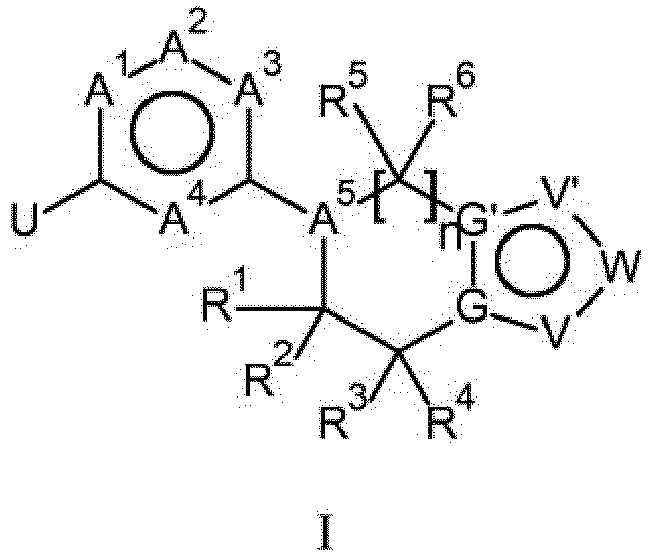 A1 und A2 unabhängig voneinander C-R22 sindA3 und A5 N sindA4 N oder C-R7 istn I ist;R1 und R2 Wasserstoff sind;R3 und R4 unabhängig voneinander gleich H oder Methyl sind;R5 und R6 unabhängig voneinander H, Methyl oder Sauerstoff sind, wobei, wennR5 und R6 Sauerstoff sind, R5 und R6 ein Sauerstoffatom sind, das eine Doppelbindung (=O) bildet;G und G' Kohlenstoff sind;V und V' unabhängig voneinander N oder C-R7 sind;R7 zusammengesetzt ist aus Wasserstoff, Halogen, Halogenalkyl, CN, Cyanoalkyl, Trifluormethyl, Alkyl, Alkenyl, Alkinyl, Amino, Sauerstoff, Hydroxyl, Schwefel, Hydrosulfuryl, Alkoxy, Acyloxy, Acylamino, Harnstoff, Carbamoyloxy, Thioharnstoff, Sulfon, Sulfoxid, Sulfonamid, Azido, Alkylalkenyl, Alkylalkinyl, Alkylamino, Alkylacyloxy, Alkylsulfonyl, Alkylsulfinyl, Alkylsulfonamid, Azidoalkyl, Cycloalkyl, Cycloalkenyl, 3-12-gliedrigem Heterocyclus, Aryl oder 5-12-gliedrigem Heteroaryl;W V6-V7 ist, wobei V6 N oder C-R7 ist, V7 C-R23 ist, sich V6 mit V' verbindet und sich V7 mit V verbindet;U
 R20 bis R22 unabhängig voneinander zusammengesetzt sind aus Wasserstoff, Halogen, Halogenalkyl, Alkyl, Trifluormethyl, Alkylsulfonyl, Alkylsulfinyl, Alkylsulfonamid, Sulfonamid oder Alkylacyloxy; undR23 zusammengesetzt ist aus der Gruppe bestehend aus:


- Chemische Verbindung gemäß Anspruch 1, wobei A1 C-Cl ist;A2 und A4 C-H- sind;V' C-H ist;V N ist;V6 N ist; undu

- Chemische Verbindung gemäß Anspruch 1, wobei A1 C-Cl ist;A2 und A4 C-H- sind;V' C-H ist;V N ist;V6 N·ist;R23
 U
U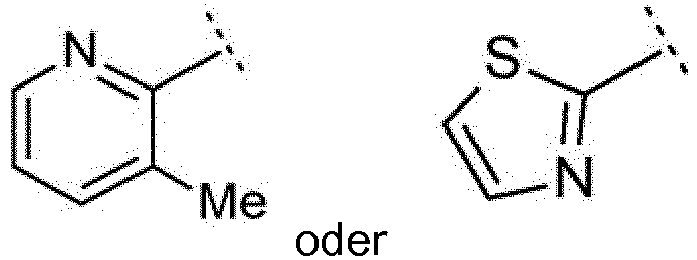
- Pharmazeutische Zusammensetzung, umfassend eine chemische Verbindung laut Formel I gemäß Anspruch 1 und einen pharmazeutisch verträglichen Träger.
- Chemische Verbindung gemäß einem der Ansprüche 1 bis 3 zur Verwendung bei der Hemmung der Aktivierung eines Hedgehog-Patched-Signalwegs bei einem Patienten, bei dem eine hyperproliferative Erkrankung diagnostiziert wurde, wobei dem Patienten eine chemische Verbindung mit einem Hedgehog-Signalweg-Inhibitor in einer wirksamen Menge verabreicht wird, um die Aktivierung des Hedgehog-Patched-Signalwegs in einer Zelle des Patienten zu reduzieren, wobei der Hedgehog-Signalweg-Inhibitor eine chemische Verbindung gemäß einem der Ansprüche 1 bis 3 ist.
Applications Claiming Priority (6)
| Application Number | Priority Date | Filing Date | Title |
|---|---|---|---|
| CN201310014254 | 2013-01-15 | ||
| CN201310057744 | 2013-02-25 | ||
| CN201310465383.5A CN103588771B (zh) | 2013-01-15 | 2013-10-08 | 具有刺猬通路拮抗剂活性的嘧啶类抗肿瘤化合物 |
| CN201310463448.2A CN103694236B (zh) | 2013-01-15 | 2013-10-08 | 一种嘧啶骨架具有刺猬通路拮抗剂活性的抗肿瘤化合物 |
| CN201310485380.8A CN103524535B (zh) | 2013-10-16 | 2013-10-16 | 具有刺猬通路拮抗剂活性的胺基噻唑-吡啶杂环化合物 |
| PCT/US2013/077305 WO2014113191A1 (en) | 2013-01-15 | 2013-12-20 | Hedgehog pathway signaling inhibitors and therapeutic applications thereof |
Publications (3)
| Publication Number | Publication Date |
|---|---|
| EP2945623A1 EP2945623A1 (de) | 2015-11-25 |
| EP2945623A4 EP2945623A4 (de) | 2016-07-13 |
| EP2945623B1 true EP2945623B1 (de) | 2018-09-05 |
Family
ID=51209995
Family Applications (1)
| Application Number | Title | Priority Date | Filing Date |
|---|---|---|---|
| EP13871618.8A Active EP2945623B1 (de) | 2013-01-15 | 2013-12-20 | Signalhemmer des hedgehog-signmalwegs und therapeutische anwendungen davon |
Country Status (3)
| Country | Link |
|---|---|
| US (1) | US9695178B2 (de) |
| EP (1) | EP2945623B1 (de) |
| WO (1) | WO2014113191A1 (de) |
Families Citing this family (37)
| Publication number | Priority date | Publication date | Assignee | Title |
|---|---|---|---|---|
| WO2012088266A2 (en) | 2010-12-22 | 2012-06-28 | Incyte Corporation | Substituted imidazopyridazines and benzimidazoles as inhibitors of fgfr3 |
| LT3495367T (lt) | 2012-06-13 | 2021-02-25 | Incyte Holdings Corporation | Pakeistieji tricikliniai junginiai, kaip fgfr inhibitoriai |
| WO2014026125A1 (en) | 2012-08-10 | 2014-02-13 | Incyte Corporation | Pyrazine derivatives as fgfr inhibitors |
| US9266892B2 (en) | 2012-12-19 | 2016-02-23 | Incyte Holdings Corporation | Fused pyrazoles as FGFR inhibitors |
| LT2986610T (lt) | 2013-04-19 | 2018-04-10 | Incyte Holdings Corporation | Bicikliniai heterociklai, kaip fgfr inhibitoriai |
| US10851105B2 (en) | 2014-10-22 | 2020-12-01 | Incyte Corporation | Bicyclic heterocycles as FGFR4 inhibitors |
| WO2016134294A1 (en) | 2015-02-20 | 2016-08-25 | Incyte Corporation | Bicyclic heterocycles as fgfr4 inhibitors |
| SG11201706287PA (en) | 2015-02-20 | 2017-09-28 | Incyte Corp | Bicyclic heterocycles as fgfr inhibitors |
| MA41551A (fr) | 2015-02-20 | 2017-12-26 | Incyte Corp | Hétérocycles bicycliques utilisés en tant qu'inhibiteurs de fgfr4 |
| KR20240036709A (ko) * | 2016-03-11 | 2024-03-20 | 에이씨 이뮨 에스에이 | 진단 및 치료를 위한 바이사이클릭 화합물 |
| AU2017294208B2 (en) * | 2016-07-04 | 2019-08-29 | Suzhou Kintor Pharmaceuticals, Inc. | Chiral heterocyclic compound with hedgehog pathway antagonist activity, method and use thereof |
| WO2018017435A1 (en) * | 2016-07-22 | 2018-01-25 | Accro Bioscience Inc. | Heteroaryl compounds as inhibitors of necrosis, composition and application thereof |
| US10968218B2 (en) * | 2016-11-03 | 2021-04-06 | Hoffmann-La Roche Inc. | Tetrahydropyridopyrimidines for the treatment and prophylaxis of hepatitis B virus infection |
| US11124495B2 (en) * | 2016-11-03 | 2021-09-21 | Hoffmann-La Roche, Inc. | Tetrahydroisoquinolines and terahydronaphthyridines for the treatment of hepatitis B virus infection |
| AR111960A1 (es) | 2017-05-26 | 2019-09-04 | Incyte Corp | Formas cristalinas de un inhibidor de fgfr y procesos para su preparación |
| GEAP202115351A (en) | 2017-11-02 | 2021-12-10 | Aicuris Gmbh & Co Kg | Novel, highly active amino-thiazole substituted indole-2-carboxamides active against the hepatitis b virus (hbv) |
| MX2020011718A (es) | 2018-05-04 | 2021-02-15 | Incyte Corp | Formas solidas de un inhibidor de receptores del factor de crecimiento de fibroblastos (fgfr) y procesos para prepararlas. |
| ES3061844T3 (en) | 2018-05-04 | 2026-04-07 | Incyte Corp | Salts of an fgfr inhibitor |
| TW202031666A (zh) | 2018-11-02 | 2020-09-01 | 德商艾庫瑞斯公司 | 對抗b型肝炎病毒(hbv)之新穎6,7-二氫-4h-噻唑并[5,4-c]吡啶脲活性劑 |
| JP2022078358A (ja) * | 2019-01-24 | 2022-05-25 | 第一三共株式会社 | エステル化合物 |
| TWI841671B (zh) * | 2019-01-24 | 2024-05-11 | 日商第一三共股份有限公司 | 具有取代基之脲化合物 |
| JP2022081701A (ja) * | 2019-01-24 | 2022-06-01 | 第一三共株式会社 | アミノ酸化合物 |
| US11628162B2 (en) | 2019-03-08 | 2023-04-18 | Incyte Corporation | Methods of treating cancer with an FGFR inhibitor |
| US11591329B2 (en) | 2019-07-09 | 2023-02-28 | Incyte Corporation | Bicyclic heterocycles as FGFR inhibitors |
| US12122767B2 (en) | 2019-10-01 | 2024-10-22 | Incyte Corporation | Bicyclic heterocycles as FGFR inhibitors |
| TWI891666B (zh) | 2019-10-14 | 2025-08-01 | 美商英塞特公司 | 作為fgfr抑制劑之雙環雜環 |
| US11566028B2 (en) | 2019-10-16 | 2023-01-31 | Incyte Corporation | Bicyclic heterocycles as FGFR inhibitors |
| WO2021113462A1 (en) | 2019-12-04 | 2021-06-10 | Incyte Corporation | Derivatives of an fgfr inhibitor |
| CA3163875A1 (en) | 2019-12-04 | 2021-06-10 | Incyte Corporation | Tricyclic heterocycles as fgfr inhibitors |
| WO2021138391A1 (en) | 2019-12-30 | 2021-07-08 | Tyra Biosciences, Inc. | Indazole compounds |
| US12012409B2 (en) | 2020-01-15 | 2024-06-18 | Incyte Corporation | Bicyclic heterocycles as FGFR inhibitors |
| TW202304459A (zh) | 2021-04-12 | 2023-02-01 | 美商英塞特公司 | 包含fgfr抑制劑及nectin-4靶向劑之組合療法 |
| JP2024522189A (ja) | 2021-06-09 | 2024-06-11 | インサイト・コーポレイション | Fgfr阻害剤としての三環式ヘテロ環 |
| EP4352060A1 (de) | 2021-06-09 | 2024-04-17 | Incyte Corporation | Tricyclische heterocyclen als fgfr-inhibitoren |
| TW202330552A (zh) * | 2021-10-13 | 2023-08-01 | 美商雷密克斯醫療公司 | 調節剪接之化合物及方法 |
| GB202212000D0 (en) * | 2022-08-17 | 2022-09-28 | Mironid Ltd | Compounds and their use as PDE4 activators |
| EP4696689A1 (de) * | 2023-04-04 | 2026-02-18 | Suzhou Kintor Pharmaceuticals, Inc. | Salzform und kristallform einer chiralen heterocyclischen verbindung mit hedgehog-pfad-antagonistischer aktivität |
Family Cites Families (6)
| Publication number | Priority date | Publication date | Assignee | Title |
|---|---|---|---|---|
| ES2233383T3 (es) | 1999-06-08 | 2005-06-16 | Lorantis Limited | Utilizacion terapeutica de un ihibidor de la via de señalizacion hedgehog. |
| US20040011252A1 (en) * | 2003-01-13 | 2004-01-22 | Sturgill Jeffrey A. | Non-toxic corrosion-protection pigments based on manganese |
| TW201412738A (zh) * | 2006-01-17 | 2014-04-01 | Vertex Pharma | 適合作為傑納斯激酶(janus kinase)抑制劑之氮雜吲哚 |
| JP2011506333A (ja) * | 2007-12-06 | 2011-03-03 | グラクソスミスクライン・リミテッド・ライアビリティ・カンパニー | 新規sEH阻害剤およびその使用 |
| US20120157471A1 (en) * | 2009-09-01 | 2012-06-21 | Pfizer Inc. | Benzimidazole derivatives |
| CA2813162C (en) * | 2010-10-20 | 2015-06-16 | Pfizer Inc. | Pyridine-2- derivatives as smoothened receptor modulators |
-
2013
- 2013-12-20 EP EP13871618.8A patent/EP2945623B1/de active Active
- 2013-12-20 WO PCT/US2013/077305 patent/WO2014113191A1/en not_active Ceased
- 2013-12-20 US US14/761,166 patent/US9695178B2/en active Active
Non-Patent Citations (1)
| Title |
|---|
| None * |
Also Published As
| Publication number | Publication date |
|---|---|
| EP2945623A1 (de) | 2015-11-25 |
| WO2014113191A1 (en) | 2014-07-24 |
| US20160024095A1 (en) | 2016-01-28 |
| US9695178B2 (en) | 2017-07-04 |
| EP2945623A4 (de) | 2016-07-13 |
Similar Documents
| Publication | Publication Date | Title |
|---|---|---|
| US9695178B2 (en) | 6-(2-pyridyl)-7,8-dihydro-5H-pyrido[4,3-D]pyrimidine analogs as hedgehog pathway signaling inhibitors and therapeutic applications thereof | |
| CN111989332B (zh) | 作为cdk抑制剂的大环化合物、其制备方法及其在医药上的应用 | |
| EP3269370B1 (de) | Neuartige kondensierte pyrimidinverbindung oder salz davon | |
| EP3037424B1 (de) | Neuartige chinolinsubstituierte verbindung | |
| EP2671582B1 (de) | Kondensierte heterocyclische derivate | |
| CN102015705B (zh) | 稠合的杂环衍生物及其用途 | |
| JP2022526854A (ja) | ホスファチジルイノシトール3-キナーゼ阻害剤 | |
| US11390634B2 (en) | Fused heterocyclic compound | |
| CN110582491A (zh) | Rho相关蛋白激酶抑制剂、包含其的药物组合物及其制备方法和用途 | |
| CN113038948B (zh) | 杂环化合物 | |
| EP3902796B1 (de) | (pyridin-2-yl)amin-derivate als tgf-beta r1 (alk5) inhibitoren zur behandlung von krebs | |
| CA3184594A1 (en) | Heterocyclic compound and use thereof | |
| EP3686197B1 (de) | 2-substituierte pyrazolamino-4-substituierte amino-5-pyrimidin-formamidverbindung, zusammensetzung und ihre verwendung | |
| JP2022517085A (ja) | ハロゲン化アリルアミン系化合物及びその適用 | |
| CN108602820A (zh) | 杂-1,5,6,7-四氢-4h-吲哚-4-酮类化合物 | |
| CN109535132B (zh) | 2-取代吡唑氨基-4-取代氨基-5-嘧啶甲酰胺类化合物、组合物及其应用 | |
| EP4342895A1 (de) | Heteroarylderivatverbindungen und verwendungen davon | |
| CN115181092A (zh) | 吡嗪化合物和其用途 | |
| WO2019154329A1 (zh) | 具有bet抑制活性的化合物及其制备方法和用途 | |
| EP4219453A1 (de) | Pyrazolverbindung und herstellungsverfahren dafür und verwendung davon | |
| WO2017070135A1 (en) | Prodrugs of 2-(4-(3-((4-amino-7-cyano-imidazo[2,1-f][1,2,4]triazin-2-yl)amino)phenyl)piperaz in-1-yl)propanamide derivatives as ck2 inhibitors for the treatment of cancer | |
| KR20200012971A (ko) | 단백질 키나제 저해제로서 유용한 피리도퀴나졸린의 카르복시산 유도체 | |
| HK40074500A (en) | Pyrazine compounds and uses thereof | |
| JP2025539086A (ja) | 造血前駆細胞キナーゼ1のピリドン及びピリミジノン阻害剤 | |
| HK40063493A (en) | (pyridin-2-yl)amine derivatives as tgf-beta r1 (alk5) inhibitors for the treatment of cancer |
Legal Events
| Date | Code | Title | Description |
|---|---|---|---|
| PUAI | Public reference made under article 153(3) epc to a published international application that has entered the european phase |
Free format text: ORIGINAL CODE: 0009012 |
|
| 17P | Request for examination filed |
Effective date: 20150814 |
|
| AK | Designated contracting states |
Kind code of ref document: A1 Designated state(s): AL AT BE BG CH CY CZ DE DK EE ES FI FR GB GR HR HU IE IS IT LI LT LU LV MC MK MT NL NO PL PT RO RS SE SI SK SM TR |
|
| AX | Request for extension of the european patent |
Extension state: BA ME |
|
| DAX | Request for extension of the european patent (deleted) | ||
| A4 | Supplementary search report drawn up and despatched |
Effective date: 20160609 |
|
| RIC1 | Information provided on ipc code assigned before grant |
Ipc: A61K 31/395 20060101AFI20160603BHEP |
|
| RAP1 | Party data changed (applicant data changed or rights of an application transferred) |
Owner name: SUZHOU KINTOR PHARMACEUTICALS, INC. |
|
| 17Q | First examination report despatched |
Effective date: 20170612 |
|
| GRAP | Despatch of communication of intention to grant a patent |
Free format text: ORIGINAL CODE: EPIDOSNIGR1 |
|
| INTG | Intention to grant announced |
Effective date: 20180524 |
|
| GRAS | Grant fee paid |
Free format text: ORIGINAL CODE: EPIDOSNIGR3 |
|
| GRAA | (expected) grant |
Free format text: ORIGINAL CODE: 0009210 |
|
| AK | Designated contracting states |
Kind code of ref document: B1 Designated state(s): AL AT BE BG CH CY CZ DE DK EE ES FI FR GB GR HR HU IE IS IT LI LT LU LV MC MK MT NL NO PL PT RO RS SE SI SK SM TR |
|
| REG | Reference to a national code |
Ref country code: GB Ref legal event code: FG4D |
|
| REG | Reference to a national code |
Ref country code: CH Ref legal event code: EP |
|
| REG | Reference to a national code |
Ref country code: AT Ref legal event code: REF Ref document number: 1037042 Country of ref document: AT Kind code of ref document: T Effective date: 20180915 |
|
| REG | Reference to a national code |
Ref country code: IE Ref legal event code: FG4D |
|
| REG | Reference to a national code |
Ref country code: DE Ref legal event code: R096 Ref document number: 602013043367 Country of ref document: DE |
|
| REG | Reference to a national code |
Ref country code: NL Ref legal event code: MP Effective date: 20180905 |
|
| REG | Reference to a national code |
Ref country code: LT Ref legal event code: MG4D |
|
| PG25 | Lapsed in a contracting state [announced via postgrant information from national office to epo] |
Ref country code: SE Free format text: LAPSE BECAUSE OF FAILURE TO SUBMIT A TRANSLATION OF THE DESCRIPTION OR TO PAY THE FEE WITHIN THE PRESCRIBED TIME-LIMIT Effective date: 20180905 Ref country code: NO Free format text: LAPSE BECAUSE OF FAILURE TO SUBMIT A TRANSLATION OF THE DESCRIPTION OR TO PAY THE FEE WITHIN THE PRESCRIBED TIME-LIMIT Effective date: 20181205 Ref country code: BG Free format text: LAPSE BECAUSE OF FAILURE TO SUBMIT A TRANSLATION OF THE DESCRIPTION OR TO PAY THE FEE WITHIN THE PRESCRIBED TIME-LIMIT Effective date: 20181205 Ref country code: LT Free format text: LAPSE BECAUSE OF FAILURE TO SUBMIT A TRANSLATION OF THE DESCRIPTION OR TO PAY THE FEE WITHIN THE PRESCRIBED TIME-LIMIT Effective date: 20180905 Ref country code: FI Free format text: LAPSE BECAUSE OF FAILURE TO SUBMIT A TRANSLATION OF THE DESCRIPTION OR TO PAY THE FEE WITHIN THE PRESCRIBED TIME-LIMIT Effective date: 20180905 Ref country code: GR Free format text: LAPSE BECAUSE OF FAILURE TO SUBMIT A TRANSLATION OF THE DESCRIPTION OR TO PAY THE FEE WITHIN THE PRESCRIBED TIME-LIMIT Effective date: 20181206 Ref country code: RS Free format text: LAPSE BECAUSE OF FAILURE TO SUBMIT A TRANSLATION OF THE DESCRIPTION OR TO PAY THE FEE WITHIN THE PRESCRIBED TIME-LIMIT Effective date: 20180905 |
|
| REG | Reference to a national code |
Ref country code: AT Ref legal event code: MK05 Ref document number: 1037042 Country of ref document: AT Kind code of ref document: T Effective date: 20180905 |
|
| PG25 | Lapsed in a contracting state [announced via postgrant information from national office to epo] |
Ref country code: HR Free format text: LAPSE BECAUSE OF FAILURE TO SUBMIT A TRANSLATION OF THE DESCRIPTION OR TO PAY THE FEE WITHIN THE PRESCRIBED TIME-LIMIT Effective date: 20180905 Ref country code: AL Free format text: LAPSE BECAUSE OF FAILURE TO SUBMIT A TRANSLATION OF THE DESCRIPTION OR TO PAY THE FEE WITHIN THE PRESCRIBED TIME-LIMIT Effective date: 20180905 Ref country code: LV Free format text: LAPSE BECAUSE OF FAILURE TO SUBMIT A TRANSLATION OF THE DESCRIPTION OR TO PAY THE FEE WITHIN THE PRESCRIBED TIME-LIMIT Effective date: 20180905 |
|
| PG25 | Lapsed in a contracting state [announced via postgrant information from national office to epo] |
Ref country code: RO Free format text: LAPSE BECAUSE OF FAILURE TO SUBMIT A TRANSLATION OF THE DESCRIPTION OR TO PAY THE FEE WITHIN THE PRESCRIBED TIME-LIMIT Effective date: 20180905 Ref country code: AT Free format text: LAPSE BECAUSE OF FAILURE TO SUBMIT A TRANSLATION OF THE DESCRIPTION OR TO PAY THE FEE WITHIN THE PRESCRIBED TIME-LIMIT Effective date: 20180905 Ref country code: EE Free format text: LAPSE BECAUSE OF FAILURE TO SUBMIT A TRANSLATION OF THE DESCRIPTION OR TO PAY THE FEE WITHIN THE PRESCRIBED TIME-LIMIT Effective date: 20180905 Ref country code: IT Free format text: LAPSE BECAUSE OF FAILURE TO SUBMIT A TRANSLATION OF THE DESCRIPTION OR TO PAY THE FEE WITHIN THE PRESCRIBED TIME-LIMIT Effective date: 20180905 Ref country code: ES Free format text: LAPSE BECAUSE OF FAILURE TO SUBMIT A TRANSLATION OF THE DESCRIPTION OR TO PAY THE FEE WITHIN THE PRESCRIBED TIME-LIMIT Effective date: 20180905 Ref country code: CZ Free format text: LAPSE BECAUSE OF FAILURE TO SUBMIT A TRANSLATION OF THE DESCRIPTION OR TO PAY THE FEE WITHIN THE PRESCRIBED TIME-LIMIT Effective date: 20180905 Ref country code: NL Free format text: LAPSE BECAUSE OF FAILURE TO SUBMIT A TRANSLATION OF THE DESCRIPTION OR TO PAY THE FEE WITHIN THE PRESCRIBED TIME-LIMIT Effective date: 20180905 Ref country code: IS Free format text: LAPSE BECAUSE OF FAILURE TO SUBMIT A TRANSLATION OF THE DESCRIPTION OR TO PAY THE FEE WITHIN THE PRESCRIBED TIME-LIMIT Effective date: 20190105 Ref country code: PL Free format text: LAPSE BECAUSE OF FAILURE TO SUBMIT A TRANSLATION OF THE DESCRIPTION OR TO PAY THE FEE WITHIN THE PRESCRIBED TIME-LIMIT Effective date: 20180905 |
|
| PG25 | Lapsed in a contracting state [announced via postgrant information from national office to epo] |
Ref country code: SK Free format text: LAPSE BECAUSE OF FAILURE TO SUBMIT A TRANSLATION OF THE DESCRIPTION OR TO PAY THE FEE WITHIN THE PRESCRIBED TIME-LIMIT Effective date: 20180905 Ref country code: PT Free format text: LAPSE BECAUSE OF FAILURE TO SUBMIT A TRANSLATION OF THE DESCRIPTION OR TO PAY THE FEE WITHIN THE PRESCRIBED TIME-LIMIT Effective date: 20190105 Ref country code: SM Free format text: LAPSE BECAUSE OF FAILURE TO SUBMIT A TRANSLATION OF THE DESCRIPTION OR TO PAY THE FEE WITHIN THE PRESCRIBED TIME-LIMIT Effective date: 20180905 |
|
| REG | Reference to a national code |
Ref country code: DE Ref legal event code: R097 Ref document number: 602013043367 Country of ref document: DE |
|
| PLBE | No opposition filed within time limit |
Free format text: ORIGINAL CODE: 0009261 |
|
| STAA | Information on the status of an ep patent application or granted ep patent |
Free format text: STATUS: NO OPPOSITION FILED WITHIN TIME LIMIT |
|
| PG25 | Lapsed in a contracting state [announced via postgrant information from national office to epo] |
Ref country code: DK Free format text: LAPSE BECAUSE OF FAILURE TO SUBMIT A TRANSLATION OF THE DESCRIPTION OR TO PAY THE FEE WITHIN THE PRESCRIBED TIME-LIMIT Effective date: 20180905 |
|
| REG | Reference to a national code |
Ref country code: CH Ref legal event code: PL |
|
| 26N | No opposition filed |
Effective date: 20190606 |
|
| PG25 | Lapsed in a contracting state [announced via postgrant information from national office to epo] |
Ref country code: MC Free format text: LAPSE BECAUSE OF FAILURE TO SUBMIT A TRANSLATION OF THE DESCRIPTION OR TO PAY THE FEE WITHIN THE PRESCRIBED TIME-LIMIT Effective date: 20180905 Ref country code: LU Free format text: LAPSE BECAUSE OF NON-PAYMENT OF DUE FEES Effective date: 20181220 Ref country code: SI Free format text: LAPSE BECAUSE OF FAILURE TO SUBMIT A TRANSLATION OF THE DESCRIPTION OR TO PAY THE FEE WITHIN THE PRESCRIBED TIME-LIMIT Effective date: 20180905 |
|
| REG | Reference to a national code |
Ref country code: IE Ref legal event code: MM4A |
|
| REG | Reference to a national code |
Ref country code: BE Ref legal event code: MM Effective date: 20181231 |
|
| PG25 | Lapsed in a contracting state [announced via postgrant information from national office to epo] |
Ref country code: IE Free format text: LAPSE BECAUSE OF NON-PAYMENT OF DUE FEES Effective date: 20181220 |
|
| PG25 | Lapsed in a contracting state [announced via postgrant information from national office to epo] |
Ref country code: BE Free format text: LAPSE BECAUSE OF NON-PAYMENT OF DUE FEES Effective date: 20181231 |
|
| PG25 | Lapsed in a contracting state [announced via postgrant information from national office to epo] |
Ref country code: LI Free format text: LAPSE BECAUSE OF NON-PAYMENT OF DUE FEES Effective date: 20181231 Ref country code: CH Free format text: LAPSE BECAUSE OF NON-PAYMENT OF DUE FEES Effective date: 20181231 |
|
| PG25 | Lapsed in a contracting state [announced via postgrant information from national office to epo] |
Ref country code: MT Free format text: LAPSE BECAUSE OF NON-PAYMENT OF DUE FEES Effective date: 20181220 |
|
| PG25 | Lapsed in a contracting state [announced via postgrant information from national office to epo] |
Ref country code: TR Free format text: LAPSE BECAUSE OF FAILURE TO SUBMIT A TRANSLATION OF THE DESCRIPTION OR TO PAY THE FEE WITHIN THE PRESCRIBED TIME-LIMIT Effective date: 20180905 |
|
| PG25 | Lapsed in a contracting state [announced via postgrant information from national office to epo] |
Ref country code: HU Free format text: LAPSE BECAUSE OF FAILURE TO SUBMIT A TRANSLATION OF THE DESCRIPTION OR TO PAY THE FEE WITHIN THE PRESCRIBED TIME-LIMIT; INVALID AB INITIO Effective date: 20131220 Ref country code: MK Free format text: LAPSE BECAUSE OF NON-PAYMENT OF DUE FEES Effective date: 20180905 Ref country code: CY Free format text: LAPSE BECAUSE OF FAILURE TO SUBMIT A TRANSLATION OF THE DESCRIPTION OR TO PAY THE FEE WITHIN THE PRESCRIBED TIME-LIMIT Effective date: 20180905 |
|
| REG | Reference to a national code |
Ref country code: DE Ref legal event code: R082 Ref document number: 602013043367 Country of ref document: DE Representative=s name: HL KEMPNER PATENTANWAELTE, SOLICITORS (ENGLAND, DE Ref country code: DE Ref legal event code: R082 Ref document number: 602013043367 Country of ref document: DE Representative=s name: HL KEMPNER PATENTANWALT, RECHTSANWALT, SOLICIT, DE Ref country code: DE Ref legal event code: R082 Ref document number: 602013043367 Country of ref document: DE Representative=s name: HL KEMPNER PARTG MBB, DE |
|
| P01 | Opt-out of the competence of the unified patent court (upc) registered |
Effective date: 20230524 |
|
| PGFP | Annual fee paid to national office [announced via postgrant information from national office to epo] |
Ref country code: DE Payment date: 20251211 Year of fee payment: 13 |
|
| PGFP | Annual fee paid to national office [announced via postgrant information from national office to epo] |
Ref country code: GB Payment date: 20251219 Year of fee payment: 13 |
|
| PGFP | Annual fee paid to national office [announced via postgrant information from national office to epo] |
Ref country code: FR Payment date: 20251223 Year of fee payment: 13 |