EP2946703B1 - Machine à café automatique intégrée équipée d'une porte avant - Google Patents
Machine à café automatique intégrée équipée d'une porte avant Download PDFInfo
- Publication number
- EP2946703B1 EP2946703B1 EP15165342.5A EP15165342A EP2946703B1 EP 2946703 B1 EP2946703 B1 EP 2946703B1 EP 15165342 A EP15165342 A EP 15165342A EP 2946703 B1 EP2946703 B1 EP 2946703B1
- Authority
- EP
- European Patent Office
- Prior art keywords
- door
- built
- fully automatic
- coffee machine
- automatic coffee
- Prior art date
- Legal status (The legal status is an assumption and is not a legal conclusion. Google has not performed a legal analysis and makes no representation as to the accuracy of the status listed.)
- Active
Links
Images

Classifications
-
- A—HUMAN NECESSITIES
- A47—FURNITURE; DOMESTIC ARTICLES OR APPLIANCES; COFFEE MILLS; SPICE MILLS; SUCTION CLEANERS IN GENERAL
- A47J—KITCHEN EQUIPMENT; COFFEE MILLS; SPICE MILLS; APPARATUS FOR MAKING BEVERAGES
- A47J31/00—Apparatus for making beverages
- A47J31/44—Parts or details or accessories of beverage-making apparatus
- A47J31/4403—Constructional details
Definitions
- the invention relates to a built-in fully automatic coffee machine for installation in a recess of a kitchen unit for household or office use, with a user-accessible front surface in which a dispensing section for dispensing a ready-made hot beverage using a dispensing unit and a service section for performing supply and/or disposal activities are arranged.
- the front surface of the built-in fully automatic coffee machine is located on its front side, namely the only side of the intended fully automatic coffee machine facing an operator and accessible for operation. The other sides are usually surrounded by furniture parts.
- the front surface is divided into two sections. The first section is a dispensing section for dispensing a ready-made hot beverage.
- the second section is a service section for performing supply and/or disposal activities.
- Supply activities include, for example, filling at least one supply container with fresh coffee beans, filling another supply container with ground coffee, filling a water container (which may be present for redundancy reasons despite a direct water supply connection to the hot beverage preparation device), or replacing a milk container.
- Disposal includes, for example, removing an empty milk container or emptying the coffee grounds container.
- the DE 10 2012 200 312 A1 discloses a fully automatic coffee machine for household use for installation in a recess of a kitchen unit.
- the fully automatic coffee machine comprises a front section with a first section containing operating and dispensing elements.
- the front section of the fully automatic coffee machine comprises a second section, from which at least one service compartment for supply and/or disposal containers is accessible, wherein the first section is stationary and the second section is pivotable.
- US 2 838 077 A a hot drink maker and EP 1 512 354 A1 a hot drink maker with adjustable beverage spout.
- the DE 10 2007 040 308 A1 reveals a beverage maker.
- the US 3 851 939 A discloses a refrigerator with an integrated beverage maker and a door which, in a closed position, covers the dispensing section of the beverage maker.
- the object of the invention is to provide a built-in fully automatic coffee machine for household or office use, which is suitable for installation in kitchen furniture or the like and whose front design can be adapted to existing kitchen designs.
- This object is achieved according to the invention in the built-in fully automatic coffee machine mentioned above by a first door on the front surface, which, in a closed position, covers the dispensing section with the height-adjustable dispensing unit and, in an open position, makes the dispensing section accessible.
- the dispensing area is covered on the front surface by a first door in its closed position. In the open position of the first door, this makes the dispensing area accessible to the user.
- the inventive design of the built-in fully automatic coffee machine with a door that covers the dispensing section when closed allows the built-in fully automatic coffee machine to be optimally integrated into the design of the front surface of a piece of kitchen furniture that houses the built-in fully automatic coffee machine.
- the dispensing section of the built-in fully automatic coffee machine can be made easily and conveniently accessible to a user by opening the door.
- the uniform front surface meets the design requirements of a modern kitchen in which the individual appliances should hardly or not at all differ from one another or from the other kitchen furniture in terms of design. From a purely practical perspective, the associated covering of the dispensing area when the first door is closed also provides positive protection against soiling.
- the first door can, in principle, cover the preparation device completely or only its dispensing area.
- the built-in fully automatic coffee machine can comprise a second door, which in its closed position can cover the service section and in its open position can make the service section accessible. The service section and the dispensing section can then be accessed independently of one another.
- the first and second doors can be equipped so that the first door assigned to the dispensing section
- the first door can be operated by any user of the built-in fully automatic coffee machine, while the second door, assigned to the service section, is reserved for selected persons only, for example, appropriately qualified service personnel.
- the second door can, for example, have a lock that can only be used ( continued on page 3, first paragraph ). can be opened by service personnel responsible for maintaining the built-in fully automatic coffee machine.
- the first door and the second door, in their respective closed positions, can extend coplanarly in a common closing plane across the front of the built-in fully automatic coffee machine. This creates a particularly visually appealing overall impression of the built-in fully automatic coffee machine and any kitchen furniture that accommodates the built-in fully automatic coffee machine.
- the first door can be designed as a sliding door that can be pushed in front of the second door.
- the first door In its open position, the first door can extend substantially parallel to the second door in its closed position such that the second door is arranged between the service section and the first door.
- the first door When leaving the closed position, the first door then moves out of the common closing plane and slightly towards the user.
- the first door can then be pushed sideways in front of the second door until, in its open position, it covers the second door.
- the second door cannot be opened.
- the service section is no longer accessible. This effectively prevents careless incorrect operation or deliberate tampering with the built-in fully automatic coffee machine during preparation.
- the second door is designed in a discreet manner, for example without a visible door handle, the service section can remain unrecognizable for the user, which prevents incorrect operation and can make it unnecessary to close the second door with a lap.
- the first door designed as a sliding door, can be operated without affecting the space in front of the front of the built-in fully automatic coffee machine, in which a user of the built-in fully automatic coffee machine is located. This is because the opened first door does not protrude largely vertically into the room, comparable to a door that can be retracted into the kitchen unit.
- the first door designed as a sliding door, can eliminate the installation space required in the kitchen unit that the retractable door would require. door is required. When the first door is in its open position, it not only does not interfere, making the dispensing area particularly easy to access, but it also blocks the service area, thus eliminating the operating errors described above.
- the second door of the built-in fully automatic coffee machine is preferably designed as a hinged or pivoting door.
- the second door can then be opened in the conventional manner to access the supply and disposal containers in the service section of the built-in fully automatic coffee machine.
- the second door can be equipped with a mechanical or electronic lock. While the first door, which covers the service area in its open position, already makes access to the service area difficult, a lock restricts access to authorized persons, regardless of the operating status of the coffee preparation equipment.
- the built-in fully automatic coffee machine can have a guide rail that extends parallel to the second door in its closed position.
- the guide rail serves to guide the movement of the first door between its closed position and its open position.
- a sliding element movable along the guide rail and a connecting element connecting the first door to the sliding element can be provided, which enable a guided movement of the first door along the guide rail. Due to the interaction of the sliding element with the connecting element and the guide rail, the first door can be moved sideways in front of the second door when opened until the first door in its open position covers the second door in its closed position.
- Such a guide mechanism is simple to implement and easy to maintain.
- the built-in fully automatic coffee machine can be equipped with a drive unit configured to move the first door from its closed position to its open position upon actuation of an activation device.
- the drive unit can be either purely mechanical, for example, via a preloadable spring drive, or electromechanical. It enables particularly convenient operation of the built-in fully automatic coffee machine. Because a user only needs to activate the activation device to gain access to the dispensing section of the built-in fully automatic coffee machine.
- a conventional manually operated power button can serve as the activation device.
- a proximity sensor can activate the drive unit when The activation device is activated when a user falls below a defined distance from the preparation device.
- the automatic opening of the door gives the user a "magical" moment of surprise.
- the activation device can also be linked to a control system of the built-in fully automatic coffee machine in such a way that its activation also initiates a "start-up" process of the built-in fully automatic coffee machine, for example, a pre-cleaning process or heating of the brewing group to a ready-to-use state.
- the built-in fully automatic coffee machine is then particularly convenient to operate.
- the built-in fully automatic coffee machine can contain a control element or all known control elements for operating the built-in fully automatic coffee machine on the first door.
- the control element can, for example, comprise the power button for operating the first door and/or for starting up the built-in fully automatic coffee machine.
- the control element can comprise selection switches for selecting various hot beverages, such as cappuccino, latte macchiato, or regular bean coffee, for selecting the flavor intensity, i.e., the strength of the beverage, and/or for selecting different types of coffee beans.
- the control element can contain display fields for displaying the operating status of the components of the service section.
- the display fields can, for example, indicate the fill level of a water or milk container provided in the service section, the fill level of a coffee grounds container provided in the service section, or the need for a cleaning or rinsing process.
- the arrangement of the control element(s) on the first door conveys a particularly appealing design impression. This is because the entire outer surface of the first door can be used for the arrangement of generously designed control elements. On the other hand, this allows the dispensing and service sections to be made more spatially accessible by reducing the amount of control elements and making them visually clearer.
- the operating element of the first door can comprise a touch-sensitive flat screen, i.e. a touchscreen.
- a touchscreen is not only easy, intuitive, and comfortable to use, but It also has a particularly visual and haptic appeal for the user of the built-in fully automatic coffee machine.
- a touchscreen can be used with different Control and information panels can be assigned to them. In idle mode, the screen can display any content or design, or it can also be inactive, i.e. switched off.
- the first door is open, however, it can only display control and information panels that are necessary or useful for preparing hot drinks.
- the dispensing section is closed but the service section is open, however, it can offer control and information panels for carrying out supply and/or disposal activities.
- a further advantage of the touchscreen can be that, when not in use, the touchscreen fits seamlessly into the existing designs of other kitchen appliances with black fronts.
- the built-in fully automatic coffee machine can comprise, in its service section, a plurality of modularly designed supply and/or disposal containers that can be individually removed from the service section. They can be used for coffee grounds, fresh and residual water, milk, coffee beans, coffee powder, and the like.
- the service section can be equipped with at least one container for accessories and a receiving area for a milk storage container.
- the receiving area for a milk storage container can preferably be changed.
- the container is preferably arranged adjacent to the receiving area for the milk storage container, i.e.
- a container for accessories such as a quick start guide or a coffee powder measuring scoop, can be particularly well-suited for this purpose, as it is the most easily dispensable without compromising the functionality of the preparation system.
- the water container which is redundant in the case of a fixed water connection, or the third coffee bean supply container can also be removed if additional space is required.
- milk packaging of different sizes and shapes can be used in the area for the milk storage container, such as slim, tall milk bottles or landscape-format milk packaging of various sizes, each of which can be optimally and space-savingly integrated into the
- the built-in fully automatic coffee machine can be fitted into the space available. This allows the service area to be kept as small as possible without sacrificing a certain degree of flexibility.
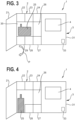
- the Figures 1 to 4 Each shows the same built-in fully automatic coffee machine as a hot beverage preparation device 1 from a front view, the visible or front surface of which is divided into a service section 2 and a dispensing section 3.
- the dispensing section 3 is arranged on the right side, while the service section 2 is arranged on the left side. However, it is also possible to arrange the dispensing section 3 on the left side and the service section 2 on the right side.
- the Figure 1 further shows the division of the front surface of the built-in fully automatic coffee machine 1 into two symmetrical, i.e. equally sized sections 2, 3.
- the service section 2 and the dispensing section 3 can also be asymmetrical, i.e. different large.
- the front surface of the built-in fully automatic coffee machine 1 is formed by a first door 31 and a second door 21.
- the first door 31 closes the dispensing section 3, the second door 21 closes the service section 2.
- a control element 4, which is designed as a touchscreen, is integrated into the first door 31. With a black lacquer or glass surface of the doors 21, 31, the control element 4 is not initially recognizable, since its screen is visually indistinguishable from the other door surfaces.
- a drive unit 33 is concealed on the first door 31 and is therefore not visible from the outside.
- the second door 21 has a lock 34 that prevents unauthorized access to the service unit 2.
- the doors 21, 31 do not have any other externally recognizable elements such as handles, furniture knobs, or the like.
- both the first and the second doors 31, 21 are in their closed positions as shown in Figure 1 They extend coplanarly across the front surface of the built-in fully automatic coffee machine 1. They therefore create a coplanar front surface of the built-in fully automatic coffee machine 1 with a uniform design, which can be seamlessly integrated into existing kitchen and office furnishings. Because both the service section 2 and the dispensing section 3 are completely concealed by the doors 21, 31, and these doors initially offer no indication of them, the built-in fully automatic coffee machine 1 is also not visually perceptible.
- the first door 31 makes the dispensing section 2 accessible. It is designed as a sliding door and can be moved in front of and parallel to the door 21.
- a height-adjustable dispensing unit 32 for dispensing a finished hot beverage, beneath which a suitable container, for example a cup or a glass, can be positioned to collect the hot beverage.
- the open dispensing section 3 itself is thus reduced to what is essential for a user of the built-in fully automatic coffee machine 1, so that they can concentrate solely on their hot beverage.
- the second door 21 makes the service section 2 accessible and simultaneously blocks the door 31 (not shown separately) and thus the access to the dispensing area 3.
- the service section 2 is used to carry out supply and disposal activities and comprises a plurality of drawer-shaped supply and disposal containers 22 to 25 and 27 to 29, the function of which is described in more detail below.
- the supply containers 22, 23 are containers for coffee beans, so that it is possible to offer two different types of coffee beans.
- the supply container 24 is a container for coffee powder, so that freshly brewed filter coffee can also be offered without the need for a grinding process. Under the supply container 24, which is used to hold coffee powder serves, a brewing unit 26 is housed. Unlike comparable known preparation devices, it is accessible from the service section 2.
- the disposal container 27 is a container for coffee grounds.
- the supply container 28 is a water tank which, despite a permanent water connection, which is not shown in the figures, acts as a buffer for water.
- the supply container 29 is designed as an accessory drawer which can be used to store small parts, such as spoons, which can be useful for filling the supply containers 22 to 24, the coffee bean containers and the coffee powder container, or to store a quick guide to the operation of the built-in fully automatic coffee machine 1.
- the supply container 25 is a milk container which is accommodated in a corresponding receiving area 35 for a milk storage container. As will be explained in more detail below, milk in its original packaging can be placed in the built-in fully automatic coffee machine 1 and connected to it via a hose.
- an actuatable power button for starting up the built-in fully automatic coffee machine 1 can be displayed, as well as selection switches for selecting various hot drinks, such as cappuccino, latte macchiato or coffee beans, for selecting the taste intensity, i.e. the strength of the drink and/or for selecting different types of coffee beans.
- the touchscreen offers the option of placing the various control elements depending on the context or depending on which of the doors 21, 31 is open.
- the control element 4 displays various display fields for indicating the operating status of the built-in fully automatic coffee machine 1, on which, for example, the fill level of a water or milk container provided in the service section 2, the fill level of a coffee grounds container provided in the service section 2 or the need for a cleaning or rinsing process are displayed.
- the arrangement of the control element 4 on the first door 31 offers the possibility of a very generous design of the control element 4, since a lot of space is available on the first door 31. This creates an optimal design impression and enables convenient operation of the built-in fully automatic coffee machine 1.
- the control element 4 is designed as a touchscreen and is not visible when the built-in fully automatic coffee machine 1 is not in use. This allows the design of the built-in fully automatic coffee machine 1 to blend in perfectly with the surrounding kitchen or office furnishings. Furthermore, the control element 4 is coupled to a motion sensor (not shown in the figures) that detects movements in the vicinity of the built-in fully automatic coffee machine 1. When the motion sensor detects that a user of the built-in fully automatic coffee machine 1 is approaching, the control element 4 on the first door 3 lights up and allows the desired function to be entered. For example, it is possible to select whether a coffee with sugar and milk or a latte macchiato should be dispensed.
- the first door 31 assigned to the service section 3 is designed as a sliding door. It is located between its Figures 1 shown closed position and its Figure 2 illustrated open position. When opened, it extends parallel to the second door 21 in its closed position. In its open position, the first door 31 is parallel to the second door 21 in its closed position, the position of which in Figure 2 is shown in dashed lines, and positioned in front of the service section 2, with the second door 21 being arranged between the service section 2 and the first door 31 in its open position.
- the first door 31 is coupled to a drive unit 33, which moves the first door 31 from its closed position to its open position upon actuation of a power button shown on the control element 4, so that a user of the built-in fully automatic coffee machine 1 only has to press the power button to gain access to the dispensing section 2 of the hot beverage preparation device 1.
- the power button is coupled to a control of the built-in fully automatic coffee machine 1, not shown in the figures, which, when Pressing the power button initiates a "start-up process" of the built-in fully automatic coffee machine 1, which puts it into an operational state.
- the second door 21 assigned to the service section 2 is designed as a hinged or pivoting door, which opens in the direction of the arrow P in Figure 3 can be pivoted from its closed position to its open position.
- the first door 31 can display the relevant information on the control element 4 when the second door 21 is open thanks to its touchscreen design. It can indicate, for example, that a coffee bean container 22, 23 needs to be refilled or that the coffee grounds container 27 needs to be emptied. Information about a brewing unit 26 that needs to be cleaned can also be displayed here if necessary. Due to the space available on the first door 31, it is also possible to display information about the procedure for cleaning the brewing unit.
- the second door 21 is provided with a lock 34. This allows the service section 2 to be protected from unauthorized access.
- the supply and/or disposal containers 22 to 25 and 27 to 29 provided in the service section 2 of the built-in fully automatic coffee machine 1 can each be removed individually from the service section 2 of the built-in fully automatic coffee machine 1.
- the shape and size of the receiving area 35 for a milk storage container 25 can be changed by removing or adding the supply container 29.
- the receiving area 35 for a milk storage container can be enlarged such that a tall milk container 25, such as a bottle, can be inserted into the receiving area 35.
Landscapes
- Engineering & Computer Science (AREA)
- Food Science & Technology (AREA)
- Apparatus For Making Beverages (AREA)
Claims (10)
- Machine à café intégralement automatique encastrable (1) à usage domestique ou de bureau avec une surface frontale accessible pour un utilisateur, dans laquelle sont disposées une section de distribution (3) pour la distribution d'une boisson chaude finie avec une unité de distribution (32) et une section de service (2) pour effectuer des opérations d'alimentation et/ou d'évacuation, caractérisée en ce que l'unité de distribution (32) est réglable en hauteur, et en ce qu'une première porte (31) sur la surface frontale couvre la section de distribution (3) dans une position fermée et rend la section de distribution (3) accessible pour la distribution d'une boisson chaude finie dans une position ouverte.
- Machine à café intégralement automatique encastrable selon la revendication 1, caractérisée par une deuxième porte (21) qui couvre la section de service (2) dans une position fermée et qui rend la section de service (2) accessible dans une position ouverte, dans laquelle la première porte (31), dans sa position fermée, et la deuxième porte (21), dans sa position fermée, s'étendent de façon coplanaire sur le côté frontal de la machine à café intégralement automatique encastrable (1).
- Machine à café intégralement automatique encastrable selon la revendication 2, caractérisée par une porte coulissante comme première porte (31), laquelle s'étend, dans sa position ouverte, de telle sorte sensiblement parallèlement à la deuxième porte (21) se trouvant dans sa position fermée, que la deuxième porte (21) est disposée entre la section de service (2) et la première porte (31).
- Machine à café intégralement automatique encastrable selon la revendication 2 ou 3, caractérisée par une porte à butée ou une porte pivotante comme deuxième porte (21).
- Machine à café intégralement automatique encastrable selon l'une des revendications 2 à 4, caractérisée par un rail de guidage qui s'étend parallèlement à la deuxième porte (21) dans sa position fermée, pour déplacer la première porte (31) entre sa position fermée et sa position ouverte, par le biais d'un élément de déplacement mobile le long du rail de guidage et d'un élément de liaison reliant la première porte (31) à l'élément de déplacement.
- Machine à café intégralement automatique encastrable selon l'une des revendications 1 à 5, caractérisée par une unité d'entraînement (33) qui est aménagée pour déplacer la première porte (31) de sa position fermée dans sa position ouverte lors de l'actionnement d'un bouton de mise en marche.
- Machine à café intégralement automatique encastrable selon l'une des revendications 1 à 6, caractérisée en ce que la première porte (31) contient un élément de commande (4) pour la commande de la machine à café intégralement automatique encastrable (1).
- Machine à café intégralement automatique encastrable selon la revendication 7, caractérisée en ce que l'élément de commande (4) de la première porte (31) comprend un écran plat tactile.
- Machine à café intégralement automatique encastrable selon l'une des revendications 1 à 8, caractérisée en ce que la section de service (2) comprend une pluralité de contenants d'alimentation et/ou d'évacuation (22, 23, 24, 25, 27, 28, 29) amovibles individuellement de la section de service, pour le marc de café, l'eau, les grains de café et/ou le café en poudre.
- Machine à café intégralement automatique encastrable selon l'une des revendications 1 à 9, caractérisée en ce que la section de service (2) comprend au moins un contenant (29) pour des accessoires et une zone de réception (35) pour un récipient de réserve de lait (25), dans laquelle la zone de réception (35) pour un récipient de réserve de lait (25) peut être modifiée en retirant ou en ajoutant au moins un contenant (29).
Applications Claiming Priority (1)
| Application Number | Priority Date | Filing Date | Title |
|---|---|---|---|
| DE102014209928.5A DE102014209928A1 (de) | 2014-05-23 | 2014-05-23 | Kaffeevollautomat mit Türenfront |
Publications (2)
| Publication Number | Publication Date |
|---|---|
| EP2946703A1 EP2946703A1 (fr) | 2015-11-25 |
| EP2946703B1 true EP2946703B1 (fr) | 2025-03-12 |
Family
ID=53008362
Family Applications (1)
| Application Number | Title | Priority Date | Filing Date |
|---|---|---|---|
| EP15165342.5A Active EP2946703B1 (fr) | 2014-05-23 | 2015-04-28 | Machine à café automatique intégrée équipée d'une porte avant |
Country Status (2)
| Country | Link |
|---|---|
| EP (1) | EP2946703B1 (fr) |
| DE (1) | DE102014209928A1 (fr) |
Families Citing this family (9)
| Publication number | Priority date | Publication date | Assignee | Title |
|---|---|---|---|---|
| DE102016202630A1 (de) * | 2016-02-19 | 2017-08-24 | BSH Hausgeräte GmbH | Heißgetränkezubereitungsvorrichtung mit Verriegelungselementen |
| EP3563731B1 (fr) | 2016-12-30 | 2020-11-11 | Novadelta-Comércio e Industria de Cafés, Lda. | Machine de préparation de boissons avec accès amélioré à des composants internes de la machine |
| PT109823B (pt) | 2016-12-30 | 2023-01-20 | Novadelta Comercio E Ind De Cafes Lda | Máquina de preparação de bebidas com descarga removível |
| DE202018101006U1 (de) * | 2018-02-23 | 2018-03-02 | Jura Elektroapparate Ag | Getränkebereitungsmaschine für Brühgeräte mit einer Abdeckblende zum Abdecken einer in einer Gehäusewand ausgebildeten Öffnung |
| DE102018204836B4 (de) | 2018-03-29 | 2025-03-06 | BSH Hausgeräte GmbH | Heißgetränkezubereitungseinrichtung mit einer Frontfläche |
| EP3881732A1 (fr) | 2020-03-17 | 2021-09-22 | BSH Hausgeräte GmbH | Machine à café automatique |
| DE102020124463A1 (de) | 2020-09-18 | 2022-03-24 | Küster Holding Gesellschaft mit beschränkter Haftung | Bedienvorrichtung mit einem Drehsteller zur Erfassung von Bediener- oder Benutzereingaben |
| DE102020124464A1 (de) | 2020-09-18 | 2022-03-24 | Küster Holding Gesellschaft mit beschränkter Haftung | Drehsteller zur Erfassung von Bediener- oder Benutzereingaben |
| DE102020124454B4 (de) | 2020-09-18 | 2023-02-09 | Küster Holding Gesellschaft mit beschränkter Haftung | Drehsteller zur Erfassung von Bediener- oder Benutzereingaben |
Citations (5)
| Publication number | Priority date | Publication date | Assignee | Title |
|---|---|---|---|---|
| US2838077A (en) * | 1954-10-20 | 1958-06-10 | Waterman Engineering Company | Dispensing machine for beverages |
| DE3635669A1 (de) * | 1986-10-21 | 1988-04-28 | Frenzel Kaeltetech | Bordkueche |
| EP1512354A1 (fr) * | 2003-09-02 | 2005-03-09 | Jura Elektroapparate Ag | Appareil de préparation de boissons avec tube d'écoulement universellement réglable |
| DE102007040308A1 (de) * | 2007-08-24 | 2009-02-26 | Miele & Cie. Kg | Getränkebereiter mit einem Gehäuse und einer daran gehaltenen höhenverstellbaren Zapfeinheit sowie Zapfverfahren |
| DE102008042276A1 (de) * | 2008-09-22 | 2010-04-01 | BSH Bosch und Siemens Hausgeräte GmbH | Getränkeautomat |
Family Cites Families (6)
| Publication number | Priority date | Publication date | Assignee | Title |
|---|---|---|---|---|
| US3851939A (en) * | 1973-11-05 | 1974-12-03 | Gen Motors Corp | Cabinet sliding panel and tracking arrangement |
| US4728281A (en) * | 1986-07-21 | 1988-03-01 | Mcguffin George B | Key controlled beverage making device |
| US6357342B1 (en) * | 2000-09-11 | 2002-03-19 | Simatelex Manufactory Co., Ltd. | Electric coffee maker |
| DE102006025419A1 (de) * | 2006-05-31 | 2007-12-06 | BSH Bosch und Siemens Hausgeräte GmbH | Bewegliches Fenster am Kaffeegerätegehäuse |
| US8950315B2 (en) * | 2010-11-15 | 2015-02-10 | Conair Corporation | Brewed beverage appliance and method |
| DE102012200312A1 (de) | 2012-01-11 | 2013-07-11 | BSH Bosch und Siemens Hausgeräte GmbH | Kaffeevollautomat mit Servicefach |
-
2014
- 2014-05-23 DE DE102014209928.5A patent/DE102014209928A1/de active Pending
-
2015
- 2015-04-28 EP EP15165342.5A patent/EP2946703B1/fr active Active
Patent Citations (5)
| Publication number | Priority date | Publication date | Assignee | Title |
|---|---|---|---|---|
| US2838077A (en) * | 1954-10-20 | 1958-06-10 | Waterman Engineering Company | Dispensing machine for beverages |
| DE3635669A1 (de) * | 1986-10-21 | 1988-04-28 | Frenzel Kaeltetech | Bordkueche |
| EP1512354A1 (fr) * | 2003-09-02 | 2005-03-09 | Jura Elektroapparate Ag | Appareil de préparation de boissons avec tube d'écoulement universellement réglable |
| DE102007040308A1 (de) * | 2007-08-24 | 2009-02-26 | Miele & Cie. Kg | Getränkebereiter mit einem Gehäuse und einer daran gehaltenen höhenverstellbaren Zapfeinheit sowie Zapfverfahren |
| DE102008042276A1 (de) * | 2008-09-22 | 2010-04-01 | BSH Bosch und Siemens Hausgeräte GmbH | Getränkeautomat |
Also Published As
| Publication number | Publication date |
|---|---|
| DE102014209928A1 (de) | 2015-11-26 |
| EP2946703A1 (fr) | 2015-11-25 |
Similar Documents
| Publication | Publication Date | Title |
|---|---|---|
| DE102014209928A1 (de) | Kaffeevollautomat mit Türenfront | |
| EP0783859B1 (fr) | Distributeur de boissons | |
| EP1051941B1 (fr) | Arrangement d'une cafetière électrique | |
| DE202010000024U1 (de) | Getränkezubereitungsmaschine | |
| EP2028982B1 (fr) | Fenêtre mobile sur boîtier de machine à café | |
| EP3305141B1 (fr) | Machine à café automatique | |
| DE102008005361A1 (de) | Dampfrohr für einen Kaffeevollautomaten | |
| EP3433461B1 (fr) | Dispositif de distribution | |
| DE102016100948A1 (de) | Teeautomat, System und Verfahren zur Steuerung eines Teeautomaten | |
| EP2893856A1 (fr) | Appareil automatique de fabrication d'une boisson infusée | |
| DE19848370B4 (de) | Vorrichtung und Verfahren zur Zubereitung eines Kaffeeaufgusses | |
| EP3878324B1 (fr) | Cafétière automatique | |
| DE102013109541B4 (de) | Anordnung mit einer Verstellvorrichtung und einem Heißgetränkeautomaten | |
| DE102019134919A1 (de) | Getränkezubereitungsvorrichtung mit Auslasseinrichtung | |
| WO2009027050A2 (fr) | Système, comprenant au moins deux réservoirs et un dispositif de raccordement, et dispositif de raccordement et réservoir | |
| EP3755190B1 (fr) | Machine pour préparer des boissons de type infusions munie d'un cache afin de couvrir une ouverture ménagée dans une paroi de corps | |
| WO2008148501A1 (fr) | Four à micro-ondes destiné à un dispositif de distribution | |
| EP3195767A1 (fr) | Automate de préparation de boissons comprenant une grille pour les tasses | |
| DE3729799C2 (de) | Elektrisch betriebenes Gerät zum Zubereiten von Heißgetränken, wie Kaffee, Tee od. dgl., insbesondere Kaffeeautomat | |
| EP3530155B1 (fr) | Dispositif d'installation pour la production de boissons infusées | |
| EP2606781B1 (fr) | Appareil de préparation de boissons | |
| DE102017201361B4 (de) | Getränkeautomat | |
| DE102024123034A1 (de) | Getränkeautomat und Verfahren zum Betreiben eines Getränkeautomaten | |
| DE102018123299A1 (de) | Getränkeautomat | |
| DE19633650A1 (de) | Vorrichtung zum Spülen von Trinkgefäßen |
Legal Events
| Date | Code | Title | Description |
|---|---|---|---|
| PUAI | Public reference made under article 153(3) epc to a published international application that has entered the european phase |
Free format text: ORIGINAL CODE: 0009012 |
|
| AK | Designated contracting states |
Kind code of ref document: A1 Designated state(s): AL AT BE BG CH CY CZ DE DK EE ES FI FR GB GR HR HU IE IS IT LI LT LU LV MC MK MT NL NO PL PT RO RS SE SI SK SM TR |
|
| AX | Request for extension of the european patent |
Extension state: BA ME |
|
| 17P | Request for examination filed |
Effective date: 20160525 |
|
| RBV | Designated contracting states (corrected) |
Designated state(s): AL AT BE BG CH CY CZ DE DK EE ES FI FR GB GR HR HU IE IS IT LI LT LU LV MC MK MT NL NO PL PT RO RS SE SI SK SM TR |
|
| STAA | Information on the status of an ep patent application or granted ep patent |
Free format text: STATUS: EXAMINATION IS IN PROGRESS |
|
| 17Q | First examination report despatched |
Effective date: 20190131 |
|
| GRAP | Despatch of communication of intention to grant a patent |
Free format text: ORIGINAL CODE: EPIDOSNIGR1 |
|
| STAA | Information on the status of an ep patent application or granted ep patent |
Free format text: STATUS: GRANT OF PATENT IS INTENDED |
|
| INTG | Intention to grant announced |
Effective date: 20241023 |
|
| GRAS | Grant fee paid |
Free format text: ORIGINAL CODE: EPIDOSNIGR3 |
|
| GRAA | (expected) grant |
Free format text: ORIGINAL CODE: 0009210 |
|
| STAA | Information on the status of an ep patent application or granted ep patent |
Free format text: STATUS: THE PATENT HAS BEEN GRANTED |
|
| AK | Designated contracting states |
Kind code of ref document: B1 Designated state(s): AL AT BE BG CH CY CZ DE DK EE ES FI FR GB GR HR HU IE IS IT LI LT LU LV MC MK MT NL NO PL PT RO RS SE SI SK SM TR |
|
| REG | Reference to a national code |
Ref country code: GB Ref legal event code: FG4D Free format text: NOT ENGLISH |
|
| REG | Reference to a national code |
Ref country code: CH Ref legal event code: EP |
|
| REG | Reference to a national code |
Ref country code: DE Ref legal event code: R096 Ref document number: 502015017040 Country of ref document: DE |
|
| REG | Reference to a national code |
Ref country code: IE Ref legal event code: FG4D Free format text: LANGUAGE OF EP DOCUMENT: GERMAN |
|
| PG25 | Lapsed in a contracting state [announced via postgrant information from national office to epo] |
Ref country code: RS Free format text: LAPSE BECAUSE OF FAILURE TO SUBMIT A TRANSLATION OF THE DESCRIPTION OR TO PAY THE FEE WITHIN THE PRESCRIBED TIME-LIMIT Effective date: 20250612 |
|
| PG25 | Lapsed in a contracting state [announced via postgrant information from national office to epo] |
Ref country code: FI Free format text: LAPSE BECAUSE OF FAILURE TO SUBMIT A TRANSLATION OF THE DESCRIPTION OR TO PAY THE FEE WITHIN THE PRESCRIBED TIME-LIMIT Effective date: 20250312 |
|
| PGFP | Annual fee paid to national office [announced via postgrant information from national office to epo] |
Ref country code: DE Payment date: 20250430 Year of fee payment: 11 |
|
| PG25 | Lapsed in a contracting state [announced via postgrant information from national office to epo] |
Ref country code: ES Free format text: LAPSE BECAUSE OF FAILURE TO SUBMIT A TRANSLATION OF THE DESCRIPTION OR TO PAY THE FEE WITHIN THE PRESCRIBED TIME-LIMIT Effective date: 20250312 |
|
| REG | Reference to a national code |
Ref country code: LT Ref legal event code: MG9D |
|
| PG25 | Lapsed in a contracting state [announced via postgrant information from national office to epo] |
Ref country code: NO Free format text: LAPSE BECAUSE OF FAILURE TO SUBMIT A TRANSLATION OF THE DESCRIPTION OR TO PAY THE FEE WITHIN THE PRESCRIBED TIME-LIMIT Effective date: 20250612 |
|
| PG25 | Lapsed in a contracting state [announced via postgrant information from national office to epo] |
Ref country code: HR Free format text: LAPSE BECAUSE OF FAILURE TO SUBMIT A TRANSLATION OF THE DESCRIPTION OR TO PAY THE FEE WITHIN THE PRESCRIBED TIME-LIMIT Effective date: 20250312 |
|
| REG | Reference to a national code |
Ref country code: NL Ref legal event code: MP Effective date: 20250312 |
|
| PG25 | Lapsed in a contracting state [announced via postgrant information from national office to epo] |
Ref country code: LV Free format text: LAPSE BECAUSE OF FAILURE TO SUBMIT A TRANSLATION OF THE DESCRIPTION OR TO PAY THE FEE WITHIN THE PRESCRIBED TIME-LIMIT Effective date: 20250312 |
|
| PGFP | Annual fee paid to national office [announced via postgrant information from national office to epo] |
Ref country code: FR Payment date: 20250505 Year of fee payment: 11 |
|
| PG25 | Lapsed in a contracting state [announced via postgrant information from national office to epo] |
Ref country code: GR Free format text: LAPSE BECAUSE OF FAILURE TO SUBMIT A TRANSLATION OF THE DESCRIPTION OR TO PAY THE FEE WITHIN THE PRESCRIBED TIME-LIMIT Effective date: 20250613 Ref country code: BG Free format text: LAPSE BECAUSE OF FAILURE TO SUBMIT A TRANSLATION OF THE DESCRIPTION OR TO PAY THE FEE WITHIN THE PRESCRIBED TIME-LIMIT Effective date: 20250312 |
|
| PGFP | Annual fee paid to national office [announced via postgrant information from national office to epo] |
Ref country code: CH Payment date: 20250602 Year of fee payment: 11 |
|
| PG25 | Lapsed in a contracting state [announced via postgrant information from national office to epo] |
Ref country code: NL Free format text: LAPSE BECAUSE OF FAILURE TO SUBMIT A TRANSLATION OF THE DESCRIPTION OR TO PAY THE FEE WITHIN THE PRESCRIBED TIME-LIMIT Effective date: 20250312 |
|
| PG25 | Lapsed in a contracting state [announced via postgrant information from national office to epo] |
Ref country code: SE Free format text: LAPSE BECAUSE OF FAILURE TO SUBMIT A TRANSLATION OF THE DESCRIPTION OR TO PAY THE FEE WITHIN THE PRESCRIBED TIME-LIMIT Effective date: 20250312 |
|
| PG25 | Lapsed in a contracting state [announced via postgrant information from national office to epo] |
Ref country code: SM Free format text: LAPSE BECAUSE OF FAILURE TO SUBMIT A TRANSLATION OF THE DESCRIPTION OR TO PAY THE FEE WITHIN THE PRESCRIBED TIME-LIMIT Effective date: 20250312 |
|
| PG25 | Lapsed in a contracting state [announced via postgrant information from national office to epo] |
Ref country code: PT Free format text: LAPSE BECAUSE OF FAILURE TO SUBMIT A TRANSLATION OF THE DESCRIPTION OR TO PAY THE FEE WITHIN THE PRESCRIBED TIME-LIMIT Effective date: 20250714 |
|
| PG25 | Lapsed in a contracting state [announced via postgrant information from national office to epo] |
Ref country code: IT Free format text: LAPSE BECAUSE OF FAILURE TO SUBMIT A TRANSLATION OF THE DESCRIPTION OR TO PAY THE FEE WITHIN THE PRESCRIBED TIME-LIMIT Effective date: 20250312 Ref country code: PL Free format text: LAPSE BECAUSE OF FAILURE TO SUBMIT A TRANSLATION OF THE DESCRIPTION OR TO PAY THE FEE WITHIN THE PRESCRIBED TIME-LIMIT Effective date: 20250312 |
|
| PG25 | Lapsed in a contracting state [announced via postgrant information from national office to epo] |
Ref country code: EE Free format text: LAPSE BECAUSE OF FAILURE TO SUBMIT A TRANSLATION OF THE DESCRIPTION OR TO PAY THE FEE WITHIN THE PRESCRIBED TIME-LIMIT Effective date: 20250312 Ref country code: CZ Free format text: LAPSE BECAUSE OF FAILURE TO SUBMIT A TRANSLATION OF THE DESCRIPTION OR TO PAY THE FEE WITHIN THE PRESCRIBED TIME-LIMIT Effective date: 20250312 |
|
| PG25 | Lapsed in a contracting state [announced via postgrant information from national office to epo] |
Ref country code: RO Free format text: LAPSE BECAUSE OF FAILURE TO SUBMIT A TRANSLATION OF THE DESCRIPTION OR TO PAY THE FEE WITHIN THE PRESCRIBED TIME-LIMIT Effective date: 20250312 |
|
| PG25 | Lapsed in a contracting state [announced via postgrant information from national office to epo] |
Ref country code: SK Free format text: LAPSE BECAUSE OF FAILURE TO SUBMIT A TRANSLATION OF THE DESCRIPTION OR TO PAY THE FEE WITHIN THE PRESCRIBED TIME-LIMIT Effective date: 20250312 |
|
| PG25 | Lapsed in a contracting state [announced via postgrant information from national office to epo] |
Ref country code: IS Free format text: LAPSE BECAUSE OF FAILURE TO SUBMIT A TRANSLATION OF THE DESCRIPTION OR TO PAY THE FEE WITHIN THE PRESCRIBED TIME-LIMIT Effective date: 20250712 |
|
| PG25 | Lapsed in a contracting state [announced via postgrant information from national office to epo] |
Ref country code: LU Free format text: LAPSE BECAUSE OF NON-PAYMENT OF DUE FEES Effective date: 20250428 |
|
| REG | Reference to a national code |
Ref country code: DE Ref legal event code: R097 Ref document number: 502015017040 Country of ref document: DE |
|
| PG25 | Lapsed in a contracting state [announced via postgrant information from national office to epo] |
Ref country code: MC Free format text: LAPSE BECAUSE OF FAILURE TO SUBMIT A TRANSLATION OF THE DESCRIPTION OR TO PAY THE FEE WITHIN THE PRESCRIBED TIME-LIMIT Effective date: 20250312 |
|
| REG | Reference to a national code |
Ref country code: BE Ref legal event code: MM Effective date: 20250430 |
|
| PG25 | Lapsed in a contracting state [announced via postgrant information from national office to epo] |
Ref country code: DK Free format text: LAPSE BECAUSE OF FAILURE TO SUBMIT A TRANSLATION OF THE DESCRIPTION OR TO PAY THE FEE WITHIN THE PRESCRIBED TIME-LIMIT Effective date: 20250312 |
|
| PG25 | Lapsed in a contracting state [announced via postgrant information from national office to epo] |
Ref country code: BE Free format text: LAPSE BECAUSE OF NON-PAYMENT OF DUE FEES Effective date: 20250430 |
|
| PLBE | No opposition filed within time limit |
Free format text: ORIGINAL CODE: 0009261 |
|
| STAA | Information on the status of an ep patent application or granted ep patent |
Free format text: STATUS: NO OPPOSITION FILED WITHIN TIME LIMIT |
|
| REG | Reference to a national code |
Ref country code: CH Ref legal event code: L10 Free format text: ST27 STATUS EVENT CODE: U-0-0-L10-L00 (AS PROVIDED BY THE NATIONAL OFFICE) Effective date: 20260121 |
|
| 26N | No opposition filed |
Effective date: 20251215 |
|
| GBPC | Gb: european patent ceased through non-payment of renewal fee |
Effective date: 20250612 |
|
| PG25 | Lapsed in a contracting state [announced via postgrant information from national office to epo] |
Ref country code: GB Free format text: LAPSE BECAUSE OF NON-PAYMENT OF DUE FEES Effective date: 20250612 |
|
| PG25 | Lapsed in a contracting state [announced via postgrant information from national office to epo] |
Ref country code: IE Free format text: LAPSE BECAUSE OF NON-PAYMENT OF DUE FEES Effective date: 20250428 |
|
| REG | Reference to a national code |
Ref country code: CH Ref legal event code: U11 Free format text: ST27 STATUS EVENT CODE: U-0-0-U10-U11 (AS PROVIDED BY THE NATIONAL OFFICE) Effective date: 20260501 |