EP2947155A1 - Procédés de détection d'ions d'arsenic - Google Patents
Procédés de détection d'ions d'arsenic Download PDFInfo
- Publication number
- EP2947155A1 EP2947155A1 EP14168834.1A EP14168834A EP2947155A1 EP 2947155 A1 EP2947155 A1 EP 2947155A1 EP 14168834 A EP14168834 A EP 14168834A EP 2947155 A1 EP2947155 A1 EP 2947155A1
- Authority
- EP
- European Patent Office
- Prior art keywords
- promoter
- arsr
- regulatory protein
- nucleic acid
- dna binding
- Prior art date
- Legal status (The legal status is an assumption and is not a legal conclusion. Google has not performed a legal analysis and makes no representation as to the accuracy of the status listed.)
- Withdrawn
Links
- 238000000034 method Methods 0.000 title abstract description 27
- 229910052785 arsenic Inorganic materials 0.000 title description 44
- -1 arsenic ions Chemical class 0.000 title description 6
- 108091006104 gene-regulatory proteins Proteins 0.000 claims abstract description 118
- 102000034356 gene-regulatory proteins Human genes 0.000 claims abstract description 118
- 241000894006 Bacteria Species 0.000 claims abstract description 86
- 108090000623 proteins and genes Proteins 0.000 claims abstract description 69
- 230000006698 induction Effects 0.000 claims abstract description 45
- 239000003344 environmental pollutant Substances 0.000 claims abstract description 43
- 231100000719 pollutant Toxicity 0.000 claims abstract description 43
- 238000012360 testing method Methods 0.000 claims abstract description 43
- 238000001514 detection method Methods 0.000 claims abstract description 41
- 102000004169 proteins and genes Human genes 0.000 claims abstract description 41
- 239000007788 liquid Substances 0.000 claims abstract description 31
- 239000002957 persistent organic pollutant Substances 0.000 claims abstract description 21
- 150000007523 nucleic acids Chemical class 0.000 claims description 100
- 230000004568 DNA-binding Effects 0.000 claims description 88
- 108020004707 nucleic acids Proteins 0.000 claims description 83
- 102000039446 nucleic acids Human genes 0.000 claims description 83
- 238000013518 transcription Methods 0.000 claims description 70
- 230000035897 transcription Effects 0.000 claims description 70
- 238000011144 upstream manufacturing Methods 0.000 claims description 68
- AQLMHYSWFMLWBS-UHFFFAOYSA-N arsenite(1-) Chemical compound O[As](O)[O-] AQLMHYSWFMLWBS-UHFFFAOYSA-N 0.000 claims description 62
- 101150005693 arsR gene Proteins 0.000 claims description 54
- 241000588724 Escherichia coli Species 0.000 claims description 36
- 230000002759 chromosomal effect Effects 0.000 claims description 36
- 239000013604 expression vector Substances 0.000 claims description 30
- XLYOFNOQVPJJNP-UHFFFAOYSA-N water Substances O XLYOFNOQVPJJNP-UHFFFAOYSA-N 0.000 claims description 28
- DJHGAFSJWGLOIV-UHFFFAOYSA-K Arsenate3- Chemical compound [O-][As]([O-])([O-])=O DJHGAFSJWGLOIV-UHFFFAOYSA-K 0.000 claims description 22
- 229940000489 arsenate Drugs 0.000 claims description 22
- 238000001784 detoxification Methods 0.000 claims description 20
- 108091028043 Nucleic acid sequence Proteins 0.000 claims description 19
- 238000003259 recombinant expression Methods 0.000 claims description 15
- FWMNVWWHGCHHJJ-SKKKGAJSSA-N 4-amino-1-[(2r)-6-amino-2-[[(2r)-2-[[(2r)-2-[[(2r)-2-amino-3-phenylpropanoyl]amino]-3-phenylpropanoyl]amino]-4-methylpentanoyl]amino]hexanoyl]piperidine-4-carboxylic acid Chemical compound C([C@H](C(=O)N[C@H](CC(C)C)C(=O)N[C@H](CCCCN)C(=O)N1CCC(N)(CC1)C(O)=O)NC(=O)[C@H](N)CC=1C=CC=CC=1)C1=CC=CC=C1 FWMNVWWHGCHHJJ-SKKKGAJSSA-N 0.000 claims description 10
- 101150111036 arsB gene Proteins 0.000 claims description 9
- 101150046576 arsC gene Proteins 0.000 claims description 9
- 231100001240 inorganic pollutant Toxicity 0.000 claims description 9
- 235000020188 drinking water Nutrition 0.000 abstract description 7
- 239000003651 drinking water Substances 0.000 abstract description 7
- 229920000122 acrylonitrile butadiene styrene Polymers 0.000 description 84
- 239000013612 plasmid Substances 0.000 description 49
- 230000014509 gene expression Effects 0.000 description 47
- 108010048367 enhanced green fluorescent protein Proteins 0.000 description 44
- RQNWIZPPADIBDY-UHFFFAOYSA-N arsenic atom Chemical compound [As] RQNWIZPPADIBDY-UHFFFAOYSA-N 0.000 description 37
- 210000004027 cell Anatomy 0.000 description 25
- 241000660147 Escherichia coli str. K-12 substr. MG1655 Species 0.000 description 21
- LLEMOWNGBBNAJR-UHFFFAOYSA-N biphenyl-2-ol Chemical group OC1=CC=CC=C1C1=CC=CC=C1 LLEMOWNGBBNAJR-UHFFFAOYSA-N 0.000 description 20
- 230000000694 effects Effects 0.000 description 17
- 238000012217 deletion Methods 0.000 description 16
- 230000037430 deletion Effects 0.000 description 16
- 230000002103 transcriptional effect Effects 0.000 description 15
- 108700028369 Alleles Proteins 0.000 description 13
- 108700008625 Reporter Genes Proteins 0.000 description 13
- 238000003556 assay Methods 0.000 description 13
- 241001646716 Escherichia coli K-12 Species 0.000 description 12
- 239000012634 fragment Substances 0.000 description 12
- 230000001965 increasing effect Effects 0.000 description 12
- 238000004519 manufacturing process Methods 0.000 description 12
- 239000004205 dimethyl polysiloxane Substances 0.000 description 10
- 235000010292 orthophenyl phenol Nutrition 0.000 description 10
- 229920000435 poly(dimethylsiloxane) Polymers 0.000 description 10
- 239000013598 vector Substances 0.000 description 10
- 230000027455 binding Effects 0.000 description 9
- 210000000349 chromosome Anatomy 0.000 description 9
- 108091006146 Channels Proteins 0.000 description 8
- 230000001580 bacterial effect Effects 0.000 description 8
- 230000001419 dependent effect Effects 0.000 description 7
- 239000002609 medium Substances 0.000 description 7
- 230000004044 response Effects 0.000 description 7
- 108020003589 5' Untranslated Regions Proteins 0.000 description 6
- IAZDPXIOMUYVGZ-UHFFFAOYSA-N Dimethylsulphoxide Chemical compound CS(C)=O IAZDPXIOMUYVGZ-UHFFFAOYSA-N 0.000 description 6
- 239000007993 MOPS buffer Substances 0.000 description 6
- PXHVJJICTQNCMI-UHFFFAOYSA-N Nickel Chemical compound [Ni] PXHVJJICTQNCMI-UHFFFAOYSA-N 0.000 description 6
- BQCADISMDOOEFD-UHFFFAOYSA-N Silver Chemical compound [Ag] BQCADISMDOOEFD-UHFFFAOYSA-N 0.000 description 6
- 238000005259 measurement Methods 0.000 description 6
- 108020004999 messenger RNA Proteins 0.000 description 6
- 238000003752 polymerase chain reaction Methods 0.000 description 6
- XUIMIQQOPSSXEZ-UHFFFAOYSA-N Silicon Chemical compound [Si] XUIMIQQOPSSXEZ-UHFFFAOYSA-N 0.000 description 5
- 125000003275 alpha amino acid group Chemical group 0.000 description 5
- 238000013461 design Methods 0.000 description 5
- 230000029087 digestion Effects 0.000 description 5
- 238000000684 flow cytometry Methods 0.000 description 5
- 239000011521 glass Substances 0.000 description 5
- 239000001963 growth medium Substances 0.000 description 5
- 230000001105 regulatory effect Effects 0.000 description 5
- 239000000523 sample Substances 0.000 description 5
- 229910052710 silicon Inorganic materials 0.000 description 5
- 239000010703 silicon Substances 0.000 description 5
- 125000006850 spacer group Chemical group 0.000 description 5
- HCHKCACWOHOZIP-UHFFFAOYSA-N Zinc Chemical compound [Zn] HCHKCACWOHOZIP-UHFFFAOYSA-N 0.000 description 4
- 229910052787 antimony Inorganic materials 0.000 description 4
- WATWJIUSRGPENY-UHFFFAOYSA-N antimony atom Chemical compound [Sb] WATWJIUSRGPENY-UHFFFAOYSA-N 0.000 description 4
- 230000033228 biological regulation Effects 0.000 description 4
- 238000011161 development Methods 0.000 description 4
- 238000010790 dilution Methods 0.000 description 4
- 239000012895 dilution Substances 0.000 description 4
- 230000002068 genetic effect Effects 0.000 description 4
- 230000001939 inductive effect Effects 0.000 description 4
- 230000003993 interaction Effects 0.000 description 4
- 239000002773 nucleotide Substances 0.000 description 4
- 239000002985 plastic film Substances 0.000 description 4
- 239000008399 tap water Substances 0.000 description 4
- 235000020679 tap water Nutrition 0.000 description 4
- 231100000167 toxic agent Toxicity 0.000 description 4
- 239000003440 toxic substance Substances 0.000 description 4
- 238000001890 transfection Methods 0.000 description 4
- 229910052725 zinc Inorganic materials 0.000 description 4
- 239000011701 zinc Substances 0.000 description 4
- BTBUEUYNUDRHOZ-UHFFFAOYSA-N Borate Chemical compound [O-]B([O-])[O-] BTBUEUYNUDRHOZ-UHFFFAOYSA-N 0.000 description 3
- RYGMFSIKBFXOCR-UHFFFAOYSA-N Copper Chemical compound [Cu] RYGMFSIKBFXOCR-UHFFFAOYSA-N 0.000 description 3
- 108020004414 DNA Proteins 0.000 description 3
- 101000664418 Homo sapiens Secreted Ly-6/uPAR-related protein 1 Proteins 0.000 description 3
- 102100038583 Secreted Ly-6/uPAR-related protein 1 Human genes 0.000 description 3
- 229910004273 TeO3 Inorganic materials 0.000 description 3
- 150000001413 amino acids Chemical class 0.000 description 3
- 230000003321 amplification Effects 0.000 description 3
- 238000004166 bioassay Methods 0.000 description 3
- 229910052797 bismuth Inorganic materials 0.000 description 3
- JCXGWMGPZLAOME-UHFFFAOYSA-N bismuth atom Chemical compound [Bi] JCXGWMGPZLAOME-UHFFFAOYSA-N 0.000 description 3
- 229910052793 cadmium Inorganic materials 0.000 description 3
- BDOSMKKIYDKNTQ-UHFFFAOYSA-N cadmium atom Chemical compound [Cd] BDOSMKKIYDKNTQ-UHFFFAOYSA-N 0.000 description 3
- 239000006285 cell suspension Substances 0.000 description 3
- ZCDOYSPFYFSLEW-UHFFFAOYSA-N chromate(2-) Chemical compound [O-][Cr]([O-])(=O)=O ZCDOYSPFYFSLEW-UHFFFAOYSA-N 0.000 description 3
- 229910017052 cobalt Inorganic materials 0.000 description 3
- 239000010941 cobalt Substances 0.000 description 3
- GUTLYIVDDKVIGB-UHFFFAOYSA-N cobalt atom Chemical compound [Co] GUTLYIVDDKVIGB-UHFFFAOYSA-N 0.000 description 3
- 238000004737 colorimetric analysis Methods 0.000 description 3
- 238000011109 contamination Methods 0.000 description 3
- 229910052802 copper Inorganic materials 0.000 description 3
- 239000010949 copper Substances 0.000 description 3
- 230000007613 environmental effect Effects 0.000 description 3
- 230000037433 frameshift Effects 0.000 description 3
- 230000004927 fusion Effects 0.000 description 3
- 230000001976 improved effect Effects 0.000 description 3
- QSHDDOUJBYECFT-UHFFFAOYSA-N mercury Chemical compound [Hg] QSHDDOUJBYECFT-UHFFFAOYSA-N 0.000 description 3
- 229910052753 mercury Inorganic materials 0.000 description 3
- 230000000813 microbial effect Effects 0.000 description 3
- 244000005700 microbiome Species 0.000 description 3
- 238000002156 mixing Methods 0.000 description 3
- 238000010369 molecular cloning Methods 0.000 description 3
- 229910052759 nickel Inorganic materials 0.000 description 3
- 238000003199 nucleic acid amplification method Methods 0.000 description 3
- 125000003729 nucleotide group Chemical group 0.000 description 3
- 239000000047 product Substances 0.000 description 3
- 229910052709 silver Inorganic materials 0.000 description 3
- 239000004332 silver Substances 0.000 description 3
- 239000000243 solution Substances 0.000 description 3
- 241000894007 species Species 0.000 description 3
- 239000011550 stock solution Substances 0.000 description 3
- XHGGEBRKUWZHEK-UHFFFAOYSA-L tellurate Chemical compound [O-][Te]([O-])(=O)=O XHGGEBRKUWZHEK-UHFFFAOYSA-L 0.000 description 3
- 229910052716 thallium Inorganic materials 0.000 description 3
- BKVIYDNLLOSFOA-UHFFFAOYSA-N thallium Chemical compound [Tl] BKVIYDNLLOSFOA-UHFFFAOYSA-N 0.000 description 3
- 230000009466 transformation Effects 0.000 description 3
- 239000012224 working solution Substances 0.000 description 3
- TWRXJAOTZQYOKJ-UHFFFAOYSA-L Magnesium chloride Chemical compound [Mg+2].[Cl-].[Cl-] TWRXJAOTZQYOKJ-UHFFFAOYSA-L 0.000 description 2
- 108010034634 Repressor Proteins Proteins 0.000 description 2
- 102000009661 Repressor Proteins Human genes 0.000 description 2
- 241001138501 Salmonella enterica Species 0.000 description 2
- FAPWRFPIFSIZLT-UHFFFAOYSA-M Sodium chloride Chemical compound [Na+].[Cl-] FAPWRFPIFSIZLT-UHFFFAOYSA-M 0.000 description 2
- 238000013019 agitation Methods 0.000 description 2
- 229960000723 ampicillin Drugs 0.000 description 2
- AVKUERGKIZMTKX-NJBDSQKTSA-N ampicillin Chemical compound C1([C@@H](N)C(=O)N[C@H]2[C@H]3SC([C@@H](N3C2=O)C(O)=O)(C)C)=CC=CC=C1 AVKUERGKIZMTKX-NJBDSQKTSA-N 0.000 description 2
- 239000003242 anti bacterial agent Substances 0.000 description 2
- 239000007864 aqueous solution Substances 0.000 description 2
- 108010005774 beta-Galactosidase Proteins 0.000 description 2
- 102000005936 beta-Galactosidase Human genes 0.000 description 2
- 230000003115 biocidal effect Effects 0.000 description 2
- 210000002421 cell wall Anatomy 0.000 description 2
- 238000005119 centrifugation Methods 0.000 description 2
- 238000006243 chemical reaction Methods 0.000 description 2
- 230000001276 controlling effect Effects 0.000 description 2
- 230000003247 decreasing effect Effects 0.000 description 2
- 229920001971 elastomer Polymers 0.000 description 2
- 238000001317 epifluorescence microscopy Methods 0.000 description 2
- 230000002349 favourable effect Effects 0.000 description 2
- 238000005558 fluorometry Methods 0.000 description 2
- 238000004108 freeze drying Methods 0.000 description 2
- 239000003673 groundwater Substances 0.000 description 2
- 229910001385 heavy metal Inorganic materials 0.000 description 2
- 238000011534 incubation Methods 0.000 description 2
- 239000000411 inducer Substances 0.000 description 2
- 229910052500 inorganic mineral Inorganic materials 0.000 description 2
- 150000002500 ions Chemical class 0.000 description 2
- 229930027917 kanamycin Natural products 0.000 description 2
- 229960000318 kanamycin Drugs 0.000 description 2
- SBUJHOSQTJFQJX-NOAMYHISSA-N kanamycin Chemical compound O[C@@H]1[C@@H](O)[C@H](O)[C@@H](CN)O[C@@H]1O[C@H]1[C@H](O)[C@@H](O[C@@H]2[C@@H]([C@@H](N)[C@H](O)[C@@H](CO)O2)O)[C@H](N)C[C@@H]1N SBUJHOSQTJFQJX-NOAMYHISSA-N 0.000 description 2
- 229930182823 kanamycin A Natural products 0.000 description 2
- 239000006166 lysate Substances 0.000 description 2
- 239000000463 material Substances 0.000 description 2
- 239000011707 mineral Substances 0.000 description 2
- 238000012986 modification Methods 0.000 description 2
- 230000004048 modification Effects 0.000 description 2
- 239000013642 negative control Substances 0.000 description 2
- 238000002360 preparation method Methods 0.000 description 2
- 230000008569 process Effects 0.000 description 2
- 230000009467 reduction Effects 0.000 description 2
- 230000002829 reductive effect Effects 0.000 description 2
- 230000035945 sensitivity Effects 0.000 description 2
- 238000004904 shortening Methods 0.000 description 2
- 229920002379 silicone rubber Polymers 0.000 description 2
- PTLRDCMBXHILCL-UHFFFAOYSA-M sodium arsenite Chemical compound [Na+].[O-][As]=O PTLRDCMBXHILCL-UHFFFAOYSA-M 0.000 description 2
- 239000007787 solid Substances 0.000 description 2
- 238000010561 standard procedure Methods 0.000 description 2
- UCSJYZPVAKXKNQ-HZYVHMACSA-N streptomycin Chemical compound CN[C@H]1[C@H](O)[C@@H](O)[C@H](CO)O[C@H]1O[C@@H]1[C@](C=O)(O)[C@H](C)O[C@H]1O[C@@H]1[C@@H](NC(N)=N)[C@H](O)[C@@H](NC(N)=N)[C@H](O)[C@H]1O UCSJYZPVAKXKNQ-HZYVHMACSA-N 0.000 description 2
- 239000000725 suspension Substances 0.000 description 2
- HJTAZXHBEBIQQX-UHFFFAOYSA-N 1,5-bis(chloromethyl)naphthalene Chemical compound C1=CC=C2C(CCl)=CC=CC2=C1CCl HJTAZXHBEBIQQX-UHFFFAOYSA-N 0.000 description 1
- YMHOBZXQZVXHBM-UHFFFAOYSA-N 2,5-dimethoxy-4-bromophenethylamine Chemical compound COC1=CC(CCN)=C(OC)C=C1Br YMHOBZXQZVXHBM-UHFFFAOYSA-N 0.000 description 1
- BFSVOASYOCHEOV-UHFFFAOYSA-N 2-diethylaminoethanol Chemical compound CCN(CC)CCO BFSVOASYOCHEOV-UHFFFAOYSA-N 0.000 description 1
- MHUWZNTUIIFHAS-XPWSMXQVSA-N 9-octadecenoic acid 1-[(phosphonoxy)methyl]-1,2-ethanediyl ester Chemical compound CCCCCCCC\C=C\CCCCCCCC(=O)OCC(COP(O)(O)=O)OC(=O)CCCCCCC\C=C\CCCCCCCC MHUWZNTUIIFHAS-XPWSMXQVSA-N 0.000 description 1
- 108091006112 ATPases Proteins 0.000 description 1
- 102000057290 Adenosine Triphosphatases Human genes 0.000 description 1
- 229920000936 Agarose Polymers 0.000 description 1
- 102000002260 Alkaline Phosphatase Human genes 0.000 description 1
- 108020004774 Alkaline Phosphatase Proteins 0.000 description 1
- NLXLAEXVIDQMFP-UHFFFAOYSA-N Ammonia chloride Chemical compound [NH4+].[Cl-] NLXLAEXVIDQMFP-UHFFFAOYSA-N 0.000 description 1
- 229910017251 AsO4 Inorganic materials 0.000 description 1
- 238000009623 Bosch process Methods 0.000 description 1
- UXVMQQNJUSDDNG-UHFFFAOYSA-L Calcium chloride Chemical compound [Cl-].[Cl-].[Ca+2] UXVMQQNJUSDDNG-UHFFFAOYSA-L 0.000 description 1
- VYZAMTAEIAYCRO-UHFFFAOYSA-N Chromium Chemical compound [Cr] VYZAMTAEIAYCRO-UHFFFAOYSA-N 0.000 description 1
- 206010061764 Chromosomal deletion Diseases 0.000 description 1
- 108020004705 Codon Proteins 0.000 description 1
- 238000001712 DNA sequencing Methods 0.000 description 1
- 201000004624 Dermatitis Diseases 0.000 description 1
- 229920002307 Dextran Polymers 0.000 description 1
- 108090000790 Enzymes Proteins 0.000 description 1
- 102000004190 Enzymes Human genes 0.000 description 1
- 108700039691 Genetic Promoter Regions Proteins 0.000 description 1
- WQZGKKKJIJFFOK-GASJEMHNSA-N Glucose Natural products OC[C@H]1OC(O)[C@H](O)[C@@H](O)[C@@H]1O WQZGKKKJIJFFOK-GASJEMHNSA-N 0.000 description 1
- 108010043121 Green Fluorescent Proteins Proteins 0.000 description 1
- 102000004144 Green Fluorescent Proteins Human genes 0.000 description 1
- 108010001336 Horseradish Peroxidase Proteins 0.000 description 1
- 206010020649 Hyperkeratosis Diseases 0.000 description 1
- 108090000862 Ion Channels Proteins 0.000 description 1
- 102000004310 Ion Channels Human genes 0.000 description 1
- 239000007836 KH2PO4 Substances 0.000 description 1
- 208000001126 Keratosis Diseases 0.000 description 1
- 208000008839 Kidney Neoplasms Diseases 0.000 description 1
- 108060001084 Luciferase Proteins 0.000 description 1
- 239000005089 Luciferase Substances 0.000 description 1
- 239000006137 Luria-Bertani broth Substances 0.000 description 1
- 208000003351 Melanosis Diseases 0.000 description 1
- 102000018697 Membrane Proteins Human genes 0.000 description 1
- 108010052285 Membrane Proteins Proteins 0.000 description 1
- 229910003328 NaAsO2 Inorganic materials 0.000 description 1
- 108090000854 Oxidoreductases Proteins 0.000 description 1
- 102000004316 Oxidoreductases Human genes 0.000 description 1
- 108010001267 Protein Subunits Proteins 0.000 description 1
- 102000002067 Protein Subunits Human genes 0.000 description 1
- 241001489201 Pseudomonas nitroreducens HBP1 Species 0.000 description 1
- 208000000453 Skin Neoplasms Diseases 0.000 description 1
- 101000793689 Sus scrofa Azurocidin Proteins 0.000 description 1
- 108010006785 Taq Polymerase Proteins 0.000 description 1
- 239000004098 Tetracycline Substances 0.000 description 1
- 108700009124 Transcription Initiation Site Proteins 0.000 description 1
- 108091023040 Transcription factor Proteins 0.000 description 1
- 102000040945 Transcription factor Human genes 0.000 description 1
- 108091023045 Untranslated Region Proteins 0.000 description 1
- 208000007097 Urinary Bladder Neoplasms Diseases 0.000 description 1
- 241000545067 Venus Species 0.000 description 1
- 230000001944 accentuation Effects 0.000 description 1
- 230000004913 activation Effects 0.000 description 1
- 108091006088 activator proteins Proteins 0.000 description 1
- 239000011543 agarose gel Substances 0.000 description 1
- 125000000539 amino acid group Chemical group 0.000 description 1
- 238000004458 analytical method Methods 0.000 description 1
- 239000003674 animal food additive Substances 0.000 description 1
- 150000001449 anionic compounds Chemical class 0.000 description 1
- 229940088710 antibiotic agent Drugs 0.000 description 1
- 101150105197 arsD gene Proteins 0.000 description 1
- RBFQJDQYXXHULB-UHFFFAOYSA-N arsane Chemical compound [AsH3] RBFQJDQYXXHULB-UHFFFAOYSA-N 0.000 description 1
- LZYIDMKXGSDQMT-UHFFFAOYSA-N arsenic dioxide Inorganic materials [O][As]=O LZYIDMKXGSDQMT-UHFFFAOYSA-N 0.000 description 1
- GOLCXWYRSKYTSP-UHFFFAOYSA-N arsenic trioxide Inorganic materials O1[As]2O[As]1O2 GOLCXWYRSKYTSP-UHFFFAOYSA-N 0.000 description 1
- 238000001479 atomic absorption spectroscopy Methods 0.000 description 1
- 238000001391 atomic fluorescence spectroscopy Methods 0.000 description 1
- QVGXLLKOCUKJST-UHFFFAOYSA-N atomic oxygen Chemical compound [O] QVGXLLKOCUKJST-UHFFFAOYSA-N 0.000 description 1
- 230000008901 benefit Effects 0.000 description 1
- 239000008280 blood Substances 0.000 description 1
- 210000004369 blood Anatomy 0.000 description 1
- 239000001110 calcium chloride Substances 0.000 description 1
- 229910001628 calcium chloride Inorganic materials 0.000 description 1
- 239000001506 calcium phosphate Substances 0.000 description 1
- 229910000389 calcium phosphate Inorganic materials 0.000 description 1
- 235000011010 calcium phosphates Nutrition 0.000 description 1
- 238000004364 calculation method Methods 0.000 description 1
- 238000005266 casting Methods 0.000 description 1
- 230000001925 catabolic effect Effects 0.000 description 1
- 230000015556 catabolic process Effects 0.000 description 1
- 230000003197 catalytic effect Effects 0.000 description 1
- 125000002091 cationic group Chemical group 0.000 description 1
- 230000008859 change Effects 0.000 description 1
- 239000003795 chemical substances by application Substances 0.000 description 1
- 231100000481 chemical toxicant Toxicity 0.000 description 1
- 239000013611 chromosomal DNA Substances 0.000 description 1
- 230000001684 chronic effect Effects 0.000 description 1
- 238000010367 cloning Methods 0.000 description 1
- 238000002485 combustion reaction Methods 0.000 description 1
- 150000001875 compounds Chemical class 0.000 description 1
- 238000004590 computer program Methods 0.000 description 1
- 238000010276 construction Methods 0.000 description 1
- 210000000805 cytoplasm Anatomy 0.000 description 1
- 230000001086 cytosolic effect Effects 0.000 description 1
- 239000002274 desiccant Substances 0.000 description 1
- 239000010432 diamond Substances 0.000 description 1
- 238000004512 die casting Methods 0.000 description 1
- 238000011496 digital image analysis Methods 0.000 description 1
- 230000003292 diminished effect Effects 0.000 description 1
- 230000003467 diminishing effect Effects 0.000 description 1
- BNIILDVGGAEEIG-UHFFFAOYSA-L disodium hydrogen phosphate Chemical compound [Na+].[Na+].OP([O-])([O-])=O BNIILDVGGAEEIG-UHFFFAOYSA-L 0.000 description 1
- 229910000397 disodium phosphate Inorganic materials 0.000 description 1
- 238000010494 dissociation reaction Methods 0.000 description 1
- 230000005593 dissociations Effects 0.000 description 1
- 239000012153 distilled water Substances 0.000 description 1
- 239000012154 double-distilled water Substances 0.000 description 1
- 238000001312 dry etching Methods 0.000 description 1
- 238000001035 drying Methods 0.000 description 1
- 239000012636 effector Substances 0.000 description 1
- 238000004520 electroporation Methods 0.000 description 1
- 239000000284 extract Substances 0.000 description 1
- 238000000605 extraction Methods 0.000 description 1
- 230000008713 feedback mechanism Effects 0.000 description 1
- 238000011049 filling Methods 0.000 description 1
- MHMNJMPURVTYEJ-UHFFFAOYSA-N fluorescein-5-isothiocyanate Chemical compound O1C(=O)C2=CC(N=C=S)=CC=C2C21C1=CC=C(O)C=C1OC1=CC(O)=CC=C21 MHMNJMPURVTYEJ-UHFFFAOYSA-N 0.000 description 1
- 239000007850 fluorescent dye Substances 0.000 description 1
- 230000037406 food intake Effects 0.000 description 1
- 239000002803 fossil fuel Substances 0.000 description 1
- 231100000221 frame shift mutation induction Toxicity 0.000 description 1
- 239000012520 frozen sample Substances 0.000 description 1
- 239000007789 gas Substances 0.000 description 1
- 239000000499 gel Substances 0.000 description 1
- 239000008103 glucose Substances 0.000 description 1
- 239000005090 green fluorescent protein Substances 0.000 description 1
- 230000008821 health effect Effects 0.000 description 1
- XLYOFNOQVPJJNP-ZSJDYOACSA-N heavy water Substances [2H]O[2H] XLYOFNOQVPJJNP-ZSJDYOACSA-N 0.000 description 1
- 238000004128 high performance liquid chromatography Methods 0.000 description 1
- 231100000003 human carcinogen Toxicity 0.000 description 1
- 238000009396 hybridization Methods 0.000 description 1
- 238000010191 image analysis Methods 0.000 description 1
- 238000003384 imaging method Methods 0.000 description 1
- 230000006872 improvement Effects 0.000 description 1
- 238000010348 incorporation Methods 0.000 description 1
- 238000009616 inductively coupled plasma Methods 0.000 description 1
- 239000002440 industrial waste Substances 0.000 description 1
- 208000015181 infectious disease Diseases 0.000 description 1
- 230000002401 inhibitory effect Effects 0.000 description 1
- 229910001412 inorganic anion Inorganic materials 0.000 description 1
- 238000003780 insertion Methods 0.000 description 1
- 230000037431 insertion Effects 0.000 description 1
- 230000007794 irritation Effects 0.000 description 1
- 210000003734 kidney Anatomy 0.000 description 1
- 238000011005 laboratory method Methods 0.000 description 1
- 210000004185 liver Anatomy 0.000 description 1
- 208000014018 liver neoplasm Diseases 0.000 description 1
- 238000011068 loading method Methods 0.000 description 1
- 229910001629 magnesium chloride Inorganic materials 0.000 description 1
- 230000007246 mechanism Effects 0.000 description 1
- 230000001404 mediated effect Effects 0.000 description 1
- NGYIMTKLQULBOO-UHFFFAOYSA-L mercury dibromide Chemical compound Br[Hg]Br NGYIMTKLQULBOO-UHFFFAOYSA-L 0.000 description 1
- 230000004060 metabolic process Effects 0.000 description 1
- 239000011325 microbead Substances 0.000 description 1
- 238000000520 microinjection Methods 0.000 description 1
- 238000000386 microscopy Methods 0.000 description 1
- 238000005065 mining Methods 0.000 description 1
- 239000000203 mixture Substances 0.000 description 1
- 229910000402 monopotassium phosphate Inorganic materials 0.000 description 1
- 210000004400 mucous membrane Anatomy 0.000 description 1
- 230000003287 optical effect Effects 0.000 description 1
- 150000002894 organic compounds Chemical class 0.000 description 1
- 239000005416 organic matter Substances 0.000 description 1
- 239000001301 oxygen Substances 0.000 description 1
- 229910052760 oxygen Inorganic materials 0.000 description 1
- 239000008188 pellet Substances 0.000 description 1
- 239000000575 pesticide Substances 0.000 description 1
- 229920002120 photoresistant polymer Polymers 0.000 description 1
- 239000004810 polytetrafluoroethylene Substances 0.000 description 1
- 229920001343 polytetrafluoroethylene Polymers 0.000 description 1
- GNSKLFRGEWLPPA-UHFFFAOYSA-M potassium dihydrogen phosphate Chemical compound [K+].OP(O)([O-])=O GNSKLFRGEWLPPA-UHFFFAOYSA-M 0.000 description 1
- 230000002028 premature Effects 0.000 description 1
- 239000003755 preservative agent Substances 0.000 description 1
- KCXFHTAICRTXLI-UHFFFAOYSA-N propane-1-sulfonic acid Chemical compound CCCS(O)(=O)=O KCXFHTAICRTXLI-UHFFFAOYSA-N 0.000 description 1
- 230000001681 protective effect Effects 0.000 description 1
- 238000000746 purification Methods 0.000 description 1
- 238000011002 quantification Methods 0.000 description 1
- 108010054624 red fluorescent protein Proteins 0.000 description 1
- 238000012163 sequencing technique Methods 0.000 description 1
- 238000013207 serial dilution Methods 0.000 description 1
- 210000003491 skin Anatomy 0.000 description 1
- 229940047047 sodium arsenate Drugs 0.000 description 1
- 239000011780 sodium chloride Substances 0.000 description 1
- 159000000000 sodium salts Chemical class 0.000 description 1
- 239000002689 soil Substances 0.000 description 1
- 229960005322 streptomycin Drugs 0.000 description 1
- 239000000126 substance Substances 0.000 description 1
- 238000006467 substitution reaction Methods 0.000 description 1
- 239000000758 substrate Substances 0.000 description 1
- 239000006228 supernatant Substances 0.000 description 1
- 230000002195 synergetic effect Effects 0.000 description 1
- 230000009885 systemic effect Effects 0.000 description 1
- 229960002180 tetracycline Drugs 0.000 description 1
- 229930101283 tetracycline Natural products 0.000 description 1
- 235000019364 tetracycline Nutrition 0.000 description 1
- 150000003522 tetracyclines Chemical class 0.000 description 1
- MPLHNVLQVRSVEE-UHFFFAOYSA-N texas red Chemical compound [O-]S(=O)(=O)C1=CC(S(Cl)(=O)=O)=CC=C1C(C1=CC=2CCCN3CCCC(C=23)=C1O1)=C2C1=C(CCC1)C3=[N+]1CCCC3=C2 MPLHNVLQVRSVEE-UHFFFAOYSA-N 0.000 description 1
- 230000005026 transcription initiation Effects 0.000 description 1
- 238000010361 transduction Methods 0.000 description 1
- 230000026683 transduction Effects 0.000 description 1
- QORWJWZARLRLPR-UHFFFAOYSA-H tricalcium bis(phosphate) Chemical compound [Ca+2].[Ca+2].[Ca+2].[O-]P([O-])([O-])=O.[O-]P([O-])([O-])=O QORWJWZARLRLPR-UHFFFAOYSA-H 0.000 description 1
- 210000002700 urine Anatomy 0.000 description 1
- 208000019553 vascular disease Diseases 0.000 description 1
- 238000012795 verification Methods 0.000 description 1
- 238000011179 visual inspection Methods 0.000 description 1
- 239000003643 water by type Substances 0.000 description 1
- 108091005957 yellow fluorescent proteins Proteins 0.000 description 1
- UZVNCLCLJHPHIF-NOJKMYKQSA-J zinc;(1e)-2-(ethylcarbamoylamino)-n-methoxy-2-oxoethanimidoyl cyanide;manganese(2+);n-[2-(sulfidocarbothioylamino)ethyl]carbamodithioate Chemical compound [Mn+2].[Zn+2].[S-]C(=S)NCCNC([S-])=S.[S-]C(=S)NCCNC([S-])=S.CCNC(=O)NC(=O)C(\C#N)=N\OC UZVNCLCLJHPHIF-NOJKMYKQSA-J 0.000 description 1
Images




Classifications
-
- C—CHEMISTRY; METALLURGY
- C12—BIOCHEMISTRY; BEER; SPIRITS; WINE; VINEGAR; MICROBIOLOGY; ENZYMOLOGY; MUTATION OR GENETIC ENGINEERING
- C12N—MICROORGANISMS OR ENZYMES; COMPOSITIONS THEREOF; PROPAGATING, PRESERVING, OR MAINTAINING MICROORGANISMS; MUTATION OR GENETIC ENGINEERING; CULTURE MEDIA
- C12N15/00—Mutation or genetic engineering; DNA or RNA concerning genetic engineering, vectors, e.g. plasmids, or their isolation, preparation or purification; Use of hosts therefor
- C12N15/09—Recombinant DNA-technology
- C12N15/63—Introduction of foreign genetic material using vectors; Vectors; Use of hosts therefor; Regulation of expression
- C12N15/70—Vectors or expression systems specially adapted for E. coli
-
- C—CHEMISTRY; METALLURGY
- C12—BIOCHEMISTRY; BEER; SPIRITS; WINE; VINEGAR; MICROBIOLOGY; ENZYMOLOGY; MUTATION OR GENETIC ENGINEERING
- C12Q—MEASURING OR TESTING PROCESSES INVOLVING ENZYMES, NUCLEIC ACIDS OR MICROORGANISMS; COMPOSITIONS OR TEST PAPERS THEREFOR; PROCESSES OF PREPARING SUCH COMPOSITIONS; CONDITION-RESPONSIVE CONTROL IN MICROBIOLOGICAL OR ENZYMOLOGICAL PROCESSES
- C12Q1/00—Measuring or testing processes involving enzymes, nucleic acids or microorganisms; Compositions therefor; Processes of preparing such compositions
- C12Q1/68—Measuring or testing processes involving enzymes, nucleic acids or microorganisms; Compositions therefor; Processes of preparing such compositions involving nucleic acids
- C12Q1/6876—Nucleic acid products used in the analysis of nucleic acids, e.g. primers or probes
- C12Q1/6888—Nucleic acid products used in the analysis of nucleic acids, e.g. primers or probes for detection or identification of organisms
- C12Q1/689—Nucleic acid products used in the analysis of nucleic acids, e.g. primers or probes for detection or identification of organisms for bacteria
-
- C—CHEMISTRY; METALLURGY
- C12—BIOCHEMISTRY; BEER; SPIRITS; WINE; VINEGAR; MICROBIOLOGY; ENZYMOLOGY; MUTATION OR GENETIC ENGINEERING
- C12Q—MEASURING OR TESTING PROCESSES INVOLVING ENZYMES, NUCLEIC ACIDS OR MICROORGANISMS; COMPOSITIONS OR TEST PAPERS THEREFOR; PROCESSES OF PREPARING SUCH COMPOSITIONS; CONDITION-RESPONSIVE CONTROL IN MICROBIOLOGICAL OR ENZYMOLOGICAL PROCESSES
- C12Q1/00—Measuring or testing processes involving enzymes, nucleic acids or microorganisms; Compositions therefor; Processes of preparing such compositions
- C12Q1/68—Measuring or testing processes involving enzymes, nucleic acids or microorganisms; Compositions therefor; Processes of preparing such compositions involving nucleic acids
- C12Q1/6897—Measuring or testing processes involving enzymes, nucleic acids or microorganisms; Compositions therefor; Processes of preparing such compositions involving nucleic acids involving reporter genes operably linked to promoters
-
- C—CHEMISTRY; METALLURGY
- C12—BIOCHEMISTRY; BEER; SPIRITS; WINE; VINEGAR; MICROBIOLOGY; ENZYMOLOGY; MUTATION OR GENETIC ENGINEERING
- C12Q—MEASURING OR TESTING PROCESSES INVOLVING ENZYMES, NUCLEIC ACIDS OR MICROORGANISMS; COMPOSITIONS OR TEST PAPERS THEREFOR; PROCESSES OF PREPARING SUCH COMPOSITIONS; CONDITION-RESPONSIVE CONTROL IN MICROBIOLOGICAL OR ENZYMOLOGICAL PROCESSES
- C12Q2600/00—Oligonucleotides characterized by their use
- C12Q2600/142—Toxicological screening, e.g. expression profiles which identify toxicity
-
- G—PHYSICS
- G01—MEASURING; TESTING
- G01N—INVESTIGATING OR ANALYSING MATERIALS BY DETERMINING THEIR CHEMICAL OR PHYSICAL PROPERTIES
- G01N2520/00—Use of whole organisms as detectors of pollution
Definitions
- the present invention relates to methods and tools useful for the detection of pollutants such as arsenic ions in drinking water samples.
- Contamination of natural waters with arsenic is a recurring problem in both industrialized and developing countries, and drinking water supplies for large populations can have concentrations much higher than the permissible levels (for most European countries and the United States, 10 ⁇ g arsenic per liter; elsewhere, 50 ⁇ g arsenic per liter).
- Systemic and chronic exposure to arsenic is known to lead to vascular diseases, to irritations of the skin and of mucous membranes as well as to dermatitis, keratosis and melanosis.
- Inorganic arsenic is a human carcinogen and ingestion of inorganic arsenic increases the risk of developing cancer of the bladder, liver, kidney and skin ( Abernathy et al,Arsenic exposure and health effects, Elsevier Science Ltd, London, 1999 ).
- Arsenic contamination most frequently has a natural origin since arsenic is a common element of minerals in the earth's crust. Weathering of such minerals can be accelerated by microbial activity, specifically in anoxygenic groundwaters with abundant available respirable organic matter, which leads to high concentrations of dissolved inorganic arsenic species. Dominant inorganic anions in solution are arsenite [As(III) in AsO 2 - ] or arsenate [As(V) in AsO 4 3- ].
- Sources of arsenic can also be anthropogenic and include the application of organoarsenical pesticides, the combustion of fossil fuels, the use of organoarsenical feed additives, mining activities, the disposal of industrial wastes, and the application of arsenic-containing desiccants and preservatives.
- bacteria-based bioassay Trang et al, 2005, Environ. Sci. Technol, 39: 7625-7630 .
- the bacteria-based bioassay exploits the extremely sensitive natural defence system of bacteria against arsenite and arsenate, and couples this defence reaction to the production of an easily measurable output.
- bacteria-based bioassays or bacterial reporters are genetically modified bacteria comprising a gene coding for a regulatory protein inducing the production of a specific reporter protein (typically a spectroscopically or electrochemically active protein) in the presence of a particular chemicals (e.g. heavy metals such as arsenic, organic compounds).
- Bacterial reporters for detecting arsenic disclosed so far were typically based on the arsRDBAC operon on E. coli plasmid R773 ( Hedges et al, 1973, J. Bacterial, 115:459-460 ).
- the arsRDBAC operon is transcribed as a single mRNA and is responsible for the regulation and the production of the proteins of the detoxification system in E. coli.
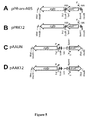
- ArsR and ArsD are both transacting repressor proteins that homeostatically regulate the levels of ars expression ( Figure 1A ). Although both are 13 kDa protomers and form homodimers, they share no sequence similarity.
- ArsR is an As(III)/Sb(III)-responsive repressor with high affinity for its operator site (ABS), that controls the basal level of expression of the operon. Binding of arsenite or antimonite leads to dissociation of ArsR from the operator site, permitting transcription to occur more efficiently.
- ArsD has a lower affinity for the operator site, but it binds at higher protein concentrations.
- the ArsAB complex is an ATP driven oxyanion efflux pump that removes arsenite and antimonite from the cell.
- the 583 residues ArsA ATPase is the catalytic subunit whereas ArsB forms the membrane channel.
- ArsC is a reductase converting pentavalent As (arsenate) into the trivalent form arsenite), which is the substrate of the ArsR regulatory protein and of the efflux pump complex. Typically, it is assumed that the cell cannot avoid entry of arsenite or arsenate. When the cytoplasmic arsenite concentration increases, ArsR releases repression resulting in a rise in the levels of ars transcript and consequently an increase in the various Ars gene products. An internal feedback loop exists to avoid that production of the system increases to Inhibitory levels of e.g., the integral membrane protein ArsB. At high levels of ArsD, it acts as a repressor that shuts down ars operon expression. Together, ArsR and ArsD form a regulatory circuit that controls both the basal and maximal levels of expression of the ars operon.
- the first bacterial reporters were developed by fusing a reporter gene downstream of arsR, like luciferase or ⁇ -galactosidase ( Figure 1B ) ( Ramanathan et al, 1997, Anal. Chem. 69: 3380-3384 ).
- arsR like luciferase or ⁇ -galactosidase
- the production of the reporter gene is dependent on the production of ArsR (coupled system).
- ArsR coupled system
- the ArsR protein controls its own expression via a negative feedback mechanism.
- One limitation of this system is the considerable background signal even in the absence of arsenic.
- the present invention is directed towards methods and biologically based test systems for the detection of pollutants in liquid samples such as drinking water.
- a first aspect of the invention provides a biologically based test system for the detection of inorganic and organic pollutants in liquid samples comprising a genetically modified bacterium producing a reporter protein upon induction of a regulatory protein in presence of said pollutant.
- the nucleic acid(s) of said bacterium comprises:
- nucleic acid(s) of said bacterium comprises:
- a second aspect of the invention relates to a recombinant expression vector for use in a biologically based test system for the detection of inorganic and organic pollutants in liquid samples as described herewith.
- a third aspect of the invention resides in a host cell such as a bacterium comprising said recombinant expression vector, as well as isolated genetically modified bacteria, for use in a biologically based test system for the detection of inorganic and organic pollutants in liquid samples, producing a reporter protein upon induction of a regulatory protein in presence of said pollutant, as described herewith.
- a fourth aspect of the invention concerns a method for preparing said genetically modified bacterium comprising introducing the recombinant expression vector as described herewith in a bacterium.
- a fifth aspect relates to a biologically based test kit for the detection of inorganic and organic pollutants in liquid samples as described herewith as well as a method of production of said test kit.
- a sixth aspect of the invention provides a device for the detection of inorganic and organic pollutants in liquid samples as described herewith as well as a method of production of said device.
- a seventh aspect of the invention provides the use of a biologically based test system as described herewith for the detection of inorganic and organic pollutants in liquid samples.
- polystyrene resin encompasses inorganic and organic toxic compounds generally found in water such as drinking water. It includes, for instance, arsenic ions (arsenite (As(III)), arsenate (As(V))), antimonite (Sb(III)), cadmium (Cd 2+ ), zinc (Zn 2+ ), mercury (Hg 2+ ), silver (Ag 2+ ), bismuth (Bi 3+ ), borate (BO 3 3- ), cobalt (Co 2+ ), chromate (CrO 4 2- ), copper (Cu 2+ ), nickel (Ni 2+ ), lead (Pb 3+ ), antimony (Sb 2+ ), tellurate (TeO 3 2- ), thallium (Tl + ) ions.
- an operon allowing detoxification of a pollutant in bacteria refers to the system of defence against toxic compound(s) and/or metabolism (in particular catabolism) of toxic compound(s) to render said compound(s) inactive, which certain microorganisms like bacteria have naturally developed.
- the "operon” designates a functioning unit of genomic DNA containing a cluster of genes under the control of a single promoter. The genes are transcribed together into an mRNA strand and either translated together in the cytoplasm, or undergo trans-splicing to create monocistronic mRNAs that are translated separately, i.e. several strands of mRNA that each encode a single gene product.
- Control of an operon is a type of gene regulation that enables organisms to regulate the expression of various genes depending on environmental conditions.
- Operon regulation can be either negative or positive by induction or repression.
- a regulatory repressor protein e.g. ArsR
- ABS a regulatory repressor binding site, ABS
- an inducer molecule e.g. a toxic compound like arsenite
- it binds to the repressor and changes its conformation so that it is unable to bind to the operator. This allows for expression of the operon.
- liquid samples cover water samples including drinking water, environmental water (e.g. water from rivers, groundwater), urine or blood, water extracts from food stuffs and soils.
- the terms "derive” or “derivative” applied to a protein or to a nucleic acid refer to an amino acid sequence or nucleic acid sequence that is substantially homologous to the referenced sequence from which it derives, but which has an amino acid sequence or nucleic acid sequence different from that of the referenced sequence because of one or more amino acid or one or more nucleotide deletions, insertions and/or substitutions.
- a substantially homologous amino acid sequence can be at least 80%, at least 85%, at least 90%, at least 95%, at least 96%, at least 97%, at least 98% or at least 99% identical to the referenced amino acid sequence.
- a substantially homologous nucleic acid sequence can be at least 80%, at least 85%, at least 90%, at least 95%, at least 96%, at least 97%, at least 98% or at least 99% identical to the referenced nucleic acid sequence.
- the identity of two amino acid sequences or of two nucleic acid sequences can be determined by visual inspection and/or mathematical calculation, or more easily by comparing sequence information using known computer program used for sequence comparison such as Clustal package version 1.83.
- a derivative may comprise a sequence having at least one conservatively substituted amino acid, meaning that a given amino acid residue is replaced by a residue having similar physiochemical characteristics.
- a first aspect of the invention relates to a biologically based test system for the detection of inorganic and organic pollutants in liquid samples, such as water samples and in particular drinking water samples, comprising a genetically modified bacterium producing a reporter protein upon induction of a regulatory protein in presence of said pollutant, wherein the nucleic acid(s) of said bacterium comprises:
- the different aspects of the invention are applicable to any system allowing detoxification of pollutants involving a regulatory protein that regulates the expression of at least one gene having detoxification effects and/or catabolic effects upon induction in the presence of a specific pollutant as for instance the systems of detoxification of arsenic ions (arsenite (As(III)), arsenate (As(V))), antimonite (Sb(III)), cadmium (Cd 2+ ), zinc (Zn 2+ ), mercury (Hg 2+ ).
- arsenic ions arsenite (As(III)), arsenate (As(V))
- Sb(III) antimonite
- Cd 2+ cadmium
- zinc Zn 2+
- mercury Hg 2+
- pollutants which can be detected with the invention include, for instance, silver (Ag 2+ ), bismuth (Bi 3+ ), borate (BO 3 3- ), cobalt (Co 2+ ), chromate (CrO 4 2- ), copper (Cu 2+ ), nickel (Ni 2+ ), lead (Pb 3+ ), antimony (Sb 2+ ), tellurate (TeO 3 2- ), thallium (Tl + ).
- the biologically based test system comprises a genetically modified bacterium as defined above comprising two DNA binding sites for said regulatory protein.
- the first DNA binding site for said regulatory protein is located upstream from said promoter, at a distance from said promoter that is identical to the distance found between the DNA binding site and the promoter of said operon in a bacteria having naturally developed said operon.
- the second DNA binding site for said regulatory protein is located upstream from said promoter and upstream from the first DNA binding site.
- the second DNA binding site for said regulatory protein is located downstream from said promoter and downstream from the first DNA binding site.
- the distance between two DNA binding sites for said regulatory protein is comprised between a minimum distance avoiding mutual steric interactions between said bound regulatory protein and a maximum distance still allowing synergistic effects of increasing concentrations of said regulatory protein, caused by the local interaction of said regulatory protein with the binding site.
- Said minimum and maximum distances can be evaluated by placing the two DNA binding sites at known distances on the chromosome of a bacterium expressing a fluorescently labelled ArsR functional derivative and by measuring the intensity of the fluorescent gradient as a function of the relative positioning of the two DNA binding sites, using standard methods in the field such as by single cell epifluorescence microscopy, for instance as described by Hammar et al. (Science, 2012, 336:1595-1598 ).
- the distance between two DNA binding sites for said regulatory protein is comprised between about 80 bp and about 500 bp, more particularly between about 80 bp and about 490 bp, more particularly between about 80 bp and about 450 bp, more particularly between about 80 and about 250 bp, still more particularly between about 80 and 220 bp, or between about 80 and 200 bp or between about 100 and 180 bp, or between about 110 and 180 bp, or between about 115 and about 170 bp, or between about 150 and about 220 bp.
- the first DNA binding site is located upstream from said promoter, the second DNA binding site is located downstream from said promoter, and the distance between the two DNA binding sites is comprised between about 80 and 250 bp, in particular between about 80 and 220 bp, more particularly between about 84 or 85 bp and 219 or 220 bp.
- the first DNA binding site is located upstream from said promoter, the second DNA binding site is located downstream from said promoter, and the distance between the two DNA binding sites is about 85 bp, e.g. of 80, 81, 82, 83, 84, 85, 86, 87, 88, 89, or 90 bp.
- the first DNA binding site is located upstream from said promoter, the second DNA binding site is located downstream from said promoter, and the distance between the two DNA binding sites is about 220 bp, e.g. of 215, 216, 217, 218, 219, 220, 221, 222, 223, 224, or 225 bp.
- both the first and the second DNA binding sites are located upstream from said promoter, and the distance between the two DNA binding sites is comprised between about 80 and 200 bp, in particular between about 100 and 180 bp, or more particularly between about 115 or 116 bp and 170 bp.
- both the first and the second DNA binding sites are located upstream from said promoter, and the distance between the two DNA binding sites is about 170 bp, e.g 165, 166, 167, 168, 169, 170, 171, 172, 173, 174 or 175 bp.
- both the first and the second DNA binding sites are located upstream from said promoter, and the distance between the two DNA binding sites is about 115 bp, e.g 110, 111, 112, 113, 114, 115, 116, 117, 118, 119, 120 or 121 bp.
- arsRDABC operon on E. coli plasmid R773 which are widespread among bacterial species, although many bacteria carry arsenite resistance genes on the chromosome (e.g. arsRBC operon in E. coli K12 or MG1655).
- the nucleic acid encoding said ArsR regulatory protein comprised in the second transcription unit can derive from the naturally occurring E. coli plasmid R773 or from E. coli chromosomal ars operon.
- the nucleic acid encoding said ArsR regulatory protein comprised in the second transcription unit derives from the naturally occurring E. coli plasmid R773, in particular the nucleic acid encoding said ArsR regulatory protein has at least 80%, at least 90%, at least 95%, at least 96%, at least 97%, at least 98%, at least 99%, or 100% identity with the nucleic acid sequence of the allele of the arsR gene naturally present in E. coli plasmid R773 of SEQ ID NO: 1.
- the nucleic acid encoding said ArsR regulatory protein comprised in the second transcription unit has a nucleic acid sequence deriving from the sequence of the allele of the arsR gene naturally present on the chromosome of a bacterium, in particular the nucleic acid encoding said ArsR regulatory protein has at least 80%, at least 90%, at least 95%, at least 96%, at least 97%, at least 98%, at least 99%, or 100% identity with the nucleic acid sequence of the allele of the arsR gene naturally present in the chromosome of E. coli K12 of SEQ ID NO: 2.
- the nucleic acid encoding said ArsR regulatory protein in the second transcription unit and the promoter in the first transcription unit derive from the same plasmidic ars operon or from the same chromosomal ars operon, e.g. from the same plasmidic ars operon from the E. coli plasmid R773 or from the same chromosomomal ars operon of E. coli such as E. coli K12.
- nucleic acid encoding said ArsR regulatory protein in the second transcription unit and the promoter in the first transcription unit derive from the chromosomal ars operon from E. coli such as E. coli K12.
- nucleic acid encoding said ArsR regulatory protein in the second transcription unit has the nucleic acid sequence of SEQ ID NO: 2 and the promoter in the first transcription has the nucleic acid sequence of SEQ ID NO: 3.
- said first and second transcription units are located on the chromosome or on a bacterial plasmid of the genetically modified bacterium.
- the genetically modified bacterium is an Escherichia coli strain bearing a genetically modified plasmid, said plasmid carrying:
- the genetically modified bacterium is an E. coli strain, in particular E. coli K12 or a strain derived from strain K12 such as E. coli MG1655 ( Riley et al, 2006, Nucleic Acids Res 34: 1-9 ), optionally deleted for at least one of chromosomal arsB, arsC and arsR genes.
- the genetically modified bacterium is E. coli MG1655 deleted for chromosomal arsB and arsC genes and, optionally, also deleted for chromosomal arsR gene.
- the nucleic acid encoding a reporter protein is a nucleic acid encoding a chromogenic label (e.g. horseradish peroxidase, alkaline phosphatase, ⁇ -galactosidase) or fluorescent compound (e.g. Green Fluorescent Protein and derivatives thereof including enhanced green fluorescent protein (EGFP), Red Fluorescent Protein, Yellow Fluorescent protein and derivatives thereof including venus), or luminescent labels including luciferins.
- a chromogenic label e.g. horseradish peroxidase, alkaline phosphatase, ⁇ -galactosidase
- fluorescent compound e.g. Green Fluorescent Protein and derivatives thereof including enhanced green fluorescent protein (EGFP), Red Fluorescent Protein, Yellow Fluorescent protein and derivatives thereof including venus
- luminescent labels including luciferins.
- constitutive promoters comprised in the second transcriptional unit useful in the invention include a "moderately” constitutive promoter such as P AA -promoter or a “strong” constitutive promoter such as P Ltet0 promoter described in Alper et al (PNAS, 2005, 102: 12678-12683 ).
- the biologically based test system can comprise a genetically modified bacterium as described herewith, which is in the form of a whole cell without disruption of its cell wall or in the form of cell-free lysate. Both forms are appropriate for the use of the biologically based test system for the detection of inorganic and organic pollutants in liquid samples.
- a recombinant expression vector for use in a biologically based test system for the detection of inorganic and organic pollutants in liquid samples such as water samples comprising:
- nucleotide sequences mentioned above can be inserted in the recombinant expression vector by methods well known to a person skilled in the art such as, for example, those that are described in MOLECULAR CLONING: A LABORATORY MANUAL, Sambrook et al., 4th Ed., Cold Spring Harbor Laboratory Press, Cold Spring Harbor, N.Y., 2001 .
- the first and second transcription units comprised in the recombinant expression vector of the invention are generally independently regulated.
- the different aspects of the invention are applicable to any system allowing detoxification of pollutants involving a regulatory protein that regulates the expression of at least one gene having detoxification effects upon induction in the presence of a specific pollutant as for instance the systems of detoxification of arsenic (arsenite (As(III)), arsenate (As(V))), antimonite (Sb(III)), cadmium (Cd 2+ ), zinc (Zn 2+ ), mercury (Hg 2+ ), silver (Ag 2+ ), bismuth (Bi 3+ ), borate (BO 3 3- ), cobalt (Co 2+ ), chromate (CrO 4 2- ), copper (Cu 2+ ), nickel (Ni 2+ ), lead (Pb 3+ ), antimony (Sb 2+ ), tellurate (TeO 3 2- ), thallium (Tl + ) ions.
- arsenic arsenite (As(III)
- a recombinant expression vector for use in a biologically based test system for the detection of inorganic pollutants selected from the group consisting of arsenite, arsenate and antimonite in liquid samples such as water samples comprising:
- the expression vector according to the invention further comprises a gene conferring resistance to an antibiotic such as kanamycin and/or ampicillin for maintaining a selection pressure in bacteria transformed with such vectors in order not to lose said vector after multiple successive divisions of the bacteria.
- an antibiotic such as kanamycin and/or ampicillin
- the bacteria are cultivated in presence of the antibiotic against which the vector confers a resistance to the bacteria.
- said expression vector can be any plasmid that can be maintained and expressed in a bacterium like E. coli.
- said expression vector is a derivative of the E. coli K12 plasmids pBR322, pUC18, pACYC184 or RSF1010.
- the expression vectors according to the invention are selected from the group consisting of: pAA-2ABS+489, pAA-2ABS+219, pAA-2ABS+84, pAA-2ABS-440, pAA-2ABS-170 and pAA-2ABS-116, as described in the Example section and Figure 2 (where pAAUN corresponds to pAA-2ABS+84), or derive from those plasmids.
- the names of the vectors according to the invention recapitulate the main features distinguishing the vectors between each other's and provide, from left to right, the following indications: the first three letters identify the promoter type controlling the transcription of the arsR gene (e.g. pAA), the second group of five characters (e.g. - 2ABS) refers to the number of ABS present in total in the system and the last group of digits beginning with a "+" or a "-" (e.g. +489) defines the distance between the first ABS (in the natural positioning relative to the Pars promoter controlling the transcription of the reporter gene) and the second ABS, this number is positive when the second ABS is placed downstream from the Pars promoter and negative when the second ABS is placed upstream from the Pars promoter.
- the first three letters identify the promoter type controlling the transcription of the arsR gene (e.g. pAA)
- the second group of five characters e.g. - 2ABS
- the expression vectors according to the invention are selected from the group consisting of: pAA-2ABS-440, pAA-2ABS-170 and pAA-2ABS-116, as described in the Example section and Figure 2 , or derive from those plasmids.
- the expression vector according to the invention comprises:
- the expression vector according to the invention comprises:
- the expression vector according to the invention comprises:
- All the vectors according to the invention illustrated in the example section are responsive to arsenite concentrations lower than 10 ⁇ g/l, they differ for the level of background noise (signal in absence of inducer) and overall signal production eventually leading to a broad range of signal to noise ratio.
- the expression vector according to the invention is pAA-2ABS-170 as described in the Example section and figure 2A , or derives from this plasmid.
- the expression vector pAA-2ABS-170 or a derivative thereof, comprises:
- the expression vector pAA-2ABS-170 is particularly useful for the purpose of arsenite detection in water samples since it presents both low background noise and high overall signal, as demonstrated in the Example section, and thus allows for precise readout by means of lower quality reader.
- the expression vector according to the invention is pAA-2ABS-116 as described in the Example section and figure 2A , or derives from this plasmid.
- the expression vector pAA-2ABS-116 or a derivative thereof, comprises:
- a host cell comprising a recombinant expression vector as described herewith.
- an isolated genetically modified bacterium for use in a biologically based test system for the detection of inorganic and organic pollutants in liquid samples such as water samples, producing a reporter protein upon induction of a regulatory protein in presence of said pollutant, wherein the nucleic acid(s) of said bacterium comprises:
- the different aspects of the invention are applicable to any system allowing detoxification of pollutants involving a regulatory protein that regulates the expression of at least one gene having detoxification effects upon induction in the presence of a specific pollutant.
- the isolated genetically modified bacterium is as described above, wherein the pollutant is selected from the group consisting of arsenite, arsenate and antimonite, said operon is an ars operon, and said regulatory protein is the ArsR regulatory protein.
- the isolated genetically modified bacterium according to the invention can further have one or more of the above mentioned particular features, such as those related to the relative positioning of the two DNA binding sites and/or the distance between said DNA binding sites, those related to the genetic background of said bacterium such as the strain from which it derives, the deletion of at least one chromosomal arsB and arsC genes and optionally the deletion of chromosomal arsR gene, the allele of the nucleic acid encoding the ArsR regulatory protein, and those related to the reporter protein.
- the isolated genetically modified bacterium according to the invention is as described above, wherein, in said first transcription unit, the first and second DNA binding sites are located upstream from said promoter.
- the isolated genetically modified bacterium according to the invention is as described above, wherein the distance between two DNA binding sites is comprised between about 80 bp and about 500 bp, in particular between about 80 bp and about 250 bp, more particularly between about 80 and 220 bp or 80 and 200 bp, and/or between about 100 and 180 bp, in particular between about 110 and 180 bp, or more particularly between about 115 and 170 bp.
- the isolated genetically modified bacterium according to the invention is an E. coli strain, in particular E. coli MG1655, deleted for at least one chromosomal arsB, arsC and/or arsR gene.
- the nucleic acid encoding said ArsR regulatory protein in the second transcription unit has the nucleic acid sequence of SEQ ID NO: 2 and the promoter in the first transcription has the nucleic acid sequence of SEQ ID NO: 3.
- a biologically based test kit for the detection of inorganic and organic pollutants in liquid samples such as water samples, in particular for the detection of inorganic pollutants selected from the group consisting of arsenite, arsenate and antimonite, comprising genetically modified bacteria according to the invention producing a reporter protein upon induction of a regulatory protein in presence of a pollutant.
- said bacteria have been encapsulated in agarose microbeads of a diameter ranging from 40-70 ⁇ m.
- said bacteria have been lyophilized.
- said lyophilized bacteria according to the invention are reconstituted with the liquid sample to be tested.
- a device for the detection of inorganic and organic pollutants in liquid samples such as water samples, in particular for the detection of inorganic pollutants selected from the group consisting of arsenite, arsenate and antimonite, comprising genetically modified bacteria according to the invention.
- the device according to the invention comprises lyophylized genetically modified bacteria according to the invention and two gas-permeable plastic sheets casted together forming multiple cavities containing said bacteria.
- said bacteria have been lyophilized and are sealed into multiple cavities of, for instance, about 200 ⁇ l of volume, formed by casting two gas-permeable plastic sheets together.
- the water sample can be injected, with the help of a syringe, through a rubber septum directly into a channel that leads to the cavities comprising the genetically modified bacteria of the invention.
- 24 spots of lyophilised whole cell genetically modified bacteria according to the invention can be sealed in cavities obtained by die-casting of two plastic sheets. Additionally, channels connect triplicate spots to the same rubber septum and the sample can be injected with a syringe needle.
- the device according to the invention is a portable device.
- the genetically modified bacteria can be in the form of whole cells without disruption of their cell wall or in the form of cell-free lysate.
- kits and devices according to the invention can be disposed easily by autoclaving or incineration.
- the kit and device according to the invention can be stored at -20°C or at -80°C for several weeks.
- Another aspect of the invention relates to a biologically based test system for the detection of inorganic and organic pollutants in liquid samples such as water samples, comprising a genetically modified bacterium producing a reporter protein upon induction of a regulatory protein in presence of said pollutant, wherein the nucleic acid(s) of said bacterium comprises:
- the nucleic acid encoding said regulatory protein under (b) is placed under the control of a constitutive promoter in a transcription unit independent of the transcription unit comprising the nucleic acid under (a).
- the biologically based test system according to the invention can further be characterized by one or more of the above mentioned particular features, such as those related to the relative positioning of the two DNA binding sites and/or the distance between said DNA binding sites, those related to the genetic background of said bacterium such as the strain from which it derives, the deletion of at least one chromosomal arsB and arsC genes and optionally the deletion of chromosomal arsR gene, and those related to the reporter protein.
- a particular embodiment of the invention relates to a biologically based test system for the detection of inorganic pollutants selected from the group consisting of arsenite, arsenate and antimonite, in liquid samples such as water samples, comprising a genetically modified bacterium producing a reporter protein upon induction of an ArsR regulatory protein in presence of said pollutant, wherein the nucleic acid(s) of said bacterium comprises:
- nucleic acid encoding said ArsR regulatory protein under (b) is placed under the control of a constitutive promoter in a transcription unit independent of the transcription unit comprising the nucleic acid under (a).
- nucleic acid encoding said ArsR regulatory protein under (b) is placed under the control of the promoter of the ars operon in the same transcription unit as the transcription unit comprising the nucleic acid under (a).
- the first and second DNA binding sites are located upstream from said promoter.
- the test system of the invention is particularly useful for detecting arsenite, arsenate or antimonite present at concentrations ranging from near 0 to about 150 ⁇ g/l, more particularly below or equal to 50 ⁇ g/l, still more particularly below or equal to 10 ⁇ g/l or between about 10 and about 50 ⁇ g/l, in liquid samples including water samples.
- the distance between two DNA binding sites for said regulatory protein is comprised between about 80 bp and about 500 bp, in particular between about 80 bp and about 250 bp, more particularly between about 80 and 220 bp or 80 and 200 bp, and/or between about 100 and 180 bp, in particular between about 110 and 180 bp, or more particularly between about 115 and 170 bp.
- One aspect of the invention relates to a method for preparing and/or isolating a genetically modified bacterium producing a reporter protein upon induction of a regulatory protein in presence of a pollutant as described herewith.
- Said method of preparation comprises introducing the recombinant expression vector according to the invention in a host cell such as a bacterium.
- a host cell such as a bacterium.
- the introduction of the recombinant expression vector in a host cell can be carried out according to methods that are well known to a person skilled in the art, such as those described in BASIC METHODS IN MOLECULAR BIOLOGY, Davis et al., 2nd ed., McGraw-Hill Professional Publishing, 1995 , and MOLECULAR CLONING: A LABORATORY MANUAL, supra, such as transfection by calcium phosphate, transfection by DEAE dextran, transfection, microinjection, transfection by cationic lipids, electroporation, transduction or infection.
- Standard methods in the field for cultivating micro-organisms and for lyophilizing (freeze-drying) microorganisms can be used.
- bacteria are suspended in a suitable protective medium, frozen and exposed to a vacuum to remove water from the frozen sample. After drying, the bacteria are typically stored under vacuum in glass vials.
- Another aspect of the invention relates to a method for preparing a device for the detection of inorganic and organic pollutants in liquid samples such as water samples, in particular for the detection of inorganic pollutants selected from the group consisting of arsenite, arsenate and antimonite, comprising:
- a still other aspect of the invention relates to the use of a biologically based test system, kit or device according to the invention for the detection of inorganic and organic pollutants, in particular for the detection of inorganic pollutants selected from the group consisting of arsenite, arsenate and antimonite, in liquid samples such as water samples.
- a still other aspect of the invention relates to the use of a biologically based test system, kit or device as defined above, wherein the nucleic acid(s) of said bacterium comprises:
- a still other aspect of the invention relates to the use of a biologically based test system, kit or device as described above, wherein the nucleic acid(s) of said bacterium comprises:
- the starting design consisted of an "uncoupled" variant of the natural P ars -arsR feedback system, in which arsR is placed under control of the constitutive P AA -promoter and is divergently oriented to the egfp gene, which is under control of the P ars -promoter ( Merulla et al, 2013, supra ).
- Three variants were produced, in which an extra copy of the ABS was placed upstream of egfp but at increasing distances downstream of the transcription start site ( Figure 2 ).
- the sequence used for the spacer region consisted of a frameshift arsR gene sequence, so as to be able to compare ABS-distance effects between the variants having two ABS versus the ones having only a single ABS.
- a 576-bp region consisting of the ABS sequence, followed by P ars and arsR, and again an ABS sequence as in ( Stocker et al., 2003, Environ Sci Technol 37:4743-4750 ) was de novo synthesized (DNA2.0, Inc.), but with addition of a 5' SacI and a 3' PsiI site, and with an extra C-nucleotide at position 30 to introduce a frame shift mutation in arsR ( ⁇ arsR ). This results in stop codons at position 31, 46, 103 and 256. Furthermore, positions 156 and 426 of ⁇ arsR were mutated to create two KpnI sites.
- plasmid pAA-2ABS+489 was produced, in which the distance between the two ABS was 489 bp ( Figure 2 ).
- pAA-2ABS+219 was produced.
- Variants carrying a single ABS were then produced from pAAUN (also called pAA-2ABS+84 according to the nomenclature described herewith), pAA-2ABS+489, and pAA-2ABS+219 by EcoRI digestion and recircularization, which removes a 81-bp fragment containing the ABS proximal to egfp (resulting in plasmids pAA-1ABS+67, pAA-1ABS+425, pAA-1ABS+155, respectively ( Figure 2 ).
- HbpR/P C -promoter from P. azelaica HBP1 was used.
- E. coli pHBP269 was used, which carries both the hbpR gene and, divergently oriented, the egfp gene under control of the P C -promoter.
- the ABS was inserted downstream of the P C -promoter on pHBP269 by recovering an 81-bp EcoRI-EcoRI ABS fragment from pPR-arsR-ABS ( Stocker et al, 2003, supra ), and inserting this in both orientations into the unique EcoRI site on pHBP269 ( Figure 2 ).
- pHBP-ABS-dir1 in which the ABS is in the native orientation with respect to the direction of the Pc- (and P ars ) promoter
- pHBP-ABS-dir2 in which the ABS is in the opposite direction.
- coli strains were additionally transformed with plasmid pGEM-pAA-ArsR that contains a PCR amplified P AA - arsR fragment from pAAUN using primers of SEQ ID NO: 6 and of SEQ ID NO: 7.
- plasmid arsR is under the control of the P AA promoter and further downstream of the endogenous P lac promoter of pGEM-T-Easy.
- E. coli bioreporter strains were grown for 16 h at 37°C and 160 rpm agitation of the culture flask in LB medium in the presence of 50 ⁇ g/ml kanamycin (Km) to select for the presence of the pAAUN- or pHBP-based reporter plasmids and, when required, 100 ⁇ g/ml ampicillin (Ap) to select for pGEM-pAA-ArsR.
- Km kanamycin
- Ap ampicillin
- the bacterial culture was then 100-fold diluted into fresh LB medium plus Km and incubated for two hours at 160 rpm agitation until the culture turbidity at 600 nm had reached between 0.3 and 0.4 (representative for exponentially growing cells).
- MOPS medium contains 10% [v/v] of MOPS buffer, 2 mM MgCl 2 , 0.1 mM CaCl 2 , 2 g glucose per liter, and is set at pH 7.0).
- MOPS buffer itself was prepared by dissolving, per liter: 5 g NaCl, 10 g NH 4 Cl, 98.4 g 3-([N-morpholino]propanesulfonic acid, sodium salt), 0.59 g Na 2 HPO 4 ⁇ 2H 2 O, and 0.45 g KH 2 PO 4 . This cell suspension was subsequently used for the reporter assays.
- Bioreporter assays were prepared in 96 well microplates (Greiner bio-one).
- an aliquot of 180 ⁇ l of bioreporter cell suspension in MOPS was mixed with 20 ⁇ l aqueous solution containing between 0 and 1 mg arsenite (AsIII) per liter, prepared by serial dilution of a 0.05 M solution of NaAsO 2 (Merck) in arsenic-free tap water.
- induction with 2-hydroxybiphenyl (2HBP) stock solutions were made from 0 to 10 mM of 2HBP in pure dimethylsulfoxide (DMSO), from which working solutions were prepared by dilution of 1:100 in arsenic-free tap water.
- DMSO dimethylsulfoxide
- Reporter assays with double induction were prepared by mixing 160 ⁇ l of MOPS bioreporter cell suspension with 20 ⁇ l of 2HBP working solution and 20 ⁇ l of arsenite aqueous solution. Bioreporter assays were prepared in triplicate and incubated at 30°C under mixing at 500 rpm for 3 h in the case of single arsenic induction assay and 2 h for the double induction in a 96-well thermostated shaker (THERMOstar, BMG Labtech).
- HbpR is a ⁇ 54 -RNA polymerase dependent transcription factor, which activates the P C -promoter upstream of the hbpC gene in the presence of the effector 2-hydroxybiphenyl (2HBP).
- EGFP fluorescence was about 35-fold higher after 2 h incubation with 10 ⁇ M 2HBP in E. coli carrying plasmids pHBP269 (without ABS) and pGEM-pAA-arsR, a plasmid in which ArsR is constitutively expressed from the P AA -promoter.
- the results showed that EGFP expression from the P C -promoter on pHBP269 was not influenced by the presence of sub-toxic amounts of arsenite between 5 and 100 ⁇ g/l.
- the arsR K12 gene was amplified from the genome of E. coli MG1655 by PCR, while adding the same ribosome binding site upstream of arsR R773 and two flanking restriction sites (BamHI and XbaI). Chromosomal DNA was prepared from a freshly grown colony of E. coli MG1655 (16 h) on solid LB media, which was resuspended in 100 ⁇ l of double distilled water and boiled for 5 min. After centrifugation at 10,000 x g for 1 min 1 ⁇ l of the supernatant was recovered and used as template in the PCR.
- the reaction was carried out with Taq-polymerase (Promega) at a Tm of 55°C, with elongation steps of 40 s, and 25 cycles, in presence of primer of SEQ ID NO: 8 (carrying a BamHI site and the arsR R773 ribosome binding site) and primer of SEQ ID NO: 9 (carrying an XbaI site).
- the PCR fragment was purified from agarose gel and ligated to prepared pGEM-T easy vector (Promega). After transformation into E. coli this resulted in plasmid pGEM_arsR-K12.
- the arsR-K12 insert was validated by DNA sequencing.
- pAAK12 was then assembled by recovering the arsR fragment from pGEM_arsR_K12 by XbaI-BamHI digestion, which was ligated with the P ars - egfp fragment from pAAUN (BamHI-NheI digested) and the linearized vector pPROBE (cut with NheI-XbaI). The final plasmid was validated for the correct composition of the arsR K12 - P ars -egfp fragment. Note that the P ars promoter is of R773 origin. The arsR K12 gene was expressed from the constitutive P AA promoter and is oriented in the opposite direction from P ars .
- This fragment was recovered from the production plasmid by digestion with PsiI and SalI, and ligated with the vector part of pPR-arsR-ABS cut with the same enzymes. After transformation into E. coli and verification of the plasmid content, this resulted in plasmid pArs-arsRK12-ABS.
- the microfluidic cartridge was composed of a polydimethylsiloxane (PDMS) block containing the designed channels and cages bonded on a typical microscopy glass slide with thickness of 1 mm.
- the PDMS block was fabricated from a silicon mold, which contained the negative imprint of the cages and channels.
- a silicon wafer was structured by dry etching (Bosch process, Alcatel 601E) using a photolithographically structured AZ1512 resist (Clariant) as a mask. Designs were made using Clewin (WieWeb) and transferred to a chrome mask by laser writing. Then, using this mask, they were transferred to the positive photoresist by selective UV exposure.
- the PDMS block was irreversibly bonded onto a 1 mm thick glass slide by treating the surfaces with oxygen plasma (0.6 mbar, 100 W, 1 min, Diener Electronic - Femto) and placing the imprinted PDMS surface onto the glass.
- oxygen plasma 0.6 mbar, 100 W, 1 min, Diener Electronic - Femto
- Appropriate dilutions of a 50 mM stock solution of sodium arsenite (NaAs02, Merck) or of a 13 mM stock solution of sodium arsenate were prepared in (arsenic free) tap water to obtain a 1 mg/l arsenite working solution.
- Whole cell bioreporter suspensions were mixed immediately before loading into the microfluidics cartridge with solutions containing final arsenite concentrations of between 2.5 and 200 ⁇ g/l, with tap water alone as negative control. Seven ⁇ l of this bioreporter-arsenic suspension was loaded into an inlet of 12 lines in a PDMS cartridge.
- Inlets were subsequently connected to a custom made volumetric pump via a short 1.06 mm diameter PTFE tube (Fisher Scientific).
- the filling and connection procedure took around five min, after which the cartridge was pressurized and the bioreporter cells started to flow and accumulate in the filter cage.
- EGFP fluorescence from the cells accumulated on the filter was followed by digital microscope imaging on a Leica inverted microscope at 200-fold magnification over a time period up to 3 h at 20 °C. Exposure times were set to 66 ms with a gain factor of 10 and the lowest intensity of the light source.
- Reporter signals were quantified by digital image analysis using MetaMorph Offline version 7 Or3 (Molecular Device) graphic analysis software, and are expressed as arbitrary units of image intensity (A.U.)
- Arsenic reporter assays for fluorimetry were performed as described in Merulla et al (2013, supra ). In other cases, flow cytometry was used to measure the expression of EGFP in the reporter cells. This was done following the procedure detailed for examples 1 to 3.
- Plasmid R773 has been described because of its ability to confer to E. coli resistance to high levels of arsenate (AsV), arsenite (AsIII) and arsenic trioxide, although it also confers resistance to tetracycline and streptomycin.
- arsRDABC 4.4 kb operon
- arsRDABC 4.4 kb operon
- Genes for arsenic resistance are also frequently found on the chromosome of prokaryotic species.
- the chromosomal ars operon i.e. arsRBC
- the chromosomal ars operon differs from that of R773 in lacking arsD and arsA.
- arsR R773 Blastn and Blastp comparison between arsR from plasmid R773 ( arsR R773 , Genbank accession number P15905, SEQ ID NO: 1) indicated 74% nucleotide and 77% amino acid identity to the chromosomal version of E. coli K12 (arsR K12 , Genbank accession number AAC76526, SEQ ID NO: 2).
- arsR R773 shows 91% nucleotide identity to ArsR from the chromosome of Salmonella enterica (Genbank accession number NP_863361.1.), suggesting its origin may have been Salmonella enterica.
- E. coli strains that are used as hosts for arsenic bioreporter circuits may thus potentially show and suffer from crosstalk (i.e. interaction between one element of one system and one element of the other system) between the two ArsR alleles for control of Pars mediated transcription. This would occur when ArsR R773 would bind the ars K12 -promoter, or ArsR K12 the P arsR773 operator, or when ArsR R773 -ArsR K12 would form heterodimers.
- deletion of the genes for the ArsB pump could make cells reacting more sensitively to lower arsenite concentration in the extracellular medium. Indeed, E. coli MG1655 strains without the chromosomal ars operon divided much slowly than wild-type in the presence of arsenite, but this was only evident at arsenite concentrations of 19 mg/l and beyond (not shown).
- Host strains were transformed in first instance with the regular feedback circuit on pPR-arsR-ABS, in which case egfp is expressed from ArsR R773 and P ars,R773 ( Figure 5 ).
- EGFP induction could be observed by fluorimetry after 60 and 90 min of exposition to arsenite.
- the level of normalized EGFP fluorescence (i.e., corrected by culture turbidity) at the same arsenite concentration was higher in E. coli with chromosomal ars deletions than in E. coli wild-type MG1655 ( Figure 6 ). The increase was highest in E .
- the uncoupled circuit could magnify the effect of the chromosomal ars deletion ( Figure 6D-F ), but this was dependent on the strength of the promoter used to produce arsR.
- arsR R773 expression was driven from the "moderately" constitutive P AA -promoter but in pLTet0UN from the stronger P Ltet0 promoter ( Merulla et al, 2013, supra ).
- Deletion of arsRBC and even more so of arsBC drastically increased the EGFP expression from pAAUN, but this was almost undetectable in case of pLTet0UN ( Figure 6E, F ).
- the fold induction in the low range of arsenite concentrations (below 10 ⁇ g AsIII/l) is better for the arsR K12 variants, because of the increased steepness of the response curve ( Figure 7A-C ).
- the pAAK12 circuit in E . coli MG1655 ⁇ BC responded with 2.5 to 3 fold-induction at 2.5 ⁇ g AsIII/l and with 6 to 8 folds at 10 ⁇ g AsIII/l (Table 1).
- the feedback circuits performed better, with 22 to 38 folds for pPR-arsR-ABS and 15 to 23 folds for pPRK12 (Table 1). Table 1.
- microfluidic devices indicated that by combining the different concepts (e.g., uncoupled circuit, arsBC chromosomal deletion) one could sufficiently enhance signal response from the cells to enable detection by simple and cheap fluorescence detectors.
Landscapes
- Chemical & Material Sciences (AREA)
- Life Sciences & Earth Sciences (AREA)
- Health & Medical Sciences (AREA)
- Organic Chemistry (AREA)
- Genetics & Genomics (AREA)
- Engineering & Computer Science (AREA)
- Zoology (AREA)
- Wood Science & Technology (AREA)
- Proteomics, Peptides & Aminoacids (AREA)
- General Engineering & Computer Science (AREA)
- Analytical Chemistry (AREA)
- Biotechnology (AREA)
- Bioinformatics & Cheminformatics (AREA)
- Biophysics (AREA)
- Molecular Biology (AREA)
- Microbiology (AREA)
- Biochemistry (AREA)
- Physics & Mathematics (AREA)
- General Health & Medical Sciences (AREA)
- Immunology (AREA)
- Biomedical Technology (AREA)
- Plant Pathology (AREA)
- Measuring Or Testing Involving Enzymes Or Micro-Organisms (AREA)
- Micro-Organisms Or Cultivation Processes Thereof (AREA)
Priority Applications (2)
| Application Number | Priority Date | Filing Date | Title |
|---|---|---|---|
| EP14168834.1A EP2947155A1 (fr) | 2014-05-19 | 2014-05-19 | Procédés de détection d'ions d'arsenic |
| PCT/IB2015/053653 WO2015177711A1 (fr) | 2014-05-19 | 2015-05-18 | Procédés de détection de polluants |
Applications Claiming Priority (1)
| Application Number | Priority Date | Filing Date | Title |
|---|---|---|---|
| EP14168834.1A EP2947155A1 (fr) | 2014-05-19 | 2014-05-19 | Procédés de détection d'ions d'arsenic |
Publications (1)
| Publication Number | Publication Date |
|---|---|
| EP2947155A1 true EP2947155A1 (fr) | 2015-11-25 |
Family
ID=50729420
Family Applications (1)
| Application Number | Title | Priority Date | Filing Date |
|---|---|---|---|
| EP14168834.1A Withdrawn EP2947155A1 (fr) | 2014-05-19 | 2014-05-19 | Procédés de détection d'ions d'arsenic |
Country Status (2)
| Country | Link |
|---|---|
| EP (1) | EP2947155A1 (fr) |
| WO (1) | WO2015177711A1 (fr) |
Cited By (2)
| Publication number | Priority date | Publication date | Assignee | Title |
|---|---|---|---|---|
| WO2016133830A1 (fr) | 2015-02-16 | 2016-08-25 | The Regents Of The University Of California | Biocapteur microfluidique microbien |
| CN110144362A (zh) * | 2019-04-28 | 2019-08-20 | 广东省微生物研究所(广东省微生物分析检测中心) | 一种砷响应荧光素酶报告载体及其构建方法和应用 |
Families Citing this family (1)
| Publication number | Priority date | Publication date | Assignee | Title |
|---|---|---|---|---|
| KR101917122B1 (ko) * | 2015-11-27 | 2018-11-09 | 건국대학교 산학협력단 | 바이오리포터 미생물, 이를 이용한 토양 내 생물이용가능한 비소 및 카드뮴의 정량화 방법 및 토양 정화 공정의 평가 방법 |
Citations (1)
| Publication number | Priority date | Publication date | Assignee | Title |
|---|---|---|---|---|
| EP1367134A1 (fr) * | 2002-05-31 | 2003-12-03 | EAWAG Eidg.Anstalt für Wasserversorgung Abwasserreinigung u. Gewässerschutz | Procédé de détection d'ions arsenics par des bactéries indicateurs |
Family Cites Families (1)
| Publication number | Priority date | Publication date | Assignee | Title |
|---|---|---|---|---|
| US9976169B2 (en) * | 2012-07-13 | 2018-05-22 | The Florida International University Board Of Trustees | Biosensors for organic and inorganic arsenic |
-
2014
- 2014-05-19 EP EP14168834.1A patent/EP2947155A1/fr not_active Withdrawn
-
2015
- 2015-05-18 WO PCT/IB2015/053653 patent/WO2015177711A1/fr not_active Ceased
Patent Citations (2)
| Publication number | Priority date | Publication date | Assignee | Title |
|---|---|---|---|---|
| EP1367134A1 (fr) * | 2002-05-31 | 2003-12-03 | EAWAG Eidg.Anstalt für Wasserversorgung Abwasserreinigung u. Gewässerschutz | Procédé de détection d'ions arsenics par des bactéries indicateurs |
| WO2003102223A1 (fr) | 2002-05-31 | 2003-12-11 | Eawag Eidg.Anstalt Für Wasserversorgung | Procede de detection d'ions d'arsenic a l'aide d'une bacterie indicatrice |
Non-Patent Citations (18)
| Title |
|---|
| ABERNATHY ET AL.: "Arsenic exposure and health effects", 1999, ELSEVIER SCIENCE LTD |
| ALPER ET AL., PNAS, vol. 102, 2005, pages 12678 - 12683 |
| DAVIDE MERULLA ET AL: "Bioreporters and biosensors for arsenic detection. Biotechnological solutions for a world-wide pollution problem", CURRENT OPINION IN BIOTECHNOLOGY, vol. 24, no. 3, 1 June 2013 (2013-06-01), pages 534 - 541, XP055145335, ISSN: 0958-1669, DOI: 10.1016/j.copbio.2012.09.002 * |
| DAVIDE MERULLA ET AL: "Tunable reporter signal production in feedback-uncoupled arsenic bioreporters", MICROBIAL BIOTECHNOLOGY, vol. 6, no. 5, 15 January 2013 (2013-01-15), pages 503 - 514, XP055145333, ISSN: 1751-7915, DOI: 10.1111/1751-7915.12031 * |
| DAVIS ET AL.: "BASIC METHODS IN MOLECULAR BIOLOGY", 1995, MCGRAW-HILL PROFESSIONAL PUBLISHING |
| HAMMAR ET AL., SCIENCE, vol. 336, 2012, pages 1595 - 1598 |
| HEDGES ET AL., J. BACTERIOL, vol. 115, 1973, pages 459 - 460 |
| JASPERS ET AL., MICROBIOLOGY, vol. 147, 2001, pages 2183 - 94 |
| MERULLA ET AL., MICROBIAL BIOTECHNOLOGY, vol. 5, 2013, pages 503 - 514 |
| P. HAMMAR ET AL: "The lac Repressor Displays Facilitated Diffusion in Living Cells", SCIENCE, vol. 336, no. 6088, 21 June 2012 (2012-06-21), pages 1595 - 1598, XP055145330, ISSN: 0036-8075, DOI: 10.1126/science.1221648 * |
| RAHMAN ET AL., ENVIRON. SCI. TECHNOL, vol. 36, 2002, pages 5385 - 5394 |
| RAMANATHAN ET AL., ANAL. CHEM., vol. 69, 1997, pages 3380 - 3384 |
| RILEY ET AL., NUCLEIC ACIDS RES, vol. 34, 2006, pages 1 - 9 |
| SAMBROOK ET AL.: "MOLECULAR CLONING: A LABORATORY MANUAL", 2001, COLD SPRING HARBOR LABORATORY PRESS |
| SAMBROOK ET AL.: "Molecular Cloning: A Laboratory Manual.", 2000 |
| STOCKER ET AL., ENVIRON SCI TECHNOL, vol. 37, 2003, pages 4743 - 4750 |
| STOCKER JUDITH ET AL: "Development of a set of simple bacterial biosensors for quantitative and rapid measurements of arsenite and arsenate in potable water", ENVIRONMENTAL SCIENCE & TECHNOLOGY, AMERICAN CHEMICAL SOCIETY, US, vol. 37, no. 20, 15 October 2003 (2003-10-15), pages 4743 - 4750, XP002449112, ISSN: 0013-936X, DOI: 10.1021/ES034258B * |
| TRANG ET AL., ENVIRON. SCI. TECHNOL, vol. 39, 2005, pages 7625 - 7630 |
Cited By (6)
| Publication number | Priority date | Publication date | Assignee | Title |
|---|---|---|---|---|
| WO2016133830A1 (fr) | 2015-02-16 | 2016-08-25 | The Regents Of The University Of California | Biocapteur microfluidique microbien |
| EP3259366A4 (fr) * | 2015-02-16 | 2018-09-12 | The Regents of the University of California | Biocapteur microfluidique microbien |
| US11209412B2 (en) | 2015-02-16 | 2021-12-28 | The Regents Of The University Of California | Microbial microfluidic biosensor |
| EP4071252A1 (fr) * | 2015-02-16 | 2022-10-12 | The Regents of the University of California | Biocapteur microfluidique microbien |
| CN110144362A (zh) * | 2019-04-28 | 2019-08-20 | 广东省微生物研究所(广东省微生物分析检测中心) | 一种砷响应荧光素酶报告载体及其构建方法和应用 |
| CN110144362B (zh) * | 2019-04-28 | 2020-10-27 | 广东省微生物研究所(广东省微生物分析检测中心) | 一种砷响应荧光素酶报告载体及其构建方法和应用 |
Also Published As
| Publication number | Publication date |
|---|---|
| WO2015177711A1 (fr) | 2015-11-26 |
Similar Documents
| Publication | Publication Date | Title |
|---|---|---|
| Amaro et al. | Functional GFP-metallothionein fusion protein from Tetrahymena thermophila: a potential whole-cell biosensor for monitoring heavy metal pollution and a cell model to study metallothionein overproduction effects | |
| Appia-Ayme et al. | Characterization of an operon encoding two c-type cytochromes, an aa3-type cytochrome oxidase, and rusticyanin in Thiobacillus ferrooxidans ATCC 33020 | |
| Villadangos et al. | Engineered coryneform bacteria as a bio-tool for arsenic remediation | |
| Kelly et al. | Bioluminescent reporter bacterium for toxicity monitoring in biological wastewater treatment systems | |
| Jansson | Tracking genetically engineered microorganisms in nature | |
| Sharma et al. | Bioluminescent bioreporter for assessment of arsenic contamination in water samples of India | |
| EP2694687B1 (fr) | Procédé in vitro pour le dépistage à haut débit d'agents génotoxiques dans des cellules eucaryotes | |
| Rocha et al. | Optimization of peptide nucleic acid fluorescence in situ hybridization (PNA-FISH) for the detection of bacteria: The effect of pH, dextran sulfate and probe concentration | |
| Gupta et al. | An effective strategy for a whole-cell biosensor based on putative effector interaction site of the regulatory DmpR protein | |
| EP2947155A1 (fr) | Procédés de détection d'ions d'arsenic | |
| Zare et al. | Acute toxicity of Hg, Cd, and Pb towards dominant bacterial strains of sequencing batch reactor (SBR) | |
| US8389263B2 (en) | Spores for the stabilization and on-site application of bacterial whole-cell biosensing systems | |
| Zeyaullah et al. | Isolation, identification and PCR amplification of merA gene from highly mercury polluted Yamuna river | |
| Smalla | Culture‐independent microbiology | |
| Muñoz-Martín et al. | Novel cyanobacterial bioreporters of phosphorus bioavailability based on alkaline phosphatase and phosphate transporter genes of Anabaena sp. PCC 7120 | |
| US12509735B2 (en) | Use of probes to detect toxinogenic cyanobacteria, detection method and corresponding kits | |
| WO2003102223A1 (fr) | Procede de detection d'ions d'arsenic a l'aide d'une bacterie indicatrice | |
| CN103627666A (zh) | 一种利用细菌全细胞生物传感器检测铜浓度的方法 | |
| Dissanayake et al. | Isolation of heavy metal-resistant Staphylococcus epidermidis strain TWSL_22 and evaluation of heavy metal bioremediation potential of recombinant E. coli cloned with isolated cadD | |
| EP1921157A2 (fr) | Processus de détection de substances toxiques | |
| Kim et al. | Analysis of the stress effects of endocrine disrupting chemicals (EDCs) on Escherichia coli | |
| EP1795613A1 (fr) | Biocapteur avec l'utilisation d'un gene de synthese d'un pigment d'une bacterie pourpre non sulfureuse et procede de construction du biocapteur | |
| Hoshino et al. | In situ PCR for visualizing distribution of a functional gene “amoA” in a biofilm regardless of activity | |
| CN121641169A (zh) | 一种阻控水环境抗生素抗性基因传播的污染物预警方法 | |
| Mueller‐Spitz et al. | Reliability of mCP method for identification of Clostridium perfringens from faecal polluted aquatic environments |
Legal Events
| Date | Code | Title | Description |
|---|---|---|---|
| PUAI | Public reference made under article 153(3) epc to a published international application that has entered the european phase |
Free format text: ORIGINAL CODE: 0009012 |
|
| AK | Designated contracting states |
Kind code of ref document: A1 Designated state(s): AL AT BE BG CH CY CZ DE DK EE ES FI FR GB GR HR HU IE IS IT LI LT LU LV MC MK MT NL NO PL PT RO RS SE SI SK SM TR |
|
| AX | Request for extension of the european patent |
Extension state: BA ME |
|
| STAA | Information on the status of an ep patent application or granted ep patent |
Free format text: STATUS: THE APPLICATION IS DEEMED TO BE WITHDRAWN |
|
| 18D | Application deemed to be withdrawn |
Effective date: 20160526 |