EP2947478A2 - Dosimètre à neutrons - Google Patents
Dosimètre à neutrons Download PDFInfo
- Publication number
- EP2947478A2 EP2947478A2 EP15167250.8A EP15167250A EP2947478A2 EP 2947478 A2 EP2947478 A2 EP 2947478A2 EP 15167250 A EP15167250 A EP 15167250A EP 2947478 A2 EP2947478 A2 EP 2947478A2
- Authority
- EP
- European Patent Office
- Prior art keywords
- dosimeter
- neutron
- region
- chlorine
- partially
- Prior art date
- Legal status (The legal status is an assumption and is not a legal conclusion. Google has not performed a legal analysis and makes no representation as to the accuracy of the status listed.)
- Withdrawn
Links
- 239000000463 material Substances 0.000 claims abstract description 112
- 230000005855 radiation Effects 0.000 claims abstract description 36
- 238000001514 detection method Methods 0.000 claims abstract description 35
- 239000000460 chlorine Substances 0.000 claims abstract description 34
- 238000010521 absorption reaction Methods 0.000 claims abstract description 32
- ZAMOUSCENKQFHK-UHFFFAOYSA-N Chlorine atom Chemical compound [Cl] ZAMOUSCENKQFHK-UHFFFAOYSA-N 0.000 claims abstract description 31
- 229910052801 chlorine Inorganic materials 0.000 claims abstract description 31
- -1 polyethylene Polymers 0.000 claims description 15
- 239000001257 hydrogen Substances 0.000 claims description 14
- 229910052739 hydrogen Inorganic materials 0.000 claims description 14
- UFHFLCQGNIYNRP-UHFFFAOYSA-N Hydrogen Chemical compound [H][H] UFHFLCQGNIYNRP-UHFFFAOYSA-N 0.000 claims description 13
- 229920003023 plastic Polymers 0.000 claims description 13
- 239000004033 plastic Substances 0.000 claims description 13
- 239000004698 Polyethylene Substances 0.000 claims description 12
- 229920000573 polyethylene Polymers 0.000 claims description 11
- 239000004743 Polypropylene Substances 0.000 claims description 10
- 239000006096 absorbing agent Substances 0.000 claims description 10
- 229920001155 polypropylene Polymers 0.000 claims description 9
- 239000007769 metal material Substances 0.000 claims description 8
- XEEYBQQBJWHFJM-UHFFFAOYSA-N Iron Chemical compound [Fe] XEEYBQQBJWHFJM-UHFFFAOYSA-N 0.000 claims description 4
- VYZAMTAEIAYCRO-UHFFFAOYSA-N Chromium Chemical compound [Cr] VYZAMTAEIAYCRO-UHFFFAOYSA-N 0.000 claims description 2
- RYGMFSIKBFXOCR-UHFFFAOYSA-N Copper Chemical compound [Cu] RYGMFSIKBFXOCR-UHFFFAOYSA-N 0.000 claims description 2
- RTAQQCXQSZGOHL-UHFFFAOYSA-N Titanium Chemical compound [Ti] RTAQQCXQSZGOHL-UHFFFAOYSA-N 0.000 claims description 2
- QCWXUUIWCKQGHC-UHFFFAOYSA-N Zirconium Chemical compound [Zr] QCWXUUIWCKQGHC-UHFFFAOYSA-N 0.000 claims description 2
- 229910052797 bismuth Inorganic materials 0.000 claims description 2
- JCXGWMGPZLAOME-UHFFFAOYSA-N bismuth atom Chemical compound [Bi] JCXGWMGPZLAOME-UHFFFAOYSA-N 0.000 claims description 2
- 229910052804 chromium Inorganic materials 0.000 claims description 2
- 239000011651 chromium Substances 0.000 claims description 2
- 239000010949 copper Substances 0.000 claims description 2
- 229910052802 copper Inorganic materials 0.000 claims description 2
- 229910052742 iron Inorganic materials 0.000 claims description 2
- 239000010936 titanium Substances 0.000 claims description 2
- 229910052719 titanium Inorganic materials 0.000 claims description 2
- WFKWXMTUELFFGS-UHFFFAOYSA-N tungsten Chemical compound [W] WFKWXMTUELFFGS-UHFFFAOYSA-N 0.000 claims description 2
- 239000010937 tungsten Substances 0.000 claims description 2
- 229910052721 tungsten Inorganic materials 0.000 claims description 2
- 229910052720 vanadium Inorganic materials 0.000 claims description 2
- LEONUFNNVUYDNQ-UHFFFAOYSA-N vanadium atom Chemical compound [V] LEONUFNNVUYDNQ-UHFFFAOYSA-N 0.000 claims description 2
- 229910052726 zirconium Inorganic materials 0.000 claims description 2
- 239000000470 constituent Substances 0.000 claims 1
- 239000004800 polyvinyl chloride Substances 0.000 description 25
- 229920000915 polyvinyl chloride Polymers 0.000 description 25
- 238000006243 chemical reaction Methods 0.000 description 12
- 239000013078 crystal Substances 0.000 description 11
- 230000000694 effects Effects 0.000 description 8
- PQXKHYXIUOZZFA-UHFFFAOYSA-M lithium fluoride Chemical compound [Li+].[F-] PQXKHYXIUOZZFA-UHFFFAOYSA-M 0.000 description 8
- 238000013461 design Methods 0.000 description 6
- 238000005259 measurement Methods 0.000 description 6
- 206010020751 Hypersensitivity Diseases 0.000 description 5
- 230000007613 environmental effect Effects 0.000 description 5
- 239000010408 film Substances 0.000 description 5
- 239000002245 particle Substances 0.000 description 5
- 239000004065 semiconductor Substances 0.000 description 5
- 229910052796 boron Inorganic materials 0.000 description 4
- 238000001704 evaporation Methods 0.000 description 4
- 230000003993 interaction Effects 0.000 description 4
- 150000002500 ions Chemical class 0.000 description 4
- 229910052751 metal Inorganic materials 0.000 description 4
- 239000002184 metal Substances 0.000 description 4
- ZOXJGFHDIHLPTG-UHFFFAOYSA-N Boron Chemical compound [B] ZOXJGFHDIHLPTG-UHFFFAOYSA-N 0.000 description 3
- 230000008901 benefit Effects 0.000 description 3
- 230000008020 evaporation Effects 0.000 description 3
- 230000005865 ionizing radiation Effects 0.000 description 3
- 238000012544 monitoring process Methods 0.000 description 3
- 238000000904 thermoluminescence Methods 0.000 description 3
- 230000006978 adaptation Effects 0.000 description 2
- 208000026935 allergic disease Diseases 0.000 description 2
- 125000004429 atom Chemical group 0.000 description 2
- 125000001309 chloro group Chemical group Cl* 0.000 description 2
- 238000010276 construction Methods 0.000 description 2
- 230000004992 fission Effects 0.000 description 2
- 229920001903 high density polyethylene Polymers 0.000 description 2
- 239000004700 high-density polyethylene Substances 0.000 description 2
- 230000009610 hypersensitivity Effects 0.000 description 2
- 238000012549 training Methods 0.000 description 2
- 238000003466 welding Methods 0.000 description 2
- 230000005461 Bremsstrahlung Effects 0.000 description 1
- 206010028980 Neoplasm Diseases 0.000 description 1
- BQCADISMDOOEFD-UHFFFAOYSA-N Silver Chemical compound [Ag] BQCADISMDOOEFD-UHFFFAOYSA-N 0.000 description 1
- 239000011358 absorbing material Substances 0.000 description 1
- 230000004913 activation Effects 0.000 description 1
- 229910052782 aluminium Inorganic materials 0.000 description 1
- XAGFODPZIPBFFR-UHFFFAOYSA-N aluminium Chemical compound [Al] XAGFODPZIPBFFR-UHFFFAOYSA-N 0.000 description 1
- 230000015572 biosynthetic process Effects 0.000 description 1
- 230000001186 cumulative effect Effects 0.000 description 1
- 238000011161 development Methods 0.000 description 1
- 238000010790 dilution Methods 0.000 description 1
- 239000012895 dilution Substances 0.000 description 1
- 238000010894 electron beam technology Methods 0.000 description 1
- 238000011156 evaluation Methods 0.000 description 1
- 239000011888 foil Substances 0.000 description 1
- 239000012634 fragment Substances 0.000 description 1
- 239000011521 glass Substances 0.000 description 1
- PCHJSUWPFVWCPO-UHFFFAOYSA-N gold Chemical compound [Au] PCHJSUWPFVWCPO-UHFFFAOYSA-N 0.000 description 1
- 229910052737 gold Inorganic materials 0.000 description 1
- 239000010931 gold Substances 0.000 description 1
- 150000002431 hydrogen Chemical class 0.000 description 1
- 125000004435 hydrogen atom Chemical group [H]* 0.000 description 1
- 238000001746 injection moulding Methods 0.000 description 1
- 238000009434 installation Methods 0.000 description 1
- 230000000155 isotopic effect Effects 0.000 description 1
- 229910052744 lithium Inorganic materials 0.000 description 1
- 238000012423 maintenance Methods 0.000 description 1
- 150000002739 metals Chemical class 0.000 description 1
- 238000000034 method Methods 0.000 description 1
- 229920000642 polymer Polymers 0.000 description 1
- 230000008092 positive effect Effects 0.000 description 1
- 230000008569 process Effects 0.000 description 1
- 230000005258 radioactive decay Effects 0.000 description 1
- 230000009467 reduction Effects 0.000 description 1
- 230000004044 response Effects 0.000 description 1
- 238000005549 size reduction Methods 0.000 description 1
- 230000007480 spreading Effects 0.000 description 1
- 238000003892 spreading Methods 0.000 description 1
- 230000003068 static effect Effects 0.000 description 1
- 239000000126 substance Substances 0.000 description 1
- 230000005469 synchrotron radiation Effects 0.000 description 1
- 229920001169 thermoplastic Polymers 0.000 description 1
- 239000004416 thermosoftening plastic Substances 0.000 description 1
- 239000010409 thin film Substances 0.000 description 1
- 230000001988 toxicity Effects 0.000 description 1
- 231100000419 toxicity Toxicity 0.000 description 1
- 238000011144 upstream manufacturing Methods 0.000 description 1
- 239000013585 weight reducing agent Substances 0.000 description 1
- 239000002023 wood Substances 0.000 description 1
Images

Classifications
-
- G—PHYSICS
- G01—MEASURING; TESTING
- G01T—MEASUREMENT OF NUCLEAR OR X-RADIATION
- G01T3/00—Measuring neutron radiation
-
- G—PHYSICS
- G01—MEASURING; TESTING
- G01T—MEASUREMENT OF NUCLEAR OR X-RADIATION
- G01T1/00—Measuring X-radiation, gamma radiation, corpuscular radiation, or cosmic radiation
- G01T1/02—Dosimeters
- G01T1/10—Luminescent dosimeters
- G01T1/11—Thermo-luminescent dosimeters
Definitions
- the invention relates to a dosimeter for detecting polyenergetic neutron radiation.
- dosimeters it must be taken into account in dosimeters that it is sufficient to fulfill the legal requirements if they are hypersensitive to the relevant radiation. This is because if, in the case of a hypersensitive dosimeter, the radiation dose registered by the latter does not exceed the prescribed limit value, the preset limit value is not exceeded even by the actually released radiation dose. One often speaks of a conservative estimate of the ambient dose equivalent. On the other hand, one would like to avoid, for example, unnecessary, sometimes very expensive shielding measures, which is why the dosimeters used should not be overly hypersensitive either.
- the statutory measured quantity H * (10), which represents a measure of the environmental equivalent dose, must be considered in particular.
- neutron radiation is released not only in nuclear reactors, but also in particle accelerators, in particular in ion accelerators.
- particle accelerators In the case of particle accelerators, there is no "direct release" of neutrons.
- particles and / or high-energy bremsstrahlung possibly also synchrotron radiation
- the release of neutrons of different energies may also occur.
- particle accelerators has greatly increased and continues to increase.
- electron beams are used industrially in the meantime for welding (in particular for welding aluminum).
- ion accelerators including heavy ion accelerators
- the number of related equipment that can emit neutron radiation has increased over the years, and continues to increase.
- the crystals used in the mentioned TLD maps can only register comparatively slow neutrons, so-called thermal neutrons. These have a kinetic energy of typically ⁇ 100 meV. If higher-energy neutron radiation is to be measured, then either completely different measuring principles must be used, or The neutrons must first be slowed down so that they can be registered by TLD cards. In today's technical systems, especially in heavy ion accelerators, it is particularly necessary to be able to measure neutron radiation with energies up to several 100 GeV.
- thermoluminescent crystal is surrounded by a neutron converter, which leads high-energy neutrons (ie neutrons in the energy range of> 10 MeV) to spallation reactions through the interaction of neutrons with metal atoms (ie material of the neutron converter, more precisely with metal atomic nuclei), ie for the evaporation of protons and neutrons ,
- the neutrons emitted during this process have an energy that is significantly lower than the high-energy neutrons incident on the dosimeter. Accordingly, it is possible to conclude the "original dose of high-energy neutrons" by means of the neutron radiation released by spallation.
- the neutron converter in turn is surrounded by a serving as a moderator body body, which is a hydrogen-containing Substance, such as hydrogen-containing plastics, in particular polyethylene (PE) or polymethylmethachrylate (PMMA).
- This moderator body is used to decelerate incident fast neutrons (neutrons with "average energy” of typically 25 meV to 10 MeV), so that they can finally be registered by the thermoluminescent crystal.
- PE polyethylene
- PMMA polymethylmethachrylate
- This moderator body is used to decelerate incident fast neutrons (neutrons with "average energy" of typically 25 meV to 10 MeV), so that they can finally be registered by the thermoluminescent crystal.
- a major disadvantage of the dosimeter described here is its large mass and its complex structure and its comparatively large size. All this makes the dosimeter comparatively difficult to handle in practice (even if the actual functionality of the dosimeter, ie the registration of ionizing radiation, is certainly fulfilled).
- the object of the invention is thus to provide a dosimeter for detecting polyenergetic neutron radiation which is improved in comparison to dosimeters for detecting polyenergetic neutron radiation, as are known in the prior art.
- the invention solves this problem.
- a dosimeter for detecting polyenergetic neutron radiation which has at least one receiving area for at least one detection element and at least one neutron absorption area such that the neutron absorption area at least partially comprises a chlorine-containing material or consists of a chlorine-containing material containing chlorine, in particular a chlorine-containing Material in which chlorine is an atomic component of a material molecule.
- TLD thermoluminescence detector
- thermoluminescent crystal is particularly thought of LiF.
- TLD cards are particularly advantageous because the infrastructure does not need to be changed. This means that existing TLD card readers can still be used. This can significantly increase the acceptance of the presently proposed dosimeter.
- active detection elements This is particularly useful if you have to respond quickly to a dose overrun (for example, by switching off the system or the like).
- the dosimeter has additional facilities, such as in particular one or more additional moderators, one or more additional neutron converters or one or more additional neutron absorbers.
- the receiving area must be suitably designed for the respective devices. It is preferred, moreover, if the receiving area of the presently proposed dosimeter is accessible from the outside in such a way that the detection elements (in particular TLD cards or the like) are easily accessible from outside, so that they can be easily exchanged if necessary.
- Material regions in this case, for example, a neutron absorption region
- the respective geometries may have certain symmetries. In principle, these may be formed, for example, spherical or spherical. It is also possible that certain "modified spherical shapes", such as rotationally ellipsoidal forms or the like find application. The use of somewhat “partially symmetrical” geometric shapes is also conceivable. Purely exemplary may in this context be thought of as cylinders or barrel-shaped shapes (including a "face-to-face arrangement of cylinder disks" and the like).
- the legal requirement that the environmental monitoring takes place independently of the direction of the radiation is often very simple.
- the regions can be designed and arranged, for example, in such a way that they are arranged only in certain (space) angle regions, in particular relative to the detection element, but also in such a way that they cover the relevant detection element more or less well.
- an "energy-selective absorber” can be understood in particular to be an absorber material which essentially absorbs neutrons only in a certain energy range (possibly also in several energy ranges) or, conversely, transmits only neutrons in a certain energy range (or several energy ranges), whereas the other energy ranges be absorbed substantially.
- the chlorine-containing material at least partially comprises a chlorine-containing plastic material or at least partially consists of a chlorine-containing plastic material.
- a chlorine-containing plastic material or at least partially consists of a chlorine-containing plastic material.
- plastic materials are widely available and inexpensive. Thanks to a substantially arbitrary formability (in particular thermoplastics are to be mentioned) in particular the mechanical structure of the resulting dosimeter is usually particularly simple, since the material itself can act as a "static element".
- PVC polyvinyl chloride
- HDPVC High Density PVC
- Straight PVC is inexpensive and widely used. This allows a particularly simple design of the dosimeter be promoted again.
- Another positive aspect of PVC possibly also of other material molecules or plastic materials
- the proportion of hydrogen usually has further properties which are usually advantageous for dosimeter applications (which will be discussed in more detail below).
- the dosimeter with at least one moderator, which preferably at least partially comprises a hydrogen-containing material or consists of a hydrogen-containing material, wherein the hydrogen is in particular an atomic component of a material molecule.
- a moderator is particularly useful to neutron radiation with (especially medium) energy (ie so-called fast Neutrons) such "energetic shift" (in other words, the incident neutron radiation so “energetic treatment”) that this can be registered by the detection element used or by the detection elements used.
- this may be the slowing down of (fast) neutrons in the range of 25 meV or 100 meV up to about 10 MeV, which are slowed down by interaction with the moderator material such that it (at least partially) the moderator material as thermal neutrons leave, which in turn can be registered, for example, by TLD cards.
- the "energetic effect" can be influenced by appropriate choice of material and / or thickness of the material. An additional influence can also result from the nature of the arrangement of different material layers. For example, it is to be considered here whether a moderator layer is provided before and / or after a neutron absorption region and / or a neutron conversion region.
- the dosimeter prefferably be designed such that at least one neutron absorption region and at least one moderator region coincide at least in regions and / or at least partially have a similar, preferably the same material or at least partially consist of a similar, preferably of the same material.
- this can help reduce the mechanical outlay for the dosimeter, since fewer different areas have to be provided.
- such a design may also prove to be particularly advantageous with respect to the dose registration curve, since in a sense a neutron absorption and simultaneously a neutron moderation can take place over a "longer range", whereby both effects can advantageously influence the result.
- the proposed training often also an additional, so unexpected reduction in weight and / or the geometrical dimensions of the dosimeter.
- materials which are particularly suitable for realizing a particularly effective "simultaneous" neutron absorption effect and neutron moderating effect mention should be made of the previously mentioned chlorine-containing plastic materials, in particular PVC materials.
- a moderation effect in particular a moderation effect with respect to neutrons is to be considered.
- the dosimeter has a plurality of moderator areas, wherein preferably at least two moderator areas are designed differently and / or have a different type of material and / or consist of a different type of material.
- the finally registered dose can be selected particularly suitably with regard to its registration curve ("filter curve").
- filter curve the registration curve
- the registration curve can be particularly easily and effectively adapted to a desired target curve.
- the arrangement of the moderator areas here does not necessarily relate to the moderator areas "per se", but also in relation to optionally provided further areas, such as in particular additional neutron absorption areas and / or neutron conversion areas.
- At least one moderator region comprises a polyethylene material (PE) and / or a polypropylene material (PP) and / or a polymethylmethachrylate material (PMMA) and / or a polyethylene material and / or a polypropylene material and or a polymethylmethachrylate material
- the material in question preferably being a dense polyethylene material (HDPE) and / or a dense polypropylene material (HDPE) and / or a dense polymethylmethachrylate material (HDPMMA) is.
- Such materials are inexpensive and readily available and moreover have advantageous mechanical properties.
- due to their high hydrogen content (in chemically bound form) and essentially lack of atomic proportions of neutron absorbing and / or neutron converting material these are particularly suitable for acting as a substantially "pure" neutron moderator.
- At least one neutron converter region is provided in the dosimeter, wherein the neutron converter region has at least a portion of at least one metallic material or consists of a metallic material.
- Such neutron converter regions are particularly suitable for converting particularly high-energy neutron radiation into a "well detectable energy range".
- high-energy neutrons with energies of> 10 MeV up to several 100 GeV are to be considered in this context.
- Metallic materials with as high an atomic number as possible are particularly suitable for so-called spallation reactions in which high-energy neutrons are captured by the atoms (atomic nuclei) (which is a "temporary capture").
- the trapped neutrons lead to an evaporation of protons and neutrons through interaction with nucleons.
- the evaporating protons and neutrons typically have a significantly lower energy than the captured neutrons; this is typical of spallation reactions.
- the "effectiveness" of the neutron converter is advantageously influenced by upstream and / or downstream moderator regions and / or neutron absorption regions.
- a titanium material, a chromium material, a vanadium material, an iron material, a copper material, a tungsten material are attached a lead material to think of a bismuth material and / or a zirconium material.
- Such metallic materials have been found to be particularly suitable for the proposed purpose.
- At least one material region is formed in a layer-like manner and / or that in the dosimeter at least one material region has a substantially cylindrical shape and / or a substantially barrel-like shape.
- the proposed geometric shapes make it possible to realize a compact and lightweight design of the dosimeter, wherein nevertheless a typically high symmetry with respect to the neutron radiation to be detected can be realized.
- a layer-like design of the material regions in particular when using "onion-like superimposed layer sequences"
- a particularly advantageous adaptation of the different materials and / or regions to one another can be realized. As a result, this can lead to particularly advantageous dose registration filter curves, which is generally desirable.
- At least one material region in particular at least one moderator region, at least one neutron absorber region and / or at least one neutron converter region is provided with recesses.
- recesses which may be formed, for example, as holes or other cavities
- an adaptability of the influence of neutrons of different energies can be realized even with given materials and / or predetermined layer thicknesses. If holes are provided purely by way of example in a neutron absorption region capturing thermal neutrons, the proportion of thermal neutrons which can penetrate the neutron absorber region can be increased.
- This form of training can prove to be particularly useful if a given Standard dosimeter to be adapted to certain conditions (a kind of calibration of the same) and / or, for example mechanical constraints prevent (basically conceivable) dilution of a relevant area (in this example, a neutron absorber area) or (disproportionately) complicate.
- a preferred development of the proposed dosimeter results if at least one active detection element and / or at least one passive detection element is provided. In this way it is possible, depending on the requirement, to obtain both a "cumulative" measurement result (in particular for dosimetric environmental monitoring, in which connection passive detection elements are usually provided) and / or to obtain an "immediate” measurement result (in this case react very quickly to any events, in which context active detection elements are usually provided). In principle, all conceivable, in particular known in the prior art detection elements can be used here. In connection with passive detection elements, for example, photographic films, gap detectors and / or "dosimetrically integrating" crystals are to be considered.
- the radiation to be detected in particular neutrons
- the detector material for example in 235-U
- the generated fission fragments produce traces in a corresponding material (for example in CR-39).
- active detection elements for example counter-tubes, such as counter tubes with 3-He or BF 3 to think.
- semiconductor detectors in particular semiconductor detectors, which are covered with a converter (for example comprising B and / or Li, in particular a converter for slow neutrons) are also conceivable.
- a converter for example comprising B and / or Li, in particular a converter for slow neutrons
- Another conceivable variant is the use of activation detectors for pulsed neutron radiation.
- a thin film for example, a gold or silver foil
- their radioactive decay be measured via a semiconductor detector
- a second semiconductor detector without foil serves as a reference (the difference signal is a measure of the neutron dose).
- thermoluminescent element and / or at least one photoluminescent element is provided in the dosimeter, which is preferably designed to be separately handled by the rest of the dosimeter and further preferably in the receiving area for at least one detection element (which is particularly preferably designed removable).
- at least one passive detection element is designed in the manner proposed.
- detection elements have proven to be particularly advantageous in the past and enforced accordingly.
- a corresponding infrastructure is present (for example, thermoluminescence evaluation devices), which can be further used in the proposed design of the dosimeter.
- thermoluminescent elements or photoluminescent elements are also able to detect short-term "showers" of neutron radiation. Such a pulsed appearance of (neutron) radiation is to be expected in the future to an increasing extent, since in the meantime accelerator systems are spreading using ultrashort pulsed lasers.
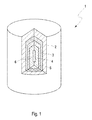
- a first embodiment of a neutron dosimeter 1 is shown in a schematic perspective view. To illustrate the internal structure of the neutron dosimeter, the neutron dosimeter 1 is shown partially cut open. How one Fig. 1 can well, consists of the Neutronendosimeter 1 of a plurality of different layers 2, 3, 4, 5, the matrioschka-like (in the manner of the known Russian, made of wood and brightly painted, nested egg-shaped dolls with talisman character) into each other arranged nested and formed.
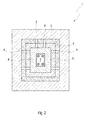
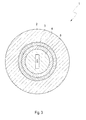
- a receiving area 6 for a detection element 7 (in the present case a card receptacle 6 for a TLD card 7) is provided, into which a TLD card 7 (TLD for thermoluminescence detector) can be inserted (in FIG Fig. 2
- TLD card 7 TLD for thermoluminescence detector
- FIG Fig. 2 TLD card 7 is located in the receiving area 6 by way of example.
- the receiving area 6 is designed in such a way that it is accessible from the outside. This can be done, for example, by a preferably with the help of a kind of plug closed, elongated access channel, which is not shown here for clarity reasons.
- PVC polyvinyl chloride
- the PVC layer 2 contains in chemically bound form in their molecules a larger number of hydrogen atoms and a larger number of chlorine atoms.
- Hydrogen is a suitable moderator for neutron radiation. This means that incident higher-energy neutrons (in particular higher energies than thermal neutrons, in other words energies of ⁇ 25 meV) in the PVC layer 2 are slowed down (moderated).
- thermoluminescent crystals mostly LiF crystals
- TLD cards 7 can essentially register only thermal neutrons.
- detection elements for example, nuclear track detectors, slit detectors or the like
- the PVC layer 2 causes due to their chlorine content (more precisely, it is essentially exclusively the isotope 35 Cl) capture (absorption) in particular slow, especially thermal neutrons.
- the PVC layer 2 acts as a combined neutron absorption and neutron moderator layer.
- a possible special neutron absorption layer having a smaller thickness or a lower neutron absorption capacity can be formed (first embodiment of a neutron dosimeter 1 according to FIG Figs. 1 to 3 ) or even omitted entirely (second embodiment of a neutron dosimeter 8 according to FIG Fig. 4 ).
- first embodiment of a neutron dosimeter 1 according to FIG Figs. 1 to 3 or even omitted entirely (second embodiment of a neutron dosimeter 8 according to FIG Fig. 4 ).
- a significantly less expensive construction can be achieved since neutron absorption layers are often formed using relatively expensive and difficult-to-handle materials (for example boron).
- a (albeit reduced) neutron absorption layer 3 which in the present case consists of borated rubber, is still provided.
- the boron concentration in the borated rubber layer is 10%.
- concentrations such as concentrations between 0%, 5%, 10%, 15% or 20% to 5%, 10%, 15%, 20%, 25%, 30% or 40% are conceivable.
- concentrations between 0%, 5%, 10%, 15% or 20% to 5%, 10%, 15%, 20%, 25%, 30% or 40% are conceivable.
- boron in particular turns out to be advantageous because it can be provided in the proposed rubber layer in substantially any concentrations, so that a particularly good adaptability of the neutron dosimeter 1 is made possible.
- a neutron conversion layer 4 which should be made of a metal-containing material with metals of high atomic number, in this case lead, should be made.
- the neutron conversion layer 4 spallation effects of particularly high-energy neutrons (typically with energies of ⁇ 10 MeV up to several 100 GeV) occur.
- the metallic nuclei of the neutron conversion layer 4 trap such high-energy neutrons (initially). Interaction with the other nucleons in the nucleus leads to a release (evaporation / spallation) of protons and neutrons from the atomic nucleus concerned.
- the released nucleons, in particular neutrons have a lower energy, which corresponds to the energy of thermal neutrons or fast neutrons (so that the respective neutrons can be slowed down by especially downstream moderator materials towards thermal neutrons).
- a special ("exclusive") moderator layer 5 is provided within the neutron conversion layer 4.
- neutrons with average energy typically energies 25 meV to 10 MeV, so-called fast neutrons
- a "pure" moderator material is used (which therefore shows only low neutron absorption at best), in the present case polypropylene (PP), polyethylene (PE) or polymethylmethachrylate (PMMA). If you consider plastic materials higher Density used (which are readily available commercially), so the dimension of the neutron dosimeter 1 can be further reduced.
- the receiving area 6 is a card receiving area 6 for a TLD card 7.
- the receiving area 6 is a card receiving area 6 for a TLD card 7.
- TLD cards 7 By default, however, the use of TLD cards 7 is proposed. In particular, commercially available, standardized TLD cards 7 can be used, which typically have four receiving areas for lithium fluoride crystals (LiF crystals).
- LiF crystals lithium fluoride crystals
- TLD cards have 7 more advantageous properties.
- these can also register very high (short-term) doses.
- This is of particular relevance as particle accelerators are increasingly emerging using ultra-short pulsed laser flashes.
- very short-lived neutron releases and release of other ionizing radiation
- TLD cards are 7 but also in its current embodiment, this usually in the state.
- Typical dimensions for the presently proposed first embodiment of a neutron dosimeter 1 are a height of about 10 cm and a diameter of about 51 mm for the inner moderator layer 5, a height of about 12 cm and a diameter of about 71 mm for the neutron conversion layer 4, a Height of about 13 cm and a diameter of about 81 mm for the neutron absorption layer 3 and a height of about 16 cm and a diameter of about 160 mm for the PVC layer 2.
- the dimensions mentioned are the outer dimensions of the respective layer.
- the internal dimensions result from the outer dimensions of the respective next inner layer or from the shape and size of the inner receiving region 6.
- the resulting external dimension thus corresponds to the size of the PVC layer 2 and is thus in the range of 16 cm in height and 16 cm in diameter.
- This is to be compared with the "GSI bullets", as they are for example in DE 10 2004 020 979 A1 are described, which have a diameter of typically 30 cm. Roughly speaking, it is about a size reduction to about half each, with a corresponding weight reduction by a factor of the order of 8 (scaled with third power).
- the dedicated neutron absorption layer 3 is completely absent.
- the corresponding functionality of the neutron absorption (especially of thermal neutrons) is taken over by the outer PVC layer 2 (combined neutron absorption and Neutronenabsorator Anlagen).
- the "omission" of the dedicated neutron absorption layer 3 can be compensated by a correspondingly larger (thicker) formation of the PVC layer 2. Possibly but this is not necessary, especially when due to the environmental conditions only comparatively few neutrons with medium energy (fast neutrons) occur.
- the reduced absorption of thermal neutrons usually leads to a hypersensitivity of the neutron dosimeter 8 for neutrons of medium energy (ie for fast neutrons).
- the dose rate finally measured by the TLD card 7 is a conservative (too high) estimate for the actual dose rate present. If only a few neutrons of average energy occur, the "hypersensitivity" of the neutron dosimeter 8 for neutrons in this energy range can easily be accepted, since this affects the total, measured dose rate only comparatively small.
- holes 9 are provided in one or more layers (typically in the neutron absorption layer 3 and / or in the neutron conversion layer 4). These allow an unhindered and uninfluenced passage of thermal neutrons through the corresponding layer.
- holes 9 are additionally or alternatively provided in particular in a PVC layer 2 or a "pure" moderator layer 5.
Landscapes
- Physics & Mathematics (AREA)
- Health & Medical Sciences (AREA)
- Life Sciences & Earth Sciences (AREA)
- General Physics & Mathematics (AREA)
- High Energy & Nuclear Physics (AREA)
- Molecular Biology (AREA)
- Spectroscopy & Molecular Physics (AREA)
- Measurement Of Radiation (AREA)
Applications Claiming Priority (1)
| Application Number | Priority Date | Filing Date | Title |
|---|---|---|---|
| DE102014107149.2A DE102014107149A1 (de) | 2014-05-21 | 2014-05-21 | Neutronendosimeter |
Publications (2)
| Publication Number | Publication Date |
|---|---|
| EP2947478A2 true EP2947478A2 (fr) | 2015-11-25 |
| EP2947478A3 EP2947478A3 (fr) | 2015-12-02 |
Family
ID=53268625
Family Applications (1)
| Application Number | Title | Priority Date | Filing Date |
|---|---|---|---|
| EP15167250.8A Withdrawn EP2947478A3 (fr) | 2014-05-21 | 2015-05-12 | Dosimètre à neutrons |
Country Status (2)
| Country | Link |
|---|---|
| EP (1) | EP2947478A3 (fr) |
| DE (1) | DE102014107149A1 (fr) |
Cited By (1)
| Publication number | Priority date | Publication date | Assignee | Title |
|---|---|---|---|---|
| CN108535760A (zh) * | 2018-04-02 | 2018-09-14 | 中国疾病预防控制中心辐射防护与核安全医学所 | 核应急剂量卡及核应急剂量测量方法 |
Citations (3)
| Publication number | Priority date | Publication date | Assignee | Title |
|---|---|---|---|---|
| US3911283A (en) * | 1974-02-08 | 1975-10-07 | Atlantic Richfield Co | Personnel ionizing radiation dosimeter |
| GB2374976A (en) * | 2001-04-26 | 2002-10-30 | Bnfl | Neutron detector units |
| DE102004020979A1 (de) | 2004-04-22 | 2005-11-17 | GSI Gesellschaft für Schwerionenforschung mbH | Dosimeter zur Erfassung von Neutronenstrahlung |
Family Cites Families (5)
| Publication number | Priority date | Publication date | Assignee | Title |
|---|---|---|---|---|
| US3452197A (en) * | 1965-02-24 | 1969-06-24 | American Mach & Foundry | Biological equivalent responsive neutron survey meter |
| FR2619622B1 (fr) * | 1987-08-21 | 1989-11-17 | Commissariat Energie Atomique | Dispositif de caracterisation de matiere fissile comportant au moins un detecteur de rayonnement neutronique noye a l'interieur d'un scintillateur de detection du rayonnement gamma |
| DE19627264C1 (de) * | 1996-07-06 | 1997-10-23 | Karlsruhe Forschzent | Neutronendosisleistungsmesser |
| GB0722430D0 (en) * | 2007-11-15 | 2007-12-27 | Health Prot Agency | Radiation detection |
| US8946648B2 (en) * | 2012-01-19 | 2015-02-03 | Princeton Gamma-Tech Instruments Llc | Dual range digital nuclear spectrometer |
-
2014
- 2014-05-21 DE DE102014107149.2A patent/DE102014107149A1/de not_active Withdrawn
-
2015
- 2015-05-12 EP EP15167250.8A patent/EP2947478A3/fr not_active Withdrawn
Patent Citations (3)
| Publication number | Priority date | Publication date | Assignee | Title |
|---|---|---|---|---|
| US3911283A (en) * | 1974-02-08 | 1975-10-07 | Atlantic Richfield Co | Personnel ionizing radiation dosimeter |
| GB2374976A (en) * | 2001-04-26 | 2002-10-30 | Bnfl | Neutron detector units |
| DE102004020979A1 (de) | 2004-04-22 | 2005-11-17 | GSI Gesellschaft für Schwerionenforschung mbH | Dosimeter zur Erfassung von Neutronenstrahlung |
Cited By (1)
| Publication number | Priority date | Publication date | Assignee | Title |
|---|---|---|---|---|
| CN108535760A (zh) * | 2018-04-02 | 2018-09-14 | 中国疾病预防控制中心辐射防护与核安全医学所 | 核应急剂量卡及核应急剂量测量方法 |
Also Published As
| Publication number | Publication date |
|---|---|
| DE102014107149A1 (de) | 2015-11-26 |
| EP2947478A3 (fr) | 2015-12-02 |
Similar Documents
| Publication | Publication Date | Title |
|---|---|---|
| EP1740976B1 (fr) | Dosimetre concu pour detecter un rayonnement neutronique | |
| DE3145046C2 (de) | Verfahren und Einrichtung zum Erzeugen einer Darstellung der räumlichen Verteilung einer Flüssigkeitsströmung innerhalb einer Hohlkörperstruktur | |
| EP3410104B1 (fr) | Procédé et dispositif d'analyse multi-élément basé sur l'activation par neutrons et utilisation | |
| EP1642155B1 (fr) | Dosimetre destine a detecter des rayonnements neutroniques | |
| DE3007816A1 (de) | Szintillations-detektor | |
| EP2204820B1 (fr) | Enceinte de protection contre les radiations | |
| DE1774021A1 (de) | Vorrichtung zur Bestimmung der Feuchtigkeit in einem Material,insbesondere fuer Bodenuntersuchungen mit Hilfe von Neutronen | |
| DE2260094C2 (de) | Vorrichtung zum Bestimmunen des Äquivalent-Dosiswertes von Neutronen mit einem innerhalb einer Abschirmung angeordneten Albedo-Neutronendetektor | |
| DE102015008272A1 (de) | Schlitzblendensystem für bildgebende Verfahren mit harter Strahlung | |
| DE2228871A1 (de) | Dosimeter | |
| DE102013102920A1 (de) | Vorrichtung zum Verifizieren der Hadronentherapie durch Messung prompter Gammastrahlung unter Verwendung aktiver Kollimatoren | |
| DE102013220280B4 (de) | Verfahren zum Messen einer anthropogenen Neutronendosis und Neutronendosimeter | |
| DE102014107149A1 (de) | Neutronendosimeter | |
| DE3928711A1 (de) | Absorptionsmantel zur absorption radioaktiver strahlung und spaltprodukte | |
| CH404973A (de) | Verfahren und Vorrichtung zum Messen der Temperatur eines Mittels | |
| EP4248177A1 (fr) | Boîtier radioprotecteur destiné à des dispositifs de mesure radiométriques | |
| EP3561459B1 (fr) | Dispositif et procédé de mesure du niveau de remplissage ou de la densité d'un milieu à l'aide de muons | |
| EP2893373A1 (fr) | Dispositif dosimètre à haute énergie | |
| DE1598584B1 (de) | Verfahren und vorrichtung zur durchfuehrung von aktivierungs analysen | |
| DE1233500C2 (de) | Vorrichtung zum Messen eines Neutronenflusses | |
| DE2613700A1 (de) | Vorrichtung zur zerstoerungsfreien bestimmung thermisch spaltbarer nuklide in ausgedehnten proben | |
| EP3101447B1 (fr) | Dosimetre et procede de determination d'une dose de radiation | |
| Postelt | Neutron-induced prompt gamma signatures in plutonium-239, plutonium-240, uran-235 and uran-238 | |
| Drinhaus | Development of a detector for sensitive on-line detection of radionuclides (α, β, γ) in the (drinking) water network | |
| DE1639539B1 (de) | Dosimeter zum Messen einer Neutronendosis ueber praktisch den gesamten Neutronenenergiebereich |
Legal Events
| Date | Code | Title | Description |
|---|---|---|---|
| PUAL | Search report despatched |
Free format text: ORIGINAL CODE: 0009013 |
|
| PUAI | Public reference made under article 153(3) epc to a published international application that has entered the european phase |
Free format text: ORIGINAL CODE: 0009012 |
|
| 17P | Request for examination filed |
Effective date: 20150512 |
|
| AK | Designated contracting states |
Kind code of ref document: A2 Designated state(s): AL AT BE BG CH CY CZ DE DK EE ES FI FR GB GR HR HU IE IS IT LI LT LU LV MC MK MT NL NO PL PT RO RS SE SI SK SM TR |
|
| AX | Request for extension of the european patent |
Extension state: BA ME |
|
| AK | Designated contracting states |
Kind code of ref document: A3 Designated state(s): AL AT BE BG CH CY CZ DE DK EE ES FI FR GB GR HR HU IE IS IT LI LT LU LV MC MK MT NL NO PL PT RO RS SE SI SK SM TR |
|
| AX | Request for extension of the european patent |
Extension state: BA ME |
|
| RIC1 | Information provided on ipc code assigned before grant |
Ipc: G01T 1/11 20060101ALI20151026BHEP Ipc: G01T 3/00 20060101AFI20151026BHEP |
|
| 17Q | First examination report despatched |
Effective date: 20170406 |
|
| STAA | Information on the status of an ep patent application or granted ep patent |
Free format text: STATUS: THE APPLICATION IS DEEMED TO BE WITHDRAWN |
|
| 18D | Application deemed to be withdrawn |
Effective date: 20190625 |