EP2949201A1 - Etikett mit einer hydrochromen tinte, und behälter, der mit einem solchen etikett versehen ist - Google Patents
Etikett mit einer hydrochromen tinte, und behälter, der mit einem solchen etikett versehen ist Download PDFInfo
- Publication number
- EP2949201A1 EP2949201A1 EP15170079.6A EP15170079A EP2949201A1 EP 2949201 A1 EP2949201 A1 EP 2949201A1 EP 15170079 A EP15170079 A EP 15170079A EP 2949201 A1 EP2949201 A1 EP 2949201A1
- Authority
- EP
- European Patent Office
- Prior art keywords
- layer
- container
- label
- water
- ink
- Prior art date
- Legal status (The legal status is an assumption and is not a legal conclusion. Google has not performed a legal analysis and makes no representation as to the accuracy of the status listed.)
- Withdrawn
Links
- XLYOFNOQVPJJNP-UHFFFAOYSA-N water Substances O XLYOFNOQVPJJNP-UHFFFAOYSA-N 0.000 claims abstract description 70
- 239000011148 porous material Substances 0.000 claims abstract description 19
- 239000000123 paper Substances 0.000 claims description 20
- 239000004744 fabric Substances 0.000 claims description 14
- 239000000463 material Substances 0.000 claims description 14
- 238000000034 method Methods 0.000 claims description 14
- 230000002093 peripheral effect Effects 0.000 claims description 12
- 239000012815 thermoplastic material Substances 0.000 claims description 11
- 238000004519 manufacturing process Methods 0.000 claims description 8
- 229920000728 polyester Polymers 0.000 claims description 5
- 239000011111 cardboard Substances 0.000 claims description 4
- 230000002441 reversible effect Effects 0.000 claims description 4
- 230000000295 complement effect Effects 0.000 claims description 3
- 239000000835 fiber Substances 0.000 claims description 3
- 238000000465 moulding Methods 0.000 claims description 3
- 239000002861 polymer material Substances 0.000 claims description 3
- 239000011087 paperboard Substances 0.000 claims description 2
- 239000010410 layer Substances 0.000 description 125
- 239000000976 ink Substances 0.000 description 63
- 239000004743 Polypropylene Substances 0.000 description 8
- -1 polypropylene Polymers 0.000 description 8
- 229920001155 polypropylene Polymers 0.000 description 8
- 239000012943 hotmelt Substances 0.000 description 7
- 239000000758 substrate Substances 0.000 description 7
- 230000008859 change Effects 0.000 description 6
- 210000001519 tissue Anatomy 0.000 description 5
- VYPSYNLAJGMNEJ-UHFFFAOYSA-N Silicium dioxide Chemical compound O=[Si]=O VYPSYNLAJGMNEJ-UHFFFAOYSA-N 0.000 description 4
- 238000002347 injection Methods 0.000 description 4
- 239000007924 injection Substances 0.000 description 4
- 238000007639 printing Methods 0.000 description 4
- 238000009833 condensation Methods 0.000 description 3
- 230000005494 condensation Effects 0.000 description 3
- 239000004033 plastic Substances 0.000 description 3
- 229920003023 plastic Polymers 0.000 description 3
- 238000004382 potting Methods 0.000 description 3
- 230000008569 process Effects 0.000 description 3
- 239000005871 repellent Substances 0.000 description 3
- 239000002689 soil Substances 0.000 description 3
- LYCAIKOWRPUZTN-UHFFFAOYSA-N Ethylene glycol Chemical compound OCCO LYCAIKOWRPUZTN-UHFFFAOYSA-N 0.000 description 2
- 241001080024 Telles Species 0.000 description 2
- 239000000853 adhesive Substances 0.000 description 2
- 238000000151 deposition Methods 0.000 description 2
- 239000007888 film coating Substances 0.000 description 2
- 238000009501 film coating Methods 0.000 description 2
- 238000007647 flexography Methods 0.000 description 2
- 238000007650 screen-printing Methods 0.000 description 2
- 239000000377 silicon dioxide Substances 0.000 description 2
- 239000000126 substance Substances 0.000 description 2
- 239000012780 transparent material Substances 0.000 description 2
- VGGSQFUCUMXWEO-UHFFFAOYSA-N Ethene Chemical compound C=C VGGSQFUCUMXWEO-UHFFFAOYSA-N 0.000 description 1
- 239000005977 Ethylene Substances 0.000 description 1
- 239000004698 Polyethylene Substances 0.000 description 1
- 238000010521 absorption reaction Methods 0.000 description 1
- 238000004026 adhesive bonding Methods 0.000 description 1
- 230000001070 adhesive effect Effects 0.000 description 1
- 239000012790 adhesive layer Substances 0.000 description 1
- VXAUWWUXCIMFIM-UHFFFAOYSA-M aluminum;oxygen(2-);hydroxide Chemical compound [OH-].[O-2].[Al+3] VXAUWWUXCIMFIM-UHFFFAOYSA-M 0.000 description 1
- 230000004888 barrier function Effects 0.000 description 1
- 235000013361 beverage Nutrition 0.000 description 1
- 239000011248 coating agent Substances 0.000 description 1
- 238000000576 coating method Methods 0.000 description 1
- 235000020965 cold beverage Nutrition 0.000 description 1
- 239000003086 colorant Substances 0.000 description 1
- 230000032798 delamination Effects 0.000 description 1
- 230000000694 effects Effects 0.000 description 1
- 238000011049 filling Methods 0.000 description 1
- 230000004927 fusion Effects 0.000 description 1
- 239000011521 glass Substances 0.000 description 1
- 235000012171 hot beverage Nutrition 0.000 description 1
- 230000002209 hydrophobic effect Effects 0.000 description 1
- WGCNASOHLSPBMP-UHFFFAOYSA-N hydroxyacetaldehyde Natural products OCC=O WGCNASOHLSPBMP-UHFFFAOYSA-N 0.000 description 1
- 238000007641 inkjet printing Methods 0.000 description 1
- 230000002427 irreversible effect Effects 0.000 description 1
- 238000002372 labelling Methods 0.000 description 1
- 239000007788 liquid Substances 0.000 description 1
- 239000000155 melt Substances 0.000 description 1
- 238000002844 melting Methods 0.000 description 1
- 230000008018 melting Effects 0.000 description 1
- 238000002156 mixing Methods 0.000 description 1
- 239000000203 mixture Substances 0.000 description 1
- 239000012466 permeate Substances 0.000 description 1
- 239000000049 pigment Substances 0.000 description 1
- 238000009832 plasma treatment Methods 0.000 description 1
- 229920000058 polyacrylate Polymers 0.000 description 1
- 239000004417 polycarbonate Substances 0.000 description 1
- 229920000515 polycarbonate Polymers 0.000 description 1
- 229920000573 polyethylene Polymers 0.000 description 1
- 239000000047 product Substances 0.000 description 1
- 230000001902 propagating effect Effects 0.000 description 1
- 230000001681 protective effect Effects 0.000 description 1
- 230000002940 repellent Effects 0.000 description 1
- 230000004044 response Effects 0.000 description 1
- 238000007789 sealing Methods 0.000 description 1
- KKCBUQHMOMHUOY-UHFFFAOYSA-N sodium oxide Chemical compound [O-2].[Na+].[Na+] KKCBUQHMOMHUOY-UHFFFAOYSA-N 0.000 description 1
- 229910001948 sodium oxide Inorganic materials 0.000 description 1
- 239000000243 solution Substances 0.000 description 1
- 239000002904 solvent Substances 0.000 description 1
- 239000004834 spray adhesive Substances 0.000 description 1
Images

Classifications
-
- A—HUMAN NECESSITIES
- A01—AGRICULTURE; FORESTRY; ANIMAL HUSBANDRY; HUNTING; TRAPPING; FISHING
- A01G—HORTICULTURE; CULTIVATION OF VEGETABLES, FLOWERS, RICE, FRUIT, VINES, HOPS OR SEAWEED; FORESTRY; WATERING
- A01G9/00—Cultivation in receptacles, forcing-frames or greenhouses; Edging for beds, lawn or the like
- A01G9/02—Receptacles, e.g. flower-pots or boxes; Glasses for cultivating flowers
- A01G9/021—Pots formed in one piece; Materials used therefor
-
- A—HUMAN NECESSITIES
- A01—AGRICULTURE; FORESTRY; ANIMAL HUSBANDRY; HUNTING; TRAPPING; FISHING
- A01G—HORTICULTURE; CULTIVATION OF VEGETABLES, FLOWERS, RICE, FRUIT, VINES, HOPS OR SEAWEED; FORESTRY; WATERING
- A01G27/00—Self-acting watering devices, e.g. for flower-pots
- A01G27/008—Component parts, e.g. dispensing fittings, level indicators
-
- A—HUMAN NECESSITIES
- A01—AGRICULTURE; FORESTRY; ANIMAL HUSBANDRY; HUNTING; TRAPPING; FISHING
- A01G—HORTICULTURE; CULTIVATION OF VEGETABLES, FLOWERS, RICE, FRUIT, VINES, HOPS OR SEAWEED; FORESTRY; WATERING
- A01G9/00—Cultivation in receptacles, forcing-frames or greenhouses; Edging for beds, lawn or the like
- A01G9/006—Plant receptacles specially adapted as labels or label holders
-
- G—PHYSICS
- G01—MEASURING; TESTING
- G01N—INVESTIGATING OR ANALYSING MATERIALS BY DETERMINING THEIR CHEMICAL OR PHYSICAL PROPERTIES
- G01N31/00—Investigating or analysing non-biological materials by the use of the chemical methods specified in the subgroup; Apparatus specially adapted for such methods
- G01N31/22—Investigating or analysing non-biological materials by the use of the chemical methods specified in the subgroup; Apparatus specially adapted for such methods using chemical indicators
- G01N31/222—Investigating or analysing non-biological materials by the use of the chemical methods specified in the subgroup; Apparatus specially adapted for such methods using chemical indicators for investigating moisture content
-
- G—PHYSICS
- G01—MEASURING; TESTING
- G01N—INVESTIGATING OR ANALYSING MATERIALS BY DETERMINING THEIR CHEMICAL OR PHYSICAL PROPERTIES
- G01N33/00—Investigating or analysing materials by specific methods not covered by groups G01N1/00 - G01N31/00
- G01N33/24—Earth materials
- G01N33/246—Earth materials for water content
-
- G—PHYSICS
- G09—EDUCATION; CRYPTOGRAPHY; DISPLAY; ADVERTISING; SEALS
- G09F—DISPLAYING; ADVERTISING; SIGNS; LABELS OR NAME-PLATES; SEALS
- G09F3/00—Labels, tag tickets, or similar identification or indication means; Seals; Postage or like stamps
- G09F3/02—Forms or constructions
- G09F3/0291—Labels or tickets undergoing a change under particular conditions, e.g. heat, radiation, passage of time
- G09F3/0294—Labels or tickets undergoing a change under particular conditions, e.g. heat, radiation, passage of time where the change is not permanent, e.g. labels only readable under a special light, temperature indicating labels and the like
Definitions
- the present invention relates to a label for coating a wall of a container, in particular by an overmoulding process, and to such a container.
- This container can have any shape and volume.
- the present invention is more particularly directed to a container that can be used for the cultivation of plants.
- This invention makes use of a hydrochrome ink which has the particularity of changing state in contact with water.
- Such a type of ink is well known and some companies make use of it by integrating it into product lines.
- Another company specializing in toys has covered the surface of a carpet with a hydrochrome ink.
- the surface of the carpet In the absence of moisture, the surface of the carpet has a uniform appearance.
- Such a design of the container makes it possible to characterize a filling only if a significant temperature difference is ensured between the walls of the container and the liquid poured therein for condensation to occur on the external surface of the container. .
- Such a design is not suitable for containers intended for other uses, in particular to receive a substrate and a plant for cultivation. Indeed, the phenomenon of condensation described in the aforementioned document is not generated in such cases, since the water optionally contained in the substrate is at the same temperature as that of the container.
- the hydrochrome ink is placed on the inner surface of the container so that it is in direct contact with the water possibly contained in the container. Indeed, in this case, a possible change of state of the hydrochrome ink would be detectable only by observing the inner surface of the container. Now, it is the outer surface of the container which is intended to be seen by the examiner, the inner surface being masked by the substrate contained in the container.
- the document EP 2,269,443 discloses a container comprising a porous wall incorporating a water presence indicator.
- a region of the outer face of said porous wall is covered with a graphic, itself covered with a layer of a moisture-sensitive material which is opaque in the absence of water and transparent in the presence of water.
- the symbol is visible from outside the container when water is present therein and passes through the porous wall, and invisible in the absence of water in the container.
- the container wall must be covered on its outer face with a watertight material, except at the location of the humidity control. The manufacture of such a container is therefore complex.
- the document WO 03/015060 describes a humidity indicator based on water-repellent ink.
- This device comprises a label stuck on the outer face of the wall of a container so as to close an orifice made in said wall.
- Said label is formed successively of a layer of water repellent ink, a layer of paper, an adhesive layer and a transparent film.
- the water-repellent ink diffuses through the paper and then becomes visible from the outside of the container.
- this solution requires making an orifice in the container.
- the present invention aims to solve these problems by proposing a label comprising a hydrochrome ink, said label being affixed to the wall of the container so that the hydrochromatic ink is visible from the outside of the container, and whose change of 'state is caused by the presence of moisture directly contained in the container.
- hydrochrome is meant in the present text an ink having a first aspect in the dry state and a second aspect different from the first in the wet state, the first aspect being typically opaque while the second aspect is transparent. In a particularly advantageous manner, such a change of appearance is reversible.
- This label is intended to be affixed to an inner wall of a container, said wall being made of a transparent material and impervious to water.
- water in any form ie water alone or incorporated in a substrate such as potting soil
- a substrate such as potting soil
- the hydrochrome ink changes state and becomes transparent, so that the second colored layer is visually revealed.
- a fourth transparent and waterproof layer protects the whole.
- this ink being opaque in the absence of water and transparent in the presence of water
- these opacity / transparency are considered in relation to the light of the visible range.
- an ink that is not transparent but translucent may be suitable for the invention. This ink may have any color.
- the fourth layer is made of a thermoplastic material.
- the container comprises an additional receptacle, received in said internal volume, and of complementary shape of the latter, this receptacle being impermeable and provided with at least one through opening.
- Another aspect of the invention relates to a method of manufacturing such a container.
- the label is held in the mold cavity by an electrostatic charge.
- the container may have any shape and volume. It can for example take the form of a bottle, a bottle, a bowl, a glass, a cylindrical pot, etc.
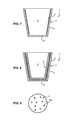
- This container referenced 1 has a bottom 10 which extends in a plane and from which rises a peripheral wall 11 diverging as one moves away from the bottom 10. It has a form of revolution.
- At least the peripheral wall 11 comprises a multilayer structure comprising a label which will be described in detail below.
- Said multi-layer structure can occupy the entire surface of the peripheral wall or only a part of the surface of said wall.
- the bottom 10, which is advantageously in one piece with the wall 11, also consists of this same multilayer structure.
- This structure is partially shown in cross-section at the figure 2 .
- this structure 2 has, on the side of the internal volume V, a first layer 20 of a porous material, that is to say permeable to water.
- the first layer 20 may be made of a material such as standard paper, blotting paper or filter paper. You can also use cardboard.
- the first layer 20 is a fabric.
- the fabric is permeable to water.
- fabric has a number of advantages.
- the fabric does not deform when it absorbs water, which limits the risk of delamination of the multilayer structure.
- the fabric can be cleaned with a sponge without risk even with an abrasive surface while in the case of paper the fibers tend to detach from the rest of the structure.
- the tissue is less susceptible to mold.
- the thinnest possible thickness to facilitate its implementation in a label, particularly to allow its conformation to the container wall.
- the second layer 21 is a colored layer. Preferably, it covers the entire surface of the first layer, but this is not mandatory. Thus, it can be envisaged that there exists on the outer surface of the first layer one or more regions coated with this colored layer.
- this colored layer is not to be soluble in water.
- said colored layer is permeable to water.
- a colored ink will be used.
- commercially available inks can be used according to the intended printing technique, avoiding water-soluble inks and water-impermeable inks.
- the third layer 22 is a layer of a hydrochrome ink which covers the second colored layer, this ink being opaque in the absence of water and transparent in the presence of water.
- the ink may for example be white color when opaque. It is applied to the second layer 21 in a sufficient thickness so that it covers and completely masks the color thereof when it is opaque.
- these first three layers 20-22 together form a label.
- the ink used to form the colored layer 21 must withstand the temperature of the melt (which is of the order of 250 ° C in the case of polypropylene, and which may be higher or lower depending on the plastic material used) and the mold during the injection. In this case, it is therefore avoided to use a wax or xerographic type graphic ink, which risks melting and mixing with the hydrochrome ink, giving it an undesired color tone.
- the hydrochrome ink being slightly alkaline, it is also necessary to choose, for the layer 21, grades of alkaline resistant colored pigments.
- the structure comprises a fourth layer of a transparent material 23 which is impervious to water, and which defines the wall of the container itself. Possibly, although in a less advantageous manner, said material may be translucent. From outside the container, it is thus possible to observe, through this fourth layer 23, the state of the hydrochrome ink 22 which masks or on the contrary reveals the colored layer 21.
- this fourth layer is made of a thermoplastic material. Among the possible materials that may be mentioned include polycarbonate, polyethylene and polypropylene. Said fourth layer may be colorless or colored.
- FIG. 3 to 6 only individualize the different layers of which we have just spoken. With the exception of the layer 23, these different layers can form a two-dimensional set 2 'such as a label. Preferably, said assembly 2 'has sufficient flexibility to match the shape of the container wall.
- the figure 3 represents a portion of the first layer 20, while the figure 4
- This layer 21 is bicolored and has a pattern 210 which has, in this embodiment, the shape of a sun.
- a pattern 210 which has, in this embodiment, the shape of a sun.
- the hydrochrome ink layer 22 which covers the layers 20 and 21 is identified.
- the hydrochrome ink layer 22 covers the entire colored layer 21.
- the hydrochrome ink layer may cover only a portion of the colored layer 21.
- the colored layer has a uniform hue and the hydrochrome ink defines a pattern.
- the label may advantageously comprise, on the hydrochrome ink layer 22, a layer of a transparent thermofusible polymer material 24, for example polypropylene.
- This layer protects hydro-chrome ink while preserving its functionality.
- Said hot-melt layer 24 also makes it possible to improve the mechanical properties of the label (in particular its resistance to tearing) before it is used in the container 1.
- the hot-melt layer 24 is intended to come into contact with the layer 23 which forms the container wall. Thus, if the container 1 is formed by overmolding a thermoplastic material on the label, the hot melt layer 24 merges with the thermoplastic material injected.
- the assembly 2 'formed of the layers 20, 21, 22 and where appropriate 24 is inseparable from the layer 23.
- the layer 24 advantageously has a self-adhesive outer face covered a peelable protective film.
- thermoplastic material injected For the production of the hot-melt layer 24, various polypropylene (PP) film-coating films were tested. Whatever the method of application of said film (heat-sealing, pre-coated cold adhesive on the film or use of a spray adhesive on a bare film), the overmoulding tests showed the good fusion between the film of film coating and the thermoplastic material injected.
- PP polypropylene
- the container contains water itself, but one can also consider the case where the container receives a wet substrate such as potting soil.
- the water contained in the container 1 passes little by little through the first porous layer 20, as well as the second colored layer, to reach the third layer 22 of hydrochrome ink. In doing so, it changes state and becomes transparent.
- the passage of water can be done directly in the direction of the thickness of this layer but also by capillarity, from an edge of the layer 20, with propagation in a plane perpendicular to the thickness.
- the water can impregnate the layer 20 over a certain height. higher at the water level and thus change the appearance of the hydrochrome ink. This allows to reveal, on a large surface, even a small amount of water contained in the bottom of the container.
- Such a phenomenon is impossible in the absence of such a porous layer: indeed, in such a case, only the water present directly at the hydrochrome ink can change the appearance of the ink and thus be detected .
- the fourth layer 23 is transparent and impermeable, it makes it possible, on the one hand, to see through the layers 22 and 23 and possibly 24 the presence of the colored layer 21 and this also makes it possible to constitute a watertight barrier which prevents the water out of the container. This constitutes a first state of the container.
- the response time of the hydrochrome ink depends on the absorption capacity of the porous material.
- the layer of hydrochrome ink which is preferably reversible, returns to its initial state in which it is opaque (for example the white color). Under these conditions, the absence of water in the container can be seen from the outside through the fourth layer 23, since the second colored layer is no longer visible. In the case where the container is a flower pot, a user understands that it is then time to pour water into the container.
- the hydrochrome ink layer 22 it is also possible for the hydrochrome ink layer 22 to cover only a portion of the colored layer 21.
- the portion of the colored layer 21 not covered with the hydrochrome ink is visible in FIG. continuously from outside the container, while the portion coated with the hydrochrome ink is masked by said opaque ink in the dry state and revealed by said transparent ink in the wet state.
- Figures 7 and 8 are represented two other embodiments of the container of the figure 1 .
- the fourth layer 23 forms a container 3 comprising a bottom 10 and a peripheral wall 11 of the container, the unitary unit 2 'consisting of the first, second and third layers (and optionally the hot-melt layer) above being distinct from the container 3, secured to the inner face of the layer 23, for example glued in the manner of a label.
- Said unitary assembly is typically applied to the peripheral wall, and possibly to the bottom of the container 3.
- a complementary receptacle is placed in the interior volume V of the container on which the assembly comprising the hydrochrome ink layer is placed, and additional 4, this receptacle being impermeable.
- it may be a container made of an opaque plastic material.
- this additional container has openings 400 for the passage of water towards the first layer of the structure 2, the water propagating in the porous material of the layer 20 by capillarity from the bottom
- the layer 20 of porous material extends from the bottom of the container, so that any water present at the bottom of the container reaches the lower edge of said porous material.
- this receptacle 4 may be the receptacle containing the substrate and the plant, the receptacle 1 fulfilling an aesthetic function and indicating the degree of humidity of the substrate.
- the porous material of the first layer 20 is surface-treated so that it has first porous regions and second regions impermeable to water. This makes it possible to considerably increase the service life of the structure 2 thus formed and, if necessary, to adjust the capillarity phenomena mentioned above.
- the printing technique of the colored ink of the second layer 21 may be of different types. Thus, one can proceed to printing by flexography, heliography, offset technique, inkjet or screen printing.
- the deposit must be homogeneous.
- the deposit thickness should not be too thin because the ink would not be so opacifying in the dry state, nor too thick because the ink would be difficult to be transparent in the wet state.
- the thickness of the hydrochrome ink layer is between 30 and 60 microns.
- inks comprising acrylic polymers, silica (or a mixture of silica / aluminum dioxide / sodium oxide), water and a solvent (and possibly ethylene). glycol).
- the label formed of the layers 20 to 22 (and where appropriate 24) then becomes inseparable from the fourth layer 23.
- the use of a fabric as a porous material for the first layer 20 has advantages over paper.
- the label in order to maintain the label on the core (moving part of the mold), the label must be as flexible as possible in order to fit the conical shape of the core.
- the label after printing all the layers, the label usually becomes too rigid to be properly held on the core.
- tissue-based labels approximately 350-450 ⁇ m, compared with 40-50 ⁇ m for a standard polypropylene label
- these remain much more flexible than their paper-based counterparts.
- labels based on polyester fabric can be electrostatically charged, which is not the case of paper-based labels. This allows, as for standard labels based on polypropylene, to electrostatically charge the label to allow it to adhere to the mold.
- a suction system placed inside the core may also be used to maintain the label on the core during the injection of the thermoplastic material.
- the label formed of the layers 20 to 22 can optionally be subsequently removed and replaced by a new label, for example when it has been degraded.
- the label covers a substantial part of the surface of the peripheral wall of the container.
- the label may be arranged at the location of a level indication window. Reading the water level is not done directly by observing the water through the window, which can be inconvenient, but by observing the color of the label, the part of the label in contact with the water. water with a different appearance from the part of the label that is dry. By choosing the aspects in the dry state and the wet state sufficiently different, the label thus allows an easier reading of the water level in the tank.
- the invention is not limited to the cultivation of plants but more generally applies to any container intended to give an indication of the presence of water in the container.
Landscapes
- Life Sciences & Earth Sciences (AREA)
- Health & Medical Sciences (AREA)
- Engineering & Computer Science (AREA)
- General Physics & Mathematics (AREA)
- Environmental Sciences (AREA)
- Physics & Mathematics (AREA)
- Chemical & Material Sciences (AREA)
- Immunology (AREA)
- General Health & Medical Sciences (AREA)
- Biochemistry (AREA)
- Analytical Chemistry (AREA)
- Pathology (AREA)
- Biophysics (AREA)
- Water Supply & Treatment (AREA)
- Molecular Biology (AREA)
- Environmental & Geological Engineering (AREA)
- General Life Sciences & Earth Sciences (AREA)
- Geology (AREA)
- Remote Sensing (AREA)
- Food Science & Technology (AREA)
- Medicinal Chemistry (AREA)
- Theoretical Computer Science (AREA)
- Details Of Rigid Or Semi-Rigid Containers (AREA)
Applications Claiming Priority (2)
| Application Number | Priority Date | Filing Date | Title |
|---|---|---|---|
| FR1454910A FR3021494B1 (fr) | 2014-05-30 | 2014-05-30 | Recipient faisant usage d'une encre hydrochrome et ses procedes de fabrication |
| FR1461699A FR3021746B1 (fr) | 2014-05-30 | 2014-12-01 | Etiquette comprenant une encre hydrochrome et recipient comportant une telle etiquette |
Publications (1)
| Publication Number | Publication Date |
|---|---|
| EP2949201A1 true EP2949201A1 (de) | 2015-12-02 |
Family
ID=53264600
Family Applications (1)
| Application Number | Title | Priority Date | Filing Date |
|---|---|---|---|
| EP15170079.6A Withdrawn EP2949201A1 (de) | 2014-05-30 | 2015-06-01 | Etikett mit einer hydrochromen tinte, und behälter, der mit einem solchen etikett versehen ist |
Country Status (2)
| Country | Link |
|---|---|
| EP (1) | EP2949201A1 (de) |
| FR (1) | FR3021746B1 (de) |
Cited By (4)
| Publication number | Priority date | Publication date | Assignee | Title |
|---|---|---|---|---|
| JP2018014985A (ja) * | 2016-07-25 | 2018-02-01 | 裕人 吉添 | 植木鉢及び水やり時期判定方法 |
| EP4111850A1 (de) * | 2021-06-28 | 2023-01-04 | Freshape SA | Farbbasierter feuchtigkeitsanzeiger in einem pflanzenzuchtbehälter |
| WO2023244800A1 (en) * | 2022-06-17 | 2023-12-21 | Multi Packaging Solutions, Inc. | Multi-layered tags |
| US20250110104A1 (en) * | 2023-09-29 | 2025-04-03 | Temptime Corporation | Environmentally sensitive plant id tag |
Citations (5)
| Publication number | Priority date | Publication date | Assignee | Title |
|---|---|---|---|---|
| FR2301013A1 (fr) * | 1975-02-12 | 1976-09-10 | Anquetin Jacques | Dispositif avertisseur d'assechement |
| GB2073567A (en) * | 1980-04-14 | 1981-10-21 | Bellaplast Gmbh | Plant container of synthetic thermoplastic material |
| WO2003015060A2 (de) | 2001-08-08 | 2003-02-20 | Schreiner Gmbh & Co. Kg | Etikett und verfahren zum nachweis unerwünschter feuchtigkeit |
| WO2005123516A2 (en) | 2004-06-14 | 2005-12-29 | Sports Media, Inc. | Container and method of making a container |
| EP2269443A1 (de) | 2009-07-02 | 2011-01-05 | Far East University | Blumentopf mit Feuchtigkeitssensormaterial zur umgehenden Wässerung |
-
2014
- 2014-12-01 FR FR1461699A patent/FR3021746B1/fr not_active Expired - Fee Related
-
2015
- 2015-06-01 EP EP15170079.6A patent/EP2949201A1/de not_active Withdrawn
Patent Citations (5)
| Publication number | Priority date | Publication date | Assignee | Title |
|---|---|---|---|---|
| FR2301013A1 (fr) * | 1975-02-12 | 1976-09-10 | Anquetin Jacques | Dispositif avertisseur d'assechement |
| GB2073567A (en) * | 1980-04-14 | 1981-10-21 | Bellaplast Gmbh | Plant container of synthetic thermoplastic material |
| WO2003015060A2 (de) | 2001-08-08 | 2003-02-20 | Schreiner Gmbh & Co. Kg | Etikett und verfahren zum nachweis unerwünschter feuchtigkeit |
| WO2005123516A2 (en) | 2004-06-14 | 2005-12-29 | Sports Media, Inc. | Container and method of making a container |
| EP2269443A1 (de) | 2009-07-02 | 2011-01-05 | Far East University | Blumentopf mit Feuchtigkeitssensormaterial zur umgehenden Wässerung |
Cited By (4)
| Publication number | Priority date | Publication date | Assignee | Title |
|---|---|---|---|---|
| JP2018014985A (ja) * | 2016-07-25 | 2018-02-01 | 裕人 吉添 | 植木鉢及び水やり時期判定方法 |
| EP4111850A1 (de) * | 2021-06-28 | 2023-01-04 | Freshape SA | Farbbasierter feuchtigkeitsanzeiger in einem pflanzenzuchtbehälter |
| WO2023244800A1 (en) * | 2022-06-17 | 2023-12-21 | Multi Packaging Solutions, Inc. | Multi-layered tags |
| US20250110104A1 (en) * | 2023-09-29 | 2025-04-03 | Temptime Corporation | Environmentally sensitive plant id tag |
Also Published As
| Publication number | Publication date |
|---|---|
| FR3021746B1 (fr) | 2017-01-06 |
| FR3021746A1 (fr) | 2015-12-04 |
Similar Documents
| Publication | Publication Date | Title |
|---|---|---|
| EP0795390B1 (de) | Behälter mit einem dekorativen Etikett und Verfahren zu dessen Herstellung | |
| EP2949201A1 (de) | Etikett mit einer hydrochromen tinte, und behälter, der mit einem solchen etikett versehen ist | |
| EP1247756B1 (de) | Geschlossene Kapsel zur Getränkezubereitung | |
| EP0803210B1 (de) | Beutelverpackung für ein cremiges oder pastiges Produkt; Herstellungsverfahren dafür und Schminkdose mit einem derartigen Beutel | |
| CA2574259C (fr) | Conditionnement pour l'infusion d'une matiere a infuser | |
| FR2972180A3 (fr) | Kit ou ensemble pour la formation de capsules remplissables pour la preparation d'infusions | |
| FR2902083A1 (fr) | Recipient a double paroi et procede pour la realisation d'un tel recipient | |
| FR3021494A1 (fr) | Recipient faisant usage d'une encre hydrochrome et ses procedes de fabrication | |
| FR2821712A1 (fr) | Godet pour culture de vegetaux | |
| EP1070460B1 (de) | Gegenstand mit einer Rückseite, die mit einem Überzug versehen ist, welche das Enstehen von Lichteffekten erlaubt, die an der Vorderseite wahrzunehmen sind | |
| EP3625022B1 (de) | Verfahren zur herstellung einer schale mit einer zierfolie | |
| EP2491437B1 (de) | Selektives färbeverfahren, transparente komponente mit zellstruktur resultierend aus diesem verfahren | |
| CA2363215A1 (fr) | Boite recouverte d'un materiau non tisse | |
| EP2373549B1 (de) | Verpackung mit veränderlichem aussehen | |
| WO2011135250A1 (fr) | Conditionnement a usage individuel d'un produit cosmetique sensible a l'exposition a un rayonnement ultraviolet | |
| EP3137313B1 (de) | Sicherheitsstreifen und sicherheitsdokument mit diesem streifen | |
| WO2003056974A2 (fr) | Pot notamment de creme cosmetique | |
| FR3012799A1 (fr) | Opercule pelable pour l'obturation d'un recipient, et joint d'etancheite comprenant un tel opercule | |
| FR2861058A1 (fr) | Distributeur de produit fluide. | |
| EP4298954A1 (de) | Verfahren zur herstellung eines glasbehälters mit integriertem dekorzubehör und entsprechender glasdekorbehälter | |
| FR2807397A1 (fr) | Recipient pour liquides | |
| FR2993220A1 (fr) | Element de garnissage presentant un aspect variable sur sa face d'aspect | |
| WO2021180700A1 (fr) | Composant de décoration et procédé de fabrication associé | |
| EP1415569A1 (de) | Vorrichtung zum Verpacken eines Produktes und Verpackungsverfahren | |
| FR2962068A1 (fr) | Procede de decoration d'un objet. |
Legal Events
| Date | Code | Title | Description |
|---|---|---|---|
| 17P | Request for examination filed |
Effective date: 20150601 |
|
| AK | Designated contracting states |
Kind code of ref document: A1 Designated state(s): AL AT BE BG CH CY CZ DE DK EE ES FI FR GB GR HR HU IE IS IT LI LT LU LV MC MK MT NL NO PL PT RO RS SE SI SK SM TR |
|
| AX | Request for extension of the european patent |
Extension state: BA ME |
|
| PUAI | Public reference made under article 153(3) epc to a published international application that has entered the european phase |
Free format text: ORIGINAL CODE: 0009012 |
|
| STAA | Information on the status of an ep patent application or granted ep patent |
Free format text: STATUS: THE APPLICATION IS DEEMED TO BE WITHDRAWN |
|
| 18D | Application deemed to be withdrawn |
Effective date: 20190103 |