EP2949606B1 - Système de commissionnement dans le bon ordre et préparation de marchandises - Google Patents
Système de commissionnement dans le bon ordre et préparation de marchandises Download PDFInfo
- Publication number
- EP2949606B1 EP2949606B1 EP15168218.4A EP15168218A EP2949606B1 EP 2949606 B1 EP2949606 B1 EP 2949606B1 EP 15168218 A EP15168218 A EP 15168218A EP 2949606 B1 EP2949606 B1 EP 2949606B1
- Authority
- EP
- European Patent Office
- Prior art keywords
- goods
- transport
- arrangement according
- outbound
- station
- Prior art date
- Legal status (The legal status is an assumption and is not a legal conclusion. Google has not performed a legal analysis and makes no representation as to the accuracy of the status listed.)
- Active
Links
Images

Classifications
-
- B—PERFORMING OPERATIONS; TRANSPORTING
- B65—CONVEYING; PACKING; STORING; HANDLING THIN OR FILAMENTARY MATERIAL
- B65G—TRANSPORT OR STORAGE DEVICES, e.g. CONVEYORS FOR LOADING OR TIPPING, SHOP CONVEYOR SYSTEMS OR PNEUMATIC TUBE CONVEYORS
- B65G1/00—Storing articles, individually or in orderly arrangement, in warehouses or magazines
- B65G1/02—Storage devices
- B65G1/04—Storage devices mechanical
- B65G1/137—Storage devices mechanical with arrangements or automatic control means for selecting which articles are to be removed
- B65G1/1373—Storage devices mechanical with arrangements or automatic control means for selecting which articles are to be removed for fulfilling orders in warehouses
- B65G1/1378—Storage devices mechanical with arrangements or automatic control means for selecting which articles are to be removed for fulfilling orders in warehouses the orders being assembled on fixed commissioning areas remote from the storage areas
Definitions
- the present invention relates to an arrangement for order picking and provision of goods, in particular cuboid piece goods such as containers, boxes or (beverage) boxes.
- Arrangements for picking and supplying goods or packages are generally known. For example, from the EP 1 035 045 B1 such an arrangement is known.
- This arrangement consists of a goods-in end for receiving pallets loaded with the same type of goods, a depalletizing station for separating the goods of the same type from the pallets, which is arranged downstream of the goods-in end, a multitude of transport tracks arranged next to one another, through which the separated goods can be picked up and can be moved to one end of the transport lanes, each of the transport lanes only receiving the same type of goods, a plurality of removal devices at the end of each of the transport lanes, through which goods to be picked and made available for dispatch can be released from the transport lanes in a computer-controlled manner and via a horizontally running conveyor lane to one Packing table can be moved further, and an end on the goods output side for delivering the pallets equipped with picked goods that are ready for shipping.
- this arrangement has proven to be relatively disadvantageous.
- a storage area with shelves for storing the loaded pallets is proposed, which on the one hand requires an extremely stable overall construction and on the other hand a high logistical performance.
- this arrangement requires an enormously large amount of space as a result of the arrangement of all arrangement components on one level and a resultant flat flow of goods. Both are particularly investment-, operating- and personnel-intensive and therefore extremely costly.
- the system comprises a removal device, the means for depalletizing packages in order to transfer the packages individually from pallets arranged in a high-bay warehouse to a conveyor.
- the picking of the packages clearly takes place on one level.
- the conveyor is assigned to the high-bay warehouse on one level.
- An arrangement for order picking and provision of goods is known.
- a method for storing and / or picking goods units is described, which is based on an arrangement in which goods arriving on transport pallets are separated in a depalletizing device, the individual goods are combined into goods units and are taken up in transport shuttles.
- the transport shuttles transport the goods on transport rails to a buffer store.
- the goods are temporarily stored in the buffer store.
- the merchandise units are called up from the buffer warehouse as required, then removed and picked up by the transport shuttle from the buffer warehouse.
- the transport shuttles then transport the goods units on transport rails to a palletizing device, in order to ultimately transport the goods units on mixed pallets in the desired order Way to put together.
- the merchandise units are moved into and out of the buffer warehouse by separate transport shuttles that are guided on transport rails.
- the present invention is therefore based on the object of providing an arrangement for the correct order picking and provision of goods or packages, which is structurally particularly simple, compact and space-saving and at the same time has a high performance in handling goods.
- grouped load carriers provided for dispatch are arranged in a horizontal plane below a horizontal plane of the at least one stacking place, a particularly simple, extremely compact and stable and very space-saving design of the arrangement is achieved.
- This can be achieved in particular by arranging the goods receipt-side and goods-exit-side ends in at least one horizontal Level and other arrangement components in at least one horizontal plane different from one another, whereby the available space to be accommodated by the arrangement according to the invention can be fully utilized.
- the result is a significantly smaller total area spread of the arrangement.
- Such utilization of the available space, even in height can only be achieved by designing the arrangement according to the invention.
- the arrangement according to the invention not least because of the training in at least two or more horizontal levels, leads to an optimal utilization and at the same time to a substantially improved performance in the handling of goods themselves, with a considerable reduction in the investment, operating and personnel costs.
- the goods-in end and the goods-out end are preferably arranged on a common, in particular essentially level, level.
- the at least one destacking station and the at least one stacking station are arranged on a common level and / or on mutually different levels.
- the constructive measures according to which the at least one unstacking place and the at least one stacking place are arranged on a common level above the ground level of the goods-in end and the goods-out end are of great interest for an extremely simple construction with the greatest possible use of space.
- the measures of claim 4 are advantageous for an additional simplification of the construction of the arrangement as a whole and a simple flow of goods. According to this, the goods are received End and the end of the goods side are arranged adjacent to each other.
- the goods-in end and the goods-out end according to claim 5 are arranged in particular in an edge area or on the edge of a rectangular, square, circular or elliptical base area of the arrangement.
- the goods can be moved from the goods receipt end to the goods exit end according to claim 6 in a flow of goods almost closed, in particular to a rectangular, square, circular or elliptical base surface adapted to the arrangement, shape.
- the goods can be moved from the goods-in end to the goods-out end, in particular in a flow of goods over at least two levels between the goods-in end and the goods-out end.
- the end of the goods-in end and / or the end of the goods-out is assigned to a collective load carrier intermediate storage for receiving the collective load carriers loaded with the same type of goods and / or the collective load carriers loaded with picked goods that are ready for shipping.
- the intermediate carrier intermediate storage is arranged in an area substantially below the at least one unstacking location and / or the at least one stacking location.
- a scaffold or the like supporting structure in particular made of steel, is arranged.
- the at least one destacking station and / or the at least one stacking station is / are designed to be automatically or manually operable.
- the arrangement over at least two levels proves to be particularly advantageous with regard to a considerable physical relief for the operating personnel for the at least one unstacking place and / or stacking place.
- This enables the operating personnel to easily and quickly separate the goods from a group carrier or load them onto a group carrier without having to lift the goods themselves or otherwise have to handle them.
- mutual timing of the lifting speed or the cycle between the vertically or essentially vertically running transport path, which is upstream of the unstacking station or the stacking station, and the time required by the operating personnel for separating or loading goods the goods only need more by moving horizontally. With manual de-stacking of the goods, any previous weight-related and thus physical and unhealthy strain on the operating personnel is advantageously eliminated.
- the at least one unstacking station and / or the at least one stacking station is / are designed to be manually operable and between two vertically or substantially vertically running transport tracks, by means of which the groupage carriers loaded with the goods can be moved vertically upwards or downwards , arranged.
- the transport tracks arranged one above the other and / or next to one another are preferred, according to claim 13, from the at least one upper level of the at least one unstacking location and / or stacking location to the level of the goods-in side and the goods-out side End arranged at an angle of up to about 15 °, in particular between about 2 ° and 10 ° and preferably between about 3 ° and 7 °.
- one or more conveyor devices are assigned to the transport lanes arranged one above the other and / or next to one another at the beginning of the transport lanes, through which the separated goods can be conveyed into the transport lanes.
- the at least one conveyor track which is arranged downstream of the removal devices and runs at least partially vertically, is designed as a linear lifting conveyor device and / or spiral or screw conveyor device.
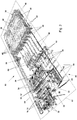
- the arrangement 10 is provided for the orderly picking and provision of goods 12 or packages, in particular cuboid piece goods such as containers, boxes or (beverage) boxes.
- the arrangement 10 comprises an end 14 for the receipt of groupage goods carriers 16.
- the end 14 for the goods receipt side corresponds to a goods receipt for so-called article groupage carriers, which are each equipped with goods 12 of the same type, for example.
- the arrangement 10 comprises an end 18 on the goods output side for delivering groupage carriers 16 '.
- the end 18 on the goods exit side corresponds to a goods issue for so-called customer groupage carriers which are equipped with picked goods 12 'which are provided for dispatch.
- a collective load carrier intermediate storage 20 is / are also assigned to the goods-in end 14 and / or the goods-out end 18, which can be equipped, for example, with an electrical bulk load carrier web 22, such as an electropallet train.
- the electrical collective charge carrier web 22 has one or more transport modules 24, such as guide carriages or the like. The collective load carriers 16, 16 'are picked up by the transport modules 24 and transported away from the goods-in end 14 and conveyed directly to subsequent facilities for further treatment and / or to the goods-out end 18.
- the groupage carriers 16, 16 ' are then conveyed, that is to say indirectly, for further treatment to subsequent facilities and / or are brought to the end 18 at the goods exit in order to be prepared for dispatch from there.
- the collective load carriers 16, each equipped with, for example, the same type of goods 12, are fed directly from the goods receipt end 14 or indirectly from the intermediate load carrier intermediate storage 20 to a device for removing a load securing device.
- a plastic film can be provided as a load securing device, into which the goods 12 and the collective load carriers 16 are each welded in order to fix and hold the goods 12 on or on the collective load carriers 16.
- the film is removed in the device for removing the load securing, which can be done automatically and / or just as manually.
- the collective load carriers 16 are fed to at least one vertically or essentially vertically running transport path 28.
- the vertical transport path (s) 28 is / are arranged downstream of the goods receipt end 14 and can be designed as a linear lifting conveyor device.
- the collective load carriers 16, each equipped with, for example, similar goods 12 can be moved vertically upward.
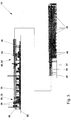
- a total of 6 vertically or essentially vertically extending devices 28 are provided.
- the vertically extending devices 28 is at least one unstacking 30, 32, on which the goods 12 of the same type are separated by the groupage carriers 16.
- the embodiment of the arrangement 10 has, as from the 1 to 3 can be seen, a total of 4 unstacking locations 30, 32. Of these, 2 unstacking locations 30 are each designed to be automatic and 2 unstacking locations 32 are each operable manually.
- the throughput of an automatically operated unstacking station 30 is greater than that of a manual unstacking station 32 and less stressful for the operating personnel and therefore less harmful to health.
- this requires an absolutely trouble-free process.
- the goods 12 must not be shifted or offset from one another, not even slightly, the goods 12 must have an identical height in each layer, etc.
- an absolutely trouble-free process cannot be realized, which often leads to interruptions of the flow of goods, in which the goods 12 must be manually aligned by the operating personnel or maintenance or repair work must be carried out on the unstacking station 30, etc.
- manual unstacking stations 32 are used more and more frequently and preferably in practice.
- the separation or unloading of the goods 12 can take place, for example, but not necessarily, in layers and / or in the horizontal direction.
- the goods 12 of the uppermost layer of the groupage carriers 16 are placed on horizontally or substantially horizontally running transport tracks 34.
- the underside of the goods 12 of the uppermost layer of the goods 12 and the contact surfaces of the groupage carriers 16 or the top of the goods 12 of the layer 12 of the goods 12 located directly under the top layer and the contact surfaces of the horizontal transport tracks 34 for the goods 12 are preferably located on a common level, so that the goods 12 can only be moved manually by the operating personnel. The operating personnel is thus able to remove the goods 12 easily and quickly from a group carrier 16 to separate without lifting, carrying or handling the goods 12 yourself or having to walk or bend down.
- the goods 12 only need to be can be moved further by moving horizontally. With manual de-stacking of the goods 12, there is thus advantageously no standstill of the arrangement or of the flow of goods and any previous weight-related and thus physical and unhealthy strain on the operating personnel.
- the manually operable unstacking locations 32 each between two vertically or essentially vertically running transport tracks 28, via which the groupage carriers 16 loaded with the same type of goods 12 can be moved vertically upward.
- the throughput of the manual unstacking locations 32 can be increased significantly, since during the separation of goods 12 from a (first) groupage carrier 16 another (second) groupage carrier 16 is already being prepared and moved upwards in parallel by the further vertically running transport path 28 can be, so that the operating personnel can continue with the separation of goods 12 of the uppermost layer of the further (second) collection load carrier 16 after the separation of the goods 12 of the lowest position of the (first) groupage carrier 16 almost without a time, etc.
- the separated goods 12 are fed via the horizontally running transport tracks 34 and / or horizontal and vertical switches 36 to a multiplicity of transport tracks 38 arranged one above the other and / or next to one another, which have a picking warehouse form.
- a multiplicity of transport tracks 38 arranged one above the other and / or next to one another, which have a picking warehouse form.
- the conveyor device (s) 40 is / are designed as transverse conveyor devices.
- the separated goods 12 can be picked up from the transport tracks 38 and moved to one end of the transport tracks 38 according to arrow 42, each of the transport tracks 38 only receiving goods 12 of the same type.
- the plurality of transport tracks 38 form a flow channel store for the goods 12.
- the transport tracks 38 run horizontally or essentially horizontally. Devices (not shown) are assigned to the transport tracks 38, by means of which the goods 12 are forcibly moved along the transport tracks 38 from their beginning to their end.
- the transport tracks 38 are arranged inclined from the at least one upper level of the unstacking stations 30, 32 towards the plane of the goods receipt-side and goods-exit-side ends 14, 18.
- the goods 12 are automatically moved as a result of gravity and / or possibly with the support of motor-driven (conveyor) devices (not shown) along the conveyor tracks 38 from the beginning to the end thereof.
- the inclination is preferably an angle of up to approximately 15 °, in particular between approximately 2 ° and 10 ° and preferably between approximately 3 ° and 7 °.
- removal devices 44 can be found, by means of which goods 12 to be picked and made available for dispatch can be released from the transport tracks 38 in a computer-controlled manner. The goods 12 'are picked and provided in the correct order.
- the conveyor tracks 46 can be designed as linear lifting conveyors and / or spiral or screw conveyors.
- two or more partially vertically running conveyor tracks 46 form a matrix sorter in a very preferred manner and provide order-based picking and provision of goods 12 'together with the removal devices 44 and a control device in a control and command station (not shown in each case) and a computer-based process.
- the picked goods 12 'made available for dispatch are transferred to horizontal or substantially horizontal conveyor tracks 48 which are arranged downstream of the conveyor tracks 46 and at least one stacking place 50, 52 for loading the collective load carriers 16' with the picked ones Shipping provided goods 12 'forwarded.
- the embodiment of the arrangement 10 has, as shown in FIGS 1 to 3 is shown, a total of 6 stacking spaces 50, 52. Of these, 2 stacking stations 50 are designed to be automatic and 4 stacking stations 52 can be operated manually.
- Automatic or manual stacking stations 50, 52 are comparable to automatic or manual unstacking stations 30, 32, which is why reference is made in detail to the above explanations. In practice, manual stacking places 52 are therefore increasingly preferred over automatic stacking places.
- the loading or loading of the collective load carriers 16 'with the goods 12' can also, for example, but not necessarily, take place in layers.
- the underside of the goods 12 'and the support surfaces of the horizontal transport tracks 48 for the goods 12' and the support surfaces of the groupage carriers 16 'or the top of the goods 12' of the uppermost layer of the goods 12 ' preferably coincide in one plane, so that the goods 12 'are only to be moved by the operating personnel. It is thus possible for the operating personnel to easily and quickly load or load the groupage carrier 16 'with the goods 12' without having to lift or otherwise handle the goods 12 'themselves.
- the stacking stations 50, 52 are in turn followed by at least one vertically or substantially vertically running transport path 54, via which the groupage carriers 16 'with the picked goods 12' ready for dispatch can be moved vertically downwards to the end 18 at the goods exit.
- each of the stacking stations 50, 52 arranged a vertically extending transport path 54.
- the goods 12' only have to be used by moving horizontally. With manual stacking of the goods 12 ', any previous weight-related and thus physical and unhealthy strain on the operating personnel is advantageously eliminated.
- the goods-in end 14 for receiving the groupage carriers 16 or article groupage carriers with the respective goods 12 in a horizontal or substantially horizontal plane 56 below a horizontal one or essentially horizontal plane 58 of the at least one unstacking place 32, 34 for separating the respective similar goods 12 from the groupage carriers 16.
- the goods output end 18 for delivering the groupage carriers 16 'with the picked goods 12' ready for dispatch is arranged in a horizontal or substantially horizontal plane 56 below a horizontal or substantially horizontal plane 58 of the at least one stacking place 50, 52.
- the level 58 of the unstacking stations 30, 32 and / or the stacking stations 50, 52 is preferably formed by a platform, a scaffold or the like supporting structure, in particular made of steel.
- the goods-in end 14 and the goods-out end 18 are arranged on a common, in particular ground-level 56 level.
- the unstacking locations 30, 32 and the stacking locations 50, 52 are also located on a common level 58.
- the unstacking locations 30, 32 and the stacking locations 50, 52 alternatively or cumulatively on different (upper) levels.
- the unstacking locations 30, 32 and the stacking locations 50, 52 are arranged on a common level 58 above the ground level level 56 of the goods-in end 14 and the goods-out end 18.
- the goods-in end 14 and the goods-out end 18 are arranged adjacent to each other.
- the goods-in end 14 and the goods-out end 18 are in the embodiment of the arrangement 10 in an edge area 60 or on the edge of a rectangular base 62 of the arrangement 10.
- the goods 12, 12 'can also be moved from the goods-in end 14 to the goods-out end 18 in a flow of goods of almost closed shape, which is particularly adapted to a rectangular base 62 of the arrangement 10.
- the goods 12, 12 'can be moved in a goods flow over the at least two levels 56, 58 between the goods-in end 14 and the goods-out end 18.
- the intermediate load carrier intermediate storage 20 is arranged in an area substantially below the at least one unstacking location 30, 32 and / or the at least one stacking location 50, 52, which leads to a significantly improved use of space and thus a considerable saving in space requirements and a reduction in investment and Operating costs of the arrangement 10 leads overall.
- the present invention is not limited to the illustrated embodiment of the arrangement 10. It is thus readily possible to design the base area 62 of the arrangement 10 in a square, circular or elliptical manner, in deviation from the embodiment described above. Accordingly, the goods receipt end 14 and the goods exit end 18 are arranged in an edge area 60 or on the edge of a square, circular or elliptical base 62. At the same time, the goods 12, 12 'can be moved in a flow of goods of an almost closed shape, which is particularly adapted to a square, circular or elliptical base area of the arrangement.
Landscapes
- Engineering & Computer Science (AREA)
- Mechanical Engineering (AREA)
- Warehouses Or Storage Devices (AREA)
Claims (15)
- Système de commissionnement et de préparation de marchandises (12, 12') dans le bon ordre, en particulier de marchandises de détail de forme parallélépipédique, telles que des récipients, des cartons ou des caisses (de boisson), comportant
une extrémité (14) côté entrée de marchandises pour recevoir des supports de groupage (16) équipés de marchandises respectives de même type (12),
au moins une bande transporteuse (28) agencée en aval de l'extrémité (14) côté entrée de marchandises et s'étendant verticalement ou sensiblement verticalement, par laquelle les supports de groupage (16) équipés de marchandises respectives de même type (12) peuvent être déplacés verticalement vers le haut,
au moins un poste de dépilage (30, 32) qui est agencé en aval de la bande transporteuse (28) s'étendant verticalement ou sensiblement verticalement et qui est destiné à individualiser les marchandises respectives de même type (12) depuis les supports de groupage (16),
une multitude de bandes transporteuses (38) agencées les unes au-dessus ou et/ou à côté des autres, depuis lesquelles les marchandises individualisées (12) peuvent être reprises et déplacées jusqu'à une extrémité des bandes transporteuses (38), chacune des bandes transporteuses (38) reprenant chacune seulement des marchandises de même type (12), et les bandes transporteuses (38) agencées les unes au-dessus et/ou à côté des autres étant agencées en étant inclinées depuis ledit au moins un plan supérieur (58) dudit au moins un poste de dépilage (30, 32) et/ou poste d'empilage (50, 52) jusqu'au plan (56) de l'extrémité (14, 18) côté entrée de marchandises et côté sortie de marchandises,
une multitude de moyens de prélèvement (44) à l'extrémité de chacune des bandes transporteuses (38), par lesquels des marchandises (12) à commissionner et à préparer pour l'expédition peuvent être libérées depuis les bandes transporteuses (38) en étant commandées par ordinateur,
au moins deux bandes de convoyage (46) agencées en aval des moyens de prélèvement (44) et s'étendant au moins partiellement verticalement, auxquelles/par lesquelles les marchandises (12') commissionnées préparées pour l'expédition peuvent être remises et déplacées vers le haut en étant commandées par ordinateur, lesdites au moins deux bandes de convoyage (46) s'étendant verticalement formant une trieuse matricielle et permettant un commissionnement et une préparation de marchandises (12') dans le bon ordre, conjointement avec les moyens de prélèvement (44) et avec un moyen de commande dans une station de contrôle et de commande,
au moins un poste d'empilage (50, 52) agencé en aval de ladite au moins une bande de convoyage (46) s'étendant au moins partiellement verticalement, pour équiper les supports de groupe (16') avec les marchandises (12') commissionnées préparées pour l'expédition,
au moins une bande transporteuse (54) agencée en aval du poste d'empilage (50, 52) et s'étendant verticalement ou sensiblement verticalement, par laquelle les supports de groupage (16') équipés des marchandises (12') commissionnées préparées pour l'expédition peuvent être déplacés verticalement vers le bas, et
une extrémité (18) côté sortie de marchandises agencée en aval de la bande transporteuse verticale (54) et destinée à remettre les supports de groupage (16, 16') équipés des marchandises (12, 12') commissionnées préparées pour l'expédition,
dans lequel
l'extrémité (14) côté entrée de marchandises destinée à reprendre les supports de groupage (16) équipés des marchandises respectives de même type (12) est agencée dans un plan horizontal (56) au-dessous d'un plan horizontal (58) dudit au moins un poste de dépilage (30, 32) destiné à individualiser les marchandises respectives de même type (12) depuis les supports de groupage (16,) et l'extrémité (18) côté sortie de marchandises destinée à remettre les supports de groupage (16') équipés des marchandises (12') commissionnées préparées pour l'expédition est agencée dans un plan horizontal (56) au-dessous d'un plan horizontal (58) dudit au moins un poste d'empilage (50, 52). - Système selon la revendication 1, caractérisé en ce que l'extrémité (14) côté entrée de marchandises et l'extrémité (18) côté sortie de marchandises sont agencées sur un plan commun (56), en particulier situé au niveau du sol.
- Système selon la revendication 1 ou 2, caractérisé en ce que ledit au moins un poste de dépilage (30, 32) et ledit au moins un poste d'empilage (50, 52) sont agencés sur un plan commun (58), en particulier au-dessus du plan (56) situé au niveau du sol de l'extrémité (14) côté entrée de marchandises et de l'extrémité (18) côté sortie de marchandises, et/ou sur des plans différents l'un de l'autre.
- Système selon l'une des revendications 1 à 3, caractérisé en ce que l'extrémité (14) côté entrée de marchandises et l'extrémité (18) côté sortie de marchandises sont agencées au voisinage l'une de l'autre.
- Système selon l'une des revendications 1 à 4, caractérisé en ce que l'extrémité (14) côté entrée de marchandises et l'extrémité (18) côté sortie de marchandises sont agencées dans une zone de bord (60) ou au bord d'une surface de base (62) du système (10) réalisée en forme rectangulaire, carrée, circulaire ou elliptique.
- Système selon l'une des revendications 1 à 5, caractérisé en ce que les marchandises (12, 12') peut être déplacées depuis l'extrémité (14) côté entrée de marchandises jusqu'à l'extrémité (18) côté sortie de marchandises en un flux de marchandises de forme pratiquement fermée, en particulier adaptée à une surface de base (62) du système (10) réalisée en forme rectangulaire, carrée, circulaire ou elliptique.
- Système selon l'une des revendications 1 à 6, caractérisé en ce que les marchandises (12, 12') peut être déplacées depuis l'extrémité (14) côté entrée de marchandises jusqu'à l'extrémité (18) côté sortie de marchandises en un flux de marchandises sur au moins deux plans (56, 58) entre l'extrémité (14) côté entrée de marchandises et l'extrémité (18) côté sortie de marchandises.
- Système selon l'une des revendications 1 à 7, caractérisé en ce qu'un entrepôt (20) de supports de groupage destiné à reprendre les supports de groupage (16) équipés des marchandises respectives de même type (12) et/ou les supports de groupage (16') équipés des marchandises (12') commissionnées préparées pour l'expédition est/sont associé(s) à l'extrémité (14) côté entrée de marchandises et/ou à l'extrémité (18) côté sortie de marchandises.
- Système selon la revendication 8, caractérisé en ce que l'entrepôt (20) de supports de groupage est agencé dans une zone sensiblement au-dessous dudit au moins un poste de dépilage (30, 32) et/ou dudit au moins un poste d'empilage (50, 52).
- Système selon l'une des revendications 1 à 9, caractérisé en ce que ledit au moins un poste de dépilage (30, 32) et/ou ledit au moins un poste d'empilage (50, 52) est/sont agencé(s) sur une plate-forme, un échafaudage ou une construction porteuse similaire, en particulier en acier.
- Système selon l'une des revendications 1 à 10, caractérisé en ce que ledit au moins un poste de dépilage (30, 32) et/ou ledit au moins un poste d'empilage (50, 52) est/sont réalisé(s) avec fonctionnement automatique ou manuel.
- Système selon l'une des revendications 1 à 11, caractérisé en ce que ledit au moins un poste de dépilage (30, 32) est réalisé avec fonctionnement manuel et est agencé entre deux bandes transporteuses (28) s'étendant verticalement ou sensiblement verticalement par lesquelles les supports de groupage (16) équipés des marchandises respectives de même type (12) peuvent être déplacés verticalement vers le haut, et/ou ledit au moins un poste d'empilage (50, 52) est réalisé avec fonctionnement manuel et est agencé entre deux bandes transporteuses (54) s'étendant verticalement ou sensiblement verticalement par lesquelles les supports de groupage (16') équipés des marchandises (12') commissionnées préparées pour l'expédition peuvent être déplacés verticalement vers le haut.
- Système selon l'une des revendications 1 à 12, caractérisé en ce que les bandes transporteuses (38) agencées les unes au-dessus et/ou à côté des autres sont agencées avec une inclinaison depuis ledit au moins un plan supérieur (58) dudit au moins un poste de dépilage (30, 32) et/ou dudit au moins un poste d'empilage (50, 52) vers le plan (56) de l'extrémité (14, 18) côté entrée de marchandises et côté sortie de marchandises, sous un angle allant jusqu'à environ 15°, en particulier entre environ 2° et 10° et de préférence entre environ 3° et 7°.
- Système selon l'une des revendications 1 à 13, caractérisé en ce qu'un ou plusieurs moyens de convoyage (40) sont associés aux bandes transporteuses (38) agencées unes au-dessus et/ou à côté des autres, au début des bandes transporteuses (38), moyens par lesquels les marchandises (12) individualisées peuvent être convoyées jusque dans les bandes transporteuses (38).
- Système selon l'une des revendications 1 à 14, caractérisé en ce que ladite au moins une bande de convoyage (46) agencée en aval des moyens de prélèvement (40) et s'étendant au moins partiellement verticalement est réalisée sous forme de moyen convoyeur de soulèvement linéaire et/ou de moyen convoyeur spiralé ou hélicoïdal.
Applications Claiming Priority (1)
| Application Number | Priority Date | Filing Date | Title |
|---|---|---|---|
| DE102014107023.2A DE102014107023A1 (de) | 2014-05-19 | 2014-05-19 | Anordnung zur reihenfolgerichtigen Kommissionierung und Bereitstellung von Waren |
Publications (2)
| Publication Number | Publication Date |
|---|---|
| EP2949606A1 EP2949606A1 (fr) | 2015-12-02 |
| EP2949606B1 true EP2949606B1 (fr) | 2020-01-01 |
Family
ID=53189707
Family Applications (1)
| Application Number | Title | Priority Date | Filing Date |
|---|---|---|---|
| EP15168218.4A Active EP2949606B1 (fr) | 2014-05-19 | 2015-05-19 | Système de commissionnement dans le bon ordre et préparation de marchandises |
Country Status (2)
| Country | Link |
|---|---|
| EP (1) | EP2949606B1 (fr) |
| DE (1) | DE102014107023A1 (fr) |
Families Citing this family (1)
| Publication number | Priority date | Publication date | Assignee | Title |
|---|---|---|---|---|
| AT520005A1 (de) | 2017-06-02 | 2018-12-15 | Tgw Logistics Group Gmbh | Verfahren und Warenlagersystem zum Kommissionieren von Waren mit effizient betriebenem dynamischen Puffer |
Citations (6)
| Publication number | Priority date | Publication date | Assignee | Title |
|---|---|---|---|---|
| US4527937A (en) * | 1983-05-13 | 1985-07-09 | Orion Automation Industries | Automatic storage and distribution system |
| EP0396960A2 (fr) * | 1989-05-09 | 1990-11-14 | Focke & Co. (GmbH & Co.) | Méthode et installation pour réarranger des objets palettisés par sortes en groupes dont la composition des sortes est définie |
| EP0627371A1 (fr) * | 1993-06-04 | 1994-12-07 | Ferag AG | Procédé pour la préparation de commandes et dispositif de mise en oeuvre de ce système |
| DE102006025617A1 (de) * | 2006-05-24 | 2007-11-29 | SSI Schäfer Noell GmbH Lager- und Systemtechnik | Separate Packstation |
| DE102006025620A1 (de) * | 2006-05-24 | 2007-11-29 | SSI Schäfer Noell GmbH Lager- und Systemtechnik | Regallager und Kommissionierverfahren |
| US20130031876A1 (en) * | 2010-04-19 | 2013-02-07 | Siemens Aktiengesellschaft | Loading system and method for loading packaged items |
Family Cites Families (5)
| Publication number | Priority date | Publication date | Assignee | Title |
|---|---|---|---|---|
| US4073388A (en) * | 1977-01-06 | 1978-02-14 | Zetco Manufacturing Company, Incorporated | Semi-automatic lifting system |
| DE4015935C2 (de) * | 1990-05-17 | 1997-07-24 | Ferdinand Christ | Kommissioniervorrichtung für Artikel |
| DE19905967B4 (de) | 1999-02-12 | 2004-02-05 | Dynamic Systems Engineering B.V. | Anlage zur Warenkommissionierung, insbesondere zur Kommissionierung von Lebensmitteln in rechteckigen Paketgebinden |
| DE102006025619A1 (de) * | 2006-05-24 | 2007-11-29 | SSI Schäfer Noell GmbH Lager- und Systemtechnik | Regal-integrierte Packstation und Kommissionierverfahren |
| DE102011050437A1 (de) * | 2011-05-17 | 2012-11-22 | Swisslog Ag | Verfahren zum Lagern und/oder Kommissionieren von Wareneinheiten |
-
2014
- 2014-05-19 DE DE102014107023.2A patent/DE102014107023A1/de not_active Withdrawn
-
2015
- 2015-05-19 EP EP15168218.4A patent/EP2949606B1/fr active Active
Patent Citations (6)
| Publication number | Priority date | Publication date | Assignee | Title |
|---|---|---|---|---|
| US4527937A (en) * | 1983-05-13 | 1985-07-09 | Orion Automation Industries | Automatic storage and distribution system |
| EP0396960A2 (fr) * | 1989-05-09 | 1990-11-14 | Focke & Co. (GmbH & Co.) | Méthode et installation pour réarranger des objets palettisés par sortes en groupes dont la composition des sortes est définie |
| EP0627371A1 (fr) * | 1993-06-04 | 1994-12-07 | Ferag AG | Procédé pour la préparation de commandes et dispositif de mise en oeuvre de ce système |
| DE102006025617A1 (de) * | 2006-05-24 | 2007-11-29 | SSI Schäfer Noell GmbH Lager- und Systemtechnik | Separate Packstation |
| DE102006025620A1 (de) * | 2006-05-24 | 2007-11-29 | SSI Schäfer Noell GmbH Lager- und Systemtechnik | Regallager und Kommissionierverfahren |
| US20130031876A1 (en) * | 2010-04-19 | 2013-02-07 | Siemens Aktiengesellschaft | Loading system and method for loading packaged items |
Also Published As
| Publication number | Publication date |
|---|---|
| EP2949606A1 (fr) | 2015-12-02 |
| DE102014107023A1 (de) | 2015-12-03 |
Similar Documents
| Publication | Publication Date | Title |
|---|---|---|
| EP3036164B1 (fr) | Dispositif de stockage de conteneurs empilables | |
| EP3218290B1 (fr) | Procédé et agencement pour le transport d'objets, de colis de détail et/ou de fûts dans au moins deux sections de voie de transport | |
| EP2315714B1 (fr) | Dispositif entièrement automatique de préparation d'articles dans des contenants de commandes | |
| EP2019799B1 (fr) | Station de remplissage séparée | |
| EP0860382B1 (fr) | Procédé pour la préparation de commandes et dispositif pour la préparation de commandes pour la réalisation du procédé | |
| DE202020101678U1 (de) | Flaschentray und Flaschenbehandlungsanlage | |
| CH714401A1 (de) | Vorrichtung zum Beladen und Entladen von schienengeführten Hängefördersystemen. | |
| WO2011006597A1 (fr) | Procédé et système de chargement pour préparer des commandes d'articles sur des supports de chargement cibles | |
| EP3246272A1 (fr) | Glissière et dispositif de tri et procédé de tri de marchandise au détail | |
| DE102013218442A1 (de) | Verfahren und Vorrichtung zur horizontalen Verschiebung von Artikellagen zwischen benachbarten Fördermodulen | |
| EP2918524B1 (fr) | Système destiné à désempiler manuellement et/ou à empiler des marchandises | |
| DE3524344A1 (de) | Verfahren und vorrichtung zum ent- und beladen von paletten | |
| DE102014104470A1 (de) | Stapelkommissionierung | |
| EP2176149B1 (fr) | Procédé de désempilement ou d'empilement de fûts | |
| DE19712839B4 (de) | Kommissionierverfahren, Kommissionieranlage zur Durchführung des Verfahrens sowie Sortierpuffer hierfür | |
| EP1975074B1 (fr) | Dispositif et procédé de chargement et de déchargement d'une multitude d'objets installés dans un récipient de réception ouvert sur le dessus | |
| EP2949606B1 (fr) | Système de commissionnement dans le bon ordre et préparation de marchandises | |
| DE102009052345B4 (de) | Automatisierte Kommissioniervorrichtung und Verfahren zum automatisierten Kommissionieren von Büchern, Medien, Prospekten und ähnlichen Gegenständen | |
| DE19540147C2 (de) | Vorrichtung zum Stapeln und Entstapeln von Transportkisten | |
| EP2602213B1 (fr) | Préparation des commandes combinée avec véhicules de préparation des commandes et un dispositif de palettisation pour stockage | |
| EP3766812B1 (fr) | Machine de dépalletisation pourvu de dispositif de transfert et de distribution de charge dépalletisée | |
| DE4426615C1 (de) | Vorrichtung zum Stapeln oder Entstapeln von stapelbarem Gut | |
| DE3203757A1 (de) | Vorrichtung zum zwischenstapeln von gegenstaenden | |
| DE1556213A1 (de) | Stapelmaschine | |
| EP1462395A1 (fr) | Tampon intermédiaire |
Legal Events
| Date | Code | Title | Description |
|---|---|---|---|
| AK | Designated contracting states |
Kind code of ref document: A1 Designated state(s): AL AT BE BG CH CY CZ DE DK EE ES FI FR GB GR HR HU IE IS IT LI LT LU LV MC MK MT NL NO PL PT RO RS SE SI SK SM TR |
|
| AX | Request for extension of the european patent |
Extension state: BA ME |
|
| PUAI | Public reference made under article 153(3) epc to a published international application that has entered the european phase |
Free format text: ORIGINAL CODE: 0009012 |
|
| 17P | Request for examination filed |
Effective date: 20160601 |
|
| RBV | Designated contracting states (corrected) |
Designated state(s): AL AT BE BG CH CY CZ DE DK EE ES FI FR GB GR HR HU IE IS IT LI LT LU LV MC MK MT NL NO PL PT RO RS SE SI SK SM TR |
|
| STAA | Information on the status of an ep patent application or granted ep patent |
Free format text: STATUS: EXAMINATION IS IN PROGRESS |
|
| 17Q | First examination report despatched |
Effective date: 20170203 |
|
| GRAP | Despatch of communication of intention to grant a patent |
Free format text: ORIGINAL CODE: EPIDOSNIGR1 |
|
| STAA | Information on the status of an ep patent application or granted ep patent |
Free format text: STATUS: GRANT OF PATENT IS INTENDED |
|
| INTG | Intention to grant announced |
Effective date: 20180815 |
|
| GRAJ | Information related to disapproval of communication of intention to grant by the applicant or resumption of examination proceedings by the epo deleted |
Free format text: ORIGINAL CODE: EPIDOSDIGR1 |
|
| STAA | Information on the status of an ep patent application or granted ep patent |
Free format text: STATUS: EXAMINATION IS IN PROGRESS |
|
| INTC | Intention to grant announced (deleted) | ||
| GRAP | Despatch of communication of intention to grant a patent |
Free format text: ORIGINAL CODE: EPIDOSNIGR1 |
|
| STAA | Information on the status of an ep patent application or granted ep patent |
Free format text: STATUS: GRANT OF PATENT IS INTENDED |
|
| INTG | Intention to grant announced |
Effective date: 20190125 |
|
| GRAS | Grant fee paid |
Free format text: ORIGINAL CODE: EPIDOSNIGR3 |
|
| GRAJ | Information related to disapproval of communication of intention to grant by the applicant or resumption of examination proceedings by the epo deleted |
Free format text: ORIGINAL CODE: EPIDOSDIGR1 |
|
| GRAL | Information related to payment of fee for publishing/printing deleted |
Free format text: ORIGINAL CODE: EPIDOSDIGR3 |
|
| STAA | Information on the status of an ep patent application or granted ep patent |
Free format text: STATUS: EXAMINATION IS IN PROGRESS |
|
| GRAP | Despatch of communication of intention to grant a patent |
Free format text: ORIGINAL CODE: EPIDOSNIGR1 |
|
| STAA | Information on the status of an ep patent application or granted ep patent |
Free format text: STATUS: GRANT OF PATENT IS INTENDED |
|
| INTC | Intention to grant announced (deleted) | ||
| INTG | Intention to grant announced |
Effective date: 20190717 |
|
| GRAA | (expected) grant |
Free format text: ORIGINAL CODE: 0009210 |
|
| STAA | Information on the status of an ep patent application or granted ep patent |
Free format text: STATUS: THE PATENT HAS BEEN GRANTED |
|
| AK | Designated contracting states |
Kind code of ref document: B1 Designated state(s): AL AT BE BG CH CY CZ DE DK EE ES FI FR GB GR HR HU IE IS IT LI LT LU LV MC MK MT NL NO PL PT RO RS SE SI SK SM TR |
|
| REG | Reference to a national code |
Ref country code: GB Ref legal event code: FG4D Free format text: NOT ENGLISH |
|
| REG | Reference to a national code |
Ref country code: CH Ref legal event code: EP Ref country code: CH Ref legal event code: NV Representative=s name: WAGNER + HELBIG PATENTANWAELTE CONSEILS EN PRO, CH Ref country code: AT Ref legal event code: REF Ref document number: 1219545 Country of ref document: AT Kind code of ref document: T Effective date: 20200115 |
|
| REG | Reference to a national code |
Ref country code: IE Ref legal event code: FG4D Free format text: LANGUAGE OF EP DOCUMENT: GERMAN |
|
| REG | Reference to a national code |
Ref country code: DE Ref legal event code: R096 Ref document number: 502015011365 Country of ref document: DE |
|
| REG | Reference to a national code |
Ref country code: NL Ref legal event code: FP |
|
| REG | Reference to a national code |
Ref country code: SE Ref legal event code: TRGR |
|
| REG | Reference to a national code |
Ref country code: LT Ref legal event code: MG4D |
|
| PG25 | Lapsed in a contracting state [announced via postgrant information from national office to epo] |
Ref country code: RS Free format text: LAPSE BECAUSE OF FAILURE TO SUBMIT A TRANSLATION OF THE DESCRIPTION OR TO PAY THE FEE WITHIN THE PRESCRIBED TIME-LIMIT Effective date: 20200101 Ref country code: PT Free format text: LAPSE BECAUSE OF FAILURE TO SUBMIT A TRANSLATION OF THE DESCRIPTION OR TO PAY THE FEE WITHIN THE PRESCRIBED TIME-LIMIT Effective date: 20200527 Ref country code: FI Free format text: LAPSE BECAUSE OF FAILURE TO SUBMIT A TRANSLATION OF THE DESCRIPTION OR TO PAY THE FEE WITHIN THE PRESCRIBED TIME-LIMIT Effective date: 20200101 Ref country code: CZ Free format text: LAPSE BECAUSE OF FAILURE TO SUBMIT A TRANSLATION OF THE DESCRIPTION OR TO PAY THE FEE WITHIN THE PRESCRIBED TIME-LIMIT Effective date: 20200101 Ref country code: LT Free format text: LAPSE BECAUSE OF FAILURE TO SUBMIT A TRANSLATION OF THE DESCRIPTION OR TO PAY THE FEE WITHIN THE PRESCRIBED TIME-LIMIT Effective date: 20200101 Ref country code: NO Free format text: LAPSE BECAUSE OF FAILURE TO SUBMIT A TRANSLATION OF THE DESCRIPTION OR TO PAY THE FEE WITHIN THE PRESCRIBED TIME-LIMIT Effective date: 20200401 |
|
| PG25 | Lapsed in a contracting state [announced via postgrant information from national office to epo] |
Ref country code: LV Free format text: LAPSE BECAUSE OF FAILURE TO SUBMIT A TRANSLATION OF THE DESCRIPTION OR TO PAY THE FEE WITHIN THE PRESCRIBED TIME-LIMIT Effective date: 20200101 Ref country code: BG Free format text: LAPSE BECAUSE OF FAILURE TO SUBMIT A TRANSLATION OF THE DESCRIPTION OR TO PAY THE FEE WITHIN THE PRESCRIBED TIME-LIMIT Effective date: 20200401 Ref country code: IS Free format text: LAPSE BECAUSE OF FAILURE TO SUBMIT A TRANSLATION OF THE DESCRIPTION OR TO PAY THE FEE WITHIN THE PRESCRIBED TIME-LIMIT Effective date: 20200501 Ref country code: GR Free format text: LAPSE BECAUSE OF FAILURE TO SUBMIT A TRANSLATION OF THE DESCRIPTION OR TO PAY THE FEE WITHIN THE PRESCRIBED TIME-LIMIT Effective date: 20200402 Ref country code: HR Free format text: LAPSE BECAUSE OF FAILURE TO SUBMIT A TRANSLATION OF THE DESCRIPTION OR TO PAY THE FEE WITHIN THE PRESCRIBED TIME-LIMIT Effective date: 20200101 |
|
| REG | Reference to a national code |
Ref country code: DE Ref legal event code: R097 Ref document number: 502015011365 Country of ref document: DE |
|
| PG25 | Lapsed in a contracting state [announced via postgrant information from national office to epo] |
Ref country code: SK Free format text: LAPSE BECAUSE OF FAILURE TO SUBMIT A TRANSLATION OF THE DESCRIPTION OR TO PAY THE FEE WITHIN THE PRESCRIBED TIME-LIMIT Effective date: 20200101 Ref country code: EE Free format text: LAPSE BECAUSE OF FAILURE TO SUBMIT A TRANSLATION OF THE DESCRIPTION OR TO PAY THE FEE WITHIN THE PRESCRIBED TIME-LIMIT Effective date: 20200101 Ref country code: SM Free format text: LAPSE BECAUSE OF FAILURE TO SUBMIT A TRANSLATION OF THE DESCRIPTION OR TO PAY THE FEE WITHIN THE PRESCRIBED TIME-LIMIT Effective date: 20200101 Ref country code: DK Free format text: LAPSE BECAUSE OF FAILURE TO SUBMIT A TRANSLATION OF THE DESCRIPTION OR TO PAY THE FEE WITHIN THE PRESCRIBED TIME-LIMIT Effective date: 20200101 Ref country code: RO Free format text: LAPSE BECAUSE OF FAILURE TO SUBMIT A TRANSLATION OF THE DESCRIPTION OR TO PAY THE FEE WITHIN THE PRESCRIBED TIME-LIMIT Effective date: 20200101 Ref country code: ES Free format text: LAPSE BECAUSE OF FAILURE TO SUBMIT A TRANSLATION OF THE DESCRIPTION OR TO PAY THE FEE WITHIN THE PRESCRIBED TIME-LIMIT Effective date: 20200101 |
|
| PLBE | No opposition filed within time limit |
Free format text: ORIGINAL CODE: 0009261 |
|
| STAA | Information on the status of an ep patent application or granted ep patent |
Free format text: STATUS: NO OPPOSITION FILED WITHIN TIME LIMIT |
|
| 26N | No opposition filed |
Effective date: 20201002 |
|
| PG25 | Lapsed in a contracting state [announced via postgrant information from national office to epo] |
Ref country code: MC Free format text: LAPSE BECAUSE OF FAILURE TO SUBMIT A TRANSLATION OF THE DESCRIPTION OR TO PAY THE FEE WITHIN THE PRESCRIBED TIME-LIMIT Effective date: 20200101 Ref country code: IT Free format text: LAPSE BECAUSE OF FAILURE TO SUBMIT A TRANSLATION OF THE DESCRIPTION OR TO PAY THE FEE WITHIN THE PRESCRIBED TIME-LIMIT Effective date: 20200101 |
|
| PG25 | Lapsed in a contracting state [announced via postgrant information from national office to epo] |
Ref country code: SI Free format text: LAPSE BECAUSE OF FAILURE TO SUBMIT A TRANSLATION OF THE DESCRIPTION OR TO PAY THE FEE WITHIN THE PRESCRIBED TIME-LIMIT Effective date: 20200101 Ref country code: PL Free format text: LAPSE BECAUSE OF FAILURE TO SUBMIT A TRANSLATION OF THE DESCRIPTION OR TO PAY THE FEE WITHIN THE PRESCRIBED TIME-LIMIT Effective date: 20200101 |
|
| PG25 | Lapsed in a contracting state [announced via postgrant information from national office to epo] |
Ref country code: IE Free format text: LAPSE BECAUSE OF NON-PAYMENT OF DUE FEES Effective date: 20200519 Ref country code: FR Free format text: LAPSE BECAUSE OF NON-PAYMENT OF DUE FEES Effective date: 20200531 |
|
| PG25 | Lapsed in a contracting state [announced via postgrant information from national office to epo] |
Ref country code: TR Free format text: LAPSE BECAUSE OF FAILURE TO SUBMIT A TRANSLATION OF THE DESCRIPTION OR TO PAY THE FEE WITHIN THE PRESCRIBED TIME-LIMIT Effective date: 20200101 Ref country code: MT Free format text: LAPSE BECAUSE OF FAILURE TO SUBMIT A TRANSLATION OF THE DESCRIPTION OR TO PAY THE FEE WITHIN THE PRESCRIBED TIME-LIMIT Effective date: 20200101 Ref country code: CY Free format text: LAPSE BECAUSE OF FAILURE TO SUBMIT A TRANSLATION OF THE DESCRIPTION OR TO PAY THE FEE WITHIN THE PRESCRIBED TIME-LIMIT Effective date: 20200101 |
|
| PG25 | Lapsed in a contracting state [announced via postgrant information from national office to epo] |
Ref country code: MK Free format text: LAPSE BECAUSE OF FAILURE TO SUBMIT A TRANSLATION OF THE DESCRIPTION OR TO PAY THE FEE WITHIN THE PRESCRIBED TIME-LIMIT Effective date: 20200101 Ref country code: AL Free format text: LAPSE BECAUSE OF FAILURE TO SUBMIT A TRANSLATION OF THE DESCRIPTION OR TO PAY THE FEE WITHIN THE PRESCRIBED TIME-LIMIT Effective date: 20200101 |
|
| P01 | Opt-out of the competence of the unified patent court (upc) registered |
Effective date: 20230528 |
|
| PGFP | Annual fee paid to national office [announced via postgrant information from national office to epo] |
Ref country code: NL Payment date: 20250522 Year of fee payment: 11 |
|
| PGFP | Annual fee paid to national office [announced via postgrant information from national office to epo] |
Ref country code: DE Payment date: 20250422 Year of fee payment: 11 |
|
| PGFP | Annual fee paid to national office [announced via postgrant information from national office to epo] |
Ref country code: LU Payment date: 20250520 Year of fee payment: 11 Ref country code: BE Payment date: 20250520 Year of fee payment: 11 |
|
| PGFP | Annual fee paid to national office [announced via postgrant information from national office to epo] |
Ref country code: CH Payment date: 20250601 Year of fee payment: 11 |
|
| PGFP | Annual fee paid to national office [announced via postgrant information from national office to epo] |
Ref country code: AT Payment date: 20250519 Year of fee payment: 11 |
|
| PGFP | Annual fee paid to national office [announced via postgrant information from national office to epo] |
Ref country code: SE Payment date: 20250522 Year of fee payment: 11 |
|
| PGFP | Annual fee paid to national office [announced via postgrant information from national office to epo] |
Ref country code: GB Payment date: 20260324 Year of fee payment: 12 |