EP2950910B1 - Kohlenstoffabscheidungslösungsmittel und verfahren zur verwendung derartiger lösungsmittel - Google Patents
Kohlenstoffabscheidungslösungsmittel und verfahren zur verwendung derartiger lösungsmittel Download PDFInfo
- Publication number
- EP2950910B1 EP2950910B1 EP14746742.7A EP14746742A EP2950910B1 EP 2950910 B1 EP2950910 B1 EP 2950910B1 EP 14746742 A EP14746742 A EP 14746742A EP 2950910 B1 EP2950910 B1 EP 2950910B1
- Authority
- EP
- European Patent Office
- Prior art keywords
- solvent
- weight percentage
- piperazine
- glycol
- alkanolamine
- Prior art date
- Legal status (The legal status is an assumption and is not a legal conclusion. Google has not performed a legal analysis and makes no representation as to the accuracy of the status listed.)
- Active
Links
Images
Classifications
-
- B—PERFORMING OPERATIONS; TRANSPORTING
- B01—PHYSICAL OR CHEMICAL PROCESSES OR APPARATUS IN GENERAL
- B01D—SEPARATION
- B01D53/00—Separation of gases or vapours; Recovering vapours of volatile solvents from gases; Chemical or biological purification of waste gases, e.g. engine exhaust gases, smoke, fumes, flue gases, aerosols
- B01D53/14—Separation of gases or vapours; Recovering vapours of volatile solvents from gases; Chemical or biological purification of waste gases, e.g. engine exhaust gases, smoke, fumes, flue gases, aerosols by absorption
- B01D53/1493—Selection of liquid materials for use as absorbents
-
- B—PERFORMING OPERATIONS; TRANSPORTING
- B01—PHYSICAL OR CHEMICAL PROCESSES OR APPARATUS IN GENERAL
- B01D—SEPARATION
- B01D53/00—Separation of gases or vapours; Recovering vapours of volatile solvents from gases; Chemical or biological purification of waste gases, e.g. engine exhaust gases, smoke, fumes, flue gases, aerosols
- B01D53/14—Separation of gases or vapours; Recovering vapours of volatile solvents from gases; Chemical or biological purification of waste gases, e.g. engine exhaust gases, smoke, fumes, flue gases, aerosols by absorption
- B01D53/1425—Regeneration of liquid absorbents
-
- B—PERFORMING OPERATIONS; TRANSPORTING
- B01—PHYSICAL OR CHEMICAL PROCESSES OR APPARATUS IN GENERAL
- B01D—SEPARATION
- B01D53/00—Separation of gases or vapours; Recovering vapours of volatile solvents from gases; Chemical or biological purification of waste gases, e.g. engine exhaust gases, smoke, fumes, flue gases, aerosols
- B01D53/14—Separation of gases or vapours; Recovering vapours of volatile solvents from gases; Chemical or biological purification of waste gases, e.g. engine exhaust gases, smoke, fumes, flue gases, aerosols by absorption
- B01D53/1456—Removing acid components
- B01D53/1475—Removing carbon dioxide
-
- B—PERFORMING OPERATIONS; TRANSPORTING
- B01—PHYSICAL OR CHEMICAL PROCESSES OR APPARATUS IN GENERAL
- B01D—SEPARATION
- B01D2251/00—Reactants
- B01D2251/30—Alkali metal compounds
- B01D2251/306—Alkali metal compounds of potassium
-
- B—PERFORMING OPERATIONS; TRANSPORTING
- B01—PHYSICAL OR CHEMICAL PROCESSES OR APPARATUS IN GENERAL
- B01D—SEPARATION
- B01D2251/00—Reactants
- B01D2251/60—Inorganic bases or salts
- B01D2251/606—Carbonates
-
- B—PERFORMING OPERATIONS; TRANSPORTING
- B01—PHYSICAL OR CHEMICAL PROCESSES OR APPARATUS IN GENERAL
- B01D—SEPARATION
- B01D2252/00—Absorbents, i.e. solvents and liquid materials for gas absorption
- B01D2252/10—Inorganic absorbents
- B01D2252/103—Water
-
- B—PERFORMING OPERATIONS; TRANSPORTING
- B01—PHYSICAL OR CHEMICAL PROCESSES OR APPARATUS IN GENERAL
- B01D—SEPARATION
- B01D2252/00—Absorbents, i.e. solvents and liquid materials for gas absorption
- B01D2252/20—Organic absorbents
- B01D2252/202—Alcohols or their derivatives
- B01D2252/2023—Glycols, diols or their derivatives
-
- B—PERFORMING OPERATIONS; TRANSPORTING
- B01—PHYSICAL OR CHEMICAL PROCESSES OR APPARATUS IN GENERAL
- B01D—SEPARATION
- B01D2252/00—Absorbents, i.e. solvents and liquid materials for gas absorption
- B01D2252/20—Organic absorbents
- B01D2252/202—Alcohols or their derivatives
- B01D2252/2023—Glycols, diols or their derivatives
- B01D2252/2026—Polyethylene glycol, ethers or esters thereof, e.g. Selexol
-
- B—PERFORMING OPERATIONS; TRANSPORTING
- B01—PHYSICAL OR CHEMICAL PROCESSES OR APPARATUS IN GENERAL
- B01D—SEPARATION
- B01D2252/00—Absorbents, i.e. solvents and liquid materials for gas absorption
- B01D2252/20—Organic absorbents
- B01D2252/204—Amines
- B01D2252/20405—Monoamines
-
- B—PERFORMING OPERATIONS; TRANSPORTING
- B01—PHYSICAL OR CHEMICAL PROCESSES OR APPARATUS IN GENERAL
- B01D—SEPARATION
- B01D2252/00—Absorbents, i.e. solvents and liquid materials for gas absorption
- B01D2252/20—Organic absorbents
- B01D2252/204—Amines
- B01D2252/2041—Diamines
-
- B—PERFORMING OPERATIONS; TRANSPORTING
- B01—PHYSICAL OR CHEMICAL PROCESSES OR APPARATUS IN GENERAL
- B01D—SEPARATION
- B01D2252/00—Absorbents, i.e. solvents and liquid materials for gas absorption
- B01D2252/20—Organic absorbents
- B01D2252/204—Amines
- B01D2252/20426—Secondary amines
-
- B—PERFORMING OPERATIONS; TRANSPORTING
- B01—PHYSICAL OR CHEMICAL PROCESSES OR APPARATUS IN GENERAL
- B01D—SEPARATION
- B01D2252/00—Absorbents, i.e. solvents and liquid materials for gas absorption
- B01D2252/20—Organic absorbents
- B01D2252/204—Amines
- B01D2252/20431—Tertiary amines
-
- B—PERFORMING OPERATIONS; TRANSPORTING
- B01—PHYSICAL OR CHEMICAL PROCESSES OR APPARATUS IN GENERAL
- B01D—SEPARATION
- B01D2252/00—Absorbents, i.e. solvents and liquid materials for gas absorption
- B01D2252/20—Organic absorbents
- B01D2252/204—Amines
- B01D2252/20436—Cyclic amines
- B01D2252/20447—Cyclic amines containing a piperazine-ring
-
- B—PERFORMING OPERATIONS; TRANSPORTING
- B01—PHYSICAL OR CHEMICAL PROCESSES OR APPARATUS IN GENERAL
- B01D—SEPARATION
- B01D2252/00—Absorbents, i.e. solvents and liquid materials for gas absorption
- B01D2252/20—Organic absorbents
- B01D2252/204—Amines
- B01D2252/20478—Alkanolamines
-
- B—PERFORMING OPERATIONS; TRANSPORTING
- B01—PHYSICAL OR CHEMICAL PROCESSES OR APPARATUS IN GENERAL
- B01D—SEPARATION
- B01D2252/00—Absorbents, i.e. solvents and liquid materials for gas absorption
- B01D2252/20—Organic absorbents
- B01D2252/204—Amines
- B01D2252/20478—Alkanolamines
- B01D2252/20489—Alkanolamines with two or more hydroxyl groups
-
- B—PERFORMING OPERATIONS; TRANSPORTING
- B01—PHYSICAL OR CHEMICAL PROCESSES OR APPARATUS IN GENERAL
- B01D—SEPARATION
- B01D2252/00—Absorbents, i.e. solvents and liquid materials for gas absorption
- B01D2252/20—Organic absorbents
- B01D2252/205—Other organic compounds not covered by B01D2252/00 - B01D2252/20494
- B01D2252/2056—Sulfur compounds, e.g. Sulfolane, thiols
-
- B—PERFORMING OPERATIONS; TRANSPORTING
- B01—PHYSICAL OR CHEMICAL PROCESSES OR APPARATUS IN GENERAL
- B01D—SEPARATION
- B01D2252/00—Absorbents, i.e. solvents and liquid materials for gas absorption
- B01D2252/50—Combinations of absorbents
- B01D2252/504—Mixtures of two or more absorbents
-
- B—PERFORMING OPERATIONS; TRANSPORTING
- B01—PHYSICAL OR CHEMICAL PROCESSES OR APPARATUS IN GENERAL
- B01D—SEPARATION
- B01D2252/00—Absorbents, i.e. solvents and liquid materials for gas absorption
- B01D2252/60—Additives
- B01D2252/602—Activators, promoting agents, catalytic agents or enzymes
-
- B—PERFORMING OPERATIONS; TRANSPORTING
- B01—PHYSICAL OR CHEMICAL PROCESSES OR APPARATUS IN GENERAL
- B01D—SEPARATION
- B01D2257/00—Components to be removed
- B01D2257/30—Sulfur compounds
- B01D2257/304—Hydrogen sulfide
-
- B—PERFORMING OPERATIONS; TRANSPORTING
- B01—PHYSICAL OR CHEMICAL PROCESSES OR APPARATUS IN GENERAL
- B01D—SEPARATION
- B01D2258/00—Sources of waste gases
- B01D2258/02—Other waste gases
- B01D2258/0283—Flue gases
-
- F—MECHANICAL ENGINEERING; LIGHTING; HEATING; WEAPONS; BLASTING
- F23—COMBUSTION APPARATUS; COMBUSTION PROCESSES
- F23J—REMOVAL OR TREATMENT OF COMBUSTION PRODUCTS OR COMBUSTION RESIDUES; FLUES
- F23J2215/00—Preventing emissions
- F23J2215/50—Carbon dioxide
-
- F—MECHANICAL ENGINEERING; LIGHTING; HEATING; WEAPONS; BLASTING
- F23—COMBUSTION APPARATUS; COMBUSTION PROCESSES
- F23J—REMOVAL OR TREATMENT OF COMBUSTION PRODUCTS OR COMBUSTION RESIDUES; FLUES
- F23J2219/00—Treatment devices
- F23J2219/40—Sorption with wet devices, e.g. scrubbers
-
- Y—GENERAL TAGGING OF NEW TECHNOLOGICAL DEVELOPMENTS; GENERAL TAGGING OF CROSS-SECTIONAL TECHNOLOGIES SPANNING OVER SEVERAL SECTIONS OF THE IPC; TECHNICAL SUBJECTS COVERED BY FORMER USPC CROSS-REFERENCE ART COLLECTIONS [XRACs] AND DIGESTS
- Y02—TECHNOLOGIES OR APPLICATIONS FOR MITIGATION OR ADAPTATION AGAINST CLIMATE CHANGE
- Y02C—CAPTURE, STORAGE, SEQUESTRATION OR DISPOSAL OF GREENHOUSE GASES [GHG]
- Y02C20/00—Capture or disposal of greenhouse gases
- Y02C20/40—Capture or disposal of greenhouse gases of CO2
-
- Y—GENERAL TAGGING OF NEW TECHNOLOGICAL DEVELOPMENTS; GENERAL TAGGING OF CROSS-SECTIONAL TECHNOLOGIES SPANNING OVER SEVERAL SECTIONS OF THE IPC; TECHNICAL SUBJECTS COVERED BY FORMER USPC CROSS-REFERENCE ART COLLECTIONS [XRACs] AND DIGESTS
- Y02—TECHNOLOGIES OR APPLICATIONS FOR MITIGATION OR ADAPTATION AGAINST CLIMATE CHANGE
- Y02E—REDUCTION OF GREENHOUSE GAS [GHG] EMISSIONS, RELATED TO ENERGY GENERATION, TRANSMISSION OR DISTRIBUTION
- Y02E20/00—Combustion technologies with mitigation potential
- Y02E20/16—Combined cycle power plant [CCPP], or combined cycle gas turbine [CCGT]
-
- Y—GENERAL TAGGING OF NEW TECHNOLOGICAL DEVELOPMENTS; GENERAL TAGGING OF CROSS-SECTIONAL TECHNOLOGIES SPANNING OVER SEVERAL SECTIONS OF THE IPC; TECHNICAL SUBJECTS COVERED BY FORMER USPC CROSS-REFERENCE ART COLLECTIONS [XRACs] AND DIGESTS
- Y02—TECHNOLOGIES OR APPLICATIONS FOR MITIGATION OR ADAPTATION AGAINST CLIMATE CHANGE
- Y02E—REDUCTION OF GREENHOUSE GAS [GHG] EMISSIONS, RELATED TO ENERGY GENERATION, TRANSMISSION OR DISTRIBUTION
- Y02E20/00—Combustion technologies with mitigation potential
- Y02E20/16—Combined cycle power plant [CCPP], or combined cycle gas turbine [CCGT]
- Y02E20/18—Integrated gasification combined cycle [IGCC], e.g. combined with carbon capture and storage [CCS]
Definitions
- This disclosure relates to a method for the preparation of solvents and methods for treatment of industrial effluent gases, and, more specifically, this disclosure relates to solvents and process for using these solvents to aid in the removal of carbon dioxide (CO 2 ) from other sources such as power plants or industrial utility.
- CO 2 carbon dioxide
- US 6 436 174 B1 relates to a process for removing acidic gas constituents such as CO 2 and H 2 S from gases using an absorption medium, to the absorption medium itself and to its use.
- the present invention provides a solvent for recovery of carbon dioxide from gaseous mixture, comprising:
- the present invention also provides a method for removing CO 2 from a stream, comprising the steps of:
- This disclosure is directed towards a solvent (not necessarily in full accordance with the claims) for recovery of carbon dioxide from gaseous mixture having an alkanolamine, reactive amines acting as promoter or activators, and a carbonate buffer.
- One specific solvent contains less than about 75% by weight of dissolving medium water and glycol (e.g., polyethylene glycol) and has a single liquid phase.
- Another specific solvent contains less than about 75% by weight of dissolving medium water and glycol (e.g., polyethylene glycol) and has a single liquid phase.
- Another specific solvent contains less than about 75 %> by weight of dissolving medium water and sulfolane and has a single liquid phase.
- solvent can refer to a single solvent or a mixture of solvents.
- This disclosure includes several aspects and provides methods and solvents that, when used alone or in combination, may significantly reduce or eliminate carbon dioxide (CO 2 ) emissions from industrial plants that burn solid fuels, particularly coal-fired power plants.
- CO 2 carbon dioxide
- This disclosure is directed to CO 2 capture/sequestration from flue gases CO 2 emissions should also be applicable to CO 2 capture from gas and oil fired boilers, combined cycle power plants, coal gasification, and hydrogen plants, biogas plants.
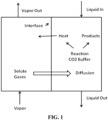
- the vapor and liquid phases are contact in a small cross-section.
- the absorption step involves removal of acid gases and other components from the gas phase by transport into the liquid phase.
- the gas-liquid interface separates the phases.
- An absorbing gas dissolves into the liquid at the interface, then diffuses across a thin layer of liquid (termed the diffusion layer) of one specific solvent.
- the gas meets the reactive absorbent component in one specific solvent, reacts with it, and generates heat and reaction products such as carbonate. Reaction products can diffuse into the bulk liquid while the liberated heat of reaction heats the liquid.
- tertiary amine/hindered amine there is a mixture of tertiary amine/hindered amine, reactive amines (e.g., a polyamine activator), carbonate buffer, a dissolving medium of water and physical polyethylene glycol as to solvent system remain as a single liquid phase in removing acidic gases from gaseous mixture.
- reactive amines e.g., a polyamine activator
- carbonate buffer e.g., a polyamine activator
- a dissolving medium of water and physical polyethylene glycol as to solvent system remain as a single liquid phase in removing acidic gases from gaseous mixture.
- reactive amines can be any one of nitrogen containing compounds represented by following formulae (IV) to (XIII) or mixture thereof.
- Reactive amines may be nitrogen-containing compound having a secondary nitrogen in a ring or a nitrogen-containing compound having a tertiary nitrogen in a ring.
- reactive amines can be a nitrogen-containing compound having secondary and tertiary nitrogen in a ring.
- reactive amines can be a nitrogen-containing compound having a nitrogen in a substituent group branching from the ring.
- reactive amines can be nitrogen-containing compound may be a nitrogen-containing compound having a primary nitrogen in a substituent group branching from the ring.
- reactive amines can be a nitrogen-containing compound having three nitrogen atoms or more in a molecule thereof.
- reactive amines can be a nitrogen-containing compound having in a molecule thereof all of primary, secondary, and tertiary nitrogens.
- the second compound component may be any one of nitrogen-containing compounds represented by following formulae (XIV) to (XIX) or a mixture thereof:
- the reactive amine may be piperazine, N-2-Hydroethyl Piperazine, 2-aminomethyl piperazine or mixture thereof.
- one of one specific solvent components can be represented by polyethylene glycol (PEG) represented by the following formulae (XXI) and / or physical pressure driven solvent or mixture thereof: Polyethylene Glycol (C 2n H 4n+2 O n+1 ) H-(O-CH 2 -CH 2 ) n -OH
- alkanolamines may be contained in an amount in a range from equal to or larger than 10 wt % to equal to or less than 40 wt %
- reactive amines may in an amount in a range from equal to or larger than 6 wt % to equal to or less than 40 wt %
- a total amount of the alkanolamine and reactive amines may be more than 20 wt % to equal to or less than 80 wt %.
- the alkanolamine may be represented by the formula (I), where each of R 1 and R 2 is H.
- the alkanolamine may be represented by the formula (I), where x is 2 to 4 and y is 4 to 8.
- the alkanolamine may be represented by the formula (I), where x is 2 to 4, y is 4 to 8, and R 2 is CH 3 , C 2 H 5 , C 3 H 7 , or C 4 H 9 .
- the alkanoamine may be represented by the formula (I), where x is 2, y is 4, R 1 is CH 3 , and R 2 is C 2 H 4 OH.
- An absorbent liquid for absorbing CO 2 or H 2 S or both from gas includes a cyclic amine compound having one nitrogen in a ring.
- the cyclic amine having one nitrogen in a ring may be a cyclic amine having one nitrogen in a 5-membered ring, 6-membered ring, or 7-membered ring.
- the cyclic amine having one nitrogen in a 5-membered ring, 6-membered ring, or 7-membered ring may be pyrrolidine (PR), piperidine (PZ), or hexamethyleneimine (HMI).
- PR pyrrolidine
- PZ piperidine
- HMI hexamethyleneimine
- the cyclic amine compound having one nitrogen in a ring may be a nitrogen containing compound having a primary nitrogen in a substituent group branching from the ring.
- the nitrogen-containing compound having a primary nitrogen in a substituent group branching from the ring may be aminomethylpiperidine or aminoethylpiperidine.
- the cyclic amine compound having one nitrogen in a ring may be a nitrogen-containing compound having a hydroxyl group in a 5-membered ring, 6-membered ring, or 7-membered ring.
- the nitrogen-containing compound having a hydroxyl group in a 5-membered ring, 6-membered ring, or 7-membered ring may be piperidinol (PDN).
- An absorbent liquid includes a mixture of one specific solvent, and an alkanolamine.
- the alkanolamine may be monoethanolamine (MEA), ethylaminoethanol (EAE), triethanolamine, N-methyldiethanolamine (MDEA), diisopropanolamine, diglycolamine, or a mixture thereof.
- a process for removing CO 2 or H 2 S or both a includes an absorption tower that allows gas containing CO 2 or H 2 S or both and an absorbent liquid to be in contact with each other to remove CO 2 or H 2 S or both from the gas; and a regeneration tower that regenerates a solution which has absorbed the CO 2 or H 2 S or both, the absorption tower reusing the solution regenerated at the regeneration tower by removing the CO 2 or H 2 S or both from the solution.
- one specific solvent for recovery of carbon dioxide from gaseous mixture includes hindered amine, reactive amine, Polyethylene glycol, and a alkali carbonate buffer.
- the remaining solvent may be water.
- Reactive amines may be a piperazine and its derivative such as piperazine, 2-aminomethyl piperazine, N-aminoethylpiperazine (in accordance with the claims), hydroxyethylpiperazine, 3-(3-pyrrolidyl)piperidine, 2-(3-pyrrolidyl)piperazine, 3-(3-piperidyl)-piperidine, 3-(2-piperazinyl)piperidine, or 2-(2-piperazinyl)piperazine, 2-aminomethyl piperazine.
- piperazine 2-aminomethyl piperazine
- N-aminoethylpiperazine in accordance with the claims
- hydroxyethylpiperazine 3-(3-pyrrolidyl)piperidine
- 2-(3-pyrrolidyl)piperazine 3-(3-piperidyl)-piperidine
- 3-(2-piperazinyl)piperidine 3-(2-piperazinyl)piperidine
- the reactive amine may be ethylenediamine, dimethyl ethylenediamine, pyrazolidine, imidazolidine, 2-(2-pyrrolidyl)-pyrrolidine, 2-(2-imidazolidyl) imidazolidine or mixture thereof.
- One example includes a solvent having hindered amine, mixture of active amine piperazine and N-2 Hydroethyl Piperazine, a carbonate buffer, polyethylene glycol, and water.
- One embodiment may include a solvent with polyethylene glycol, any of a class of organic compounds belonging to the alcohol family; in the molecule of a glycol, two hydroxyl (OH) groups are attached to different carbon atoms.
- the term is often applied to the simplest member of the class, ethylene glycol.
- Ethylene glycol also called 1,2-ethanediol, molecular formula HOCH 2 CH 2 OH, is a colourless, oily liquid possessing a sweet taste and mild odor. It can be produced commercially from ethylene oxide, which is obtained from ethylene.
- propylene glycol also called 1,2-propanediol, resembles ethylene glycol in its physical properties.
- glycols include 1,3-butanediol, 1,4-butanediol, 2-ethyl-1,3-hexanediol, and 2-methyl-2-propyl-1,3-propanediol, methoxytriglycol and others and are suitable herewith.
- Hindered amine / tertiary amine may be N-methyldiethanolamine (MDEA), 2-(2-aminoethoxy)ethanol, Aminoethylethanolamine (AEEA), 2-amino-2methyl-1-proponal (AMP), 2-(ethyamino)-ethanol (EAE), 2-(methylamino)-ethanol (MAE), 2-(diethylamino)-ethanol (DEAE), diisopropanolamine (DIPA), methylaminopropylamine (MAPA), 3-aminopropanol (AP), 2,2-dimethyl-1,3-propanediamine (DMPDA), 3-amino-1-cyclohexylaminopropane (ACHP), diglycolamine (DGA), 1-amino-2-propanol (MIPA), 2-methyl-methanolamine (MME), N-methyldiethanolamine (MDEA), 2-(2-aminoethoxy)ethanol, Aminoethylethanolamine (AEEA), 2-
- the solvent of the invention contains a carbonate buffer.
- the pH may range for a carbonate buffer may be between 8.0 and 9.0.
- Carbonate in one specific solvent increases the pH of one specific solvent. This high pH allows for increased carbon dioxide capture in the form of bicarbonate salts. The carbonate can be regenerated when one specific solvent is heated. In some instances percarbonate may contribute to the buffer system.
- Suitable carbonate buffer salts are described herein.
- the amount of carbonate buffer salt used in the buffer system is an amount that is sufficient, when used with the remaining components, to raise salivary pH to a pH of about 7.8 or more, about 8.5 or more, and about 9 or more (e.g., about 9-11), irrespective of the starting pH.
- the carbonate salt is selected from the group consisting of sodium carbonate, potassium carbonate, calcium carbonate, ammonium carbonate, and magnesium carbonate.
- the bicarbonate salt is selected from the group consisting of sodium bicarbonate, potassium bicarbonate, calcium bicarbonate, ammonium bicarbonate, and magnesium bicarbonate.
- the binary buffer system comprises sodium carbonate and sodium bicarbonate.
- the sodium bicarbonate is desiccant-coated sodium bicarbonate.
- the amount of carbonate buffer and reactive amine piperazine in the solution is limited by the solubility of both components in water, thus resulting in solid solubility limit for aqueous solutions.
- the solubility of potassium carbonate buffer in a CO 2 rich solution is 3.6 m and the solubility of piperazine in water is approximately 2 m.
- the resulting lower concentration can result in slow reaction rate and low solution capacity.
- Reactive amines such as piperazine and CO 2 react, it undergoes equilibrium reaction to form piperazine carbamate and piperazine dicarbamate and some free and bound piperazine. Because of the addition of carbonate buffer salt; which react with free and bound piperazine in reacting more CO 2 to form piperazine carbamate and piperazine dicarbamate.
- the ratio of equivalents of carbonate salt to equivalents of reactive amine can be between 0.3 - 3.0.
- concentrations of the reactive amine and carbonate salt can be between 3.0 - 8.0 equivalents/Kg H 2 O or 4.0 and 6.0 equivalents/Kg H 2 O.
- the amount of piperazine and carbonate buffer salt can be adjusted based on the solubility in water and polyethylene glycol.
- one specific solvent and method of use for the removal of CO 2 from flue gas, natural gas, hydrogen gas, synthesis gas, and other process and waste gas streams may contain a carbonate buffer, a reactive amine, a hindered amine, and a polyethylene glycol, resulting in the solution pH between (10 - 13.5) in absence of CO 2 .
- This chemical solvent is designed to increase the rate of CO 2 removal to improve the efficiency of a removal process.
- Piperazine is freely soluble in water and solubility in ethylene glycol up to about 20 wt%.
- Carbonate buffer salt solubility in water is 112 g/100 mL at 20 °C.
- the temperature of the solution when contacting with the gaseous stream may be between approximately 30 °C - 125 °C.
- the rate constant for the reaction of CO 2 with the piperazine derivative (K PZ ) may be at least 25 m 3 /mol-s at 25 °C, or at least 50 m 3 /mol-s at 25 °C.
- one specific solvent has a reactive amine in concentration between about 6 wt% and 40 wt%.
- one specific solvent has a alkanolamine in a concentration between about 10wt% and 40 wt%.
- the solvent has a carbonate buffer with a concentration between about 0.15wt% - 10 wt%.
- one specific solvent has a solute concentration between about 2 wt% - 40 wt%.
- one specific solvent has a tertiary balance to keep one specific solvent or solvent system as a single liquid phase.
- the solvent the alkanolamine has a weight percentage between 25 wt% and 40 wt% and is selected from group comprising N-methyldiethanolamine (MDEA), 2-amino-2methyl-1-proponal (AMP);
- the reactive amines have a weight percentage between 10 wt% and 25 wt% and is selected from group comprising piperazine, N aminoethylpiperazine (AEP); and the glycol has a weight percentage between 10 wt% and 25 wt%.
- the solvent the alkanolamine has a weight percentage between 30 wt% and 40 wt% and is selected from group comprising N-methyldiethanolamine (MDEA), 2-amino-2methyl-1-proponal (AMP);
- the reactive amines have a weight percentage between 10 wt% and 18 wt% and is selected from group comprising piperazine, N aminoethylpiperazine (AEP); and the glycol has a weight percentage between 15 wt% and 20 wt%.
- the solvent the alkanolamine has a weight percentage between 32 wt% and 35 wt% and is selected from group comprising N-methyldiethanolamine (MDEA), 2-amino-2methyl-1-proponal (AMP);
- the reactive amines have a weight percentage between 11 wt% and 15 wt% and is selected from group comprising piperazine, N aminoethylpiperazine (AEP); and
- the glycol has a weight percentage between 18 wt% and 20 wt%.
- the solvent the alkanolamine has a weight percentage between 25 wt% and 40 wt%; the reactive amines have a weight percentage between 10 wt% and 25 wt%; and the glycol has a weight percentage between 10 wt% and 25 wt%.
- the solvent the alkanolamine has a weight percentage between 30 wt% and 40 wt%; the reactive amines have a weight percentage between 10 wt% and 18 wt%; and the glycol has a weight percentage between 15 wt% and 20 wt%.
- the solvent the alkanolamine has a weight percentage between 32 wt% and 35 wt%; the reactive amines have a weight percentage between 11 wt% and 15 wt%; and the glycol has a weight percentage between 18 wt% and 20 wt%.
- the solvent the alkanolamine has a weight percentage between 25 wt% and 40 wt%; the reactive amines have a weight percentage between 10 wt% and 25 wt%; and the sulfolane has a weight percentage between 10 wt% and 25 wt%.
- the solvent the alkanolamine has a weight percentage between 30 wt% and 40 wt%; the reactive amines have a weight percentage between 10 wt% and 18 wt%; and the sulfolane has a weight percentage between 15 wt% and 20 wt%.
- the solvent the alkanolamine has a weight percentage between 32 wt% and 35 wt%; the reactive amines have a weight percentage between 11 wt% and 15 wt%; and the sulfolane has a weight percentage between 18 wt% and 20 wt%.
- a method of removing CO 2 from a gaseous stream including: contacting a gaseous stream with a solution wherein the solution is formed by combining: alkanolamines, a reactive amine , an carbonate salt, poly ethylene glycol and water; whereby the contact removes CO 2 from the gaseous stream; and regenerating the solution.
- concentrations may be limited by the solubility of the components at a temperature and contact of the exhaust gaseous stream with one specific solvent removes CO 2 from the gaseous stream; and regenerating the solution.
- the regenerating may include heating CO 2 -rich solution, which may occur at a temperature of approximately 90 °C - 130 °C, approximately 110 °C.
- An additive such as an antifoaming agent, an antioxidant, a corrosion inhibitor (e.g. vanadium oxide or a chromate), a flocculation aid, or a mixture of two or more additives may be included as part of the solution.
- the method of removing CO 2 from a gaseous stream may further include applying a water wash system, wherein the water wash system collects the volatile alkanolamine and reactive amine from treated gaseous stream.
- the regeneration of the solution may occur in a vacuum stripper column, and the solution may be returned to contact with the gaseous stream after regeneration.
- gaseous stream may be from a coal-fired power plant, or it may be flue gas, natural gas, hydrogen gas, synthesis gas or a waste gas stream.
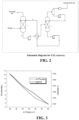
- Fig. 2 is a schematic diagram of an apparatus for removing acidic gases especially CO 2 .
- gas is allowed to enter to an absorption tower 1 through a CO 2 - containing gas-feed.
- the gas placed in the absorption tower 1 is brought into contact in a counter flow with a CO 2 absorbent liquid fed from 3, and CO 2 is absorb and removed from the gas by the absorbing liquid, and the resultant gas is discharge from the top as treated gas.
- the absorbent liquid fed to the absorption tower 1 absorb CO 2 , and is led to heat exchanger and heated and led to a regeneration tower 4.
- the absorbent liquid flows through a packed portion towards the lower portion of the tower. During this time, CO 2 is removed to regenerate the absorbent liquid.
- the regenerated absorbent liquid is led by a pump to the heat exchanger and fed back to the absorption tower 1 through an absorbent liquid feed inlet line 3.
- the CO 2 removed from the absorbent liquid is brought into contact with a reflux water, and cooled by a regeneration tower reflux condenser and, in a reflux drum, the CO 2 separated from the reflux water formed by condensing water vapor accompanying the CO 2 , and led to a CO 2 recovery step.
- the reflux water is fed by a reflux water pump to the regenerator tower 4.
- One specific solvent loaded with CO 2 in the absorber may be heated up to stripper temperature for the regeneration of CO 2 .
- One specific solvent stream can be pre-heated in the lean-rich cross heat exchanger and then additional heat may be used to maintain the temperature of one specific solvent in the stripper.
- Q sens ⁇ C P ⁇ T ⁇ rich ⁇ ⁇ lean C a min e
- the contributing factors to the sensible heat are solvent flow, specific heat capacity of one specific solvent and the temperature increase.
- the only parameter that can be varied is one specific solvent flow which further depends on the concentration of one specific solvent and one specific solvent loadings. This can be decreased by circulating less solvent and maintaining the same CO 2 production rate. This is checked by means of comparing the Net Capacity of a solvent which is defined as the difference in the loading at the absorption and desorption conditions.
- the CO 2 which is reversibly bound to one specific solvent needs to be regenerated.
- the heat of desorption is equivalent to the heat of absorption.
- piperazine As the rate activator for the CO 2 absorption is piperazine and its derivative, the limitation with piperazine is its high volatility. It has highest reaction kinetics among its derivatives. It is white crystals which need more water to foam a clear solutions or need Polyethylene glycol to solubilize it. But because of the high volatility the loss of the piperazine is high and to minimize the volatility loss in the solvent, piperazine component is partly or completely replaced by rate activator such as N-2-hydroethyl piperazine whose vapor pressure is 99.7% less than piperazine. Reactive Amine Piperazine N-2-HYDROETHYL Piperazine Formula C 4 H 10 N 2 C 6 H 14 N 20 Mol.
- the densities of were measured using a 25 ⁇ 10 -6 m 3 (at 298 K) Gay-Lussac pycnometer. For each run, the pycnometer containing the solvent solution was put in a constant temperature bath. The bath temperature was controlled within ⁇ 0.1 K of the desired temperature level using a circulator temperature controller. Once the solution reached the desired temperature, it was weighed to within ⁇ 0.0001 g with an analytical balance. Each reported density data is the average of at least three measurements.
- the viscosities of solutions were measured using Cannon Fenske Viscometer. For each viscosity measurement, the temperature was controlled within ⁇ 0.1 K of the desired level with a circulator temperature controller. The viscometers containing samples were immersed in a thermostatic bath and allowed to equilibrate to the set point temperature for at least 15 min. Later, the efflux time of samples was measured manually with a digital stopwatch having an accuracy of 0.01s. The efflux time is measured by allowing meniscus to pass between two specific marks. The kinematic viscosity was obtained by multiplying efflux time in seconds with the respective viscometer constant. The dynamic viscosity of the samples is calculated by multiplying the kinematic viscosity values with their corresponding density values.
- Each viscosity data is the average of at least three measurements. Mass% Mol% Molarity (mol/lit) Molality (mol/kg water) Density Kg/m 3 MDEA 25 7.3 2.185 5.387 1055 at 40 °C Ethylene Glycol 20 11.19 3.351 8.262 Piperazine 15 6.05 1.811 4.465 K 2 CO 3 1 0.25 0.0734 0.186 H 2 O 39 75.21
- FIG. 3 describes viscosity in mPa.sec and density in kg/m 3 (on Y-axis) w.r.t temperature °C (on X-axis) for the solvent Si. It is observed that viscosity and density decreases with the increase in temperature.
- T 40 °C Loading CO 2 PARTIAL pressure kPa 0.118545 0.068 0.167315 0.208 0.20191 0.420 0.231713 0.963 0.27593 2.388 0.315874 5.076 0.356194 8.245 0.395963 14.492 0.470479 33.408 0.496462 50.479 0.539315 78.051 0.575544 98.729
- T 50 °C Loading CO 2 PARTIAL pressure kPa 0.067229 0.043 0.119626 0.159 0.189261 0.710 0.232958 1.701 0.287389 4.549 0.320698 7.513 0.379275 16.116 0.400526 24.539 0.484553 62.484 0.516075 76.269 0.528049 103.841
Landscapes
- Chemical & Material Sciences (AREA)
- Engineering & Computer Science (AREA)
- Analytical Chemistry (AREA)
- General Chemical & Material Sciences (AREA)
- Oil, Petroleum & Natural Gas (AREA)
- Chemical Kinetics & Catalysis (AREA)
- Gas Separation By Absorption (AREA)
- Treating Waste Gases (AREA)
Claims (9)
- Lösungsmittel zur Rückgewinnung von Kohlendioxid aus einem Gasgemisch, umfassend:(a) ein Alkanolamin, ausgewählt aus der Gruppe umfassend N-Methyldiethanolamin (MDEA) und 2-Amino-2-methyl-1-propanol (AMP) und mit einem Gewichtsanteil zwischen 25 Gew.-% und 40 Gew.-%,(b) Piperazinamine, wobei das Piperazinamin N-Aminoethylpiperazin (AEP) mit einem Gewichtsanteil zwischen 10 Gew.-% und 25 Gew.-% ist,(c) einen Carbonatpuffer mit einem Gewichtsanteil zwischen 0,15 Gew.-% und 10 Gew.-%,(d) Wasser und(e) ein Glykol mit einem Gewichtsanteil zwischen 10 Gew.-% und
20 Gew.-%, oderein Sulfolan mit einem Gewichtsanteil zwischen 10 Gew.-% und 20 Gew.-%,wobei das Lösungsmittel zu weniger als 75 Gew.-% Wasser enthält und eine einzige flüssige wässrige Phase aufweist. - Lösungsmittel nach Anspruch 1, wobei das Glykol Polyethylenglykol ist.
- Lösungsmittel nach Anspruch 1, wobei das Glykol aus der Gruppe ausgewählt ist, die aus Monoethylenglykol (EG), Diethylenglykol (DEG), Triethylenglykol, Tetraethylenglykol und Methoxytriglykol (MTG) besteht.
- Lösungsmittel nach Anspruch 1 oder 2, wobei das Lösungsmittel zu weniger als 30 Gew.-% Wasser enthält.
- Lösungsmittel nach Anspruch 1, wobei(a) das Alkanolamin einen Gewichtsanteil zwischen 30 Gew.-% und
40 Gew.-% aufweist,(b) die Piperazinamine einen Gewichtsanteil zwischen 10 Gew.-% und 18 Gew.-% aufweisen,(c) das Glykol oder Sulfolan einen Gewichtsanteil zwischen 15 Gew.-% und 20 Gew.-% aufweist. - Lösungsmittel nach Anspruch 1, wobei(a) das Alkanolamin einen Gewichtsanteil zwischen 32 Gew.-% und 35 Gew.-% aufweist,(b) die Piperazinamine einen Gewichtsanteil zwischen 11 Gew.-% und 15 Gew.-% aufweisen,(c) Polyethylenglykol einen Gewichtsanteil zwischen 18 Gew.-% und 20 Gew.-% aufweist.
- Verfahren zum Entfernen von CO2 aus einem Strom, umfassend die Schritte:(a) Kontaktieren des Stroms mit dem Lösungsmittel nach einem der Ansprüche 1 bis 6;(b) Ermöglichen von CO2-Absorption bei einer bestimmten Temperatur zur Bildung von CO2-reichem Lösungsmittel;(c) Regenerieren des Lösungsmittels durch Erhitzen des CO2-reichen Lösungsmittels auf über 80 °C.
- Verfahren nach Anspruch 7, wobei der Strom eine Temperatur zwischen 40 °C und 65 °C aufweist und die Regeneration unter einem Druck zwischen 0,01 und 30 Bar erfolgt.
- Verfahren nach Anspruch 7, wobei(a) das Alkanolamin einen Gewichtsanteil zwischen 32 Gew.-% und 35 Gew.-% aufweist,(b) Piperazinamine einen Gewichtsanteil zwischen 11 Gew.-% und 15 Gew.-% aufweisen,(c) das Glykol oder Sulfolan einen Gewichtsanteil zwischen 18 Gew.-% und 20 Gew.-% aufweist.
Priority Applications (1)
| Application Number | Priority Date | Filing Date | Title |
|---|---|---|---|
| EP24164162.0A EP4427835A1 (de) | 2013-01-31 | 2014-01-31 | Lösungsmittel zur kohlenstoffabfangen und verfahren zur verwendung solcher lösungsmittel |
Applications Claiming Priority (2)
| Application Number | Priority Date | Filing Date | Title |
|---|---|---|---|
| US201361759191P | 2013-01-31 | 2013-01-31 | |
| PCT/IB2014/000419 WO2014118633A2 (en) | 2013-01-31 | 2014-01-31 | Carbon capture solvents and methods for using such solvents |
Related Child Applications (2)
| Application Number | Title | Priority Date | Filing Date |
|---|---|---|---|
| EP24164162.0A Division EP4427835A1 (de) | 2013-01-31 | 2014-01-31 | Lösungsmittel zur kohlenstoffabfangen und verfahren zur verwendung solcher lösungsmittel |
| EP24164162.0A Division-Into EP4427835A1 (de) | 2013-01-31 | 2014-01-31 | Lösungsmittel zur kohlenstoffabfangen und verfahren zur verwendung solcher lösungsmittel |
Publications (3)
| Publication Number | Publication Date |
|---|---|
| EP2950910A2 EP2950910A2 (de) | 2015-12-09 |
| EP2950910A4 EP2950910A4 (de) | 2017-01-18 |
| EP2950910B1 true EP2950910B1 (de) | 2024-12-11 |
Family
ID=51263076
Family Applications (2)
| Application Number | Title | Priority Date | Filing Date |
|---|---|---|---|
| EP24164162.0A Pending EP4427835A1 (de) | 2013-01-31 | 2014-01-31 | Lösungsmittel zur kohlenstoffabfangen und verfahren zur verwendung solcher lösungsmittel |
| EP14746742.7A Active EP2950910B1 (de) | 2013-01-31 | 2014-01-31 | Kohlenstoffabscheidungslösungsmittel und verfahren zur verwendung derartiger lösungsmittel |
Family Applications Before (1)
| Application Number | Title | Priority Date | Filing Date |
|---|---|---|---|
| EP24164162.0A Pending EP4427835A1 (de) | 2013-01-31 | 2014-01-31 | Lösungsmittel zur kohlenstoffabfangen und verfahren zur verwendung solcher lösungsmittel |
Country Status (6)
| Country | Link |
|---|---|
| US (1) | US10239014B2 (de) |
| EP (2) | EP4427835A1 (de) |
| DK (1) | DK2950910T3 (de) |
| ES (1) | ES3014995T3 (de) |
| FI (1) | FI2950910T3 (de) |
| WO (1) | WO2014118633A2 (de) |
Cited By (1)
| Publication number | Priority date | Publication date | Assignee | Title |
|---|---|---|---|---|
| EP3817839A1 (de) * | 2018-07-02 | 2021-05-12 | Carbon Clean Solutions Limited | Verfahren und system zur entfernung von kohlendioxid aus lösungsmitteln |
Families Citing this family (20)
| Publication number | Priority date | Publication date | Assignee | Title |
|---|---|---|---|---|
| US9732673B2 (en) * | 2010-07-02 | 2017-08-15 | Exxonmobil Upstream Research Company | Stoichiometric combustion with exhaust gas recirculation and direct contact cooler |
| EP3024563A4 (de) * | 2013-07-23 | 2017-08-16 | Carbon Clean Solutions Pvt. Ltd. | Geteiltes leitungssystem, verfahren und prozess zur co2-rückgewinnung |
| TW201617126A (zh) * | 2014-08-22 | 2016-05-16 | 卡本克林解決方案有限公司 | 含有醇類及胺類之碳捕捉溶劑以及使用此溶劑之方法 |
| DK3247484T3 (da) * | 2015-01-22 | 2024-01-02 | Carbon Clean Solutions Ltd | Opløsningsmiddel og fremgangsmåde til fjernelse af sure gasser fra gasblanding |
| EP3250311A4 (de) * | 2015-01-28 | 2019-02-13 | Fluor Technologies Corporation | Verfahren und system zur verbesserung der energieeffizienz von kohlendioxidabscheidung |
| US10376829B2 (en) | 2017-06-13 | 2019-08-13 | Fluor Technologies Corporation | Methods and systems for improving the energy efficiency of carbon dioxide capture |
| CN109420409B (zh) * | 2017-08-22 | 2021-08-06 | 中国石油化工股份有限公司 | 从气流中选择性除去含有h2s和co2的酸性气的吸收剂及方法 |
| US12059649B2 (en) | 2018-06-26 | 2024-08-13 | Carbon Clean Solutions Limited | Solvent and process for removing carbon dioxide from a gaseous mixture having high carbon dioxide partial pressures |
| GB201813839D0 (en) | 2018-06-26 | 2018-10-10 | Carbon Clean Solutions Ltd | System and process of capturing carbon dioxide from flue gases |
| US11607646B2 (en) | 2018-08-29 | 2023-03-21 | Indian Oil Corporation Limited | Process for CO2 capture from gaseous streams |
| CN109529550A (zh) * | 2018-10-22 | 2019-03-29 | 昆明理工大学 | 一种相变捕集二氧化硫的吸收液 |
| WO2020262779A1 (ko) * | 2019-06-27 | 2020-12-30 | 한국에너지기술연구원 | 청정연료 생산을 위한 바이오가스 정제 시스템 및 방법 |
| FR3104452B1 (fr) * | 2019-12-13 | 2022-09-09 | Ifp Energies Now | Procede de regeneration d’une solution aqueuse de meg contenant des sels avec traitement de la purge |
| EP3964279A1 (de) | 2020-09-07 | 2022-03-09 | Indian Oil Corporation Limited | Lösungsmittelzusammensetzung für co2-aufnahme und dadurch vermitteltes verfahren |
| WO2023073389A1 (en) | 2021-10-26 | 2023-05-04 | Totalenergies Onetech | Method for the purification of a gas mixture comprising carbon dioxide and optionally hydrogen sulfide |
| CN115475486A (zh) * | 2022-10-20 | 2022-12-16 | 华北电力大学(保定) | 一种抗氧化降解相变吸收剂、其捕集二氧化碳方法及应用 |
| WO2024228530A1 (ko) * | 2023-05-03 | 2024-11-07 | 주식회사 파나시아 | 이산화탄소 포집용 흡수제 |
| CN119056200B (zh) * | 2023-06-02 | 2025-09-19 | 中国石油化工股份有限公司 | 捕集二氧化碳的吸收液和应用与捕集二氧化碳的方法 |
| CN117339348A (zh) * | 2023-10-18 | 2024-01-05 | 河北科技大学 | 一种液-液相变吸收剂及其在捕集二氧化碳中的应用 |
| NL2036288B1 (en) * | 2023-11-17 | 2025-05-27 | Opure B V | Process and apparatus for the purification of biogas |
Family Cites Families (10)
| Publication number | Priority date | Publication date | Assignee | Title |
|---|---|---|---|---|
| DE19828977A1 (de) * | 1998-06-29 | 1999-12-30 | Basf Ag | Verfahren zur Entfernung saurer Gasbestandteile aus Gasen |
| DE10139453A1 (de) * | 2001-08-10 | 2003-02-20 | Basf Ag | Verfahren und Absorptionsmittel zur Entfernung saurer Gase aus Fluiden |
| AU2006217575B2 (en) * | 2005-02-24 | 2010-12-23 | Co2 Solutions Inc. | An improved CO2 absorption solution |
| US7846407B2 (en) * | 2006-04-07 | 2010-12-07 | Liang Hu | Self-concentrating absorbent for acid gas separation |
| CN101612510B (zh) * | 2008-06-25 | 2011-10-05 | 中国科学院大连化学物理研究所 | 一种吸收co2的微通道吸收器 |
| US7842126B1 (en) * | 2008-09-30 | 2010-11-30 | The United States Of America As Represented By The United States Department Of Energy | CO2 separation from low-temperature flue gases |
| US8541622B2 (en) * | 2009-06-30 | 2013-09-24 | Nalco Company | Acid gas scrubbing composition |
| US8318114B2 (en) * | 2010-04-16 | 2012-11-27 | Nalco Company | Composition for treating acid gas |
| WO2012038868A1 (en) * | 2010-09-20 | 2012-03-29 | Prateek Bumb | Solvent composition for carbon dioxide recovery |
| EP2678094A4 (de) * | 2011-02-03 | 2014-12-10 | Co2 Solutions Inc | Co2-behandlungen mittels entsprechend der dicke eines reaktiven flüssigfilms sortierter enzympartikel für verbesserte katalyse |
-
2014
- 2014-01-31 EP EP24164162.0A patent/EP4427835A1/de active Pending
- 2014-01-31 WO PCT/IB2014/000419 patent/WO2014118633A2/en not_active Ceased
- 2014-01-31 DK DK14746742.7T patent/DK2950910T3/da active
- 2014-01-31 ES ES14746742T patent/ES3014995T3/es active Active
- 2014-01-31 US US14/765,935 patent/US10239014B2/en active Active
- 2014-01-31 EP EP14746742.7A patent/EP2950910B1/de active Active
- 2014-01-31 FI FIEP14746742.7T patent/FI2950910T3/fi active
Cited By (1)
| Publication number | Priority date | Publication date | Assignee | Title |
|---|---|---|---|---|
| EP3817839A1 (de) * | 2018-07-02 | 2021-05-12 | Carbon Clean Solutions Limited | Verfahren und system zur entfernung von kohlendioxid aus lösungsmitteln |
Also Published As
| Publication number | Publication date |
|---|---|
| US10239014B2 (en) | 2019-03-26 |
| ES3014995T3 (en) | 2025-04-28 |
| US20160193563A1 (en) | 2016-07-07 |
| WO2014118633A3 (en) | 2015-02-19 |
| EP4427835A1 (de) | 2024-09-11 |
| EP2950910A4 (de) | 2017-01-18 |
| WO2014118633A2 (en) | 2014-08-07 |
| FI2950910T3 (fi) | 2025-03-06 |
| DK2950910T3 (da) | 2025-03-03 |
| EP2950910A2 (de) | 2015-12-09 |
Similar Documents
| Publication | Publication Date | Title |
|---|---|---|
| US10239014B2 (en) | Carbon capture solvents and methods for using such solvents | |
| US7585479B2 (en) | Method of deacidizing a gas by partly neutralized multiamines | |
| ES2977453T3 (es) | Procedimiento para desacidificar un gas con una disolución absorbente con regeneracién fraccionada | |
| CA2657993C (en) | Absorbent liquid, and apparatus and method for removing co2 or h2s from gas with use of absorbent liquid | |
| ES2368268T3 (es) | Proceso de desacidificación de un gas por solución absorbente con regeneración fraccionada por calentamiento. | |
| US8206489B2 (en) | Method of deacidizing a gas with a fractional regeneration absorbent solution with control of the water content of the solution | |
| JP5713997B2 (ja) | 酸性ガス吸収剤、酸性ガス除去装置および酸性ガス除去方法 | |
| DK1725320T3 (en) | PROCEDURE FOR REMOVING CARBON Dioxide From Gas Flow With Low Carbon Dioxide Partial Pressure | |
| KR100768383B1 (ko) | 이산화탄소 분리용 혼합 흡수제 | |
| CA2870164C (en) | Aqueous alkanolamine solution and process for the removal of h2s from gaseous mixtures | |
| US10226734B2 (en) | Hybrid solvent formulations for selective H2S removal | |
| US9421492B2 (en) | Aminopyridine derivatives for removal of hydrogen sulfide from a gas mixture | |
| US20130164204A1 (en) | Solvent composition for carbon dioxide recovery | |
| CA2963598C (en) | Aqueous solution of 2-dimethylamino-2-hydroxymethyl-1, 3-propanediol useful for acid gas removal from gaseous mixtures | |
| EA024196B1 (ru) | Поглощающая композиция для кислого газа | |
| JP2016533886A (ja) | 四級アンモニウム塩を含有するガススイートニング溶媒 | |
| KR20090032375A (ko) | 산성가스 분리용 고효율 흡수제 | |
| CA2741248A1 (en) | Scrubbing solution consisting of aqueous ammonia solution and amines for the scrubbing of gases and use of such solution | |
| JP2014097498A (ja) | 酸性ガス吸収剤、酸性ガス除去装置および酸性ガス除去方法 | |
| KR20170067788A (ko) | 2-디메틸아미노-2-하이드록시메틸-1,3-프로판디올의 수용액을 사용하여 가스 혼합물로부터 산 가스를 제거하는 방법 | |
| JP2006167520A (ja) | 吸収液、吸収液を用いたガス中のco2又はh2s除去装置及び方法 | |
| JP5627534B2 (ja) | 吸収液、吸収液を用いたガス中のco2又はh2s除去装置及び方法 | |
| RU2589166C1 (ru) | Способ очистки газовых потоков от диоксида углерода |
Legal Events
| Date | Code | Title | Description |
|---|---|---|---|
| PUAI | Public reference made under article 153(3) epc to a published international application that has entered the european phase |
Free format text: ORIGINAL CODE: 0009012 |
|
| 17P | Request for examination filed |
Effective date: 20150831 |
|
| AK | Designated contracting states |
Kind code of ref document: A2 Designated state(s): AL AT BE BG CH CY CZ DE DK EE ES FI FR GB GR HR HU IE IS IT LI LT LU LV MC MK MT NL NO PL PT RO RS SE SI SK SM TR |
|
| AX | Request for extension of the european patent |
Extension state: BA ME |
|
| DAX | Request for extension of the european patent (deleted) | ||
| RIC1 | Information provided on ipc code assigned before grant |
Ipc: B01D 53/14 20060101AFI20160712BHEP Ipc: C01B 31/20 20060101ALI20160712BHEP Ipc: B01D 53/40 20060101ALI20160712BHEP |
|
| A4 | Supplementary search report drawn up and despatched |
Effective date: 20161221 |
|
| RIC1 | Information provided on ipc code assigned before grant |
Ipc: B01D 53/40 20060101ALI20161215BHEP Ipc: B01D 53/14 20060101AFI20161215BHEP Ipc: C01B 31/20 00000000ALI20161215BHEP |
|
| RAP1 | Party data changed (applicant data changed or rights of an application transferred) |
Owner name: CARBON CLEAN SOLUTIONS LIMITED |
|
| RAP1 | Party data changed (applicant data changed or rights of an application transferred) |
Owner name: CARBON CLEAN SOLUTIONS LIMITED |
|
| STAA | Information on the status of an ep patent application or granted ep patent |
Free format text: STATUS: EXAMINATION IS IN PROGRESS |
|
| 17Q | First examination report despatched |
Effective date: 20210812 |
|
| GRAP | Despatch of communication of intention to grant a patent |
Free format text: ORIGINAL CODE: EPIDOSNIGR1 |
|
| STAA | Information on the status of an ep patent application or granted ep patent |
Free format text: STATUS: GRANT OF PATENT IS INTENDED |
|
| RIC1 | Information provided on ipc code assigned before grant |
Ipc: B01D 53/40 20060101ALI20240229BHEP Ipc: B01D 53/14 20060101AFI20240229BHEP |
|
| INTG | Intention to grant announced |
Effective date: 20240326 |
|
| GRAJ | Information related to disapproval of communication of intention to grant by the applicant or resumption of examination proceedings by the epo deleted |
Free format text: ORIGINAL CODE: EPIDOSDIGR1 |
|
| STAA | Information on the status of an ep patent application or granted ep patent |
Free format text: STATUS: EXAMINATION IS IN PROGRESS |
|
| GRAP | Despatch of communication of intention to grant a patent |
Free format text: ORIGINAL CODE: EPIDOSNIGR1 |
|
| INTC | Intention to grant announced (deleted) | ||
| STAA | Information on the status of an ep patent application or granted ep patent |
Free format text: STATUS: GRANT OF PATENT IS INTENDED |
|
| INTG | Intention to grant announced |
Effective date: 20240718 |
|
| GRAS | Grant fee paid |
Free format text: ORIGINAL CODE: EPIDOSNIGR3 |
|
| GRAA | (expected) grant |
Free format text: ORIGINAL CODE: 0009210 |
|
| STAA | Information on the status of an ep patent application or granted ep patent |
Free format text: STATUS: THE PATENT HAS BEEN GRANTED |
|
| AK | Designated contracting states |
Kind code of ref document: B1 Designated state(s): AL AT BE BG CH CY CZ DE DK EE ES FI FR GB GR HR HU IE IS IT LI LT LU LV MC MK MT NL NO PL PT RO RS SE SI SK SM TR |
|
| P01 | Opt-out of the competence of the unified patent court (upc) registered |
Free format text: CASE NUMBER: APP_59794/2024 Effective date: 20241105 |
|
| REG | Reference to a national code |
Ref country code: GB Ref legal event code: FG4D |
|
| REG | Reference to a national code |
Ref country code: CH Ref legal event code: EP |
|
| REG | Reference to a national code |
Ref country code: IE Ref legal event code: FG4D |
|
| REG | Reference to a national code |
Ref country code: DE Ref legal event code: R096 Ref document number: 602014091311 Country of ref document: DE |
|
| REG | Reference to a national code |
Ref country code: DK Ref legal event code: T3 Effective date: 20250225 |
|
| REG | Reference to a national code |
Ref country code: NL Ref legal event code: FP |
|
| REG | Reference to a national code |
Ref country code: FI Ref legal event code: FGE |
|
| REG | Reference to a national code |
Ref country code: SE Ref legal event code: TRGR |
|
| REG | Reference to a national code |
Ref country code: LT Ref legal event code: MG9D |
|
| PG25 | Lapsed in a contracting state [announced via postgrant information from national office to epo] |
Ref country code: HR Free format text: LAPSE BECAUSE OF FAILURE TO SUBMIT A TRANSLATION OF THE DESCRIPTION OR TO PAY THE FEE WITHIN THE PRESCRIBED TIME-LIMIT Effective date: 20241211 |
|
| PG25 | Lapsed in a contracting state [announced via postgrant information from national office to epo] |
Ref country code: BG Free format text: LAPSE BECAUSE OF FAILURE TO SUBMIT A TRANSLATION OF THE DESCRIPTION OR TO PAY THE FEE WITHIN THE PRESCRIBED TIME-LIMIT Effective date: 20241211 |
|
| PG25 | Lapsed in a contracting state [announced via postgrant information from national office to epo] |
Ref country code: LV Free format text: LAPSE BECAUSE OF FAILURE TO SUBMIT A TRANSLATION OF THE DESCRIPTION OR TO PAY THE FEE WITHIN THE PRESCRIBED TIME-LIMIT Effective date: 20241211 Ref country code: GR Free format text: LAPSE BECAUSE OF FAILURE TO SUBMIT A TRANSLATION OF THE DESCRIPTION OR TO PAY THE FEE WITHIN THE PRESCRIBED TIME-LIMIT Effective date: 20250312 |
|
| PG25 | Lapsed in a contracting state [announced via postgrant information from national office to epo] |
Ref country code: RS Free format text: LAPSE BECAUSE OF FAILURE TO SUBMIT A TRANSLATION OF THE DESCRIPTION OR TO PAY THE FEE WITHIN THE PRESCRIBED TIME-LIMIT Effective date: 20250311 |
|
| REG | Reference to a national code |
Ref country code: AT Ref legal event code: MK05 Ref document number: 1749964 Country of ref document: AT Kind code of ref document: T Effective date: 20241211 |
|
| PG25 | Lapsed in a contracting state [announced via postgrant information from national office to epo] |
Ref country code: SM Free format text: LAPSE BECAUSE OF FAILURE TO SUBMIT A TRANSLATION OF THE DESCRIPTION OR TO PAY THE FEE WITHIN THE PRESCRIBED TIME-LIMIT Effective date: 20241211 |
|
| PG25 | Lapsed in a contracting state [announced via postgrant information from national office to epo] |
Ref country code: PL Free format text: LAPSE BECAUSE OF FAILURE TO SUBMIT A TRANSLATION OF THE DESCRIPTION OR TO PAY THE FEE WITHIN THE PRESCRIBED TIME-LIMIT Effective date: 20241211 |
|
| PG25 | Lapsed in a contracting state [announced via postgrant information from national office to epo] |
Ref country code: IS Free format text: LAPSE BECAUSE OF FAILURE TO SUBMIT A TRANSLATION OF THE DESCRIPTION OR TO PAY THE FEE WITHIN THE PRESCRIBED TIME-LIMIT Effective date: 20250411 |
|
| PG25 | Lapsed in a contracting state [announced via postgrant information from national office to epo] |
Ref country code: PT Free format text: LAPSE BECAUSE OF FAILURE TO SUBMIT A TRANSLATION OF THE DESCRIPTION OR TO PAY THE FEE WITHIN THE PRESCRIBED TIME-LIMIT Effective date: 20250411 |
|
| PG25 | Lapsed in a contracting state [announced via postgrant information from national office to epo] |
Ref country code: EE Free format text: LAPSE BECAUSE OF FAILURE TO SUBMIT A TRANSLATION OF THE DESCRIPTION OR TO PAY THE FEE WITHIN THE PRESCRIBED TIME-LIMIT Effective date: 20241211 |
|
| PG25 | Lapsed in a contracting state [announced via postgrant information from national office to epo] |
Ref country code: AT Free format text: LAPSE BECAUSE OF FAILURE TO SUBMIT A TRANSLATION OF THE DESCRIPTION OR TO PAY THE FEE WITHIN THE PRESCRIBED TIME-LIMIT Effective date: 20241211 Ref country code: RO Free format text: LAPSE BECAUSE OF FAILURE TO SUBMIT A TRANSLATION OF THE DESCRIPTION OR TO PAY THE FEE WITHIN THE PRESCRIBED TIME-LIMIT Effective date: 20241211 |
|
| PG25 | Lapsed in a contracting state [announced via postgrant information from national office to epo] |
Ref country code: SK Free format text: LAPSE BECAUSE OF FAILURE TO SUBMIT A TRANSLATION OF THE DESCRIPTION OR TO PAY THE FEE WITHIN THE PRESCRIBED TIME-LIMIT Effective date: 20241211 |
|
| PG25 | Lapsed in a contracting state [announced via postgrant information from national office to epo] |
Ref country code: CZ Free format text: LAPSE BECAUSE OF FAILURE TO SUBMIT A TRANSLATION OF THE DESCRIPTION OR TO PAY THE FEE WITHIN THE PRESCRIBED TIME-LIMIT Effective date: 20241211 |
|
| REG | Reference to a national code |
Ref country code: CH Ref legal event code: PL |
|
| REG | Reference to a national code |
Ref country code: DE Ref legal event code: R097 Ref document number: 602014091311 Country of ref document: DE |
|
| PG25 | Lapsed in a contracting state [announced via postgrant information from national office to epo] |
Ref country code: MC Free format text: LAPSE BECAUSE OF FAILURE TO SUBMIT A TRANSLATION OF THE DESCRIPTION OR TO PAY THE FEE WITHIN THE PRESCRIBED TIME-LIMIT Effective date: 20241211 Ref country code: LU Free format text: LAPSE BECAUSE OF NON-PAYMENT OF DUE FEES Effective date: 20250131 |
|
| PG25 | Lapsed in a contracting state [announced via postgrant information from national office to epo] |
Ref country code: BE Free format text: LAPSE BECAUSE OF NON-PAYMENT OF DUE FEES Effective date: 20250131 |
|
| PLBE | No opposition filed within time limit |
Free format text: ORIGINAL CODE: 0009261 |
|
| STAA | Information on the status of an ep patent application or granted ep patent |
Free format text: STATUS: NO OPPOSITION FILED WITHIN TIME LIMIT |
|
| PG25 | Lapsed in a contracting state [announced via postgrant information from national office to epo] |
Ref country code: CH Free format text: LAPSE BECAUSE OF NON-PAYMENT OF DUE FEES Effective date: 20250131 |
|
| REG | Reference to a national code |
Ref country code: BE Ref legal event code: MM Effective date: 20250131 |
|
| 26N | No opposition filed |
Effective date: 20250912 |
|
| PGFP | Annual fee paid to national office [announced via postgrant information from national office to epo] |
Ref country code: GB Payment date: 20251230 Year of fee payment: 13 |
|
| PGFP | Annual fee paid to national office [announced via postgrant information from national office to epo] |
Ref country code: FI Payment date: 20251230 Year of fee payment: 13 Ref country code: DK Payment date: 20251230 Year of fee payment: 13 |
|
| PGFP | Annual fee paid to national office [announced via postgrant information from national office to epo] |
Ref country code: NL Payment date: 20251230 Year of fee payment: 13 Ref country code: FR Payment date: 20251230 Year of fee payment: 13 |
|
| PGFP | Annual fee paid to national office [announced via postgrant information from national office to epo] |
Ref country code: SE Payment date: 20251230 Year of fee payment: 13 |
|
| PG25 | Lapsed in a contracting state [announced via postgrant information from national office to epo] |
Ref country code: IE Free format text: LAPSE BECAUSE OF NON-PAYMENT OF DUE FEES Effective date: 20250131 |
|
| PGFP | Annual fee paid to national office [announced via postgrant information from national office to epo] |
Ref country code: ES Payment date: 20260202 Year of fee payment: 13 |
|
| PGFP | Annual fee paid to national office [announced via postgrant information from national office to epo] |
Ref country code: NO Payment date: 20260102 Year of fee payment: 13 Ref country code: DE Payment date: 20251229 Year of fee payment: 13 |
|
| PGFP | Annual fee paid to national office [announced via postgrant information from national office to epo] |
Ref country code: IT Payment date: 20251230 Year of fee payment: 13 |