EP2951277B1 - Verfahren zur extraktion von trocken vorgelagerter körperflüssigkeit in einer probe - Google Patents
Verfahren zur extraktion von trocken vorgelagerter körperflüssigkeit in einer probe Download PDFInfo
- Publication number
- EP2951277B1 EP2951277B1 EP13814576.8A EP13814576A EP2951277B1 EP 2951277 B1 EP2951277 B1 EP 2951277B1 EP 13814576 A EP13814576 A EP 13814576A EP 2951277 B1 EP2951277 B1 EP 2951277B1
- Authority
- EP
- European Patent Office
- Prior art keywords
- sample
- bodily fluid
- extraction
- body fluid
- carrier material
- Prior art date
- Legal status (The legal status is an assumption and is not a legal conclusion. Google has not performed a legal analysis and makes no representation as to the accuracy of the status listed.)
- Active
Links
Images


Classifications
-
- B—PERFORMING OPERATIONS; TRANSPORTING
- B01—PHYSICAL OR CHEMICAL PROCESSES OR APPARATUS IN GENERAL
- B01L—CHEMICAL OR PHYSICAL LABORATORY APPARATUS FOR GENERAL USE
- B01L3/00—Containers or dishes for laboratory use, e.g. laboratory glassware; Droppers
- B01L3/50—Containers for the purpose of retaining a material to be analysed, e.g. test tubes
- B01L3/502—Containers for the purpose of retaining a material to be analysed, e.g. test tubes with fluid transport, e.g. in multi-compartment structures
- B01L3/5027—Containers for the purpose of retaining a material to be analysed, e.g. test tubes with fluid transport, e.g. in multi-compartment structures by integrated microfluidic structures, i.e. dimensions of channels and chambers are such that surface tension forces are important, e.g. lab-on-a-chip
- B01L3/502707—Containers for the purpose of retaining a material to be analysed, e.g. test tubes with fluid transport, e.g. in multi-compartment structures by integrated microfluidic structures, i.e. dimensions of channels and chambers are such that surface tension forces are important, e.g. lab-on-a-chip characterised by the manufacture of the container or its components
-
- B—PERFORMING OPERATIONS; TRANSPORTING
- B01—PHYSICAL OR CHEMICAL PROCESSES OR APPARATUS IN GENERAL
- B01L—CHEMICAL OR PHYSICAL LABORATORY APPARATUS FOR GENERAL USE
- B01L2300/00—Additional constructional details
- B01L2300/06—Auxiliary integrated devices, integrated components
- B01L2300/0681—Filter
-
- B—PERFORMING OPERATIONS; TRANSPORTING
- B01—PHYSICAL OR CHEMICAL PROCESSES OR APPARATUS IN GENERAL
- B01L—CHEMICAL OR PHYSICAL LABORATORY APPARATUS FOR GENERAL USE
- B01L2300/00—Additional constructional details
- B01L2300/08—Geometry, shape and general structure
- B01L2300/0809—Geometry, shape and general structure rectangular shaped
- B01L2300/0816—Cards, e.g. flat sample carriers usually with flow in two horizontal directions
-
- B—PERFORMING OPERATIONS; TRANSPORTING
- B01—PHYSICAL OR CHEMICAL PROCESSES OR APPARATUS IN GENERAL
- B01L—CHEMICAL OR PHYSICAL LABORATORY APPARATUS FOR GENERAL USE
- B01L2300/00—Additional constructional details
- B01L2300/08—Geometry, shape and general structure
- B01L2300/0832—Geometry, shape and general structure cylindrical, tube shaped
-
- B—PERFORMING OPERATIONS; TRANSPORTING
- B01—PHYSICAL OR CHEMICAL PROCESSES OR APPARATUS IN GENERAL
- B01L—CHEMICAL OR PHYSICAL LABORATORY APPARATUS FOR GENERAL USE
- B01L2300/00—Additional constructional details
- B01L2300/08—Geometry, shape and general structure
- B01L2300/0861—Configuration of multiple channels and/or chambers in a single devices
- B01L2300/0867—Multiple inlets and one sample wells, e.g. mixing, dilution
-
- B—PERFORMING OPERATIONS; TRANSPORTING
- B01—PHYSICAL OR CHEMICAL PROCESSES OR APPARATUS IN GENERAL
- B01L—CHEMICAL OR PHYSICAL LABORATORY APPARATUS FOR GENERAL USE
- B01L2300/00—Additional constructional details
- B01L2300/08—Geometry, shape and general structure
- B01L2300/0861—Configuration of multiple channels and/or chambers in a single devices
- B01L2300/087—Multiple sequential chambers
-
- B—PERFORMING OPERATIONS; TRANSPORTING
- B01—PHYSICAL OR CHEMICAL PROCESSES OR APPARATUS IN GENERAL
- B01L—CHEMICAL OR PHYSICAL LABORATORY APPARATUS FOR GENERAL USE
- B01L2400/00—Moving or stopping fluids
- B01L2400/04—Moving fluids with specific forces or mechanical means
- B01L2400/0403—Moving fluids with specific forces or mechanical means specific forces
- B01L2400/0409—Moving fluids with specific forces or mechanical means specific forces centrifugal forces
-
- B—PERFORMING OPERATIONS; TRANSPORTING
- B01—PHYSICAL OR CHEMICAL PROCESSES OR APPARATUS IN GENERAL
- B01L—CHEMICAL OR PHYSICAL LABORATORY APPARATUS FOR GENERAL USE
- B01L2400/00—Moving or stopping fluids
- B01L2400/04—Moving fluids with specific forces or mechanical means
- B01L2400/0403—Moving fluids with specific forces or mechanical means specific forces
- B01L2400/0433—Moving fluids with specific forces or mechanical means specific forces vibrational forces
- B01L2400/0439—Moving fluids with specific forces or mechanical means specific forces vibrational forces ultrasonic vibrations, vibrating piezo elements
-
- B—PERFORMING OPERATIONS; TRANSPORTING
- B01—PHYSICAL OR CHEMICAL PROCESSES OR APPARATUS IN GENERAL
- B01L—CHEMICAL OR PHYSICAL LABORATORY APPARATUS FOR GENERAL USE
- B01L2400/00—Moving or stopping fluids
- B01L2400/06—Valves, specific forms thereof
- B01L2400/0633—Valves, specific forms thereof with moving parts
- B01L2400/0644—Valves, specific forms thereof with moving parts rotary valves
Definitions
- biochemical processes are based on the handling of liquids. Typically, this handling is carried out manually with aids such as pipettes, reaction vessels, active probe surfaces or laboratory equipment. Some of these processes are already automated by pipetting robots or special devices.
- Lab-on-a-chip systems are microfluidic systems that accommodate the entire functionality of a macroscopic laboratory on a plastic substrate the size of a credit card.
- Lab-on-a-chip systems typically consist of two main components.
- a test carrier or a disposable cartridge contains structures and mechanisms for the implementation of the fluidic basic operations (e.g. mixers), which can consist of passive components such as channels, reaction chambers, upstream reagents or active components such as valves or pumps.
- the second main components are actuation, detection and control units.
- One of the primary means used in diagnosing a person's health is by analyzing the person's blood or other body fluids for the presence or absence of "analytes" indicative of the person's health.
- Certain body fluids such as urine, saliva, semen and others. can be obtained non-invasively, and analysis of such fluids can provide information about a person's health.
- the body fluid that usually provides the most complete picture of a person's health is whole blood.
- DBS Dried Blood Spots
- the WO 2011/137533 A1 discloses a method for the preparation of a sample using a digital microfluidic array and the optional subsequent mass analysis of an extracted analyte.
- An analyte present within a dried sample is extracted in an extraction solution by an electrical response of the digital microfluid array in that a droplet of the extraction solution is transported onto the dried sample.
- DE 10 2008 042581 A1 shows a microfluidic arrangement for obtaining and optionally processing an extract from a sample and for transferring it in flowable form into a microfluidic chip with an extractor that has a compressible extraction chamber and at least one opening thereof, a reactor that has a reaction chamber, one with the At least one inlet opening communicating with the extractor, the two openings defining a flow path between the chambers, having an outlet opening for fluidic connection with the microfluidic chip and a vent opening of the reaction chamber, and a filter arrangement connected in the flow path between the extractor and the reactor.
- the method defined in claim 1 has the advantage over conventional solutions that it is now possible to easily assign dry upstream samples (such as DBS samples) for any dry upstream body fluids in a microfluidic system by means of a LoC system extract and, if necessary, carry out further analyzes afterwards, whereby a significant expansion of the applications for dry pre-stored samples can be realized. As described above, this also results in a significant simplification with regard to the handling of the samples taken, since they no longer need to be cooled and can also be kept longer than is possible, for example, in the case of whole blood or other body fluids.
- body fluids stored in a dry state can advantageously be examined in a sample, which body fluids are obtained in a less invasive and patient-friendly manner.
- the exemplary device is particularly advantageously suitable for the extraction of all types of dry body fluids from a sample, such as urine, sputum, lavage, saliva, ejaculate / semen, pericardial fluid, pleural fluid, abdominal fluid, peritoneal dialysate (CAPD), drainage fluid, bronchoalveolar irrigation ( BALF), cerebrospinal fluid, gastric juice, sweat, lymph, Bile, pancreatic secretions, blood, breast milk, vaginal secretions of women, tear fluid, nasal secretions, cerebral fluid, ascites, pleural fluid, amniotic fluid, ear wax, pus, synovia, menstrual fluid, aqueous humor of the eye, etc.
- a sample such as urine, sputum, lavage, saliva, ejaculate / semen, pericardial fluid, pleural fluid, abdominal fluid, peritoneal dialysate (CAPD), drainage fluid, bronchoalveolar irrigation ( BALF), cerebrospinal fluid, gas
- the extraction of the dry upstream body fluid from the sample takes place by means of incubation in an elution solution.
- This extraction process soaks the carrier material together with the dry body fluid of the sample until the analytes have detached from the carrier material. Soaking can also take place at elevated temperatures.
- Various water-based or organic solutions can be used for the elution solution.
- these include alcohols (in particular ethanol, butonal, isopropanol, methanol, etc.), buffer solutions with water (for example PBS, Tween, HEPES and sodium azide), as well as organic substances (for example organic acids or bases, etc.), protein-containing solutions (for example Example milk, BSA, calcein), inorganic solutions (for example acids and bases), detergents and salts.
- alcohols in particular ethanol, butonal, isopropanol, methanol, etc.
- buffer solutions with water for example PBS, Tween, HEPES and sodium azide
- organic substances for example organic acids or bases, etc.
- protein-containing solutions for example Example milk, BSA, calcein
- inorganic solutions for example acids and bases
- the body fluid stored in dry form is extracted from the sample by means of a pump function of an elution solution through the sample over a predetermined time.
- the extraction can be carried out by means of a pump function, in that the elution solution is pumped back and forth through the sample, in particular the carrier material of the sample, for the predetermined time.
- the extraction of the dry body fluid from the sample takes place by means of ultrasound.
- ultrasound should be used at a frequency which both leads to the extraction of the body fluid from the carrier material and also excludes damage to or change in the body fluid during the extraction.
- frequencies in a range from 20 kHz to 50 MHz should preferably be used.
- the power density should preferably be less than 1 W / cm 2 .
- the extraction of the dry body fluid from the sample takes place by means of enzymatic digestion of the carrier material by enzymes. If the sample has a dissolvable, degradable or enzymatically digestible carrier material, then the extraction of the dry body fluid stored upstream from the carrier material can be carried out by a specific, enzymatic digestion of the carrier material by enzymes.
- Proteases, proteinases or proteolytic enzymes such as those used for the cleavage of, for example proteins or peptides, in biological or bio-chemical processes can be mentioned as examples of such enzymes.
- the sample is placed horizontally, vertically or inclined with respect to the device on the receiving area.
- a differently oriented recording of the sample on the device may be necessary.
- the receiving area can also be designed to be pivotable with respect to the lab on chip system, the receiving area for this purpose having, for example, a carrier which is pivotably coupled to the lab on chip system and is used for receiving the sample.
- a filter or a purification device is also provided for the body fluid extracted from the sample.
- a purification device for example in the dispensing area of the lab-on-chip system, in operative connection with a microfluidic channel which connects the receiving area with the dispensing area, a DNA purification, a Protein purification, an ion exchanger, antibody-based purification of blood components, etc. can be provided.
- the carrier material of the sample is made of a degradable or dissolvable material, of a filter material or consists of a polymer.
- a degradable material an enzymatically digestible material is preferably provided, such as cellulose.
- a dissolvable material a liquid-soluble material is preferably provided, such as gelatin for example.
- surface filters or fabric filters can be used which include, for example, PVDF, silica matrix, felts, spunbonded fabrics, paper, fabric, synthetic fibers (in particular made of polyester, polyphenylene sulfide, polytetrafluoroethylene, etc.), ceramic fibers / sintered bodies, glass fibers, metals , as well as other materials suitable for use as a filter.
- the carrier material of the sample consists of glass as fibers or of glass beads.
- the glass spheres (or beads) can each be provided with a smooth, rough or structured surface, mixtures of differently shaped glass spheres for a sample also being possible.
- the different carrier materials can also be processed chemically and / or physically in order to be able to provide a desired property.
- An exemplary cartridge that is not claimed comprises a device for extracting body fluid stored in a sample, a housing of the cartridge, a drum which has at least one chamber, the device being arranged in the interior of the drum.
- the previously required pipetting steps for the extraction of the dry body fluid stored in a sample by the automated processing in the LoC system are advantageously dispensed with, which significantly simplifies handling for the operating personnel and thus the costs for processing the Sample can be reduced by extraction.
- the dry body fluid stored in the sample is extracted from the sample by means of incubation in an elution solution.
- This extraction process soaks the carrier material together with the dry body fluid of the sample until the analytes have detached from the carrier material. Soaking can also take place at elevated temperatures.
- the water-based or organic solutions described above are suitable for the elution solution.
- the body fluid stored in dry form is extracted from the sample by means of a pumping function of an elution solution through the sample over a predetermined time.
- the extraction can be carried out by means of a pump function, in that the elution solution is pumped back and forth through the sample, in particular the carrier material of the sample, for the predetermined time.
- the efficiency of the extraction process according to the invention can be optimized by controlling the temperature and / or pressure during the extraction.
- the extraction of the dry body fluid from the sample takes place by means of ultrasound.
- ultrasound should be used at a frequency which both leads to the extraction of the body fluid from the carrier material and also excludes damage to or change in the body fluid during the extraction.
- the extraction of the dry body fluid from the sample takes place by means of enzymatic digestion of the carrier material by enzymes. If the sample has a dissolvable, degradable or enzymatically digestible carrier material, then the extraction of the dry body fluid stored upstream from the carrier material can be carried out by a specific, enzymatic digestion of the carrier material by enzymes.
- Fig. 1 shows a simplified and schematic representation of an exemplary device 100 for the extraction of dry body fluid (not shown) in a sample 30.
- the device 100 has a lab on chip system 10 with a receiving area 20 which is used to receive the sample 30 with the Body fluid in dry upstream form in a carrier material (not shown) is provided.
- the lab on chip system 10 has a release area 50 for releasing the extracted body fluid from the sample 30, which is operatively connected to the receiving area 20 via a microfluidic channel (not shown). The extraction of the dry upstream body fluid from the sample 30 takes place in the receiving area 20.
- DBS pellet 30 for sample 30 is described below by way of example. However, any types of samples which contain a body fluid stored in a dry state can be used for use in the present device 100.
- the pellet 30 is placed in the LoC system 10, namely in the receiving area 20.
- the pellet 30 can be placed in the receiving area 20 either horizontally, at an angle or vertically.
- Fig. 2 shows a schematic perspective view of the device 100 according to FIG Fig. 1 wherein the pellet 30 is placed in the receiving area 20 of the device 100. After the pellet 30 has been placed in the receiving area 20, the blood sample is extracted. The extraction can take place in different ways. The extracted blood sample is then released to the environment (not shown) at the release area 50 of the device 100, preferably with the aid of a tube (not shown).
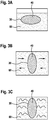
- Figs. 3A to 3C show a schematic view of extraction methods for the extraction of dry body fluid stored upstream from a sample.
- Figure 3A shows a first method for extracting a dry body fluid (not shown) from a sample 30.
- the sample 30 is separated from the carrier material 40 of the sample 30 by means of incubation in an elution solution.
- This extraction process implements a soaking of the carrier material 40 together with the dry body fluid of the sample 30, until the analytes have detached from the carrier material 40. Soaking can also take place at elevated temperatures.
- Various water-based or organic solutions can be used for the elution solution.
- these include alcohols (in particular ethanol, butonal, isopropanol, methanol, etc.), buffer solutions with water (for example PBS, Tween, HEPES and sodium azide), and organic substances (for example organic acids or Bases etc), protein-containing solutions (for example milk, BSA, calcein), inorganic solutions (for example acids and bases), detergents and salts.
- alcohols in particular ethanol, butonal, isopropanol, methanol, etc.
- buffer solutions with water for example PBS, Tween, HEPES and sodium azide
- organic substances for example organic acids or Bases etc
- protein-containing solutions for example milk, BSA, calcein
- inorganic solutions for example acids and bases
- Figure 3B shows a method according to the invention for extracting a dry body fluid (not shown) by means of a pump function.
- an elution solution 60 is pumped back and forth through a sample 30, in particular the carrier material 40 of the sample 30, for a predetermined time.
- the efficiency of the extraction process according to the invention can be optimized by controlling the temperature and / or pressure during the extraction.
- Figure 3C shows another method, not according to the invention, for extracting a dry body fluid (not shown) from a sample 30 by means of ultrasound.
- ultrasound should be used at a frequency which both leads to the extraction of the body fluid from the carrier material 40 of the sample 30 and also excludes damage to or change in the body fluid during the extraction.
- Frequencies in the range of 20 kHz to 50 MHz should preferably be used.
- the power density should preferably be less than 1 W / cm 2 .
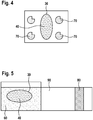
- Fig. 4 shows a schematic view of a fourth extraction method for a dry body fluid (not shown) in a sample 30.
- a blood sample in the form of a pellet 30 is stored on an enzymatically digestible cellulose carrier material 40.
- the blood sample is extracted from the carrier material 40 by specific, enzymatic digestion of the carrier material 40 by enzymes 70.
- proteolytic enzymes such as those used for the cleavage of, for example proteins or peptides, in biological or bio-chemical processes can be mentioned as examples of such enzymes.
- FIG. 11 shows a schematic view of a region of the exemplary device which is provided for purifying an extracted body fluid from a sample 30.
- a filter function 80 is arranged downstream in a microfluidic channel 90.
- a purification function (not shown), such as, for example, a DNA purification, a protein purification, an ion exchanger, an antibody-based purification of blood components, etc., can be provided in the microfluidic channel 90.
- Fig. 6 shows a cartridge 200 with a device (not shown) for the extraction of dry body fluid (not shown) in a sample 30.
- the cartridge 200 comprises a housing 210 which has a substantially hollow cylinder main section which is located in the upper region of the cartridge 200 is located.
- the interior of the cartridge 200 has three drums 220, 221, 222 which are arranged one above the other along the axis of rotation 235 of the cartridge 200 and are congruent to one another.
- Each drum 220, 221, 222 in turn has at least two chambers 230, 231 in its interior, which are provided for receiving different reagents and for one or more analytes (here the DBS pellet 30).
- the individual drums 220, 221, 222 are rotated along the axis of rotation 235 of the cartridge 200 by the action of centrifugal force with the aid of a so-called 'ballpoint pen mechanism' (not shown).
- Fig. 6 shows a possible embodiment for a drum 220 in which the DBS pellet 30 or another dry body fluid is introduced into the drum 220 from above.
- the right side of Fig. 6 shows a further embodiment for a drum 220, in which the DBS pellet 30 is introduced laterally through an opening 240 into the drum 220.
- the device for the extraction of a dry body fluid in the LoC system can be located in a chamber 230 of one of the drums 220, 221, 222.
Landscapes
- Chemical & Material Sciences (AREA)
- Health & Medical Sciences (AREA)
- Dispersion Chemistry (AREA)
- Analytical Chemistry (AREA)
- General Health & Medical Sciences (AREA)
- Hematology (AREA)
- Clinical Laboratory Science (AREA)
- Chemical Kinetics & Catalysis (AREA)
- Sampling And Sample Adjustment (AREA)
Description
- Die Durchführung biochemischer Prozesse basiert auf der Handhabung von Flüssigkeiten. Typischerweise wird diese Handhabung manuell mit Hilfsmitteln wie Pipetten, Reaktionsgefäßen, aktiven Sondenoberflächen oder Laborgeräten durchgeführt. Durch Pippetierroboter oder Spezialgeräte sind diese Prozesse zum Teil bereits automatisiert.
- Sogenannte Lab-on-a-Chip-Systeme (Westentaschenlabor oder Chiplabor, kurz LoC-Systeme) sind mikrofluidische Systeme, welche die gesamte Funktionalität eines makroskopischen Labors auf einem nur scheckkartengroßen Kunststoffsubstrat unterbringen. Lab-on-a-Chip-Systeme bestehen typischerweise aus zwei Hauptkomponenten. Ein Testträger oder eine Einwegkartusche beinhaltet Strukturen und Mechanismen für die Umsetzung der fluidischen Grundoperationen (z.B. Mischer), welche aus passiven Komponenten wie Kanälen, Reaktionskammer, vorgelagerte Reagenzien oder auch aktiven Komponenten wie Ventile oder Pumpen bestehen können. Die zweite Hauptkomponente sind Aktuations-, Detektions- und Steuereinheiten.
- Eines der zur Diagnose des Gesundheitszustandes einer Person verwendeten primären Mittel ist die Analyse des Blutes oder anderer Körperflüssigkeiten der Person auf die An- oder Abwesenheit von "Analyten", die auf die Gesundheit der Person schließen lassen. Bestimmte Körperflüssigkeiten, wie zum Beispiel Urin, Speichel, Samen u. a. können nichtinvasiv gewonnen werden, und die Analyse derartiger Flüssigkeiten kann Informationen über den Gesundheitszustand einer Person bereitstellen. Die Körperflüssigkeit, die in der Regel jedoch das vollständigste Bild von der Gesundheit einer Person liefert, ist das Vollblut.
- Um die genaueste Analyse des Blutes zu erhalten, ist es wichtig, die Analyte von der zellulären Fraktion des Blutes verhältnismäßig schnell nach der Probenentnahme zu trennen. Zentrifugation und anschließende Kühlung von Proben ist in den meisten Fällen zur Erhaltung der Integrität einer Blutprobe oder anderen Körperflüssigkeit für eine ausreichende Zeitdauer ausreichend. Das Verfahren ist jedoch umständlich und teuer, weil es erforderlich macht, dass das Blut oder eine andere Probe entweder an einem Ort gesammelt wird, welcher die gesamte vorschriftsmäßige Ausrüstung besitzt, oder dass die Probe gekühlt und in ein separates Laboratorium zur weiteren Verarbeitung versandt wird. Es ist auch ein erheblicher Zeitaufwand erforderlich, um die Analysenergebnisse zu erhalten. Zeit kann jedoch für das Leben oder die Gesundheit des Patienten kritisch sein.
- Seit den frühen sechziger Jahren werden sogenannte Dried Blood Spots (DBS) verwendet, insbesondere zur Diagnostik von Stoffwechselerkrankungen bei Neugeborenen. Dazu werden einige Tropfen kapillares Blut auf einfaches Filterpapier aufgebracht. Der Gebrauch von DBS hat einige Vorteile gegenüber der klassischen Vollblute-/Plasmaprobe, die zurzeit noch die verbreitetste Probenart darstellt. Einer der größten Vorteile stellt die Möglichkeit der Lagerung der DBS bei Raumtemperatur dar, welches den Transport vom Patienten zum analytischen Labor vereinfacht und kostengünstiger macht. Ein weiterer Vorteil ist das geringe benötigte Probenvolumen von 10 bis 30 µl Blut für DBS im Vergleich zu 100 bis 500 µl für die Plasmaproben. Dieser Vorteil spielt vor allem eine Rolle, wenn Kinder oder kleine Tiere, wie zum Beispiel Nagetiere, beprobt werden sollen.
- Momentan gibt es kaum mikrofluide Systeme, die Analytik oder Diagnostik mit Trockenblut (DBS) durchführen können. Ein Grund dafür ist, dass die Extraktion des Trockenbluts in eine für die Diagnostik akzeptable Form (meist flüssig) aus Filtermaterial aufwendig sein kann. Es kann auch schwierig sein, die aufgelöste, wässrige Probe von dem festen Filtermaterial zu separieren. Sobald der Analyt gelöst ist, ist manchmal ein weiterer Aufreinigungsschritt nötig. All diese Schritte benötigen viele Wegwerfteile (z.B. Pipettenspitzen, MTP, Plastikgefäße) und Prozessschritte, die oft mehrere verschiedene Geräte in Anspruch nehmen.
- Die
WO 2011/137533 A1 offenbart ein Verfahren für die Herstellung einer Probe unter Verwendung eines digitalen Mikrofluid-Arrays und die optionale anschließende Massenanalyse eines extrahierten Analyten. Ein innerhalb einer getrockneten Probe vorhandener Analyt wird in einer Extraktionslösung durch ein elektrisches Ansprechen des digitalen Mikrofluid-Arrays extrahiert, indem ein Tröpfchen der Extraktionslösung auf die getrocknete Probe transportiert wird. -
DE 10 2008 042581 A1 zeigt eine mikrofluidische Anordnung zum Gewinnen und gegebenenfalls Bearbeiten eines Extraktes aus einer Probe und zum Überführen desselben in fließfähiger Form in einen mikrofluidischen Chip mit einem Extraktor, der eine komprimierbare Extraktionskammer und mindestens eine Öffnung derselben aufweist, einem Reaktor, der eine Reaktionskammer, eine mit der mindestens einen Öffnung des Extraktors kommunizierende Eintrittsöffnung, wobei die beiden Öffnungen einen Fließweg zwischen den Kammern definieren, eine Austrittsöffnung zur fluidischen Verbindung mit dem mikrofluidischen Chip und eine Entlüftungsöffnung der Reaktionskammer aufweist, und einer in den Fließweg zwischen dem Extraktor und dem Reaktor geschalteten Filteranordnung. - Das in dem Anspruch 1 definierte Verfahren weist gegenüber herkömmlichen Lösungen den Vorteil auf, dass es nunmehr möglich ist, trocken vorgelagerte Proben (wie beispielsweise DBS Proben) für beliebige trocken vorgelagerte Körperflüssigkeiten in einem mikrofluidischen System mittels eines LoC-Systems auf einfache Art und Weise zu extrahieren und gegebenenfalls nachfolgend weiteren Analysen durchzuführen, wodurch eine wesentliche Ausweitung der Anwendungen für trocken vorgelagerte Proben realisierbar ist. Dadurch ergibt sich wie oben stehend beschrieben auch eine wesentliche Vereinfachung im Hinblick auf die Handhabung von den entnommenen Proben, da diese nicht mehr gekühlt werden müssen und zusätzlich länger haltbar sind, als es zum Beispiel im Fall von Vollblut oder anderer Körperflüssigkeiten möglich ist.
- Schließlich sind generell bei der Verwendung von trocken vorgelagerten Körperflüssigkeiten in einer Probe kleinere Probevolumen für eine Analyse ausreichend, so dass die Methode vor allem auch für Säuglinge oder kleine Tiere in Frage kommt oder auch bei wiederholter Entnahme von Proben für den Patienten schonender ist. Deshalb können mit einer beispielhaften Vorrichtung in vorteilhafter Weise trocken vorgelagerte Körperflüssigkeiten in einer Probe untersucht werden, welche auf weniger invasive und patientenfreundlichere Weise gewonnen werden.
- Die beispielhafte Vorrichtung eignet sich besonders vorteilhaft für die Extraktion von trocken vorgelagerten Körperflüssigkeiten aller Art aus einer Probe, wie zum Beispiel Urin, Sputum, Lavage, Speichel, Ejakulat/Sperma, Perikardialflüssigkeit, Pleuraflüssigkeit, Abdominalflüssigkeit, Peritonealdialysat (CAPD), Drainageflüssigkeit, Bronchoalveolarspülung (BALF), Zerebrospinalflüssigkeit, Magensaft, Schweiß, Lymphe, Galle, Pankreas Sekretionen, Blut, Muttermilch, Vaginalsekret der Frau, Tränenflüssigkeit, Nasensekret, Hirnwasser, Aszites, Pleuraflüssigkeit, Fruchtwasser, Ohrenschmalz, Eiter, Synovia, Menstruationsflüssigkeit, Kammerwasser des Auges etc.
- Mögliche Anwendungen für das Verfahren zur Extraktion von trocken vorgelagerter Körperflüssigkeit in einer Probe beinhalten beispielsweise:
- Metabolische Krankheitsdiagnostik, Therapiebegleitung und Screening bei Säuglingen, Kindern und Erwachsenen, sowie Tieren und anderen Lebewesen,
- Infektionsdiagnostik und Therapiebegleitung und Screening (zum Beispiel HIV, HPV, STD, Hepatitis etc.)
- Blutzucker
- Screening, Diagnostik und Therapiebegleitung von Erbkrankheiten (zum Beispiel Sichelzellen-Anämie, Autoimmunerkrankungen, wie Morbus Crohn, Diabetes, Lupus, etc.) Begleitende Untersuchungen bei klinischen Studien (bspw. in Phasen II/III)
- Veterinär-Anwendungen
- Gemäß eines Beispiels zum besseren Verständnis der Erfindung erfolgt das Extrahieren der trocken vorgelagerten Körperflüssigkeit aus der Probe mittels Inkubation in einer Elutionslösung. Dieses Extraktionsverfahren realisiert ein Einweichen des Trägermaterials zusammen mit der trocken vorgelagerten Körperflüssigkeit der Probe, solange bis sich die Analyten vom Trägermaterial gelöst haben. Dabei kann das Einweichen auch bei erhöhten Temperaturen erfolgen. Für die Elutionslösung kommen verschiedene wasser-basierte oder organische Lösungen in Frage. Beispielsweise zählen dazu Alkohole (insbesondere Ethanol, Butonal, Isopropanol, Methanol, etc), Pufferlösungen mit Wasser (zum Beispiel PBS, Tween, HEPES und Sodium Azide), sowie organische Stoffe (zum Beispiel organische Säuren oder Basen etc), proteinhaltige Lösungen (zum Beispiel Milch, BSA, Calcein), anorganische Lösungen (zum Beispiel Säuren und Basen), Detergenzien und Salze.
- Erfindungsgemäß erfolgt das Extrahieren der trocken vorgelagerten Körperflüssigkeit aus der Probe mittels einer Pumpfunktion einer Elutionslösung durch die Probe über eine vorbestimmte Zeit. Dabei kann die Extraktion mittels einer Pumpfunktion erfolgen, indem die Elutionslösung für die vorbestimmte Zeit durch die Probe, insbesondere dem Trägermaterial der Probe, hin- und hergepumpt wird. Eine Optimierung der Effizienz des erfindungsgemäßen Extraktionsverfahrens ist mit einer
- Steuerung von Temperatur und/oder Druck während des Extrahierens möglich. Für die Elutionslösung kommen die vorstehend erwähnten Lösungen in Frage.
- Gemäß eines Beispiels zum besseren Verständnis der Erfindung erfolgt das Extrahieren der trocken vorgelagerten Körperflüssigkeit aus der Probe mittels Ultraschall. Hierbei sollte Ultraschall mit einer Frequenz verwendet werden, welche sowohl zur Extraktion der Körperflüssigkeit von dem Trägermaterial führt als auch eine Beschädigung oder Veränderung der Körperflüssigkeit während der Extraktion ausschließt. Hierzu sollten vorzugsweise Frequenzen in einem Bereich von 20 kHz bis 50 MHz verwendet werden. Die Leistungsdichte sollte vorzugsweise weniger als 1 W/cm2 betragen.
- Gemäß eines Beispiels zum besseren Verständnis der Erfindung erfolgt das Extrahieren der trocken vorgelagerten Körperflüssigkeit aus der Probe mittels enzymatischen Verdauens des Trägermaterials durch Enzyme. Wenn die Probe ein auflösbares, abbaubares oder enzymatisch-verdaubares Trägermaterial aufweist, dann kann die Extraktion der trocken vorgelagerten Körperflüssigkeit von dem Trägermaterial durch ein spezifisches, enzymatisches Verdauen des Trägermaterials durch Enzyme erfolgen. Als Beispiel für solche Enzyme können Proteasen, Proteinasen oder proteolytische Enzyme genannt werden, wie sie für die Spaltung von, zum Beispiel Proteinen oder Peptiden, in biologischen bzw. bio-chemischen Prozessen verwendet werden.
- Gemäß einer weiteren Ausgestaltung des Verfahrens ist die Probe horizontal, vertikal oder gegenüber der Vorrichtung geneigt auf dem Aufnahmebereich platziert. In Abhängigkeit von der vorgesehen Anwendungsumgebung der Vorrichtung kann eine unterschiedlich orientierte Aufnahme der Probe auf der Vorrichtung erforderlich sein. Alternativ dazu kann auch der Aufnahmebereich schwenkbar gegenüber dem Lab On Chip-System ausgebildet sein, wobei der Aufnahmebereich hierzu beispielsweise einen Träger aufweist, welcher schwenkbar mit dem Lab On Chip-System gekoppelt ist und für die Aufnahme der Probe dient.
- Gemäß einer weiteren Ausgestaltung des Verfahrens ist des Weiteren ein Filter oder eine Aufreinigungsvorrichtung für die aus der Probe extrahierte Körperflüssigkeit vorgesehen. So kann im Hinblick auf die Aufreinigungsvorrichtung, beispielsweise im Abgabebereich des Lab On Chip-Systems, in Wirkverbindung mit einem mikrofluidischen Kanal, welcher den Aufnahmebereich mit dem Abgabebereich verbindet, eine DNA-Aufreinigung, eine Proteinaufreinigung, ein Ionenaustauscher, eine Antikörper-basierende Aufreinigung von Blutkomponenten etc. vorgesehen sein.
- Gemäß einer weiteren Ausgestaltung des Verfahrens ist das Trägermaterial der Probe aus einem abbaubaren oder auflösbaren Material, aus einem Filtermaterial oder besteht aus einem Polymer. Im Fall eines abbaubaren Materials ist vorzugsweise ein enzymatisch-verdaubares Material vorgesehen, wie zum Beispiel Zellulose. Im Fall eines auflösbaren Materials ist vorzugsweise ein flüssigkeits-lösliches Material vorgesehen, wie zum Bespiel Gelatine. Im Hinblick auf die Verwendung von Filtermaterialien können Oberflächenfilter oder Gewebefilter eingesetzt werden, welche beispielsweise PVDF, Silikamatrix, Filze, Spinnvliese, Papier, Gewebe, Kunstfasern (insbesondere aus Polyester, Polyphenylensulfid, Polytetrafluorethylen etc.), keramische Fasern/Sinterkörper, Glasfasern, Metalle umfassen, sowie andere Materialien, welche zur Verwendung als ein Filter geeignet sind.
- Gemäß einer weiteren Ausgestaltung des Verfahrens besteht das Trägermaterial der Probe aus Glas als Fasern oder aus Glaskügelchen. Die Glaskügelchen (oder beads) können jeweils mit einer glatten, rauen oder strukturierten Oberfläche versehen sein, wobei auch Gemische von unterschiedlich gestalteten Glaskügelchen für eine Probe möglich sind. Prinzipiell können die unterschiedlichen Trägermaterialien auch chemisch und/oder physikalisch bearbeitet sein, um somit eine gewünschte Eigenschaft zur Verfügung stellen zu können.
- Eine beispielhafte, nicht beanspruchte Kartusche umfasst eine Vorrichtung zur Extraktion von trocken vorgelagerter Körperflüssigkeit in einer Probe, ein Gehäuse der Kartusche, eine Trommel, welche zumindest eine Kammer aufweist, wobei die Vorrichtung im Inneren der Trommel angeordnet ist.
- Hieraus ergibt sich der Vorteil, dass bei der Kartusche die Nutzung mehrerer, zum Teil kostenintensiver Geräte für die Aufbereitung von trocken vorgelagerten Körperflüssigkeiten in einer Probe nicht mehr notwendig ist, da sämtliche Prozessschritte nunmehr im LoC System stattfinden, welches in der Anschaffung wesentlich preisgünstiger ist. Des Weiteren können in der Kartusche weitere Schritte für das Aufbereiten der extrahierten Körperflüssigkeit aus der Probe realisiert werden, so dass für eine nachfolgende Analyse die aufbereitete Körperflüssigkeit bereitgestellt werden kann.
- Gemäß dem Patentanspruch 1 wird ein Verfahren zum Extrahieren einer trocken vorgelagerten Körperflüssigkeit aus einer Probe beansprucht.
- Bei dem erfindungsgemäßen Verfahren entfallen in vorteilhafter Weise des Weiteren die bislang erforderlichen Pipettierschritte für die Extraktion der trocken vorgelagerten Körperflüssigkeit in einer Probe durch die automatisierte Prozessierung im LoC-System, wodurch die Handhabung für das Bedienpersonal wesentlich vereinfacht wird und somit die Kosten für eine Aufbereitung der Probe mittels Extraktion verringert werden können.
- Gemäß eines nicht beanspruchten Verfahrens erfolgt das Extrahieren der trocken vorgelagerten Körperflüssigkeit aus der Probe mittels Inkubation in einer Elutionslösung. Dieses Extraktionsverfahren realisiert ein Einweichen des Trägermaterials zusammen mit der trocken vorgelagerten Körperflüssigkeit der Probe, solange bis sich die Analyten vom Trägermaterial gelöst haben. Dabei kann das Einweichen auch bei erhöhten Temperaturen erfolgen. Für die Elutionslösung kommen die vorstehend beschriebenen wasser-basierten oder organischen Lösungen in Frage.
- Erfindungsgemäß erfolgt das Extrahieren der trocken vorgelagerten Körperflüssigkeit aus der Probe mittels einer Pumpfunktion einer Elutionslösung durch die Probe über eine vorbestimmte Zeit. Dabei kann die Extraktion mittels einer Pumpfunktion erfolgen, indem die Elutionslösung für die vorbestimmte Zeit durch die Probe, insbesondere dem Trägermaterial der Probe, hin- und hergepumpt wird. Eine Optimierung der Effizienz des erfindungsgemäßen Extraktionsverfahrens ist mit einer Steuerung von Temperatur und/oder Druck während des Extrahierens möglich.
- Gemäß eines Beispiels zum besseren Verständnis der Erfindung erfolgt das Extrahieren der trocken vorgelagerten Körperflüssigkeit aus der Probe mittels Ultraschall. Hierbei sollte Ultraschall mit einer Frequenz verwendet werden, welche sowohl zur Extraktion der Körperflüssigkeit von dem Trägermaterial führt als auch eine Beschädigung oder Veränderung der Körperflüssigkeit während der Extraktion ausschließt.
- Gemäß eines Beispiels zum besseren Verständnis der Erfindung erfolgt das Extrahieren der trocken vorgelagerten Körperflüssigkeit aus der Probe mittels enzymatischen Verdauens des Trägermaterials durch Enzyme. Wenn die Probe ein auflösbares, abbaubares oder enzymatisch-verdaubares Trägermaterial aufweist, dann kann die Extraktion der trocken vorgelagerten Körperflüssigkeit von dem Trägermaterial durch ein spezifisches, enzymatisches Verdauen des Trägermaterials durch Enzyme erfolgen.
- Die vorliegende Erfindung wird anhand der beiliegenden Zeichnungen erklärt. Es zeigt dabei
-
Fig. 1 : eine schematische perspektivische Ansicht einer beispielhaften Vorrichtung zur Extraktion von trocken vorgelagerter Körperflüssigkeit in einer Probe, -
Fig. 2 : eine schematische perspektivische Ansicht der Vorrichtung gemäßFig. 1 , wobei die Probe in einem Aufnahmebereich der Vorrichtung platziert ist, -
Figs. 3A bis 3C : eine schematische Ansicht von Extraktionsverfahren zur Extraktion von trocken vorgelagerter Körperflüssigkeit aus einer Probe. -
Fig. 4 : eine schematische Ansicht eines weiteren Extraktionsverfahrens für eine trocken vorgelagerte Körperflüssigkeit in einer Probe. -
Fig. 5 : eine schematische Ansicht eines Bereichs einer beispielhaften Vorrichtung, welcher für die Aufreinigung einer extrahierten Körperflüssigkeit aus der Probe vorgesehen ist, und -
Fig. 6 : eine bespielhafte, nicht beanspruchte Kartusche mit einer beispielhaften Vorrichtung zur Extraktion von trocken vorgelagerter Körperflüssigkeit in einer Probe. -
Fig. 1 zeigt in vereinfachter und schematischer Darstellung eine beispielhafte Vorrichtung 100 zur Extraktion von trocken vorgelagerter Körperflüssigkeit (nicht dargestellt) in einer Probe 30. Die Vorrichtung 100 weist ein Lab On Chip-System 10 mit einem Aufnahmebereich 20 auf, welcher zur Aufnahme der Probe 30 mit der Körperflüssigkeit in trocken vorgelagerter Form in einem Trägermaterial (nicht dargestellt) vorgesehen ist. Des Weiteren weist das Lab On Chip-System 10 einen Abgabebereich 50 zur Abgabe der extrahierten Körperflüssigkeit aus der Probe 30 auf, welche mit dem Aufnahmebereich 20 über einen mikrofluidischen Kanal (nicht dargestellt) wirkverbunden ist. Die Extraktion der trocken vorgelagerten Körperflüssigkeit aus der Probe 30 erfolgt in dem Aufnahmebereich 20. - Im Folgenden wird beispielhaft die Verwendung eines DBS Pellets für die Probe 30 beschrieben. Es sind jedoch für den Einsatz in der vorliegenden Vorrichtung 100 beliebige Arten von Proben verwendbar, welche eine trocken vorgelagerte Körperflüssigkeit enthalten. Zum Extrahieren des Blutes aus dem Pellet 30 wird das Pellet 30 in das LoC-System 10 eingelegt, nämlich in den Aufnahmebereich 20. Das Pellet 30 kann dabei entweder horizontal, schräg oder vertikal in den Aufnahmebereich 20 eingelegt werden.
-
Fig. 2 zeigt eine schematische perspektivische Ansicht der Vorrichtung 100 gemäßFig. 1 , wobei das Pellet 30 in dem Aufnahmebereich 20 der Vorrichtung 100 platziert ist. Nach Platzieren des Pellet 30 in den Aufnahmebereich 20 wird die Blutprobe extrahiert. Die Extraktion kann auf unterschiedliche Arten stattfinden. Anschließend wird die extrahierte Blutprobe an dem Abgabebereich 50 der Vorrichtung 100 an die Umgebung (nicht dargestellt) abgegeben, vorzugsweise mit Hilfe eines Schlauchs (nicht dargestellt). -
Figs. 3A bis 3C zeigen eine schematische Ansicht von Extraktionsverfahren zur Extraktion von trocken vorgelagerter Körperflüssigkeit aus einer Probe. -
Fig. 3A zeigt ein erstes Verfahren für das Extrahieren einer trocken vorgelagerten Körperflüssigkeit (nicht dargestellt) aus einer Probe 30. Dabei wird die Probe 30 mittels Inkubation in einer Elutionslösung vom Trägermaterial 40 der Probe 30 getrennt. Dieses Extraktionsverfahren realisiert ein Einweichen des Trägermaterials 40 zusammen mit der trocken vorgelagerten Körperflüssigkeit der Probe 30, solange bis sich die Analyten vom Trägermaterial 40 gelöst haben. Dabei kann das Einweichen auch bei erhöhten Temperaturen erfolgen. Für die Elutionslösung kommen verschiedene wasser-basierte oder organische Lösungen in Frage. Beispielsweise zählen dazu Alkohole (insbesondere Ethanol, Butonal, Isopropanol, Methanol, etc), Pufferlösungen mit Wasser (zum Beispiel PBS, Tween, HEPES und Sodium Azide), sowie organische Stoffe (zum Beispiel organische Säuren oder Basen etc), proteinhaltige Lösungen (zum Beispiel Milch, BSA, Calcein), anorganische Lösungen (zum Beispiel Säuren und Basen), Detergenzien und Salze. -
Fig. 3B zeigt ein erfindungsgemäßes Verfahren für das Extrahieren einer trocken vorgelagerten Körperflüssigkeit (nicht dargestellt) mittels einer Pumpfunktion. Hierbei wird eine Elutionslösung 60 für eine vorbestimmte Zeit durch eine Probe 30, insbesondere dem Trägermaterial 40 der Probe 30, hin- und hergepumpt. Eine Optimierung der Effizienz des erfindungsgemäßen Extraktionsverfahrens ist mit einer Steuerung von Temperatur und/oder Druck während des Extrahierens möglich. -
Fig. 3C zeigt ein weiteres, nicht erfindungsgemäßes Verfahren für das Extrahieren einer trocken vorgelagerten Körperflüssigkeit (nicht dargestellt) aus einer Probe 30 mittels Ultraschall. Hierbei sollte Ultraschall mit einer Frequenz verwendet werden, welche sowohl zur Extraktion der Körperflüssigkeit von dem Trägermaterial 40 der Probe 30 führt als auch eine Beschädigung oder Veränderung der Körperflüssigkeit während der Extraktion ausschließt. Es sollten vorzugsweise Frequenzen in einem Bereich von 20 kHz bis 50 MHz verwendet werden. Die Leistungsdichte sollte vorzugsweise weniger als 1 W/cm2 betragen. -
Fig. 4 zeigt eine schematische Ansicht eines vierten Extraktionsverfahrens für eine trocken vorgelagerte Körperflüssigkeit (nicht dargestellt) in einer Probe 30. Eine Blutprobe in der Form eines Pellet 30 wird auf einem enzymatischverdaubaren Cellulose-Trägermaterial 40 gelagert. Das Extrahieren der Blutprobe vom Trägermaterial 40 findet durch spezifisches, enzymatisches Verdauen des Trägermaterials 40 durch Enzyme 70 statt. Als Beispiel für solche Enzyme können Proteasen, Proteinasen oder proteolytische Enzyme genannt werden, wie sie für die Spaltung von, zum Beispiel Proteinen oder Peptiden, in biologischen bzw. bio-chemischen Prozessen verwendet werden. -
Fig. 5 zeigt eine schematische Ansicht eines Bereichs der beispielhaften Vorrichtung, welcher für eine Aufreinigung einer extrahierten Körperflüssigkeit aus einer Probe 30 vorgesehen ist. Zur Aufreinigung der Blutprobe ist flussabwärts in einem mikrofluiden Kanal 90 eine Filterfunktion 80 angeordnet. Zusätzlich kann auch eine Aufreinigungsfunktion (nicht dargestellt), wie zum Beispiel eine DNA-Aufreinigung, eine Proteinaufreinigung, ein Ionenaustauscher, eine Antikörper-basierende Aufreinigung von Blutkomponenten, etc. in dem mikrofluiden Kanal 90 vorgesehen sein. -
Fig. 6 zeigt eine Kartusche 200 mit einer Vorrichtung (nicht dargestellt) zur Extraktion von trocken vorgelagerter Körperflüssigkeit (nicht dargestellt) in einer Probe 30. Die Kartusche 200 umfasst ein Gehäuse 210, welches einen im Wesentlichen hohlyzlindrischen Hauptabschnitt aufweist, welcher sich im oberen Bereich der Kartusche 200 befindet. Die Kartusche 200 weist in ihrem Inneren drei Trommeln 220, 221, 222 auf, welche entlang der Rotationsachse 235 der Kartusche 200 übereinander und kongruent zueinander angeordnet sind. Jede Trommel 220, 221, 222 weist in ihrem Inneren wiederum mindestens zwei Kammern 230, 231 auf, welche für die Aufnahme von unterschiedlichen Reagentien sowie für einen oder mehrere Analyten (hier den DBS Pellet 30) vorgesehen sind. Während der Extraktion und Aufbereitung des DBS Pellets 30 werden die einzelnen Trommeln 220, 221, 222 durch die Einwirkung der Zentrifugalkraft mit Hilfe einer sogenannten ,Kugelschreiber-Mechanik' (nicht dargestellt) entlang der Rotationsachse 235 der Kartusche 200 gedreht. - Die linke Seite von
Fig. 6 zeigt eine mögliche Ausführungsform für eine Trommel 220, bei welcher der DBS Pellet 30 oder eine andere trocken-vorgelagerte Körperflüssigkeit von oben in die Trommel 220 einführt wird. Die rechte Seite vonFig. 6 zeigt eine weitere Ausführungsform für eine Trommel 220, bei welcher der DBS Pellet 30 seitlich durch eine Öffnung 240 in die Trommel 220 eingeführt wird. Die Vorrichtung für die Extraktion einer trocken vorgelagerten Körperflüssigkeit im LoC-System kann sich dabei in einer Kammer 230 von einer der Trommeln 220, 221, 222 befinden.
Claims (5)
- Verfahren zum Extrahieren einer trocken vorgelagerten Körperflüssigkeit aus einer Probe, mit den Schritten:- Bereitstellen einer Vorrichtung (100) zur Extraktion von trocken vorgelagerter Körperflüssigkeit, aufweisend ein Lab On Chip-System (10) mit einem Aufnahmebereich (20), welcher zur Aufnahme einer Probe (30) mit zumindest einer Körperflüssigkeit in trocken vorgelagerter Form in einem Trägermaterial (40) vorgesehen ist, und mit einem Abgabebereich (50) zur Abgabe der extrahierten Körperflüssigkeit aus der Probe (30), wobei eine Extraktion der trocken vorgelagerten Körperflüssigkeit aus der Probe (30) in dem Aufnahmebereich (20) erfolgen kann,- Bereitstellen einer Probe (30), welche zumindest eine trocken vorgelagerte Körperflüssigkeit in einem Trägermaterial (40) aufweist;- Extrahieren der trocken vorgelagerten Körperflüssigkeit aus der Probe (30) in dem Aufnahmebereich (20); und- Abgeben der aus der Probe (30) extrahierten Körperflüssigkeit in dem Abgabebereich (50) der Vorrichtung (100),dadurch gekennzeichnet, dass
das Extrahieren der trocken vorgelagerten Körperflüssigkeit aus der Probe (30) durch ein Hin- und Herpumpen einer Elutionslösung durch das Trägermaterial der Probe (30) über eine vorbestimmte Zeit erfolgt. - Verfahren nach Anspruch 1, dadurch gekennzeichnet, dass die Probe (30) horizontal, vertikal oder gegenüber dem Lab On Chip-System (10) geneigt auf dem Aufnahmebereich (20) platziert wird.
- Verfahren nach einem der Ansprüche 1 oder 2, dadurch gekennzeichnet, dass des Weiteren ein Filter (80) oder eine Aufreinigungsvorrichtung für die aus der Probe (30) extrahierte Körperflüssigkeit in der Vorrichtung (100) vorgesehen ist.
- Verfahren nach einem der Ansprüche 1 bis 3, dadurch gekennzeichnet, dass das Trägermaterial (40) der Probe (30) aus einem abbaubaren oder auflösbaren Material, aus einem Filtermaterial ist oder aus einem Polymer besteht.
- Verfahren nach einem der Ansprüche 1 bis 3, dadurch gekennzeichnet, dass das Trägermaterial (40) der Probe (30) aus Glas als Fasern oder aus Glaskügelchen besteht.
Applications Claiming Priority (2)
| Application Number | Priority Date | Filing Date | Title |
|---|---|---|---|
| DE102013201505.4A DE102013201505A1 (de) | 2013-01-30 | 2013-01-30 | Vorrichtung zur Extraktion von trocken vorgelagerter Körperflüssigkeit in einer Probe, Kartusche sowie Verfahren |
| PCT/EP2013/078086 WO2014117908A1 (de) | 2013-01-30 | 2013-12-27 | Vorrichtung zur extraktion von trocken vorgelagerter körperflüssigkeit in einer probe, kartusche sowie verfahren |
Publications (2)
| Publication Number | Publication Date |
|---|---|
| EP2951277A1 EP2951277A1 (de) | 2015-12-09 |
| EP2951277B1 true EP2951277B1 (de) | 2021-04-14 |
Family
ID=49885280
Family Applications (1)
| Application Number | Title | Priority Date | Filing Date |
|---|---|---|---|
| EP13814576.8A Active EP2951277B1 (de) | 2013-01-30 | 2013-12-27 | Verfahren zur extraktion von trocken vorgelagerter körperflüssigkeit in einer probe |
Country Status (3)
| Country | Link |
|---|---|
| EP (1) | EP2951277B1 (de) |
| DE (1) | DE102013201505A1 (de) |
| WO (1) | WO2014117908A1 (de) |
Families Citing this family (4)
| Publication number | Priority date | Publication date | Assignee | Title |
|---|---|---|---|---|
| WO2018002249A1 (de) * | 2016-06-30 | 2018-01-04 | Sarstedt Aktiengesellschaft & Co. Kg | Vorrichtung zum bereitstellen von eine getrocknete flüssigkeitsmenge, insbesondere blut, aufweisenden, saugfähigen probenträgern |
| DE102018200520A1 (de) * | 2018-01-15 | 2019-07-18 | Robert Bosch Gmbh | Verfahren zum Bereitstellen einer Lösung der Substanz in einer mikrofluidischen Vorrichtung |
| CN108393105B (zh) * | 2018-04-20 | 2023-08-25 | 华南师范大学 | 一种微流控芯片及其控制系统、控制方法 |
| DE102022206246A1 (de) | 2022-06-22 | 2023-12-28 | Robert Bosch Gesellschaft mit beschränkter Haftung | Mikrofluidiksystem mit Ionenaustauscher-Mischbettharz |
Family Cites Families (4)
| Publication number | Priority date | Publication date | Assignee | Title |
|---|---|---|---|---|
| DE102008042581B4 (de) * | 2008-10-02 | 2012-02-02 | INSTITUT FüR MIKROTECHNIK MAINZ GMBH | Mikrofluidische Extraktions- und Reaktionsvorrichtung |
| US10232374B2 (en) * | 2010-05-05 | 2019-03-19 | Miroculus Inc. | Method of processing dried samples using digital microfluidic device |
| US10016757B2 (en) * | 2011-04-28 | 2018-07-10 | Labcyte Inc. | Sample containers adapted for acoustic ejections and sample preservation and methods thereof |
| DE102011077134A1 (de) * | 2011-06-07 | 2012-12-13 | Robert Bosch Gmbh | Kartusche, Zentrifuge sowie Verfahren zum Mischen einer ersten und zweiten Komponente |
-
2013
- 2013-01-30 DE DE102013201505.4A patent/DE102013201505A1/de not_active Withdrawn
- 2013-12-27 EP EP13814576.8A patent/EP2951277B1/de active Active
- 2013-12-27 WO PCT/EP2013/078086 patent/WO2014117908A1/de not_active Ceased
Non-Patent Citations (1)
| Title |
|---|
| None * |
Also Published As
| Publication number | Publication date |
|---|---|
| WO2014117908A1 (de) | 2014-08-07 |
| DE102013201505A1 (de) | 2014-07-31 |
| EP2951277A1 (de) | 2015-12-09 |
Similar Documents
| Publication | Publication Date | Title |
|---|---|---|
| EP1883474B1 (de) | System zur integrierten und automatisierten dna- oder protein-analyse und betriebsverfahren eines solchen systems | |
| DE69804239T2 (de) | Verfahren und apparat zur durchmischung und abscheidung von partikel-material aus einer flüssigen probe | |
| EP3663387B1 (de) | Vorrichtung und verfahren zum aufbereiten von flüssigkeiten, insbesondere körperflüssigkeiten | |
| DE102006002258B4 (de) | Modul zur Aufbereitung einer biologischen Probe, Biochip-Satz und Verwendung des Moduls | |
| EP2951277B1 (de) | Verfahren zur extraktion von trocken vorgelagerter körperflüssigkeit in einer probe | |
| EP2087934A1 (de) | Verfahren und Vorrichtung zur automatisierten Prozessierung einer Probe | |
| DE202008011578U1 (de) | Flüssigkeitstransfervorrichtung | |
| DE102014105437A1 (de) | Mikrofluidik-Modul und Kassette für die immunologische und molekulare Diagnostik in einem Analyseautomaten | |
| EP3347691B1 (de) | Anordnung für die individualisierte patientenblutanalyse und verwendung | |
| EP3030654A1 (de) | Verfahren und vorrichtung zum aufbereiten einer zielzellen und begleitzellen enthaltenden probe biologischen materials zum extrahieren von nukleinsäuren der zielzellen | |
| EP2923760A1 (de) | Chiplabor-kartusche für ein mikrofluidisches system zum analysieren einer probe biologischen materials, mikrofluidisches system zum analysieren einer probe biologischen materials sowie verfahren und vorrichtung zum analysieren einer probe biologischen materials | |
| DE102008035644B4 (de) | Zellchipsystem mit Höhenversatz | |
| DE102021214276A1 (de) | Vorrichtung und Verfahren zum Splitten dreidimensionaler Agglomerate | |
| EP2893980A1 (de) | Mikrofluidisches System sowie Verfahren zum Analysieren einer Probe biologischen Materials | |
| EP2774677A2 (de) | Vorrichtung zur Durchführung von chemischen und/oder biochemischen Prozessen | |
| DE102021212645B4 (de) | Vorrichtung und Verfahren zur Durchführung mikrofluidischer Prozessschritte | |
| EP1740296B1 (de) | Verfahren zur herstellung einer lösung, zugehörige anordnung sowie anwendungen des verfahrens und der anordnung | |
| WO2017129541A1 (de) | Röhre mit einer mikrofluidischen struktur | |
| EP3784140A1 (de) | Vorrichtung und verfahren zum vorbereiten von probenmaterial | |
| DE102022213554B4 (de) | Vorrichtung und Verfahren zum Splitten dreidimensionaler Agglomerate | |
| DE102023206884A1 (de) | Mikrofluidische Vorrichtung und Verfahren zum Betreiben einer mikrofluidischen Vorrichtung | |
| DE102017220531A1 (de) | Adapter für eine mikrofluidische Vorrichtung zur Überführung einer Substanz, insbesondere einer Probe | |
| EP4448717A1 (de) | Vorrichtung und verfahren zum splitten dreidimensionaler agglomerate | |
| DE102021203634A1 (de) | Mikrofluidische Vorrichtung und Verfahren zum Betreiben einer mikrofluidischen Vorrichtung | |
| WO2020161013A1 (de) | Mikrofluidikeinrichtung und verfahren zum abtrennen von blutserum |
Legal Events
| Date | Code | Title | Description |
|---|---|---|---|
| PUAI | Public reference made under article 153(3) epc to a published international application that has entered the european phase |
Free format text: ORIGINAL CODE: 0009012 |
|
| 17P | Request for examination filed |
Effective date: 20150831 |
|
| AK | Designated contracting states |
Kind code of ref document: A1 Designated state(s): AL AT BE BG CH CY CZ DE DK EE ES FI FR GB GR HR HU IE IS IT LI LT LU LV MC MK MT NL NO PL PT RO RS SE SI SK SM TR |
|
| AX | Request for extension of the european patent |
Extension state: BA ME |
|
| DAX | Request for extension of the european patent (deleted) | ||
| STAA | Information on the status of an ep patent application or granted ep patent |
Free format text: STATUS: EXAMINATION IS IN PROGRESS |
|
| 17Q | First examination report despatched |
Effective date: 20161116 |
|
| RAP1 | Party data changed (applicant data changed or rights of an application transferred) |
Owner name: ROBERT BOSCH GMBH |
|
| GRAP | Despatch of communication of intention to grant a patent |
Free format text: ORIGINAL CODE: EPIDOSNIGR1 |
|
| STAA | Information on the status of an ep patent application or granted ep patent |
Free format text: STATUS: GRANT OF PATENT IS INTENDED |
|
| INTG | Intention to grant announced |
Effective date: 20201223 |
|
| GRAS | Grant fee paid |
Free format text: ORIGINAL CODE: EPIDOSNIGR3 |
|
| GRAA | (expected) grant |
Free format text: ORIGINAL CODE: 0009210 |
|
| STAA | Information on the status of an ep patent application or granted ep patent |
Free format text: STATUS: THE PATENT HAS BEEN GRANTED |
|
| AK | Designated contracting states |
Kind code of ref document: B1 Designated state(s): AL AT BE BG CH CY CZ DE DK EE ES FI FR GB GR HR HU IE IS IT LI LT LU LV MC MK MT NL NO PL PT RO RS SE SI SK SM TR |
|
| REG | Reference to a national code |
Ref country code: GB Ref legal event code: FG4D Free format text: NOT ENGLISH |
|
| REG | Reference to a national code |
Ref country code: CH Ref legal event code: EP |
|
| REG | Reference to a national code |
Ref country code: DE Ref legal event code: R096 Ref document number: 502013015653 Country of ref document: DE |
|
| REG | Reference to a national code |
Ref country code: IE Ref legal event code: FG4D Free format text: LANGUAGE OF EP DOCUMENT: GERMAN |
|
| REG | Reference to a national code |
Ref country code: AT Ref legal event code: REF Ref document number: 1382400 Country of ref document: AT Kind code of ref document: T Effective date: 20210515 |
|
| REG | Reference to a national code |
Ref country code: LT Ref legal event code: MG9D |
|
| REG | Reference to a national code |
Ref country code: NL Ref legal event code: MP Effective date: 20210414 |
|
| PG25 | Lapsed in a contracting state [announced via postgrant information from national office to epo] |
Ref country code: HR Free format text: LAPSE BECAUSE OF FAILURE TO SUBMIT A TRANSLATION OF THE DESCRIPTION OR TO PAY THE FEE WITHIN THE PRESCRIBED TIME-LIMIT Effective date: 20210414 Ref country code: BG Free format text: LAPSE BECAUSE OF FAILURE TO SUBMIT A TRANSLATION OF THE DESCRIPTION OR TO PAY THE FEE WITHIN THE PRESCRIBED TIME-LIMIT Effective date: 20210714 Ref country code: FI Free format text: LAPSE BECAUSE OF FAILURE TO SUBMIT A TRANSLATION OF THE DESCRIPTION OR TO PAY THE FEE WITHIN THE PRESCRIBED TIME-LIMIT Effective date: 20210414 Ref country code: LT Free format text: LAPSE BECAUSE OF FAILURE TO SUBMIT A TRANSLATION OF THE DESCRIPTION OR TO PAY THE FEE WITHIN THE PRESCRIBED TIME-LIMIT Effective date: 20210414 Ref country code: NL Free format text: LAPSE BECAUSE OF FAILURE TO SUBMIT A TRANSLATION OF THE DESCRIPTION OR TO PAY THE FEE WITHIN THE PRESCRIBED TIME-LIMIT Effective date: 20210414 |
|
| PG25 | Lapsed in a contracting state [announced via postgrant information from national office to epo] |
Ref country code: SE Free format text: LAPSE BECAUSE OF FAILURE TO SUBMIT A TRANSLATION OF THE DESCRIPTION OR TO PAY THE FEE WITHIN THE PRESCRIBED TIME-LIMIT Effective date: 20210414 Ref country code: RS Free format text: LAPSE BECAUSE OF FAILURE TO SUBMIT A TRANSLATION OF THE DESCRIPTION OR TO PAY THE FEE WITHIN THE PRESCRIBED TIME-LIMIT Effective date: 20210414 Ref country code: PL Free format text: LAPSE BECAUSE OF FAILURE TO SUBMIT A TRANSLATION OF THE DESCRIPTION OR TO PAY THE FEE WITHIN THE PRESCRIBED TIME-LIMIT Effective date: 20210414 Ref country code: NO Free format text: LAPSE BECAUSE OF FAILURE TO SUBMIT A TRANSLATION OF THE DESCRIPTION OR TO PAY THE FEE WITHIN THE PRESCRIBED TIME-LIMIT Effective date: 20210714 Ref country code: PT Free format text: LAPSE BECAUSE OF FAILURE TO SUBMIT A TRANSLATION OF THE DESCRIPTION OR TO PAY THE FEE WITHIN THE PRESCRIBED TIME-LIMIT Effective date: 20210816 Ref country code: ES Free format text: LAPSE BECAUSE OF FAILURE TO SUBMIT A TRANSLATION OF THE DESCRIPTION OR TO PAY THE FEE WITHIN THE PRESCRIBED TIME-LIMIT Effective date: 20210414 Ref country code: GR Free format text: LAPSE BECAUSE OF FAILURE TO SUBMIT A TRANSLATION OF THE DESCRIPTION OR TO PAY THE FEE WITHIN THE PRESCRIBED TIME-LIMIT Effective date: 20210715 Ref country code: IS Free format text: LAPSE BECAUSE OF FAILURE TO SUBMIT A TRANSLATION OF THE DESCRIPTION OR TO PAY THE FEE WITHIN THE PRESCRIBED TIME-LIMIT Effective date: 20210814 Ref country code: LV Free format text: LAPSE BECAUSE OF FAILURE TO SUBMIT A TRANSLATION OF THE DESCRIPTION OR TO PAY THE FEE WITHIN THE PRESCRIBED TIME-LIMIT Effective date: 20210414 |
|
| REG | Reference to a national code |
Ref country code: DE Ref legal event code: R097 Ref document number: 502013015653 Country of ref document: DE |
|
| PG25 | Lapsed in a contracting state [announced via postgrant information from national office to epo] |
Ref country code: DK Free format text: LAPSE BECAUSE OF FAILURE TO SUBMIT A TRANSLATION OF THE DESCRIPTION OR TO PAY THE FEE WITHIN THE PRESCRIBED TIME-LIMIT Effective date: 20210414 Ref country code: CZ Free format text: LAPSE BECAUSE OF FAILURE TO SUBMIT A TRANSLATION OF THE DESCRIPTION OR TO PAY THE FEE WITHIN THE PRESCRIBED TIME-LIMIT Effective date: 20210414 Ref country code: EE Free format text: LAPSE BECAUSE OF FAILURE TO SUBMIT A TRANSLATION OF THE DESCRIPTION OR TO PAY THE FEE WITHIN THE PRESCRIBED TIME-LIMIT Effective date: 20210414 Ref country code: SM Free format text: LAPSE BECAUSE OF FAILURE TO SUBMIT A TRANSLATION OF THE DESCRIPTION OR TO PAY THE FEE WITHIN THE PRESCRIBED TIME-LIMIT Effective date: 20210414 Ref country code: SK Free format text: LAPSE BECAUSE OF FAILURE TO SUBMIT A TRANSLATION OF THE DESCRIPTION OR TO PAY THE FEE WITHIN THE PRESCRIBED TIME-LIMIT Effective date: 20210414 Ref country code: RO Free format text: LAPSE BECAUSE OF FAILURE TO SUBMIT A TRANSLATION OF THE DESCRIPTION OR TO PAY THE FEE WITHIN THE PRESCRIBED TIME-LIMIT Effective date: 20210414 |
|
| PLBE | No opposition filed within time limit |
Free format text: ORIGINAL CODE: 0009261 |
|
| STAA | Information on the status of an ep patent application or granted ep patent |
Free format text: STATUS: NO OPPOSITION FILED WITHIN TIME LIMIT |
|
| 26N | No opposition filed |
Effective date: 20220117 |
|
| PG25 | Lapsed in a contracting state [announced via postgrant information from national office to epo] |
Ref country code: IS Free format text: LAPSE BECAUSE OF FAILURE TO SUBMIT A TRANSLATION OF THE DESCRIPTION OR TO PAY THE FEE WITHIN THE PRESCRIBED TIME-LIMIT Effective date: 20210814 Ref country code: AL Free format text: LAPSE BECAUSE OF FAILURE TO SUBMIT A TRANSLATION OF THE DESCRIPTION OR TO PAY THE FEE WITHIN THE PRESCRIBED TIME-LIMIT Effective date: 20210414 |
|
| PG25 | Lapsed in a contracting state [announced via postgrant information from national office to epo] |
Ref country code: MC Free format text: LAPSE BECAUSE OF FAILURE TO SUBMIT A TRANSLATION OF THE DESCRIPTION OR TO PAY THE FEE WITHIN THE PRESCRIBED TIME-LIMIT Effective date: 20210414 Ref country code: IT Free format text: LAPSE BECAUSE OF FAILURE TO SUBMIT A TRANSLATION OF THE DESCRIPTION OR TO PAY THE FEE WITHIN THE PRESCRIBED TIME-LIMIT Effective date: 20210414 |
|
| REG | Reference to a national code |
Ref country code: CH Ref legal event code: PL |
|
| GBPC | Gb: european patent ceased through non-payment of renewal fee |
Effective date: 20211227 |
|
| REG | Reference to a national code |
Ref country code: BE Ref legal event code: MM Effective date: 20211231 |
|
| PG25 | Lapsed in a contracting state [announced via postgrant information from national office to epo] |
Ref country code: LU Free format text: LAPSE BECAUSE OF NON-PAYMENT OF DUE FEES Effective date: 20211227 Ref country code: IE Free format text: LAPSE BECAUSE OF NON-PAYMENT OF DUE FEES Effective date: 20211227 Ref country code: GB Free format text: LAPSE BECAUSE OF NON-PAYMENT OF DUE FEES Effective date: 20211227 |
|
| PG25 | Lapsed in a contracting state [announced via postgrant information from national office to epo] |
Ref country code: FR Free format text: LAPSE BECAUSE OF NON-PAYMENT OF DUE FEES Effective date: 20211231 Ref country code: BE Free format text: LAPSE BECAUSE OF NON-PAYMENT OF DUE FEES Effective date: 20211231 |
|
| PG25 | Lapsed in a contracting state [announced via postgrant information from national office to epo] |
Ref country code: LI Free format text: LAPSE BECAUSE OF NON-PAYMENT OF DUE FEES Effective date: 20211231 Ref country code: CH Free format text: LAPSE BECAUSE OF NON-PAYMENT OF DUE FEES Effective date: 20211231 |
|
| REG | Reference to a national code |
Ref country code: AT Ref legal event code: MM01 Ref document number: 1382400 Country of ref document: AT Kind code of ref document: T Effective date: 20211227 |
|
| PG25 | Lapsed in a contracting state [announced via postgrant information from national office to epo] |
Ref country code: AT Free format text: LAPSE BECAUSE OF NON-PAYMENT OF DUE FEES Effective date: 20211227 |
|
| PG25 | Lapsed in a contracting state [announced via postgrant information from national office to epo] |
Ref country code: HU Free format text: LAPSE BECAUSE OF FAILURE TO SUBMIT A TRANSLATION OF THE DESCRIPTION OR TO PAY THE FEE WITHIN THE PRESCRIBED TIME-LIMIT; INVALID AB INITIO Effective date: 20131227 |
|
| PG25 | Lapsed in a contracting state [announced via postgrant information from national office to epo] |
Ref country code: CY Free format text: LAPSE BECAUSE OF FAILURE TO SUBMIT A TRANSLATION OF THE DESCRIPTION OR TO PAY THE FEE WITHIN THE PRESCRIBED TIME-LIMIT Effective date: 20210414 |
|
| PG25 | Lapsed in a contracting state [announced via postgrant information from national office to epo] |
Ref country code: MK Free format text: LAPSE BECAUSE OF FAILURE TO SUBMIT A TRANSLATION OF THE DESCRIPTION OR TO PAY THE FEE WITHIN THE PRESCRIBED TIME-LIMIT Effective date: 20210414 |
|
| PG25 | Lapsed in a contracting state [announced via postgrant information from national office to epo] |
Ref country code: MT Free format text: LAPSE BECAUSE OF FAILURE TO SUBMIT A TRANSLATION OF THE DESCRIPTION OR TO PAY THE FEE WITHIN THE PRESCRIBED TIME-LIMIT Effective date: 20210414 |
|
| PG25 | Lapsed in a contracting state [announced via postgrant information from national office to epo] |
Ref country code: TR Free format text: LAPSE BECAUSE OF FAILURE TO SUBMIT A TRANSLATION OF THE DESCRIPTION OR TO PAY THE FEE WITHIN THE PRESCRIBED TIME-LIMIT Effective date: 20210414 |
|
| PGFP | Annual fee paid to national office [announced via postgrant information from national office to epo] |
Ref country code: DE Payment date: 20260223 Year of fee payment: 13 |